Arkansas Nuclear Reactors found by regulator to need more oversight

 Feds Say Entergy’s Arkansas Nuclear Reactors Need More Oversight, NPR By WESLEY BROWN/ TALK BUSINESS & POLITICS 14 Mar 16 In an annual evaluation of the nation’s commercial nuclear plants, the federal Nuclear Regulatory Commission said Entergy Arkansas’ Nuclear One and Two units in Russellville were among three reactors that require increased oversight because of two safety findings of “substantial significance” in 2015…….
Eleven reactors need to resolve one or two items of low safety significance. For this performance level, regulatory oversight includes additional inspections and follow-up of corrective actions. Plants in this level are: Clinton (Illinois); Davis Besse (Ohio); Dresden 2 (Illinois); Duane Arnold (Iowa); Indian Point 3 (New York); Millstone 3 (Connecticut); Prairie Island 2 (Minnesota); River Bend (Louisiana); Sequoyah 1 (Tennessee); and Susquehanna 1 and 2 (Pennsylvania). Duane Arnold, Millstone 3, and Susquehanna 1 and 2 have resolved their issues since the reporting period ended and have transitioned to the highest performing level, NRC officials.
There were three reactors in the fourth performance category, or Column 4, including Entergy’s Arkansas Nuclear One and Two units in Russellville, and Entergy Corp.’s Pilgrim Nuclear Power Station in Plymouth, Mass. Pilgrim is in the fourth performance Column 4 category because of long-standing issues of low-to-moderate safety significance, NRC officials said.
Nuclear reactors in Column 4 receive additional inspections and increased NRC management attention to confirm performance issues are being addressed. Later this year, the NRC will host a public meeting in the vicinity of each plant to discuss the details of the annual assessment results………
ISSUES ARISE FROM 2013 ACCIDENT
The issues relating to the Entergy nuclear reactors in Russellville stem back to the events surrounding the industrial accident that occurred at the plant on March 31, 2013, which resulted in one fatality and eight injured personnel. At the time of the event, Unit 1 was shut down in a refueling outage with the reactor vessel head off and fuel in the vessel. Beginning in 2013, Entergy Operations officials and the NRC began extensive inspections of the flood protection program at ANO.
All told, more than 100 previously unknown flood barrier deficiencies creating flooding pathways into the site’s two auxiliary buildings were found. These included defective floor seals, flooding barriers that were designed, but never installed, and seals that had deteriorated over time. In one case, a special hatch that was supposed to close a ventilation duct in the Unit 1 auxiliary building in the event of flooding had never been installed.
In June 2014, ANO Units 1 and 2 received yellow violations because electrical equipment damaged during an industrial incident increased risk to the plant. Workers were moving a 525-ton component out of the plant’s turbine building when a temporary lifting rig collapsed on March 13, 2013, damaging plant equipment. Those violations moved both units from Column 1 to Column 3 of the NRC’s Action Matrix, which the agency increases its oversight of plants as performance declines.
Bowling said the NRC placed Arkansas Nuclear One in Column 4 in March 2015 after issuing the two “yellow findings” for each nuclear unit related to the 2013 heavy equipment handling incident in which a lift operated by a contractor failed. Two subsequent yellow findings for Arkansas Nuclear One and Two related to flood barrier effectiveness had the cumulative effect of moving the plant to Column 4………http://ualrpublicradio.org/post/feds-say-entergy-s-arkansas-nuclear-reactors-need-more-oversight#stream/0
France’s auditor brands Hinkley Point nuclear project as financially risky

 Hinkley Point branded potentially risky for EDF by French auditor, Guardian 11 Mar 16
Cour des Comptes urges greater study of nuclear project’s risks given poor recent investments and the fact EDF must fund likely cost overruns. EDF’s £18bn project to build nuclear reactors in Britain is potentially risky for the state-owned utility, whose foreign investments in recent years have proved disappointing, France’s top public auditor has said.
In a report on EDF’s international strategy, the Cour des Comptes – the French equivalent of the UK’s National Audit Office – said EDF and its 85% state shareholding should take a close look at the risks associated with the project to build two nuclear reactors at Hinkley Point in Somerset.
The report, which focuses on the 2009-2014 period – which includes EDF’s October 2013 agreement with the British government but not its deal in October 2015 with the Chinese utility CGN to take a one-third stake – said the financing around the Hinkley Point deal was potentially risky for EDF.
The auditor said EDF’s cashflow and high debt limit its capacity to invest abroad, especially given the huge sums needed to upgrade its ageing French nuclear plants.
“Even though the [Hinkley Point] deal has not been finalised, the complexity of the deal and especially the way it could impact the responsibility of EDF suffice to raise serious questions,” the auditor ……..http://www.theguardian.com/business/2016/mar/11/hinkley-point-risky-edf-french-auditor-cour-de-comptes?CMP=share_btn_tw
No long term solution in sight for nuclear waste
Stop Wasting Time–Create a Long-Term Solution for Nuclear Waste, Three decades after Chernobyl, the U.S. needs to tackle its own ominous nuclear safety problem Scientific American April 1, 2016
April marks the 30th anniversary of the world’s worst nuclear power disaster, the explosion and fire at a reactor at the Chernobyl plant in Ukraine, in the former Soviet Union. It forced more than 300,000 people to flee and created a zone tens of kilometers wide where radiation levels remain hazardous to this day.
A severe reactor accident is unlikely in the U.S. and other countries with safer facilities. But we face another danger that is in many ways more threatening than a meltdown: the steady accumulation of radioactive waste. The U.S. has dithered over this clear and present danger for decades, irresponsibly kicking the can down the road into the indefinite future.
The spent fuel produced by nuclear power plants will emit harmful radiation for hundreds of thousands—even millions—of years. Some 70,000 metric tons of it are now stored at 70 sites scattered across 39 states. One in three Americans lives within roughly 80 kilometers of a storage site. The waste, hot from radioactive decay, is held in deep pools of water or in “dry casks” of concrete and steel that sit on reinforced pads. Accidents or terrorist attacks could drain the pools or crack the casks, with the risk that the exposed waste could catch fire, spreading radioactive soot across the surrounding countryside and into food chains in a Chernobyl-like catastrophe. As the years go by and waste is packed into overcrowded pools and pads, that risk will only grow………
Ultimately, if consent-based siting efforts fail, in favor of the common good the federal government must exercise its power of eminent domain to overcome local opposition, creating a deep geologic repository for nuclear waste. Regardless of whether the next president is for or against nuclear power, he or she must act decisively to avoid poisoning our shared future.
Call to New York Governor to stop supporting nuclear power
Environmentalists call on Cuomo to end support of nuclear power, NCPR, by Tom Magnarelli (WRVO) , in Syracuse, NY Mar 15, 2016 — Five years after the Fukushima nuclear disaster in Japan, protesters in Syracuse called on Governor Andrew Cuomo to stop supporting nuclear and invest in renewable energy instead. The protest was organized by the Alliance for a Green Economy.
Critics of nuclear said it is dangerous and expensive. Joe Heath, an attorney for the Onondaga Nation, grew up in Oswego County and said he understands how important jobs such as the ones at the Fitzpatrick nuclear plant are to the region. But Heath said the governor should be investing in green jobs in Oswego County, the way he did with the solar panel manufacturing plant, SolarCity in Buffalo. “If we invest in the renewable future, then we will have jobs for generations yet to come,” Heath said…….
Heath said nuclear power produces spent fuel rods which are radioactive and require constant maintenance. “Like so many other environmental mistakes that we’re making, we’re kicking the can down the road to future generations,” Heath said. Heath said nuclear is not cheap. The reason Entergy said it is closing Fitzpatrick is because it is losing tens of millions of dollars. Although renewable power sources such as solar can also be expensive, environmentalists argue the more people that use it, the cheaper it will be in the future.
There is one nuclear plant Cuomo wants to close: Indian Point over safety concerns because of its proximity to New York City. http://www.northcountrypublicradio.org/news/story/31297/20160315/environmentalists-call-on-cuomo-to-end-support-of-nuclear-power
Fukushima evacuations were not worth the money, study says
For sure such gibberish pseudo-scientific study, totally biased, must have been financed by the nuclear lobby to completely whitewash the Japanese Government failure to take the necessary real measures to adequately and effectively protect the eastern Japan population ( 50 millions people) from the effects of the March 2011 Fukushima explosions’ radioactive plumes, then from the radionuclides loaded gases released by Fukushima Daiichi for the past 5 years continuously contaminating the people, their living environment, plus their food and water supply.
Furthermore it chooses deliberately to ignore all the scientific studies made in the past 50 years about the harmful effects of radiation on various living species.
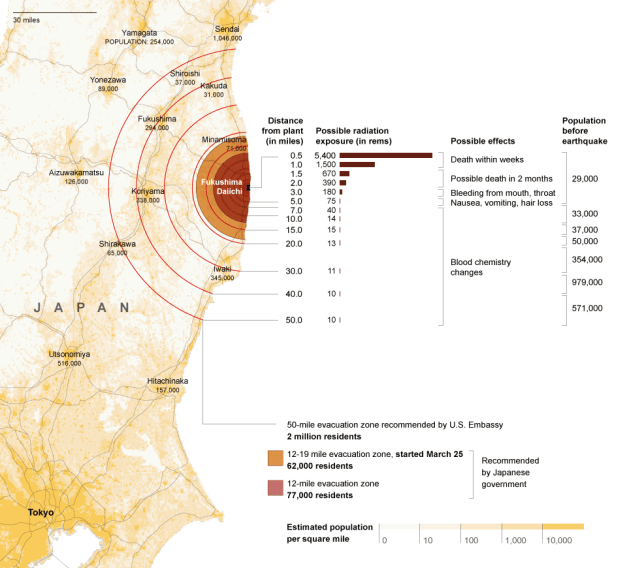
At the time on March 2011, the US Embassy in Tokyo had advised the Japanese Government to evacuate all the population within a 50-mile radius zone. To not avail as the Japanese Government chose to evacuate only within a 12 to 19-mile radius zone , evacuating in the end only 160,000 residents instead of the 2 millions residents as advised by the US Embassy.
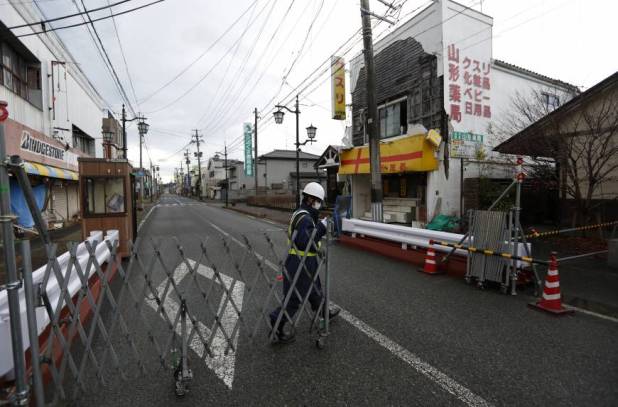
A gate is shut at the evacuation zone in Namie, Fukushima Prefecture, on Feb. 14. In such places, the scars are still obvious and many evacuees who fled are unwilling to return.
Fukushima evacuations were not worth the money, study says
LONDON – The costs of evacuating residents from near the Fukushima No. 1 plant and the dislocation the people experienced were greater than their expected gain in longevity, a British study has found.
The researchers found that at best evacuees could expect to live eight months longer, but that some might gain only one extra day of life. They said this does not warrant ripping people from their homes and communities.
The team of experts from four British universities developed a series of tests to examine the relocations after the Fukushima crisis and earlier Chernobyl disaster in 1986.
After a three-year study, the academics have concluded that Japan “overreacted” by relocating 160,000 residents of Fukushima Prefecture, even though radioactive material fell on more than 30,000 sq. km of territory.
“We judged that no one should have been relocated in Fukushima, and it could be argued this was a knee-jerk reaction,” said Philip Thomas, a professor of risk management at Bristol University. “It did more harm than good. An awful lot of disruption has been caused However, this is with hindsight and we are not blaming the authorities.”
The team used a wide range of economic and actuarial data, as well as information from the United Nations and the Japanese government.
In one test, an assessment of judgment value, the researchers calculated how many days of life expectancy were saved by relocating residents away from areas affected by radiation.
They compared this with the cost of relocation and how much this expenditure would impact the quality of people’s lives in the future.
From this information, they were able to work out the optimal or rational level of spending and make a judgment on the best measures to mitigate the effects of a nuclear accident.
Depending on how close people were to the radiation, the team calculated that the relocations added a period of between one day to 21 days to the evacuees’ lives.
But when this was compared with the vast amounts of money spent, the academics came to the conclusion that it was unjustified in all cases.
In some areas, they calculated that 150 times more money was being spent than was judged rational.
Thomas adds, the tests do not take into account the physical and psychological effects of relocating, which have been shown to have led to more than 1,000 deaths among elderly evacuees.
Other studies have also found that once people have lived away for a certain period of time it can become increasingly difficult to persuade them to return.
After Chernobyl, the world’s worst nuclear disaster, around 116,000 people were initially relocated away from the disaster zone.
Looking back on the incident, the team judged it was only worthwhile to relocate 31,000 people because they would have lost in excess of 8.7 months in life expectancy had they remained.
However, for the rest of the 116,000 people, it would have been a more rational decision to keep them where they were, given that their average loss of life was put at three months.
Four years later, a further 220,000 people were relocated from areas close to Chernobyl. Researchers found this unjustified.
Thomas says the loss in life expectancy following a nuclear accident has to be put into context alongside other threats all people face.
For example, it has been claimed that the average Londoner will lose about 4½ months in life expectancy due to high pollution levels.
Thomas concludes governments should carry out a more careful assessment before mounting a relocation operation of at least a year. A temporary evacuation could be a good idea while authorities work out the risk from radiation, he said.
In the future, Thomas would like to see more real-time information made available to the public on radiation levels in order to avoid hysteria and bad planning.
On a plus note, the team found that other remedial measures — decontaminating homes, deep ploughing of soil and bans on the sales of certain food products — were far more effective.
Thomas has already discussed his findings with colleagues at the University of Tokyo and he is keen that his findings can help better quantify the risks from radioactive leaks.
The project was sponsored by the Engineering and Physical Sciences Research Council, Britain’s main agency for funding research in engineering and the physical sciences. It was intended to give advice for nuclear planners both in Britain and India.
The research team comprised specialists from City University in London, Manchester University, the Open University and Warwick University.
March 15 Energy News

World:
¶ Brazil’s power sector regulator Aneel has authorized three wind energy plants, with a combined capacity of 60.1 MW, to start commercial operations. According to Brazil’s Ministry of Planning, the investment totalled more than BRL 284.7 million ($78.5 million, €70.7 million). [SeeNews Renewables]
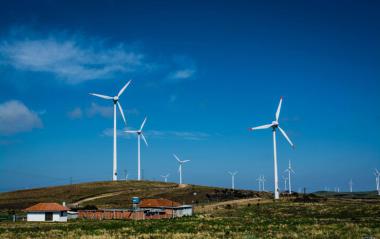 Brazilian wind farm. Author: Carla Wosniak.
License: Creative Commons, Attribution 2.0 Generic
¶ Climate laws will be tightened to cut carbon emissions effectively to zero, the UK’s government said. Under current law, emissions must be cut of by 80% by 2050, but ministers said it is clear the UK must not increase CO2 at all because the warming threat is so severe. [BBC]
¶ Uruguay went from having virtually no wind generation in 2007 to become a double world-record holder in less than a decade. By 2013, it was receiving the largest share of clean energy investment as a percentage of GDP…
View original post 461 more words
Dangerous Alpha Radiation Surface Contamination on Toshiba Shipment; Workers Burned at Toshiba Facility in South Carolina – Same Facility Separate Events

Westinghouse is now a Toshiba (Japan) subsidiary. It is 87% Toshiba owned; 10% Kazatomprom (Kazakhstan State owned), and 3% IHI (Japan) owned.
The first US NRC “event” apparently has to do with down-blending of [Obama’s beloved] HEU (highly enriched uranium) and LEU (low enriched uranium) recovery. Some of the containers for the radioactive material shipped from South Carolina to Tennessee had high levels of alpha radiation on the outside. The highest was 106 Bq (disintegrations, shots, per second) per 100 sq cm (i.e. 10 x 10 cm or 4 x 4 inches). Nuclear is lethal through its entire fuel chain. Any one of these shots can cause genetic damage, which may or may not be properly repaired, and which can thus lead to cancer or other diseases, which may sometimes even be inherited. Alpha emitters are particularly damaging and thus difficult to repair.
How much, if any, of this radioactive…
View original post 728 more words
March 14 Energy News
World:
¶ Sixteen US ships that participated in relief efforts after Japan’s nuclear disaster five years ago remain contaminated with low levels of radiation from the crippled Fukushima Daiichi nuclear power plant, top Navy officials told Stars and Stripes. A total of 25 ships took part in Operation Tomadachi. [Stripes Japan]
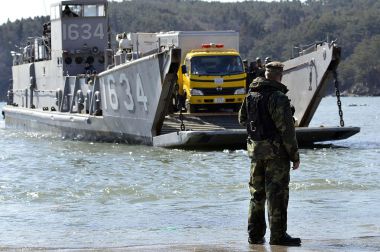 Operation Tomadachi delivering supplies. Photo by Lance Cpl. Mark Stroud. Public domain photo, Marine Corps. Wikimedia Commons.
¶ The recent years have seen the demand for smart microgrids surge to unprecedented levels. This spike in demand is attributable to the growing share of renewable energy in the global energy matrix. Transparency Market Research has issued a report on the global smart microgrid market. [Industry Today]
¶ Connective Energy Holdings Limited, of Donegal, Ireland, has announced they will create 90 jobs over the next two years by using anaerobic digesters to turn manure into bio-gas…
View original post 701 more words
As a Minister and Member of Parliament “I was Never Told the Truth by the Nuclear Industry”, Tony Benn (3 April 1925-14 March 2014)
Anthony Neil Wedgwood (Tony) Benn (3 April 1925 – 14 March 2014) was a Member of the British Parliament (MP) for 47 years between 1950 and 2001, and served as Minister of Technology (1966-1970), Secretary of State for Industry (1974-75) and for Energy (1975-79). https://en.wikipedia.org/wiki/Tony_Benn Thus, he was a Member of Parliament during the Windscale fire of 10 October 1957.
Tony Benn speaking in the British Parliament:
“The real reason why I want to contribute to the debate is because of the nuclear industry, for which I had responsibility for many years. Recent events at Sellafield confirm what I learned by experience; even as a Minister–let alone a Member of Parliament–I was never told the truth by the nuclear industry. For example, I found out about the fire at Windscale–now called Sellafield–only when I visited Tokyo. My officials had never told me about it. When I asked them why…
View original post 1,487 more words
Europe’s False Solutions for Ukraine’s Energy Woes
From Bankwatch.org: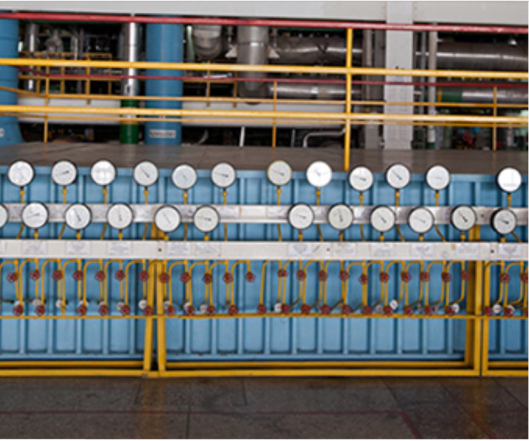
“Europe’s false solutions for Ukraine’s energy woes
Current EU support is not just a distraction from the energy path Ukraine needs to take, it also puts countless communities in Ukraine and abroad at risk.
by Iryna Holovko, Ukrainian energy campaigner
March 9, 2016
European decision makers had good intentions, but in their efforts to help ensure Ukraine’s energy security, especially in turbulent times like these, they have been continuously overlooking the far reaching implications of perpetuating the country’s dependence on outdated nuclear power.
Two years after the Euromaidan protest, the bond between Ukraine and the EU never seemed stronger, and recognising the poor state of the country’s nuclear power plants could not be more urgent.
The European Bank for Reconstruction and Development (EBRD) and Euratom – each extended EUR 300 million in loans for improving the safety of Ukraine’s 12 nuclear energy units – had also practically…
View original post 721 more words
Former Labour MP Tony Benn on how Britain Secretly Helped Israel Build Its Nuclear Arsenal
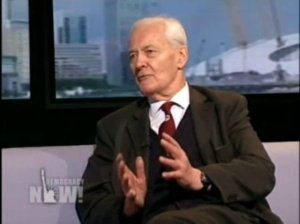
Interview starts at 10 min: http://youtu.be/_c5CAO8X5Fw
From DemocracyNow.org:
“FRIDAY, MARCH 10, 2006
Former Labour MP Tony Benn on how Britain Secretly Helped Israel Build Its Nuclear Arsenal
We have an extended conversation with Tony Benn, one of Britain’s most distinguished politicians and the longest serving MP in the history of the Labour party. Benn discusses the new revelations the British government helped Israel build the atom bomb. Benn also speaks about U.S. and U.K. relations, extraordinary rendition, Guantanamo Bay, torture, religion, and the state of the media. [includes rush transcript]
BBC News revealed Thursday the British government secretly supplied Israel with hundreds of chemical shipments in the 1960’s, despite fears the chemicals could be used to develop nuclear weapons. Analysts say the shipments, which included plutonium, helped speed up Israel’s acquisition of an atomic bomb. All told, the BBC reported the British chemicals could have been used to produce bombs…
View original post 6,425 more words
Japan, US, France to team up on Fukushima clean-up: official

TOKYO – The Japanese government will team up with experts in the United States and France to develop brand new technologies to collect melted fuel from crippled reactors at Fukushima, an official said Monday.
Scientists have long warned the technology required for the complex — and potentially dangerous — task does not yet exist, and would have to be invented.
Entombing the uranium rods in concrete and effectively abandoning the site — as was done after the meltdown at Chernobyl in 1986 — has been ruled out by the Japanese government as politically unacceptable, leaving innovation as the only possible solution.
Japan’s science and technology ministry said it would work with the US Energy Department and the French National Research Agency on the project — a key step towards eventual decommissioning, which is expected to begin in 2021.
“This is the first basic research led by the government designed to help decommission Fukushima Daiichi after TEPCO worked together with its partners overseas at the private level,” a ministry official said, referring to the operator of the plant.
Under the plan, the US side will help Japan develop equipment and technology to manage and dispose of highly-radioactive waste produced from the decommissioning work, the official said.
France will cooperate with Japan in developing remote-control technology, including robotic and image processing expertise that can withstand high-radiation environments, he said.
The Japanese government plans to finance the projects by spending part of its “Fukushima technology development budget” worth 3.0 billion yen ($26.4 million).
No matter what BBC says: Fukushima disaster is killing people
Chris Busby – 14th March 2016

IAEA marine experts and Japanese scientists collect water samples in coastal waters near the Fukushima Daiichi Nuclear Power Station
The BBC has been excelling itself in its deliberate understatement of the Fukushima nuclear catastrophe, writes Chris Busby. While calling in pseudo experts to say radiation is all but harmless, it’s ignoring the science that shows that the real health impacts of nuclear fallout are around 1,000 times worse than claimed.
I am so ashamed of the BBC. It seems, as an institution, to be supporting and promulgating an enormous lie about the health effects of radioactive pollution. And not providing any balanced scientific picture.
On the 5th Anniversary of the catastrophe we saw Prof Geraldine Thomas, the nuclear industry’s new public relations star, walk through the abandoned town of Ohkuma inside the Fukushima exclusion zone with BBC reporter Rupert Wingfield-Hayes.
She was described as “One of Britain’s leading experts on the health effects of radiation”. Thomas is of the opinion that there is no danger and the Japanese refugees can come back and live there in the ‘zone’. Her main concern was how untidy it all was: “left to rack and ruin”, she complained, sadly.
At one point Rupert pulled out his Geiger Counter and read the dose of 3 microSieverts per hour. “What does that mean”, he asked, “how much radiation would it give in a year to people who came back here?”
Thomas replied, “About an extra milliSievert a year which is not much considering you get 2mSv a year from natural background. The long term impact on your health would be absolutely nothing.”
Now anyone who has a calculator can easily multiply 3 microSieverts (3 x 10⁻⁶ Sv) by 24 hours and 365 days. The answer is 26 mSv (0.026Sv) not “about 1mSv” as the “leading expert on the health effects of radiation” told the dumbfounded viewers.
Any real expert would not have made such a stupid mistake. But this woman is not a real expert, her CV shows she has published almost nothing in the way of original research, so we must ask how it is the BBC come to take her seriously.
Those who hate nothing so much as the truth
This recalled the day the first reactor exploded in 2011. I was in London, and the BBC asked me to come into the studio and comment. Also there was a nuclear industry apologist, Dr Ian Fells. Like Gerry Thomas he was unconcerned about the radiation: the main problem for him was that the lifts would not work. People would have to climb stairs, he complained.
I said then on that first day that this was a serious accident like Chernobyl but he and all the stooges that followed him told the viewers that it was no problem, not like Chernobyl, hydrogen explosion, no breach of containment pressure vessels etc. Some months later, looking back, it is clear I was correct on every point, but I never was invited back to the BBC.
I visited Japan, took sophisticated measuring equipment, obtained vehicle air filters, spoke to the Japanese people and advised them to take Calcium tablets to block the Strontium-90. My vehicle air filter measurements showed clearly that large areas of north east Japan were seriously contaminated including Tokyo.
This was too much for the nuclear industry: I was attacked in the Guardian newspaper by pro-nuclear Pauline-converted George Monbiot in an attempt to destroy my credibility. One other attacker was Geraldine Thomas. What she said then was as madly incorrect then as what she is saying now. But the Guardian would not let me respond.
The important evidence for me in the recent BBC clip is the measurement of dose given by Rupert’s Geiger counter, 3microSieverts per hour (3μSv/h). Normal background in Japan (I know, I measured it there) is about 0.1μSv/h. So in terms of external radiation, Ruperts’s measurement gave 30 times normal background.
Fukushima: we have a very serious problem
Is this a problem for health? You bet it is. The question no-one asked is what is causing the excess dose? The answer is easy: radioactive contamination, principally of Caesium-137. On the basis of well-known physics relationships we can say that 3μSv/h at 1m above ground represents a surface contamination of about 900,000 Bq per square metre of Cs-137. That is, 900,000 disintegrations per second in one square metre of surface.
And note that they were standing on a tarmac road which appeared to be clean. And this is 5 years after the explosions. The material is everywhere, and it is in the form of dust particles which can be inhaled. Invisible sparkling fairy-dust that kills hang in the air above such measurements.
The particles are not just of Caesium-137. They contain other long lived radioactivity, Strontium-90, Plutonium 239, Uranium-235, Uranium 238, Radium-226, Polonium-210, Lead-210, Tritium, isotopes of Rhodium, Ruthenium, Iodine, Cerium, Cobalt 60, the list is long.
The UN definition of radioactively contaminated land is 37,000Bq / square metre, and so, on the basis of the measurement made by the BBC reporter, the town of Ohkuma in the Fukushima zone (and we assume everywhere else in the zone) is still, five years after the incident, more than 20 times the level where the UN would, and the Soviets did, step in and control the population.
But the Japanese government want to send the people back there. It is bribing them with money and housing assistance. It is saying, like Gerry Thomas, that there is no danger. And the BBC is giving this criminal misdirection a credible platform. The argument is based on the current radiation risk model, that of the International Commission on Radiological Protection the ICRP.
Last month, my German colleagues and I published a scientific paper in the peer reviewed journal Environmental Health and Toxicology. It uses real-world data from those exposed to the same substances that were released by Fukushima to show that the ICRP model is wrong by 1,000 times or more.
This is a game changing piece of research. But were we asked to appear on the BBC, or anywhere else? No. What do our findings and calculations suggest will have happened in the five years since the explosions and into the future? Let’s take a look at what has happened since 2011.
And this is only the beginning …
The reactors are still uncontrolled five years after the explosions and continue to release their radioactive contents to the environment despite all attempts to prevent this. Concerning the melted fuel, there is no way to assess the condition or specific whereabouts of the fuel though it is clearly out of the box and in the ground. Robots fail at the extremely high radiation levels found.
Ground water flowing through the plant is becoming contaminated and is being pumped into storage tanks for treatment. High radiation levels and debris have delayed the removal of spent fuel from numbers 1, 2 and 3 reactor buildings. TEPCO plans to remove debris from reactor 3 and this work has begun. Then they are hoping to remove the fuel rods out of reactors 1 and 2 by 2020 and the work on removing debris from these 2 reactors has not begun yet.
Much of the radioactivity goes into the sea, where it travels several hundreds of km. up and down the coast destroying sea life and contaminating intertidal sediment. The radionuclides bind to fine sediment and concentrate in river estuaries and tidal areas like Tokyo Bay.
Here the particles are resuspended and brought ashore to be inhaled by those living within 1km of the coast. From work done by my group for the Irish Government on the contaminated Irish Sea we know that this exposure will increase the rate of cancer in the coastal inhabitants by about 30%.
The releases have not been stopped despite huge amounts of work, thought and action. The treated water is still highly radioactive and cannot yet be released. An ice wall designed to stop the flow of water getting to the plant is still not operational and the Japanese Nuclear regulator still has not given the go-ahead.
‘Son of Fukushima’ waiting to happen
This may be wise because an environment report showed that use of the ground water caused rapid subsidence and can destabilise the structures of the reactors. That is a real problem on site with 3 heavy spent fuel pools still full and largely inaccessible. Collapse of the buildings would lead to coolant loss and a fire or even explosion releasing huge amounts of radioactivity.
So this is one nightmare scenario: ‘Son of Fukushima’. A solid wall at the port side may have slowed the water down but diverting the water may cause problems with the ground water pressure on site and thus also threaten subsidence. Space for storing the radioactive water is running out and it seems likely that this will have to be eventually spilled into the Pacific.
Only 10% of the plant has been cleaned up although there are 8,000 workers on site at any one time, mostly dealing with the contaminated water. Run-off from storms brings more contamination down the rivers from the mountains. There are millions of 1-ton container bags full of radioactive debris and other waste which has been collected in decontamination efforts outside the plant and many of these bags are only likely to last a handful of years before degrading and spilling their contents. Typhoons will spread this highly contaminated contents far and wide.
TEPCO are also burning waste from the plant in a single incinerator. Further afield, contamination efforts to clean up the homes and roads are hampered by the torrential rains that are increasing because of global warming; the rain is bringing large amounts of contaminated soil back into these areas as well as the contaminated leaves and pollen from the forest areas that TEPCO are unable to clean.
Far off the shore there are natural areas that act as nurseries for many species of sea life. It has been found that intertidal marine species such as anemones, sponges, crustaceans, worms and bivalves within 30 km of the damaged reactors have disappeared altogether because of the 300 tons of highly radioactive water a day flowing out of the plant into the sea.
This water contains large amounts of tritium, making it radioactive; the effects of tritium on the larval stages of marine invertebrates has been studied in the UK. It was found at the University of Plymouth that levels involving doses of less than 1mSv of tritium inhibited the development.
Going global
Radioactivity from Fukushima has now migrated across the Pacific and is appearing on the West Coast of the USA. The scientific community there, like Gerry Thomas, subscribe to the flawed ICRP model, and since the levels of Caesium-137 measured are low, (maybe 10Bq/cubic metre of sea water), they say that there will be no health effects. But like Thomas they are wrong.
The problem is that ‘dose’ cannot be used to assess risk from internal radioactive particles. Dose is an average over large masses of tissue: but cancer begins in a single cell or local community of cells and these particles from Fukushima cause massive local doses. This is why there have been countless web reports of marine mammals with patchy sores or localised tumours. The question of the ongoing effect of this Fukushima radioactivity on the Pacific biota far from Japan remains open.
The effects on wild creatures in Japan are clear and have been studied. There have been peer-reviewed reports of genetic damage in birds and in insects; a major scientist studying these genetic effects at Fukushima and in the Chernobyl affected areas also is Tim Mousseau.
But whilst he can study plants and animals, no-one can study humans. There is a kind of closure on such data, with the Japanese government controlling it. The government is more interested in getting Fukushima ready for the Olympics and is using financial and cultural pressure to move families back into contaminated zones.
Japan is also exporting radioactive produce, and is using trade agreements to bully countries into accepting these poisons on the basis of the ICRP model. I was in Korea a few months back as an expert witness in a radiation case involving high levels of thyroid cancer near their nuclear sites. I was told about Japan using international trade laws to force its contaminated foods on to the Koreans, who were measuring the radioactivity and sending the stuff back. So watch out for radioactive items from Japan.
So what’s the evidence?
Let’s look at the only real health data which has emerged to see if it gives any support to my original estimate of 400,000 extra cancers in the 200km radius. Prof Tsuda has recently published a paper in the peer reviewed literature identifying 116 thyroid cancers detected over three years by ultrasound scanning of 380,000 0-18 year olds.
The background rate is about 0.3 per 100,000 per year, so in three years we can expect 3.42 thyroid cancers. But 116 were found, an excess of about 112 cases. Geraldine says that these were all found because they looked: but Tsuda’s paper reports that an ultrasound study in Nagasaki (no exposures) found zero cases, and also an early ultrasound study also found zero cases. So Geraldine is wrong. The thyroid doses were reported to be about 10mSv. On the basis of the ICRP model, that gives an error of about 2,000 times.
From the results of our new genetic paper we can safely predict a 100% increase in congenital malformations in the population up to 200km radius. In an advanced technological country like Japan these will be picked up early by ultrasound and aborted, so we will not actually see them, even if there were data we could trust.
What we will see is a fall in the birth rate and increase in the death rate. We know what has been happening and what will happen; we have seen it before in Chernobyl. And just like Chernobyl, the (western) authorities are influenced by or take their lead from the nuclear industry: the ICRP and the International Atomic Energy Agency, (IAEA) which since 1959 has taken over from the World Health Organisation as the responsible authority for radiation and health (Yes, really!).
They keep the lid on the truth using stupid individuals like Geraldine Thomas and, by analogy with New Labour: New BBC. Increasingly I could say ‘New Britain’ as opposed to the Great Britain of my childhood, a country I was proud of where you could trust the BBC. I wonder how the reporters like Rupert can live with themselves presenting these lies.
Fukushima is far from being over, the deaths have only just begun.
The BBC report: bbc.com/news/world-asia-35761141
The study: ‘Genetic Radiation Risks – A Neglected Topic in the Low Dose Dabate‘ by Busby C, Schmitz-Feuerhake I, Pflugbeil S is published in Environmental Health and Toxicology.
Chris Busby is an expert on the health effects of ionizing radiation. He qualified in Chemical Physics at the Universities of London and Kent, and worked on the molecular physical chemistry of living cells for the Wellcome Foundation. Professor Busby is the Scientific Secretary of the European Committee on Radiation Risk based in Brussels and has edited many of its publications since its founding in 1998. He has held a number of honorary University positions, including Visiting Professor in the Faculty of Health of the University of Ulster. Busby currently lives in Riga, Latvia. See also: chrisbusbyexposed.org, greenaudit.org and llrc.org.
Is India’s Government Hiding A Serious Accident Underway In Gujarat?
India’s Former Nuclear Regulator Says, Govt Might Be  , CounterCurrents By Kumar Sundaram 13 March, 2016 Indiaresists.com The retired chief of India’s nuclear regulator, Dr. A Gopalakrishnan has sent out an urgent note in which he has cautioned that a ‘loss of coolant accident(LOCA)’ might be underway in Gujarat’s Kakrapar Nuclear Power Station(KAPS). A LOCA accidents is the most serious accident that can happen in nuclear plants and it might lead to the meltdown of the reactor fuel core.
The same reactor had a major accident in 1994 when floodwaters drowned Kakrapar. The floodgates meant to release excess water could not be opened and the water kept increasing–which could lead to a major accident–but it was prevented with the efforts of local engineers. Mr. Manoj Mishra, a worker in the power station then who blew whistle on that accident was terminated by the NPCIL. He was denied justice even by the Supreme Court in India which bought the NPCIL’s argument that he cannot be a whistle-blower as he did not have technical degrees. Mr. Mishra had years of experience in the reactor and he was a strong leader of the workers’ union.
Kakrapar is situated not very far from the Vansda-Bharuch earthquake faultline running through Gujarat, which has experienced several major earthquakes.
Exactly on the 5th anniversary of Fukushima, a leak has been reported in the Unit-1 of the Kakrapar Nuclear Power Station near Surat in Gujarat.
Here is the note by Dr. Gopalakrishnan:
The Kakrapar Unit-I nuclear reactor in Gujarat is undergoing a moderately large leakage of heavy water from its Primary Heat Transport (PHT) system since 9.00 AM on March 11,2016. From the very limited information released by the Nuclear Power Corporation of India Limited (NPCIL) and the Atomic Energy Regulatory Board (AERB) of the government , as well as from the conversations I had with press people who have been in touch with nuclear officials, few inferences can be drawn.
Till 7.00 PM on March 12,2016 , the DAE officials have no clue as to where exactly the PHT leak is located and how big is the rate of irradiated heavy water that is leaking into the reactor containment . However, some reports indicate that the containment has been vented to the atmosphere at least once , if not more times , which I suspect indicates a tendency for pressure build up in that closed space due to release of hot heavy water and steam into the containment housing . If this is true, the leak is not small , but moderately large , and still continuing. No one confirms that any one has entered the containment (in protective clothing) for a quick physical assessment of the situation , perhaps it is not safe to do so because of the high radiationfields inside . When NPCIL officials state that the reactor cooling is maintained , I believe what they may be doing is to allow the heavy water or light water stored in the emergency cooling tanks to run once-through the system and continue to pour through the leak into the containment floor through the break .
All this points to the likelihood that what Kakrapar Unit-1 is undergoing is a small Loss-of-Coolant Accident (LOCA) in progress. It is most likely that one or more pressure tubes (PT) in the reactor (which contain the fuel bundles) have cracked open , leaking hot primary system heavy-water coolant into the containment housing . ……….
. It may be possible that , having built more than 20 PHWRs , NPCIL and AERB in recent years have become overconfident and relaxed their strict adherence to this Aging Management Program , which might have been the reason for the current accident.
Let me caution the reader that the above conjecture is based on bits and pieces of reliable and not so reliable information gathered from different people close to the accident details and in positions of authority. Future detailed evaluation may or may not prove my entire set of conclusions or part of them to be not well-founded. But , technical experts are compelled to put out such conjectures because of the total lack of transparency of the Indian cilvilian nuclear power sector and the atomic energy commission (AEC) , the Dept. of Atomic Energy (DAE) , the NPCIL and the AERB . Public have a need to know and , therefore , the AEC and its sub-ordinate organizations need to promptly release status reports on the progressing safety incident which could affect their lives , to alleviate their concerns and anxieties . It is a series of such lapses in communication over the years which has built up the ever-increasing trust deficit in the DAE system among the general public. All future plans for expanding the civilian nuclear power sector should be put on hold until a truly independent nuclear safety regulator is put in place , who is not controlled by the AEC or the Prime Minister’s Office (PMO) , who will then be answerable to openly communicating with the public on all civilian nuclear power matters.
Kumar Sundaram is a senior researcher with Coalition for Nuclear Disarmament and Peace (CNDP) and Editor of DiaNUke.org http://www.countercurrents.org/sundaram130316.htm
Nuclear propagandist Prof Geraldine Thomas: comfortable , but incorrect, spin on Fukushima
Is this a problem for human health? You bet it is. The question no-one asked is what is causing the excess dose? The answer is easy: radioactive contamination, principally of Caesium-137. On the basis of well-known physics relationships we can say that 3Sv/h at 1m above ground represents a surface contamination of about 900,000Bq per square metre of Cs-137. That is, 900,000 disintegrations per second in one square metre of surface: and note that they were standing on a tarmac road which appeared to be clean. And this is 5 years after the explosions. The material is everywhere, and it is in the form of dust particles which can be inhaled; invisible sparkling fairy-dust that kills hang in the air above such measurements.
The particles are not just of Caesium-137. They contain other long lived radioactivity, Strontium-90, Plutonium 239, Uranium-235, Uranium 238, Radium-226, Polonium-210, Lead-210, Tritium, isotopes of Rhodium, Ruthenium, Iodine, Cerium, Cobalt 60. The list is long.
the Japanese government wants to send the people back there. It is bribing them with money and housing assistance. It is saying, like Gerry Thomas, there is no danger. And the BBC is giving this misdirection a credible platform.
They keep the lid on the truth using ill-informed individuals like Geraldine Thomas.
Fukushima is far from being over, and the deaths have only just begun.
Is Fukushima’s nuclear nightmare over? Don’t count on it https://www.rt.com/op-edge/335362-fukushima-nuclear-japan-bbc/ Chris Busby 12 Mar 16
 On the 5th Anniversary of the catastrophe, Prof Geraldine Thomas, the nuclear industry’s new public relations star, walked through the abandoned town of Ohkuma inside the Fukushima exclusion zone with BBC reporter Rupert Wingfield-Hayes.
Thomas was described as “one of Britain’s leading experts on the health effects of radiation”. She is of the opinion that there is no danger and the Japanese refugees can come back and live there in the “zone”. Her main concern seemed to be how untidy it all was: “Left to rack and ruin,” she complained, sadly.
At one point, Rupert pulled out his Geiger counter and read the dose: 3 microSieverts per hour. “How much radiation would it give in a year to people who came back here,” he asked. Thomas replied: “About an extra milliSievert a year, which is not much considering you get 2mSv a year from natural background”.
“The long term impact on your health would be absolutely nothing.”
Now anyone with a calculator can easily multiply 3 microSieverts (3 x 10⁻⁶ Sv) by 24 hours and 365 days. The answer comes out to be 26 mSv (0.026Sv), not “about 1mSv” as the “leading expert on the health effects of radiation” reported.
I must personally ask if Gerry Thomas is a reliable expert; her CV shows she has published almost nothing in the way of original research, so we must ask how it is the BBC has taken her seriously. Continue reading
1 This Month

petition to oppose the rapid increase of space-military industry threatening Jeju Island and the region.
[Petition by April 19th (KST)] Stop the joint military-Hanwha Systems-Jeju Provincial Government Sea Launch!

Chernobyl: The Lost Tapes – A good documentary on Chernobyl on SBS available On Demand for the next 3 weeks– https://www.sbs.com.au/ondemand/tv-program/chernobyl-the-lost-tapes/2352741955560

of the week–London Campaign for Nuclear Disarmament


Tell the Ukrainian Government to Drop Prosecution of Peace Activist Yurii Sheliazhenko
To see nuclear-related stories in greater depth and intensity – go to https://nuclearinformation.wordpress.com
-
Archives
- April 2026 (194)
- March 2026 (251)
- February 2026 (268)
- January 2026 (308)
- December 2025 (358)
- November 2025 (359)
- October 2025 (376)
- September 2025 (257)
- August 2025 (319)
- July 2025 (230)
- June 2025 (348)
- May 2025 (261)
-
Categories
- 1
- 1 NUCLEAR ISSUES
- business and costs
- climate change
- culture and arts
- ENERGY
- environment
- health
- history
- indigenous issues
- Legal
- marketing of nuclear
- media
- opposition to nuclear
- PERSONAL STORIES
- politics
- politics international
- Religion and ethics
- safety
- secrets,lies and civil liberties
- spinbuster
- technology
- Uranium
- wastes
- weapons and war
- Women
- 2 WORLD
- ACTION
- AFRICA
- Atrocities
- AUSTRALIA
- Christina's notes
- Christina's themes
- culture and arts
- Events
- Fuk 2022
- Fuk 2023
- Fukushima 2017
- Fukushima 2018
- fukushima 2019
- Fukushima 2020
- Fukushima 2021
- general
- global warming
- Humour (God we need it)
- Nuclear
- RARE EARTHS
- Reference
- resources – print
- Resources -audiovicual
- Weekly Newsletter
- World
- World Nuclear
- YouTube
-
RSS
Entries RSS
Comments RSS
 nuclear-news
