A South Australian ponders on transporting high level wastes across the globe
 Response to the Tentative Findings of the SA Nuclear Fuel Cycle Royal Commission A Submission by Paul Langley Nuclear Exhaust 16 Mar 16 “……Transport of HLNW from around the world to a SA HLNW geologic repository
The Royal Commission apparently assumes that the movements of many hundreds of thousands of tonnes of spent nuclear fuel from many countries around the world to the Gawler Craton will be low risk, no problems and perfectly safe. As contradictory as those stances are. I do not accept that position of default safety. Further I do not accept that the unloading of the HLNW will be perfectly safe. I do not accept that road transport from port to repository site will be perfectly safe, even on a dedicated purpose built road.
I would recommend that Super Freighters laden with the contents of countless reactor cores not sail down the Somali coast nor in the waters to the south of Thailand for fear of pirates. They should avoid man made Islands in the South China Sea. I suppose the ships will be guarded by 6 English policemen each with two revolvers between them. Rather than half the Pacific Fleet they would actually warrant. If they ever get to leave their home ports. What is the Somali coast going to be like in 40 years? Peaceful or short of rad weapons…….” https://nuclearexhaust.wordpress.com/2016/03/15/response-to-the-tentative-findings-of-the-sa-nuclear-fuel-cycle-royal-commission/
India’s massive bet on solar power is paying off
 India’s big move into solar is already paying off CNN Money by Huizhong Wu @CNNTech March 7, 2016: India’s massive bet on solar power is paying off far earlier than anticipated.
The price of solar power has plummeted in recent months to levels rivaling that of coal, positioning the renewable source as a viable mainstream option in a country where 300 million people live without electricity.
And that could turn out to be a conservative forecast. At a recent government auction, the winning bidder offered to sell electricity generated by a project in sunny Rajasthan for 4.34 rupees (6 cents) per kilowatt hour, roughly the same price as some recent coal projects.
“Solar is very competitive,” said Vinay Rustagi of renewable energy consultancy Bridge to India. “It’s a huge relief for countries like India which want to get more and more solar power.”
Prime Minister Narendra Modi has made access to electricity a top priority, and has set the goal of making 24-hour power available to all 1.3 billion Indians. Currently, even India’s biggest cities suffer from frequent power outages…..http://money.cnn.com/2016/03/07/technology/india-solar-energy-coal/index.html
Response to South Australia Nuclear Fuel Chain Royal Commission’s Tentative Findings
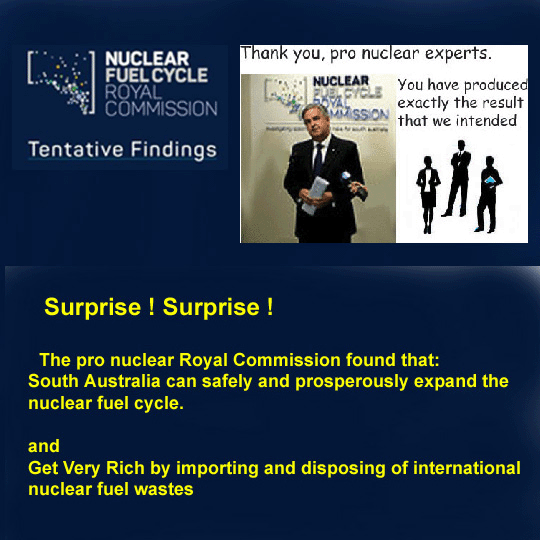
ABOUT SUBMISSIONS in response to The Tentative Findings of the South Australian Nuclear Fuel Chain Royal Commission, Noel Wauchope 16 Mar 16
Today I take the unusual step of publishing several extracts from one submission. The Royal Commission has allowed very little time for people to send in submissions. So – few are available to me right now.
BUT – Paul Langley of South Australia has prepared a submission. And it is a beauty! Why? Because not only does it pack a punch, but, equally important, Langley provides a wealth of information, facts, figures, and reference sources – https://nuclearexhaust.wordpress.com/2016/03/15/response-to-the-tentative-findings-of-the-sa-nuclear-fuel-cycle-royal-commission/
Sad to mutilate such a strong and lengthy submission, but I have done so on this website. So there are 5 extracts from the submission, on today’s page. If you have time, go to the original. If you don’t have time, at least see what Langley writes about Transport of High Level Nuclear Waste, Gawler Crater, The Law and the Profits, Gaining Public Trust, AN ALTERNATIVE to nuclear industry
The workers of the Fukushima nuclear clean-up
Fukushima Keeps Fighting Radioactive Tide 5 Years After Disaster, NYT By JONATHAN SOBLE MARCH 10, 2016 TOKYO — Of the thousands of workers who have answered the help-wanted ads at Fukushima Daiichi, the ruined and radioactive nuclear power plant in northeastern Japan, the part-time lettuce farmer and occasional comic-book artist Kazuto Tatsuta must be among the least likely.
“I needed a job,” Mr. Tatsuta, 51, recalled of his decision in 2012 to accept work at the site of one of the world’s worst nuclear accidents.
His duties included welding broken water pipes and inspecting remote-controlled robots that survey radioactive hot spots. And his comic strips, once populated with baseball players and gangsters, now tell stories of middle-aged, blue-collar men like himself who do the grunt work at Fukushima, some of whom find a sense of purpose and belonging they lacked in the outside world.
“It’s secure. You’re not going to get laid off there,” Mr. Tatsuta said. “But you’re also working for a goal.”
Five years after a powerful earthquake and tsunami struck, causing three reactors at Fukushima to melt down, that goal is the focus of a colossal effort at once precarious and routine. A veneer of stability at the plant masks a grueling, day-to-day battle to contain hazardous radiation, which involves a small army of workers, complex technical challenges and vexing safety trade-offs.
Fukushima has become a place where employees arrive on company shuttle buses and shop at their own on-site convenience store, but where they struggle to control radiation-contaminated water and must release it into the sea. Many of the most difficult and dangerous cleanup tasks still lie ahead, and crucial decisions remain unsettled………
The duration of the cleanup also creates the risk of labor shortages, he said, especially in jobs requiring special skills. Japan’s population is shrinking and, with the future of nuclear power uncertain, many young people are unwilling to stake careers on the industry.
For now, Fukushima is bustling with about 7,000 workers, much more than before the disaster and twice as many as two years ago. The town of Iwaki to the south has become a kind of workers’ village. At dawn, vans and buses line up to ferry workers to the plant via staging areas where they don protective white Tyvek suits, radiation monitors and gas masks.
“You think of it as totally normal work,” said Mr. Tatsuta, who asked to be identified only by his pen name to avoid being blacklisted by the plant’s owner, Tokyo Electric Power Company……….
For workers at the site, radiation is a constant enemy — though many see it more as a threat to their livelihoods than their lives. Government regulations forbid cleanup workers to be exposed to too much radiation, and when they hit the limits, they risk being laid off or reassigned to lower-paying jobs.
“If you go over the radiation limits, you can’t work,” Mr. Tatsuta said. “You’re always calculating how to keep the dose low.”
The temptation to cheat can be strong, for both workers and their managers. A government examination of Tokyo Electric’s safety practices in 2013 found that it had underreported the radiation exposure of a third of the workers whose records were reviewed. The company says it has since tightened reporting procedures……..http://www.nytimes.com/2016/03/11/world/asia/japan-fukushima-nuclear-disaster.html?_r=0
Bill Gates enjoys spruiking his plutonium dream
Bill Gates’ Nuclear Pipe Dream: Convert Depleted Uranium to Plutonium to Power Earth for Centuries, Truth Out Tuesday, 15 March 2016 By Josh Cunnings and Emerson Urry, EnviroNews | Video Report Voice of Bill Gates –-“……… Excerpt #1: There was a concept a long time ago that you would do a different type of reactor called a “fast reactor,” that would make a bunch of another element called plutonium, and then you would pull that out, and then you would burn that. That’s called “breeding” in a fast reactor. That is bad because plutonium is nuclear weapons material. It’s messy. The processing you have to get through is not only environmentally difficultly, it’s extremely expensive.
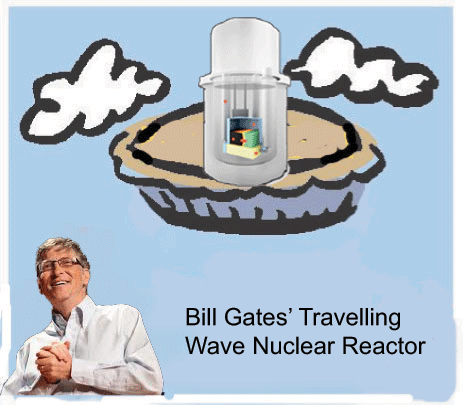 Cunnings: The man considered by many to be supposedly a humanitarian trailblazer when it comes to combatting disease, has a plan to fast-breed the mountainous heaps of depleted uranium at Paducah into plutonium — one of the most dangerous and disease-causing substance on the face of the planet. Then in turn, this plutonium would be used to power what would be the so-called new fourth-generation nuclear power plants. Let’s listen to Gates articulate his plutonium scheme.
Voice of Bill Gates — Excerpt #2: The concept of this so-called “TerraPower reactor” is that you, in the same reactor, you both burn and breed. So, instead of making plutonium and then extracting it, we take uranium — the 99.3 percent that you normally don’t do anything with — we convert that, and we burn it.
[Editor’s Note: Bill Gates is the current Chairman of the Board of TerraPower — a Washington-based nuclear power technology company.]
Cunnings: Now get this, only 60 seconds after Gates acknowledges the tremendous problem of bringing more plutonium into this world, he turns around and makes a joke about it to a crowd filled with university students from nuclear programs — all this, only a few months after the catastrophic triple melt-through at Fukushima Daiichi.
Bill Gates — Excerpt #3: Our flame is taking the normal depleted uranium — the 99.3 percent that’s cheap as heck, and there’s a pile of it sitting in Paducah, Kentucky that’s enough to power the United States for hundreds and hundreds of years. You’re taking that and you are converting it to plutonium (humorously under his breath) — and then you’re burning that.
Cunnings: Oh yes, Mr. Gates seems to have a little love affair going on with plutonium — and the notion is that we need nuclear power to save ourselves from climate change.
Bill Gates — Excerpt #4: You could go nuts!
Wall Street Journal Interviewer Alan Murray: If everything goes perfectly?
Gates: Absolutely.
Murray: How often does everything go perfectly?
Gates: In nuclear? Ah, well, ya’ know… If you ignore… (laughter) No, no. Come on. If you ignore 1979 [Three Mile Island], and 1986 [Chernobyl], and 2011 [Fukushima], come on — we’ve had a good century (laughter). No seriously. I mean, in terms of raw figures, you know, coal mining, natural gas … More people die, I mean … It wasn’t far from here a natural gas pipe blew up and incinerated people.
Bill Gates Excerpt #5: So we can simulate Richter-10 earthquakes. We simulate 70-foot waves coming into these things. Very cool. We basically say no human should ever be required to do anything, because if you judge by Chernobyl and Fukushima, the human element is not on your side.
Bill Gates Excerpt #6: We have, you know, total fail-safe … Any reactor that a human has to do something … that’s a little scary.
Bill Gates Excerpt #7: So, you’ve got to design something that humans just don’t have to be involved in.
Bill Gates Excerpt #8: I love nuclear. It does this radiation thing that’s tricky (laughter). But they’re good solutions. You know, it was interesting; recently, in Connecticut this natural gas plant blew up 11 guys. It just blew them up.
Murray: But you are personally investing in nuclear?
Gates: Right………” http://www.truth-out.org/news/item/35229-bill-gates-nuclear-pipe-dream-convert-mountains-of-depleted-uranium-to-plutonium-to-power-earth-for-centuries
Court hearing – clash between German Govt and nuclear utilities
German utilities, government clash at nuclear court hearing Reuters 14 Mar 16
*Gov’t confident it will win the case -Minister
* Utilities could claim as much as 19 bln euros
* Final decision to take several months (Recasts, adds comments from RWE, Minister, graphic)
By Christoph Steitz and Tom Käckenhoff KARLSRUHE, Germany, German power firms and government members clashed at a court hearing over the country’s controversial decision to shut down all nuclear plants by 2022, a lawsuit that could allow utilities to claim 19 billion euros ($21 billion) in damages.
In a case that pits a struggling energy industry against the government, Germany’s Constitutional Court will examine the arguments of E.ON, RWE and Vattenfall , who want to be compensated for the closure………http://uk.reuters.com/article/germany-utilities-nuclear-idUKL5N16N2G7
Fukushima – too toxic for humans AND for robots
Fukushima’s ground zero: No place for man or robot BY AARON SHELDRICK AND MINAMI FUNAKOSHI , Reuters, Mar 11, 2016 The robots sent in to find highly radioactive fuel at Fukushima’s nuclear reactors have “died”; a subterranean “ice wall” around the crippled plant meant to stop groundwater from becoming contaminated has yet to be finished. And authorities still don’t know how to dispose of highly radioactive water stored in an ever mounting number of tanks around the site……
Today, the radiation at the Fukushima plant is still so powerful it has proven impossible to get into its bowels to find and remove the extremely dangerous blobs of melted fuel rods, weighing hundreds of tonnes. Five robots sent into the reactors have failed to return.
The plant’s operator, Tokyo Electric Power Co (Tepco) 9501.t, has made some progress, such as removing hundreds of spent fuel roads in one damaged building. But the technology needed to establish the location of the melted fuel rods in the other three reactors at the plant has not been developed.
“It is extremely difficult to access the inside of the nuclear plant,” Naohiro Masuda, Tepco’s head of decommissioning said in an interview. “The biggest obstacle is the radiation.”
The fuel rods melted through their containment vessels in the reactors, and no one knows exactly where they are now. This part of the plant is so dangerous to humans, Tepco has been developing robots, which can swim under water and negotiate obstacles in damaged tunnels and piping to search for the melted fuel rods.
But as soon as they get close to the reactors, the radiation destroys their wiring and renders them useless, causing long delays, Masuda said.
Each robot has to be custom-built for each building.“It takes two years to develop a single-function robot,” Masuda said. ………
ICE WALL
Tepco is building the world’s biggest ice wall to keep groundwater from flowing into the basements of the damaged reactors and getting contaminated.
First suggested in 2013 and strongly backed by the government, the wall was completed in February, after months of delays and questions surrounding its effectiveness. Later this year, Tepco plans to pump water into the wall – which looks a bit like the piping behind a refrigerator – to start the freezing process.
Stopping the ground water intrusion into the plant is critical, said Arnie Gundersen, a former nuclear engineer………..Reporting by Aaron Sheldrick and Minami Funakoshi. Editing by Bill Tarrant http://www.reuters.com/article/us-japan-disaster-decommissioning-idUSKCN0WB2X5
Plutonium and ” fourth generation nuclear power”
Bill Gates’ Nuclear Pipe Dream: Convert Depleted Uranium to Plutonium to Power Earth for Centuries, Truth Out Tuesday, 15 March 2016 By Josh Cunnings and Emerson Urry, EnviroNews | Video Report Cunnings: “………..EnviroNews Editor-in-Chief Emerson Urry chatted with the esteemed nuclear industry expert and whistleblower Arnie Gundersen to explore whether Gates’ plan is a good idea or not.
 Emerson Urry: Let’s go back to Bill Gates again, [and] the fourth generation nuclear power. I’ve heard him out there speaking about this, and essentially his ambition to, let’s say, convert Paducah, Kentucky [to plutonium]. What can you tell us about Paducah, Kentucky? We understand it went bankrupt a couple years back, and I think there is quite a bit of radioactive material still there. We’ve heard at one point in time it was also one of the world’s largest greenhouse gas emitters from the Freon — not to mention having four allocated coal-fired power plants. What can you tell us about Paducah, Kentucky? What does the situation on the ground look like there, and how do you think they will deal with all that?
Arnie Gundersen: Paducah didn’t have centrifuges, it had gaseous diffusion, and there’s no need for the plant anymore, so the plant has to be decommissioned and destroyed. What’s happened is, the way they shut the plant down was, to be nice, sub-optimal. And what they allowed it to do was for all that uranium to cake inside the pipes. So, had they done it in a more orderly fashion, the plant could have been much cleaner when they went to shut it down — but they didn’t. So, the Paducah site is a very expensive cleanup that is going to take 20 or 30 years to decontaminate. You know, it’s like all of these bomb legacy sites — Hanford in Washington State…
Urry: … that has the plutonium leak in AY-102 correct? Which has that been ratcheted down? Have they been able to ratchet down AY-102?
Gundersen: No. Hanford is going to take 70 years and cost 110 billion dollars to clean up. So, here we are paying over half of a century for the legacy of building bombs for five years in 1940. And so, Paducah is another one of those sites. It was built to enrich uranium. Why did we do that? Because we had a bomb program. And now we’re stuck with these huge costs that are underfunded or unfunded by Congress. That plant is going to sit there for 30 years. It will create a lot of employment for a lot of people knocking it down, but it also is highly radioactive, and it’s got to be done so cautiously, and it’s a really difficult problem.
Cunnings: There’s no known disintegration of plutonium small enough that doesn’t possess the ability to cause cancer. To be clear, there is no safe amount to be exposed to whatsoever.
Plutonium, though a naturally occurring element was virtually non-existent on planet earth before the dawn of the nuclear age. Now, each of the roughly 400 uranium-powered nuclear reactors in the world create approximately 500 pounds of plutonium each year — or enough to create about 100 nuclear warheads each.
Coming from a “humanitarian” concerned with curing diseases, the notion that plutonium is the way to save ourselves from a runaway climate catastrophe seems the epitome of oxymoronic — utterly and woefully contradictory. But stay tuned for more on that topic, as in episode 14 of this series we examine whether or not we really need nuclear to solve the climate quandary.
But, in the meanwhile, let’s just say that Bill Gates’ nuclear ambitions go beyond mere ideas. He actually possesses financial holdings in one very dangerous situation indeed — a situation that is presently causing residents around St. Louis, Missouri to live under an all-out nuclear nightmare. And that scenario will be the topic of discussion in the next episode of our short series.
So please, tune in tomorrow for part three, where we explore the scary situation at hand in the Westlake Landfill in St. Louis, Missouri. Signing off for now, this is Josh Cunnings…… http://www.truth-out.org/news/item/35229-bill-gates-nuclear-pipe-dream-convert-mountains-of-depleted-uranium-to-plutonium-to-power-earth-for-centuries
Japan to work with France and USA on new technologies for decommissioning Fukushima nuclear station wreck
France, Japan and United States to work together on Fukushima decommissioning http://enformable.com/2016/03/france-japan-united-states-work-together-fukushima-decommissioning/ The Japanese government has decided to work with the United States and France to develop new technologies to help operators decommission the Fukushima Daiichi nuclear power plant.
The Science and Technology Ministry of Japan will work together with the French National Research Agency and the United States Department of Energy.
The United States will work with Japan to develop new technologies to deal with the incredible amounts of radioactive waste being generated by decommissioning and decontamination activities.
France will help develop new robotic and remote-control equipment that will survive the extreme levels of radiation in the crippled reactor buildings.
The agreement between the three nations will also enhance the cooperation between governments.
Climate action a winner for USA with clean energy and transport policies
Clean energy is win-win for the US, Climate News Network, March 13, 2016, by Tim Radford Simply implementing its Paris climate conference commitments on reducing greenhouse gas emissions could save the US billions of dollars – and save hundreds of thousands of lives.
LONDON, 13 March, 2015 − Scientists have worked out how the US could save as many as 300,000 lives by 2030, and get a tenfold return on its investments at the same time.
It’s simple. All the nation has to do is what it promised to do at the Paris climate conference last December − launch clean energy and transport policies, reduce greenhouse gas emissions by two-thirds or more, and pursue the international goal of keeping global warming to below 2°C.
Drew Shindell, professor of climate sciences at Duke University, North Carolina, and colleagues report in Nature Climate Change that the climate policies agreed by 195 nations at the latest UN summit on climate change deliver a winning scenario for the most powerful nation on Earth.
If the US pursued the switch to electric cars and renewable energy, hundreds of thousands of premature deaths could be prevented − not just by containing global warming and limiting the extent of climate change, but by the consequent reduction in soot, aerosols and ozone, all of which are pollutants with consequences for health.
Implementation costs
And although such policies would cost considerable sums to implement, the money saved in the long run would exceed expenditure by between fivefold and tenfold. Even in the short term, benefits of up to $250 billion a year are likely to exceed implementation costs.
“Achieving the benefits, however, would require both larger and broader emissions reductions than those in current legislation or regulations,” the scientists warn………..
The clean energy policies would prevent 175,000 premature deaths by 2030, with 22,000 fewer annually thereafter. Clean transport policies could prevent 120,000 premature deaths by the same year, and about 14,000 annually thereafter.
Calculations like these are based on a wide range of assumptions, and so are the potential rewards. Near-term national benefits could be anything from $140 billion a year to $1,050bn by 2030, but the Duke scientists settle on a likely figure of $250bn. Altogether, by 2030, the US would have saved $1,200bn under their proposals.
But if other countries do the same thing, the benefits would begin to multiply with the decades. Those benefits, the scientists say, would roughly quintuple, and could be 10 times larger than implementation costs.
“The US has pledged to markedly reduce emissions that cause warming, but has left many details to be determined later,” the scientists say − which is why they constructed their own emissions scenarios………
The proposals sound like a win-win offer. But the Duke scientists are aware of the problems. Their suggestions go twice as far as policies yet to be implemented in the US Clean Power Plan, and the costs of implementation would not be fairly spread.
They end on a note of realism: “Most benefits would accrue to society at large, whereas businesses that could face economic losses would not directly benefit from decreased emissions.
“These misaligned economic incentives between the welfare of individual companies and that of society at large create substantial implementation barriers.” − Climate News Network http://climatenewsnetwork.net/clean-energy-is-win-win-for-the-us/
World losing the battle against climate change: record-breaking heat
 Record-breaking heat shows world ‘losing battle’ against climate change, ABC News 15 Mar 16 Alan Finkel tells Q&A Australia’s chief scientist has warned the planet is “losing the battle” against climate change, after new data showed February set a “completely unprecedented” record for the hottest month since global records began.
Meteorologist Dr Jeff Masters said although the absolute hottest month on record was July 2015, July and August tend to be 4C hotter than January and February because the large land mass in the Northern Hemisphere cools the planet during the northern winter.
Writing on the Weather Underground blog, Dr Masters and his co-author Bob Henson said February was exceptional because it was 1.35C hotter than the long-term average, while July was only 0.75C hotter than average.
“Perhaps even more remarkable is that February 2015 crushed the previous February record [set during the peak of the 1997-98 El Nino] by a massive 0.47C,” they wrote…….http://www.abc.net.au/news/2016-03-14/february-smashed-all-time-global-heat-record/7246356
India may have to shut down two uneconomic reactors at Tarapur
 Oldest Indian Nuclear Reactors Near Mumbai May Be Shut Down, Bloomberg, Rajesh Kumar Singh, 14 Mar 16
-
Tarapur 1 & 2 unprofitable, undergoing frequent maintenance
-
Nuclear Power Corp. may seek higher tariff from regulator
-
India may shut two of its oldest reactors almost five decades after they went into operation as power tariffs aren’t keeping pace with maintenance costs, according to Sekhar Basu, secretary at the Department of Atomic Energy.
The first two reactors at Tarapur, about 100 kilometers (62 miles) from Mumbai at India’s western coast, suffer frequent maintenance shutdowns that make them unprofitable, Basu said in a phone interview. They earn about 0.89 rupees (1 cent) for every kilowatt hour of electricity produced, which isn’t enough to sustain operations. Nuclear plants in India received an average tariff of 2.78 rupees per kilowatt hour in the year ended March 2015, according to the Department of Atomic Energy.
“We are pouring in money into the reactors rather than making income from them,” Basu said. “At the current tariff, it’s become unviable to run the two reactors and we may be forced to shut them down if the tariff is not increased.”
Basu didn’t provide details on the timing of a possible decommissioning, a process that can take decades and generate thousands of tons of radioactive waste. Nuclear Power Corp., the nation’s sole operator of nuclear power plants, may approach the electricity regulator for a tariff increase when operations become unsustainable, Basu said. -
Liability Law
Nuclear Power spokesman N. Nagaich couldn’t be reached on his office phone for a comment. Sanjeev Kumar, chairman at Maharashtra State Electricity Distribution Co., which buys power from the reactors, didn’t respond to phone calls and a text message sent on his mobile phone.
The boiling water reactors, which can produce 160 megawatts each, were supplied by General Electric Co. and started operating in 1969, marking India’s foray into nuclear energy. India plans to raise atomic power capacity more than ten-fold by 2032 as part of its clean-energy drive. The expansion plans have been complicated by the nation’s liability law. The statute, which exposes plant equipment suppliers to accident claims, is borne out of concerns over nuclear safety……..http://www.bloomberg.com/news/articles/2016-03-15/india-mulls-shutting-oldest-nuclear-plants-amid-mounting-costs
$Billions for US nuclear submarines
 ‘Top priority’: Next-generation US nuclear submarines head Navy’s budget Rt.com 15 Mar, 2016 The US Navy is requesting over $1.8 billion from Congress for the upcoming fiscal year to begin developing and building new nuclear ballistic missile submarines, a top priority for the military branch, according to a Congressional Research Service report.
Should the request for $773.1 million in advance procurement funding and $1.0911 billion for research and development be met, the Navy would be ready begin work on replacing 14 Ohio-class SSBNs, or nuclear ballistic missile submarines, with 12 new subs of a whole new class.
The total cost of the program, known as SSBN(X) or the Ohio Replacement Program, is currently estimated to be $95.8 billion. The small fraction of $1.8 billion would be spent from the Navy’s fiscal year 2017 budget, which runs October 1, 2016 to September 30, 2017. The first new-generation submarine would be acquired in 2021, according to the Congressional Research Service report.
Known as the nuclear triad, land, air and sea nuclear capabilities are reemerging as areas of priority for rearmament and modernization. Submarines, which can remain underwater for months on end, are more likely to survive nuclear attacks than their land and air nuclear counterparts, although they may not be as accurate when it comes to attacks.
According to Popular Mechanics, the nuclear-armed subs “tend to be assigned retaliatory missions against ‘countervalue’ targets – civilian targets such as cities, factories, oil refineries, and transportation infrastructure.”………https://www.rt.com/usa/335612-new-navy-nuclear-submarines/
Tax-payer money proposed in Senate, to keep uneconomic Fitzpatrick nuclear plant going

 Senate proposal includes $100M to keep Fitzpatrick nuclear plant online, North Country Public Radio, by Payne Horning (WRVO) , in Oswego, NY Mar 15, 2016 — The New York Senate Republican budget proposal includes money for Oswego County’s Fitzpatrick nuclear power plant. It would give $100 million to try to extend the life of the financially struggling plant.
The money would provide the immediate support Fitzpatrick needs to pay for the costs of refueling the plant, a lengthy and expensive process that has to take place this year. The ultimate goal is to keep Fitzpatrick open until 2017 when lucrative tax credits from the state could become available……..
Entergy is planning to close the facility next January because they said Fitzpatrick is losing $60 million annually. Since the decision to close the plant was announced last fall, lawmakers have been working to find a quick financial fix. If approved, the $100 million could be available as soon as April, but lawmakers in Albany are just starting the budget process and the proposal could be removed or changed. http://www.northcountrypublicradio.org/news/story/31295/20160315/senate-proposal-includes-100m-to-keep-fitzpatrick-nuclear-plant-online
USA’s nuclear regulator ineffective, as radiation leaks continue
 Nuclear Plants Leak Radiation, and Regulator Faces Scrutiny Five years after one of the worst nuclear disasters in history, America’s nuclear plants still face safety issues. Indian Point nuclear power plant sits on the Hudson River outside New York City.USA News, By Alan Neuhauser March 15, 2016
Yet it’s radioactive, and in the past two months, two nuclear power plants outside New York City and Miami were found to be leaking tritium: the former into groundwater within the facility’s confines, the second straight into Biscayne Bay.
The leaks, revealed in news reports, apparently haven’t contaminated drinking water and don’t pose a threat to human health. But tritium, while less potent than other substances like cesium or strontium or radium, can still be harmful in high enough concentrations, even lethal. And that’s before taking the public reaction into account: The New York incident made headlines across the region, anti-nuclear groups warned the state was “flirting with catastrophe,” and Gov. Andrew Cuomo ordered an investigation.
The incidents came just a few weeks before the fifth anniversary of the meltdown at Japan’s Fukushima Daiichi nuclear plant, which was sparked by a tsunami and earthquake and became the world’s worst nuclear disaster since Chernobyl. They also occurred as the industry was working to burnish its image on safety: All of the nation’s 61 nuclear plants are at least 20 years old, many are over 40, and at least one plant operator has announced it hopes to extend its reactors’ licenses to 80 years.
Yet more than three-quarters of the country’s commercial nuclear power sites have reported some kind of radioactive leak in their life spans, an investigation by the Associated Press found in June 2011 – three months after Fukushima. At the same time, the U.S. Nuclear Regulatory Commission has repeatedly weakened federal regulations to allow plants to keep operating, despite thousands of problems ranging from corroded pipes to cracked concrete and radioactive leaks.
Late last month, seven NRC engineers went public with a petition urging the agency to fix a critical design flaw in the electrical systems of all but one of the nation’s nuclear plants – a highly unusual move for federal employees.
“We have a very ineffective regulator that will not impose any costs that will jeopardize the economics of these plants,” says Paul Blanch, a longtime engineer and industry worker turned watchdog. While a tritium leak may not imperil human health, “it indicates a very sloppy operational environment of aging management and fixing obvious sources of leaks.”………
since finalizing the new standards, the agency has reportedly inspected and approved just two of the country’s 61 plants for compliance: one in Tennessee, the other in Virginia, Bloomberg BNA found. It’s also unclear whether new equipment for maintaining power at the plant during a prolonged outage will even work, experts say: while the NRC’s mandate called for buying the new equipment, it apparently lacked minimum performance standards.
Meanwhile, last fall, Indian Point in New York – the plant leaking tritium – suffered four unplanned outages in two months………http://www.usnews.com/news/articles/2016-03-15/nuclear-plants-leak-radiation-and-regulator-faces-scrutiny
1 This Month

petition to oppose the rapid increase of space-military industry threatening Jeju Island and the region.
[Petition by April 19th (KST)] Stop the joint military-Hanwha Systems-Jeju Provincial Government Sea Launch!

Chernobyl: The Lost Tapes – A good documentary on Chernobyl on SBS available On Demand for the next 3 weeks– https://www.sbs.com.au/ondemand/tv-program/chernobyl-the-lost-tapes/2352741955560

of the week–London Campaign for Nuclear Disarmament


Tell the Ukrainian Government to Drop Prosecution of Peace Activist Yurii Sheliazhenko
To see nuclear-related stories in greater depth and intensity – go to https://nuclearinformation.wordpress.com
-
Archives
- April 2026 (194)
- March 2026 (251)
- February 2026 (268)
- January 2026 (308)
- December 2025 (358)
- November 2025 (359)
- October 2025 (376)
- September 2025 (257)
- August 2025 (319)
- July 2025 (230)
- June 2025 (348)
- May 2025 (261)
-
Categories
- 1
- 1 NUCLEAR ISSUES
- business and costs
- climate change
- culture and arts
- ENERGY
- environment
- health
- history
- indigenous issues
- Legal
- marketing of nuclear
- media
- opposition to nuclear
- PERSONAL STORIES
- politics
- politics international
- Religion and ethics
- safety
- secrets,lies and civil liberties
- spinbuster
- technology
- Uranium
- wastes
- weapons and war
- Women
- 2 WORLD
- ACTION
- AFRICA
- Atrocities
- AUSTRALIA
- Christina's notes
- Christina's themes
- culture and arts
- Events
- Fuk 2022
- Fuk 2023
- Fukushima 2017
- Fukushima 2018
- fukushima 2019
- Fukushima 2020
- Fukushima 2021
- general
- global warming
- Humour (God we need it)
- Nuclear
- RARE EARTHS
- Reference
- resources – print
- Resources -audiovicual
- Weekly Newsletter
- World
- World Nuclear
- YouTube
-
RSS
Entries RSS
Comments RSS
 nuclear-news