Electric vehicles not green if they’re fuelled by nuclear power
 Disadvantages lurk in push for nuclear power http://www.thestar.com/autos/2016/03/18/disadvantages-lurk-in-push-for-nuclear-power.html
Electric cars are only as eco-friendly as the fuel powering our electricity grid, By: Peter Gorrie the Star, Mar 18 2016 I’ve recently focused on electric vehicles, especially Ontario’s steps to promote them with more charging stations and bigger incentives. The tone generally has been that the moves are positive, helping to pave the way for greater use of electric vehicles as part of a greener, more sustainable future.
But EVs are only as green as the electricity that powers them. If it comes from coal-burning generating stations, they can be responsible for more toxic and greenhouse-gas emissions than internal combustion engines.With stations fuelled by oil or natural gas, it might be a wash. Things are supposed to improve as you travel along the scale from nuclear power to hydro, and then, in the best case, wind, solar and other renewable sources. Ontario claims to be on the greenest end of the spectrum, since most of our electricity comes from hydro and nuclear generation, and we no longer burn coal.
Not so fast.
A few weeks ago, Premier Kathleen Wynne, in an unsuccessful bid to boost the Liberal candidate in the Whitby-Oshawa byelection, announced a $13 billion refurbishment of the Darlington nuclear generating station.
A similar amount is to be spent on the Bruce Nuclear station near Kincardine on the shores of Lake Huron.
What’s wrong with this?
- Nuclear power is far from pollution-free. It creates toxic greenhouse-gas emissions as uranium is mined, shipped and processed, and the plants are built, operated and dismantled.
- It raises safety issues, particularly from radiation releases. That danger is acknowledged by the Canadian Nuclear Safety Commission, which now requires that potassium iodide pills — to reduce the threat of thyroid cancer after radiation exposure — be distributed to everyone within 10 km of nuclear plants, and available to anyone within 50 km.
- Despite decades of expensive research, there’s still no consensus on how and where to store the most radioactive waste from these facilities.
- The plan to store low- and medium-level waste at the Bruce site is raising concern all around the Great Lakes.
- The $26 billion estimate for the two Ontario refurbishments is a lot of cash. Worse, the actual total will likely be far higher, given the history and apparent inevitability of cost overruns. Construction and refits at Darlington and Bruce have ranged from 50 to 350 per cent over budget. Even taking inflation into account, the overruns are substantial.
All this makes nuclear power dangerous, uncertain and very expensive.
Many reports suggest alternatives — including conservation, hydro, and renewables such as wind, solar and biofuels — could ensure we have the electricity we need, at far less cost and risk. They say EVs, with their ability to store electricity and level fluctuations in supply and demand, could be part of a solution.
It’s at least worth an objective, open look. But pouring so much into nuclear power kills the chance to even consider other options. Sadly, while renewables spark growth and jobs elsewhere, that’s the route we’re on. We need to stop and examine all the choices
Which brings us back to EVs. They can only be considered truly green if they’re fuelled by the greenest-possible power sources, which is what we should demand.
NASA and Rosatom want nuclear rockets to take astronauts to Mars
Nasa wants to use nuclear rockets to get to Mars: Space agency claims the technique is ‘most effective way’ of reaching red planet
- Nuclear propulsion weighs almost half as much as a chemical rocket
- Nasa is also are planning to build rockets powered by nuclear fission
- They hope it could be used to carry astronauts to the red planet in 2033
- Follows news this week that Russia plans to test a nuclear engine in 2018
By ELLIE ZOLFAGHARIFARD FOR DAILYMAIL.COM
Nuclear thermal propulsion is ‘the most effective’ way of sending humans to Mars.
That’s according to Nasa administrator and former astronaut, Charles Bolden, who made the statement when speaking to Congress this week.
‘We are on a journey to Mars and most people believe that, in the end, nuclear thermal propulsion will be the most effective form of propulsion to get there,’ he said.
 He didn’t, however, expand on details on how quickly Nasa hoped the technology could get astronauts to Mars. ……..’A nuclear power unit makes it possible to reach Mars in a matter of one to one and a half months, providing capability for manoeuvring and acceleration,’ Sergey Kirienko, head of Rosatom told RT . http://www.dailymail.co.uk/sciencetech/article-3499441/Nasa-wants-use-nuclear-rockets-Mars-Space-agency-claims-technique-effective-way-reaching-red-planet.html
Disastrous nuclear deal puts UK energy security at risk
 Karl Sheridan, Yorkshire Post 18 Mar 16 I FERVENTLY pray that EDF do, indeed, pull the plug on the proposed new build nuclear reactor at Hinkley Point. Although the Government is all for it, surely common sense would dictate that it just doesn’t make sense for our country to invest billions on a design that is already outdated and, according to figures, will be highly expensive to run?
We, as a nation, should be investing in this country, not allowing other countries to fleece us, as is already happening. EDF is already proving to be a lame duck in the energy market place and to form a partnership with them would be disastrous in the long term. Why couldn’t the money being wasted on HS2 be used instead? Far better for us to have a secure UK-owned energy supply than knocking half an hour off a train journey, surely? http://www.yorkshirepost.co.uk/news/opinion/yp-letters-disastrous-nuclear-deal-puts-uk-energy-security-at-risk-1-7805594#ixzz43I4nTGfT
Singapore cutting emissions by tapping the sun
MAR 18, 2016 Singapore plans to curb its greenhouse gas emissions by 2030 and is moving to meet the target by tapping more of the sun’s energy.
Solar power usage here has gone up almost 30-fold since 2009, statistics from the Energy Market Authority (EMA) show.
Total installed solar photovoltaic capacity rose from 1.5MW in 2009 to 43.8MW at the end of last year. “This is the equivalent of powering around 14,000 four-room HDB flats for a year,” an EMA spokesman said. There are now 886 solar installations here, most of which are for non-residential use, for instance, at the Singapore Sports Hub…….http://www.straitstimes.com/singapore/cutting-emissions-by-tapping-the-sun
Nuclear accidents make mutant bugs and birds
Biologist Timothy Mousseau has spent years collecting mutant bugs, birds and mice around Chernobyl and Fukushima. In a DW interview, he shares some surprising insights into the effects of nuclear accidents on wildlife.

DW: Professor Timothy Mousseau, did you collect these mutant firebugs [pictured at the top of the page]?
Timothy Mousseau: Yes, the firebugs are really an eye-opener. My research partner Anders Moller and I were visiting Chernobyl on April 26, 2011. We were wandering around Pripyat collecting flowers, to study their pollen, when Anders reached down to the ground and pulled up this little bug with red and black markings. He said: “Tim, look, it’s a mutant – it’s missing an eye spot!”
From then on we started collecting these little bugs in each place we visited, from the most contaminated parts of the Red Forest to relatively clean areas in abandoned villages. Eventually we had several hundred of these little critters. It was very obvious that deformed patterns were much more prevalent in areas of high contamination.
This is just one of many similar anecdotes about the deformed critters of Chernobyl. Literally every rock we turn over, we find a signal of the mutagenic properties of the radiation in the region.

A pair of great tit birds collected near Chernobyl – left is normal, the individual on the right has a facial tumor
Is there a threshold of radiation below which there’s no effect?
The impact of radiation on rates of mutation, cancer and mortality varies a good deal by species. But statistically, there’s a simple relationship with dose. Small dose, small effect; big dose, big effect. There doesn’t appear to be a threshold below which there’s no effect.
Interestingly, organisms living in nature are much more sensitive to radiation than lab animals – comparing mice raised in labs and mice in the wild, exposed to identical levels of ionizing radiation, the mortality rate among wild mice is eight or 10 times that of lab mice. It’s because lab animals are protected from most stressors – like cold or hunger.
Are plants and trees affected too?
Yes, we’ve collected a lot of deformed pollen. Seen a lot of deformed trees, too. Pines often show growth-form abnormalities, even in normal areas with no radionucleotide contamination. Sometimes it’s an insect infestation, sometimes a hard freeze at the wrong time – you can find such anomalies anywhere.
But in contaminated areas of Ukraine, we have a correlation between frequency of abnormality and the Chernobyl event. It’s pretty strong evidence. There was a recent paper showing a very similar phenomenon in Fukushima. The trees there are very young, but will likely also be twisted up in knots 30 years from now!

Mousseau’s field crew collecting pollen and insect samples on the left, with the Chernobyl reactor in the distance. Right, a mutant pine tree at Chernobyl
What are the long-term effects of radiation on animal or plant species in contaminated areas? They’ve had their genomes altered. Will mutants persist?
Well, in the long run, no. The thing is, some background rate of mutations happens constantly in every species, even in uncontaminated areas – albeit at a much lower rate than in areas contaminated by nuclear accidents. So most genetic variants have been tried already. The great majority are either neutral or slightly deleterious. If a mutation had any benefit to offer, it would already be there in the population.
So the long-term effect of nuclear accidents on biodiversity is … none?
Yes, that’s right. Over evolutionary time, we expect that populations will return to normal after the mutagen disappears. Radionucleotides decay, hot sites eventually cool down, mutations become less frequent again, and healthy animal and plant populations recolonize the sites. So the genetic status quo ante returns – except if mutations have occurred that permanently enhance fitness, but that’s very rare.
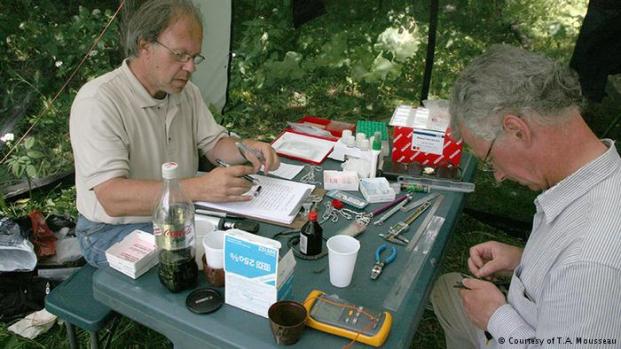
Mousseau (left) and colleague Anders Moller recording measurements in the field at Chernobyl
Some mutations might persist for a while if they’re adaptive during the hot phase. For example, there’s selection for animals whose cells produce a higher antioxidant load, which makes them more resistant to the effects of ionizing radiation. But that protection comes at a metabolic cost. After radiation levels die down, those variants will be selected back out of the population.
Where things get complicated is when the harmful mutations are recessive, that is, when it takes two copies [one for each chromosome] for the expression of the mutation. Many mutations fall into this category. They can accumulate in populations because they’re not expressed until two copies come into the same individual [one from the mother, the other from the father].
Because of this, populations can be affected by such mutations for many generations even after the mutagen is removed, and also, via dispersal, in populations that were never affected by the mutagen.
How can radioactive contamination interact with other problems that affect ecosystems, like habitat loss or climate change?
Certainly climate change is an additional stressor that is likely to interact with radiation to affect populations. We have demonstrated that while swallows in most places have moved their breeding dates forward in response to warming, in the Chernobyl area they are actually delayed. We hypothesize that this is due to the stress from the radioactive contaminants.
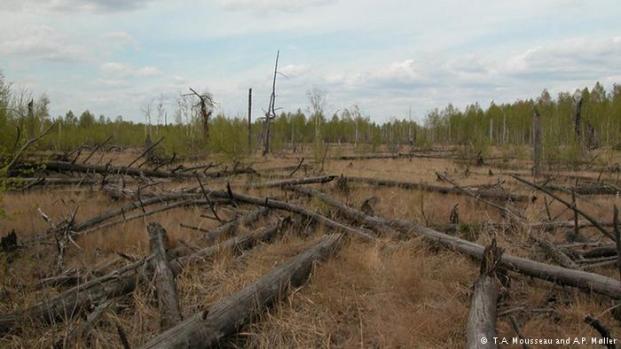
The Red Forest near Chernobyl in Ukraine presents a high risk of fire, as a lack of bacteria prevents the trees from decaying
The biggest fear at present is related to the observation of hotter and drier summers in Ukraine, and the resulting increase in number and size of forest fires. Last summer there were three large fires, and one of them burned through some very contaminated areas.
We have predicted that such events could pose a significant threat to both human populations and the environment via re-suspension and deposition of radionuclides in the leaf litter and plant biomass.
In addition to the threat of catastrophic wildfire spreading nuclear contamination, birds and mammals also move around. Do they absorb radioactive elements in their food and water in contaminated sites, carry them elsewhere, thus dispersing the contamination more widely?
Do animals move radionuclides? Yes! I did a study years ago that showed very significant amounts of radionuclides are exported every year by birds. But it seems unlikely that the amount is enough to cause measurable health effects – unless you’re eating the birds. It is known that some people living outside the Chernobyl Exclusion Zone are getting very significant doses from hunting the contaminated wild boar that leave the zone.

Mouse with cataract collected near Chernobyl – the more radioactive the site, the higher the frequency of defects
This year marks five years since the Fukushima accident, and 30 years since Chernobyl. How long will the contaminated zones around Chernobyl and Fukushima be mutagenic and dangerous?
Chernobyl was a nuclear fire and ongoing fission event for 10 days, with strontium, uranium and plutonium isotopes strewn into the landscape. They have long half-lives, so many areas will remain hazardous for centuries, even thousands of years.
Fukushima was largely a cesium event, and cesium radionucleotides have a relatively short half-life. The area will mostly naturally decontaminate itself within decades, at most within a couple hundred years.
Timothy Mousseau is a professor of biological sciences at the University of South Carolina in Columbia, South Carolina. He is one of the world’s leading experts on the effects of radionucleotide contamination from nuclear accidents on wild bird, insect, rodent, and plant populations.
Interview: Nils Zimmermann
March 18 Energy News

Opinion:
¶ So … was that climate change? • While the broad trends of climate change, and our role in causing it by burning fossil fuels, have been clear for decades, it was not possible until recently to tie a specific storm, drought, flood or heat wave to long-term warming trends. Thankfully, that’s changing. [CNN]
 Waterspout off the Florida Keys. Photo by Dr. Joseph Golden, NOAA. US Government image. Public Domain. Wikimedia Commons.
¶ How Cheap Oil Is Accelerating Investment In Sustainable
Energy • An increasingly unprofitable global oil market is discouraging its own investors. Cheap oil no longer foretells disaster for renewable energy companies because investors want opportunities for growth. [CleanTechnica]
Science and Technology:
¶ February smashed the previous record for the warmest February and even became the warmest month ever compared to average, according to NOAA. February temperatures averaged 1.21° C (2.18° F)…
View original post 538 more words
Nazi Gold: The Merkers Mine Treasure and the Planned Dumping of German Nuclear Waste on America

“Silence in the face of evil is itself evil. Not to speak is to speak. Not to act is to act“. Dietrich Bonhoeffer, German Lutheran theologian and pastor become Anti-Nazi dissident and hung by the Nazis on April 9, 1945.
“These are a few of the thousands of wedding rings the Germans removed from their victims in order to salvage the gold. U.S. First Army troops found these rings, with watches, precious stones, eyeglasses, and gold teeth fillings, in a cave adjoining the Buchenwald concentration camp near Weimar, Germany. 5/5/45.” 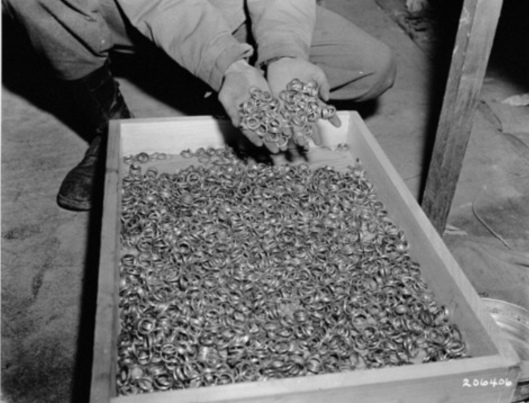
“The Schutzstaffeln’s (SS) Office for Economy and Administration, which operated the concentration camps, also wanted their loot held by the Reichsbank to be sent to Merkers for safekeeping. From August 26, 1942, until January 27, 1945, the SS made seventy-six deliveries to the Reichsbank of property seized from concentration camp victims. This stolen property was…
View original post 13,878 more words
Judges clad in protective gear inspect evacuated areas in Fukushima for on-site evidence in class action suit

Judge Hideki Kanazawa, third from right in the front row, walks through an area evacuated due to radiation while wearing protective clothing, near the homes of plaintiffs in a lawsuit over the nuclear disaster, in Futaba, Fukushima Prefecture, on March 17, 2016.
FUKUSHIMA–Fukushima District Court judges inspected the houses of three evacuated plaintiffs on March 17 in connection with a lawsuit filed against the government and Tokyo Electric Power Co. over the nuclear disaster.
It marked the first visit by judges to evacuation zones regarding litigation concerning the accident at the Fukushima No. 1 nuclear power plant, which was caused by the Great East Japan Earthquake and tsunami in March 2011.
Called “Nariwai Sosho” (livelihood suit), the lawsuit has about 4,000 plaintiffs seeking consolation money and the restoration of their former lives that were lost because of the nuclear accident.
What was gleaned from the on-site inspections will be used as evidence in the trial.
The plaintiffs had called for the judges to visit the affected sites and hear their explanations to assess the scope of damage of the nuclear disaster.
The inspections involving about 50 people, which were closed to the media, started at 10:45 a.m. and ended around 4:30 p.m.
Three judges, including Presiding Judge Hideki Kanazawa, first visited the home of Sadatoshi Sato, a 68-year-old who raised livestock before the disaster, in Namie.
Other plaintiffs, government officials and TEPCO representatives accompanied the judges. All participants wore white protective suits and masks.
At Sato’s home, the judges viewed empty cattle sheds. Sato had been raising about 150 cattle when the nuclear accident unfolded, but most of them starved to death while he was evacuating. Sato also took the judges to the site where the dead cattle were buried.
“I want the judges to give a thoughtful ruling so that the dead cattle would rest in peace,” Sato told reporters after the inspection.
The judges also visited the homes of 67-year-old Yuji Fukuda in Futaba and a woman in Tomioka who had been operating a piano school out of her house before the nuclear accident.
Fukuda’s house is in a difficult-to-return zone about 4 kilometers from the Fukushima No. 1 nuclear plant. He showed the judges his once-thriving garden. He also told them about a local store that is now desolate.
“I told the judges from the bottom of my heart that I am not the only one who has suffered,” Fukuda said. “I had wanted the judges to come sooner. But my hope has finally come true.”
http://ajw.asahi.com/article/0311disaster/recovery/AJ201603180055
Judges clad in protective gear visit Fukushima in class action suit
FUKUSHIMA — Judges from the Fukushima District Court donned protective gear to make an on-site visit on March 17 to towns evacuated due to high radiation levels, as they deliberate a class action lawsuit over the Fukushima nuclear disaster.
Some 3,900 people who lived in Fukushima Prefecture and adjacent prefectures at the time of the meltdowns at the Fukushima No. 1 nuclear plant have sued the government and plant operator Tokyo Electric Power Co. for compensation and a restoration of their hometowns to their pre-disaster state. According to lawyers for the plaintiffs, the March 17 visit is the first time that a court handling a lawsuit over the Fukushima disaster has made an on-site visit.
The visit consisted of around 50 people, including three judges and lawyers for both the plaintiffs and the defendants. They went to three evacuated towns, Futaba, Namie and Tomioka, where they looked inside the homes of plaintiffs, thrown into disorder by scavenging animals and full of strewn furniture and bad odors. They also walked by JR Futaba Station, now unmanned and silent.
Plaintiff Yuji Fukuda, 67, who evacuated from Futaba and is now living in the city of Iwaki, said after the visit, “The judges understood that we are continuing to suffer from being driven from our towns and having to leave our homes and properties unattended.”
At his cow barn, Sadatoshi Sato, 68, livestock farmer and plaintiff from Namie, explained to the judges how most of the around 150 cattle he kept had died from starvation after the town was evacuated.
The plaintiffs in the case are seeking 20 million yen in compensation each for 40 people who lived in areas that are under evacuation order. They are also seeking a reduction in radiation doses to pre-disaster levels, and payment of 50,000 yen per month to each plaintiff for the duration until this happens.
http://mainichi.jp/english/articles/20160318/p2a/00m/0na/003000c
NRA criticizes Asahi story on radiation dose monitors
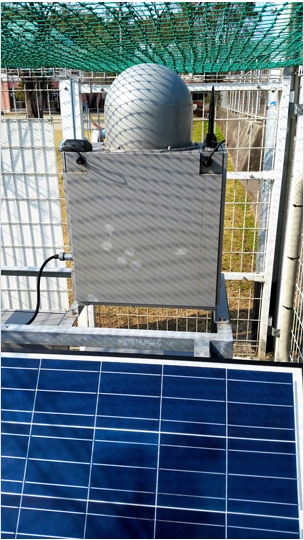
This radiation dose monitoring post, installed about 21 kilometers from the Sendai nuclear power plant in Satsuma-Sendai, Kagoshima Prefecture, can only measure radiation doses up to 80 microsieverts per hour.
The head of the Nuclear Regulation Authority on March 16 criticized an Asahi Shimbun story on radiation dose monitors around the Sendai nuclear power plant, saying it is misleading to residents near nuclear facilities.
The NRA demanded that The Asahi Shimbun explain the news-gathering process that led to the March 14 story headlined, “Half of the radiation dose monitoring posts around the Sendai nuclear power plant cannot measure levels that serve as criteria for evacuation,” in the vernacular Asahi Shimbun.
“(The article) is criminal in the sense the content fanned unnecessary anxieties among municipalities hosting nuclear power plants and people living around them,” Shunichi Tanaka, chairman of NRA, said.
The article, carried in the morning edition, said 22 of the 48 monitoring posts installed in the area between 5 kilometers and 30 km from the Sendai plant in Kagoshima Prefecture can only measure radiation doses up to 80 microsieverts per hour. That means these posts are incapable of measuring doses of 500 microsieverts per hour, the criterion for judgments on issuing evacuation orders to residents immediately after a nuclear accident.
“It is not a problem that only half of the monitoring posts can measure (500 microsieverts) and the other half cannot do so,” Tanaka said. “What is important is whether those monitoring posts are sufficient for us to judge (whether to order evacuations) through monitoring.”
On the evening of March 15, the NRA released a statement on its website, saying, “There is a possibility that (the article) will cause misunderstandings.”
The statement said monitoring posts that can accurately measure low radiation doses and monitoring posts that can measure high radiation doses are installed in combination, so the mechanism to judge whether to issue evacuation orders has been “put in place.”
The NRA statement also said, “We recognize that it is important to continuously enhance monitoring systems for emergencies.”
In addition, the NRA took issue with a comment from the nuclear watchdog that appeared in the article.
“Our staff never said what was written,” the NRA said.
It demanded that The Asahi Shimbun explain whether the comment was a fact.
The Asahi Shimbun carried the article to enhance local governments’ evacuation systems as much as possible.
“As for the article, (our reporters) interviewed NRA executives several times,” the newspaper said in a statement.
* * *
Asahi’s stance on the issue
The Asahi Shimbun believed that, in the case of radiation doses rising sharply after an accident at a nuclear power plant, 500 microsieverts per hour will become an important barometer on whether to immediately evacuate residents living in the area between 5 km and 30 km from the plant.
Therefore, the newspaper focused on whether equipment that can measure 500 microsieverts per hour has been put in place.
After the accident at the Fukushima No. 1 nuclear power plant operated by Tokyo Electric Power Co., the government revised its guidelines to deal with nuclear disasters. The government decided that people living within a radius of 5 km from a nuclear plant would have to evacuate immediately if an accident occurs.
For people living in the area between 5 km and 30 km from the plant, the government decided that they would have to stay indoors, and a judgment would be made on whether to issue evacuation orders to them after checking the radiation doses measured by monitoring posts.
The government decided that if a level of 20 microsieverts per hour continues for an entire day, it will instruct those residents to evacuate within a week. However, if the radiation doses reach 500 microsieverts per hour, the government will instruct them to evacuate immediately.
This year, The Asahi Shimbun asked 21 prefectures that are obliged to compile evacuation measures for residents about the installation of monitoring posts in the area between 5 km and 30 km from a nuclear plant.
With the exception of Kagoshima Prefecture, where the Sendai nuclear plant is located, 20 prefectures have installed or plan to install monitoring posts that can measure up to 500 microsieverts per hour in all or most of the spots.
Prefectural government officials said that in the accident in Fukushima, the area of high radiation doses spread widely and that it is a matter of course that the monitoring posts can measure up to 500 microsieverts.
Others said that making it possible to measure up to 500 microsieverts will lead to relief and safety of the prefecture’s people.
Officials of prefectural governments have made such remarks because of the accident that occurred at the Fukushima No. 1 nuclear power plant. Radiation doses could differ drastically in spots that are several kilometers away.
In the initial stage of the Fukushima disaster, measuring radiation doses while moving in a car was inadequate due to a shortage of gasoline and other reasons.
In a complex disaster combined with an earthquake or other factors, there is a possibility that measuring equipment cannot be transported because of damage to roads.
The 48 monitoring posts that are installed in the area between 5 km and 30 km from the Sendai nuclear plant are positioned so that they can be used to make judgments on evacuations from each district.
As for the Sendai nuclear plant, an NRA official in charge of the issue revealed to The Asahi Shimbun this month that when the government “approved” the evacuation system around the plant in 2014, prior to the restarts of its reactors, a then division chief of the NRA strongly asked the Kagoshima prefectural government to expand its monitoring system.
As for the current situation of monitoring systems, the NRA is also looking into the installation and capabilities of monitoring posts around nuclear power plants throughout the country.
http://ajw.asahi.com/article/behind_news/social_affairs/AJ201603170065
Shocking health effects in Fukushima nuclear workers found under the official radiation dose limits
The First male Daichi nuclear site worker had an official total dose of 50mSv. “I suffered damages to kidneys, heart, etc. — all important organs in my body.” The second male Daichi nuclear s…
Source: Shocking health effects in Fukushima nuclear workers found under the official radiation dose limits
Climate and Nuclear News 18 March

Christina Macpherson’s websites & blogs
CLIMATE and RENEWABLE ENERGY Renewable energy effective in stalling greenhouse gas emissions – International Energy Agency (IEA). New study shows how warm ocean currents affect Antarctic ice shelves. . Sea levels could rise to mind-boggling levels. Antarctic ice sheets melting: when will the tipping point be reached?
Climate action a winner for USA with clean energy and transport policies. India’s massive bet on solar power is paying off.
The Importance Of The Nuclear Security Summit – five points.
UK and FRANCE France’s auditor brands Hinkley Point nuclear project as financially risky. EDF want French tax-payers’ financial aidfor UK Hinkley Point Nuclear Project. UK Members of Parliament to question EDF executives about Hinkley nuclear project financing. New UK nuclear project Hinkley Point C – now a”dead duck” ? Political importance to world’s nuclear powers, of getting Hinkley project happening.
BELGIUM 30 major European cities and districts call for shutdown of aging Belgian nuclear reactors.
JAPAN. Fukushima fuel melted through containment vessels and is “spewing radiation”. Fukushima – too toxic for humans AND for robots. The health toll of Fukushima nuclear disaster – especially workers and children. The workers of the Fukushima nuclear clean-up. Japan, US, France to team up on Fukushima clean-up: official.
After court ruling, things are grim for Japan’s nuclear industry.
USA.
- $Billions for US nuclear submarines.
- USA worried about weapons proliferation risks in China’s Nuclear Recycling plan.
- USA’s nuclear regulator ineffective, as radiation leaks continue.
- Tax-payer money proposed in Senate, to keep uneconomic Fitzpatrick nuclear plant going.
- South Carolina nuclear whistleblower workers punished for speaking out on safety concerns.
- Hanford Nuclear Reservation ordered by federal judge to comply with new deadlines for nuclear waste clean-up.
- Bill Gates enjoys spruiking his plutonium dream.
TAIWAN. Despite rain , thousands rally across Taiwan, against nuclear power.
SOUTH AFRICA. Seven key areas for concern in South Africa’s nuclear build plan.
INDIA. Kakrapar Nuclear Plant Is Likely Undergoing A Loss-Of-Coolant Accident: Dr. A. Gopalakrishnan
Renewable energy effective in stalling greenhouse gas emissions – International Energy Agency (IEA)

 Surge in renewable energy stalls world greenhouse gas emissions
Falling coal use in China and the US and a shift towards renewable energy globally saw energy emissions level for the second year running, says IEA, Guardian, John Vidal, 17 Mar 16, Falling coal use in China and the US and a worldwide shift towards renewable energy have kept greenhouse gas emissions level for a second year running, one of the world’s leading energy analysts has said.
Preliminary data for 2015 from the International Energy Agency (IEA) showed that carbon dioxide emissions from the energy sector have levelled off at 32.1bn tonnes even as the global economy grew over 3% .
Electricity generated by renewable sources played a critical role, having accounted for around 90% of new electricity generation in 2015. Wind power produced more than half of all new electricity generation, said the IEA.
The figures are significant because they prove to traditionally sceptical treasuries that it is possible to grow economies without increasing climate emissions.
“The new figures confirm last year’s surprising but welcome news: we now have seen two straight years of greenhouse gas emissions decoupling from economic growth. Coming just a few months after the landmark COP21 agreement in Paris, this is yet another boost to the global fight against climate changem” said IEA director, Fatih Birol.
The two largest emitters, China and the US, both reduced energy-related emmisions in 2015. In China, they declined 1.5%, as coal use dropped for the second year running and in the US they declined 2%, as a large switch from coal to natural gas use in electricity generation took place.
However, these declines were offset by increasing emissions in most other Asian developing economies and the Middle East, said the IEA…….
A seperate report by the European Environment agency (EEA) shows that the EU-wide share of renewable energy has increased from 14.3% in 2012 to 15% in 2013. This allowed the EU to cut its demand for fossil fuels by 110m tonnes of oil equivalent in 2013. This, said the EEA, is the equivalent of a gross reduction of CO2 emissions of 362m tonnes in 2013. http://www.theguardian.com/environment/2016/mar/16/surge-in-renewable-energy-stalls-world-greenhouse-gas-emissions
UK Members of Parliament to question EDF executives about Hinkley nuclear project financing

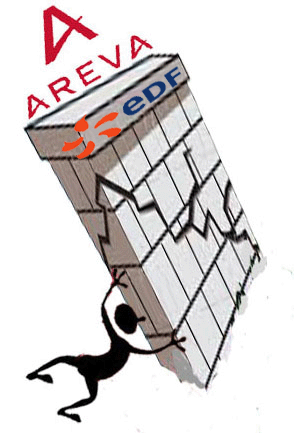 EDF Energy to be grilled by MPs over Hinkley Point C nuclear power plant , City AM. 17 Mar 16 EDF Energy will be grilled by a group of MPs next week over the controversial Hinkley Point C nuclear power plant in Somerset.
EDF’s chief executive Vincent de Rivaz, and managing director of new nuclear build Humphrey Cadoux-Hudson, will appear before the energy and climate change select committee on Wednesday.
It comes as French economy minister Emmanuel Macron pledged fresh financing for the £18bn project during a visit to a nuclear power plant there today.
EDF has been forced to defend Hinkley after its chief financial officer Thomas Piquemal resigned over the huge costs. It subsequently sent a letter to employees reiterating confidence that the project will go ahead.
“The hearing will give EDF Energy an opportunity to answer the committee’s questions on the investment plans for a new nuclear power station at Hinkley Point C in Somerset,” it said in a statement today……..http://www.cityam.com/237033/edf-energy-to-be-grilled-by-mps-over-hinkley-point-c-nuclear-power-plant
Fukushima fuel melted through containment vessels and is “spewing radiation”
Reuters: Fukushima fuel melted through containment vessels and is “spewing radiation” — Nuke Expert: Fuel has “scattered all over the place” — Gov’t: Fuel may have burned out into environment — Tepco Official: Fuel could have flowed out “like lava in a volcano” (VIDEOS) http://enenews.com/tepco-official-admits-melted-fuel-flowed-like-volcanic-lava-nuclear-expert-melt-containment-vessel-fuel-scattered-all-place-reuters-fuel-melted-containment-spewing-radiation-guardian-fuel-be?utm_source=feedburner&utm_medium=email&utm_campaign=Feed%3A+ENENews+%28Energy+News%29
Reuters, Mar 11, 2016 (emphasis added): Today, the radiation at the Fukushima plant is still so powerful it has proven impossible to get into its bowels to find and remove the extremely dangerous blobs of melted fuel rods, weighing hundreds of tonnes… The fuel rods melted through their containment vessels in the reactors, and no one knows exactly where they are now… Tepco has been developing robots [to] negotiate obstacles in damaged tunnels and piping to search for the melted fuel rods.
Reuters, Mar 9, 2016: Five years on, melted fuel rods still spew radiation…
DW, Mar 11, 2016: The melted nuclear fuel and the destroyed pressure vessel in the nuclear reactors 1 to 3 continue to be major problems… “So far, nobody knows what exactly happened in there and how to solve it,” [Heinz Smital, a nuclear physicist] told DW. “Until now, there is no solution to recover the melted fuel rods from the reactors.”
News Corp Australia, Mar 11, 2016: Today, the radiation at the Fukushima plant is still so powerful it is impossible to extract and remove deadly melted fuel rods… [Tepco is] grappling with the fact that they don’t have the technology to find missing melted fuel rodsin three reactors at the plant. The rods melted through containment vessels in the reactors.
Guardian, Mar 11, 2016: [It’s] the most daunting task the nuclear industry has ever faced: removing hundreds of tons of melted fuel from the plant’s stricken reactors… something no nuclear operator has ever attempted… Of greatest concern, though, is reactor 1, where the fuel may have burned through the pressure vessel, fallen to the bottom of the containment vessel and into the concrete pedestal below – perhaps even outside it – according to a report by the International Research Institute for Nuclear Decommissioning… Masuda and Tepco engineers who spoke to the Guardian conceded that they still didn’t know where the fuel is located. “To be honest, we don’t know exactly where the fuel is”… Masuda said… “No one has ever done what we’re doing”…
PBS Newshour, Mar 11, 2016 (at 35:15 in):
- Miles O’Brien, PBS correspondent: What about the melted fuel in the reactor cores? They aren’t even sure where it all is.
- Lake Barrett, Tepco advisor: Is it in one big vertical lump on the floor underneath it? Or did it come down and flow like lava in a volcano and move out to the sides? We don’t know yet… Nothing of this magnitude [i.e. the attempt to remove Fukushima’s melted fuel] has ever been done by mankind…
Interview with nuclear engineer Hiroaki Koide (translation by Prof. Robert Stolz, transcription by Akiko Anson), published Mar 8, 2016: We simply do not know where the core is or in what state it is… [The government and TEPCO] are convinced that the melted core fell through the bottom of the pressure vessel and now lie at the bottom of the containment vessel―basically piling up like nuggets of the melted core [See Lake Barrett’s statement above]. There’s no way this would be the case. (Laughs)… It should have been scattered all over the place… Though the containment vessel is made of steel, if the melted core has come in contact with that steel, just as it ate through the floor of the pressure vessel, it could possibly have melted through the containment vessel… There are situations in which the containment vessel can suffer a melt-through. I think this likely has already happened.
Watch: PBS Newshour | Reuters
30 major European cities and districts call for shutdown of aging Belgian nuclear reactors
 Shut old nuclear reactors, says unprecedented alliance of EU cities
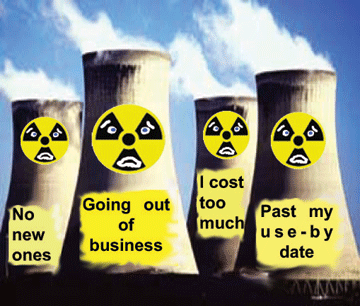
Communities and campaigners in Germany, the Netherlands and Luxembourg lobby for closure of two ageing 40-year old Belgian nuclear reactors close to borders, Guardian, Arthur Neslen 17 Mar 16, An unprecedented alliance of 30 major cities and districts from three countries has joined forces to try to shut down two ageing Belgian nuclear reactors close to their borders.
Cologne and Dusseldorf in Germany, Luxembourg City and Maastricht in theNetherlands are among the cities co-funding a lawsuit to close one reactor – Tihange 2 – and calling on the European commission to prepare a separate case at the European court of justice.
“More than 30 districts have adopted resolutions to support us, and want to join the lawsuit,” said Helmut Echtenberg, the mayor of Germany’s Greater Aachen region, who is leading the campaign.
Only one plaintiff may appear in court, “but we will ensure that Tihange 2 is no longer connected to the grid in the future,“ Echtenberg said. “This is my honest conviction.”…….
The 40-year old reactors have been plagued by a litany of problems such as reactor pressure vessel micro-cracks, fire and one mysterious case of sabotage.
These have sparked what Echtenberg calls “existential fear” in Aachen, which lies 60km upwind of the plant. Anxiety is rife that house prices and business activity could soon suffer.
Anti-nuclear posters festoon the shops in Aachen town centre, stickers adorn car windows and stories about Tihange are regularly splashed across local papers.
Hartmut Falter, the owner of Aachen’s oldest bookstore, Die Mayersche, has put up a 10m x 3m anti-nuclear poster in his storefront. “The risk of a nuclear accident is not very high but if it happened, the damage would be extreme,” he told the Guardian. “Unfortunately, nuclear dangers do not stop at the frontier.”…….
Last week, it was announced that France’s oldest reactor in Fessenheim, on the German border, would close after complaints by Germany and Switzerland.
Lawyers are already working on a second nuclear lawsuit, which may be filed in Belgium by the Dutch city of Maastricht. The regional governments of North Rhine Westphalia and Rhineland Palatinate are taking separate cases against the reactors to the UN and European commission…….. http://www.theguardian.com/environment/2016/mar/17/shut-old-nuclear-reactors-says-unprecedented-alliance-of-eu-cities
1 This Month

petition to oppose the rapid increase of space-military industry threatening Jeju Island and the region.
[Petition by April 19th (KST)] Stop the joint military-Hanwha Systems-Jeju Provincial Government Sea Launch!

Chernobyl: The Lost Tapes – A good documentary on Chernobyl on SBS available On Demand for the next 3 weeks– https://www.sbs.com.au/ondemand/tv-program/chernobyl-the-lost-tapes/2352741955560

of the week–London Campaign for Nuclear Disarmament


Tell the Ukrainian Government to Drop Prosecution of Peace Activist Yurii Sheliazhenko
To see nuclear-related stories in greater depth and intensity – go to https://nuclearinformation.wordpress.com
-
Archives
- April 2026 (194)
- March 2026 (251)
- February 2026 (268)
- January 2026 (308)
- December 2025 (358)
- November 2025 (359)
- October 2025 (376)
- September 2025 (257)
- August 2025 (319)
- July 2025 (230)
- June 2025 (348)
- May 2025 (261)
-
Categories
- 1
- 1 NUCLEAR ISSUES
- business and costs
- climate change
- culture and arts
- ENERGY
- environment
- health
- history
- indigenous issues
- Legal
- marketing of nuclear
- media
- opposition to nuclear
- PERSONAL STORIES
- politics
- politics international
- Religion and ethics
- safety
- secrets,lies and civil liberties
- spinbuster
- technology
- Uranium
- wastes
- weapons and war
- Women
- 2 WORLD
- ACTION
- AFRICA
- Atrocities
- AUSTRALIA
- Christina's notes
- Christina's themes
- culture and arts
- Events
- Fuk 2022
- Fuk 2023
- Fukushima 2017
- Fukushima 2018
- fukushima 2019
- Fukushima 2020
- Fukushima 2021
- general
- global warming
- Humour (God we need it)
- Nuclear
- RARE EARTHS
- Reference
- resources – print
- Resources -audiovicual
- Weekly Newsletter
- World
- World Nuclear
- YouTube
-
RSS
Entries RSS
Comments RSS
 nuclear-news
