Legal challenge to Florida utilities’ Nuclear Cost Fees

 Lawsuit Challenges Florida Utilities’ $2B Nuclear Cost Fees By CURT ANDERSON, abc, AP LEGAL AFFAIRS WRITER MIAMI — Feb 23, 2016, A federal lawsuit has been filed challenging $2 billion in fees charged by Florida’s two largest electric utilities for nuclear plant projects, some of which were never completed.
The proposed class-action lawsuit filed Monday seeks to stop the fees and recover unspecified damages for about 6.4 million customers of Florida Power & Light and Duke Energy. The fees were imposed on ratepayers under a law passed in 2006 by the Legislature and implemented by the state Public Service Commission.
The suit contends that the law violates the U.S. Constitution’s commerce clause by discriminating against other out-of-state energy producers and that it is pre-empted by federal energy and nuclear laws. It also claims Florida customers are improperly charged for nuclear projects that can be subject to huge cost overruns or that are never built.
One example cited in the lawsuit is Duke’s plan to build two new reactors in Levy County, which enabled the utility to begin collecting recovery fees in 2008. Even though the project was abandoned in 2013, Duke can keep all the fees it has collected plus other amounts deemed prudent by state regulators.
“These two utilities have racked up huge expenses with nuclear power plant projects — some of which they completely abandoned — and have left ratepayers holding the bag,” said attorney Steve Berman, managing partner at Seattle-based Hagens Berman, which filed the lawsuit in South Florida federal court.
Berman’s firm and the nonprofit Institute for Southern Studies say other states, including Georgia and Louisiana, have laws similar to that in Florida allowing utilities to collect such fees…….
According to state records, Duke Energy has collected more than $1.2 billion in nuclear cost recovery fees since 2008. For FPL, the total tops $814 million.
If the lawsuit is certified as a class action, it could eventually repay millions of Florida customers of the two utilities a portion of the fees they have been charged under the law. The lawsuit also asks U.S. District Judge William Dimitrouleas of Fort Lauderdale to halt further collection of the fees by declaring the law unconstitutional. http://abcnews.go.com/US/wireStory/lawsuit-challenges-florida-utilities-2b-nuclear-cost-fees-37145865
Nuclear Deal Will Play A Role In Iran’s Elections
February 23, 2016 Iranians vote Friday for parliament and a committee that could someday choose the next supreme leader. Reformers aren’t getting traction as the benefits from the nuclear deal are slow to materialize. [incl audio] ……http://www.npr.org/2016/02/23/467768259/nuclear-deal-will-play-a-role-in-irans-elections
Nuclear industry AND tax-payer funds both may be needed to cover nuclear shutdown costs
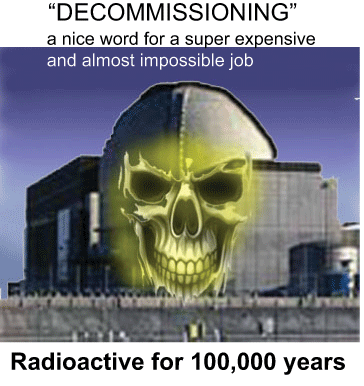 SHUTDOWN COSTS Picking Up the Nuclear Tab, Handelsblatt BY KLAUS STRATMANN 23 Feb 16, A leaked draft report on Germany’s exit from nuclear power recommends the nation’s four big utilities foot the €19.7 billion bill for decommissioning their power plants – but any costs above that may be carried by taxpayers.
FACTS In 2011, Germany announced a complete phase-out of nuclear power by 2022, with a target of 80 percent renewable energy by 2050.
The four major power firms in Germany, E.ON, RWE, EnBW and Vattenfall, and plant operator Krümmel have set aside €39.6 billion for their share of the phase-out costs.
A government financial commission has now devised a structure for dividing the responsibilities and clarifying the financial liabilities of industry and government. Germany moved a step closer this week to deciding how to pay for its forced exit from nuclear power. The government is moving toward requiring four nuclear plant operators pay the first €19.7 billion ($22 billion). Any costs above that — including hard-to-estimate expenses for storing nuclear fuel — would be paid for by taxpayers.
The recommendations are included in a draft of a government report on the issue obtained by Handelsblatt. The document was described as a preliminary recommendation and could have been leaked as a trial balloon.
The draft recommends making E.ON, RWE EnBW and Vattenfall, the four utilities, pay for “decommissioning and demolition” of their nuclear power plants. The government would then step in assume the costs of the trickier task of removing and storing radioactive waste.
The utilities together have set aside about €39.6 billion ($43.6 billion) to cover their costs of decommissioning. But there is a strong possibility that final costs may rise well beyond that.
The cost of waste disposal and storage, in particular, is seen as particularly difficult to gauge, promting fears among consumer advocates that the utilities could end up saddling taxpayers with the majority of costs.
The report recommends that a state fund be set up to pay for the waste disposal, financed in part by the four utilities, which would transfer in about half of their total reserves. But the report stops short of saying how costs would be divided between industry and taxpayers if disposal costs are greater than expected…… https://global.handelsblatt.com/edition/374/ressort/politics/article/utilities-wont-escape-nuclear-clean-up-costs
Germany’s “big four” utilities liable for nearly 40 billion euros for nuclear waste storage
Nuclear commission proposes firms transfer cash by 2022 to pay for clean-up http://af.reuters.com/article/commoditiesNews/idAFB4N10000F Feb 22, 2016 BERLIN (Reuters) – Germany’s utilities will have to transfer provisions set aside to pay for the interim and final storage of nuclear waste to a fund in cash by 2022, according to a draft report from a government-appointed committee seen by Reuters on Monday.
The report recommends that Germany’s — E.ON, RWE, EnBW and Vattenfall — remain liable for the cost of up to double the 18 billion euros ($19.8 billion) allocated so far to pay for interim and final storage.
The companies will also have to set aside a further 1.3 billion euros in provisions, according to the report which is due to be presented at the end of the month. ($1 = 0.9084 euros) (Reporting by Markus Wacket; Writing by Caroline Copley; Editing by Christoph Steitz)
Entergy won’t save loss-making FitzPatrick nuclear plant
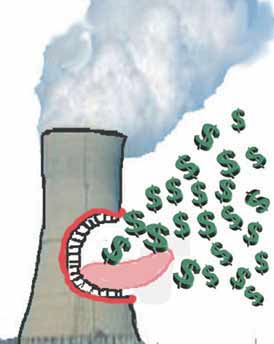 Entergy rebuffs latest NY plan to save FitzPatrick nuclear plant, syracuse.com By Tim Knauss | tknauss@syracuse.com SCRIBA, N.Y. – The state Public Service Commission said today it is working on plans to provide financial assistance to the FitzPatrick nuclear plant in a desperate attempt to keep the plant from shutting down.
PSC officials said they will undertake a rushed review of the plan and expect to have financial subsidies available for FitzPatrick by June, long before the plant’s scheduled closure next January.
The commission did not specify how much assistance it would provide. ………
PSC Chair Audrey Zibelman beseeched Entergy Corp., which owns FitzPatrick, to work with state officials on a financial rescue for the nuclear plant.
“The plan would enable expedited financial support to FitzPatrick and other qualified nuclear power plants in Upstate New York,” said PSC Chair Audrey Zibelman. “Until then, we invite Entergy to work with us to make the plans necessary to refuel FitzPatrick and to support the statewide objectives of New York’s new Clean Energy Standard.”
Entergy officials responded that it is too late to save FitzPatrick, which the company plans to close because it loses money. The company added that if Cuomo wants to reduce carbon emissions, he should back off his insistence that Entergy shut down the Indian Point nuclear facility, which Cuomo says is unsafe because of its proximity to New York City.
Cuomo recently announced his plan to offer financial “clean energy” payments for nuclear power, but the help would only go to Upstate nukes – FitzPatrick and Nine Mile Point in Oswego County, and Ginna in Wayne County. Indian Point’s two reactors would not qualify…….
The commission today agreed to conduct a speeded-up review aimed at making financial supports available to Upstate nuclear plants as early as June. Entergy officials dismissed today’s action as too uncertain and too late to save FitzPatrick…. http://www.syracuse.com/news/index.ssf/2016/02/entergy_to_cuomo_its_too_late_to_save_fitzpatrick_but_not_indian_point.html
“disaster waiting to happen” – Indian Point nuclear plant called
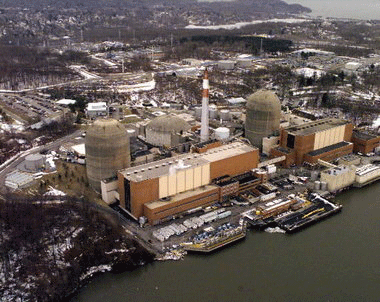 Indian Point nuclear plant called “disaster waiting to happen” CBS News,
In the past year alone there have been a number of mishaps at Indian Point, including a power failure in the reactor core, a transformer fire, an alarm failure, and the escape of radiated water into groundwater. The plant sits about 25 miles north of New York City, so a serious mishap could potentially put millions of people in harm’s way.
“It’s a disaster waiting to happen and it should be shut down,” Paul Gallay, president of Riverkeeper, a watchdog organization dedicated to protecting the Hudson River, told CBS News.
The Indian Point Energy Center, located on the bank of the Hudson River in the town of Buchanan, supplies electricity for millions of homes, businesses and public facilities in New York City and Westchester County, just north of the city.
Environmental groups call the latest problem just the tip of the iceberg, and Gov. Andrew Cuomo is joining with organizations like Riverkeeper, the National Resources Defense Council and others in seeking the permanent closure of the plant.
Earlier this month, Entergy Corporation, which owns Indian Point, reported increased levels of tritium-contaminated water at three monitoring wells, with one well’s radioactivity increasing by as much as 65,000 percent.
Tritium is a radioactive form of hydrogen that occurs naturally in small doses and is a byproduct of nuclear reactors. It could enter a person’s body by drinking tritiated water, or it can also be inhaled as a gas or absorbed through the skin. Tritium can reach all parts of the body like normal water and is eventually expelled through urine. The U.S. Nuclear Regulatory Commission (NRC) says tritium emits “very weak radiation and leaves the body relatively quick.”
Little research has been done on the health effects of exposure to increased levels of tritium. But the NRC states: “Exposure to very small amounts of ionizing radiation is thought to minimally increase the risk of developing cancer, and the risk increases as exposure increases.”……..
The Environmental Protection Agency’s (EPA) standard limit for tritium in drinking water, established in 1976, is 20,000 picocuries per liter. (A picocurie is a unit of radiation that could be measured in a laboratory.) By comparison, after the recent leak, samples showed the tritium-laced water at Indian Point had a radioactivity level of more than 8 million picocuries per liter. That level was the highest regulators have seen at Indian Point, Cuomo said, compared to a normal reading of about 12,300 picocuries per liter.
According to a 2014 notice in the Federal Register, EPA is expected to update the standards for tritium in drinking water. EPA did not make anyone available for comment……..
“The good news is, advances in alternate power sources, grid management and energy conservation have brought us to the day when the aging, unsafe Indian Point can close,” Gallay said. He enumerated a number of other available sources of energy for the region, including 600 megawatts thanks to transmission system upgrades and another 500 megawatts available through energy savings achieved through efficiency and renewable energy.
“There will be enough power to keep the lights on in our homes and hospitals, our businesses and schools — in every place that makes our communities healthy and vibrant,” Gallay said. http://www.cbsnews.com/news/indian-point-nuclear-power-plant-called-a-disaster-waiting-to-happen/
Trouble brewing in South Africa over nuclear energy programme
Storm brewing over nuclear energy programme, My Broadband, 23 Feb 16 A storm that has been brewing over the Department of Energy’s nuclear energy programme and PetroSA could erupt, reports News24. By News24 Wire – February 23, 2016 A storm that has been brewing over the Department of Energy’s (DoE) nuclear energy programme and PetroSA could erupt at its portfolio committee meeting on Tuesday, after Minister Tina Joemat-Pettersson snubbed the session last week.
“Tomorrow’s (Tuesday) committee meeting will present the minister with a real opportunity to deliver on her promise of transparency and provide the South African public much needed and vital information on South Africa’s proposed nuclear deal,” according to Democratic Alliance MP Gordon Mackay on Monday.
Last week, the committee asked Joemat-Pettersson to explain the implications of President Jacob Zuma’s State of the Nation (Sona) address in which he cautioned that the country would “only procure nuclear on a scale and pace that our country can afford”.
“The minister, who arrived an hour late, dodged addressing the issue by saying she is going to be part of a parliamentary debate on Wednesday and couldn’t pre-empt this in a portfolio committee meeting,” according Liz McDaid, spokesperson for environmentalist group Safcei.
“The chair then promised that the committee would hear what the minister planned to do given Sona and also for her to account for her own parliamentary comments,” she said. “This is all meant to take place on Tuesday 23rd”.
During her Sona debate on February 17, Joemat-Pettersson said the country had to go nuclear because of the water situation in the country.
“We simply have to go the nuclear route,” said Joemat-Pettersson, “because we don’t have enough freshwater. Koeberg recycles 22bn litres of seawater, while Medupi (coal-fired) power station uses 17bn litres of freshwater.”
Gordon, who heads up the DA’s energy portfolio, told Fin24 that the committee has been clear.
“We want all pertinent documentation relating to SA’s proposed nuclear new build programme,” he said. “Specifically, the Integrated Nuclear Infrastructure Programme (an assessment of SA’s readiness for civil nuclear expansion), all financing options and economic impact assessments.”
“Without these documents any decision to proceed with nuclear must be seen to be irrational,” he said.
McDaid said Parliament has failed to hold Joemat-Pettersson to account. “At one stage, the chair told the public that there would be a discussion on the nuclear deal, but it never happened,” she said. “Then last year, the minister arrived at the meeting with a classified document, which could not be discussed.”
Nuclear train steams ahead
“At the end of last year, during the budget review process, the DoE failed to account for Necsa (SA Nuclear Energy Corporation), which did not report and asked to be exempt from reporting to parliament.”
“Necsa has major liabilities for its failure to address nuclear contamination,” she said. “There is no information on the extent of the contamination, the amount of the liability and the timeline to fix this. Now Necsa is saying that the government must pay and that it is not liable.
“Despite the lack of the accountability, the nuclear train steams ahead.”…….. http://mybroadband.co.za/news/energy/156097-storm-brewing-over-nuclear-energy-programme.html
United Nations works toward legalisation of absolute nuclear disarmament
 United Nations Working on Legalisation of Absolute Nuclear Disarmament http://www.australianetworknews.com/united-nations-working-on-legalization-of-absolute-nuclear-disarmament/United Nations is fighting its way to legalise absolute nuclear disarmament. The decision was made after North Korea’s nuclear weapon test in January, as well as the United States’ mock test for more usable nuclear weapons.
A rocket launch was carried out by North Korea in the first part of February. They allegedly tested the capability of their long-range missiles. The intercontinental ballistic missile of USA named Minuteman III has also been tested out on Feb. 21, Sunday. In response to this, a small fraction of the international community rose up to express their sentiments on the issue.
While the UN’s Secretary-General commented that wrong weapons would always be wrong, regardless who uses it, the rest of the international community has already shown acceptance of the idea that nuclear weapons can be used to defend a territory.
Despite the acceptance of the major countries of the world, United Nations continues to stigmatize nuclear weapons. The international organization does this by declaring the weapons as unacceptable and immoral,Huffington Post reported.
United Nations is also working on negotiating an international treaty that will prohibit the use of nuclear weapons and they are planning to push through with the idea whether or not the nuclear-armed states approve it. They intend to do this to show other nations that they are making a bold point on the issue.
The nuclear weapon disarmament work starts now as there are more and more headlines regarding the recent tests of North Korea. They have designated a new working group based in Geneva to work separately with this problem,ICANW reported.
United Nations is investing its time and resources in creating legal measures that can legalize nuclear disarmament. They are doing their best to stigmatize nuclear weapons while the nuclear states continue to counter the UN’s strategies.
UN aims to make a nuclear weapon free community by reminding people of the atomic bombs in Hiroshima and Nagasaki, 70 years ago. They aim to show people that this is what nuclear weapons symbolize.
NRA suggests Tepco to give up removing molten fuel from Fukushima plant

On 2/19/2016, Fuketa, a committee member of NRA (Nuclear Regulation Authority) visited Fukushima plant and commented it needs to be considered if it is the best option to remove the molten fuel or not. He also suggested to remove a part of molten fuel to solidify the rest.
He added it depends on the research result.
The government of Japan and Tepco had been planning to remove the molten fuel at least from Reactor 1, 2 and 3 however it has not even been known where the molten fuel is accumulated.
http://www.logsoku.com/r/open2ch.net/newsplus/1455960843/
NRA suggests Tepco to give up removing molten fuel from Fukushima plant
For some Fukushima mothers, protecting children from radiation comes at heavy price

Residents who were evacuated from Okuma and three other towns in Fukushima Prefecture attend an event at a public housing facility in Iwaki to help them assimilate into the community on Feb. 19.
Three-and-a-half years after fleeing to central Japan, a mother received a package from her husband who had opted to remain at their home in Fukushima Prefecture despite the nuclear disaster.
From Tamura, about 35 kilometers west of the stricken Fukushima No. 1 nuclear plant, the father sent snacks for the couple’s two children. The cardboard box also contained divorce papers.
“I cannot send money to my family whom I cannot see,” the husband told his wife.
She still refused to return home.
Thanks to decontamination work, radiation levels have fallen around the nuclear plant since the triple meltdown caused by the Great East Japan Earthquake and tsunami in March 2011. And families are returning to their hometowns, trying to resume normal lives.
But many mothers, distrustful of the government’s safety assurances, still harbor fears that radiation will affect the health of their children. As a result of these concerns, families are being torn apart, friendships have ended, and a social divide remains wide in Fukushima communities.
Around 70,000 people are still not allowed to return to their homes located in evacuation zones designated by the central government. And an estimated 18,000 people from Fukushima Prefecture whose homes were outside those zones remain living in evacuation.
The government is pushing for Fukushima residents to return home and trying to counter false rumors about the nuclear disaster.
More families in Fukushima Prefecture are willing to buy food produced in the prefecture–but not all.
A 40-year-old mother who once lived on the coast of Fukushima Prefecture and moved farther inland to Koriyama said she still fears for the health of her 11-year-old daughter.
Her classmates started serving “kyushoku” school lunches containing Fukushima rice and vegetables that passed the screening for radioactive materials. But the fifth-grader has instead eaten from a bento lunch box prepared by her mother.
The daughter says that eating her own lunch led to teasing from her classmates. She heard one of them say behind her back: “You aren’t eating kyushoku. Are you neurotic?”
She does not talk to that classmate anymore, although they used to be friends.
“I now feel a bit more at ease even when I am different from other students,” the daughter said.
Her mother expressed concerns about her daughter’s social life, but protecting her child’s health takes precedence.
“My daughter may fall ill sometime,” the mother said. “I feel almost overwhelmed by such a fear.”
An official of the Fukushima prefectural board of education said a certain number of students act differently from other students because of health concerns over radiation.
“Although the number is limited, some students bring bento to their schools,” the official said. “Some students wear surgical masks when they participate in footraces during outdoor school athletic meets.
“The feelings toward radiation vary from person to person, so we cannot force them (to behave in the same way as other students).”
Sung Woncheol, a professor of sociology at Chukyo University, and others have conducted surveys on mothers whose children were 1 to 2 years old when the nuclear disaster started. The mothers live in Fukushima city and eight other municipalities in Fukushima Prefecture.
Of the 1,200 mothers who responded to the survey in 2015, 50 percent said they had concerns about child-rearing in Fukushima Prefecture.
Nearly 30 percent said they avoid or try to avoid using food products from Fukushima Prefecture, compared with more than 80 percent six months after the disaster.
But for some mothers, the passage of nearly five years since the disaster unfolded has not erased their fears of radiation.
The 36-year-old mother who received the divorce papers from her husband in autumn 2014 continues to live with her children in the central Japan city to which she had no previous connection.
A month after the nuclear disaster, she fled with her then 1-year-old son and her daughter, 10, from their home, even though it was not located in an evacuation zone.
She said she left Fukushima Prefecture because she “could not trust the data released by the central government.”
The mother still has not told her children that their parents are divorced.
“I believe I could protect the health of my children,” the woman said. “But my family has collapsed.”
http://ajw.asahi.com/article/0311disaster/fukushima/AJ201602230068
Wasteful spending in Tohoku
Along the beaches of Kesennuma, Miyagi Prefecture, which used to boast popular resorts, a colossal seawall is nearing completion, measuring 14.7 meters high, 9 meters thick at the base and 5 km long. This is but one of many wasteful construction projects being carried out under the pretext of rebuilding the areas in northern Japan devastated by the March 2011 earthquake and tsunami.
Almost five years after the disasters, there are many projects under way that waste huge sums of taxpayer money and benefit only a handful of construction firms and individuals who have sold their land to make way for such ventures. As if by coincidence, law enforcement authorities have taken action over bid rigging among paving companies involved in expressway construction.
Why is such a huge seawall being built in an area of Kesennuma that is mostly rice paddies? A local source confides it is because municipal assembly members, local powerful figures and those close to them sold the land to the central government at a high price. An estimated ¥2.5 billion is said to have been paid by the government to the property owners for the otherwise worthless land on which the seawall is being built.
The total cost for building the 5-km seawall was initially set at ¥23 billion but has now ballooned to ¥36 billion. This is but a small portion of an overall coastal seawall construction project stretching over 400 km in Iwate, Miyagi and Fukushima prefectures, the total cost of which is budgeted at ¥1 trillion.
As of last fall, only 17 percent of the project had been completed. Even though more than 80 percent of it can still be canceled, neither the central government nor the prefectural and municipal governments have any intention of suspending the project.
Another wasteful reconstruction scheme relates to relocating tsunami victims to higher ground. One such project being pushed by the city of Higashi-Matsushima, Miyagi Prefecture, envisages developing a hillside area to accommodate 450 houses. But the cost for the land redevelopment alone is ¥40 billion, or some ¥100 million per house — a figure that befits only the most luxurious residential area.
Even if this project is completed, there are many people who initially welcomed the plan but have found it impossible to build their own house in the area. This is because, according to a member of an association of tsunami victims, the cost to build a house has gone up 50 percent from the initial estimate of ¥15 million.
The Miyagi Prefectural Government, meanwhile, is building 15,000 houses under a seven-year, ¥180 billion plan. As of the end of last year, about half had been completed. But 16 of the 21 municipalities where those houses were built are plagued with vacancies since many of the more than 20,0000 quake victims currently living in rent-free temporary housing facilities are refusing to move into these permanent houses. As construction work continues on the remaining 7,000-plus houses, the vacancy rate is bound to increase, rendering it foolish to put any more money into the project.
A total of ¥3.5 trillion in public money is to be poured into areas devastated by the quake and tsunami to build housing facilities or to move people to higher ground. But the results of this spending spree are characterized by huge seawalls resembling prison walls, redeveloped highland areas where only a small number of houses have been built and housing with high vacancy rates.
Another sector in which public money is being wasted is road construction. Many plans for new roads, which had been submitted before the 2011 disasters, are now resurfacing as if to ride on the coattails of the massive reconstruction projects.
One example is a 100-km road to connect the inland city of Morioka and the coastal city of Miyako, both in Iwate Prefecture. Local residents had clamored in vain for the new road for more than two decades. After the disasters, however, money was suddenly allocated for the road, ostensibly for the purpose of securing emergency transport.
Similarly, the Ministry of Land, Infrastructure, Transport and Tourism is pushing a new coastal “reconstruction highway” linking Miyagi and Aomori prefectures.
Such reconstruction projects have brought big benefits to many players in the construction industry — and not just major general contractors but also smaller regional firms. Hashimototen Co., for one, has grown rapidly in the post-earthquake years to become the second-largest contractor in Miyagi Prefecture in terms of completed construction projects, thanks to its close connection with a powerful Liberal Democratic Party Lower House member — Akihiro Nishumura, a former vice minister of reconstruction — and other LDP lawmakers.
A suspicion has reportedly arisen that Hashimototen conspired with third-ranking Maruhon Gumi Corp. to split a pair of tunnel contracts so that each could build one for about ¥1 billion.
Major general contractors are also suspected of collusion. In the immediate aftermath of the earthquake, Hazama Corp. and Maeda Corp., both of which have footholds in the Tohoku region, won many contracts for debris removal. According to a local construction industry insider, this prompted leading general contractors to ask LDP lawmakers to coordinate construction orders for reconstruction projects.
As if to prove that notion, contracts for huge reconstruction projects have all been won by majors like Kajima Corp., Shimizu Corp. and Taisei Corp. Local firms that have been chosen as subcontractors by the majors have prospered so much that their executives are buying expensive cars like Mercedes to reduce their tax payments, says an insider close to a major general contractor.
The very root of this and other unethical conduct in the tsunami-hit areas appears to lie in the staggering ¥26 trillion to be spent by the central government in the first five years following the disasters. If the local governments are not required to bear any cost, it is logical that they won’t worry if the money is going to waste.
Last year, the Reconstruction Agency sought to oblige the prefectures and municipalities to bear part of the cost but faced bitter opposition and was criticized for “bullying the disaster victims.” In the end, it was decided that they will shoulder no more than 3 percent of the total spending. For example, the construction cost of the Sanriku Expressway linking Sendai with Miyako will be wholly shouldered by the central government. A member of the Miyagi Prefectural Assembly, speaking on condition of anonymity, said that the ¥26 trillion has “spoiled” the three prefectures hit hardest by the disasters — Fukushima, Miyagi and Iwate.
The situation in Fukushima Prefecture is complicated by the nuclear crisis, which forced residents near the affected power plant to flee. Even though the evacuation order was lifted last September for the town of Naraha, more than 2,000 former residents had not returned as of Jan. 14, choosing instead to remain in the city of Iwaki.
Currently they are receiving monthly compensation of ¥100,000. A local newspaper reporter said that many of those continuing to remain in temporary housing units are likely to become public welfare recipients after they have used up the compensation money.
It is true that there are local residents who are still suffering from the effects of the March 2011 disasters. But now that five years will soon have passed, attention should not be turned away from the reality of the devastated areas. Continuing to lavish funds on the victimized areas will only result in money collected from taxpayers from all over the country disappearing into the dark — a world that has nothing to do with reconstruction in the true sense of the word.
http://www.japantimes.co.jp/opinion/2016/02/22/commentary/japan-commentary/wasteful-spending-tohoku/#.VszRrebzN_n
Labor shortage hampering Japan’s post tsunami recovery
Tokyo, Feb 24 (EFE).- A growing labor shortage in northeastern Japan, which was struck by the 2011 tsunami, is hampering the economic recovery of the region five years after the tragedy, said an academic from a leading university of the region.
More than 45 percent of the companies in the area that were surveyed, reported a shortage of personnel, said Satoru Masuda, Professor of Regional Planning at the Tohoku University and President of the Research Center for Earthquake Restoration, at a press conference in Tokyo.
This is a 2.2 percent jump over 2014 and 66 percent higher than that reflected in the 2012 survey, a year after the earthquake and subsequent tsunami, which struck the northeastern coast of the archipelago and left over 18,000 people dead and missing.
The sectors most affected by this include fishing, which was decimated by the catastrophe, and the retail sector.
According to Masuda, the retail sector has been greatly affected by the progressive decline in population in the three worst-affected prefectures (Iwate, Miyagi and Fukushima), from where almost 90,000 people (more than 6 percent of the population) have fled since 2011.
Almost all the people who fled the region immediately after the tsunami and accident at the Fukushima nuclear plant decided not to return and this has hugely affected the retail sector, Masuda explained.
The problem, he added, is that many traders staying in temporary facilities the government allocated them to keep this sector alive, are not being able to get funding to reopen their businesses.
If they leave, many residents’ well-being will be affected and they will end up following their footsteps, he concluded.
The data provided by Masuda also shows the construction sector, which led the region’s recovery, peaked in 2013, and even though it is still better off than other sectors, has already begun to decline.
http://noticias.alianzanews.com/309_hispanic-world/3645372_labor-shortage-hampering-japan-s-post-tsunami-recovery.html
Less protective gear at Fukushima Daiichi
The operator of the Fukushima Daiichi nuclear plant plans to make it easier for workers engaged in decommissioning efforts nearly 5 years after the accident. They will gradually be able to work without wearing protective gear or gloves in areas with low radiation.
NHK has learned that Tokyo Electric Power Company is to introduce the new measure early next month for about 90 percent of the facility.
Radiation readings near the ground in these areas were 5 microsieverts per hour or less as of December. The figures went down after the operator removed contaminated soil and paved the surface.
TEPCO will increase in stages the number of workers wearing only regular work clothing.
The utility now requires each worker to wear protective gear and 2 pairs of gloves. This is preventing them from moving around smoothly and from carrying out precision work.
The policy will continue for people working near the reactor buildings and around tanks that contain highly radioactive water.
TEPCO plans to notify workers and tighten controls so that they do not approach these areas without wearing protective gear.
http://www3.nhk.or.jp/nhkworld/en/news/20160225_02/
TEPCO failed to follow manual on meltdown
A new finding on the 2011 Fukushima Daiichi nuclear accident has raised questions about the way the plant’s operator initially explained the catastrophe taking place in the reactors.
Nuclear fuel in 3 of the plant’s reactors melted down following the earthquake and tsunami on March 11th of that year.
Tokyo Electric Power Company did not admit there had been meltdowns for 2 more months.
The utility previously said it could find no grounds to conclude the reactors had melted down.
But it has been revealed that the firm’s in-house manual noted that damage of more than 5 percent to a reactor core should be called a meltdown. A core houses nuclear fuel.
TEPCO found the description in the manual in a probe following a request from an investigative panel of the Niigata prefectural government.
If the utility had followed the manual, it should have assessed the damage was a meltdown 3 days after the accident, when the reactors’ sensors were restored.
Engineers learned at that time that fuel in the No.1 reactor was 55 percent damaged, and 30 percent in the No.3 reactor. Both clearly meet the criteria of a meltdown.
TEPCO revised its manual after the accident. It now says it will assess and disclose when a meltdown has occurred before nuclear fuel is damaged 5 percent.
Tepco admits it should have declared meltdowns at Fukushima plant much earlier
Nearly five years after the nation’s worst nuclear accident, Tokyo Electric Power Co. has admitted that its staff failed to follow damage assessment guidelines, according to which they should have reported the meltdowns almost immediately.
A Tepco spokesman on Wednesday said the company’s Disaster Management Manual requires a reactor to be declared “in meltdown” if 5 percent or more of its fuel rods are determined to be “damaged.”
Tepco knew the extent of the damage early on. As of March 14, 2011, it estimated that 55 percent of the fuel rod assemblies of the reactor No. 1 and 25 percent of those at reactor No. 3 were “damaged,” based on the levels of radiation detected, Tepco spokesperson Yukako Handa told The Japan Times by phone.
Yet, despite widespread public skepticism at that time, the company refused to use the word “meltdown” for a period of about two months.
This led to widespread public speculation about a cover-up and failure to admit the extent of the damage. The sudden removal of a nuclear regulator spokesman fueled this.
Handa said a meltdown would have been declared if the guidelines had been followed correctly. But she said Tepco reported its estimates of damage to the government immediately — as required by law — and its failure to describe the situation as one of meltdown did not break regulations.
“Executives in charge of public relations at the time of the accident were not aware of the assessment criteria written in the Disaster Management Manual,” Handa said.
“They believed there was no clear definition of a ‘meltdown,’ so they didn’t make any clear remarks about one,’ ” she said.
Handa said Tepco will investigate why it failed to follow the assessment manual.
Wednesday’s announcement by Tepco was the first confirmation that such a manual even exists. NHK broke the news earlier in the day.
Whether to admit a “meltdown” was taking place at the plant was a sensitive topic for both the central government and Tepco from the start.
On March 12, one day after the tsunami knocked out power and cooling facilities, Koichiro Nakamura, a senior official at the now-defunct Nuclear and Industry Safety Agency, told a news conference that a “meltdown of a reactor’s core” may be taking place at the Fukushima plant, given the radiation levels detected.
Nakamura was promptly removed from a PR position at the agency, sparking speculation of a government cover-up of something critical underway at the site.
http://www.japantimes.co.jp/news/2016/02/24/national/tepco-admits-initial-assessments-fukushima-meltdowns-wrong/#.Vs33_ebzN_n
1 This Month
Chernobyl: The Lost Tapes – A good documentary on Chernobyl on SBS available On Demand for the next 3 weeks– https://www.sbs.com.au/ondemand/tv-program/chernobyl-the-lost-tapes/2352741955560

of the week–London Campaign for Nuclear Disarmament

Tell the Ukrainian Government to Drop Prosecution of Peace Activist Yurii Sheliazhenko
To see nuclear-related stories in greater depth and intensity – go to https://nuclearinformation.wordpress.com
-
Archives
- April 2026 (114)
- March 2026 (251)
- February 2026 (268)
- January 2026 (308)
- December 2025 (358)
- November 2025 (359)
- October 2025 (376)
- September 2025 (257)
- August 2025 (319)
- July 2025 (230)
- June 2025 (348)
- May 2025 (261)
-
Categories
- 1
- 1 NUCLEAR ISSUES
- business and costs
- climate change
- culture and arts
- ENERGY
- environment
- health
- history
- indigenous issues
- Legal
- marketing of nuclear
- media
- opposition to nuclear
- PERSONAL STORIES
- politics
- politics international
- Religion and ethics
- safety
- secrets,lies and civil liberties
- spinbuster
- technology
- Uranium
- wastes
- weapons and war
- Women
- 2 WORLD
- ACTION
- AFRICA
- Atrocities
- AUSTRALIA
- Christina's notes
- Christina's themes
- culture and arts
- Events
- Fuk 2022
- Fuk 2023
- Fukushima 2017
- Fukushima 2018
- fukushima 2019
- Fukushima 2020
- Fukushima 2021
- general
- global warming
- Humour (God we need it)
- Nuclear
- RARE EARTHS
- Reference
- resources – print
- Resources -audiovicual
- Weekly Newsletter
- World
- World Nuclear
- YouTube
-
RSS
Entries RSS
Comments RSS
 nuclear-news