Tokyo governor won’t speculate on Olympic bribery scandal

Intensifying the Fukushima denial campaign
Not contented with its media strong censorship and its 2013 passed State Secrecy Law discouraging any possible whistleblower inside Japan , Japan’s government is now directing its Fukushima denial propaganda toward the international community, in preparation of the 2020 Tokyo Olympics venue and its numerous visitors to come, and also to encourage its Asian neighbor countries to lift their import restrictions, their radiation contamination tests, for them to buy anew Eastern Japan’s agricultural and marine products.
Its Ministry of Environment has added a new segment to its website on radioactive decontamination in Fukushima Prefecture to promote the ‘understanding of progress’ in Fukushima’s environmental recovery among people residing outside Japan.
The irony is that they have the balls to call one of their programs, the Fukushima Diairies. I think many of you remember that the Fukushima Diary Blog was one of the very few blogs informing us about the Fukushima catastrophe from 2011 to 2016. Especially during the first year, 2011, the blogger, Iori Mochizuki, was the only one bringing out Fukushima news from inside Japan. http://fukushima-diary.com/

Delicacies from disaster-hit areas on the menu for Tokyo IOC banquet

Tokyo 2020 to feed IOC food from disaster-hit regions

Activists call on artists to join protests against 2020 Olympics in Tokyo
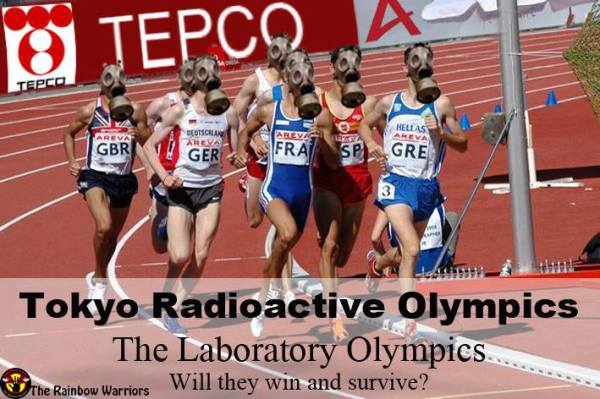
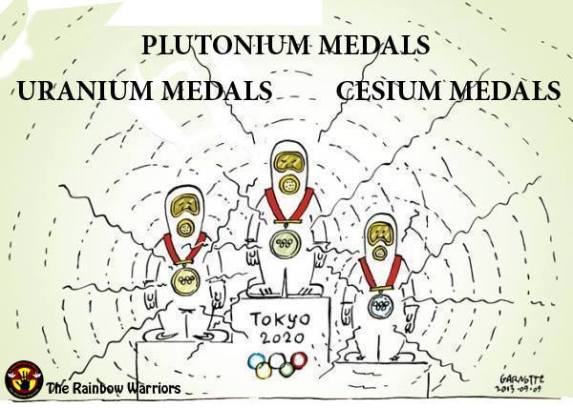
Olympic games in Fukushima: Is it safe?

 Fukushima city is going to host Olympic baseball and softball games in 2020.
What is the level of radio-contamination there? This is the question on everybody’s mind, spectators and players from all over the world. Is it really safe?
Baseball and softball games will take place in Azuma Sports Park in Fukushima city.


Fukushima prefecture provides the information below on the radiation measurements of the Park.

Measurements of the airborne radiation dose in the baseball stadium: No 13-16
Those of the softball stadium: No 4
The lines above and below indicate the value of the radiation dose at 1cm and 5cm above the ground.
We notice that, as usual, Fukushima prefecture gives only measurements in terms of radiation dose. Based on this information, one might think that it would be relatively safe to play there or to attend the games. However, monitoring only the radiation dose is not enough for radioprotection. The radiation dose is an indication of external irradiation exposure. In this case, the measures of radioprotection will be to stay away from the radioactive objects or not to stay in their vicinity for a long time. But the radiation dose does not provide information to avoid the risk of internal irradiation. For this latter, it is necessary to monitor surface contamination density or concentration, in this case, of soil (in terms of Becquerels/m2 or Bq/kg), as well as the concentration of radioactive substances in the air (Bq/m3). The radioprotection measures against internal irradiation would be wearing protective gear and masks to avoid the radioactive substances from adhering to the skin and/or entering the body.
Here is some information provided by Yoichi OZAWA of « Fukuichi Area Environmental Radiation Monitoring Project », the group of which we have published several soil contamination maps in this blog. OZAWA took measurements on July 27 at the request of the ARD German TV channel team which was visiting Fukushima.

Contamination concentration and density of 5cm surface soil around the Azuma Baseball Stadium
Point A : The entrance of the « Torimu no Mori» where children play.
Radiation dose at 1m above the ground : 0.12 μSv/h
Radiation dose on the ground : 0.19µSv/h
Surface concentration : 605 Bq/kg
Surface density : 47,300 Bq/m2
Point B : In front of the Multi-purpose Fields.
Radiation dose at 1m above the ground : 0.10 μSv/h
Radiation dose on the ground : 0.22µSv/h
Surface concentration : 410 Bq/kg
Surface density : 31,200 Bq/m2
To interpret these figures, let us remind you that in Japan, according to the Ordinance on Prevention of Ionizing Radiation Hazards, places where the effective dose is likely to surpass 1.3mSv in 3 months (approximately 0.6µSv/h of airborne radioactivity) or the contamination density to exceed 40,000Bq/m2 are designated as a « Radiation Control Zone » and public entry must be severely restricted. People under 18 years old are not allowed to enter, and even adults, including nuclear workers, cannot stay more than 10 hours. It is prohibited to eat, drink or stay overnight. To leave the zone, one has go through a strict screening to check for radioactive substances leaving the zone, a measure to protect the individual person as well as the environment.
We do not have the measures of surface density of the baseball nor softball stadiums, but in answering the question of the above German TV team, the information was given as to the decontamination work and radiation dose. There had been decontamination work, and the airborne radiation dose was about 0.04µSv/h in the baseball stadium.
Even when decontamination work has been carried out in the stadium, the mountains and woods behind the park have not been decontaminated, and wind and rain bring the radioactive substances towards the park. Besides, as we can see above, other places in the park are highly contaminated when we look at the surface contamination. They represent high risks of internal irradiation. Moreover, according to recent research, radioactive particles disseminated by the Fukushima Daiichi nuclear accident are mostly insoluble in water. This characteristic makes the health hazard much worse than in the case of the usual water soluble Cesium (see English transcription of NHK documentary on Insoluble Radioactive Particles in this blog). We believe that this Park should not be open to the public, especially to children.
The small type of insoluble radioactive particles – also called Cesium balls -, are dispersed in the Tokyo metropolitan area. People who visit this area should be careful and should take adequate radioprotection measures especially when it is windy and the radioactive particles can be re-disseminated.
All in all, we believe that there is far too much risk for the players and spectators to participate in the Olympic games in Fukushima. Fukushima should not host the Olympic games. Furthermore, we are against holding the Olympic games in Tokyo.
___
Read also :
See the publication of August 4 2017 in the FB of Oz Yo
https://fukushima311voices.wordpress.com/2017/08/07/olympic-games-in-fukushima-is-it-safe/
Ministry pushes farmers to attain certification to supply food for Tokyo Olympics

The agriculture ministry has stepped up efforts to certify more agricultural producers in preparation for the 2020 Tokyo Olympics and Paralympics, as the number of meals to be served for athletes and staff will likely exceed 15 million, the amount distributed during the 2012 London Games.
Agricultural producers supplying food for the upcoming quadrennial sporting events are required to obtain certificates under the Good Agricultural Practices third-party system to guarantee safety.
In Japan, about 4,500 farmers and farming organizations have acquired either the Global GAP, issued by a German association, or the Japan GAP (JGAP), managed by the Japan GAP Foundation. This is likely to fall short of the number of producers needed in the 2020 Games, sources familiar with the situation said.
A big obstacle is the expense of obtaining the certificates, with close to ¥100,000 in screening fees needed for the JGAP.
In March, the organizing committee for the Tokyo Games announced a decision to use food made by GAP-certified producers for meals to be served at the Olympic village and other related facilities.
With the current situation, Japan would have to procure a considerable amount of food from abroad, the sources said.
The ministry has set a goal of more than tripling the number of certified agricultural producers from the current level by the fiscal year ended March 2020.
In addition to providing subsidies to cover JGAP screening fees, the ministry plans to give priority to producers aiming to obtain GAP certificates in specific subsidy programs in fiscal 2018.
The Fukushima Prefectural Government plans to take advantage of the 2020 Games to dispel misinformation about the safety of food produced in the prefecture, home to Tokyo Electric Power Company Holdings Inc.’s Fukushima No. 1 nuclear power plant, where triple reactor meltdowns occurred due to damage from the March 2011 earthquake and tsunami.
In May this year, Fukushima Gov. Masao Uchibori declared that Fukushima aims to rank top among the country’s 47 prefectures in terms of the number of producers with GAP certificates. At present, there are nine GAP-certified producers in the prefecture.
By supplying locally produced food for the games, the prefecture hopes to promote the Fukushima brand in and outside Japan.
The prefectural government is now actively holding seminars to inform farmers and agricultural cooperative officials about the advantages of gaining GAP certification.
A company that operates a fruit farm producing persimmons, peaches and apples in the Fukushima city of Aizuwakamatsu won the JGAP certificate in January.
The process involved preparation of daily work reports and other documents. The costs, including expenses for pesticide storage facilities, were high, according to the firm.
Still, Mitsuhiro Saito, 60, president of the company, said, “The acquisition of the certificate helped boost our awareness about the importance of maintaining a clean environment and labor safety.”
But his farm may face a shortage of fruits for regular sales if products are supplied for the 2020 Games.
Saito now believes that it would be better for his farm to supply products for the Olympics and Paralympics only if inventories are enough, rather than placing absolute priority on the Games and creating problems for regular customers.
Fukushima Radiation and the 2020 Tokyo Olympics
Japan Plans to Expose Its People and 2020 Tokyo Olympians to Fukushima Radiation
 Radiation-contaminated debris and soil is stockpiled for disposal near the Tokyo Electric Power Company’s embattled Fukushima Daiichi nuclear power plant on February 25, 2016, in Okuma, Japan.
Former nuclear industry senior vice president Arnie Gundersen, who managed and coordinated projects at 70 US atomic power plants, is appalled at how the Japanese government is handling the Fukushima nuclear crisis.
“The inhumanity of the Japanese government toward the Fukushima disaster refugees is appalling,” Gundersen, a licensed reactor operator with 45 years of nuclear power engineering experience and the author of a bestselling book in Japan about the Fukushima Daiichi disaster, told Truthout.
He explains that both the Japanese government and the atomic power industry are trying to force almost all of the people who evacuated their homes in the wake of the Fukushima nuclear disaster to return “home” before the 2020 Tokyo Olympics.
This March Japan’s federal government announced the subsidies that have, up until now, been provided to Fukushima evacuees who were mandated to leave their homes are being withdrawn, which will force many of them to return to their contaminated prefecture out of financial necessity.
And it’s not just the Japanese government. The International Olympic Commission is working overtime to normalize the situation as well, even though conditions at Fukushima are anything but normal. The commission even has plans for the 2020 Tokyo Olympics to have baseball and softball games played at Fukushima.
Gundersen believes these developments are happening so that the pro-nuclear Japanese government can claim the Fukushima disaster is “over.” However, he noted, “The disaster is not ‘over’ and ‘home’ no longer is habitable.”
His analysis of what is happening is simple.
“Big banks and large electric utilities and energy companies are putting profit before public health,” Gundersen added. “Luckily, my two young grandsons live in the US; if their parents lived instead in Fukushima Prefecture [a prefecture is similar to a state in the US], I would tell them to leave and never go back.”
Reports of radiation from the Fukushima Daiichi nuclear disaster, which began when a tsunami generated by Japan’s deadly earthquake in 2011 struck the nuclear plant, have been ongoing.
Seven more people who used to live in Fukushima, Japan were diagnosed with thyroid cancer, the government announced in June. This brings the number of cases of thyroid cancer of those living in the prefecture at the time the disaster began to at least 152.
While the Japanese government continues to deny any correlation between these cases and the Fukushima disaster, thyroid cancer has long since been known to be caused by radioactive iodine released during nuclear accidents like the one at the Fukushima Daiichi power plant. A World Health Organization report released after the disaster started listed cancer as a possible result of the meltdown, and a 2015 study in the journal Epidemiology suggested that children exposed to Fukushima radiation were likely to develop thyroid cancer more frequently.
The 2011 disaster left 310 square miles around the plant uninhabitable, and the area’s 160,000 residents were evacuated. This April, officials began welcoming some of them back to their homes, but more than half of the evacuees in a nearby town have already said they would not return to their homes even if evacuation orders were lifted, according to a 2016 government survey.
Officials from Tokyo Electric Power Company (TEPCO), the company responsible for cleaning up the disaster, announced this February they were having difficulty locating nuclear fuel debris inside one of the reactors. Radiation inside the plant continues to skyrocket to the point of causing even robots to malfunction.
Cancer cases continue to crop up among children living in towns near Fukushima.
And it’s not as if the danger is decreasing. In fact, it is quite the contrary. Earlier this year, radiation levels at the Fukushima plant were at their highest levels since the disaster began.
TEPCO said atmospheric readings of 530 sieverts an hour had been recorded in one of the reactors. The previous highest reading was 73 sieverts an hour back in 2012. A single dose of just one Sievert is enough to cause radiation sickness and nausea. Five sieverts would kill half of those exposed within one month, and a dose of 10 sieverts would be fatal to those exposed within weeks.
Dr. Tadahiro Katsuta, an associate professor at Meiji University, Japan, is an official member of the Nuclear Reactor Safety Examination Committee and the Nuclear Fuel Safety Examination Committee of the Nuclear Regulation Authority. Truthout asked him what he was most concerned about regarding the Japanese government’s handling of the ongoing nuclear disaster at Fukushima.
“What I regard as the most dangerous, personally, is the fact that the Japanese government has chosen the national prestige and protection of electric power companies over the lives of its own citizens,” Katsuta, who wrote the Fukushima update for the World Nuclear Industry Status Report, said.
Gundersen thinks it simply makes no sense to hold the Olympics in Japan.
“Holding the 2020 Olympics in Japan is an effort by the current Japanese government to make these ongoing atomic reactor meltdowns disappear from the public eye,” Gundersen said. “I discovered highly radioactive dust on Tokyo street corners in 2016.”
According to Gundersen and other nuclear experts Truthout spoke with, the crisis is even worse.
Fukushima and Surrounding Prefectures Radioactively “Contaminated”
“The Japanese government never dedicated enough resources to trying to contain the radiation released by the meltdowns,” Gundersen said.
Gundersen said that during his first trip to Japan in 2012, he stated publicly that the cleanup of Fukushima would cost more than a quarter of a trillion dollars, and TEPCO scoffed at his estimate. But now in 2017, TEPCO has reached and announced the same conclusion, but as a result of its inaction in 2011 and 2012, the Pacific Ocean and the beautiful mountain ranges in Fukushima and surrounding prefectures are contaminated.
One of the tactics that Prime Minister Shinzō Abe’s administration chose to deploy at Fukushima to contain radiation was an underground “ice wall.”
“As the ‘ice wall’ was being designed, I spoke out that it was doomed to fail, and was [an] incredibly expensive diversion,” Gundersen said. “There are techniques that could stop water from entering the basements of the destroyed reactors so that the radioactivity would not migrate through the groundwater to the ocean, but the Japanese government continues to resist pursuing them.”
Gundersen argues that Japan could and should build a sarcophagus over all three destroyed reactors and wait 100 years to dismantle them. This way, the radioactive exposure will be minimized for Japanese workers, and ongoing radioactive releases to the environment would be minimized as well.
Gundersen also points out that it is equally important that radioactive water continues to run out of the mountain streams into the Pacific, so a thorough cleanup of the mountain ranges should begin right now, but that is a mammoth undertaking that may never succeed.
In addition to his other roles, Arnie Gundersen serves as the chief engineer for Fairewinds Energy Education, a Vermont-based nonprofit organization founded by his wife Maggie. Since founding the organization, Maggie Gundersen has provided paralegal and expert witness services for Fairewinds. Like her husband, she’s had an inside view of the nuclear industry: She was an engineering assistant in reload core design for the nuclear vendor Combustion Engineering, and she was in charge of PR for a proposed nuclear reactor site in upstate New York.
When Truthout asked her how she felt about the Abe government’s response to Fukushima, she said, “Human health is not a commodity that should be traded for corporate profits or the goals of politicians and those in power as is happening in Japan. The Japanese government is refusing to release accurate health data and is threatening to take away hospital privileges from doctors who diagnose radiation symptoms.”
Maggie Gundersen added that her husband also met with a doctor who lost his clinic because he was diagnosing people with radiation sickness, instead of complying with the government’s story that their illnesses were due to the psychological stress of the Fukushima Daiichi meltdowns.
M.V. Ramana is the Simons Chair in Disarmament, Global and Human Security at the Liu Institute for Global Issues at the University of British Columbia in Canada, and is also a contributing author to the World Nuclear Industry Status Report for 2016. Like the Gundersens, he is critical of the Abe administration’s mishandling of Fukushima.
“I am not sure we can expect much better from the Abe administration that has shown so little regard for people’s welfare in general and has supported the nuclear industry in the face of clear and widespread opposition,” Ramana told Truthout. “As with restarting nuclear power plants, one reason for this decision seems to be to reduce the liability of the nuclear industry, TEPCO in this case. It is also a way for the Abe administration to shore up Japan’s image, as a desirable destination for the Olympics and more generally.”
Katsuta agreed.
“Prime Minister Abe has neither the knowledge about the issue of Fukushima accident nor the interest at all,” Katsuta said. “The Abe administration has yet to clearly apologize for its responsibility for promoting the nuclear energy policy.”
Instead, according to Katsuta, the Abe administration has lifted evacuation orders in an effort to “erase the memories of the accident.”
Fukushima Evacuees “Forced” Back Home
In the immediate wake of the Fukushima Daiichi meltdowns, 160,000 people fled areas around the plant. The Abe government has been providing housing subsidies to those who were evacuated, but its recent announcement means those subsidies will no longer be provided. Many “voluntary evacuees” will be forced to consider returning despite lingering concerns over radiation.
“This is very unfortunate,” Ramana said of the withdrawal of the subsidies. “The people who were evacuated from Fukushima have already been through a lot and for some of them to be told that the government, and presumably TEPCO, does not have any more liability for their plight seems quite callous.”
He explains that, in enacting this callous move, the Japanese government is claiming that radiation exposure is now within “safe levels” for people to return home. This claim ignores the fact that levels now are even higher than before the accident, and also disregards the widespread uncertainties plaguing the measurement of radiation in the affected areas.
Katsuta expressed similar concerns.
“The lifted evacuation area has not been restored completely, as the radiation dose is still high, and decontamination of the forest is excluded,” he said. “Besides, the decontamination waste is often stored in the neighborhood, and there were many families who did not return, and then the local community collapsed.”
Katsuta added that the subsidies only amount to $1,000 per refugee, so paying them for the next 10 years is “not expensive” in order to safeguard human lives.
Given her work in PR for the nuclear industry, Maggie Gundersen had an interesting position on the Abe government’s tactics.
When she was working for the atomic power industry, she was “carefully taught” certain misinformation about atomic power reactors by industry scientists and engineers. She said she would never have done that work if she had known the “hidden truth.” She and Arnie were both taught that atomic power was the “peaceful use of the atom” — she does not support war and believes that the use of atomic weapons or depleted uranium are horrific crimes — and she explains that she never would have worked for or promoted atomic power knowing what she knows now.
“Arnie and I immediately noticed that TEPCO and the Japanese government were using the same playbook that was used at Chernobyl and Three Mile Island (and for that matter, Deepwater Horizon),” Maggie Gundersen explained. “Governments immediately minimize the amount of radiation being released, or in the case of Deepwater Horizon, the amount of oil.”
She added that in each of these cases, the mainstream press dutifully reported shortly after the crisis that there was nothing to fear, even though there was no evidence to support these assertions. The governments’ objectives were to minimize fear and chaos, and most media simply echoed officials’ claims. The responses to the Fukushima disaster are following the same pattern.
“Is the Abe regime glossing over the seriousness of the Fukushima meltdowns and ongoing radioactivity? Absolutely,” she said. “What is happening in Japan to the known and unknown victims is a human rights violation and an environmental justice debacle.”
2020 Tokyo Olympics to Be Held Amidst “Hot Particles”
Katsuta said that the Fukushima evacuees are “extremely worried” that their plight will be overshadowed by the Olympics. He believes the Japanese government is using the Olympics to demonstrate to the world that Japan is now a “safe” country and that the Fukushima disaster “has been solved.”
“In Japan, the people are really forgetting the Fukushima accident as … the news of the Olympics increases,” he said.
Arnie Gundersen doesn’t think it makes sense to have some of the Olympic venues (soccer, baseball and possibly surfing) in Fukushima Prefecture itself.
“Radioactively ‘hot particles’ are everywhere in Fukushima Prefecture and in some of the adjacent prefectures as well,” he said. “These ‘hot particles’ present a long-term health risk to the citizens who live there and the athletes who will visit.”
Ramana, too, believes that the events held closer to Fukushima “may be adding to the radiation dose of the competitors and the spectators.”

Fukushima Disaster “Will Continue for More Than 100 Years”
Maggie Gundersen pointed out that the Nuclear Regulatory Commission consistently claims it has learned lessons from Fukushima, but she doesn’t think the commission — or the Japanese government, or corporations — learned any lessons at all.
“Energy production is all about money,” she said. “After the meltdowns, many banks in Japan invested in keeping the atomic power reactors on hold until the disaster could sort itself out. Those banks and the government supporting its access to the use of the atom have a vested interest in starting the old reactors up.”
Katsuta has a dire outlook for the future of Fukushima, and said there are already numerous evacuees who have given up hope of returning because they are aware of the crisis being unsolvable by the current means of TEPCO and the Abe administration.
“Even if decontamination and decommissioning work progresses, the problem will not be solved,” he said. “We have not yet decided how to dispose of decontamination waste and decommissioning waste.”
Ramana believes Fukushima should be a reminder of the inherent hazards associated with nuclear power, and how those hazards become worse when entities that control these technologies put profits over human wellbeing.
Arnie Gundersen had even stronger words.
“The disaster at Fukushima Daiichi will continue for more than 100 years,” he explained. “Other atomic power reactor disasters are bound to occur. Chernobyl and Fukushima Daiichi should have taught everyone around the world that nuclear power is a technology that can destroy the fabric of a society overnight.”
According to him, the remains of the reactor containments at Units 1, 2 and 3 are highly susceptible to damage from another severe earthquake, and any earthquake of 7.0 or higher at the Fukushima site could provoke further severe radiation releases.
Shortly after the meltdowns, Maggie and Arnie Gundersen both spoke about Japan being at a “tipping point”: It could respond to the disaster by leading the world in renewable energy while choosing to protect people and the pristine rural environment through sustainable energy economies.
But obviously it didn’t work out that way.
“The world saw Japan as technologically savvy, but instead of moving ahead and creating a new worldwide economy, it continues with an old tired 20th century paradigm of energy production,” Maggie Gundersen said. “Look at the huge success and progress of solar and wind in other countries like Germany, Nicaragua and Denmark. Why not go energy independent, creating a strong economy, producing many more jobs and protecting the environment?”
Arnie Gundersen has plans to return to Japan later this year on a crowdsourced trip with scientific colleagues in order to teach Japanese citizen scientists how to take additional radioactive samples. Fairewinds Energy Education is currently fundraising to make this possible.
In the meantime, dramatic examples of the ongoing dangers of nuclear power in Japan abound.
In June, radioactive materials were found in the urine of five workers exposed to radiation in an accident at a nuclear research facility in Japan’s Ibaraki Prefecture. In that incident, one of the workers had a large amount of plutonium in his lungs.
Recent polls in Japan show that the Japanese public has lost faith in nuclear safety regulation, and a majority of them favor phasing out nuclear power altogether.
Meanwhile in the US, President Donald Trump has put nuclear energy first on the country’s energy agenda and has announced a comprehensive study of the US nuclear energy industry. Trump’s energy secretary Rick Perry said, “We want to make nuclear cool again.
https://www.ecowatch.com/tokyo-olympics-fukushima-2460798164.html
Anger as Fukushima to host Olympic events during Tokyo 2020 Games

An environmental activist wearing a gas mask takes part in a recent demonstration to mark the 6th anniversary of the Fukushima nuclear disaster
The decision to hold baseball and softball matches in the city of Fukushima as part of the Tokyo 2020 Olympic Games has been criticised as a cynical manoeuvre by the Japanese government to convince the world that the 2011 nuclear crisis is over.
The Tokyo Organising Committee of the Olympic and Paralympic Games announced on Friday that the Fukushima Azuma Baseball Stadium will host softball and baseball matches during the Games.
Venues in Tokyo will host the majority of the sporting events, which will take place six years after a magnitude 9 earthquake struck off Tohoku, triggering a tsunami that killed more than 18,000 people and the melt-down of three reactors at the Fukushima Dai-ichi nuclear plant, which is less than 50 miles from Fukushima City.
In a statement, the committee said it believes that “the hosting of events in Fukushima will support recovery efforts in the overall Tohoku region.
“Matches played in the Tohoku region will be further evidence of Tokyo 2020’s commitment to bring sporting events to the recovering areas and will demonstrate the power of sport”, it added.
The statement makes no mention of ongoing efforts at the Fukushima plant to bring the reactors under control and recover the nuclear fuel that has escaped from containment vessels. Authorities estimate it will take 40 years for the site to be rendered safe.
Work is also continuing to decontaminate areas that were beneath the nuclear plume immediately after the accident. According to government figures, around 120,000 people are still not able to return to their homes because of the disaster.
“It’s fine for athletes and spectators to go to Fukushima for a couple of days to compete, but the Japanese government is using this to claim that everything is back to normal and that he evacuees should go back to their homes”, said Aileen Mioko-Smith, an anti-nuclear campaigner with Kyoto-based Green Action Japan.
“It’s unconscionable”, she told The Telegraph. “To tell people that because the Games are being held in Fukushima that it is perfectly safe for people to go back to their homes, for farmers to go back into their fields, for children to play in the open air is just wrong”.
http://www.telegraph.co.uk/olympics/2017/03/17/anger-fukushima-host-olympic-events-tokyo-2020-games/
Fukushima’s Upcoming Olympics

Japan will hold soccer and baseball events in Fukushima Prefecture for the Tokyo 2020 Olympics. This is not a spoof. Effective March 2017, the Japan Football Association displaces Tokyo Electric Power Company’s emergency operations center at J-Village, the national soccer training center before the nuclear meltdown occurred.
To naysayers that say this is a joke, the answer is ‘no this is not a joke’. It is absolutely true Olympic events will be held in Fukushima Prefecture, thereby casting aside any and all concerns about the ongoing nuclear meltdown; after all that’s history.
Or, is it?
Here is the announcement as carried in The Japan Times some months ago: “The men’s and women’s national soccer teams for the 2020 Tokyo Olympics will use the J-Village national soccer training center, currently serving as Tokyo Electric Power Co.’s forward base in dealing with the Fukushima nuclear crisis, as their training base, the Japan Football Association revealed Saturday.”
For those who missed the past few classes, Fukushima is home to the worst industrial accident in human history as three nuclear reactors experienced 100% meltdown, the dreaded “China Syndrome.” Molten core, or corium, in all of the reactors, highly radioactive and deadly, frizzles robots. Tokyo Electric Power Company (TEPCO) says it may take 40 years to clean up the disaster zone, but that is a wild guess.
Nobody on planet Earth has any idea where the radioactive molten cores are, within the reactor containment vessels or burrowed into the earth, and/or what happens next, e.g., there’s speculation that Unit #2 is rickety and could collapse from another big earthquake (Japan is riddled with earthquake zones, experiencing an earthquake on average every day) thus collapsing, which leads to an untold, massive disaster, rendering the city of Tokyo uninhabitable.
According to Dr. Shuzo Takemoto, Engr. / Kyoto University, February 2017: “The Fukushima nuclear facility is a global threat on level of a major catastrophe… The problem of Unit 2… If it should encounter a big earth tremor, it will be destroyed and scatter the remaining nuclear fuel and its debris, making the Tokyo metropolitan area uninhabitable.”
Numerous efforts by TEPCO to locate the melted cores have been useless. As of recently: “Some Nuclear Regulation Authority members are skeptical of continuing to send robots into reactors in the crippled Fukushima No. 1 plant to collect vital data on the locations of melted nuclear fuel and radiation levels… investigations utilizing robots controlled remotely generated few findings and were quickly terminated” (Source: Nuke Watchdog Critical as Robot Failures Mount at Fukushima Plant, The Asahi Shimbun, March 24, 2017).
All of which inescapably brings to mind the following question: How could anybody possibly have the audacity to bring Olympic events to the backyard of the worst nuclear meltdown in history whilst it remains totally 100% out of control?
Answer: Japan’s PM Shinzō Abe and the International Olympic Committee (IOC).
According to Naohiro Masuda, the head of decommissioning, TEPCO does not know how to decommission the nuclear facilities. Meanwhile, ongoing radiation is a constant threat to air, soil, food, and water, e.g., state inspectors have discovered deadly high levels of cesium pooling at the base of Fukushima’s 10 big dams that serve as water reservoirs (drinking water and agriculture). For example, Ganbe Dam 27,533 Bq/kg and Mano Dam at 26,859 Bq/kg whereas Japan’s Environment Ministry’s safe limit for “designated waste” is set at 8,000 Bq/kg. That limit is for “waste,” not drinking water. (Source: High Levels of Radioactive Cesium Pooling at Dams Near Fukushima Nuke Plant, The Mainichi – Japan’s National Daily Since 1922, September 26, 2016.)
Japanese officials are ignoring the extraordinarily high levels of cesium at the bottom of the dam reservoirs because the top water levels do meet drinking water standards. The prescribed safe limit of radioactive cesium for drinking water is 200 Bq/kg. A Becquerel (“Bq”) is a gauge of strength of radioactivity in materials such as Iodine-131 and Cesium-137. As it happens, Cesium-137 is one of the most poisonous substances on the face of the planet.
Additionally, open storage and incineration of toxic and radioactive rubble is ongoing throughout the prefecture. In fact, the entire prefecture is a toxic warehouse of radioactive isotopes, especially with 70% of Fukushima consisting of forests never decontaminated, yet the Abe administration is moving people back to restricted zones that Greenpeace Japan says contain radioactive hot spots.
According to Greenpeace Japan, which has conducted 25 extensive surveys for radiation throughout Fukushima Prefecture since 2011: “Unfortunately, the crux of the nuclear contamination issue – from Kyshtym to Chernobyl to Fukushima- is this: When a major radiological disaster happens and impacts vast tracts of land, it cannot be ‘cleaned up’ or ‘fixed’.” (Source: Hanis Maketab, Environmental Impacts of Fukushima Nuclear Disaster Will Last ‘decades to centuries’ – Greenpeace, Asia Correspondent, March 4, 2016).
With the onset of the Fukushima Diiachi meltdown, the Japanese government increased the International Commission on Radiological Protection guidelines for radiation exposure of people from 1 millisievert (mSv) per year up to 20 mSv/yr. As such, according to the standards set by the International Commission on Radiological Protection, ICRP Publication 111, Japan’s Olympics will expose Olympians and visitors to higher than publicly acceptable levels of radiation. After all, the emergency guideline of 20 mSv/yr was never meant to be a long-term solution.
With the onset of Olympic venues in Fukushima, maybe that will open the way for the 2024 Olympics in Chernobyl. But, on second thought that will not work. Chernobyl’s Exclusion Zone is 1,000 square miles (off limits for hundreds, maybe thousands, of years) because of an explosion in one nuclear power plant that is now under control whereas Fukushima has three nuclear meltdowns that remain, to this day and into the unforeseeable future, radically out of control and extremely hazardous.
Mystifying and Confusing?
Yes, it’s mystifying and confusing, but the games go on.
http://www.counterpunch.org/2017/04/12/fukushimas-upcoming-olympics/
2020 Olympic food suppliers lack necessary food safety certification

As the organizers of the 2020 Olympics and Paralympics work on ensuring that food provided during the tournament will be safe, the games face a huge shortage of domestic food producers with the necessary food safety certification.
The certification in question is known as “Good agricultural practice,” or GAP for short. Ever since the London Olympics and Paralympics in 2012, the provision of GAP-certified food and drink to venues such as the Olympic Village has become increasingly important.
However, the number of producers in Japan who hold GAP certification is extremely low — partly due to high costs and a lack of knowledge about GAP among consumers. It is thought that less than 1 percent of food producers in Japan hold either the Global GAP or Japanese GAP certification.
This is an issue for producers because the organizing committee for the Tokyo 2020 Games is on the verge of finalizing criteria for food safety during the tournament — with much of the criteria expected to revolve around GAP certification.
In response to the current shortage of GAP-certified producers in Japan, an official close to the government commented, “If we keep going at this pace, there is a real danger than there won’t be enough domestically produced food available during the Games.” This would be a great shame because the country has a multitude of wonderful food and drink on offer, such as “wagyu” (Japanese beef) and Japanese tea.
Furthermore, it is expected that about 15 million meals will need to be provided during the 2020 Olympics, so naturally, it will be an excellent opportunity to showcase Japanese food to the rest of the world.
There is a modified version of GAP in Japan — based on Ministry of Agriculture, Forestry and Fisheries of Japan (MAFF) guidelines — but just five of Japan’s 47 prefectures, including Shimane and Tokushima, follow it.
A British version of GAP known as “Red Tractor” was introduced prior to the 2012 London Olympics and Paralympics. In total, 80 percent of food producers who supplied the tournament in London picked up the Red Tractor certification by 2010. Such a system may well provide inspiration for Japanese farmers.
GAP is an important certification because it helps stop the mixing in of any improper substances during the food production process. For example, under GAP regulations, pesticides must be stored safely in a locked room. Also, any fluorescent lighting close to agricultural produce should be covered accordingly.
However, although GAP certification is undeniably well-intended, farmers wanting to apply must pay an annual registration fee in the region of several thousand yen per year, and depending on the size of the farm, there is a screening fee in the region of 100,000 to 400,000 yen per year. In addition, awareness about GAP is low among distributors and consumers, and the fact that GAP certification would not be accepted as a reason for raising food prices means that there are several hurdles for producers.
The government does plan to provide some financial support in this area, but for the time being, awareness across Japan about GAP certification remains a pressing issue.
http://mainichi.jp/english/articles/20170305/p2a/00m/0na/001000c
Rebuilding Fukushima through Soccer
To expose children to possible radioactive nanoparticles without any protection just for the sake of propaganda to show that everything is safe and back to normal in Fukushima is irresponsible and criminal! All in the name of the recovery and reconstruction campaign organized by the Japanese government to welcome all the tourists to come to “clean” beautiful Japan for the 2020 Tokyo Olympics! Olympics to which Fukushima produce will be used to prepare the meals fed to the visiting athletes! All in the name of promotion and economic reconstruction! Alternate facts, total denial of reality being substituted to real facts and dangers. A total insanity!

A former soccer training facility close to Japan’s crippled Fukushima Daiichi Nuclear Plant has been used as a staging point for recovery work since the 2011 nuclear disaster, but that’s about to change.
Temporary dormitories for workers stand where there used to be a soccer field at the facility, called J-Village. The area is filled with memories for Shigenari Akashi, who worked as a coach for a junior youth team there for more than 10 years.
“National tournament finals used to be held here. Children from all over the country would practice hard, aspiring to play here,” Akashi says.
J-Village was Japan’s first national soccer training center. It opened in 1997 and over the years saw more than a million visitors. The complex was even used to train the national teams of Japan and Argentina.
But the nuclear disaster changed everything. The facility is just 20 kilometers from the plant, so Tokyo Electric Power Company rented it to set up an operational base for containing the accident.
“I was in shock and at a loss for words when I saw the Self-Defense Forces’ tanks here, and the gravel laid on the natural turf for the parking lot,” says Akashi.
At the end of last year, the moment he had been waiting for finally arrived as TEPCO began work to return the facility to its original form.
Fukushima Prefecture has even bigger plans — tt wants to build Japan’s first “all-weather soccer field” at the site. Part of the facility is scheduled to open in the summer of 2018.
The Japan Football Association has given the project its full support. The Japanese national team will use the new J-Village as its training base for the 2020 Tokyo Olympics.
But there are bigger challenges than rebuilding. There are fears over radiation levels — in some areas they’re still higher than international standards recommend. So the J-Village operator has a plan.
“The construction work will focus on largely replacing the soil, a technique we expect will reduce radiation levels more than usual decontamination methods,” says Eiji Ueda, who is executive vice president at the facility. “We can emphasize how safe it is by hosting national teams from Japan or perhaps abroad for training.”
A town near J-Village was evacuated because of the disaster. Residents got the green light to move back a year and a half ago but few have returned as most of the evacuees still live in a neighboring city.
Akashi and his co-workers have been giving soccer classes for children, including some who lived near J-Village. But there are mixed feelings about playing there again.
“I want to use the new J-Village, but I live far away now, so it will be hard to go there very often,” says a boy at the facility.
“We still have the lingering memory of it being used as the staging ground for decommissioning work,” says one father.
For Akashi, he’s got a specific goal in mind.
“In reviving J-Village, we want to give back local people a gathering place and their sense of pride. We believe this will also help to revive Fukushima as a whole,” he says.
The clock on the J-Village scoreboard is stopped at 2:46 p.m., the moment the earthquake struck. The deep rift created over the last 6 years will need to be filled so that the clock can move forward once more.
https://www3.nhk.or.jp/nhkworld/en/news/editors/3/rebuildingfukushimathroughsoccer/
Fukushima faces wall to hosting Olympic baseball
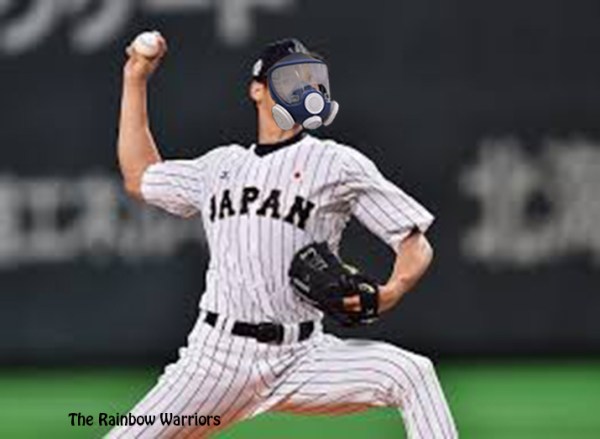
LAUSANNE, Switzerland – The world governing body for baseball and softball is calling on the organizing committee of the 2020 Tokyo Olympics to secure “a second stadium in the metropolitan area,” and is making it a prerequisite for the body to approve a plan to hold some games for the additional event in Fukushima Prefecture, it has been learned.
The organizing committee is finding it difficult to accept the idea of setting up “a second stadium” and negotiations are bound to reach a deadlock. The decision to make Fukushima an Olympic venue may have to wait until next spring or later.
The request from the World Baseball Softball Confederation was made known in a letter sent to the Tokyo Organizing Committee of the Olympic and Paralympic Games. Yoshiro Mori, the president of the organizing committee, revealed the content of the letter in an interview with The Yomiuri Shimbun on Wednesday. Mori is attending a board meeting of the International Olympic Committee held in Lausanne, Switzerland.
The IOC board approved of the plan to make Yokohama Stadium in the city of Yokohama the main venue for the additional event, but the decision on Fukushima was deferred.
According to Mori, the letter stated that the three possible venues in the prefecture – stadiums in the cities of Fukushima, Iwaki and Koriyama – were worthy candidates, but also set two conditions in order for the WBSC to approve the plan: to upgrade the stadium to be decided such as by turfing the infield and to secure a second stadium in the metropolitan area.
The IOC currently has plans to divide the six participating national teams into two groups for the preliminary round, so that eight to 10 games will be held in total including the final. The WBSC, on the other hand, intends to make the qualifying games a round robin of all six teams, which would likely increase the total number of games to from 17 to 19. With this in mind, the world body is hoping to add a second stadium to the event, such as Seibu Prince Dome in Tokorozawa, Saitama Prefecture, or Zozo Marine Stadium in Chiba.
Mori made it clear after the IOC board meeting that he would oppose the idea of a second stadium in the metropolitan area. He explained that the organizing committee has an understanding with the IOC that hosting an Olympic event in a disaster area should be considered separately as part of ongoing restoration efforts. “We have reconfirmed with the IOC that the principle of one venue still stands,” he said.
Financial concerns are another reason for opposing the second stadium plan. A senior official of the organizing committee said, “The budget will likely swell, and therefore, it would be difficult [to accept the idea].”
Mori had discussions with IOC President Thomas Bach at a luncheon on Wednesday. The IOC side informally told Mori that it backs the idea of hosting events in Fukushima and also that it will hear from the WBSC about the matter. The Japan side intends to continue negotiations with the WBSC while working in tandem with the IOC, and hopes to reach a conclusion at an IOC board meeting to be held next spring or later.
Deferring the decision to host the event in Fukushima will likely hinder preparations for the event, such as modifying the stadium and securing operation fees, and may put unwanted pressure on the disaster area.
The IOC board meeting on Wednesday came to a conclusion on the venues of five other additional events, including karate and surfing.
According to the decision, karate will be held at Nippon Budokan in Chiyoda Ward, Tokyo, while skateboarding and sport climbing will take place in the Odaiba and Aomi districts in Koto Ward, Tokyo. Tsurigasaki Beach in Ichinomiya, Chiba Prefecture, is the venue for surfing.
The organizing committee informed the board of its plan to cap the total cost of holding the Games at 2 trillion yen ($17.5 billion) and promoted Japan’s efforts to cut down costs.
Northeastern Japan Asks Koike for Tokyo Olympics Support
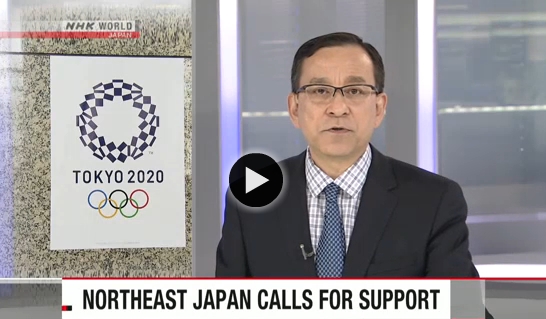
Northeastern Japan asks Koike for support
Prefectural leaders from northeastern Japan have asked the Tokyo governor for cooperation in supporting reconstruction of the 2011 disaster-hit region through the 2020 Olympic and Paralympic Games.
The governors and vice governors of the 6 prefectures handed a letter to Yuriko Koike when they met in Tokyo on Monday.

They hope the Tokyo Games will help revitalize areas affected by the 2011 earthquake and tsunami. The region’s recovery is a key theme for the Games.
The letter calls for the region’s festivals and traditional arts performances to be featured in events held in the run-up to the Olympics and Paralympics.
It also asks that the region’s wood materials be used at the Games facilities and food products at cafeterias in the athletes’ village.
The letter requests the torch relay course pass through the entire region so as many residents as possible will be able to take part in the run.
The governors said they hope the Games will contribute to bringing more foreign tourists to northeastern Japan.
They also said people in the region want an opportunity to express their gratitude to other countries for assisting in reconstruction.
Tokyo Governor Koike said the Games are the best opportunity to show to the world how the region has recovered.
Shame on TEPCO For Taking Kids into Fukushima Exclusion Zone for Damage Control Campaign
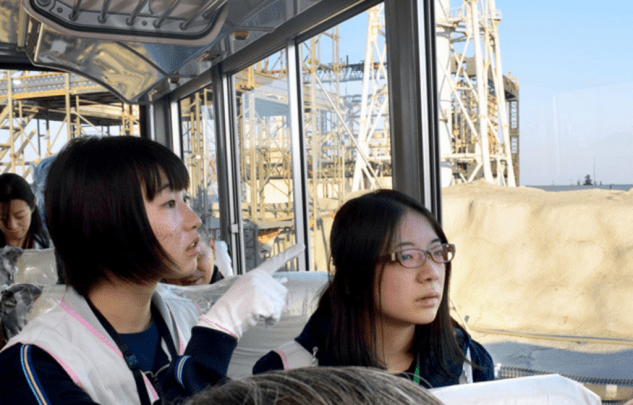
On November 18, 2016, Tokyo Electric Power Company, a.k.a. TECPCO, took a group of 13 students wearing dosimeters from Fukushima High School into the exclusion zone around the hobbled Fukushima Daiichi Power Plant for an educational tour. It is the opinion of the EnviroNews World News Editorial Board that this is unacceptable, and should not happen again until all radiation is cleaned up at the site.
The Asahi Shimbun reported, “It was the first tour by youngsters since the disaster as plant operator Tokyo Electric Power Co. had deemed the radiation risk was too high.”
To be clear, epidemiology and medical science have firmly established there is no “safe” amount of radiation to be exposed to — period — end of story. With each subsequent exposure, no matter how small, the bombarded organism experiences an increase in cancer risk.
Knowing that science has firmly established that there is no “safe” limit of radiation to be exposed to, it is the opinion of the EnviroNews World News Editorial Board that TEPCO should be ashamed of itself for taking a class of high school students into the still radioactive exclusion zone around the crippled power plant as part of what has been a continuous damage control campaign since the accident’s inception. Furthermore, TEPCO should apologize to the families, and commit publicly to not take any more children into the exclusion zone until all radioactivity has been removed.
FUKUSHIMA’S EXCLUSION ZONE: STILL A VERY DANGEROUS PLACE
The exclusion zone around the demolished Fukushima Daiichi power plant is a dangerous place. But when a person goes there, the invisible dangers that lurk don’t threaten to kill or maim right away — the hazardous radioactive rays and particles around Fukushima threaten to kill or harm them at some point years down the road — and those same radioactive exposures can also predispose and mutate their unborn children and grandchildren with birth defects, disease and cancer.
The gestation period of cancers from radiation ranges from as low as four years, to as high as fifty years or more. If an 80-year-old person is exposed to radioactivity, it is likely that other causes, either natural or unnatural, will lead to their demise before maladies caused by radiation will. However, for a very young person subjected to radioactivity, this is not the case, and for this reason, again, TEPCO should be ashamed of itself for taking children who may want to later have children themselves, into the exclusion zone for a publicity stunt. A physical trip to the location is not necessary to educate youth about the Fukushima accident, or nuclear power in general. To make a physical trip to the site with children is highly irresponsible. Less risky means of education must be used instead.
TEPCO AND JAPAN’S CONTINUOUS DAMAGE CONTROL CAMPAIGN
To suggest that TEPCO has been engaging in a continuous campaign of damage control and coverup is not a stretch at all. Earlier this year, TEPCO finally confessed publicly that it lied to the press and the entire world immediately following the meltdowns, downplaying the severity, and not admitting full meltdowns had occurred until several months later, when in fact, the company knew within hours that meltdowns were underway. This blatant lie put many thousands at risk and hampered evacuation strategies. Shortly after the company’s admission, former TEPCO Chairman Tsunehisa Katsumata, and two former Vice Presidents, Sakae Muto and Ichiro Takekuro were indicted for “professional negligence resulting in deaths and injury.”
Japan as a country, also has a serious PR problem with the ongoing Fukushima crisis — and that PR issue translates into economic problems, hence, Japan has done anything possible to slap a happy face on the disaster from the get-go.
Though it’s possible to display many examples of this, the country’s fervent and costly effort to host the 2020 Olympics, despite many concerns about Fukushima from the international community, may be the grandest. Japan has done much to stifle and stymie the voices of anti-nuclear protestors, while maintaining everything is “under control” at the rubbled plant. Nothing could be further from the truth.
It is the opinion of the EnviroNews World News Editorial Board that TEPCO, and the Japanese government, should come fully clean, relinquish their pridefulness, and engage the international community for help in the cleanup effort.
FUKUSHIMA: A SPEWING NUCLEAR DRAGON STILL ON THE LOOSE
To be clear on another point: the crisis at Fukushima Daiichi is in no way under control — quite the opposite. It is still out of control in many regards. For example, the radioactive waste water pileup problem at Fukushima is beyond critical, as over 1,100 massive storage tanks have engulfed nearly the entire area, filling the crumpled nuke site to the brim with deadly radioactive water. The operator has on multiple occasions had to discharge large amounts of tainted H2O out to sea. Secondly on this point is the fact that deadly uranium and plutonium contaminated water have been leaching into the ocean from under the reactor buildings on a continuous basis due to groundwater seepage.
Japan is a country that has been torn to shreds by radiation poisoning, possibly more than any other. Furthermore, Japan is one of only a couple dozen or so nations on earth suffering population decline, but scarily, Japan’s population is starting to contract at an alarming speed due to a low birth rate. The last thing organizations need to be doing is risking the genetic integrity and fertility of Japan’s youths by taking them to nuclear meltdown ground zeros. TEPCO should hang its head in front of the media, apologize, and agree to engage in no further publicity stunts that endanger the country’s children.
NUCLEAR COMPANIES SHOULD BE LIMITED, OR KEPT OUT OF SCHOOL-BASED NUCLEAR EDUCATION ENTIRELY
On another relevant topic, EnviroNews has long taken issue with nuclear companies being invited to participate in the educational process on nuclear issues, as our research has shown that children’s opinions are easily swayed when “educated” on the topic by nuclear companies. Many of the campaigns we’ve seen represent borderline indoctrination on the pros of nuclear power, while typically failing to mention catastrophes and the practically boundless risks and uncleaned waste sites still plaguing the planet today. Teachers and administrators should use more discretion on a topic as controversial as nuclear, and recognize that the industry’s propaganda campaigns know no boundaries.
One of many examples of these industry-driven “nukewashing” campaigns was witnessed by EnviroNews when EnergySolutions, a nuclear waste disposal company stationed in Utah, “educated” a class of students in Salt Lake City about the “benefits” of radiation. Before the event around three-quarters of the class was opposed to nuclear energy, but when surveyed again after EnergySolutions was finished, around three-quarters of the students had changed their stance to a pro-nuclear position. Naturally, the teacher failed to bring in an educator from any anti-nuclear groups who would paint a different picture entirely. Sadly, the U.S. Government, via the Department of Energy (DOE), has also gotten involved in the nukewashing with a curriculum based program called, the Harnessed Atom.
With that stated, it is the further opinion of the EnviroNews World News Editorial Board that nuclear companies should be kept out of the educational process on nuclear issues entirely — or at least limited to situations where anti-nuke organizations are allowed to present opposing views on the dangers and downsides of nuclear simultaneously.
“The tour made me realize that we should arm ourselves with accurate information if we want to change people’s perceptions of Fukushima as a scary place,” said Keika Kobiyama, a first-year student in the Fukushima High School tour group. Sadly Keika, the leaking radioactive nightmare at Fukushima Daiichi is still a very “scary place,” and should be recognized as such — and if TEPCO told you otherwise, the company is, well, full of radioactive crap.
1 This Month

of the week – Shut Down Drone Warfare!


Tell the Ukrainian Government to Drop Prosecution of Peace Activist Yurii Sheliazhenko

Petition to revoke the licensing of the Near Surface Nuclear Disposal Facility (NSDF) at Chalk River. https://www.ourcommons.ca/petitions/en/Petition/Details?Petition=e-7247
To see nuclear-related stories in greater depth and intensity – go to https://nuclearinformation.wordpress.com
-
Archives
- April 2026 (7)
- March 2026 (251)
- February 2026 (268)
- January 2026 (308)
- December 2025 (358)
- November 2025 (359)
- October 2025 (376)
- September 2025 (257)
- August 2025 (319)
- July 2025 (230)
- June 2025 (348)
- May 2025 (261)
-
Categories
- 1
- 1 NUCLEAR ISSUES
- business and costs
- climate change
- culture and arts
- ENERGY
- environment
- health
- history
- indigenous issues
- Legal
- marketing of nuclear
- media
- opposition to nuclear
- PERSONAL STORIES
- politics
- politics international
- Religion and ethics
- safety
- secrets,lies and civil liberties
- spinbuster
- technology
- Uranium
- wastes
- weapons and war
- Women
- 2 WORLD
- ACTION
- AFRICA
- Atrocities
- AUSTRALIA
- Christina's notes
- Christina's themes
- culture and arts
- Events
- Fuk 2022
- Fuk 2023
- Fukushima 2017
- Fukushima 2018
- fukushima 2019
- Fukushima 2020
- Fukushima 2021
- general
- global warming
- Humour (God we need it)
- Nuclear
- RARE EARTHS
- Reference
- resources – print
- Resources -audiovicual
- Weekly Newsletter
- World
- World Nuclear
- YouTube
-
RSS
Entries RSS
Comments RSS
 nuclear-news