Namie’s high recovery hopes haunted by dwindling coffers, fears of losing vital state dole
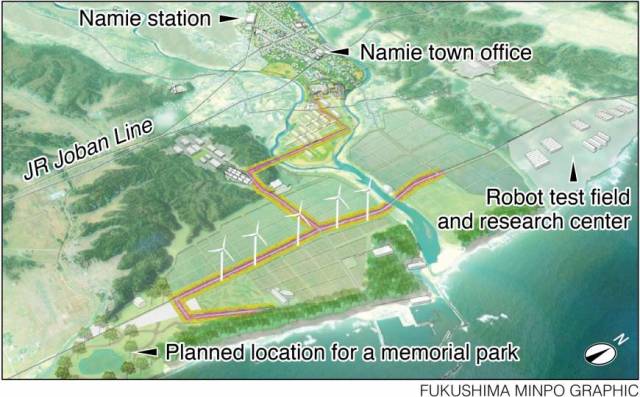
A robot testing facility, a robotics research center, a base for renewable energy and a memorial park — these are some of the plans the irradiated town of Namie, Fukushima Prefecture, has in mind for rebuilding after the triple reactor meltdown at the nearby Fukushima No. 1 power plant in March 2011.
But to pursue those plans, the town needs funds — a gigantic amount.
Namie is hoping to cover its funding needs with central government grants. But the two sides are still negotiating whether the municipality must shoulder a certain amount.
Also, there is no guarantee that the grants will continue beyond fiscal 2020, when the central government-designated reconstruction and revitalization period ends. This has residents worried that, even if the facilities are built, the municipality won’t be able to shoulder the maintenance and personnel costs needed to keep the facilities running.
“We are currently negotiating fiercely with the central government,” said Namie’s deputy mayor, Katsumi Miyaguchi, 61.
The town of Namie had the largest population in the Futaba district, but its coffers took a major hit after the calamity triggered by the Great East Japan Earthquake on March 11, 2011.
Residential tax revenue, which comprises about 30 to 40 percent of all tax revenues, sank to ¥500 million from about a ¥1 billion before 3/11 after the town decided to waive taxes for those with annual income below ¥5 million.
Whether to continue the waiver program is another difficult political issue.
The town was also waiving property taxes but plans to resume them when evacuations are lifted in some areas next spring. But land values have plunged since the meltdowns and any property tax revenues are expected to be low.
The same goes for corporate tax revenue, which has been hit by 3/11 business suspensions.
In short, Namie wouldn’t be able to pay the salaries of its town officials, let alone finance a reconstruction plan, if it weren’t for the central government grants.
As the centerpiece of its plan, Namie plans to build a facility adjacent to its town hall that would offer local information and house restaurants that serve up local specialties.
But that remains to be seen.
“We are making plans despite the uncertainty that the central government’s grants will cover them,” said a town official in charge. “If the funds don’t cover the entire plan, it may need to be revised.”
In the mayor’s office, currently in the city of Nihonmatsu, there is a calender showing the number of days that have passed since the disasters hit — over 2,000. But Namie is still far from recovery.
“The financial resources we’ve lost due to the disaster are excessive,” said Namie Mayor Tamotsu Baba, 68. “We desperately need the central government to continue its support.”
Another town executive agreed.
“If the government stops providing grants four years later when the reconstruction/revitalization period ends, it means the government has abandoned Namie,” the executive said.
Abe Sees Fukushima Progress!!!
Radiation risks are being swept under the rug. That restoration plan voluntarily chooses to ignore the risks for people to be living in a contaminated environment, not differentiating between the external and internal exposures and their sure harmful consequences to people health. Not to mention the ongoing incineration of contaminated waste in the Fukushima Prefecture 19 municipal incinerators, continuously redistributing radioactive nanoparticles into the environment. All done in the name of economic reconstruction!
Cabinet to approve Fukushima restoration plan
Prime Minister Shinzo Abe has visited Fukushima Prefecture to inspect the progress of restoration following the 2011 nuclear accident.
Abe visited a machinery parts manufacturer in Minamisoma City on Saturday.
The government and Fukushima Prefecture have been working to create a cluster of robotics’ companies in the city.
The president of the manufacturer told the prime minister that he hopes the robotics industry will help revitalize the local economy.
Abe responded that the state-of-the-art robot testing facilities that had been built in the city should attract companies from around the world, and that he wants the region to develop around them.
Abe later visited the town of Kawamata, where an evacuation order is expected to be lifted next March.
He ate fermented natto soybeans manufactured in the town using local products.
Abe told reporters after the inspection that his government intends to help people from areas where the evacuation order will be lifted with housing and rebuilding their lives.
He also said his cabinet will approve a plan before the end of the month to accelerate Fukushima’s restoration. He said it includes partial governmental funding for decontamination in non-entry zones.
https://www3.nhk.or.jp/nhkworld/en/news/20161210_23/
Tax Breaks Mulled to Aid Reconstruction in Fukushima No-Go Zone
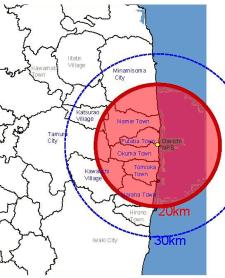
The Abe government and ruling coalition are considering giving tax breaks to companies that do business in reconstruction footholds to be set up in the no-go zone heavily contaminated by the 2011 nuclear accident in Fukushima Prefecture, according to informed sources.
Officials believe such measures will help advance industrial recovery in the prefecture hurt by the reactor meltdowns at the Fukushima No. 1 power plant in March 2011, the sources said Tuesday.
Under consideration are corporate tax cuts to promote capital investment and employment of people affected by the crisis by firms damaged by the nuclear accident and companies that newly expand into the area.
The special reconstruction areas will be created starting in fiscal 2017. Priority will be given to decontamination work and infrastructure development in the footholds, so that evacuation orders for local residents can be lifted around the end of March 2022.
The tax measures will be included in the fiscal 2017 tax system reform package that the Liberal Democratic Party-led ruling coalition plans to draw up Dec. 8.
Similar tax breaks are provided in evacuation areas outside the no-go zone. Through the planned measures, the government hopes to encourage the opening of businesses necessary for residents to live in the area, such as convenience stores and gas stations, as well as promoting job creation.
The government and the ruling camp are considering the options of allowing companies to deduct from their corporate taxes 15 percent of the amounts of their capital investment made in the footholds and granting lump-sum depreciation of new equipment and facilities so they can reduce their taxable incomes by larger margins than under regular depreciation rules.
Another possible measure is giving a corporate tax cut equivalent to 20 percent of salaries for employees in the footholds that companies hire from among those affected by the nuclear accident.
Also under consideration extending by four years a corporate tax cut granted to the owners of housing for disaster victims in special economic zones on condition the buildings meet fire resistance and other requirements and that the owners give priority to disaster-affected people in choosing tenants.
Fukushima Governor to Pitch Local Attractions in U.S.
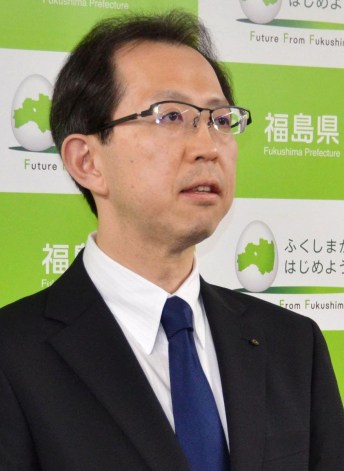
Washington, Oct. 18 (Jiji Press)–Visiting Fukushima Governor Masao Uchibori said Tuesday that he will pitch in the United States specialties and attractions of the northeastern Japan prefecture, such as sake and hot springs.
At a press conference, Uchibori said he wants many people to visit the prefecture from the United States and take first-hand looks at the current situation there.
If such visitors disseminate information about the prefecture in their own words, that will be a significant step toward reconstruction, he added.
Fukushima was hit hard by the March 2011 nuclear reactor meltdown at the Fukushima No. 1 power plant of Tokyo Electric Power Company Holdings Inc. following a massive earthquake and subsequent tsunami.
The evacuation area due to radioactive contamination caused by the nuclear disaster now accounts for only 5 pct of the prefecture’s land area and people live normal lives in the remaining 95 pct, Uchibori explained.
High-school Students Continuously Put at Risk for Propaganda Use
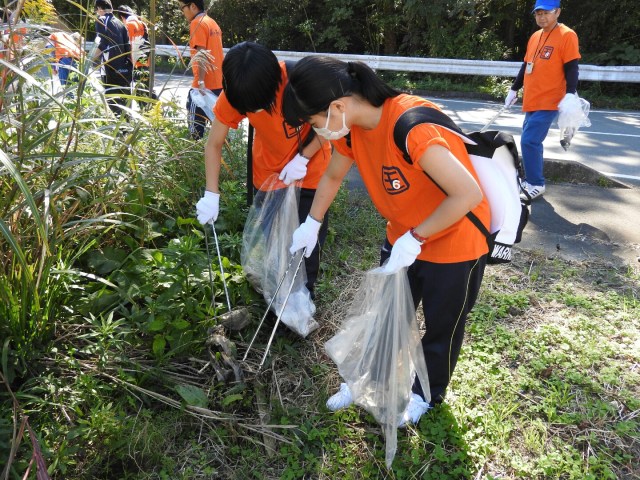
National route 6 which runs only a few km parallel to the coast where stands what is left of Daiichi Nuclear power plant, high-school students are cleaning up radiation.
14 high school students were picking up trash. 0.7μSv / h radiation measured by some citizens’ group at some of the places. With dust being blown, many high school students were walking still without a mask.
The criticism that it could endanger the children, was ignored by Yumiko Nishimoto, president of the NPO “Happy load net” which organized that acttion, answering “we are living here every day.” .
Clean-up activities with an eye to the torch relay of the Tokyo Olympics. The priority is the “reconstruction”, and the health of children is secondary, completely neglected.
The NPO responsible for such insanity argues that it helps them studying about radiation, that they do that every year.
Children are continuously being used to help the propaganda that everything is back to normal. But it’s a lie and it is borderline criminal. Shame on you Japan.
http://taminokoeshimbun.blog.fc2.com/blog-entry-61.html
Damage caused only by misconceptions about the nuclear incident not by the nuclear accident itself, according to the Yomiuri Shimbun, a pro-government newspaper
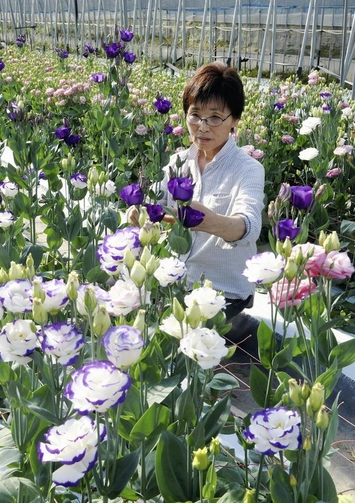
Fukushima farmers plant flowers to revive agriculture
Tomoko Horiuchi checks eustoma she grows in Minami-Soma, Fukushima Prefecture, in early August.
FUKUSHIMA — Farmers from Fukushima Prefecture’s municipalities who have received the government’s evacuation directives in the wake of the 2011 disaster at the Fukushima No. 1 nuclear power plant are cultivating flowers as a new agricultural business to rebuild their lives.
The climate in these areas is suited to growing colorful flowers, as it has abundant sunshine and a relatively large change in temperature between day and night.
After the nuclear crisis, the price of rice harvested in the prefecture has hovered at low levels because of the damaged perception of crops grown in the area.
But because growing flowers is less susceptible to damage caused by misconceptions about the nuclear incident, an increasing number of local farmers actively cultivate eustoma and other popular ornamental flowers.
Junichi Futatsuya, 65, from the Haramachi district in Minami-Soma, began cultivating eustoma in the spring of 2014 using an idle greenhouse where he used to raise rice seedlings. In 2015, a local agricultural cooperative that covers Minami-Soma formed a section to grow eustoma, with Futatsuya participating in the project. Membership has now grown to 25 people.
Stable prices
In July, the evacuation directives were lifted in most areas of Minami-Soma, and many farmers now sell their flowers in Tokyo in the hopes of gaining recognition for them in areas that are major markets.
Futatsuya, who restarted cultivating rice this year, said, “I’m expecting to secure income by growing rice and flowers.”
Kawasaki Flora Auction Market Co. trades in flowers produced by Futatsuya and other farmers from the prefecture.
“We don’t hear any dealers in the market saying they would shy away from the products because the flowers are produced in Fukushima Prefecture,” said Manabu Aishima, 49, a section chief of the Kawasaki-based company. “Farmers can expect all-year shipping with adequate investment in plants and equipment.”
Tomoko Horiuchi, 69, also grows eustoma in the district. She said she did not experience a wide fluctuation in prices before or after the crisis.
“It made me realize that flowers are not susceptible [to damage caused by misconceptions]. I would like fellow producers to increase to more stably supply flowers to the market,” she said.
Supporting ambition
Daytime entry is allowed in areas where evacuation directives have been issued as long as these areas are not designated as “difficult-to-return zones” due to high levels of radiation exposure.
In July last year, six farmers in the town of Namie formed a study group to grow flowers, and one of the farmers was able to grow and ship eustoma to customers.
The Namie town government plans to conduct a survey to find places suitable for flower cultivation and is considering consolidating greenhouses near the town office.
Meanwhile, in the village of Iitate, evacuation directives are scheduled to be lifted in most places at the end of March 2017. Four farmers will build greenhouses in the village to grow baby’s-breath flowers on a trial basis.
The Fukushima prefectural government is also financially supporting farmers if they build greenhouses and purchase equipment to make flower cultivation a new business in the Hamadori area, which is close to the nuclear plant.
“We’d like to support ambitious farmers,” said Masatoshi Kanno, vice chief of the prefectural government’s horticulture section.
Footholds Should Be Built in Fukushima No-Go Zone: LDP Team
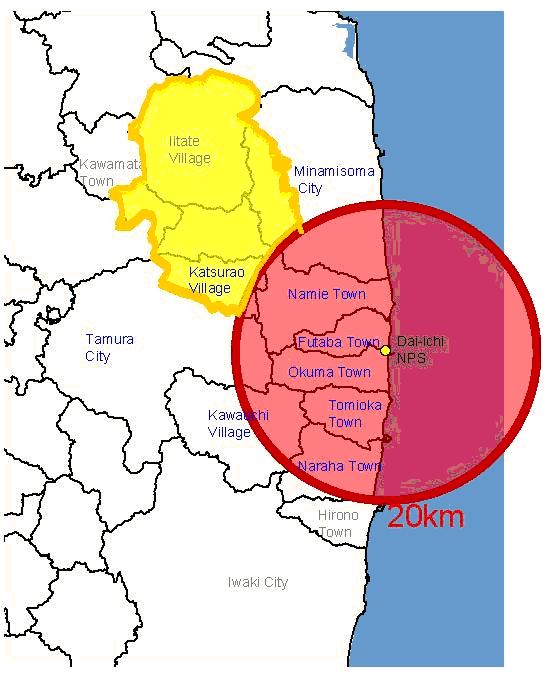
Tokyo, Aug. 17 (Jiji Press)–Reconstruction footholds should be set up in the no-go zone heavily contaminated by the 2011 nuclear accident in Fukushima Prefecture in northeastern Japan, a Liberal Democratic Party team proposed Wednesday.
The footholds should be used for decontamination work and infrastructure development so that evacuation orders for residents of the zone will be lifted in around five years, said the ruling party’s Headquarters for Accelerating Reconstruction after the Great East Japan Earthquake.
At a general meeting, the headquarters broadly agreed on a draft outline of the party’s planned sixth reconstruction proposal for areas damaged by the March 2011 earthquake and tsunami and the subsequent reactor meltdowns at Tokyo Electric Power Company Holdings Inc.’s Fukushima No. 1 nuclear power plant.
The government plans to remove all evacuation advisories in municipalities affected by the nuclear accident by the end of March 2017, excluding in the no-go zone where radiation levels are still too high for local residents to return home anytime soon.
The LDP will submit the proposal to Prime Minister Shinzo Abe later this month, after finalizing it through discussions with its coalition partner, Komeito.
Fukushima banks hope to lure nuclear evacuees back by reopening branches
FUKUSHIMA – Regional banks in Fukushima Prefecture are reopening outlets in radiation-contaminated areas to help lure residents back more than five years after the triple core meltdown at the Fukushima No. 1 power plant laid waste to the region in March 2011.
Residents have been slow to return despite the phased lifting of evacuation orders in cleaned-up areas, so regional banks are eager to play a trailblazing role by allowing residents to use their branches as places to socialize.
Abukuma Shinkin Bank, based in Minamisoma, reopened its Odaka branch there in March 2013 and the branch in the town of Namie on July 12.
The evacuation order for the central part of Namie is expected to be lifted by the end of next March, but there are still structures that collapsed from the March 11, 2011, Great East Japan Earthquake.
“We’ll put the light on in the town where people do not live,” said Yoshihiro Ota, president of Abukuma Shinkin, stressing the significance of reopening the Namie branch.
Abukuma Shinkin became the first financial institution to reopen a branch in Namie, which sits next to the town of Futaba, one of the two municipalities that host the crippled Fukushima No. 1 plant, which lost all power after being swamped by tsunami spawned by the temblor. The plant is run by Tokyo Electric Power Co. Holdings Inc.
“We hope our branch, where local people can stop by freely and enjoy chatting, will become a place that can console them,” said Takahiro Abe, chief of the Namie branch.
“Being the first to reopen a branch in the town will hopefully allow us to attract people and see rises in deposits and loans,” Abe added.
In April, Toho Bank, based in the city of Fukushima, restarted its branch in Naraha, another town close to the Fukushima No. 1 plant.
Although the evacuation order for Naraha was lifted last September, only 8.1 percent of its residents had returned as of July 4.
“Financial institutions are indispensable regional infrastructure,” said Hiroshi Yamaka, chief of Toho Bank’s Naraha branch. “Regional banks have a major role to play in helping residents return home.”
But it is not easy to achieve industrial revival in contaminated areas neglected by the long evacuation.
A male business owner who visited Abukuma Shinkin’s Namie branch on the day it reopened said, “The bank told me that they will lend me money, but I can’t decide on new investment because I’m old and there’s no one I can hand over my business to.”
Surf Contest in Minamisoma, Fukushima

On July 17, 2012, they had a national surf contest in Minami Soma city, Fukushima..
In Fukushima, Minami Soma City, after the nuclear accident, for the first time a surfing tournament took place.
Competition in Minami Soma after the nuclear accident had been canceled. It was held for the first time in six years.
Before March 2011, Minami Soma was known as one of Japan’s leading surfing spots.
The evacuation order having been lifted in most of Minami Soma city, Minami Soma city aimed to boost its reconstruction by reviving its surf contest on its Kitaizumi coast.
200 participants from all over Japan came to engage in that surf contest.
How long shall we accept Japan to pollute our skies with incineration of radioactive materials?
I regret that so much energy, so much money was wasted into the making of this « beautiful » documentary, produced by NHK for the 5th year Anniversary, to spin and to twist the truth so as to make it more acceptable to the eyes of the victims themselves and to the eyes of the world, to brainwash world opinion about the present ongoing situation at Fukushima Daiichi and in Fukushima prefecture.
Of course it is fully expected as it is coming from NHK, which is to Japan what the Pravda newspapers was to the Soviet era, the Japanese central government nationwide propaganda organ.
Using foreigners to give more credibility to their delivered spiel is quite slick, those foreigners shills remind me a lot of some of the French collaborators working for the German Gestapo during the the German Occupation of France in exchange of material benefits, those will not be the first nor the last.
Beside the whole positive reconstruction spin, there is only one point that will should remember and take seriously : the whole reconstruction-decontamination program of the Japanese government is entirely based on incineration.
They tell us that their incineration technology will keep contained 99,9% of the radionuclides , that none will end up into our skies.
Why should we trust them, during the last 5 years they haven’t be very trustworthy nor straightforward to say the least.
How long are we gonna accept, tolerate Japan, to pollute our skies, our commonly owned and shared living environment, with their radioactive mess ?
Fukushima Prefecture has become a familiar name worldwide as a result of the nuclear accidents in 2011. Ever since then, the world has been concerned about what’s happening regarding radioactive contamination in the prefecture. To answer that question, the program will squarely face what’s been going on in Fukushima since the accidents.
French documentary filmmaker Keiko Courdy, who has been covering Fukushima since the nuclear accidents, will appear as a guest, along with experts on radiation, and the situation in Fukushima today will be explained in an easy-to-understand manner.
Various people who have appeared on TOMORROW will also take part. The program considers the future of Fukushima by featuring those who continue striving to overcome many hardships. They include villagers who have been carrying out decontamination work in the evacuation zones, hoping to return to their homes, and young people who are showing remarkable progress in re-energizing Fukushima’s farming with their new ideas.
Available until April 11, 2016
http://www3.nhk.or.jp/nhkworld/en/vod/tomorrow/20160326.html
FIVE YEARS AFTER: 45% of mayors in affected areas see delayed recovery
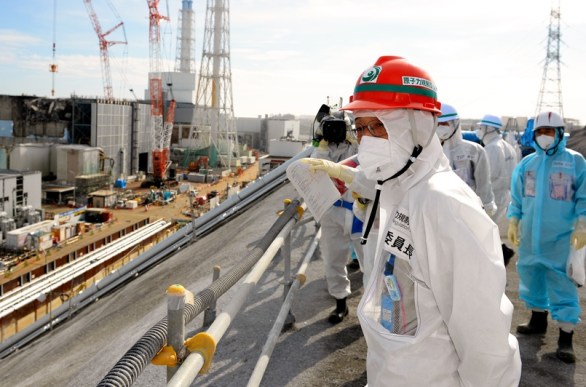
In a new survey, 19 of the 42 mayors in Iwate, Miyagi and Fukushima prefectures, or 45 percent, said that recovery from the Great East Japan Earthquake, tsunami and nuclear accident will take longer than predicted three years ago.
The Asahi Shimbun survey also shows that the accident at the Fukushima No. 1 nuclear power plant is continuing to hamper recovery efforts in Fukushima Prefecture, compared with the other two prefectures.
As for 15 mayors in Fukushima Prefecture, nine, or 60 percent, said that their projected completion period of recovery will be in fiscal 2023 or later, according to the survey.
In contrast, almost all the mayors in Iwate and Miyagi prefectures said the recovery process will be completed by the end of fiscal 2022.
The survey is the fourth of its kind since The Asahi Shimbun started it in 2013. The 42 mayors were chosen as their municipalities were located in coastal areas damaged by the tsunami or ordered to evacuate due to the nuclear accident.
The Asahi Shimbun surveyed the mayors in writing and in interviews. As for the recovery completion period, they were asked to choose from “fiscal 2015,” “fiscal 2016 to fiscal 2017,” “fiscal 2018 to fiscal 2022” and “in fiscal 2023 or later.”
Two of the 15 mayors in Fukushima Prefecture chose “fiscal 2015” in the survey held in 2013 but selected “in fiscal 2023 or later” in the latest survey. In addition to the two, five other mayors gave the same response in the latest survey although they had projected an earlier completion of the recovery process.
The 15 mayors were also asked about factors obstructing the recovery. They were allowed to list up to three. Fourteen cited having to deal with the nuclear accident.
“It is realistic to think that recovery will take 20 or 30 years even if the evacuation order is lifted,” said Namie Mayor Tamotsu Baba. All the residents of Namie are currently living outside the town due to the evacuation order.
“The challenge is what we should do to maintain our town,” he added.
“Residents in my village cannot plan their future,” said Katsurao Mayor Masahide Matsumoto. All the residents in Katsurao have also evacuated the village.
“I want the central government to present its policies as early as possible on what to do with the (high radiation) ‘difficult-to-return’ zones,” Matsumoto added.
Of the 27 mayors in Iwate and Miyagi prefectures, 26 replied that the recovery will be completed by the end of fiscal 2022. The figure shows the seriousness of the delay of recovery efforts in Fukushima Prefecture.
As a factor that is obstructing their recovery, nine mayors in Miyagi Prefecture cited a “shortage of staff members for their municipal governments.” Meanwhile, in Iwate Prefecture, seven mayors cited a “shortage of businesses and workers,” but six chose a “shortage of staff members for their municipal governments.”
According to the internal affairs ministry, 39 municipalities of the three prefectures were demanding additional staff members as of January this year. The number of insufficient staff members stood at 196 in total.
http://ajw.asahi.com/article/0311disaster/recovery/AJ201603060036

Government to spur work to fully reopen Fukushima’s disaster-hit JR Joban Line

The limited express train “Super Hitachi No. 50,” bound for Ueno Station in Tokyo, has remained at Haranomachi Station in Minami-Soma, Fukushima Prefecture, since March 11, 2011, as the JR Joban Line became partly unavailable due to the Great East Japan Earthquake, tsunami and an accident at the Fukushima No. 1 nuclear power plant. East Japan Railway Co. plans to remove the train from the railway in mid-March.
Government to spur work to fully reopen Fukushima’s disaster-hit JR Joban Line
NARAHA, FUKUSHIMA PREF. – Prime Minister Shinzo Abe expressed a willingness Saturday to spur work to fully reopen East Japan Railway Co.’s Joban Line in Fukushima Prefecture, which was partially closed following the March 2011 earthquake and tsunami.
The government is looking at completely reopening the Joban Line in the spring of 2020, ahead of the Tokyo Olympics and Paralympics, informed sources said.
“I’ve instructed the transport minister to promptly indicate the timing (of the reopening),” Abe told reporters during a visit to the Fukushima Prefecture town of Naraha near the disaster-crippled Fukushima No. 1 nuclear plant.
The Joban Line’s operator, also known as JR East, has released a plan to reopen in stages by the end of 2017 all shuttered sections but the Tomioka-Namie segment near the nuclear plant.
The prime minister also said that he will instruct the industry minister to set up a public-private panel to start a detailed study this month on a plan to make Fukushima Prefecture a key region for renewable energy production.
“In Fukushima in 2020, hydrogen fuel for 10,000 fuel cell vehicles will be produced from (the use of) renewable energy,” Abe said.
On Saturday, he visited a stock farm in the city of Fukushima, a restaurant using local ingredients in the town of Hirono, a battery factory in Naraha and other facilities.
“The reconstruction of Tohoku is the Abe administration’s top priority,” the prime minister said ahead of the fifth anniversary on Friday of the massive disaster.
http://www.japantimes.co.jp/news/2016/03/05/national/government-to-spur-work-to-fully-reopen-fukushimas-disaster-hit-jr-joban-line/#.Vtss5ObzN_l
FIVE YEARS AFTER: Joban Line to be fully resumed by spring 2020
Damaged in the 2011 Great East Japan Earthquake and tsunami and disrupted by the nuclear accident, the JR Joban Line, which runs between Tokyo and Miyagi Prefecture, is set to fully resume operation by spring 2020.
On March 5, Prime Minister Shinzo Abe inspected the Joban Line and told reporters, “I instructed the transport minister to set as early as possible the time when train services will be resumed along the entire portion.”
The government is expected to set the target of spring 2020 for the full resumption of service at its Reconstruction Promotion Council meeting on March 10, according to government sources. That will allow railway services to be fully available before the 2020 Tokyo Olympics and Paralympics, to be held in the summer of that year.
At present, services are still unavailable in two sections. One is the 46-kilometer stretch between Tatsuta Station in Naraha, Fukushima Prefecture, and Haranomachi Station in Minami-Soma, also in the prefecture.
The other is the 22.6-km section between Soma Station in Soma, Fukushima Prefecture, and Hamayoshida Station in Watari, Miyagi Prefecture.
Of the 46-km stretch, the 21-km portion between Tomioka Station in Tomioka and Namie Station in Namie is close to the crippled Fukushima No. 1 nuclear power plant, and most of the areas along the route have been designated as “difficult-to-return zones” due to high radiation levels.
In those areas, it is necessary to remove the crossties and gravel that are contaminated with radioactive substances and to lay new ones. The work is expected to continue until fiscal 2019.
Meanwhile, the operation of the remaining sections is scheduled to resume by fiscal 2017
http://ajw.asahi.com/article/0311disaster/recovery/AJ201603060030

Prime Minister Shinzo Abe speaks with local high school students at JR Odaka Station
on the Joban Line in Minamisoma, Fukushima Prefecture,
on Saturday during a visit to the area.
Survey finds “post-disaster” reconstruction slow in Tohoku prefectures
The pace of reconstruction after the powerful earthquake and tsunami that hit parts of northeastern Japan in March 2011, and the subsequent nuclear disaster, differs from community to community, with a delay forecast in Fukushima municipalities affected by radiation from the accident, a Jiji Press survey has revealed.
The survey was conducted in January and February in a total of 42 municipalities along the Pacific coast in Iwate, Miyagi and Fukushima prefectures, and around Tokyo Electric Power Co.’s Fukushima No. 1 nuclear power station, where an unprecedented triple reactor meltdown occurred following the natural disasters.
Of the 42, 12 are in Iwate, and 15 each in Miyagi and Fukushima.
Of the total, 15 municipalities said that post-disaster reconstruction will be completed by the end of fiscal 2020 in March 2021, the final year of the reconstruction period designated by the government.
Three municipalities said reconstruction will finish by the end of fiscal 2016, one by the end of fiscal 2017, six by the end of fiscal 2018 and five by the end of fiscal 2019.
The city of Soma in Fukushima said it is difficult to say exactly when the construction projects will be completed.
Meanwhile, 11 municipalities, including nine in Fukushima, noted that post-disaster reconstruction will end in fiscal 2021 or later.
Many of the nine Fukushima towns and villages cited delays in work to decontaminate areas polluted with radiation and dispose of radiation-tainted soil, and the restoration of agriculture, forestry and fishery industries.
This suggests that industry reconstruction has been tardy, affected by shipment restrictions and misinformation about radiation.
The two other municipalities projecting the completion of reconstruction after fiscal 2020 are Sendai, the prefectural capital of Miyagi, and the Miyagi town of Minamisanriku.
Sendai faces a delay in land procurement for reconstruction projects, including one for elevating roads. The central district of Minamisanriku was devastated by the tsunami.
In Iwate, nearly 50 percent of the planned public housing for people who lost their homes in the quake and tsunami has been completed. The proportion stands at about 50 percent in Miyagi and 40 percent in Fukushima.
Of the 12 Fukushima municipalities where evacuation advisories were issued after the nuclear accident, six, including the towns of Tomioka and Okuma, said that their populations at the end of 2025 are expected to decrease by 20 percent or more from current levels.
Among other municipalities in Fukushima and the two other prefectures, five, including Minamisanriku, project drops of 15-20 percent and eight foresee declines of 10-15 percent.
An official of Minamisanriku said, “The population decrease in our town will likely accelerate, because the number of children is falling and some of the residents who have been evacuated to other areas have found new homes and jobs there and therefore opted not to return to Minamisanriku.”
In Miyagi, Sendai and three nearby municipalities expect increases in their populations, on the back of inflows of evacuees from other areas and the establishment of operational hubs by construction companies.
In Fukushima, population growth is forecast in the town of Shinchi, where a liquefied natural gas storage facility is planned to be constructed.
Many of the surveyed municipalities said that they want the central government to continue securing enough reconstruction budgets and providing personnel support, and to increase flexibility in subsidy programs.
The earthquake and tsunami killed more than 15,800 people and left over 2,500 others unaccounted for.
http://www.japantimes.co.jp/news/2016/02/28/national/social-issues/survey-finds-post-disaster-reconstruction-slow-tohoku-prefectures/#.VtMsmubzN_l
How officials and popular academics have responded to disaster victims in the wake up of Tokyo Electric Power Company’s Fukushima nuclear accident
 About the author
I worked as a full-time teacher at a public high school in Fukushima for about twenty-five-and-a-half years, until July 31, 2011. During the first four years of my career, I taught at Futaba High School in Futaba-machi, home to the Fukushima Daiichi Nuclear Power Plant. Naturally, I have heard stories about the harsh working conditions of nuclear workers. For example, in a certain area of the power plant, working for 10 minutes would exceed the legal maximum daily radiation exposure limit. So each shift was officially recorded as 10 minutes even though their actual worked shift was 8 hours. The workers would primarily wipe water leaking from the piping surrounding the nuclear reactor. When workers died of illnesses like cancer, their families received unusually high amounts of cash as lump-sum payments, while actual workmen’s compensation insurance was not provided.
 At the time of the 2011 nuclear accident, I was living in a city 53 kilometers (33 miles) away from the power plant with my wife and two children. I was working at a public school 60 kilometers (37 miles) from the plant.
After the accident, on the evening of March 15, 2011, the maximum airborne radioactive levels of 23 microsievert/hour was detected in Fukushima City, where I worked. Outside the school the following day, however, the annual school acceptance announcements were held as scheduled. Several faculty, including myself, met with the principal to insist that usual outdoor announcement be cancelled as to avoid having young students exposed to radiation–but the announcement event was forced outdoors. The principal cited reasons such as, “the Fukushima Prefecture office strongly supports the outdoor plan” and he “had no choice as the school principal.”
From April 2011 on, aside from the prohibition of outdoor gym classes, neither my school nor the Fukushima Board of Education took any measures to prevent further radiation exposure for students. The school had students practice club activities outdoors as usual. Indoor club athletes were made to run outdoors as well, without any protective measure against radiation exposure. Despite the standard practice, measures such as gargling, washing hands, changing clothes, and showering weren’t deemed necessary for students when returning from outdoor activities. Since I had some knowledge about radiation exposure, I advised the students to take caution to remove potential contamination whenever possible. However, in response to my giving the students advice to prevent radioactive materials from entering the building, I had been cautioned by the Fukushima Prefectural Board of Education, in the form of official “guidance” which forbids me to even talk about radiation and nuclear power plants to the students. Given that I was officially barred from protecting students from radiation exposure, I decided to make my move: along with my family, I evacuated my hometown and relocated to Sapporo city in Hokkaido. Once we evacuated, we found out about a financial system by Fukushima Prefecture which supports voluntary evacuees from the areas outside of the officially restricted zone (though it only approved applications from evacuees pre-December 2012; those who evacuated thereafter would not be financially supported).
I have been teaching part-time in Hokkaido. Since finding out that within the public school system the Fukushima Prefecture Board of Education can intervene to oversee public high school relocation anywhere, I have been teaching at private schools only. Aside from my part-time job, I have been involved in a nuclear power plant damages lawsuit as a plaintiff as well as a member of the refugee organization.
 1. Fukushima Prefectural Government and the Tokyo Electric Power Company (TEPCO)’s Fukushima Nuclear Accident
The reactors at the TEPCO Fukushima Daiichi Nuclear Power Plant, especially Unit 1 and Unit 2, were delivered and installed from the US after the US manufacturer finished all of their construction. As for Units 3, 4, 5, and 6 the Japanese manufacturer added their own “improvements” to the original structure.
I will try to avoid a lengthy explanation. TEPCO’s Fukushima Daiichi Nuclear Power Plant frequently had accidents immediately after beginning operation and the nuclear workers’ exposure levels amounted to twice to ten times the average exposure dose at other nuclear plants. Furthermore, TEPCO kept a lot of serious accidents hidden from Fukushima Prefecture and the Japanese government. TEPCO proposed using Unit 3 for so-called pluthermal power generation, utilizing fuel which can contain weapons-grade plutonium in order to reduce the plutonium surplus in Japan. Eisaku Sato, then-governor of Fukushima, strongly objected to the proposal.The Japanese government arrested and convicted Governor Sato on bribery charges with the amount of the bribe recognized as “zero yen.” They drove him to resign, then elected Yuhei Sato as the new governor. As described above, neither the Fukushima governor nor the organization called the Fukushima Prefectural Government had power over TEPCO.
 2. Nuclear accident and the Fukushima Prefectural Government
March 11, 2011, when a massive earthquake hit a wide area including Fukushima Prefecture, the building of the Fukushima prefectural office (which had been planned to function as a Disaster Response Headquarters) was damaged in the earthquake. The headquarters were set up in a small building next to the main office building to serve temporary functions. The prefectural government has never publicized records of proceedings and documents from over 20 meetings in the beginning. From the 25th meeting, they finally began keeping records of proceedings.
At the time, the temporary disaster response headquarters was believed to have had little to no communication lines, and had reportedly only two satellite mobile phones. Although the communication infrastructure began to be rebuilt gradually, what was happening then still remains largely unknown. There has been no official investigation into the correspondence between the local governments, the central government and TEPCO, and no evacuation orders to the local communities.
As far as public record goes, the only time Fukushima Governor issued an announcement in the first week was on the evening of March 14th. “Follow the instructions and do not panic,”“High school entrance announcements will be held as planned on March 16th,”— these two lines were broadcast repeatedly throughout local media.
From another angle, the recordings of the TEPCO video conference shows that Fukushima Prefecture requested TEPCO make a public announcement saying “the explosion in the Unit 3 at Fukushima Daiichi will not cause health damage.” Appalled by the request, thinking they “couldn’t say such an irresponsible thing,” TEPCO decided to “ask the central government to suppress Fukushima Prefecture,”—as evidently recorded during the video conference.
However Fukushima Prefecture repeatedly expressed that in the “Nakadōri” region—which includes the prefectural capitol, Fukushima City, and the commercially and industrially flourishing Koriyama City—there would be zero risk of health damage from radiation.
There has been a use of protective measures like wearing long-sleeves and masks for school children, which may have been a globally familiar sight through media reports. However this was not a recommendation or an order issued by Fukushima Prefecture, but rather a result of demands from local PTAs to boards of education in individual school districts.
 Towards the end of March 2011, right before the school year resumed, the Fukushima governor was seen out in local grocery stores saying “Fukushima today is business as usual,” in which he began a campaign to “dispel harmful rumors” about local agricultural produce being contaminated by radiation. The governor also opposed widening the evacuation zone beyond the 20km radius of the nuclear power plant, and has repeatedly made remarks to avoid increasing the number of evacuees from outside the official evacuation zone.
As a result, aside from two local Fukushima newspapers, NHK, and four private television networks in addition to NHK Radio and Radio Fukushima, there was little to no mention of messages from outside Fukushima offering free housings and support networks for voluntary evacuees. Fukushima Prefecture also prohibited the use of not only public conference centers, but private facilities for hosting “counseling room” for evacuation as well. People around me practically had no knowledge of local autonomous support groups offering evacuation support. I have heard numerous times that “there is no evacuation order from outside the prefecture, meaning we have been abandoned.” In fact, it was Fukushima Prefecture who had been interfering with such efforts to reach our community.
 3. Hiroshi Kainuma, “the Sociologist”
In 2011, an author from Fukushima became renowned after publishing the book “Fukushima’ theory–the birth of a nuclear village,” based on a thesis he wrote as a sociology student at the University of Tokyo Graduate School of Interdisciplinary Information Sciences. His name is Hiroshi Kaiuma, born in Iwaki City, Fukushima, and graduated from the University of Tokyo Literature department at the age of 25 and advanced to the graduate program. I must note that this is difficult to grasp if you are not well-connected within Fukushima. But in short, Iwaki City, where Mr. Kainuma was born and raised, has very little connection to the Futaba district which hosts TEPCO’s power plant. In terms of large-scale trading areas, while the Futaba district is part of the Sendai, Miyagi Prefecture trade area, Iwaki City would be part of Mito City in Ibaraki Prefecture. In any case, Mr. Kainuma did not have strong connections to the Fukushima Prefectural government prior to March 11th, 2011.
Since the meltdown, however, he has somehow become “the Fukushima spokesperson who speaks about Fukushima on TV and radio.”
Additionally, I have written several critiques of his writings, one of which can be found on the following link (in Japanese): “Personal note on “‘Fukushima’ theory–the birth of a nuclear village”
4. Hiroshi Kainuma and the Fukushima Prefectural Government
After 3.11, his master’s thesis was published in books and he began to be featured in various media, including an appearance as a commentator on the popular evening program “Hodo Station (News Station).” We must note that the content of his remarks have been consistent—such as, “The acceptance of nuclear power plant by local communities was necessary for the regions’ survival”; “Those outside of Fukushima protesting against nuclear energy do not understand the reality of nuclear-hosting communities.” His views and comments on the anti-nuclear movement have been antagonistic from the beginning, for example, “People who oppose nuclear energy are rubbing local communities the wrong way.”
Mr. Kainuma currently holds the title of Junior Researcher of the Fukushima Future Center for Regional Revitalization, but at the same time he is a PhD student at the University of Tokyo. While it would be appropriate to call him a sociology researcher, I feel it’s an overestimation to refer to him as a sociologist.
Currently the gist of Mr. Kainuma’s speech is towards the “recovery of Fukushima in visible forms” and its target audience is outside Fukushima Prefecture. While many others have in fact been referring to “bags” jammed with contaminated waste—seen everywhere and impossible to be ignored upon entering Fukushima—Mr. Kainuma continues to emphasize the “ordinary Fukushima” without mentioning the bags.
I see the previous governor of Fukushima, Yuhei Sato, in Mr. Kainuma in many ways, like in his seeming lack of experience interacting with people in temporary housings immediately following the meltdowns, or with shelter residents still living with much confusion and inconveniences as a result of the disaster.
Even the current Fukushima governor does not seem to have made too many visits to temporary shelters during or after elections.
To those who evacuated Fukushima to outer prefectures like myself, the Prefecture kept even more distance. By principle, they never made any official inspection visits to meet the evacuees. There is a notable lack of inspection visits not only in remote areas such as Hokkaido, but also in places like Yamagata and Niigata which are adjacent to Fukushima Prefecture.
In the wake of the disaster, though there was housing support for those who evacuated the areas outside of Fukushima as well, such efforts have gradually died down—as of March 2016, state subsidies for housing would be available only for evacuees who are from Fukushima. In addition, the housing subsidy program for those who evacuated the non-restricted zone will end in March 2017. However, there is no housing program for returning residents to Fukushima even if they decide to move back there.
Starting March 2017, voluntary evacuees still living in outer prefectures need to choose one of the three following choices:
1) Return home to Fukushima while paying out-of-pocket for most of the expenses associated with the move and your life thereafter. 2) Continue living outside Fukushima while relinquishing your rights to access resources as a disaster victim 3) Upon proving your need for financial assistance, receive housing subsidies for up to 2 years to live in privately-owned housing.
The reason for this policy change was credited to correspondence between the Minister of Environment and the Nuclear Regulatory Authority, a non-governmental agency to provide scientific grounds for nuclear policy. The Minister of Envirnoment asked the NRA if “it is considered desirable to evacuate the areas that don’t have restrictions” to which the NRA answered, ”these areas are no longer fit to be evacuated.” It should be noted that there was no legal ground for this correspondence to be treated as official; how this exchange was reviewed and by whom is unknown.
Based on this document issued by the NRA, the Japanese government made a Cabinet decision to largely reduce support for evacuees through the Nuclear Accident Child Victim’s Support Law.
Following this decision, Fukushima Prefecture also determined its policy would end support for the voluntary evacuees from non-restricted areas.
Hiroshi Kainuma is working from an assumed role to justify such policy of Fukushima Prefecture, utilizing his position as a so-called sociologist. Even if he has ideas and views that differ from Fukushima Prefecture’s policy, he does not speak about them on media or at talk events.
For instance, when Mr. Kainuma was relatively unknown before 3.11, he had reportedly interviewed local anti-nuclear activists. Another instance tells us that although he had met and interviewed several people who have moved voluntarily out of the non-restricted areas, he proceeds to ignore the voices and opinions of them as though they had never existed.
Last year, nuclear reactors in Japan started resuming operation. Mr. Kainuma has not been seen or heard expressing opposition to it. Neither Fukushima Prefecture nor the Prefectural Assembly expresses any intentions to oppose nuclear restorations.
5. The current presence of “Hiroshi Kainuma”
Through the circumstances described above, Hiroshi Kainuma is working so as to be portrayed by the media as a Fukushima Prefecture spokesperson, intent on selling “business-as-usual” appeal and depicting a Fukushima that “overcame a nuclear disaster.”
Meanwhile, and quite unfortunately, many Fukushima residents agree with his words and actions. Just as there are many people hoping to forget the scars from the 1995 Great Hanshin Earthquake, there are many who explicitly “do not evacuate,” comprising an overwhelming majority of the Fukushima population and wishing to forget and move past the disaster and nuclear crisis.
Here we have an academic scholar who speaks for us and to those who are outside Fukushima as well, saying to leave the nuclear disaster in the past.
Thus, this concludes the significance of Hiroshi Kainuma’s existence today.
http://mp-nuclear-free.com/

No Legitimacy, No Principle in Japan’s Nuclear Victim Support Policy

Fukushima, Voices of Evacuees
By Toshinori Shishido
原発事故被害者支援策の、論理的根拠と正当性の欠如(日本語)
In July 2015, the Fukushima prefectural government announced its plan to terminate housing assistance for nuclear evacuees who fled areas outside of the restricted zone at the end of March 2017. It has absolutely no intention to change this policy as of this moment in February 2016.
In addition, by March 2017, the Fukushima Prefectural Office will lift evacuation orders for the entire prefecture, except for the immediate vicinity of the power plant designated the “difficult-to-return zone,” that has “equal to or greater than the external exposure dose of 50mSv/year.” (Insert: “translator’s note: the internationally recognized standard dose limit per year is 1mSv/year.) For residents who may eventually move back to these areas, the Prefectural Office has determined that it will only pay one year’s worth of compensation (1.2 million yen or US$ 10,500) per person and will terminate other special protective measures and financial incentives.
For residents of regions that have been designated as “difficult-to-return areas”, the Office has reportedly finished the payments of reparations in bulk, and is not going to make additional payments.
And for residents outside of Fukushima Prefecture, there has been almost no official support for damages from the nuclear power plant accident in the first place.
While the government has provided extremely limited housing support for very few residents from prefectures adjacent to Fukushima and for evacuees from these prefectures, it has gradually decreased the target population over time and plans to end all financial assistance for them by March 2018.
Although there is room to compensate local industries for damages, even in cases where the “Nuclear Damages Dispute Resolution Center” (or Alternative Dispute Resolution Center, ADR for short), established to bring speedy resolutions, has sought payment from Tokyo Electric Power Company, there are an increasing number of cases in which TEPCO has refused to pay. In addition, even though the ADR Center has repeatedly demanded that the Japanese government instruct TEPCO to comply with the settlements and make payments quickly, the Japanese government has not directed TEPCO to do so.
For sources related to above, please refer to:
Website of Education, Culture, Sports, Science and Technology “About compensation for nuclear damage caused by the Tokyo Electric Power Company Fukushima nuclear power plant accident” (in Japanese)
“About the guidance on the determination regarding damages caused by Tokyo Electric Power Company’s Fukushima Daiichi and Daini nuclear accident (PDF: 169KB, in Japanese)”
Website of Ministry of Education, Culture, Sports, Science and Technology, Nuclear Damages Dispute Resolution Center (in Japanese)
It is clear to us that Japanese officials have neglected to work on compensation, reparation, fact-finding, clarification of causes, and information disclosure from the nuclear accident until now. Not only that, but Japanese government agencies have destroyed some official documents from immediately after the nuclear accident without even notifying the public, on the grounds that there is a “legal obligation to preserve these documents for three years”.
Thanks to the destruction of documents from early stages, it has become extremely difficult to obtain proof that there have been measures that should have been implemented immediately after the nuclear accident, and it has become difficult to investigate and prove government blunders.
On matters besides those related to the nuclear accident, both the Japanese government and the Fukushima prefectural government are promoting and activating economic activities, including capital improvement projects fueled with tax money.
As for the motorways, all of Route 6, the main national highway, has been re-opened, and all of the Joban Expressway opened in 2015, ahead of the original construction schedule, which had been planned prior to the nuclear accident.
As for the railway, Japan Railway East Japan is aiming to reopen its entire Joban Line in the summer of 2020, prior to the Tokyo Olympics.

“Recovery” can be realized on roads and railroads through ample budgeting, gathering materials, and investing labor. The same is also true for most infrastructure, such as local government offices and electricity. The exception, however, is the water supply – there is no guarantee that radioactive isotopes that have accumulated at the bottom of the lake upstream of the intake will not be mixed into the water supply.
Including the issue of water supply, the fundamental causes of the troubles related to the current “revitalization” programs come from the government and Prefecture’s attitude that ignores the wishes of the residents who are victims. If I may borrow the phrase that has been used over time, there has been no “revitalization of humans.”
In other words, why doesn’t the “revitalization” from the nuclear accident that is promoted by the Japanese national government and the Fukushima prefectural government become the “revitalization” of people? Let us return to the starting point to consider this.
The reasons I propose are two-fold.
First, both the Japanese government and the Fukushima prefectural government continue to avert their eyes from the fact that this is a nuclear disaster. They never told residents about the extremely long timeline and difficulty of managing the aftermath of a nuclear disaster. Most of the media are constantly releasing words straight from the government and Fukushima prefecture without even investigating the contents. Hence, the majority of victims have been unable to face the complexity of the issues.
While it will soon be five years since March 11, 2011, it is hard to say that authorities have correctly communicated to the public how dangerous the situation had become, not only at the Fukushima Daiichi and Daini power plants under declaration of a Nuclear Emergency Situation, but also at the nearby Tokai 2 and Onagawa power plants.
Even Diet members and nuclear “scientists” have spoken unabashedly in the Diet and on television that “no problems occurred at [these] state-of-the-art nuclear power plants”, without being prompted to correct themselves. To say nothing of what happened to the ten reactors in Fukushima Prefecture and what is happening to them today, which is not even known.
On December 16, 2012, then-Prime Minister Noda used what had until then been only a scientific term, “cold shutdown,” to declare a “state of cold shutdown” in circumstances where this could not be [scientifically] declared. In other words, it was so necessary for the Japanese government to domestically fabricate the impression that “the nuclear crisis is over” that it used the term in a way not internationally recognized as a scientific concept.
And in regard to Reactors 1 to 4 at Daiichi, the government didn’t even bother making potentially realizable countermeasures an object of debate. They called issues inside the power plant “on-site” issues, implying there was little room for off-site intervention, and no projects after the “cold shutdown” declaration were deemed urgent. Naturally, we are left with no option to even ask beyond what options are available; how long these options will take to be effective or how long they will last.
Assuming this unstable situation at the power plant, it is impossible to discuss how
people’s daily existence around the accident plant [Daiichi] is possible to what distance, in what way.
The problem is not limited to within the facility. As long as we are unable to see distinctly what types of radioactive isotopes and how much they are present, at least within the vicinity of several miles off the plant, the “revitalization” planning would draw direct link from the clean up of the plant.
However, even in the areas within 10km (6.2 miles) radius of the plant where the airborne radioactive levels are relatively lower than its surroundings, the government has already decided to lift evacuation order by March of 2017.
Therefore, to those who will be living in the close proximity to the plant, the fate of the nuclear crisis is a matter of life and death. The government however insist that on-site (within plant facility) and off-site issues are two separate issues, refusing to incorporate clean-up plans into the “revitalization” roadmap.
Even if I give it extra compromise as to say the situation inside fences of the power plant is not related to “revitalization” activities, I must stress that both the government and Fukushima prefecture continue to defend an absurd stance on any potential radiological effects in the future, stating “any potential impact would be would be small enough to be unrecognizable.”
The state-led plans to proceed with human recovery as if the “disaster wasn’t a nuclear disaster” is extremely reckless, considering cases of Chernobyl nuclear accident and nuclear testings at Marshall Islands.However, the Japanese government and the Fukushima prefectural government continue to be reckless, ignoring “the people.”
My second point is that the Japanese government, the Fukushima prefecture as well as many local municipal offices have been deceiving us without a directly facing the human beings as victims and by neglecting the whereabouts of them.Essentially, when disasters and accidents bring damage, state bodies would have to desperately gather information from the first day in order to clarify the extent of the damage.
On the flip side, in regards to the victims and damages caused by the earthquake and tsunami that occurred on March 11, there have been evidences across the country that municipalities and governments put extensive efforts to grasp and understand the extent of damages as much as possible.even in municipalities where almost all of residences and even offices were damaged by the tsunami, there were attempts to understand the scale and circumstances of the damage.In places where the damages was too great for local municipalities to maintain their functions, prefectural governments cooperated trying to figure out actual damage.
However, with respect to the current nuclear accident, the government did not try to figure out scale of the damage or the actual situations of the victims.There is no way to find out the reason why they chose not to, unless you have access to confidential information by the government.
I suppose that the Japanese government and prefectural offices would have been liable for investigating the nuclear accident and not the local municipalities which didn’t have necessary human, organizational and technical resources. Yet there is no evidence of the government or prefectural offices having actively looked into the actual damages and status of evacuations caused by the nuclear contamination.
Rather, even when evacuees themselves demanded for official investigation, the authorities refused to act on their behalf and at times delayed publications of data they obtained.
I am yet to see a single governmental document on how nuclear evacuations took place. Perhaps such documents never even existed.
To my knowledge, in Japan, there has not been any official agencies or staff positions for creating and maintaining historical records of national events. Due to this, there is a serious lack of documentation that could be used as future reference. Nor the involvement of the responsible parties is ever questioned.
In fact, after writing the above paragraph I attempted to summarize evacuation processes as much as I could within my knowledge, only to find such efforts would require vast amount of writings and I would not know when I could finish such a project. Thus for the time being I would like to conclude my thesis here.
In conclusion, I will verify my points in summary.
The so-called “nuclear disaster victim assistance program” orchestrated by the Japanese government and Fukushima prefecture has been fraudulent since its inception. For the goal of their program has never been to protect the livelihood and safety of the victims and it lacked logical foundation.
By ending the inherently fraudulent assistance program, the government and Fukushima prefecture are crying out loud to the world that Fukushima has been recovered. The Fukushima prefectural government continues to actively send delegations overseas solely for the publicity purpose.
I repeat.
Fukushima Prefecture sends the delegations in order to round down the nuclear disaster victims and to disguise to the world the fact that the “reconstruction” they are proposing is ignoring the voices of victims.
No Legitimacy, No Principle in Japan’s Nuclear Victim Support Policy
1 This Month
10 March A LIVE WEBINAR THE REAL EFFECTS OF NUCLEAR POWER
What the Industry Isn’t Telling Us
1:00 PM Mountain, 2 pm Central, 3 pm Eastern. Live on the Keepers of the Water Facebook page



18 March Webinar @ 1 PM EST: An Assessment of SMR Projects: The Case of Canada
register for the zoom:
https://us02web.zoom.us/webinar/register/WN_o8BIIOUvQ2ONJR1nta65DQ#/registration


of the week – STOP SMALL MODULAR REACTORS IN CANADA
To see nuclear-related stories in greater depth and intensity – go to https://nuclearinformation.wordpress.com
-
Archives
- March 2026 (109)
- February 2026 (268)
- January 2026 (308)
- December 2025 (358)
- November 2025 (359)
- October 2025 (376)
- September 2025 (258)
- August 2025 (319)
- July 2025 (230)
- June 2025 (348)
- May 2025 (261)
- April 2025 (305)
-
Categories
- 1
- 1 NUCLEAR ISSUES
- business and costs
- climate change
- culture and arts
- ENERGY
- environment
- health
- history
- indigenous issues
- Legal
- marketing of nuclear
- media
- opposition to nuclear
- PERSONAL STORIES
- politics
- politics international
- Religion and ethics
- safety
- secrets,lies and civil liberties
- spinbuster
- technology
- Uranium
- wastes
- weapons and war
- Women
- 2 WORLD
- ACTION
- AFRICA
- Atrocities
- AUSTRALIA
- Christina's notes
- Christina's themes
- culture and arts
- Events
- Fuk 2022
- Fuk 2023
- Fukushima 2017
- Fukushima 2018
- fukushima 2019
- Fukushima 2020
- Fukushima 2021
- general
- global warming
- Humour (God we need it)
- Nuclear
- RARE EARTHS
- Reference
- resources – print
- Resources -audiovicual
- Weekly Newsletter
- World
- World Nuclear
- YouTube
-
RSS
Entries RSS
Comments RSS
 nuclear-news