Fukushima Consequences of Radiation on Wildlife
By Pierre Fetet (translation by Hervé Courtois)
Source : http://www.fukushima-blog.com/2016/09/fukushima-consequences-de-la-radioactivite-sur-la-faune.html
Scientific studies conducted following the Fukushima disaster revealed little by little the consequences of radioactivity on the living and particularly on wildlife. Although published, they are nevertheless rarely circulated. This is why I would like to put a spotlight on some of them and publicize various observations which we do not hear much about, to counter the silly optimism to always relativize the consequences of low doses on life. Any dose of radiation, however small it be, has effects on the living: the ionizing radiation breaks the DNA molecules.
The birds
The feathers of birds take radioactive dust released into the atmosphere continuously by the wind. They therefore suffer permanent external irradiation.
We can see this dust by placing a contaminated bird on a radio-sensitive paper for a month. Here is an example with a bird picked in Iitate in December 2011.
Autoradiography also allows to highlight that the birds also undergo internal contamination.

Autoradiography of a bird revealing radioactive contamination in the plumage and stomach (Source Morizumi)
Yasuo HORI has also reported that some swallows Fukushima undergo depigmentation, as had already been found in Chernobyl. The Wild Bird Society of Japan also noted that the tail feathers of some Japanese swallows were not uniform.
It must be said that nests of swallows up to 1.4 million becquerels of radioactive cesium per kilogram (Bq / kg) have been found in the towns of Okuma and Namie. The nests of chickadees, were not better: 1.3 million Bq / kg.

Left: Swallow from Minamisoma (Fukushima Prefecture) – Right: deformed tail of a swallow from Kakuda (Miyagi Prefecture)
According to studies conducted by Tim Mousseau (University of South Carolina), the population of fifteen bird species living in contaminated areas of Fukushima prefecture decreases with time, with a 30% survival rate.
Another research focused on a falcon species returning in the same nest every year was also conducted by a team of scientists led by Naoki Murase (Nagoya University) at a distance of 100 to 120 km from the Fukushima Daiichi nuclear plant. The interest of this study is that raptors are at the top of a food chain and concentrate radionuclides accumulated by their prey. The authors have shown that the reproductive capacity of the bird was related to radiation measured directly under the nest : radioactivity affects the germline of the bird. The ability of birds to leave the nest fell from 79 to 55% in 2012 and 50% in 2013.
Another study finally published in 2015 by ASN and the Anders Møller laboratory (CNRS), focused on the total dose – internal and external – of birds.
It showed that 90% of the 57 species studied had been chronically exposed to radioactivity dose rate possibly affecting their reproduction.

Simplified representation of the level change of maximum exposure of adult birds (in dose rate) for 57 species of the bird community observed on 300 sites and four years of study. Compared to the range of variation (in blue) ambient dose rate measured on the sites and ranges (red) corresponding to various effects in birds published by the ICRP (2008) (Source IRSN)
So there are three factors that affect living organisms in contaminated areas: the ambient radiation (the dose that is received by being next to a radioactive object), the external contamination (radioactive dust that sticks to the skin, hair, feathers), and internal contamination (radionuclides ingested or trapped in organs).
The butterflies
The first scientific evidence of damage to a living organism by radioactive contamination due to the disaster of Fukushima Daiichi was delivered by the team of researcher Chiyo Nohara (University of Okinawa).
The study highlighted the physiological and genetic damage of a common butterfly of Japan, the maha zizeeria. In May 2011, some show relatively slight abnormalities. But the first female offspring of the first generation showed more serious defects, inherited by the second generation. Adult butterflies collected in September 2011, then showed more severe abnormalities than those collected in May: abortive hatching, infertility, size reduction, slow growth, high mortality and morphological abnormalities (Atrophied wings, curved or in excess number, malformed antennae, bumpy eyes, discolored).
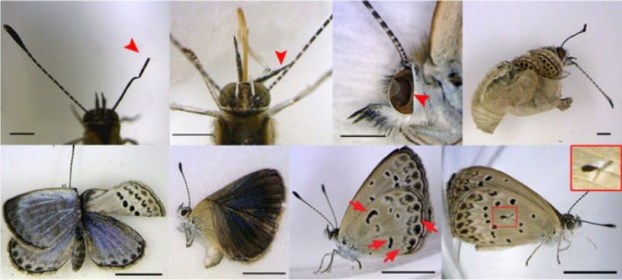
Representative anomalies of butterflies fed contaminated leaves. (Source: Hiyama et al)
Aphids
In 2014, Shin-ichi Akimoto (Hokkaido University) found that about 10% of certain insects, such as aphids, have malformations in Fukushima. But their survival and their reproduction remain possible.
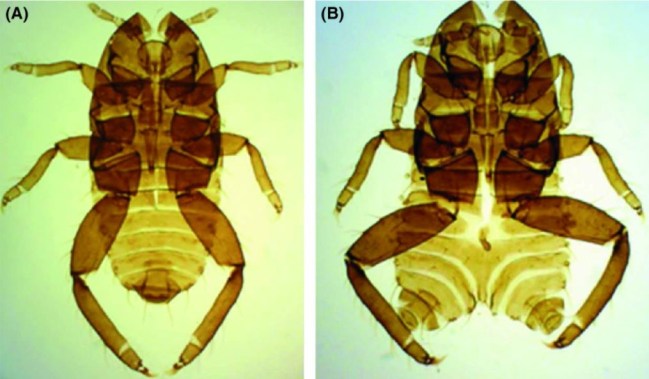
Sorini aphid T. From Fukushima. (A) normal morphology, (B) Level 3 malformation of the abdomen (Source: S. Akimoto)
The cows
The phenomenon of white patches (depigmentation) on the observed swallows in Fukushima and Chernobyl is also found on the cows of Masami Yoshizawa, at the Farm of Hope in Namie, a town located 14 km from the destroyed plant .

A cow of Masami Yoshizawa was brought to Tokyo in 2014 to the government for diagnosis (AFP Photo)
Horses
The biologist Hayato Minamoto reported the carnage suffered by Tokuei Hosokawa, an Iitate farmer who lost a hundred horses in two years. Iitate had suffered the brunt of the radioactive cloud from the Fukushima Daiichi plant in March-April 2011.
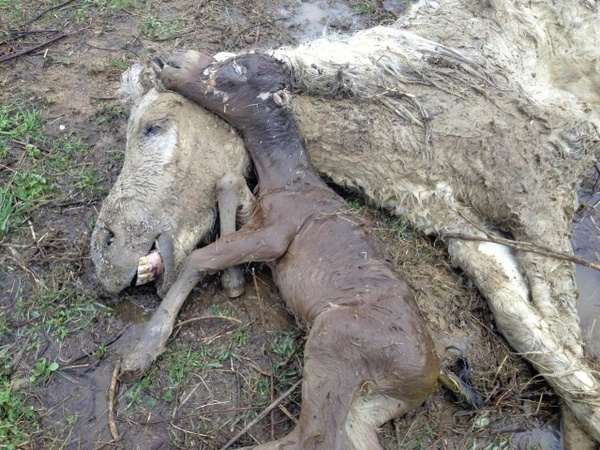
Iitate horses
Monkeys
Between April 2012 and March 2013, researchers led by Shin-ichi Hayama (Japan University of Life Sciences and Veterinary Sciences) analyzed the blood of 61 Japanese monkeys living in a forest 70 km from the Fukushima Daiichi nuclear power plant. The total concentration of cesium in monkeys muscles was between 78 and 1778 Bq / kg. Blood tests in these animals revealed a small quantity of white blood cells and red blood cells, which could make them more vulnerable. The decrease of blood cells was directly proportional to the concentration of cesium in the muscles, which suggests a dose-response correlation. Researchers estimate that exposure to radioactive materials contributed to hematological changes in Fukushima monkeys.

Drawing by Julien Loïs
Provisional Conclusion
The consequences of radioactivity on animals are visible to anyone who will bother to observe what happens. In this article, I focused on some animals only (there would be other cases to develop: the population decline of the cicadas, the increased cataract of rodents, etc.). Scientists could conduct similar studies on this strange animal that is man, but it would not be politically correct.
Yet this has already been done, in Hiroshima and Nagasaki, Chernobyl. For example, studies conducted between 1993 and 1998 on Ukrainian children permitted to observe a drop of blood cells, which was related to the exposure of each child to cesium depending on the place of residence. And yet, in Tokyo, from 2011 to 2014, Dr. Mita observed that white blood cells, especially neutrophils, decreased in children under 10 years old. (Which prompted him to move and to ask his patients to leave Tokyo). But no, do not say anything, and do not look into such matter.
In Japan, the denial of the danger is a must. The only mention of a nosebleed in a manga can cause a national affair and censorship … To speak of the negative consequences of the nuclear disaster at Fukushima Daiichi is not accepted.
You must rebuild, you must forget, you must think about the future. Institutionally, only one study is accepted, the monitoring of thyroids of children in Fukushima. That study is the screen that hides the forest of lies.
And yet, despite 131 thyroid cancers confirmed in June 2016, the official Japanese scientists refuse to see them as caused by radioactivity.
Pierre Fetet
To read more:
1) Scientific studies cited in this article
The biological impacts of the Fukushima nuclear accident on the pale grass blue butterfly, A. Hiyama, C. Nohara, S. Kinjo, W. Taira, S. Gima, A. Tanahara, J.-M. Otaki, 2012
Low blood cell counts in wild Japanese monkeys after the Fukushima Daiichi nuclear disaster, K. Ochiai, S. Hayama, S. Nakiri, S. Nakanishi, N. Ishii, T. Uno, T. Kato, F. Konno, Y. Kawamoto, S. Tsuchida, T. Omi, 2014
Morphological abnormalities in gall-forming aphids in a radiation-contaminated area near Fukushima Daiichi: selective impact of fallout?, S. Akimoto, 2014
Effects of the Fukushima Daiichi nuclear accident on goshawk reproduction, K. Murase, J. Murase, R. Horie, K. End, 2015
Radiological dose reconstruction for birds reconciles outcomes of Fukushima with knowledge of dose-effect relationships, J. Garnier-Laplace, K. Beaugelin-Seiller, C. Della-Vedova, J.-M. Métivier, C. Ritz, T. A. Mousseau, A. P. Møller, 2015
Cumulative effects of radioactivity from Fukushima on the abundance and biodiversity of birds, A. P. Møller, I. Nishiumi & T. A. Mousseau, 2015
2) Articles and file
Tchernobyl, une histoire pas si naturelle que ça (Pierre Fetet)
Non, Tchernobyl n’est pas devenu une réserve naturelle (Timothy Mousseau)
A Fukushima, les souris sont aveugles et les oiseaux ne chantent plus (Anne-Laure Barral)
The Implications of The Massive Contamination of Japan With Radioactive Cesium by Steven Starr
Everything You Didn’t Want, Or Do Want To Know About The Dangers Of Nuclear Radiation by Steven Starr, Senior Scientist, Physicians for Social Responsibility
Director, University of Missouri, Clinical Laboratory Science Program
At the Helen Caldicott Foundation Fukushima Symposium, New York Academy of Medicine, 11 March 2013
The Different Dangerosity of Some Radioactive Elements.

Not willing to Lie, the Chairman of the Fukushima Thyroid Examination Assessment Subcommittee Resigned
Of course this news was not released in the Japanese national main media nor in the Fukushima local media, it was only released in the Hokkaido Shimbun, a local media from the northern island Hokkaido.
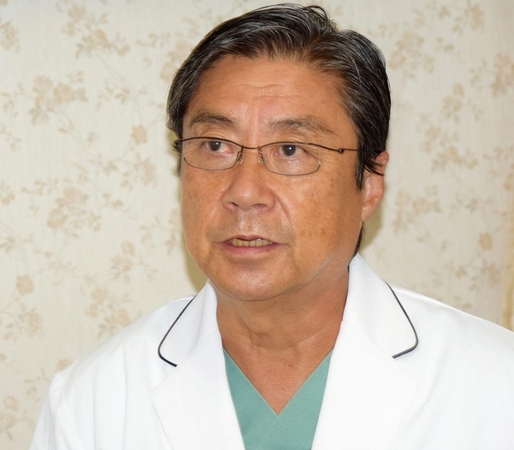
Dr. Kazuo Shimizu
Dr. Kazuo Shimizu, Chairman of the Thyroid Examination Assessment Subcommittee and member of the Oversight Committee for the Fukushima Health Management Survey, a thyroid surgeon and Honorary Director at Kanaji Hospital, and Professor Emeritus at Nippon Medical School, and former chair of the board of the Japanese Society of Thyroid Surgery, submitted his resignation as Chairman of the Thyroid Examination Assessment Subcommittee.
As Chairman of the Thyroid Examination Assessment Subcommittee, he does not personally agree with the interim report conclusion that “it is unlikely that the effects of radiation” caused the high incidence of thyroid cancer found in the Fukushima Prefecture. Not agreeing with the drawn conclusions of the interim report and as Chairman not free to have a personal opinion, nor to express it, he decided to resign.
Dr. Kazuo Shimizu is a doctor, a leading authority in endoscopic surgery of the thyroid gland. Within the Fukushima population, 380,000 children below 18 years old at the time of the Fukushima Daiichi nuclear plant accident in March 2011 have been examined. 174 people have been so far diagnosed with thyroid cancer or suspected thyroid cancer.
Dr. Kazuo Shimizu says that such high incidence of thyroid cancer, from his long clinical experience, is unnatural. That frequency is a fact, which should not be explained, nor discarded by just the “It is unlikely that the effects of radiation.” caused that high incidence conclusion.
In the former Soviet Union after the 1986 Chernobyl nuclear accident, thyroid cancer was frequent in children due the released iodine-131.
http://headlines.yahoo.co.jp/hl?a=20161021-00010003-doshin-soci
However, it is not that surprising. When Oshidori Mako interviewing Dr. Kazuo Shimizu in May 2015 asked « Is it really overdiagnosis that is going on? », Dr. Kazuo Shimizu answered :“I am not in a position to be able to say, ‘It is not due to overdiagnosis.’ As chair of the Subcommittee, I cannot validate opinions of either side. It is hard for me. I would have been able to voice my opinions more clearly if I hadn’t been elected chair of the Subcommittee.”
http://fukushimavoice-eng2.blogspot.fr/2015/08/oshidori-mako-interviews-experts.html
2019 Rugby World Cup in Japan
Before the 2020 Radioactive Olympics of Tokyo, the 2019 Radioactive Rugby World Cup in Japan!!!

World Rugby concluded its latest round of meetings with the Japan 2019 organizing committee in Tokyo Japan Friday, October 14, 2016 in connection with the preparation of the Rugby World Cup 2019.
The Executive Director of World Rugby, Brett Gosper, led a delegation to the quarterly meeting. Three years of the global tournament for the first time on Asian soil, Brett Gosper commented on key issues of the organization.
“We are satisfied with the way things are moving,” he said. “The budget, the planning for the stadiums … the preparations are on track and the foundations are solid. “
Bill Beaumont, president of World Rugby, who will visit Japan next week to take part of the World forum on sport and culture in Tokyo – along with IOC President Thomas Bach – is convinced that Japan 2019 will mobilize entire country.
“The Rugby World Cup will be an event for Japan as a whole,” he said. “Sport is about friendship and this tournament will be the proof with the teams, fans and the Japanese community will live the event together. Everyone is invited to participate in the biggest sporting event in the world in 2019. The host cities will benefit from significant economic benefits, but also sports and culture by hosting one of the world biggest sporting events. By working with the organizing committee, we are determined to make the most of the equipment for the benefit of all. “
Record profits were generated by the Rugby 2015 World Cup the order of £ 2.3 billion (€ 2.5 billion) to £ 1.1 billion (€ 1.2 billion) more to the UK economy through the 406,000 visitors who came and stayed on average 14 days. With 12 host cities, Japan can hope to break records.
The fan base is growing in Japan, especially because of the performance of the national team to the World Cup 2015 Rugby and Rugby 7 team at Rio Olympics Games that finished off the podium. Nearly 50% of fans believe that the Rugby World Cup in Japan will significantly raised the level of rugby in the country and 11 million say they are interested to take part. A total of 59 million Japanese watched the Rugby World Cup 2015.
High-school Students Continuously Put at Risk for Propaganda Use
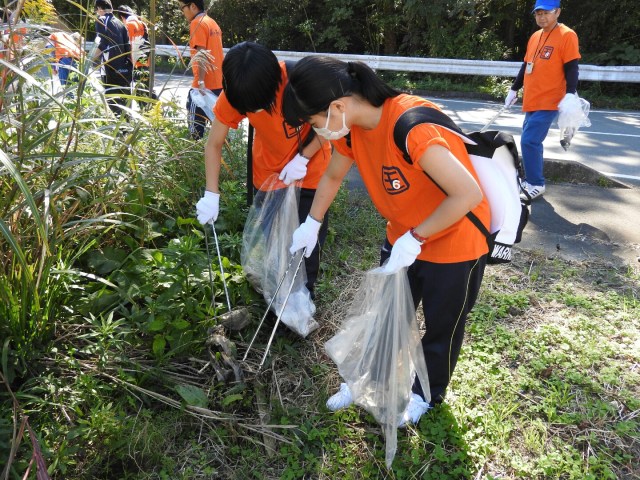
National route 6 which runs only a few km parallel to the coast where stands what is left of Daiichi Nuclear power plant, high-school students are cleaning up radiation.
14 high school students were picking up trash. 0.7μSv / h radiation measured by some citizens’ group at some of the places. With dust being blown, many high school students were walking still without a mask.
The criticism that it could endanger the children, was ignored by Yumiko Nishimoto, president of the NPO “Happy load net” which organized that acttion, answering “we are living here every day.” .
Clean-up activities with an eye to the torch relay of the Tokyo Olympics. The priority is the “reconstruction”, and the health of children is secondary, completely neglected.
The NPO responsible for such insanity argues that it helps them studying about radiation, that they do that every year.
Children are continuously being used to help the propaganda that everything is back to normal. But it’s a lie and it is borderline criminal. Shame on you Japan.
http://taminokoeshimbun.blog.fc2.com/blog-entry-61.html
Tokyo governor visits alternative site in Miyagi Prefecture for 2020 Games’ rowing and canoe sprint
We are many to think that it is shocking, disgusting and very sad that after over5 & a half years they are still putting their greed above the health of those people who would participate and go to watch these games, not to mention their own people. They should have relinquished as soon as they knew that the Fukushima Daiichi nuclear disaster had contaminated a good third of the country.

Tokyo Gov. Yuriko Koike (left front) and Miyagi Gov. Yoshihiro Murai (left back) wave to the press as they inspect the Naganuma rowing course in the city of Tome, Miyagi Prefecture, on Saturday.
Tokyo Gov. Yuriko Koike on Saturday visited a boat race course in Miyagi Prefecture, a facility emerging as an alternative venue for the rowing and canoe sprint events at the 2020 Tokyo Olympic games.
“Based on this visit, I will start considering venues,” Koike told reporters after inspecting facilities at the Naganuma rowing course in the city of Tome, more than 400 kilometers from Tokyo. Miyagi is one of the prefectures in northeastern Japan hit hardest by the March 2011 earthquake and tsunami.
Games organizers and the International Rowing Federation had already approved the Sea Forest Waterway venue to be constructed on Tokyo Bay, but a metropolitan government cost review panel recommended last month that plan be reconsidered.
The Tokyo Olympic and Paralympic organizing committee has raised concerns that costs could top ¥35.1 billion ($337 million) even if the rowing and canoe sprint events were held at the Naganuma rowing course. But Miyagi Prefecture Gov. Yoshihiro Murai argued Saturday in a television appearance that the overall cost is “estimated at around ¥15 to ¥20 billion.”
On the TV program, Murai also emphasized that most of the costs will be for “permanent facilities” after the Olympic Games, and that the prefectural government would shoulder the cost to remove temporary housing.
Last Wednesday, Murai visited Koike in Tokyo to convey his wish to hold the rowing and canoe events in Miyagi to show the world the recovery Japan has made since the 2011 quake and tsunami disaster.
Koike had told Murai that the Naganuma boat course was an option and she would “make a comprehensive decision” after visiting the site.
The organizing committee, however, has questioned the feasibility of holding those events at the Miyagi site, raising what they said are “nine problems,” including transportation, infrastructure and costs.
Saitama Gov. Kiyoshi Ueda has also said his prefecture is ready to host the rowing and canoe sprint events at Saiko Doman Green Park in the city of Toda.
According to a wildlife journalist, even in Tokyo some animals suffer mutations
Already few weeks ago a Japanese friend mentioned to me that he noticed very few insects this summer in Tokyo. This article now corroborates it.
If the wild life around Tokyo is that affected, how about the health of the people living there?

Frog having one eye only (photo by Eiki Sato, from October 10, 2016)
Ravages in Tokyo from the nuclear accident at Fukushima Daiichi 250km away.
The documentary film “Paradise Phantom” just came out. This documentary is about the stationary observations on animals by Eiki Sato, a wildlife journalist. The screening of this film took place at a movie theater in Suginami-ku, Tokyo on September 25, 2016.
Sato filmed for 170 hours various animals in the wild places of Tokyo, for example the banks of the Arakawa river, the fields near sports stadiums and Tokyo plants. These are real paradises for many living creatures, such as kestrels, shrikes, bats, frogs, dragonflies, even the gray beetles, animals that are not on the global red list threatened species.
The documentary shows that since two years animals with abnormalities are being observed . The cause of these abnormalities would be the accumulated radioactivity in the soil of Tokyo, according to Eiki Sato.
During his observations Eiki Sato found many types of deformities, due to mutations: Various insects affected with malformed or missing wing, or with curled wings, or abnormal eyes, unabling them to fly. Mosquito with bent spine, dragonflies with mishaped eyes unable to fly high. Birds with affected eyes, or feathers, unable to fly. Many also cannot reproduce, their population sharply decreasing.
http://www.tokyo-sports.co.jp/entame/entertainment/602104/
Radiation Brain Moms and Citizen Scientists: The Gender Politics of Food Contamination after Fukushima
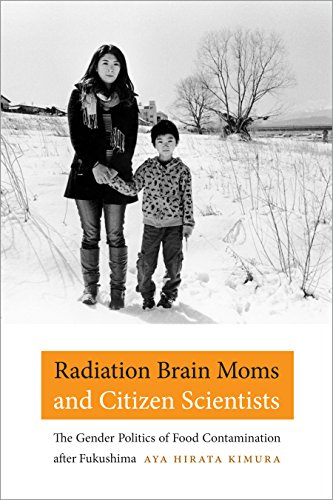
by Aya Hirata Kimura (Author)
Following the Fukushima Daiichi Nuclear Power Plant disaster in 2011 many concerned citizens—particularly mothers—were unconvinced by the Japanese government’s assurances that the country’s food supply was safe. They took matters into their own hands, collecting their own scientific data that revealed radiation-contaminated food. In Radiation Brain Moms and Citizen Scientists Aya Hirata Kimura shows how, instead of being praised for their concern about their communities’ health and safety, they faced stiff social sanctions, which dismissed their results by attributing them to the work of irrational and rumor-spreading women who lacked scientific knowledge. These citizen scientists were unsuccessful at gaining political traction, as they were constrained by neoliberal and traditional gender ideologies that dictated how private citizens—especially women—should act. By highlighting the challenges these citizen scientists faced, Kimura provides insights into the complicated relationship between science, foodways, gender, and politics in post-Fukushima Japan and beyond.
Editorial Reviews
Review
“Riveting and smart, Radiation Brain Moms and Citizen Scientists tracks the efforts made by citizens in post-Fukushima Japan to ensure the safety of their food from radioactive contamination. In the face of state neglect and criticism from fellow Japanese, these initiatives display a ‘soft’ boldness (versus activist politics). Interweaving stories of citizen scientists and ‘radiation brain moms’ with sharp theoretics that deconstruct the entanglements of science, neoliberalism, and postfeminism at work, this book is at once powerful and timely.”
(Anne Allison, author of Precarious Japan)
“Based on careful research, extensive fieldwork, and a judicious use of political and feminist theory, this book’s relevance to political and social developments extends beyond Japan’s borders. It is a reminder of the ongoing effects of the Fukushima disaster in Japan at a time when these effects are being increasingly ignored by the global media. A timely and important book, Radiation Brain Moms and Citizen Scientists will appeal to scholars of contemporary Japanese society as well as science and technology studies scholars, especially those interested in the gender dimensions of science and technology.”
(Tessa Morris-Suzuki, author of Borderline Japan: Foreigners and Frontier Controls in the Postwar Era)
About the Author
Aya Hirata Kimura is Associate Professor of Women’s Studies at the University of Hawai’i at Manoa and the author of Hidden Hunger: Gender and Politics of Smarter Foods.
Meet the nuclear cattle of Fukushima
(CNN)Some families have at least one relative who’s either odd or eccentric. Others boast family members of a more unusual kind.
That’s what one filmmaker discovered in 2011 when he heard of a group of former farmers in Fukushima‘s nuclear exclusion zone, fighting to keep their radiation-affected cows alive, though they brought them no profit.
“The farmers think of these cows as family. They know that these cows can’t be sold, but they don’t want to kill them just because they’re not worth anything,” Tamotsu Matsubara, who made a film called ‘Nuclear Cattle’ (Hibaku Ushi) on their plight, told CNN.
It costs around 2,000 dollars to maintain each cow for a year. The farmers featured in Matsubara’s film are among those who refused to obey the Japanese government’s initial requests to euthanize cows in the exclusion zone.
“[These farmers] really want them to serve a greater purpose for humans and for science,” explained Matsubara.
Nuclear Cattle
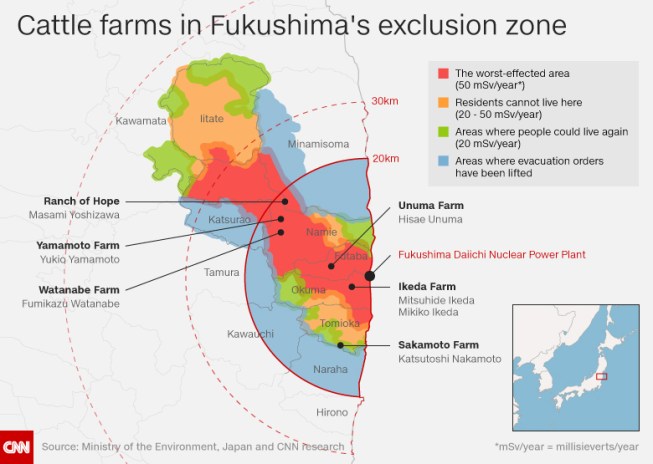
On March 11 2011, a 15-meter tsunami triggered by a 8.9-magnitude earthquake, disabled the Fukushima Daiichi nuclear power plant in Fukushima, causing a nuclear accident.
Residents within a 20 km radius of the facility were forced to evacuate their homes and leave behind their livelihoods and possessions.
Before leaving, some farmers released their cows so they could roam free and survive in the nuclear fallout-affected area. 1,400, however, died from starvation, while the government euthanized 1,500 more.
Since 2011, Matsubara has documented both the relationship six farmers have with their surviving herds as well as an ongoing study examining the effects radiation has on large mammals.
A greater scientific purpose
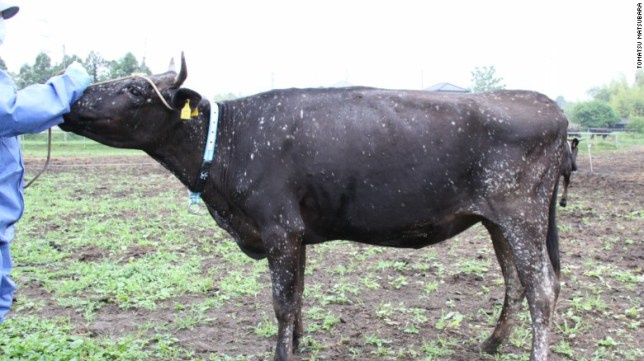
A cow from within Fukushima’s 20 km exclusion zone with an abnormal white spot outbreak.
The farmers — who return two or three times a week to their former farms — initially kept their cows alive just out of love. But since 2013, Keiji Okada, an animal science expert at Iwate University, has been carrying out tests on them.
Okada established the Society for Animal Refugee & Environment post-Nuclear Disaster, a non-profit with researchers from Kitazato, Tohoku and Tokyo university. The researchers are funded through their universities, and say their project is the first to look into the effects of radiation on large animals.
“Large mammals are different to bugs and small birds, the genes affected by radiation exposure can repair more easily that it’s hard to see the effects of radiation,” Okada, told CNN.
“We really need to know what levels of radiation have a dangerous effect on large mammals and what levels don’t,” he added.
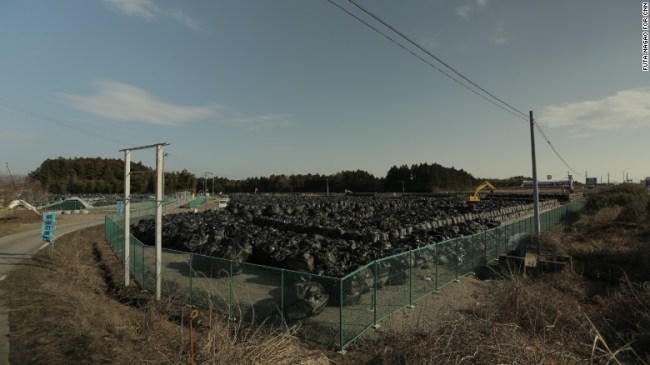
A mountain of black bags filled with contaminated soil sits piled on a roadside in Tomioka, Fukushima. A massive national project to remove topsoil and vegetation contaminated by the Fukushima nuclear disaster will produce at least 22 million square meters of radioactive waste.
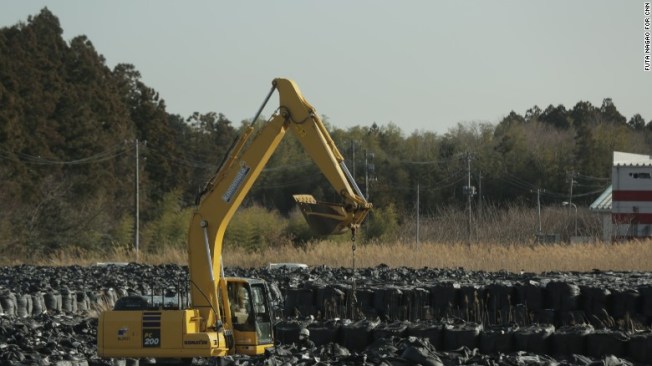
Colossal quantities of contaminated material have been collected from the Fukushima site and surrounding area. What will be done to dispose them still remains to be seen.
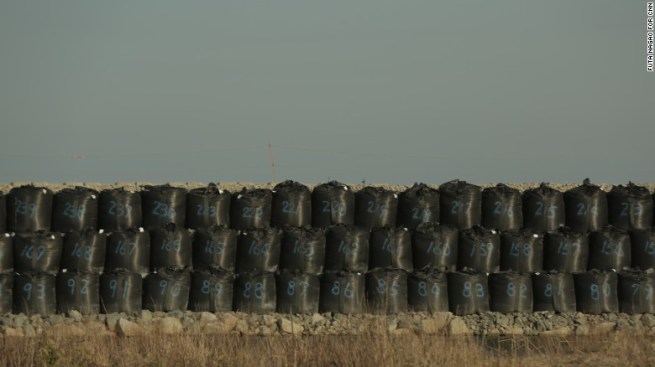
One of hundreds of temporary storage sites for contaminated material.

A giant, 780-meter sea wall under construction near the Fukushima Daiichi nuclear plant is designed to prevent contaminated water on the site from seeping into the ocean
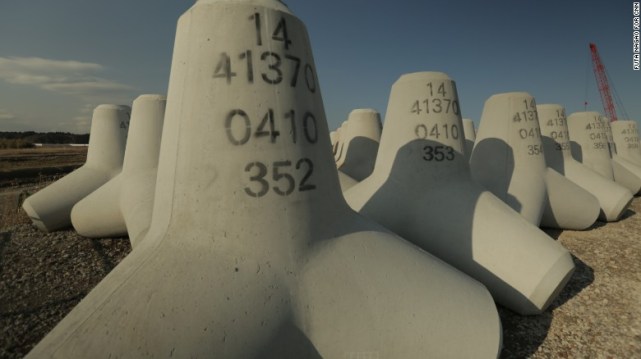
Tetrapods piled up at Udedo port in Namie, Fukushima, waiting to be used for a 7 meter high, 3 kilometer long breakwater along the coast line.
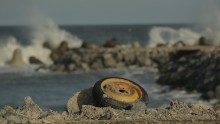
Prior to the wall’s construction, radioactive water and materials readily seeped into the ocean, threatening local fishing stocks and causing potentially irreversible damage to the sea floor.
So far, the cows living within the exclusion zone haven’t shown signs of leukemia or cancer — two diseases usually associated with high levels of radiation exposure. Some, however, have white spots on their hides. Their human minders suspect that these are the side-effects of radiation exposure.
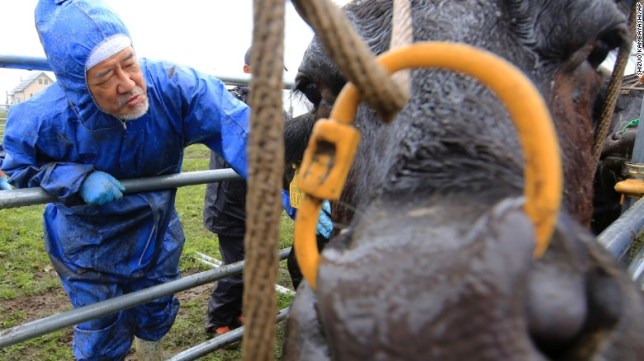
Keiji Okada, associate professor of veterinary medicine and agriculture at Iwate University, examines a cow at Ikeda Ranch in Okuma town, 5 kilometers (3 miles) west of Japan’s crippled Fukushima Dai-ichi nuclear power plant.
As Japan continues to confront its nuclear past, present and future, Okada said his group’s study would keep the country prepared in the event of another disaster.
“We need to know what levels of radiation are safe and dangerous for large mammals, and have that data ready so that the euthanization of livestock can be kept to the minimum,” added Okada.
The ‘cows of hope’
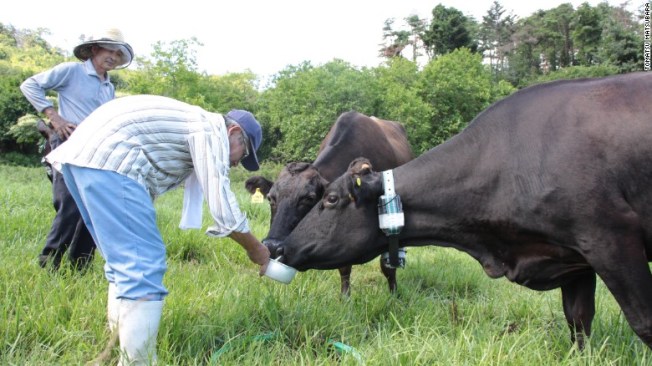
Elderly farmers feeds their radiation-affected cows in the exclusion zone.
Since 2011, the Japanese government has taken measures to decontaminate radiation-affected zones within Fukushima by stripping surface soil from contaminated zones and by cleansing asphalt roads and playgrounds.
Evacuation notices have also lifted on some towns in Fukushima. Taichi Goto, a spokesperson from the Ministry of the Environment’s Office for Decontamination told CNN that Namie, a town currently in the exclusion zone, was scheduled to be decontaminated by March 2017. Yet critics point that the state’s measures still aren’t enough.
Matsubara acknowledged the government’s decontamination work but asserted that it was impossible for them to clear the mountainous areas west of the exclusion zone.
While some farmers have slowly started to rebuild their lives by starting new businesses in decontaminated areas in Fukushima, the campaign to keep alive irradiated cows within the exclusion zone continues.
“These cows are the witnesses of the nuclear accident,” Masami Yoshikawa, who lives in Namie town in the heart of the exclusion zone, states in Nuclear Cattle.
“They’re the cows of hope.”
http://edition.cnn.com/2016/09/27/asia/japan-fukushima-nuclear-cows/index.html
East Japan Soil Measurement Project of Minna no Data Site

About This Project
It’s time to cooperate
When we started up MDS (Minna no Data Site, Everyone’s Data Site) we constructed inclusive and shared system on measuring data of food as the first stage, as there were many people who were concerned about food intake.
However, we planned to launch the measuring data of soil as a second stage after intensively equipped the system on food.
In autumn 2014, after one year from opening of MDS, we start up to platform soil measurement data. We, as citizens, try to start to map the status of soil contamination spread over East Japan.
The following is the reason why we stand up to start the East Japan Soil Becquerel Measurement Project. Objectives, outline and methodology of the project is explained.
Outline
In the Project, the method of collection is standardized in order to make comparison of data from multiple measurement laboratories. The Manual for Collection is developed by considering the easiest method of measurement within the limits of keeping accuracy, because many citizens conduct collection and measurement by themselves.
Collected soil is measured by the participating measuring laboratories of MDS. The result becomes open to the public and the report is sent to the collector.
Objectives
Radioactivity contamination by the accident of Tepko Fukushima Nuclear Power Plant is long term lasting.
The soil contamination map of broader areas is needed to understand contamination of neighborhood by measurement and comparison of data.
Though central and local governments conduct soil researches, those researches are insufficient because the value is lower by measuring deep place, or they measure only air dose.
As they decide the spot of measurement by mesh, the data what citizens want to know is lacking.
In our Project, we aim to grasp status of contamination where citizens make living every day. For example, place where children frequently play, where people pick wild grass, or where farmers work is being measured.
The Project aims that people can access necessary information as much as possible by utilizing data and database and by accumulating information which one can find at a glance and can search at ease.
We hope the result would be used as a tool for action for everyone.
Methodology
■ The depth of collection is from 0 to 5 cm, because most of cesium stays within 5 cm from surface of the earth.
Collection of soil should be conducted when it does not rain for several days, in order to avoid weight error caused by water. Less than 10 percent of moisture content is desirable.
■ Spot for collection is set at higher dose spot by measuring rate of air dose (1m、5cm).
The extreme high spot such as micro hot spots and concentrated environment are excluded.
■ Collection is made by a method to compare results of each place.
■ Samples are measured at the participating laboratories of MDS.
・Measurement accuracy of those laboratories is ensured by the MDS original examination.
・The results are accumulated in the common database.
■ The result sof measurement are open to public on MDS. MDS has Japanese and English site.
■ Mapping of data is planned after gathering enough results.
■ Trial calculation of amount of radioactivity by a square meter is planned to be conducted. (Becquerel/ Kg →Becquerel /square meter)
Target areas:17prefectures in east-Japan
Tohoku : Aomori Iwate Akita Miyagi Yamagata Fukushima
Kanto : Ibaragi Tochigi Gunma Saitama Chiba Tokyo Kanagawa
Chubu : Yamanashi Nagano Shizuoka Nigata
* In Iwate, the Soil Project Iwate had implemented measurement at more than 300 spots in 2012 and 2013.
The project activity will be made starting from requested districts. Individuals, groups and any organization such as school and daycare can participate in measurement of proposed spots. Proposing more than 5 spots are desirable.
The measurement spots will be decided after consultation basically in the same municipality.
★ How to support us:
Collection of samples, payment of 2,000yen for measurement of one sample, payment of actual postage for samples.
★ How to feed back :
Sending result of measurement of the spots including spectrum, Reading and downloading data at MDS.
Support our site and project!
To those of you who are viewing this site from overseas, Thank you for visiting ”Minna no Data Site” (Combined Database of Independent Radioactivity Measurement Labs) .
MDS has stacked the data measured by the independent radioactivity measurement laboratories in response to the Fukushima Daiichi nuclear power plant accident, As of September 2014, the number of the food data became nearly 10,000.
For the benefit of those who worry about radioactive contamination of Japan from overseas, we opened the English site. We have started “East Japan soil measurement project” since October 2014 in addition to the food data.
From the fact that government has not done the adequate soil contamination survey for the citizens, this project promotes measuring soils of the places like parks, vacant lots, and educational facilities which are closely related to children’s daily life.
This project is based on the method of “Iwate soil measurement project “(2012- 2013) by citizens of Iwate Prefecture. If the method for collecting the soil is different, the results of monitoring vary greatly.
By using an easy-to-understand manual of the standardized method, you are able to compare, review and analysis the data from different locations. We will publish the measurement results of soil on this site.
We record the status of the radioactive contamination of Japan carefully from the standpoint of citizens, and hope that it will help people who are living with anxiety. For the people overseas, we are preparing the English version of data to show where and how much radioactively contaminated.
To run this project, big budget for measurement cost and update cost of web systems are required. There are 300 locations in each 17 prefectures in Eastern Japan, and each place costs about 4,000 yen.
Although it is planned to reduce costs and to ask for volunteers as much as possible, still the costs such as measurement costs, project management costs and Web systems costs are expected to some extent also.
It is a project of the scale that no one even challenged yet. We rely on your generosity to help funding for this project. We would appreciate your support from abroad. Thank you for your cooperation and support.
The information page of “East Japan soil measurement project” is currently in preparation. It will be published shortly.
◎Donate by the bank transfer
Postal Transfer:
Postal Transfer Account : 10090-85754261
Account Name: Minna no data site Unei Iinkai
Bank Account
Yuucho Bank Branch : Zero Zero Eight (Branch 008):
Interim : 8575426
Account Name: Minna no data site Unei Iinkai
Remittances in either USD or EUR can be made from overseas banks,.
Please note that remittances to Japan cannot be made from certain financial institutions.
For details, please ask your local bank.
http://en.minnanods.net/#mds_indx_srch
http://en.minnanods.net/soil/soil_support.html
High levels of radioactive cesium pooling at dams near Fukushima nuke plant
Once radionuclides enter the eco-system, they move around carried by wind and water. They can’t “go away.” They can’t be “decontaminated.” They can only be moved, the biggest force moving them is nature, not clean up crews.
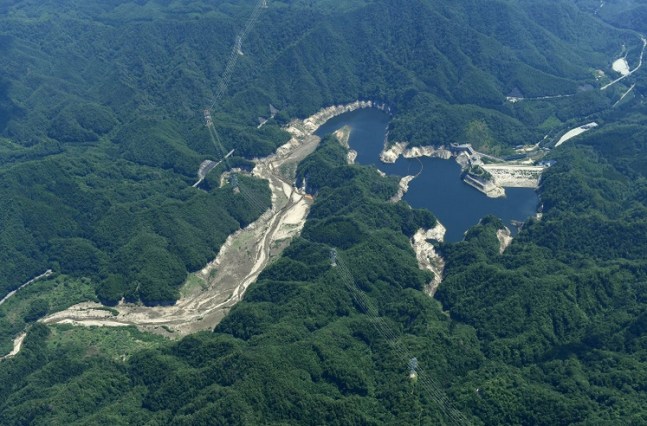
Ogaki Dam in Namie, Fukushima Prefecture, as seen from a Mainichi Shimbun helicopter in July 2016, contains high concentrations of radioactive cesium exceeding the limit set for designated waste.
High levels of radioactive cesium pooling at dams near Fukushima nuke plant
High concentrations of radioactive cesium have been accumulating at the bottom of 10 major dams within a 50-kilometer radius from the disaster-stricken Fukushima No. 1 Nuclear Power Plant, a survey by the Environment Ministry has found.
Radioactive cesium emanating from the 2011 nuclear disaster is pooling at those dams, which are used to hold drinking water and for agricultural use, after the substances flew into there from mountains, forests and rivers. The radiation levels at the bottom of those dams top those set for designated waste at over 8,000 becquerels per kilogram.
While the Environment Ministry plans to monitor the situation without decontaminating the dams on the grounds that radiation levels in dam water is not high enough to affect human health, experts are calling for the ministry to look into measures to counter any future risks.
The ministry began a monitoring survey on those dams and rivers downstream in September 2011 to grasp the moves of radioactive substances flowing into them from mountains and forests that are not subject to decontamination work. The survey samples water at 73 dams in Tokyo, Iwate and seven other prefectures about once every several months.
Among them, there were 10 dams in Fukushima Prefecture where the average concentration of cesium in the surface layer of bottom soil measured between fiscal 2011 and 2015 topped the regulated levels for designated waste. Those dams include Ganbe Dam in the village of Iitate with 64,439 becquerels per kilogram of cesium, Yokokawa Dam in the city of Minamisoma with 27,533 becquerels, and Mano Dam in Iitate with 26,859 becquerels.
Meanwhile, the surface water at those 10 dams contained 1-2 becquerels per liter of cesium, which is below the drinking water criteria at 10 becquerels.
While the total amount of cesium deposited at the bottom of those dams is unknown from the environment ministry’s survey, a separate study conducted at Ogaki Dam in the town of Namie by the Ministry of Agriculture, Forestry and Fisheries’ Tohoku Regional Agricultural Administration Office estimated in December 2013 that there was a combined 8 trillion becquerels of cesium 134 and cesium 137 at the dam. The figure came about after estimating the amount of accumulated cesium every 10-meter-square area based on cesium levels in sedimentary soil sampled at 110 locations at the bottom of the dam, which is for agricultural use.
The National Institute for Environmental Studies in Tsukuba, Ibaraki Prefecture, will shortly begin a full-scale survey on cesium concentrations at several dams.
“At the moment, it is best to contain cesium at those dams. If we dredge it, the substance could curl up and could contaminate rivers downstream,” said an Environment Ministry official.
http://mainichi.jp/english/articles/20160926/p2a/00m/0na/007000c
Anxiety soars as cesium builds up in Fukushima dams
Dams surrounding the stricken Fukushima No. 1 Nuclear Power Plant operated by Tokyo Electric Power Co. (TEPCO) have become de facto storage facilities for high concentrations of radioactive cesium as the element continues to accumulate.
With no effective countermeasures in sight, the government insists that water from the dams is safe, but to local residents, the government’s stance comes across as the shelving of a crucial problem.
“It’s best to leave it as it is,” an official from the Ministry of the Environment says, with the knowledge that in 10 dams in Fukushima Prefecture, there is soil containing concentrations of cesium over the limit set for designated waste — or over 8,000 becquerels per kilogram.
According to monitoring procedures carried out by the ministry, the levels of radioactive cesium detected in the dams’ waters, at 1 to 2 becquerels per liter, are well below the maximum amount permitted in drinking water, which is 10 becquerels per liter. The air radiation doses in the dams’ surrounding areas are at a maximum 2 microsieverts per hour, which the ministry says “does not immediately affect humans, if they avoid going near the dams.” This information is the main basis behind the central government’s wait-and-see stance. For the time being, the cesium appears to have attached itself to soil and is collected at the bottom of the dams, with the water above it blocking radiation from reaching and affecting the surrounding areas.
In a basic policy based on a special law, passed in August 2011, on measures for dealing with radioactive material following the onset of the Fukushima nuclear disaster, the Environment Ministry stipulates the decontamination of areas necessary from “the standpoint of protecting human health.” The ministry argues that as long as high concentrations of cesium at the bottom of multiple dams in Fukushima Prefecture do not pose imminent danger to human health, there are no legal problems in the ministry refraining from taking action.
“If the dams dry up due to water shortages, we just have to keep people from getting close to them,” the aforementioned ministry official says. “If we were to try to decontaminate the dams, how would we secure water sources while the work is in progress? The impact of trying to decontaminate the dams under the current state of affairs would be greater than not doing anything.”
This stance taken by the central government has drawn protests from local residents.
“The Environment Ministry only says that it will monitor the dams’ water and the surrounding areas. They say, ‘We’ll deal with anything that comes up,’ but when asked what they plan to do if the dams break, they have no answers. It’s painful to us that we can only give town residents the answers that the Environment Ministry gives us,” says an official with the revitalization division of the Namie Municipal Government. The central government is set to lift evacuation orders for a part of the Fukushima Prefecture town of Namie in spring of 2017.
According to a Ministry of Agriculture, Forestry and Fisheries survey, Ogaki Dam, an agricultural dam in Namie, was estimated to have sediment totaling approximately 8 trillion becquerels of cesium as of December 2013. The agriculture ministry plans to re-survey the dam’s accumulated cesium amounts and water safety before the water is used for agricultural purposes. Agricultural and fishery products from Fukushima Prefecture are tested to ensure that radioactive substances that they contain are below the maximum permissible amounts stipulated by law before they are shipped for distribution.
Still, one town official worries how revelations of high levels of radioactive material in local dams will affect consumers. “No matter how much they are told that the water is safe, will consumers buy agricultural products from Namie, knowing that there is cesium at the bottom of local dams?”
A 57-year-old vegetable farmer from Namie who has been evacuated to the Fukushima Prefecture city of Iwaki says, “The central government keeps on emphasizing that the dams are safe, but doesn’t seem to be considering any fundamental solutions to the problem. If this state of affairs persists, we won’t be able to return to Namie with peace of mind, nor will it be easy to resume farming.”
http://mainichi.jp/english/articles/20160926/p2a/00m/0na/011000c
In Fukushima, A Bitter Legacy Of Radiation, Trauma and Fear
Five years after the nuclear power plant meltdown, a journey through the Fukushima evacuation zone reveals some high levels of radiation and an overriding sense of fear. For many, the psychological damage is far more profound than the health effects.
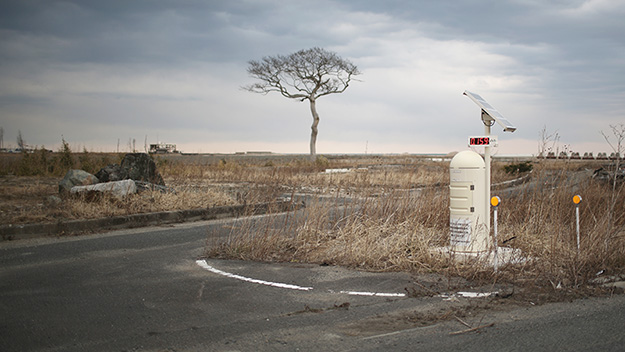
A radiation monitoring station alongside a road in Namie, Japan.
Japan’s Highway 114 may not be the most famous road in the world. It doesn’t have the cachet of Route 66 or the Pan-American Highway. But it does have one claim to fame. It passes through what for the past five years has been one of the most radioactive landscapes on the planet – heading southeast from the Japanese city of Fukushima to the stricken nuclear power plant, Fukushima Daiichi, through the forested mountains where much of the fallout from the meltdown at the plant in March 2011 fell to earth.
It is a largely empty highway now, winding through abandoned villages and past overgrown rice paddy fields. For two days in August, I traveled its length to assess the aftermath of the nuclear disaster in the company of Baba Isao, an assemblyman who represents the town of Namie, located just three miles from the power plant and one of four major towns that remain evacuated.
At times, the radiation levels seemed scarily high – still too high for permanent occupation. But radiation was just the start. More worrying, I discovered, was the psychological and political fallout from the accident. While the radiation – most of it now from caesium-137, a radioactive isotope with a half-life of 30 years – is decaying, dispersing, or being cleaned up, it is far from clear that this wider trauma has yet peaked. Fukushima is going to be in rehab for decades.
I began my journey with Baba, a small bustling man of 72 years, at Kawamata, a town on Highway 114 that is a gateway to the mountains beyond. These mountains are where the fallout was greatest, and the forests that cover most of their slopes have retained the most radioactivity. The mountains make up most of the government-designated “red zone,” where radiation doses exceed 50 millisieverts a year and which are likely to remain uninhabited for many years.
A second “yellow zone” has doses of 20-50 millisieverts, where returning may soon be possible; and a third “green zone,” with less than 20 millisieverts, is deemed safe to live in, and an organized return is under way or planned. Zones are re-categorized as radioactivity decays and hotspots are decontaminated.
To check progress, I took with me a Geiger counter that measured gamma radiation, the main source of radiation for anyone not eating contaminated food.
Beyond Kawamata, the road was largely empty and houses sat abandoned and overgrown. There was no cellphone signal. At first, houses we measured at the roadside had radiation doses equivalent to only around 2 millisieverts per year, a tenth of the government threshold for reoccupation. But within minutes, as we climbed into the mountains, radiation increased as we moved from green to yellow to red zones.
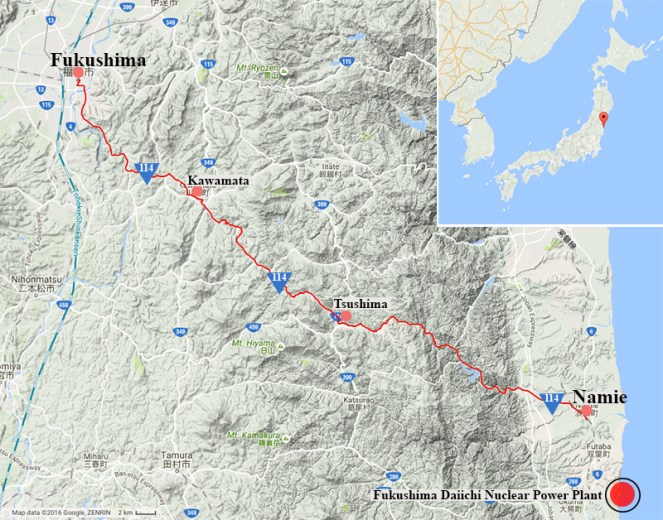
A map tracing Japan’s Highway 114 through the Fukushima evacuation zone
Despite the radiation, wildlife is thriving in the absence of people, Baba said. There are elk, wolves, lynx, monkeys, and bears in the mountains. “Nature here is beautiful,” he said, “but we can’t fish or collect bamboo shoots or eat the mountain vegetables that people used to harvest from the forests.”
We stopped by an abandoned gas station in Tsushima, a village in the lee of Mount Hiyama, where wild boar had excavated the soil right by a vending machine that appeared remarkably intact. The bright-red digital display on an official Geiger counter read the equivalent of 21 millisieverts per year, just above the limit for human habitation.
The day after the disaster at the power plant began, 1,400 people from Namie came to Tsushima after being ordered to evacuate. “I was among them,” said Baba. “We had no information. People were just told to come. When we arrived, we went to the village police station and found that the police there were in full protective clothing against the radiation. They said it was a precaution in case they had to go to the power plant, but they had obviously been told that something serious was going on that the population hadn’t been told. That’s when our suspicion about the honesty of the authorities began.”
Tsushima has since become an unofficial shrine to the disaster. In the window of an abandoned shop are posters with bitter, ironic messages, some directed at the nuclear plant’s operator, Tokyo Electric Power: “Thanks to TEPCO, we can shed tears at our temporary housing,” read one. “Thanks to TEPCO, we can play pachinko.” But one, in English, just said, “I shall return.”
Back on Highway 114, a car stopped, and a woman got out. Konno Hidiko was driving to Namie – day trips are allowed, but overnight stays banned – to clean her parents’ former house and tidy an ancestral grave before relatives visited during an upcoming religious holiday. “My parents are dead now, but I still clean their house,” she said. “There are mice inside and wild boar have been in. We won’t ever return to live there. But we might build a new house there one day.”
Further along, Baba stopped the car and walked up a path swathed in vegetation. “This is my house,” he said suddenly, pointing to a barely visible building. It was shuttered. But I noticed laundry still hanging to dry in an upstairs window. On a tour of the grounds, Baba showed me his plum trees. “The fruit is too dangerous to eat now, and we can’t drink the water from the well, either.” We found a shed where he and his schoolteacher wife once kept cattle, and a former hay shed where he stored old election banners.
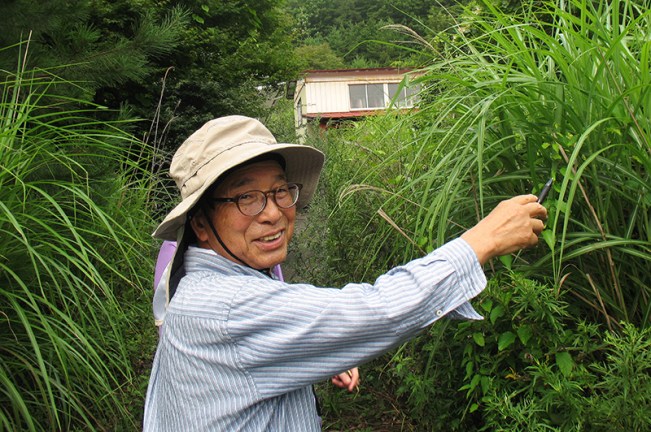
Baba Isao approaches his abandoned house in Namie.
I checked my meter. It read 26 millisieverts per year in the hay shed, but shot up to an alarming 80 in undergrowth outside. That was four times the safe level for habitation. No wonder Baba had no plans to return. “I am just the son of a farmer. I wonder who has a right to destroy our home and my livelihood,” he mused bitterly. “Please tell the world: No Nukes.”
At his local post office, an official monitor by the road measured 56 millisieverts. Mine agreed, but when we pointed it close to a sprig of moss pushing through the tarmac, it went off the scale. “They measured 500 millisieverts here last week,” Baba said. “Moss accumulates radioactivity.”
As we drove on, the roadside was now marked every few kilometers by massive pyramids of black plastic bags, containing radioactive soil that had been stripped from roadside edges, paddy fields, and house gardens as part of government efforts to decontaminate the land. An estimated 3 million bags, all neatly tagged, now await final disposal at facilities planned along the coast. But the task of transporting the soil is so huge that the authorities are building a new road so trucks can bypass the scenic mountain villages along Highway 114.
Through a checkpoint we came at last to Namie town. Just before my visit, major media such as The Guardian and CNN had published images of the town by a photographer who claimed to have gained secret, unauthorized entry to the “ghost town.” He posed in his images wearing a gas mask to show how dangerous it was.
My visit to the town had required a request in advance, via Baba, but no subterfuge. And I found Namie a surprisingly busy “ghost town.” Nobody is yet allowed to live there. But some 4,000 people work there every day, repairing the railway line and roads, building new houses, and knocking down quake-damaged shops, preparing for the planned return of its citizens in April 2017.
There was plenty of earthquake damage, and vegetation pushed through cracks in the roads and the pavement in the front yards. Black bags were everywhere. But the traffic lights functioned, and drivers obeyed them; there was a 7-Eleven and the vending machines had Coke in them. Nobody wore protective clothing or masks. My biggest safety concern was not radiation, but the news, conveyed over the town’s public address system on the afternoon I was there, that a bear had been spotted in the suburbs.
Despite its proximity to the power plant, average radiation levels in the town were down to around 2 millisieverts per year in Namie – lower, in fact, than I recorded in Fukushima City, which was never evacuated.
“I have no idea how many people will come back,” said Baba. “They have a lot of misgivings because of the radioactive contamination. And I think their fears are totally justified. It is totally unthinkable for me to return to my old place, so I cannot encourage them to return to theirs.” He quoted a survey of the town’s 21,000 former residents showing that only 18 percent wanted to come back. That sounded similar to nearby Naraha town, where only a fifth returned after the all-clear was given last year.
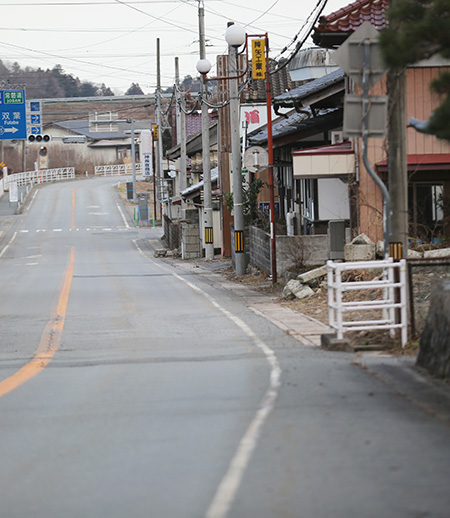
A deserted street in Namie in early 2016.
People especially feared for their children. The biggest concern was reports of an epidemic of thyroid cancer among children exposed to radioactive iodine in the days after the accident. An ultrasound screening program had found an apparent 30-fold increase in cysts, nodules, and some cancers in children’s thyroid glands. It had made headline news.
But at the Fukushima Medical University, doctors and medical researchers insisted that radiation doses were far too low to pose a serious cancer risk, not least because contaminated foodstuffs that could have harbored the iodine were rapidly withdrawn from sale. Ken Nollet, an American who is director of radiation health at the university, insists that the apparent epidemic was evidence only of better searching for disease. He told me a Korean screening study using the same techniques on a non-exposed population found similar rates to those in Fukushima’s contaminated zone.
Thanks to the rapid, if chaotic, evacuation of the area after the power plant began its meltdown, and the controls of foodstuffs, doctors say they believe there are unlikely to be many, if any, deaths among the public from radiation from the Fukushima accident. “A few members of the public got a CT scan’s worth of radiation; almost nobody received more than the dose from a barium meal,” said Nollet.
But there have been deaths nonetheless. Some 60 old people died as a direct result of the evacuation, including several who died of hunger after being left behind, said a doctor at Soma hospital, Sae Ochi. And depression remains widespread among evacuees, she says. There have been around 85 suicides linked to its after-effects. “It’s post-traumatic stress,” said Masaharu Maeda at Fukushima Medical University. “People with very negative views about the risks of radiation are more likely to be depressed. It’s a vicious circle.”
Some doctors told me that while the initial evacuation was necessary, the failure to plan a swift return as radiation levels fell had been disastrous. Apart from a few high-dose areas in the mountains, the psychological risks of staying away exceed the radiological risks of coming back. But the confusion has contributed to a serious loss of trust among the public for medical, as well as nuclear, authorities. “When we try to explain the situation,” says Nollet, “we are seen as complicit in nuclear power.”
It seems increasingly unlikely that the majority of families will return to the abandoned towns as the official all-clear is given. As we drove back from Namie, I dropped in on a group of old women living in an evacuation camp outside Kawamata. One told me they wanted to return to their old homes, but that “most young people simply won’t go back. They fear for their children, but also they have moved on in their lives, with new jobs and their children in new schools.”
And maybe that is not a bad thing. At a kindergarten in Soma City, just outside the exclusion zone, teachers told me that, away from the fear of radiation, there was a baby boom going on there. The crop of new students this year was the largest since the accident.
http://e360.yale.edu/feature/fukushima_bitter_legacy_of_radiation_trauma_fear/3035/
Information about malformations of fetus and abortions in Fukushima
This video is from April 9, 2016, 6 months ago.
Two evacuated women from Fukushima talk about their experiences. One of them gives information about malformations of fetus and abortions.
With English subtitles which are not great but you can follow the story.
Radioactive Food And Water The New Normal In Japan
“We forget that the water cycle and the life cycle are one.” — Jacques Cousteau
“When drinking water, remember its source.” — Chinese proverb
“Ye shall know them by their fruits. Do men gather grapes of thorns, or figs of thistles?
Even so every good tree bringeth forth good fruit; but a corrupt tree bringeth forth evil fruit.
A good tree cannot bring forth evil fruit, neither can a corrupt tree bring forth good fruit.
Every tree that bringeth not forth good fruit is hewn down, and cast into the fire.
Wherefore by their fruits ye shall know them.” — Matthew 7:16-20, Holy Bible
Japan has an amazing food culture thanks in part to the rich volcanic soil and ample rainfall, despite the lack of spacious farms. As it stands, Japan can feed approximately one third of its population from domestic production.
If you watch Japanese TV from time to time, you will see a bizarre and disturbing fetishization of food that borders on the insane. The media and in turn consumers are obsessed with food as not only a source of nutrition and social cohesion (all for the good), but as art, fashion and status symbol, a celebration of gluttony and greed; an infantile obsession with eating for self satisfaction.
I love good and healthy food and appreciate Asian cuisine, but we eat to live, not live to eat. This social pathology affects other cultures as well as seen by increasing rates of extreme obesity especially in Western countries due to the proliferation of shopping malls, junk food and high fructose corn syrup.
How ironic then that a “high food” society like Japan would have to suffer the insult of radioactive contamination. This is not a tuna melt sandwich but a nuclear melt-down sundae.
The long-term consequences of the Fukushima nuclear disaster continue to linger years after the event. Anyone who studies Chernobyl will know that even after three decades radioactive contamination persists. Although a different type of accident occurred there, in the case of Fukushima it was three reactors that had meltdowns instead of one, and even possibly “melt throughs” referring to corium penetrating the reactor buildings in lateral and vertical outward paths.
In the days and months that followed the Fukushima disaster in March of 2011, many people became very worried about radioactive contamination of the food and water supply, especially from short-lived iodine isotopes, followed by the more persistent and harmful cesium, strontium and plutonium. There was much testing by both the government and independent researchers and organizations. Despite the best efforts of the Japanese government, nuclear industry and mainstream media to downplay the crisis, social media proved helpful in educating the public about how to reduce consumer risks.
The worst contamination occurred nearest the disaster site of the Fukushima No. 1 nuclear power station (Dai-ichi) which is located about half way up the east coast in Fukushima prefecture.
When I visited Hirano town with my colleague Yoichi Shimatsu in 2013, we traveled on foot within a few kilometers of the site. We observed abnormally high levels of radiation making it unfit for long-term habitation. Decontamination has taken place there but it is not a thorough removal method and basically shifts radiation from one spot to another in the environment.
Today, if you visit the Japanese government website of the Nuclear Regulation Authority (1) you can find a variety reports on radiation levels with most reports citing very low levels of radiation. How the government arrives at such measurements is not clearly explained at the website. Are their measurements reliable or being taken in a selective manner?
The government hopes to normalize the former evacuation zone by allowing and encouraging residents to move back as soon as possible, despite their reluctance to do so.
Only 28% of Fukushima children returning to former schools….
The majority of schoolboys and girls are opting to stay out of their hometowns due to anxiety over radiation exposure and resettlement at evacuation sites (2).
The problem of radioactive contamination is not unique to Fukushima but to the entire region including Tokyo, home of millions. Recall that 60 million people were originally exposed to radioactive fallout from the accident. Japan was actually lucky because the majority of radiation blew out to sea away from Honshu, not back over the population.
While the government moves to allow wide-scale fishing off the coast of Fukushima (3), and the NRA reports minimal levels of radiation leaking from the plant into the ocean, this confidence in a safe environment is undermined by a report from Greenpeace which found “[r]adiation along Fukushima rivers up to 200 times higher than Pacific Ocean seabed.”
Riverbank sediment samples taken along the Niida River in Minami Soma, measured as high as 29,800 Bq/kg for radiocaesium (Cs-134 and 137). The Niida samples were taken where there are no restrictions on people living, as were other river samples. At the estuary of the Abukuma River in Miyagi prefecture, which lies more than 90km north of the Fukushima Daiichi plant, levels measured in sediment samples were as high as 6,500 Bq/kg (4).
The rivers and ocean are connected and one wonders why the media does not report on these worrying hotspots. These dangerously high levels are indicative of the widely scattered hotspots in the region. In contrast, I could find no reports on the radiation levels at river banks and lake beds at the NRA website, only some reports on radiation found in dust, seawater and so on.
For example, one 2014 report states:
Air dose rates in both “Road and its adjacent area” and “Vacant land lot” have decreased more rapidly than we expected considering the physical half-life of radionuclide in 32 months after the accident. Air dose rates in “Road and its adjacent area” have decreased more rapidly than “Vacant land lot” in 32 months after the accident (5).
The Culture Of Cover Up: Spiked!
A few months ago I was shopping at my health food store in central Tokyo when I was asked by the clerk if I would like to be interviewed by a TV reporter from the Asahi News. I said “sure why not.” Japanese TV often has “man on the street” types of interviews and if you put the shop in a good light, you might appear in a news “infomercial.”
The reporter asked me various questions about why I buy organic food and I spoke proficiently in Japanese about the positive benefits of eating organic food including its superior nutrition and flavor, and because it contributes to the local farm economy.
But I shocked the guy at this point when I bluntly stated that due to the radioactive contamination from Fukushima nuclear disaster, I prefer to buy food produced from as far away as possible, never from the northeast or Tokyo regions of Japan. Food from the west and far southwest of Japan has substantially less radioactive contamination.
I’m not sure if the reporter was even aware of the issue, being a “news reporter” you think he might have been. But it was clear from his reaction that this was a one hundred percent taboo topic. Perhaps because I was a foreigner I was perceived as rude and barbaric for raising it, and I knew ahead of time that by mentioning this my interviewed would not be aired, and it wasn’t.
In fact, after the 3/11 accident my regular health food shop very noticeably shifted the origin of their produce away from the northeast and Tokyo and toward the west, southwest of Japan due to consumer concerns. As for the Asahi News who are an arm of the Abe Propaganda Establishment (APE), Fukushima must only be presented to the public as a pristine location whose products are reliable and safe. A recent study reported:
According to the agriculture ministry, 260,538 food items were inspected in fiscal 2015, and 99 percent of farm products had cesium of less than 25 becquerels per kilogram. The tests showed that 264 items, or 0.1 percent of the total, had cesium exceeding the upper limit. Of these, 259 — or 98 percent — were wild mushrooms, game meat, freshwater fish and other so-called “hard-to-control items” (6).
According to this official data, small numbers of becquerels could be – probably are – routinely entering the general food supply, not to mention the issue of Tokyo’s persistently contaminated water supply which contains minute amounts of cesium.
Radiation is the new normal.
Although the majority of food is under 25 bq per kg of contamination, we don’t know the exact amount. If you multiply that small amount by the number of items consumed daily the danger to health grows exponentially over time.
It is good that Japan has strict standards on radioactive food products — the US allows 1,500 becquerels per kilogram versus Japan’s 100 — but the ubiquitous and long-term aspect of the problem is an ongoing concern.
Richard Wilcox is a contributing editor and writer for the book: Fukushima: Dispossession or Denuclearization? (2014) and a Tokyo-based teacher and writer who holds a PhD in environmental studies. He is gratefully a periodic contributor to Activist Post.
References
1 – Nuclear Regulation Authority
http://radioactivity.nsr.go.jp/en/
2 – Only 28% of Fukushima children returning to former schools
http://mainichi.jp/english/articles/20160910/p2a/00m/0na/001000c
3 – 83 species now eligible for test fishing off coast of Fukushima
http://www.asahi.com/ajw/articles/AJ201609110002.html
4 – Radiation along Fukushima rivers up to 200 times higher than Pacific Ocean seabed – Greenpeace
http://www.greenpeace.org/international/en/press/releases/2016/Radiation-along-Fukushima-rivers-up-to-200-times-higher-than-Pacific-Ocean-seabed—Greenpeace/
5 – Monitoring air dose rates in road/its adjacent area and vacant land lot from a series of surveys by car-borne radiation detectors and survey meters after the Fukushima Daiichi NPS accident
https://www.nsr.go.jp/data/000067236.pdf
6 – 0.1% of food items exceed radiation limit 5 1/2 years after nuke disaster
http://mainichi.jp/english/articles/20160909/p2a/00m/0na/023000c
http://www.activistpost.com/2016/09/radioactive-food-water-new-normal-japan.html
1 This Month

of the week – Shut Down Drone Warfare!


Tell the Ukrainian Government to Drop Prosecution of Peace Activist Yurii Sheliazhenko

Petition to revoke the licensing of the Near Surface Nuclear Disposal Facility (NSDF) at Chalk River. https://www.ourcommons.ca/petitions/en/Petition/Details?Petition=e-7247
To see nuclear-related stories in greater depth and intensity – go to https://nuclearinformation.wordpress.com
-
Archives
- April 2026 (68)
- March 2026 (251)
- February 2026 (268)
- January 2026 (308)
- December 2025 (358)
- November 2025 (359)
- October 2025 (376)
- September 2025 (257)
- August 2025 (319)
- July 2025 (230)
- June 2025 (348)
- May 2025 (261)
-
Categories
- 1
- 1 NUCLEAR ISSUES
- business and costs
- climate change
- culture and arts
- ENERGY
- environment
- health
- history
- indigenous issues
- Legal
- marketing of nuclear
- media
- opposition to nuclear
- PERSONAL STORIES
- politics
- politics international
- Religion and ethics
- safety
- secrets,lies and civil liberties
- spinbuster
- technology
- Uranium
- wastes
- weapons and war
- Women
- 2 WORLD
- ACTION
- AFRICA
- Atrocities
- AUSTRALIA
- Christina's notes
- Christina's themes
- culture and arts
- Events
- Fuk 2022
- Fuk 2023
- Fukushima 2017
- Fukushima 2018
- fukushima 2019
- Fukushima 2020
- Fukushima 2021
- general
- global warming
- Humour (God we need it)
- Nuclear
- RARE EARTHS
- Reference
- resources – print
- Resources -audiovicual
- Weekly Newsletter
- World
- World Nuclear
- YouTube
-
RSS
Entries RSS
Comments RSS
 nuclear-news