Fukushima Quote of the Day

“We achieved the sixth straight year of victory despite the severe situation due to rumors about radiation contamination”.
Amount of food with radioactive cesium exceeding gov’t standards ‘dropping’, so they claim

More Fukushima Propaganda to Come from Japan’s Ministry of the Environment

Ministry of the Environment Cohosts Panel Discussion “Update Fukushima” —
So, how many Bananas are equal to Chernobyl and Fukushima?: Jim Green on Nuclear Propagandists

One of the reasons the comparison is specious is that some exposures are voluntary, others aren’t. Australian academic Prof. Barry Brook said in the aftermath of the Fukushima disaster: “People don’t understand that they live in an environment that is awash with radiation and they make decisions every day which affect their radiation dose – they hop on an airplane or eat a banana or sit close to the TV.” True – but people choose to hop on an airplane or eat a banana or sit close to the TV, whereas radiation doses from nuclear plants and nuclear accidents are usually involuntary.
Another reason why the comparison made by ‘Nuclear for Climate’ is specious is that it ignores spikes in radioactive emissions during reactor refueling. Radiation biologist Dr Ian Fairlie notes that when nuclear reactors are refueled, a 12-hour spike in radioactive emissions exposes local people to levels of radioactivity up to 500 times greater than during normal operation. The spikes may explain infant leukemia increases near nuclear plants − but operators provide no warnings and take no measures to reduce exposures.
The comparison between bananas and nuclear power plants also ignores the spike in emissions and radiation doses following catastrophic accidents. So, what’s the Banana Equivalent Dose (yes, that’s a thing) of the Chernobyl and Fukushima disasters?
According to the International Atomic Energy Agency (IAEA), the collective effective dose from Chernobyl was 600,000 person-Sieverts. The UN Scientific Committee on the Effects of Atomic Radiation estimates radiation exposure from the Fukushima disaster at 48,000person-Sieverts.
Combined, exposure from Chernobyl and Fukushima is estimated at 648,000 person-Sieverts. Exposure from eating a banana is estimated at between 0.09-2.3 microSieverts. Let’s use a figure of 0.1 microSievert per banana. Thus, exposure from Chernobyl and Fukushima equates to 6,480,000,000,000 Banana Equivalent Doses – that’s 6.48 trillion bananas or, if you prefer, 6.48 terabananas or 6,480 gigabananas.
End-to-end, that many 15-cm (6-inch) bananas would stretch 972 million kilometres – far enough to reach the sun 6.5 times over, or the moon 2,529 times over.
Potassium cycle
Another reason the comparison made by ‘Nuclear for Climate’ is specious is explained by Dr Gordon Edwards from the Canadian Coalition for Nuclear Responsibility:
“[T]he body already has a lot of “natural” potassium including K-40 [which is unavoidable], and any new “natural” potassium ingested is balanced by eliminating a comparable amount of “natural” potassium to maintain the “homeostasis” of the body. In other words the body’s own mechanisms will not allow for a net increase in potassium levels – and therefore will not allow for an increase in K-40 content in the body.
“Here’s what the Oak Ridge Associated Universities has to say; (ORAU was founded in 1946 as the Oak Ridge Institute of Nuclear Studies.): ‘The human body maintains relatively tight homeostatic control over potassium levels. This means that the consumption of foods containing large amounts of potassium will not increase the body’s potassium content. As such, eating foods like bananas does not increase your annual radiation dose. If someone ingested potassium that had been enriched in K-40, that would be another story.’
“The same argument does not work for radioactive caesium, or for any of the radioactive pollutants given off by a nuclear power plant, because most of these materials do not exist in nature at all – and those that do exist in nature are not subject to the same homeostatic mechanism that the body uses to control potassium levels. Consequently any foodstuffs or beverages containing radioactive caesium or other man-made radioactive pollutants will cause an additional annual dose of ionizing radiation to the person so exposed.”
Likewise, Linda Gunter explained in a 16 November 2017 article:
“At the COP23 Climate Talks currently underway in Bonn, a group calling itself Nuclear for Climate, wants you to slip on their false banana propaganda and fall for their nonsensically unscientific notion that bananas are actually more dangerous than nuclear power plants! I am not making this up. Here is the picture.
“The oxymoronic Nuclear for Climate people are handing out bananas complete with a sticker that reads: “This normal, every-day banana is more radioactive than living near a nuclear power plant for one year.” …
“If you smell something rotten in this banana business, you are right. So let’s peel off the propaganda right now. In short, when you eat a banana, your body’s level of potassium-40 doesn’t increase. You just get rid of some excess potassium-40. The net dose of a banana is zero.
“To explain in more detail, the tiny radiation exposure due to eating a banana lasts only for a few hours after ingestion, namely the time it takes for the normal potassium content of the body to be regulated by the kidneys. Since our bodies are under homeostatic control, the body’s level of potassium-40 doesn’t increase after eating a banana. The body just gets rid of some excess potassium-40.
“The banana bashers don’t want you to know this and instead try to pretend that the potassium in bananas is the same as the genuinely dangerous man-made radionuclides ‒ such as cesium-137 and strontium-90 ‒ that are released into our environment from nuclear power facilities, from atomic bomb tests and from accidents like Fukushima and Chernobyl.
“These radioactive elements, unlike the potassium-40 in bananas, are mistaken by the human body for more familiar elements. For example, ingested radioactive strontium-90 replaces stable calcium, and ingested radioactive cesium-137 replaces stable potassium. These nuclides can lodge in bones and muscles and irradiate people from within. This is internal radiation and can lead to very serious, long-lasting and trans-generational health impacts.”
An unfortunate incident in Goiania, Brazil in September 1987 illustrates the hazards of cesium-137, a fission product. Two people stole a radiotherapy source from a disused medical clinic. A security guard did not show up to work that day; he went instead to the cinema to see ‘Herbie Goes Bananas‘. The radiotherapy source contained 93 grams of cesium-137. It was sold to a junkyard dealer. Many people were exposed to the radioactive cesium and they spread the contamination to other sites within and beyond the town. At least four people died from exposure to the radiation source and, according to the IAEA, “many others” suffered radiation injuries. Those injured included eight patients who required surgical debridments, amputation of the digital extremities and plastic skin grafts. The incident was rated Level 5 (‘Accident with Off Site Risk’) on the 7-point International Nuclear Event Scale.
Terrorists don’t arm themselves with bananas
There is a long history of nuclear power plants being used directly and indirectly in support of nuclear weapons programs. Bananas are of no interest to nuclear weapons proliferators. There’s no Treaty on the Non-Proliferation of Bananas, no Comprehensive Test Banana Treaty, no Anti-Banana Missile Treaty. Kim Jong-un and Donald Trump aren’t threatening each other with bananas; not yet, at least.
Nuclear historian Paul Langley notes that terrorists don’t arm themselves with bananas:
“The potassium cycle in humans is no excuse for nuclear authorities anywhere on the planet to claim any benefit or natural precedent for the marketing of nuclear industry emissions contaminated food.
“The fission products are not nutrients. Do not eat them. The nuclear industry promises to keep its radioactive sources sealed. When the industry invariably fails in this undertaking, it turns around and claims that the residue of its pollution is like a banana. Crap. The residue is like the residue of a rad weapon. Fact. It’s the same stuff. Terrorists do not attempt to arm themselves with bananas. They are not dangerous.
“Radio Strontium, Radio Iodine, Radio cesium have NO PLACE in food. Nuke is not clean, it is not green and it relies on lies it has concocted over decades. … The more the nuclear industry claims eating plutonium, strontium, cesium, iodine and other fuel and fission products is OK because bananas exist and because the potassium is a needed nutrient, the more I consider them to be blatant liars.”
Evacuating a nuclear disaster areas is (usually) a waste of time and money, says study

New study says Minami-soma as safe as Western Japan cities – do they really expect us to believe this?
On September 5, 2017, Minami-soma city made a statement on the city’s radiation levels compared to 3 cities in West Japan, which has been reported in several newspapers. It’s important to comment on this study because the statement is intended to persuade the population to return to live there.
We are publishing comments on the articles below after having discussed with M. Ozawa of the citizen’s measurement group named the “Fukuichi Area Environmental Radiation Monitoring Project“. For English speaking readers, please refer to the article of Asahi Shimbun in English. For our arguments we refer to other articles published in other newspapers – Fukushima Minyu and Fukushima Minpo – which are only in Japanese.
Here are the locations of Minami-soma and the 3 other cities.

Here is the article of the Asahi Shimbun
Fukushima city shows radiation level is same as in west Japan
By SHINTARO EGAWA/ Staff Writer
September 5, 2017 at 18:10 JST
MINAMI-SOMA, Fukushima Prefecture–Radiation readings here on the Pacific coast north of the crippled Fukushima No. 1 nuclear power plant are almost identical to those of sample cities on the other side of Japan.
The Minami-Soma government initiated the survey and hopes the results of the dosimeter readings, released Sept. 4, will encourage more evacuees to return to their home areas after they fled in the aftermath of the 2011 nuclear disaster.
A total of 100 portable dosimeters were handed out to 25 city employees from each of four cities–Minami-Soma, Tajimi in Gifu Prefecture, Fukuyama in Hiroshima Prefecture and Nanto in Toyama Prefecture. They were asked to take them wherever they went from May 29 through June 11.
The staff members were evenly dispersed with their homes in all corners of the cities they represented.
In addition, only those living in wooden houses were selected as different materials, concrete walls, for example, are more effective in blocking radiation.
In July 2016, evacuation orders for most parts of Minami-Soma were lifted, but not many residents have so far returned.
The city’s committee for health measures against radiation, which is made up of medical experts, analyzed the data.
The median value of the external radiation dosage of the 25 staff of Minami-Soma was 0.80 millisieverts per annum, while the average value was 0.82 mSv per annum, according to Masaharu Tsubokura, the head of the committee and a physician at Minami-Soma general hospital.
No significant difference was found in the three western cities.
Both figures were adjusted to include the natural radiation dose, and are below the 1-mSv per annum mark set by the national government as the acceptable amount of long-term additional radiation dosage, which is apart from natural radiation and medical radiation dosages.
The radiation doses in all cities were at levels that would not cause any health problems, according to Tsubokura.
“Making comparisons with other municipalities is important,” Tsubokura said. “I am intending to leave the survey results as an academic paper.”
Our comments
1) The difference of life style between city employees and local agricultural population
As we see in the article, portable dosimeters were handed out to city employees. They spend most of their day time in an office protected by concrete walls which are efficient for blocking radiation as stated in the article. However, in Minami-soma, most of the population spends more time outside, very often working in the fields. Their life style is different and therefore the external radiation dose cannot be similar to those of city employees. The result of the comparison between the external radiation dose of city employees cannot be used as an argument to say that it is safe for the local population to live in Minami-soma.
2) In the article of Fukushima Minyu, it is stated that in Minami-soma the radiation dose has a wider range than in the other three cities. This means that there are hotspots, which leads to higher risks of internal irradiation.
3) The radiation dose expressed in terms of Sieverts is relevant for radioprotection when the source of radiation is fixed and identified. This is the case for most of the nuclear workers. However, in the case of Fukushima after the nuclear accident where the whole environment is radio-contaminated and the radioactive substances are dispersed widely everywhere, it is not a relevant reference for radioprotection. It is important in this case to measure surface contamination density, especially of soil.
4) 6 years and 6 months since the accident, cesium has sunk in the soil. It is thought to be between 6 and 10 cm from the surface. This means the top layer of soil from 0 to 5 cm is blocking the radiation, reducing the measures of the effective dose. However, this does not mean that the population is protected from internal irradiation, since cesium can be re-scattered by many means, by digging or by flooding, for example.
5) The reliability of individual portable dosimeters has already been raised many times. This device is not adequate to capture the full 360° exposure in radio-contaminated environments as described in point 3 above.
6) In the article, it is stated that background radiation is included in the compared values, but it does not mention the actual background radiation measurements in the 4 cities.
The Table of Fukushima Minyu
Radiation dose of the 4 cities
 Values include the background radiation dose
To summarize, the sample study group does not represent the overall population. The study doesn’t include the risks of internal radiation, for which the measurement of contaminated soil is indispensible. The dosimeters are not adequate to measure the full load of radio-contaminated environments. So, the research method is not adequate to draw the conclusion to say that it is safe for the population to return to live in Minami-soma.
High School Girls Used to Promote a Beach in Fukushima
They used high school girls to promote a beach in Fukushima. The same way that they were using highschool kids to pick up trash along the Joban Expressway….

“Photo Journal: Long-awaited laughter”
High school students in the garb of Hawaiian hula dancers play in the waves at the Usuiso seaside resort in Iwaki, Fukushima Prefecture, after the beach opened for the first time in seven years on July 15, 2017. The resort was heavily hit by the 2011 tsunami, which took the lives of 115 residents and destroyed close to 90 percent of homes in the district. However, the resort finally reopened its stretches of white sands to families on Saturday, with lively hula performances by local high school girls. (Mainichi) https://mainichi.jp/english/articles/20170715/p2a/00m/0na/014000c
Fukushima decontamination near-complete in evacuated areas, so they claim
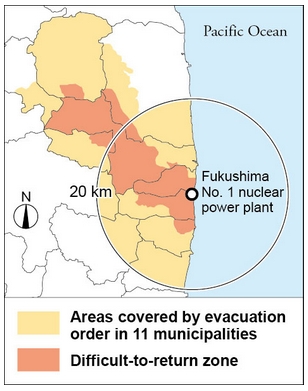
SIX YEARS AFTER: Fukushima decontamination near-complete in evacuated areas
Decontamination work in areas covered by the evacuation order from the 2011 Fukushima nuclear disaster is expected to conclude this month, paving the way for evacuees from the affected communities to return home.
With the project’s completion, the government’s focus will shift to the cleanup of heavily contaminated areas near the crippled Fukushima No. 1 nuclear power plant and infrastructure building.
The areas covered in the Environment Ministry’s decontamination project constitute those in 11 municipalities, including Okuma and Futaba, the two towns co-hosting the nuclear complex.
The decontamination project got under way there in fiscal 2012 to remove soil, fallen leaves and other materials contaminated by radioactive substances primarily in residential areas, roads, and rice paddies and fields.
But the areas collectively known as the difficult-to-return zone where annual radiation doses were estimated to exceed 50 millisieverts as of the end of 2011 and still estimated at more than 20 millisieverts five years after the disaster were excluded from the decontamination work in those 11 local governments.
The cleanup in nine municipalities has already been completed, while the project in the remaining two is expected to finish this month, according to the government.
The completion of the project comes after the Cabinet approved a policy to finish decontamination by the end of March 2017 at a meeting in March 2016.
The evacuation order for Okuma and Futaba will remain in place even though the cleanup project will soon be over.
But the government expects to lift the order for people from the remaining nine municipalities, except for residents from the difficult-to-return zone, by April 1.
That will make the total area remaining under the evacuation order 30 percent of the size six years ago.
According to the ministry, decontamination operations have been carried out in 99 local governments in and outside of Fukushima Prefecture, costing about 2.6 trillion yen ($23.56 billion) over the past five years.
Although the government initially covers the costs of decontamination, it sends the bill to Tokyo Electric Power Co., the plant’s operator.
Despite the cleanup project, many evacuees will likely remain anxious about radiation exposure when they return because forests and woods except for those close to residential areas have not been decontaminated.
The government envisages setting up hubs for rebuilding the difficult-to-return zone by carrying out an intensive cleanup to make the areas habitable by 2022.
A Campaign to Tackle “Misinformation” about Radioactive Contamination
Masahiro Imamura, Minister for Reconstruction, wants to launch a large-scale campaign, to correct the incorrect information about radioactive contamination of agricultural, forestry and fisheries products from Fukushima Prefecture; as an effort to tackle the issue of “misinformation about radioactive contamination” crippling Fukushima foods. That means more propaganda to come, more lies to hide the real risks of radiation to the people’s health. As if propaganda, to brainwash the people with a large-scale campaign would be the solution to make radiation disappear.

Reconstruction chief Masahiro Imamura
Reconstruction chief praises efforts in Tohoku, flags information campaign on radiation risks
Minister for reconstruction Masahiro Imamura has praised efforts to rebuild the devastated Tohoku region but says a large-scale information campaign is needed to share accurate information about radiation six years after the March 2011 meltdowns at the Fukushima No. 1 nuclear power plant.
Imamura outlined the plan in a recent interview in response to what he said was incorrect information about radioactive contamination of agricultural, forestry and fisheries products from Fukushima Prefecture.
It also comes as a growing number of children who evacuated from the prefecture fall victim to bullying.
Massive amounts of radioactive substances were emitted from the plant soon after it was knocked out by massive tsunami from the 9.0-magnitude March 11, 2011, Great East Japan Earthquake, which hit hardest in Fukushima and the nearby prefectures of Miyagi and Iwate.
Asked about the degree of progress in reconstructing areas hit by the disaster, Imamura said, “Acquisition of land and other procedures needed for the restoration of damaged infrastructure initially took time, but the pace of construction work was very rapid once it was launched.”
“From now, we should focus on the rebuilding of Fukushima,” he said, noting that medium- to long-term measures should be promoted, including decommissioning the Fukushima No. 1 plant and decontaminating areas polluted with radioactive fallout.
“We want to encourage evacuees to return to their hometowns in Fukushima by presenting future visions for the communities through improving the living environment and accelerating the revival of local industries,” Imamura added.
On how to tackle the incidences of bullying targeting evacuated Fukushima children, Imamura said, “We’ll strengthen information-sharing about radiation. All government agencies should jointly work to compile and launch a campaign for that purpose, while obtaining cooperation from private companies.
“This is an issue for not only children, but adults,” he said. “We’ll prepare documents and other materials that are easy to understand in order to eliminate prejudice against evacuated people.”
Imamura said the campaign would also be an effort to tackle the issue of “misinformation about radioactive contamination crippling Fukushima foods.”
“I’ll seek cooperation from Prime Minister Shinzo Abe as well,” he said.
Imamura said he believed the Reconstruction Agency’s efforts to date to rebuild areas affected by the March 2011 disaster have been praised to a certain degree. Still, he pointed to the importance of re-examining whether information on what affected areas need has been properly conveyed to the Reconstruction Agency and other government bodies.
Imamura said Japan’s aging population and low birthrate were also contributing to shrinking communities across the nation — something he described as a structural problem.
“It’s important to build a system that generates profits through stepped-up use of information technology and the modernization of factory equipment, even if human resources are limited,” he said.
“We need to check again whether communities will be able to smoothly help one another in times of disaster, although lessons from the March 2011 disaster were effectively utilized in a series of powerful earthquakes that mainly hit Kumamoto Prefecture in April last year, and the October 2016 strong quake in Tottori Prefecture,” Imamura added.
http://www.japantimes.co.jp/news/2017/03/21/national/reconstruction-chief-praises-efforts-tohoku-flags-information-campaign-radiation-risks/#.WNJEq6KmnIV
Fukushima Catastrophe at 6: Normalizing Radiation Exposure Demeans Women and Kids and Risks Their Health

Since the election of President Trump, certain words have taken prominence in our lexicon: “alternative facts”, “gaslighting”, “normalization”. But the techniques these words represent have been used by the nuclear industry and its purveyors in government since the Cold War love affair with nuclear weapons began.
And as we deal with the continuing fallout 6 years after the Fukushima, and 31 years after the Chernobyl, catastrophes began, the nuclear industry continues to put these techniques to good use. They have labeled “radiophobic” those who question nuclear power or who refuse to move back to contaminated areas or eat contaminated food. They shame people into taking health risks and socially isolate those who refuse to comply. They sell the lie of decontamination despite the fact that what has been decontaminated one day, may be recontaminated the next.
Women and children are often the focus of these “normalization” techniques. And they are the ones with the most to lose including supportive social and familial structures, and ultimately, health. Females, children and pregnancy pay a disproportionate price for nuclear energy because they are especially vulnerable to radiation damage. When a catastrophe like Fukushima happens, they become targets: targets of gaslighting, social isolation, radiation damage.
Japan’s radiation refugees
The Internal Displacement Monitoring Center (IDMC) estimates that as of Nov 2016, the number of people displaced because of the earthquake, tsunami and radioactive contamination remains at 134,000. Of this number, 84,000 are still displaced around Fukushima, where evacuation orders are not yet lifted around the reactor.
In 2017, Japan is lifting evacuation orders and basically forcing people to move back to towns that were, and still are, contaminated with radioactivity from the ruined Fukushima nuclear reactors. Those who return are promised a one-time sum for doing so. For those who will not go back, the Japan government will cut off compensation. The IDMC frames the issue as a horrible choice: return to risk or try to reintegrate elsewhere without any resources. Greenpeace, in their February 2017 report, demonstrates that the uncertain risks and unpredictable nature of radiological contamination mean there is no return to normal.
Taking radiation into your psyche, as if it is normal
Radiation is associated with disease, even at low levels. Nuclear power proponents incorrectly contend that if you think you are sick from radiation exposure, it is all in your head and your health problems resulted from your worry. In other words, it was your fault, not theirs. They term it “radiophobia”. This pernicious label was first coined in the United States in the 1950’s. Like much of the initial Cold War nuclear policy, it attempted to “normalize” nuclear technology so that above ground atomic bomb tests could continue unhindered.
In fact, an opinion piece in the Western journal of surgery, obstetrics and gynecology, a medical journal which addressed women’s health issues, blamed caretakers for inciting fear of nuclear weapons in children. In the piece, entitled “RADIOPHOBIA; a new psychological syndrome,” the author claims “Anxiety-ridden parents or teachers who fear atomic bombs probably project the same fears to their children…” And that this “conditioning amounts to psychological punishment”. In essence the author, who was not a qualified mental health practitioner, was accusing these parents of abuse. The not-so-subtle implication was that radiophobia was a woman’s disease that she passed to any children she contacted.
The unscientific radiophobia label has persisted through the larger nuclear power catastrophes. For instance, according to a Macmillan dictionary entry, “Chernobyl has left an enduring legacy of opposition to nuclear power, now often referred to as radiophobia by technical experts…” However, the targets of this dismissive and derisive label are not just those who oppose nuclear power. The mysogynistic overtones of the radiophobic label are clearly present as the Fukushima and Chernobyl catastrophes continue to unfold.
In the wake of a nuclear catastrophe, exposed women and children are specifically berated into silence. If they continue to express concerns about health impacts, they risk becoming social outcasts. In this context, radiophobia is a social label used to stigmatize, not a scientific or medical diagnosis. In the case of Japan, radiophobia is called “radiation brain mom“. This epithet particularly refers to women who question whether food is contaminated; and it implies that they are irrational, overly emotional and unscientific, merely for asking the question.
Radiophobia accusations at Fukushima put children and women’s health at risk
After Fukushima began, doctor of psychosomatic medicine, Katsuno Onozawa, was interviewed by the Asahi Shimbun in 2013. As an actual expert on psychosomatic disorders, she stated: “children were exhibiting a range of symptoms including sore throats, nosebleeds, diarrhea, fatigue, headaches and rashes…” Yet these symptoms were written off as “radiophobia” and the mothers were accused of making their children sick by worrying. “Many reproach themselves, thinking, ‘Maybe I’m the one who’s strange,’ and become depressed.” She concludes: “If we say ‘it’s safe’ despite the risks only to erase fears, then we simply leave in place the danger that defenseless children may be contaminated.”
For the record, here are some symptoms of short-term, higher radiation exposure: “nausea, vomiting, headache, and diarrhea…swelling, itching, and redness of the skin” Many around Three Mile Island complained of similar symptoms following the partial meltdown there. The higher the radiation dose, the quicker the symptoms manifest. Children are more vulnerable to radiation exposure than adults, women more vulnerable than men.
In Japan, the “radiation brain mom” label has resulted in a self-censoring of concern about radiological contamination, leaving women and children unprotected after exposure to the initial radiation cloud. Subsequently their health is continually put at risk from food and environmental contamination. “Silence was not imposed by an iron fist of government, but rather wrapped around people like soft velvet, gently making women feel that they had to be silent.”
Taking radiation into your body, as if it is normal
Since the Fukushima catastrophe started, recommendations for radiation exposure limits in Japan were increased by 20 times. The International Commission on Radiological Protection (ICRP) sets non-binding recommendations internationally for post nuclear catastrophes. Their limit is 1 mSv per year in addition to background radiation. This effectively would double the dose from unavoidable natural background, which is already 0.8 to 1 mSv per year. However, according to the IAEA, 1-20 mSv per year “is acceptable and in line with the international standards and with the recommendations from the relevant international organisations, e.g. ICRP, IAEA, UNSCEAR and WHO”.
Therefore Japan is, under controversy, encouraging resettlement in areas up to 20 mSv/yr. The increase in the allowable exposure limit occurred after contamination created wide-reaching negative economic impacts. Before the radioactive release contaminated Fukushima province, it was a center for organic farming and the “eat locally” movement. Since the contamination, consumer instinct has been to avoid Fukushima products.
Since studies show cancer and other disease impacts can occur within the range of natural background, clearly, the decision to allow a higher exposure level had nothing to do with health. Instead, it was an economic decision that took advantage of the fact that many diseases induced by this radiation exposure may not show for years, or may show as hard-to-attribute subclinical impacts, masking radiation’s disease-causing role. For those health impacts that do appear, nuclear proponents can always fall back on the argument that “it is all in your head”–i.e. radiophobia.
International agencies and industries normalize eating contaminated food to save face and money.
The ICRP is guilty of encouraging radiation ingestion, despite known risks. One recommendation is the encouragement of growing, selling and consuming, contaminated food, as an economic imperative for those in contaminated areas.
ICRP has also supported an effort in the wake of Fukushima called ETHOS that encourages “practical radiation protection culture” (PRPC). ETHOS was an effort originally started with the French nuclear industry, after the Chernobyl catastrophe began, when they realized that the cost of evacuation and compensation was starting to impact the nuclear industry’s financial and public standing worldwide.
Encouraging PRPC is a cowardly way of saying it’s too expensive to move people away from contaminated areas or allow them to eat clean eat food, so officials need to tell people there is no health risk from contamination. This is done under the guise of empowering the local populations by providing them with monitoring equipment, training, and a sense that eating contaminated food is okay. Mothers in Belarus were trained to measure the radioactive contamination of their children and to accept a certain level, resigning them to the fate of living with and eating radioactivity.
ETHOS goes one step further in claiming that individuals bear the responsibility to keep themselves safe from radioactive contamination with little to no help or resources from the industry that caused the contamination in the first place. Now, ETHOS is in Fukushima, protecting the nuclear industry from those whose lands it has defiled and whose lives it has marred.
The U.S. will be no different
For those who are hoping the U.S. will somehow escape the radiation normalization process, think again. We are learning from Fukushima and Chernobyl that international bodies like the World Health Organization (WHO) or ICRP will provide no support for clean food and relocation to uncontaminated land should we suffer a nuclear catastrophe.
We are further learning that our U.S. Environmental Protection Agency (EPA) admits that decontamination is a lie. Using very colorful and demeaning language regarding radiological cleanup, an EPA employee said in 2013 “‘U.S. residents are used to having ‘cleanup to perfection,’ but would have to abandon their ‘not-in-my-backyard’ mentality in such cases. ‘People are going to have to put on their big-boy pants and suck it up…’”.
Dove-tailing on this egregiously tone-deaf statement, EPA proceeded to institute “protective” action guides (PAGs) meant to provide levels of acceptable contamination in food and water subsequent to a radiological incident. A radiological incident can include a catastrophic release but also lesser releases from transport accidents, for instance. The limits EPA recommends are hundreds to thousands of times higher for some radionuclides than previously allowed. Exposure could continue at these levels for years, endangering women and children the most. Just like women have been resigned or bullied into silence at Chernobyl and Fukushima, we can expect the same modus operandi here.
UN Human rights instruments offer women and children radiation protection when other national and international agencies fail to
Women and children are more susceptible to radioactivity, therefore any attempt to label women as irrational for fearing radioactivity is ludicrous. The fact is, women and early life stages are not protected by the recommendations of international experts. Women and children have, and will continue to, pay a disproportionate price for the use of nuclear power, it’s routine radioactive releases, and the catastrophes it causes.
Increasing allowable levels of exposure post accident for economic convenience or to tamp down fear is unacceptable. Encouraging women and children to eat contaminated food appears to be in violation of Article 24 of the Convention of the Rights of the Child (CRC), particularly the principle of needed access to “adequate nutritious foods and clean drinking-water, taking into consideration the dangers and risks of environmental pollution”.
Women’s voices should count for more, not less
Women are often the most concerned about social health, and are the first and most vociferous in protecting public health following a nuclear catastrophe. And science shows they should be. Women and children are more vulnerable to radiation’s impacts and the life-stage of pregnancy is uniquely sensitive. They pay the highest price for nuclear power and it releases, so their voices should count for more, both in the energy decisions we currently face and in how we protect those whose lives are upturned by nuclear catastrophes.
SIX YEARS AFTER: Fukushima port welcomes fishing boats back for 1st time since 2011
Kurumi Sugita:
“This is too cruel.
Why play with local people’s strong desire to believe in the back-to-normal dream?
This desire is in the heart of all the people who love their hometown and want to recover the ordinary life before the nuclear accident.
If you mention the contamination, you are regarded almost as an enemy to the back-to-normal reconstruction efforts. This is how you destroy the solidarity, and it has been going on since 6 years. People’s heart bleed in this cruel situation and contradictions.”

Fishing boats return to Ukedo fishing port in Namie, Fukushima Prefecture, on Feb. 25.
NAMIE, Fukushima Prefecture–Fishing boats returned to their home port on Feb. 25 for the first time in six years since the Great East Japan Earthquake, tsunami and accident at the Fukushima No. 1 nuclear power plant wreaked havoc here.
The Ukedo fishing port, located seven kilometers north of the nuclear plant, was destroyed by the tsunami caused by the powerful earthquake in March 2011. In addition, nearby areas of the sea were contaminated by radioactive substances discharged from the crippled plant.
Since then, the reconstruction of the port has started and the work is ongoing.
On Feb. 25, 26 fishing boats entered the port to prepare for the start of the fishing season of “kounago,” or young fish of “ikanago” (Japanese sand lance), in mid-March. Fishing is scheduled to resume in waters that are more than 10 km from the nuclear plant.
“This is the first step to return to my life as a fisherman,” said a smiling Ichiro Takano, 69, a third-generation fisherman.
Fukushima peach exports recover in Southeast Asia, sparking hope for other produce???

The original article was published by Fukushima Minpo, local Fukushima Newspaper, which promotes “recovery”.To export your contaminated fruits to other countries is plainly criminal.
Fukushima peaches are making inroads into Southeast Asian markets in what prefectural officials see as a model case of recovery in its farm produce.
Fukushima grabbed the top share of Japanese peach exports to three Southeast Asian countries last year — 73.9 percent in Thailand, 76.8 percent in Malaysia and 55.9 percent in Indonesia.
In terms of volume, Fukushima exported a combined 30.6 tons of peaches to the three countries plus Singapore in 2016, surpassing the 23.9 tons logged in 2010 — the year before the triple meltdown at the Fukushima No. 1 power plant shattered trust in its farm produce in March 2011.
Given the improved figures, the Fukushima Prefectural Government now believes the measures it took to combat harmful rumors are paying off. It hopes to revive sales channels for other produce by using the recovery of peach exports as a base.
The prefectural government announced the export data at the end of January based on the Finance Ministry’s trade statistics for 2016 and other figures compiled by the Fukushima headquarters of the National Federation of Agricultural Cooperative Associations, or JA Zen-Noh.
Fukushima is the nation’s No. 2 peach-growing prefecture after Yamanashi and has been dubbed a “fruit kingdom” for the wide variety grown, including cherries, grapes, pears and apples.
Its peach exports peaked at 70 tons in 2008, thanks mainly to Taiwan and Hong Kong, but import bans imposed from the Fukushima disaster saw the peach trade collapse to zero in 2011.
According to the prefecture’s public relations office, Fukushima was quick to review its sales strategy and shift focus to Southeast Asia, where some countries eased import restrictions on its produce at an early stage.
A decision to promote the sweetness and freshness of Fukushima peaches was also a major factor in grabbing the hearts of consumers, the office said.
Despite the success in Thailand, Malaysia and Indonesia, it may take time before other countries in the region follow suit.
In Singapore, for example, Fukushima peaches last year had a market share of only 12 percent among all peaches the city-state imported from Japan.
The prefecture is hoping that the improvements in the three countries will help persuade other markets, such as Hong Kong and Taiwan, that its peaches are safe.
The recovery of the fruit’s reputation overseas has provided great encouragement to the prefecture’s peach growers, including Shigeyoshi Saito, 58, of the city of Date.
“Along with other items, peaches are a main pillar of Fukushima’s farm produce,” he said. “I hope their good reputation in Southeast Asia will spread the word to the entire world.”
Convenient Acccounts of Fukushima Radiation Exposure Ignore Glaring Issue

Every time I read something about the Fukushima disaster my blood pressure rises.
For example, recent efforts to represent (hypothesized) remnants of melted fuel rods in unit 2 as evidence of containment is revealed as misleading when one considers the size of the reactor (larger than a bus) and the amount of fuel contained within unit 2’s:
Justin McCurry January 30, 2017, Possible nuclear fuel find raises hopes of Fukushima plant breakthrough. The Guardian, https://www.theguardian.com/environment/2017/jan/31/possible-nuclear-fuel-find-fukushima-plant
Operator says it has seen what may be fuel debris beneath badly damaged No 2 reactor, destroyed six years ago in triple meltdown
Hopes have been raised for a breakthrough in the decommissioning of the wrecked Fukushima Daiichi nuclear plant after its operator said it may have discovered melted fuel beneath a reactor, almost six years after the plant suffered a triple meltdown.
Tokyo Electric Power (Tepco) said on Monday that a remote camera appeared to have found the debris beneath the badly damaged No 2 reactor, where radiation levels remain dangerously high. Locating the fuel is the first step towards removing it. The operator said more analysis would be needed before it could confirm that the images were of melted uranium fuel rods, but confirmed that the lumps were not there before Fukushima Daiichi was hit by a powerful earthquake and tsunami on 11 March 2011.
The amount of fuel contained of fuel in those reactors was substantial. If TEPCO had found all, or most, of the melted reactor fuel they would know it.
According to a November 16 report by Tepco titled, ‘Integrity Inspection of Dry Storage Casks and Spent Fuel at Fukushima Daiichi Nuclear Power Station,’[i] as of March 2010 the Daini site held 1,060 tons of spent uranium fuel. The total spent uranium fuel inventory at Daiichi in March 2010 was reported as 1,760 tons. The 2010 report asserts that approximately 700 spent fuel assemblies are generated every year.[ii] The report specifies that Daiichi’s 3,450 assemblies are stored in each of the six reactor’s spent fuel pools. The common spent fuel pool contains 6291 assemblies. The amount of MOX fuel stored at the plant has not been reported.
I suspect that TEPCO knows that most of the fuel is gone from unit 2’s reactor containment and that what remains is a fraction of the total load, which was either dispersed in the explosions or has left the building.
But what bothers me even more than obfuscation around missing fuel are misleading accounts of radiation exposure.
Case in point: The article published in CNBC below last week alleges that Fukushima radiation exposure was “far lower” than previously found:
Robert Ferris. Jan 24, 2017. Fukushima radiation levels far lower than previously thought, study finds. CNBC.Com, http://www.cnbc.com/2017/01/24/fukushima-radiation-levels-far-lower-than-previously-thought-study-finds.html
Radiation levels remaining from the 2011 disaster at Japan’s Fukushima Daiichi nuclear plant appear to be a small fraction of what previous measurements suggested, according to a recently published study that followed levels in tens of thousands of people living near the site of the accident.
Science magazine highlighted the research Monday, calling it the first study to measure individual radiation levels in locals following a major nuclear disaster. The study was published in the peer reviewed Journal of Radiological Protection in December.
I’ve seen this type of headline before so I was immediately suspicious. I pulled up the journal article and found a glaring issue that problematizes the validity of this conclusion that radiation levels were lower than previously calculated.
Here is the glaring issue ignored in the CNBC’s optimistic headline: The radiation monitoring badges were provided to residents in August of 2011. The disaster and radiation exposure began March 11, 2011.
Consequently, RESIDENTS WERE NOT GIVEN BADGES TO MEASURE EXPOSURE UNTIL FULLY 5 MONTHS AFTER exposure, a fact that is acknowledged in the title of the research article but ignored in the news coverage:
Makoto Miyazaki and Ryugo Hayano. 2017. Individual external dose monitoring of alltizens of Date City by passive dosimeter 5 to 51 months after the FukushimaNPP accident (series): 1. Comparison of individual dose with ambient dose rate monitored by aircraft surveys. J. Radiol. Prot. 37 1(http://iopscience.iop.org/0952-4746/37/1/1) http://iopscience.iop.org/article/10.1088/1361-6498/37/1/1/pdf
For the measurement of individual external doses, Date City distributed individual dosim-eters (radio-photoluminescence (RPL) glass dosimeters: Glass Badge) to kindergarten-, elementary- and junior high school-children in August 2011. The target group was subsequently enlarged as the production capacity of the supplier increased, and the measurements are still ongoing
How is it possible to conclude that exposure was lower than previously thought when the evidence for that claim is generated from a study that excludes the first 5 months of exposure?
Truth has an especially slippery feel when it comes to Fukushima….
????????????????????????????????????????????????????????????
REFERENCES
[i] It is worth noting that although this report was produced on 10/26/2010, the file properties indicate the document was modified on 3/13/2011: Integrity Inspection of Dry Storage Casks and Spent Fuels at Fukushima Daiichi Nuclear Power Station (16 November 2010), http://www.nirs.org/reactorwatch/accidents/6-1_powerpoint.pdf
[ii] Integrity Inspection of Dry Storage Cask.
http://majiasblog.blogspot.fr/2017/02/convenient-acccounts-of-fukushima.html
Fukushima governor rebuts minister’s 3/11 recovery claim

Reconstruction Minister Masahiro Imamura addresses an official conference on the reconstruction and rebuilding of Fukushima Prefecture in Fukushima city on Jan. 28.
FUKUSHIMA–Using marathon analogies, opinions on the current state of Fukushima Prefecture almost six years after the 2011 nuclear accident were running far apart between a national minister and local officials at a conference here to discuss the recovery process.
“If this is a marathon, Fukushima’s recovery is 30 kilometers into the race,” said Reconstruction Minister Masahiro Imamura at the beginning of the conference on reconstruction of quake damage and rebuilding in the prefecture on Jan. 28. “Now, we have come to the crunch.”
A disgruntled Fukushima Governor Masao Uchibori refuted Imamura’s optimistic analogy when he was interviewed by reporters after the conference’s close.
“Some regions in the designated evacuation zones are not even at the starting line,” said Uchibori. “Even in the areas where the designation is already lifted, recovery has only just begun.”
The evacuation order in most of the surrounding area of the Fukushima No. 1 nuclear power plant is scheduled to be lifted at the end of March, apart from some “difficult-to-return zones” where radiation readings remain high.
The affected municipal governments are concerned that the central government’s understanding of areas affected by the 2011 disaster has been fading as the sixth anniversary approaches in March.
Aside from the opening, the conference, chaired by Imamura, was closed to the media.
According to one attendee, Imamura told conference delegates that he put “Fukushima first.”
Aping the catchphrase style of U.S. President Donald Trump and Tokyo Governor Yuriko Koike, Imamura apparently meant he prioritizes the recovery of the disaster-hit area of Fukushima Prefecture, but his choice of words failed to impress local officials.
The head of one municipal government said: “It is not a very good catchphrase to use here as it reminds us of the Fukushima No. 1 nuclear plant.”
“I would like him to be more sensitive about expressions he uses,” another complained.
Fukushima ice cream sales “immune” to fears of radiation
“If you tell a lie big enough and keep repeating it, people will eventually come to believe it. The lie can be maintained only for such time as the State can shield the people from the political, economic and/or military consequences of the lie. It thus becomes vitally important for the State to use all of its powers to repress dissent, for the truth is the mortal enemy of the lie, and thus by extension, the truth is the greatest enemy of the State.” Paul Joseph Goebbels (29 October 1897 – 1 May 1945) was Adolf Hitler‘s Propaganda Minister in Nazi Germany.
The town of Koriyama in Fukushima Prefecture was one of the towns most severely hit by the Fukushima Daiichi March 2011 plume. Though not evacuated as it is located outside of the 30km radius evacuation zone decided by the Japanese government, it remains quite contaminated and has many radioactive hotspots.
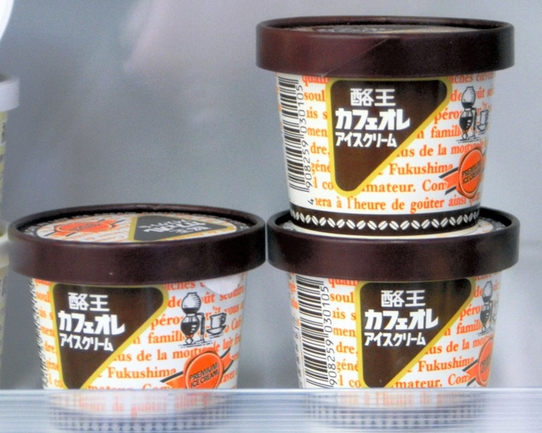
Winter sales have been strong for Rakuou Cafe au Lait Ice Cream produced in Fukushima Prefecture.
KORIYAMA, Fukushima Prefecture–A dairy company here that has withstood fears and rumors about radiation has produced a hot-selling item in the middle of winter.
Within two weeks in November, the initial 6,000 cups of Rakuou Cafe au Lait Ice Cream, produced by Rakuounyugyou Co. in Koriyama, were nearly sold out.
The company, founded in 1975, shipped out an additional lot of around 18,000 cups in December, but this supply has also run short.
Rakuounyugyou shipped 25,000 more cups, mostly to outlets in Fukushima Prefecture, in mid-January, and plans to ship an additional 24,000 within this month.
“Perhaps our ice cream is being seen as more of a premium product,” a sales official at the company said.
Rakuounyugyou’s Rakuou Cafe au Lait, a mild-flavored lactic drink containing at least 50 percent raw milk from Fukushima Prefecture, has an entrenched fan base both in and outside the prefecture.
The company maintained its sales levels in the aftermath of the 2011 Fukushima nuclear disaster, while its competitors suffered losses due to radiation fears and rumors among the public.
Rakuounyugyou developed the ice cream product to commemorate the 40th anniversary of the release of Rakuou Cafe au Lait. The ice cream contains at least 10 percent Rakuou Cafe au Lait and at least 10 percent milk.
“We exercised trial and error because we absolutely didn’t want to disappoint fans of our Cafe au Lait,” the sales official said.
The ice cream was initially sold mainly at sightseeing facilities and expressway service areas in Fukushima Prefecture. Demand was high even though the company did little in the way of a sales campaign.
The spreading popularity of the product can be attributed to Twitter.
Tweets about the ice cream can sound like a hunt for a rare Pokemon on the “Pokemon Go” game app.
“Where could I get one?” one post said. “I got one!” said another.
It is not the first time the social networking service has helped the dairy company; tweets of encouragement spread in the aftermath of the nuclear disaster.
“Be what may, the Rakuou Cafe au Lait tastes so good,” said one particularly popular tweet at that time.
Cafe au Lait is being shipped to a growing number of retailers, most of them in the greater Tokyo area. Sales of the product are up 10 percent from pre-disaster levels.
“Word of our ice cream has also been spread by our fans,” the sales official said. “We are so grateful that we are reduced to tears.”
http://www.asahi.com/ajw/articles/AJ201701290010.html
1 This Month

of the week – Shut Down Drone Warfare!


Tell the Ukrainian Government to Drop Prosecution of Peace Activist Yurii Sheliazhenko

Petition to revoke the licensing of the Near Surface Nuclear Disposal Facility (NSDF) at Chalk River. https://www.ourcommons.ca/petitions/en/Petition/Details?Petition=e-7247
To see nuclear-related stories in greater depth and intensity – go to https://nuclearinformation.wordpress.com
-
Archives
- March 2026 (244)
- February 2026 (268)
- January 2026 (308)
- December 2025 (358)
- November 2025 (359)
- October 2025 (376)
- September 2025 (257)
- August 2025 (319)
- July 2025 (230)
- June 2025 (348)
- May 2025 (261)
- April 2025 (305)
-
Categories
- 1
- 1 NUCLEAR ISSUES
- business and costs
- climate change
- culture and arts
- ENERGY
- environment
- health
- history
- indigenous issues
- Legal
- marketing of nuclear
- media
- opposition to nuclear
- PERSONAL STORIES
- politics
- politics international
- Religion and ethics
- safety
- secrets,lies and civil liberties
- spinbuster
- technology
- Uranium
- wastes
- weapons and war
- Women
- 2 WORLD
- ACTION
- AFRICA
- Atrocities
- AUSTRALIA
- Christina's notes
- Christina's themes
- culture and arts
- Events
- Fuk 2022
- Fuk 2023
- Fukushima 2017
- Fukushima 2018
- fukushima 2019
- Fukushima 2020
- Fukushima 2021
- general
- global warming
- Humour (God we need it)
- Nuclear
- RARE EARTHS
- Reference
- resources – print
- Resources -audiovicual
- Weekly Newsletter
- World
- World Nuclear
- YouTube
-
RSS
Entries RSS
Comments RSS
 nuclear-news