8 cases of inappropriately stored nuclear waste found at northern Japan reprocessing plant
 The Japan Nuclear Fuel Ltd. (JNFL) nuclear fuel reprocessing plant in the village of Rokkasho, Aomori Prefecture, is seen in this May 14, 2020 file photo taken from a Mainichi Shimbun aircraft
July 15, 2020
TOKYO — Japan Nuclear Fuel Ltd. (JNFL) had been inappropriately storing nuclear waste at a nuclear fuel reprocessing plant in Rokkasho, Aomori Prefecture, in northern Japan, including keeping waste in undesignated areas, the country’s nuclear regulatory body has revealed.
The Nuclear Regulation Authority (NRA) had instructed JNFL to make improvements in its practices in 2017, but the company had left some of its nuclear waste in places where they were not supposed to be. There has been no confirmation that any of the radioactive substances leaked. There have been a series of shoddy practices uncovered at JNFL, which is likely to call into question the company’s attitude.
At the fuel reprocessing plant, uranium and plutonium are extracted from spent nuclear fuel for reuse in nuclear reactors. Highly radioactive waste liquid that is generated in the process becomes nuclear waste when it is solidified in glass. According to the NRA and others, JNFL had been keeping nuclear waste in a building different from the one the waste is meant to be stored in. As for the approximately 160 kilograms of shards of radioactive waste liquid solidified in glass, an appropriate storage method had not been stipulated. There were eight cases of inappropriate storage, some of them spanning the past 19 years.
Inspectors from the NRA Secretariat confirmed inappropriate storage of nuclear waste in August 2017. The regulatory body asked that JNFL correct its practices by August 2019, but only two of the eight cases had been remedied by the end of June 2020.
At a meeting concerning the safety inspection of the nuclear fuel reprocessing plant this past May, the NRA had determined that the plant had effectively met the government’s new criteria. JNFL explained that it had intended to consult with the NRA Secretariat once the inspections had taken place. The NRA, meanwhile, says that the situation is exempt from safety inspections under the government’s new criteria.
Nuclear waste briefings in coastal areas
Making nuclear waste has to be stopped

Is Fukushima doomed to become a dumping ground for toxic waste?


Nuclear Waste Crisis in Fukushima is a Human Rights Issue


Gov’t says 70% of land suitable for nuclear waste disposal
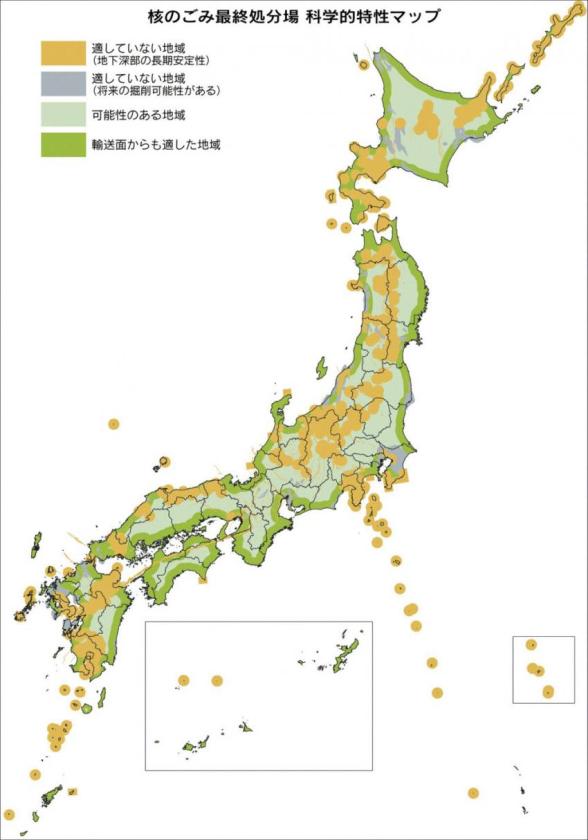
The Japanese government unveiled Friday a map indicating potential deep-underground disposal sites for high-level radioactive nuclear waste, identifying some 70% of the country’s land as suitable.
Based on the map, the government is expected to ask multiple municipalities to accept researchers looking into whether those areas can host sites to dispose of waste left by nuclear power generation. But the process promises to be both difficult and complicated amid public concerns over nuclear safety following the 2011 Fukushima nuclear disaster.
The nationwide map showed that up to 900 municipalities, or half of the country total, encompass coastal areas deemed “favorable.” Areas near active faults, volcanoes and potential drilling sites such as around oil fields are considered unsuitable.
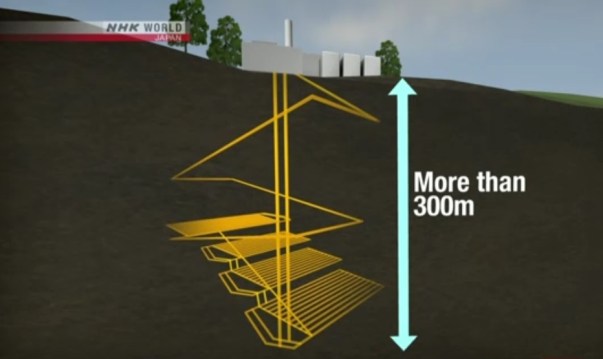
For permanent disposal, high-level radioactive waste, produced as a result of the process of extracting uranium and plutonium from spent fuel, must be stored more than 300 meters underground so that it cannot impact human lives or the environment.
The government will store the waste in vitrified canisters for up to some 100,000 years until the waste’s radioactivity decreases.
As of March, some 18,000 tons of spent fuel existed in Japan with the figure set to increase as more nuclear plants resume operation. When spent fuel that has already been reprocessed is included, Japan will have to deal with about 25,000 such canisters.
The map, illustrated in four different colors based on levels of the suitability of geological conditions, was posted on the website of the Ministry of Economy, Trade and Industry.
Energy minister Hiroshige Seko said Friday that the unveiling of the colored map is an “extremely important step toward the realization of the final disposal but also the first step of a long road.”
Taking the map as an opportunity, “we hope to have communications (with municipalities) nationwide and earn the understanding of the public,” he said.
“It scientifically and objectively shows nationwide conditions, but it is not something with which we will seek municipalities’ decisions on whether to accept a disposal site,” Seko said.
Areas near active faults, volcanoes and oil fields which are potential drilling sites are deemed unsuitable because of “presumed unfavorable characteristics” and colored in orange and silver.
Areas other than those are classified as possessing “relatively high potential” and colored in light green.
Among the potential areas, zones within 20 kilometers of a coastline, around 30 percent of total land, are deemed especially favorable in terms of waste transportation and colored in green.
The map has also colored as suitable a part of Fukushima Prefecture, where reconstruction efforts are underway from the 2011 massive earthquake and tsunami that led to the Fukushima nuclear plant disaster.
But Seko said the government has no plans at this stage to burden the prefecture additionally with the issue of disposal of high-level radioactive waste.
The minister also indicated that Aomori Prefecture in northeastern Japan, home to a facility to reprocess nuclear fuel, is exempt as the prefectural government and state have agreed not to construct a nuclear waste disposal facility there.
Japan, like many other countries with nuclear plants, is struggling to find a permanent geological disposal repository, while Finland and Sweden are the only countries worldwide to have decided on final disposal sites.
A process to find local governments willing to host a final repository site started in 2002 in Japan, but little progress was made due mainly to opposition from local residents.
In 2015, the government decided to choose candidate sites suitable on scientific grounds for building a permanent storage facility, rather than waiting for municipalities to offer to host such a site.
The government aims to construct a site that can house more than 40,000 canisters, with estimated costs amounting to 3.7 trillion yen ($33 billion).
METI Releases Map of Suitable Nuclear Waste Disposal Sites
To be clear ! No place is ‘suitable’ for storing nuke waste, never was, never will be…
Even more in Japan where you can hardly find land without an active fault beneath it, 2000 plus earthquakes per year. Not counting the volcanoes.

Japan Releases Map of Areas Suitable for Nuclear Waste Disposal
Japan released a map identifying areas of the country suitable for nuclear waste disposal as part of a broader plan to figure out what to do with roughly 18,000 tons of highly radioactive nuclear waste.
The map highlights areas that aren’t near fault lines, volcanoes or ground where temperatures are high — thus making them highly likely to be adequate for storing the so-called high-level radioactive waste consisting primarily of used fuel from nuclear facilities.
The map will be used to begin determining the ideal location to store the waste 300 meters (984 feet) underground, according to Hirokazu Kobayashi, director of radioactive waste management at Japan’s Ministry of Economy, Trade and Industry. More than 1,500 of Japan’s 1,800 municipalities have areas suitable for storing nuclear waste, he added.
The map’s release “is the first step on the long road toward disposing of the nation’s highly radioactive nuclear waste,” METI minister Hiroshige Seko told reporters in Tokyo on Friday.
Before storage, the fuel would be reprocessed at facilities designed to separate usable uranium from high-level waste. Construction of the nation’s first large-scale reprocessing plant at the Rokkasho complex in northern Japan is expected to finish in the first half of the next fiscal year.

METI maps out suitable nuclear waste disposal sites
The government on Friday unveiled a nationwide map of potential disposal sites for high-level nuclear waste that identifies coastal areas as “favorable” and those near active faults as unsuitable.
Based on the map, the government is expected to ask the municipalities involved to let researchers study whether sites on their land can host atomic waste disposal sites.
But the process promises to be both difficult and complicated as public concern lingers over the safety of nuclear power since the triple core meltdown in Fukushima Prefecture in March 2011.
The map, illustrated in four colors indicating the suitability of geological conditions, was posted on the website of the Ministry of Economy, Trade and Industry.
Energy minister Hiroshige Seko said earlier Friday that the unveiling of the map is an “important step toward bringing about final disposal sites, but also the first step on a long road.”
“We hope to communicate (with municipalities) nationwide and win over the public,” he said.
“The map is not something with which we will seek municipalities’ decisions on whether to accept a disposal site,” Seko said.
To permanently dispose of high-level nuclear waste, it must be stored at a repository more than 300 meters underground so it cannot harm human life or the environment.
The map identifies about 70 percent of Japan as suitable for hosting nuclear dumps. Up to 900 municipalities, or half of the nation’s total, encompass coastal areas deemed favorable for permanent waste storage.
Areas near active faults, volcanoes and oil fields, which are potential drilling sites, are deemed unsuitable because of “presumed unfavorable characteristics,” and hence colored in orange and silver on the map.
The other areas are classified as possessing “relatively high potential” and colored in light green.
Among the potential areas, zones that are within 20 km (12 miles) of the coastline are deemed especially favorable in terms of waste transportation and colored in green. The ministry formulated the classification standards in April.
Parts of giant Fukushima Prefecture, where decontamination and recovery efforts remain underway from the mega-quake, tsunami and triple core meltdown of March 2011, are also suitable, according to the map. But Seko said the government has no plans at this stage to impose an additional burden on the prefecture.
Seko also signaled that Aomori Prefecture, which hosts a nuclear fuel reprocessing facility, is exempt from the hunt because the prefectural government and the state have agreed not to build a nuclear waste disposal facility there.
Japan, like many other countries with nuclear power plants, is struggling to find a permanent geological site suitable for hosting a disposal repository. Finland and Sweden are the only countries worldwide to have picked final disposal sites.
http://www.japantimes.co.jp/news/2017/07/28/national/meti-posts-map-potential-nuclear-waste-disposal-sites/?utm_source=Daily+News+Updates&utm_campaign=477c1bb388-Sunday_email_updates29_07_2017&utm_medium=email&utm_term=0_c5a6080d40-477c1bb388-332835557#.WXtmQ63MynZ
Japan map showing potential nuclear waste disposal sites to be released

Nuclear storage crisis grows as reactor restarts continue
 An official from the Agency for Natural Resources and the Nuclear Waste Management Organization of Japan shows a model of a proposed underground burial facility for nuclear waste during a town hall meeting in Toyama on May 20
TOYAMA – More than six years after the March 11, 2011, Tohoku quake, tsunami, and triple meltdown at the Fukushima No. 1 nuclear power plant, Japan is accelerating efforts to restart as many reactors as it possibly can. Four have been revived so far, and Kansai Electric Power Co. plans to restart the Takahama No. 3 unit soon.
But the rush to restart them has only highlighted the fact that Japan still has no final repository for its high-level radioactive waste. Original plans to first reprocess spent fuel at the Rokkasho facility in Aomori Prefecture before final disposal somewhere else have long been stalled. After 17 years asking prefectures and municipalities around the country to host such a site, no takers have been found.
So the government has changed its approach, saying it will draw up a map by this summer of “scientifically appropriate” candidate sites around the country.
To explain what that means, a series of town hall meetings are taking place at select locations this month and next month.
On May 20, officials from the Agency for Natural Resources and the Nuclear Waste Management Organization of Japan (NUMO) were in Toyama, which is less than 50 km from the Shika nuclear power plant in neighboring Ishikawa Prefecture.
At present, there are about 18,000 tons of spent nuclear fuel stored in about 40,000 canisters at Japan’s nuclear power plants, said NUMO Executive Director Shinichi Ito. A final disposal site for high-level waste produced when, or if, the fuel is reprocessed would need to be quite large. Most of it would be underground, with an elaborate tunnel system of transport vehicles to deliver and store the waste.
“In terms of scale, above-ground facilities at a final depository would be between 1 to 2 sq. km, and the underground portion would be 6 to 10 sq. km in area, located at a depth of more than 300 meters from the surface. There would be some 200 km of tunnels in total for the storage facilities,” Ito said.
Waste would be stored at the site for around a half century. The basic cost for building a final depository is ¥3.7 trillion.
In drawing up the map of what constitutes a scientifically appropriate site, the government has a list of conditions and standards based on what it does not want.
A site should not be built within a 15-km radius of a volcano, and not near active fault lines at least 10 km long. In addition, it should not be situated in area where there is a lot of geothermal activity.
The government is also seeking a site that is within 20 km of a port where ships carrying the waste could dock, since transporting waste by ship, the government says, is the most appropriate method.
Iwao Miyamoto, director of the public relations office of the Agency for Natural Resources’ Radioactive Waste Management Office, said that, after the map is publicized and dialogue takes place with authorities deemed to have appropriate sites, a three-stage survey process would be carried out.
“The first stage would be to research the seismological and geological history of a potential site, checking to see how frequently earthquakes and volcanoes in and around the area have occurred,” Miyamoto said. “The second stage would be on-site drilling to determine how porous the rock bed is, and the third step is a precision survey to determine if the site can handle an underground storage facility.
“The first survey stage is expected to take two years, the second stage four years, and the final stage around 14 years,” he added.
In an attempt to entice the authorities at a chosen site, the central government will offer funding and economic incentives that the municipalities hosting nuclear power plants have long enjoyed.
“NUMO will work with a government that accepts a final storage facility to renovate and expand its roads, ports, and information systems,” Ito said. “There will also be donations for revitalizing the local economy via support for locally produced goods and for local culture.”
However, overcoming local political resistance in an area judged appropriate for a final depository is likely to be a long, difficult road. Nobody wants to be known as the town or village with a nuclear waste dump, and questions remain about the safety of transporting toxic waste by land or by sea.
Some governors in prefectures with many reactors have made it clear they will oppose any effort by the central government or utilities to bury nuclear waste on site or beside the plant that generated it.
“Fukui has accepted nuclear power plants. But it has no obligation to accept final disposal of nuclear waste,” Fukui Gov. Issei Nishikawa said in 2015. Fukui is home to 13 commercial reactors.
“We have our hands full just dealing with the nuclear reactors we have now,” Saga Gov. Yoshinori Yamaguchi said last year, indicating his prefecture would not accept being the site of a final repository. Saga hosts the four reactors at the Genkai plant run by Kyushu Electric. Yamaguchi approved the restart of Genkai units 3 and 4 in April.
Once the map is published, it is sure to galvanize opinion in those places judged appropriate and become a politically delicate topic. Yet with Agency for Natural Resources estimates showing the spent fuel pools of 17 power plants will run out of space within the next 15 years, if run continuously, the problem of final disposal grows more acute with each passing day. Pressure on those areas that fit the requirements for final disposal is likely to be intense.
At this point, though, the central government says that if a local government with a site deemed appropriate by the map still refuses once the survey begins, that will be the end of it.
“If there is official opposition at the local level at any stage of a survey, there would be no advancement to the next stage,” Miyamoto said.
However, given all of the problems Japan has had trying to make its reprocessing program work, critics say that attempting to draw up a plan for a final repository is a pipe dream.
” The Japanese government knows the current final nuclear waste repository program will never materialize. The whole project depends upon the creation of high-level vitrified waste canisters, i.e. the reprocessing of spent nuclear fuel. But the program also depends on Japan recovering and consuming tons and tons of plutonium
” The Rokkasho reprocessing plant’s commercial operation has been delayed 23 times, and the fast reactor program to consume the plutonium is at square one despite over a half century of effort,” said Aileen Mioko Smith of Kyoto-based Green Action.
Government to release map of potential final nuclear disposal sites this summer
 Solidified nuclear waste mixed with glass is placed in canisters at a reprocessing plant in Rokkasho, Aomori Prefecture, in 2012
The government has set the criteria for a map meant to identify potential final disposal sites for high-level radioactive nuclear waste, paving the way for its release as early as this summer.
The process of finding a host for nuclear waste could face challenges amid public concerns over safety.
Based on the map, the government will approach select municipalities to allow research to be conducted for suitable sites to store waste from nuclear power generation.
For permanent disposal, high-level nuclear waste needs to be stored at a final depository more than 300 meters underground for up to about 100,000 years until radiation levels fall and there is no longer potential harm to humans and the environment.
The government plans to create a permanent underground repository somewhere in stable bedrock so the canisters can be stored for tens of thousands of years.
The map is likely to classify which areas are geologically suitable for such a structure to be built deep enough underground. This would rule out areas near active faults and volcanoes as well as oil and coal fields.
Based on waste transport criteria, the map is likely to show that zones within 20 km of the coastline are favorable to host final disposal sites.
The government hopes other municipalities — not just the ones located near nuclear power plants — may also become interested in hosting the disposal facilities. It also wants to show that a variety of places nationwide are suitable for nuclear waste management.
The map was originally planned for a 2016 release but the publication date was later postponed, as some local governments were wary that disposal sites would be imposed on them.
About 18,000 tons of spent fuel currently exist in Japan. Including spent fuel that has already been reprocessed, the country’s total jumps to about 25,000 canisters of vitrified high-level waste, all of which needs to be managed.
The process to find local governments willing to host final storage started in 2002, but little progress was made due mainly to opposition from local residents.
In May 2015, the central government introduced a plan announcing that final depository site selection would be based on scientific grounds, rather than waiting for municipalities to volunteer.
Before presenting the map, the government will hold symposiums between mid-May and June at nine cities to explain the map criteria to the public. The cities include Tokyo, Nagoya and Fukuoka.
Radioactive waste is classified into two categories: The high-level type is generated from reprocessing spent fuel by separating the plutonium and uranium for recycling, while the low level type refers to all other waste.
High-level waste is a byproduct of fission in the reactor core, which is very hot and dangerous. It is mixed with glass and solidified before being placed in robust heat-resistant stainless steel canisters that are 130 cm high, 40 cm in diameter and weigh 500 kg each.
A full canister emits about 1,500 sieverts per hour — an extremely lethal biological level — and has a surface temperature in excess of 200 degrees.
Its radioactivity starts at 20,000 trillion becquerels. It will take about 1,000 years to fall to one-thousandth of that level, and tens of thousands of years to weaken to the same intensity as natural uranium ore, the Natural Resources and Energy Agency says.
Worldwide, only Finland and Sweden have been able to successfully decide on a final depository site for nuclear waste, while many other countries with nuclear plants face difficulties in doing so.
The United States decided in 2009 to call off a plan to build a site to dispose spent fuel in Nevada’s Yucca Mountain due to local opposition, but President Donald Trump earmarked funds to revive the plan in the budget proposal for fiscal 2018 unveiled in March.
In Japan, the selection process is also a touchy issue and has triggered conflicts in the communities around which prospective depository sites have been considered.
In one example, Minamiosumi Mayor Toshihiko Morita in Kagoshima Prefecture filed a criminal complaint against a 65-year-old resident for libel, claiming that his allegations that the rural town office had been actively inviting such a facility was not only groundless but also defamation.
The resident handed out flyers to about 500 households in the town in January which said Morita went to Tokai, Ibaraki Prefecture, and Horonobe in Hokkaido at the invitation of the private sector involved in the construction of nuclear waste disposal facilities. Both municipalities host nuclear-related facilities.
Morita flatly denied the allegations, telling Kyodo News in writing that he has heard “rumors” that there have been moves aimed at hosting a nuclear waste disposal facility but “I myself haven’t gone anywhere and been treated to anything.”
“I would reject any request from the central government” to host one, Morita said. The town approved an ordinance to reject a plan to host a nuclear waste disposal facility the year after the 2011 nuclear crisis at the Fukushima No. 1 plant.
A supporter of the mayor, however, did visit nuclear-related facilities in locations including Rokkasho, Aomori Prefecture, several years ago, according to the supporter’s admission, and a Tokyo company covered the expenses of the trip.
Riken to experiment converting nuclear waste into precious metals
The government-backed Riken research institute is set to launch experiments on converting radioactive substances contained in high-level nuclear waste generated at atomic power stations into precious metals starting fiscal 2018, it has been learned.
The method, which is dubbed “modern alchemy,” is said to be theoretically viable but hasn’t been put into practical use. If realized, the formula is expected to contribute to trimming nuclear waste and even making effective use of it.
The experiment will be part of the Cabinet Office’s program to promote innovative research and development, called “Impulsing Paradigm Change through Disruptive Technologies (ImPACT)” program. In the initial stage of the demonstration experiment, palladium-107, a radioactive material contained in nuclear waste and whose half-life is 6.5 million years, will be turned into nontoxic palladium-106, which is commonly used in dental therapy, jewelry goods and exhaust gas purification catalysts.
Using an accelerator at the Riken Nishina Center for Accelerator-Based Science in Wako, Saitama Prefecture, the scientists will attempt to convert palladium-107 into palladium-106 by irradiating the former with deuteron beams, in what is called the “nuclear transformation” process. The experiment is set to be the world’s first of its kind on nuclear transformation of palladium, according to Riken officials.
The researchers will compile the outcome of the experiment as early as the fall of 2018 after confirming the ratio of palladium successfully transformed and other results.
As nuclear waste is highly radioactive, the government is currently looking into methods to isolate such waste deep into the ground after sealing it in specially designed containers. If the nuclear transformation process proves viable, it could contribute to reducing nuclear waste and making efficient use of it.
It remains to be seen whether nuclear transformation will prove successful just as in theory and if the process can be turned into practical use at a low cost. In the past, a nuclear transformation experiment was carried out on minor actinides, or “heavy” nuclear waste, at the Joyo experimental fast reactor in Oarai, Ibaraki Prefecture, but the upcoming experiment will be the country’s first using fission products, or “light” nuclear waste.
ImPACT program manager Reiko Fujita said, “We are still at the basic research stage and are far from putting it into practical use. We will, however, move a step forward if we manage to obtain data through our experiment.”

Japan Studying Nuclear Waste Burial 5,000 meters Deep on the Pacific Island of Minamitorishima
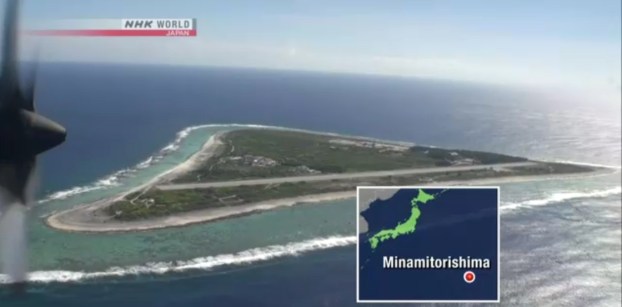
An agency affiliated with the Japanese government is to study the possibility of burying nuclear waste at a depth of about 5,000 meters. That’s much deeper than proposed in the government’s current plan.
Researchers from the Japan Agency for Marine-Earth Science and Technology, or JAMSTEC, will carry out a basic survey for the new disposal option after next April.
The survey will be conducted at Minamitorishima, a remote island above the geologically stable Pacific Plate.
JAMSTEC says it will use a research vessel to collect data on the topography and geology of the area.
No technology exists to bury nuclear waste 5,000 meters below ground as there are many technical challenges.
The Japanese government has been planning to bury high-level radioactive waste from nuclear plants at a depth of more than 300 meters in final disposal facilities. Officials are currently looking for candidate sites.
Nagasaki University Professor Tatsujiro Suzuki is a former member of Japan’s Atomic Energy Commission. He says it is too soon to discuss a technology that has yet to be developed, but he thinks basic research by the agency could help to create more options.
https://www3.nhk.or.jp/nhkworld/en/news/20161225_17/
VOX POPULI: A curse that lasts 100,000 years: buried nuclear waste
Homo sapiens sapiens, or anatomically modern humans, emerged on the African continent about 200,000 years ago. They started migrating to various parts of the globe around 60,000 years ago with some eventually reaching the Japanese archipelago.
The Paleolithic era came and went, and rice cultivation began in the Neolithic era.
I started thinking about these prehistoric times after a recent news report mentioned “100,000 years” in connection with radioactive waste that must be disposed of when nuclear reactors are dismantled.
It takes a mind-boggling number of years for nuclear waste, stored deep underground, to decrease in radioactivity to a level that is no longer a health hazard.
With respect to highly radioactive waste such as reactor control rods, the Nuclear Regulation Authority has just set its basic policy, which is that electric power companies will be responsible for the management of such waste for 300 to 400 years, and then the government will take over for the next 100,000 years.
Every precaution must be taken to prevent future humans from accidentally entering sites where the waste is buried and digging the ground. The potential effects of earthquakes and volcanic eruptions on the stored waste also has to be considered.
In determining the extent of responsibility to be shouldered by utilities, it was agreed that it would not be realistic to expect them to manage the storage sites for tens of thousands of years to come.
According to “Hyakunen Tsuzuku Kigyo no Joken” (Conditions necessary for businesses to last 100 years) compiled by Teikoku Databank, a corporate credit research and database service company, there are some, but not many, Japanese companies that have remained in business for more than 400 years.
They include Sumitomo Metal and Mining Co., Yomeishu Seizo Co., and Matsuzakaya, which were founded before or during the Edo Period (1603-1867).
Are Japan’s electric power companies also destined to join their ranks?
But whether it’s 400 years or 100,000 years from now, nobody in our present generation can remain responsible for all those years. I shudder at this “ultrarealistic” reality.
Incidentally, Japan’s first nuclear reactor commenced commercial operation 50 years ago.
Residents come out in force to protest against Sino-French nuclear project

Rumours that Lianyungang, Jiangsu province will be site of plant sparks rally in city
Residents in Lianyungang in Jiangsu province ignored police warnings and filled a square for a demonstration over rumours the city would be the site of a Sino-French nuclear project.
The rally over a used-nuclear-fuel processing and recycling plant underscored the tension between public concern over nuclear safety and the growing pressure on China to reduce its reliance on fossil fuels.
The scene appeared to turn tense on Sunday night, the second night of the protest, with pictures posted on Weibo claiming to show police in riot gear, and messages claiming police scuffled with demonstrators. The claim could not be independently verified.
The Lianyungang city government also issued a statement late on Sunday, saying the site for the project was still being deliberated. The government pledged to ensure transparency and consult the public, but also warned it would deal with rumour-mongers severely.
Residents started to gather in a square downtown on Saturday night, with some chanting the slogan “boycott nuclear waste”, videos and photos circulating on mainland social media showed.
“The government only highlights the mass investment in the project and its economic benefit, but never mentions a word about safety or health concerns,” a local resident surnamed Ding told the Post by phone. “We need to voice our concerns, that’s why we went on our protests,” he said.
Police had issued a warning late on Friday saying that the demonstration organiser had not applied for the gathering, and calling on residents not to be misled by information circulating on the internet. Large numbers of police officers were also deployed to the demonstration venue.

Saturday’s demonstration appeared to be peaceful, with no reported conflicts.
Meanwhile over the weekend, the country conducted its first comprehensive nuclear-emergency drill, which aimed to test and improve responses to nuclear incidents, according to the State Administration of Science, Technology and Industry for National Defence, Xinhua reported.
Dubbed Storm-2016, the drill had no pre-planned scripts or expected results, Xinhua added.
China’s ambition to develop nuclear power was briefly hampered in 2011, after Beijing suspended approval for new nuclear power stations and started to conduct nationwide safety checks of all projects in the wake of the disaster in Fukushima, Japan.
The moratorium was lifted last year when at least two nuclear power plants, including one in Lianyungang, were given the green light for construction.
The nation’s five-year plan covering 2016 to 2020 calls for a dramatic increase in non-fossil-fuel energy sources, with six to eight new nuclear plants to be built each year.
China has 35 nuclear reactors in operation and 20 under construction, according to the International Atomic Energy Agency.
Six provinces – including Guangdong, Shandong , Fujian, Zhejiang and Gansu – the only inland province – are listed as candidates for the Sino-French project, according to China Business News.
However, public anger was triggered late last month when comments on a government news website hinted that Lianyungang would be the site of the new project. According to CNNC’s website, the plant was to be the biggest ever project between China and France, and would be built by CNNC using technology from Areva, France’s state-owned maker of nuclear reactors.
Thousands in Eastern Chinese City Protest Nuclear Waste Project

Jean-Bernard Lévy, left, chief executive of the French power company EDF, with Qian Zhimin, center, president of the China National Nuclear Corporation, and Philippe Knoche, chief executive of Areva, in Paris last year.
BEIJING — China’s efforts to expand its nuclear power sector suffered a backlash in one eastern seaboard city over the weekend, as thousands of residents took to the streets to oppose any decision to build a reprocessing plant in the area for spent nuclear fuel.
The government of Lianyungang, a city in Jiangsu Province, tried to calm residents on Sunday, a day after thousands of people defied police warnings and gathered near the city center, chanting slogans, according to Chinese news reports and photographs of the protests shared online.
They chanted “no nuclear fuel recycling project,” the state-run Global Times reported, citing footage from the scene. “It is unsafe to see another nuclear project coming and besieging us,” one resident told the paper.
Residents used WeChat, a popular Chinese messaging service, to share video footage showing downtown Lianyungang at night crowded with hundreds of people, many of them middle-aged, walking down a broad street in waves and chanting loudly, “Oppose nuclear waste, defend our home.”
The city government responded with the mix of reassurances and warnings that Chinese officials often use in the face of protests over pollution and environmental concerns. “Currently, the project is still at the stage of preliminary assessment and comparing potential sites, and nothing has been finally decided,” the city government said in a statement issued on Sunday.
But officials did not rule out that the site chosen might be somewhere near Lianyungang, and they warned against any more protests. “The relevant departments will use the law to strike hard against a tiny number of lawbreakers who concoct and spread rumors and disturb the social order,” the city government said.
On Monday, there were no signs of renewed demonstrations in the city. But the residents had made their point: Another possible building block of China’s nuclear power expansion had come under passionate public attack, defying the police warnings and government attempts to defuse alarm.
The Chinese government has said that it will accelerate building nuclear power and processing plants to wean the economy more quickly off coal. In March, the national legislature endorsed a five-year plan that promises to push forward with more nuclear power plants and a reprocessing plant for used fuel from China’s growing number of reactors. Japan also has plans to open a reprocessing plant.
But in Lianyungang and elsewhere, fears over the safety of nuclear power — magnified by the Fukushima calamity in Japan in 2011 — could frustrate those plans.
Lianyungang is just 20 miles southwest of a coastal nuclear power plant at Tianwan, which has two units operating, two under construction and approval to build two more. But the idea that used nuclear fuel might be reprocessed in the area seemed to renew anxieties about radiation risks.
A 2010 survey of 1,616 residents in the area already showed widespread apprehension about the Tianwan plant: 83.5 percent of respondents said they “worried about improper handling of nuclear waste.”
Complaints over industrial pollution, waste incinerators, toxic soil and other environmental issues have become one of the biggest causes of mass protest in China. And nuclear facilities have also become a source of worry for many.
In July 2013, officials in southern China shelved plans for a nuclear fuel fabrication plant after hundreds of nearby residents protested. Proposals for new nuclear power stations have also been met by online denunciations and petitions.
The demonstrations in Lianyungang broke out on Saturday after rumors spread that the area had been chosen as the site for a nuclear fuel processing and recycling plant to be built by the China National Nuclear Corporation, in cooperation with a French company, Areva. The companies have said construction will start in 2020 and be finished by 2030.
The companies have not reported settling on a site, nor have they revealed many other details about the proposed plant. But when China’s premier, Li Keqiang, visited France in June of last year, the companies agreed “to finalize the negotiations in the shortest possible time frame.”
Last month, a unit of the China National Nuclear Corporation said on its website that managers had visited Lianyungang to “study the proposed site.” That news appeared to sow alarm among some residents, who, in addition to the street protests, have taken to social media and online forums to voice opposition to the idea.
On Sina.com Weibo, a popular Chinese site that works like Twitter, messages have sprung up using a picture of a face in a heavy protective mask holding up a nuclear radiation sign with a red X across it. “The people of Lianyungang don’t want radiation,” the picture says.
The China National Nuclear Corporation’s nuclear fuel reprocessing unit said on its website on Saturday that the proposed plant would help the country become a “nuclear strong power.” But it emphasized that a site had not been chosen. It said places in six provinces, including Jiangsu, were under consideration.
http://www.nytimes.com/2016/08/09/world/asia/china-nuclear-waste-protest-lianyungang.html?_r=0
1 This Month

of the week – Shut Down Drone Warfare!


Tell the Ukrainian Government to Drop Prosecution of Peace Activist Yurii Sheliazhenko

Petition to revoke the licensing of the Near Surface Nuclear Disposal Facility (NSDF) at Chalk River. https://www.ourcommons.ca/petitions/en/Petition/Details?Petition=e-7247
To see nuclear-related stories in greater depth and intensity – go to https://nuclearinformation.wordpress.com
-
Archives
- April 2026 (19)
- March 2026 (251)
- February 2026 (268)
- January 2026 (308)
- December 2025 (358)
- November 2025 (359)
- October 2025 (376)
- September 2025 (257)
- August 2025 (319)
- July 2025 (230)
- June 2025 (348)
- May 2025 (261)
-
Categories
- 1
- 1 NUCLEAR ISSUES
- business and costs
- climate change
- culture and arts
- ENERGY
- environment
- health
- history
- indigenous issues
- Legal
- marketing of nuclear
- media
- opposition to nuclear
- PERSONAL STORIES
- politics
- politics international
- Religion and ethics
- safety
- secrets,lies and civil liberties
- spinbuster
- technology
- Uranium
- wastes
- weapons and war
- Women
- 2 WORLD
- ACTION
- AFRICA
- Atrocities
- AUSTRALIA
- Christina's notes
- Christina's themes
- culture and arts
- Events
- Fuk 2022
- Fuk 2023
- Fukushima 2017
- Fukushima 2018
- fukushima 2019
- Fukushima 2020
- Fukushima 2021
- general
- global warming
- Humour (God we need it)
- Nuclear
- RARE EARTHS
- Reference
- resources – print
- Resources -audiovicual
- Weekly Newsletter
- World
- World Nuclear
- YouTube
-
RSS
Entries RSS
Comments RSS
 nuclear-news