
Evacuations after Severe Nuclear Accidents by Dr Ian Fairlie, January 27, 2018:
This article discusses three related matters –
- The experience of evacuations during the Fukushima nuclear disaster
- Whether lengthy evacuations from large cities are feasible?
- Some emergency plans for evacuations in North America
(a) Introduction
If another severe nuclear accident, such as Windscale (in 1957), Chernobyl (1986) or Fukushima (2011) were to occur then the adverse health effects would primarily depend on wind direction and on the nature of the accident. The main responses to a nuclear disaster are shelter, evacuation and stable iodine prophylaxis. The most important, in terms of preventing future cancer epidemics, is evacuation. This article is based on North American evacuation plans. Little is known of UK emergency evacuation plans as few, if any, are publicly available.
In North American plans, if a severe nuclear accident were to occur, able citizens would be requested to leave designated evacuation/no entry zones under their own steam and to find accommodation with family and friends in uncontaminated areas. At the same time, Government authorities would evacuate prisons, hospitals, nursing homes, care homes and certain schools.
Little, if any, consideration seems to have been given to how long such evacuations would last. For example, the large majority of the 160,000 people who left or were evacuated from Fukushima Prefecture, Japan during the accident in March 2011 are still living outside the Prefecture. Many are living in makeshift shelters eg shipping containers or prefab houses.
At present, the Japanese Government is attempting to force evacuees (by withdrawing state compensation) to return to less contaminated areas, with little success. Currently, ~7 years after the accident, an area of about 1,000 square km is still subject to evacuation and no entry orders. This compares with the area of 2,700 square km still evacuated and subject to no or restricted entry at Chernobyl ~32 years after the accident.
(b) Experience of the Fukushima Evacuation
In 2015 and 2016, the author visited Fukushima Prefecture in Japan with international study teams. These study tours were informative as they revealed information about the evacuations that differed from official accounts by TEPCO and the Japanese Government. From many discussions with local mayors, councillors, local health groups and small community groups, the following information was revealed.
The most common figure cited for evacuees is 160,000, of which 80,000 were evacuated by the authorities and the rest left on their own, often on foot, cycles and carts. It took about two weeks to evacuate all parts of the initial 20 km (later 30 km) radius evacuation areas around the Fukushima reactors.
The main reason for the delays was that many roads in the Prefecture were jammed with gridlocks which sometimes lasted 24 hours a day, for several days on end on some roads. These traffic jams were partly due to the poor existing road infrastructure and partly due to many road accidents. These jams were of such severity that safety crews for the Fukushima nuclear station had to be moved in and out mostly by helicopter. All public transport by trains and buses ceased. Mobile telephone networks and the internet crashed due to massive demand.
Thousands of people either refused to leave their homelands or returned later. Older farmers often refused to leave their animals behind or be moved from their ancestral lands. In at least a dozen recorded cases, older farmers slaughtered their cow herds rather than leave them behind (dairy cows need to be milked daily): they then committed suicide themselves in several instances (see next section).
According to Hachiya et al (2014), the disaster adversely affected the telecommunications system, water supplies, and electricity supplies including radiation monitoring systems. The local hospital system was dysfunctional; hospitals designated as radiation-emergency facilities were unable to operate because of damage from the earthquake and tsunami, and some were located within designated evacuation zones. Emergency personnel, including fire department personnel, were often asked to leave the area.
At hospitals, evacuations were sometimes carried out hurriedly with the unfortunate result that patients died due to intravenous drips being ripped out, medicaments being left behind, the absence of doctors and nurses who had left, and ambulance road accidents (see next section). Many hastily-allocated reception centres (often primary schools) were either unable or ill-equipped to deal with seriously ill patients.
Much confusion resulted when school children were being bussed home, while their parents were trying to reach schools to collect their children. Government officials, doctors, nurses, care workers, police, firepersons, ambulance drivers, emergency crews, teachers, etc faced the dilemma of whether to stay at their posts or return to look after their families. In the event, many emergency crews refused to enter evacuation zones for fear of radiation exposure.
Stable iodine was not issued to most people. Official evacuation plans were either non-existent or inadequate and, in the event, next to useless. In many cases, local mayors took the lead and ordered and supervised evacuations in their villages without waiting for orders or in defiance of them. Apparently, the higher up the administrative level, the greater the levels of indecision and lack of responsibility.
In the years after the accident, the longer-lasting effects of the evacuations have become apparent. These include family separations, marital break-ups, widespread depression, and further suicides. These are discussed in a recent publication (Morimatsu et al, 2017) which relates the sad, often eloquent, stories of the Fukushima people. They differ sharply from the accounts disseminated by TEPCO.
(c) Deaths from evacuations at Fukushima
Official Japanese Government data reveal that nearly 2,000 people died from the effects of evacuations necessary to avoid high radiation exposures from the Fukushima disaster, including from suicides http://www.reconstruction.go.jp/topics/main – cat2/sub – cat2 – 1/20141226_kanrenshi.pdf
The uprooting to unfamiliar areas, cutting of family ties, loss of social support networks, disruption, exhaustion, poor physical conditions and disorientation resulted in many people, in particular older people, apparently losing their will to live. www.pref.fukushima.lg.jp/uploaded/attachment/62562.docx
The evacuations also resulted in increased levels of illnesses among evacuees such as hypertension, diabetes mellitus and dyslipidaemia (Hasegawa, 2016), psychiatric and mental health problems (Sugimoto et al, 2012), polycythaemia- a slow growing blood cancer (Sakai et al, 2014 and 2017), cardiovascular disease (Ohiro et al, 2017), liver dysfunction (Takahashi A et al, 2017) and severe psychological distress (Kunii et al, 2016).
Increased suicide rates occurred among younger and older people following the Fukushima evacuations, but the trends are unclear. A 2014 Japanese Cabinet Office report stated that, between March 2011 and July 2014, 56 suicides in Fukushima Prefecture were linked to the nuclear accident. http://www.japantimes.co.jp/news/2014/08/26/national/social-issues/fukushimas-high-number-disaster-related-suicides-likely-due-nuclear-crisis-cabinet-office/#.Vcstm_mrGzl
(d) Should evacuations be ordered?
The above account should not be taken as arguments against evacuations as they constitute an important dose-saving and life-saving strategy during emergencies. Instead, the toll from evacuations should be considered part of the overall toll from nuclear accidents.
In future, deaths from evacuation-related ill-heath and suicides should be included in assessments of the fatality numbers from nuclear disasters. http://www.ianfairlie.org/wp-content/uploads/2015/08/Summing-up-the-Effects-of-the-Fukushima-Nuclear-Disaster-10.pdf
For example, although about 2,000 deaths occurred during and immediately after the evacuations, it can be calculated from UNSCEAR (2013) collective dose estimates that about 5,000 fatal cancers will arise from the radiation exposures at Fukushima, ie taking into account the evacuations. Many more fatal cancers would have occurred if the evacuations had not been carried out.
There is an acute planning dilemma here: if evacuations are carried out (even with good planning) then illnesses and deaths will undoubtedly occur. But if they are not carried out, even more people could die. In such situations, it is necessary to identify the real cause of the problem. And here it is the existence of NPPs near large population centres. In such cases, consideration should be given to the early closure of the NPPs, and switching to safer means of electricity generation.
(e) Very Large Cities: Evacuations for lengthy periods?
If another severe nuclear accident were to occur, the death toll would depend on wind direction and whether the reactors were close to large cities. For example, Pickering NPP is located 20 miles from Toronto in Canada with an urban population of ~5 million; Indian Point NPP in the state of New York US is located 30 miles from New York City (~9 million); and Dungeness NPP is located 50 miles from London, UK (~9 million). These nuclear stations are just major examples of nuclear power stations located relatively close to urban centres, especially in the UK, US, and France.
If the worst were to occur and radioactive plumes from a severe nuclear accident reached large cities, would it be feasible to evacuate them quickly, and would it be feasible to do so for lengthy periods? There appears to be little literature on these questions, but it is expected that severe logistical problems would exist with the timely evacuation of millions of residents, workers and visitors from major cities,
(d) US Evacuation Plans after nuclear accidents – viability?
In the US, viable evacuation plans are a legal NRC requirement for continued reactor operation. But “viability” has often been a contentious legal issue in the past. http://articles.latimes.com/1987-02-07/news/mn-1732_1_davis-besse.
For example, in the 1980s and 1990s, this issue was at the centre of court battles at the Davis Besse reactor in Ohio and the Seabrook nuclear power station in New Hampshire. It played a critical role in the shutdown of the Shoreham reactor on Long Island, New York state. http://www.nytimes.com/1986/11/14/us/around-the-nation-court-delays-license-for-ohio-nuclear-plant.html?mcubz=3.
After a major 1986 earthquake damaged the Perry reactor in Ohio on the north shore of Lake Erie, the then Ohio Governor, Richard Celeste, sued the US NRC to delay its issuance of the plant’s operating license on the grounds of the non-viability of evacuation of large population centres nearby. The US population within 80 km of Perry nuclear station was 2,300,000. Canadian populations would have been affected but were not included. https://en.wikipedia.org/wiki/Perry_Nuclear_Generating_Station#cite_note-7
An Ohio state commission concluded evacuation of nearby large cities during a disaster at Perry was not possible. http://www.cleveland.com/nation/index.ssf/2011/09/perry_nuclear_reactors_risk_of.html
(e) Evacuation plans in Canada
In Canada, the Ontario Government has been developing evacuation plans for the Pickering nuclear station near Toronto since 1980, but whether the feasibility of such plans has kept up with the significant population growth around the station over 40 years is an open question.
Their draft plans have involved many Government Departments and hundreds of individuals. See https://www1.toronto.ca/city_of_toronto/office_of_emergency_management/files/pdf/nuclear_rsp.pdf
https://www.emergencymanagementontario.ca/english/beprepared/ontariohazards/nuclear/nuclear_plan_pickering.html
https://www.emergencymanagementontario.ca/english/beprepared/ontariohazards/nuclear/provincial_nuclear_emergency_response_plan.html#P2618_168284
However, the matter of evacuation is relatively undeveloped: future detailed plans remain to be drawn up by local governments in and near Toronto. This is perhaps unsurprising given the difficulties involved, but it appears that many issues remain to be resolved. For example,
- How long would it take to untangle traffic jams exiting the city?
- How long it would take for drivers to reach their emergency vehicles and school buses?
- Would emergency crews enter contaminated zones to deal with accidents?
- What happens when residents refuse to leave?
- How to deal with residents who return?
- How lomg would evacuations last? Months, years, decades?
Another issue is what happens when people, who are asked not to leave, decide to evacuate? In 1979, during the Three Mile Island nuclear accident near Harrisburg in Pennsylvania US, evacuation requests were made for approximately 3,500 vulnerable older people, children and pregnant women. The result was 140,000 immediately fled the area, thus creating large traffic jams which impeded the evacuations of vulnerable people. (Ziegler and Johnson, 1984).
The Canadian plans reveal that, in the event of a severe accident, evacuation will be for a radius of 20 km from the NPPs (in the direction of the plume). This differs from the US Nuclear Regulatory Commission’s two emergency planning zones around NPPs – a plume exposure pathway zone with a radius of 16 km, concerned primarily with exposure to, and inhalation of, airborne radioactive contamination. Secondly, an ingestion and direct radiation pathway zone of 80 km, primarily concerned with ingestion of contaminated foods/ liquids and ground radiation from deposited Cs-137. https://en.wikipedia.org/wiki/Perry_Nuclear_Generating_Station#cite_note-6
(f) Conclusions
The experiences of Japanese evacuees after Fukushima discussed above are distressing to read. Their experiences were terrible, so much so that it requires Governments of large cities with nearby NPPs to reconsider their own situations and to address the question… what would happen if radioactive fallout heavily contaminated large areas of their city and required millions of residents to leave for long periods of time, eg several decades?
And how long would evacuations need to continue….weeks, months, years, or decades? The time length of evacuations is usually avoided in the evacuation plans seen so far. In reality, the answer would depend on Cs-137 concentrations in surface soils. The time period could be decades, as the half-life of the principal radionuclide, Cs-137, is 30 years. This raises the possibility of large cities becoming uninhabited ‘ghost’ towns like Tomioka, Okuma, Namie, Futaba, etc in Japan and Pripyat in Ukraine.
This bleak reality is hard to accept or even comprehend. However it is a matter that some Governments need to address after Fukushima.
Wheatley et al (2017) comprehensively examined the historical records of 216 nuclear accidents, mishaps and near-misses since the mid-1950s. They predicted the future frequencies and severities of nuclear accidents and concluded both were “unacceptably high”. Wheatley et al (2016) also concluded that the relative frequency with which nuclear events cascaded into nuclear disasters remained large enough that, when multiplied by their severity, the aggregate risk to society was “very high”. It is unsurprising that, after Fukushima, several major European states including Germany and Switzerland have decided to phase-out their nuclear reactors.
References
Hachiya M, Tominaga T, Tatsuzaki H, Akashi M (2004) Medical Management of the Consequences of the Fukushima nuclear power plant incident. Drug Dev Res. 2014 Feb;75(1):3-9.
Hasegawa A, Ohira T, Maeda M, Yasumura S Tanigawa K (2016) Emergency Responses and Health Consequences after the Fukushima Accident; Evacuation and Relocation. Clin Oncol (R Coll Radiol) 2016 Apr;28(4):237-44.
Kunii Y et al and Mental Health Group of the Fukushima Health Management Survey(2016) Severe Psychological Distress of Evacuees in Evacuation Zone Caused by the Fukushima Daiichi Nuclear Power Plant Accident: The Fukushima Health Management Survey. PLoS One. 2016 Jul 8;11(7).
Morimatsu A; Sonoda M; M.A.; M.K.; Edited by Fields, L (2017) “Seeking Safety: Speeches, Letters and Memoirs by Evacuees from the 2011 Fukushima Nuclear Disaster. https://redkimono.org/fukushima-memoirs/
Ohira T and Fukushima Health Management Survey Group (2017) Changes in Cardiovascular Risk Factors After the Great East Japan Earthquake. Asia Pac J Public Health (2017) Mar;29(2_suppl):47S-55S.
Sakai A and Fukushima Health Management Survey Group (2017) Persistent prevalence of polycythaemia among evacuees 4 years after the Great East Japan Earthquake: A follow-up study. Prev Med Rep. 2017 Jan 12;5:251-256
Sakai A, Ohira T, Hosoya M, Ohtsuru A, Satoh H, Kawasaki Y, Suzuki H, Takahashi A, Kobashi G, Ozasa K, Yasumura S, Yamashita S, Kamiya K, Abe M (2014) Life as an evacuee after the Fukushima Daiichi nuclear power plant accident is a cause of polycythaemia: the Fukushima Health Management Survey. BMC Public Health 2014 Dec 23;14:1318.
Sugimoto S Krull S Nomura T Morita and M Tsubokura (2012) The voice of the most vulnerable: lessons from the nuclear crisis in Fukushima, Japan. Bull World Health Organ. 2012 Aug 1; 90(8): 629–630.
Takahashi A et al and Fukushima Health Management Survey Group (2017) Effect of evacuation on liver function after the Fukushima Daiichi Nuclear Power Plant accident: The Fukushima Health Management Survey. J Epidemiol 2017 Apr;27(4):180-185.
UNSCEAR (2013) Levels and effects of radiation exposure due to the nuclear accident after the 2011 great east-Japan earthquake and tsunami. United Nations Scientific Committee on the Effects of Atomic Radiation . New York.
Weinisch K, Brueckner P (2015) The impact of shadow evacuation on evacuation time estimates for nuclear power plants. J Emerg Manag. 2015 Mar-Apr;13(2):145-58.
Wheatley S, Sovacool B, Sornette D (2016) Reassessing the safety of nuclear power. Energy Research & Social Science Volume 15, May 2016, 96-100.
Wheatley S, Sovacool B, Sornette D (2017) Of Disasters and Dragon Kings: A Statistical Analysis of Nuclear Power Incidents and Accidents. Risk Anal. 2017 Jan;37(1): 99-115.
Ziegler DJ and Johnson JH (1984) Evacuation Behaviour In Response To Nuclear Power Plant Accidents. The Professional Geographer Volume 36, 1984 – Issue 2 Pages 207-215.
http://www.ianfairlie.org/news/evacuations-severe-nuclear-accidents/
Another article from Ian Fairlie from August 2015 deserves another read:
https://sputniknews.com/analysis/201508201025992771/
January 29, 2018
Posted by dunrenard |
Fukushima 2018 | Evacuation, Fukushima Daiichi, Nuclear Disaster |
2 Comments
This article examines the systems for designating and containing both the contamination from the March 2011 Fukushima nuclear power plant (NPP) accident and the fear of radiation. This discourse of containment appears in the cinematic images of two fiction films: Land of Hope (Kibō no kuni, 2012) and The Tranquil Everyday (Odayaka na nichijō, 2012). I look at the films’ portrayals of the female characters who struggle to confirm and assess radiological danger in so-called “safe” zones. When they voice their fears and challenge the illusion of safety, they themselves are contained and made invisible by the diagnoses of radiophobia, hysteria, and paralyzing fatalism.
Keywords: Fukushima Daiichi Nuclear Power Plant, 3/11 fiction film, gender, radiological danger, radiophobia, containment
In the aftermath of the nuclear meltdowns at the Fukushima Daiichi Nuclear Power Plant (NPP) in spring 2011, the Japanese government and plant owner Tokyo Electric Power Company (TEPCO) sought to contain the disaster and to allay the fears of citizens. These measures of containment took tangible, visible form as words, actions, images, and physical objects: the various designations for the evacuation areas, no entry signs, fences, barriers, protective gear, masks, and government assurances of “no immediate health risks” (tadachi ni eikyō wa nai).1 Yet the danger itself—radiation spewing from the plant—remained invisible. Hence these signifiers had to overcompensate for our inability to perceive the nuclear threat by attempting to mark the boundaries of the invisible. In doing so, they sought to grant a sense of security that turned out to be as false as the myth of safety surrounding Japan’s nuclear program itself.
This article examines these systems of nuclear signification, specifically this discourse of containment, as it appears in two works of post-disaster Japanese cinema: Sono Sion’s Land of Hope (Kibō no kuni, 2012) and Uchida Nobuteru’s The Tranquil Everyday (Odayaka na nichijō, 2012).2 The systems of nuclear signification are at work in both of these fiction films as characters attempt to assess the level of danger even though they are outside the official designated no-go zones. Land of Hope is set in an area designated as an evacuation zone where danger is identified, and by extension, safety ostensibly reassured. However, when the characters leave the disaster area, the boundaries become much harder to identify, with some markers disappearing altogether. Two of the characters in Land of Hope leave the disaster area, and The Tranquil Everyday takes place entirely outside of the affected zones. In these so-called “safe landscapes,” the majority of characters in the films unquestioningly accept the government assurances of safety. However, those few who do ask questions—primarily female characters—are left to make their own judgments about the dangers of radiation, which neither visibly mark the landscape nor are visibly marked by the signage and warnings of the disaster zone.
Uchida Nobuteru, the director of The Tranquil Everyday stated his desire to focus on women after seeing their fear and the reactions to them on the internet.3 His producer, Sugino Kiki, who also plays Saeko in the film, concurred saying: “after the disaster, the voices of women, who are deeply aware of the disaster’s impact on daily life, were hardly heard in society at all.4 Uchida’s film focuses almost exclusively on women, and Sono also emphasizes the plight of the daughter-in-law in Land of Hope. When the women in these films challenge this system of safety by voicing fear and doubt, they are marked, and the threat they represent is defused when they are inscribed within the language of nuclear containment. The women’s actions set them apart from their communities, and they are further distanced by another set of signifiers—radiophobia, hysteria, and paralyzing fatalism—medical and psychological discourses used to contain dissent and deny responsibility in the post-nuclear accident climates of Hanford, Chernobyl, and Fukushima.
Kristina Iwata-Weickgenannt argues in “Gendering ‘Fukushima’: Resistance, Self-Responsibility, and Female Hysteria in Sono Sion’s Land of Hope” that while the gender stereotypes in Sono’s film make “his anti-nuclear criticism more socially acceptable,” he reinforces the social limits on anti-nuclear protest that has been marked as female, and undercuts the credibility of his characters and his message about the need to rethink the nation’s support for nuclear power.5 Iwata-Weickgenannt is interested in how the gender bias in Land of Hope subverts the film’s ability to function as an anti-nuclear critique.6 In this article, I further Iwata-Weickgenannt’s arguments about the gendered response to the Fukushima disaster by considering how danger is marked both inside and outside the disaster zone, and how the public marking of radiation in non-disaster zones is itself a dangerous act that must be contained lest it compromise the shared public desire for a belief in safety. While the signifiers within the disaster zone work to make the nuclear threat visible, signifiers outside the zone render invisible anyone who questions this myth of safety.
Although there are male characters in these films, some of whom are also ostracized, the focus is on women and children. By limiting the subject in this way, these films dramatize the shift in Japanese society that turned the nuclear situation into a domestic drama.7 The government and TEPCO refused to take responsibility for this national problem, turning it into a dilemma for private individuals to solve through personal decisions about whether to evacuate, where to live, what to eat, etc. Hideaki Fujiki critiques this very logic of choice that was forced on residents in post-disaster Japan where the government has implemented “a decontamination program that nudges the residents to choose to remain in the 1-20mSv areas rather than leave.8 This privatization of risk shifts responsibility for the disaster away from the government to individual residents.9 In these two films, the private choices regarding the presence of radiological danger become problematic when they mark a shared public space that is assumed to be safe.
Before turning to a summary of the films, I comment on their place within the body of post-disaster cinema in Japan. The vast majority of films about 3/11 are documentary, including a large number of amateur works as well as those made by established filmmakers, such as Funahashi Atsushi, Kamanaka Hitomi, Fujiwara Toshi, Mori Tatsuya, and Ian Thomas Ash.10 Fictional 3/11 films have been criticized by filmmakers such as Funahashi for misrepresenting the truth of the situation, and have courted controversy for their use of panoramic footage from the disaster area that has been deemed disrespectful.11 A full exploration of both the reason for the small number of fictional 3/11 films and the above criticism is beyond the scope of this paper, but the answer may also be a question of economics and viewer expectations. As early as 2012 it was said that “novels dealing with the disaster do not sell, movies do not draw audiences, and TV shows have low ratings.” 12 Sono’s film was primarily funded with money from the UK, Taiwan, and Germany, and Uchida talked about the difficulty of finding funding in Japan.13 Do the economics of mainstream cinema preclude fiction films about the disaster, or are Japanese viewers uninterested in film as social critique, as Sono himself suggested?14 Additionally, documentary filmmakers have exercised a level of ethical restraint that has kept them from depicting problems in the disaster area due to the demand for respect for their subjects that the medium imposes.15 This ethical restraint in documentary cinema may hinder representations in fiction films as well.
I am interested in the fictional 3/11 film specifically because the limited representation of the disaster in non-documentary cinema has not been reproduced in other fiction-based media, such as literature and manga, which have flourished in the wake of the disaster. My focus with these films is on those characters who live outside the disaster zone, and perhaps it is the representation of less easily identifiable victims in so-called “non-disaster” areas, or the discord within post-disaster communities that presents a challenge for cinema. I argue, however, that these films successfully depict a post-nuclear disaster environment in which the characters struggle to assess danger in the face of challenges such as the invisibility of radiation, the unknowability of that danger, and the desire of their communities to believe in government assurances of safety. Below is a brief summary of the films.
Land of Hope starts with an earthquake that triggers an explosion at the local NPP. Mr. Ono, a cattle farmer, has part of his property cordoned off by the authorities who are setting up a 20km evacuation zone around the affected plant. Ono’s neighbors are evacuated to shelters, but some of his property lies just outside the perimeter. Ono orders his son Yoichi to leave the area and take his wife Izumi with him, since she is of childbearing age and should not stay in the irradiated environment. The film follows both Yoichi and Izumi as they struggle to relocate, and their former neighbors the Matsuzaki family, who are adjusting to life in the shelters. When Izumi finds out she is pregnant, she sees danger all around. Yoichi is harassed at work for the actions his wife takes to protect herself. Meanwhile, Mr. Ono is pressured by the authorities to leave his home, since he and his wife are the only residents left in the area. The film ends with Mr. Ono killing his cattle, himself, and his wife. Yoichi and Izumi escape to a seemingly safe area only to find out that it is irradiated as well. This final scene makes the title of the film deeply ironic.
The Tranquil Everyday also begins with an earthquake and nuclear accident as it follows the lives of two women. Yukako and her husband Tatsuya live next door to Saeko, the mother of a young girl, Kiyomi. The two women struggle to understand the deluge of information about the nuclear disaster and to keep their families safe. Saeko’s efforts to ensure her daughter’s safety at school are blocked by a group of mothers who ridicule her and deny her fears about radiation. Hounded by hate mail and crank phone calls, abandoned by her husband, and unable to keep her daughter safe, she is driven to an attempted double suicide when her daughter gets a nosebleed. Yukako smells the natural gas that Saeko left running in her apartment, courageously saves them, and then supports Saeko’s efforts to regain custody of her daughter. Yukako reconciles with her husband, who realizes her fears are real, and the story ends with him proposing they try again to have a baby. The final scene is of them packing up their apartment to move to an undisclosed location.
Depicting the nuclear environment
As visual media, these films signal the presence of an irradiated environment by means of visible markers: fences and cordoned zones, no entry signs, protective gear, masks, and numerical readings on beeping Geiger counters. In Land of Hope the nuclear environment is represented as a space that is physically blocked off and separated. The residents encounter innumerable “no entry” signs (tachiiri kinshi) and police blockades (image 1).
In one scene, the Ono family watches as the authorities construct a fence across their land, and a later scene shows the town bisected by these fences (image 2), a shot that references the real-world consequences for towns like Namie that were divided by the designation of no-go zones.16

At times the characters try to break through these barriers, sometimes successfully, like the Matsuzaki’s son who is trying to help his girlfriend return to the area of her parental home, or the Onos, who cross the barrier to care for their neighbor’s dog. In another scene, Mrs. Ono, who suffers from a form of dementia, wanders through the town while her husband frantically searches for her. Although these characters enter the zone with no protection against the radiation, there is also no explicitly voiced fear of it. The film seems to be asking: if the Ono’s have no need for protective gear in their home or on their land, why would they need it only feet away on the other side of the no-go zone? It is not only the Onos, but the town officials trying in vain to convince the Onos to evacuate, who are seen traveling around the area in regular clothing, not even wearing masks.
Although it is questionable how much protection masks can provide from radiological danger, the non-wearing of them in these scenes works as a performance of safety that is puzzling. Mr. Ono is deeply skeptical of the government’s assurances that life is safe on his side of the barrier, yet he does not take any measures to protect himself and his wife from the radiation. Although he does send his son and daughter-in-law away, Mr. Ono chooses to remain and die on his ancestral land. Cinematically these scenes of characters roaming the no-go zone without protection send mixed messages: is it dangerous or not? The only scenes in which characters in or near the no-go zone wear protective gear are those of the authorities who construct the fence across the Ono’s land and evacuate their neighbors (image 1). Besides this, the film does not indicate that the characters in or near the zone are in any danger of being irradiated, in effect treating these visible barriers, and by extension the evacuation zones they mark, as meaningless. Although the messaging in some of these scenes is unclear, ultimately the film shows how the construction of barriers and zones serves only as false reassurance, and does not provide any real protection from radiation that in reality cannot be contained.
The questioning of these barriers and their designated zones references real world criticism of the Japanese government’s evacuation orders. The Japanese government instituted a system of concentric circles as a means of demarcating areas for evacuating residents based on their distance from the plant, rather than use the knowledge from Chernobyl and US nuclear testing that showed the “uneven and patchy” nature of radiation fallout.17 The government decision to delay until March 23 (12 days after the disaster) the release of the SPEEDI (System for Prediction of Environmental Emergency Dose Information) data that would have taken into account wind and weather patterns is one example of the failure of the concentric circle model of evacuation to accurately reflect the dangers on the ground. Some residents fleeing the radiation unknowingly moved into zones of higher contamination, a situation that could have been avoided or ameliorated by the release of this data and by extending the unsafe zones accordingly.18 Additionally, the government decided to raise the annual exposure dosage that is considered safe, subjecting citizens to 20 times the normal risk for those within the designated zones. Those outside these official areas were not given support to evacuate, despite the fact that many were in areas of higher radiation according to SPEEDI data.19
In contrast to the situation in the evacuation zones, both fiction films emphasize the fear of radiation on the part of characters who reside in areas that are supposedly safe. These safe areas are unmarked because they are outside the official zones, and hence the danger is harder to identify. The spread of radiation beyond the visible markers/boundaries of the no-go zones is a source of anxiety for the characters in Land of Hope and The Tranquil Everyday. I focus on the women in these films who distrust reassurances that the radiation will not spread, and who question the government’s ability to protect them. In the face of an invisible threat, they rely on information found on the internet and on their own readings of radiation levels around them to confirm their fears. When these women take action to protect themselves, as described below, they create their own markers of safety and danger in an unmarked landscape, and are harassed and ostracized for doing so. When the women’s decisions about their private lives mark the shared, public space as unsafe, the community perceives them as a threat.
In Land of Hope, Izumi’s fears peak after talking to a young mother at the hospital who tells Izumi the doctors found cesium in her breastmilk even though she is not from the disaster area and has been very careful (image 3).
In one scene, Izumi imagines the world outside as filled with red gas—as the invisible dangers of radiation are made visible and given names like cesium (image 4).
She runs home, gets out her Geiger counter, and tapes her windows shut. Unclear of where the boundaries are, Izumi attempts to create her own “safe zone,” blocking out the dangers of the world around her by isolating herself; she seals off her apartment and wears protective gear, regardless of whether she is indoors or outside. The film includes scenes of her walking down the city streets and shopping in the supermarket dressed in full protective gear, as the residents stare in amazement and resentment (image 5).
Not only is Izumi’s response seen as extreme; her husband Yoichi is harassed by his coworkers who see Izumi’s actions as an insult to the town. When Izumi first tapes up their apartment she tells Yoichi that moving there was meaningless because they are still exposed to the dangers of radiation. When he counters that the government says it is OK, she yells that they are fighting an “invisible war.” Her comment functions as a self-conscious reference in the film to the very lack of visibility of nuclear threats.
The nuclear crisis plays out in Sono Sion’s campy, over-the-top style. But the naturalistic, albeit melodramatic, Tranquil Everyday portrays an even more extreme response to the radioactive environment. This film is set exclusively in areas that should be safe since they are outside of the official evacuation zones, but the dangers of contamination are seemingly ever present. In The Tranquil Everyday, Yukako and Saeko experience the disaster simultaneously, and the film cuts back and forth between the two to show their parallel experience. Both women watch their TVs in horror, research radiation on the computer, and try to convince their families to take safety measures by wearing a mask. The women live next door to each other, and Uchida sets their lives on a collision course.
Yukako, who is childless and works at home does not feel the social pressure on Saeko, who has to make choices about sending her daughter to school and allowing her to play outside, as she deals with the effects of state and institutional policies on perceptions of radiation and daily life. Saeko’s public choices to protect her daughter—making her wear a mask and bring her own lunch to school—are met with resistance and rejection by the community of other mothers at the school (image 6).
Saeko’s (and to some extent Yukako’s) predicament is reminiscent of the Chernobyl survivors Adriana Petryna describes who are trapped by large scale scientific studies in two “undesirable and potentially hazardous moral-conceptual states. . . The first is denial or amnesia (‘nothing happened here’). The second is a state of constant exposure to unpredictable unknowns.”20 Surrounded by mothers who seek to maintain their belief in the visible markers that indicate their safe remove from the radiation, Saeko is confronted by the narrative of “nothing happened here.”21 This narrative combines with the lack of official markers of danger to allow the mothers and school officials to maintain a status quo ignorant of the radiological dangers.22 Yet, armed with some knowledge from the internet and a Geiger counter, Saeko and Yukako know that they are in “a state of constant exposure to unpredictable unknowns.” In one scene, Yukako panics and runs into the school yard passing out masks and talking about the effects of radiation on children after the Chernobyl accident. She is taken away by the police—her protest criminalized and silenced. Saeko, powerless to change the world around her and hounded by community pressure to conform, takes extreme action when her daughter gets a nosebleed. The nosebleed is the only visible, physical effect of radiation seen in either film. It has been a controversial visible marker of radiation exposure in post-Fukushima Japan, as seen in the uproar over Kariya Tetsu’s inclusion of a nosebleed scene in the popular manga series Oishinbo.23 The scene comes after his protagonist visits the ailing NPP, and both locals and government officials criticized Kariya for spreading “harmful rumors” about radiation levels in the disaster area.24
In an act far more extreme than Izumi’s donning of protective gear, Saeko turns on the natural gas inside her apartment and tries to kill herself and her daughter. This attempted double suicide by an invisible gas—a poison produced by a utility company—works as a symbolic death by radiation. Saeko and her daughter both live, thanks to her neighbor Yukako’s intervention. But Saeko, a single parent, loses custody of her daughter, and it is hard to imagine that she will return to a normal life with Kiyomi. Life as she knew it is over. She pays a very high price for having publicly voiced her fears.
Both films turn into domestic dramas of women becoming unhinged by their fears of radiation, fears that other characters in the film do not share (at least openly), because the systems of nuclear signification indicate that no danger is present. Living outside the evacuation zones, the decision to protect oneself becomes entirely personal and beyond the scope of either government or TEPCO responsibility. Yet, because the resistance offered by Izumi, Saeko, and Yukako threatens the normative discourse of safety, they must be contained by another set of barriers, namely a series of diagnoses. In Land of Hope, Izumi’s ob-gyn tells Yoichi that she suffers from hōshanō kyōfushō (radiophobia) and that it could negatively impact her pregnancy. In The Tranquil Everyday, Saeko gets hate mail which labels her as a radiophobic, neurotic nuisance (hōshanō noirōzē meiwaku), not as someone with valuable information to share or whose voice in the public debate should be countenanced (image 7). When Yukako is taken away by the police, one of the mothers calls her “strange” (okashii), a comment on her non-normative, “disturbed” behavior.

Kristina Iwata-Weickgenannt makes the connection between Izumi’s diagnosis of “radiophobia” and the post-Fukushima bashing of “anti-nuclear activists as ‘hysterical.’”25 But these associations have a history that is not limited to the Fukushima accident. The term “radiophobia” was coined by Ukrainian health minister Anatolii Romanenko “to describe unwarranted fear and panic among populations” due to “chronic informational stress,” and the diagnosis was assigned to radiation victims after Chernobyl as a means to avoid taking “public responsibility” for the illnesses caused by the NPP disaster.26 Even before this syndrome was officially named, those living downwind of American nuclear testing, especially women, were told by Public Health Service officials “that their ‘neurosis’ about the fallout was the only thing that would give them cancer, particularly if they were female.” Manifestations of radiation sickness were attributed to such neuroses and labeled “housewife syndrome.”27
Saeko’s attempted double suicide can also be attributed to a “paralyzing fatalism.” Petryna references this term in relation to the WHO 2005 Chernobyl report that argued that “persistent myths and misconceptions about the threat of radiation have resulted in ‘paralyzing fatalism’” “among those living in affected areas.”28 Petryna objects to these “moral claims” about the survivors, and argues instead that they have been “overlooked by science.”29 However, in The Tranquil Everyday there is no such counter argument to defend Saeko’s actions. She is portrayed as a victim of this “paralyzing fatalism” that drives her to attempt a double suicide with her young daughter (image 8).
Sharon Stephens reminds us that this gender bias runs throughout the nuclear industry: the International Commission on Radiological Protection (ICRP) has never had a woman on their commission, and the public has been long portrayed in terms of the stereotypical feminine characteristics of irrational, uneducated, emotional, and at times hysterical behavior.30
Beyond this medicalization, Saeko is further contained or discounted by the social pressure that forces conformity, a dynamic that has been documented in the disaster area. Research by Slater, Morioka, and Danzuka reveals the ways that the “micro-politics” of the family can put pressure on Fukushima mothers, especially those in farming communities, to remain with their children in the contaminated areas as part of their duties to their husbands, mothers-in-law, and extended families.31 The fears of radiation expressed by these mothers are labeled “damaging rumors” (fūhyō higai), discrediting both the words of dissent and the speaker.32 The label of “rumor” is one means of blocking the “leakage of doubt and fear” in the contaminated area.33 Slater, Morioka, and Danzuka also discuss the ways that women who express their fears of radiation are pathologized as having an “unstable and unreasonable nervous personality type.”34 These women’s concerns were dismissed as “irrational fears” and they were labeled as “crazy” (atama ga okashikunatta).35 When Saeko has her confrontation with the mothers at the school, they accuse her of spreading “damaging rumors.” Just as the words and images of safety “contain” the radiation, these diagnoses and labels “contain” these women and defuse their threat.
The pressure on Saeko comes from the mothers at her daughter’s school, but even these mothers are shown as harboring their own fears about radiation. One of the mothers who works at the supermarket talks to Yukako about another mother (Saeko) who was bullied at the daycare, expressing her own uncertainty about what to do. Yukako tells her to wear a mask but to tell others it is for a cold, advice she takes later in the film. Noriko, the most outspoken of the mothers, is married to an employee of the electric company and seems distressed after a hushed cell phone conversation with her husband. Noriko silences others but may be unable to express her own anxiety and perhaps even dissent. The research of Slater et al. reveals this community silencing, and The Tranquil Everyday paints a muted, yet nuanced picture of women both applying pressure to conform and feeling that same pressure themselves.36
Although both films depict the societal pressures on women, neither portrays women finding supportive communities in which they can express their concerns about radiation. In The Tranquil Everyday, Saeko would seem to have found support in Yukako, but the film ends with Yukako and her husband packing up to move away. Sugino Kiki commented that the film is not about who is right or wrong, but about allowing the expression of a range of opinions, something she feels is lacking in Japan.37 In The Tranquil Everyday the women may have equal opportunity to voice their opinions, but they do not all suffer societal censure for having done so. Noriko’s group is not silenced or ostracized in the same way or to the same degree as Saeko, Yukako, or Izumi are. Some opinions are socially acceptable, while others are not. Documentary filmmaker Kamanaka Hitomi puts a different spin on the difficulties these women face in speaking out. She argues that Japanese women “are not trained to speak out” and “have not yet grown into their voices.”38 The silencing of women in these films is not a function of the gender of the filmmakers. As mentioned earlier, Sugino had a large role in the making of The Tranquil Everyday, and there are instances of women speaking out in films like Ian Thomas Ash’s A2-B-C. If anything, the films portray the various societal pressures that shut down women or limit the topics on which are allowed to speak.39 This runs parallel to the ways in which anti-nuclear protests in Japan are gendered female, but are also depoliticized due to the emphasis on so-called domestic concerns such as children’s safety.40
Uchida Nobuteru, director of The Tranquil Everyday, talked about how he saw his film as expressing the desire to return to an everyday normalcy that had been stolen by the Fukushima accident.41 However, both films show the impossibility of such a return. If areas like those in The Tranquil Everyday are unsafe, how can areas around the plant and in the disaster zone possibly be safe? The films depict an irradiated environment that is all around and is not contained by the visible barriers of evacuation zones and no-entry signs, questioning the government’s rhetoric of containment and the myth of safety surrounding nuclear power. Both argue for a wider circle of victimization and in doing so, cast doubt on the government’s decision to move residents back into the former no-go zones.
Additionally, these fiction films depict a social environment where “the indeterminacy and unknowability of radiation effects is the rule.” In this environment the female protagonists are confronted with the fabricated amnesia of “nothing happened here,” all the while fearing they are in a state of “constant exposure” to danger. None of the women have any viable options to protect themselves or their children (born or unborn). To use Petryna’s words, they are forced into a “moral calculus of risk.”42 As domestic dramas, these films depict the erasure of government culpability and the shifting of responsibility to individual citizens. Although The Tranquil Everyday nuances its scenes of public silencing, in failing to show any women who are anti-nuclear activists, members of support networks, or citizens whose contribution to public discourse is valued, both films depict, and do little to counter, existing stereotypes of women’s roles in post-Fukushima accident Japan. Women like Saeko remain isolated and silenced.
Acknowledgments: The author would like to thank University of Delaware and the Association of Japanese Literary Studies conference at Pennsylvania State University for the opportunity to present this research at an earlier stage. I also thank the reviewers for their insightful and helpful suggestions.
Japanese Chief Cabinet Secretary, Edano Yukio used this phrase on March 16 after explosions at reactors 1, 2, and 3 and a fire at number 4. He repeated this phrase on seven occasions. See Noriko Manabe, The Revolution Will Not Be Televised: Protest Music After Fukushima (New York: Oxford University Press, 2015), 49. Also see Manabe for a list of officials who said the conditions were safe post-meltdown. Manabe, 125. Edano’s “tadachi” (immediate) was nominated for buzzword of the year. Manabe, 139.
See the trailers here and here
Odayaka na nichijō:Uchida Nobuteru, accessed October 6, 2017.
“Intabyū: Odayaka na nichijō,” Eiga.com, December 20, 2012.
Kristina Iwata-Weickgenannt, “Gendering ‘Fukushima’: Resistance, Self-Responsibility, and Female Hysteria in Sono Sion’s Land of Hope,” in Fukushima and the Arts: Negotiating Nuclear Disaster, ed. Barbara Geilhorn and Kristina Iwata-Weickgenannt (London ; New York : New York: Routledge, 2017), 114.
In Land of Hope, the patriarch Mr. Ono is a major exception to this gendered response, but he remains in an area that is clearly marked in relation to the contaminated zone. This article focuses primarily on the problems women encounter well outside of the no-go zones. See Iwata-Weickgenannt for more on the male characters in Land of Hope.
Fujiki notes that the standard for a ‘safe area’ in post-3/11 Japan is one affected by less than 20mSv of radiation, but the ICRP advises such a high level as acceptable only in “exceptional cases.” 1mSv is the normal standard. Hideaki Fujiki, “Problematizing Life: Documentary Films on the 3.11 Nuclear Catastrophe,” in Fukushima and the Arts: Negotiating Nuclear Disaster, ed. Barbara Geilhorn and Kristina Iwata-Weickgenannt (London ; New York: Routledge, 2017), 92.
Fujiki, 92. For more on the 3/11 disaster and privatization of risk, see Majia Holmer Nadesan, Fukushima and the Privatization of Risk (Houndmills, Basingstoke, Hampshire: Palgrave Macmillan, 2013).
See for example Funahashi’s Futaba kara tōku hanarete = Nuclear Nation (2012), Kamanaka’s Surviving Internal Exposure (Naibu hibaku o ikinuku, 2012) and Little Voices from Fukushima (Chisaki koe no kannon – sentaku suru hitobito, 2015), Fujiwara’s No Man’s Zone (Mujin chitai, 2012), Mori’s 311 (2013) and Ash’s A2-B-C (2013).
I am thankful to Ryan Cook for this information. Sono was criticized for using such footage. For more on Sono, see Iwata-Weickgenannt, “Gendering ‘Fukushima’: Resistance, Self-Responsibility, and Female Hysteria in Sono Sion’s Land of Hope,” 112.
Genkaiken and Iida Ichishi, “Joron hajime ni,” in Higashinihon daishinsaigo bungakuron, ed. Genkaiken (Tokyo: Nan’undō, 2017), 11.
Odayaka na nichijō:Uchida Nobuteru. For more on the distribution of these documentary films, see Fujiki, “Problematizing Life: Documentary Films on the 3.11 Nuclear Catastrophe.”
For more on Sono’s comments see Iwata-Weickgenannt, “Gendering ‘Fukushima’: Resistance, Self-Responsibility, and Female Hysteria in Sono Sion’s Land of Hope,” 110–12. She also suggests that the influence of the nuclear village has restricted the fictionalization of 3/11 in Japanese cinema.
Fujiki, “Problematizing Life: Documentary Films on the 3.11 Nuclear Catastrophe,” 106.
Namie was divided into three evacuation zones. “Fukushima’s Namie Sees No-Go Zone Designation Lifted,” The Japan Times Online, April 1, 2013.
Sarah Phillips, “Fukushima Is Not Chernobyl? Don’t Be so Sure,” Somatosphere: Science, Medicine, Anthropology (blog), March 11, 2013. Philips questions why the Japanese government did not apply the knowledge from Chernobyl and US nuclear testing about the “uneven and patchy” nature of radiation fallout in order to map the evacuation zones “according to the actual radiological data.” The concentric circle model is standard for nuclear evacuation zones.
The Japanese government released this data to the US military on March 14, nine days earlier. Phillips.
The Japanese government raised the acceptable level for annual individual radiation exposure from 1mSv pre-3/11 to 20mSv after the disaster. Phillips; Gabrielle Hecht, “Nuclear Janitors: Contract Workers at the Fukushima Reactors and Beyond,” The Asia-Pacific Journal 11, no. 1.2 (January 14, 2013); Vincenzo Capodici and Shaun Burnie, “Reassessing the 3.11 Disaster and the Future of Nuclear Power in Japan: An Interview with Former Prime Minister Kan Naoto,” trans. Richard Minear, The Asia-Pacific Journal 14, no. 18.1 (September 15, 2016); Adriana Petryna, Life Exposed : Biological Citizens after Chernobyl (Princeton University Press, 2002), xxiii.
Petryna, Life Exposed, xxvii.
Yukako’s husband Tatsuya is also silenced by his boss who uses similar arguments to dismiss Tatsuya’s request for a job transfer to Kansai, saying the government has assured us the radiation will do no harm.
Lorie Brau, “Oishinbo’s Fukushima Elegy: Grasping for the Truth About Radioactivity in Food Manga,” in Fukushima and the Arts: Negotiating Nuclear Disaster, ed. Barbara Geilhorn and Kristina Iwata-Weickgenannt (London ; New York: Routledge, 2017), 177–98; Eiichiro Ochiai, “The Manga ‘Oishinbo’ Controversy: Radiation and Nose Bleeding in the Wake of 3.11,” The Asia-Pacific Journal 11, no. 25.4 (June 23, 2014).
Filmmaker Funahashi Atsushi spoke in Kariya’s defense. See Funahashi Atsushi, “’Oishinbo’ no hanaji mondai: teki o miayamatte wa ikenai,” Hafinton posuto, May 12, 2014.
Iwata-Weickgenannt, “Gendering ‘Fukushima’: Resistance, Self-Responsibility, and Female Hysteria in Sono Sion’s Land of Hope,” 122–23.
Petryna, Life Exposed, 160, 177. See Petryna’s quote from forensic psychiatrist Oleksandr Tolkach about the implementation of this new term and its use in solving “all emerging social problems” (177).
Carole Gallagher, American Ground Zero: The Secret Nuclear War (Cambridge, Mass: The MIT Press, 1993), xxx. I am grateful to Norma Field for this reference.
Petryna, Life Exposed, xv; For more on the application of this diagnosis to the Fukushima accident, see George Johnson, “When Radiation Isn’t the Real Risk,” New York Times, September 21, 2015, sec. Science. Johnson quotes a medical physicist who argues: “It was the fear of radiation that ended up killing people.”
Petryna, Life Exposed, xv.
Sharon Stephens, “Bounding Uncertainty: The Post-Chernobyl Culture of Radiation Protection Experts,” in Catastrophe & Culture : The Anthropology of Disaster, ed. Susannah M. Hoffman and Anthony Oliver-Smith (Santa Fe, NM: School of American Research Press, 2002), 110. The nuclear industry has a bias against women, but according to the Gender and Radiation Impact Project, “the harm to girls and women is, overall, roughly twice that of boys and men.” “Gender and Radiation Impact Project,” accessed December 12, 2017. I am grateful to Norma Field for this reference.
David H. Slater, Rika Morioka, and Haruka Danzuka, “MICRO-POLITICS OF RADIATION: Young Mothers Looking for a Voice in Post–3.11 Fukushima,” Critical Asian Studies 46, no. 3 (July 3, 2014): 494–95.
This is the same term that was used in the Oishinbo controversy.
Slater, Morioka, and Danzuka, “MICRO-POLITICS OF RADIATION,” 497–98.
Slater, Morioka, and Danzuka, 503.
Slater, Morioka, and Danzuka, 505.
As mentioned above, Yukako’s husband Tatsuya is also silenced.
“Intabyū: Odayaka na nichijō.”
Anastasia Smith, “KJ 81 Online Special: Filmmaker and Activist Kamanaka Hitomi,” Kyoto Journal (blog), accessed December 4, 2017. I am grateful to Norma Field for this reference.
Women activists were allowed to distribute pamphlets about the dangers of radiation as long as they did not include the words “nuclear energy.” For more see Slater, Morioka, and Danzuka, “MICRO-POLITICS OF RADIATION,” 502–3.
For more on the social limitations on female anti-nuclear protest in Japan see Iwata-Weickgenannt, “Gendering ‘Fukushima’: Resistance, Self-Responsibility, and Female Hysteria in Sono Sion’s Land of Hope,” 114–16.
Odayaka na nichijō:Uchida Nobuteru.
Petryna, Life Exposed, xxiv.


January 2, 2018
Posted by dunrenard |
Fukushima 2018 | Containment, Fiction Film, Fukushima Daiichi, Fukushima Radiation, Gender, Nuclear Disaster, Radiological danger, Radiophobia |
Leave a comment
The impact of Fukushima Daiichi’s nuclear meltdown extends far and wide, as the hemispheric ecosystem gets hit by tons of radioactive water. Additionally, surreptitiousness surrounds untold death and illness, yet it remains one of the least understood and deceitfully reported episodes of journalism in modern history.
At the same time as Japan passed its totalitarian secrecy act in December 2013, it passed an obstructive Cancer Registration Law, which made it illegal to share medical data or information on radiation-related issues, denying public access to medical records, with violators subject to fines of two million Yen or 5-10 years in prison, a pretty stiff penalty for peeking into medical records, giving the appearance of somebody running scared.
Furthermore, and more egregiously yet, a confidentiality agreement to control medical information about radiation exposure was signed in January 2014 by IAEA, UNSCEAR, and Fukushima Prefecture and Fukushima Medical University. Thereafter, all info of illness from radiation is reported to a central repository run by Fukushima Medical Centre and IAEA. In turn, the Fukushima Centre for Environmental Creation was created in 2015 to communicate “accurate information on radiation to the public and dispel anxiety.” Ahem!
Well now, isn’t that convenient, a central depository controlled by the International Atomic Energy Agency –IAEA- to report on Fukushima Daiichi radiation exposure and medical illness. It’s not hard to figure that’s rotten to the core, sounding a lot like words lifted directly off the pages of George Orwell’s Nineteen Eighty-Four (1949).
Meanwhile, much, but not all, mainstream media reports about radiation-induced illnesses and deaths at Fukushima are feeble grossly incompetent journalism, as follows: “The latest update (in April) by the World Nuclear Association re the Fukushima disaster: There have been no deaths or cases of radiation sickness from the nuclear accident…” (Source: Michael W. Chapman, 5 Years Later, Deaths Caused by Radiation Leak at Fukushima -O-, CNS News, May 11, 2016).
According to The World Nuclear Association, as of October 2017: “There have been no deaths or cases of radiation sickness from the nuclear accident, but over 100,000 people were evacuated from their homes to ensure this. Government nervousness delays the return of many.”
Here’s one more statement of zero deaths at Fukushima, by Hannah Ritchie, published in Our World in Data, July 24, 2017: “In the case of Fukushima, although 40-50 people experienced physical injury or radiation burns at the nuclear facility, the number of direct deaths from the incident are quoted to be zero.”
And one more, an article in Forbes by Dr. James Conca, an expert on energy, nuclear and dirty bombs, “After Five Years, What Is The Cost Of Fukushima?” d/d March 10, 2016: “Strangely, the costs that never materialized were the most feared, those of radiation-induced cancer and death… No one received enough dose, even the 20,000 workers who have worked tirelessly to recover form this event.”
Au contraire, it is believed that official reports of Fukushima radiation-induced sicknesses and deaths are horribly underreported and/or intentionally manipulated to show few, if any, cases. Based upon numerous testimonials obtained by independent journalists and researchers in Japan and U.S, attorneys, there is considerable evidence of radiation-induced deaths and sicknesses.
Seemingly, somebody is dead wrong on the issue of radiation-induced deaths, whether it’s (1) official sources via mainstream news or (2) independent researchers/journalists/U.S. attorneys that claim to personally know of deaths. One of those two sources is dead wrong and seriously misleading the world, which, in and of itself, should be classified as a criminal act, like the Nazi Nuremberg trials (1945-49). In point of fact, if it can be proven that people are covering up and/or lying about Fukushima radiation-induced illness and death, they should be tried and imprisoned, similar to Nazi war criminals. The implications of widespread radiation are not a trifle.
When it comes to uncontrollable radiation, there’s an ecumenical obligation for full transparency as a basic right for all humanity, worldwide.
“It’s a real shame that the authorities hide the truth from the whole world, from the UN. We need to admit that actually many people are dying. We are not allowed to say that, but TEPCO employees also are dying. But they keep mum about it,” Katsutaka Idogawa, former mayor of Futaba (Fukushima Prefecture), Fukushima Disaster: Tokyo Hides Truth as Children Die, Become Ill from Radiation – Ex-Mayor, RT News, April 21, 2014.
Individual medical doctors in Japan have reported serious radiation-related problems, for example: “In April 2014, Dr Tsuda Toshihide, an epidemiologist at Okayama University, declared this a ‘thyroid cancer epidemic’ and predicted multiple illnesses from long-term internal radiation below 100 mSv/y and advocated for a program of outbreak (emergency or rapid) epidemiology in and outside Fukushima.” (Source: Adam Broinowski, PhD (author of 25 major academic publications and Post Doctoral Research Fellow, Australian National University): “Informal Labour, Local Citizens and the Tokyo Electric Fukushima Daiichi Nuclear Crisis: Responses to Neoliberal Disaster Management,” Australian National University, 2017.
“Similarly, a Tokyo-based physician, Dr Mita Shigeru, circulated a public statement notifying his colleagues of his intention to relocate his practice to Okayama due to overwhelming evidence of unusual symptoms in his patients (roughly 2,000). Given that soil in Tokyo post-Fukushima returned between 1,000 and 4,000 Bq/kg, as compared to an average of 500 Bq/kg (Cs 137 only) in Kiev soil, Mita pointed to a correlation between these symptoms and the significant radiation contamination in Tōhoku and metropolitan Tokyo.” (Broinowski)
“The ashes of half a dozen unidentified laborers ended up at a Buddhist temple in a town just north of the crippled Fukushima nuclear plant. Some of the dead men had no papers; others left no emergency contacts. Their names could not be confirmed and no family members had been tracked down to claim their remains. They were simply labeled “decontamination troops” — unknown soldiers in Japan’s massive cleanup campaign to make Fukushima livable again five years after radiation poisoned the fertile countryside,” (Source: Mari Yamaguchi, Fukushima ‘Decontamination Troops’ Often Exploited, Shunned, AP & ABC News, Minamisona, Japan, March 10, 2016).
Mako Oshidori, director of Free Press Corporation/Japan, investigated several unreported worker deaths, and interviewed a former nurse who quit TEPCO: “I would like to talk about my interview of a nurse who used to work at the Fukushima Daiichi Nuclear Power Plant (NPP) after the accident… He quit his job with TEPCO, and that’s when I interviewed him… As of now, there are multiple NPP workers that have died, but only the ones who died on the job are reported publicly. Some of them have died suddenly while off work, for instance, during the weekend or in their sleep, but none of their deaths are reported.” (Source: The Hidden Truth about Fukushima by Mako Oshidori, delivered at the International Conference, Effects of Nuclear Disasters on Natural Environment and Human Health held in Germany, 2014 co-organized by International Physicians for Prevention of Nuclear War).
“They are not included in the worker death count. For example, there are some workers who quit the job after a lot of radiation exposure… and end up dying a month later, but none of these deaths are either reported, or included in the death toll. This is the reality of the NPP workers,” Ibid.
Greenpeace has been conducting radiation readings throughout Fukushima ever since 311. Accordingly, Greenpeace/Japan Press Release -Tokyo, 21 February 2017: “The Japanese government will soon lift evacuation orders for 6,000 citizens of Iitate village in Fukushima Prefecture where radiation levels in nearby forests are comparable to the current levels within the Chernobyl 30km exclusion zone – an area that more than 30 years after the accident remains formally closed to habitation. Seventy-five percent (75%) of Iitate is contaminated forested mountains.”
Over time, high levels of radiation from the mountains leach onto cleaned up areas down below. In point of fact, based upon several Greenpeace analyses throughout Fukushima Prefecture, former inhabitants of several communities are returning to towns and villages where spot checks show unacceptable levels of radiation.
“Faced with the post-311 reality of government (and corporate) policy that protects economic and security interests over public health and well-being, the majority of the 2 million inhabitants of Fukushima Prefecture are either unconscious of or have been encouraged to accept living with radioactive contamination. People dry their clothes outside, drink local tap water and consume local food, swim in outdoor pools and the ocean, consume and sell their own produce or catches. Financial pressure after 311 as well as the persistent danger of social marginalisation has made it more difficult to take precautionary measures (i.e. permanent relocation, dual accommodation, importing food and water) and develop and share counter-narratives to the official message. Nevertheless, some continue to conceal their anxiety beneath a mask of superficial calm.” (Broinowski)
“As Fukushima city resident Shiina Chieko observed, the majority of people seem to have adopted denial as a way to excise the present danger from their consciousness. Her sister-in-law, for example, ignored her son’s ‘continuous nosebleeds’; while her mother had decided that the community must endure by pretending that things were no different from pre-311 conditions.” (Broinowski)
Radiation exposure shows up years later as one of several illnesses. This gives the nuclear industry an advantage of time lapses in its position statements about the safety of nuclear energy. After all when enough time lapses, who knows for sure the cause of death?
However, Chernobyl provides a perfect case study of radiation-caused deaths of workers with a direct link, “liquidators,” exposed to Chernobly radiation (1986), keeping in mind that radiation takes several years to show up as cancer and other severe ailments: “By 2001, of 800,000 healthy Russian and Ukrainian liquidators (with an average age of 33 years) sent to decontaminate, isolate and stabilise the reactor, 10 per cent had died and 30 per cent were disabled. By 2009, 120,000 liquidators had died, and an epidemic of chronic illness and genetic and perigenetic damage in nuclear workers’ descendants appeared (this is predicted to increase over subsequent generations). The full extent of the damage will not be understood until the fifth generation of descendants. By the mid-2000s, 985,000 additional deaths between 1986 and 2004 across Europe were estimated as a direct result from radiation exposure from Chernobyl.” (Broinowski)
Chernobyl likely foreshadows a dismal future for those exposed to Fukushima radiation whether residents, workers, or untold recipients throughout the extent of flowing seas, which is universal.
As Chernobyl clearly demonstrates: Over time, radiation cumulates in bodily organs. For an example of how radiation devastates human bodies generation by generation, consider: According to USA Today, Chernobyl’s Legacy: Kids With Bodies Ravaged by Disaster, April 17, 2016: “There are 2,397,863 people registered with Ukraine’s health ministry to receive ongoing Chernobyl-related health care. Of these, 453,391 are children — none born at the time of the accident. Their parents were children in 1986. These children have a range of illnesses: respiratory, digestive, musculoskeletal, eye diseases, blood diseases, cancer, congenital malformations, genetic abnormalities, trauma.”
As for Fukushima’s direct impact on Americans that helped at the time of the meltdowns, former Senator John Edwards is representing cancer-ridden sailors who interceded on a humanitarian basis aboard the USS Ronald Reagan. According to Edwards: “We have all these sailors. Sailors whose case is now five years old, who have died or are in the process of dying right now.” Edwards noted that some of his sailor clients have children born with birth defects. (Source: Bianca Bruno, Dying Navy Sailors Push for Trial on Fukushima Meltdown, Courthouse News.com, September 1, 2017).
Attorney Charles Bonner, representing US service members exposed to Fukushima fallout, Jul 21, 2015 (at 10:45 in on YouTube): We now have a 250+ young sailors with all kinds of illnesses, we’ve had three die. We had one of the sailors who came home and impregnated his wife. They gave birth to a little baby born with brain cancer and cancer down the spine, lived for two years, and just died in March of this year. (Source: https://www.youtube.com/watch?v=V0zGbG2dTvo&feature=youtu.be&t=645)
TEPCO’s attorney Gregory Stone claims his client accepts responsibility for the radiation released but maintains the amount sailors were exposed to was negligible. Stone: “People get sick at different times of their lives for different reasons.”
As people unceremoniously, more times than not anonymously, die from radiation exposure, the Abe administration keeps a tight lid on the reality and the potency of Fukushima Daiichi radiation. And, when faced with the prospect of not knowing what to do, bring on the Olympics! That’s pretty good cover for a messy situation, making it appear to hundreds of thousands of attendees, as well as to the world community “all is well.”
Postscript: “These sailors are supposed to be very healthy. It’s not a normal situation. It is unbelievable that just in four or five years that these healthy sailors would become sick… I think that both the U.S. and Japanese government have something to hide.” Former Prime Minister Junichiro Koizumi of Japan 2001-06 quoted in New York Times 12/31/2016.
November 25, 2017
Posted by dunrenard |
Fukushima 2017 | Fukushima Daiichi, Nuclear Disaster |
1 Comment
“Japan is a totalitarian corporate state where corporate interests are protected from liability by layers of subcontractors and by vested interests of powerful political bodies and extremely harsh state secrecy laws. As such, it is believed that nuclear safety and health issues, including deaths, are underreported and likely not reported at all in most cases. Therefore, the worldview of nuclear power, as represented in Japan at Fukushima Daiichi, is horribly distorted in favor of nuclear power advocacy.”
The radiation effects of the Fukushima Daiichi Nuclear Power Plant triple meltdowns are felt worldwide, whether lodged in sea life or in humans, it cumulates over time. The impact is now slowly grinding away only to show its true colors at some unpredictable date in the future. That’s how radiation works, slow but assuredly destructive, which serves to identify its risks, meaning, one nuke meltdown has the impact, over decades, of 1,000 regular industrial accidents, maybe more.
It’s been six years since the triple 100% nuke meltdowns occurred at Fukushima Daiichi d/d March 11th, 2011, nowadays referred to as “311”. Over time, it’s easy for the world at large to lose track of the serious implications of the world’s largest-ever industrial disaster; out of sight out of mind works that way.
According to Japanese government and TEPCO (Tokyo Electric Power Company) estimates, decommissioning is a decade-by-decade work-in-progress, most likely four decades at a cost of up to ¥21 trillion ($189B). However, that’s the simple part to understanding the Fukushima nuclear disaster story. The difficult painful part is largely hidden from pubic view via a highly restrictive harsh national secrecy law (Act on the Protection of Specially Designated Secrets, Act No. 108/2013), political pressure galore, and fear of exposing the truth about the inherent dangers of nuclear reactor meltdowns. Powerful vested interests want it concealed.
Following passage of the 2013 government secrecy act, which says that civil servants or others who “leak secrets” will face up to 10 years in prison, and those who “instigate leaks,” especially journalists, will be subject to a prison term of up to 5 years, Japan fell below Serbia and Botswana in the Reporters Without Borders 2014 World Press Freedom Index. The secrecy act, sharply criticized by the Japanese Federation of Bar Associations, is a shameless act of buttoned-up totalitarianism at the very moment when citizens need and in fact require transparency.
The current status, according to Mr. Okamura, a TEPCO manager, as of November 2017: “We’re struggling with four problems: (1) reducing the radiation at the site (2) stopping the influx of groundwater (3) retrieving the spent fuel rods and (4) removing the molten nuclear fuel.” (Source: Martin Fritz, The Illusion of Normality at Fukushima, Deutsche Welle–Asia, Nov. 3, 2017)
In short, nothing much has changed in nearly seven years at the plant facilities, even though tens of thousands of workers have combed the Fukushima countryside, washing down structures, removing topsoil and storing it in large black plastic bags, which end-to-end would extend from Tokyo to Denver and back.
As it happens, sorrowfully, complete nuclear meltdowns are nearly impossible to fix because, in part, nobody knows what to do next. That’s why Chernobyl sealed off the greater area surrounding its meltdown of 1986. Along those same lines, according to Fukushima Daiichi plant manager Shunji Uchida: ”Robots and cameras have already provided us with valuable pictures. But it is still unclear what is really going on inside,” Ibid.
Seven years and they do not know what’s going on inside. Is it the China Syndrome dilemma of molten hot radioactive corium burrowing into Earth? Is it contaminating aquifers? Nobody knows, nobody can possibly know, which is one of the major risks of nuclear meltdowns, nobody knows what to do. There is no playbook for 100% meltdowns. Fukushima Daiichi proves the point.
“When a major radiological disaster happens and impacts vast tracts of land, it cannot be ‘cleaned up’ or ‘fixed’.” (Source: Hanis Maketab, Environmental Impacts of Fukushima Nuclear Disaster Will Last ‘decades to centuries’ – Greenpeace, Asia Correspondent, March 4, 2016)
Meanwhile, the world nuclear industry has ambitious growth plans, 50-60 reactors currently under construction, mostly in Asia, with up to 400 more on drawing boards. Nuke advocates claim Fukushima is well along in the cleanup phase so not to worry as the Olympics are coming in a couple of years, including events held smack dab in the heart of Fukushima, where the agricultural economy will provide fresh foodstuff.
The Olympics are PM Abe’s major PR punch to prove to the world that all-is-well at the world’s most dangerous, and out of control, industrial accident site. And, yes it is still out of control. Nevertheless, the Abe government is not concerned. Be that as it may, the risks are multi-fold and likely not well understood. For example, what if another earthquake causes further damage to already-damaged nuclear facilities that are precariously held together with hopes and prayers, subject to massive radiation explosions? Then what? After all, Japan is earthquake country, which defines the boundaries of the country. Japan typically has 400-500 earthquakes in 365 days, or nearly 1.5 quakes per day.
According to Dr. Shuzo Takemoto, professor, Department of Geophysics, Graduate School of Science, Kyoto University: “The problem of Unit 2… If it should encounter a big earth tremor, it will be destroyed and scatter the remaining nuclear fuel and its debris, making the Tokyo metropolitan area uninhabitable. The Tokyo Olympics in 2020 will then be utterly out of the question,” (Shuzo Takemoto, Potential Global Catastrophe of the Reactor No. 2 at Fukushima Daiichi, February 11, 2017).
Since the Olympics will be held not far from the Fukushima Daiichi nuclear accident site, it’s worthwhile knowing what to expect, i.e., repercussions hidden from public view. After all, it’s highly improbable that the Japan Olympic Committee will address the radiation-risk factors for upcoming athletes and spectators. Which prompts a question: What criteria did the International Olympic Committee (IOC) follow in selecting Japan for the 2020 Summer Olympics in the face of three 100% nuclear meltdowns totally out of control? On its face, it seems reckless.
This article, in part, is based upon an academic study that brings to light serious concerns about overall transparency, TEPCO workforce health & sudden deaths, as well as upcoming Olympians, bringing to mind the proposition: Is the decision to hold the Olympics in Japan in 2020 a foolish act of insanity and a crude attempt to help cover up the ravages of radiation?
Thus therefore, a preview of what’s happening behind, as well as within, the scenes researched by Adam Broinowski, PhD (author of 25 major academic publications and Post Doctoral Research Fellow, Australian National University): “Informal Labour, Local Citizens and the Tokyo Electric Fukushima Daiichi Nuclear Crisis: Responses to Neoliberal Disaster Management,” Australian National University, 2017.
The title of Dr. Broinowski’s study provides a hint of the inherent conflict, as well as opportunism, that arises with neoliberal capitalism applied to “disaster management” principles. (Naomi Klein explored a similar concept in The Shock Doctrine: The Rise of Disaster Capitalism, Knopf Canada, 2007).
Dr. Broinowski’s research is detailed, thorough, and complex. His study begins by delving into the impact of neoliberal capitalism, bringing to the fore an equivalence of slave labor to the Japanese economy, especially in regards to what he references as “informal labour.” He preeminently describes the onslaught of supply side/neoliberal tendencies throughout the economy of Japan. The Fukushima nuke meltdowns simply bring to surface all of the warts and blemishes endemic to the neoliberal brand of capitalism.
According to Professor Broinowski: “The ongoing disaster at the Fukushima Daiichi nuclear power station (FDNPS), operated by Tokyo Electric Power Company (TEPCO), since 11 March 2011 can be recognised as part of a global phenomenon that has been in development over some time. This disaster occurred within a social and political shift that began in the mid-1970s (ed. supply-side economics, which is strongly reflected in America’s current tax bill under consideration) and that became more acute in the early 1990s in Japan with the downturn of economic growth and greater deregulation and financialisation in the global economy. After 40 years of corporate fealty in return for lifetime contracts guaranteed by corporate unions, as tariff protections were lifted further and the workforce was increasingly casualised, those most acutely affected by a weakening welfare regime were irregular day labourers, or what we might call ‘informal labour.”
In short, the 45,000-60,000 workers recruited to deconstruct decontaminate Fukushima Daiichi and the surrounding prefecture mostly came off the streets, castoffs of neoliberalism’s impact on “… independent unions, rendered powerless, growing numbers of unemployed, unskilled and precarious youths (freeters) alongside older, vulnerable and homeless day labourers (these groups together comprising roughly 38 per cent of the workforce in 2015) found themselves not only (a) lacking insurance or (b) industrial protection but also in many cases (c) basic living needs. With increasing deindustrialisation and capital flight, regular public outbursts of frustration and anger from these groups have manifested since the Osaka riots of 1992.” (Broinowski)
The Osaka Riots of 25 years ago depict the breakdown of modern society’s working class, a problem that has spilled over into national political elections worldwide as populism/nationalism dictate winners/losers. In Osaka 1,500 rampaging laborers besieged a police station (somewhat similar to John Carpenter’s 1976 iconic film Assault on Precinct 13) over outrage of interconnecting links between police and Japan’s powerful “Yakuza” or gangsters that bribe police to turn a blind eye to gangster syndicates that get paid to recruit, often forcibly, workers for low-paying manual jobs for industry.
That’s how TEPCO gets workers to work in radiation-sensitive high risks jobs. Along the way, subcontractors rake off most of the money allocated for workers, resulting in a subhuman lifestyle for the riskiest most life-threatening jobs in Japan, maybe the riskiest most life-threatening in the world.
Japan has a long history of assembling and recruiting unskilled labor pools at cheap rates, which is typical of nearly all large-scale modern industrial projects. Labor is simply one more commodity to be used and discarded. Tokyo Electric Power Company (“TEPCO”) of Fukushima Daiichi fame adheres to those long-standing feudalistic employment practices. They hire workers via layers of subcontractors in order to avoid liabilities, i.e. accidents, health insurance, safety standards, by penetrating into the bottom social layers that have no voice in society.
As such, TEPCO is not legally obligated to report industrial accidents when workers are hired through complex webs or networks of subcontractors; there are approximately 733 subcontractors for TEPCO. Here’s the process: TEPCO employs a subcontractor “shita-uke,” which in turn employs another subcontractor “mago-uke” that relies upon labor brokers “tehaishilninpu-dashi.” At the end of the day, who’s responsible for the health and safety of workers? Who’s responsible for reporting cases of radiation sickness and/or death caused by radiation exposure?
Based upon anecdotal evidence from reliable sources in Japan, there is good reason to believe TEPCO, as well as the Japanese government, suppress public knowledge of worker radiation sickness and death, as well as the civilian population of Fukushima. Thereby, essentially hoodwinking worldwide public opinion, for example, pro-nuke enthusiasts/advocates point to the safety of nuclear power generation because of so few reported deaths in Japan. But, then again, who’s responsible for reporting worker deaths? Answer: Other than an occasional token death report by official sources, nobody!
Furthermore, TEPCO does not report worker deaths that occur outside of the workplace even though the death is a direct result of excessive radiation exposure at the workplace. For example, if a worker with radiation sickness becomes too ill to go to work, they’ll obviously die at home and therefore not be reported as a work-related death. As a result, pro-nuke advocates claim Fukushima proves how safe nuclear power is, even when it goes haywire, because there are so few, if any, deaths, as to be inconsequential. That’s a boldfaced lie that is discussed in the sequel: Fukushima Darkness – Part 2.
“As one labourer stated re Fukushima Daiichi: ‘TEPCO is God. The main contractors are kings, and we are slaves’. In short, Fukushima Daiichi clearly illustrates the social reproduction, exploitation and disposability of informal labour, in the state protection of capital, corporations and their assets.” (Broinowski)
Indeed, Japan is a totalitarian corporate state where corporate interests are protected from liability by layers of subcontractors and by vested interests of powerful political bodies and extremely harsh state secrecy laws. As such, it is believed that nuclear safety and health issues, including deaths, are underreported and likely not reported at all in most cases. Therefore, the worldview of nuclear power, as represented in Japan at Fukushima Daiichi, is horribly distorted in favor of nuclear power advocacy.
And Full-text (PDF) of Adam Broinowski’s cited research paper is available here:
November 23, 2017
Posted by dunrenard |
Fukushima 2017 | Fukushima Daiichi, Nuclear Disaster |
Leave a comment

In the history of nuclear disaster, Fukushima stands out in its singularity. There, two kinds of disasters were intermixed: the earthquake/tsunami, and the nuclear explosion. On March 11, 2011, nature and civilization collapsed in the worst imaginable manner. The first catastrophe was tragic enough—with 15,894 deaths, 6,152 heavy injuries, and 2,561 missing persons (as of March 2016). Then came the radioactive contamination. If it had been just the so-called natural disaster, it might have been possible for us to materialize a paradise built in hell or mutual aid society amid the zone of devastation, hand in hand with its natural resilience. But the second disaster instantaneously deprived us of all power to intervene in the radioactive terrain.
This is a new challenge not only for anti-nuke discourses and movements but also anarchism or anti-authoritarian politics in a broad sense. Interviews with Mari, a Japanese feminist, anti-capitalist activist, and writer, can attest to that. When I first interviewed her, on June 12, 2011, three months after the disaster, an anarchic sensibility was dramatically in evidence. The complexity of people’s emotions—grief (over the losses), fear (of the coming devastation), panic (due to uninformed dread), rage (against nuclear capitalism and the state), and even joy (tied to the possibility of a regime change)—generated an affective power that fueled a wide range of grassroots organizing, from everyday struggles such as do-it-ourselves radiation monitoring and voluntary evacuation, to all sorts of anti-nuke actions, including legal actions against Tokyo Electric Power Company (TEPCO) and the Japanese government.
In the second interview, which took place on July 1, 2016, Mari explains what happened to the affective climate during the time in between. The complexity of the emotions, once collectivized in an ensemble, could have been the strongest weapon for organizing a resistance movement, but by the time of our second interview, they had been overshadowed by the nationalist empathy for the industrial and commercial reconstruction of Fukushima. This is largely due to the conformism that has long dominated Japanese society, wherein the nation is assumed to be a big family ruled by the emperor, to which family, township, municipality, and civil society are deemed subunits. Even the annual Hiroshima commemoration is not totally free from nationalism.
Yet Mari believes that the magnitude of people’s sufferings post-Fukushima sustains the potential of affective politics to decompose this nationalist empathy. To achieve that, however, the struggles must shift their perspective: from shortsighted political goals to aims related to the enduring quality of radiation contamination, both temporally and spatially.
It has been five years since the disaster. How has the situation changed?
It has taken five years for the public to know how criminal the responses of the government have been. In part this has to do with the temporality of the nuclear disaster, which necessitates time for the victims and evacuees to settle in and reflect on their situations. Around 2013, the nuclear disaster was finally acknowledged as a “man-made disaster” by the government. Meanwhile, thanks to journalists’ tireless investigations, the fact was clarified that TEPCO had totally neglected measures to protect against the effects of a tsunami for over 10 to 12 years.
After the earthquake, a tsunami with a 15-meter wave hit the reactors. TEPCO was not unaware of such a possibility. It repeatedly ignored warnings by specialists. In fact, up until four days before the accident, the discussion concerning the need to take measures had gone back and forth between TEPCO and government agencies. The international code for nuclear policy states that it must be prepared for even a situation that may arise once in 10,000 years. TEPCO not only ignored it but also made special efforts to do away with it. Even after the accident, the government has subtly covered up the evasion. All in all, the people realize they have been consistently tricked and deceived by the authorities. It was some independent bloggers, journalists, lawyers, and reporters who strived to reveal all this. With the retrospective revelations, the victims were naturally infuriated. In this sense, the five years have been spent preparing evidence for lawsuits—about 40 cases with over 10,000 plaintiffs. So criminal actions, too, will follow. Although the legal fight has its limitations, this development requires attention.
All in all, the government has done nothing for or even harmed the disaster victims.
In the first place, the government refuses to count the number of—if I may use this term—the refugees. It has to do with its intention not to define who are refugees. The problem is that the category of those who are desperately migrating in fact and the legal category of refugees are not in sync. This is because the Japanese government, if it grasped the actual number, would not be able to deal with it unless it gave up “business as usual.” Therefore, it would rather underestimate the number by refusing to accept the reality. By paying attention only to the forced evacuees, it chooses to ignore the voluntary evacuees from Fukushima, not to mention those from Tokyo, and even treats them like “illegal immigrants.”
Meanwhile, radiation-related illnesses have been increasing, haven’t they?
Yes. Children’s thyroid cancer has evidently increased. Even the government acknowledges it, although adding a strange proviso that more cases may be discovered because of its obsession to nitpick. But we all know that at some point in the future, the government will be forced to admit the reality. So far, it has looked into the situation only in Fukushima but not in adjoining prefectures. So the people have been investigating the cases by themselves; for instance, in Kashiwa City in Chiba Prefecture, there are as many as 173 cases. In addition, leukemia among the nuclear workers has drastically increased. As someone has said, radiation is an ideal poison, because of the difficulty of proving causality in court.
My friends and I, both in and outside Japan, imagined that a radical change would come inevitably. But in five years, the situation is going in the opposite direction, toward the reinforcement of pronuclear and pro-rearmament nationalism. And yet the disaster continues—since March 11, the majority of people have become disaster victims in different ways and degrees. Not only in Fukushima but also Tokyo, an unprecedented number of residents have been and will be affected by radiation. The fact is made more and more invisible, however, buried by inattention. What do you think is creating this situation?
There are many factors on both personal and social levels. Those who live with dangerous contamination don’t want to think about, admit, and confront the fact, though they know it in their subconscious, because acknowledging it would force them to join along with a radical change in all existential dimensions. Reinforcing the denial is the sense of equilibrium that has been socially shared in the postwar period. Among the many things that have been said about catastrophe in the contemporary history of disaster, the most dreadful is the revelation that the seeds of the catastrophe had been embedded in the midst of the everyday life of the highly consumerist society; the possibilities of planetary catastrophe have been so deeply internalized in the high-consumerist and controlled society called Japan. And to say it in reverse, even a catastrophe of this magnitude is quickly absorbed into the everyday process of social reproduction.
When I visit Japan, walk around the city, and watch television, I am shocked by the normalness of consumer life as well as the images of joy in embracing it—of food, technology, culture, and tourism—co-existing with the radioactive contamination. That is to say, tragedy certainly co-exists in various respects. What is the status as well as the features of people’s emotional responses—rage, sorrow, dread, anxiety, and so on?
One thing I can say is this: There are certainly physical losses, such as health, home, family, subsistence, and so forth, but public discourses often emphasize the “loss of home” or “deprived community”—namely, the loss of what cannot be reduced to a monetary value. All in all, these expressions are saying that invisible things that are indispensable for constituting individuals—a place to live and act, mutual relations, and the ways and means of life—are largely destroyed.
What can one do when this happens? There are no formulas to deal with such situations. So people must continue to record what happens, how the situation changes, and how they feel about it. For instance, it took about 20 years for Michiko Ishimure to begin writing her magnum opus Paradise in the Sea of Sorrow, after her engagement with the Minamata mercury poisoning. The power of the novel, which involves real enunciations and events of the victims along with their movement, exists in her persistent documentation and commemoration of the everyday endless purgatory for oceanic lives, animals, children, farmers, fishers, and so on. Only by this strategy of persisting in the unbearable temporality can the events of even an absurdity that refuses interpretation spark resistance from time to time. The Fukushima nuclear disaster, too, is very much an event of temporality and feeling. And our strategy to confront it must be based on collective, persistent recording and memorializing.
In the entirety of social apparatuses, forces are in full gear to make us forget about and nullify all the events around the accident. The coming Tokyo Olympics 2020 is the symbolic machine for a nationwide obliviousness, but in the larger picture, the civilian use of nuclear power has always involved such effects from the outset. Nuclear accidents and the resulting illnesses involve a time lag that does not follow clean-cut regularity, from which oblivion effects are made to develop.
The nuclear disaster doesn’t have an end, and therefore healing by mourning is out of the question at this point. What unites us is rage, which is the basic weapon to organize ourselves to fight against nuclear capitalism and the state. But in the five years after, rage seems to have been replaced by counterparts—apathy and resignation—leading to passive onlooking rather than engagement. Mourning is solidly shared among the earthquake and tsunami victims, who have physically lost homes, families, and means of subsistence. Still, in this case, where the nuclear disaster immediately followed, another spatiotemporal dimension that is unthinkable for us was imposed, spreading like a social cancer and depriving us of any cathartic solution. In the second dimension, mourning is bracketed, because the effects of radioactive pollution are hard to prove as causes. We need time—until an undeniable number of clinical cases appear, probably after 10, 15, or 20 years, and nobody can then deny the effects as data—or the cathartic phase, which involves a full and massive attack against the nuclear regime, won’t come.
At this moment, the cancer patients along with their families focus more on cure than political action—that which can be organized based on a solid causal recognition. For that matter, the victims of Hiroshima and Nagasaki are still fighting for recognition even today, more than 70 years after the bombs. They are still suspended in devastation. All in all, for the struggles against nuclear power, the crux is how we manage to confront the unbearably long temporality, based on observations and recordings of the situational and sensual mutation. Therefore, at this moment in the struggle against radioactive pollution, sorrow and mourning seem to be futile.
What are you going to do from now on?
There are many things to be done. But I believe the basis for all projects is to patiently observe what is going on and listen to people’s voices. It seems to me that what is lacking is the will to see through the event: what it involves, where it leads, what are the effects to whom and what … Generally speaking, perspectives of social and political movements are too shortsighted.
After Fukushima, we saw a dramatic upsurge of the anti-nuke movement for two years. But after the Oi nuclear plant was restarted in spite of the mass direct action to blockade it, the movement quickly stagnated. The ultraconservative Abe administration came into power, realizing the reform of the U.S.– Japan security treaty toward Japan’s militarization. Thereafter it has been doing almost whatever it wants to do. No protest movements and no progressive politics have been able to stop it. Its policies are centered on a kind of shock doctrine and the politics of spectacle that constantly shift its ostensible focus in order to fade from our attention. To fight against this, we should not just respond to its moves but also construct multilayered strategies based on the non-spectacular developments of events—such as the increasing number of people getting sick or refugees having lives like fugitives—that are invisible in the media and incalculable in statistics.
Even before Fukushima, nuclear problems were always made to be obscure, as exemplified by the issues of nuclear workers and radioactive contamination. As analyzed in the inspiring book by Olga Kuchinskaya, The Politics of Invisibility, on the political situation after Chernobyl, nuclear politics is based on invisibility instead of open debate on scientific truth. In Japan, various safety standards have been set and reset after Fukushima, which have nothing to do with scientific consideration but are pure political decisions made tacitly for the benefit of nuclear industries.
How would you describe the situation people face in Japan after Fukushima?
A phrase from the book Voices From Chernobyl by Svetlana Alexievich speaks to it well:
Something occurred for which we do not yet have a conceptualization, or analogies or experience, something to which our vision and hearing, even our vocabulary, is not adapted. Our entire inner instrument is tuned to see, hear or touch. But none of that is possible. In order to comprehend this, humanity must go outside its own limits.
A new history of feeling has begun.
Ungraspability or spatiotemporal indeterminacy exists at the core of nuclear accidents and radioactive contamination. Radioactivity, which is invisible, omnipresent, and everlasting, has come to determine our future. In my adolescence, the so-called no-future thing was in fashion, yet it has now become reality. After Hiroshima and Nagasaki, during Japan’s postwar period, an obsession with apocalyptic imagery—such as in Godzilla, Japan Sinks, and Akira—flourished in mass representation. But I think that to confront the post–Fukushima disaster situation, we need a much longer view: a planetary history. In this sense, I am interested in the recent debates on the Anthropocene.
Political discourses circulating around today’s Japan, including those of the sociopolitical movements, even feminism and anarchism, avoid dealing with the crux of the event. I would see an ultimate potency for emancipation if not healing not in these discourses but instead in the rumors and panics—the fundamental power to awe deriving from people’s dread and rage. This is to initiate our thoughts about what is really troubling or unsound. This is the only basis for resisting the status quo, which is constantly seeking to absorb the endlessly expanding accident. As Yu-Fu Tuan stresses in his Landscape of Fear, a community that has lost the power to fear will perish.
Meanwhile, as evident with the so-called anarchists in today’s Japan, claiming to be an anarchist and confronting a life in anarchy are two different things. Those who grasp people’s autonomous actions after the disaster as anarchy and go along with them anarchistically are limited. According to my observation, I can see anarchist practice in those who have been actively engaged in people’s autonomous projects to deal with irradiation rather than those who have organized a large-scale anti-nuke movement.
I myself am a feminist, but when I see those who take care of the health of their families—or more straightforwardly, “mothers”—struggling so radically, I feel embarrassed to think in the name of feminism. Those people who live the anarchic situation don’t know the -isms such as anarchism, Marxism, and feminism.
I see that in the exploitation of these existences, there exists the political core of the Fukushima dilemma. If so, it is necessary to discover the moment in which to transversally connect these modes and practices of existence. Would that be possible? Is patiently recording and observing radiation and illnesses—or a certain strategy of information and collective intelligence—helpful for that?
That has to be done, but we don’t know how to do that precisely yet. But the problem is that the discursive realm on the Fukushima disaster, including journalism, media, and academia, has proved futile in terms of dealing with the invisible exploitation of these existences. It is a sine qua non to break out of the form of conventional method and thought to tackle the problematic and then share the results widely. This incapacity has revealed the institutional limit of discourses. People point out the power of what’s commonly called the “nuclear village,” the network of pronuclear authorities, stretching out in the central and local governments, bureaucracy, companies, industries, academia, and media, which constantly discredits and incapacitates the spreading and exchange of critical information. But according to my observation, a village-like network where all anomalies are immediately silenced or ejected entraps all realms of political and intellectual practice in Japan even before the conspiratorial operations of the nuclear village.
I value the work of some independent bloggers, researchers, and journalists who dedicate themselves to analyzing what is happening. But I feel the need of more collaborative efforts toward building a collective intelligence and information-sharing network to fight against the pronuclear status quo. It is necessary to analyze the present situation, involving the incapacitated sociopolitical movements and the complexity of sovereign power. We need, to repeat, patient observation and sharp analysis. If we can share them, we can rise up for rebellion, together with nuclear workers and care workers. Trusting the potency of the people and sharing information and analysis would be the best means of organizing. It goes without saying that demonstrating and campaigning for election are far from enough. What’s necessary is less about stronger protests than a rebellion on wider, existential dimensions.
For a year or two after 3/11, the majority experienced the state of anarchy with fissures running across the social space and everyday life. People were enraged, feeling ferocious, with a desperate need to exert justice. The defeat of the movement was due to the organizers who could not tolerate the state of anarchy beyond their control. They could not deal with people’s power to live, grudge, rage, and panic. They sought to direct the mass impetus toward a well-mannered organization, a civil institution, with enlightened attitudes on politics and science. This was responsible for the stagnation today.
Now it is evident that the waste from the melted core of the Fukushima Daiichi reactors cannot be removed. This has long been known, but now it is being revealed bit by bit by the authority. But the people don’t seem to be infuriated any longer. “Oh, we had known it”—this sense of déjà connu seems to prevail among the public. This is the scariest thing. This is precisely the extension of the mechanism inherent in nuclear power that Günther Anders (1902–92), a German philosopher and antinuke activist, pointed out in terms of “apocalyptic blindness” [Apocalypse-Blindheit]. So it is necessary for us to be shocked, to fear anew. My hope is then to be enraged together—more than ever.
https://thenewinquiry.com/the-nuclear-national-family/
October 10, 2017
Posted by dunrenard |
Fukushima 2017 | Fukushima, Japanese Society, Nuclear Disaster |
Leave a comment


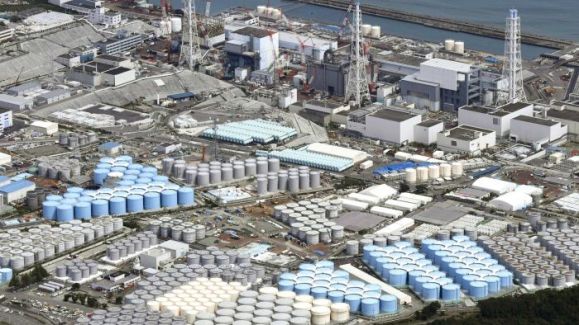





 nuclear-news