Sparking Fears of Airborne Radiation, Wildfire Burns in Fukushima ‘No-Go Zone’
Contaminated forests such as those outside fallout sites like Fukushima and Chernobyl ‘are ticking time bombs’
 Kendra Ulrich, senior Global Energy campaigner for Greenpeace Japan on the Asakaze, a research vessel chartered by Greenpeace Japan, doing radiation survey work off shore of Fukushima Daiichi.
A wildfire broke out in the highly radioactive “no-go zone” near the crippled Fukushima nuclear power plant over the weekend, reviving concerns over potential airborne radiation.
Japanese newspaper The Mainichi reports that lightning was likely to blame for sparking the fire Saturday on Mount Juman in Namie, which lies in the Fukushima Prefecture and was one of the areas evacuated following the 2011 meltdown. The area continues to be barred to entry as it is designated a “difficult-to-return zone” due to continually high radiation levels.
Local officials were forced to call in the Japanese military, the Ground Self-Defense Force (GSDF), to help battle the blaze, which continued to burn on Monday. At least 10 hectares of forest have burned so far.
“A total of eight helicopters from Fukushima, Miyagi and Gunma prefectures as well as the SDF discharged water on the site to combat the fire,” The Mainichi reports. “As the fire continued to spread, however, helicopters from the GSDF, Fukushima Prefecture and other parties on May 1 resumed fire extinguishing operations from around 5 am [local time].”
An official with the Ministry of the Environment said Monday that there has been “no major changes to radiation levels” in the region, according to the newspaper, but added that they will “continue to closely watch changes in radiation doses in the surrounding areas.”
In a blog post last year, Anton Beneslavsky, a member of Greenpeace Russia’s firefighting group who has been deployed to fight blazes in nuclear Chernobyl, outlined the specific dangers of wildfires in contaminated areas.
“During a fire, radionuclides like caesium-137, strontium-90 and plutonium rise into the air and travel with the wind,” Beneslavsky wrote. “This is a health concern because when these unstable atoms are inhaled, people become internally exposed to radiation.”
Contaminated forests such as those outside fallout sites like Fukushima and Chernobyl “are ticking time bombs,” scientist and former regional government official Ludmila Komogortseva told Beneslavsky. “Woods and peat accumulate radiation,” she explained “and every moment, every grass burning, every dropped cigarette or camp fire can spark a new disaster.”
Wildfire continues in Fukushima

A wildfire has been raging for more than 2 days near the damaged Fukushima Daiichi nuclear power plant.
The fire started in a mountain forest on the outskirts of Namie Town in Fukushima Prefecture. The area is part of a zone designated as “no-entry” due to high radiation levels following the 2011 nuclear disaster.
Fukushima and Miyagi prefectures and the Self-Defense Forces are using helicopters to fight the blaze. They are also looking at the possibility of using ground crews.
Footage from an NHK helicopter on Monday morning showed smoke rising from wide areas and fires burning in several locations.
Local officials and firefighters say the blaze abated somewhat on Monday afternoon thanks to rainfall. The wildfire is estimated to have burned about 20 hectares of land so far.
Wildfire rages in highly radioactive Fukushima mountain forest
This is bad news. Fires like this in contaminated forests aerosolize the radiation that covers the plants and has been taken up in the soil and redistributes it through the smoke. It makes no sense to bring people back to the territories in the vicinity of the highly radio-contaminated forests.
NAMIE, Fukushima — A fire broke out in a mountain forest near the crippled Fukushima No. 1 Nuclear Power Plant on the evening of April 29, consuming an area approximately 20 hectares in size, according to prefectural authorities.
The fire started on 448-meter-high Mount Juman in Namie, Fukushima Prefecture, prompting the prefectural government to request the dispatch of the Ground Self-Defense Force (GSDF) on a disaster relief mission on April 30. A total of eight helicopters from Fukushima, Miyagi and Gunma prefectures as well as the SDF discharged water on the site to combat the fire.
As the fire continued to spread, however, helicopters from the GSDF, Fukushima Prefecture and other parties on May 1 resumed fire extinguishing operations from around 5 a.m.
The area is designated as a “difficult-to-return zone” due to high radiation levels from the Fukushima nuclear disaster, and entry into the area is barred in principle.
According to the Fukushima Meteorological Office, a lightning advisory had been issued for the town of Namie when the fire broke out, and Fukushima Prefectural Police suspect that lightning was to blame for the blaze as they continue to investigate the cause of the incident.
As of May 1, there were no major changes to radiation levels in the heart of Namie and other areas near the fire scene, according to the Ministry of the Environment.
“We will continue to closely watch changes in radiation doses in the surrounding areas,” said a ministry official.
http://mainichi.jp/english/articles/20170501/p2a/00m/0na/003000c


14 microSv/h 5cm above from street-side soil Namie, Fukushima
From Birdhairjp
On 22 Apr 2017, I measured radiation in front of a temple of Onoda area,
Namie town of Fukushima prefecture Japan.
I monitored 0.94 micro Sievert per hour in air at chest hight
on road side near a utility pole.
And I monitored air dose rate 0.85 micro Sievert on asphalt road pavement.
There is a place, the monitor figures jump up.
There left highly contaminated soil at the street side.
2.3 micro Sievelt per hour, chest height.
13 to 14 micro Sievelt per hour 5 cm height from the soil.
18 to 20 micro Sievelt per hour when the monitor laid directly on the soil.
Soil contaminated with high concentration of radioactive material
It is like hell
Incredible contamination in Namie, Fukushima
The evacuation orders of the most populated areas of Namie, Fukushima were lifted on March 31st this year.
“Fukuichi area environmental radiation monitoring project” has published airborne radiation measurements map and soil surface density map. The results are simply incredible. This is far much worse than in Radiation Control Zone. Any area becomes designated as such when the total effective dose due to external radiation and that due to radioactive substances in the air is likely to exceed 1.3mSv per quarter – over a period of three months, or when the surface density is over 40,000Bq/m2. In the Radiation Control Zone, it is prohibited to drink, eat or stay overnight. Even adults are not allowed to stay more than 10 hours. To leave the zone, one has to go through a strict screening.
Namie’s radio contamination is far over these figures! And people are told to go back to these areas.
Here is the posting of “Fukuichi area environmental radiation monitoring project” in their FB page on April 20th.
We are uploading the map of airborne radiation rate map measured by GyoroGeiger, the Android supported Geiger counter, during the 38th monitoring action between 3 and 7 April 2017. Dose rate is measured at 1m from the ground.
At 56 points over 100 measuring points, the dose rate was over 1µSv/h. These points are indicated in red. The highest measure was 3.71µSv/h. Conversion to annual dose gives 32mSv. Is it allowed to make evacuees return to such areas?

Here is the soil contamination map uploaded on April 15th. They even had to introduce 7 scales, for the contamination is so high and they couldn’t deal with the scales they were using before! It is a violation of human rights to let people live in such areas.

https://fukushima311voices.wordpress.com/2017/04/22/incredible-contamination-in-namie-fukushima/
Japan Lifts Evacuation Orders for 3 Fukushima Areas

Fukushima, March 31 (Jiji Press)–Japan on Friday lifted its evacuation orders for the village of Iitate and two other areas that had been enforced due to the nuclear disaster at the Fukushima No. 1 nuclear power station in northeastern Japan.
The move came six years after Tokyo Electric Power Company Holdings Inc.’s <9501> power station suffered meltdowns after the huge earthquake and tsunami in March 2011, triggering evacuation orders in many places in Fukushima Prefecture, including Iitate and the other two areas.
Residents of Iitate, the town of Namie and the Yamakiya district in the town of Kawamata, totaling some 22,100 at the end of February, can now return home, except in a handful of places included in no-go zones where radiation levels are still too high.
With the evacuation order set to be removed for the town of Tomioka on Saturday, Okuma and Futaba, the host towns of the crippled power station, will be the only Fukushima municipalities without an area where an evacuation order has been lifted.
Meanwhile, municipalities where evacuation orders have been removed have their own problems: a slow return of residents.
More Evacuation Orders to Be Lifted in Namie and Tomioka Towns
15 March, 2017, from Japan Atomic Industrial Forum, Japan pro-nuclear website :
On March 10, the Japanese government’s nuclear emergency response headquarters decided to lift evacuation orders in two categories in Namie and Tomioka Towns: specifically, those areas where “living is not permitted” and those where “evacuation order will soon be lifted.” The orders will be lifted at 12:00 a.m. on March 31 and April 1 in Namie and Tomioka, respectively.

Since similar orders in the same two categories will also be lifted on March 31 in Iitate Village and Kawamata Town, the latest decision means that the only areas where evacuation orders are still in effect are those where “residents will not be able to return home for a long time.” Specifically, that refers to all of Okuma and Futaba Towns, as well as certain areas of Minami-Soma City, Tomioka Town, Namie Town, Katsurao Village and Iitate Village.
Apart from those, sections of the JR Joban Line unusable since the earthquake will be reopened when the orders are lifted in Namie and Tomioka Towns: namely, the line between Odaka and Namie on April 1, and the line between Tomioka and Tatsuta in some time in October.
According to the Japanese Ministry of the Environment, area-wide decontamination has already been completed as of the end of January in nine of the eleven municipalities in Fukushima Prefecture that are now designated as “special decontamination areas,” which are directly managed by the national government. The term does not include areas where residents will not be able to return home for a long time.
The decontamination work is expected to be completed in the remaining two municipalities—Minami-Soma City and Namie Town—by the end of this month.
As for the transport of soil removed in decontamination work to sites planned for the interim storage of radioactive waste, a total of about 210,000 cubic meters has already been transported as of the beginning of March. In FY17 (April 2017 to March 2018), some 500,000 cubic meters of removed soil will be transported, in anticipation of the beginning of storage next fall, with priority to be placed on soil now stored at schools.
http://www.jaif.or.jp/en/more-evacuation-orders-to-be-lifted-in-namie-and-tomioka-towns/
Govt. to lift more Fukushima evacuation orders

The Japanese government is set to lift evacuation orders in 2 municipalities in Fukushima Prefecture, issued after the 2011 nuclear disaster.
The government will hold a joint meeting between the reconstruction taskforce and the nuclear disaster task force on Friday. On Saturday, it will be 6 years since the earthquake and tsunami.
Participants will decide on whether to lift an evacuation order in part of Namie town on March 31st and a portion of Tomioka on April 1st.
Following the accident at the Fukushima Daiichi nuclear plant, the government issued evacuation orders for 11 municipalities in the prefecture and has since gradually lifted them.
With the latest measure, the orders will be in effect only in no-entry zones with high radiation levels as well as part of the towns of Futaba and Okuma that co-host the nuclear plant.
About 1,150 square kilometers were initially subject to the government evacuation order. That number is now expected to shrink to about 369.
The central government hopes to continue decontamination work and infrastructure projects in some no-entry zones. It says it wants to create a hub for reconstruction by the end of fiscal 2021, where residents and decontamination workers will live.
But the government faces challenges in rebuilding communities as an increasing number of people, mainly the young, say they don’t want to return to their hometowns even if evacuation orders are lifted.
Up to 20µSv/h at Namie Junior High School, Fukushima
Namie Junior High School, Namie, Futaba, Fukushima prefecture.
Measures taken on February 5, 2017, on March 31, 2017 the japanese government will lift the evacuation order in Namie, for its inhabitants to return….

At 1m above the ground : 3.5μSv/h

At 50cm above the ground : 6μSv/h

At 5cm above the ground 20μSv/h

Measurement location
https://goo.gl/maps/27kyf41xyUr
Radiation Measured 16μSv/h at Ground Level in Namie-cho, Fukushima

A residential area of namie-Cho, Namie-Cho, radiation measured 1.3μSv/h at 1 meter above ground and 16μSv/h at ground level
As Japan is trying desperately to use any tactics and resources such as “the cult like” ETHOS to incite refugees to return to their radioactive land, just in time to display the reconstruction of Fukushima to dumb tourists who will visit the prefecture during the next Tokyo Olympics, the reality of things with a Geiger counter and willing citizens paints a total different picture.
This is in Namie cho, a residential district in Fukushima.
What tourist won’t see while traveling Fukushima:
– Tons of highly radioactive waste buried hastily under the grounds of school grounds or abandonned at random on forests or radioactive ash poured into rivers.
– Tons of radioactive waste being burned across incinerators in Japan, spraying dangerous isotopes all over – continuously for the past 4 years.
– Children cleaning up roads of radiation so close to Daiichi – most with no real protection.
– Daiichi sinking, leaking, spewing radiation for 5 years into the ground, the air, rivers and the ocean.
– Contaminated food cleverly being distributed, mislabeled, mixed with non contaminated produces to lower the amount of bequerels and served to children in Japan.
– The discrimination within the prefecture between victims over beliefs or aid money (which no one will soon be able to have access to) and non victims.
– The fear of mothers over their children’s health and future.
Enjoy your Olympics !
Special credits to Oz Yo and Nelson Surjon
Namie’s high recovery hopes haunted by dwindling coffers, fears of losing vital state dole
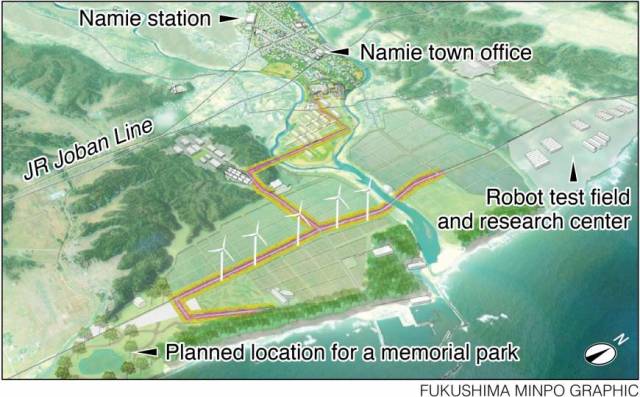
A robot testing facility, a robotics research center, a base for renewable energy and a memorial park — these are some of the plans the irradiated town of Namie, Fukushima Prefecture, has in mind for rebuilding after the triple reactor meltdown at the nearby Fukushima No. 1 power plant in March 2011.
But to pursue those plans, the town needs funds — a gigantic amount.
Namie is hoping to cover its funding needs with central government grants. But the two sides are still negotiating whether the municipality must shoulder a certain amount.
Also, there is no guarantee that the grants will continue beyond fiscal 2020, when the central government-designated reconstruction and revitalization period ends. This has residents worried that, even if the facilities are built, the municipality won’t be able to shoulder the maintenance and personnel costs needed to keep the facilities running.
“We are currently negotiating fiercely with the central government,” said Namie’s deputy mayor, Katsumi Miyaguchi, 61.
The town of Namie had the largest population in the Futaba district, but its coffers took a major hit after the calamity triggered by the Great East Japan Earthquake on March 11, 2011.
Residential tax revenue, which comprises about 30 to 40 percent of all tax revenues, sank to ¥500 million from about a ¥1 billion before 3/11 after the town decided to waive taxes for those with annual income below ¥5 million.
Whether to continue the waiver program is another difficult political issue.
The town was also waiving property taxes but plans to resume them when evacuations are lifted in some areas next spring. But land values have plunged since the meltdowns and any property tax revenues are expected to be low.
The same goes for corporate tax revenue, which has been hit by 3/11 business suspensions.
In short, Namie wouldn’t be able to pay the salaries of its town officials, let alone finance a reconstruction plan, if it weren’t for the central government grants.
As the centerpiece of its plan, Namie plans to build a facility adjacent to its town hall that would offer local information and house restaurants that serve up local specialties.
But that remains to be seen.
“We are making plans despite the uncertainty that the central government’s grants will cover them,” said a town official in charge. “If the funds don’t cover the entire plan, it may need to be revised.”
In the mayor’s office, currently in the city of Nihonmatsu, there is a calender showing the number of days that have passed since the disasters hit — over 2,000. But Namie is still far from recovery.
“The financial resources we’ve lost due to the disaster are excessive,” said Namie Mayor Tamotsu Baba, 68. “We desperately need the central government to continue its support.”
Another town executive agreed.
“If the government stops providing grants four years later when the reconstruction/revitalization period ends, it means the government has abandoned Namie,” the executive said.
1 This Month

of the week – Shut Down Drone Warfare!


Tell the Ukrainian Government to Drop Prosecution of Peace Activist Yurii Sheliazhenko

Petition to revoke the licensing of the Near Surface Nuclear Disposal Facility (NSDF) at Chalk River. https://www.ourcommons.ca/petitions/en/Petition/Details?Petition=e-7247
To see nuclear-related stories in greater depth and intensity – go to https://nuclearinformation.wordpress.com
-
Archives
- March 2026 (251)
- February 2026 (268)
- January 2026 (308)
- December 2025 (358)
- November 2025 (359)
- October 2025 (376)
- September 2025 (257)
- August 2025 (319)
- July 2025 (230)
- June 2025 (348)
- May 2025 (261)
- April 2025 (305)
-
Categories
- 1
- 1 NUCLEAR ISSUES
- business and costs
- climate change
- culture and arts
- ENERGY
- environment
- health
- history
- indigenous issues
- Legal
- marketing of nuclear
- media
- opposition to nuclear
- PERSONAL STORIES
- politics
- politics international
- Religion and ethics
- safety
- secrets,lies and civil liberties
- spinbuster
- technology
- Uranium
- wastes
- weapons and war
- Women
- 2 WORLD
- ACTION
- AFRICA
- Atrocities
- AUSTRALIA
- Christina's notes
- Christina's themes
- culture and arts
- Events
- Fuk 2022
- Fuk 2023
- Fukushima 2017
- Fukushima 2018
- fukushima 2019
- Fukushima 2020
- Fukushima 2021
- general
- global warming
- Humour (God we need it)
- Nuclear
- RARE EARTHS
- Reference
- resources – print
- Resources -audiovicual
- Weekly Newsletter
- World
- World Nuclear
- YouTube
-
RSS
Entries RSS
Comments RSS
 nuclear-news