J-Village still contaminated – major uncertainties over decontamination and Olympic torch route
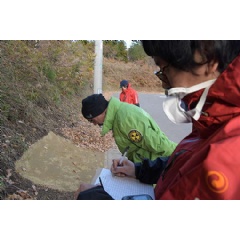
High-level radiation hot spots found at J-Village, the starting point of Tokyo 2020 Olympic Torch Relay
 The Japan leg of the 2020 Tokyo Olympic torch relay will start at a the J-Village soccer facility in Fukushima Prefecture.
Tokyo, Japan, 4 December 2019 – High-level radiation hot spots have been found at the sports complex where the 2020 Tokyo Olympic torch relays will begin, according to a survey to be released by Greenpeace Japan. The radiation levels around J-Village Stadium in Fukushima Prefecture were as high as 71 microsieverts per hour at surface level. This is 1,775 times higher than the 0.04 microsieverts per hour prior to the Fukushima Daiichi triple reactor meltdown in 2011.
Greenpeace’s Nuclear Monitoring & Radiation Protection Advisors detected and documented several radiation hot spots on 26 October during its annual survey, which will be published in spring 2020. On 18 November, Greenpeace Japan sent a letter to Minister Koizumi of the Japanese Ministry of the Environment
, demanding immediate decontamination measures and assurance that the public will not be exposed to radiation hot spots during the Olympics and Paralympics events at J-Village. Copies were also sent to the President of the International Olympic Committee, as well as the Presidents of the International Paralympic Committee, Japanese Olympic and Paralympic Committees, and the Governor of Fukushima Prefecture, who is also the President of J-Village.
Greenpeace has yet to receive a response from the Japanese government but is publicly releasing the information on the radiation hot spots due to an article published today (4 December) by Sankei Shimbun.
The article reports some details of Greenpeace Japan’s letter to the Japanese government and Olympic bodies, which was leaked to the media by an unknown official. The article states that the soil around the particular hotspot with 71 microsieverts per hour at surface level was removed by TEPCO yesterday (3 December).
“While general radiation levels were low at the J-Village, these radiation hot spots are of significant public health concern. Radiation hot spots of such high levels can be found in the closed area around Fukushima (so-called Area 3), but should not be present in publicly accessible areas. Yet, they are at a location that has been the focus of an extensive decontamination program and is also the starting point for the Olympic torch relay in Japan.
These radiation hot spots highlight both the scale of contamination caused by the Fukushima Daiichi disaster, and the failure of decontamination efforts. We have called on the Ministry of Environment to act urgently and to initiate immediate decontamination,” said Kazue Suzuki, Energy Campaigner at Greenpeace Japan.
The radiation hot spots at the parking lot close to J-Village are of particular concern because they are located in an area that is currently visited by a large number of people. The highest figures were: 71µSv/h at contact, 32µSv/h at 10cm, 6µSv/h at 50cm and 1.7µSv/h at 1m, while the official Japanese government’s decontamination threshold is 0.23µSv/h.
“There is a risk that heavy rain will spread these higher levels of contamination on public roads, and thus re-contaminate already decontaminated surfaces. This could partially undo earlier efforts to decontaminate the public areas in J-Village. From our observations, it is unlikely that radiation hot spots of such high levels re-emerged from re-contamination after the previous decontamination. It is more logical that the decontamination was not sufficiently and thoroughly conducted in the first place,” said Shaun Burnie, Senior Nuclear Specialist at Greenpeace Germany and the team leader of the survey.
To protect public safety, Greenpeace Japan demands that the Japanese government conduct an immediate and extensive radiation survey of the public areas in and around J-Village and nearby Olympic/Paralympic venues. Furthermore, they should promptly conduct decontamination if further radiation hot spots are identified. Regular screenings of the radiation levels in J-Village should be also conducted to monitor possible re-contamination of public areas.
Greenpeace’s Nuclear Monitoring & Radiation Protection Advisors will soon re-test the J-Village to determine if subsequent decontamination attempts have been adequately conducted.
Olympics-Radiation hot spots found at Tokyo 2020 torch relay start – Greenpeace
 J-village
December 4, 2019
TOKYO, Dec 4 (Reuters) – Radiation hot spots have been found at the J-Village sports facility in Fukushima where the Tokyo 2020 Olympic torch relay will begin, Greenpeace Japan said on Wednesday.
Greenpeace found that radiation levels around the recently refurbished venue, which also hosted the Argentina team during the Rugby World Cup earlier this year, were significantly higher than before the Fukushima Daiichi nuclear reactor meltdown following the March 2011 earthquake and tsunami.
Greenpeace’s survey found radioactivity readings taken at J-Village on Oct. 26 as high as 71 microsieverts per hour at surface level.
People are exposed to natural radiation of 2,000-3,000 microsieverts a year, so anyone staying in the vicinity of J-Village for two or more days could be exposed to more than that.
These readings, although not deemed life-threatening if exposed for a short length of time, are 1,775 times higher than prior to the March 2011 disaster, according to the NGO.
The Olympic flame is due to arrive from Greece in Japan on March 20, with the torch relay officially starting from J-Village on March 26.
Greenpeace said in a statement that it had sent its findings to Japan’s Ministry of Environment, but had received no response.
“There is a risk that heavy rain will spread these higher levels of contamination on public roads, and thus re-contaminate already decontaminated surfaces,” warned Greenpeace nuclear specialist Shaun Burnie, team leader of the J-Village survey, in a statement.
An ministry official acknowledged to Reuters on Wednesday that the ministry had been alerted to higher radiation level readings in an area surrounding J-Village and that decontamination measures had been taken.
“The ministry cooperated with related groups to decrease radiation levels in that area,” said the official.
“On Dec. 3, Tokyo Electric Power (Tepco) took measures to decrease radiation levels in said area.”
The Fukushima Daiichi nuclear station, located about 220 km (130 miles) northeast of Tokyo, was rocked by a magnitude 9.0 earthquake and subsequent tsunami in March 2011, sparking three reactor meltdowns.
More than 160,000 residents fled nearby towns in the aftermath as radiation from the reactors contaminated water, food and air. Greenpeace called on the Japanese government to conduct more extensive radiation surveys in the area and the NGO planned to return to J-Village soon to “determine if subsequent decontamination attempts have been adequately conducted.”
Tokyo 2020 organisers could not be immediately reached for comment.
Worries that local food could be contaminated by the nuclear disaster has prompted plans by South Korea’s Olympic committee to buy radiation detectors and ship homegrown ingredients to Japan for its athletes at the Tokyo Games. (Additional reporting by Mari Saito; editing by Simon Cameron-Moore)
Radiation hotspots ‘found near Fukushima Olympic site’
Greenpeace calls for fresh monitoring of region where nuclear disaster occurred
 The Fukushima Daiichi power plant, which was the site of a nuclear disaster in 2011. Officials are keen to showcase the area’s recovery.
Wed 4 Dec 2019
Greenpeace has said it detected radiation hotspots near the starting point of the upcoming Olympic torch relay in Fukushima.
Japan’s environment ministry said the area was generally safe but it was in talks with local communities to survey the region before the 2020 Games, which open on 24 July.
The government is keen to use the Olympics to showcase Fukushima’s recovery from the 2011 tsunami. It intends to use J-Village, a sports complex located about 12 miles from the nuclear plant that was damaged in the disaster, as the starting point for the Japan leg of the torch relay taking place in March.
Originally designed as a training centre for athletes, J-Village functioned for years as a logistics hub for crews working to control and decommission the defunct reactors.
After a cleanup process, the sports centre became fully operational again in April this year, shortly after the torch relay decision.
Greenpeace urged fresh radiation monitoring and continued cleanup efforts, saying it had detected some spots with radiation levels as high as 1.7 microsieverts per hour when measured one metre above the surface.
This compared with the national safety standard of 0.23 microsieverts per hour, and a normal reading in Tokyo of about 0.04 microsieverts per hour. The hotspots showed a reading of 71 microsieverts per hour at the surface level, Greenpeace said.
However, J-Village’s website said the radiation reading at its main entrance was 0.111 microsieverts per hour on Wednesday, while one of its fields showed a reading of 0.085 microsieverts per hour.
The Tokyo Electric Power Company, which operates the Fukushima plant, said it cleaned the spots on Tuesday after the environment ministry told the firm about them.
Greenpeace said it relayed its findings to the Japanese government as well as local and international Olympic organisers. The group will publish a report of its findings in the region next year.
Fukushima soccer facility, repurposed after 3/11 disaster, fully reopens

Fukushima soccer facility to fully reopen in April after 2011 crisis

J-Village soccer center in Fukushima to partially reopen in July
A vice-president is Tepco’ member.

Fukushima Facility to Become Soccer Training Camp for 2020 Olympics
Tepco to end operations at the J-Village complex by March
Facility to be used as training camp for 2020 Tokyo Olympics
The base for the cleanup of the Fukushima nuclear plant will be returned by March to its original use: the training camp for the Japanese national soccer team.
In a symbolic step in the struggle to contain one of the worst nuclear disasters, Tokyo Electric Power Co. Holdings Inc. will return the J-Village facility — about 20 kilometers (12 miles) from the crippled Dai-Ichi plant and just 7 kilometers from the current exclusion zone — to the prefectural government during the current fiscal year, company spokesman Tatsuhiro Yamagishi said Tuesday. It’s also a boon for soccer players who will use the complex as their training base for the 2020 Tokyo Olympics.
The complex, opened in 1997 and shut down after March 2011 meltdown, will be fully reopened for players of “The Beautiful Game” in April 2019. It boasts 11 soccer pitches, a 1,200 square-meter gymnasium and a four-lane pool.
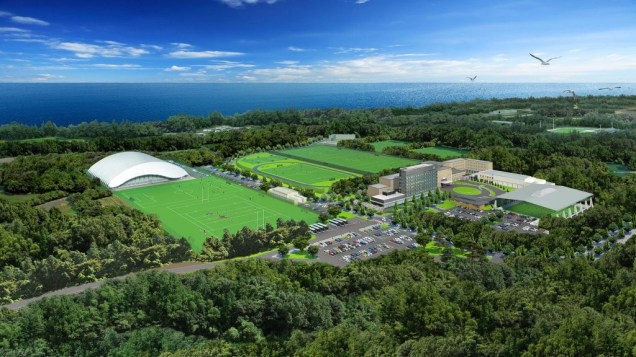
The hand-over is a shot in the arm for Prime Minister Shinzo Abe, who has vowed the nuclear disaster will not impede the nation’s plans to host the 2020 Games. In September, the premier said the situation at Fukushima is “under control” and that there doesn’t need to be a review of measures to prevent contamination.
“This promised handover of J-village would serve as a symbol of progress,” Daniel Aldrich, professor and director of the security and resilience studies program at Northeastern University in Boston, said by e-mail.
“Tepco clearly hopes that this will show the nation that it is on track in the Fukushima accident clean up process,” Aldrich said. “However, a number of obstacles, including expanding costs for decommissioning, a lack of physical control over the contaminated groundwater at the site, and complaints about the decontamination process nearby will no doubt hinder the process.”
As Tepco begins in coming years to remove melted fuel at Fukushima, clean-up costs may rise to several hundred billion yen annually from the current 80 billion yen ($763 million), Japan’s industry ministry said in October. About 300 metric tons of water — partly from the nearby hills — flow into the reactor building daily, mixing with melted fuel and becoming contaminated, according to the company.
The utility used the soccer facility as a make-shift base for tasks from corporate communications to measuring the radiation exposure of employees. It even built temporary dormitories there.
Dumpling soup from Fukushima like grandma used to make

“Ganimaki suiton” (front) from Minamisoma, Fukushima Prefecture and “mami suiton” (back) of Naraha.
The Japan Football Village (J-Village) is a soccer training facility located in Naraha, Fukushima Prefecture, where Yoshiteru Nishi, chef for the national soccer team, works.
It is located about 20 kilometers from the Fukushima No. 1 nuclear power plant. After the 2011 accident at the plant, J-Village was used as a base for decommissioning work.
The green grass pitch was covered in gravel and turned into a parking lot. The restaurant was closed.
That summer, Nishi was asked to cook for the decommissioning workers. He had seen the workers eating canned or boil-in-the-bag foods.
“There are people who need my skills,” Nishi thought, and opened a cafeteria at the facility. He served a buffet of fried chicken, grilled fish, simmered dishes and more. He wanted to support those working in a grueling environment with nutritious meals.
Meanwhile, he opened a restaurant in the neighboring town of Hirono, where eating and drinking establishments remained closed due to the nuclear power plant accident.
“I wanted to create a place where the residents returning from evacuation spots can eat warm meals and feel relaxed,” the 54-year-old chef says.
The menu includes “suiton,” a local dumpling soup with chicken and vegetables that was popular at J-Village. Former national team coach Philippe Troussier once commented, “This is grandma’s taste,” and named it “mami suiton” (mommy’s suiton).
Nishi also introduced another version of suiton called “ganimaki,” a local specialty of Minami-Soma.
Ganimaki is a soup of “mokuzu-gani” (Japanese mitten crab) caught in local rivers. They are finely crushed and run through a sieve. When poured into boiling water, the essence floats up in fluffy form. In Minami-Soma, it is a dish served on festive occasions.
When he was small, Nishi would busy himself catching the deep-green-colored crabs in the river. When his mother stir-fried them with eggs, they tasted heavenly.
Due to radiation contamination caused by the Fukushima plant accident, the Japanese mitten crabs of Minami-Soma are not allowed to be consumed.
“I yearn for them all the more,” Nishi says.
For the recipe, he used crabs caught in Iwaki in southern Fukushima Prefecture.
“The food culture of Fukushima has been nurtured by the large number of people who live here,” Nishi says. “I will strive to keep the tradition alive.”
http://www.asahi.com/ajw/articles/AJ201607270008.html
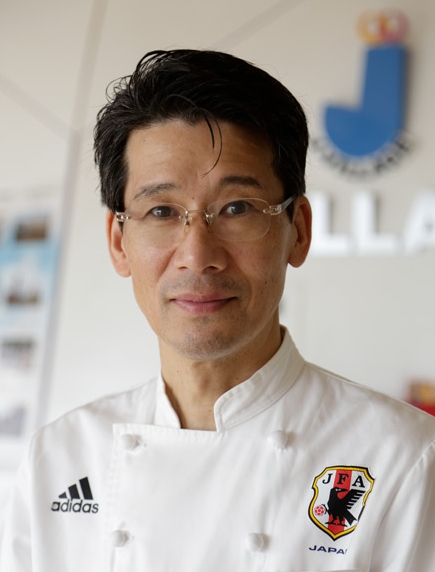
The Japan Football Village (J-Village) is a soccer training facility located in Naraha, Fukushima Prefecture, where Yoshiteru Nishi, chef for the national soccer team, works.
Japan Olympic teams to train in nuclear clean-up zone

Piles of used protective clothing worn by workers inside the contaminated ‘exclusion zone’, seen in 2011 at J-Village, a football training complex serving as an operation base for those battling Japan’s nuclear disaster in Fukushima
Tokyo (AFP) – Japan’s Olympic football teams will train for the Tokyo 2020 Games at a complex currently being used as a base for thousands of workers cleaning up the crippled Fukushima nuclear plant.
The Japan Football Association (JFA) said Monday that the Japanese men’s and women’s teams would hold their training camps at J-Village, once the country’s centre of excellence until it was taken over by plant operators following the 2011 nuclear disaster.
“The teams will use the J-Village facility as a training base,” JFA communications chief Takato Maruyama told AFP.
“It is something the JFA had been talking about but a timeline hadn’t been formally approved by the executive board, until now,” Maruyama said.
J-Village is on the fringes of the old 12-mile (20-kilometre) exclusion zone around the stricken plant, which suffered a triple reactor meltdown after a giant tsunami slammed into it in March, 2011, causing massive radiation leaks and forcing the evacuation of more than 150,000 people.
As the nuclear crisis raged, J-Village became the front line in the fight to control the situation, with helipads, medical centre and dormitories hastily erected for workers filing in and out of the plant in their protective suits and masks.

Workers queue for a bowl of soup at J-Village, a football training complex serving as an operation base for those battling Japan’s nuclear disaster in Fukushima prefecture, in 2011
Following the removal of the no-entry zone last September, the sprawling site located in the sleepy town of Naraha will undergo large-scale reconstruction with a view to a partial reopening by July 2018.
“Obviously the complex will need some refurbishment but that is the time frame we have heard from TEPCO (Tokyo Electric Power Company) and J-Village,” said Maruyama.
Japanese officials plan to reopen the facility — originally constructed by TEPCO and donated to the regional government in 1997 — to serve as a symbol of recovery for the Tokyo Olympics.
Venues in the tsunami-ravaged northeastern Tohoku region also hoping to be involved in the Games.
“J-Village has always been an important venue and it has a large role to play in the recovering of Fukushima,” JFA director Eiji Ueda told local media.
Despite the symbolic value of training at the complex, the JFA insisted that safety was of utmost importance.
“We can’t make any specific comment on radiation but clearly you can’t play football in places where it isn’t safe for people to go,” said Maruyama, referring to the proposal to reopen J-Village in 2018.
“Obviously it will be opened on condition that all decontamination work has been completed safely,” he added.
“We can’t say (at this point) if that decontamination will have been fully carried out and whether there will be zero effect from radiation by that time.”
1 This Month

of the week – Shut Down Drone Warfare!


Tell the Ukrainian Government to Drop Prosecution of Peace Activist Yurii Sheliazhenko

Petition to revoke the licensing of the Near Surface Nuclear Disposal Facility (NSDF) at Chalk River. https://www.ourcommons.ca/petitions/en/Petition/Details?Petition=e-7247
To see nuclear-related stories in greater depth and intensity – go to https://nuclearinformation.wordpress.com
-
Archives
- April 2026 (19)
- March 2026 (251)
- February 2026 (268)
- January 2026 (308)
- December 2025 (358)
- November 2025 (359)
- October 2025 (376)
- September 2025 (257)
- August 2025 (319)
- July 2025 (230)
- June 2025 (348)
- May 2025 (261)
-
Categories
- 1
- 1 NUCLEAR ISSUES
- business and costs
- climate change
- culture and arts
- ENERGY
- environment
- health
- history
- indigenous issues
- Legal
- marketing of nuclear
- media
- opposition to nuclear
- PERSONAL STORIES
- politics
- politics international
- Religion and ethics
- safety
- secrets,lies and civil liberties
- spinbuster
- technology
- Uranium
- wastes
- weapons and war
- Women
- 2 WORLD
- ACTION
- AFRICA
- Atrocities
- AUSTRALIA
- Christina's notes
- Christina's themes
- culture and arts
- Events
- Fuk 2022
- Fuk 2023
- Fukushima 2017
- Fukushima 2018
- fukushima 2019
- Fukushima 2020
- Fukushima 2021
- general
- global warming
- Humour (God we need it)
- Nuclear
- RARE EARTHS
- Reference
- resources – print
- Resources -audiovicual
- Weekly Newsletter
- World
- World Nuclear
- YouTube
-
RSS
Entries RSS
Comments RSS
 nuclear-news