In Fukushima, a land where few return
The evacuation orders for most of the village of Iitate have been lifted. But where are the people?
 The build-up of contaminated bags is slowly changing the landscape of Iitate, Fukushima Prefecture.
IITATE, FUKUSHIMA PREF. – Some day when I have done what I set out to do, I’ll return home one of these days, where the mountains are green, my old country home, where the waters are clear, my old country home.
— “Furusato,” Tatsuyuki Takano
A cherry tree is blooming in the spring sunshine outside the home of Masaaki Sakai but there is nobody to see it. The house is empty and boarded up. Weeds poke through the ground. All around are telltale signs of wild boar, which descend from the mountains to root and forage in the fields. Soon, the 60-year-old farmhouse Sakai shared with his mother and grandmother will be demolished.
“I don’t feel especially sad,” Sakai says. “We have rebuilt our lives elsewhere. I can come back and look around — just not live here.”
A few hundred meters away the road is blocked and a beeping dosimeter begins nagging at the bucolic peace. The reading here is a shade over 1 microsievert per hour — a fraction of what it was when Sakai’s family fled in 2011.
The radiation goes up and down, depending on the weather, Sakai says. In gullies and cracks in the road, and up in the trees, it soars. With almost everyone gone, the monkeys who live in the forests have grown bolder, stopping to stare at the odd car that appears instead of fleeing, as they used to.
A cluster of 20 small hamlets spread over 230 square kilometers, Iitate was undone by a quirk of the weather in the days that followed the nuclear accident in March 2011. Wind carried radioactive particles from the Fukushima No. 1 nuclear power plant, which is located about 45 kilometers away, that fell in rain and snow on the night of March 15, 2011. After more than a month of indecision, during which the villagers lived with some of the highest radiation recorded in the disaster (the reading outside the village office on the evening of March 15 was a startling 44.7 microsieverts per hour), the government ordered them to leave.
Now, the government says it is safe to go back. With great fanfare, all but the still heavily contaminated south of Iitate, Nagadoro, was reopened on March 31.
 A radiation monitoring post is installed in the village of Iitate on March 27, ahead of the lifting of an evacuation order for most areas of the village. The post bears the message ‘Welcome home.’
The reopening fulfills a pledge made by Mayor Norio Kanno: Iitate was the first local authority in Fukushima Prefecture to set a date for ending evacuation in 2012, when the mayor promised to reboot the village in five years. The village has a new sports ground, convenience store and udon restaurant. A clinic sees patients twice a week. All that’s missing is people.
Waiting to meet Kanno in the government offices of Iitate, the eye falls on a book displayed in the reception: “The Most Beautiful Villages in Japan.” Listed at No. 12 is the beloved rolling patchwork of forests, hills and fields the mayor has governed for more than two decades — population 6,300, famous for its neat terraces of rice and vegetables, its industrious organic farmers, its wild mushrooms and the black wagyu cow that has taken the name of the area.
The description in the book is mocked by reality outside. The fields are mostly bald, shorn of vegetation in a Promethean attempt to decontaminate it of the radiation that fell six years ago. There is not a cow or a farmer in sight. Tractors sit idle in the fields. The local schools are empty. As for the population, the only part of the village that looks busy is the home for the elderly across the road from Kanno’s office.
 A school sits deserted in Iitate, Fukushima Prefecture, in April.
“The village will never return to how it used to be before the disaster,” Kanno says, “but it may develop in a different way.”
Recovery has started, Kanno says, wondering whether returnees will be able to start building a village they like.
“Who knows? Maybe one day that may help bring back evacuees or newcomers,” Kanno says. “Life doesn’t improve if you remain pessimistic.”
Even for those who have permanently left, he adds, “it doesn’t mean that their furusato can just disappear.”
The pull of the furusato (hometown) is exceptionally strong in Japan, says Tom Gill, a British anthropologist who has written extensively about Iitate.
Yearning for it “is expressed in countless sentimental ballads,” Gill says. “One particular song, simply titled ‘Furusato,’ has been sung by children attending state schools in Japan since 1914.”
The appeal has persisted despite — or perhaps because of — the fact that the rural/urban imbalance in Japan is more skewed than in any other developed nation, Gill says; just 10 percent of the nation’s population live in the country.
This may partly explain the extraordinary efforts to bring east Fukushima back to life. By one study, more than ¥2.34 trillion has been spent decontaminating an area roughly half the size of Rhode Island.
There has been no official talk of abandoning it. Indeed, any suggestion otherwise could be controversial: When industry minister Yoshio Hachiro called the abandoned communities “towns of death” in September 2011, the subsequent outrage forced him to quit a week later.
Instead, the area was divided into three zones with awkward euphemisms to suggest just the opposite: Communities with annual radiation measuring 20 millisieverts or less (the typical worldwide limit for workers in nuclear plants) are “being prepared for lifting of evacuation order,” districts of 20-50 millisieverts per year are “no-residence zones” and the most heavily contaminated areas of 50 millisieverts or more per year, such as Nagadoro, are “difficult-to-return.”
In September 2015, Naraha, which is located 15 kilometers south of the Fukushima No. 1 nuclear plant, became the first town in the prefecture to completely lift the evacuation order imposed after the triple meltdown. Naraha has a publicly built shopping street, a new factory making lithium batteries, a kindergarten and a secondary school.
A team of decontamination workers has been sent to every house — in some cases several times. Of the pre-disaster 7,400 residents, about 1,500 mainly elderly people have returned, the local government says, although that figure is likely inflated.
In Iitate, the cost of decontamination works out at about ¥200 million per household. That, and the passage of time, has dramatically reduced radiation in many areas to below 20 millisieverts a year. However, Kanno says, the cleanup extends to only 20 meters around each house, and three-quarters of the village is forested mountains. In windy weather, radioactive elements are blown back onto the fields and homes.
“All that money, and for what?” asks Nobuyoshi Itoh, a farmer and critic of the mayor. “Would you bring children here and let them roam in the fields and forests?”

Nobuyoshi Itoh walks through a forest by his land in Iitate, Fukushima Prefecture.
Itoh opted to stay in one of the more heavily toxic parts of the village after everyone fled, with little apparent ill effect, although he says his immune system has weakened.
One of the reasons why Iitate was such a pleasant place to live before the nuclear crisis, he recalls, was its unofficial barter system. “Most people here never bought vegetables; they grew them,” he says. “I would bring someone potatoes and they would give me eggs. That’s gone now.”
At most, he says, a few hundred people are back — but they’re invariably older or retired.
“They alone will not sustain the village,” Itoh says. “Who will drive them around or look after them when they are sick?”
As the depth of the disaster facing Iitate became clear, local people began to squabble among themselves. Some were barely scraping a living and wanted to leave, although saying so out loud — abandoning the furusato — was often difficult. Many joined lawsuits against the government.
Even before disaster struck, the village had lost a third of its population since 1970 as its young folk relocated to the cities, mirroring the hollowing-out of rural areas across the country. Some wanted to shift the entire village elsewhere, but Kanno wouldn’t hear of it.
Compensation could be a considerable incentive. In addition to ¥100,000 a month to cover the “mental anguish” of being torn from their old lives, there was extra money for people with houses or farms. A five-year lump sum was worth ¥6 million per person — twice that for Nagadoro. One researcher estimates a rough figure of ¥50 million for the average household, sufficient to leave behind the uncertainties and worries of Iitate and buy a house a few dozen miles away, close enough to return for work or to the village’s cool, tranquil summers.

Masaaki Sakai stands outside his home in Iitate, Fukushima Prefecture.
Many have already done so. Though nobody knows the true figure, the local talk is that perhaps half of the villagers have permanently left. Surveys suggest fewer than 30 percent want to return, and even less in the case of Nagadoro.
Yoshitomo Shigihara, head of the Nagadoro hamlet, says many families made their decision some time ago. His grandchildren, he says, should not have to live in such a place.
“It’s our job to protect them,” Shigihara says. He lives in the city of Fukushima but returns roughly every 10 days to inspect his house and weed the land.
Even with so much money spent, Shigihara doubts whether it will bring many of his friends or relatives back. At 70 years of age, he is not sure that he even wants to return, he says.
“I sometimes get upset thinking about it, but I can’t talk with anyone in Fukushima, even my family, because we often end up quarreling,” he says. “People try to feel out whether the others are receiving benefits, what they are getting or how much they received in compensation. It’s very stressful to talk to anyone in Iitate. I’m starting to hate myself because I end up treating others badly out of frustration.”
Kanno has won six elections since 1996 and has overseen every step of Iitate’s painful rehabilitation, navigating between the anger and despair of his constituents and the official response to the disaster from the government and Tokyo Electric Power Company Holdings (Tepco), operator of the crippled nuclear plant.
 Ground Self-Defense Force members decontaminate areas tainted with radioactive substances in Iitate, Fukushima Prefecture, in December 2011.
He wants more money to complete decontamination work (the government claims it is finished), repair roads and infrastructure. Returnees need financial support, he says. However, it is time, he believes, to end the monthly compensation, which, in his view, induces dependency.
“If people keep saying that life is hard, they will not be able to recover,” he says. “What we need is support for livelihoods.”
A new system gives seed money to people who voluntarily come back to start businesses or farms.
“We don’t want to give the impression that we are influencing people’s decisions or forcing them to return,” the mayor says, using the phrase “kokoro ni fumikomu,” which literally means “to step into hearts.”
Yet, next year, thousands of Iitate evacuees will face a choice: Go back or lose the money that has helped sustain them elsewhere for six years. Evacuation from areas exposed to less than 20 millisieverts per year will be regarded as “voluntary” under the official compensation scheme.
This dilemma was expressed with unusual starkness last month by Masahiro Imamura, the now sacked minister in charge of reconstructing Tohoku. Pressed by a freelance reporter, Imamura tetchily said it was up to the evacuees themselves — their “own responsibility, their own choice” — whether or not to return.
The comment touched a nerve. The government is forcing people to go back, some argued, employing a form of economic blackmail, or worse, kimin seisaku — abandoning them to their fate.
Itoh is angry at the resettlement. For him, politics drives the haste to put the disaster behind.
“It’s inhuman to make people go back to this,” he says. Like the physical damage of radiation, he says, the psychological damage is also invisible: “A lot of people are suffering in silence.”
Itoh believes the government wants to show that the problems of nuclear power can be overcome so it can switch the nation’s idling nuclear reactors back on. Just four are in operation while the fate of 42 others remains in political and legal limbo. Public opinion remains opposed to their restart.
Many people began with high hopes in Iitate but have gradually grown distrustful of the village government, says Kenichi Hasegawa, a farmer who wrote a book titled “Genpatsu ni Furusato o Ubawarete” (“Fukushima’s Stolen Lives”) in 2012. Right from the start, he says, the mayor desperately tried to hide the shocking radiation outside his office.
“Villagers have started losing interest,” Hasegawa says.
Meetings called by the mayor are poorly attended.
“But they hold meetings anyway,” Hasegawa says, “just to say they did.”
Kanno rejects talk of defeatism. A tourist shop is expected to open in August that will attract people to the area, he says. Some villagers are paving entrances to their houses, using money from the reconstruction budget. As for radiation, everyone “has their own idea” about its effects. The lifting of the evacuation is only the start.
Itoh says he once trusted public officials but those days are long gone. By trying to save the village, he says, the mayor may in fact be killing it.
 Bags filled with contaminated waste sit in a field in the village of Iitate, Fukushima Prefecture, in March 2016.
http://www.japantimes.co.jp/news/2017/05/13/national/social-issues/fukushima-land-return/
Fukushima village begins sowing rice for first time since nuclear crisis

A farmer plants rice at a paddy for commercial sale in Iitate, Fukushima Prefecture, on Wednesday for the first time since the meltdowns at the Fukushima No. 1 nuclear power plant in 2011. In the forefront is a sign warning against an electric fence set up for wild boars.
FUKUSHIMA – Rice planting for commercial sales began on Wednesday in a village in Fukushima Prefecture for the first time since the 2011 disaster at the Fukushima No. 1 nuclear power plant.
A total of eight farms in Iitate plan to resume growing rice this year in a combined area of about 7 hectares after evacuation orders were lifted at the end of March for large parts of the village.
With much of the area contaminated by radiation following the nuclear crisis, the total arable area has shrunk from around 690 hectares before the disaster, according to the village.
The farmers will conduct radiation tests before shipping their rice. No rice grown in the village has shown levels of radioactivity exceeding the safety standard since experimental rice planting began in 2012.
“(I feel) comfortable. We want to get back even a step closer to the village of six years ago,” said Shoichi Takahashi, 64, while working a rice planting machine.
The municipality has supported farming efforts, including installing electric fences around the area to protect the rice fields from wild boar and working the soil after decontamination.
Measures to encourage evacuees to return to Fukushima are also slowly underway.
On Wednesday, an Upper House committee passed a bill aimed at boosting government support so evacuees can return to their homes earlier in areas which are off-limits in principle in the wake of the March 2011 nuclear meltdowns.
The Upper House plenary session is expected to clear the bill soon, allowing the government to fund more infrastructure rebuilding such as roads and get rid of radioactive substances in the area.
The bill already cleared the House of Representatives on April 14 but deliberations in the upper chamber stalled after Masahiro Imamura, who served as reconstruction minister, sparked outrage following a series of gaffes and ultimately resigned on April 26.
Minamisoma Mayor Katsunobu Sakurai called on Prime Minister Shinzo Abe on Wednesday to help introduce an advanced medical care system in the city north of the crippled Fukushima No. 1 nuclear plant.
Sakurai made the plea during his meeting with Abe at the Prime Minister’s Office.
The evacuation order was lifted last July in one part of the city but medical institutions and clinics had been on the decline even before the natural disasters and nuclear crisis.
In a bid to ease residents’ health concerns, the city office is developing a system where residents have access to doctors online.
Goichiro Toyoda, head of Medley Inc., which provides the remote medical care system, asked the government to revise regulations to allow a broader reach for the program.
Abe said he will do his best.
Japan Lifts Evacuation Orders for 3 Fukushima Areas

Fukushima, March 31 (Jiji Press)–Japan on Friday lifted its evacuation orders for the village of Iitate and two other areas that had been enforced due to the nuclear disaster at the Fukushima No. 1 nuclear power station in northeastern Japan.
The move came six years after Tokyo Electric Power Company Holdings Inc.’s <9501> power station suffered meltdowns after the huge earthquake and tsunami in March 2011, triggering evacuation orders in many places in Fukushima Prefecture, including Iitate and the other two areas.
Residents of Iitate, the town of Namie and the Yamakiya district in the town of Kawamata, totaling some 22,100 at the end of February, can now return home, except in a handful of places included in no-go zones where radiation levels are still too high.
With the evacuation order set to be removed for the town of Tomioka on Saturday, Okuma and Futaba, the host towns of the crippled power station, will be the only Fukushima municipalities without an area where an evacuation order has been lifted.
Meanwhile, municipalities where evacuation orders have been removed have their own problems: a slow return of residents.
SYMPOSIUM: Locals, experts discuss radiation risks, solutions, future in Iitate

FUKUSHIMA–Even after six years, lingering concerns over radiation loom large over the lives of evacuees from a village in northeastern Tohoku ravaged by the Great East Japan Earthquake and nuclear disaster in 2011.
Residents have agonized over whether to return to their homes in the village of Iitate, one of the most heavily contaminated areas, since evacuation orders are to be lifted on March 31.
Masanobu Akaishizawa, 67, head of an administrative district of Iitate, expressed his concerns at a recent symposium held here in mid-February.
“Experts say radiation doses don’t affect us as long as we stay home,” he said. “But I wonder about the quality of my life if I can neither go to the mountains nor the river.”
Iitate was in the direct path of radioactive materials that spewed from the Fukushima No. 1 nuclear power plant, operated by Tokyo Electric Power Co., following the triple meltdown due to the earthquake, tsunami as well as the government and TEPCO’s shortcomings on March 11, 2011.
Ahead of the lifting of the evacuation order for most of the village of Iitate on March 31, researchers and journalists, who have conducted field surveys since immediately after the accident, shared their views on radiation effects on health and avoiding health risks with villagers at the symposium.
The symposium, titled “Think about the future of Iitate villagers,” was hosted by the Iitate-mura Society for Radioecology, which comprises academics and citizens who committed themselves to continue their support for residents through their expertise.
During the session, Tetsuji Imanaka, a researcher at the Kyoto University Research Reactor Institute, estimated the annual average radiation exposure to residents if they immediately return to the area after the evacuation orders are lifted. He put the figure at approximately 5 millisieverts of radiation.
“How can residents come to terms with the health risks caused by radiation exposure? That’s the issue,” Imanaka said.
Katsumi Furitsu, a doctor at the Hyogo College of Medicine, highlighted the government’s responsibility.
Furitsu has conducted research in the areas devastated by the crippled Chernobyl nuclear plant in Ukraine, site of the world’s worst nuclear accident in 1986.
“Low-dose radiation exposure also has health risks in accordance with the amount,” Furitsu said.
“Offering appropriate health management and medical benefits (for the disaster victims who have been exposed to radiation) is the government’s minimum responsibility just like it issued ‘hibakusha’ (A-bomb victims) health books in Hiroshima and Nagasaki,” Furitsu emphasized.
Hibakusha health books have been awarded to those certified by the government as radiation victims of the 1945 atomic bombings, making them eligible for special health-care benefits, including allowing them access to free medical assistance.
Such a book could also become a powerful weapon to force the government to take responsibility for Fukushima evacuees for future damage to their health potentially related to radiation exposure.
Villagers expressed, however, concern that this could lead to possible future discrimination.
“We understand the necessity of issuing the radiation exposure record books to protect victim’s health,” said one resident. “But high school girls have fears and worries about possible future discrimination that is likely to be caused by possessing the books by posing such questions as, “Can we get married?” or “Can we have children?”
In response to those poignant voices from the disaster victims, Furitsu said, “In Hiroshima and Nagasaki, the same concerns were expressed. However, unjustified discrimination occurred not because of the health book, but because those who should take responsibility didn’t take it.”
“The government should take measures that help residents who had been burdened with unnecessary risks,” Furitsu said, referring to such matters as providing health management, medical benefits, education and other activities to raise awareness of discrimination against disaster victims, especially if they have been exposed to low-dose radiation.
Yoshinobu Ito, 73, a farmer who moved to Iitate before the disaster, was especially worried about the risk radiation could have on children when they return to the village.
He released the results of measurements of radiation levels around his house that he has taken since the Fukushima nuclear disaster.
“Although the levels of radiation dose have dropped, they are still 10 times higher than the figures before the disaster. Even if I return to Iitate, rebuilding agriculture is a hardship,” said Ito.
The effects of radiation also cast a shadow over Japanese cattle farmers such as Kiyomi Shigihara, 62, of Nagadoro in the southernmost section of Iitate. Nagadoro was designated as the only “difficult-to-return zone” in the village.
With regard to the government policy of decontaminating only reconstruction base areas and then lifting an evacuation order after five years, Shigihara said, “Under these circumstances, even if I return home, there’s nothing I can do.”
Unable to repress his emotions, Shigihara wiped tears from his eyes.
No Return to Normal in Fukushima
Just 6 years ago Fukushima was struck by a deadly earthquake, and then a nuclear disaster. For the survivors, there’s been no return to normal.
High radiation risks in Fukushima village as government prepares to lift evacuation order – Greenpeace

A recent Greenpeace Japan led survey team found radiation dose rates at houses in the village of Iitate well above long-term government targets, with annual and lifetime exposure levels posing a long-term risk to citizens who may return. Evacuation orders will be lifted for Iitate no later than 31 March 2017, to be followed one year later by the termination of compensation payments.
“The relatively high radiation values, both inside and outside houses, show an unacceptable radiation risk for citizens if they were to return to Iitate. For citizens returning to their irradiated homes they are at risk of receiving radiation equivalent to one chest X-ray every week. This is not normal or acceptable,” said Ai Kashiwagi, energy campaigner with Greenpeace Japan [1].
As Japan nears the six years from beginning of the nuclear disaster, the Japanese government last week confirmed that it has not yet conducted any assessments of lifetime exposure risks for citizens if they were to return to Iitate.
The Greenpeace Japan survey results are based on thousands of real-time scanning measurements, including of houses spread over the Iitate region. This data was then used to calculate a weighted average around the houses, which were then computed to give annual exposure rates and over a lifetime of 70 years, taking into account radioactive isotope decay. The survey work also included soil sampling with analysis in an independent laboratory in Tokyo, the measurement of radiation hot spots and the recovery of personal dose badges that had been installed in two houses in February 2016.
For lifetime exposure due to external cesium radiation exposure, the dose range has been calculated, at between 39 mSv and 183 mSv, depending on either 8 or 12 hours per day spent outdoors, for citizens living at the houses over a 70 year period beginning in March 2017 [2]. Among the thousands of points Greenpeace Japan measured for each house, nearly all the radiation readings showed that the levels were far higher than the government’s long term decontamination target of 0.23µSv/h, which would give a dose of 1 mSv/yr.
The weighted average levels measured outside the house of Iitate citizen Toru Anzai was 0.7µSv/h, which would equal 2.5 mSv per year; even more concerning in addition, was the dose badges inside the house showed values in the range between 5.1 to 10.4mSv per year raising questions over the reliability of government estimates [3].
These levels far exceed the 1 mSv annual maximum limit recommended by the International Commission on Radiological Protection (ICRP) [4] , yet the decontamination program is being declared complete for the area that will have its evacuation order lifted next month.
“The government is not basing its policies on science or in the interest of protecting public health. It has failed to provide estimates of lifetime exposure rates for Iitate’s citizens, nor considered how re-contamination from forests will pose a threat for decades to come,” said Jan Vande Putte, radiation specialist with Greenpeace Belgium.
“The Abe government is attempting to create a false reality that six years after the start of the Fukushima Daiichi accident life is returning to normal. In the real world of today, and for decades to come, there is and will be nothing normal about the emergency radiological situation in Iitate,” said Vande Putte.
Greenpeace is demanding that the Japanese government provide full financial support to survivors, so that they are not forced to return for economic reasons. It must take measures to reduce radiation exposure to the absolute minimum to protect public health and allow citizens to decide whether to return or relocate free from duress and financial coercion.
Greenpeace has launched a public petition in solidarity in defense of human rights of Fukushima survivors.
Notes to Editors:
The report can be accessed here: “No Return to Normal”.
Photo and video is available here.
[1] X-ray dose rates range depend on multiple factors, including the equipment used and the patient. A typical dose per chest X-ray would be 0.05mSv, which if given each week would be 2.6 mSv over a year.
[2] These figures do not include natural radiation exposures expected over a lifetime, nor does it include the external and internal doses received during the days and weeks following the March 2011 Fukushima Daiichi nuclear accident. In the case of many citizens of Iitate, evacuation was both delayed and complex, the early-stage external radiation exposure estimated for the 1,812 villagers where estimations of external radiation dose average 7 mSv, with the highest being 23.5 mSv according to Imanaka. Internal exposure from consumption of contaminated food products is also not included.
[3] The government estimates that levels of radiation inside houses is 60 percent less than outside due to the shielding effect of the building. The Greenpeace results raise the possibility that this is not a reliable basis for estimating dose levels in houses.
[4] ICRP recommendations for the public, sets the maximum recommended dose for areas that are not affected by a nuclear accident at 1 mSv a year. However, the Japanese government set a condition that it is acceptable for the public to receive up to 20 mSv per year in Iitate, as a response to an emergency right after the Fukushima Daiichi nuclear accident.
Stricken village holds 1st event for ‘new’ adults since disaster

Young people in colorful kimono and other attire pose for a commemorative photo after being reunited with an elementary school teacher during Coming-of-Age Day event on Jan. 8 in Iitate, Fukushima Prefecture.
IITATE, Fukushima Prefecture–Young people dressed to the nines to celebrate Coming-of-Age Day on Jan. 8, the first time the ceremony has been held here since the Fukushima nuclear accident in 2011.
For many, the public holiday was an opportunity to reunite with old friends also reaching the age of majority, 20 years old, during the year ending in March.
Iitate remains one of the most heavily contaminated areas where evacuation orders still remain in effect because of the triple meltdown at the Fukushima No. 1 nuclear power plant triggered by the earthquake and tsunami disaster.
Despite the catastrophe, the village went ahead with the ceremony in light of the government’s decision to lift the evacuation orders in the most of the village at the end of March.
“With its abundant nature, Iitate is our home and where our lives are rooted,” said Keita Matsushita, a sophomore at the Miyagi University of Education in Sendai, during his speech at the ceremony he delivered on behalf of 61 “shin-seijin,” literally new adults.
“I am grateful for those who are committing themselves to the rebuilding of Iitate,” he said.
Matsushita, who was a second-year junior high school student when the 2011 disaster struck, expressed delight at running in to old friends again and catching up on their lives.
He also expressed concern about the future of the village.
“I am not sure whether the dose of radiation in the village is at a safe limit yet,” Matsushita said.
“The infrastructure has not been rebuilt yet, so I won’t be going back.”
Thirty-nine municipalities in Fukushima Prefecture held Coming-of-Age Day ceremonies.
For areas where evacuation orders still remain in effect–Okuma, Namie, Tomioka—the ceremonies were held outside the towns.
http://www.asahi.com/ajw/articles/AJ201701090038.html
Young people in colorful kimono and other attire pose for a commemorative photo after being reunited with an elementary school teacher during Coming-of-Age Day event on Jan. 8 in Iitate, Fukushima Prefecture.
State to lift evacuation order for most of Fukushima village of Iitate from March 31
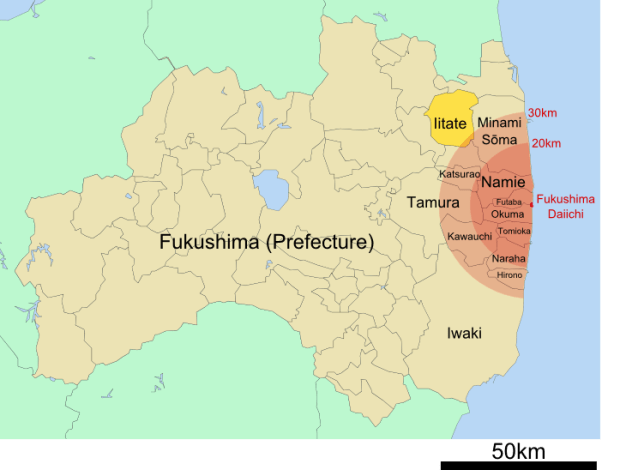
FUKUSHIMA – The central government has said it is considering plans to lift its evacuation order for most of the village of Iitate, Fukushima Prefecture, effective March 31.
The village is nearby the Fukushima No. 1 nuclear power plant, which experienced a meltdown disaster in 2011.
Yosuke Takagi, state minister of economy, trade and industry, conveyed the plan to Mayor Norio Kanno and other officials of the Fukushima Prefecture village at a meeting on Wednesday.
The government plans to make an official decision on the lifting shortly, along with a program to be launched in July to allow residents to stay overnight at their homes as part of preparations for permanent returns.
The evacuation order will be lifted for areas with less radiation from the three reactor meltdowns at the Tokyo Electric Power Co. Holdings Inc. plant, which was damaged in the March 2011 earthquake and tsunami.
As of the end of May, 5,917 residents in 1,770 households, or over 90 percent of the overall population of the village, were registered as citizens of such areas.
The government plans to finish decontamination work on houses by the end of this month and on farmland, roads and other facilities by the end of this year.
Visiting the village’s temporary office in the city of Fukushima on Wednesday, Takagi said the government aims to get the residents to return home by “resolving a series of challenges one by one.”
Kanno said, “We still have a long way to go and have to rebuild our village in a new form.”
The evacuation order will remain in place for highly contaminated areas, where 268 residents in 75 households are registered as local citizens.
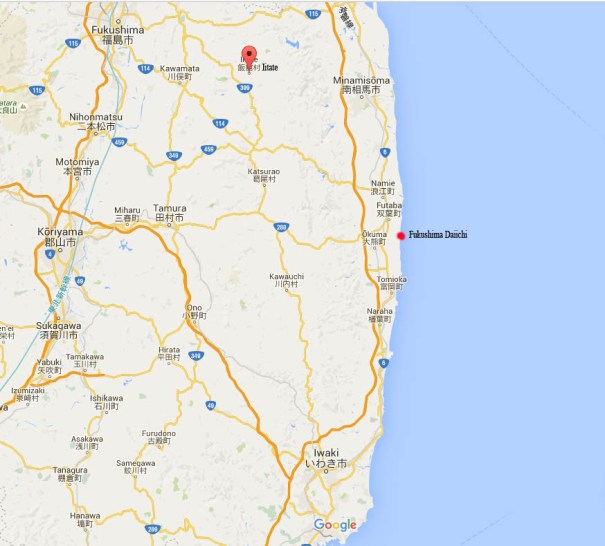
1 This Month

of the week – Shut Down Drone Warfare!


Tell the Ukrainian Government to Drop Prosecution of Peace Activist Yurii Sheliazhenko

Petition to revoke the licensing of the Near Surface Nuclear Disposal Facility (NSDF) at Chalk River. https://www.ourcommons.ca/petitions/en/Petition/Details?Petition=e-7247
To see nuclear-related stories in greater depth and intensity – go to https://nuclearinformation.wordpress.com
-
Archives
- March 2026 (251)
- February 2026 (268)
- January 2026 (308)
- December 2025 (358)
- November 2025 (359)
- October 2025 (376)
- September 2025 (257)
- August 2025 (319)
- July 2025 (230)
- June 2025 (348)
- May 2025 (261)
- April 2025 (305)
-
Categories
- 1
- 1 NUCLEAR ISSUES
- business and costs
- climate change
- culture and arts
- ENERGY
- environment
- health
- history
- indigenous issues
- Legal
- marketing of nuclear
- media
- opposition to nuclear
- PERSONAL STORIES
- politics
- politics international
- Religion and ethics
- safety
- secrets,lies and civil liberties
- spinbuster
- technology
- Uranium
- wastes
- weapons and war
- Women
- 2 WORLD
- ACTION
- AFRICA
- Atrocities
- AUSTRALIA
- Christina's notes
- Christina's themes
- culture and arts
- Events
- Fuk 2022
- Fuk 2023
- Fukushima 2017
- Fukushima 2018
- fukushima 2019
- Fukushima 2020
- Fukushima 2021
- general
- global warming
- Humour (God we need it)
- Nuclear
- RARE EARTHS
- Reference
- resources – print
- Resources -audiovicual
- Weekly Newsletter
- World
- World Nuclear
- YouTube
-
RSS
Entries RSS
Comments RSS
 nuclear-news