Radiation levels in seabed off Fukushima ‘100s of times’ higher than prior to disaster – Greenpeace
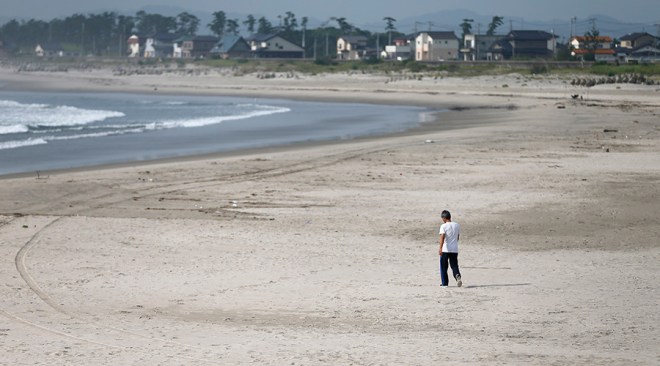
A man walks at the empty Yotsukura municipal beach in Iwaki, about 40 km (25 miles) south of the tsunami-crippled Fukushima Daiichi nuclear power plant, Fukushima
The amount of radioactive substances in seabed off Fukushima is hundreds of times higher than before the disaster, a report issued by Greenpeace reveals. The figures mean that there is absolutely “no return to normal after nuclear catastrophe” in the area.
On Thursday, the environmental group released a report addressing the results of the study during which scientists analyzed radioactivity levels along Fukushima’s rivers and in the Pacific seabed off the coast.
“These river samples were taken in areas where the [Prime Minister Shinzo] Abe government is stating it is safe for people to live. But the results show there is no return to normal after this nuclear catastrophe,”said Ai Kashiwagi, Energy Campaigner at Greenpeace Japan.
The report showed there is hundreds of times more radioactive substances in the seabed off Fukushima coast than there was prior to 2011. It also stated that the level of hazardous materials along local rivers is 200 times higher compared to the Pacific Ocean seabed.
“The extremely high levels of radioactivity we found along the river systems highlights the enormity and longevity of both the environmental contamination and the public health risks resulting from the Fukushima disaster,” Kashiwagi said.
The vast territories including contaminated forests and freshwater systems “will remain a perennial source of radioactivity for the foreseeable future,” scientists warned in the press release.
They analyzed the level of radioactive materials, such as Cesium-134 and Cesium-137 (Cs-137), noting a colossal increase in the figures.
While the amount of Cs-137 in seabed near the Fukushima plant was only 0.26 Bq/kg prior to the nuclear disaster, the current number stands at 120 Bq/kg, the report showed. On the whole, the data showed that Cs will pose a threat to human health for hundreds of years to come.
“The radiation levels in the sediment off the coast of Fukushima are low compared to land contamination, which is what we expected and consistent with other research,” said Kendra Ulrich, senior global energy campaigner at Greenpeace Japan.
The current site of the destroyed plant “remains one of the greatest nuclear threats” to Fukushima communities and the Pacific Ocean, the group said.
“The hundreds of thousands of tonnes of highly-contaminated water, the apparent failure of the ice wall to reduce groundwater contamination, and the unprecedented challenge of three molten reactor cores all add up to a nuclear crisis that is far from over,” said Ulrich.
Greenpeace also warned against the government’s decision to lift a number of evacuation orders around the Fukushima plant by March 2017.
The Fukushima Daiichi nuclear disaster, the largest since the 1986 Chernobyl disaster, took place in March 2011 and resulted in three nuclear meltdowns and a leak of radioactive materials. The accident prompted a nationwide shutdown of all nuclear power plants in Japan with Sendai being the first to start working again, in August 2015.
https://www.rt.com/news/352628-fukushima-radiation-seabed-greenpeace/
Radiation along Fukushima rivers up to 200 times higher than Pacific Ocean seabed – Greenpeace
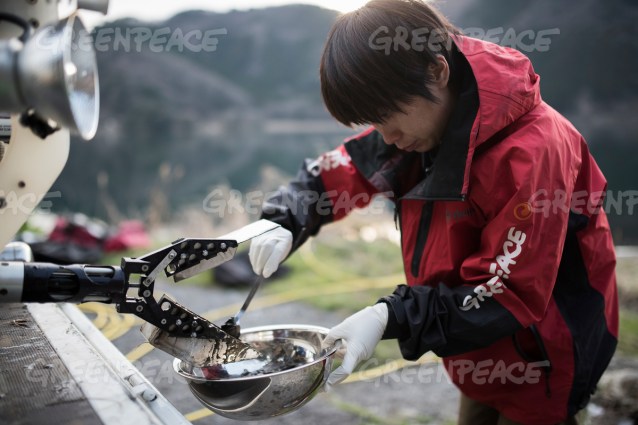
Sediment Sampling at Lake Biwa in Japan: Mai Suzuki from Greenpeace Japan, removes sediment samples from the ROV grabber (Remote Operated Vehicle), at Lake Biwa. Greenpeace has been surveying lake Biwa to conduct baseline sampling. The lake is located as close as 30 km from the Takahama nuclear plant owned by Kansai Electric. In the event of a severe accident Lake Biwa would be at risk of major radioactive contamination. The lake provides the drinking water for 14,5 million people in Shiga Prefecture, the city of Kyoto and the wider Kansai region. The citizens of Shiga recently won a historic legal action that forced the immediate shutdown of Takahama reactor #3, Kansai electric is determined to overturn the legal action on appeal and restart both Takahama 3 and 4 reactor.
Tokyo, 21 July 2016 – Radioactive contamination in the seabed off the Fukushima coast is hundreds of times above pre-2011 levels, while contamination in local rivers is up to 200 times higher than ocean sediment, according to results from Greenpeace Japan survey work released today.
“The extremely high levels of radioactivity we found along the river systems highlights the enormity and longevity of both the environmental contamination and the public health risks resulting from the Fukushima disaster,” said Ai Kashiwagi, Energy Campaigner at Greenpeace Japan.
“These river samples were taken in areas where the Abe government is stating it is safe for people to live. But the results show there is no return to normal after this nuclear catastrophe,” said Kashiwagi.
Riverbank sediment samples taken along the Niida River in Minami Soma, measured as high as 29,800 Bq/kg for radiocaesium (Cs-134 and 137). The Niida samples were taken where there are no restrictions on people living, as were other river samples. At the estuary of the Abukuma River in Miyagi prefecture, which lies more than 90km north of the Fukushima Daiichi plant, levels measured in sediment samples were as high as 6,500 Bq/kg.
The lifting of evacuation orders in March 2017 for areas that remain highly contaminated is a looming human rights crisis and cannot be permitted to stand. The vast expanses of contaminated forests and freshwater systems will remain a perennial source of radioactivity for the foreseeable future, as these ecosystems cannot simply be decontaminated.
Caesium-137 has a half life of 30 years, and will continue to pose a risks to the the environment and human health for hundreds of years. Cs-137 contamination in seabed samples near the Fukushima plant was measured at up to 120 Bq/kg – compared to levels pre-2011 of 0.26 Bq/kg. Further, the levels of contamination found 60km south of the Fukushima Daiichi nuclear plant were comparable with those found within 4km of the plant. Numerous marine science investigations, have concluded that these higher levels are one explanation for some marine species still showing higher cesium levels than the background levels in seawater.
“The radiation levels in the sediment off the coast of Fukushima are low compared to land contamination, which is what we expected and consistent with other research,” said Kendra Ulrich, Senior Global Energy Campaigner at Greenpeace Japan. “The sheer size of the Pacific Ocean combined with powerful complex currents means the largest single release of radioactivity into the marine environment has led to the widespread dispersal of contamination.”
Most of the radioactivity in Fukushima Daiichi reactor units 1-3 core fuel in March 2011 remains at the site.
“The scientific community must receive all necessary support to continue their research into the impacts of this disaster,” said Ulrich.
“In addition to the ongoing contamination from forests and rivers, the vast amount of radioactivity onsite at the destroyed nuclear plant remains one of the greatest nuclear threats to Fukushima coastal communities and the Pacific Ocean. The hundreds of thousands of tonnes of highly contaminated water, the apparent failure of the ice wall to reduce groundwater contamination, and the unprecedented challenge of three molten reactor cores all add up to a nuclear crisis that is far from over,” said Ulrich.
A radiation survey team onboard the research vessel Asakaze, supported by the Greenpeace flagship Rainbow Warrior, conducted underwater survey work along the Fukushima coastline from 21 February to 11 March this year, as well collecting samples in river systems. The samples were measured at an independent laboratory in Tokyo.
Link to the report, Atomic Depths, can be found here http://www.greenpeace.org/japan/Global/japan/pdf/20160721_AtomicDepths_ENG.pdf
http://www.greenpeace.org/japan/ja/news/press/2016/pr201607211/
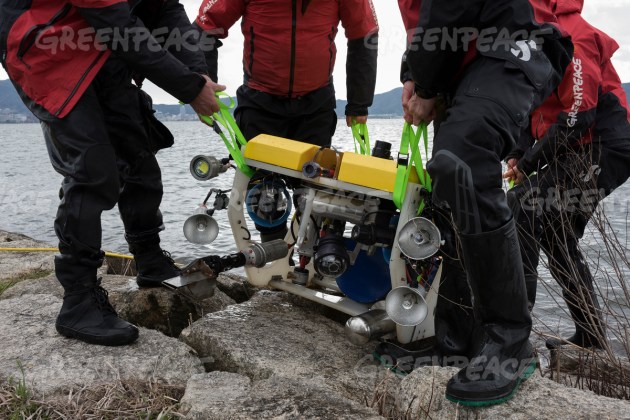
Greenpeace Japan members carry out ROV (Remote Operated Vehicle) operations at Lake Biwa, Shiga Prefecture in Japan. Greenpeace has been surveying lake Biwa to conduct baseline sampling.
Greenpeace reports jump in radioactive contamination in Fukushima waterways
Greenpeace Japan member Mai Suzuki removes sediment samples from a remotely operated grabber at Lake Biwa in Shiga Prefecture on March 22.
OSAKA – Greenpeace Japan on Thursday said it has discovered radioactive contamination in Fukushima’s riverbanks, estuaries and coastal waters at a scale hundreds of times higher than pre-2011 levels.
One sample of sediment taken along the Niida River, less than 30 km northwest of the crippled Fukushima No. 1 power plant, revealed the presence of cesium-134 and cesium-137 at levels of 29,800 becquerels per kilogram.
That was just one of 19 samples of dried sediment and soil the environmental activist group took and analyzed from the banks of the Abukuma, Niida, and Ota rivers. The samples were collected by Greenpeace in February and March.
All of the samples but one exhibited more than 1,000 Bq/kg of radioactive material. The lowest level, 309 Bq/kg, was logged at a spot along the Abukuma River.
Cesium-134 has a half-life of about two years, but cesium-137 has a half-life of 30 years and is considered particularly hazardous. The standard limits set for radioactive cesium in Japan are 100 Bq/kg for general foods and 10 Bq/kg for drinking water.
“The radiological impacts of the Fukushima nuclear disaster on the marine environment, with consequences for both human and nonhuman health, are not only the first years. They are both ongoing and future threats, principally the continued releases from the Fukushima No. 1 plant itself and translocation of land-based contamination throughout Fukushima Prefecture, including upland forests, rivers, lakes and coastal estuaries,” the report said.
Greenpeace Japan also published the results of tests on dried marine sediment samples collected at 25 points off the Fukushima coastal area, including three river estuaries, during this same period, at depths of between 7.4 and 30.6 meters. The results showed that the highest level of cesium was 144 Bq/kg taken from a sample collected off the coast from the Fukushima power plant, while the lowest total cesium figure was 6.5 Bq/kg off Nakanosaku, well to the south of the plant.
In addition to Fukushima, Greenpeace Japan took dried sediment samples from Lake Biwa at three locations near the shore. The results showed cesium levels to be between 7.1 Bq/kg and 13 Bq/kg at two locations, and negligible at the other two.
The safety of Lake Biwa, which provides drinking water for about 14 million people in the Kansai region, has become a major bone of contention between Kansai Electric Power Co., which wants to restart reactors in neighboring Fukui Prefecture, and residents in and around Lake Biwa who are fighting to keep them shut down.
Report on Ecological Impacts of the Fukushima Daiichi Nuclear Accident 5years Later

The report is based on a large body of independent scientific research in impacted areas in the Fukushima region, as well as investigations by Greenpeace radiation specialists over the past five years. It exposes deeply flawed assumptions by the International Atomic Energy Agency and the Abe government in terms of both decontamination and ecosystem risks. It further draws on research on the environmental impact of the 1986 Chernobyl nuclear catastrophe as an indication of the potential future for contaminated areas in Japan.
The environmental impacts of the Fukushima Daiichi nuclear disaster will last decades to centuries, due to man-made, long-lived radioactive elements are absorbed into the living tissues of plants and animals and being recycled through food webs, and carried downstream to the Pacific Ocean by typhoons, snowmelt, and flooding.
Greenpeace has conducted 25 radiological investigations in Fukushima since March 2011. In 2015, it focused on the contamination of forested mountains in Iitate district, northwest of the Fukushima Daiichi nuclear power plant. Both Greenpeace and independent research have shown the movement of radioactivity from contaminated mountain watersheds, which can then enter coastal ecosystems. The Abukuma, one of Japan’s largest rivers which flows largely through Fukushima prefecture, is projected to discharge 111 TBq of 137Cs and 44 TBq of 134Cs, in the 100 years after the accident.
http://www.greenpeace.org/japan/ja/library/publication/20160304_report/
Mutations, DNA damage seen in Fukushima forests, says Greenpeace
Conservation group Greenpeace warned on Friday that the environmental impact of the Fukushima nuclear crisis five years ago on nearby forests is just beginning to be seen and will remain a source of contamination for years to come.
The March 11, 2011 magnitude-9.0 undersea earthquake off the nation’s northeastern coast sparked a massive tsunami that swamped cooling systems and triggered reactor meltdowns at the Fukushima No. 1 nuclear plant.
Radiation spread over a wide area and forced tens of thousands of people from their homes — many of whom will likely never return — in the worst nuclear accident since Chernobyl in 1986.
As the fifth anniversary of the disaster approaches, Greenpeace said signs of mutations in trees and DNA-damaged worms were beginning to appear, while “vast stocks of radiation” mean that forests cannot be decontaminated.
In a report, Greenpeace cited “apparent increases in growth mutations of fir trees, … heritable mutations in pale blue grass butterfly populations” as well as “DNA-damaged worms in highly contaminated areas.”
The report came as the government intends to lift many evacuation orders in villages around the Fukushima plant by March 2017, if its massive decontamination effort progresses as it hopes.
For now, only residential areas are being cleaned in the short-term, and the worst-hit parts of the countryside are being omitted, a recommendation made by the International Atomic Energy Agency.
But such selective efforts will confine returnees to a relatively small area of their old hometowns, while the strategy could lead to re-contamination as woodlands will act as a radiation reservoir, with pollutants washed out by rains, Greenpeace warned.
The conservation group said its report relies largely on research published in peer-reviewed international journals.
But “most of the findings in it have never been covered outside of the close circles of academia”, report author Kendra Ulrich said.
The government’s push to resettle contaminated areas and also restart nuclear reactors elsewhere around the country that were shut down in the aftermath of the crisis are a cause for concern, Ulrich said, stressing it and the IAEA are using the opportunity of the anniversary to play down the impact of the radiation.
“In the interest of human rights — especially for victims of the disaster — it is ever more urgent to ensure accurate and complete information is publicly available and the misleading rhetoric of these entities challenged,” she said.
Scientists, including a researcher who found mutations of Fukushima butterflies, have warned, however, that more data are needed to determine the ultimate impact of the Fukushima accident on animals in general.
Researchers and medical doctors have so far denied that the accident at Fukushima would cause an elevated incidence of cancer or leukemia, diseases that are often associated with radiation exposure.
But they also noted that long-term medical examination is needed, especially due to concerns over thyroid cancer among young people — a particular problem for people following the Chernobyl catastrophe.
http://www.japantimes.co.jp/news/2016/03/04/national/science-health/mutations-dna-damage-seen-fukushima-forests-greenpeace/#.VtmtlObzN_m
Five years on, Fukushima still faces contamination crisis: environmentalists

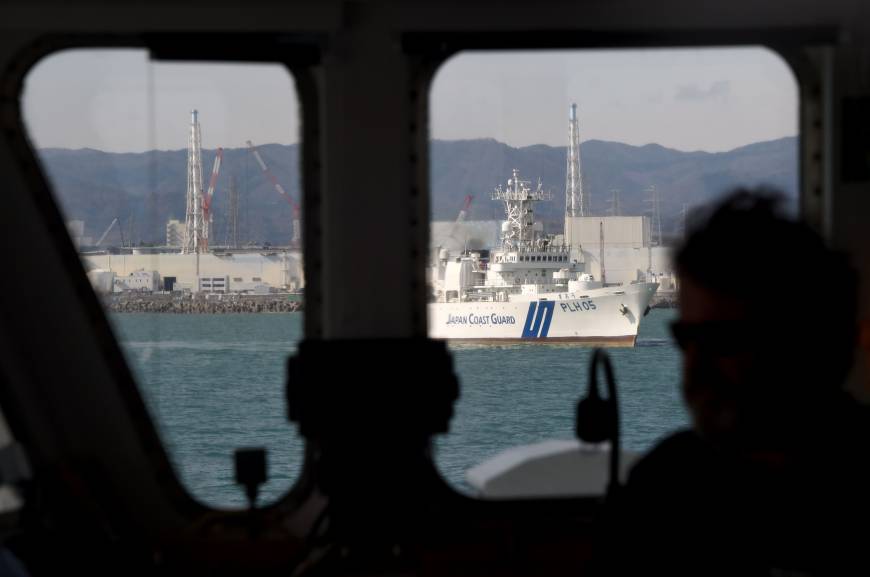
Crippled Fukushima Daiichi nuclear power plant in northeastern Japan.
Fish market vendor Satoshi Nakano knows which fish caught in the radiation tainted sea off the Fukushima coast should be kept away from dinner tables.
Yet five years after the worst nuclear accident since Chernobyl there is still no consensus on the true extent of the damage – exacerbating consumer fears about what is safe to eat.
Environmentalists are at odds with authorities, warning the huge amounts of radiation that seeped into coastal waters after a powerful tsunami caused a meltdown at the Fukushima Daiichi nuclear power plant on March 11, 2011, could cause problems for decades.
The Japanese government is confident it has stemmed the flow of radioactive water into the ocean, but campaigners insist contaminated ground water has continued to seep into the Pacific Ocean, and the situation needs further investigation.
“It was the single largest release of radioactivity to the marine environment in history,” Greenpeace nuclear expert Shaun Burnie said on the deck of the campaign group’s flagship Rainbow Warrior, which has sailed in to support a three-week marine survey of the area the environmental watchdog is conducting.
Fukushima is facing an “enormous nuclear water crisis,” Burnie warned.
He added: “The whole idea that this accident happened five years ago and that Fukushima and Japan have moved on is completely wrong.”
Existing contamination means fishermen are banned from operating within a 20-km radius from the plant.
Although there are no figures for attitudes on seafood alone, the latest official survey by the government’s Consumer Affairs Agency showed in September that more than 17 per cent of Japanese are reluctant to eat food from Fukushima.
Nakano knows it’s best for business to carefully consider the type of seafood he sells, in the hope it will quell consumer fears.
“High levels of radioactivity are usually detected in fish that move little and stick to the seabed. I am not an expert, but I think those kinds of fish suck up the dirt of the ocean floor,” he said from his hometown of Onahama by the sea.
Greenpeace is surveying waters near the Fukushima plant, dredging up sediment from the ocean floor to check both for radiation “hotspots” as well as places that are not contaminated.
On Monday, the Rainbow Warrior sailed within a 1.6km of the Fukushima coast as part of the project – the third such test it’s conducted but the closest to the plant since the nuclear accident.
Researchers on Tuesday sent down a remote-controlled vehicle attached with a camera and scoop, in order to take samples from the seabed, which will then be analysed in independent laboratories in Japan and France.
“It’s very important [to see] where is more contaminated and where is less or even almost not contaminated,” Greenpeace’s Jan Vande Putte said, stressing the importance of such findings for the fishing industry.
Local fishermen have put coastal catches on the market after thorough testing, which includes placing certain specimens seen as high risk through radiation screening – a programme Greenpeace lauds as one of the most advanced in the world.
The tests make sure no fish containing more than half of the government safety standard for radiation goes onto the market.
The 2011 disaster was caused by a magnitude 9.0 undersea earthquake off Japan’s northeastern coast which then sparked a massive tsunami that swamped cooling systems and triggered reactor meltdowns at the Fukushima Daiichi plant, run by operator Tokyo Electric Power (TEPCO).
Today, about 1,000 huge tanks for storing contaminated water occupy large parts of the site, but as 400 tonnes of groundwater a day flows into the damaged reactor buildings, many more will be needed.
TEPCO have said they are taking measures to stop water flowing into the site, including building an underground wall, freezing the land itself and siphoning underground water.
The government too insist the situation is under control.
“The impact of the contaminated water is completely contained inside the port of the Fukushima plant,” Tsuyoshi Takagi, the Cabinet minister in charge of disaster reconstruction, told reporters on Tuesday.
But Greenpeace’s Burnie says stopping the groundwater flow is crucial to protecting the region.
“What impact is this having on the local ecology and the marine life, which is going on over years, decades?”, Burnie asked.
He added: “We can come back in 50 years and still be talking about radiological problems” at the nuclear plant as well as along the coast, he said.

Storage site of contaminated soil generated by decontamination work in Fukushima Prefecture, home of the crippled Fukushima Daiichi complex
Greenpeace Rainbow Warrior Back to Fukushima
Five years ago the Rainbow Warrior was in Fukushima and now we’re back to test the mess from the 2011 nuclear disaster.
Nearly a 100,000 people STILL can’t return back to their homes…It’s time to end this nuclear nightmare. Let’s switch on renewable
Five years on, Greenpeace assessing marine contamination off Fukushima
ONAHAMA, FUKUSHIMA PREF. – Fish market vendor Satoshi Nakano thinks he knows which fish caught in the radiation-tainted sea off the Fukushima coast should be kept away from dinner tables.
Yet five years after the worst nuclear accident since Chernobyl there is still no consensus on the true extent of the damage — exacerbating consumer fears about what is safe to eat.
Environmentalists are at odds with authorities, warning that the huge amounts of radiation that seeped into coastal waters after the disaster in 2011 could cause problems for decades.
The government is confident it has stemmed the flow of radioactive water, but campaigners insist contaminated ground water has continued to seep into the Pacific Ocean, and the situation needs further investigation.
“It was the single largest release of radioactivity to the marine environment in history,” Greenpeace nuclear expert Shaun Burnie said, speaking aboard the campaign group’s Rainbow Warrior ship, which has sailed in to support a three-week marine survey of the area the environmental watchdog is conducting.
Fukushima is facing an “enormous nuclear water crisis,” Burnie said.
“The whole idea that this accident happened five years ago and that Fukushima and Japan have moved on is completely wrong.”
Fishermen are banned from operating only within 20 kilometers of the plant.
Although there are no figures for attitudes on seafood alone, the latest official survey by the government’s Consumer Affairs Agency showed in September that more than 17 percent of Japanese are reluctant to eat food from Fukushima.
Nakano knows it is best for business to consider carefully the type of seafood he sells, in the hope it will quell consumer fears.
“High levels of radioactivity are usually detected in fish that move little and stick to the seabed. I am not an expert, but I think those kinds of fish suck up the dirt of the ocean floor,” he said in his coastal hometown of Onahama.
Greenpeace is surveying waters near the Fukushima plant, dredging up sediment from the ocean floor to check both for radiation hot spots as well as places that are not contaminated.
On Monday, the Rainbow Warrior sailed within 1.6 kilometers of the Fukushima coast as part of the project — the third such test it has conducted, but the closest to the plant since the nuclear accident.
Researchers Tuesday sent down a remote-controlled vehicle attached with a camera and scoop in order to take samples from the seabed, which will then be analyzed in independent laboratories in Japan and France.
“It’s very important (to see) where is more contaminated and where is less or even almost not contaminated,” Greenpeace’s Jan Vande Putte said, stressing the importance of such findings for the fishing industry.
Local fishermen have put coastal catches on the market after thorough testing, which includes placing certain specimens seen as high risk through radiation screening — a program Greenpeace lauds as one of the most advanced in the world.
The tests make sure no fish containing more than half of the government safety standard for radiation goes onto the market.
The 2011 disaster was caused by a magnitude-9.0 earthquake off Japan’s northeastern coast, which sparked a massive tsunami that swamped cooling systems and triggered reactor meltdowns at the Fukushima No. 1 plant, run by operator Tokyo Electric Power Co.
Today, about 1,000 huge tanks for storing contaminated water occupy large parts of the site, but as 400 tons of groundwater a day flows into the damaged reactor buildings, many more will be needed.
Tepco’s measures to reduce the water influx include building an underground wall, freezing the land itself and siphoning underground water.
The government, too, insists the situation is under control.
“The impact of the contaminated water is completely contained inside the port of the Fukushima plant,” Tsuyoshi Takagi, the Cabinet minister in charge of disaster reconstruction, told reporters on Tuesday.
But Greenpeace’s Burnie says stopping the groundwater flow is crucial to protecting the region.
“What impact is this having on the local ecology and the marine life, which is going on over years, decades?” Burnie asked.
“We can come back in 50 years and still be talking about radiological problems” at the nuclear plant as well as along the coast, he said.
http://www.japantimes.co.jp/news/2016/02/26/national/five-years-greenpeace-assessing-marine-contamination-off-fukushima/#.VtBtWObzN_l
Fukushima Report Dangerously Downplays Ongoing Health Risks: Greenpeace
“The IAEA report actively supports the Abe government’s and the global nuclear industry’s agenda to make it appear that things can return to normal after a nuclear disaster.”

A new report from the International Atomic Energy Agency (IAEA) “downplays” the continuing environmental and health effects of the Fukushima nuclear meltdown while supporting the Japanese government’s agenda to normalize the ongoing disaster, Greenpeace Japan charged on Tuesday.
The Vienna-based IAEA released its final report Monday on the 2011 triple meltdown at the Fukushima No. 1 nuclear power plant. While the agency pointed to numerous failings, including unclear responsibilities among regulators, weaknesses in plant design and in disaster-preparedness, and a “widespread assumption” of safety, it was more circumspect with regard to health concerns.
The Fukushima disaster released vast amounts of radiation, leading to fears that cases of thyroid cancer in children would soar as they did following the Chernobyl disaster of 1986.
The 200-page report sought to assuage those worries, stating: “Because the reported thyroid doses attributable to the accident were generally low, an increase in childhood thyroid cancer attributable to the accident is unlikely.”
That assertion wasn’t bulletproof, however. The report added: “[U]ncertainties remained concerning the thyroid equivalent doses incurred by children immediately after the accident.”
In a press statement, Greenpeace Japan seized on the information gap.
“The IAEA concludes that no discernible health consequences are expected as a result of the Fukushima disaster, but admits important uncertainties in both radiation dose and long-term effects,” said Kendra Ulrich, senior global energy campaigner with Greenpeace Japan. “Nobody knows how much radiation citizens were exposed to in the immediate days following the disaster. If you don’t know the doses, then you can’t conclude there won’t be any consequences. To say otherwise is political rhetoric, not science.”
The IAEA report conveniently comes as pro-nuclear Prime Minister Shinzo Abe systematically seeks to lift evacuation orders and re-start the country’s nuclear program.
“The IAEA report actively supports the Abe government’s and the global nuclear industry’s agenda to make it appear that things can return to normal after a nuclear disaster,” Ulrich said. “But there is nothing normal about the lifestyle and exposure rates that the victims are being asked to return to.”
In July, Greenpeace Japan charged that the IAEA “has sought to downplay the radiological risks to the population since the early days in 2011. In fact, it produced two documents that can be said to have laid the foundation and justification for Abe’s current policy of de facto forced resettlement.”
Exploring the political dynamics further, Ulrich wrote at the time:
Over four years after the triple reactor core meltdowns and exploded containment buildings at the Fukushima Daiichi nuclear power plant, the majority of the Japanese public has remained opposed to any nuclear restart. The country has been completely nuclear-free for nearly two years, thanks in large part to significant public opposition, in spite of the massive pressure from nuclear utilities and the Abe government on local city governments.
However, these utilities are massively powerful and the Abe government is wholly in bed with them.
In an effort to reduce public opposition, Abe has been pushing forward the pro-nuclear agenda to ‘normalize’ a nuclear disaster. If the public can be convinced that less than five years after the worst nuclear disaster in a generation, citizens can go home and return to life the way it was before the disaster – with no additional health risks – then that is a powerful argument against the majority of Japanese citizens who oppose nuclear reactor restarts.
Japan’s Asahi Shimbun newspaper reported Tuesday that evacuees from three Fukushima Prefecture localities who were displaced by the nuclear disaster started temporarily returning to their homes on Monday to prepare for their eventual permanent return.
“But applicants for the temporary stay program that began that day totaled 1,265, less than 10 percent of about 14,000 eligible as of Aug. 30,” the paper reported. “The small number indicates that an overwhelming majority of evacuees are still concerned about radiation levels and prospects for a return to normalcy in their hometowns.”
Source: Common Dreams
1 This Month
10 March A LIVE WEBINAR THE REAL EFFECTS OF NUCLEAR POWER
What the Industry Isn’t Telling Us
1:00 PM Mountain, 2 pm Central, 3 pm Eastern. Live on the Keepers of the Water Facebook page



18 March Webinar @ 1 PM EST: An Assessment of SMR Projects: The Case of Canada
register for the zoom:
https://us02web.zoom.us/webinar/register/WN_o8BIIOUvQ2ONJR1nta65DQ#/registration


of the week – STOP SMALL MODULAR REACTORS IN CANADA
To see nuclear-related stories in greater depth and intensity – go to https://nuclearinformation.wordpress.com
-
Archives
- March 2026 (109)
- February 2026 (268)
- January 2026 (308)
- December 2025 (358)
- November 2025 (359)
- October 2025 (376)
- September 2025 (258)
- August 2025 (319)
- July 2025 (230)
- June 2025 (348)
- May 2025 (261)
- April 2025 (305)
-
Categories
- 1
- 1 NUCLEAR ISSUES
- business and costs
- climate change
- culture and arts
- ENERGY
- environment
- health
- history
- indigenous issues
- Legal
- marketing of nuclear
- media
- opposition to nuclear
- PERSONAL STORIES
- politics
- politics international
- Religion and ethics
- safety
- secrets,lies and civil liberties
- spinbuster
- technology
- Uranium
- wastes
- weapons and war
- Women
- 2 WORLD
- ACTION
- AFRICA
- Atrocities
- AUSTRALIA
- Christina's notes
- Christina's themes
- culture and arts
- Events
- Fuk 2022
- Fuk 2023
- Fukushima 2017
- Fukushima 2018
- fukushima 2019
- Fukushima 2020
- Fukushima 2021
- general
- global warming
- Humour (God we need it)
- Nuclear
- RARE EARTHS
- Reference
- resources – print
- Resources -audiovicual
- Weekly Newsletter
- World
- World Nuclear
- YouTube
-
RSS
Entries RSS
Comments RSS
 nuclear-news