Class action lawsuit against the victims of thyroid cancer caused by the Fukushima Daiichi Nuclear Power Plant accident begins

May 26, 2022
On May 26, a class action lawsuit began in which six people who were children at the time of the accident at TEPCO’s Fukushima Daiichi Nuclear Power Plant are seeking compensation from TEPCO for thyroid cancer they contracted as a result of the accident.
The six, who were between the ages of 6 and 16 when the Fukushima Daiichi nuclear power plant accident occurred 11 years ago, claim that they were living in Fukushima Prefecture at the time and that they developed thyroid cancer as a result of radiation exposure from the nuclear accident.
After the accident, they were diagnosed with thyroid cancer in tests conducted by Fukushima Prefecture, and have been forced to have their thyroid glands removed and undergo lifelong hormone treatment.
The trial will begin on March 26 at the Tokyo District Court, and the plaintiffs’ lawyers have stated that, “According to statistics from a national research institute, the average number of thyroid cancer cases in children was only one to two per million people per year for the 10 years until 2007, but in Fukushima, at least 293 cases have been confirmed in the 10 years since the accident. In Fukushima, however, at least a total of 293 cases of cancer have been confirmed in the 10 years since the accident,” and that “the cancer is presumed to be caused by exposure to radiation from the accident.
A female plaintiff stated, “I prioritized treatment over my dreams for the future and had no choice but to quit my university studies. I hope that through the trial, relief for the patients will be realized,” she tearfully appealed.
According to the plaintiffs’ lawyers, this is the first class action lawsuit to hold TEPCO responsible for the health damage caused by radiation exposure from the nuclear power plant accident, and TEPCO has indicated that it will fight the case.
The next meeting will be held in September, and TEPCO is scheduled to make a rebuttal.
The Fukushima Prefecture’s expert panel and the UN scientific committee’s opinion is
The Fukushima Prefectural Expert Panel and the United Nations Scientific Committee have each expressed their opinions on whether the thyroid cancer diagnosed in some children living in Fukushima Prefecture at the time of the accident at TEPCO’s Fukushima Daiichi Nuclear Power Plant was caused by exposure to radiation from the nuclear power plant accident.
As part of its post-nuclear accident health survey, Fukushima Prefecture conducted a large-scale test using ultrasound equipment to check for thyroid cancer in approximately 380,000 people who were under the age of 18 at the time of the accident.
Fukushima Prefecture has established a committee of experts to analyze whether the cancers found were caused by radiation exposure.
Of these, 187 have been evaluated by 2019, and a report has been compiled stating that “no relationship between the thyroid cancers found and radiation exposure can be found”.
The reasons given were that the estimated radiation doses received by children in Fukushima Prefecture after the accident were much lower than those received in the 1986 Chernobyl nuclear power plant accident, and that there was no statistical bias in the regional distribution of cancer patients and no trend indicating an association with radiation exposure.
The expert panel is still analyzing the remaining 87 people diagnosed after FY2016, and the results of the evaluation have not yet been presented.
On the other hand, the UN Scientific Committee, which evaluates the effects of radiation on humans and the environment, estimated radiation doses last year based on the type and amount of radioactive materials released by the accident and the evacuation behavior of the residents, and concluded that “it is unlikely that any health effects directly attributable to radiation exposure caused by the accident will be observed in the residents of Fukushima Prefecture in the future. The report states that “the likelihood of health effects directly caused by radiation exposure in Fukushima Prefecture in the future is low.
The report also stated that the cases diagnosed in Fukushima Prefecture “are not the result of radiation exposure, but rather the result of highly sensitive ultrasound examinations that are likely to have diagnosed cancers that would not normally be detected,” and expressed a negative opinion on the causal relationship between thyroid cancer and the cases.
TEPCO “will listen to the plaintiffs’ claims in detail and respond appropriately.
TEPCO said, “We will listen to the plaintiffs’ claims and the details of their claims in detail and respond appropriately. TEPCO once again expresses its sincere apology to the people of Fukushima Prefecture and the wider community for the inconvenience and concern caused by the accident at the Fukushima Daiichi Nuclear Power Plant.
The plaintiff, a woman in her 20s, said
The six young people who filed the lawsuit claim that they were diagnosed with cancer and that it has affected the future they had envisioned.
One of the plaintiffs, a woman in her 20s from Nakadori, Fukushima Prefecture, was a junior high school student when the nuclear accident occurred.
It was in the spring, about four years after the accident, that she felt a change in her health.
She had just left her family in Fukushima and started living alone when she entered university.
Her body was swollen all over, her menstrual period came once every two weeks, her skin became rough, and she began to feel a strong discomfort in her throat and body pain.
After consulting with her family, she underwent an examination as part of the prefectural health survey conducted by Fukushima Prefecture after the nuclear power plant accident, and was diagnosed with thyroid cancer.
The woman recalls her feelings at the time, “I had hoped that the surgery would improve my health, but even after the surgery, I continued to feel ill easily, and I became increasingly worried that the cancer might recur or spread.
However, her health did not improve as expected, and she had no choice but to leave the company after about a year and a half in order to prioritize her treatment.
Even now, regular visits to the hospital and medication are essential for her. “I had longed to be a career woman who worked hard, but I now have to prioritize my health in everything I do,” she said. I am worried that it will affect my future choices of marriage and childbirth,” she confides.
Regarding the relationship between exposure to radiation from the nuclear accident and thyroid cancer, the Fukushima prefectural government’s expert panel has so far stated that “no relationship has been found.
All of the plaintiffs, including the woman, are going to trial without revealing their faces or names publicly, as some have criticized them for claiming health problems caused by exposure to radiation as Fukushima is making progress toward recovery.
The woman said, “I was afraid that I would be discriminated against if people knew that I was from Fukushima Prefecture and had thyroid cancer, so I could hardly tell anyone until now,” adding, “I thought there were many people who suffered from cancer as well and had to give up their dreams such as higher education and employment, or who could not speak up for fear of discrimination and prejudice, and I became an adult first. I decided that I would be the one to show courage. I would like to clarify the facts through the trial and seek redress for the damage.
https://www3.nhk.or.jp/news/html/20220526/k10013644951000.html?fbclid=IwAR3esCBTOE5Qt6wSYOxfbjHDypiU4KBILUC3zFy-ko35Qyb2sf1iVCh_sk4
Thyroid cancer surgery 4 times “I want to know the causal relationship

May 25, 2022
Thyroid cancer has been confirmed in approximately 300 children who were in Fukushima Prefecture at the time of the accident at TEPCO’s Fukushima Daiichi Nuclear Power Plant. The question is, “Is there a causal relationship between the accident and thyroid cancer? A man, 25, who was in the second year of junior high school at the time of the accident, had undergone four surgeries and was fearful that the cancer would recur, so he filed a lawsuit to find the answer. The first oral argument in the lawsuit by the man and six other young people demanding compensation from TEPCO will be held at the Tokyo District Court on March 26. (The first oral argument of the lawsuit will be held at the Tokyo District Court on April 26.)
◆”I am always concerned about the recurrence and metastasis of cancer.
I live my life knowing that one day the cancer will recur and affect my health,” said a man from Nakadori, Fukushima Prefecture. The man is from Nakadori in central Fukushima Prefecture and works for a company in Tokyo. Although he has to take medication for the rest of his life, he says his health is good and his work is fulfilling.
However, the fear of recurrence or metastasis always haunts him. What if I lose my voice or my health deteriorates to the point where I can no longer work? I can’t think about the future,” he says. At first, she was not positive about the trial, but now she hopes that she can help other children suffering from thyroid cancer by preserving a record of the facts of the trial.
He was 19 years old when he found out he had thyroid cancer while attending a university in Tokyo. His father did not tell him that the doctor had told him that the cancer was highly malignant, had metastasized extensively, and that he might not live five years.
Another doctor told him that it was “the same as what was seen in Chernobyl” and that it was “probably related to the nuclear accident. The father said, “When I told my son that he had cancer, he accepted it without hesitation. I cried inside. I shouldn’t have stayed in Fukushima,” he said. He still feels regret over not evacuating.
At the age of 20, the man had one thyroid gland partially removed. Six months later, he had the entire thyroid removed, but it had spread to his lymph nodes, and the surgery lasted six hours. Because he was in the same position for a long time, he could not sleep after the surgery due to severe bedsore pain. Unable to speak or even complain about the pain, he endured it while connected to a tube. His heart sank, and he could not respond to his family’s words. She thought about death for the first time, saying, “It might be easier to die.
Shocked by the document “Contraception for 6 months
At the age of 21, he underwent a third surgery for metastasis to the lymph nodes, and at the age of 24, the disease recurred. During radiation treatment after the surgery, he received a document that said, “Use contraception for six months. The man, who is married and wants to have children, was shocked that this might affect his children. The man said, “For the first time, I understood why fathers were angry about the nuclear accident and desperate to find a hospital for their children.
The government and the Fukushima prefectural government have taken the position that a causal relationship between the thyroid cancers found in Fukushima Prefecture and the nuclear accident “cannot be recognized at this time. Since filing the lawsuit, the father has also sensed an atmosphere of discrimination directed toward the men and the other plaintiffs. Some people said, “Don’t put a damper on the good progress Fukushima is making,” and some of their acquaintances left them.
After the nuclear accident, 301 young people were found to have thyroid cancer in surveys conducted by Fukushima Prefecture and other organizations. The plaintiffs’ lawyers claim that the incidence of childhood thyroid cancer is dozens of times higher than usual and that a causal link to the nuclear accident is clear.
The men say. If it wasn’t the nuclear accident, then what was it? If we don’t say anything, it will be assumed that nothing happened, and the facts will be buried. I want to make this a valuable trial.”
https://www.tokyo-np.co.jp/article/179323?fbclid=IwAR3-Lto8wP7XLmZQqRMSnkdxpRYlCwO9j4_PBFzLyDw6W351cTVC5vgeF9c
Plaintiff diagnosed with thyroid cancer after the Fukushima nuclear accident: “I have suffered without telling anyone

May 25, 2022
In January 2022, children who suffered from thyroid cancer and were living in Fukushima Prefecture at the time of the accident at TEPCO’s Fukushima Daiichi Nuclear Power Plant, aged between 6 and 16, became plaintiffs and filed a lawsuit against TEPCO, claiming that their thyroid cancer was caused by the nuclear accident and demanding that the company clarify the causal relationship.
This is the first class action lawsuit filed against TEPCO 11 years after the accident, claiming the effects of radiation exposure.
All of the plaintiffs have had their thyroid glands removed, and four of the six have relapsed; the four who have undergone two or more surgeries and had their entire thyroid glands removed must continue to take hormone medication for the rest of their lives. Another child has been diagnosed with distant metastasis to the lungs.
We interviewed one of the plaintiffs, who said, “I have suffered for the past 11 years without being able to tell anyone. (Writer: Chia Yoshida)
Announcement of acceptance with the possibility of exposure to radiation
Sawa Mukai (15 years old at the time of the accident, pseudonym) was an athletic child who was affected by the disaster on March 11, 2011, the day of her junior high school graduation ceremony. She recalls how eerie it was to see a blizzard immediately after the earthquake, followed by a sky that suddenly cleared up.
The next day, she helped clean up a relative’s house that had been completely destroyed by the earthquake. The road in front of the relative’s house was jammed with cars heading in a westerly direction.
It was strange because there is not usually a lot of traffic on this road, but when I thought about it later, I realized that they were cars evacuating from the nuclear power plant,” Mukai said.
On March 12, Fukushima Daiichi Nuclear Power Plant Unit 1 exploded, Unit 3 exploded on March 14, Unit 2 was in a critical condition, and Unit 4 exploded on March 15.
The next day, March 16, was the announcement of acceptance to high schools in Fukushima. Many junior high school students in the prefecture went out to the high schools they had applied to in order to check their numbers.
Although many teachers and staff members were opposed to the announcement of acceptance in the midst of the possibility of children being exposed to radiation, the prefecture decided to go ahead with the announcement. Mr. Mukai was one of those who had no choice but to go to the acceptance announcement.
Kenichi Ido, a lawyer representing the plaintiffs, points out that “elementary and junior high school students who were unprotected at the time of the accident were exposed to radiation, which may have led to their illnesses.
“We often hear stories of students who were engaged in club activities as usual, or who went to the March 16th prefectural high school acceptance announcement,” he said. The government has assumed that there are no health hazards caused by the nuclear accident, but this is not the case,” said Ido.
Even if the radiation dose rate is above the standard value, “Oh, well…
The risk of radiation exposure lurked even in high school.
Although Ms. Mukai was fond of sports, she gave up her outdoor sports club, which she had planned to join. His mother was concerned that he should not be exposed to radiation as much as possible.
Although warning poles were placed at hot spots (areas with locally elevated radiation levels) on campus to alert people to the danger, once they became accustomed to the area, everyone began to pass by them.
Gradually, no one would wear masks to avoid internal exposure. Mr. Mukai wore a mask until the end, but in the summer of 2011, he began to remove it because it was too hot.
At the time, the Ministry of Education, Culture, Sports, Science and Technology (MEXT) had a standard for school grounds that they could only be used if the air dose rate was “less than 3.8 μSv per hour,” but “It’s over. But I once heard a teacher say, “Well, that’s OK.
The radiation level at home was also high. In some places, the radiation levels were 100 times higher than before the accident. Even indoors, the levels were 60 times higher than before the accident. The family decontaminated the area with a high-pressure washer, but the levels did not go down that much.
Mr. Mukai was unable to join an athletic team, so he focused on his schoolwork, aiming to attend a university in Tokyo. Thanks to his efforts, he was accepted with a recommendation. She was so happy that she started living in Tokyo in early March (before entering university),” she smiles.
I will never forget the doctor’s words: “There is no cause-and-effect relationship between the nuclear accident and my life.
There were many places to play in Tokyo, I started a part-time job, and my new life was enjoyable.
However, around that time, she began to experience some physical problems. Her body swelled, her menstrual periods became irregular, she gained weight, and her skin became rough. And when she swallowed water or saliva, she felt discomfort in her throat.
When she consulted her mother, she was told that it might be a thyroid-related condition and that she should get checked out as soon as possible. Mr. Mukai was busy with university classes and other obligations, so he missed the second thyroid checkup conducted by the Fukushima prefectural government.
Soon after, Ms. Mukai took the test along with other children at a large-scale thyroid screening site in Fukushima Prefecture. The test took only a minute or so for the others, but the process stopped at Mr. Mukai’s spot.
While applying the echo, Ms. Mukai saw the doctor nod his head and wondered if something was wrong.
Later, the results arrived at his parents’ home, and his mother contacted Mr. Mukai in Tokyo to inform him of the “reexamination. Fukushima Medical University called her twice and asked her to retest immediately. Ms. Mukai said that by that time she had a dim feeling that she might have thyroid cancer.
In the fall of 2015, he was told at the hospital that he had thyroid cancer. Mukai will never forget being told by the doctor that there was no causal relationship between the nuclear accident and the cancer, even though he had not asked any questions at the time.
I wondered how they could possibly know that,” Mukai said.
She then underwent surgery to remove the left half of her thyroid gland at the age of 20.
He was 20 years old. “I hope that other sufferers will be in a situation where they can raise their voices,” he said.
In consideration of his health condition, he quit the part-time job he had enjoyed.
After graduating from university, he found a job, but his health deteriorated due to the hard work. She quit the job she had longed for, and now works at a job that is less demanding on her body.
If her numbers worsen, she has to resume taking her medication, and she lives her life constantly worrying about her health.
I gave up a lot of things myself, but there are many more people younger than me who had to make the choice to give up,” Mukai said.
People who dropped out of college. Some have dropped out of college, others have been unable to find work. Some confided in me that they had given up on love and marriage and could not even think about falling in love with someone. I was shocked by all of them.
As she recounted her own experiences, Ms. Mukai was considerate of the other plaintiffs and those who had contracted thyroid cancer but were not plaintiffs.
There is a situation where other small children cannot speak up,” she said. I hope that by raising our voices this time, other sufferers will be able to speak out,” said Mukai.
The incidence of childhood thyroid cancer is generally said to be “1 to 2 per million children.
However, in Fukushima Prefecture, according to a prefectural survey, 273 children were diagnosed with suspected malignant (cancerous) thyroid cancer through cytological puncture diagnosis, and 226 children have already undergone surgery. When national cancer registries and regional cancer registries are combined, more than 300 people have been diagnosed with thyroid cancer.
The aforementioned lawyer Ido also commented, “In Fukushima Prefecture today, people cannot talk about the fact that they have thyroid cancer because it is a sensitive issue, and they are isolated from the rest of the community.
Ms. Mukai, too, had only been able to talk about her thyroid cancer to those close to her. However, this changed when she decided to file the lawsuit. As a result of calling for support for the trial through crowdfunding, he raised approximately 17.62 million yen, far exceeding his goal of 10 million yen.
I was very happy that 1,966 people donated to the trial and sent messages of support. The other plaintiffs were also happy,” said Mukai.
My fears that I would be discriminated against or that I would not be understood were slightly allayed.
On the other hand, however, on the same day that the lawsuit was filed, five former prime ministers, including Junichiro Koizumi and Naoto Kan, sent a letter to the European Commission, the executive body of the European Union, stating that “many children are suffering from thyroid cancer,” to which incumbent Diet members and Fukushima Prefecture Governor Masao Uchibori protested, calling the information “false,” “inappropriate,” and “regrettable. The letter was sent to the European Commission, the executive body of the European Union (EU).
They said, “We are surprised and indignant that you would make such a statement even though you know that there are children who have developed thyroid cancer. Because I have seen other plaintiffs who are truly suffering, that statement was unforgivable,” said Mukai.
Mukai, who felt that this trial would not be an easy one, has continued to consider the causal relationship between the nuclear accident and thyroid cancer by attending study sessions with experts and reading the complaint.
Among the plaintiffs, there were some who were so mentally distressed that they could not eat rice, and this made me feel more strongly that something had to be done.
I believe that there is a causal relationship between the accident and thyroid cancer, and although I cannot do it alone, I would like to fight the trial in cooperation with the plaintiffs and the defense team,” said Mukai.
The first oral argument will be held at the Tokyo District Court on May 26 at 14:00. Plaintiffs are scheduled to make statements.
The plaintiffs and their lawyers in the thyroid cancer trial are seeking continued support for the trial through the crowdfunding service “READYFOR.
Chia Yoshida: Freelance writer. After the Fukushima Daiichi nuclear power plant accident, she has continued to cover victims and evacuees. She is the author of “Reporto: Mother and Child Evacuation” (Iwanami Shinsho), “Sotoko no Fukushima: Nukei no Koto o Koto wo Ikiru Hitobito” (After Fukushima: People Living After the Nuclear Accident) (Jinbunshoin), “Korunin: Futaba-gun Firefighters’ 3/11” (Iwanami Shoten), and co-author of “Nukei Hakusho” (White Paper on Nuclear Evacuation) (Jinbunshoin).
https://www.bengo4.com/c_18/n_14499/?fbclid=IwAR3_UvXqIe0qKimhfOjjsd4cx4PD48RIaSElF8EjAVvOJDxjorxy7JYE2QM
Payouts for nuclear disaster in urgent need of revamp

May 12, 2022
The government’s committee overseeing compensation for victims of the 2011 Fukushima nuclear disaster has begun considering whether existing guidelines for payouts should be revised upward.
Established in the aftermath of the triple meltdown at the Fukushima No. 1 nuclear power plant, the guidelines have long been denounced as woefully inadequate in light of the impact of the unprecedented accident. The committee’s decision comes far too late. Many victims are now advanced in years and there is no time to waste in revamping the guidelines.
The criteria for amounts to be paid out were drawn up in August 2011 by the government’s Dispute Reconciliation Committee for Nuclear Damage Compensation as “interim guidelines.” To expedite payments, the panel set general rules concerning eligibility based on categories of damages.
The guidelines, last reviewed in December 2013, are supposed to indicate minimum amounts of compensation for different types of damages. The utility is supposed to determine the actual sums to be paid after considering the special circumstances of individual victims.
Thirty or so group lawsuits have been filed by victims asserting that estimates of damages based on this method were insufficient. The plaintiffs are also seeking to hold the government liable for damages.
More than 10,000 people are involved in these legal actions. A series of rulings by district and high courts since 2017 granted higher damages to the plaintiffs than the estimates based on the guidelines. Seven of the rulings against plant operator Tokyo Electric Power Co. were finalized by the Supreme Court this spring.
The cases deal with different issues. Some supported the argument that all plaintiffs in a certain area should be compensated for mental stress due to their “loss of homes,” meaning they were deprived of their livelihoods and community life. These rulings represent judicial recognition of certain kinds of damages common to many local residents that are not covered by the guidelines. The guidelines should at least be changed to address these issues. Fukushima Prefecture and other local administrative authorities have urged the central government to review the criteria based on the court decisions.
In a belated move, the committee decided to analyze the rulings and identify types of damages not covered by the guidelines. This is a necessary process, but more needs to be done. The panel should confront the diverse and complicated realities resulting from years of living in forced evacuation.
Many victims have not filed lawsuits despite their unhappiness with damage payments offered by TEPCO. The plaintiffs of the rulings contend that the amounts granted by the courts are still insufficient. The committee should listen to the opinions of the victims and local administrations involved and examine a broad range of cases. It should not hesitate to make necessary adjustments to the guidelines in line with the realities.
This problem is an acid test for TEPCO’s commitment to supporting victims of the disaster. The company has consistently refused to pay compensation beyond the amounts based on the guidelines in both class action lawsuits and in mediations by a government dispute-settlement body. It has apparently decided to wait for the committee’s decision. As the company responsible for the disastrous accident, TEPCO’s stance toward the issue raises serious doubt about its awareness of its obligation to make genuine efforts to provide relief to victims.
The Ministry of Economy, Trade and Industry, which is effectively the primary shareholder of the utility under state control, must instruct the company to address the problem with sincerity.
The central government and TEPCO should not forget that they bear the grave responsibility to make all possible efforts to fully compensate victims for damages caused by the nuclear disaster.
Review the standards for compensation for nuclear accidents based on the reality of the situation

May 12, 2022
A government panel has begun to consider whether to review the guidelines for compensation for damages caused by the accident at TEPCO’s Fukushima Daiichi Nuclear Power Plant. The guidelines were created immediately after the accident, and their inadequacies have been repeatedly pointed out since then. It must be said that it is too late. Many of the victims are elderly, and the revision of the guidelines needs to be hastened.
In August 2011, the Nuclear Damage Dispute Review Panel compiled an interim guideline for compensation. The guidelines were last reviewed in December 2001, and the general framework has not changed since then. The TEPCO was supposed to determine the amount of compensation by taking into account the individual circumstances of each victim.
However, about 30 class-action lawsuits have been filed against TEPCO based on this system, alleging that the company’s compensation is inadequate and questioning the responsibility of the government and other parties. Since 2005, the district and high courts have ordered the defendants to pay more than the calculated amount, and in seven of the cases, the Supreme Court ruled in favor of TEPCO this spring.
Although the content of the judgments differed from each other, there were several cases in which the court found that the plaintiffs in a certain area had suffered psychological damage due to the loss of their hometowns, which deprived them of their livelihood and local communities. It can be said that the judiciary recognized the existence of collective damages that the guidelines did not grasp. At the very least, it is essential to revise the guidelines in this area. Fukushima Prefecture and other local governments are also calling on the government to review the guidelines in light of the court decision.
The Board of Inquiry has finally gotten around to analyzing the content of the court decisions and identifying the types of damages that are omitted from the guidelines. This is necessary work, but it is not the only thing that needs to be done. It is necessary to face the reality of the damage, which is becoming more diverse and complex due to the prolonged evacuation.
Even if they were not satisfied with the amount of compensation TEPCO had awarded them, many of the victims did not take the matter to court. The plaintiffs in the lawsuit also claim that the amount awarded in the judgment is still inadequate. The Board should also listen to the opinions of the victims and local governments involved and scrutinize a wide range of cases. If there are parts of the guidelines that do not match the actual situation, the Board should not hesitate to revise them.
TEPCO’s stance is also questionable. TEPCO has stubbornly refused to provide uniform compensation that exceeds the guidelines in class action lawsuits and in settlement mediation procedures conducted by government agencies. It is questionable whether TEPCO is aware of its responsibility as the company that caused the tragic accident to take the initiative in seeking compensation. The Ministry of Economy, Trade, and Industry, which is in effect the major shareholder of TEPCO, is required to strictly instruct TEPCO to take a sincere approach.
It must do everything in its power to make amends to the victims until they are fully compensated. We must not forget that this is the heavy responsibility placed on the government and TEPCO.
https://www.asahi.com/articles/DA3S15291024.html?iref=pc_photo_gallery_bottom
Supreme Court Arguments in Fukushima Nuclear Power Plant and Livelihood Lawsuits Plaintiffs: “Our Lives Have Been Changed” Ruling in June

April 26, 2022
Residents who lived in Fukushima Prefecture and neighboring prefectures at the time of the accident at TEPCO’s Fukushima Daiichi Nuclear Power Plant have filed a class action lawsuit, “Give us back our community, give us back our livelihood! Fukushima Nuclear Power Plant Lawsuit (Livelihood Lawsuit)” was held on April 25 at the Second Petty Bench of the Supreme Court.
Since the Second Petty Bench of the Supreme Court has already rejected TEPCO’s appeal in March 2022, the only remaining point of contention is the responsibility of the national government.
The Supreme Court has already rejected TEPCO’s appeal in March 2022, so the only remaining point of contention is the responsibility of the government. In the Ikigyo lawsuit, the Sendai High Court in the second trial accepted the government’s responsibility, saying that the accident could have been prevented if measures had been taken.
The plaintiffs, referring to the reliability of the “long-term assessment” that the government agency was supposed to have warned about earthquakes, claimed that the Nuclear and Industrial Safety Agency (NISA) and TEPCO failed to take tsunami countermeasures despite warnings in 2002 that a tsunami was coming, and that the government, which has regulatory authority, is responsible for this.
The government, on the other hand, argued that the long-term assessment (issued by the government) was unreliable, and that even if it had ordered countermeasures, the accident could not have been prevented. The trial concluded with a request that the plaintiffs’ claims be dismissed.
At a press conference held after the hearing, Takashi Nakajima, the leader of the plaintiffs in the Ikigyo lawsuit, said, “The government has shown absolutely no remorse, so it will repeat the damage, as evidenced, for example, by its policy of discharging tritium-contaminated water into the ocean. If it is not condemned, it will continue to do so,” he said, harshly criticizing the government’s stance. (Chia Yoshida, writer)
- We have had our lives changed.

On the day of the argument, five buses from Fukushima Prefecture, one from Soso in Hamadori, one from Fukushima (northern part of the prefecture), one from Koriyama (central part of the prefecture), one from Shirakawa (southern part of the prefecture), and one from the National Federation of Peasant Movements (Fukushima), headed for the Supreme Court. 350 people gathered from Fukushima Prefecture and beyond, and many banners and banners were raised in front of the Supreme Court.
One of the plaintiffs, a woman who said she left by bus from Fukushima City at 6:00 a.m. that day, spoke her mind along the roadside in front of the Supreme Court, “At the time of the nuclear accident, I had two elementary school children, and I did not allow them to participate in marathons and other events held outside because of concerns about radiation.
The nuclear accident increased radiation levels in their living environment, and many parents made the decision to stop their children from outdoor activities as much as possible in order to prevent them from being exposed to radiation.
I feel sorry for them now because they don’t have the same memories as everyone else,” she said. The children didn’t say anything at the time, but recently they told me, ‘We wanted to do it with everyone. Our lives have been changed. There is no such thing as the government not being responsible. I want my life back to the way it was before.
Another plaintiff, who was standing next to me, added, “If you talk to each and every one of the victims, they all have their own story of the nuclear accident.
●“I moved 11 times in 11 years” after the nuclear accident.
Keiko Fukaya, who lived in Tomioka Town, Fukushima Prefecture, was the one who presented her argument that day. At the press conference, she said, “I have moved 11 times in the past 11 years. How hard it has been for me. I wanted the presiding judge to understand that,” she said.
Ms. Fukaya opened a beauty salon in her home at the age of 60 after working for 40 years as a hair stylist in stores in Namie Town and Tomioka Town while raising her children. Welcoming customers from the community, eating vegetables from her own garden together, and chatting happily with them were the things that made her life worth living.
When the nuclear accident occurred, he was at work and evacuated with almost nothing. Since then, he has moved 11 times, but no matter where he went, he never felt at ease. He turned 70 during the evacuation and did not have the energy to build a house or store in a new place.
I want them to give me back my life itself, which the nuclear accident took away from me,” he said. If that is not possible, I joined the trial because I want them to clarify how the accident happened and who is responsible,” said Fukaya.
At the appeal hearing three years ago, a judge from the Sendai High Court came to see Mr. Fukaya’s home and store. That judge ruled in the appeal trial that not only TEPCO was negligent, but also that the national government was responsible.
●”The trial is a major stepping stone, but it is not the end.

In their arguments on this day, the plaintiffs referred to the reliability of the “long-term assessment” that the government agency was supposed to have warned about the earthquake.
They argued that the Nuclear and Industrial Safety Agency (NISA) (the national government) and TEPCO, which has regulatory authority, are responsible for not taking tsunami countermeasures, even though there were warnings in 2002 that a tsunami was coming and could not be ignored.
Attorney Guntaro Managi, who represents the plaintiffs, said, “The government is responsible for not exercising its regulatory authority properly because it has been entrusted with the authority to prevent accidents from happening, even if they should happen, because of the enormous damage that could occur to people’s lives and health.
The government, on the other hand, argues that the long-term evaluation (issued by the government) was unreliable and that the accident could not have been prevented even if countermeasures had been ordered.
Mr. Nakajima, the leader of the plaintiffs’ group, said at a press conference after the argument date, “The government has shown absolutely no remorse, so it will repeat the damage, as evidenced, for example, by its policy of discharging tritium-contaminated water into the ocean. If it is not absolved, it will continue to do so,” he said, criticizing the government’s refusal to accept responsibility.
He continued, “I believe that our trial is required to make the government admit its illegality, and at the same time, to make the government change its attitude through public opinion, not only that of the plaintiffs. The trial is a major stepping stone, but I don’t think it will be the end of the story,” said Nakajima.
In addition to the Ikigyo lawsuits, three other cases in Chiba, Gunma, and Ehime are being argued before the Supreme Court. The Ikigyo lawsuit is the third case to be argued before the Supreme Court, and the Ehime nuclear power plant lawsuit is scheduled to be argued on May 16 before the ruling in June.
Chia Yoshida: Freelance writer. After the Fukushima Daiichi nuclear power plant accident, she has continued to cover victims and evacuees. She is the author of “Reporto: Mother and Child Evacuation” (Iwanami Shinsho), “Sotoko no Fukushima: Nukei no Koto o Koto wo Ikiru Hitobito” (After Fukushima: People Living After the Nuclear Accident) (Jinbunshoin), “Korunin Futaba-gun Firefighters’ 3/11” (Iwanami Shoten), and co-author of “Nukei Hakusho” (White Paper on Nuclear Evacuation) (Jinbunshoin).
https://www.bengo4.com/c_18/n_14414/?fbclid=IwAR0tC3Wv4waE-11sRewA_DCDDB6AbL_NwHW8gSbtHRze0koA5jgMVQ-inL4
Ruling pressures Japan to set proper damages for Fukushima nuclear disaster

March 19, 2022 (Mainichi Japan)
The amount of compensation has been finalized in a series of class-action lawsuits brought by people affected by the disaster at the Fukushima Daiichi Nuclear Power Station managed by Tokyo Electric Power Co. Holdings (TEPCO). The Supreme Court rejected appeals filed by TEPCO in six cases.
It is a message from the judiciary that relief for victims of the unprecedented nuclear disaster is insufficient. In each of the cases, the amounts awarded exceeded the compensation standards set by the Japanese government. The administration should seriously take the judicial decision to heart, and the standards should be revised immediately.
According to the government’s standards, people who lived in what are now called “difficult-to-return” zones are entitled to 14.5 million yen (about $121,600) in compensation, while those who evacuated voluntarily are entitled to damages of 80,000 yen (about $670). The amount was determined with reference to liability insurance for traffic accidents.
However, those who were forced to evacuate or otherwise relocate were deprived of their lives in their hometowns and local community ties. And people who continued to live in those areas were unable to engage in agriculture, fishing or other such lines of work.
In six high court cases, the courts increased the amounts of compensation to several million yen above the government’s standards and expanded the areas eligible for compensation, among other measures. They judged that the government standards did not set compensation high enough for people who had lost the basis for their livelihoods and had seen their hometowns utterly transformed.
In particular, in a ruling on one case with about 3,600 plaintiffs, the court set compensation amounts by evacuation zone and area. There is accordingly room for those who did not take part in the suit to file for compensation in the future.
To advance relief in line with the actual situations of victims, there is an urgent need to raise the government’s standards and expand the areas eligible for redress. Local bodies in affected areas are also calling for reviews.
Meanwhile, TEPCO’s response is being questioned anew.
In court, TEPCO maintained that it could not accept compensation that exceeded the standards. It even went as far as to claim that the current standards were too high.
The nuclear disaster compensation system is not premised on a presumption of negligence by TEPCO. Yet there have been rulings pointing out inadequate safety measures. The company’s responsibility is extremely heavy.
TEPCO’s three pledges for compensation are: 1) Be sure every eligible person receives payment; 2) Be sure that compensation is given promptly and accurately; 3) Defer to the proposals of mediators on settlements. It should faithfully carry these pledges out.
Eleven years have passed since the outbreak of the nuclear disaster, and many people still have no option but to stay where they have evacuated to. A significant number have decided to relocate permanently to other areas. The government and TEPCO have a responsibility to compensate the people who suffered damage in good faith.
https://mainichi.jp/english/articles/20220319/p2a/00m/0op/007000c
The Fukushima disaster ruined their lives.

Posted on by beyondnuclearinternational
They campaigned for justice, but the nuclear accident killed them anyway
By Linda Pentz Gunter
Kenichi Hasegawa was a dairy farmer in Fukushima Prefecture at the time of the March 11, 2011 Fukushima Daiichi nuclear disaster, living in a family of eight in Itate village with his parents, wife, children and grandchildren.
Itate is approximately 50 kilometers away from the nuclear site, but quickly became one of the most radioactively contaminated places as a result of the Fukushima disaster. Yet, residents were told little and it took more than a month for an evacuation order to be issued for Itate. Many did not leave until late June.
Mr. Hasegawa himself stayed on in Itate for five months after the disaster, tending to his cows until all of them were put down. Meanwhile, he kept a visual record of conditions there, taking more than ten thousand photos and 180 videos (in Japanese).
On October 22, 2021 Hasegawa died of thyroid cancer at just 68, almost certainly caused by his prolonged exposure to radioactive iodine released by the Fukushima Daiichi nuclear catastrophe.
Before the nuclear disaster, Hasegawa owned 50 dairy cows and farmed vegetables. He was also a political leader, serving as mayor of his local ward. But the Fukushima accident changed everything.
With a high concentration of radioactive substances now found in dairy milk, his business was ruined. Angered by the cover-up by authorities of the true extent of radioactive contamination, he became a co-representative along with Ms. Ruiko Muto, of the Nuclear Accident Victims Group Liaison Committee, established in 2015.
By then, he had already authored the 2012 book, Fukushima’s Stolen Lives: A Dairy Farmer’s Story, in which he delivered an eyewitness account of the aftermath of the nuclear disaster, “as he suffered with the knowledge that his children and grandchildren had been exposed to radiation, as he lost all of his cattle (who were considered part of the family, not simply the source of their livelihood), and as he endured the suicide of a fellow dairy farmer and friend.”
That friend wrote his final words on a wall before he died: “If only there were no nuclear power plants.”
Hasegawa returned to Itate in 2018, once the evacuation order had been lifted, and began growing buckwheat, largely to prevent his pastures from turning into wasteland. Although radiation levels in the buckwheat registered below what is considered dangerous, Hasegawa could not sell the crop.
In a 2020 interview with his Committee colleague, Ms. Muto, a resident of Miharu town, Hasegawa said: “The nuclear plant robbed us of everything. We still can’t go into the forests. Families with children used to go into the forest to gather wild plants and teach many things. That was a common practice, taken for granted. But today we can’t do anything like that. We can no longer eat anything foraged from the forest.
“In Japan, a community like ours affected by radiation is seen as an inconvenience,” Hasegawa told Muto. “They would like us to disappear and be forgotten.”
Family life was shattered by the Fukushima accident, including Hasegawa’s. His children and grandchildren vowed not to return the village and its contaminated land. In the Maeda neighborhood, where Hasegawa served as mayor, the population is now largely comprised of the elderly.
Worse still, Hasegawa said TEPCO’s approach was to blame the victims, rather than take responsibility for the devastation its nuclear power plant had caused.
“TEPCO eventually said that it’s really the village’s fault that people were exposed to radiation, because they did not evacuate,” Hasegawa recalled to Muto. “But we couldn’t evacuate because we had livestock or other things holding us back. They are saying everything was our own responsibility. Of course I protested loudly. How dare they blame us!”
Hasegawa is sadly, and unsurprisingly, not the only person who has succumbed to a premature death owing to radiation exposure caused by the Fukushima Daiichi nuclear catastrophe. By 2021, friends and colleagues involved with the aftermath of the Fukushima Daiichi disaster could count numerous people who had died.
Yet, even immediately after the still on-going nuclear disaster began, Japan’s Chief Cabinet Secretary said repeatedly: “There is no immediate effect on the human body or health”. The phrase was all too reminiscent of the ironic and prescient warning give to us by radiation researcher, Rosalie Bertell, in her 1985 book, “No Immediate Danger”.
One of those also lost in 2021 was Ms Yayoi Hitomi. She was only 60 years old when she died of ovarian cancer on September 28. Already an anti-nuclear activist well before the Fukushima Daiichi disaster, she was living in Koriyama city, situated just 60km from the stricken plant. Although Koriyama was categorized as outside of the mandatory evacuation zone, it was full of radiation hotspots.

Hitomi was a member of Women of Fukushima Against Nuclear Power. She worked as a journalist and web writer, and was one of the most efficient organizers of the Fukushima Nuclear Criminal Litigation Support Group. After Hitomi’s death, Muto, the head of the plaintiffs’ group, said that it was as if she had lost one of her arms.
Hitomi went to Europe in March 2016, and spoke in several countries on the situation in Fukushima. She was full of energy, and looked no older than 40. However, in the fall of 2016, a cancer was discovered and she passed away five years later. Her death tells us that even if you live outside of the mandatory exclusion zone, you aren’t always protected against potentially lethal radiation health hazards.
These coming losses had been predicted in a March 2020 interview (in Japanese), when Hasegawa and his wife had observed that people in their 50s and 60s were dying like flies.
All of this of course gives the lie to — and makes especially insensitive and abhorrent — claims made by nuclear power boosters, and even lazy journalists, that “no one died because of the Fukushima nuclear accident”.
Kurumi Sugita also contributed to this article.
Headline photo of Kenichi Hasegawa speaking in Australia, by MAPW Australia/Creative Commons
10 years after
September 3, 2021
10th testimony of Fonzy, 10 years after the Fukushima nuclear disaster. Thanks to her for continuing to give us news! The vigilance, even if it is less assiduous, is always necessary.
Hello,
I have been silent for several years. I am fine, I still live in the same place, 280 km from the Fukushima Daiichi plant.
Since the accident of the power plant, 10 years have passed. I must confess that it is difficult to be always on the alert, or in a state of alert all the time. Little by little, I am letting go of the restrictions I had imposed on myself. There are still some things I continue to do, for example:
- Wearing a mask
In 2011, I wore an N95 mask every time I went to Tokyo, even in summer when it was 35 C. Since the N95 mask is expensive, I have been wearing a “normal” mask since 2012, and I still continue to this day. Right now, the mask is almost mandatory even in my neighborhood because of Covid 19.
- More mushrooms
Shiitake, button mushroom, oyster mushroom,… well all kinds of mushrooms are gone from the table. From time to time, I miss Shiitake, but it will not be fatal not to eat mushrooms. On the other hand, eating mushrooms could be…
- Buying products from southwestern Japan
I normally buy vegetables that are produced beyond 500 km from the Daiichi plant. The same goes for fruits. In other words, I buy broccoli from Kyoto, but not lettuce from Chiba (250 km). I used to avoid products from the south of Nagano (300 km from Daiichi) or Gifu (400 km from Daiichi), but now I occasionally buy fruits produced there.
- Eating in restaurants as little as possible
In the early years, I almost never ate in restaurants. When I was forced to attend a party with colleagues, I tried not to eat anything, as it was said that Fukushima products (which should not exceed the limit of 100 Bq/kg) were used in catering. Starting in 2015 or ’16, I began to dine once every two or three months in restaurants that I chose well and that served us products from Kyushu or Shikoku, regions that are in the southwest of Japan.
- Avoiding the rain
I used to like to walk without an umbrella in the rain, especially with a light rain. After Fukushima, as soon as I feel a drop, I open my umbrella. I always have my umbrella when it might rain later in the day. So I always pay close attention to the weather.
Now I tell you what I don’t do anymore.
- Mineral water
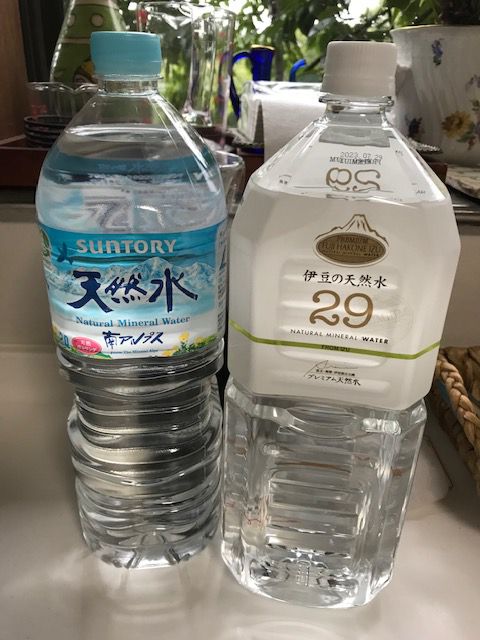
Until March 2021, we only drink mineral water, we only use mineral water to make soup, stew, in short everything that is to be eaten at home. However, the water bottles are heavy, we have to go to the supermarket quite often to buy a box of six bottles that we consume quite quickly. It’s not free either… So we decided to stop using mineral water for cooking. We still drink the mineral water whose radioactivity is measured.
Mineral water: cesium and iodine are measured by the gamma spectrometer (Photo Fonzy). The bottle on the left costs 0.6 euros, the bottle on the right 2.15 euros.
- Fish
For at least eight years after the accident we did not eat fish. However, my partner had colon cancer in 2019, and afterwards he preferred to eat “lightly”, so we resumed the habit of eating fish. I mostly buy fish from southwestern Japan, but occasionally I buy fish from a port near our home, because they are much fresher. I avoid fish from the shallow waters such as sole or turbot.
- Geiger counter
I walked around with my Geiger counter a lot in 2011, and a little less in 2012, and now … I don’t know where it is anymore, maybe in a drawer, but I haven’t seen it for years. I wonder if my friends who had one still use it.
- Anti-nuclear demonstrations
For two or three years after Fukushima, there were many anti-nuclear demonstrations organized not only in Tokyo but also throughout Japan. We shouted in front of the Tepco headquarters, in front of the Parliament, in the streets, we were very numerous at one time. There were activists who made anti-nuclear mobilizations every Friday night in front of the Parliament. This was a success for some time. I too participated often, especially in 2011 and 2012. However, they stopped their movement for good in March 2021 because there were, according to them, much less participants lately and they had no budget to continue. Now anti-nuclear demonstrations are very rare, although there are still some who mobilize from time to time. It seems to me that we Japanese are not very demonstrative. We’ll see…
- Convincing the others
Even though I talked to my friends and relatives about the risks of contamination and the dangers of nuclear power plants, it was almost impossible to convince them to be interested in this kind of problems.
That’s it. I do what I think I can do without too much stress. Still thinking about Fukushima is possible, but now we should have more imagination, because we don’t talk about it anymore. I thank those who continue to think about Fukushima despite so much geographical distance and so many years passed. Thank you for your solidarity.
Fonzy
Nagasaki citizen’s group prays for survivors of Fukushima nuclear disaster
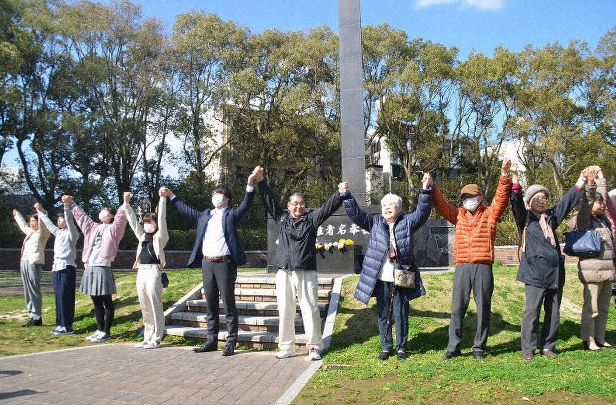 Citizen’s group members form a human chain in front of the hypocenter cenotaph during an event to pray for the restoration of Fukushima, hit by the 2011 meltdowns of the Fukushima Daiichi Nuclear Power Station, at the Hypocenter Park in the city of Nagasaki, on March 11, 2020
March 13, 2020
NAGASAKI — A citizen’s group in this southwestern Japan city destroyed by the 1945 U.S. atomic bombing held an event to pray for no more nuclear tragedies on March 11, the day of the meltdowns at the 2011 Fukushima Daiichi Nuclear Power Station.
A total of 15 participants, including atomic bomb survivors and high school students, gathered at the Nagasaki Hypocenter Park and offered a silent prayer at 2:46 p.m., the exact time the Great East Japan Earthquake struck, and formed a human chain in front of the hypocenter cenotaph.
The group was organized in 2013 and has interacted with people in Fukushima, which still struggles to recover from the nuclear disaster, to offer support from an area that has experienced the devastating destruction of nuclear weapons. Atomic bomb survivors and second-generation members have visited Fukushima and invited locals to visit Nagasaki for a lecture event.
Hiroko Sakaguchi, 70, a second-generation atomic bomb survivor, gave a speech at the March 11 event. “Many people still cannot return to their hometowns due to the nuclear accident. Even if buildings are rebuilt, that doesn’t mean real restoration. The disaster is still continuing there,” she said.
https://mainichi.jp/english/articles/20200312/p2a/00m/0na/020000c
Pope Francis meets with victims of Japan’s 3/11 disasters
 Pope Francis meets with victims of the March 2011 earthquake and tsunami on Monday in Tokyo.
November 25, 2019
Pope Francis on Monday met with victims of the March 2011 earthquake and tsunami that devastated northeastern Japan, a day after railing against the destructive power of nuclear weapons in the atomic bomb-hit cities of Nagasaki and Hiroshima.
The gathering in Tokyo was set because the pope wanted to meet with those who suffered from what he calls the “triple disaster” involving the quake, tsunami and the meltdown of the Fukushima No. 1 nuclear power plant.
In the first papal visit to Japan in 38 years, conducted under the theme of Protect All Life, the pope had wanted to visit disaster-hit areas but could not because of his full schedule, according to people close to him.
Three victims were to recount to him their experiences — a high school student who fled to Tokyo from the nuclear disaster in Fukushima Prefecture, the head of a kindergarten in Iwate Prefecture who lost a student in the tsunami, and a Buddhist priest who survived the disasters.
The event came ahead of separate meetings with Emperor Naruhito and Prime Minister Shinzo Abe scheduled for later in the day in the Japanese capital.
Pope Francis urges fresh efforts for Fukushima victims
 Pope Francis attends a meeting with victims of the 2011 “triple disaster” in Tokyo, on Nov 25, 2019.

Tepco toughens stance toward nuclear disaster damages settlement

TEPCO firmly at fault for balking at payouts to disaster victims

Fukushima Victims File Appeal, Contesting $1,500 Compensation Court Ruling
 In this March 11, 2011 file photo, waves are seen washing over a 10-meter-high breakwater and approaching the Fukushima No. 1 nuclear plant.
Plaintiffs appeal ruling in Fukushima nuclear disaster damages suit
Fukushima victims appeal $1,500 compensation payouts
Plaintiffs file appeal to win bigger payout over Fukushima nuclear disaster
1 This Month

of the week – Shut Down Drone Warfare!


Tell the Ukrainian Government to Drop Prosecution of Peace Activist Yurii Sheliazhenko

Petition to revoke the licensing of the Near Surface Nuclear Disposal Facility (NSDF) at Chalk River. https://www.ourcommons.ca/petitions/en/Petition/Details?Petition=e-7247
To see nuclear-related stories in greater depth and intensity – go to https://nuclearinformation.wordpress.com
-
Archives
- March 2026 (251)
- February 2026 (268)
- January 2026 (308)
- December 2025 (358)
- November 2025 (359)
- October 2025 (376)
- September 2025 (257)
- August 2025 (319)
- July 2025 (230)
- June 2025 (348)
- May 2025 (261)
- April 2025 (305)
-
Categories
- 1
- 1 NUCLEAR ISSUES
- business and costs
- climate change
- culture and arts
- ENERGY
- environment
- health
- history
- indigenous issues
- Legal
- marketing of nuclear
- media
- opposition to nuclear
- PERSONAL STORIES
- politics
- politics international
- Religion and ethics
- safety
- secrets,lies and civil liberties
- spinbuster
- technology
- Uranium
- wastes
- weapons and war
- Women
- 2 WORLD
- ACTION
- AFRICA
- Atrocities
- AUSTRALIA
- Christina's notes
- Christina's themes
- culture and arts
- Events
- Fuk 2022
- Fuk 2023
- Fukushima 2017
- Fukushima 2018
- fukushima 2019
- Fukushima 2020
- Fukushima 2021
- general
- global warming
- Humour (God we need it)
- Nuclear
- RARE EARTHS
- Reference
- resources – print
- Resources -audiovicual
- Weekly Newsletter
- World
- World Nuclear
- YouTube
-
RSS
Entries RSS
Comments RSS
 nuclear-news