Years without forestry education as Fukushima decontamination falls short
Mar 14, 2022
The March 2011 meltdown at the Fukushima No. 1 nuclear power plant caused serious damage to forests in the surrounding areas. Even now, 11 years after the accident, little has been done to decontaminate them.
In some areas, projects are underway to restore the satoyama, areas of mountain forest maintained by residents of adjacent communities, but the airborne radiation levels in those areas are still not low enough that children can safely enter, according to a local community leader.
One such area is the Yamakiya district in the town of Kawamata, Fukushima Prefecture. Walking trails in the Daini Oyako no Mori forest are covered by snow, and sunny slopes are lined with zelkova trees.
Yellow and pink vinyl wrapped around the trees indicates the year they were planted by local elementary school students. At the end of March, it will be five years since the evacuation order for the Yamakiya district was lifted. But even now, the voices of children have not returned to the mountains.
In 2016, satoyama restoration projects were launched in the prefecture to improve the forest environment. Decontamination, reforestation and radiation monitoring were carried out in an integrated manner in the mountain and forest areas that had been used by residents.
The projects have been carried out based on the comprehensive forest restoration policy for Fukushima Prefecture, which was compiled jointly by the Reconstruction Agency, the Agriculture, Forestry and Fisheries Ministry and the Environment Ministry. A total of approximately 800 hectares in 14 municipalities were selected as model areas, including forest parks and walking trails, where fallen leaves and other sediment was removed and thinned.

In the past, the forestry club of Yamakiya Elementary School was active in Daini Oyako no Mori. But since the nuclear accident, the forest had not been cared for and was in a dilapidated state — with thickets growing over the planted zelkova trees.
The town and the local residents chose Daini Oyako no Mori as a site for the project in order to revive the area as a site where children could study forestry. The project was launched in December 2016, prior to the planned lifting of the evacuation order for Yamakiya district at the end of March 2017.
The project covers an area of about 2 hectares. In fiscal years 2016 and 2017, planted cedar and zelkova trees were thinned and cleared, and trees that had fallen due to snow were removed. Logs were spread on slopes as a measure to control topsoil runoff.
Decontamination work was conducted in fiscal 2018. Leaves and branches that had fallen to the ground and other accumulated organic matter were removed in areas covering 5,595 square meters of the forest, including an open square and walking trails. The zelkova trees could die if their surfaces were stripped, so the work focused on clearing the grass and thickets.
Comparing the radiation levels in September 2018, before the decontamination work, and in November the same year, after the work, the average radiation level in the open square had been reduced by 22%, to 0.69 microsievert per hour. Based on the result, the central government concluded that “the decontamination work contributed to creating an environment ready for the resumption of forest study activities.”
However, even after the decontamination process, the airborne radiation levels were far from the central government’s long-term target of 0.23 microsieverts per hour. At some monitoring points, radiation levels exceeded 1 microsievert per hour.
“The area is not ready for children to go back,” said Toshio Hirono, 71, leader of the Yamakiya Elementary School’s forestry club.
Residents are demanding that the forest, where children once enjoyed the greenery, be restored to its original state.
The forestry club, which did its main work in Daini Oyako no Mori, was known both within and outside of the prefecture for its progressive activities that took advantage of the abundant natural resources. At the entrance of the forest, a signboard notes a commemorative tree planting by the group to mark a national commendation they received.
Children belonged to the group in the fourth through sixth grade, and their activities were diverse. They processed thinned cedar trees to create a walking path in their school’s front yard, built bridges over a river and moat in nearby mountains and made a mallet by hand for pounding rice cakes. They learned about the importance of nature by collecting mushrooms and tara buds, and eating rice cakes kneaded with burdock leaves.
These activities came to a halt after the nuclear accident at Tokyo Electric Power Company Holdings Inc.’s Fukushima No. 1 plant. Before the accident, Yamakiya Elementary School had 30 to 40 children. But the number of children decreased due to the establishment of an evacuation zone, and the school has been closed since fiscal 2019.
“If it hadn’t been for the nuclear accident, there would have been so much more I wanted to do,” said Hirono.
Hirono has been serving as the third leader of the group for about 20 years, without a chance to pass on his position to a successor due to the suspension of its activities. He feels that although Daini Oyako no Mori has been decontaminated, the level of radiation has not gone down enough.
“If there is even a slight concern, we cannot allow our children to go into the mountains,” he said with a sigh.
Even after the model project ended, Hirono continues to voluntarily clear the undergrowth along the walking trails every fall. He understands that decontaminating all the forests in the town will not be easy, but believes that unless the radiation levels in the surrounding areas of Daini Oyako no Mori are lowered, residents will not be reassured.
“It is the central government’s responsibility to decontaminate until the residents are satisfied,” he said.
https://www.japantimes.co.jp/news/2022/03/14/national/fukushima-forest-decontamination/
Radiation still hitting flora, fauna in forests in Fukushima

March 11, 2022
SENDAI—On a chilly night in early February, Masatoshi Suzuki hauled a black plastic bag containing four macaque carcasses into his lab at Tohoku University.
The monkeys were killed as agricultural pests, but for researchers like Suzuki, the animals are invaluable specimens to determine the effects of radiation from the Fukushima nuclear disaster.
Nearly 11 years after the triple meltdown at the Fukushima No. 1 nuclear plant, questions remain over the extent of damage to animals and plants caused by the radioactive substances released in the accident.
Suzuki, who specializes in radiobiology, hopes his studies will provide clues on the possible impact of the radiation on humans.
He and his colleagues have studied 709 macaques in Fukushima Prefecture since 2012. Of all the wild species available for study in the contaminated areas, macaques are most similar to humans.

The four dead macaques were given to Suzuki by farmers who destroyed the animals several hours earlier in Namie, a town that lies about 4 kilometers from the crippled nuclear plant. Parts of Namie are still off-limit due to high radiation levels.
Other primates used in the studies have come from off-limit areas in Minami-Soma, a city north of the nuclear plant, and elsewhere in the prefecture.
The researchers dissect the carcasses to determine if the livers, lungs, thyroid glands and muscle tissues were affected by radiation from the nuclear accident.
Deformations in plant lice and fir trees have been reported since the nuclear disaster started.
But Suzuki said he has seen no credible reports of such physical abnormalities in wild animals, including macaques, as well as domestic livestock.
However, damage might be occurring at the cellular level in the animals.
Background radiation levels in most of the mountain forests in Fukushima and neighboring prefectures are higher than those in residential areas, which have undergone decontamination procedures.
In the nature-filled areas that have not been decontaminated, macaques continue to be exposed to radioactive materials while feeding on polluted fruits and other food sources.
According to Suzuki’s studies, the muscles showed the highest concentration of radioactive cesium among all of the macaques’ organs.
The average radioactivity level in the thigh muscles was about 40,000 becquerels per macaque captured in Namie in fiscal 2013.
In fiscal 2018, the figure was down to about 20,000 becquerels per macaque.
The researchers found that macaques exposed to higher radiation doses had slightly fewer blood-producing cells in bone marrow compared with the animals with lower exposure readings. The nuclear accident may have compromised some macaques’ ability to make blood.
The researchers used the density of radioactive cesium in the macaques’ muscles and in soil at areas where they were captured to calculate the level of radiation doses the animals were exposed to both internally and externally.
Suzuki also said they detected chromosomal abnormalities resulting from radiation damage to genes.
He said radiation exposure can increase the stress level in one organ, but the same dose could have the opposite effect in a different organ. One possible reason for this is that the animal’s defense system was galvanized to curb stress levels following exposure.
Suzuki emphasized the need to continue monitoring macaques and other animals to determine the impact from prolonged radiation exposure.
“So far, we have discovered no significant health hazards in the individual macaques studied,” he said. “But they continue to display changes in their cells and organs, albeit minor ones. We do not know what these changes will translate into in the long run.”
CESIUM PASSED THROUGH FOOD CHAIN
A study by other scientists showed that radioactive cesium from the nuclear accident could be traveling through food chains in the environment.
“If we can track down the movement of radioactive cesium in the food chain, the findings would show us its cycling mechanism in the ecosystem,” said Sota Tanaka, a researcher of radioecology at Akita Prefectural University.
He believes that studying the cycling mechanism of cesium will help to predict its long-term movement and lead to improved use of resources in mountain forests and the rebuilding of agriculture in contaminated areas.
Joint research by Tanaka and Taro Adachi, professor of applied entomology at the Tokyo University of Agriculture, found that radioactivity levels have decreased year after year in rice-field grasshoppers in Iitate, a village west of the stricken nuclear plant that still has some off-limit areas.
In 2016, all of the grasshoppers monitored had radioactivity readings below 100 becquerels per kilogram.
But garden web spiders in Iitate showed a wide range of readings from one year to the next. Their radioactivity levels were actually higher in 2015 than in 2014.
In 2016, one spider had a reading of more than 300 becquerels per kilogram.
Radioactive cesium remains on the ground even after rainfalls.
Plants rarely absorb cesium through their roots, but can become contaminated by falling cesium particles. And the researchers believe the cesium levels in grasshoppers have dropped steadily because they feed on the leaves of living plants.
As for the spiders, they are eating bugs that have high cesium levels because they feed on contaminated dead leaves mixed with contaminated soil, according to Tanaka.
That may be why the eight-legged predators are showing higher radioactivity readings than the grasshoppers, he said.
Their study also found that earthworms had radioactivity levels higher than those for the grasshoppers and spiders, likely because they are eating contaminated soil and withered leaves.
Japan to finish radioactive soil transfer to interim storage site
“Finished” is only government propaganda, reality differs!
With radioactive waste being kept “temporarily” at 830 locations in six municipalities in Fukushima Prefecture, stuck in limbo with no early prospect of being shipped to interim storage facilities ahead of a government-set deadline. The volume of contaminated soil and other radioactive materials awaiting shipment totals 8,460 cubic meters.

Mar 13, 2022
Fukushima – The government is set to complete by March 31 work on transferring radioactive soil collected from areas polluted by the 2011 nuclear disaster in Fukushima Prefecture to an interim storage facility as part of the decontamination effort.
The facility, straddling the Fukushima towns of Futaba and Okuma, surrounds Tokyo Electric Power Company Holdings Inc.’s Fukushima No. 1 nuclear power plant, the site of the triple meltdown that followed a massive earthquake and tsunami 11 years ago.
Under the law, such soil will be transferred to a permanent disposal site outside the prefecture by 2045. The final site has yet to be decided, however.
Since the amount of soil is massive, the Environment Ministry is planning to use some of it for public works and other projects across the country.
“We’ll reach a major juncture” by completing the transfer, a senior ministry official said. “From now on, we’d like to foster people’s understanding on the reuse (of the soil).”
The 1,600-hectare interim storage site, about the same size as Tokyo’s Shibuya Ward, is slated to hold about 14 million cubic meters of soil collected through decontamination work.
Since 2015, such soil collected from around Fukushima has been taken to the site after being stored at temporary storage facilities.
Over 1,800 local landowners, including residents of the towns, cooperated with the central government to secure land to establish the storage facility, mainly by selling their properties to the state.
Many landowners “made tough decisions to give up their properties for the sake of reconstruction,” Okuma Mayor Jun Yoshida said. “Many were my acquaintances, including friends from school, the person who arranged my marriage and workers at the town office,” Yoshida added.
The ministry plans to use only soil with relatively low levels of radioactive concentrations for public works, farmland and other purposes. It hopes that three-fourths of the total will be reused.
A demonstration project to grow flowers and vegetables on farmland using such soil has already started in the Nagadoro district in the Fukushima village of Iitate.
Meanwhile, projects to utilize the soil for road construction have been scrapped due to opposition from local residents in the cities of Nihonmatsu and Minamisoma, both in Fukushima Prefecture.
In May last year, the ministry started holding meetings to discuss the recycling of such soil with the general public to win wider understanding. Such events took place in Tokyo and the city of Nagoya.
The next session is scheduled to be held in the city of Fukuoka this month.
Futaba Mayor Shiro Izawa stressed that electricity generated by the Fukushima No. 1 plant had been consumed in the greater Tokyo area. Reuse of soil collected through decontamination work “will not proceed unless people who benefited (from the Fukushima plant) understand that fact,” he said.
“It is difficult for people living far from Fukushima to empathize” with those having to deal with tainted soil, said Hiroshi Kainuma, associate professor at the University of Tokyo’s Graduate School of Interdisciplinary Information Studies.
Kainuma said the government should proceed while checking constantly whether its communication with the public on the issue is appropriate.
11 years on: Fukushima governor wants all evacuation orders to be lifted

Mar 11, 2022
Fukushima – The government should lift all evacuation orders issued after the March 2011 nuclear accident in Fukushima Prefecture, Gov. Masao Uchibori said in an interview.
Uchibori welcomed the central government’s pledge to ensure that all evacuees from the triple meltdown at Tokyo Electric Power Company Holdings Inc.’s Fukushima No. 1 nuclear plant may return home by the end of the decade, if they wish.
“However, there are many challenges such as handling land and housing of residents who do not intend to return, and working out details of decontamination methods,” Uchibori said Monday.
“The situation differs by area. We will urge the central government to carefully listen to the intentions of each municipality and act in a responsible way to lift evacuation orders in all difficult-to-return areas and reconstruct such zones,” he said.
When asked about the central government’s plan to release treated radioactive water from the nuclear plant into the ocean, he said that he will urge the government to carefully give explanations to all people concerned and to give out more information to prevent any more harmful rumors.
“There are opinions in Japan and abroad opposing the water release and calling for the careful handling of the matter,” he said.
On the handling of contaminated soil from Fukushima, Uchibori said that it is the central government’s obligation to move it out of the prefecture for final disposal by 2045.
On last summer’s Tokyo Olympics and Paralympics dubbed the “Reconstruction Games,” the governor said that the event became a legacy although there were some restrictions.
“Due to the COVID-19 pandemic, the event was different from what we had imagined, but the prefecture’s products, such as peaches, were highly evaluated by people related to the Games,” he said.
“By utilizing the connections we gained at the Games, we will work to expand exchanges through sports, such as by hosting large-scale events and having children and athletes interact with each other.”
“We also want to further share Fukushima’s attractiveness both domestically and internationally through exchanges,” he added.
https://www.japantimes.co.jp/news/2022/03/11/national/fukushima-governor-evacuation-orders/
Radioactive waste stuck at 830 sites with nowhere to go

March 3, 2022
Vast quantities of topsoil collected during decontamination work after the 2011 Fukushima nuclear disaster are stuck in limbo at hundreds of sites with no early prospect of being shipped to interim storage facilities ahead of a government-set deadline.
The soil is being kept “temporarily” at 830 locations in six municipalities in Fukushima Prefecture.
The city of Koriyama has 582 sites containing about 6,000 cubic meters of waste, followed by Fukushima with about 2,000 cubic meters at 200 locations.
Significant delays are expected in shipping the soil even though the government had planned to complete the operation by the end of this month as required by law.
The volume of contaminated soil and other radioactive materials awaiting shipment totals 8,460 cubic meters, which is the equivalent of 130 trucks each weighing 10 tons.
A key reason for the delay is that new houses were built on land where contaminated soil was buried as negotiations over storage sites in many communities dragged on. This accounts for about 50 percent of the cases cited by municipalities in a survey by the prefectural government last September.
About 30 percent of cases resulted from the refusal of landowners to bear the transportation costs, while about 10 percent are due to an inability by the authorities to contact the landowners.
As time passed, ownership of land tracts changed due to sales transactions and inheritance issues. Some landowners had no idea their plots contained radioactive material.
Tokyo Electric Power Co., operator of the crippled Fukushima No. 1 nuclear plant, shouldered the cost of the cleanup.
But the owners of the homes in question are obliged to pick up the tab for relocating so that the buried waste can be removed, according to the Environment Ministry.
Officials in the six local governments said the radiation levels at the 830 sites pose no health hazard as the readings were below 0.23 microsieverts per hour, the threshold for the need to decontaminate.
Decontamination work in affected communities in the prefecture wound up by March 2018.
The waste from those operations is required by law to be shipped outside the prefecture for final disposal by 2045.
Until then, the interim storage facility is all that is available.
The central government and Fukushima prefectural authorities have been locked in talks for the past 18 months on what to do with contaminated soil that cannot be moved any time soon.
The Environment Ministry called on local governments to continue managing contaminated soil that is deemed difficult to move in line with a directive issued in December 2020 that made it their responsibility.
The special measures law concerning the handling of radioactive materials stipulates that municipalities, which oversaw the cleanup, are responsible for managing the contaminated materials.
But the ministry’s directive upset local governments, which operate with limited manpower and funds.
Officials with the Fukushima and Sukagawa city governments held informal talks with the ministry last October to request that the central government collect, manage and transport the contaminated soil.
“We cannot manage these sites forever as the number of our employees is dwindling,” one official said.
Kencho Kawatsu, who chairs a committee with oversight for the environmental safety of the interim storage facility, underlined the need for the central and Fukushima prefectural governments to share in the responsibility for managing the temporary storage sites with municipalities.
“If the radioactive soil is scattered, it could fuel rumors that prove harmful to Fukushima municipalities,” said Kawatsu, a guest professor of environmental policy and radiation science at Fukushima University.
He suggested centralizing data on the issue to prevent such an occurrence.
The status of the interim storage facility for storing waste from decontamination is disclosed

February 22, 2022
On the 22nd, the progress of the interim storage facility for the waste from the decontamination of Fukushima Prefecture was shown to the press.
The delivery of waste from areas other than the difficult-to-return areas will be almost finished next month.
The Ministry of the Environment is storing decontamination waste from Fukushima Prefecture in an interim storage facility located in Okuma and Futaba towns, and the site was opened to the press on the 22nd.
One of the storage sites for soil from the decontamination process is 15 meters high and 900,000 cubic meters of soil is being piled up.
According to the Ministry of the Environment, 92% of the 1,400 cubic meters of decontamination waste generated in areas other than the difficult-to-return areas had been brought in as of November last year, and the Ministry expects to finish bringing in almost all of it by the end of next month.
In addition, waste generated in the areas where decontamination is being carried out in preparation for the lifting of evacuation orders will continue to be delivered.
It has been decided that the final disposal of the waste will be outside of Fukushima Prefecture by 2045, and the Ministry of the Environment hopes to reuse the soil from the decontamination for public projects.
Mr. Masanori Shoko, deputy director of the Fukushima Regional Environment Office, said, “It is important to gain nationwide understanding for the reuse of the soil, and we have been holding dialogue meetings, but we feel that the understanding of the younger generation is an issue. We would like to continue our efforts so that they will be interested in the final disposal outside of the prefecture.
https://www3.nhk.or.jp/lnews/fukushima/20220222/6050017330.html?fbclid=IwAR1hiH53kc7RiR7wPIdX35SneWkjAqFeE0JVeH8rtNISyu4jRNoOtoIYnpo
46% of school lunches use ingredients from Fukushima Prefecture, the highest rate since 2010

February 10, 2022
The percentage of prefectural food ingredients used in school lunches in Fukushima Prefecture this year was 46.0% (up 1.8 points from the previous year), the highest since 2010, before the Great East Japan Earthquake. The prefecture’s Board of Education has been supporting the prefecture’s dietary education. The prefectural board of education attributes the increase to efforts to increase opportunities to use the prefecture’s food, including the provision of the “Fukushima Health Support Menu” designed by a company that supports dietary education. The prefectural board of education announced the results on September 9.
The graph below shows the rate of utilization. In fiscal 2012, the year following the earthquake and the nuclear accident, the percentage dropped to 18.3% due to concerns about radioactive materials, but it has been on a recovery trend since then.
The utilization rate by region is as shown in the table below. The utilization rate by region is as shown in [Table]. Minamiaizu has the highest rate at 59.1%, which is due to the direct provision of foodstuffs in cooperation with farmers. The prefectural board of education hopes to expand the good practice to the entire prefecture.
In terms of food items, beans were the most popular at 66.5%, due to the fact that they can be easily incorporated into side dishes and soups as tofu and natto. Rice and other grains accounted for 63.9%, followed by fruits at 54.2%.
The survey was conducted at a total of 280 facilities, including public schools, municipal community kitchens, and prefectural schools that provide complete school lunches, and looked at the percentage of prefectural food ingredients in the food items used in a daily school lunch over a total of 10 days from June 14 to 18 and November 15 to 19 last year.
https://www.minyu-net.com/news/news/FM20220210-684498.php?fbclid=IwAR0j3BiDuSmR21dggtT97x9ziE_zoUoKK9kpEQFRhqyNOEFpQrZUCA_5BY0
Fukushima’s forestry industry still haunted by nuclear meltdown

Feb 21, 2022
Almost 11 years since the Fukushima No. 1 nuclear power plant meltdown, the forestry industry in Fukushima Prefecture is still suffering serious difficulties, with mountains and forests once contaminated by radioactive fallout left untouched.
In addition to declining demand for lumber, lingering worries over the effect of the radiation from the plant hit by the March 2011 quake and tsunami have seen the local forestry industry face acute labor shortages.
Yoshihisa Kanagawa, 65, of the forestry cooperative in the county of Higashishirakawa, still remembers a comment made by a local resident a few years ago.
“Don’t drop anything with radiation,” the resident told him, pointing to bark that had fallen to the ground from a truck loaded with logs Kanagawa was transporting from nearby mountains.
Kanagawa said he felt the deep-rooted mistrust among residents about the effect of the nuclear disaster. “(I was shocked to know) some people were still thinking that way,” he recalled.
Airborne radiation levels in the prefecture’s forests rose immediately after the nuclear disaster at the Tokyo Electric Power Company Holdings Inc. plant but have declined over time. The average radiation level at 362 sites in the prefecture was 0.18 microsieverts per hour in the year beginning April 2020, down by 80% from the level in the year through March 2012, according to a prefectural survey.
Under the prefecture’s standards, trees can be felled and transported from a forest if the radiation level in the air at the felling site is at 0.50 microsieverts or less per hour.
The bark that fell from Kanagawa’s truck was from logs in forests with radiation levels within prefectural limits.
There was a time when reducing the exposure of forestry workers to radiation was cited as an issue in the local forestry industry.
“Although few people talk about it, some people are (still) concerned about (any potential health effect of) the radiation,” he said. “It would be a shame if this has had something to do with the drop in forestry workers.”
Manahata Ringyo, a forestry firm based in the town of Hanawa, mainly deals with state-owned forests in the area. The town was the biggest lumber producer in the prefecture in 2018.
While more than 90% of the company’s sales are to businesses in the prefecture, the company attaches the results of radiation tests on waste from the logs when dealing with customers outside of the prefecture, as such tests are requested by some of them.
The practice continues even now, after almost 11 years.
The reasons behind the labor shortage in the forestry industry are said to be the hard nature of the work and a decline in demand for lumber.
Masato Kikuchi, 61, president of Manahata Ringyo, believes that the nuclear accident may have exacerbated the situation. “I want (the central government) to do more to secure human resources for the forestry industry in Fukushima Prefecture,” he said.
The number of people newly employed in the forestry industry in the prefecture has decreased by two-thirds in the 10 years since the Fukushima No. 1 disaster. The number of new workers was 242 in 2010, but it began to decline in 2011 and dropped to 78 in 2020, or only 32.2% of the number a decade earlier.
Alarmed by the situation, the prefecture will open a new training facility inside the prefecture’s Forestry Research Center in Koriyama in April to train people in field work and forest management.
The training facility, Forestry Academy Fukushima, will offer a long-term training course of one year for high school graduates who wish to work in the forestry industry and short-term training for municipal employees and forestry workers.
In the one-year program, trainees will cover forestry-related knowledge and skills, as well as acquire practical skills at a training field in a mountain forest. The facility will be equipped with a simulation room for forestry machines, in addition to classrooms and a building for practical training.
Fifteen applicants who have been accepted into the program will begin their one-year training in April.
At the end of the training period, the prefecture will encourage the trainees to find employment at forestry cooperatives and other forestry-related businesses in Fukushima.
“We will try to develop human resources who will be engaged in the forestry industry over the long term,” an official from the forestry promotion division of the prefecture said.
https://www.japantimes.co.jp/news/2022/02/21/national/fukushima-forestry-meltdown-difficulties/
Where to in 2045? Contaminated Soil from the Nuclear Power Plant Accident: Current Status of Interim Storage Facilities in Fukushima
February 21, 2022
Contaminated soil and other materials generated by decontamination following the accident at TEPCO’s Fukushima Daiichi Nuclear Power Plant are being temporarily stored at an interim storage facility adjacent to the plant. The decontamination of areas outside the difficult-to-return areas has largely been completed, and the decontamination of areas inside the difficult-to-return areas in the designated reconstruction and revitalization base areas (reconstruction bases), where evacuation orders are expected to be lifted after this spring, is also proceeding. However, no concrete measures have been taken for decontamination of the difficult-to-return areas outside the reconstruction centers, and no progress has been made in discussing the transport of contaminated soil out of Fukushima Prefecture. Eleven years after the accident, there is still no way to solve the problem of radioactive waste. (Kenta Onozawa, Shinichi Ogawa)
12.67 million bags from 52 municipalities in Fukushima Prefecture
Radioactive materials released from the nuclear power plant in the accident contaminated land and buildings in Fukushima Prefecture and other large areas. Each municipality has made progress in decontamination, and the soil and other waste from the decontamination process has been collected in flexible container bags (sandbags, one bag is one cubic meter), and delivery to the interim storage facility built around Fukushima Daiichi began in FY2015. As of February 10, 2022, the total amount of waste will amount to about 12.67 million cubic meters from 52 of the 59 municipalities in Fukushima. (*The graph below can also be viewed by region: Hamadori, Nakadori, and Aizu)
How much contaminated soil has been transported to the interim storage facility?
February 10, 2022
All areas:
Fukushima Prefecture has a population of 1,810,286 (as of 1 May 2021) and has a geographic area of 13,783 square kilometres (5,322 sq mi). Fukushima is the capital and Iwaki is the largest city of Fukushima Prefecture, with other major cities including Kōriyama, Aizuwakamatsu, and Sukagawa. Fukushima Prefecture is located on Japan’s eastern Pacific coast at the southernmost part of the Tōhoku region, and is home to Lake Inawashiro, the fourth-largest lake in Japan. Fukushima Prefecture is the third-largest prefecture of Japan (after Hokkaido and Iwate Prefecture) and divided by mountain ranges into the three regions of Aizu, Nakadōri, and Hamadōri.

Hamadori:
Hamadōri (浜通り) is the easternmost of the three regions of Fukushima Prefecture. Hamadōri is bordered by the Abukuma Highlands to the west and the Pacific Ocean to the east. The principal city of the area is Iwaki.
Area: 2,969.11 km2 (1,146.38 sq mi)
Population: (2017) 452,588

Nakadori:
Nakadōri (中通り, Nakadōri) is a region comprising the middle third of Fukushima Prefecture, Japan. It is sandwiched between the regions of Aizu to the west and Hamadōri to the east. The principal cities of the area are Kōriyama and the prefecture’s capital, Fukushima.
Area : 5,392.95 km2 (2,082.23 sq mi)
Population: ( 2017) 1,159,245

Aizu:
Aizu (会津) is the westernmost of the three regions of Fukushima Prefecture. The principal city of the area is Aizuwakamatsu.
Area: 5,420.69 km2 (2,092.94 sq mi)
Population: (2017) 270,648

Source: Interim Storage Facility Information Website
The total amount of contaminated garbage is not foreseeable.
According to the Ministry of the Environment, the amount of contaminated soil generated from the decontamination of areas other than the difficult-to-return areas is estimated to be 14 million cubic meters, a huge amount equivalent to 11 fillings of Tokyo Dome. The soil is scheduled to be delivered to the interim storage facility by March 2010. In the remaining difficult-to-return areas in seven cities, towns, and villages in Fukushima Prefecture, six cities, towns, and villages (excluding Minamisoma City) have been designated as “Designated Reconstruction and Revitalization Centers (Reconstruction Centers)” where decontamination will be carried out ahead of time. It is estimated that 1.6 to 2 million cubic meters of contaminated soil will be released from the decontamination of the reconstruction centers.
In addition to this, in August 2009, the government decided to lift the evacuation order for those who wish to return to their homes in the difficult-to-return areas outside the reconstruction centers. The Ministry of the Environment said, “We will proceed with the acquisition of land and the construction of storage facilities while monitoring the status of delivery. We do not know the maximum amount that can be brought in.
Uncertainty about transporting the materials out of Fukushima Prefecture
As the name implies, the storage at the interim storage facility is supposed to be “temporary” before the final disposal. The government has promised that the contaminated soil will be transported to a final disposal site outside Fukushima Prefecture in 2045, 30 years after the storage began in 2015. However, it is not clear if there are any municipalities that will accept the waste contaminated by the nuclear accident, and the candidate site has not yet been decided.
At present, three quarters of the total amount of contaminated soil stored at the site contains less than 8,000 becquerels of radioactive cesium per kilogram. The government plans to reuse the contaminated soil with a concentration of 8,000 becquerels or less for road construction and other public works. The government plans to reuse soil contaminated with less than 8,000 becquerels for road construction and other public works. However, opposition to the use of contaminated soil from local residents is strong, and efforts to put the technology to practical use are running into difficulties. The Ministry of the Environment says, “We will continue to develop technology and work to gain the understanding of the people concerned.
The interim storage facilities are located around the Fukushima Daiichi Nuclear Power Plant and cover an area of 1,600 hectares. Of the privately owned land, which accounts for about 80%, 93% has been acquired by the government. The delivery of contaminated soil generated outside the difficult-to-return area is expected to be completed in March 2022.

11 years after the accident at the Fukushima Daiichi Nuclear Power Plant, residents angered by the retreat from decontamination of the entire area: “It is only natural to clean up the mess and return it.
February 19, 2022
It will soon be 11 years since the accident at TEPCO’s Fukushima No. 1 nuclear power plant. Many people who have left their homes in areas where it is difficult to return are still uncertain about their future. Last year, the government announced a new policy to decontaminate only the areas around the homes of those who wish to return to their homes in areas where the lifting of evacuation orders was not foreseeable. This is a step backward from the previous policy of decontaminating the entire area, and the residents are angry, saying, “They won’t decontaminate unless we decide to return? (Natsuko Katayama)

In August 2021, the government decided to partially lift the evacuation order for the remaining difficult-to-return areas in seven cities, towns, and villages in Fukushima Prefecture by decontaminating homes and roads by 2029 in response to requests from people who want to return to their homes and live there. The government plans to begin decontamination in fiscal 2024, but has yet to decide what to do with the homes and land of those who do not wish to return. The “designated recovery and revitalization zone,” where decontamination was prioritized within the zone, accounts for only about 8% of the area that is difficult to return to.

The trees around our house and in the fields have grown so thick that we can’t do anything about them… Every time Kazuo Kubota, 70, and his wife Taiko, 66, who have been living as evacuees in Fukushima City, return to their home in the difficult-to-return area of Namie Town in Fukushima Prefecture, they sigh.
Their house is located in the Hatsuki district of Tsushima, Namie Town, about 30 kilometers northwest of the nuclear power plant. The fields are overgrown with trees that can grow up to three meters high. We can’t even cut the kaya with a sickle anymore,” said Kazuo. The plastic greenhouse for leaf tobacco is now just a skeleton, with thick branches sticking up from below. His house was also ransacked by wild boars and other animals, and he gave up clearing it.

Still, Taiko feels relieved when she returns to Hatsuke. Surrounded by nature, she feels the four seasons. Horseradish grows in the stream beside my house, and salamanders live there. I want to return here as soon as possible.
He hopes to have the area around his house decontaminated and the house demolished, the land cleared, and the house rebuilt so that he and Kazuo’s mother, Tsuya (95), can return to the area together.
If we could have lived in Hatsuke, our family would have been much closer,” said Taiko. Before the nuclear accident, the family used to go everywhere together, but after the evacuation, they were separated.

Tsuya, who used to work in the fields early in the morning and take care of her favorite flowers, began to stay at home more and more often and developed dementia. The family became increasingly strained and quarrelsome. With no one to talk to about her care, Taiko developed alopecia areata and continued to go to the hospital.
In the same town of Tsushima, there is a “Specific Reconstruction and Regeneration Center Area (Reconstruction Center)” where decontamination is being carried out ahead of time, covering 1.6% of the total area of Tsushima. On the other hand, Hatsuke, located to the west of the Reconstruction Center, has relatively low levels of radiation, but has not been decontaminated except along the main road.
When Taiko sees places in Namie that have been decontaminated over and over again, she feels her guts boil over.
If the area had been decontaminated even once, I would have been motivated to do my best,” she said. Why is it that all other areas are decontaminated before being sent home, but the hard-to-return area, which has the highest radiation dose, is not decontaminated until the residents decide to return?

His eldest son is said to be saying, “I want to start a farm in Hatsuke after I finish raising my child. However, there is a strong concern that decontamination limited to the living areas of those who wish to return to the area will result in “unevenness” and many contaminated areas will remain.
That is why Kazuo is so angry. “I still want to go back here. My parents cultivated this land and passed it down to me. I want to leave it to the next generation. If we pollute the land, it is only natural to clean it up and return it.”
”Eleven years have passed. I want to go home. I want to go home. I’ll do whatever I can to return to Hatsuke and die,” Tsuya said, but then he said, “I’ve given up. I’ve given up.”
Taiko said as if she were praying. “I don’t know how long we will be able to move. I want the decontamination work to be done as soon as possible.”
A lonely evening at home for Fukushima man retracing past

December 11, 2021
OKUMA, Fukushima Prefecture–Settling in for the night, Mitsuhide Ikeda poured sake into a glass and raised a toast to framed photos of his deceased parents: “I finally made it back home. Let’s drink together.”
The last time the 60-year-old cattle farmer spent a night at home was 10 years and nine months ago.
Large parts of this town that co-hosts the Fukushima No. 1 nuclear power plant were declared “difficult-to-return” zones after the triple meltdown triggered by the 2011 earthquake and tsunami disaster.
Ikeda’s parents died after the nuclear accident.
The Shimonogami district where the Ikeda’s home is located lies about five kilometers southwest of the Fukushima nuclear facility.
As part of efforts to rebuild the areas around the plant, the government recently began letting residents return home for an overnight stay as a means of preparing for the day when they can do so permanently.
Unsurprisingly, concerns about radiation levels are still on the minds of many former residents. His wife, Mikiko, 64, refused to accompany him for that reason. Ikeda was the only individual in his neighborhood who took up the offer to return home.
Dangerously high radiation levels registered immediately after the disaster that made it impossible for anybody to live in the area have gradually fallen. The government spent vast sums on the time-consuming process of decontaminating topsoil as a way of reducing radiation levels.
It intends to lift the evacuation order for some parts of Okuma in spring. That would be the first step for setting the stage for residents to return home.
The temporary overnight stay program began in Katsurao on Nov. 30 and is gradually being expanded to five other municipalities, including Okuma.
A check for radiation in November on the Ikeda plot found one spot with a reading of 3.8 microsieverts per hour, above the level deemed safe enough for the government to lift the evacuation order.
Even though the Environment Ministry is planning additional decontamination work, Mikiko was unsettled by the reading and concluded it would be impossible to pick up the threads of their past life in Okuma.
Other changes in the close to 11 years since the nuclear disaster make a return to Okuma unrealistic.
While a large supermarket, hospital and bank branch remain standing in the town, there is no indication when those facilities might resume operations.
In the interim, the Ikedas plan to commute to Okuma from the community they moved to as evacuees.
The overnight stay program is restricted to an area close to what was once the bustling center of the town. About 7,600 residents lived there before the nuclear disaster.
The town government envisions that as many as 2,600 people will reside in the town within five years of the evacuation order being finally lifted if plans proceed to rebuild social infrastructure.
But the writing is on the wall for many people.
According to the Environment Ministry, about 1,150 homes in the district had been torn down as of the end of September.
And as of Dec. 8, only 31 residents in 15 households applied for the overnight stays.
Even Ikeda admits that Okuma will likely never return to the community he knew before 2011.
“Too much time has passed,” he said.
Last Fukushima town to reopen welcomes back its first residents
Three people have moved back to Futaba, which aims to attract about 2,000 over the next five years

February 16, 2022
Late last month, Yoichi Yatsuda slept in his own home for the first time in more than a decade.
As a resident of Futaba, a town in the shadow of the wrecked Fukushima Daiichi nuclear power plant, there was a time when simply spending the night in his family home had seemed an impossible dream.
The 70-year-old was one of tens of thousands of people who were forced to flee and start a life in nuclear limbo when the plant had a triple meltdown in March 2011.
As Japan reeled after the earthquake and tsunami that killed more than 18,000 people and triggered the world’s worst nuclear disaster since Chernobyl, Yatsuda and his wife, Analisa, and an estimated 160,000 other residents of Fukushima prefecture packed a few belongings and left, believing they would be back within weeks.
“If you had told me at the beginning that I would have to wait this long to come home, I would have given up straight away,” said Yatsuda, a retired professional keirin cyclist who has lived in more than 10 places since the disaster.
Today, the couple are attempting to rebuild their lives in Futaba, the last of dozens of towns and villages to have ended their status as no-go zones after radiation levels were deemed low enough for people to return.

They made periodic visits to repair and refurbish their house, which was once overrun by wild boar, and have been allowed to stay overnight on a trial basis since late January. Local authorities hope more people will follow when the evacuation order is officially lifted in parts of the town later this year.
Yatsuda’s homecoming has been bittersweet. Before the disaster, Futaba was home to about 7,000 people. Just 15 residents applied to take part in the trial, and to date only three, including Yasuda and his wife, have moved back permanently.
Many of his former neighbours have found jobs and built new lives in other parts of the region and across Japan. In a poll by the reconstruction agency, just 10% of Futaba’s former residents said they would like to return, while 60% had no plans to go back.
Those with young children are the most reluctant to contemplate returning to a town that has no schools, shops, restaurants, hospitals or public services. Those with homes that survived the tsunami – which killed 50 people in Futaba – have had them demolished, leaving the town dotted with empty plots of land.
Yatsuda’s only neighbour – although he lives a short drive away – is Yasushi Hosozawa, who lives in a tiny room above a parking space and a shed filled with his beloved fishing rods.
“I was born here, and I always felt that if I was ever given the chance to return, then I would take it,” said Hosozawa, whose wife and son run a restaurant in another Fukushima town farther inland. “I love fishing and have my own boat moored here … that was a big factor in deciding to come back.”

The 78-year-old, a former plumber and cafeteria owner, returned late last month to find that his water supply had yet to be reconnected, meaning he had to drive to the railway station to use the toilet. “There used to be lots of people here,” he said, pointing at patches of grass where his neighbours’ homes once stood. “But look at it now … it’s a wasteland.”
Like many Fukushima residents, Yatsuda has little positive to say about Tokyo Electric Power (Tepco), the company that operates the nuclear plant, where decommissioning work is expected to last decades. “I believed Tepco when they said that something like the 2011 disaster could never happen,” he said. “It’s all about trust. When I returned to Fukushima 40 years ago, I was assured that this was a safe place to live.”
While no one expects life in Futaba to ever return to its pre-disaster normality, local officials believe more people will resettle. The town has set a target of attracting about 2,000 people, including new residents, over the next five years, and new public housing for 25 households will open in October.

“Very few people want to come back, so can you really say that the town has recovered?” said Yatsuda, who will plant flowers in his garden this spring and, he hopes, reopen the gym behind his home where he trained aspiring keirin racers before the disaster.
“The problem is people can’t see physical signs of recovery with their own eyes. Unless the authorities do more to create jobs and attract new residents, I can’t see things improving much in the next 10 years.”
The stress of life as an evacuee has taken a toll on his mental and physical health, but he has no regrets about returning to a town that, its three current residents aside, still resembles a nuclear ghost town. “This is our house. This is where we played with our children when they were little,” he said.
While the couple have no concerns about radiation, they have accepted that, for now, they must travel outside the town to spend time with their eight grandchildren.
“We used to enjoy seeing friends and playing with our grandchildren here,” said Analisa. “It would be great if younger families moved here … I desperately want to see and hear children again.”
Health care for displaced persons in Fukushima to be phased out
November 10, 2021
According to Asahi, the Reconstruction Agency wants to phase out medical care for people displaced by the nuclear disaster and has started discussions with local authorities, as acknowledged by the minister in charge.
Currently, residents of 13 municipalities in Fukushima who had to evacuate either compulsorily or by recommendation receive a full or partial reduction of their health or nursing care costs. The number of evacuees from these municipalities amounted to 150,000 in August 2011. This assistance is expected to be phased out starting in 2023 for people in areas where evacuation orders were lifted before April 2017. It would still be maintained for the 22,000 people from the so-called difficult return areas.
In some communes, such as Minami-Sôma or Tamura, the only beneficiaries are the people who had to evacuate. The “voluntary evacuees”, who left on their own, do not benefit.
The end of aid worries some people who have seen their health conditions worsen following the evacuation. It should be better targeted to those who need it, regardless of their original status.

The agency spearheading rebuilding efforts stemming from the Fukushima nuclear disaster is now in talks with local authorities about phasing out assistance programs to help evacuees meet their medical and nursing care costs.
Kosaburo Nishime, the minister in charge of rebuilding, acknowledged Nov. 9 that the Reconstruction Agency is engaged in discussions to assess what local governments want in the planned overhaul of the program.
Under the current program, residents of 13 municipalities in Fukushima Prefecture who were ordered or advised to evacuate in the aftermath of the triple meltdown at the Fukushima No. 1 nuclear plant in 2011 have had full or partial reductions of their health or nursing care costs. The number of evacuees from those municipalities totaled 150,000 as of August 2011.
The agency plans to begin scaling back the size of the aid as early as in fiscal 2023, according to a senior agency official.
The target that will come under the review concerns residents of 11 municipalities where the evacuation orders had been lifted by April 2017.
The agency plans to phase out the assistance over several years after notifying the appropriate authorities a year in advance of the end of the aid program.
But about 22,000 evacuees, including those from Okuma and Futaba, the towns co-hosting the crippled nuclear plant, as well as those who are not allowed to return due to continuing high levels of radiation, will not come under the planned review, according to agency officials.
The agency will consider that situation at a later date.
The move toward a full-scale review was prompted by concerns raised within the agency about the fairness of extending the assistance program when many residents in the same municipality had no access to such benefits.
For instance, Tamura and Minami-Soma have two types of evacuees, depending on where affected communities are located in their cities: residents ordered to evacuate and those who evacuated voluntarily. The latter are not eligible to receive any reduction in their health and nursing care costs.
This has given rise to a growing sense of resentment among those without access to the assistance in light of the fact the aid program has now been in place for many years.
On the other hand, plans to review the program have already met with fierce opposition from local officials.
“It is totally unacceptable,” said Ikuo Yamamoto, the mayor of Tomioka.
Evacuation orders were lifted in April 2017 for most parts of the town. But some areas are still off-limits.
“We are still in the middle of rebuilding,” Yamamoto complained. “I strongly request that the central government keeps the current program going as it is.”
Yuichi Harada, who is 72 years old and lives as an evacuee in Nihonmatsu after he fled Namie, both in the prefecture, said a blanket review of the program was the wrong approach.
“Some evacuees have to pay a lot more in medical fees than before as their health started to deteriorate” due to the evacuation, he said. “The government should fine-tune the program to reach out to people who badly need assistance.”
The central government sets aside about 25 billion yen ($221 million) annually for health and nursing care assistance to evacuees.
Fukushima Thyroid Cancer in Kids – Epidemiologist Joseph Mangano – NH #556
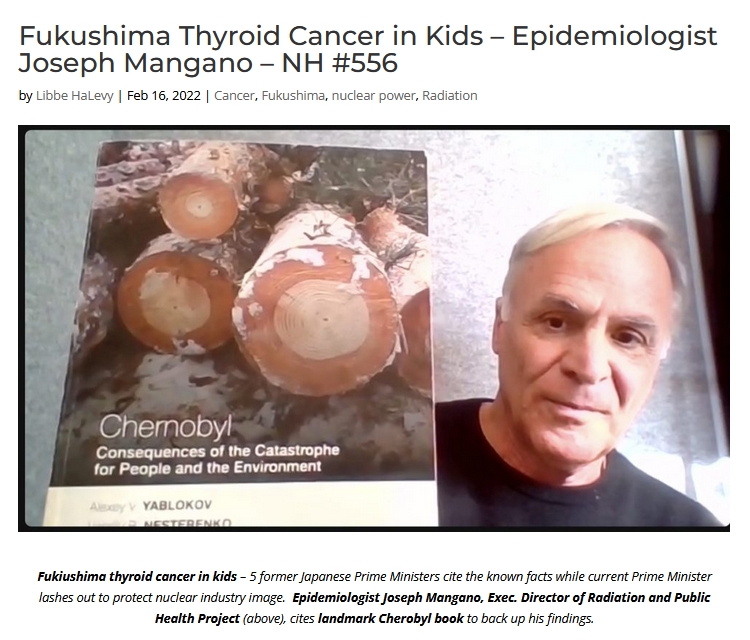
This Week’s Featured Interview on Nuclear Hotseat:
- Joseph Mangano is Executive director of Radiation and Public Health Project. He is an epidemiologist – one who searches for the cause of disease, identifies people who are at risk, determines how to control or stop the spread, or prevent it from happening again. Joe has over 30 years of experience working with nuclear numbers and comes from a history of teasing out health information from data. We spoke on Friday, February 11, 2022.
Fukushima man returning home wants to tell sons about his ‘error’

February 14, 2022
FUTABA, Fukushima Prefecture–The town where Yuji Onuma in his youth dreamed up a slogan promoting the “bright future” that nuclear power promised remains deserted and a shell of its former self.
But Onuma, 45, is now hoping to pass along a different message to his sons of the dangers of nuclear power, as he plans to continue visiting his former home after more than a decade away.
Evacuees from this town, cohost to the crippled Fukushima No. 1 nuclear power plant, are being allowed to stay overnight at their homes for the first time in 11 years since the nuclear disaster.
The temporary stays are ahead of a full return envisaged in the limited area of Futaba in summer this year. Futaba is the only municipality where all residents remain evacuated.
OVERNIGHT STAY REKINDLES MEMORIES
An Asahi Shimbun reporter accompanied Onuma, his wife and their two sons as they returned home from Jan. 29 through 30 on a “preparatory overnight stay” program that started on Jan. 20.
Around noon on Jan. 29, Onuma was in the Konokusa district of Futaba, 6 kilometers to the northwest of the nuclear plant, with his wife and two sons.
The district is designated a “difficult-to-return” zone, where an evacuation order remains in place because of the high levels of radiation from the triple meltdown at the plant, and is outside the area for the preparatory stay program.
Houses in the district were seen with entrances closed off with barricades.
“Damage from the nuclear disaster is not always easy to see, but I still want you to know something about it,” he told his family as they walked along a street.
Onuma pointed to a barbershop that he used to go to as a young boy. He also pointed to the home of a classmate and a road he would take to go to a driving school.
“There were people’s livelihoods in every single one of these houses before we were evacuated,” he told his family members in the midst of the totally deserted landscape.
“Oh!”
The abrupt shout came from Yusei, the oldest of Onuma’s sons. Right before the eyes of the 10-year-old was a house that was flattened by the massive tremor of the Great East Japan Earthquake, which triggered a tsunami and the nuclear disaster, on March 11, 2011.
A rainwater drainage pipe covered with moss was seen lying on the ground. A tree was spotted growing through an opening between the tiles of the house’s roof.
Difficult-to-return zones account for more than 90 percent of the landmass of Futaba, where no one has yet returned to live. Ties with fellow townspeople have grown so thin that Onuma learned about the deaths of his neighbors and a classmate only through an information bulletin of the town government.
“It’s so sad,” Onuma said. “I could have offered incense for them if only it had not been for the nuclear disaster.”
The preparatory overnight stay program started in the area designated a “specified reconstruction and revitalization base,” where the evacuation order is expected to be lifted in June.
In the designated area, many houses have been demolished. Onuma’s home stands alone, surrounded by empty lots.
Onuma also had planned to have his home demolished, as no elementary school or junior high school was likely to be reopened any time soon.
What the youngest of his sons said changed his mind. Onuma quoted 8-year-old Yusho as saying, when the family was visiting Futaba last March, “I like Futaba. I want to come to Futaba again.”
Encouraged by his son’s remarks, Onuma in April began improving the living conditions at his home, including tidying it up and decontaminating it.
He said he hopes to keep returning here with his family during summer vacations and on other occasions so he can see how the community will continue changing in the future.
ARCHITECT OF FUTABA’S ONCE PROUD SLOGAN
An overhead signboard once greeted visitors to a central shopping street in Futaba’s downtown area. It carried a slogan saying, “Nuclear power is the energy of a bright future,” which Onuma submitted when he was an elementary school pupil to win a local competition.
Being the author of the iconic slogan was, for some time following the nuclear disaster, a source of distress for Onuma.
He once thought that atomic energy could be entrusted to provide people’s power needs for the future. However, in the twinkling of an eye, the nuclear accident changed the lives of so many people.
Onuma said he has a different view of nuclear power now.
“I have to tell my children everything, including my own ‘error,’ so the same thing will never be repeated,” Onuma said.
He planted pansies, which can mean “remembrance” in the language of flowers, on a flower bed outside his home.
“I hope to convey pre-disaster remembrances of Futaba to my children,” he said. “And I also hope to go on creating new ‘remembrances’ in this town, where the clocks have stood still for 10 years and 10 months and counting.”
EVACUATION ORDER MAY BE LIFTED IN JUNE
Futaba was home to 7,140 residents when the quake and tsunami struck. The town remains totally evacuated due to the nuclear disaster that resulted, and its residents are taking shelter across 42 of Japan’s 47 prefectures.
Part of Futaba’s difficult-to-return zones has been designated a specified reconstruction and revitalization base. The town government is hoping to have the evacuation order lifted in the reconstruction base area in June.
The preparatory overnight stay program, which allows evacuees who want to return to spend the night at their homes in advance to prepare for their lives there, started in Futaba on Jan. 20.
Many townspeople of Futaba, in the meantime, have rebuilt their lives in other communities to which they have evacuated. Only 19 individuals from 13 households had applied for a preparatory overnight stay by Jan. 27, with Onuma’s two sons being the only minors among them.
The town government has set the goal of having 2,000 residents, including new settlers, five years after the evacuation order is lifted.
When parties including the Reconstruction Agency and the town government took a survey last year, however, some 60 percent of Futaba’s residents said they had decided against returning, and only about 10 percent said they wished to return.
1 This Month

of the week – Shut Down Drone Warfare!


Tell the Ukrainian Government to Drop Prosecution of Peace Activist Yurii Sheliazhenko

Petition to revoke the licensing of the Near Surface Nuclear Disposal Facility (NSDF) at Chalk River. https://www.ourcommons.ca/petitions/en/Petition/Details?Petition=e-7247
To see nuclear-related stories in greater depth and intensity – go to https://nuclearinformation.wordpress.com
-
Archives
- March 2026 (244)
- February 2026 (268)
- January 2026 (308)
- December 2025 (358)
- November 2025 (359)
- October 2025 (376)
- September 2025 (257)
- August 2025 (319)
- July 2025 (230)
- June 2025 (348)
- May 2025 (261)
- April 2025 (305)
-
Categories
- 1
- 1 NUCLEAR ISSUES
- business and costs
- climate change
- culture and arts
- ENERGY
- environment
- health
- history
- indigenous issues
- Legal
- marketing of nuclear
- media
- opposition to nuclear
- PERSONAL STORIES
- politics
- politics international
- Religion and ethics
- safety
- secrets,lies and civil liberties
- spinbuster
- technology
- Uranium
- wastes
- weapons and war
- Women
- 2 WORLD
- ACTION
- AFRICA
- Atrocities
- AUSTRALIA
- Christina's notes
- Christina's themes
- culture and arts
- Events
- Fuk 2022
- Fuk 2023
- Fukushima 2017
- Fukushima 2018
- fukushima 2019
- Fukushima 2020
- Fukushima 2021
- general
- global warming
- Humour (God we need it)
- Nuclear
- RARE EARTHS
- Reference
- resources – print
- Resources -audiovicual
- Weekly Newsletter
- World
- World Nuclear
- YouTube
-
RSS
Entries RSS
Comments RSS
 nuclear-news