Government OKs reopening of Fukushima village section to residents in June

June 3, 2022
Fukushima – More than a decade since the March 2011 nuclear disaster, some registered residents of part of a Fukushima village made off-limits by high radiation levels can finally return home after the government decided Friday to lift evacuation orders on June 12.
While some areas around stations and rail tracks had their so-called “difficult-to-return” zone classification lifted, it is the first time for the classification to be lifted to host permanent residents again.
A 0.95 square kilometer part of Katsurao, located near the defunct Fukushima No. 1 nuclear power plant, will have the designation lifted, the government’s nuclear emergency response headquarters and the Reconstruction Agency agreed in a joint meeting.
The move comes after national and local governments decided in May that the area’s radiation decontamination and infrastructural developments had progressed enough to reopen.
“This is a big step toward the restoration of the village,” said Mayor Hiroshi Shinoki in a statement. “The lifting is not a goal, but a start.”
The entirety of Katsurao became off-limits after the nuclear crisis triggered by an enormous earthquake and tsunami on March 11, 2011, with evacuation orders for most of the village lifted on June 12, 2016.
Of the 30 registered households and 82 residents in the relevant part of Katsurao, just four households totaling eight people have expressed an intention to return, according to the village government.
Currently, around 337 sq. km of land in six municipalities of Fukushima Prefecture, including Katsurao, Okuma and Futaba, is still subject to the difficult-to-return zone classification.
At Friday’s meeting, Prime Minister Fumio Kishida said he intends to “move ahead with work to lift restrictions and further accelerate Fukushima’s recovery.”
Among the five other Fukushima municipalities inside the zone, Futaba and Okuma are set to have restrictions partially lifted from June onward, while the other three can expect partial removals in spring 2023.
However, more than 90% of the difficult-to-return zone in the prefecture will remain under the classification, and there is no concrete timetable for when it will be completely accessible again.
Areas reopening after Fukushima nuclear disaster need sustained gov’t support

June 10, 2022
Evacuation orders that have been in place since the 2011 Fukushima Daiichi Nuclear Power Station disaster are set to be lifted in part of the Fukushima Prefecture village of Katsurao, one of the so-called difficult-to-return zones, on June 12.
Difficult-to-return zones, which people are forbidden from entering in principle due to high radiation levels, have been left behind in the recovery process. The latest move marks the first time that people will be able to live in one of these areas since the meltdowns triggered by the March 2011 Great East Japan Earthquake and tsunami.
The central parts of six difficult-to-return towns and villages including Katsurao have been designated as “zones for reconstruction and recovery,” and the national government has been carrying out decontamination work there. The part of the village of Katsurao set to reopen for living is one of such zones, finally marking a step forward more than 11 years after the accident.
However, of the 82 people in 30 households registered in that part of Katsurao, at this stage only eight people in four households have expressed their intention to return.
Evacuation orders were lifted in 2016 for other parts of Katsurao that fell outside the difficult-to-return zone, five years after the onset of the disaster. Another six years have passed since then, and residents have apparently become hesitant to return.
Through next spring, it is expected to become possible for people to permanently return to designated reconstruction and recovery zones in five remaining towns and villages including the towns of Futaba and Okuma, which the crippled nuclear power station straddles.
Many residents, however, are reluctant to return as those areas face an uncertain future. While local bodies are planning to secure medical care and attract commercial facilities into the areas, there is a need to steadily prepare such a living environment.
Besides worries about the future, an additional source of concern for people is that decontamination work in areas outside the specified reconstruction and recovery zones has yet to commence.
The government promised to create an environment enabling all residents wanting to return to do so in the 2020s. But the only places outside the restoration and recovery zones that the government has decided to decontaminate are returning residents’ homes and their vicinities. It has not revealed how it plans to handle other land and homes.
If the scope of decontamination work is not fixed, there will likely be many residents unable to decide whether they can return with peace of mind. The government needs to quickly present a course of action.
The road to recovery of the difficult-to-return zones is still far off. An official at Katsurao Murazukuri Kosha, a public corporation that is promoting the revival of the village, stressed, “First, it’s important to properly support the lives of people who have returned. We want to move forward one step at a time from there.”
The government has a responsibility to accomplish the revitalization of Fukushima. It must listen to the voices of residents, and continue to offer sustained support.
https://mainichi.jp/english/articles/20220610/p2a/00m/0op/013000c
Magnitude 6.0 quake shakes Japan’s east and northeast

May 22, 2022
TOKYO (Kyodo) — An earthquake with a preliminary magnitude of 6.0 struck Fukushima and other prefectures in Japan’s east and northeast on Sunday, but there was no threat of a tsunami, the country’s weather agency said.
There were no immediate reports of injuries or serious property damage following the quake, which occurred around 12:24 p.m.
The quake’s magnitude was later revised upward from the initial estimate of 5.8, the Japan Meteorological Agency said.
The quake registered a lower 5 on the Japanese seismic intensity scale of 7 in Fukushima’s Iwaki city, according to the agency. Its focus was at a depth of about 30 kilometers in the Pacific off Ibaraki Prefecture.
The quake registered 4 in some other parts of Fukushima and 3 in the neighboring prefectures of Miyagi, Yamagata, Ibaraki, Niigata and Tochigi.
No abnormalities were found at the Tokai No. 2 nuclear power plant on the coast of Ibaraki or at the Fukushima Daiichi and Daini nuclear power plants, their operators said.
There were also no major transport disruptions. JR East said it briefly suspended services on a section of the Tohoku Shinkansen bullet train line between Fukushima and Miyagi prefectures.
https://www.japantimes.co.jp/news/2022/05/22/national/earthquake-ibaraki-fukushima/
Seismic intensity of 5 on the Iwaki City, Fukushima Prefecture, Japan; operation suspended between Takahagi and Tomioka on Joban Line

May 22, 2022
At around 0:24 p.m. on March 22, an earthquake centered off the coast of Ibaraki Prefecture hit Iwaki City, Fukushima Prefecture, with an intensity of just under 5 on the Japanese seismic scale, while Koriyama City, Hirono Town, Tomioka Town, Namie Town, and other areas in Fukushima Prefecture registered an intensity of 4 on the Japanese scale. According to the Japan Meteorological Agency, the epicenter was about 5 km deep, and the magnitude of the quake was estimated at 6.0. There is no concern of a tsunami from this quake.
According to East Japan Railway Company, the earthquake caused a temporary power outage on the Tohoku Shinkansen Line between Shin-Shirakawa and Shiroishi Zao, suspending operations, which resumed at 0:32 pm. The line was reportedly delayed by up to 10 minutes.
Also, due to the earthquake, operation is suspended on the Joban Line between Takahagi (Takahagi City, Ibaraki Prefecture) and Tomioka (Tomioka Town, Fukushima Prefecture) on the up and down lines.
https://www.asahi.com/articles/ASQ5Q44YWQ5QUTIL00F.html?fbclid=IwAR23WM3gBJHdz7AUbi7pmI1lkOKNgpPyNpvK_TRmjrqeTGOk52FCnPCen8w
Entry ban to end for village in Fukushima, but few plan return

May 17, 2022
Evacuation orders will be lifted in June for the first time in the residential zone considered the most heavily contaminated from 2011 nuclear disaster in Fukushima Prefecture.
Residents who fled from the Noyuki district of Katsurao village northwest of the Fukushima No. 1 nuclear plant will be allowed to restart living there on June 12.
The decision followed a meeting between central government officials handling the nuclear accident and Katsurao officials on May 16.
The official decision is expected to be announced at a meeting of the government’s nuclear emergency response headquarters led by Prime Minister Fumio Kishida.
Eighty-two people of 30 households who used to live in the district will be eligible to return. The district is about 20 kilometers from the stricken nuclear plant and part of the government-designated “difficult-to-return zone.”
Eight people of four families have expressed their intention to return, according to village officials.
More than 11 years have passed since the area was put off-limits by the government. And many evacuees and their families have started new lives elsewhere.
Yoshinobu Osawa, a 68-year-old man who lives in public housing with his wife in Miharu, a town about 30 km from the Noyuki district, indicated that they will not return to their original home.
His house in the district was dismantled three years ago, and he believes he is too old to rebuild his life from scratch.
“The passage of 11 years after the disaster weighs heavily,” he said.
Following the triple meltdown at the plant in March 2011, the government issued evacuation orders for areas where annual radiation doses were estimated to reach 20 millisieverts, including all of Katsurao.
The government also designated areas with readings of 50 millisieverts a year in the difficult-to-return zone.
Seven municipalities, with a combined pre-disaster population of 22,000, fell in this category, including most of Katsurao as well as Okuma and Futaba, which co-host the nuclear plant.
Barricades were erected to prevent people from entering the difficult-to-return zone.
In December 2011, the government prioritized decontamination efforts in districts outside the difficult-to-return zone. It also said restrictions on living in the zone would remain for many years because of the high radiation levels.
But in a reversal of the policy, the government in August 2016 announced that it would clean up parts of the zone for a future lifting of the entry ban. A government study showed that radiation levels had dropped naturally in some areas of the zone despite the absence of decontamination work.
In 2016, Katsurao villagers whose homes were located in areas with readings of less than 50 millisieverts a year were allowed to return.
However, less than 30 percent have returned, according to the village hall, which is hoping that 80 people will return within the next five years.
Hiroshi Shinoki, the village chief, acknowledged the challenge at a news conference on May 16.
“We have finally reached the starting line for reconstruction,” he said. “But numerous problems have arisen as time passed by.”
The lifting of the entry ban for specific reconstruction areas in Okuma and Futaba is expected between June and July.
Osawa noted that cleanup work has reduced the radiation levels of the Noyuki district to less than 20 millisieverts a year.
Still, the figure is 10 times that of the pre-disaster doses.
He said he cannot gather mushrooms and edible wild plants like he used to because they are now contaminated.
(This article was compiled from reports by Susumu Imaizumi, Tetsuya Kasai, Keitaro Fukuchi and Senior Staff Writer Noriyoshi Ohtsuki.)

Japan to Lift Evacuation Order for Fukushima Katsurao Area June 12

May 16, 2022
Japan will lift on June 12 an evacuation order for a Fukushima Prefecture district that has been in place since the 2011 nuclear disaster.
The district in the northeastern village of Katsurao, designated as a specified reconstruction and revitalization base, will become the first area in the so-called difficult-to-return zone to host permanent residents again.
The central government’s nuclear disaster response headquarters, as well as the Katsurao village and Fukushima prefectural governments, announced an agreement on the removal of the order at a news conference in the village office.
In 2011, all Katsurao residents were ordered to evacuate due to the triple meltdown at Tokyo Electric Power Company Holdings Inc.’s Fukushima No. 1 nuclear plant in the prefecture.
Later, the evacuation order was lifted for most of the village. Still, the Noyuki district, which is some 1,600 hectares and accounts for some 20 pct of the village, remains designated the difficult-to-return zone due to high radiation levels.
Evacuation order to be lifted for Fukushima district on June 12

May 16, 2022
Katsurao, Fukushima Pref. – An evacuation order for a Fukushima Prefecture district that has been in place since the 2011 nuclear disaster will be lifted on June 12.
The district in the village of Katsurao, designated as a specified reconstruction and revitalization base, will become the first area in the so-called difficult-to-return zone to host permanent residents again.
The central government’s nuclear disaster response task force, as well as the Katsurao village and Fukushima prefectural governments, announced an agreement on the removal of the order at a news conference in the village office.
In 2011, all Katsurao residents were ordered to evacuate due to the triple meltdown at Tokyo Electric Power Company Holdings’ Fukushima No. 1 nuclear plant in the prefecture.
Later, the evacuation order was lifted for most of the village. Still, the Noyuki district, which totals some 1,600 hectares and accounts for some 20% of the village, remains designated as a difficult-to-return zone due to high radiation levels.
“We’ve finally reached the starting line,” Katsurao Mayor Hiroshi Shinoki told the news conference, stressing his resolve to provide people from the village with “support for the reconstruction of their lives.”
Masahiro Ishii, state minister of economy, trade and industry, who heads the task force, said he is “aware of the voicing of concerns mainly about radiation levels.”
“We’ll work carefully, including for the establishment of a consultation system, while holding discussions with the village,” he added.
According to the Katsurao government, the village’s specified reconstruction and revitalization base, which is some 95 hectares, has 82 registered residents belonging to 30 households.
But only four members of two households have taken part in a program from the end of November last year that allows locals to stay inside the district to prepare for the expected full return.
“Eleven years have already passed since the disaster, and we cannot return as soon as the order is lifted,” Sayuri Osawa, 67, said.
Osawa, who lives in the Fukushima town of Miharu, was among those who attended a briefing held on Sunday for displaced Katsurao residents.
“If I could return, I would work on a farm and plant flowers,” she said with a smile.
Fukushima has six specified reconstruction and revitalization bases.
Of the municipalities hosting the bases, the towns of Futaba and Okuma are hoping to see the evacuation order lifted for their bases in June and between late June and early July, respectively.
https://www.japantimes.co.jp/news/2022/05/16/national/katsurao-district-evacuation-order-lifting/
Evacuation order may be lifted in part of Fukushima ‘difficult-to-return’ zone
May 13, 2022
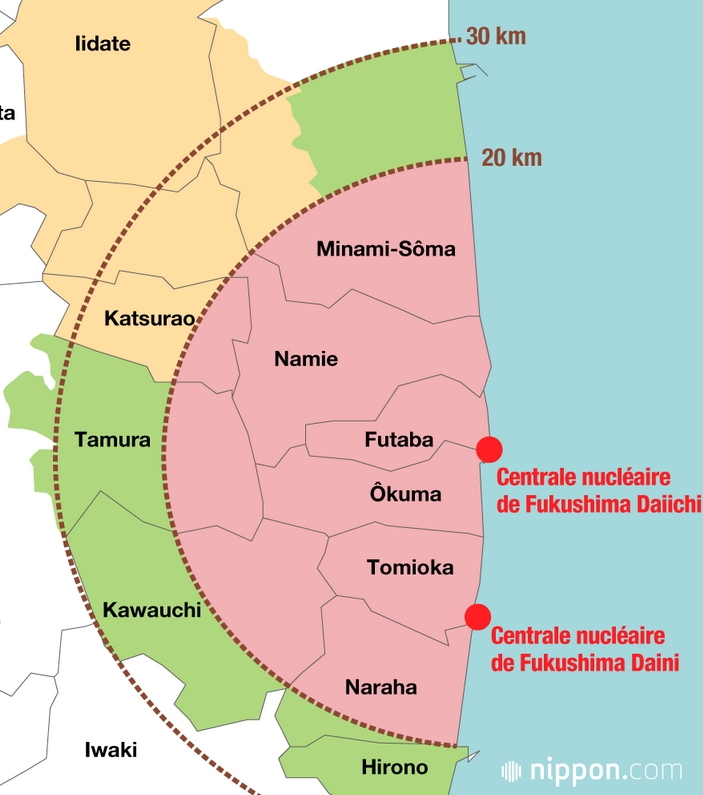
Officials in Japan plan to lift an evacuation order for part of the area designated as a “difficult-to-return” zone in Fukushima Prefecture due to high radiation levels from the 2011 nuclear accident.
An evacuation order remains in place for the Noyuki district, which covers about 20 percent of Katsurao Village.
Authorities aim to lift the order in about six percent of the district, which has received preferential treatment for decontamination work and infrastructure projects.
Sources say a briefing for residents about the result of the rebuilding work is scheduled for Sunday, after a delay due to the coronavirus pandemic.
The sources say officials from the central and prefectural governments and the village are making arrangements to lift the order on June 5 at the earliest.
It would be the first case in which people will be able to return to their homes in a “difficult-to-return” zone. Katsurao Village officials say eight people from four households are hoping to return to the area.
Fukushima farm products still dealing with negative image

April 24, 2022
NIHONMATSU, Fukushima Prefecture–Rice farmer Toshio Watanabe felt strongly embarrassed when he saw the estimate for the selling price of rice to be harvested in 2022.
Farm products of Fukushima Prefecture faced consumer pullback and canceled orders following the Fukushima No. 1 nuclear power plant disaster of 2011.
“People drive a hard bargain against rice from Fukushima Prefecture, which they buy only at lower prices than products of other prefectures, even for the same quality and taste,” said Watanabe, who farms in Nihonmatsu, Fukushima Prefecture.
“We could have put up a good fight if only it had not been for the nuclear disaster. As things stand now, however, we have ended up as the sole loser.”
More than 11 years on, farmers like Watanabe and the public sector in this northeastern prefecture still continue to struggle with lingering reverberations of the effects of negative publicity due to radiation fears.
FUKUSHIMA RICE THE ‘SOLE LOSER’
A document distributed by a local farming association in late February said this year’s rice crop is likely to sell at only 9,500 yen ($77) per 60 kilograms, falling below the 10,000-yen mark for the second straight year.
A rice farmer risks posting a deficit when the take-home selling price is less than 10,000 yen per 60 kg, considering the current production cost of nearly 9,000 yen per 60 kg.
Farmers will likely have to endure difficulties this year like they did in 2021, when rice prices dropped sharply due to a general oversupply and weak demand in the restaurant industry.
Rice harvested in Fukushima Prefecture disappeared from many supermarket shelves following the nuclear disaster, as consumers avoided Fukushima labels due to radiation fears.
More than 11 years on, rice grown in the prefecture has seen its market ratings always stuck in the lower reaches, with trading prices hovering below the national average.
Rice of the Koshihikari variety from the Nakadori (central strip) area of Fukushima Prefecture, which contains Nihonmatsu, was being traded at 11,047 yen per 60 kg, down 17 percent year on year, according to a preliminary report on the “direct trading prices” of rice harvested in 2021, which the farm ministry released in February.
The average price of all brands from all areas of Japan stood at 12,944 yen per 60 kg, down only 11 percent from the previous year. That means the gap has only spread.
CONSUMERS SHOWING MORE UNDERSTANDING
Apart from rice, peaches, grapes and other farm products, which face harsh competition from rivals grown in other prefectures, have also seen, over the past several years, their market trading prices remain stuck nearly 10 percent below the national average.
“Dealers from other prefectures sometimes decline to take products of Fukushima Prefecture when there is too much of products from a good harvest,” said the president of a wholesaler based in the prefectural capital of Fukushima that has dealt in fruits and vegetables from the prefecture for more than 50 years.
“Negative publicity effects remain deep-rooted overseas,” said Koji Furuyama, a 46-year-old farmer who grows peaches and apples in the prefectural capital.
Furuyama has aggressively been venturing into overseas markets. In 2017, for example, he exported peaches to a department store in Thailand.
Following the nuclear disaster, however, food products from Fukushima Prefecture came under embargoes and other import restrictions by 55 nations and regions of the world, 14 of which continue to impose restrictions of some kind or another.
The central government and Tokyo Electric Power Co., operator of the crippled Fukushima No. 1 nuclear plant, have decided to release treated contaminated water from the plant into the ocean.
The water release, which will start as early as spring next year, could cause additional negative publicity effects, Furuyama said.
By comparison, effects of the negative public image are seldom perceptible these days in food items for which product differentiation is feasible, such as by supplying the items in large amounts when there are few shipments of rival products from other prefectures.
Figures of the Tokyo Metropolitan Central Wholesale Market show that vegetables from Fukushima Prefecture, such as tomatoes and cucumbers, have been priced above the national average over the past several years.
Consumers are coming to show more understanding toward the prefecture’s food products.
In a survey conducted by the Consumer Affairs Agency in February 2022, only 6.5 percent of the respondents said they hesitate to buy food products from Fukushima Prefecture for fear of radiation. The percentage is the lowest ever and is below the 10-percent mark for the second straight year.
SALES PROMOTION CAMPAIGN ALONE ‘NOT ENOUGH’
The government of Fukushima Prefecture has so far allocated large chunks of post-disaster rebuilding budgets for campaigns against negative publicity and for sales promotion.
A centerpiece of the latest years, among other things, is a program for promoting sales on major online marketplaces operated by Amazon.com Inc., Rakuten Group Inc. and Yahoo Japan Corp. Dentsu East Japan Inc., an ad agency, has been commissioned to operate the project.
In fiscal 2020, the program earned proceeds of about 3.4 billion yen, a record since the project started in fiscal 2017, although more than 500 million yen was spent on subsidizing the initial costs for sellers on the marketplaces and issuing discount coupons worth 10 to 30 percent.
In fiscal 2021, the prefectural government project earned sales of more than 2.6 billion yen on a consignment budget of only 360 million yen.
That is not bad in terms of cost-effectiveness. However, that is tempered by the fact that marketing efforts that rely on coupons do not necessarily help empower the production areas, and no information is provided to sellers that would allow them to analyze what kind of customers purchased which products.
“This program is premised on the availability of the post-disaster rebuilding budgets,” said an official in charge of the project. “It is certainly not sustainable.”
“Fukushima Prefecture’s products stuck in low price ranges would need to venture into new markets other than the existing ones, but such a venture can seldom be achieved through public relation efforts of the public sector and an ad agency alone,” said Ryota Koyama, a professor of agricultural economics with Fukushima University.
He added: “More money should be spent on production areas to support efforts for improving breeds and the equipment.”
Fukushima farmers’ efforts serve to undo TEPCO’s damage

April 19, 2022
About Fukushima farmers’ compensation, here is the Tweet thread posted by Mako Oshidori (see note at bottom) translated by us :

“The financial compensation given to farmers after the nuclear accident is designed so that the difference between sales before and after the accident is paid to them as compensation for ‘image damage.
Farmers are developing their own varieties, developing their own sales networks, and conducting experiments to limit the transfer of cesium from the soil to the vegetables.
As a result of all these efforts, when sales returned to pre-accident levels, the compensation became zero.
“Thus, our efforts serve to cancel the damage caused by TEPCO!”

2) Cesium in the soil is still present, so “this is not just an image problem, but real damage.”
Members of the Fukushima Farmers Federation continue to renew their demands for “radiation protection policy for farmers.”
It is TEPCO that benefits from the effects of the slogan “Eating Fukushima products for solidarity” which leads to reducing the amount of compensation received by farmers.
Moreover, if a farmer does not continue to operate in Fukushima, there will be no compensation.

3) Farmers in Fukushima have been trying to find a way to prevent the transfer of cesium from the soil to the crops.
In the years immediately following the accident, vegetables from neighboring counties have been found to have higher levels of cesium than those from Fukushima.
There are still agricultural lands with surface contamination above the standard of the radiation control zone defined by the Ordinance on the Prevention of Radiation Risks.
Negotiations for the establishment of the radiation protection policy for farmers are continuing this year.
Note:
The couple Mako and Ken OSHIDORI are known in Japan as manzaishi (comedy duo in the style of folk storytellers). As soon as the Fukushima nuclear accident began in March 2011, Mako decided to attend TEPCO press conferences in order to access information that was dramatically missing from the media. With the help of Ken, her husband and work partner, she became a freelance journalist, one of the most knowledgeable on the Fukushima issue, and feared as such by TEPCO.
https://nosvoisinslointains311.home.blog/2022/04/19/les-efforts-des-agriculteurs-servent-a-annuler-les-actes-prejudiciables-de-tepco/?fbclid=IwAR1Q9OkhLPO07bp6RxeTxwqHZ-U5HO4Wwaj_igq-aK7dunkrkKvx9J_jy1Y
New research institute to open near Fukushima plant next year

April 17, 2022
The area devastated by the Fukushima nuclear accident will host an international research and education institute in April next year, which would significantly boost the population around the crippled nuclear power plant.
Hundreds of researchers are expected to work on five areas, including energy, robotics for reactor decommissioning, and agriculture, forestry and fisheries.
The government’s Reconstruction Promotion Council, presided over by Prime Minister Fumio Kishida, decided on the outline of the organization on March 29.
The institute will be located in the eastern part of Fukushima Prefecture known as Hamadori as part of the reconstruction efforts from the 2011 nuclear accident.
The government will finalize the site by September after consulting with local officials and residents, but the facility will likely be built around Tokyo Electric Power Co.’s Fukushima No. 1 nuclear plant, sources said.
The project cost, however, remains unclear.
The institute will have dozens of employees when it opens.
The organization will provide investments and technical assistance to startups and other enterprises to create local jobs, while it will work with the International Atomic Energy Agency (IAEA) to nurture human resources.
An estimate presented by the Reconstruction Agency at an expert meeting in May 2020 shows the local population will increase 30 to 40 percent due to the migration of some 5,000 people in connection with the institute.
Some have questioned whether the institute is needed, given that many existing national research and development centers are already studying similar topics.
In response, researchers working on selected subjects, such as radioactive materials, at the prefectural offices of the Japan Atomic Energy Agency, the National Institutes for Quantum Science and Technology and the National Institute for Environmental Studies will be redeployed to the new center together with related research equipment and facilities.
Discussions will also begin over consolidation of another robot research facility set up by the industry ministry and the prefecture into the institute.
Don’t discharge contaminated water into the sea! Nationwide simultaneous standing in Iwaki

April 13, 2022
On April 13, 2021, one year after the government decided on the disposal of contaminated water stored in tanks from the Fukushima Daiichi Nuclear Power Plant accident, in violation of its promise to the fishing industry that no disposal would take place without the understanding of all concerned parties, and ignoring the opposition and cautious opinions of 70% of the local government councils in Fukushima Prefecture and the opposition of many Fukushima residents One year has passed.
On April 13, “April 13 National Simultaneous Standing in Iwaki Against Discharge of Contaminated Water from Nuclear Power Plants into the Sea” was held near the entrance intersection of Aquamarine Fukushima at Onahama Port in Iwaki City.
Since last June, we have been calling for a monthly standing on the 13th of every month, “Don’t pollute the sea any more! Citizens’ Council”, which has been calling for standing on the 13th every month since June last year, started the event after noon with the slogan “Protect our hometown oceans! Protect our fisheries! Protect our children!” From 12:30 p.m., about 20 participants spoke against the discharge of contaminated water into the ocean from their respective standpoints.
Mr. Oda, the co-chairperson of the event, said, “One year has passed since the government’s decision on April 13 to discharge contaminated water into the ocean, so let’s not pollute the sea any more! He reported on the release of the “Appeal” and the citizens’ groups’ online joint press conference, and appealed, “We will continue to raise our voices to protect our precious daily lives. Mr. Yoneyama of the Citizens’ Council also spoke with the Citizens’ Circle to Monitor Nuclear Regulations, FoE Japan, an international environmental NGO, and Don’t Pollute the Sea Anymore! The report was based on the “Submission of a written request and negotiations with TEPCO and the government demanding the cessation of the discharge of contaminated water from the Fukushima Daiichi Nuclear Power Plant” held on March 29 by four organizations: the Citizens’ Council of Japan, the Kansai Liaison Conference for the Evacuation Plan, and the Kansai Liaison Conference for the Evacuation Plan. The speaker appealed to the audience. Prefectural Councilor Furuichi also reported on how the Fukushima Prefectural Assembly continued to review the “petition for a cautious response to the application for prior consent regarding the ALPS process water discharge facility” submitted to the assembly, and stressed the significance of citizens’ continued opposition activities. Mr. Yuzuru Suzuki, professor emeritus at the University of Tokyo and former director of the Fisheries Experiment Station, also spoke about what would happen to fish if tritium and other contaminated water were to be released, saying that they are currently in the process of collecting data before the release of water. He expressed his determination that even if the release of contaminated water were to be forced, he would continue marine research to clarify the effects of radiation and force the cancellation of the project. After this, citizens continued to demonstrate their will by making one appeal after another.
The public comment on the draft review report will be held once the review meeting for the “Application for Approval of Changes to the Implementation Plan” for the basic design of the “ALPS process water” dilution and discharge system and related facilities, which TEPCO applied to the Nuclear Regulation Authority at the end of last year, is completed on March 15. After that, if Fukushima Prefecture, Okuma Town, and Futaba Town give their approval to the “Request for Prior Approval,” construction will begin in June.
The oceans of our hometown, the oceans of Japan, and the oceans of the world must not be further polluted by radiation.
Let’s not allow the construction of the discharge facility to start in June, and let’s spread our voices of opposition and our standing circle across the country and the world like a ripple to a giant wave in order to stop the discharge of radioactive materials one year later.
On May 13, together with standing, we will prepare and call for an action to demand the halt of the start of construction of the discharge facility.
Let us all protect the oceans of our hometown, the oceans of Japan, and the oceans of the world.
Contaminated soil piles up in vast Fukushima cleanup project

March 18, 2022
More than a decade of decontamination efforts around the crippled Fukushima Daiichi Nuclear Power Plant has allowed thousands of evacuees to return home. But there are still some areas off limits due to the radiation levels. And as contaminated soil piles up, former residents are wondering when, or if, they will go back.
The cleanup work started soon after the nuclear accident in March 2011. The nuclear disaster discharged radioactive particles across Fukushima and neighboring prefectures. More than 70 percent of Fukushima’s municipalities were registering radiation levels above the national safety standard. Decontamination was key to making the region safe again and reviving local industries.
Workers have been removing radioactive topsoil, grass, trees, and building materials. The scale and expense of the project is vast. The Japanese government has already spent more than $43 billion on decontamination efforts.

Storage facility worries residents
The contaminated soil and waste was piling up in residential areas and hindering reconstruction efforts, so the government decided to build temporary storage facilities on land stretching across the towns of Futaba and Okuma which host the nuclear plant. It occupies a 1,600-hectare site—nearly five times the size of New York’s Central Park.

Since 2015, about 1,000 trucks have been arriving daily and dumping around 7,000 bags of soil. The Environment Ministry says workers have moved almost 13 million cubic meters of it so far.
The government introduced a law requiring the soil to be moved out of Fukushima Prefecture by 2045. But the people of Fukushima, especially those who used to live near the site, are worried it will become a permanent fixture.
“There is concern that this will become a final disposal site, but I understand that it’s inevitable that people will have to accept it,” says an 84-year-old man who once lived on the site. “I don’t think I will be alive in 30 years, but I want them to put my land back the way it was.”
Promising research
In a bid to reduce the overall amount of waste, crews are sorting the material at the facility to separate what can be burned. It is hoped that some of the soil can be reused.

The Environment Ministry is looking at whether it can use the soil to grow vegetables or build roads. Research on food cultivation in the area has found radiation levels below official standards.
So far, the research has been limited to one district of Fukushima. The Environment Ministry is planning to commission further studies aim to help people understand what’s possible and, most importantly, what’s safe.
A final disposal site
The biggest challenge for the national government is to find suitable land outside of Fukushima for final disposal. Officials have been running a public awareness campaign to try to find support for a location. So far, no municipality has volunteered to be the host.
Despite the lack of progress, the government is adamant it remains committed to its deadline.
“We have promised the local government we will dispose of the waste outside the prefecture by March 2045,” says Environment Ministry official Hattori Hiroshi. “Since it is required by law, we will fulfill the promise. Of course, we are fully aware of the voices of concern from local people.”
High radiation zones remain
Officials say the project to transfer contaminated soil to an interim storage site will be largely completed by the end of this month, but in parts of Fukushima—including the towns of Futaba and Okuma—the radiation levels are relatively high and full-scale decontamination work has not yet begun. And more than 30,000 people still are not able to return their homes.

Not one of the former residents of Futaba has returned to live there full-time. Local officials are hoping to allow some back in June for the first time. But an official survey found that more than 60 percent of the former residents have no intention of returning. Only about one in ten said they want to return. Almost a quarter of respondents say they haven’t made their minds up yet.
Many of the evacuees have already restarted their lives elsewhere. The central and local governments are hoping they can attract new residents to the area and are offering $17,000 to anyone who makes the move.
But for those former residents undecided about returning, safety concerns are paramount. They want to know if the decontamination work will be completed and the soil will be moved. They also want more clarity about the decommissioning work at the crippled plant. The government has promised that will be completed by 2051 at the latest, but details are scant.
Contaminated soil from nuclear power plant, destination yet to be determined…

March 12, 2022
Seven years have passed since the operation of the interim storage facilities that surround TEPCO’s Fukushima Daiichi Nuclear Power Plant began. The delivery of contaminated soil from the decontamination of the nuclear accident is expected to be almost completed by the end of this month, except for that from the difficult-to-return zone. Although Fukushima Prefecture has legislated that the contaminated soil must be removed from the prefecture by 2045, the destination of the soil has yet to be decided.
After the nuclear accident, more than 17 million cubic meters of contaminated soil and waste from decontamination in Fukushima Prefecture have been generated. Because it is unrealistic to dispose of such a large amount of waste, the government hopes to reuse the contaminated soil, which has a relatively low concentration of radioactive materials, as a “resource” for public works projects and agricultural land. The target is soil with a level of 8,000 becquerels per kilogram or less, which currently accounts for three-fourths of the total. Furthermore, it is estimated that up to 97% of the material will be reusable by the year 45 due to natural attenuation and other factors.
However, at this point, only a little less than 1 million cubic meters will be used for a demonstration project in Iitate Village, Iitate Prefecture, to demonstrate the use of agricultural land. It would be nice if it could be used for large-scale public works projects such as port reclamation, but in this day and age, there is no need,” said a Ministry of the Environment official.
Eleven years after the earthquake, there is not even a clear destination for the contaminated soil. Residents are expected to protest if attempts are made to reuse the soil, and zero governors have responded that they would be willing to accept it. In municipalities that do not have interim storage facilities, the contaminated soil is “stored on-site” and can be found in residential areas in the Tokyo metropolitan area.
Survey of 46 prefectural governors: Zero governors responded that they were “willing to accept” the waste.
It is not easy to gain the understanding of residents. In 2006, the Japanese government planned to use the contaminated soil for a demonstration project to widen an expressway in Minamisoma City. However, local residents protested one after another, saying that it was the same as final disposal and that their crops would be damaged by harmful rumors, and in March of last year, the government informed the residents of its decision to abandon the project.
The residents of the area were not happy with the decision.
https://www.asahi.com/articles/ASQ3C5DZTQ33UGTB00X.html?fbclid=IwAR1ro_tQJZMsG_kr6rXgKCqXHdvix-WmRG5uwcEaEYzuPRFkji3w7PAfJxo
Man who shot famed tsunami video turned lens on Fukushima’s future

March 15, 2022
NAMIE, Fukushima — The schoolyard of an elementary school is empty of children, with only rusted playground equipment left on the barren soil. An elderly man looks wistfully around the shrine with cherry blossoms in full bloom.
“During cherry blossom season, children used to come here on field trips,” he says.
It is a scene from a 2016 documentary that chronicled the lives of people in Fukushima Prefecture affected by the March 2011 disaster in the context of the cherry blossom viewing season.
Titled “Fukushima Sakura Kiko” (Fukushima cherry blossom travel story), it was filmed in the spring of 2015 in the Odaka district of Minami-Soma, Fukushima Prefecture, by Takashi Hokoi, a former NHK news cameraman who currently is pursuing a career as an artist based in Fukushima.
The Odaka district, about 15 kilometers north of Tokyo Electric Power Company Holdings, Inc.’s Fukushima No. 1 nuclear power plant, was still under an evacuation order at the time.
Seven years have passed since Hokoi, now 37, shot the documentary.
“I can hear the sound of a lawn mower,” Hokoi said with a slight smile when he revisited the district earlier this month.
With the evacuation order lifted, there are signs of life again, such as windows with open curtains. He knows that many people have not yet returned, but it is a welcome change.
The documentary was widely shown when it was released. However, Hokoi has a much more well-known video to his name, one that was circulated all over the world.
It was also one of the reasons that Hokoi left the world of journalism.
A foaming tsunami wave powers upstream in a river and floods the Sendai Plain. Houses and cars are instantly swallowed up by the wall of water.
The scene was broadcast live from an NHK helicopter at about 3:50 p.m. on March 11, 2011. Recording the destruction was Hokoi, who was in his first year as a cameraman.
Hokoi was working for the NHK Fukushima broadcasting station. He was at Sendai Airport on the day of the disaster. From an NHK helicopter, he was dumbstruck by the scene below and aimed his camera to the ground.
Tsunami waves crashed over main roads and swirled around, and houses were washed away or on fire. As he tried to come to grips with the reality-defying scene, one thought pervaded his mind: There must be people in those houses, in those cars.
The shocking video was given an award by the Japan Newspaper Publishers and Editors Association in September 2011. But Hokoi felt guilty receiving such praise. “All I did was escape to a safe place and film what I was told to,” he thought.
In 2013, NHK spoke to him about a transfer. But he decided to resign, and remained in Fukushima. He had a sense of guilt about leaving the disaster-hit area just two years after shooting such scenes and seeing its future as somebody else’s problem.
After leaving NHK, the idea for the documentary featuring cherry blossoms and people in Fukushima Prefecture came to him, all because of one person he had known.
Yuichi Harada was the third-generation owner of a clock shop and chairman of a local chamber of commerce and industry in the town of Namie, Fukushima Prefecture. In 2014, while Hokoi was planning to create a video about the disaster at the request of his university, Harada guided him around the town, which was still under evacuation orders.
Harada, now 72, had evacuated to the city of Nihonmatsu to the west, where he organized a community of displaced Namie residents and negotiated with TEPCO over compensation. All the while, he also continued tending to cherry trees along a river in Namie with other volunteers.
“If someone returns to the town and the cherry trees in bloom bring back memories, it might change how they feel,” Harada said.
That really hit home for Hokoi, that someone who had lost their beloved hometown could be so optimistic, believing that one day it would return.
Hokoi decided to depict present-day Fukushima through cherry blossoms, the symbol of spring and hope.
Since this spring, Hokoi has been working on a sequel to “Sakura Kiko.” He is motivated because, while interest in Fukushima Prefecture may be fading, the situation there is now more complicated.
Harada continues to look after the cherry trees today. As people could not return to Namie, he was never able to restart his business, and his store was torn down about six years ago.
The evacuation order for his hometown has since been lifted, but Harada has given up on ever returning to Namie. He thinks about moving to Ibaraki Prefecture, where his eldest daughter lives, but his mother, now in her 90s, wants him to stay in Nihonmatsu.
“Life is hard, isn’t it?” Harada said with a sad smile as he gazed at the cherry trees with Hokoi.
The strength of our desires does not necessarily make them come true. That is the harsh reality of disasters. “I want to continue following the lives of people in Fukushima Prefecture and try to find what reconstruction really means,” Hokoi said.
He will continue to face the disaster head-on.
■ Evacuation orders
Soon after the nuclear accident at the Fukushima No.1 nuclear power plant, the government designated an area within a 20-kilometer radius as a “warning zones” (evacuation order zones).
Areas outside that zone experiencing high levels of radiation were designated as “planned evacuation zones,” and the government demanded that residents in both zones evacuate.
The range of evacuation orders as of April 2012 extended to all or part of 11 municipalities, but that number has since decreased to the present-day seven.
Within those seven municipalities are areas designated as “difficult-to-return zones,” some of which are being developed as key reconstruction bases to provide a foothold for returning residents.
1 This Month

of the week – Shut Down Drone Warfare!


Tell the Ukrainian Government to Drop Prosecution of Peace Activist Yurii Sheliazhenko

Petition to revoke the licensing of the Near Surface Nuclear Disposal Facility (NSDF) at Chalk River. https://www.ourcommons.ca/petitions/en/Petition/Details?Petition=e-7247
To see nuclear-related stories in greater depth and intensity – go to https://nuclearinformation.wordpress.com
-
Archives
- March 2026 (244)
- February 2026 (268)
- January 2026 (308)
- December 2025 (358)
- November 2025 (359)
- October 2025 (376)
- September 2025 (257)
- August 2025 (319)
- July 2025 (230)
- June 2025 (348)
- May 2025 (261)
- April 2025 (305)
-
Categories
- 1
- 1 NUCLEAR ISSUES
- business and costs
- climate change
- culture and arts
- ENERGY
- environment
- health
- history
- indigenous issues
- Legal
- marketing of nuclear
- media
- opposition to nuclear
- PERSONAL STORIES
- politics
- politics international
- Religion and ethics
- safety
- secrets,lies and civil liberties
- spinbuster
- technology
- Uranium
- wastes
- weapons and war
- Women
- 2 WORLD
- ACTION
- AFRICA
- Atrocities
- AUSTRALIA
- Christina's notes
- Christina's themes
- culture and arts
- Events
- Fuk 2022
- Fuk 2023
- Fukushima 2017
- Fukushima 2018
- fukushima 2019
- Fukushima 2020
- Fukushima 2021
- general
- global warming
- Humour (God we need it)
- Nuclear
- RARE EARTHS
- Reference
- resources – print
- Resources -audiovicual
- Weekly Newsletter
- World
- World Nuclear
- YouTube
-
RSS
Entries RSS
Comments RSS
 nuclear-news