News outlets worldwide are reporting that at least 66 residents of Japan have died as a result of Typhoon Hagibis. Our hearts reach out to the people of Japan and the families of the deceased.
The news coverage from Reuters caught our attention due to its research that Fukushima Prefecture was apparently the region hardest hit by the typhoon. According to the Reuters story entitled: Rescuers slog through mud as Japan typhoon death toll rises to 66:
“The highest toll was in Fukushima prefecture north of Tokyo, where levees burst in at least 14 places along the Abukuma River, which meanders through a number of cities in the largely agricultural prefecture. At least 25 people died in Fukushima, including a mother and child who were caught in flood waters, NHK said…. Residents in Koriyama, one of Fukushima’s larger cities, said they were taken by surprise by the flooding. Police were searching house-to-house to make sure nobody had been left behind or was in need of help.
“The river has never flooded like this before, and some houses have been completely swept away. I think it might be time to redraw hazard maps or reconsider evacuation plans,” said Masaharu Ishizawa, a 26-year-old high school teacher …”
Fukushima prefecture is very mountainous and largely remote. The radioactive fallout, which spread throughout Japan after the three Fukushima nuclear meltdowns in 2011, is impossible to clean up in these inaccessible mountainous areas that lie throughout Fukushima Prefecture. Even in populous Tokyo, more than one-year after the meltdowns, Fairewinds’ research identified randomly selected Soil Samples Would Be Considered Nuclear Waste in the US, which we discussed in the video on Fairewinds’ website.
It is our belief from our ongoing research that the ensuing flooding induced by Typhoon Hagibis is moving significant amounts of radiation from high in the mountains down to cities, towns, and farmland in Japan. Our analysis on several radiation sampling trips to the prefecture proves that there are huge amounts of residual radiation that were previously trapped in the soil.
Now, due to the heavy rain, subsequent river flooding, and burst levees (dams) this radioactive soil is moving and being pushed from the mountains down into more populous areas where people live and crops are grown. Once again it appears that government authorities and rescue organizations are ignoring this new, long-term threat, or have not been apprised by the JAEA (Japan Atomic Energy Agency) and nuclear power industry of the monumental health risks involved.
October 20, 2019
Posted by dunrenard |
fukushima 2019 | Flooding, Fukushima Prefecture, radiation, Typhoon Hagibis |
Leave a comment
For bags made to resist only 3 years, they fared incredibly well in this powerful typhoon, that after 8 years, more than double their resistance expectancy….
The lies and cover-up continue:
Koizumi (Environment Minister) insists that “there won’t be any impact on the environment” regarding radioactive bags swept away by the typhoon.
Koizumi said, “I’ve received reports that large bags that have already been collected were not damaged, so there won’t be any impact on the environment.”
Anyway, the radioactive bags are not the main problem. The main problem is the accumulated radionuclides in the forested hills of Fukushima prefecture, 80% of its land surface. Which have never been decomtaminated. that powerful typhoon has redistributed a lot of those forested hills radiation everywhere…. To be inhaled by people….
The plan is to bring the 17 million tons of radiactive bags scattered allover the Fukushima prefecture to the intermediary storage location build between Okume and Futaba, to separate the debris from the soil, to incinerate the debris, so as to reduce the volume of incinerated debris by 50. To store the resulting high radiation waste for the 30 years before to find somewhere a final storage site, and to recycle the low radiation waste into roads and building construction….http://josen.env.go.jp/en/storage/
17 million radioactive bags resulting from multiple partial decontamination of the residence areas and some of the agricultural fields, from less than 20% of the Fukushima prefecture land surface. 80%, the forested parts, hills and mountains have never been decontaminated. And from those the accumulated radionuclides are ruisseling down to the previously decontaminated places, recontaminating them, during the raining season, the typhoon redistributing thos radionuclides all over Fukushima and even outside Fukushima to other prefectures. A never ending story.
Typhoon response dominates diet debate
The government’s response to Typhoon Hagibis dominated Tuesday’s debate in the Diet.
Opposition lawmakers grilled the government on its handling of the storm, including why radioactive waste produced after the 2011 nuclear disaster was not properly protected.
Multiple bags of waste produced from decontamination efforts flooded into a river in Fukushima.
Environment Minister Shinjiro Koizumi says local officials found 10 bags that had been swept away by the storm and are investigating whether there are any more.
Koizumi said, “I’ve received reports that large bags that have already been collected were not damaged, so there won’t be any impact on the environment.”
Another issue debated was the management of emergency shelters.
Opposition members pointed out that a municipality in Tokyo did not accept homeless people at some evacuation centers.
Yuko Mori of Democratic Party for the People said, “We should respect the basic human rights of disaster victims and provide necessary facilities for them. That’s a basic principle.”
Prime Minister Shinzo Abe replied, “I think it would be desirable for each evacuation center to properly accept all people. We will examine what really happened with the local governments and take appropriate measures.”
October 20, 2019
Posted by dunrenard |
fukushima 2019 | Fukushima Prefecture, Lies & Cover-up, Typhoon Hagibis |
Leave a comment
Some facilities that had been damaged in 2011 were hit again over the weekend in a region of Japan that can never seem to catch a break.
A woman cleaning out her home in Koriyama, in Fukushima Prefecture, on Sunday. Typhoon Hagibis struck as the Japanese government was eager to declare the region recovered from the 2011 nuclear crisis.
KORIYAMA, Japan — For Hiroyoshi Yaginuma, the typhoon may well be the straw that breaks his back.
On Monday, Mr. Yaginuma, 49, a third-generation owner of an auto body shop in Fukushima Prefecture, was cleaning out the wreckage from Typhoon Hagibis, which battered Japan over the weekend and killed more than 70 people. The typhoon had brought record-setting rains that caused a levee to break on a nearby river, unleashing floodwaters that filled the first floor of his building, destroying everything.
It was only two years ago that Mr. Yaginuma finally finished paying off a $185,000 loan he had taken out to rebuild his shop in Koriyama, an industrial city in Fukushima, after it was badly damaged by a devastating earthquake and tsunami in 2011.
Fukushima is the name that everyone remembers from that disaster eight years ago. It was in this prefecture that waves from the tsunami overpowered a nuclear power plant’s protective sea walls, setting off a catastrophic meltdown. Tens of thousands of people were evacuated; many have still not returned.
An aerial view of Koriyama on Sunday.
On Monday, as Mr. Yaginuma surveyed the garage floor where demolished equipment and heaps of tires, hubcaps and oil cans were drowning in a mess of mud, he said he wasn’t sure he could summon the energy to rebuild his business all over again.
“I am thinking maybe now this is the end,” he said. “I think there is a possibility that this will be a place where not many people can live anymore.”
Typhoon Hagibis struck as the Japanese government and many municipal leaders were eager to declare Fukushima recovered from the 2011 crisis.
“I am thinking maybe now this is the end,” said Hiroyoshi Yaginuma, the owner of an auto body shop in Koriyama.
Critics have said that narrative was already too rosy. The cleanup at the Daiichi nuclear plant is far from complete. The government has yet to decide what to do with more than one million tons of contaminated water stored in close to 1,000 tanks on the site.
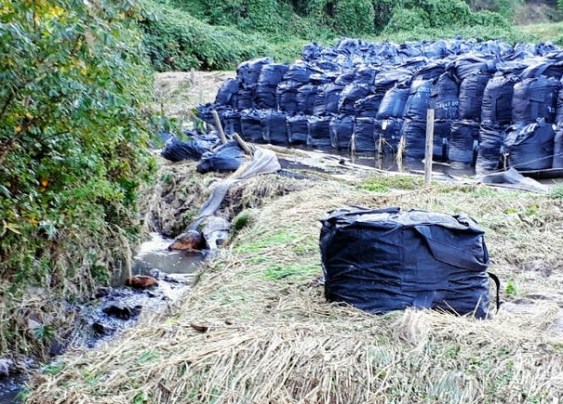
Soil scraped from land that was exposed to radiation in the days after the nuclear accident is still stored in millions of industrial-strength plastic bags all over the prefecture. In the city of Tamura, the floodwaters displaced an unknown number of these bags from a temporary storage area, although 10 bags were later recovered undamaged.
Now the region will have to undergo a more intensive cleanup to recover from the typhoon, especially as a stadium 55 miles west of the Daiichi plant prepares to host baseball during the Tokyo Summer Olympics next year.
Storage tanks holding contaminated water at the Daiichi nuclear power plant last year.
The storm inundated several communities throughout Fukushima with floodwaters from the Abukuma River. According to NHK, the public broadcaster, 25 people died in Fukushima because of the typhoon.
Some facilities that had been damaged in 2011 in Koriyama, less than 45 miles from the nuclear plant, were hit again over the weekend. A hospital that was knocked out for two months by the earthquake, for example, flooded this time around.
On Monday, many neighborhoods were still underwater. Where the waters had receded, residents and business owners went back to retrieve what little was salvageable.
In an industrial park off the banks of the Abukuma, couches, bookshelves, desks and office chairs sat along roadsides, awaiting garbage pickup. As rain fell again, workers hosed down walls and mopped up floors.
Workers checking a power line in Koriyama
At Sanko Mokuzai, a company that sells wood stoves and lumber, the chief executive, Toshiyuki Iwasaki, 63, joined several workers to load water-damaged wood panels onto a flatbed truck.
The Fukushima nuclear disaster had already forced him to find another source of timber after the government forbade sales of lumber harvested from the prefecture over radiation fears.
Yet even with the pileup of natural and man-made disasters, he said he could not afford to move because of local connections built over the company’s 50-year history.
“If I have to move,” Mr. Iwasaki said, “I will have to abandon my business.”
Still, he said he had little appetite for some of the government cheerleading for Fukushima’s recovery.
“I don’t really have any ambitions for Fukushima,” he said. “We just have to do what we need for ourselves. We are not really thinking, Let’s do this for Fukushima.”
Although the region’s population overall has dropped and those over 65 now account for close to a third of the population, Fukushima’s plight has attracted a few new residents who hope it might still be revived.
Naohisa Fujita, 46, and his wife, Yumi, 34, said they had moved to Koriyama from Nagano in 2013 because they wanted to help the people of the region.
Yasuko Kokubun found her daughter’s wedding album intact as she cleaned her house after the typhoon.
Early Monday morning, Mr. Fujita, who works in home maintenance and renovation, got a chance to help someone directly. When he and two other residents took a boat to inspect the damage from the typhoon’s floods in their neighborhood, they rescued an older man and his son who were stranded inside their home.
The Fujitas said they were anxious about how soon they could move back to their flooded first-floor rental apartment after cleaning it out. They acknowledged they might have to find a new place to live.
Still, Ms. Fujita was determined that they stay in Koriyama. “We have to work to make this place livable,” she said.
In 2011, about 9,100 people who had lived in villages elsewhere in Fukushima evacuated to Koriyama. Many of them put down roots and stayed.
But about 10,000 Koriyama residents decided to leave in the aftermath of the nuclear meltdown.
Those who remained have built up a resilience in the face of repeated setbacks.
“There is the disaster fatigue of these people who have been hit by all these disasters,” said Kyle Cleveland, a professor of sociology at the Tokyo campus of Temple University, who has written extensively about the response of Fukushima communities to the 2011 nuclear crisis.
“But I think it tends to breed a sense of fatalism,” he added.
That sense of resignation could be felt at Takase Elementary School in Koriyama, where about 400 people sought shelter from the typhoon and more than 230 remained on Monday.
Yukari Yoshinari, 22, who was there with her husband and 2-month-old son, as well as her older sister and her family, was overwhelmed but stoic about the flooding of her home.
Members of the Yoshinari and Yamanobe families were evacuated to an elementary school.
Sitting on the floor of the gym on cardboard mats covered with thin foam pads, Ms. Yoshinari, who is on maternity leave from her job as a caregiver at a nursing home, and her sister, Satomi Yamanobe, 24, folded clothes they had taken to a local laundromat.
Two nights as evacuees had been taxing. The baby had trouble sleeping with bright lights on all night. There were no diapers and only minimal food. When the Yoshinaris went to inspect their home, the floodwaters still came to their hips and they could see that their electronic appliances, tatami straw floor mats and furniture had been destroyed.
But there was no question of moving out of Koriyama. “I have grown up here,” said Ms. Yoshinari, as she rocked her son, Ayuto, to sleep on her shoulder. “It would take too much courage to leave.”
“But,” she added, “I would not recommend anyone else to move into Koriyama.”
October 20, 2019
Posted by dunrenard |
fukushima 2019 | Fukushima Prefecture, Typhoon Hagibis |
Leave a comment
The real problem, more than bags of radioactive waste flushed into rivers, is the dispersion of radioactive contamination by the flood. Contaminated land and radionuclides move to homes coming from mountains and forests that had never been decontaminated.
In addition, the deposition of contaminated sludge at the bottom of rivers and dams has been disturbed and dispersed. When the sludge is dried and the dust disperses in the air with the wind, increasing highly the risk of the internal irradiation by inhalation.
Flexible bulk bags containing waste produced from decontamination work around the Fukushima No. 1 nuclear power plant were swept away in flooding during Typhoon No. 19 in Tamura, Fukushima Prefecture.
Bags of debris from Fukushima disaster swept away in typhoon
TAMURA, Fukushima Prefecture–Bulk bags filled with greenery collected during decontamination efforts after the nuclear disaster at the Fukushima No. 1 nuclear power plant were swept into a river during Typhoon No. 19 on Oct. 12.
According to the Tamura city government, the bags were among 2,667 that have been stored temporarily at a site in the Miyakoji-machi district here.
The facility was flooded after heavy rains brought by the typhoon, and the water carried an unknown number of the bags to a river about 100 meters away.
A city government official received a phone call at around 9:20 p.m. on Oct. 12 from a nearby civil engineering firm, saying six of the bulk bags had been recovered from the river.
Each of the bulk bags was 1 cubic meter in size. No sheets had been placed over the bags as a precaution against the rain and wind from the typhoon.
A city official said consultations will be held with the Environment Ministry to determine possible effects on the environment.
The decontamination effort involved removing debris, such as soil, leaves and plants, containing radioactive substances released after the 2011 triple meltdown at the Fukushima No. 1 plant.
October 20, 2019
Posted by dunrenard |
fukushima 2019 | Fukushima Prefecture, Hagibis Typhoon, Radionuclides |
Leave a comment
Governor Masao Uchibori gave an update on progress in the Fukushima Prefecture, where the Olympic Games Tokyo 2020 are playing a key role in the reconstruction of the area affected by the 2011 tsunami.
He informed the IOC that the Fukushima Azuma Baseball Stadium is already being used. It will host baseball and softball competitions for Tokyo 2020, including the tournament opening matches. Football games will be played at nearby Miyagi Stadium.
The IOC President and Governor Uchibori also discussed the visit by a group of students from Fukushima to Lausanne on the occasion of the Winter Youth Olympic Games Lausanne 2020.
The Governor also gave reassurances on the safety issues with regard to food and radiation.
He emphasised the evaluation of the Food and Agriculture Organisation of the United Nations (FAO), which said: “Measures [taken by the Japanese authorities] to monitor and respond to issues regarding radionuclide contamination of food are appropriate, and the food supply chain is controlled effectively by the relevant authorities.” The Governor explained food safety is being constantly monitored by the FAO and that these levels can be considered as safe for all visitors.
Governor Uchibori explained that the radiation levels in 97.5 per cent of the Fukushima prefecture do not pose a risk and could, in fact, be compared to those found in major cities around the world. The remaining 2.5 per cent, where there is higher radiation, is fenced off and not accessible to visitors.
President Bach visited the tsunami-hit area of Fukushima in November last year with Prime Minister Abe. He met young athletes, toured some venues and witnessed the progress of reconstruction. He also saw there a number of students from the region whom he later welcomed to the IOC headquarters in Lausanne. President Bach invited them to join him at a softball game to be played in Fukushima during the Olympic Games Tokyo 2020. These young people are part of the “Support Our Kids” programme in which the Swiss Embassy in Japan is involved, and which supports children affected by the 2011 tsunami.
The IOC President will welcome a second group of students to Olympic House in Lausanne in January 2020 during the Winter Youth Olympic Games.
Many cities in the region affected by the 2011 earthquake will be a point of international sports exchanges as a “Host Town”. They will welcome teams from different countries and regions ahead of and during the Olympic Games Tokyo 2020.
In another symbolic gesture, Fukushima will also stage the first leg of the Olympic Torch Relay in the run-up to the Olympic Games next July.

October 20, 2019
Posted by dunrenard |
fukushima 2019 | 2020 Olympics, Fukushima Governor, Fukushima Prefecture, OIC, Olympic house |
Leave a comment
Lawyer Kiyoshi Morikawa, center, who represents evacuees in Tokyo from Fukushima Prefecture, speaks at a news conference in Tokyo on Oct. 3.
Fukushima Prefecture will take legal action to evict five households living in public housing in Tokyo who voluntarily evacuated from the prefecture following the 2011 nuclear accident.
The prefectural assembly on Oct. 3 approved in a majority vote plans to file a lawsuit against the evacuees, who are residing in the housing for government employees without signing a contract or paying rent.
The suit will also demand that the households pay a total of about 6 million yen ($56,190), which is between 500,000 yen and 2 million yen per household, equivalent to two years of rent.
All factions except for the Japanese Communist Party voted in favor, while an assembly member belonging to the Constitutional Democratic Party of Japan left before the vote. The prefecture plans to file the lawsuit within this year.
Rent-free housing for evacuees who left their homes located outside the government-designated evacuation zones ended at the end of March 2017. The prefecture allowed them to continue living in the accommodations through the end of March 2019 if they paid rent.
However, the five households have not signed contracts to remain in the housing and have not paid rent or parking fees.
Lawyer Kiyoshi Morikawa, who represents three of the five households and is a co-representative of a lawyers group for the Fukushima nuclear disaster victims in areas around Tokyo, and other members held a news conference in Tokyo on Oct. 3.
Morikawa read out a statement from a female evacuee in her 30s who said, “I have spent every day living in fear. Although being evacuated from Fukushima Prefecture, I am scared as I feel like the prefecture is going to take everything from me.”
Morikawa also read out a complaint made by a group of plaintiffs in a Fukushima nuclear disaster lawsuit in Tokyo and its lawyers group that said, “What the prefecture is going to do is to take housing by force at the evacuation sites. It is extremely unacceptable.”
According to Morikawa, the three households are unable to pay the rents as their incomes dropped due to being forced to evacuate from the prefecture following the accident at the Fukushima No. 1 nuclear power plant, caused by the Great East Japan Earthquake and tsunami.
October 8, 2019
Posted by dunrenard |
fukushima 2019 | Evacuees, Fukushima Prefecture |
Leave a comment
 An ostrich runs by a bicycle with rusted chain in November 2011 in Tomioka, Fukushima Prefecture.
September 30, 2019
Of all the astonishing sights that unfolded in the aftermath of the 2011 nuclear crisis, the one that took the biscuit was ostriches roaming in one of the towns hosting the stricken Fukushima No. 1 nuclear plant.
Farmers in the area were forced to abandon their livestock due to mass evacuations ordered after the triple meltdown at the plant, and many departing residents also left their pet dogs and cats to fend for themselves as evacuation shelters would not accept animals.
An area of 20 kilometers radius of the plant was declared off-limits immediately after the accident, and the creatures left behind became feral.
It was not uncommon for later visitors, wearing protective gear because of high radiation levels, to see cattle and pigs wandering through the streets of Futaba and Okuma, the now-empty towns that co-hosted the nuclear power plant.
Masato Kino, now 50 and an economy ministry official in charge of decommissioning and radioactive water issues, returned to the area on Sept. 23, 2011, six months after the magnitude-9.0 earthquake that hit the northeastern Tohoku region, triggered devastating tsunami which in turn knocked out cooling systems at the plant and caused the nuclear crisis.
He was flabbergasted to come across an ostrich peeping into a private home from its yard in Okuma, Fukushima Prefecture.
That day, Kino, who at the time also served as an official of the government’s local nuclear accident control headquarters, was accompanying returning evacuees on their visits to tend to family graves.
The ostrich was observed as Kino and three colleagues were driving back.
Although he wondered what the ostrich was doing there, he had the wherewithal to scatter dog food out of the car window for the big bird to tuck into.
Each time Kino came across dogs and cats in the restricted area, he would scatter dog food he had prepared in his car. He saw himself as a “lonely volunteer.”
It later emerged that the bird had escaped from an ostrich park in Okuma, situated 7 km from the Fukushima No. 1 plant. The facility was opened in 2001 by Toshiaki Tomizawa, now 81, a former assemblyman of Futaba, Fukushima Prefecture, to draw tourists to the region.
KEEPING OSTRICHES ALIVE
The ostrich park had nine birds when it opened. But the figure quickly rose to 30 and a restaurant was set up on the premises to serve ostrich meat. Soon after that, the nuclear crisis struck.
Following the disaster, Tomizawa moved to Saitama Prefecture to live with his daughter.
When he returned to the park three months later, more than half of the ostriches had died. The remaining 10 or so became feral in the no-entry zone.
Many sightings of the species were reported, drawing complaints from people, who on temporary return visits, were frightened to encounter ostriches near their homes.
Tomizawa trapped six ostriches in late 2011 with help from the farm ministry and other parties.
Farm ministry officials told him to kill them, so Tomizawa contacted ornithologists and other experts to find ways to “make full use of them.”
One of them, Yoshihiro Hayashi, director-general of the National Museum of Nature and Science, who was involved in research on animals affected by the disaster, asked ornithologist Hiroshi Ogawa, an animal husbandry professor at the Tokyo University of Agriculture, for advice.
In response to the offer, Ogawa began examining how the six ostriches trapped in January and May 2012 had absorbed radioactive substances.
It was assumed the feral birds feasted on contaminated plants, bugs and rainwater, so Ogawa tried to see if there was a way of reducing radioactive substances in their bodies by feeding them radiation-free dog food and well water.
Although the ostriches should have been kept in an area where radiation levels were significantly lower, transferring animals from the no-entry zone was prohibited. As a result, they were cared for at Tomizawa’s stable in the restricted area.
The birds displayed a radiation reading of 4.6 microsieverts per hour when the research started in March 2012. To lower the figure, Tomizawa frequented the stable from Saitama Prefecture once every one or two weeks to give them clean food and water.
The six ostriches were finally euthanized and dissected one month, two and a half months, nine and a half months and 14 months after they were caught, respectively, so that changes in radiation levels in their bodies could be analyzed.
SIGNIFICANT FINDINGS
The results showed that almost no radioactive substances other than radioactive cesium derived from the Fukushima crisis remained in their bodies, meaning that they were free from strontium and other more dangerous materials.
According to the findings, cesium is more easily absorbed through skeletal muscles than organs. It turned out to be difficult to rid muscle tissue of the substance.
The cesium reading began dropping nine and a half months after the birds were captured, which suggests the radiation level will drop if the animals are kept under low-radiation conditions.
“The research provided insights into internal radiation exposure and drops in the radiation level of wild animals,” Ogawa said.
Tomizawa, who still lives in Saitama Prefecture, described his ostrich park as having “reported successive losses and posing many problems.”
But Tomizawa also has good memories of that time. Because the overseas media gave the escaped ostriches more extensive coverage than in Japan, Tomizawa was treated like a TV celebrity when he visited Indonesia, Australia and elsewhere after the disaster.
“I met many people thanks to the ostriches,” Tomizawa said. “I feel things worked out right in the end.”
OSTRICHES AT NUCLEAR PLANT
Tomizawa decided to open the ostrich park in 2001, two years after Tokto Electric Power Co. began keeping four ostriches at its Fukushima No. 1 plant.
The reasoning behind TEPCO’s bizarre move was that the high productivity rate of the bird species resembled that of reactors.
An ostrich reaches adulthood within two years on a meager diet of wheat and corn, yet grows to 2 meters tall and weighs more than 100 kilograms. A female ostrich lays eggs for 40 years, starting from the age of 2.
“This feature is similar to the characteristic of nuclear power plants that can generate a lot of electricity from a small volume of uranium fuel,” reads a promotional pamphlet issued by plant operator TEPCO around that time.
As ostriches are called Strauss in German, TEPCO said it wanted the Fukushima No. 1 nuclear power plant to be nicknamed “Strauss power plant” in the document.
However, those efforts appear to have fallen flat as few TEPCO officials were aware of the nickname.
TEPCO hired a veterinarian to look after the ostriches, but as the species is ill-tempered it was decided that the three ostriches still alive should be sent to Tomizawa to look after.
While a TEPCO public relations official said the utility could not offer a detailed explanation as to when and why the utility stopped keeping the birds “due to an absence of relevant documents,” at least one thing can be said about the project: what it touted as “highly productive” turned out–just like the nuclear power plant–to be difficult to deal with.
http://www.asahi.com/ajw/articles/AJ201909300003.html?fbclid=IwAR18JGMk7r6HVK19KMoYYskcS9lpul-Mp2urIiZV1uOq6CCTcXJWkndOyNI
October 7, 2019
Posted by dunrenard |
fukushima 2019 | Fukushima Prefecture, Fukushima Radiation |
Leave a comment
 This Jan. 25, 2019, file photo shows water tanks containing contaminated water that has been treated at the Fukushima Dai-ichi nuclear plant in Okuma town, Fukushima prefecture, northeastern Japan. Japan has reassured foreign diplomats about the crippled Fukushima nuclear plant’s safety amid concerns about massive amounts of treated but radioactive water stored in tanks. Diplomats from 22 countries, including South Korea, attended a briefing Wednesday, Sept. 4, 2019, where Japanese officials stressed the importance of combating rumors.
 Diplomats from 22 countries attend a briefing on the Fukushima nuclear plant’s safety at the foreign ministry in Tokyo, Wednesday, Sept. 4, 2019. Japan has reassured foreign diplomats about the crippled nuclear plant’s safety amid concerns about massive amounts of treated but radioactive water stored in tanks
September 4, 2019
TOKYO (AP) — Japan tried to reassure foreign diplomats Wednesday about safety at the crippled Fukushima nuclear plant amid concerns about massive amounts of treated but radioactive water stored in tanks.
Diplomats from 22 countries and regions attended a briefing at the Foreign Ministry, where Japanese officials stressed the importance of combating rumors about safety at the plant, which was decimated by a 2011 earthquake and tsunami, while pledging transparency.
The plant’s operator, Tokyo Electric Power Co., or TEPCO, said last month that it would run out of storage space for the water in 2022, prompting South Korea to raise safety questions amid tensions with Japan that have intensified over trade and history. South Korea was among those represented at Wednesday’s briefing.
Water must be continuously pumped into the four melted reactors at the plant so the fuel inside can be kept cool, and radioactive water has leaked from the reactors and mixed with groundwater and rainwater since the disaster.
The plant has accumulated more than 1 million tons of water in nearly 1,000 tanks. The water has been treated but still contains some radioactive elements. One, tritium — a relative of radiation-emitting hydrogen — cannot be separated.
Tritium is not unique to Fukushima’s melted reactors and is not harmful in low doses, and water containing it is routinely released from nuclear power plants around the world, including in South Korea, officials say.
The water has been a source of concern, sparking rumors about safety, especially as Japan tries to get countries to lift restrictions on food imports from the Fukushima area ahead of the 2020 Tokyo Olympics. Import restrictions are still in place in 22 countries and regions, including South Korea and China.
“In order to prevent harmful rumors about the Fukushima Dai-ichi plant from being circulated, we believe it is extremely important to provide scientific and accurate information,” Yumiko Hata, a Ministry of Economy, Trade and Industry official in charge of the Fukushima accident response, said at the briefing. “We appreciate your understanding of the situation and continuing support for the decommissioning work at the Fukushima Dai-ichi plant.”
Officials said there were no complaints from the diplomats Wednesday about Japan’s handling of the water.
More than eight years after the accident, Japan has yet to decide what to do with the radioactive water. A government-commissioned panel has picked five options, including the controlled release of the water into the Pacific Ocean.
As disputes between Japan and neighboring South Korea escalated over export controls and colonial-era labor used by Japanese companies, Seoul last month announced plans to step up radiation tests of Japanese food products, and asked about the contaminated water and the possibility of its release into the sea.
Experts say the tanks pose flooding and radiation risks and hamper decontamination efforts at the plant. Nuclear scientists, including members the International Atomic Energy Agency and Japanese Nuclear Regulation Authority, have recommended the water’s controlled release into the sea as the only realistic option scientifically and financially. Local residents oppose this, saying the release would trigger rumors of contamination, which would spell doom for Fukushima’s fishing and agriculture industries.
The panel recently added a sixth option of long-term storage.
https://www.chron.com/news/science/article/Japan-briefs-diplomats-to-wipe-Fukushima-nuke-14412118.php?fbclid=IwAR3s08wA1bmvk0pODxuvDWOiQ4Kd5wy81v8vA7FzhX7gB_7PzflRoure5ZA
September 8, 2019
Posted by dunrenard |
fukushima 2019 | Fukushima Prefecture, Radioactive Water, Sea Dumping |
Leave a comment
Ground-level nuclear disasters leave much more radioactive fallout than Tokyo is willing to admit
A storage tank for contaminated water near the site of the Fukushima nuclear disaster
International concerns are growing over the Japanese government’s plans to provide meals from the Fukushima area to squads participating in the 2020 Tokyo Olympics. The starting point for the Olympic torch relay, and even the baseball stadium, were placed near the site of the Fukushima Nuclear Power Plant. It seems to be following the model of the Tokyo Olympics in 1964, where Japan’s rise from the ashes of the atomic bombs was underscored by having a young man born the day of the Hiroshima bombing act serve as the relay’s last runner. Here we can see the Shinzo Abe administration’s fixation on staging a strained Olympic reenactment of the stirring Hiroshima comeback – only this time from Fukushima.
But in terms of radiation damages, there is a world of difference between Hiroshima and Fukushima. Beyond the initial mass casualties and the aftereffects suffered by the survivors, the atomic bombing of Hiroshima resulted in little additional radiation exposure. Nuclear technology being as crude as it was back then, only around one kilogram of the Hiroshima bomb’s 64kg of highly enriched uranium actually underwent any reaction, resulting in a relatively small generation of nuclear fission material.
Whereas ground-based nuclear testing results in large quantities of radioactive fallout through combining with surface-level soil, the Hiroshima bomb exploded at an altitude of 580m, and the superheated nuclear fission material rose up toward the stratosphere to spread out around the planet, so that the amount of fallout over Japan was minimal.
Even there, most of the nuclides had a short half-life (the amount of time it takes for half the total atoms in radioactive material to decay); manganese-56, which has a half-life of three hours, was the main cause of the additional radiation damages, which were concentrated during the day or so just after the bomb was dropped. The experience of Nagasaki was similar. As a result, both Hiroshima and Nagasaki were able to fully resume as functioning cities by the mid-1950s without additional decontamination efforts.
Piles of plastic bags containing contaminated soil and other waste, a common site in the Fukushima region
Fukushima’s radiation increases over time
The Fukushima disaster did not result in mass casualties, but the damages from radiation have only increased over time. The nuclear power plants experiencing core meltdowns had the equivalent of around 12 tons of highly enriched uranium in nuclear fuel – roughly 12,000 times more than the amount of uranium that underwent nuclear fission in the Hiroshima bomb. At one point, the Japanese government announced that Fukushima released 168 times more cesium than the Hiroshima bomb. But even that was merely a difference in emissions; there’s an immeasurable difference between the amount of fallout from Hiroshima, which was left over from a total spread out over the planet at a high altitude, and the amount from Fukushima, which was emitted at ground level.
Hiroshima also experienced little to no exposure to cesium-137 and strontium-90 – nuclides with half-lives of around 30 years that will continue to afflict Japan for decades to come. Due to accessibility issues, most of the forests that make up around 70% of Fukushima’s area have been left unaddressed. According to Japanese scholars, around 430 square kilometers of forest was contaminated with high concentrations of cesium-137. The danger of this forest cesium is that it will be carried toward residential or farm land by wind and rain, or that contaminated flora and fauna will be used in processing and distribution. Indeed, cedar wood from Fukushima remains in distribution in the region, and was even shipped off recently to serve as construction material for the Tokyo Olympics. Meanwhile, the incidence of thyroid cancer in children – a rare condition – has risen all the way from one to two cases before the incident to 217 in its wake. Yet the Abe administration has only impeded a study by physicians, using various government-controlled Fukushima-related investigation committees as vehicles for sophistry and controlling media reporting on the issue.
Seok Kwang-hoon, energy policy consultant of Green Korea
Abe administration hoping to cut costs in nuclear waste disposal
The economic consequences have been astronomical as well. From an expert group’s analysis, the Japan Center for Economic Research estimated that the 14 million tons of radioactive waste from collecting Fukushima’s cesium-contaminated soil would result in a financial burden of 20 trillion yen (US$187.98 billion) based on the acceptance costs at the Rokkasho-mura radioactive waste disposal center. Contaminated water from the Fukushima Nuclear Power Plant – which already amounts to 1.2 million tons and is expected to increase to 2 million – was predicted to cost fully 51 trillion yen (US$479.35 billion) in tritium and strontium removal costs alone. Factor in the 10 trillion yen (around US$94 billion) in resident compensation, and the amount is close to the Japanese government’s total annual budget. Hoping to cut costs, the Abe administration announced plans to reuse soil waste in civil engineering, while the contaminated water is expected to be dumped into the Pacific after the formalities of a discussion. But few if any Japanese news outlets have been doing any investigative reporting on the issue.
When Abe declared the situation “under control” during the Olympic bidding campaign in 2013, this truthfully amounted to a gag order on the press and civil society. Having the world’s sole experience of filing and winning a World Trade Organization (WTO) case on Fukushima seafood, South Korea may be in the best position to alert the world to the issue of radioactivity and the Tokyo Olympics. I look forward to seeing efforts from the administration.
By Seok Kwang-hoon, energy policy consultant of Green Korea
September 1, 2019
Posted by dunrenard |
fukushima 2019 | 2020 Olympics, Contamination, Food safety, Fukushima Prefecture, radiation, safety |
Leave a comment
BERLIN (Jiji Press) — Nine high school students from Fukushima Prefecture gave speeches in Berlin on Thursday about their experiences of the March 2011 triple disaster that hit hard the prefecture.
Addressing German high school students, the nine from Fukushima recounted in English what they experienced in the disaster, in which a huge earthquake and deadly tsunami struck, followed by a meltdown accident at Tokyo Electric Power Company Holdings Inc.’s Fukushima No. 1 power plant.
An audience of several hundred listened attentively.
Kae Togawa, 15, from Namie, most of which is still in a no-entry zone due to high radiation levels, talked about her experience of being bullied because of the accident, with tears in her eyes.
“I was told such bad words many times [as] ‘You are an evacuee, you get compensation. You bring in radiation,’” Togawa said.
Sumire Kuge, 16, from Koriyama, said: “I can’t forget many foreigners who I watched on the news. They aren’t Hollywood stars or [a] president. But they helped our country.”
“I want to be like them. One thing to learn is if I have courage, I can help someone,” Kuge added. She received big applause.
The speeches were given as part of a high school student exchange project between Fukushima and Germany led by the Japanese nonprofit organization Earth Walkers. Under the project, students from Fukushima will stay in Germany for two to three weeks and learn about renewable energy and other topics.
August 12, 2019
Posted by dunrenard |
fukushima 2019 | Fukushima Prefecture, Students, Testimonies |
Leave a comment








 nuclear-news