32,000 workers at Fukushima No. 1 got high radiation dose, Tepco data show
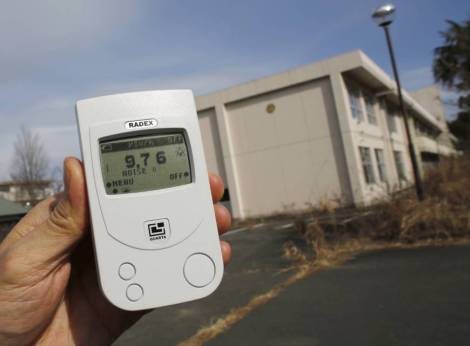
A Reuters reporter measures a radiation level of 9.76 microsieverts per hour in front of Kumamachi Elementary School inside the exclusion zone in Okuma, near Tokyo Electric Power Co’s tsunami-crippled Fukushima No. 1 nuclear power planton Feb. 13
A total of 32,760 workers at the Fukushima No. 1 nuclear plant had an annual radiation dose exceeding 5 millisieverts as of the end of January, according to an analysis of Tokyo Electric Power Co. data.
A reading of 5 millisieverts is one of the thresholds of whether nuclear plant workers suffering from leukemia can be eligible for compensation benefits for work-related injuries and illnesses.
Of those workers, 174 had a cumulative radiation dose of more than 100 millisieverts, a level considered to raise the risk of dying after developing cancer by 0.5 percent. Most of the exposure appears to have stemmed from work just after the start of the crisis on March 11, 2011.
The highest reading was 678.8 millisieverts.
Overall, a total of 46,490 workers were exposed to radiation, with the average at 12.7 millisieverts.
The number of workers with an annual dose of over 5 millisieverts increased 34 percent from fiscal 2013 to 6,600 in fiscal 2014, when workloads grew to address the increase in radiation-tainted water at the plant. The number was at 4,223 in the first 10 months of fiscal 2015, which ends this month, on track to mark an annual decline.
A labor standards supervision office in Fukushima Prefecture last October accepted a claim for workers compensation by a man who developed leukemia after working at the plant, the first recognition of cancer linked to work after the meltdowns as a work-related illness. Similar compensation claims have been rejected in three cases so far, according to the labor ministry.
The average radiation dose was higher among Tepco workers at the plant than among workers from subcontractors in fiscal 2010 and 2011. Starting in fiscal 2012, the reading was higher among subcontractor workers than among Tepco workers.
The average dose for subcontractor workers was 1.7 times the level of Tepco workers in fiscal 2013, 2.3 times in fiscal 2014 and 2.5 times in fiscal 2015 as of the end of January.
A separate analysis of data from the Nuclear Regulation Authority showed that the average radiation dose of workers at 15 nuclear power plants across the country, excluding the Fukushima No. 1 and No. 2 plants, fell to 0.22 millisievert in fiscal 2014, when none of the plants was in operation, down 78 percent from 0.99 millisievert in fiscal 2010
http://www.japantimes.co.jp/news/2016/03/07/national/science-health/32000-fukushima-no-1-workers-got-high-radiation-dose-tepco-data-show/#.Vt2gKfl95D8
TEPCO Prosecution: A Sign That Japan’s Nuclear Industry Is in Free Fall
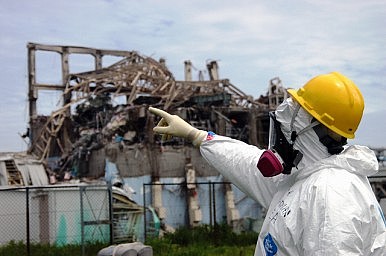
The criminal prosecution of TEPCO is another step in the process to end nuclear power in Japan.
By Shaun Burnie
The decision this week to indict executives of Japan’s largest energy utility, Tokyo Electric Power Company (TEPCO), for their failure to prevent the meltdown of three reactors at Fukushima Daiichi is a major step forward for the people of Japan.
The fact that this criminal prosecution is taking place at all is a vindication for the thousands of citizens and their dedicated lawyers who are challenging the nation’s largest power company and the establishment system. It is a devastating blow to the obsessively pro-nuclear Abe government, which is truly fearful of the effects the trial will have on nuclear policy and public opinion over the coming years.
For the eight other nuclear power companies in Japan, including their executives, the signal is clear – ignore nuclear safety and there is every prospect that when the next nuclear accident happens at your plant you will end up in court. For an industry that disregarded safety violations and falsified inspection results through its entire existence, the prosecution of TEPCO will be shocking.
But it would be naive to think that profound behavioral change will inevitably follow. In fact, in the five years after the accident, Japan’s nuclear industry has not just failed to learn the lessons of the accident, it is still actively ignoring them. In the three years since nuclear plant operators applied to restart their shutdown nuclear fleet, the evidence shows that when it comes to nuclear safety the bottom line is not safety, but money.
Leaving aside the inherent risks of another severe nuclear accident, the new safety agency in Japan, the Nuclear Regulation Authority (NRA) is overwhelmed, incapable and inadequate.
Back in 2008, TEPCO produced an internal report that predicted a maximum credible tsunami of 15.7 meters, but continued to insist that it would not reach the nuclear plant at Fukushima, which sits at a height of 10 meters. The cooling pumps for the reactor cores and spent fuel pools were located at just four metres above sea level.
Historical evidence that a major tsunami would impact the eastern Pacific coast of Ibaraki, Fukushima and Miyagi was well known. Modelling suggested that the next major tsunami was overdue and would inundate the coastal plain about 2.5 to 3 km inland. In 2009, Japanese nuclear regulators questioned the vulnerability of the Fukushima Daiichi reactors to a large-scale tsunami and asked TEPCO to “consider” concrete steps against tsunami waves at the plant. TEPCO responded: “Do you think you can stop the reactors?”
This relaxed attitude is not just limited to TEPCO. In recent weeks, Kyushu Electric informed the NRA that the emergency seismic proof isolation building that they committed to build by March of this year would not be built after all, despite being a condition to secure approval to restart the two Sendai reactors. The NRA expressed its disappointment, but the Sendai reactors restarted in August and continue to operate.
At the Takahama nuclear plant, owned by Kansai Electric the NRA admitted in the last month that they do not know if the reactors comply with fire safety regulations requiring essential electric safety cabling to be adequately separated and protected.
The loss of safety cable function sounds mundane, but the risks are considered more severe than all other failures at a nuclear plant combined. Without electricity, vital safety systems do not work and control of the reactor is lost. A severe accident at Takahama would threaten millions of residents of Kyoto, Osaka, Kobe and the wider Kansai region.
Nonetheless, the NRA granted Kansai Electric an exemption to avoid delaying restart. Takahama reactor-3 resumed operation in late January, while Reactor 4 at Takahama resumed operations for less than three days before shutting down again on 29 February due to an electrical failure.
These examples are the tip of the atomic iceberg that threatens the next nuclear disaster in Japan. With three reactors now operating, the industry remains in crisis. Having sat on idle assets for the last few years, the utilities are desperate to resume operations, while the nuclear obsessed Abe government is happy to support them. It’s time to put people first.
Nuclear power is a financial disaster which will only get worse as the electricity market opens to new suppliers and renewable energies out-price them. And the vast majority in Japan realize this: 60 percent of Japanese are opposed to the phase-in of nuclear, and there are more than 300 lawyers fighting reactor by reactor to prevent restart on behalf of citizens. At this rate, the Abe government and the nuclear industry will never see the target of 35 reactors restarted by 2030.
The criminal prosecution of TEPCO, long in coming, is another step in the process to end nuclear power in Japan and for a transformation of its energy system to renewables.
Shaun Burnie is a nuclear specialist at Greenpeace Germany, currently working as part of a Greenpeace radiation survey team in the Pacific Ocean off the coast of Fukushima
‘Dark tourism’ grows at 3/11 sites

Participants in a ‘dark tourism’ tour check out vacant Ukedo Elementary School in the abandoned town of Namie, Fukushima Prefecture, in early February. As the fifth anniversary of the 2011 calamity approaches, a growing number of visitors are taking part in Fukushima-related tours
Shinichi Niitsuma is enthusiastic about showing visitors the attractions of the small town of Namie: its tsunami-hit coastline, abandoned houses and hills overlooking the radiation-soaked reactors of the disabled Fukushima nuclear power plant.
Five years after the nuclear disaster emptied this stretch of Honshu’s northeastern coastline, tourism is giving residents of the abandoned town a chance to exorcise the horrors of the past.
Like the Nazi concentration camps in Poland or Ground Zero in New York, the areas devastated by the Fukushima disaster have recently become hot spots for “dark tourism” and drawn more than 2,000 visitors keen to see the aftermath of the worst nuclear accident in a quarter century.
“There is no place like Fukushima — except maybe Chernobyl — to see how terrible a nuclear accident is,” Niitsuma said, referring to the 1986 disaster in Ukraine.
“I want visitors to see this ghost town, which is not just a mere legacy but clear and present despair,” he added as he drove visitors down Namie’s main street just 8 km (5 miles) from the stricken nuclear plant.
On March 11, 2011, a magnitude-9 earthquake off Tohoku’s coast spawned massive tsunami that swept ashore, leaving an estimated 18,000 people dead or missing.
Namie’s residents were evacuated after the tsunami tipped the nuclear power plant into meltdown, and no-one has yet been allowed to move back due to the radiation.
Niitsuma, 70, is one of 10 local volunteer guides who organize tours to sights in Namie and other communities in Fukushima, including the tightly regulated areas.
The volunteers take visitors through the shells of buildings left untouched as extremely high radiation discouraged demolition work. The guides use dosimeters to avoid any hot spots.
A tsunami-hit elementary school is another stop on the morbid tour.
The clocks in the classrooms stopped at 3:38 p.m., the exact moment the killer waves swept ashore.
In the gymnasium, a banner for the 2011 graduation ceremony still hangs over a stage and the crippled nuclear plant is visible through shattered windows.
Former high school teacher Akiko Onuki, who survived tsunami that claimed six of her students and a colleague, and is now one of the volunteer guides.
“We must ensure there are no more Fukushimas,” Onuki, 61, said in explaining the reasons behind the tours of her devastated home.
Tourist Chika Kanezawa of Saitama Prefecture said she was shocked by the conditions.
“TV and newspapers report reconstruction is making progress and life is returning to normal,” Kanezawa, 42, said. “But in reality, nothing has changed here.”
Dairy farmer Masami Yoshizawa is still raising about 300 cows in Namie that are subsisting on radiation-contaminated grass in defiance of a government slaughter order.
As Yoshizawa showed off his herd, he explained that he’s keeping the cattle alive as a protest against Tokyo Electric Power Co., which manages the plant, and the government.
“I want to tell people all over the world, ‘What happened to me may happen to you tomorrow’,” Yoshizawa said.
The disaster shattered the government’s carefully cultivated nuclear safety myth and kept its dozens of commercial reactors offline for about two years amid nuclear safety radiation exposure fears.
But the government is gradually restarting them, claiming the resource-poor country needs nuclear power.
English teacher Tom Bridges, who also lives in Saitama, said he could share the victims’ anger and frustration through the tour.
“It’s not a happy trip but it’s a necessary trip,” he said.
Some residents still grieving their loved ones and their inability to return to their homes, say they have mixed feelings watching sightseers tramping through their former hometown.
But Philip Stone, executive director of the Institute for Dark Tourism Research at Britain’s University of Central Lancashire, said recently that such tangible reminders of disasters serve as “warnings from history.”
Niitsuma, who is from Soma, a coastal city some 35 km (just over 20 miles) north of the Fukushima No. 1 plant, says he feels haunted by regret for not having been active in the anti-nuclear movement, even though he opposed reactor construction.
“I should have acted a little more seriously,” he said.
“I’m working as a guide partially to atone.”
http://www.japantimes.co.jp/news/2016/03/06/national/dark-tourism-grows-311-sites/#.VtxHIfl95D8
Japan taxpayers foot $100bn bill for Fukushima disaster
The Fukushima nuclear disaster has cost Japanese taxpayers almost $100bn despite government claims Tokyo Electric is footing the bill, according to calculations by the Financial Times.
Almost five years after a huge tsunami caused the meltdown of three Tepco reactors by knocking out their supply of power for cooling, the figure shows how the public have shouldered most of the disaster’s cost.
It highlights the difficulty of holding a private company to account for the immense expense of nuclear accidents — a concern for countries such as the UK that are building new nuclear power stations.
The Financial Times used Ritsumeikan University professor Kenichi Oshima’s estimate that the disaster has cost Y13.3tn ($118bn) to date relative to the loss of equity value for Tepco shareholders.
“The underlying cost is mainly being paid by the public, either through electricity bills or as tax,” said Mr Oshima.
Japan’s government gives no single figure for the cost of the disaster, but Mr Oshima estimates the biggest cost to date is compensation to businesses and evacuees of Y6.2tn, followed by decontamination of the Fukushima area at Y3.5tn, and decommissioning of the reactor site at Y2.2tn.
Cash for compensation and decommissioning comes from Tepco but it gets grants from the government to keep it solvent. In theory, this cash will come back via a levy on Tepco and other nuclear operators — but this is ultimately be paid by electricity users, making it a tax by another name.
There is are also doubts about whether the levy will be sustainable when Japan’s electricity market opens to competition from April 1. In a recent interview, Tepco chief executive Naomi Hirose insisted the company would make enough money to clean up the Fukushima Daiichi plant.
“We have to preserve that earning power,” Mr Hirose said. “Victory for us means having the money to meet our responsibilities in Fukushima. If we can’t, that’s failure.”
But one way to judge Tepco’s contribution is its share price, which should reflect past losses, as well as any levies the market expects in the future. Compared with March 10 2011, the day before the disaster, Tepco’s equity has lost Y2.6tn in value. Debtholders have not suffered losses.
That implies Tepco has borne slightly less than 20 per cent of the total cost, with taxpayers picking up the other Y10.7tn. The figure is rough, and ignores the cost of shutting down all Japan’s nuclear reactors, so it is likely to understate both the total cost and the proportion paid by the public.
Tepco, the finance ministry and the economy ministry declined to comment on the estimate. A government official insisted all costs would ultimately be recouped from Tepco and said it could not pass the burden on to electricity customers. “As a whole, Tepco is paying its own costs,” said the official.
Evacuees are now being allowed to return to some villages near the Fukushima Daiichi plant but decommissioning will take decades, with radiation levels still too high even to evaluate the stricken reactors. The final cost is unknown and Mr Oshima expects his estimate to rise.
“The government’s approach has worked in that Tokyo Electric has not shut down,” said Mr Oshima. “But with the costs increasing to this extent it’s hard to see the purpose of having kept Tepco alive.”
http://www.ft.com/intl/cms/s/0/97c88560-e05b-11e5-8d9b-e88a2a889797.html#axzz428179eA0
Five Years After Fukushima, ‘No End in Sight’ to Ecological Fallout

An employee uses a a radiation dosage monitor as workers continue the decontamination and reconstruction process.
The environmental impacts of the 2011 Fukushima Daiichi nuclear disaster are already becoming apparent, according to a new analysis from Greenpeace Japan, and for humans and other living things in the region, there is “no end in sight” to the ecological fallout.
The report warns that these impacts—which include mutations in trees, DNA-damaged worms, and radiation-contaminated mountain watersheds—will last “decades to centuries.” The conclusion is culled from a large body of independent scientific research on impacted areas in the Fukushima region, as well as investigations by Greenpeace radiation specialists over the past five years.
“The government’s massive decontamination program will have almost no impact on reducing the ecological threat from the enormous amount of radiation from the Fukushima nuclear disaster,” said Kendra Ulrich, senior nuclear campaigner at Greenpeace Japan. “Already, over 9 million cubic meters of nuclear waste are scattered over at least 113,000 locations across Fukushima prefecture.”
According to Radiation Reloaded: Ecological Impacts of the Fukushima Daiichi Nuclear Accident 5 Years Later, studies have shown:
- High radiation concentrations in new leaves, and at least in the case of cedar, in pollen;
- apparent increases in growth mutations of fir trees with rising radiation levels;
- heritable mutations in pale blue grass butterfly populations and DNA-damaged worms in highly contaminated areas, as well as apparent reduced fertility in barn swallows;
- decreases in the abundance of 57 bird species with higher radiation levels over a four year study; and
- high levels of caesium contamination in commercially important freshwater fish; and radiological contamination of one of the most important ecosystems – coastal estuaries.
The report comes amid a push by the government of Japanese Prime Minister Shinzō Abe to resettle contaminated areas and also restart nuclear reactors in Japan that were shut down in the aftermath of the crisis.
However, Ulrich said, “the Abe government is perpetuating a myth that five years after the start of the nuclear accident the situation is returning to normal. The evidence exposes this as political rhetoric, not scientific fact. And unfortunately for the victims, this means they are being told it is safe to return to environments where radiation levels are often still too high and are surrounded by heavy contamination.”
According to Greenpeace, it’s not only the Abe government that holds “deeply flawed assumptions” about both decontamination and ecosystem risks, but the International Atomic Energy Agency (IAEA), too. Indeed, the failures in the methods used by the IAEA to come to the “baseless conclusion” that there would be no expected ecological impacts from the Fukushima disaster are “readily apparent,” the report claims.
In September, Greenpeace Japan blasted the IAEA for “downplaying” the continuing environmental and health effects of the nuclear meltdown in order to support the Japanese government’s agenda of normalizing the ongoing disaster.
Report on Ecological Impacts of the Fukushima Daiichi Nuclear Accident 5years Later

The report is based on a large body of independent scientific research in impacted areas in the Fukushima region, as well as investigations by Greenpeace radiation specialists over the past five years. It exposes deeply flawed assumptions by the International Atomic Energy Agency and the Abe government in terms of both decontamination and ecosystem risks. It further draws on research on the environmental impact of the 1986 Chernobyl nuclear catastrophe as an indication of the potential future for contaminated areas in Japan.
The environmental impacts of the Fukushima Daiichi nuclear disaster will last decades to centuries, due to man-made, long-lived radioactive elements are absorbed into the living tissues of plants and animals and being recycled through food webs, and carried downstream to the Pacific Ocean by typhoons, snowmelt, and flooding.
Greenpeace has conducted 25 radiological investigations in Fukushima since March 2011. In 2015, it focused on the contamination of forested mountains in Iitate district, northwest of the Fukushima Daiichi nuclear power plant. Both Greenpeace and independent research have shown the movement of radioactivity from contaminated mountain watersheds, which can then enter coastal ecosystems. The Abukuma, one of Japan’s largest rivers which flows largely through Fukushima prefecture, is projected to discharge 111 TBq of 137Cs and 44 TBq of 134Cs, in the 100 years after the accident.
http://www.greenpeace.org/japan/ja/library/publication/20160304_report/
Mutations, DNA damage seen in Fukushima forests, says Greenpeace
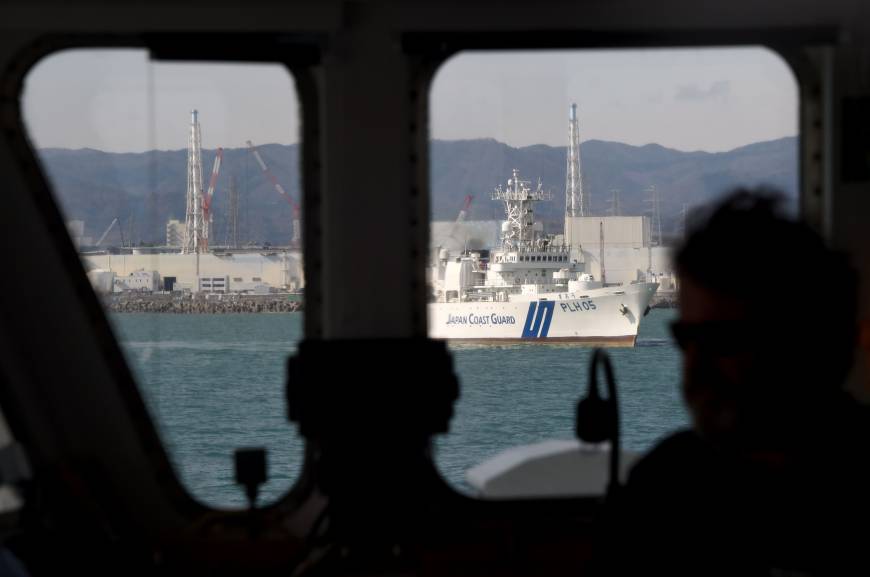
Conservation group Greenpeace warned on Friday that the environmental impact of the Fukushima nuclear crisis five years ago on nearby forests is just beginning to be seen and will remain a source of contamination for years to come.
The March 11, 2011 magnitude-9.0 undersea earthquake off the nation’s northeastern coast sparked a massive tsunami that swamped cooling systems and triggered reactor meltdowns at the Fukushima No. 1 nuclear plant.
Radiation spread over a wide area and forced tens of thousands of people from their homes — many of whom will likely never return — in the worst nuclear accident since Chernobyl in 1986.
As the fifth anniversary of the disaster approaches, Greenpeace said signs of mutations in trees and DNA-damaged worms were beginning to appear, while “vast stocks of radiation” mean that forests cannot be decontaminated.
In a report, Greenpeace cited “apparent increases in growth mutations of fir trees, … heritable mutations in pale blue grass butterfly populations” as well as “DNA-damaged worms in highly contaminated areas.”
The report came as the government intends to lift many evacuation orders in villages around the Fukushima plant by March 2017, if its massive decontamination effort progresses as it hopes.
For now, only residential areas are being cleaned in the short-term, and the worst-hit parts of the countryside are being omitted, a recommendation made by the International Atomic Energy Agency.
But such selective efforts will confine returnees to a relatively small area of their old hometowns, while the strategy could lead to re-contamination as woodlands will act as a radiation reservoir, with pollutants washed out by rains, Greenpeace warned.
The conservation group said its report relies largely on research published in peer-reviewed international journals.
But “most of the findings in it have never been covered outside of the close circles of academia”, report author Kendra Ulrich said.
The government’s push to resettle contaminated areas and also restart nuclear reactors elsewhere around the country that were shut down in the aftermath of the crisis are a cause for concern, Ulrich said, stressing it and the IAEA are using the opportunity of the anniversary to play down the impact of the radiation.
“In the interest of human rights — especially for victims of the disaster — it is ever more urgent to ensure accurate and complete information is publicly available and the misleading rhetoric of these entities challenged,” she said.
Scientists, including a researcher who found mutations of Fukushima butterflies, have warned, however, that more data are needed to determine the ultimate impact of the Fukushima accident on animals in general.
Researchers and medical doctors have so far denied that the accident at Fukushima would cause an elevated incidence of cancer or leukemia, diseases that are often associated with radiation exposure.
But they also noted that long-term medical examination is needed, especially due to concerns over thyroid cancer among young people — a particular problem for people following the Chernobyl catastrophe.
http://www.japantimes.co.jp/news/2016/03/04/national/science-health/mutations-dna-damage-seen-fukushima-forests-greenpeace/#.VtmtlObzN_m
Five years on, Fukushima still faces contamination crisis: environmentalists

Crippled Fukushima Daiichi nuclear power plant in northeastern Japan.
Fish market vendor Satoshi Nakano knows which fish caught in the radiation tainted sea off the Fukushima coast should be kept away from dinner tables.
Yet five years after the worst nuclear accident since Chernobyl there is still no consensus on the true extent of the damage – exacerbating consumer fears about what is safe to eat.
Environmentalists are at odds with authorities, warning the huge amounts of radiation that seeped into coastal waters after a powerful tsunami caused a meltdown at the Fukushima Daiichi nuclear power plant on March 11, 2011, could cause problems for decades.
The Japanese government is confident it has stemmed the flow of radioactive water into the ocean, but campaigners insist contaminated ground water has continued to seep into the Pacific Ocean, and the situation needs further investigation.
“It was the single largest release of radioactivity to the marine environment in history,” Greenpeace nuclear expert Shaun Burnie said on the deck of the campaign group’s flagship Rainbow Warrior, which has sailed in to support a three-week marine survey of the area the environmental watchdog is conducting.
Fukushima is facing an “enormous nuclear water crisis,” Burnie warned.
He added: “The whole idea that this accident happened five years ago and that Fukushima and Japan have moved on is completely wrong.”
Existing contamination means fishermen are banned from operating within a 20-km radius from the plant.
Although there are no figures for attitudes on seafood alone, the latest official survey by the government’s Consumer Affairs Agency showed in September that more than 17 per cent of Japanese are reluctant to eat food from Fukushima.
Nakano knows it’s best for business to carefully consider the type of seafood he sells, in the hope it will quell consumer fears.
“High levels of radioactivity are usually detected in fish that move little and stick to the seabed. I am not an expert, but I think those kinds of fish suck up the dirt of the ocean floor,” he said from his hometown of Onahama by the sea.
Greenpeace is surveying waters near the Fukushima plant, dredging up sediment from the ocean floor to check both for radiation “hotspots” as well as places that are not contaminated.
On Monday, the Rainbow Warrior sailed within a 1.6km of the Fukushima coast as part of the project – the third such test it’s conducted but the closest to the plant since the nuclear accident.
Researchers on Tuesday sent down a remote-controlled vehicle attached with a camera and scoop, in order to take samples from the seabed, which will then be analysed in independent laboratories in Japan and France.
“It’s very important [to see] where is more contaminated and where is less or even almost not contaminated,” Greenpeace’s Jan Vande Putte said, stressing the importance of such findings for the fishing industry.
Local fishermen have put coastal catches on the market after thorough testing, which includes placing certain specimens seen as high risk through radiation screening – a programme Greenpeace lauds as one of the most advanced in the world.
The tests make sure no fish containing more than half of the government safety standard for radiation goes onto the market.
The 2011 disaster was caused by a magnitude 9.0 undersea earthquake off Japan’s northeastern coast which then sparked a massive tsunami that swamped cooling systems and triggered reactor meltdowns at the Fukushima Daiichi plant, run by operator Tokyo Electric Power (TEPCO).
Today, about 1,000 huge tanks for storing contaminated water occupy large parts of the site, but as 400 tonnes of groundwater a day flows into the damaged reactor buildings, many more will be needed.
TEPCO have said they are taking measures to stop water flowing into the site, including building an underground wall, freezing the land itself and siphoning underground water.
The government too insist the situation is under control.
“The impact of the contaminated water is completely contained inside the port of the Fukushima plant,” Tsuyoshi Takagi, the Cabinet minister in charge of disaster reconstruction, told reporters on Tuesday.
But Greenpeace’s Burnie says stopping the groundwater flow is crucial to protecting the region.
“What impact is this having on the local ecology and the marine life, which is going on over years, decades?”, Burnie asked.
He added: “We can come back in 50 years and still be talking about radiological problems” at the nuclear plant as well as along the coast, he said.

Storage site of contaminated soil generated by decontamination work in Fukushima Prefecture, home of the crippled Fukushima Daiichi complex
Fukushima plant begins testing waste incinerators
”The operator says it expects to burn up to 14 tons of waste per day. But the resulting ash will have a higher concentration of radioactive materials than the waste has before it is burned.”
Fukushima plant begins testing waste incinerators
The operator of Fukushima Daiichi has begun testing an incinerator facility at the damaged nuclear power plant. The facility will be used for burning used protective gear and other waste produced during the decommissioning of the plant’s reactors.
Tokyo Electric Power Company initially planned to start testing the two incinerators at the facility on February 10th. But a water leak forced a delay.
Workers on Thursday began testing one of the incinerators, which had been repaired.
At the end of last year, there were about 66,000 cubic meters of waste being stored at the plant after nearly five years of decommissioning work following the March 2011 accident. That is enough to fill more than 100 swimming pools 25 meters in length.
The incinerators are expected to reduce the volume of waste by about 90 percent. The waste includes used disposable protective gear, clothing, sheets, cardboard and timber.
The operator says it expects to burn up to 14 tons of waste per day. But the resulting ash will have a higher concentration of radioactive materials than the waste has before it is burned.
TEPCO says filters installed in the smokestack will prevent the release of radioactive substances. The ash will be stored in drums inside a secure building.
Tokyo Electric Power said it will dispose of some four tons of waste in Thursday’s test. It said it will start testing the other incinerator on Sunday.
http://www3.nhk.or.jp/nhkworld/en/news/20160225_25/
TEPCO begins burning radiation-tainted work clothes at Fukushima plant
OKUMA, Fukushima Prefecture–Tokyo Electric Power Co. has started to incinerate the thousands of boxes of lightly contaminated waste, including clothing used by workers, at the Fukushima No. 1 nuclear power plant to reduce the amount of tainted waste on the site.
TEPCO, the plant operator, fired up a special on-site incinerator on Feb. 25 to burn protective suits, gloves, socks and other work clothes worn by plant workers that became contaminated with low-level radiation.
The operation will reduce the amount of tainted work clothing accumulating at the plant during decommissioning operations since the nuclear disaster unfurled in March 2011. The garments cannot be processed outside the plant due to the radiation.
The clothing being incinerated are items with the lowest levels of contamination that have been stored in tens of thousands of 1 cubic-meter special boxes. The number of containers reached 66,000 at the end of last year.
The incinerator is equipped with two types of filters that can reduce the radioactive levels of the exhaust air to less than one-millionth, while reducing the capacity of the waste to about 2 percent.
The incinerator can burn a maximum of 14 tons of items per day when it is operated to capacity for 24 hours. The ash residue will be stored in metallic barrels on the plant compound.
The incineration project was authorized by the Nuclear Regulation Authority in July 2014. TEPCO began operational tests of the incinerator using untainted waste last fall.
http://ajw.asahi.com/article/0311disaster/fukushima/AJ201602260071
TEPCO gives unconvincing excuse for delay in meltdown declaration
Tokyo Electric Power Co., the operator of the stricken Fukushima No. 1 nuclear power plant, said Feb. 24 that it could have declared the reactor meltdowns at the plant much earlier than it did.
The utility said it discovered a guideline in its operational manual that would have allowed it to announce core meltdowns only three days after the plant was struck by the tsunami in 2011 instead of the two months it actually took.
In a Feb. 24 news conference, a TEPCO official said the manual had been discovered for the first time earlier in February.
But the company’s explanations about the delay in announcing the meltdowns, triggered by the Great East Japan Earthquake and tsunami on March 11, 2011, and the recent “discovery” of the document are by no means convincing.
TEPCO initially maintained that the reactors suffered “core damage,” a condition in which nuclear fuel inside a reactor core is damaged, rather than a “meltdown.” It did not admit that meltdowns had occurred in the three reactors until late May 2011, more than two months later.
The utility claimed it had taken so long to acknowledge the meltdowns because there was “no basis” for making the judgment.
But this claim has proved false. At that time, TEPCO was suspected of concealing facts to make the accident look less serious than it actually was. The latest revelations revive such suspicions.
In a statement on Feb. 24, Niigata Governor Hirohiko Izumida called on TEPCO to conduct a thorough internal investigation to uncover the “truth behind its concealment of meltdowns,” including determining who gave the instructions.
Niigata Prefecture is home to TEPCO’s Kashiwazaki-Kariwa nuclear power plant, which the company aims to restart. Izumida has every right to make the demand.
Even more baffling is the “discovery” of the manual nearly five years after the nuclear crisis broke out.
Back then, core meltdowns were clearly defined as nuclear emergencies under the nuclear disaster special measures law. Given that TEPCO has been very sensitive to the question of whether trouble at a nuclear power plant, no matter how minor, should be reported to the government, it is hard to believe that the company failed to remember the standard concerning meltdowns.
It is clearly impossible to directly confirm whether a core meltdown is taking place during a severe nuclear accident.
That’s apparently the reason why TEPCO established a clear criterion for a nuclear meltdown that required the company to declare a meltdown when damage to a reactor core exceeds 5 percent.
When a nuclear accident occurs, only the operator of the nuclear plant has access to detailed data about what is happening. Both the government and news media depend on information provided by the plant operator for related policy decisions and news coverage.
A utility’s failure to swiftly offer accurate information about the situation could cause the government to make misguided policy decisions and the media to distribute incorrect reports about the accident.
TEPCO’s report on its investigation into the nuclear disaster, released in 2012, defended the company’s use of the term “core damage.” The report argued that the company had tried to provide accurate information about the conditions of the reactors based on available data by avoiding the term “core meltdown” because there was no clear and widely shared definition of the term.
It cannot be said that TEPCO provided the entire picture of what happened based on exhaustive and effective efforts to identify all the factors involved.
The company’s guideline concerning core meltdowns was “discovered” during an in-house investigation into how the utility responded to the Fukushima nuclear crisis. That investigation was conducted at the request of a technical committee of the Niigata prefectural government.
The prefecture called for a fresh inquiry in connection with TEPCO’s plan to restart the Kashiwazaki-Kariwa nuclear power plant.
TEPCO has said it will look into how it failed to notice the existence of the guideline through a probe involving outsiders.
The utility should determine who should be held accountable for that failure.
The company also needs to offer convincing answers to such questions as how it will prevent a recurrence and whether problems with its corporate culture played a role. Otherwise, its efforts to regain public trust are destined to fail.
http://ajw.asahi.com/article/views/editorial/AJ201602260057
TEPCO discovers after 5 years that it could have quickly declared Fukushima plant meltdown
Nearly five years later, Tokyo Electric Power Co. said Feb. 24 that it has discovered a guideline in its operational manual that would have allowed it to announce meltdowns in the nuclear disaster in only days instead of the two months it actually took.
TEPCO apologized for failing to be aware for such a long time of the guideline on how to declare meltdowns at its Fukushima No. 1 nuclear power plant, triggered by the Great East Japan Earthquake and tsunami on March 11, 2011.
While the utility announced that reactor cores had been damaged at the No. 1 and No. 3 reactors by March 14 and at the No. 2 reactor by March 15, it did not admit that meltdowns had occurred in the three reactors until May 2011.
Based on its “nuclear disaster countermeasures manual,” which was revised 11 months before the disaster, the utility could have instead declared meltdowns at the three reactors by those dates, it said.
“We sincerely apologize for failing to confirm the presence of the guideline in the manual for five years,” a TEPCO spokesperson said Feb. 24.
The company will conduct an internal investigation to determine why it failed to promptly determine and announce meltdowns based on the manual.
In the few days after the Fukushima crisis unfurled, core meltdowns at the No. 1 to No. 3 reactors dispersed a large amount of radioactive materials into the environment.
Video footage of TEPCO’s in-house teleconferences around the time show that company executives recognized the possibility of meltdowns at the reactors from the early stages of the crisis.
But the company maintained that the reactors suffered “core damage,” a condition in which nuclear fuel inside a reactor core is damaged, rather than a “meltdown” at news conferences and in its announcements. In May it officially acknowledged that meltdowns had occurred.
The utility has explained that the delay was caused by the lack of a basis to assess meltdowns in the wake of an accident.
Early on May 14, 2011, TEPCO confirmed that the No. 3 unit had suffered damage to 30 percent of its reactor core and 55 percent of the No. 1 reactor’s core was damaged, based on rising radiation levels inside reactor containment vessels. It also determined that 35 percent of the No. 2 reactor’s core was damaged on the evening of May 15.
The newly discovered guideline in the disaster countermeasures manual, which was revised in April 2010, stipulates that the company should declare a meltdown when damage to a reactor core exceeds 5 percent, TEPCO officials said.
Company officials failed to announce the meltdowns because they were unaware of the guideline in the manual, according to TEPCO.
The existence of such a standard was confirmed earlier this month during an in-house investigation into how the utility responded to the Fukushima nuclear crisis.
The investigation is being conducted at the request of Niigata Prefecture where TEPCO’s Kashiwazaki-Kariwa nuclear power plant, which the company aims to restart, is located.
In a statement on Feb. 24, Niigata Governor Hirohiko Izumida called on TEPCO to conduct a thorough internal investigation to uncover the “truth behind its concealment of meltdowns,” including determining who gave instructions.
http://ajw.asahi.com/article/0311disaster/fukushima/AJ201602250043
The Great Fukushima Cover-Up

Dr. Tetsunari Iida is the founder and executive director of the Institute for Sustainable Energy Policies (ISEP) in Japan. As such, one might have expected a recent presentation he gave in the UK within the hallowed halls of the House of Commons, to have focused on Japan’s capacity to replace the electricity once generated by its now mainly shuttered nuclear power plants, with renewable energy.
But Dr lida’s passionate polemic was not about the power of the sun, but the power of propaganda. March 11, 2011 might have been the day the Great East Japan Earthquake struck. But it was also the beginning of the Great Japan Cover-Up.
On the ISEP website, Iida extols the coming of the Fourth Revolution, following on from those in agriculture, industry and IT. “This fourth revolution will be an energy revolution, a green industrial revolution, and a decentralized network revolution”, he writes.
But in person, Iida was most interested in conveying the extent to which the Japanese people were lied to before, during and after the devastating nuclear disaster at Fukushima-Daiichi, precipitated on that same fateful day and by the deadly duo of earthquake and tsunami.
“Shinzo Abe says ‘everything is under control’”, said Iida, speaking at an event hosted by Nuclear Free Local Authorities, Green Cross, and Nuclear Consulting Group in late January. It was headlined by the former Japan Prime Minister, Naoto Kan, who was at the helm when the triple disasters struck. “Yes – under the control of the media!”
A trial for Tepco like post-war Tokyo Trials
The media may have played the willing government handmaiden in reassuring the public with falsehoods, but in July 2012, the Fukushima Nuclear Accident Independent Investigation Commission concluded that the disaster was really no accident but “man-made“. It came about, the researchers said, as a result of “collusion” between the government, regulators and the nuclear industry, in this case, Tepco.
“There should be a Tepco trial like the post-war Tokyo Trials”, Iida said, referring to the post World War II war crimes trial in which 28 Japanese were tried, seven of whom were subsequently executed by hanging.
Hope for such accountability – without advocating hanging – is fleeting at best. In 2011, while addressing a conference in Berlin hosted by the Heinrich Böll Foundation, I suggested the Tepco officials should be sent to the International Criminal Court at The Hague, (a body the US still conveniently refuses to recognize) to answer for what clearly amounts to crimes against humanity.
The remark caused a bit of a stir and earnest questions about the mechanism by which Tepco could be brought there. Needless to say, nothing of the kind ever happened, or is likely to.
Instead, the Abe’s government’s preferred tactic is to go full out to restart reactors and move everybody back home as soon as possible, as if nothing serious had happened. Just scoop off a little topsoil, cart it away somewhere else and, Abracadabra! Everything is clean and safe again!
Normalizing radiation, a policy and now a practice
Of course radiological decontamination is not that easy. Nor is it reliable. It is more like “pushing contamination from one spot to the next”, as independent nuclear expert, Mycle Schneider describes it. And radiation does not remain obediently in one place, either.
“The mountains and forests that cannot even be vaguely decontaminated, will serve as a permanent source of new contamination, each rainfall washing out radiation and bringing it down from the mountains to the flat lands”, Schneider explained. Birds move around. Animals eat and excrete radioactive plant life. Radiation gets swept out to sea. It is a cycle with no end.
Nevertheless, efforts are underway to repopulate stricken areas, particularly in Fukushima Prefecture. It’s a policy, and now a practice, of ‘normalizing’ radiation standards, to tell people that everything is alright, when clearly, there is no medical or scientific evidence to support this. And it was an approach already firmly and institutionally in place, even on March 11, 2011 as the Fukushima disaster first struck and much of the decision-making was left to individual judgement.
“We were told that evacuating poses a greater risk than radiation,” recalls Hasegawa Kenji, a farmer from Iitate, a village situated 45 kilometers from the Fukushima nuclear power plant. Featured in the Vice documentary ‘Alone In The Zone‘, Hasegawa criticizedIitate’s mayor for making what he called a terrible mistake.
“Even when the scientists told the mayor that Iitate was dangerous, he ignored them all. He brought in experts from around the country who preached about how safe it was here. They said we had nothing to worry about. They kept telling us that. Eventually the villagers fell for it and began to relax. And the mayor rejected the idea of evacuating even more. That’s why nobody left, even though the radiation levels were so high.”
The nuclear industry did not tell the public the truth
The confusion surrounding evacuation was so profound that, as Zhang et al. noted in a September 11, 2014 study published in the International Journal of Environmental Research and Public Health: “Unclear evacuation instructions caused numerous residents to flee to the northwestern zone where radiation levels were even higher.”
All par for the course, said Iida. “I must emphasize, the people in the nuclear industry did not tell the public the truth and keep us informed.”
Next in the ‘normalization’ process came the decision to raise allowable radiation exposure standards to 20 millisieverts of radiation a year, up from the prior level of 2 mSv a year. The globally-accepted limit for radiation absorption is 1 mSv a year.
This meant that children were potentially being exposed to the same levels of radiation that are permitted for adult nuclear power plant workers in Europe. Some officials even argued that zones where rates were as high as 100 mSv a year should be considered ‘safe’. Writing on his blog, anti-pollution New Orleans-based attorney, Stuart Smith, observed wryly:
“Instead of taking corrective measures to protect its people, Japan has simply increased internationally recognized exposure limits. It seems that the priority – as we’ve seen in so many other industrial disasters in so many other countries – is to protect industry and limit its liability rather than to ensure the long-term health and well being of the masses. Go figure.”
The great repatriation lie
All of this set the perfect stage for the Great Repatriation Lie. “It’s the big cover-up,” Iida told his Westminster audience. “People are being told it’s quite safe to have a little [radiation] exposure.”
Indeed, at a recent conferences of prefectural governors, young people in particular were urged to return to Fukushima. “If you come to live with us in Fukushima and work there, that will facilitate its post-disaster reconstruction and help you lead a meaningful life”, said Fukushima Gov. Masao Uchibori.
Young people in Japan, however, appear not to be cooperating. Where evacuees are returning, the majority are senior citizens, who have less to lose from a health perspectiveand are more traditionally tied to the land and their ancestral burial grounds.
“They want to die where they were born and not in an unfamiliar place”, said Yoshiko Aoki, an evacuee herself who now works with others, and who also spoke at the London conference.
All of this impacts revenue from the inhabitants’ tax which constitutes 24.3% of all local tax sources and is collected by both prefectures and municipalities. It is levied on both individuals and corporations but with the bulk of revenue coming from individuals.
Senior citizens who have retired do not contribute to income tax, so the onus is on governors and mayors to lure as many working people as possible back to their towns and regions in order to effectively finance local public services.
Radioactive areas are hardest hit economically
Late last year, the Asahi Shimbun looked at tax revenues in the 42 municipalities affected by the triple 2011 disasters of earthquake, tsunami and the Fukushima meltdowns.
Unsurprisingly, the areas hardest hit by radiological contamination had suffered the biggest economic blows. Those areas free from radioactive fallout could simply rebuild after the tsunami and earthquake, and had consequently recovered economically, some even to better than pre-3/11 levels.
“On the other end of the scale, Namie, Fukushima Prefecture, marked the biggest decreasing rate – 72.9 percent – in tax revenues for fiscal 2014”, the Asahi Shimbunreported. “All residents of the town near the crippled nuclear plant remain in evacuation. Although tax payments from companies increased from decontamination work and other public works projects, income taxes paid by residents and fixed asset taxes have declined.”
To return or not to return is the question of the hour – or it will be come March 2017, when the Abe government has announced it will revoke many evacuation orders. At that point, government compensation to evacuees would be lifted, putting them under financial pressure to return. Cue more confusion.
People are confronted, said Iida, with “two extreme views, either that it’s very dangerous or quite safe. So it’s very difficult to decide which is the truth and it has been left up to individuals.”
One of those towns that could be declared ‘safe’ is Tomioka, Japan’s Pripyat, formerly home to close to 16,000 people but now uninhabited.
“It’s like a human experiment, that’s how we feel,” said Aoki in London, herself a former Tomioka resident. “The Governor of Fukushima spoke about a safe Fukushima. We want it to become safe, but our thoughts and reality are not one and the same.”
Observes Kyoto University professor of nuclear physics, Koide Hiroaki, in the Vice film, who has been outspoken for decades against the continued use of nuclear energy:
“Once you enter a radiation controlled area, you aren’t supposed to drink water, let alone eat anything. The idea that somebody”, he pauses, ” … is living in a place like that is unimaginable.”
NRA suggests Tepco to give up removing molten fuel from Fukushima plant

On 2/19/2016, Fuketa, a committee member of NRA (Nuclear Regulation Authority) visited Fukushima plant and commented it needs to be considered if it is the best option to remove the molten fuel or not. He also suggested to remove a part of molten fuel to solidify the rest.
He added it depends on the research result.
The government of Japan and Tepco had been planning to remove the molten fuel at least from Reactor 1, 2 and 3 however it has not even been known where the molten fuel is accumulated.
http://www.logsoku.com/r/open2ch.net/newsplus/1455960843/
NRA suggests Tepco to give up removing molten fuel from Fukushima plant
Labor shortage hampering Japan’s post tsunami recovery
Tokyo, Feb 24 (EFE).- A growing labor shortage in northeastern Japan, which was struck by the 2011 tsunami, is hampering the economic recovery of the region five years after the tragedy, said an academic from a leading university of the region.
More than 45 percent of the companies in the area that were surveyed, reported a shortage of personnel, said Satoru Masuda, Professor of Regional Planning at the Tohoku University and President of the Research Center for Earthquake Restoration, at a press conference in Tokyo.
This is a 2.2 percent jump over 2014 and 66 percent higher than that reflected in the 2012 survey, a year after the earthquake and subsequent tsunami, which struck the northeastern coast of the archipelago and left over 18,000 people dead and missing.
The sectors most affected by this include fishing, which was decimated by the catastrophe, and the retail sector.
According to Masuda, the retail sector has been greatly affected by the progressive decline in population in the three worst-affected prefectures (Iwate, Miyagi and Fukushima), from where almost 90,000 people (more than 6 percent of the population) have fled since 2011.
Almost all the people who fled the region immediately after the tsunami and accident at the Fukushima nuclear plant decided not to return and this has hugely affected the retail sector, Masuda explained.
The problem, he added, is that many traders staying in temporary facilities the government allocated them to keep this sector alive, are not being able to get funding to reopen their businesses.
If they leave, many residents’ well-being will be affected and they will end up following their footsteps, he concluded.
The data provided by Masuda also shows the construction sector, which led the region’s recovery, peaked in 2013, and even though it is still better off than other sectors, has already begun to decline.
http://noticias.alianzanews.com/309_hispanic-world/3645372_labor-shortage-hampering-japan-s-post-tsunami-recovery.html
Less protective gear at Fukushima Daiichi
The operator of the Fukushima Daiichi nuclear plant plans to make it easier for workers engaged in decommissioning efforts nearly 5 years after the accident. They will gradually be able to work without wearing protective gear or gloves in areas with low radiation.
NHK has learned that Tokyo Electric Power Company is to introduce the new measure early next month for about 90 percent of the facility.
Radiation readings near the ground in these areas were 5 microsieverts per hour or less as of December. The figures went down after the operator removed contaminated soil and paved the surface.
TEPCO will increase in stages the number of workers wearing only regular work clothing.
The utility now requires each worker to wear protective gear and 2 pairs of gloves. This is preventing them from moving around smoothly and from carrying out precision work.
The policy will continue for people working near the reactor buildings and around tanks that contain highly radioactive water.
TEPCO plans to notify workers and tighten controls so that they do not approach these areas without wearing protective gear.
http://www3.nhk.or.jp/nhkworld/en/news/20160225_02/
-
Archives
- October 2026 (120)
- September 2026 (339)
- August 2026 (330)
- July 2026 (355)
- June 2026 (287)
- May 2026 (306)
- April 2026 (356)
- March 2026 (251)
- February 2026 (267)
- January 2026 (308)
- December 2025 (358)
- November 2025 (359)
-
Categories
- 1
- 1 NUCLEAR ISSUES
- business and costs
- climate change
- culture and arts
- ENERGY
- environment
- health
- history
- indigenous issues
- Legal
- marketing of nuclear
- media
- opposition to nuclear
- PERSONAL STORIES
- politics
- politics international
- Religion and ethics
- safety
- secrets,lies and civil liberties
- spinbuster
- technology
- Uranium
- wastes
- weapons and war
- Women
- 2 WORLD
- ACTION
- AFRICA
- Atrocities
- AUSTRALIA
- Christina's notes
- Christina's themes
- culture and arts
- Events
- Fuk 2022
- Fuk 2023
- Fukushima 2017
- Fukushima 2018
- fukushima 2019
- Fukushima 2020
- Fukushima 2021
- general
- global warming
- Humour (God we need it)
- Nuclear
- RARE EARTHS
- Reference
- resources – print
- Resources -audiovicual
- Weekly Newsletter
- World
- World Nuclear
- YouTube
-
RSS
Entries RSS
Comments RSS

