School to close in Fukushima as too few children able to attend
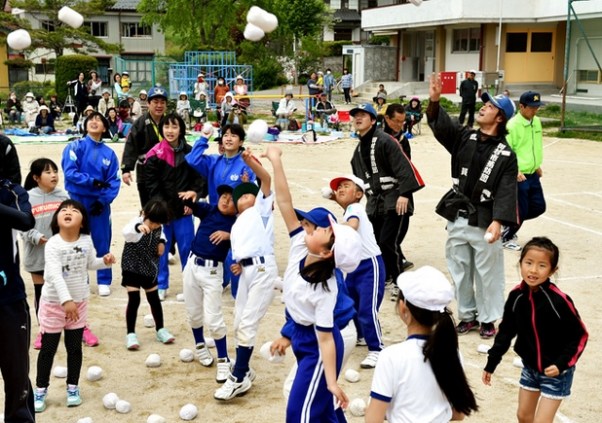
Graduates and local residents attend the last athletic meet at Iwaisawa Elementary School in Tamura, Fukushima Prefecture, on May 14.
TAMURA, Fukushima Prefecture–Despite a proud 140-year history, the Iwaisawa Elementary School here has to close–as not enough children come to classes any more due to the 2011 nuclear disaster.
The school held its last annual athletic meet on May 14. It will merge with another school after this academic year ends next March.
The school currently has 19 pupils, down from 52 before the disaster at the Fukushima No. 1 nuclear power plant.
In the lead-up to the athletic meet, the school, located in the Miyakoji district of Tamura, Fukushima Prefecture, sent out about 500 invitation letters to its graduates and local residents. About 150 people turned up.
After the nuclear accident, residents in the district were forced to evacuate to other areas. Although the evacuation order was lifted in April 2014, many of them opted to stay where they were while keeping their resident registries in the district.
As of the end of April this year, 2,564 people were officially registered as residents in the district. But of that number, only 1,600 or so actually lived there.
After the nuclear accident, pupils at Iwaisawa Elementary School temporarily took classes using classrooms of a different school in central Tamura, which had been already closed. In April 2014, they returned to their original school.
But only 29 came back, compared with the pre-accident figure of 52. The number has since further declined to 19. Because of that, it was decided the school will be merged with another school next spring.
Tepco to put some Fukushima decommissioning work on hold during G-7 summit
The majority of decommissioning work at the damaged Fukushima No. 1 nuclear plant will be put on hold while the Group of Seven summit takes place in Shima, Mie Prefecture, on May 26 to 27, according to Tokyo Electric Power Co.
Satoshi Togawa, a spokesman for Tepco, told The Japan Times on Friday that the planned suspension was a precaution to reduce “risks” that could disturb the meeting of leaders from the seven major advanced nations.
Such risks could include unexpected leaks of contaminated water from tanks or airborne radioactive material monitoring alarms being triggered, Togawa said.
Tepco will continue other essential operations, such as injecting water to keep melted nuclear fuel cool and processing contaminated water, Togawa said.
The spokesman said the suspension was not designed to reduce the risk of terrorism.
“We have made the decision without any request from the government,” he said.
A 2011 massive earthquake and ensuing tsunami knocked out critical cooling functions for three of six reactors at the plant, triggering a triple meltdown.
The decommissioning effort, which involves some 7,000 workers, is expected to take more than 40 years.
Seniors mull share house to keep Fukushima evacuee community intact
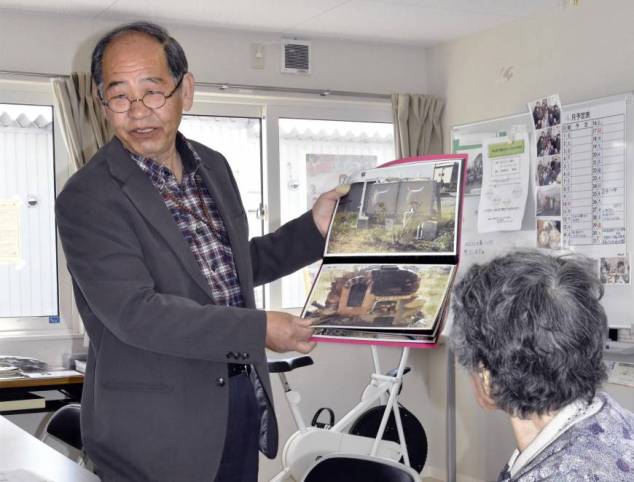
Masaharu Fujishima, who is proposing to build a share house for temporary housing residents, explains his plan to residents in a meeting in April in Minamisoma, Fukushima Prefecture.
FUKUSHIMA – As the government looks to lift the evacuation zone for part of Minamisoma, Fukushima Prefecture, elderly people currently living in temporary dwellings are considering a share house so they can stay together.
If the no-go zone is lifted, residents at temporary housing units are likely to be asked to leave. One option is to return to their hometown of Minamisoma’s Odaka district — a choice few are likely to make. Another option is to move in to city-provided public housing where they would have to start again in unfamiliar surrounds.
In Odaka, residents will be allowed to stay inside the evacuation zone to prepare for their permanent return after the designation is lifted. But of the area’s 11,700 residents, only 1,870 have registered to go back, suggesting few plan to return permanently.
It’s for this reason that Masaharu Fujishima, 70, a resident at Minamisoma’s temporary housing complex, is pitching a plan to create a share house with individual rooms and common space that will allow temporary housing residents who have bonded since the March 2011 Fukushima nuclear disaster to live together.
Fujishima evacuated from Odaka to temporary housing in the city center. Serving as head of the community association until January, he was able to talk with many residents about the troubles they faced as they attempted to rebuild their lives.
Many were worried about leaving a community of friends they bonded with over the past five years for a new one they would need to create from scratch.
“After the nuclear disaster, many people had to move around before they finally settled in the temporary housing,” said Fujishima. “I’m worried that if they leave here, they would have to go through all the trouble again of searching for a new place to live.”
So far, Fujishima has held three meetings for temporary housing residents to explain his proposal. While some feedback has been positive, with residents saying it will prevent them from becoming senile, others have voiced concern about what will happen when one of the dwellers becomes ill or dies.
To put the plan in motion, Fujishima submitted about 16,000 signatures to the Minamisoma Municipal Assembly.
The city is expected to consider the proposal, though a city official in charge of housing construction was not sure if the idea is feasible.
“It is difficult because public houses are not designed for many people to live together like a share house,” the official said.
Collision on the Joban Expressway in Fukushima
On May 4, 2016, a head-on collision between a car and a bus on the Joban Expressway in Fukushima killed a mother and her daughter on the passeger car. *link for Yahoo Japan article
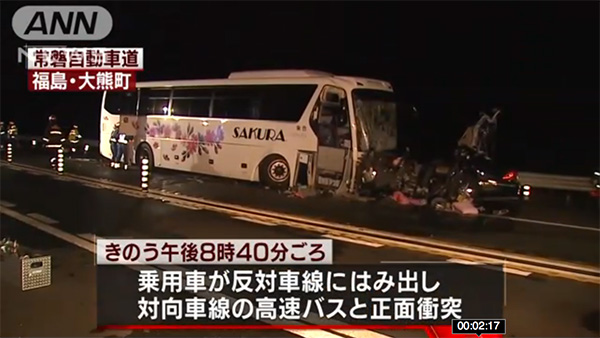
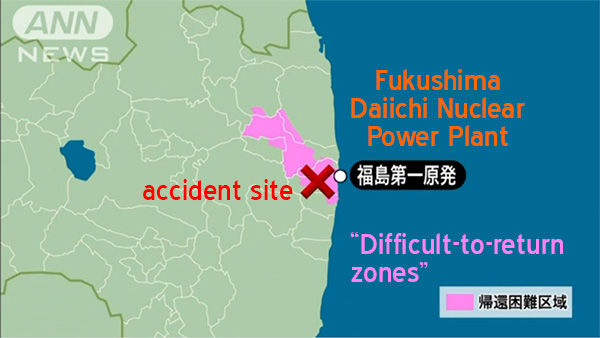
The accident happened in Okuma town which is within “Difficult-to-return” zones, due the nuclear accident at Fukushima Daiichi Nuclear Power Plant.
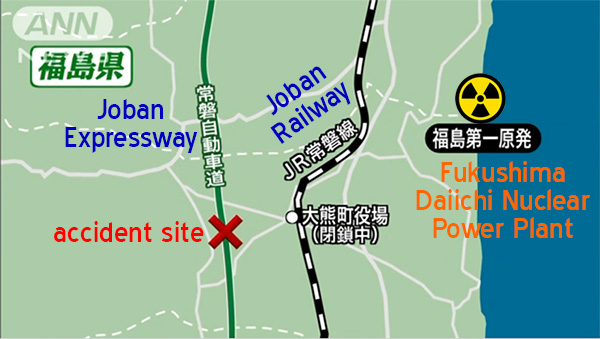
The designated area has been exposed to more than 50 millisieverts per year of radiation from the melted-down power plant. It is considered difficult for local residents to return possibly for the next several decades.
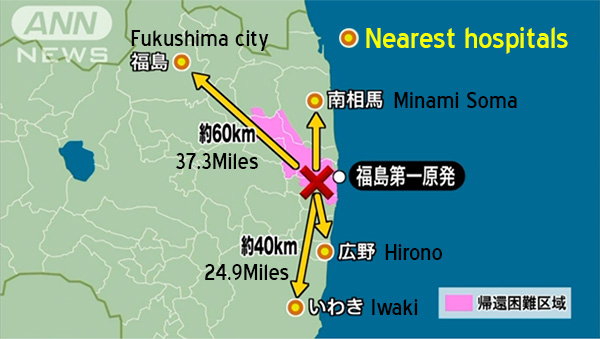
Since the entire area has been evacuated, the injured passengers on the crashed bus had be transported as far as 37Miles.
40 passengers including the bus driver had to wait for the ambulance for two hours on the side of the road. No face masks were provided.
(Cars and buses are allowed around this section of Joban Expressway, but not motorcycles due to the extreme level of radioactive contamination.)
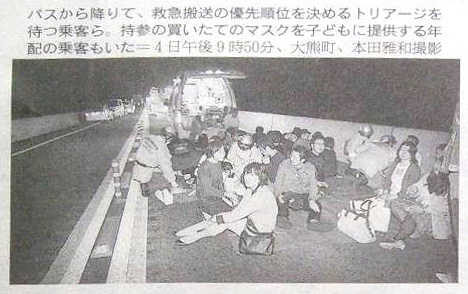
*Photo of the Japanese newspaper article courtesy of Facebook group, “NPO法人チェルノブイリへのかけはし“.

Background radiation level in Okuma town as of March 24, 25 of 2016, measured by Okuma town.
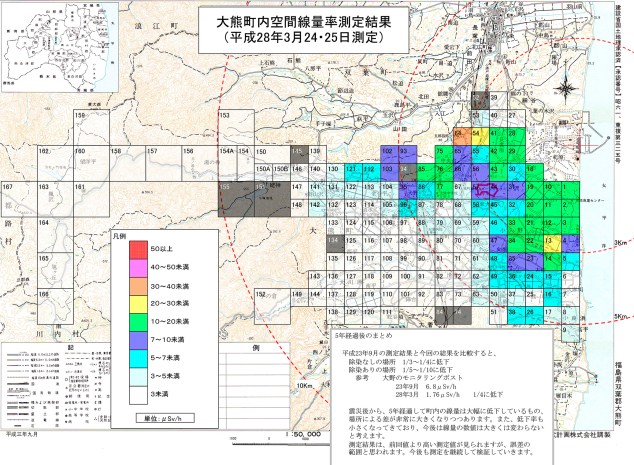

Source: http://www.mp-nuclear-free.com/main-articles/news-snippets_20160507.html
Arnie Gundersen measured 4,000 Bq/kg on a Tokyo street
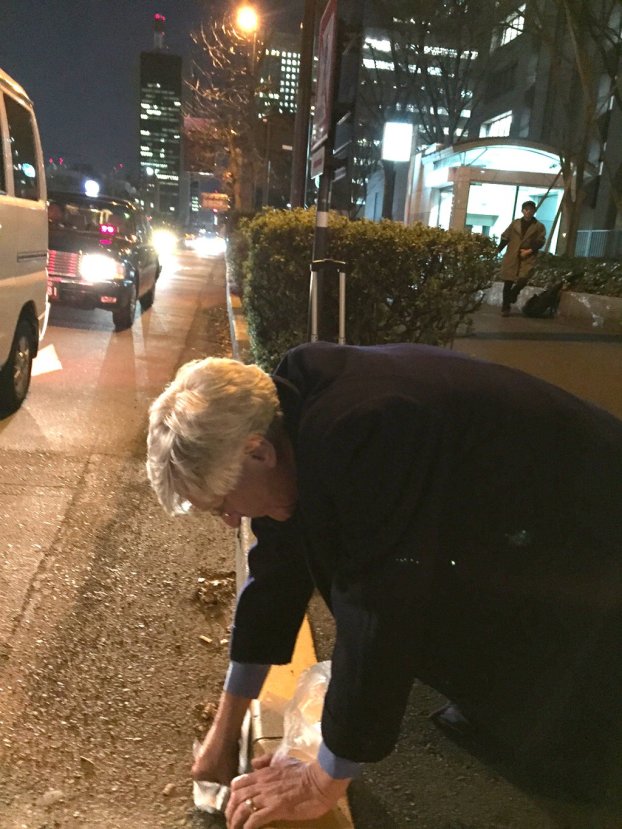
Arnie Gundersen measured 4,000 Bq/kg on a Tokyo street outside METI, Japan nuclear regulator…Olympics anyone?
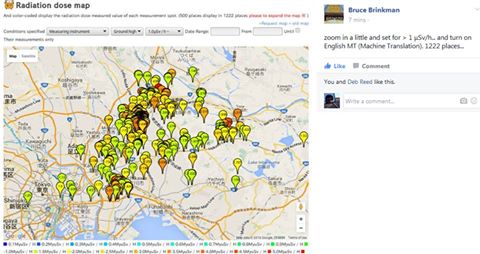
76 measurements that are over 5µS/h in the “Kashiwa hotspot”

Kashiwa city, Chiba prefecture, nearby Tokyo
Some screen caps of the new background radiation tests from Japan. Kashiwa hot spots. Thanks to Bruce Brinkman
Hakatte Geiger users have uploaded 76 measurements that are over 5µS/h in the “Kashiwa hotspot” area. You can see how they are distributed as the plume came over Kasumigaura and into eastern Tokyo. I travel through that on my way to and from work. I have to go through Matsudo and Kashiwa which are buried under the map pins.

Zoom in a little and set for > 1 μSv/h… 1222 places.
Overemphasis on economic growth led to Minamata, Fukushima: NPO forum
TOKYO — Marking the 60th anniversary of the official recognition of Minamata disease, speakers hosted by a nonprofit organization say that an overemphasis on economic growth was behind the mercury-poisoning illness as well as the nuclear disaster in Fukushima.
“Japan has put priority on economic development, rather than valuing human life, and such an attitude caused the problems of Minamata and Fukushima as well as grave fatal accidents, such as explosions at coal mines,” said Kunio Yanagida, a freelance journalist.
“The problem is that lawmakers and bureaucrats have tried to avoid their responsibility, rather than determining the truth behind the incidents, and they have failed to make the lessons learned from them universal,” he told an audience of around 1,000 at the event in Tokyo last week.
“Japan is still driven by a wartime policy of increasing its wealth and military power,” he said.
Tatsuya Mori, a film director and writer, referred to a Minamata disease patient who once said, “I was aware that I am Chisso.” The patient meant that while he is a victim of the disaster caused by Chisso Corp, a chemical maker which dumped industrial waste into the sea, he himself had enjoyed the benefits of its products and might have gone along with its actions if he had belonged to the company himself.
Mori said, “In a similar way, we could say, ‘I am Fukushima,’ or ‘I am Tokyo Electric Power Co.,’ as we have depended on the crippled Fukushima Daiichi nuclear plant” operated by the utility.
“We need to realize we have supported the system that caused the issues of Minamata and Fukushima,” he added.
The Tokyo forum was organized by Minamata Forum to mark the 60th anniversary since a public health center in Minamata in the southwestern Japan prefecture of Kumamoto received a report from a local doctor about four people with unexplained neurological disorders—considered later to be when Minamata disease was first recognized.
Before starting the session, the audience observed a moment of silence before 500 portraits of Minamata disease victims put up behind the speakers on the stage.
So far, only around 3,000 among over 33,500 applicants have been officially recognized as Minamata disease patients in Kumamoto and neighboring Kagoshima prefectures as well as Niigata Prefecture, where a similar disease was confirmed in 1965, caused by wastewater from a Showa Denko K.K. plant.
Critics claim that six decades after Minamata disease was first recognized, the issue has still not been resolved with the full number of sufferers yet to be fully acknowledged. Several damages suits are still pending.
Let Japanese Officials Eat Isotopes To Atone For Fukushima
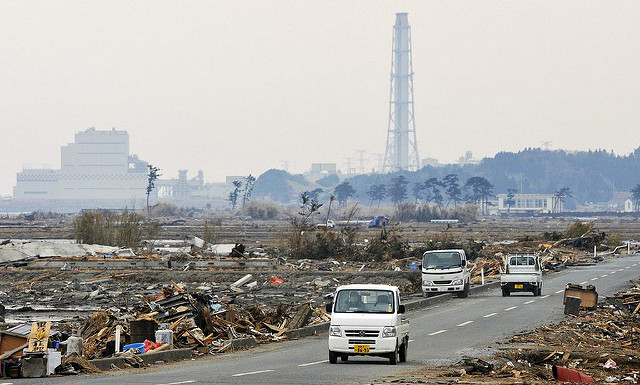
Despite the Fukushima and Chernobyl disasters, nuclear energy continues to thrive. Pictured: Fukushima shortly after the disaster.
How Japanese Officials Can Atone for Fukushima
Let them eat isotopes.
The meltdowns and release of radiation from the Fukushima Daaichi nuclear power plant has been an ongoing crisis for five years. Nuclear engineer Koide Hiroaki has been one of the most trenchant critics of how the Japanese government and power company TEPCO (mis)handled the disaster. In a wide-ranging interview at Counterpunch, he offered a way for officials, who have gone unpunished, to atone.
Right now the people of Fukushima have been abandoned in the areas of the highest levels of radiation. And abandoned people have to find a way to live. Farmers produce agricultural goods, dairy farmers produce dairy products, and ranchers produce meat; these people must do so in order to live. They are not the ones to be blamed at all.
As the Japanese state is absolutely unreliable in this matter, these people have no choice but to go on producing food in that place, all the while suffering further exposure. So I don’t think we can throw out the food they produce there under those conditions. Inevitably someone has to consume that food.
Certainly not the residents of the Fukushima area. Hiroaki has a better idea.
We should serve all of the most heavily contaminated food at say the employee cafeteria at TEPCO or in the cafeteria for Diet members [Japanese parliament] in the Diet building. But that isn’t nearly enough. We must carefully inspect the food, and once we’ve determined what foods have what levels of contamination, once that is fully measured and delineated, then those who have the corresponding levels of responsibility should eat it, should be given it.
He’s serious.
I am aware that this is a controversial proposal, but each one of us, especially those who built post-war Japan, bears responsibility for allowing our society to heavily dependent on nuclear energy without carefully reflecting on the risks and consequences of it. And more importantly, we have the responsibility for protecting children.
Even after Chernobyl and Fukushima, nuclear energy thrives. Especially in Russia and China, where they are planning to build floating nuclear energy plants. Huh? From CNN on April 28:
China is planning to build nuclear reactors that will take to the sea to provide power in remote locations. … These small power plants will be built in Chinese shipyards, mounted on large sea-going barges, towed to a remote place where power is needed and connected to the local power grid, or perhaps oil rig.
China has 20 planned; Russia seven. Never mind how much the costs would cascade if another disaster occurs. In January 2014, at Warscapes magazine, I wrote that it was difficult to understand how the advocates of nuclear power can continue to block out the risk of major accidents, especially when they are fresh in our memory.:
Fukushima has just occurred before the world has gotten over the last one, Chernobyl. What if another accident occurs while we’re still knee-deep in cleaning up and bearing the costs of Fukushima, and maybe even still Chernobyl? Casualties and damage to the environment aside for the moment, how can nations afford this? Come to think of it, how do nuclear-power companies afford it, yet continue to forge ahead?
To answer the last question: state subsidies to build nuclear energy plants. Also, of course, much of the cost of cleaning up after an accident is, as you would expect, offloaded to the state and its citizens. Bailing out the nuclear energy is of a piece with bailing out the banks.
http://fpif.org/japanese-officials-can-atone-fukushima/
How Can Japan Settle The Issue Of Fukushima Daiichi Tritium? Drink It.

Water tanks crowding the Fukushima Daichi nuclear plant site
Here’s the problem in a nutshell—or rather a thimbleful—facing the Japanese government and Tokyo Electric Power Company (TEPCO), the operator of the crippled Fukushima Daiichi nuclear plant.
There are over 1,100 large steel tanks brimming with filtered water—except for a low contaminant called tritium—clogging both the plant and an expanding area outside the site.
The water is a mix of tons of groundwater flowing into the plant’s basements and tons of contaminated water that have become radiated after draining down there through the three damaged reactors the water was injected into to keep the melted uranium cores cool. This lethal liquid mix is pumped out the basements and decontaminated before it overflows and seeps into the sea; some of it is recycled back as coolant into the reactors while the rest is pumped into the storage tanks.
This process continues hour after hour, day after day, year after year: a cunningly worthy punishment of the gods for the latter-day Sisyphus, TEPCO. Consequently, every week or two a new tank-full of treated water is added to the forest of steel now covering the area like giant alien mushrooms. The total amount of stored water exceeds 800,000 cubic tons and is inexorably heading for one million tons and more without an end in site.
The cost is enormous, and picking up the tab is the Japanese taxpayer—not TEPCO, which is undergoing a ten-year reconstruction since a government bail out saved it from bankruptcy.
So the million-ton-plus dilemma for the government has boiled down to three options: keep on with the endless and expensive tank building and filling; find a way to remove the tritium from the water; or have TEPCO discharge (dump) the water into the ocean.
The latter option is by far the easiest and least expensive method, except that the water is tritiated: that is the water has become radioactive.
Without context, that’s a scary word, until you remember that sunbathing and eating bananas are pleasant radioactive pastimes. The point being that the energy tritium gives off is so low as to be unmeasurable with a dosimeter. And the particles (not rays) tritium expels can be stopped by plastic wrap—as Shunichi Tanaka, head of Japan’s Nuclear Regulatory Authority, told the press recently.
That’s a fact, but it’s not the point, say environmentalist foes of the dumping method. Ingesting tritium is a concern for health they argue. And they have experts to back up such concerns, though they are mostly theoretical. Meanwhile, there are experts on the other side of the debate pooh-poohing such worries and asking to see some solid proof to back up the theory.
Conclusion: Those supportive of nuclear power tend to minimize the health risks of tritium, while those opposing the use of nuclear power tend to exaggerate its risks.
What is not debatable is the negative psychological impact releasing the water into the sea will have on Japan’s nervous neighbors, the suffering people of the northeast, the region’s fishing industry and the Japanese electorate.
Given such concerns and uncertainties, organizations like Greenpeace urge the government to err on the side of caution. The best option, says Greenpeace, is to continue storing the water while exploring all technical options for tritium separation.
On the face of it, that seems reasonable. But then experts opposing this stance, like Lake Barrett, a nuclear industry consultant advising TEPCO, point out that while it may be possible to create a method of separating the tritium, it hasn’t been found yet, despite much effort; and it would likely cost a couple of billion dollars to develop and perfect in any case. It’s no surprise that TEPCO and the government have reached the same conclusion.
“All that money could be better spent on schools, hospitals,” Barrett told me. “And you can’t go on building tanks forever.”
Besides, he adds, “The very low levels of tritium in the stored water are not a meaningful health risk. After verification that the radioactivity levels are within conservative Japanese health risks, I would not hesitate to drink it, bathe in it, or eat fish or shellfish harvested from it.”
Now there’s an idea. If the government is to discharge the tritiated water into the ocean without turning a large portion of the electorate against it, it needs to persuade a majority of citizens that it is safe within reason to do so. This will require a number of carefully thought out steps.
The government will have to clearly explain the pros and cons of its action and the reason for its decision; it must establish a mechanism to compensate the fisherman for the shortfall they will undergo following the release; an international panel of independent, knowledgeable people, including environmentalists of the non-hysterical variety, is required to verify the tritiated water does indeed fall well below internationally accepted standards for release; and the panel members must be granted access to monitor the process at any time they wish.
Then for the coup de grâce, Prime Minister Abe, his cabinet members along with TEPCO executives should visit Fukushima Daiichi, and while standing in front of one the giant tanks each drink a glass of the tritiated water. This won’t sway everyone, of course, but it would give the government the minimum moral authority required to make such a contentious decision.
Radioactive material from Fukushima plant coming back to Japan in the Pacific
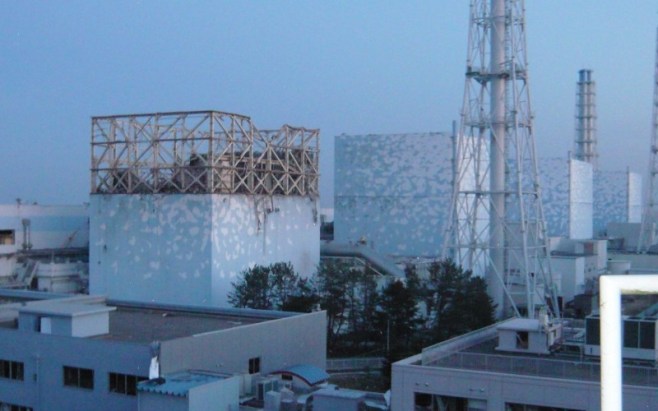
Prof. Aoyama from Institute of Environmental Radioactivity of Fukushima University reported that the radioactive material discharged from Fukushima plant circulated in the Pacific to come back to Japan offshore.
He implemented seawater analysis at 71 points from 11. 2015 to 2. 2016. The analysis is partially completed to show radioactive material has spread to the South West offshore of Japan. 2 Bq/m3 of Cs-137 was detected in seawater from South West offshore of Kyushu. 1.83 Bq/m3 was detected even offshore of the west coast of Japan.
0.38 Bq/m3 of Cs-134 was also measured to prove this is from Fukushima accident.
It is assumed that the discharged Cs-134/137 travelled to the east in the Northern Pacific. It was carried to the South and West to come back to Japan by taking 2 ~ 3 years.
He comments it is possible that the density of radioactive material increases from now.
http://www.asyura2.com/16/genpatu45/msg/611.html
Radioactive material from Fukushima plant coming back to Japan in the Pacific
To cleanup some radioactive fallout!
There are two main problems in whatever decontamination techniques used: wash off and scrap up techniques, or phytoremediation:
80% of the Fukushima prefecture land surface is forested mountains, forested mountains which you can neither wash off and scrap up nor phytoremediate.
Forested mountains from which the accumulated contamination ruissels down or flies down with wind and rain to the low land living areas which had been previouly decontaminated, some places have already been decomtaminated up to five times, always the contamination coming back up to the pre-decontamination level.
To decontaminate well and forever you would have to cut down those mountain forests, which is a huge surface to be cut down, a gigantic impossible work, which would as an immediate effect spread a lot of the accumulated various radionuclides and make the radiation level jump high everywhere.
With either of those techniques you quickly end up with a huge quantity of contaminated waste, which accumulates quickly and for which there is no real valid solution for disposal. To reduce its volume by incineration is still re-scattering radionuclides into the environment, as there is no incinerator filter capable of blocking 100% of all radionuclides nanoparticles.


Obviously, the cleanup process is much more involved than this, but you can imagine how difficult it is to keep all that radioactive dust from getting into everything. Phil Broughton is a treasure trove of stories and information. But, if you follow his blog, you’ll learn that he takes the decontamination process very seriously. Something a graduate student learned the hard way when they made a poorly-thought out April Fool’s prank. Phil had this to say about the tremendous task of nuclear cleanup:
…everything exposed to air, everything that rain water might wash over, ALL SURFACE WATER, must be assumed to be contaminated. Want to use that car? Wash it down because it’s got a crust of radioactive crap on it, and if you try to drive it, you just climbed inside your own moving irradiator box.
This is the hard part of fallout decon[tamination] and radioactive waste in general. Nothing makes it stop being radioactive other than time, and human attention spans and lifespans are somewhat incompatible with this. Not living in the higher dose world its very hard to contemplate the “I accept this dose for me, my children, and generations to come” when planning reconstruction.
A while ago, I did a couple of comics about how plants (including tumbleweeds) were being used to help clean up radioactive material. Here’s Phil again:
Fungi, in fact, do amazing work sucking fallout products out of the soils. Instead of having roots, their hyphae draw nutrients out of a very shallow layer and do it quickly. This is also good because fallout actually doesn’t penetrate all that deep below the surface of the soil. One of the ways we monitor how much radioactive material is left in the environment is by sampling the mushrooms that grow and plotting it’s drop off following an event. You may discover that there are new sources contributing to the environment which is to say the event isn’t over yet as there’s clearly a continuing release. You can also do detoxification this way by planting, harvesting, repeat until whatever your crop is isn’t showing any uptake of materials anymore.
Of course other parts of the environment are running on different clocks. It will take quite a while for contamination to get to the ground water and then for the groundwater to be sampled by plants that can tap that deep. Annoyingly, fungi and grasses might detoxify the upper layer of soil within a decade only to have the deep tapping trees pull it up from the groundwater and recontaminate the upper layer a decade after that with their now radioactive falling leaves.
After I drew the phytoremediation comics, the number one question asked by readers was: “So, what happens with the plants after they’ve absorbed the radioactive elements?” Apparently, it’s a very real problem that cleanup crews have to work with. Here’s what Kathryn Higley said when I asked her about the sunflowers being planted at Fukushima:
I’ve looked at the discussions on sunflowers and other phytoremediation techniques. From what I’ve read, they are able to capture the ‘low hanging fruit’, but they lose effectiveness after a couple of croppings/harvesting. This is because the residual material is more strongly attached to soil particles (such as clay minerals). That being said, phytoremediation is a relatively low tech solution. The challenge is then what do you do with the contaminated biomass? When I went to Fukushima you could see large ‘super sacks’ of contaminated vegetation just sitting on the side of the road (see photo below). These large bags have a limited lifespan (~5 years) before they degrade due to UV exposure and all your stored material starts being blown around by wind.

Defunct government agency exempted from indictment over Fukushima crisis
A panel has upheld a decision by prosecutors not to indict three former senior officials of the Nuclear and Industrial Safety Agency over the Fukushima crisis. The agency was responsible for nuclear safety at the time of the accident and has since been dissolved.
The decision by the Tokyo No. 1 Committee for the Inquest of Prosecution, dated April 14, means that the agency is effectively absolved of criminal responsibility for one of the world’s worst nuclear disasters.
The three were accused of professional negligence resulting in death and injury. They include Yoshinori Moriyama, NISA’s former deputy director general for nuclear accident measures.
Tsunami waves flooded the plant on March 11, 2011, knocking out power supplies and causing three reactors to melt down.
The 11-member panel concluded that it was impossible for Moriyama and the two others to foresee that 10-meter-high waves would strike.
Three former Tepco executives, including then Chairman Tsunehisa Katsumata, 76, were indicted in February based on a decision by another committee that examined a prior decision by prosecutors not to lay charges.
Under the revised inquest of prosecution law, which took effect in May 2009, criminal charges are filed if a minimum of eight members of the judicial panel vote in favor of indictment in two consecutive rulings.
NISA was scrapped in September 2012 as the nation revamped its nuclear regulatory setup following the Fukushima crisis. Critics accused the agency of lacking teeth because it was under the umbrella of the pro-nuclear Economy, Trade and Industry Ministry and therefore was seen as hand in glove with the nuclear industry.
Ice wall designed to surround Fukushima wreckage
TOKYO (AP) – Coping with the vast amounts of ground water flowing into the broken Fukushima nuclear plant – which then becomes radiated and seeps back out – has become such a problem that Japan is building a 35 billion yen ($312 million) “ice wall” into the earth around it.
But even if the frozen barrier built with taxpayers’ money works as envisioned, it won’t completely block all water from reaching the damaged reactors because of gaps in the wall and rainfall, creating as much as 50 tons of contaminated water each day, said Yuichi Okamura, a chief architect of the massive project.
“It’s not zero,” Okamura said of the amount of water reaching the reactors in an interview with The Associated Press earlier this week. He is a general manager at Tokyo Electric Power Co., or TEPCO, which operates the facility that melted down after it was hit by a tsunami in 2011, prompting 150,000 people to evacuate.
Workers have rigged pipes that constantly spray water into the reactors to keep the nuclear debris inside from overheating, but coping with what to do with the resulting radiated water has been a major headache. So far, the company has stored the water in nearly 1,000 huge tanks around the plant, with more being built each week.
TEPCO resorted to devising the 1.5-kilometer (1-mile)-long ice wall around the facility after it became clear it had to do something drastic to stem the flow of groundwater into the facility’s basement and keep contaminated water from flowing back out.
“It’s a vicious cycle, like a cat-and-mouse game,” Okamura said of the water-related issues. “We have come up against many unexpected problems.”
The water woes are just part of the many obstacles involved in controlling and dismantling the Fukushima Dai-chi plant, a huge task that will take 40 years. No one has even seen the nuclear debris. Robots are being created to capture images of the debris. The radiation is so high no human being can do that job.
The ice wall, built by construction company Kajima Corp., is being turned on in sections for tests, and the entire freezing process will take eight months since it was first switched on in late March. The entire wall requires as much electricity as would power 13,000 Japanese households.
Edward Yarmak, president of Arctic Foundations, based in Anchorage, Alaska, which designs and installs ground freezing systems and made an ice wall for the Oak Ridge reactor site, says the solution should work at Fukushima.
“The refrigeration system has just been turned on, and it takes time to form the wall. First, the soil freezes concentrically around the pipes and when the frozen cylinders are large enough, they coalesce and form a continuous wall. After time, the wall increases in thickness,” he said in an email.
But critics say the problem of the groundwater reaching the reactors was a no-brainer that should have been projected.
Building a concrete wall into the hill near the plant right after the disaster would have minimized the contaminated water problem considerably, says Shigeaki Tsunoyama, honorary professor and former president of University of Aizu in Fukushima.
Even at the reduced amount of 50 tons a day, the contaminated water produced at Fukushima will equal what came out of Three Mile Island’s total in just eight months because of the prevalence of groundwater in Fukushima, he said.
Although TEPCO has set 2020 as the goal for ending the water problems, Tsunoyama believes that’s too optimistic.
“The groundwater coming up from below can never become zero,” he said in a telephone interview. “There is no perfect answer.”
Okamura acknowledged the option to build a barrier in the higher elevation near the plant was considered in the early days after the disaster. But he defended his company’s actions.
The priority was on preventing contaminated water from escaping into the Pacific Ocean, he said. Various walls were built along the coastline, and radiation monitors show leaks have tapered off over the last five years.
Opponents of nuclear power say the ice wall is a waste of taxpayers’ money and that it may not work.
“From the perspective of regular people, we have serious questions about this piece of research that’s awarded a construction giant,” says Kanna Mitsuta, director of ecology group Friends of the Earth Japan. “Our reaction is: Why an ice wall?”
Court orders TEPCO to pay 31 million yen over deaths of Fukushima patients
The Tokyo District Court on April 27 ordered Tokyo Electric Power Co. (TEPCO) to pay a total of around 31 million yen to the families of two former patients at a local hospital who died following the 2011 crisis at the Fukushima No. 1 Nuclear Power Plant.
The families of the two elderly men had demanded the operator of the crippled nuclear plant pay a total of about 66 million yen, claiming that they died after being forced to evacuate from Futaba Hospital located approximately 4.6 kilometers from the power plant in the Fukushima Prefecture town of Okuma.
Of some 50 patients at Futaba Hospital who died following the nuclear disaster, the families of a then 98-year-old dementia patient and a then 73-year-old schizophrenia patient filed the lawsuit. While there have been two cases of settlement between the families of former Futaba Hospital patients and TEPCO at Chiba and Fukushima district courts, this is the first court ruling to have been delivered over deaths of patients at the hospital.
TEPCO had acknowledged the causal relationship between evacuation and the deaths of the two patients. The trial, therefore, had focused on the amount of damages.
According to the ruling, the conditions of the two patients had been severe and they required assistance with eating and other daily tasks. An evacuation order was issued on March 12, 2011, the following day of the disaster, and the patients left the hospital on March 14 and 16, respectively. However, unable to receive appropriate medical care, the pair died of dehydration and hypothermia.
The court determined the amount of damages at 20 million yen for each patient and judged that their existing conditions had affected the development of additional illnesses. It then reduced the amount demanded by the families by 40 percent for the dementia patient and by 20 percent for the schizophrenia patient.
An attorney representing the plaintiffs said it was unfortunate that circumstances particular to a nuclear plant disaster was not taken into consideration in the ruling.
Meanwhile, Tokyo Electric Power Company Holdings Inc. released a comment stating that the utility will go through the ruling and sincerely handle the situation.
http://mainichi.jp/english/articles/20160428/p2a/00m/0na/010000c
Fukushima ice wall won’t stop all radioactive groundwater from seeping out – chief architect

Chief architect Yuichi Okamura told AP that gaps in the wall and rainfall will still allow for water to creep into the facility and reach the damaged nuclear reactors, which will in turn create as much as 50 tons of contaminated water each day.
“It’s not zero,” Okamura, a general manager at Tokyo Electric Power Co. (TEPCO) said. “It’s a vicious cycle, like a cat-and-mouse game…we have come up against many unexpected problems.”
The wall, which will be 1.5km (1 mile) long, will consist of an underground pipe network stretching 30 meters (100 feet) below the surface, around the reactor and turbine buildings. The pipes are designed to transport refrigerant cooled to -30° Celsius (-22°F) to chill the nearby soil until it freezes.
The barrier is being turned on in sections for tests, and the entire freezing process will take eight months since it was first switched on in late March. The process requires an amount of electricity that would power 13,000 Japanese households.
Despite its current efforts, TEPCO – the operator of the Fukushima plant – has been fiercely criticized by those who say the groundwater issue should have been forecasted and dealt with sooner.
Shigeaki Tsunoyama, an honorary professor and former president of University of Aizu in Fukushima, said that building a concrete wall built into the hill near the plant after the disaster would have minimized the contaminated water issue.
Okamura acknowledged that the option of building a barrier at a higher elevation near the plant was considered in the days following the disaster, but defended the actions of TEPCO, stressing that the priority is on preventing contaminated water from escaping into the Pacific Ocean.
Others have criticized the US$312 million wall, which is being built by construction company Kajima Corp., as a waste of taxpayer money.
TEPCO has repeatedly faced criticism for its handling of the Fukushima crisis, which occurred after a massive earthquake and subsequent tsunami led to a meltdown of reactors at the facility in March 2011. The disaster was the worst nuclear accident to take place since Chernobyl in 1986.
The company has admitted that it did not act properly during the disaster, confessing in February that it announced the nuclear meltdowns far too late. It also stated in a 2012 report that it downplayed safety risks caused by the incident, out of fear that additional measures would lead to a shutdown of the plant and further fuel public anxiety and anti-nuclear campaigns.
Despite the ongoing problems encountered following the meltdowns, TEPCO has set 2020 as the goal for ending the plant’s water problem – an aim which critics say is far too optimistic.
However, the water problem is just part of the monumental challenges faced at the facility. Controlling and dismantling the plant is expected to take 40 years. Robots have been tasked with taking photos of the debris, as the radiation levels are too high for humans to complete the job.
https://www.rt.com/news/341231-fukushima-ice-wall-groundwater/
-
Archives
- October 2026 (120)
- September 2026 (339)
- August 2026 (330)
- July 2026 (355)
- June 2026 (287)
- May 2026 (306)
- April 2026 (356)
- March 2026 (251)
- February 2026 (267)
- January 2026 (308)
- December 2025 (358)
- November 2025 (359)
-
Categories
- 1
- 1 NUCLEAR ISSUES
- business and costs
- climate change
- culture and arts
- ENERGY
- environment
- health
- history
- indigenous issues
- Legal
- marketing of nuclear
- media
- opposition to nuclear
- PERSONAL STORIES
- politics
- politics international
- Religion and ethics
- safety
- secrets,lies and civil liberties
- spinbuster
- technology
- Uranium
- wastes
- weapons and war
- Women
- 2 WORLD
- ACTION
- AFRICA
- Atrocities
- AUSTRALIA
- Christina's notes
- Christina's themes
- culture and arts
- Events
- Fuk 2022
- Fuk 2023
- Fukushima 2017
- Fukushima 2018
- fukushima 2019
- Fukushima 2020
- Fukushima 2021
- general
- global warming
- Humour (God we need it)
- Nuclear
- RARE EARTHS
- Reference
- resources – print
- Resources -audiovicual
- Weekly Newsletter
- World
- World Nuclear
- YouTube
-
RSS
Entries RSS
Comments RSS

