Typhoon Lionrock Might Land On Fukushima Daiichi

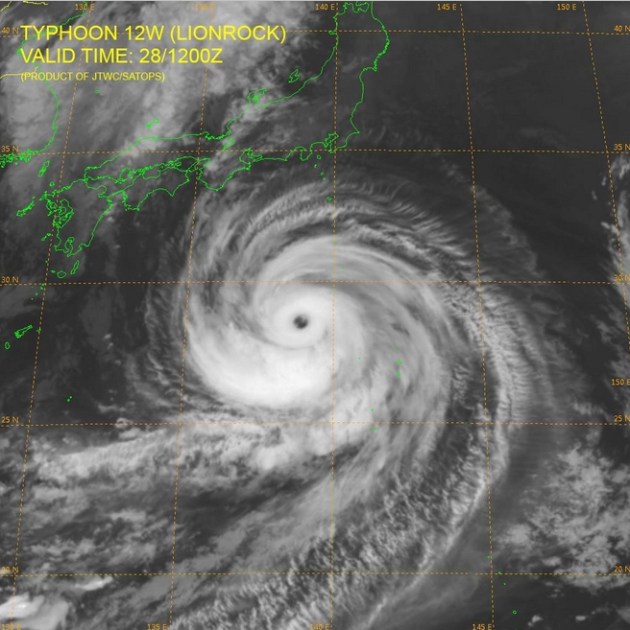
It might land in north east Japan for the first time since the beginning of meteorological records. We are very very worried about the Fukushima Daiichi NPP and the local population.
Typhoon Lionrock has strengthened and changed course. Current predictions as of today shows it hitting the Tohoku coast as a category 1 typhoon. The center of the predicted path is around Sendai, Miyagi Prefecture. Fukushima Prefecture and Fukushima Daiichi are within the predicted path zone.
Even if it doesn’t directly hit Fukushima Daiichi, outer bands could still cause significant problems. High winds could damage contaminated water tanks in the process of being disassembled or assembled on site. These tanks are highly radioactive and some may still contain highly radioactive water or sludge. Cranes and other outdoor structures that could be damaged by high winds are a concern.
The “K” drainage system connected to the roofs of the reactor buildings before the disaster. Post disaster we still see spikes in contamination in this drainage system. There are multiple other locations where this system could be fed contaminated run off. This drainage system has been redirected to the port but the port still exchanges water with the sea, so it isn’t a reliable solution. There is a pumping system to pump contaminated groundwater out of the area near the reactor buildings then to contaminated water storage.
It is not clear if it can keep up with both the ongoing groundwater intrusion and influx from a typhoon.
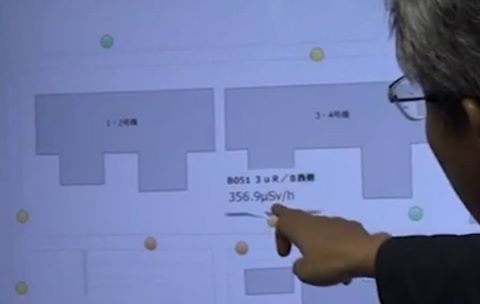
TEPCO apologizes to Niigata for meltdown cover-up
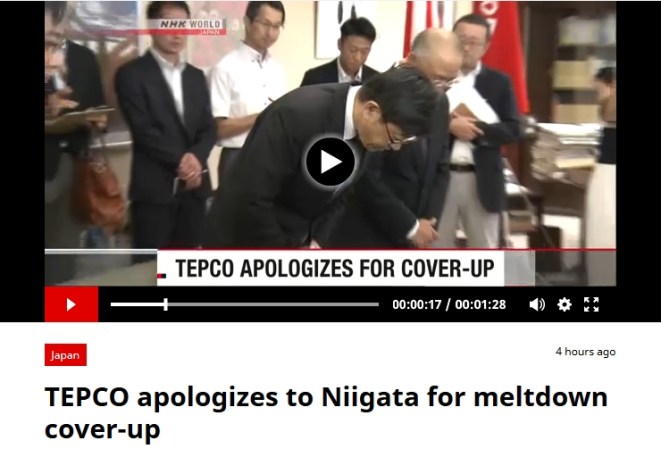
A top official of the operator of the Fukushima Daiichi nuclear power plant has apologized to the Niigata Prefecture governor for having concealed the 2011 reactor meltdowns for more than two months.
Takafumi Anegawa, Managing Executive Officer of the Tokyo Electric Power Company, met Niigata Governor Hirohiko Izumida on Thursday.
In February this year, TEPCO admitted the utility could have ascertained there was a meltdown three days after its occurrence if utility workers had followed an in-house manual. It was also later found that TEPCO’s then-president had instructed officials not to use the words “core meltdown.”
The prefecture, which hosts another TEPCO nuclear power plant on the Japan Sea coast, has put together a panel of experts to study the utility’s handling of the Fukushima accident.
Anegawa told the governor that TEPCO apologizes for not having presented a report based on an adequate investigation.
Izumida said information on meltdowns is critical for residents living near nuclear power plants to decide whether to flee or not. He said the prefecture expresses regret that TEPCO has not admitted its meltdown cover-up for five years.
Later this month, a joint panel set up by Niigata Prefecture and TEPCO plans to begin a detailed investigation.
Governor Izumida said additional probes are necessary to find out what in-house problems TEPCO had.
The governor said it is too soon to discuss resuming operations at the nuclear plant in his prefecture without a complete review of the Fukushima accident.
http://www3.nhk.or.jp/nhkworld/en/news/20160825_21/
10,000 tons of toxic water pools in Fukushima nuclear plant trenches
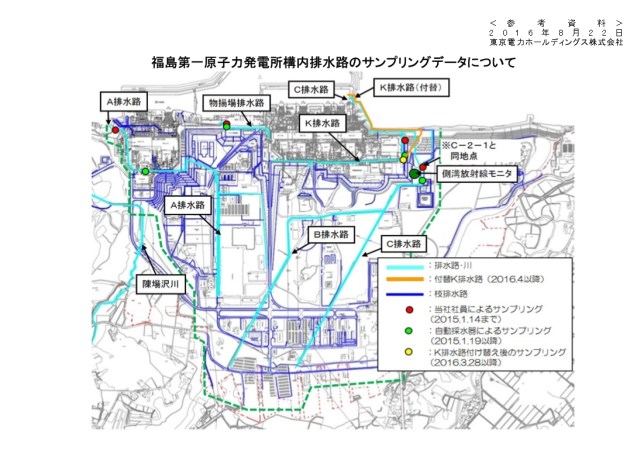
Drainage chart/map
TOKYO (Kyodo) — Around 10,000 tons of contaminated water have pooled in underground trenches around the Nos. 1 to 4 reactor buildings of the crippled Fukushima Daiichi nuclear power plant, according to the plant operator Tokyo Electric Power Company Holdings Inc.
Tokyo Electric has no immediate plan to remove the water in the trenches where cables run for the nuclear power complex devastated by the March 2011 earthquake and tsunami disaster.
Water that flew into the trenches in the wake of the huge tsunami is believed to have been mixed with highly radioactive water leaking from the basements of reactor buildings and contaminated rain water.
“Compared with around 70,000 tons of highly contaminated water that remain in the basements of the reactor buildings, (the water in the trenches) has a low level of concentration and thus poses little threat in terms of radiation exposure and the environment,” said an official of the utility known as TEPCO.

TEPCO said in a report issued in July — based on research conducted in fiscal 2015 — that it has found around 8,000 tons of toxic water in 17 locations in the trenches that connect with reactor buildings where highly radioactive water accumulates, as well as around 3,000 tons of toxic water at 11 locations in trenches that do not connect with reactor buildings.

Of the water in the trenches around the Nos. 1 to 4 reactor buildings, a removal procedure was completed by June for around 500 tons of water in a pipe that measured the highest level of radioactive cesium at 500,000 becquerels per liter.
The level of radioactive cesium in water at other locations in the trenches was mostly measured at several thousands becquerels or below.
The level in toxic water in the basements of reactor buildings has been measured at around dozens of millions becquerels at maximum.
TEPCO has said it will continue to monitor and measure the level of contamination in water in the trenches regularly and consider taking measures to remove the water in the future. But no concrete plan has been created yet.
The electricity firm has so far removed a total of around 10,000 tons of highly radioactive water at three locations in the trenches running in the seaside of the complex and completed the procedure to fill locations concerned with cement to prevent water leaks.
Still, the level of radioactive cesium remains unchecked at 40 locations in the trenches due to high radioactive levels as well as debris and other objects blocking the research operation.
Around 8,000 tons of contaminated water, including those with an extremely low level of contamination, have also been found in the trenches running around the Nos. 5 and 6 reactor buildings. The two units have lower levels of radiation doses than the Nos. 1 to 4 units as there were no nuclear meltdowns or hydrogen explosions there during the nuclear disaster.
http://mainichi.jp/english/articles/20160823/p2g/00m/0dm/074000c
Drainage charts/maps.
https://t.co/EIJkR80Biq
Tepcos Reports (PDF)
https://t.co/lTM563FjQe
Japan asks Pokemon GO players to stay out of Fukushima fallout zone – but yet still allows thousands to return living in contaminated land

Evolution at its best! Japan asks Pokemon GO players to stay out of Fukushima fallout zone – but yet still allows thousands to return living in contaminated land.
So far, everything from car crashes to shootings have been associated with the addictive game, and countries all over the world are now trying to stop accidents before they can happen. That, you see, is why Japan is asking Niantic to remove any wild pokemon that are currently cropping up in the Fukushima fallout zone.
TEPCO has asked the developer to keep pocket monsters far, far away from the radioactive site. Obviously, they are worried about trainers stumbling upon the area in their pursuit to catch, say, a Nucleon.
Currently, Tepco has confirmed, “the Fukushima Daiichi plant, the Fukushima Daini plant and the Kashiwazaki-Kariwa plant in Niigata Prefecture,” were all scouted. Unsurprisingly, pokemon were found at all three of the sites.
Masao Uchibori, the governor of Fukushima, said it would be dangerous for trainers to enter the areas due to their radioactive nature. As such, he’s confirmed that, “the prefectural government will consider how to draw attention to this.” Beyond that, the city of Nagasaki has also asked for Niantic to remove the app’s presence from Nagasaki Peace Park, a local memorial for the victims of the 1945 atomic bombing.
A month later following the announcement though, Earthquake-stricken regions in Japan are turning to the “Pokemon Go” phenomenon to catch more tourism money.
The Iwate, Miyagi, Fukushima and Kumamoto prefectural governments said Aug. 10 they will partner with Niantic Inc., operator of the popular “Pokemon Go” smartphone app, to promote local tourism.
Money talks !
Credit to Nelson Surjon
‘99% effective’ Fukushima ice wall fails to seal off crippled nuclear plant
« TEPCO has been repeatedly facing criticism for handling of the Fukushima crisis which occurred after a massive earthquake and subsequent tsunami led to a meltdown of reactors at the facility in March 2011.
The company has admitted that it did not act properly during the disaster, confessing in February that it announced the nuclear meltdowns far too late. It also stated in a 2012 report that it downplayed safety risks caused by the incident, out of fear that additional measures would lead to a shutdown of the plant and further fuel public anxiety and anti-nuclear campaigns. »
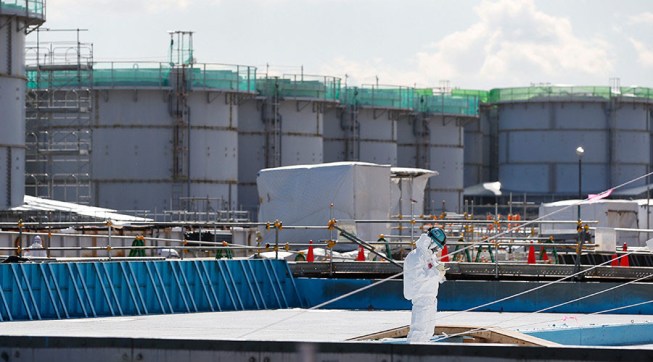
An “almost” watertight ice wall built around the Fukushima nuclear plant in a bid to prevent groundwater from entering the site has, quite predictably, proven to be not good enough, with Japan’s nuclear watchdog now urging TEPCO to find a better solution.
An expert panel with the Japanese Nuclear Regulation Authority examined the latest TEPCO report this week to assess how far and how successfully the project had been implemented, Japanese newspaper Asahi Shimbun reports. The members of the panel concluded that the ice wall was not working and a new plan was necessary to prevent groundwater getting mixed up with radioactive substances.
“The plan to block groundwater with a frozen wall of earth is failing,” said Yoshinori Kitsutaka, a panel member and a professor of engineering at Tokyo Metropolitan University.
“They need to come up with another solution, even if they keep going forward with the plan.”
In March, construction company Kajima Corp. began building the frozen wall of earth around the four damaged nuclear reactors and has completed most of the 1.5-km (1 mile) barrier. TEPCO hoped that the frozen earth barrier would thwart most of the groundwater from reaching the plant and divert it into the ocean instead. However, little or no success was recorded in the wall’s ability to block the groundwater during the five-month-period. The amount of groundwater reaching the plant has not changed after the wall was built, experts said.
The problem is said to lie in the wall’s gaps, or parts where the barrier is not frozen. According to TEPCO, 99 percent of their thermometer readings showed that the wall’s temperatures are at or below the freezing point, meaning the wall is mostly solid. However, a remaining one percent of the readings showed temperatures above the freezing point, which means the wall is not solid at those parts.
Those constitute a mere one percent of the 820-meter-long barrier, but these sections, where the earth is not frozen, are enough to ruin the entire project as they were found in areas with high levels of groundwater concentration.
TEPCO however believes that the unfrozen sections can be fixed if coated with concrete.
In April a chief architect of the project said that gaps in the wall and rainfall will still allow for water to creep into the facility and reach the damaged nuclear reactors, which will in turn create as much as 50 tons of contaminated water each day.
“It’s not zero,” Yuichi Okamura, a general manager at Tokyo Electric Power Co. (TEPCO) said referring to the amount of groundwater flowing into the plant. “It’s a vicious cycle, like a cat-and-mouse game…we have come up against many unexpected problems.”
Fukushima ice wall won’t stop radioactive groundwater from seeping out – chief architect https://t.co/57C1J48VHOpic.twitter.com/em5d53Cbtr
— RT (@RT_com) April 29, 2016
TEPCO has been repeatedly facing criticism for handling of the Fukushima crisis which occurred after a massive earthquake and subsequent tsunami led to a meltdown of reactors at the facility in March 2011.
The company has admitted that it did not act properly during the disaster, confessing in February that it announced the nuclear meltdowns far too late. It also stated in a 2012 report that it downplayed safety risks caused by the incident, out of fear that additional measures would lead to a shutdown of the plant and further fuel public anxiety and anti-nuclear campaigns.
Despite the ongoing problems encountered following the meltdowns, TEPCO has set 2020 as the goal for ending the plant’s water problem – an aim which critics say is far too optimistic. The problem of water contamination is just one of many surrounding the dismantling and containing of the Fukushima plant debris which is estimated to take at least 40 years.
Worker’s leukemia deemed result of his work at Fukushima Daiichi Nuclear plant granted compensation
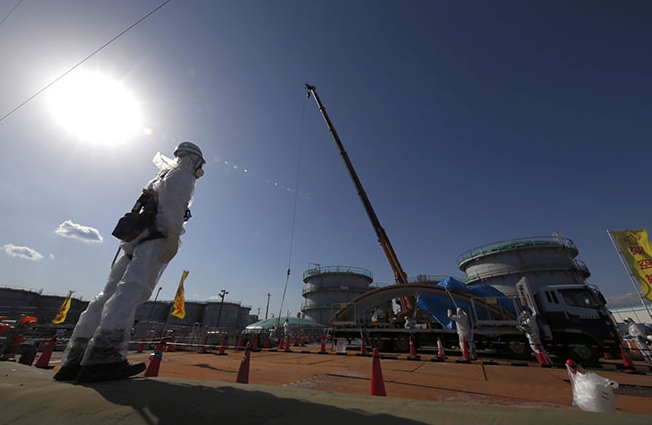
Workers in protective gear at the Fukushima No. 1 nuclear power plant in February
Man’s leukemia deemed result of his work at Fukushima plant
The labor ministry said a man who developed leukemia by helping in clean-up efforts at the crippled Fukushima No. 1 nuclear power plant is entitled to work-related compensation.
It marks the second such case since the 2011 nuclear disaster.
The Ministry of Health, Labor and Welfare recognized that the cancer was due to exposure to radiation at the facility and said the government will cover his medical expenses.
The ministry said Aug. 19 that the man, who is in his 50s, was involved in removing debris and repairing machinery that handled radioactive water at the plant between April 2011, a month after the triple meltdown triggered by the earthquake and tsunami disaster, and January 2015.
His accumulative radiation exposure was 54.4 millisieverts.
The man worked for a contractor with Tokyo Electric Power Co., the operator of the nuclear complex.
He was diagnosed with leukemia in January 2015, and filed application for worker’s accident compensation at the Fukushima Labor Standards Inspection Office, a regional branch of the ministry.
Under the ministry’s guidelines, eligibility for work-related compensation in such cases is granted if leukemia is diagnosed after the person worked for more than a year in an assignment which resulted in an annual dose of more than 5 millisieverts.
The ministry’s decision to grant compensation in this case came after a panel of experts offered their opinions on the matter.
The ministry is scrutinizing the cases of five other former workers at the plant who have applied for compensation.
Compensation in such cases was first granted last October after a man in his early 40s was diagnosed with leukemia in January 2014. He was exposed to 16 millisieverts of radiation while he worked at the plant between 2012 and 2013.
Applications for the work-related compensation as a result of the Fukushima disaster are expected to increase in coming years, experts say.
According to TEPCO, those who had annual does of more than 5 millisieverts of radiation during fiscal 2015 numbered 4,952.
http://www.asahi.com/ajw/articles/AJ201608200036.html
Fukushima worker with cancer granted compensation
Japan’s labor ministry has certified that a former worker at the Fukushima Daiichi nuclear plant is eligible for compensation for developing leukemia.
The man in his 50s had worked at the plant for nearly 4 years since April 2011, soon after the compound suffered a meltdown.
The ministry says the man was in charge of mechanical repairs at the plant. It says he developed leukemia in January last year, and applied for workers’ compensation.
Ministry officials say the man’s radiation exposure has reached 54.4 millisieverts, and that they found no other plausible causes except his work.
He is the 2nd person to be awarded compensation in connection with the accident, following a case last October involving another man with leukemia.
In all, 14 nuclear plant workers in Japan have been granted compensation for work-related cancer.
About 47,000 people have worked at the Fukushima plant in the 5 years since the accident.
Panel: TEPCO’s ‘ice wall’ failing at Fukushima nuclear plant
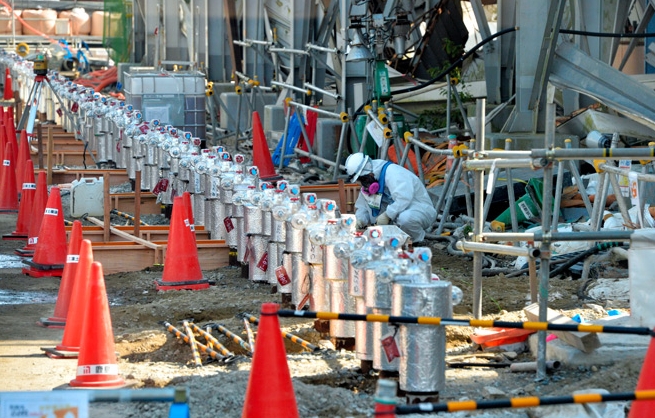
Devices to freeze the earth are set up on the southern side of the No. 4 reactor building at Tokyo Electric Power Co.’s Fukushima No. 1 nuclear power plant in Fukushima Prefecture in 2014.
Tokyo Electric Power Co.’s “frozen wall of earth” has failed to prevent groundwater from entering the crippled Fukushima No. 1 nuclear plant, and the utility needs a new plan to address the problem, experts said.
An expert panel with the Nuclear Regulation Authority received a report from TEPCO on the current state of the project on Aug. 18. The experts said the ice wall project, almost in its fifth month, has shown little or no success.
“The plan to block groundwater with a frozen wall of earth is failing,” said panel member Yoshinori Kitsutaka, a professor of engineering at Tokyo Metropolitan University. “They need to come up with another solution, even if they keep going forward with the plan.”
One big problem hampering work at the nuclear plant, which was hit by the Great East Japan Earthquake and tsunami in 2011, has been the tons of groundwater entering the buildings housing the No. 1 through No. 4 reactors every day.
The water becomes contaminated with radioactive materials within the reactor buildings.
TEPCO’s plan was to create a frozen wall of earth around the reactor buildings to divert the groundwater away from the plant and into the ocean.
The company started freezing the ground on March 31, and the project’s budget was 34.5 billion yen ($344 million) in taxpayer money as of the end of May.
But the amount of groundwater pumped from the ocean side of the frozen wall has shown little change from when there was no icy earth wall.
TEPCO’s report said 99 percent of thermometer readings on the 820-meter-long stretch showed temperatures of freezing or lower, suggesting the underground wall was frozen solid at those points.
However, the remaining 1 percent of the readings above freezing were in areas with high levels of groundwater concentration.
A 99-percent success rate may sound impressive, but much like dams, airlocks and Tupperware, TEPCO’s ice wall is failing if it is not 100-percent watertight.
The utility said the unfrozen sections could be reinforced with an injection of concrete.
The panel asked the utility submit calculations estimating the amount of groundwater that can be blocked if water is pumped before it reaches the frozen wall.
World in Danger by Arnie Gundersen
How does the Fukushima Daiichi meltdown disaster show the enormous risk potential for the continued operation of the Diablo Canyon atomic reactor? Filmed by Ecological Options Network (EON) at Point Reyes Station in California, Fairewinds Chief Engineer Arnie Gundersen presents A World in Danger. This presentation from the 2015 California speaking tour precedes a panel discussion “Tell All” between chief engineer Arnie Gundersen, Fairewinds founder and president Maggie Gundersen, and EON co-directors Jim Heddle and Mary Beth Brangan. The follow-up conversation can be found here.
Thanks to Ecological Options Network (EON) for producing the video.
http://www.fairewinds.org/nuclear-energy-education//world-in-danger
The Mysterious Case Of The Missing Fukushima Fuel
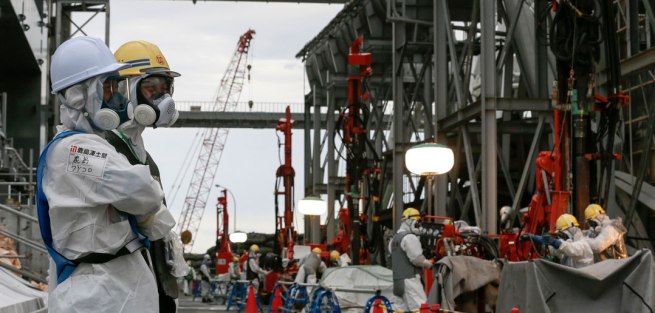
By Richard Wilcox, PhD
As the world forever hurtles toward Armageddon, the Fukushima nuclear disaster has largely faded from the front pages. But the issue is far from resolved. Radiation from nuclear accidents is not easily dispelled with estimates of clean-up time at Fukushima ranging from 40 to 500 years, and nearly six years have already passed. Even safely stored nuclear material is dangerous for 100,000 years (1).
Elvis Has Left The Building
The major question regarding the situation at Japan’s Fukushima Dai-ichi (no.1 nuclear power plant) regards the location of the melted fuel at reactor units 1, 2 and 3.
Recent evidence of the location of the fuel in unit 2 was disputed, with Tokyo Electric Co. (Tepco) and the mainstream media taking one view and independent scientists taking another. Is the melted fuel still inside the container in the reactor building, or has it leaked out and is now penetrating in scattered areas laterally and vertically into the ground?
Large amounts of melted fuel could reach the ground water, and even the aquifer which is ultimately connected to the Tokyo water supply.
Let’s compare two assessments on this important issue based on the use of “Muon tomography”:
According to the Asahi Shimbun (newspaper) version of reality which relies solely on the Tepco report:
Most of the nuclear fuel inside the No. 2 reactor at the Fukushima No. 1 nuclear power plant apparently did not melt through the pressure vessel (2).
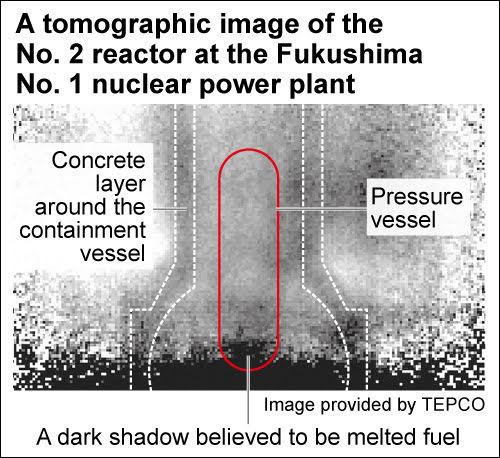
Is it that simple? Tepco’s record of reliability has become rather tarnished over the years.
Note that in the graphic image above, the word “believed” is used, which reinforces the word “apparently” used in the text of the article referring to the uncertainty of the location of the melted fuel. However, the title of the article is more confident, stating that “most fuel was contained.” The title is blatantly misleading and since most readers just skim the news, that will be what they take away from the report.
On the other hand, the independent scientists at the Simply Info website differ about the location of the fuel in relation to the container, the “Reactor Pressure Vessel” (RPV):
Tepco’s superimposed mask demarcates the bottom head too low including fuel inside the rpv which according to the refined image is clearly shown below the bottom head….”there is no fuel in the bottom of the RPV in any significant amount” (3).

This graphic indicates that a different method was used by these scientists to view the location of the melted fuel.
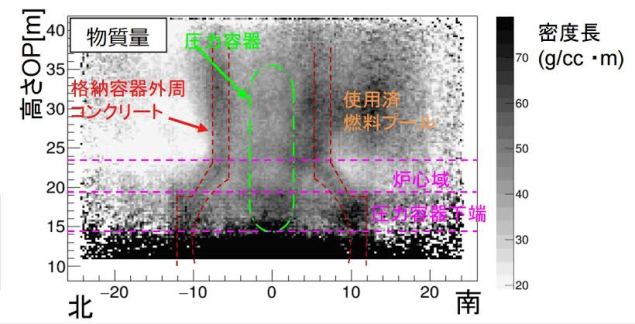
In this graphic the Simply Info scientists argue that the container drawing was placed too low in the Tepco version, whereas in their version, it is higher, making it less obvious that the fuel is in the container.
Careful reading of this article reveals that Tepco’s analysis, as so glibly presented by the mainstream media, was based on technological smoke and mirrors, clearly intended to deceive. Tepco and the media should report on the range of plausible possibilities, not only the small slice of reality they wish the public to see (4; 5).
So will the Asahi Shimbun correct their fallacious reporting? Both the Japan Times and the Asahi Shimbunare heavily owned and controlled by foreign investors and media. TheAsahi shares offices with the New York Times in Tokyo and many Japanese English dailies rely on Western news wires such as the agenda driven, oligarchic news sources, Reutersand the Associated Press (6).
Decommissioning Or Out Of Commission?
In fact, in over five years much progress has been made to control the situation at the destroyed Fukushima nuclear plant. Much of the rubble has been cleaned up and fresh coats of paints are on the buildings, but the place is still intensely radioactive, and no human can approach the specific reactor meltdown sites.
The second major issue at Dai-ichi concerns the future plans for the decommissioning of the plant. All along Tepco has said they will retrieve the melted fuel and complete decommissioning within 40 years. In fact the technology to retrieve the fuel has not yet been invented. Not only is it impossible for human workers to approach the area, but even robots break down due to the radiation short circuiting their wires.
It was recently revealed that Japan is still considering an option that many people feel would be very dangerous in the long term, and that is the “sarcophagus” solution (7). The only time this has been tried is at Chernobyl — it looks like a high-tech barn placed over the site (8). Unlike Chernobyl where the ground is rock hard, at Fukushima the ground is akin to a wet sponge with soft topsoil, so while covering it will reduce radioactive atmospheric fallout, the radiation will continue to leak downwards to the aquifer and outwards to the ocean unless appropriate engineering measures are taken.
Nevertheless, progress is slow with efforts “underway to develop the equipment needed to retrieve corium (melted fuel) samples from inside the containment structures of units 1-3 at the plant. No solid time frame” has yet been was mentioned (9).
The Nuclear Story
In an interesting aside, the best documentary film on Fukushima I have see so far, Fukushima: A Nuclear Story was released in 2015 (10). It is an Italian production but with English narration and subtitles. The plot follows journalist Pio d’Emilio during the nuclear crisis as he tries to uncover the real situation in Fukushima. The film is engaging and educational at the same time, covering new ground and combining dramatic events as they unfold at the time with scientific explanations done in an entertaining, “manga” comic book style.
The film emphasizes the near catastrophe of Tepco’s panic during the accident, and the courage and wisdom of then prime minister Naoto Kan, and the Fukushima 50, led by the plant manager Masao Yoshida whose snap judgement literally “saved the world.”
The film raises one very interesting piece of information that I did not know about which is that it was only the luck of the pool fuel gate at unit 4 not closing, in other words, malfunctioning, which allowed water in to cool the scorching fuel rods. Had that not occurred, the fuel rods could have caught fire spreading massive radiation for hundreds of miles.
Note that had the Fukushima accident happened at night or on the weekend there would have been far fewer workers at the plant to tackle the problem, possibly leading to a completely out-of-control situation.
The Ice Wall Cometh…
The “ice wall” that Tepco built in order to freeze the ground around the plant to block water flow in and out of the plant, continues to have problems. It is a very expensive operation to build and maintain, prone to technical problems and no one really knows when or if it will ever be fully implemented (i.e., taxpayer boondoggle) (11; 12). Even if the ice wall operates as intended it will not stop all of the water flow allowing some to be contaminated (13).
Is this why the sarcophagus option is still on the table? Critics have argued that the ice wall was poorly conceived from the start because it did not address dealing with the source of water flow which is at the water shed above the plant in the nearby mountains (Tepco balked at the project due to the high cost).
Japan Nuke News
Various nuclear related issues pop up from time to time around country. Since the nuclear accident in 2011, the overwhelming public sentiment has been strongly anti nuclear, despite efforts by the Abe administration to downplay the accident and restart as many of the reactors around the country as possible. The logic of the restarts against public opinion is in order to satisfy the big banks who have financed Japanese utility company operations while reactors have remained idle (expensive but not profit producing) over the past years.
Ever since the hugely destructive earthquakes earlier in 2016 on the island of Kyushu, nuclear plant restarts along the path of the fault line, which basically travels through the middle of the entire country, have been in doubt. Still we see for example in Shikoku that nuclear reactors are restarting despite local opposition (14).
Although prime minister Abe keeps pushing for resumption of nuclear operations, he probably would not want to work at the Fukushima nuclear disaster clean up site himself. It was recently reported by Japanese scientists that insoluble radioactive cesium has been detected in workers exposed to high levels of radiation at the plant (15).
Indeed, the wildlife in Fukushima prefecture has long been reported to be contaminated with radiation, recently a wild boar was detected with massive levels of radiation in its body (16). This is an indication of the general contamination of the environment there.
This doesn’t stop the Fukushima tourist board from advertising how safe and wonderful life is there. In order to drum up tourist dollars the national government has carried out a massive public relations campaign despite the lingering possibility of numerous radioactive hotspots in the area (17; 18).
Trump Threatens Nuclear Cartel
Maybe things will change a bit if Donald Trump can be elected president in the United States. Trump has promised to reduce US military presence in Japan and let them sort out their own military affairs. This does not bode well for the US-Japan military racket which siphons off billions of dollars in tax revenue to satisfy the greed of both country’s military industrial complexes, which are intensely tied up with the nuclear weapons and power industries (20).
Isn’t it ironic that the bogeyman of North Korea which is constantly conjured by Japan to justify its own growth in militarism, obtained its original nuclear weapon technology from Britain, a supposed Japan ally (21).
Funny old world ain’t it.
* Special thanks to the Simply Info website for their continuous work on the Fukushima issue; and to Activist Post for their continued reporting.
Richard Wilcox is a contributing editor and writer for the book: Fukushima: Dispossession or Denuclearization? (2014) and a Tokyo-based teacher and writer who holds a PhD in environmental studies. He is a regular contributor to Activist Post. His radio interviews and articles are archived athttp://wilcoxrb99.wordpress.com and he can be reached at wilcoxrb2013@gmail.com.
References
1 – Nuclear waste: keep out for 100,000 years
http://www.ft.com/cms/s/2/db87c16c-4947-11e6-b387-64ab0a67014c.html#axzz4EtlF3Xds
2 – New study on Fukushima reactor shows most fuel was contained
http://www.asahi.com/ajw/articles/AJ201607290050.html
3 – Something Incredible Found In Fukushima Muon Scan
http://www.fukuleaks.org/web/?p=15666
4 – First Fukushima Unit 2 Muon Scans Dispute New Scan Results
http://www.fukuleaks.org/web/?p=15650
5 – Fukushima Unit 2 Muon Scan Not So Conclusive
http://www.fukuleaks.org/web/?p=15637
6 – Democracy in Peril: Twenty Years of Media Consolidation Under the Telecommunications Act
http://www.truth-out.org/news/item/34789-democracy-in-peril-twenty-years-of-media-consolidation-under-the-telecommunications-act;
7 – NDF Tries To Walk Back Fukushima Daiichi Sarcophagus Admission
http://www.fukuleaks.org/web/?p=15607
8 – The Chernobyl Gallery: Sarcophagus
http://chernobylgallery.com/chernobyl-disaster/sarcophagus/
9 – Melted Fuel To Be Sampled From Fukushima Reactors Containment
http://www.fukuleaks.org/web/?p=15608
10 – Fukushima: A Nuclear Story
http://www.nuclearstory.com
11 – Fukushima Frozen Wall Sees Small Progress From Concrete Addition
http://www.fukuleaks.org/web/?p=15659
12 – Fukushima Frozen Wall Report For June 23 2016
http://www.fukuleaks.org/web/?p=15569
13 – Fukushima No. 1 plant’s ice wall won’t be watertight, says chief architect
http://www.japantimes.co.jp/news/2016/04/29/national/fukushima-plants-new-ice-wall-will-not-be-watertight-says-chief-architect/#.V7JtD-lMaRk
14 – Shikoku MOX plant restarts amid outcry over fresh quake fears
http://www.japantimes.co.jp/news/2016/08/12/national/shikoku-electric-poised-fire-ehime-plant-mox-reactor-amid-protests/#.V66L_ulMaRk
15 – THREE-YEAR RETENTION OF RADIOACTIVE CAESIUM IN THE BODY OF TEPCO WORKERS INVOLVED IN THE FUKUSHIMA DAIICHI NUCLEAR POWER STATION ACCIDENT
http://rpd.oxfordjournals.org/content/early/2016/03/14/rpd.ncw036
16 – 960 Bq/kg of Cs-134/137 detected from wild boar in Fukushima
http://fukushima-diary.com/2016/07/960-bqkg-of-cs-134137-detected-from-wild-boar-in-fukushima/
17 – Tokyo to Fukushima: Route to enjoy modern, old Japan
http://showcase.japantimes.co.jp/tokyo/news/?key=tokyo1
18 – Fukushima tourism making strong progress on recovery
http://www.japantimes.co.jp/news/2016/08/14/national/fukushima-tourism-making-strong-progress-recovery/#.V7Eoo-lMaRk
19 – Trump rips U.S. defense of Japan as one-sided, too expensive
http://www.japantimes.co.jp/news/2016/08/06/national/politics-diplomacy/trump-rips-u-s-defense-japan-one-sided-expensive/#.V6bc2elMaRk
20 – North Korea used British technology to build its nuclear bombs
http://www.theecologist.org/News/news_analysis/2987935/what_theresa_may_forgot_north_korea_used_british_technology_to_build_its_nuclear_bombs.htm
Source:
http://www.wakingtimes.com/2016/08/16/the-mysteriously-case-of-the-missing-fukushima-fuel/
Fukushima Disaster’s Victims
I decided to translate this particular article because this article for a change talks about the Fukushima disaster victims and in details how their everyday lives have been affected.
In most of the Fukushima related articles from websites and mainstream media, the writers usually focus on the Fukushima Daiichi nuclear power plant and its technical failures, about its continuous leaking into the Pacific ocean etc. but somehow they almost always forget to talk about the plight of the victims, the victims who are at the forefront of this tragedy.
August 12, 2016
Article written by Evelyne Genoulaz, from a lecture given by Kurumi Sugita,
translated by Dun Renard.
Source : Fukushima Blog de Pierre Fetet http://www.fukushima-blog.com/2016/08/fukushima-les-vies-sinistrees.html
March 11, 2016, Kurumi Sugita, social anthropologist researcher and founding president of the association “Our Far Neighbors 3.11”, gave a lecture entitled “Fukushima disaster’s lives” in the Nature and Environment House (MNEI) in Grenoble, Isere, an inaugural lecture for the commemoration of the “Chernobyl, Fukushima disasters”.
The speaker outlined the concrete and current situation of the victims of the Fukushima disaster, particularly on health issues. Attached to Japan, committed, Kurumi monitored the situation of 60 affected people, for several years, visiting each once a year to collect field data for her associative actions. It is the project “DILEM”, “Displaced and Undecided Left to Themselves”, from the nuclear accident in Japan – the life course and geographical trajectory of the victims outside of the official evacuation zone.
I offer a written return of this conference, courtesy of Kurumi who also was kind enough to add data to date on her return from Japan in June 2016.
Evelyne Genoulaz
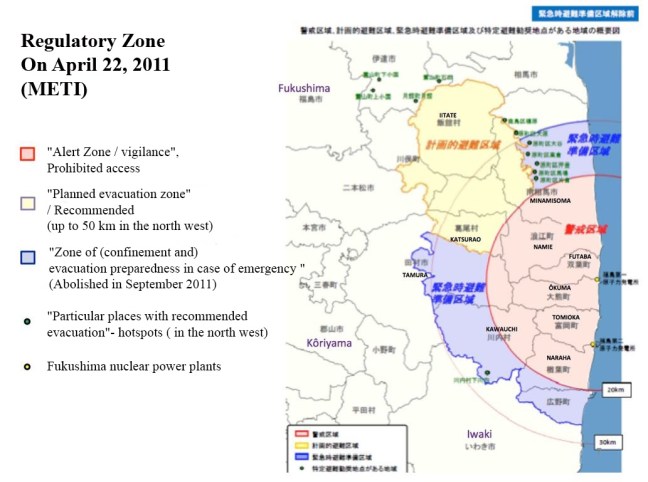
I. The contaminated territories
After the disaster the authorities declared a state of emergency and to this day Japan is still “under that declaration of a nuclear emergency state (genshiryoku kinkyu Jitai sengen).” But over time, the zoning of the contaminated territories has been increasingly reduced by the authorities, as shows the chronological overview on these maps (METI).
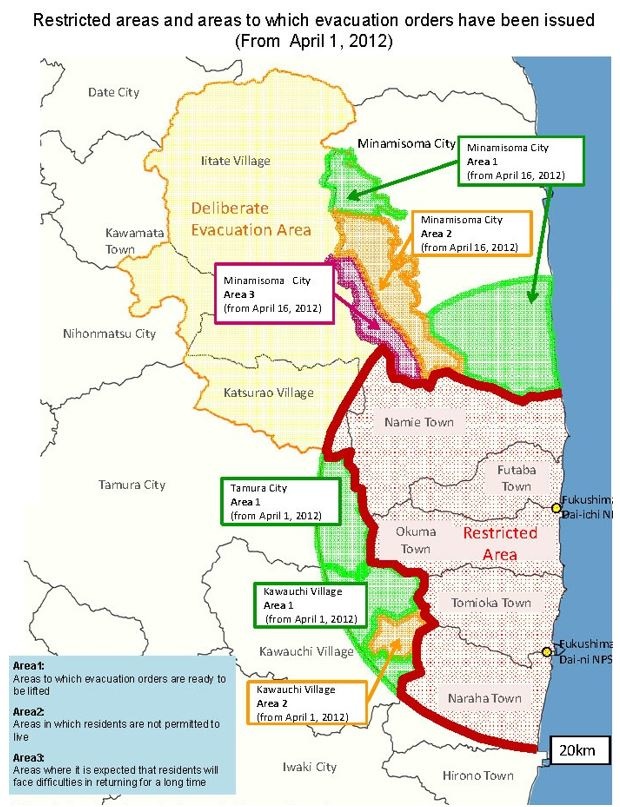
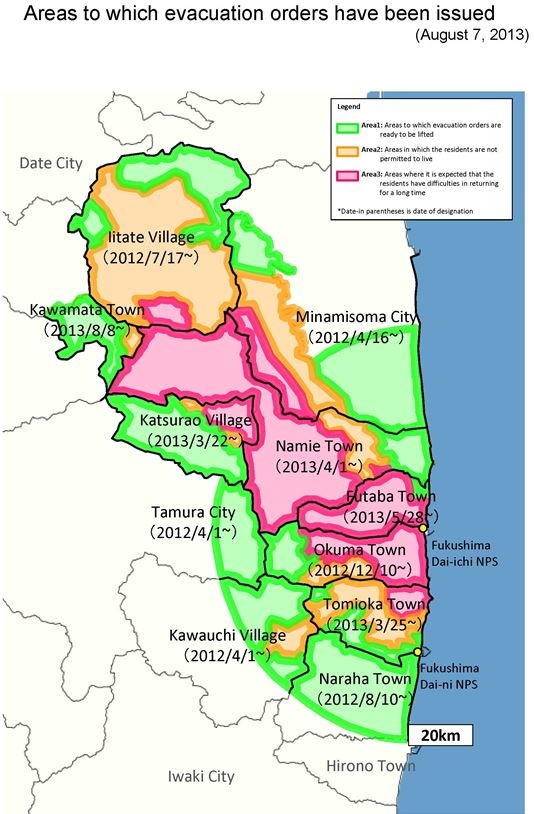
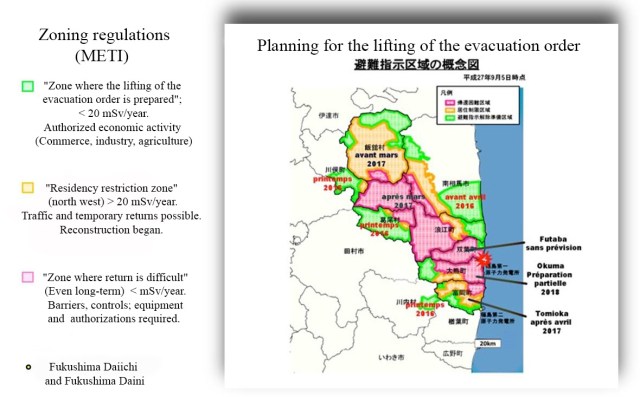
II. The return policy
Starting this month of March 2016, in fact, many areas were “open”. The return to TOMIOKA is programmed by authorities after April 2017; OKUMA partially in 2018. Only FUTABA is labeled “no projection”. Do note that zoning maps were delineated at the beginning of the disaster zoning by concentric circles, while the radioactivity is deposited in “leopard spots” and today, programmed to be returned to areas are gradually getting geographically closer to the Fukushima Daiichi nuclear plant even though these areas are dangerous!
The government is preparing to lift the evacuation order at 20 mSv / year, and areas from 20 to 50 mSv / year will enter the opening schedule after spring 2017 establishing strategic points for reconstruction ( fukkô Kyoten).
To speak only of Iitate, which was the most beautiful village in Japan, its mayor is in favor of return, but today the situation there is poignant: it was decontaminated up to 20 meters of the houses, but as it is surrounded by mountains and forests, the radioactivity will remain dangerous …
Measures delegated to individuals
The control measurement of environmental radioactivity will now be based on the individual rather than on space. Thus, everyone is invited to measure himself or herself, to measure what is consumed, so that if the individual is contaminated it will only be blamed upon his or her own negligence!
The absurd and arbitrary at work in the calculation of dose rates
Official figures on the geographical contamination, dose rates displayed, are using a biased calculation.
Usually to measure in the field a dose rate, we get a figure in mSv / h then multiply it by 24 (hours) x 365 (days) to obtain the annual rate. But this is not the calculation undertaken by the authorities.
The authorities makes first a difference between the level of contamination on one hand inside the housing, and on the other hand on the outside. They decided to consider that an individual spends only 8 hours outside. It is also estimated (official rules) that “the radiation inside a building is reduced to 40% of the radiation reading outside.”
Yet, in Minamisoma for example, studies have shown that the contamination inside was at best 10% lower than the outside, sometimes even worse inside!
That is to say that the authorities uses a biased calculation that ultimately determines if we take an example, a dose rate of 20 mSv / year whereas the actually measured dose rate is 33 mSv / year!
Residents who did not evacuate are distressed because they now know fear, for example those of Naraha who no longer recognize their city because it has changed since the disaster: vandalism, insecurity soon as night falls, since it is now black in the streets, some girls were abused …
Furthermore, Naraha is a coastal town with a seaside road and all night – especially at night – they hear the noise of the incessant and disturbing road traffic of the trucks loaded with radioactive waste, without knowing precisely what is carried …
What motivates the return policy? According to Kurumi Sugita, in view of the Olympic Games coming to Japan in 2020, the government pursues a staistics dependent objective: it comes to lowering the numbers! If the evacuees or the self-evacuees leave the “assisted housing”, they are no longer counted as “evacuees”….
III. Works and Waste
The whole territory of Fukushima Prefecture today is littered with waste bags. Everywhere, at the turn of any road you’ll encounters mountains of waste bags, sometimes piled up so high! It is a sorry sight for the residents. And space lacks where to store them, so much that the authorities have even created dumps that they call “temporary intermediary storage areas! “
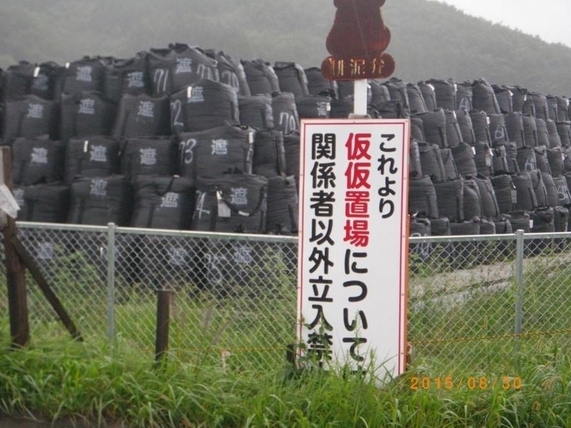
A “temporary intermediary storage area” in Iitate
A row of uncontaminated sandbags is added around the perimeter of the “square” of the most contaminated bags, so as to reduce the number of the dose rate!
As of March 2016, there were no less than 10 million bags and 128,000 temporary dumpsites in Fukushima Prefecture. Waste bags are omnipresent, despite the residents’ distress; near schools, and even in people’s gardens.
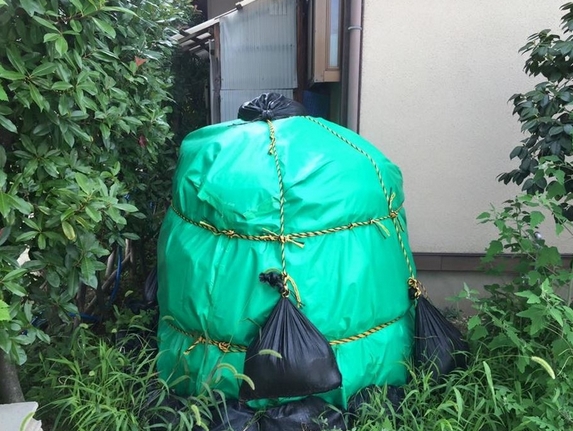
Contaminated waste bags at someone’s house
Short of sufficient storage space, the authorities are forcing residents to an intolerable alternative: if the resident does not want to store the waste on his property, it is his right. But in this case it will not be decontaminated! The resident requesting “decontamination intervention” must keep the waste on his property! This is why we see here and there, everywhere in fact, bags near buildings or in private homes.
According to the “Nuclear Reactor Regulation Law” (Genshiro tô kiseihô), the recycling threshold of “nuclear waste” is 100 Bq / kg. However, on June 30, 2016, the Ministry of Environment has officially decided to “reuse” waste below 8000 Bq / kg (1).
In practical terms, this waste will be used in public works, covered by cement and land in order to lower the ambient radioactivity.
In order to “reduce the volume” of waste, “temporary incinerators” were built to incinerate nuclear waste and to “vaporize” cesium.
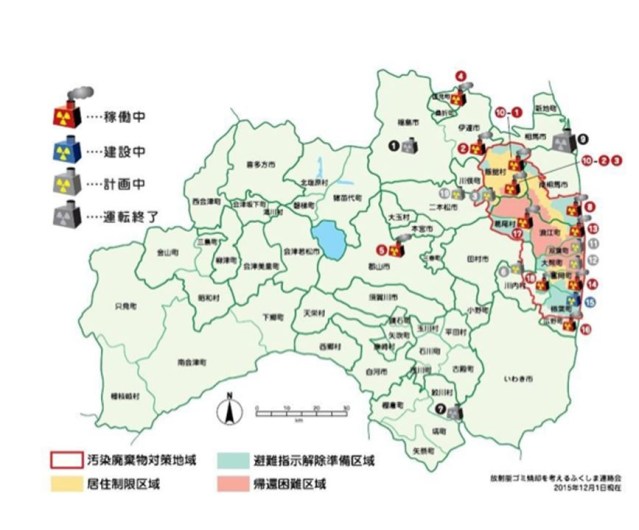
Map of Fukushima prefecture showing the nuclear waste processing establishments locations (shizai-ka center) – Legend: the icons differentiate the various incinerators; red = in operation – blue = under construction – gray / yellow = planned – gray = operation completed
Everywhere on village outskirts there are incinerators of which people know nothing! They often operate at night for two to three months and then everything stops. People wonder what is being burned… Not to mention a rumor about a secret experimentation center where much more contaminated waste would be burned…
Even more frightening, waste processing plants …
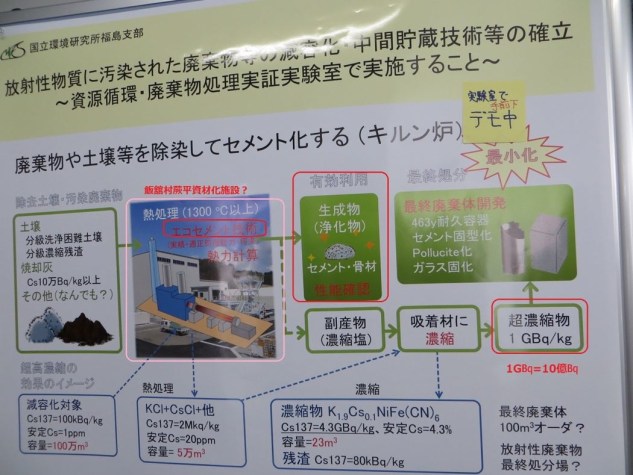
At the “Environmental Design Centre”, a poster about the revolving furnace” which decontaminates waste, debris, soil, etc, transforming them into cement”.
For example, the Warabidaira waste processing plant located in the village of Iitate or the Environment Creation Center (Kankyô Sôzô Center) opened in July 2016 in the town of Miharu, treat contaminated waste (ashes above 100 000 Bq/kg) and contaminated soil coming from land decontamination work.
Now these last two categories are not covered by the Waste Management Law (1) so they have no constraints associated with their treatment… To reduce their volume and to make them … “recyclable”!
In addition, these establishments are registered as “research institutes” and, as such, they are exempt from the building permit application commonly mandated in the framework of the waste management law!
We see inconsistencies and even contradictions between laws. We have already seen the contradiction between the limit of 100 Bq / kg set by the Nuclear Reactor Regulation Law and the 8000 Bq / kg recently adopted by the Ministry of Environment.
IV. Residents, displaced and returned
Citizen radiation measuring. Mothers, and also dads, explore the everyday environment to identify hot spots so as to modify if necessary the route recommended for children, for example “the way to school” (as in Japan all children walk single file).
For that purpose associations use “hot spot finders”. Well aware of the health risk to which children are exposed, they attach sensors connected to GPS on their strollers to walk routes and the way to school or to explore parks.
That system is well thought out: it is a vertical rod 1 meter long that leaves the ground and consists of a measuring device at 10 cm from the ground, another one at 50 cm, and a third at 1 meter to take into account the different sizes of children. If a hot spot is located, others are warned of its location and the children are required to change their route, and authorities are asked to decontaminate. For parents, this work is endless …
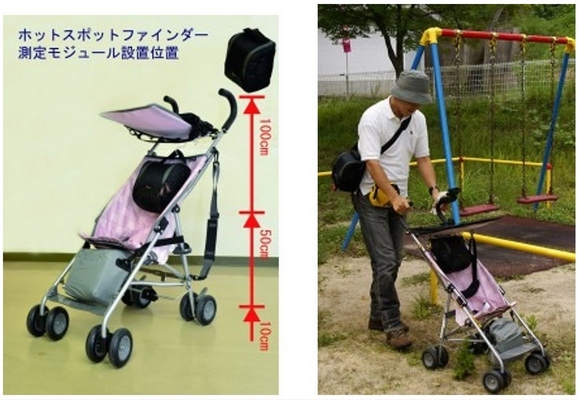
Hot spot finders
People organize citizen actions thru Internet. These independent citizen online databases are many,
and one of them is even translated into English since November 2014. It is the “Minna no Data”: ambient radioactivity measures, soil measurements, food analyzes (2).
Some associations’ logos:

V. Protest actions
The trial against the three former TEPCO executives which began in spring 2016 is the first criminal trial to take place; it could last ten years …
However, in Fukushima Prefecture, there are many other trials at different levels also taking place. For example, in March 2016, a lawsuit was initiated by 200 parents brought against the Fukushima Prefecture, to “get children out of contaminated areas.” People protest to have the “thresholds” lowered. In their opinion the issue of “thresholds” go beyond the strict framework of Japan. They fear that the thresholds of Japan will end up being generalized overseas, which is highlighted in some of the maps captions eg “against the generalization and the externalization of the 20 mSv / year threshold”. Some victims require, as after Hiroshima, “an irradiation book” (personal records) to be used for their access to treatment.
Radiation free health holiday
To send children on a health holiday is now more and more difficult, because people tend to believe that the disaster is already over therefore requests for help have become complicated.
In the city of Fukushima, for example, referring to the nuclear disaster is now taboo …
VI. Social and family catastrophe
It causes “conflicts” among neighbors (one example, one person’s place is decontaminated while its adjoining neighbor’s place is not), between beneficiaries and others, between the displaced and the residents of the hosting location (there are misunderstandings on the issue of compensations; the self-evacuated are not receiving any compensation, but the hosting city locals think they are).
So today many prefer to return their evacuated Fukushima resident card and acquire the resident card of their hosting town (in Japon you are résident of the village from which you keep the residence card) so as to “turn the page” because they can no longer bear to be called “evacuees”. They want to integrate into the community where they moved. Only older people remain unswervingly committed to their original residence; it is mostly the elderly who intend to return.
In many families of the Fukushima Prefecture men stayed by necessity to keep their jobs to provide for their families, while mothers with children evacuated to put them out of danger; but as time has passed, more than five years already, many families have disintegrated… The father visiting the family rarely, often for lack of resources, the marriage falling apart, resulting in many divorces and suicides.
Women are showing remarkable energy, they are on all fronts, openly, and even heavily involved in actions and trials, so that even the articles of the so-called “feminine” press today are often dealing with topics related to the nuclear disaster. Young women in particular are very active in the protests and rallies. This is a significant change in Japanese society.
(1) Waste Management and Public Cleansing Law, Haikibutsu no shori oyobi seisô ni kansuru hôritsu, law N°137 from 1970, last amendment in 2001 https://www.env.go.jp/en/laws/recycle/01.pdf
Nuclear Reactor Regulation Law (Genshiro tô kiseihô).
“Act on the Regulation of Nuclear Source Material, Nuclear Fuel Material and Reactors” (kakugenryô busshitsu,kakunenryô busshitsu oyobi genshiro no kisei ni kansuru hôritsu)
law N°166 from 1957(2) –
English translation of Nuclear Reactor Regulation Law.
http://www.japaneselawtranslation.go.jp/law/detail/?id=1941&vm=03&re=01
(2) – Minna no Data Site (MDS) : http://en.minnanods.net/
_____________________
After his lecture, I asked a simple question to Kurumi Sugita:
Why has she founded the association « Nos Voisins Lointains 3.11 » (“Our Distant Neighbors 3.11”)? …
In France, where lives Kurumi, several Japanese associations exchange about the disaster.
But Kurumi Sugita founded on January 8, 2013 in Lyon, the association « Nos voisins lointains 3-11 » also to inform the French and francophones who do not read Japanese.
The website of the association publishes valuable and moving testimonies, translated into French.
Thanks to donations, the association helps concretely, as much as possible, some affected families in Japan.
To know more
The website of Kurumi Sugita’s association:
http://nosvoisins311.wix.com/voisins311-france
You may find the victims testimonies on her Facebook page:
And general informations on the Fukushima nuclear disaster:
https://www.facebook.com/Nos-Voisins-Lointains-311-555557711144167/
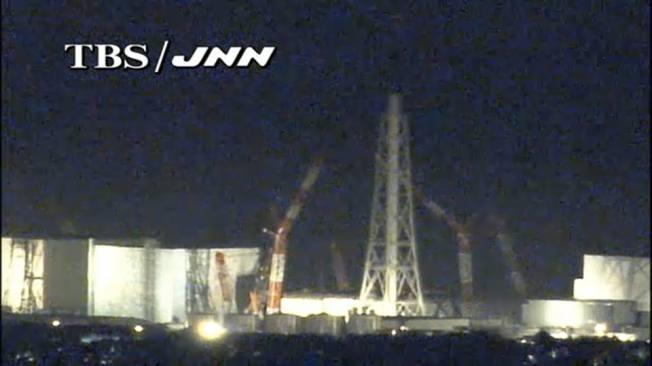
Fukushima Daiichi Still Outgassing Radionuclides
It’s still steaming away 5 1/2 years later and with the tent roof removed from Reactor 1 its poison continues to be widely dispersed.
Unit 1 side : 2016.08.14_00.00-03.00
Unit 4 side : 2016.08.14_15.00-18.00
The dead bodies in the exclusion zone of Fukushima Daiichi Nuclear Accident and their treatment
The original blogpost has been largely shortened by the translator. For more information please refer to the article in Japanese 「東京電力福島第一原子力発電所災害に係る避難指示区域内の御遺体の取扱について」. Translated by W. Crane.
June 11, 2016
An article published by Kyodo News on March 31, 2011 immediately raised a lot of attention at the time. It was titled Hundreds to up to a thousand dead bodies within the 20 km radius evacuation zone in Fukushima. “May have been contaminated after death” say police.
Some articles in English followed, such as this one by the Rediff News on the same day:
Japan: Radiation fears leaves bodies rotting, PM for scrapping N-plant
The fear of being affected by radiation has prevented authorities from collecting around 1,000 bodies of the March 11 earthquake and tsunami victims from within the 20-kilometer-radius evacuation zone near the troubled Fukushima nuclear plant.
The Kyodo news agency quoted a local police source as saying that said bodies had been ”Exposed to high levels of radiation after death.” On Sunday, high levels of radiation were detected on a body found in Okuma, Fukushima Prefecture, about 5 km from the Fukushima Daiichi Nuclear Power Station.
The authorities are now reportedly trying to figure out other ways to collect the bodies over fears that police officers, doctors and even family members may be exposed to radiation in their attempt to recover the dead bodies.
They also raised concerns that even after handing over the bodies to relatives, the cremation process could spread further radioactive materials. High levels of radiation detected on the Okuma town victim last Sunday had forced local police to give up on retrieving the body.
””Measures that can be taken vary depending on the level of radiation, so there need to be professionals who can control radiation. One option is to take decontamination vehicles there and decontaminate the bodies one by one,”” an expert on treating people exposed to radiation said.
Or this article in the Japan Times on April 1, 2016:
Hundreds of corpses believed irradiated, inaccessible
Radiation is preventing the retrieval of hundreds of bodies from inside the 20-km evacuation zone around the Fukushima No. 1 nuclear power plant, police sources said Thursday.
Based on initial reports after the March 11 catastrophe, the number of bodies is estimated at between a few hundred and 1,000, one of the sources said, adding that high radiation is now hampering full-scale searches.
That view was supported by the Sunday find of high radiation levels on a body found in Okuma, Fukushima Prefecture, 5 km from the plant.
The rescuers are now in a bind. Even if they retrieve the bodies, anyone who comes into contact with them risks being irradiated, too, whether they’re in the evacuation zone or not.
And if the bodies are cremated, the smoke could spread radioactive materials as well, the sources said. Even burial poses a problem. When the bodies decompose, they might contaminate the soil with radioactive materials.
Authorities are considering decontaminating and inspecting the bodies where they are found, but the sources said cleansing the decomposing bodies could damage them further.
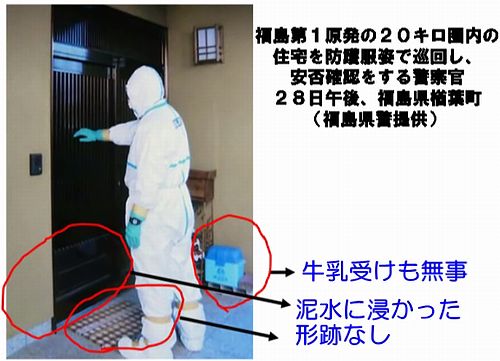
A follow up article was published on May 20 in the Kahoku Shinpo reporting that the above mentioned body was finally collected on April 1 and sent to Minamisoma city where it was diagnosed to have died of illness. No external wound was found on the body. The tsunami is ruled out of cause here completely.
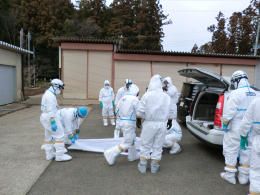
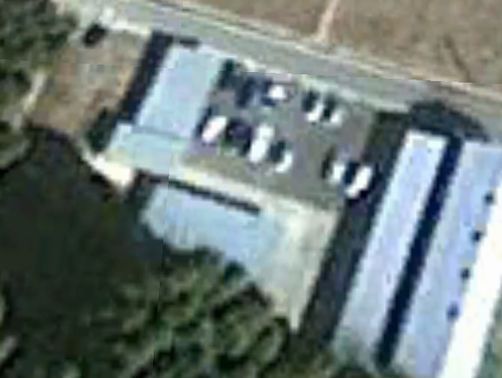
The body found in Okuma
Google Earth as of 2011/3/19
In the original article in Japanese by Kyodo News, it is described that the contamination of the body that was found in Okuma was over the detection limit of the dosimeter, which is 100.000 cpm.
In an official letter discussing what to do with all the contaminated bodies (the title of this blog post comes from this letter) the Nuclear Safety Commission says that the air dose rate of 10 μSv/h at 1 m distance from the body could be considered the equivalent of a surface contamination of 100.000 cpm. It also says that in that case the clothes have to be removed from the body before treating it because such a surface contamination is enough to cause secondary irradiation to the treating person.
If the clothes have been contaminated by a plume then the inside of the lungs must have been contaminated as well.
And this area was indeed hit by such a dense plume. The spot where the body was found was hit by a plume above 10 μSv/h first on March 13, followed by waves far higher than this (up to almost 100μSv/h, nearly 300 times the US army’s evacuation limit) on March 14 and 15. Just imagine breathing the air that was so radioactive that it contaminated the clothes so much as to cause secondary radiation.
unit:nSv/h

In the case of the people in Okuma town it would appear most likely that they died from inhaling the radiation, most probably iodine gas that was released first. But the industry, the regulators and the scientists mysteriously remain quiet about the fatal dose of when one is exposed to radiation internally. Otherwise what can be the explanation for the sudden deaths of several hundred people in a sparsely populated area? When even official sources state they were not earthquake or tsunami victims?
Maybe I am the only one but I cannot help thinking that these people whose bodies ended up being cremated and buried without identification are crying out silently that it is time to clear the real cause of their deaths. May their souls rest in peace.
Situation of Storage and Treatment of Accumulated Water including Highly Concentrated Radioactive Materials at Fukushima Daiichi Nuclear Power Station
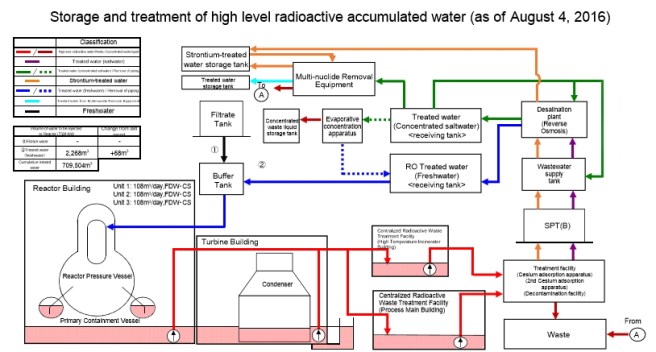
Situation of storing and treatment of accumulated water in the building (actual record) Stored amounts in each unit building (Units 1 to 4 (including condensers and trenches)) and stored and treated amounts, and other related data in the Accumulated Water Storing Facility as of July 28, 2016
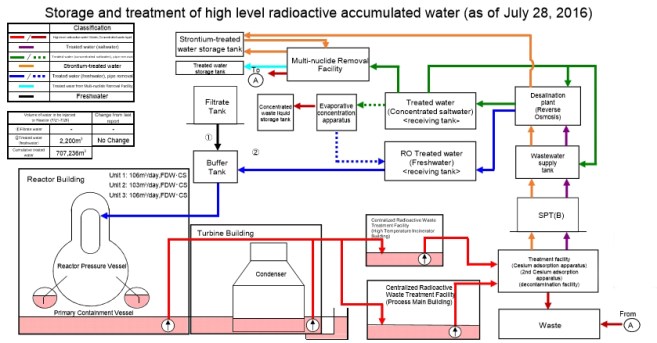
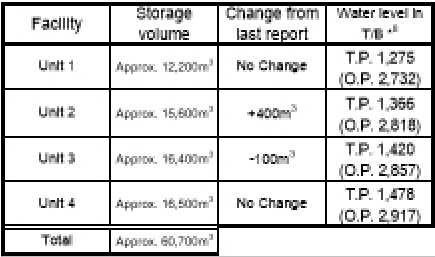
Forecast of storing and treatment
(1) Short term forecast
Water transfer is planned so that the levels of the accumulated water in Units 1 and 2 and Units 3 and 4 building will be maintained around at the level of OP. 3,000, based on the stored amount in the Accumulated Water Storing Facilities and the operating situation of the radioactive material treatment equipment. Water is transferred to the Process Main Building and/or High Temperature Incinerator Building as Accumulated Water Storing Facilities. Treatment is implemented considering the state of storage and transfer of Accumulated Water Storing Facilities.
We assume stored amounts in each unit building (Units 1 to 4 (including condenser and trench)), and stored and treated amounts, and other related data in the Accumulated Water Storing 2 Facilities as of August 4, 2016.
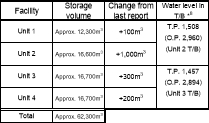
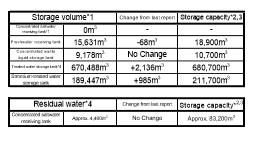
(2) Middle term forecast
Regarding accumulated water in Units 1 and 2 buildings and Units 3 and 4 buildings, from the viewpoint of reducing the risks of discharging to the ocean and leaking into the groundwater, it is necessary to keep enough capacity for the accumulated water in the building until its level reaches OP. 4,000 and to keep the accumulated water level lower than the groundwater level. On the other hand, based on the view of limiting inflow of underwater to buildings and reducing the amount of emerged accumulated water, we are planning to transfer accumulated water keeping its level in the building around OP. 3,000 considering water tank capacity. As for accumulated water of the Process Main Building and the High Temperature Incinerator Building, we are planning to treat the accumulated water considering the situation of construction of middle and low level waste water tanks, the operation factor of the radioactive material treatment instruments and duration for maintenance.
We forecast stored amounts in each unit building (Units 1 to 4 (including condensers and trenches)), and storing and treatment situations in the Accumulated Water Storing Facilities for the next 3 months.
Stored amounts in each building and the water storage equipment are forecasted to be unchanged in case transfer and treatment were implemented as scheduled without rain. However, it would be subject to change depending on the operation factor of the radioactive material treatment instruments and so on. Also, the water treated at the radioactive material treatment equipment (fresh water and condensed salt water) can be stored in the middle and low level waste water tanks.
http://www.tepco.co.jp/en/press/corp-com/release/2016/1315201_7763.html
In 2011 Fukushima Ventilation Stack Read Over 10,000mSv/hour
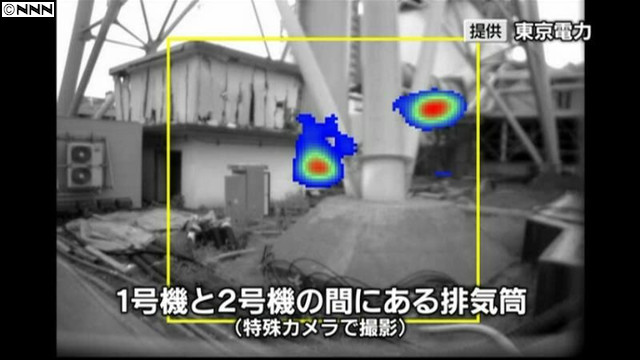
On August 2, 2011, TEPCO released a photo of the ventilation stack between reactors No. 1 and No. 2 where radioactivity over 10,000mSv / hour was measured, the highest amount of radioactivity measured to date.
The photo published is that of the ventilation stack located between reactors No. 1 and No. 2, taken on July 31 by a special camera that reacts to radioactivity.
It shows high radioactivity at two locations: at the center and at the right. The red part at the center is the place with the highest radioactivity.
Later, on August 1, workers measured the radioactivity of the pipes in the ventilation stack. The result revealed a measure exceeding 10,000 mSv / hour, the highest measurable limit.
During the venting of reactor No. 1 on March 12, 2011, the steam passed through these pipes before to be released outside. TEPCO considers that there is a strong possibility that radioactive materials would remain in the pipes.
According to TEPCO, there is no leakage of radioactive materials to the outside of the pipes.
Places around the pipes will be forbidden to enter and shielding work will be done.
Source : http://www.news24.jp/articles/2011/08/02/07187756.html
http://photo.tepco.co.jp/date/2011/201108-j/110802-01j.html
Translation credit to Kurumi Sugita
1 This Month
Chernobyl: The Lost Tapes – A good documentary on Chernobyl on SBS available On Demand for the next 3 weeks– https://www.sbs.com.au/ondemand/tv-program/chernobyl-the-lost-tapes/2352741955560

of the week–London Campaign for Nuclear Disarmament

Tell the Ukrainian Government to Drop Prosecution of Peace Activist Yurii Sheliazhenko
To see nuclear-related stories in greater depth and intensity – go to https://nuclearinformation.wordpress.com
-
Archives
- April 2026 (181)
- March 2026 (251)
- February 2026 (268)
- January 2026 (308)
- December 2025 (358)
- November 2025 (359)
- October 2025 (376)
- September 2025 (257)
- August 2025 (319)
- July 2025 (230)
- June 2025 (348)
- May 2025 (261)
-
Categories
- 1
- 1 NUCLEAR ISSUES
- business and costs
- climate change
- culture and arts
- ENERGY
- environment
- health
- history
- indigenous issues
- Legal
- marketing of nuclear
- media
- opposition to nuclear
- PERSONAL STORIES
- politics
- politics international
- Religion and ethics
- safety
- secrets,lies and civil liberties
- spinbuster
- technology
- Uranium
- wastes
- weapons and war
- Women
- 2 WORLD
- ACTION
- AFRICA
- Atrocities
- AUSTRALIA
- Christina's notes
- Christina's themes
- culture and arts
- Events
- Fuk 2022
- Fuk 2023
- Fukushima 2017
- Fukushima 2018
- fukushima 2019
- Fukushima 2020
- Fukushima 2021
- general
- global warming
- Humour (God we need it)
- Nuclear
- RARE EARTHS
- Reference
- resources – print
- Resources -audiovicual
- Weekly Newsletter
- World
- World Nuclear
- YouTube
-
RSS
Entries RSS
Comments RSS
 nuclear-news