Costs are ballooning for dismantling Japan’s Fukushima nuclear plant
“The government has estimated that decontaminating the areas around the Fukushima plant, including removing radiated topsoil, buildings and trees, will cost at least 2.5 trillion yen ($24 billion).
But experts have been warning that such estimates may be too optimistic.”
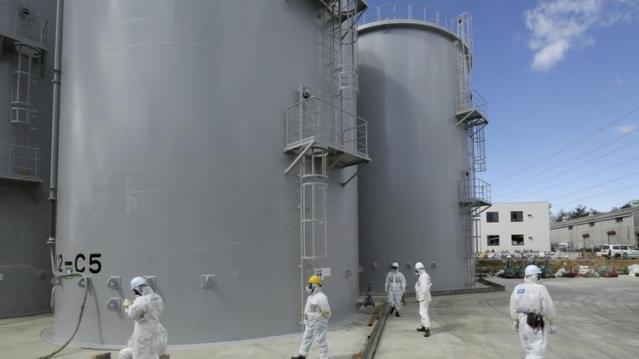
Workers check storage tanks of radiation-contaminated water at tsunami-crippled Tokyo Electric Power Co.’s Fukushima Daiichi Nuclear Power Plant in Okuma, Fukushima Prefecture, northern Japan, on March 24, 2015.
Japan’s estimate of dismantling the Fukushima nuclear plant is ballooning far beyond the utility’s estimate of 2 trillion yen ($19 billion).
A government study released Tuesday found decommissioning the Fukushima Dai-ichi plant already has cost 80 billion yen ($770 million) over the last three years.
The plant suffered multiple reactor meltdowns due to damage from the March 2011 earthquake and tsunami.
The ministry overseeing nuclear power said the decommissioning costs will continue at several hundreds of billions of yen (billions of dollars) a year.
Tokyo Electric Power Co., the utility that operated and is now decommissioning Fukushima Dai-ichi, has said decommissioning will take several decades.
Even if it were to take 30 years at an estimated annual cost at 300 billion yen ($3 billion), both conservative projections, the cost would be nearly 1 billion yen or $100 billion.
TEPCO spokesman Shinichi Nakakuki declined comment on the government projection, but he acknowledged TEPCO was still trying to determine what exactly the decommissioning effort might involve.
“It is difficult to calculate the entire cost for the decommissioning,” he said, adding that the 2 trillion yen figure had so far taken into account the effort to remove the nuclear debris, taking the example of Three Mile Island in the U.S., as well as costs and equipment needed to keep the reactors stable.
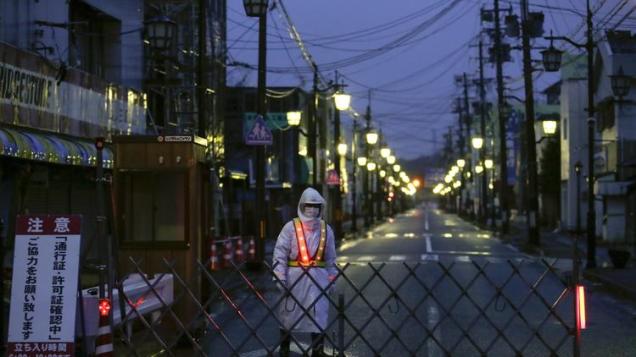
A security guard stands guard on one of the totally empty main streets in Namie, a town north of Tokyo Electric Power Company’s Fukushima Daiichi Nuclear Power Plant, Fukushima Prefecture, northern Japan, 09 March 2016.
The study did not distinguish between costs borne by the government and borne by TEPCO, which received a government bailout.
Japan has been struggling to clean up parts of the no-go zone to put the worst nuclear catastrophe since Chernobyl behind it.
The government has estimated that decontaminating the areas around the Fukushima plant, including removing radiated topsoil, buildings and trees, will cost at least 2.5 trillion yen ($24 billion).
But experts have been warning that such estimates may be too optimistic. The nuclear disaster in Fukushima displaced about 150,000 people.
http://www.chicagotribune.com/news/nationworld/ct-fukushima-nuclear-plant-20161025-story.html
Cost to scrap Fukushima nuclear plant massively underestimated, Japanese officials admit

The cost of cleaning up Tokyo Electric Power’s wrecked Fukushima Daiichi nuclear plant may rise to several billion dollars a year, from less than US$800 million now, Japan’s industry ministry said on Tuesday.
The increased cost projections appeared in ministry documents prepared for a panel tasked with devising a viable financial plan for the utility company known as Tepco, which is struggling to cope with rising costs at its Fukushima plant nearly six years after the world’s worst nuclear disaster since Chernobyl.
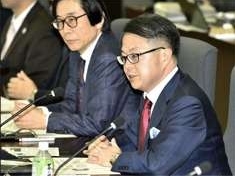
Japan’s Minister of the Economy, Trade and Industry, Hiroshige Seko, told reporters after the panel meeting, its second, that the government will provide a firmer estimate for annual decommissioning costs for the nuclear plant by the end of the year,
Surging decommissioning costs are being addressed by the panel but it is also looking into options including a break up of Tepco, which is under state control after an earthquake and tsunami sparked meltdowns at the Fukushima reactors in March 2011.
“A combination among nuclear operators is one possibility,” Yojiro Hatakeyama, a director at the industry ministry overseeing the electricity and gas industries, told reporters.
He did not elaborate on the government’s estimate for annual decommissioning costs after repeated questioning from reporters.
Experts say any move to merge atomic operations is likely to meet strong resistance from Japan’s other nuclear operators.
Japan has 10 nuclear operators and all have been hit by the political fallout from the disaster, which has undermined public faith in atomic energy. All but two of Japan’s 42 reactors are in shutdown mode.
Tepco shares were up 1 per cent by 0509 GMT, while the general market and other operators also gained.
The briefing material for the panel said the clean-up may require several hundred billion yen, or several billion US dollars, of funds every year, compared with 80 billion yen (US$766 million) now.
And these estimates are likely to surge when the company and the government decide how to extract melted uranium fuel debris at the plant in 2018 or 2019, a person with direct knowledge of discussions on restructuring Tepco said earlier this month.
The meltdowns of three reactors released radiation over a wide area, contaminating water, food and air, and forcing more than 160,000 people to evacuate.
Dismantling the reactors is expected to take about 40 years, but Tepco is still struggling to contain radioactive water from the plant and has said it can’t predict the eventual total costs of the clean-up and decommissioning.
Tepco wants the government to consider introducing rules to avoid having to book a single huge exceptional loss as soon as cost estimates for decommissioning become clearer, a person familiar with the situation said earlier.
Drone Inspection of Fukushima Units 1 & 2 Vent Tower

TEPCO reported on October 20th they used drones to measure radioactivity at the reactors 1 and 2 vent tower.
Vent towers are quite unstable during earthquakes and are highly contaminated, they are therefore not easy to dismantle, even with robot
When they sent a drone into the vent tower, they found out that a bar prevented the drone to go in lower than 10-20 m below.
It’s pretty amazing that Tepco did not know that this bar was there and that they can not give its position more precisely.
TEPCO only provided two pictures online with a laconic comment. No results of their radioactivity measuring was given. Transparency is progressing …
http://www.tepco.co.jp/en/nu/fukushima-np/handouts/2016/images/handouts_161020_02-e.pdf
Containment Repair Research for Fukushima Unit 2 Ongoing
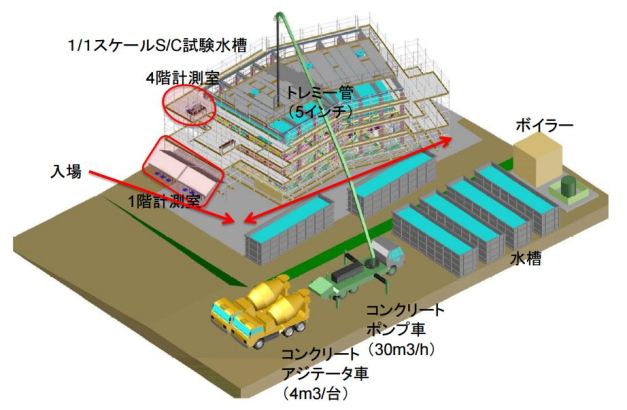
IRID announced the details of the ongoing research for repairing the unit 2 suppression chamber.
Based on their previous investigations IRID has determined that there could be a hole or series of holes of around 50mm in the unit 2 suppression chamber.
The research work is to determine if filling with concrete that structure could work. The proposed plan would use a concrete pump truck with a 5 inch diameter flexible hose to inject concrete into the suppression chamber.
Initial work took place at the Ando Hazama Technical Research Institute (Tsukuba City, Ibaraki Prefecture) on October 15th.
It seems they succeeded in layering the concrete mixture, sinking properly in the bottom of the suppression chamber tube. A 28 day pressure test will be conducted to assure the concrete properly plugs the leak.
Future work may be conducted at the new decommissioning research center at Naraha.
Source IRID :
<添付資料1:1/1スケールS/C試験に関する現場状況・概要図>
http://irid.or.jp/wp-content/uploads/2016/10/20161018_001.pdf
<添付資料2:コンクリート打設進捗に伴う時経列事象・解説図>
http://irid.or.jp/wp-content/uploads/2016/10/20161018_002.pdf
Testing of Seawater Off Fukushima Daiichi
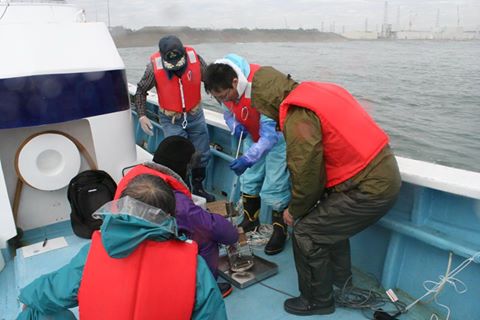
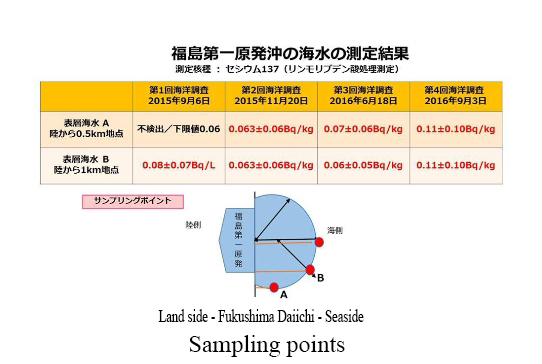
Results of seawater testing off the Fukushima Daiichi Nuclear Plant by Tarachine, the Mother’s Radiation Lab & Clinic of Iwaki, Fukushima
Item measured: Cesium 137 (method by treatment with phosphomolybdic acid)

https://www.actbeyondtrust.org/campaign/pledge/tarachine/jp/
Another Chernobyl or Fukushima risk plausible: Experts
The “flawed and woefully incomplete” public data from the nuclear industry is leading to an over-confident attitude to risk, the researchers warned.
The study, which put fresh pressure on the nuclear industry to be more transparent with data on incidents, also called for a fundamental rethink of how accidents are rated, arguing that the current method (the discrete seven-point International Nuclear Event Scale or INES) is highly imprecise, poorly defined, and often inconsistent.
For example, the Fukushima accident and the Chernobyl accident are rated 7 — the maximum severity level — on the INES scale.
However, Fukushima alone would need a score of between 10 and 11 to represent the true magnitude of consequences, the researchers said.
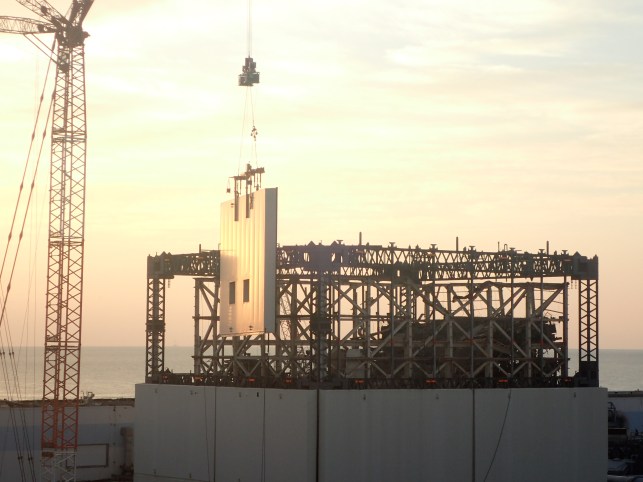
Catastrophic nuclear accidents like Chernobyl disaster in the US that took place in 1986 and the more recent Japan’s Fukushima disasters in 2011 may not be relics of the past. But the risk of such disasters are still more likely to occur once or twice per century, a study has warned.
The study found that while nuclear accidents have substantially decreased in frequency, this has been accomplished by the suppression of moderate-to-large events.
The researchers estimated that Fukushima and Chernobyl-scale disasters are still more likely than not once or twice per century, and that accidents like 1979 meltdown at Three Mile Island in the US are more likely than not to occur every 10-20 years.
For the study, a team of international risk experts analysed more than 200 nuclear accidents — the biggest-ever analysis of nuclear accidents — which provided a grim assessment of the risk estimated by the nuclear industry.
The “flawed and woefully incomplete” public data from the nuclear industry is leading to an over-confident attitude to risk, the researchers warned.
“We have found that the risk level for nuclear power is extremely high,” said lead author Spencer Wheatley, Professor at ETH Zurich in Switzerland.
“The next nuclear accident may be much sooner or more severe than the public realises,” added Benjamin Sovacool, Professor at the University of Sussex in Britain.
Further, the standard methodology used by the International Atomic Energy Agency to predict accidents and incidents — particularly when focusing on consequences of extreme events — is also problematic, the researchers said.
The study, which put fresh pressure on the nuclear industry to be more transparent with data on incidents, also called for a fundamental rethink of how accidents are rated, arguing that the current method (the discrete seven-point International Nuclear Event Scale or INES) is highly imprecise, poorly defined, and often inconsistent.
For example, the Fukushima accident and the Chernobyl accident are rated 7 — the maximum severity level — on the INES scale. However, Fukushima alone would need a score of between 10 and 11 to represent the true magnitude of consequences, the researchers said.
To remove a possibility of such disasters would likely require enormous changes to the current fleet of reactors, which is predominantly second-generation technology, Wheatley noted.
But, “even if we introduce new nuclear technology, as long as older facilities remain operational — likely, given recent trends to extend permits and relicense existing reactors — their risks, and the aggregate risk of operating the global nuclear fleet, remain,” Sovacool said.
The results were published in the journals Energy Research & Social Scienceand Risk Analysis
Prospect of Niigata nuke plant delay threatens Tepco’s Fukushima plans
TOKYO — The election of an anti-nuclear candidate as governor of Japan’s Niigata Prefecture could hit the finances of not only Tokyo Electric Power Co. Holdings but the public as well, as the utility is relying on a reactor restart in Niigata to cover Fukushima cleanup costs.
The central government reached an arrangement in 2014 to extend up to 9 trillion yen ($86.6 billion currently) in interest-free loans to pay for dealing with the fallout of the 2011 Fukushima Daiichi nuclear plant disaster. Of this, 5.4 trillion yen is to go toward compensating those affected, with Tepco and other power companies, including Kansai Electric Power and Chubu Electric Power, to repay the loans. Another 2.5 trillion yen is earmarked for decontamination work, with the costs to be recouped through the sale of Tepco shares held by the government.
But more than 6 trillion yen in compensation has been paid out so far, and cost overruns on decontamination are seen as all but certain. Decommissioning work at Tepco’s Fukushima plant, such as extracting fuel, falls outside the 9 trillion yen framework.
The 2 trillion yen Tepco had aimed to secure on its own to pay for scrapping the plant will be nowhere near enough. The utility and Japan’s industry ministry had counted on bringing the Kashiwazaki-Kariwa nuclear plant in Niigata Prefecture back online, which would improve Tepco’s earnings by 240 billion yen a year. But Gov.-elect Ryuichi Yoneyama has indicated that he is not amenable to a quick restart.
An expert panel set up by the ministry started discussing how to handle the additional costs this month. It laid out a scenario in which improved profit margins at Tepco via restructuring, along with profits from the Kashiwazaki-Kariwa facility, would be used to minimize the amount shouldered by taxpayers.
The longer it takes to restart the plant in Niigata, the larger the hit will be to Tepco’s available funding for Fukushima costs. Though the utility will squeeze out some money via internal reforms, Tepco may use rate hikes to pass on to the public what it cannot cover itself. Tepco and other utilities already have raised rates to recoup part of the compensation costs. A top industry ministry official indicated that rate increases will also be on the table to pay for decommissioning.
Power companies besides Tepco could be affected as well. Since many nuclear plants in eastern Japan use boiling-water reactors like those at the Kashiwazaki-Kariwa plant, further delays could hold up other reactor restarts in the region.
2019 Rugby World Cup in Japan
Before the 2020 Radioactive Olympics of Tokyo, the 2019 Radioactive Rugby World Cup in Japan!!!

World Rugby concluded its latest round of meetings with the Japan 2019 organizing committee in Tokyo Japan Friday, October 14, 2016 in connection with the preparation of the Rugby World Cup 2019.
The Executive Director of World Rugby, Brett Gosper, led a delegation to the quarterly meeting. Three years of the global tournament for the first time on Asian soil, Brett Gosper commented on key issues of the organization.
“We are satisfied with the way things are moving,” he said. “The budget, the planning for the stadiums … the preparations are on track and the foundations are solid. “
Bill Beaumont, president of World Rugby, who will visit Japan next week to take part of the World forum on sport and culture in Tokyo – along with IOC President Thomas Bach – is convinced that Japan 2019 will mobilize entire country.
“The Rugby World Cup will be an event for Japan as a whole,” he said. “Sport is about friendship and this tournament will be the proof with the teams, fans and the Japanese community will live the event together. Everyone is invited to participate in the biggest sporting event in the world in 2019. The host cities will benefit from significant economic benefits, but also sports and culture by hosting one of the world biggest sporting events. By working with the organizing committee, we are determined to make the most of the equipment for the benefit of all. “
Record profits were generated by the Rugby 2015 World Cup the order of £ 2.3 billion (€ 2.5 billion) to £ 1.1 billion (€ 1.2 billion) more to the UK economy through the 406,000 visitors who came and stayed on average 14 days. With 12 host cities, Japan can hope to break records.
The fan base is growing in Japan, especially because of the performance of the national team to the World Cup 2015 Rugby and Rugby 7 team at Rio Olympics Games that finished off the podium. Nearly 50% of fans believe that the Rugby World Cup in Japan will significantly raised the level of rugby in the country and 11 million say they are interested to take part. A total of 59 million Japanese watched the Rugby World Cup 2015.
Tokyo governor visits alternative site in Miyagi Prefecture for 2020 Games’ rowing and canoe sprint
We are many to think that it is shocking, disgusting and very sad that after over5 & a half years they are still putting their greed above the health of those people who would participate and go to watch these games, not to mention their own people. They should have relinquished as soon as they knew that the Fukushima Daiichi nuclear disaster had contaminated a good third of the country.

Tokyo Gov. Yuriko Koike (left front) and Miyagi Gov. Yoshihiro Murai (left back) wave to the press as they inspect the Naganuma rowing course in the city of Tome, Miyagi Prefecture, on Saturday.
Tokyo Gov. Yuriko Koike on Saturday visited a boat race course in Miyagi Prefecture, a facility emerging as an alternative venue for the rowing and canoe sprint events at the 2020 Tokyo Olympic games.
“Based on this visit, I will start considering venues,” Koike told reporters after inspecting facilities at the Naganuma rowing course in the city of Tome, more than 400 kilometers from Tokyo. Miyagi is one of the prefectures in northeastern Japan hit hardest by the March 2011 earthquake and tsunami.
Games organizers and the International Rowing Federation had already approved the Sea Forest Waterway venue to be constructed on Tokyo Bay, but a metropolitan government cost review panel recommended last month that plan be reconsidered.
The Tokyo Olympic and Paralympic organizing committee has raised concerns that costs could top ¥35.1 billion ($337 million) even if the rowing and canoe sprint events were held at the Naganuma rowing course. But Miyagi Prefecture Gov. Yoshihiro Murai argued Saturday in a television appearance that the overall cost is “estimated at around ¥15 to ¥20 billion.”
On the TV program, Murai also emphasized that most of the costs will be for “permanent facilities” after the Olympic Games, and that the prefectural government would shoulder the cost to remove temporary housing.
Last Wednesday, Murai visited Koike in Tokyo to convey his wish to hold the rowing and canoe events in Miyagi to show the world the recovery Japan has made since the 2011 quake and tsunami disaster.
Koike had told Murai that the Naganuma boat course was an option and she would “make a comprehensive decision” after visiting the site.
The organizing committee, however, has questioned the feasibility of holding those events at the Miyagi site, raising what they said are “nine problems,” including transportation, infrastructure and costs.
Saitama Gov. Kiyoshi Ueda has also said his prefecture is ready to host the rowing and canoe sprint events at Saiko Doman Green Park in the city of Toda.
Fukushima Untreated Bypass Groundwater Dumped into the sea

Up to October 14, 2016, Tepco has discarded 137 times Fukushima Daiichi untreated groundwater from the bypass into the sea, all totalling now 222,816 tons (58,861,760 gallons).
That not including the 300+ tons a day of untreated groundwater flowing through the plant and into the ocean 24/7 for 5.6 years now.
http://www.tepco.co.jp/nu/fukushima-np/info/baypassold-j.html
Judges may order gov’t to submit redacted report in lawsuit over Fukushima disaster

A judge presiding at a trial over the Fukushima nuclear crisis said the judges in charge will decide by the end of this year on whether to order the government to submit some of its investigation committee’s reports on the disaster that have been withheld.
Presiding Judge Akihiko Otake at the Tokyo District Court made the remark on Oct. 13 during an oral proceeding of the suit filed by shareholders of Tokyo Electric Power Co. (TEPCO), the operator of the crippled nuclear plant, to clarify the responsibility of former TEPCO board members over the disaster.
Otake also said the judges in charge will conduct an in camera review on other documents, part of which has been blacked out before they were disclosed, to deem whether the measure is appropriate.
Specifically, the judges will examine documents recording statements by the now deceased Masao Yoshida, who headed the Fukushima No. 1 Nuclear Power Plant at the time of the outbreak of the disaster in March 2011, and those by two officials of the then Nuclear and Industrial Safety Agency.
The documents were disclosed after the names of individuals and some other information were blacked out. The court said it has already ordered the Cabinet Office to submit the documents with the blacked-out parts unveiled. The Cabinet Office has reportedly responded that it intends to comply with the order by the end of this week.
http://mainichi.jp/english/articles/20161014/p2a/00m/0na/005000c
Toyama tritium researcher’s data targeted in cyberattacks

Research data and personal information may have been stolen from a personal computer belonging to a researcher of tritium, a radioactive isotope of hydrogen, at the University of Toyama’s Hydrogen Isotope Research Center, the university said.
In addition to research data, hackers may have stolen personal information such as email addresses on some 1,500 people, including other researchers, the school said Monday.
Most of the possibly affected research data were those that have already been published or were slated to be published, and no highly confidential information was compromised, it said.
According to the university, two staff members of the center received emails containing a virus in November 2015 and a PC of one of them, a member of the teaching staff, was infected. The PC continued questionable communications with an outside party for about six months.
The center learned of the virus infection in June following an alert from an outside organization.
The university, based in the city of Toyama, briefed the education ministry on the cyberattacks in mid-June. Earlier in October, it started informing researchers who may have been affected.
The center conducts research on hydrogen, deuterium and tritium, including their use for energy.
Tritium is regarded as a candidate for fuel in nuclear fusion reactors, and is also one of the contaminants in the water building up at the Fukushima No. 1 nuclear plant.
Accelerate water-purifying work at Fukushima plant to cut leakage risk
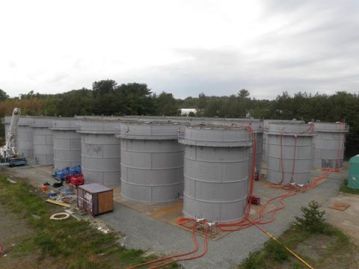
The volume of contaminated water continues to increase at Tokyo Electric Power Company Holdings Inc.’s Fukushima No. 1 nuclear power plant. Efforts to deal with this problem must be reinforced.
TEPCO has compiled a new set of measures to deal with the radioactive water. The steps are aimed at reducing to nearly zero the contaminated water inside reactor buildings, the prime source of the tainted water.
Under the new measures, the contaminated water accumulated in the basements of reactor buildings is to be purified and then transferred to storage tanks. At the same time, facilities exclusively used for purifying the tainted water are to be doubled, and the existing storage tanks will be replaced with larger ones, increasing the overall storage capacity.
Meanwhile, the volume of groundwater to be pumped up from the wells near the reactor buildings is to be increased. This is aimed at reducing the flow of underground water into the buildings, thus preventing a vicious cycle of generating more tainted water.
If all goes well, the increase in the volume of contaminated water is expected to nearly stop by 2020. We hope TEPCO will realize this goal steadily.
The measures taken so far have centered on the construction of “ice walls,” to prevent groundwater from entering the reactor buildings by freezing the underground soil around the buildings. Because this step has failed to prove effective even more than half a year after the related facilities were put into operation, TEPCO decided to shift its priority measures.
The new measures will require the approval of the Nuclear Regulation Authority. Both TEPCO and the NRA must cooperate closely so that the necessary work will not be delayed.
Consider ocean release
The reactor buildings have, in effect, turned into storage facilities for contaminated water. The volume of tainted water totals about 68,000 tons. Although the amount of radioactive material contained in the water has declined markedly when compared to the amount immediately after the nuclear accident occurred, it still remains at a high level.
The large amount of contaminated water inside the reactor buildings carries a risk of radiation exposure, posing a serious impediment to the work to decommission the plant. If highly radioactive water starts leaking underground out of the buildings and into the sea, it will create a serious situation.
Even if new measures proceed smoothly, however, tasks remain. The volume of purified water to be stored in the tanks is expected to nearly double by 2020 to about 1.2 million tons. Not only will this entail a huge maintenance cost, but there is also a danger that the water will leak if the tanks are damaged by an earthquake or other factors.
Releasing purified water that has met the existing safety criteria into the sea must be seriously considered. The discharge of purified water into the ocean has been routinely conducted at nuclear power-related facilities both at home and abroad.
It is important for both the government and TEPCO to do their utmost to explain such a plan in detail in order to win the understanding of local residents concerned. Efforts should also be made to take measures to prevent groundless rumors from adversely affecting the fisheries industry and other sectors.
It is also necessary to continuously ascertain the effect of the ice walls. Although nearly 100 percent of the walls have already been frozen, groundwater is reportedly flowing through thin gaps in the walls. Rainwater seeping through the topsoil has also increased the amount of groundwater inside the buildings.
TEPCO is proceeding with work to fill the gaps in the ice walls. If the work proves effective, the goal of reducing to zero the increase in the contaminated water will be realized two years earlier than envisaged. We hope TEPCO will strenuously work to block the flow of groundwater into the buildings.
Data on nuclear studies, workers may have leaked from university
Hacked: a good news. Hopefully those hackers might release crucial important data, which would change us from Tepco B.S and Japanese government censored information.

OYAMA–Personal information and nuclear research, including studies concerning the crippled Fukushima No. 1 nuclear plant, might have leaked in a cyber-attack at the University of Toyama here, the school reported Oct. 10.
The leaked data could possibly affect 1,492 students, researchers and individuals from public organizations and companies who conduct joint studies with the institution’s Hydrogen Isotope Research Center.
“We apologize for causing great trouble to associated organizations,” said Yasumaru Hatanaka, the university’s vice president.
However, the research that might have leaked, such as studies on water decontamination at the Fukushima nuclear plant, had all been previously presented at academic meetings, so there was no breach in confidentiality, the university said.
No malicious use of the data has been reported since the data breach came to light in June.
According to the university, the cyber-attack targeted a computer operated by a part-time employee specializing in tritium research at the center.
An e-mail containing malware was sent to both the worker and a professor with the facility in November 2015. The professor did not open the e-mail, but the employee did, causing the computer to become infected with a virus.
As a result, the employee’s computer became remotely accessible, and it made connections with four outside servers between November and June. The university’s investigation showed that the computer sent large amounts of data to two of these servers.
A further analysis of the computer found indications that at least 1,000 archive files had been created between last November and February.
Considering their size, nearly all the data stored in the computer may have been compressed into these files. Similar archive files were created using a different method in March, the university said.
The university became aware of the cyber-attack after an outside organization warned the school about suspicious network activities made by the employee’s computer.
According to a wildlife journalist, even in Tokyo some animals suffer mutations
Already few weeks ago a Japanese friend mentioned to me that he noticed very few insects this summer in Tokyo. This article now corroborates it.
If the wild life around Tokyo is that affected, how about the health of the people living there?

Frog having one eye only (photo by Eiki Sato, from October 10, 2016)
Ravages in Tokyo from the nuclear accident at Fukushima Daiichi 250km away.
The documentary film “Paradise Phantom” just came out. This documentary is about the stationary observations on animals by Eiki Sato, a wildlife journalist. The screening of this film took place at a movie theater in Suginami-ku, Tokyo on September 25, 2016.
Sato filmed for 170 hours various animals in the wild places of Tokyo, for example the banks of the Arakawa river, the fields near sports stadiums and Tokyo plants. These are real paradises for many living creatures, such as kestrels, shrikes, bats, frogs, dragonflies, even the gray beetles, animals that are not on the global red list threatened species.
The documentary shows that since two years animals with abnormalities are being observed . The cause of these abnormalities would be the accumulated radioactivity in the soil of Tokyo, according to Eiki Sato.
During his observations Eiki Sato found many types of deformities, due to mutations: Various insects affected with malformed or missing wing, or with curled wings, or abnormal eyes, unabling them to fly. Mosquito with bent spine, dragonflies with mishaped eyes unable to fly high. Birds with affected eyes, or feathers, unable to fly. Many also cannot reproduce, their population sharply decreasing.
http://www.tokyo-sports.co.jp/entame/entertainment/602104/
1 This Month

of the week – Shut Down Drone Warfare!


Tell the Ukrainian Government to Drop Prosecution of Peace Activist Yurii Sheliazhenko

Petition to revoke the licensing of the Near Surface Nuclear Disposal Facility (NSDF) at Chalk River. https://www.ourcommons.ca/petitions/en/Petition/Details?Petition=e-7247
To see nuclear-related stories in greater depth and intensity – go to https://nuclearinformation.wordpress.com
-
Archives
- April 2026 (114)
- March 2026 (251)
- February 2026 (268)
- January 2026 (308)
- December 2025 (358)
- November 2025 (359)
- October 2025 (376)
- September 2025 (257)
- August 2025 (319)
- July 2025 (230)
- June 2025 (348)
- May 2025 (261)
-
Categories
- 1
- 1 NUCLEAR ISSUES
- business and costs
- climate change
- culture and arts
- ENERGY
- environment
- health
- history
- indigenous issues
- Legal
- marketing of nuclear
- media
- opposition to nuclear
- PERSONAL STORIES
- politics
- politics international
- Religion and ethics
- safety
- secrets,lies and civil liberties
- spinbuster
- technology
- Uranium
- wastes
- weapons and war
- Women
- 2 WORLD
- ACTION
- AFRICA
- Atrocities
- AUSTRALIA
- Christina's notes
- Christina's themes
- culture and arts
- Events
- Fuk 2022
- Fuk 2023
- Fukushima 2017
- Fukushima 2018
- fukushima 2019
- Fukushima 2020
- Fukushima 2021
- general
- global warming
- Humour (God we need it)
- Nuclear
- RARE EARTHS
- Reference
- resources – print
- Resources -audiovicual
- Weekly Newsletter
- World
- World Nuclear
- YouTube
-
RSS
Entries RSS
Comments RSS
 nuclear-news