Fukushima Liquidators Are Real
 Fukushima: Tepco sends workers to repair where robots failed. High radiation.
Some weird stuff is happening at the TEPCO’s Fukushima Daiichi Nuclear Power Plant right now. While Japan has decided to drop radioactive water in the ocean, Tepco sent humans to repair where robots failed.
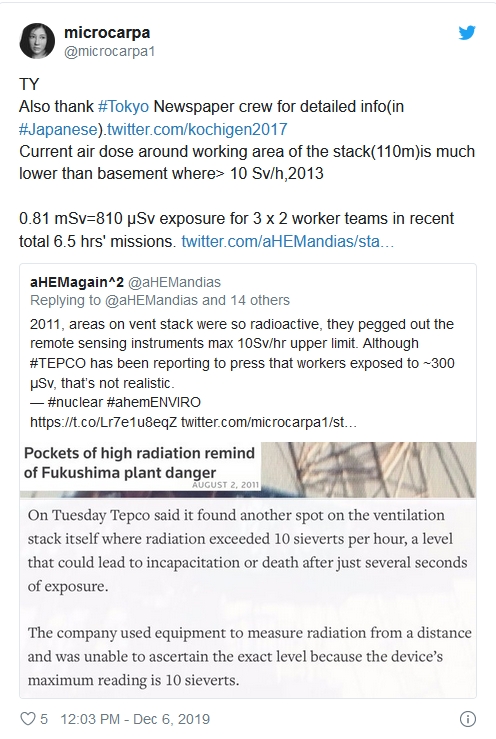
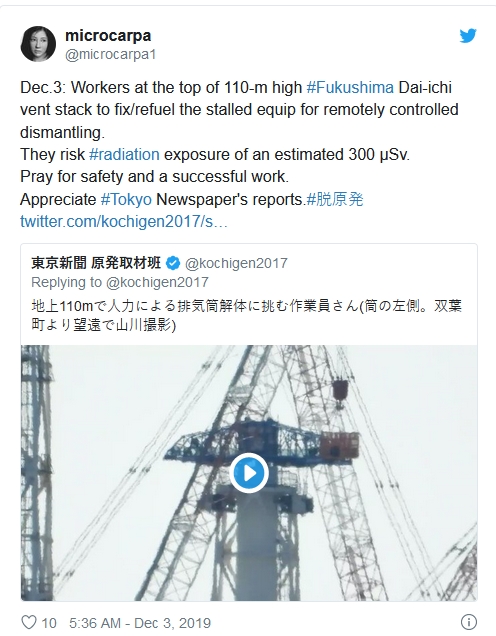
On December 3, workers were sent to the top of the exhaust stack (about 110 meters high) standing beside the Unit 1 and 2 buildings to finish cutting a cylinder body with an electric tool after the robotic infrastructure failed.

TEPCO delays Fukushima chimney demolition

December 16, 2019
The operator of the crippled Fukushima Daiichi nuclear plant says it is having difficulties reducing the height of a damaged exhaust chimney and will extend the deadline to finish the work.
The 120-meter tall exhaust stack shared by the No.1 and No.2 reactors was heavily contaminated by radioactive substances in the 2011 accident. Its steel framework was damaged by the accident.
Tokyo Electric Power Company has been working since August to halve the chimney’s height to around 60 meters to reduce the risk of collapse, but has so far only cut about nine meters.
The company says a cutter developed for the project has run into a series of problems. It says the blade of the remotely-controlled device has worn down faster than expected and become stuck.
TEPCO has suspended the demolition, and is reviewing its cutting methods and procedures. The utility says it will submit an improved plan to the Nuclear Regulation Authority.
The firm says it hopes to restart the work by the end of this month and will reschedule completion of the project from the end of March next year to mid-May.
Radiation levels in one Fukushima reactor high enough to kill a human in two minutes
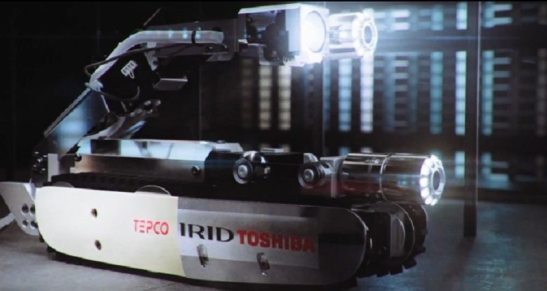
The radiation levels in ‘s unit two reactor are so high they could kill a human in two minutes, according to data collected by a robot.
Tokyo Electric Power, the company which operates the nuclear plant in Fukushima, carried out a robotic survey of the area around the core that melted six years ago, following the earthquake and tsunami that triggered the .
But the scorpion robot Sasori got stuck inside the reactor after its crawling functions failed while climbing over highly radioactive debris and had to be abandoned inside the reactor.
It recorded radiation measures in the area of 210 sieverts per hour, which are lethal enough to kill a human within two minutes.
This is not the first time a robot has become inoperable after entering the reactor.
During a previous survey, another robot designed to clean the debris for Sasori’s passage had to return halfway through when two of its cameras failed after being exposed for two hours to radiation and reaching its maximum tolerance of 1,000 sievert. Such an exposure to can kill a human within seconds.
Despite the dangerously high levels of radiation, company officials said it was not leaking outside the reactor.
The high radiation and inadequate cleaning of the reactors could also limit the scope of future investigations and the company may have to develop more radiation-resistant cameras and equipment.
The probe was specially developed for surveying the interior of the crippled reactor and collect data that will assist in removing the melted fuel.
But the level of radiation and the presence of debris seem to have brought the decommissioning project to a standstill.
‘Scorpion‘ robot mission inside Fukushima reactor aborted
December 8, 2019
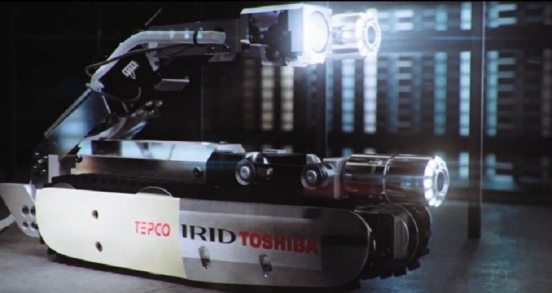
A “scorpion” robot sent into a Japanese nuclear reactor to learn about the damage suffered in a tsunami-induced meltdown had its mission aborted after the probe ran into trouble, Tokyo Electric Power company said Thursday.
TEPCO, the operator of the Fukushima nuclear plant, sent the remote-controlled device into the No. 2 reactor where radiation levels have recently hit record highs.
The “scorpion” robot, so-called because it can lift up its camera-mounted tail to achieve better viewing angles, is also designed to crawl over rubble inside the damaged facility.
But it could not reach its target destination beneath a pressure vessel through which nuclear fuel is believed to have melted because the robot had difficulty moving, a company spokeswoman said.
“It‘s not immediately clear if that‘s because of radiation or obstacles,” she said, adding that TEPCO is checking what data the robot was able to obtain, including images.
A massive undersea earthquake on March 11, 2011 sent a huge tsunami barrelling into Japan‘s northeast coast, leaving more than 18,000 people dead or missing, and sending three reactors into meltdown at the plant in the worst such accident since Chernobyl in 1986.
The Japanese government said in December that it expects the total costs — including compensation, decommissioning and decontamination — to reach 21.5 trillion yen ($189 billion) in a process likely to take decades as high radiation levels slow operations.
The robot, 60 centimetres (24 inches) long, is made by Toshiba and equipped with two cameras and sensors to gauge radiation levels and temperatures.
“Scorpion‘s mission is to take images of the situation and collect data inside the containment vessel,” TEPCO spokesman Shinichi Nakakuki said earlier.
“Challenges include enduring high levels of radiation and moving on the rough surface,” he said.
Radiation levels inside the reactor were estimated last week at 650 sieverts per hour at one spot, which can effectively shut down robots in hours.
But the probe — designed to withstand up to 1,000 sieverts of radiation in total — would not sustain severe damage because it was unlikely to remain for too long at a single point, Nakakuki said.
https://livingstonledger.com/scorpion-robot-mission-inside-fukushima-reactor-aborted/
Robot pulled from Fukushima reactor due to radiation
Cleaner robot pulled from Fukushima reactor as record radiation levels damage its camera
A remote-controlled cleaning robot sent into a damaged reactor at Japan‘s Fukushima nuclear plant had to be removed before it completed its work because of camera problems most likely caused by high radiation levels.
It was the first time a robot has entered the chamber inside the Unit 2 reactor since a March 2011 earthquake and tsunami critically damaged the Fukushima Da-ichi nuclear plant.
Tokyo Electric Power Co. said it was trying to inspect and clean a passage before another robot does a fuller examination to assess damage to the structure and its fuel.
WHAT HAPPENED?
The robot went only part way into a space under the core that TEPCO wants to inspect closely.
It crawled down the passage while peeling debris with a scraper and using water spray to blow some debris away.
The dark brown deposits grew thicker and harder to remove as the robot went further.
After about two hours, the two cameras on the robot suddenly developed a lot of noise and their images quickly darkened — a sign of a problem caused by high radiation.
The second robot, known as the ‘scorpion,‘ will also measure radiation and temperatures.
Thursday‘s problem underscores the challenges in decommissioning the wrecked nuclear plant.
Inadequate cleaning, high radiation and structural damage could limit subsequent probes, and may require more radiation-resistant cameras and other equipment, TEPCO spokesman Takahiro Kimoto said.
‘We will further study (Thursday‘s) outcome before deciding on the deployment of the scorpion,‘ he said.
TEPCO needs to know the melted fuel‘s exact location and condition and other structural damage in each of the three wrecked reactors to figure out the best and safest ways to remove the fuel.
It is part of the decommissioning work, which is expected to take decades.
During Thursday‘s cleaning mission, the robot went only part way into a space under the core that TEPCO wants to inspect closely.
It crawled down the passage while peeling debris with a scraper and using water spray to blow some debris away. The dark brown deposits grew thicker and harder to remove as the robot went further.
After about two hours, the two cameras on the robot suddenly developed a lot of noise and their images quickly darkened — a sign of a problem caused by high radiation.
Operators of the robot pulled it out of the chamber before completely losing control of it.
The outcome means the second robot will encounter more obstacles and have less time than expected for examination on its mission, currently planned for later this month, though Thursday‘s results may cause a delay.
Both of the robots are designed to withstand up to 1,000 Sieverts of radiation.
The cleaner‘s two-hour endurance roughly matches an estimated radiation of 650 Sieverts per hour based on noise analysis of the images transmitted by the robot-mounted cameras.
That‘s less than one-tenth of the radiation levels inside a running reactor, but still would kill a person almost instantly.
Kimoto said the noise-based radiation analysis of the Unit 2‘s condition showed a spike in radioactivity along a connecting bridge used to slide control rods in and out, a sign of a nearby source of high radioactivity, while levels were much lower in areas underneath the core, the opposite of what would normally be the case.
He said the results are puzzling and require further analysis.
TEPCO officials said that despite the dangerously high figures, radiation is not leaking outside of the reactor.
Images recently captured from inside the chamber showed damage and structures coated with molten material, possibly mixed with melted nuclear fuel, and part of a disc platform hanging below the core that had been melted through.
https://insiderfinancial.net/robot-pulled-from-fukushima-reactor-due-to-radiation.html
Radiation levels inside Fukushima high enough to kill robot sent to clean
December 6, 2019
A remote-controlled cleaning robot sent into a damaged reactor at Japan‘s Fukushima nuclear plant had to be removed Thursday before it completed its work because of camera problems most likely caused by high radiation levels.
It was the first time a robot has entered the chamber inside the Unit 2 reactor since a March 2011 earthquake and tsunami critically damaged the Fukushima Da-ichi nuclear plant.
Tokyo Electric Power Co. (TEPCO) said it was trying to inspect and clean a passage before another robot does a fuller examination to assess damage to the structure and its fuel. The second robot, known as the “scorpion,” will also measure radiation and temperatures.
Thursday‘s problem underscores the challenges in decommissioning the wrecked nuclear plant. Inadequate cleaning, high radiation and structural damage could limit subsequent probes, and may require more radiation-resistant cameras and other equipment, TEPCO spokesman Takahiro Kimoto said.
“We will further study (Thursday‘s) outcome before deciding on the deployment of the scorpion,” he said.
TEPCO needs to know the melted fuel‘s exact location and condition and other structural damage in each of the three wrecked reactors to figure out the best and safest ways to remove the fuel. It is part of the decommissioning work, which is expected to take decades.
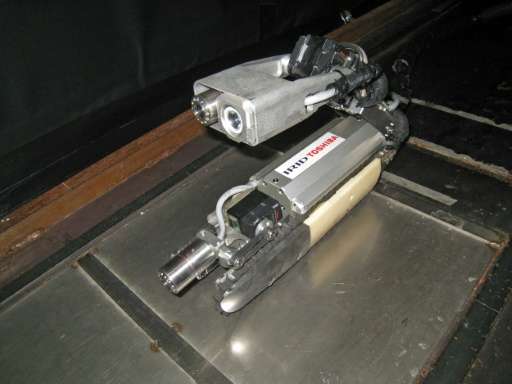
The remote-controlled “cleaning” robot, bottom, was sent in to inspect and clean a passage for another robot in the damaged nuclear facility. (TEPCO/Associated Press)
During Thursday‘s cleaning mission, the robot went only part way into a space under the core that TEPCO wants to inspect closely. It crawled down the passage while peeling debris with a scraper and using water spray to blow some debris away. The dark brown deposits grew thicker and harder to remove as the robot went further.
More obstacles for second mission
After about two hours, the two cameras on the robot suddenly developed a lot of noise and their images quickly darkened — a sign of a problem caused by high radiation. Operators of the robot pulled it out of the chamber before completely losing control of it.
The outcome means the second robot will encounter more obstacles and have less time than expected for examination on its mission, currently planned for later this month, though Thursday‘s results may cause a delay.
Both of the robots are designed to withstand up to 1,000 Sieverts of radiation. The cleaner‘s two-hour endurance roughly matches an estimated radiation of 650 Sieverts per hour based on noise analysis of the images transmitted by the robot-mounted cameras. That‘s less than one-tenth of the radiation levels inside a running reactor, but still would kill a person almost instantly.
Kimoto said the noise-based radiation analysis of the Unit 2‘s condition showed a spike in radioactivity along a connecting bridge used to slide control rods in and out, a sign of a nearby source of high radioactivity, while levels were much lower in areas underneath the core, the opposite of what would normally be the case. He said the results are puzzling and require further analysis.
TEPCO officials said that despite the dangerously high figures, radiation is not leaking outside of the reactor.
Images recently captured from inside the chamber showed damage and structures coated with molten material, possibly mixed with melted nuclear fuel, and part of a disc platform hanging below the core that had been melted through.
Fukushima nuclear debris removal to begin in 2021
 (Photo taken in Fukushima Prefecture on Aug. 10, 2018, shows the Fukushima Daiichi nuclear power plant.)
December 3, 2019
Japan on Monday unveiled a revised plan to remove molten nuclear fuel debris from the crisis-hit Fukushima Daiichi power plant in 2021, a process said to be the biggest hurdle in the cleanup of the devastated facility.
The debris removal work should start at the plant’s No. 2 reactor, according to the medium- to long-term road map released by the government.
The plan also called for completing the removal of 4,741 fuel rods left inside the pools of Nos. 1 to 6 units by 2031, giving a specific time frame for the first time.
“As more people return and rebuilding progresses in the areas around the Daiichi plant, we will take measures based on the basic principle of balancing rebuilding and decommissioning,” said industry minister Hiroshi Kajiyama, who heads the government team tasked with decommissioning.
(Photo taken in Fukushima Prefecture on Aug. 10, 2018, shows the Fukushima Daiichi nuclear power plant )
The plan, revised for the fifth time, maintained the outlook of completing the decommissioning of the plant operated by Tokyo Electric Power Company Holdings Inc. in 30 to 40 years following the nuclear meltdowns triggered by a massive earthquake and tsunami on March 11, 2011.
But given issues that have halted work and caused delays so far, it remains uncertain whether the plan will proceed as scheduled.
The No. 2 unit was in operation when the crisis began and some fuel has apparently melted through the reactor pressure vessel that holds the fuel and accumulated at the bottom of the outer primary containment vessel.
Among the three reactors that experienced core meltdowns, the reactor building housing the No. 2 unit did not suffer hydrogen explosions. The radiation levels near the reactor containment vessel are also estimated to be lower than others.
Prior to removing the nuclear debris, an earlier plan called for taking samples from the reactor within fiscal 2019 ending in March, but the revised plan states it will be done in time for the 2021 removal, and the removal to expand to 2031.
Removal of spent fuel has already begun at some of the reactors as they need to be cooled to avert melting. The fuel, including some unspent fuel, which is currently being stored inside respective pools, need to be taken to a common pool to be stored stably, although its final destination is yet to be decided.
All fuel has been removed from the pool of No. 4, which was being halted for a regular checkup at the time of the crisis, and the removal of fuel from No. 3 began in April. The same work will begin at Nos. 1 and 2 in fiscal 2023, according to the latest plan.
METI eyes 2031 end to Fukushima No. 1 cleanup

Fukushima’s contaminated water is an issue affecting all of humanity
An ocean dump could lead to a global ecological disaster
 An image of the Fukushima nuclear power plant, including storage tanks for contaminated water, taken by Greenpeace campaigner and Swedish photographer Christian Aslund on Oct. 16, 2018.
December 1, 2019
As the possibility of Japan dumping contaminated water from the Fukushima Nuclear Power Plant into the ocean has been raised, concerns are being voiced on the Korean Peninsula and through various international organizations. Obviously, it is South Korea that is leading the efforts at international coordination in organizations like the International Atomic Energy Agency (IAEA), International Maritime Organization (IMO), and World Health Organization (WHO).
The biggest issue that stands to arise if the contaminated water is dumped into the ocean is the major impact on the marine environment in the Western Pacific and the health of residents in the region, and South Korea is the closest neighbor to Japan.
In a recent piece published in the UK’s The Economist, Shaun Burnie of Greenpeace Germany warned that if Japan dumped the water into the pacific, radioactive material will begin flowing into the East Sea within a year. As Japan’s closest neighbor, South Korea has maintained that it has a right to sufficiently discuss the potential environmental threat and demand related information. During a South Korean parliamentary audit, expressions of concern about the Fukushima water release were coupled with demands for response measures to be put in place.
Unfortunately, these messages and warnings are not being expressed as part of a system of guidance and cooperation to permit a fundamental resolution. Rather, they amount more to a form of pressure within international discourse, which runs the risk of being shrugged off with pro forma logic. The predictions that radioactive material will begin washing into the East Sea within a year could change with the actual amounts and concentrations of water dumped; in the absence of real announced concentrations of inflowing contaminants, it does nothing more than to raise a threat.
More than the fact of the inflows over the year after release, we need to be aware that there are migrating species that could enter the waters near South Korea at any time. Also, what is to be done about the destruction to the marine ecosystem or the marine life that is being fished in the Pacific by the different countries? The result would be a disaster for humankind. We need a more in-depth and scientific examination to identify a disposal plan that allays the concerns of Japan’s neighbors as well as those of Japanese civil society and fishers, who are the ones suffering the ill effects first hand.
Plans for handling marine contaminants fall into five main categories. The first involves controlling the source. The most basic means of resolution is to replace materials and production processes and ban production and consumption to ensure that contaminants are not released in the first place. The second involves recirculation and reuse. This means either re-circulating contaminants through nature or reusing them for other purposes. The third involves storing the contaminants. In cases where no disposal method has yet been developed and reuse is not an option, the approach has been to contain and process them at a safe distance from areas of human activity.
The fourth involves controlling contamination through a regional quota system. This means applying different standards for management depending on the uses of particular waters; in South Korea’s case, marine protected areas and special management areas fall into this category. The last approach is contamination control through taxation. Under such a system, penalties are imposed in cases where contamination is unavoidable; as a rule, the party responsible bears the costs for compensation and restoration.
 Lee Suk-mo, professor of ecological engineering at Pukyong National University
An ocean dump from a nuclear power plant at the current level, without any international regulations in place, would be utterly unacceptable and an affront to environmental justice for humanity today and future generations. Radioactive material decays naturally; if set apart and stored, it goes away naturally over time. But because of issues concerning time and space, this is not an economical approach, and new and effective disposal technology could be developed while it is being stored.
This is why the nuclear power plant water issue is something that should be approached as an issue affecting all of humanity, rather than one restricted to Fukushima and Japan. In particular, neighbors and countries possessing nuclear power plants of their own should make it a priority to cooperate fully in technological and economic terms.
Human disasters may start in one country, but it is through international cooperation that a country’s disaster can be resolved.
By Lee Suk-mo, professor of ecological engineering at Pukyong National University
http://www.hani.co.kr/arti/english_edition/e_international/919137.html
Possible radioactive water leak at Japan’s crisis hit Fukushima nuke plant

Regulator: Venting at Fukushima reactor failed

Possible water leak from Fukushima exhaust stack

Japan gov’t tells embassies risk of contaminated Fukushima water ‘small’

Japan: Environmentalists say Fukushima water too radioactive to release

South Korea nuclear regulator wants information on radioactive Fukushima water release
 A geiger counter measures a radiation level of 54.0 microsievert per hour near the No.2 and No.3 reactor buildings at Tokyo Electric Power Co’s (TEPCO) tsunami-crippled Fukushima Daiichi nuclear power plant in Okuma town, Fukushima prefecture, Japan February 18, 2019
November 20, 2019
SEOUL (Reuters) – Japan’s reluctance to disclose information about the release of radioactive water from its damaged Fukushima nuclear plant is hampering neighboring countries’ efforts to minimize the impact, the head of South Korea’s nuclear safety agency said on Wednesday.
Since the 2011 earthquake and tsunami caused a meltdown at some of the reactors the Fukushima plant, owner Tokyo Electric Power Co (Tepco) has been storing radioactive water in tanks at the site from the cooling pipes used to keep the fuel cores from melting. The utility will run out of space for the water in 2022.
Japan has not yet decided how to deal with the contaminated water, but its environment minister said in September that radioactive water would have to be released from the site into the Pacific Ocean.
“We have been raising Japan’s radioactive water issue to the international community to minimize the impact … but as Japan hasn’t disclosed any specific plan and process we would need more details to run simulations and study,” Uhm Jae-sik, chairman of the Nuclear Safety and Security Commission, told Reuters.
In addition to the Fukushima crisis, safety concerns about nuclear energy have increased in South Korea following a 2012 scandal over the supply of faulty reactors parts with forged documents, prompting a series of shutdowns of nuclear reactors.
South Korea, the world’s fifth-largest user of nuclear power, targets a long-term phase out of atomic power to allay public concerns.
“Regardless of the government’s energy policy change, our primary goal is ensuring the safety of nuclear power,” Uhm said.
South Korea operates 25 nuclear reactors, which generate about a third of the country’s total electricity. Of the 25 reactors, 10 are offline for maintenance, according to the website of Korea Hydro & Nuclear Power.
(This story corrects the word “specific” to clarify meaning in translated quote in paragraph 4)
-
Archives
- February 2026 (199)
- January 2026 (308)
- December 2025 (358)
- November 2025 (359)
- October 2025 (376)
- September 2025 (258)
- August 2025 (319)
- July 2025 (230)
- June 2025 (348)
- May 2025 (261)
- April 2025 (305)
- March 2025 (319)
-
Categories
- 1
- 1 NUCLEAR ISSUES
- business and costs
- climate change
- culture and arts
- ENERGY
- environment
- health
- history
- indigenous issues
- Legal
- marketing of nuclear
- media
- opposition to nuclear
- PERSONAL STORIES
- politics
- politics international
- Religion and ethics
- safety
- secrets,lies and civil liberties
- spinbuster
- technology
- Uranium
- wastes
- weapons and war
- Women
- 2 WORLD
- ACTION
- AFRICA
- Atrocities
- AUSTRALIA
- Christina's notes
- Christina's themes
- culture and arts
- Events
- Fuk 2022
- Fuk 2023
- Fukushima 2017
- Fukushima 2018
- fukushima 2019
- Fukushima 2020
- Fukushima 2021
- general
- global warming
- Humour (God we need it)
- Nuclear
- RARE EARTHS
- Reference
- resources – print
- Resources -audiovicual
- Weekly Newsletter
- World
- World Nuclear
- YouTube
-
RSS
Entries RSS
Comments RSS
 nuclear-news