Japan’s Upcoming Nuclear Waste Dump
The last known “deliberate nuclear waste dumping into the ocean,” outside of the “good graces” of what the industry refers to as “detailed environmental impact assessments” that somehow (questionably, mysteriously, are you kidding me!) seem to justify dumping toxic nuclear waste was October 1993 when the Russian navy illegally dumped 900 tons of nuclear waste into international waters off the coast of Vladivostok near Japan and Korea. Moscow claimed they were running out of storage space and that “radioactive waste is not hazardous and the dumping would be according to international norms.” Sound familiar?
In 1993 Japan called the Russian dumping “extremely regrettable.”

December 7, 2021 by Robert Hunziker
Nuclear waste is an interminable curse that eternally haunts the future of civilization for hundreds/thousands of years.
“The challenge of making nuclear power safer doesn’t end after the power has been generated. Nuclear fuel remains dangerously radioactive for thousands of years after it is no longer useful in a commercial reactor.” (Source: Nuclear Waste, Union of Concerned Scientists, April 22, 2016)
There are 440 nuclear power plants in the world, all of which use nuclear fission, prompting one simple question: Is the process of generating heat via nuclear fission with a byproduct of extremely toxic radioactive waste lasting hundreds, or more, years for purposes of simply “boiling water” the epitome of human stupidity?
In April 2021, the Japanese government announced its decision to discharge nuclear waste from Fukushima Daiichi Power Plant into the Pacific Ocean via a sub-seabed pipeline. At least 1.2 million tons of tritium-laced toxic water will be discharged.
As it happens, nuclear powers of the world regularly dump nuclear waste into the ocean in violation of the London Convention (1972) and the London Protocol (1996), which are the two principal international agreements against dumping nuclear waste into the oceans. But, they get around the rules by dumping under the cover of “detailed environmental impact assessments.”
The last known “deliberate nuclear waste dumping into the ocean,” outside of the “good graces” of what the industry refers to as “detailed environmental impact assessments” that somehow (questionably, mysteriously, are you kidding me!) seem to justify dumping toxic nuclear waste was October 1993 when the Russian navy illegally dumped 900 tons of nuclear waste into international waters off the coast of Vladivostok near Japan and Korea. Moscow claimed they were running out of storage space and that “radioactive waste is not hazardous and the dumping would be according to international norms.” Sound familiar?
In 1993 Japan called the Russian dumping “extremely regrettable.” Yet, at the time, Tokyo Electric Power Company was itself discharging radioactivity into the ocean. At the time, Japanese power stations were allowed to dump nuclear waste into the ocean based upon “detailed environmental impact assessments.” (OMG is this real?) (Source: Nuclear Dumping at Sea Goads Japan Into Action, NewScientist, November 6, 1993)
“Jinzaburo Takagi, a physicist working with the Citizens’ Nuclear Information Centre in Tokyo, says: ‘If the Russians had done an impact assessment for their dumping, it would have proved safer than the Japanese power plants.’ He says local authorities in Japan have measured elevated levels of radionuclides in shellfish and seaweed near the nuclear plants. If the Japanese criticize Russian dumping, says Takagi, ‘then they will have to abandon the option of dumping nuclear waste,” Ibid.
The abovementioned series of conflicting events surrounding disposal of nuclear waste brings to mind the complexity and hypocrisy that runs throughout the nuclear industry. It stems from the hideous fact that the industry does not know what to do with radioactive waste, which is the most toxic material on the face of the planet; they do make up weird excuses and protocols to actually dump the toxic material into international waters. Not only that, but, as mentioned in the quoted article above, “local authorities in Japan have measured elevated levels of radionuclides in shellfish and seaweed near the nuclear plants.” That’s a prime example of human insanity at work. And, that was 30 years ago, but it’s a safe bet that it’s the same today.
The bitter truth is that the citizens of the world are stuck with nuclear power and its offbeat craziness and its horrific potential destructiveness because the major powers have it and want to keep it.
Greenpeace has experts with “boots-on-the-ground” at Fukushima since the beginning. Here’s Greenpeace’s take on the situation, as of recent: “There are many technical and radiological reasons to be opposed to discharging Fukushima waste water into the Pacific Ocean. And Greenpeace East Asia has reported on these and continues to investigate. But the decision also affects you on a fundamental level. It should rightly trigger an outrage. In the 21st century, when the world’s oceans are already under the most severe threats including the climate and biodiversity emergencies, a decision by any government to deliberately contaminate the Pacific with radioactivity because it’s the least cost/cheapest option when there are clear alternatives seems so perverse. That it is Japan, given its historical role in securing the prohibition on nuclear dumping in the London Convention and London Protocol, makes it all the more tragic.” (Shaun Burnie, The Japanese Government and the Fukushima Nuclear Disaster – History Repeating Itself? Greenpeace, November 17, 2021)
Further to the point of the future impact of dumping toxic radioactive water from TEPCO’s storage water tanks into the Pacific Ocean: Tsinghua University analyzed the diffusion process of the treated Fukushima contaminated water to be discharged into the ocean from 2023 onward. The results show that the tritium, which is the main pollutant, will spread to the whole of the North Pacific in 1200 days. (Source: Tracking Contaminated Water From The Fukushima Nuclear Accident, Phys.org, December 2, 2021)
The Tsinghua University analysis went on to discuss the risks, stating: “Large amounts of radionuclides can affect marine biological chains and adversely influence marine fisheries and human health. The global effects of Fukushima discharge, which will last 30 to 40 years, remain unknown.”
As stated by Tsinghua, the pollutants will reach as far as the coast of North America to the east and as far as Australia to the south. Eventually, the South Pacific Ocean and the Indian Ocean (2400 days) will be affected. On day 3600 the pollutants will cover almost the entire Pacific Ocean.
According to a UN news release d/d April 2021: “Three independent UN human rights experts expressed deep regret on Thursday over Japan’s decision to discharge potentially still radioactive Fukushima nuclear plant water into the ocean, warning that it could impact millions across the Pacific region.”
The experts call the decision by Japan “very concerning,”
Moreover, according to the UN: “While Japan said that the tritium levels are very low and do not pose a threat to human health, scientists warn that in the water, the isotope organically binds to other molecules, moving up the food chain affecting plants and fish and humans.”
“Moreover, they say the radioactive hazards of tritium have been underestimated and could pose risks to humans and the environment for over 100 years.”
Source: Counterpunch
S. Korean experts call Japan’s impact assessment of Fukushima water dumping shortsighted
A working-level briefing took place between Japan and Korea on Friday

Dec.8,2021
A Japanese simulation of the impact of radioactive water that it plans to release into the ocean is focused on the short term, and Japan doesn’t have any contingency plans in place for accidents during the release phase, say South Korean experts who attended a working-level briefing organized by Japan and Korea on Friday, the South Korean Ministry of Foreign Affairs reported.
The Japanese government is planning to release contaminated water from the Fukushima Daiichi Nuclear Power Station, where the Fukushima nuclear accident occurred in 2011.
That was part of a summary of a Korea-Japan briefing about a draft report assessing the impact of radiation during the release of contaminated water from the Fukushima plant into the ocean that a Foreign Ministry official provided reporters Tuesday. The draft report was published on Nov. 17 by Tokyo Electric Power Company (TEPCO).
In the Nov. 17 report, TEPCO said the contaminated water stored in tanks at the Fukushima site — which the Japanese government refers to as “processed water” — would have a negligible impact on the marine environment if released into the ocean. TEPCO plans to finalize the report by Dec. 18, after consulting the opinions of stakeholders.
A Foreign Ministry official added that the Japanese had said they’d organized a special working-level briefing for Korea, but not any other countries, “because Korea is Japan’s closest neighbor and the most important stakeholder.”
The Korean experts said they’d used the briefing to ask why Japan has set a yearly radioactivity target of 22 terabecquerels for the tritium that’s not removed by the advanced liquid processing system that Japan is using to process the radioactive water. They also asked why Japan has chosen a region measuring 10 square kilometers for assessing the density of radioactive contamination in seawater.
The Foreign Ministry reported that the Korean experts had also taken issue with the fact that the Japanese simulation didn’t account for long-term factors, including environmental changes in the weather and the ocean, and with the lack of contingency plans for the potential release of water that hasn’t been adequately processed.
Experts did not have enough time to address all related issues during this working-level session, which lasted for two and a half hours, so they plan to send additional questions in writing. Korea and Japan apparently have yet to reach an agreement about setting up a bilateral deliberative body, as Korea has requested, to discuss the issue of releasing the contaminated water.
“The two sides recognize the need for creating a bilateral deliberative body to exchange information more systematically, but we continue to trade opinions about setting the agenda and choosing the participants for that deliberative body,” the Foreign Ministry official said.
https://english.hani.co.kr/arti/english_edition/e_international/1022513.html
TEPCO sprays rainwater before confirming its safety, calls for prevention of recurrence METI Minister Hagiuda

December 7, 2021
Over the decommissioning of the Fukushima Daiichi Nuclear Power Plant, Tokyo Electric Power Company (TEPCO) announced on December 29th that it sprayed rainwater that had accumulated in tanks at the plant before confirming the safety of the water. Minister of Economy, Trade and Industry Hagiuda said at a press conference after the cabinet meeting on November 7, “This kind of mistake must not happen,” and demanded that the company take measures to prevent a recurrence.
On November 29, Tokyo Electric Power Company (TEPCO) announced that it had confirmed that workers had sprayed rainwater from tanks on the premises of the Fukushima Daiichi Nuclear Power Plant without analyzing the water for radioactive materials, which should have been done to ensure safety.
The All Japan Federation of Fishermen’s Cooperative Associations (Zenryoren) has protested the incident, calling it “extremely regrettable.
However, TEPCO needs to gain the understanding and trust of fishermen and other concerned parties in order to decommission the plant, and this kind of mistake should not happen.
In addition, he urged TEPCO to conduct a thorough investigation of the cause of the accident and take drastic measures to prevent recurrence.
On the other hand, regarding the IAEA’s decision to postpone until next month or later the dispatch of a survey team to verify the safety of discharging the increasing amount of treated water from the Fukushima Daiichi Nuclear Power Plant into the sea, he said, “I don’t think this will have an immediate impact on the schedule for future releases, but we will steadily work on what we can do.
https://www3.nhk.or.jp/news/html/20211207/k10013378081000.html?fbclid=IwAR2yjKbI35BHqOXsYB4oPRT7MDtOWJbqJqQX-kt3BgMYfAQxXx8AQ4VfETI
Inspection of Fukushima Daiichi Unit 3 Spent Fuel Pool’s Damage

TEPCO reported in late November on some ongoing work to inspect the remaining fuel and equipment in the Unit 3 spent fuel pool. Work took place between July and October of 2021. Part of this work included equipment in the pool classified as high radiation. This included used control rods and other high radiation equipment such as used filter canisters.
The inspection found a damaged control rod lying across a fuel rack, two damaged control rods hung in the wall rack, and damage to the rack itself. Two “dummy” fuel assemblies have damaged lifting handles and six lifting tabs on the fuel racks were damaged. Sandy debris and rust were found at the bottom of the pool, causing difficulty in examining the used filters stored in the pool.
TEPCO wasn’t able to obtain clear radiation readings due to the depth of the debris in the bottom of the pool. The highest location they were able to take a reading was near the control rod found lying across the fuel rack. That reading was 265 mSv/h. TEPCO planned to begin removing debris from the fuel rack in November of 2021. Work to remove the control rods and high-dose equipment would begin in mid-2022.
A translated version of the TEPCO report can be found here:
https://www.dropbox.com/s/z3wn2ie2y2davn3/spent_fuel_d211125_08-j_u3_translated.pdf?dl=0
The original report in Japanese can be found here:
https://www.dropbox.com/s/s1kgdpexcbxeclm/spent_fuel_d211125_08-j.pdf?dl=0
Steel Pipes to be Driven into Thawed Parts of Frozen Earth Wall at TEPCO’s Fukushima Daiichi Nuclear Power Plant
December 6, 2021
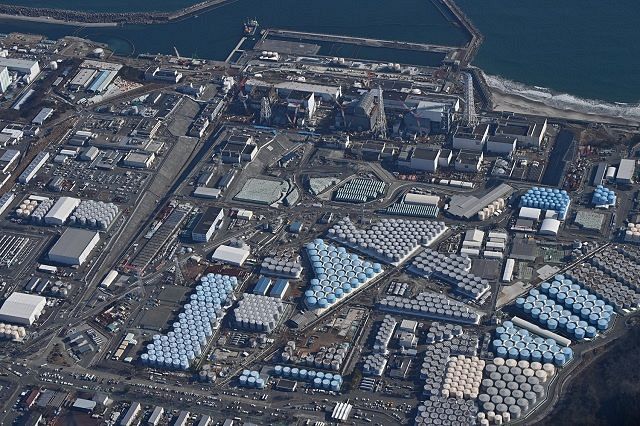
On December 6, Tokyo Electric Power Company (TEPCO) began to drive steel pipes into the ground to stop the inflow of underground water into the thawed part of the frozen soil barrier wall (about 1.5 km long) built underground around the No. 1 to No. 4 reactors at the Fukushima Daiichi Nuclear Power Plant (Okuma and Futaba towns, Fukushima Prefecture). Over the course of about a week, eight steel pipes with a diameter of 35 centimeters and a maximum length of six meters will be driven into the outside of the wall, creating a wall about four meters wide. If the water is not stopped, additional steel plates will be driven into the wall.
According to TEPCO, the frozen soil wall is believed to be thawing at the intersection of the southwest side of Unit 4 and the underground tunnel for drainage. The temperature of the ground has been above zero since mid-September, and it has been confirmed that it has reached more than 10 degrees Celsius.
The frost wall has been in operation since 2017 to prevent the inflow of groundwater into the reactor building, where melted nuclear fuel (debris) remains from the accident, and to reduce the generation of contaminated water. About 1,600 freezing pipes (30 meters long) driven into the ground are circulated with cooling liquid at 30 degrees below zero to freeze the surrounding soil.
https://www.tokyo-np.co.jp/article/147155?rct=national&fbclid=IwAR30nXaBUALO9eC4RHZkaRsXHg3j01jRmWd0RBkk4oF53UDmROD0Dk3YGNg
S. Korea voices concerns about Japan’s Fukushima water release plan

December 03, 2021
SEOUL, Dec. 3 (Yonhap) — South Korea on Friday expressed concerns over Japan’s assessment report about its planned release of radioactive water into the sea from its crippled Fukushima nuclear power plant.
The stance was delivered at a virtual meeting between South Korea and Japan over a draft report by Tokyo Electric Power Co. (TEPCO) about radioactive impacts of its planned discharge.
Last month, TEPCO, the operator of the tsunami-stricken Fukushima plant, said its planned release of radioactive water into the sea would have a very minimal impact on the marine environment and humans.
In April, Japan announced a plan to start discharging the radioactive water into the sea in 2023 in what is expected to be a decadeslong process, as all storage tanks at the Fukushima plant are expected to be full as early as the fall of 2022.
At the session, the Korean government voiced “regret” that Japan has unveiled the report on the premise that it will release the radioactive water.
“We also expressed concerns over uncertainty about the impact on humans and the environment that the discharge will have,” the government said.
South Korea also called on Japan to disclose related information in a transparent manner to its neighboring countries and sincerely engage in consultations on the issue.
According to Japanese media reports, TEPCO plans to build a roughly 1-kilometer-long undersea tunnel to release the tritium-laced water from the wrecked plant into the waters.
An estimated 1.25 million tons of such water are in temporary storage at the Fukushima nuclear plant on the east coast of Japan, which was devastated by a tsunami triggered by an earthquake in March 2011.
Fukushima Daiichi Frozen Wall Section Fails

A section of the frozen wall at Fukushima Daiichi has melted. The portion south of unit 4 has had problems remaining fully frozen for years. Now TEPCO admits it has melted in recent weeks. This portion of the frozen wall has had issues for years. Recent changes to the nearby K drainage tunnel and a recently discovered crack may be redirecting water from an underground stream into the area of the frozen wall.
TEPCO found sections near the surface of the wall had fully melted. Puddled water was found nearby. The section is relatively small and didn’t impact the lower depths of the wall’s integrity.

TEPCO’s solution is to install steel piling sections between the K drainage canal and this section of the wall, hoping to deflect underground water. This steel wall will not be completely solid. Due to the nature of driving pilings into the ground, there could be gaps as wide as 10 cm.

Once the pilings are installed, TEPCO plans to monitor the area to make sure the problem has been resolved.
https://www3.nhk.or.jp/nhkworld/en/news/20211126_16/
How Close Is Fukushima Nuclear Accident Contaminated Water to Us?
Macroscopic and microscopic simulations of Fukushima nuclear accident contaminated water discharge.
On August26, 2021, the Japanese Cabinet passed a bill to discharge treated Fukushima nuclear accident contaminated water into the Pacific Ocean to alleviate the problem of nuclear wastewater storage. However, large amounts of radionuclides can affect marine biological chains when inhaled by marine life and adversely influence marine fisheries and human health. The global effects of Fukushima discharge, which will last 30-40 years, remain unknown. Thus, identifying the diffusion process of radioactive water in oceans is critical.
To solve this problem, a team from Tsinghua University, China, developed analysis models from both macroscopic and microscopic perspectives, to simulate the diffusing process of the nuclear elements. The former one focuses on the overall distribution of pollutants, while the latter focuses on the behavior of individual pollutants.
Macro simulation results (Figure b) revealed that in the early stages of pollutant discharge, the polluted area increases rapidly, reaching 30° of latitude × 40° of longitude within 120 days. Due to ocean currents, the pollutant diffusion speed is considerably higher in the latitude direction than that in the longitude direction.
In 1200 days, the pollutants will cover almost the whole North Pacific region, reaching as far as the coast of North America to the east, and the Australia to the south. The pollutants will then spread rapidly to the South Pacific Ocean, under the influence of the equatorial current along the Panama Canal. The Indian Ocean will also be influenced, due to the waters infilling from north of Australia, in 2400 days. On day 3600, the pollutants will cover almost the entire Pacific Ocean.
Notably, although the contaminated water is discharged near the Japanese island, the contamination center (represented by yellow and red in Fig. b and c) will over time move eastward along the 35°N latitude line.

The team plotted the pollutant concentrations in adjacent waters of Miyazaki, Shanghai, and San Diego, all near 30°N, as shown in Figure d. Miyazaki gets polluted first, followed by Shanghai and San Diego, in order of their distances from Fukushima. According to the trend of the three curves, the pollutant concentration in each region increases rapidly at the beginning before stabilization. Although San Diego is the last city among the three to be affected, the steady-state concentration of pollutants in its adjacent waters is even higher than that near Miyazaki.
The differences in pollutant concentrations near Miyazaki, Shanghai, and San Diego result from the strong ocean current near Japan. Specifically, Fukushima is located at the confluence of Kuroshio (northward) and Oyashio (southward). Therefore, most pollutants do not migrate towards north and south along the land edges but spread eastward with the North Pacific west wind drift. In the early stage of treated water discharge, its impact on coastal Asia should be focused on. However, at a subsequent stage, the high concentration of nuclear elements near North America will definitely become a concern.
Reference: “Discharge of treated Fukushima nuclear accident contaminated water: macroscopic and microscopic simulations” by Yi Liu, Xue-Qing Guo, Sun-Wei Li, Jian-Min Zhang and Zhen-Zhong Hu 2021, 26 November 2021, National Science Review.
DOI: 10.1093/nsr/nwab209
Fukushima Nuclear Accident Discharge: Animation of Macroscopic Diffusion Analysis
2 déc. 2021
The increase in tritium concentration caused by Fukushima discharge over a decade. Credit: ©Science China Press
Study: Fukushima discharge to affect entire Pacific Ocean in 10 years

03-Dec-2021
Chinese scientists have mapped out the potential global effects of Fukushima discharge, suggesting that the contaminated water, if poured forth, may sprawl onto the entire Pacific Ocean within 10 years.
The study, published online in the peer-reviewed journal National Science Review, showed that 3,600 days after discharge, the pollutants will have covered almost the entire Pacific Ocean.
The Japanese government announced in April that it would start dumping contaminated water from around the spring of 2023.
The researchers from China’s Tsinghua University led by Zhang Jianmin and Hu Zhenzhong simulated the diffusing process of nuclear elements and found that the pollutants could affect China’s coast 240 days after discharge.
The polluted water would spread to almost the entire North Pacific region within 1,200 days, before spreading southward to the South Pacific Ocean and the Indian Ocean, according to the study.
The nuclear elements would eventually cause concern near North America, noticeably polluting the West coast of the United States after 2,400 days, it found.
China has expressed serious concerns about Japan’s decision to discharge contaminated water from the Fukushima nuclear station, calling for an open, transparent and responsible approach to prudently deal with its disposal.
Tracking contaminated water from the Fukushima nuclear accident

December 2, 2021
In a paper published in the National Science Review, a team from Tsinghua University analyzed the diffusion process of the treated Fukushima accident contaminated water to be discharged into the Pacific Ocean from 2023. Results show that the tritium, the main pollutant in the radioactive water, will spread to the whole North Pacific in 1200 days, which is important to formulate global coping strategies.
On 26 August 2021, the Japanese Cabinet passed a bill to discharge the treated water into the Pacific Ocean to alleviate the problem of nuclear wastewater storage. However, large amounts of radionuclides can affect marine biological chains and adversely influence marine fisheries and human health. The global effects of Fukushima discharge, which will last 30 to 40 years, remain unknown. Thus, identifying the diffusion process of radioactive water in oceans is critical.
To solve this problem, a team from Tsinghua University, China, developed analysis models from both macroscopic and microscopic perspectives, to simulate the diffusing process of the nuclear elements. The first focuses on the overall distribution of pollutant, while the second focuses on the behavior of the individual pollutant. Macro simulation results (Figure b) revealed that in the early stages of pollutant discharge, the polluted area increases rapidly, reaching 30 degrees of latitude × 40 degrees of longitude within 120 days. Due to ocean currents, the pollutant diffusion speed is considerably higher in the latitude direction than that in the longitude direction.
In 1200 days, the pollutants will cover almost the whole North Pacific region, reaching as far as the coast of North America to the east, and the Australia to the south. The pollutants will then spread rapidly to the South Pacific Ocean, under the influence of the equatorial current along the Panama Canal. The Indian Ocean will also be influenced, due to waters infilling from north of Australia, in 2400 days. On day 3600, the pollutants will cover almost the entire Pacific Ocean. Notably, although the contaminated water is discharged near the Japanese island, the contamination center (represented by yellow and red in Fig. b and c) will over time move eastward along the 35 degrees N latitude line.
The team plotted the pollutant concentrations in adjacent waters of Miyazaki, Shanghai and San Diego, all near 30 degrees N, as shown in Figure d. Miyazaki is polluted first, followed by Shanghai and San Diego, in order of their distances from Fukushima. According to the trend of the three curves, the pollutant concentration in each region increases rapidly at the beginning before stabilization. Although San Diego is the last city among the three to be affected, the steady-state concentration of pollutants in its adjacent waters is even higher than that near Miyazaki.
The differences in pollutant concentrations near Miyazaki, Shanghai and San Diego result from the strong ocean current near Japan. Specifically, Fukushima is located at the confluence of Kuroshio (northward) and Oyashio (southward). Therefore, most pollutants do not migrate towards north and south along the land edges but spread eastward with the North Pacific west wind drift. In the early stage of treated water discharge, its impact on the coastal Asia should be focused. However, at a subsequent stage, the high concentration of nuclear elements near North America will definitely become a concern.
More information: Yi Liu et al, Discharge of treated Fukushima nuclear accident contaminated water: macroscopic and microscopic simulations, National Science Review (2021). DOI: 10.1093/nsr/nwab209
https://phys.org/news/2021-12-tracking-contaminated-fukushima-nuclear-accident.html
Preparations for discharging treated water into the ocean in earnest at TEPCO’s Fukushima Daiichi Nuclear Power Plant

November 26, 2021
The Tokyo Electric Power Company (TEPCO) announced on April 26 that it will begin a survey on April 27 to construct an undersea tunnel that will connect to the outlet of the Fukushima Daiichi Nuclear Power Plant (Okuma and Futaba towns, Fukushima Prefecture), 1 km offshore, in order to proceed with a plan to release contaminated water into the sea after purification and treatment. In December, preparations began for the construction of a shaft to temporarily store the treated water, with the aim of releasing the water in the spring of 2023. In December, preparations began for the construction of a shaft to temporarily store the treated water, and the move to release the water in the spring of 2003 will be in full swing.
According to TEPCO, magnetic sensors will be used to check the seafloor at the drilling site for any obstructions in order to conduct a ground survey by boring.
Then, over a period of about a month starting in early December, the geology will be examined by drilling 10 to 30 meters into the seabed at three points along the construction route of the undersea tunnel, about 400 meters offshore from the plant, about 700 meters, and about 1 kilometer from the discharge port.
From early December to March next year, a 10-plus meter square hole will be dug at the site along the coast east of Unit 5, where a shaft will be installed. The timing of the construction of an undersea tunnel connecting the shaft to the discharge port has not yet been decided.
Explanations to the local community have been difficult, and there is deep-rooted opposition, especially from the fishing industry.
The release of treated water into the ocean is strongly opposed by people in the fishing industry, and explanations to the local community by TEPCO and the government have been difficult.
Even now, seven months after the government’s decision, TEPCO has not been able to apply for the facility plan to the Nuclear Regulation Authority. TEPCO is continuing to explain the plan to the people concerned by carrying out the seabed survey and preparatory work ahead of the plan. (Kenta Onozawa)
https://www.tokyo-np.co.jp/article/144947
Fukushima Daiichi Under Volcanic Pumice Risk
November 21, 2021
Volcanic floating pumice stones have been causing problems for coastal communities in Japan since August. The floating pumice began showing up in Okinawa near Japan’s southernmost territory first. Japan’s Agency for Marine-Earth Science and Technology predicts the pumice raft may show up around Chiba prefecture by the end of November. Chiba is directly east of Tokyo. The agency provided a video of their pumice raft plume path prediction on their website.

The plume prediction model shows it to be offshore of Fukushima prefecture by November 30th. This does have some potential to create problems at the Fukushima Daiichi disaster site. TEPCO acknowledges this here. The primary concern is units 5 and 6. Units 1 to 3 suffered meltdowns and no longer depend on any ocean cooling. The cooling system for the reactor vessels of those units is a closed-loop system that reuses treated contaminated water. This system has no dependency on the ocean to complete the cooling process. The spent fuel pools for units 1 to 3 have closed-loop cooling systems that are also not dependent on the ocean for heat exchanging. Unit 4 had no fuel in the reactor vessel during the 2011 disaster and has had all of the spent fuel removed from the spent fuel pool.
Units 5 and 6 had all of the fuel removed from the reactor vessels and was placed in the respective spent fuel pools. Unit 5 holds 1542 units of spent fuel while unit 6 holds 1884, which includes some offloaded fuel from unit 4. Additionally, 168 pieces of unused fuel in unit 5’s spent fuel pool and 428 pieces of unused fuel at unit 6 are among the total amounts. The newest fuel in these two spent fuel pools is roughly 10 years old. We explain the decay heat process of spent fuel in this report.
Both reactor units use the RHR cooling system to cool the spent fuel pools. This consists of a pump system in the reactor building basement and a seafront pump facing the port. Both units 5 and 6 had replacement pumps installed at the seafront after the 2011 disaster. In 2019 the reactor building RHR pump in unit 6 failed and needed to be replaced. In 2014 the RHR pump for unit 5 failed. TEPCO was able to “share” the RHR system from unit 6 to cool unit 5’s spent fuel pool. This kept the pool within regulated temperature ranges.
The main concern with units 5 and 6 would be the potential heat up of the spent fuel pools if the pumice raft were to hit Fukushima Daiichi. Both units have significant amounts of spent fuel in their pools with both being over 1000 fuel assemblies each in inventory. By contrast, unit 1 has 392 assemblies in the spent fuel pool, and unit 2 has 615. Over ten year old spent fuel has less ability to generate heat. Typically by the 5-year mark spent fuel can be stored in dry casks due to the decay in heat generation potential.
If the pools were to lose cooling access, water could be replaced by portable piping or hose. In a longer-term situation, a portable heat exchanger similar to those used on the spent fuel pools of units 1 to 3 could be brought in. The time frame for TEPCO to implement such a plan is unknown as that level of emergency planning has not been released to the public.
The common pool is the other cause for concern. The building that houses the common pool has an extensive series of cooling units on the roof. It is assumed that this system isn’t dependent on any seafront cooling exchange but we do not have enough detailed information about the systems to state this with 100% certainty.
The port area for units 5 and 6 does have a silt fence in place that would help reduce pumice infiltration into the areas of the cooling pumps. It could greatly reduce the possibility of pumice reaching the pump intakes but it isn’t 100% effective.

If pumice infiltration appears likely TEPCO has a plan to install additional fencing and oil collection type booms to block the port areas. TEPCO’s report also cites that the metal fence on the pump intakes for units 5 and 6 have a 9mm hole spacing that may be sufficient to stop larger pieces of pumice from reaching the pumps. As of 11.23.21 TEPCO has not released any updates to the situation at the plant related to the pumice issue. The plume is expected to pass by the plant over the next week leaving this an open issue to monitor.
Hat tip to Fukushima Diary who initially discovered the issue.
Robots to probe Fukushima No.1 reactor from Jan.

Thursday, Nov. 25, 2021
NHK has learned that the operator of the Fukushima Daiichi nuclear plant plans to start a delayed robot survey of a damaged reactor from mid-January.
Officials of Tokyo Electric Power Company say preparations are well under way to send submersible robots inside the containment vessel of the No.1 reactor.
The probe is part of efforts to remove molten fuel debris from the reactor that suffered a meltdown accident due to the 2011 earthquake and tsunami.
The utility originally planned to start the robot survey of the reactor in 2019.
It has been postponed because preparations, such as making a hole in the door of the vessel for the robots to go through, have taken time.
The officials say they are now installing equipment to remotely control the robots, and expect to carry out a survey for more than six months from mid-January.
They plan to use a total of six robots with different functions to find and examine nuclear debris, or deposits of a mixture of molten fuel and reactor parts, inside the containment vessel.
The robots will use ultrasonic devices to locate and measure how much debris there is, and how thick the deposit is. They are also expected to collect a small amount of samples.
Previous surveys at the plant confirmed the presence of deposits believed to be fuel debris in the No.2 and No.3 reactors, which also suffered meltdowns, but not in the No.1 reactor.
TEPCO to start ocean investigation by the end of the month.
November 26, 2021
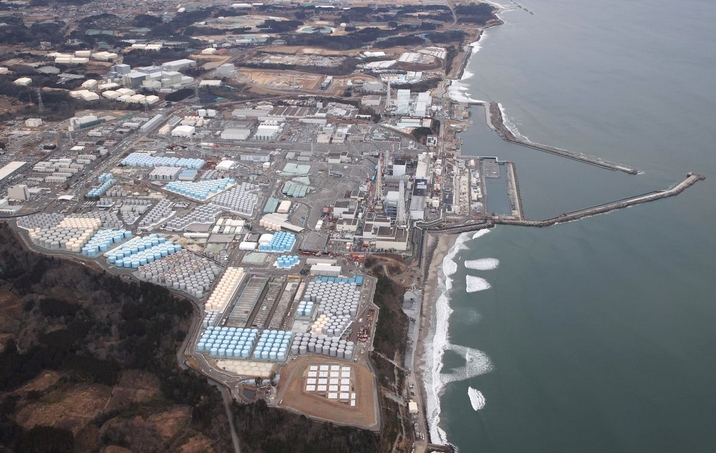
On April 25, it was learned that Tokyo Electric Power Company (TEPCO) has decided to start an oceanographic survey by the end of the month to lay an undersea tunnel for the release of treated water from the Fukushima No. 1 Nuclear Power Plant. After completing the survey, the company will start laying the tunnel, aiming to start releasing the water in spring 2023. According to the officials, TEPCO had initially expected to start the survey in September, but was forced to postpone it due to difficulties in forming a consensus with neighboring municipalities.
In August, TEPCO announced a process plan to construct an undersea tunnel, run pipes through it, and drain the water into the sea about one kilometer offshore from the plant. In this submarine survey, in addition to magnetic surveys to ascertain the condition of the seabed, including confirmation of unexploded ordnance and other hazardous materials, diving surveys will be conducted as necessary. A submarine boring survey using a workboat will also be conducted.
The submarine tunnel is expected to be about 2.5 meters in diameter, and pipes will be cut through the bedrock of the seabed from the vicinity of the No. 5 and No. 6 reactors at the plant. We had considered the idea of draining the water into the sea near the east side of the plant, but we chose to go offshore where the tritium contained in the treated water would be more diffused. It is believed that the decision was based on the fact that there are no fishing rights in the waters about one kilometer offshore and that there would be little opposition from fishermen concerned about harmful rumors.
On the 17th of this month, the government announced the results of its assessment that the radiation dose in the surrounding waters due to the release of treated water was far below the safety standards set by the government and international organizations, and that the impact of radiation on the surrounding residents and the environment was “extremely minor.
The decision to release the treated water was made in April this year by the then government of Yoshihide Suga, and Prime Minister Fumio Kishida, who inspected the plant in October, said that it was a very important issue that could not be postponed.
https://www.sankei.com/article/20211126-MVPMX33MAFNVHAA5MPOA4ULOV4/
1 This Month

of the week – Shut Down Drone Warfare!


Tell the Ukrainian Government to Drop Prosecution of Peace Activist Yurii Sheliazhenko

Petition to revoke the licensing of the Near Surface Nuclear Disposal Facility (NSDF) at Chalk River. https://www.ourcommons.ca/petitions/en/Petition/Details?Petition=e-7247
To see nuclear-related stories in greater depth and intensity – go to https://nuclearinformation.wordpress.com
-
Archives
- April 2026 (34)
- March 2026 (251)
- February 2026 (268)
- January 2026 (308)
- December 2025 (358)
- November 2025 (359)
- October 2025 (376)
- September 2025 (257)
- August 2025 (319)
- July 2025 (230)
- June 2025 (348)
- May 2025 (261)
-
Categories
- 1
- 1 NUCLEAR ISSUES
- business and costs
- climate change
- culture and arts
- ENERGY
- environment
- health
- history
- indigenous issues
- Legal
- marketing of nuclear
- media
- opposition to nuclear
- PERSONAL STORIES
- politics
- politics international
- Religion and ethics
- safety
- secrets,lies and civil liberties
- spinbuster
- technology
- Uranium
- wastes
- weapons and war
- Women
- 2 WORLD
- ACTION
- AFRICA
- Atrocities
- AUSTRALIA
- Christina's notes
- Christina's themes
- culture and arts
- Events
- Fuk 2022
- Fuk 2023
- Fukushima 2017
- Fukushima 2018
- fukushima 2019
- Fukushima 2020
- Fukushima 2021
- general
- global warming
- Humour (God we need it)
- Nuclear
- RARE EARTHS
- Reference
- resources – print
- Resources -audiovicual
- Weekly Newsletter
- World
- World Nuclear
- YouTube
-
RSS
Entries RSS
Comments RSS
 nuclear-news