Fukushima evacuee Hiroshi Ueno does not want to return to his old house
FUKUSHIMA, JAPAN – Having settled into a new life with his family outside Fukushima prefecture, Mr Hiroshi Ueno has no intention of returning home.
The 51-year-old, who was a florist in Minamisoma city – around 30km north of the Fukushima No. 1 nuclear plant – now handles data management at a support centre for other evacuees.
His son was 18 and about to start his first job when disaster struck on March 11, 2011. The extended family of 10, including Mr Ueno’s elderly parents and his sister’s family, decided to evacuate the very next day.
At that time, there was no official word from the Japanese government for mass evacuation but many residents feared the worst – a meltdown from the nuclear plant.
“Most of us left our houses without even tidying up our homes which were damaged by the earthquake,” Mr Ueno told The Straits Times.
“No one knew what would happen next.”
They packed only the bare essentials into their car and began their journey as evacuees. Over the next five days, they drove from one place to another before finally arriving at Yonezawa city where they now live. Their former home in Minamisoma had become a no-go zone.
It was only a year later that Mr Ueno and his wife were allowed a brief visit back to retrieve their important documents and other belongings.
“Wearing protective suits, we got on a bus with others who were from the same area,” he said. They were allowed to stay for only two hours and had to wear dosimeters to keep track of radiation levels.
Five years on, he would rather not return home.
“There are many issues like housing, compensation and security that have yet to be fully resolved.”
Damaged and worn out, the house will soon be demolished for redevelopment. But Mr Ueno will not be returning.
“Even looking at it is painful,” he added. “But for my parents, the house is full of memories… it is something that they couldn’t bear to let go of.”
Fukushima evacuee Miyuki Satou returns to ground zero – only to serve up piping hot bowls of ramen
FUKUSHIMA, JAPAN – It was about 2pm on a chilly Tuesday but there were no customers in Ms Miyuki Satou’s makeshift shop next to the Naraha town hall office, where she serves up piping hot bowls of ramen and udon.
The town was evacuated in the aftermath of the triple Tohoku disaster in 2011.
Although Naraha was the first town located entirely within a 20km radius of the crippled Fukushima No. 1 power plant to have its evacuation order lifted in September last year, people have been slow to return. Only 976 of its population of 7,700 have come home – mostly the elderly.
One key reason for this is that families have already rebuilt their lives and bought new homes elsewhere, including Ms Satou’s.
The 51-year-old was a former resident of the coastal town bordering the Pacific Ocean, but now lives with her two daughters who have full-time jobs in the neighbouring Iwaki city.
But her ties with Naraha have led her back to run a food business – one of only two eateries there. Both close at 3pm.
Every day she has about 70 customers – mostly workers tasked with rebuilding the town where black bags of contaminated soil still remain a common sight, or former residents who have come back to visit.
She estimates only 10 per cent of her customers are residents who have moved back home.
“There is really no demand and so there is no point opening late,” she said. “Naraha used to be a much livelier town before the disaster, but now it just feels very lonely.”
It makes no sense for young families to return, when it is more convenient to live near their new workplaces or schools, she added.
But despite the nuclear disaster having changed her life, she offered a moderate take on the use of nuclear power.
Prime Minister Shinzo Abe’s administration has said that Japan “cannot do without nuclear power” and has set a target to have nuclear power make up as much as 22 per cent of the country’s energy needs. Recent attempts to restart reactors elsewhere in the country – halted over public safety concerns following the 2011 disaster – have become entangled in a web of lawsuits.
The use of nuclear energy has split popular opinion in Japan. Ms Satou acknowledged it was a difficult question.
“It is an industry that can create a lot of jobs,” she said. “It will of course be better to use other forms of energy but I don’t think we have found one yet.”
High radiation keeps Fukushima evacuee Mitsue Masukura away from home
FUKUSHIMA, JAPAN – Retiree Mitsue Masukura, 63, who used to live in the coastal town of Namie, knows she will not be returning home anytime soon.
The Japanese government’s target is to declare all areas around the crippled Fukushima No. 1 power plant livable by March next year (2017), except for three towns. Namie is one of the three. Certain parts of the town remain off limits because decontamination works have been suspended given the high radiation dosages.
Residents like Ms Masukura, a former fishmonger, are already allowed to return for only short periods during the day. They are not allowed to stay overnight.
Not that she has any plans to return.
She said: “Even if we move home, there will hardly be any amenities because many of the former merchants have moved out and started new businesses elsewhere.
“Besides, people still do not really feel safe about returning to a town so badly affected by the nuclear fallout.”
Despite official assurances of the contrary, her unwillingness to trust the authorities stems from a case of ‘once bitten, twice shy’.
In the immediate aftermath of the March 11, 2011, disaster, there was poor communication of the situation, and conflicting instructions, which led to a lot of speculation, she said.
“We didn’t know who said what or where we should go,” she said.
As a result, her family of five moved five times from town to town, ryokan (a traditional Japanese inn) to ryokan, before settling in their current temporary living quarters in Fukushima city. Each unit is smaller than the size of a one-room flat in Singapore. Her family used to live together under one roof, but now stay next door to one another across three units.
She looks forward to the family buying a house and moving to Minamisoma next year, after her grand-daughter graduates from senior high school.
When asked how she felt about not being able to return home to Namie, she said: “It’s been already five years since we left. There are all these memories of the past, which will continue to live on in the mind.”
Fukushima Special Report: When is it safe to go home?
FUKUSHIMA, JAPAN – For 72-year-old Mr Nobuyoshi Ito, home is an isolated village with only 40 other residents. Once considered among the most beautiful villages in Japan, Iitate is today a shell of its former self before a nuclear disaster five years ago.
Most of the homes, left behind by around 6,000 residents, are empty. Farmers have been replaced with masked workers tasked with filling up black bags of contaminated soil. Only parts of the village, about an hour’s drive inland from the crippled Fukushima No 1 power plant, have been deemed safe for visitors, and they cannot stay overnight.
But that has not stopped Mr Ito, a former IT engineer-turned-farmer, from returning and staying in open defiance to study the effects of the radioactive plume that hit after the nuclear plant on the east coast of the main island Honshu was destroyed by a tsunami.
“When the government asked us to evacuate … I asked if there would be criminal charges if I continued to live here,” he said. “They said no.”
“I am a test subject, making use of the environment,” added Mr Ito, now a lobbyist opposing nuclear energy. He carries a hand-held meter to record the radiation he is exposed to daily, at his own expense.
Readings in Iitate now can range between 1.1 and 1.9 microsieverts per hour, according to government monitoring posts, which is more than 10 times those in places such as Tokyo, 250km south, where readings are around the globally accepted norm of 0.1 microsieverts per hour. This translates to a benchmark for safe radiation absorption of 1 millisievert (1,000 microsieverts) per year, although the International Atomic Energy Agency and others say anything up to 20 millisieverts per year poses no immediate danger to human health.
Mr Ito spends most of his time in the village but once a month drives three hours to Niigata prefecture on the west coast where some of his grandchildren live.
But many others from Iitate have had to evacuate to cramped temporary housing – smaller than a one-room flat in Singapore.
It is a bitter pill to swallow, said Mr Ito. “For older people like me, a slight exposure to radiation is all right, compared to the stress of living in temporary housing,” he said.
On the wall in his office is a 2011 calendar, which he has not taken down because “the female model is cute”. But it is a sombre reminder of the lives that were lost or upended at 2.46pm local time on March 11 when a 9.0-magnitude earthquake triggered a 10m wall of water that ravaged the northeastern coast of Japan and caused meltdowns in three reactors at the Fukushima plant. It was the world’s worst nuclear accident since the Chernobyl disaster in 1986.
Some 16,000 people died, most by drowning, 2,500 are still missing, and another 100,000 evacuees have not returned home. About 60 per cent of them still live within Fukushima prefecture. After the disaster, residents within a 20km radius of the No. 1 nuclear plant were evacuated, and some areas 30km away such as Iitate were cleared because of high radiation levels.
The health consequences of the leaking radiation are still unclear but more than 300,000 people aged below 18 have been screened for thyroid cancer. About 150 have tested positive, although some attribute this to more rigorous testing rather than the direct impact of radiation.
Last October, Japan confirmed the first case of radiation-linked cancer for a former Fukushima nuclear plant worker. Among evacuees, factors like stress, poor diet and a lack of exercise have also taken a toll.
Japan is halfway through a 10-year reconstruction master plan. Some 26.3 trillion yen (S$319 billion) has been budgeted since 2011 and another 6.5 trillion yen was approved this month to speed up the construction of public housing for evacuees, and for other projects such as medical care and infrastructure.
Decontamination process
Japan Ministry of Environment official Hitoshi Aoki said the government expects to lift evacuation orders by March next year in all but three areas – Namie, Futaba and Ookuma – where decontamination efforts have been suspended because of high air dose radiation. It has not yet been decided when these areas, which are closer to the plant, will be cleaned up.
The cleanup process involves removing topsoil, since cesium – a radioactive byproduct of the Fukushima meltdown – falls to the ground when it rains or snows, said Mr Aoki.
The disaster forced all of Japan’s dozens of reactors offline in the face of public worries over safety but Prime Minister Shinzo Abe said this month that Japan “cannot do without nuclear power”.
This has split public opinion and most of the country’s reactors remain shut down.
Population drain
Iitate village is expected to be one of the areas to reopen next March.
But contamination, and a general mistrust of the Government for not being upfront or transparent about the extent of the nuclear disaster in the immediate aftermath, are among reasons former Iitate residents like Mr Hideji Suzuki, 78, are reluctant to return home.
Once a farmer, he now lives with his wife in temporary housing quarters an hour by car from their old house.
“We can’t go back to Iitate anymore, even if we want to,” he said.
Residents like him will not be able to return to their former lifestyles and jobs in the mountains – which cannot be decontaminated easily – even if they moved back.
The disaster has accelerated a demographic shift away from affected cities within Fukushima prefecture.
Minamisoma city, 30km north of the plant where lower radiation levels have allowed evacuated residents to return, has seen “rapid aging”, said city official Mr Tokio Hayama. Offices have reopened but the working population – over the age of 15 and below 65 – has yet to recover.
“We need to dispel the fear of radiation, which has become a major factor that prevents their return,” said Mr Hayama.
The disaster has also split families, like Mr Yasuhiro Abe’s. The 52-year-old moved his wife and 14-year-old daughter to Kyoto, concerned about their health in the wake of the nuclear fallout.
But he stayed behind in Fukushima City – 90km from the power plant and unaffected by the exclusion order – to continue running a movie theatre he has worked at for almost 30 years.
“As far as possible, we want to raise our child in a place with lower radiation levels,” he said. “When she comes of age, she can choose whether to come back.”
Former residents have been slow to return to the seaside town of Naraha also, which was the first within the exclusion zone to have the evacuation order lifted in September last year. Many families have already rebuilt their lives elsewhere and in the six months since, only 976 of the town’s 7,700 original inhabitants have come home – mostly the elderly.
Former residents like Ms Shinoda Tomoko, 78, have chosen to move out – and move on with their lives. She now lives 60km south of the Fukushima plant in Iwaki city with her children and grandchildren who have new jobs and are attending new schools.
But retiree Tomiko Igari, 69, intends to buck the trend. On one of her regular trips back to Naraha, she said she will return in October this year, after the lease on the flat where she now lives runs out.
Her home is just across the road from a vast field that is still full of black bags with contaminated soil.
“My only hope is that when I come home, all of that will be gone,” she said. “It’s really an ugly reminder of the accident.”
http://www.straitstimes.com/asia/east-asia/fukushima-special-report-when-is-it-safe-to-go-home
Fukushima evacuee Yasuhiro Abe hopes to share same roof as wife and daughter
FUKUSHIMA, JAPAN – For Mr Yasuhiro Abe, 52, seeing his wife and daughter means an eight- to nine-hour drive south from Fukushima to Kyoto.
The mother and daughter have been living as evacuees for the past five years, since a massive earthquake and tsunami triggered a nuclear disaster in their hometown in Fukushima prefecture.
But unlike many others who were issued evacuation orders, they decided to uproot voluntarily because they are worried that harmful radioactive material could spread west with rain or snow.
His daughter was nine when the meltdowns at the Fukushima No. 1 nuclear plant happened, Mr Abe
The family first moved to the neighbouring prefecture of Yamagata before heading further away and finally settling down in the ancient city of Kyoto.
His wife and daughter now rent a home in Kyoto while Mr Abe has returned to his job as the general manager of a theatre where he has worked for almost 30 years. Now, he visits them twice every three months.
“Fukushima city and Koriyama city – inland areas within the prefecture – were never made evacuation zones despite heightened radiation levels right after the disaster,” said Mr Abe, who thinks that a factor could have been the higher population density in cities, compared to coastal towns.
He is skeptical that the heightened levels were still deemed safe.
“As far as possible, we want to raise our child in a place with lower radiation levels,” he said. “When she comes of age, she can choose whether or not to come back.” “As for myself, I’ll always be here.”
Five years on, he finds himself at a crossroads.
“In March next year (2017), the Government will be stopping housing assistance for voluntary evacuees and if we want to continue living elsewhere, it will cost more money,” he said.
While the cost of living will become an issue, he is more concerned about ensuring that his daughter completes high school without disruption. She will begin high school, likely in Kyoto, next year.
“Parents like ourselves have to consider the impact on our children’s lives before deciding if we should relocate,” said Mr Abe.
“Of course, a part of me wants them to come back – for us to live together again.”
Land acquisition for Fukushima dump site may reach 70% by 2020: ministry
FUKUSHIMA – The Environment Ministry will likely be able to acquire about 40 to 70 percent of the site it plans to use as an interim storage facility for radioactive soil and other waste from the Fukushima nuclear disaster by fiscal 2020.
The estimate is part of a five-year road map for building the facility that was presented Sunday to a council in the city of Fukushima representing the prefecture and local municipalities.
The 1,600-hectare (3,953-acre) site straddles the towns of Okuma and Futaba, home to Tokyo Electric Power Co.’s heavily damaged Fukushima No. 1 nuclear plant, where a triple meltdown was triggered by tsunami spawned by the March 2011 Great East Japan Earthquake.
If 640 to 1,150 hectares are acquired, 5 million to 12.5 million cu. meters of radiation-tainted waste can be stored there. By fiscal 2020, the ministry aims to finish transporting radioactive soil now being stored at schools or residential areas.
Environment Minister Tamayo Marukawa told reporters after the meeting that the ministry’s calculations are based on a realistic approach, adding it will continue lobbying local landowners to support the project.
To complete the project, the ministry will have to negotiate with 2,365 landowners whose property is on the targeted 1,600-hectare site. As of Friday, the ministry had visited about 1,240 of them and acquired a mere 22 hectares from 82 of them.
The negotiations are taking longer than expected due to the need to calculate official compensation. The planned facility is slated to store up to 22 million cu. meters of radioactive waste for decades.
By the end of the month, about 50,000 cu. meters of waste are expected to be transported to a provisional storage facility set up at the site.
In fiscal 2016 starting April 1, the ministry plans to transfer about 150,000 cu. meters to the site and increase the amount in stages, depending on progress with the land acquisition process.
How long shall we accept Japan to pollute our skies with incineration of radioactive materials?
I regret that so much energy, so much money was wasted into the making of this « beautiful » documentary, produced by NHK for the 5th year Anniversary, to spin and to twist the truth so as to make it more acceptable to the eyes of the victims themselves and to the eyes of the world, to brainwash world opinion about the present ongoing situation at Fukushima Daiichi and in Fukushima prefecture.
Of course it is fully expected as it is coming from NHK, which is to Japan what the Pravda newspapers was to the Soviet era, the Japanese central government nationwide propaganda organ.
Using foreigners to give more credibility to their delivered spiel is quite slick, those foreigners shills remind me a lot of some of the French collaborators working for the German Gestapo during the the German Occupation of France in exchange of material benefits, those will not be the first nor the last.
Beside the whole positive reconstruction spin, there is only one point that will should remember and take seriously : the whole reconstruction-decontamination program of the Japanese government is entirely based on incineration.
They tell us that their incineration technology will keep contained 99,9% of the radionuclides , that none will end up into our skies.
Why should we trust them, during the last 5 years they haven’t be very trustworthy nor straightforward to say the least.
How long are we gonna accept, tolerate Japan, to pollute our skies, our commonly owned and shared living environment, with their radioactive mess ?
Fukushima Prefecture has become a familiar name worldwide as a result of the nuclear accidents in 2011. Ever since then, the world has been concerned about what’s happening regarding radioactive contamination in the prefecture. To answer that question, the program will squarely face what’s been going on in Fukushima since the accidents.
French documentary filmmaker Keiko Courdy, who has been covering Fukushima since the nuclear accidents, will appear as a guest, along with experts on radiation, and the situation in Fukushima today will be explained in an easy-to-understand manner.
Various people who have appeared on TOMORROW will also take part. The program considers the future of Fukushima by featuring those who continue striving to overcome many hardships. They include villagers who have been carrying out decontamination work in the evacuation zones, hoping to return to their homes, and young people who are showing remarkable progress in re-energizing Fukushima’s farming with their new ideas.
Available until April 11, 2016
http://www3.nhk.or.jp/nhkworld/en/vod/tomorrow/20160326.html
Protesters slam ‘radiation-exposed’ Japanese sake festival
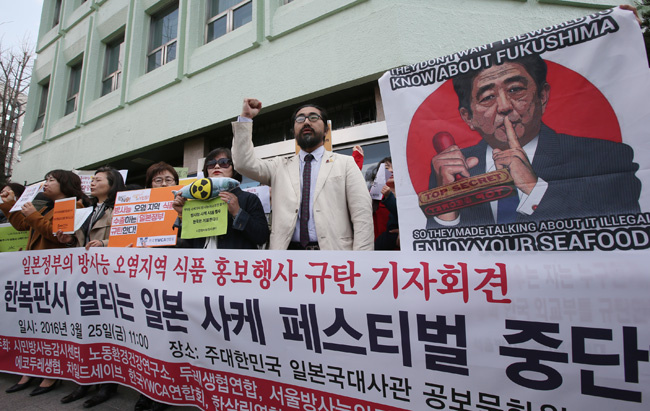
Civic groups protest in front of the Japanese Embassy in Jongno-gu, Seoul, demanding to stop the Seoul Sake Festival 2016 that may bring sakes contaminated with radiation from the Fukushima nuclear plant disaster five years ago.
By Ko Dong-hwan
Civic groups protested against a Japanese sake festival in Seoul on Friday, in a bid to prevent visitors from tasting possibly dangerous alcohol produced in areas near the Fukushima nuclear plant disaster five years ago.
Eleven civic groups held a press conference in front of the Japanese Embassy in Jongno-gu, demanding that Japan stop the Seoul Sake Festival 2016.
“Seven of the participating Japanese breweries made their liquor in areas near Fukushima, where our government has warned of possible danger from radiation,” a protester said. “The breweries must have made their liquor using water and rice from the areas. Such liquors will jeopardize our health.”
Three breweries in Miyagi Prefecture, as well as from Iwate Prefecture, Ibaraki Prefecture, Gunma Prefecture and Tochigi Prefecture participated in the festival. The Korean government stopped importing seafood from those areas in September 2013 to prevent possible radioactive contamination.
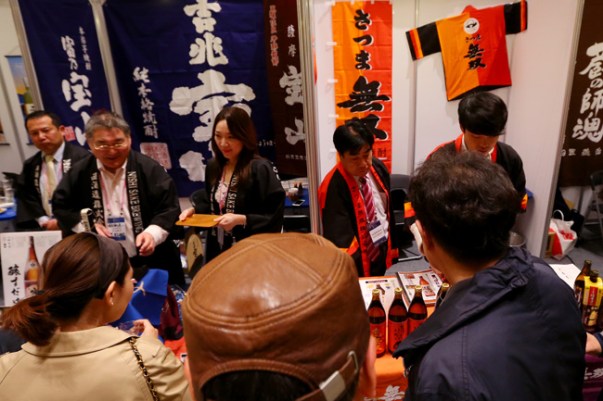
One hundred Japanese breweries introduced about 400 sakes at COEX, eastern Seoul, from Saturday to Sunday.
In March 2011, Fukushima 1 Nuclear Power Plant was hit by an earthquake-triggered tsunami. The impact caused a meltdown and release of radioactive material.
The Japanese embassy, according to Hankook Ilbo, said, “The festival organizers didn’t check whether the participating breweries were from areas that possibly were compromised by radioactive contamination, but all the food and liquor in the festival were tested in Japan and Korea.”
One hundred Japanese breweries introduced about 400 sakes at COEX, eastern Seoul, from Saturday to Sunday.
http://m.koreatimes.co.kr/phone/news/view.jsp?req_newsidx=201227
Interim storage schedule set for contaminated soil
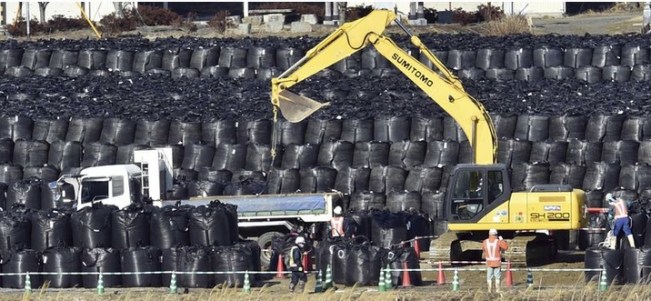
The Environment Ministry has compiled its first project schedule for the interim storage of soil and other matter contaminated by the 2011 disaster at the Fukushima No. 1 nuclear power plant, sources said.
The ministry estimates that by fiscal 2020, it will have acquired between 640 and 1,150 hectares of land, which could store 5 million to 12.5 million cubic meters of contaminated soil.
This is the first concrete schedule the government has created. It is expected to be presented to local government officials at a Sunday meeting in Fukushima Prefecture .
.
If things go as planned, the government would acquire 40 percent to 70 percent of the land expected to be needed, which could store from 20 percent to slightly over 50 percent of the contaminated soil. However, it is unclear whether things will proceed as planned.
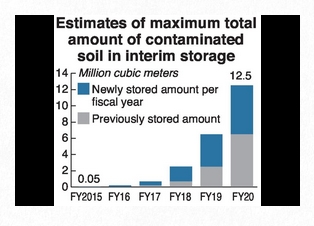
There is currently estimated to be about 10 million cubic meters of contaminated soil in Fukushima Prefecture, which could eventually rise to 22 million cubic meters.
The national government wants to purchase about 1,600 hectares straddling the municipalities of Okuma and Futaba in the prefecture as an interim storage facility.
However, as of the end of February only 18.5 hectares, or about 1 percent of the land, had been acquired.
Still, about 960 of the 2,365 landowners have given approval for the government to conduct surveys to estimate compensation. A ministry official said, “The pace of purchases is expected to pick up.”
If between 100 and 460 hectares are acquired every year starting in fiscal 2016, the ministry’s estimate of 640 to 1,150 hectares would be reached by the end of fiscal 2020.
As land is acquired, more contaminated soil can be brought to the interim storage facility.
The ministry estimates that if 2 million to 6 million cubic meters are brought to the facility in fiscal 2020, that would bring the total amount to 5 million to 12.5 million cubic meters by the end of that fiscal year,
http://www.the-japan-news.com/news/article/0002835558

“City” of Waste: Fukushima Cleanup Now Up to 10.7 Million 1-ton Bags of Radioactive Waste
By Matt Agorist
The fifth anniversary of the Fukushima disaster was on Friday, March 11. Since that fateful day in 2011, the Japanese government and the United States have continued to deny the lingering effects of this catastrophic event.
An estimated $21 billion has been spent on cleanup efforts since 2011, including funding for a team of remote activated robots capable of going to high-dose radiation areas of the plant where humans cannot enter and survive.
However, it has now emerged that at least five of these robots have been lost to the dangers that lurk in Fukushima Daiichi’s severely damaged nuclear reactors and waste treatment buildings.
Authorities in Japan want locals to think “nothing happened,” documentary director Jeffrey Jousan told RT.
“The government prints the number of people who died as a result of the 2011 disaster in the newspapers every day. [In some other prefectures], the [death toll] amounts to 300-400 people in each prefecture, but in Fukushima it is over 8,000 people,” Jousan, a US director and producer who has been living and working in Japan since 1990, said.
“It is very telling about the situation in Fukushima. It is hard for everyone who is affected by the tsunami, who lost their homes and lost their families. But [in Fukushima], people are not able to go back home, they are unable to work because people won’t buy food from Fukushima, farmers cannot farm anymore. It is affecting people, and more people are dying because of that.
According to the Fukushima prefectural government, Japan Ministry of Internal Affairs, the Tokyo Electric Power Co., the Nuclear Regulation Authority, the Federation of Electric Power Companies and the Woods Hole Oceanographic Institution, the numbers associated with this disaster are staggering.
- 164,865: Fukushima residents who fled their homes after the disaster.
- 97,320: Number who still haven’t returned.
- 49: Municipalities in Fukushima that have completed decontamination work.
- 45: Number that have not.
- 30: Percent of electricity generated by nuclear power before the disaster.
- 1.7: Percent of electricity generated by nuclear power after the disaster.
- 3: Reactors currently online, out of 43 now workable.
- 54: Reactors with safety permits before the disaster.
- 53: Percent of the 1,017 Japanese in a March 5-6 Mainichi Shimbun newspaper survey who opposed restarting nuclear power plants.
- 30: Percent who supported restarts. The remaining 17 percent were undecided.
- 760,000: Metric tons of contaminated water currently stored at the Fukushima nuclear plant.
- 1,000: Tanks at the plant storing radioactive water after treatment.
- 7,000: Workers decommissioning the Fukushima plant.
- 26,000: Laborers on decontamination work offsite.
- 200: Becquerels of radioactive cesium per cubic meter (264 gallons) in seawater immediately off the plant in 2015.
- 50 million: Becquerels of cesium per cubic meter in the same water in 2011.
- 7,400: Maximum number of becquerels of cesium per cubic meter allowed in drinking water by the U.S. Environmental Protection Agency.
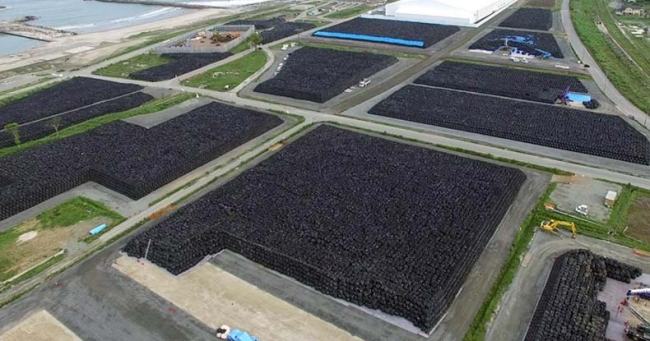
But perhaps the most staggering number of all of these statistics is the fact that the waste is being temporarily stored right next to the waterfront in a Wall-E style. The visual representation of the failure of this nuclear power plant is shocking.
Along the shore at the temporary storage site at Tomioka are 10.7 million 1-ton container bags containing radioactive debris and other waste collected in decontamination outside the plant.
Last year, a drone was flown over the ever-expanding city of waste. After watching the video, we know how ridiculous the government’s claims are that ‘we have nothing to worry about.’
650Bq/Kg of I-131 still measured from sewage sludge of Fukushima
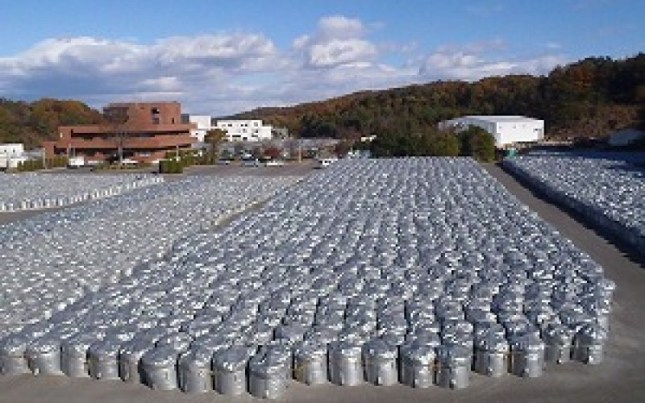
Radioactive sewage sludge storaged at sewage plant. Posted by Fukushima prefectural government.
This proves for the xth time that something is still fissioning at Fukushima Daiichi, releasing unstoppingly Iodine 131, and that ongoing since 311…..And never mind the theory that it would come from some medical iodine, if it would be the case certainly it would then measure at a much lesser level….
High level of I-131 was measured for 11 days this January in dry sewage sludge, Fukushima prefectural government announced on 2/26/2016.
According to the prefectural government, the sewage plant is in Da-te District of Fukushima prefecture.
The highest density was 648.1 Bq/Kg. It was continuously detected from 1/21 to 1/31/2016. The data of February has not been published yet.
Along with I-131, Cs-134/137 density also increase and became the highest, which was 111 Bq/Kg on the same day when I-131 density became the highest.
Both of the highest densities were detected about 1 week after the rain (57.0 mm) to strongly implies the possibility that the discharged radioactive material is carried by the wind and fall with rain.
http://www.pref.fukushima.lg.jp/uploaded/attachment/153121.pdf
650Bq/Kg of I-131 still measured from sewage sludge of Fukushima
Fukushima’s invisible victims
By
It’s been a while since we last discussed the Fukushima Daiichi triple meltdown. That is not for lack of issues; it is primarily for lack of any meaningful progress in the ongoingdisaster.
We have just passed the fifth observance of the first catastrophic day, March 11, 2011 and pretty much all of nuclear safety expert Arnie Gundersen’s grim predictions of what we would learn in the aftermath have come to pass.
What Arnie could not have predicted iin 2011 is how unwilling both TEPCO and Japan’s government officials have been to learn from this disaster, and how persistent the effort would be to suppress important radiological and epidemiological information.
Without accountability, deaths of citizens who lived near the doomed reactors following the triple meltdown have simply been attributed to the stress of evacuation, and supposedly no one has been harmed by radiation. In an unbelievable extrapolation of a convenient myth, there has been a major government effort, supported by the atomic power industry, to increase allowable levels of radiation exposure and dismiss the need for future costly evacuations as harmful and unnecessary.
It was only a little over a week ago, that anyone in an official position at TEPCO was finally held accountable under the law. I find it unbelievable that only three individuals can be held responsible for the cascade of unaddressed design flaws, corruption, lax regulation, human error and human arrogance that all contributed to making a bad situation much, much worse.
Now we are learning of an even more egregious breach of the public trust and social justice at Fukushima.
Individuals who have exhibited symptoms of radiation poisoning and other illnesses are apparently being shunned by some of their neighbors and dismissed by the medical establishment without appropriate care and without acknowledgment in their medical records.
This mistreatment specific to radiation victims is apparently not without precedent in Japanese history.
On his current speaking tour of Japan, Arnie Gundersen has had the privilege of speaking with a small group of survivors of the 1945 bombing at Hiroshima who share a unique perspective on what may lie ahead for the people of Fukushima
Hiroshima survivor, Tomiko Matsumoto, 85, recalls being a schoolgirl following that inhuman bombing. Of the 80 students at her school, only thirty survived the blast. Tomiko could be said to have been one of the “lucky” ones, but mere survival is a pretty poor kind of ‘luck.’
Still traumatized by the mental and physical horrors of the blast experience, she recalls that there was no proper care provided for the injured who were regarded with suspicion and hostility by their neighbors and callous indifference or unfeeling curiosity by their occupiers, upon whom they depended for any care that they could get.
The discrimination must have been the hardest for a young girl with no surviving family to bear:
“I was shocked because I was discriminated against by Hiroshima people. We lived together in the same place and Hiroshima people know what happened but they discriminated against each other. ..I was shocked.”
“There were so many different kinds of discrimination. People said that girls who survived the bomb shouldn’t get married. Also they refused to hire the survivors, not only because of the scars, but because they were so weak. Survivors did not have 100 percent energy.”
“There was a survivor’s certificate and medical treatment was free. But the other people were jealous. Jealous people, mentally discriminated. So, I didn’t want to show the health book sometimes, so I paid. Some of the people, even though they had the health book, were afraid of discrimination, so they didn’t even apply for the health book. They thought discrimination was worse than paying for health care.”
The mistreatment and insensitivity experienced by survivors continued into Tomiko’s adulthood. She was the victim of employment discrimination and personal shame.
Though she was lucky enough to bear children, both of her daughters are sterile and one suffers from anemia. Doctors have dismissed the possibility that the family’s health issues might be linked to her exposure to radiation from the atomic bomb blast.
It may be precisely because of their uniquely traumatic history of nuclear attack that modern Japanese society is ill-prepared to challenge the current meme being promoted by TEPCO and the Abe government, that no one was harmed by the triple meltdown at Fukushima and there is no cause for concern about using atomic power as an energy source.
Having emerged from beneath the cloud of WWII, they want to view themselves under the lens of success and progress, not to revisit the shameful legacy of nuclear radiation sickness that they had hoped to leave behind.
Sadly, neither TEPCO nor the Abe government and functionaries right down to the regional level can be trusted to reveal the truth about radiation from Fukushima Daiichi and how it’s shadow has now been irreversibly cast over the Prefecture, marring the future of Japan.
So survivors of Fukushima, like those of Hiroshima before them are left to face unfolding health issues and despair in the friendless vacuum of their own thoughts and care.
(I am pleased to be a non-technical member of the Fairewinds Energy Education crew, but my posts on GMD are mine alone and do not necessarily reflect the views of Fairewinds.)
FIVE YEARS AFTER: Fukushima thyroid cancer patients’ families join forces

The grandmother, left, and mother of a female high school student
who underwent thyroid surgery talk about their concerns
in Fukushima Prefecture on March 5
Families of young thyroid cancer patients from Fukushima Prefecture diagnosed after the 3/11 disaster have formed a support group that also aims to pressure doctors and authorities for better policies.
The 311 Thyroid Cancer Family Group hopes to share the concerns people have felt over the health of their loved ones in the five years since the onset of the nuclear crisis.
“We want the Fukushima prefectural government and doctors to demonstrate a better understanding of patients,” one member said.
The group was established by seven parents and relatives of five young people from the prefecture’s central Nakadori and eastern Hamadori areas who underwent thyroid surgery following the triple meltdown at the Fukushima No. 1 nuclear power plant.
Hiroyuki Kawai, a lawyer from the Daini Tokyo Bar Association, will lead the group as its representative. Others will help manage the association, including Motomi Ushiyama, a doctor who has served as a physician in Fukushima Prefecture and also conducted an investigation on residents of areas contaminated in the 1986 Chernobyl disaster.
“Our aim is to create a place where patients, who remain separated and are unable to even talk of their anxieties or doubts, can meet and talk to one another,” Kawai said. “By having the patients and their families unite and cry out as one, it makes it easier for us to make policy suggestions to the government.”
The group is considering filing lawsuits in the future against the central and prefectural governments, along with Tokyo Electric Power Co., the Fukushima plant’s operator, but at the moment, its main purpose is to provide direct help to the patients and their families.
The Fukushima prefectural government continues to examine the thyroid glands of residents who were 18 or under at the time of the 2011 nuclear disaster and those born following the event, which accounted for around 380,000 people. A total of 166 cases of thyroid cancer or suspected signs of the condition were found before the end of 2015.
However, the prefecture’s expert panel assessing the statistics deemed it was “unlikely the cases were caused by radiation.”
Unsurprisingly, members of the group viewed this official statement with unease and skepticism.
One high school student from Nakadori had her thyroid gland removed by a doctor at Fukushima Medical University Hospital last spring. But with the cancer cells having spread more than expected, she now has a large scar across her neck that she feels she must cover with a scarf even in summer.
Her mother, in her 40s, said: “My daughter became more prone to fatigue after the surgery. Falling asleep while playing her video games, which she loves to do, was something that never happened before.”
A nodule was found on the student’s thyroid about two years ago. At the hospital, her surgeon told her: “We will examine the tissue believed to be formed of cancer cells by sticking a needle in your neck. It’s very painful, so it’s up to you to decide. Make up your mind within a month.”
The student and mother talked it over and decided to opt for the test. But when they returned to the hospital to get the results, the mother was shocked, as the doctor just blurted out the results in front of the young patient, saying: “It was a malignant tumor.”
The doctor did, however, explain it was nothing to worry about and said: “It’s not a big deal. Thyroid cancers can be left as they are for six months or a year, and they still won’t be anything life-threatening.”
But when the student underwent surgery six months later, her mother was reprimanded by the same doctor who said: “The tumor was bigger than we had expected. Who in the world told you that you can leave it for six months?”
The doctor also warned her of the possibilities of recurrence.
After her daughter’s surgery, the mother joined an event organized by the hospital for thyroid cancer patients to meet one another. But it was nothing like what she had envisioned.
“We only heard one-sided stories, and it was not a forum that would answer any of the doubts I had,” she said. “It was completely useless.”
The father of a man who was a high school student in 2011 was disturbed by the attitude of the same doctor who also operated on his son’s thyroid.
The father said: “After the surgery, I repeatedly asked the doctor if the cancer had anything to do with the nuclear power plant, but he just flat-out rejected it saying, ‘There’s no correlation.’
Furthermore, the doctor told him: “Don’t say anything to the media even if they learn about your son’s surgery. You know there’s no necessity for you to answer them.”
“My son fears recurrence and metastasis every day,” the father said.
However, the doctor told The Asahi Shimbun through the institution’s public relations department that he had been misunderstood.
“We have been paying the utmost attention to establishing an environment where patients can talk about their worries and doubts, having mental health care specialists getting involved with them at an early stage of their treatments. Such efforts continue well into the post-surgery period,” he said in writing.
“The diagnosis of cancer is something we take extreme care when we are letting the patients know about it. But now having been confronted by interpretations that were not at all my intentions, I strongly realize the difficulty of conveying the message to patients. When we give the notice to patients who are minors, we consult their guardians and check with them before giving them the word.”
Meanwhile, the 311 Thyroid Cancer Family Group will be holding events to promote networking between patients’ families and where they can seek advice, encouraging more people to join the group.
The members said: “We first want to encourage the patients to meet each other, share information and demand improvement of their medical environments.”
http://ajw.asahi.com/article/0311disaster/fukushima/AJ201603240025
FIVE YEARS AFTER: Asahi survey: 70% of evacuees report declined health since 3/11
Almost 70 percent of 3/11 evacuees that answered an Asahi Shimbun questionnaire said their health had worsened since the triple disasters struck five years ago.
Comparing their current health to before the Great East Japan Earthquake, tsunami and Fukushima nuclear disasters, 23 percent of respondents said it had worsened greatly, while 46 percent said it had worsened somewhat.
One 67-year-old man living in temporary housing in Otsuchi, Iwate Prefecture, wrote: “I cannot use a chair because the temporary housing unit is so cramped. The condition of my knees has worsened because I have to sit on the floor for a long time.”
Questionnaires were sent out to 944 evacuees from the three hardest-hit prefectures of Iwate, Miyagi and Fukushima in February and responses were received from 619. While all respondents in 2012 were evacuees living in temporary housing, some have since moved back home.
Respondents also showed signs of psychological stresses in their responses to a question with the option to give multiple responses.
Forty-eight percent said they had experienced an increase in the concerns they felt, 37 percent said they felt down or lonely, 28 percent said they were more irritated and 25 percent said they had difficulty sleeping.
Only 22 percent said they were in a calmful state unchanged from before the disasters.
A 55-year-old woman who runs her own business and lives in an apartment in Yamada, Iwate Prefecture, said: “Whenever I see tsunami footage, I remember relatives who died and I become lonelier. I am also worried because I have no idea when I will be able to rebuild my home.”
A 77-year-old woman who was evacuated from Naraha, Fukushima Prefecture, to Aizu-Misato, also in the prefecture, said: “My life changed completely because of the nuclear accident, and I tend to feel more down. I also feel psychological uncertainty because I still do not have a settled residence.”
The respondents were also asked to list up to three policies they wanted the central and local governments to prioritize.
The most popular response for the second consecutive year was “subsidies for medical expenses” at 43 percent.
Other frequent responses were “improving elderly care services and rebuilding or expanding social welfare facilities” at 30 percent and “subsidies for monthly living expenses” at 28 percent.
The second most popular response last year was “financial support to rebuild own home.” This year that response came in fourth with 24 percent of respondents choosing it.
http://ajw.asahi.com/article/0311disaster/recovery/AJ201603220001
Japan urges China to lift import ban on farm products in place since March 2011
BEIJING – Japan urged China on Monday to scrap its import restrictions on agricultural, forestry and fisheries products and food that have been in place since the March 2011 Fukushima nuclear disaster.
Kazuyoshi Honkawa, vice minister of agriculture, forestry and fisheries, made the request at a bilateral subcabinet-level dialogue in Beijing on agricultural issues.
The two countries reopened the dialogue for the first time in six years, after suspending talks due to deteriorated bilateral ties.
After the nuclear disaster at Tokyo Electric Power Co.’s crippled Fukushima No. 1 plant, China prohibited all imports of agricultural, forestry and fisheries products and food from 10 prefectures, including Fukushima, Miyagi and Ibaraki.
Honkawa asked Chinese Vice Agriculture Minister Qu Dongyu to urge authorities to lift the import ban. The embargo is administered by China’s General Administration of Quality Supervision, Inspection and Quarantine.
Honkawa said he did not receive a clear answer on the issue from the Chinese ministry.
After the dialogue, he told reporters that the rapidly growing Chinese market is very attractive for Japanese agriculture, forestry and fisheries industries, suggesting his ministry’s aim of expanding farm exports to China.
Economic relations between Japan and China have been on the mend in recent months.
At talks last November, Prime Minister Shinzo Abe and Chinese Premier Li Keqiang agreed to restart a high-level economic dialogue that brings together the two countries’ key economic officials at an early date this year. In December, Japan and China held economic partnership talks led by vice ministerial officials for the first time in more than five years.
1 This Month

of the week – Shut Down Drone Warfare!


Tell the Ukrainian Government to Drop Prosecution of Peace Activist Yurii Sheliazhenko

Petition to revoke the licensing of the Near Surface Nuclear Disposal Facility (NSDF) at Chalk River. https://www.ourcommons.ca/petitions/en/Petition/Details?Petition=e-7247
To see nuclear-related stories in greater depth and intensity – go to https://nuclearinformation.wordpress.com
-
Archives
- April 2026 (68)
- March 2026 (251)
- February 2026 (268)
- January 2026 (308)
- December 2025 (358)
- November 2025 (359)
- October 2025 (376)
- September 2025 (257)
- August 2025 (319)
- July 2025 (230)
- June 2025 (348)
- May 2025 (261)
-
Categories
- 1
- 1 NUCLEAR ISSUES
- business and costs
- climate change
- culture and arts
- ENERGY
- environment
- health
- history
- indigenous issues
- Legal
- marketing of nuclear
- media
- opposition to nuclear
- PERSONAL STORIES
- politics
- politics international
- Religion and ethics
- safety
- secrets,lies and civil liberties
- spinbuster
- technology
- Uranium
- wastes
- weapons and war
- Women
- 2 WORLD
- ACTION
- AFRICA
- Atrocities
- AUSTRALIA
- Christina's notes
- Christina's themes
- culture and arts
- Events
- Fuk 2022
- Fuk 2023
- Fukushima 2017
- Fukushima 2018
- fukushima 2019
- Fukushima 2020
- Fukushima 2021
- general
- global warming
- Humour (God we need it)
- Nuclear
- RARE EARTHS
- Reference
- resources – print
- Resources -audiovicual
- Weekly Newsletter
- World
- World Nuclear
- YouTube
-
RSS
Entries RSS
Comments RSS
 nuclear-news