Assessment of residual doses to population after decontamination in Fukushima Prefecture
“….Fukushima Prefecture. Our probabilistic model considers the variabilities in behavioral patterns and Cs-137 surface-activity levels.
Five years after the initial contamination, the 95th percentiles of indoor workers and pensioners in 53 of the 59 municipalities were found to receive annual effective doses of below 1 mSv/y (0.026–0.73 mSv/y).
However, for outdoor workers in 25 municipalities, the annual doses were over 1 mSv/y (1.0–35 mSv/y).
Therefore, the guidance value is effective for indoor workers and pensioners; to determine whether additional countermeasures for outdoor workers should be implemented, a detailed assessment that uses more realistic assumptions is required……”
http://www.sciencedirect.com/science/article/pii/S0265931X16302247
Some restricted zones to be lifted near Fukushima nuclear plant
Soft propaganda from the Asahi Shimbun, supporting the Government lifting of the evacuation order in some of the restricted zones, encouraging people to return into the evacuated zones.
Saying “In some of the areas, however, radioactive contaminants have been washed away by rain or blown away by wind. Radiation from those substances has also dissipated naturally.”
Conveniently omitting to mention, that in many decontaminated places, radiation soon returns to pre-decontamination level, thanks to the accumulated radionuclides of the mountain forests (80% of Fukushima prefecture) always ruisseling down with the rain or carried everywhere by the wind, not mentioning also that something in Fukushima Daiichi still fissioning, releasing radionuclides loaded gassings into the environment.
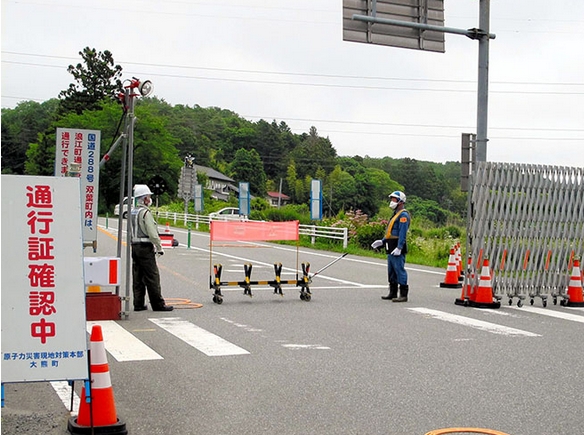
A gate is set up on a national road in Okuma, Fukushima Prefecture, restricting entrance to “difficult-to-return zones.” Permits from the central government are required to enter the areas.
For the first time since the 2011 nuclear disaster in Fukushima Prefecture, the government will lift the designation of some “difficult-to-return zones” around the crippled nuclear plant.
The rescinding is expected to be done gradually from around 2021. By that time, the government plans to undertake intensive decontamination work in central districts of municipalities, where residents will likely return, and districts along main roads.
The “difficult-to-return zones,” which cover a total of 337 square kilometers, are areas where the radiation level exceeded 50 millisieverts per year after the accident at the Fukushima No. 1 nuclear plant. Those areas are off-limits, in principle.
In some of the areas, however, radioactive contaminants have been washed away by rain or blown away by wind. Radiation from those substances has also dissipated naturally.
In front of the Environmental Radioactivity Monitoring Center of Fukushima in the central district of Okuma town, the radiation level is now about 9 millisieverts per year, about one-fifth the level of five years ago.
According to the policies of the government and the ruling parties, if radiation levels are reduced to 20 millisieverts or lower in some areas due to decontamination work, people are allowed to live there.
Of the areas, those where residents or workers for decommissioning of crippled nuclear reactors are expected to live will be subject to intensive decontamination work along with areas on both sides of main roads.
The government and the ruling parties will discuss the lifting of “difficult-to-return zones” with seven municipalities, including Okuma, and will make the official decision in August.
However, even if the designation is lifted, it is uncertain if residents will return to their homes.
According to the annual survey conducted by the Reconstruction Agency on evacuees, only about 10 percent of households evacuating from four municipalities around the nuclear plant are hoping to return home.
Before the nuclear crisis occurred, about 24,000 people of 9,000 households were living in areas that are currently designated as “difficult-to-return zones.”
Radioactive Forest
July 9, 2016
The Fukushima nuclear accident in 2011 turned the surrounding towns into a desolate land, making the area into a “radioactive forest”. Without human presence, the land is roamed by wildlife like civets, macaques and wild boars. A project is underway to study the deserted areas by attaching a camera to wild boars to record the conditions of the former farmlands. 5 years after the disaster, we take a close look at how radiation has affected the wildlife, and what it entails for us humans.
Deposition of radiocesium on the river flood plains around Fukushima

The environment in the area around Fukushima Daiichi Nuclear Power Plant has been contaminated by widely deposited significant amount of radioactive materials, which were released to the atmosphere caused by the Fukushima Daiichi Nuclear Power Plant accident due to the Great East Japan Earthquake, which occurred on March 11, 2011. The radiocesium released in the accident mainly affects radiation dose in the environment. Decontamination work in the contaminated area except a mountain forests has been conducted to decrease the radiation dose. However, there are concerns that the redistribution of this radiation due to water discharge will occur due to the resulting transport of radiocesium. In particular, the deposition of soil particles containing radiocesium on the flood plains in the downstream areas of Fukushima’s rivers can potentially increase the local radiation dose. Therefore, it is important to understand the influence of the deposition behavior of radiocesium on the radiation dose.
Investigations of rivers have been performed to enhance the understanding of the mechanisms by which radiocesium is deposited on these flood plains. It was found that the spatial distribution of the radiocesium concentration on the flood plain along the river is heterogeneous with a dependence on the depositional condition and that the number of points with high air dose rates is limited. In detail, the radiocesium concentration and air dose rates in flood channels are higher than those at the edges of the river channels. Based on these heterogeneity and hydrological events, the deposition and transport mechanisms of the radiocesium due to water discharge at rivers were also interpreted, and a conceptual model was constructed.
http://www.sciencedirect.com/science/article/pii/S0265931X16301187

Evacuation order lifted in Minami-Soma after 5 years, affecting 10,000 people
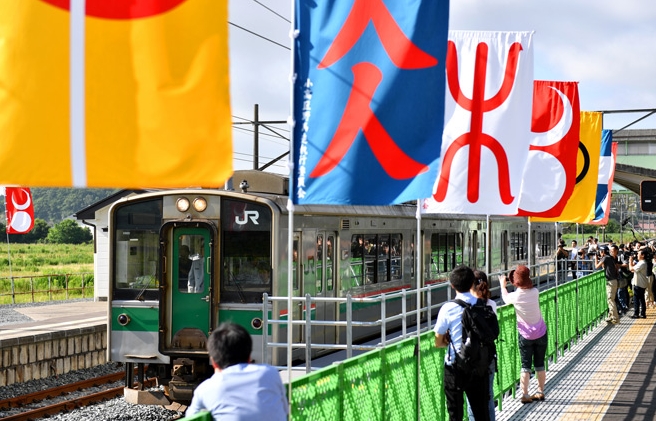
For the first time in five years, a train begins service on the 9.4-kilometer stretch between Odaka and Haranomachi stations in Minami-Soma, Fukushima Prefecture, on East Japan Railway Co.’s Joban Line at 7:33 a.m. on July 12.
Evacuation order lifted in Minami-Soma after 5 years
MINAMI-SOMA, Fukushima Prefecture–In good news for residents, an evacuation order for the southern part of the city here was lifted on July 12 for the first time since the massive earthquake and tsunami crippled the Fukushima No. 1 nuclear power plant five years ago.
However, due to lingering fears of radiation contamination, less than 20 percent of the populace are set to return to their homes.
The central government allowed residents back into the southern region of the city after midnight on July 11. It marks the sixth time that evacuation orders have been lifted for locales in Fukushima Prefecture, following such municipalities as Naraha and Katsurao.
The latest lifting in Minami-Soma affects a total of 10,807 residents in 3,487 households in all parts of the Odaka district and parts of the Haramachi district, making it the largest number of people to be let back into their homes since evacuation zones were established following the 2011 nuclear disaster.
Two residents living in a household in an area designated a “difficult-to-return” zone in the southern part of the city are still not allowed back home.
However, only about 2,000 residents signed up to stay overnight at their homes in the area ahead of the lifting of the evacuation order.
That is likely because many still fear the effects of radiation from the destroyed power plant, which straddles the towns of Futaba and Okuma to the south of Minami-Soma. In addition, five years was more than enough time for residents who evacuated elsewhere to settle down.
With at least some of the residents returning home, East Japan Railway Co. resumed service on the 9.4-kilometer stretch between Odaka and Haranomachi stations on the Joban Line for the first time in more than five years on the morning of July 12. The first train of the morning entered Odaka Station carrying 170 or so people on two cars as traditional flags used in the Soma Nomaoi (Soma wild horse chase) festival on the platform greeted passengers.
The central government is pushing to lift evacuation orders on all areas of the prefecture excluding difficult-to-return zones by March 2017.
http://www.asahi.com/ajw/articles/AJ201607120054.html
Japan lifts evacuation orders in Fukushima affecting 10,000 people
FUKUSHIMA, Japan (Kyodo) — The government on Tuesday further scaled down areas in Fukushima Prefecture subject to evacuation orders since the March 2011 nuclear disaster at the Fukushima Daiichi complex, enabling the return of more than 10,000 residents to the city of Minamisoma.
Following the move, the city will become mostly habitable except for one area containing one house. But many residents seem uneager to return, having begun new lives elsewhere.
The government is in the process of gradually lifting evacuation orders issued to areas within a 20-kilometer radius of the plant of Tokyo Electric Power Company Holdings Inc. and in certain areas beyond the zone amid ongoing radiation cleanup efforts.
Eight municipalities in Fukushima Prefecture have areas defined as evacuation zones, which are divided into three categories based on their radiation levels. The most seriously contaminated area is called a zone “where it is expected that the residents have difficulties in returning for a long time.”
In Minamisoma, the government lifted evacuation orders for areas except for the difficult-to-return zone. As of July 1, the areas had a registered population of 10,807, or 3,487 households.
To encourage evacuees to return, the central government and the city reopened hospital facilities, built makeshift commercial facilities and prepared other infrastructure.
Radiation cleanup activities have finished in residential areas, but will continue for roads and farmland until next March.
The government hopes to lift the remaining evacuation orders affecting areas other than the difficult-to-return zones by next March, officials said.
http://mainichi.jp/english/articles/20160712/p2g/00m/0dm/031000c
Showdown in apathetic Fukushima finds justice minister scrambling for survival

Justice Minister Mitsuhide Iwaki of the Liberal Democratic Party (left) campaigns in Iwaki, Fukushima Prefecture, on June 3. Right: Democratic Party candidate Teruhiko Mashiko speaks in Fukushima on June 6.
FUKUSHIMA – Justice Minister Mitsuhide Iwaki is feeling threatened.
With his electoral district in Fukushima Prefecture reduced to one seat from two for Sunday’s Upper House election, he needs to beat Democratic Party rival Teruhiko Mashiko, something he failed to pull off the last time around.
If the Cabinet minister loses, it will end his career and deal a humiliating blow to the administration of Prime Minister Shinzo Abe. And with Mashiko enjoying joint backing from opposition parties including the DP, the Fukushima race represents a showdown between the Liberal Democratic Party-Komeito ruling bloc and the opposition.
Addressing supporters last Sunday, Mashiko couldn’t have described the dynamics more succinctly.
“My opponent is no longer the justice minister. It’s Prime Minister Abe,” he said. “He’s really desperate. He’s been doing everything he can to unseat me. What an honor.”
Abe, for his part, has bent over backward to help Iwaki, joining him on the campaign trail right after the Diet closed for the summer on June 1 and sending a string of big-name politicians to Fukushima to campaign for him.
Failed strategy
Abe is said to have appointed the third-term Upper House lawmaker as justice minister in October to ensure re-election. He apparently felt he couldn’t afford to lose LDP influence in the sensitive constituency that was heavily damaged by three reactor meltdowns in March 2011.
But past election results show that Iwaki is facing an uphill battle on Sunday — the first since Fukushima became a single-seat constituency in 2013.
Not once in the past three Upper House elections has Iwaki defeated his main challenger, always finishing second. The last time he and Mashiko competed was in 2010, when Fukushima was a two-seat constituency. Mashiko won by 3,000 votes.
To make things worse, Iwaki’s appointment as justice minister appears to have backfired.
Earlier this year in the Diet, he was repeatedly driven into a corner as opposition lawmakers blitzed him with highly technical legal questions. His struggle to respond was televised nationwide. He majored in law at Sophia University.
“We all share the understanding that Iwaki, as a member of the current administration, cannot lose. If he does, the damage to the Abe administration will be immense,” his secretary, Izuru Onodera, said.
Lingering nuclear woes
While the election is being played as a vote on Abenomics, the two candidates in Fukushima are localizing the agenda.
In recent campaign trips in the prefecture, most of their speeches have focused on how they would steer Fukushima’s recovery. Five years into the worst nuclear disaster since Chernobyl, about 100,000 residents still remain displaced within and outside the prefecture.
While Iwaki trumpets the LDP’s decisiveness and legislative advantage, Mashiko is vowing to decommission all 10 reactors in the prefecture.
Standing before a crowd of supporters in Koriyama on Monday, Iwaki stressed that the LDP is the party that can steer Fukushima toward recovery and accused the DP of engaging in an “irresponsible tie-up” with the radical Japanese Communist Party.
“We cannot entrust the future of Fukushima to a mishmash opposition coalition fraught with ideological differences,” Iwaki said. “As a Cabinet member, I have the responsibility to facilitate government efforts to reconstruct Fukushima.”
Mashiko, meanwhile, reaffirmed his pledge to decommission the 10 reactors and denounced Iwaki’s ambiguous stance on the matter. Although the LDP’s Fukushima chapter has vowed to dismantle the reactors, Iwaki is apparently refusing to back that pledge publicly to avoid contradicting Abe’s pro-nuclear central government.
During campaigning activities Monday, Iwaki told The Japan Times that he will “respect” the Fukushima chapter’s stance on the reactors, before speeding off in a van.
Voter apathy
Neither candidate appears to have made much of an impression with voters.
Fukushima resident Yuriko, 54, who only wished to be identified by her first name, said she will vote but might cast a blank ballot in protest.
“I feel it will make no difference no matter who wins,” the company employee said when approached on a street in Koriyama. She said she doesn’t even know who is running.
A 25-year-old man who also requested anonymity said he only cares about one topic — employment. Even the issue of Fukushima’s recovery hardly struck a nerve.
“Everyone was affected by the disaster to a different degree and I wasn’t much of a victim. As a Fukushima resident, I’m mildly curious about how the reconstruction effort proceeds, but that topic doesn’t motivate me into any sort of action,” he said.
Expectations are even dimmer among those whose lives were upended by the calamity.
On a recent visit to a remote temporary housing unit in Nihonmatsu, evacuees from the town of Namie near the crippled Fukushima No. 1 power plant were downright apathetic about the election.
They are too preoccupied with their uncertain future, not to mention the daily inconveniences of the evacuation, to even think about the poll, they said. Not a single supermarket or hospital exists near the housing unit, forcing them to drive long distances to complete even the smallest part of their daily routine.
Nobuhiro Fujita, 68, a former farmer and carpenter, said he wasn’t interested in Sunday’s election.
“All I can think about is my own life. I don’t know what is going to happen to my house in Namie. I don’t have time to wonder about the election,” he said.
Although he wants to go home, Fujita, who suffers from numbness in his leg, said he is stuck in limbo.
“I do want to return to Namie, but even if I do, my rice field has been left unattended for too long and is now ruined. With my bad leg, I can’t do any carpentry work, either.”
A 48-year-old company employee and father who asked to be identified only by his surname of Yoshida, also took a dim view of the historic race.
“After being left like this for five years and counting, I can’t really trust the candidates to put their words into action, no matter what they say they will do for us,” he said.
“I’m resigned.”
A Massive Campaign of Disinformation to Trivialize Fukushima Health Risks

I am being nice, I did not add a 4th monkey to this picture, to represent the selling-out “scientists”….
5 years have past, we are now submerged by a massive campaign of lies, spinned propaganda, that everything is now fine about Fukushima. Some articles spreading plain nonsense, lies without any fear to be accused to be lying. Some our friends even sharing those B.S. articles on their FB pages or FB group without even having the intelligence to write an introduction to those articles, exposing the lies of those articles.
As an example, this article “Scientists Find New Kind Of Fukushima Fallout” where they say: ““He cautions that any internal radiation from particles containing cesium-137 would be much less than the doses people got from external radiation, which would come from cesium-137 and other radioactive elements in the soil or the environment around them.”
http://www.forbes.com/sites/samlemonick/2016/06/30/scientists-find-new-kind-of-fukushima-fallout/#636c0d6a4126
Which is absolute bullshit, nonsense, a lie, It completely ignores what science and multiple studies have already well established, that internal radiation is 100 times more harmful than external radiation.
Also the recently released report from the conclusions of a major 5 year review, with multi-international authors who are all working together as part of a Scientific Committee on Oceanic Research (SCOR) Working Group. The report is being presented at the Goldschmidt geochemistry conference in Japan.
http://phys.org/news/2016-06-fukushima-oceans-years.html#jCp
Which says: ” Uptake by marine life. In 2011, around half the fish samples in coastal waters off Fukushima had radiocesium levels above the Japanese 100Bq/kg limit, but by 2015 this had dropped to less than 1% above the limit. High levels are still found in fish around the FDNPP port. High levels of 131I were measured in fish in April 2011, but as this has a short radioactive half-life, it is now below detection levels. Generally, with the exception of species close to the FDNPP, there seem to be little long-term measurable effects on marine life.”
It takes 12 years for the TRITIUM to lose half of its radioactivity and 120 years for it to lose it all, And 30 years and 300 years for CESIUM, and tens of thousands of years to the PLUTONIUM etc But according to their report the Pacific is now clean just after 5 years.
That report also says: “Risk to Humans. The radiation risk to human life is comparatively modest in comparison to the 15,000 lives were lost as a result to the Tohoku earthquake and tsunami. So far, there have been no direct radiation deaths. The most exposed FDNPP evacuees received a total dose of 70 mSv, which (if they are representative of the general population) would increase their lifetime fatal cancer risk from 24% to 24.4%. However, there are still over 100,000 evacuees from the Fukushima area, and many industries such as fishing and tourism have been badly hit.”
Thus that report is completely ignoring the well proven harmful effects of a constant low dose radiation on human life, and of course completely omitting to talk about the dangers of internal exposure by contaminated food and liquid for the Fukushima population.
When I shared this report on my blog, I wrote an introduction saying: “This report raises certainly a lot of questions about today’s scientific community unbiasedness and independance from governmental and corporated powers.”
A marine biologist came to argue with me on Twitter, reproaching me to not accept science. I answered to him that I do respect science but I won’t stand for bias, for that “science” which is being influenced, bought, twisted or silenced by financial and political interests.
Reuse of radioactive soil feared to trigger illegal dumping

Piles of black bags containing radioactive soil are seen at a temporary storage site in Minamisoma, Fukushima Prefecture, on June 11, 2016. The Environment Ministry is set to conduct a demonstration experiment there possibly later this year, in which radiation doses will be measured on mounds using soil generated from decontamination work.
Reuse of radioactive soil feared to trigger illegal dumping
An Environment Ministry decision to allow reuse of radioactively contaminated soil emanating from the Fukushima nuclear disaster in public works projects has prompted experts to warn against possible dumping of such soil under fake recycling.
The ministry formally decided on June 30 to allow limited use of soil generated from decontamination work after the Fukushima No. 1 nuclear power plant disaster in mounds under road pavements and other public works projects, as long as the soil contains no more than 8,000 becquerels per kilogram of radioactive cesium. The decision was made despite questions raised during a closed meeting of the ministry over incompatibility with the decontamination criteria for farmland soil.
The Act on the Regulation of Nuclear Source Material, Nuclear Fuel Material and Reactors sets the safety criteria for recycling metals and other materials generated from the decommissioning of nuclear reactors at no more than 100 becquerels per kilogram, and requires materials whose radiation levels exceed that level to be buried underground as “radioactive waste.” The figure of 100 becquerels is derived from the International Commission on Radiological Protection’s standards that annual radiation exposure of up to 0.01 millisieverts poses negligible health risks.
However, the Fukushima disaster has disseminated radioactive materials outside the crippled nuclear plant across far wider areas than expected. Under the special measures law on decontamination of radioactive materials, which was fully put into force in January 2012, waste whose radiation levels top 8,000 becquerels per kilogram is called “designated waste” and must be treated by the government, while waste with radiation levels of 8,000 becquerels or lower can be treated in the same way as regular waste. The figure of 8,000 becquerels comes from the upper limit of annual radiation exposure doses for ordinary citizens under the reactor regulation law, which is set at 1 millisievert. Regarding the double safety standards of 100 becquerels and 8,000 becquerels, the Environment Ministry had earlier explained that the former is for “reuse” and the latter for “waste disposal.”
However, the recent Environment Ministry decision to allow the reuse of contaminated soil in public works projects runs counter to its earlier explanation. The ministry is trying to reconcile that difference by insisting that the radiation levels of tainted soil could be kept under 100 becquerels if mounds using such soil were covered with concrete and other materials to shield radiation. During a closed meeting of the ministry that discussed the matter, some attendants raised questions over inconsistencies with the decontamination criteria for farmland soil.
In April 2011, in the aftermath of the Fukushima meltdowns, the Ministry of Agriculture, Forestry and Fisheries restricted rice planting in paddies whose radiation levels topped 5,000 becquerels per kilogram of soil. While the restriction was effective for just one year, the same criteria has been in place for ensuing decontamination, where surface soil of more than 5,000 becquerels is removed and surface soil under that level is replaced with deeper layers.
It is inconsistent to strip away soil of more than 5,000 becquerels while recycling soil with the same level of radiation. However, attendants of the closed meeting never discussed the matter in detail, nor did the issue come up for discussion at an open meeting.
The radioactivity concentration of contaminated soil is higher than that of earthquake debris, whose treatment caused friction across the country on the heels of the Fukushima crisis. Therefore, officials attending an open meeting of the ministry discussed the introduction of incentives for users of tainted soil, with one saying, “Unless there are motives for using such soil, regular soil would be used instead.”
Kazuki Kumamoto, professor at Meiji Gakuin University specializing in environmental policy, criticized the ministry’s move, saying, “There is a high risk for inverse onerous contracts, in which dealers take on contaminated soil in exchange for financial benefits.” There have been a series of incidents involving such contracts, in which waste was pressed upon dealers under the guise of “recycled materials,” such as backfill material called ferrosilt and slag generated from iron refining.
“If contaminated soil was handed over under inverse onerous contracts, there is a risk that such soil could be illegally dumped later. Reuse of tainted soil would lead to dispersing contamination,” Kumamoto said.
http://mainichi.jp/english/articles/20160705/p2a/00m/0na/012000c
How about a bit of Fukushima sake?

Cups of sake are distributed to visitors at a tourism facility in Fukushima on May 18, after Fukushima Prefecture won the most awards at the Annual Japan Sake Awards.
Nuclear disaster a ‘springboard’ for Fukushima sake brewers
FUKUSHIMA–After a change in preference among the nation’s imbibers, Fukushima Prefecture rapidly gained ground as the top sake-producing area in Japan.
And then the nuclear disaster struck in March 2011.
But the triple meltdown that forced entire towns to flee and scared consumers off Fukushima products ended up fueling the rise of sake brewers in the prefecture.
Using its traditional system of public-private cooperation, Fukushima Prefecture not only took over the sake-brewing crown from Niigata Prefecture, the northeastern prefecture has also widened its lead.
Any sympathy that sake brewers had for their Fukushima rivals after the nuclear disaster has now been replaced by competitive words in the field.
Inokichi Shinjo, 65, chairman of the Fukushima Prefecture Sake Brewers Cooperative, could not hide his delight on May 18 while seeing the results of the Annual Japan Sake Awards.
“This achievement will help establish Fukushima’s reputation as the best sake-producing area in the country,” Shinjo said.
In the contest, in which the quality of young sake is judged, 18 products from Fukushima Prefecture were among the 227 brands that won the gold prize for having exceptionally good quality.
It was the fourth straight year for Fukushima to be the top prefecture in terms of number of gold prize-winning products in the competition.
The Annual Japan Sake Awards started in the Meiji Era (1868-1912), and sake from Hiroshima and Hyogo prefectures, as well as other traditional sake-producing areas, dominated the competition until the 1980s.
In the 1990s, more consumers turned to “tanrei karakuchi” (clean and dry) sake. Niigata Prefecture, known for its tanrei karakuchi products, placed first for four consecutive years starting in 1998.
Most of the sake entered in the contest are specially brewed for the occasion. But Fukushima Prefecture has overwhelmed Niigata Prefecture in the Sake Competition, where commercially available sake are evaluated.
Last year, 20 breweries in Fukushima Prefecture entered the Sake Competition.
The prefecture topped the list, with 18 brands from Fukushima, including Aizu Chujo, Nagurayama, Sharaku, Aizu Homare and Hiroki, among the 103 products selected as winners. None of the products from the 13 breweries from Niigata Prefecture were chosen.
HOW DID FUKUSHIMA TOP NIIGATA?
Fukushima-brewed sake rose in popularity after drinkers switched to “hojun amakuchi” (mellow and sweet) sake, noted for a natural flavor of rice, from tanrei karakuchi.
The turning point came in 1994, when the Juyondai sake brewed in Yamagata Prefecture, north of Fukushima Prefecture, was marketed and introduced in a magazine. The sake immediately won high praise, and prompted many brewers to produce hojun amakuchi sake, particularly in other parts of the Tohoku region.
The “Fukushima-style” system, in which citizens and public officials work together, was established to improve the quality of sake through the effective use of advanced brewing technologies.
The characteristics of rice for sake change each year, depending on the climate.
Under the system, the Aizu-Wakamatsu technical assistance office of the prefecture-run Fukushima Technology Center analyzes the year’s rice in advance and advises each brewer on the best way to produce sake.
“The mechanism enabled breweries to produce high quality sake unlike in the past,” said Kenji Suzuki, 54, head of the office’s brewing and food division.
Kenji Hiroki, 49, president of the Hiroki Shuzo Honten brewing company in Aizu-Bange, which makes Hiroki, one of the most famous sake brands in Fukushima Prefecture, said the system has also helped to prevent a trend that has hampered other traditional businesses: a lack of successors.
“Young people in their 20s and 30s have returned to local breweries to take over their parents’ businesses,” Hiroki said.
He also noted that many sake products brewed in Fukushima used to be traded at very low prices.
“The trend encouraged brewers to share their techniques to improve their circumstances together,” Hiroki said. “Even the (2011) nuclear crisis worked as a springboard for us.”
NUCLEAR DISASTER EFFECT
After the March 2011 Great East Japan Earthquake and tsunami triggered the disaster at the Fukushima No. 1 nuclear plant, companies in the prefecture had difficulty selling products because of persistent fears of radiation contamination.
The prefecture’s sake brewers cooperative has been emphasizing the safety of Fukushima-made sake, saying “both rice for sake and water are carefully examined according to strict standards.”
Such thorough checks also helped to ensure the rice and water were top quality.
Noted Fukushima breweries started joint advertising campaigns to sell their products in Tokyo. The publicity not only helped to increase sales but also spread the word about high quality of Fukushima Prefecture’s sake.
Rivals in other parts of Japan have been inspired by the efforts of Fukushima sake makers.
“Brewers from Fukushima Prefecture always point out each other’s problems when they meet, and it provides me with a good stimulus,” said Tadayoshi Onishi, 41, president of the Kiyasho Shuzo brewery in Mie Prefecture, which produces the popular Jikon brand.
Although sake production has generally declined around Japan, Fukushima brewers’ production is 10 percent higher than the level before the nuclear accident.
Shuichi Mizuma, 66, representative director of the Niigata Sake Brewers Association, expressed confidence that his prefecture would reclaim the title of “the kingdom of sake.”
“The tide often changes,” he said.
Koichi Hasegawa, 60, president of Hasegawasaketen Inc., a major sake retailer in Tokyo, said Fukushima Prefecture’s top position is not secure.
“People will soon be fed up with hojun amakuchi sake,” he said. “Shochu recently made waves as well. And Japanese consumers are frighteningly swayed by the latest trends.”
http://www.asahi.com/ajw/articles/AJ201607050001.html

Japanese photojournalist documents nuclear crises in Chernobyl, Fukushima

Ryuichi Hirokawa, a Japanese photojournalist, has documented the world’s two worst nuclear crises — in Chernobyl three decades ago, and the 2011 meltdown at the Fukushima No. 1 power plant.
With this year marking the 30th anniversary of the Chernobyl disaster, Hirokawa, 72, has released a photo book titled “Chernobyl and Fukushima” compiling his reports on the lives of victims of the catastrophes.
After years of reporting on the two disasters, Hirokawa said he has concluded that nuclear power “is not something human beings can handle or control.”
Born in 1943 in a Japanese community in Tianjin, China, Hirokawa was the first non-Soviet journalist to enter the Exclusion Zone following the accident at the Chernobyl Nuclear Power Plant in April 1986.
He has since visited the area more than 50 times and established in April 1991 a foundation for children suffering from leukemia, thyroid cancer and other diseases caused by exposure to a high level of radiation, in response to requests from their mothers.
The foundation has provided these children with medicine and medical equipment and also built recuperation facilities in Ukraine and Belarus.
One of the photos from Hirokawa’s book shows a 14-year-old Ukrainian girl named Tanya lying on a bed at her home. She was 4 years old and lived in a town close to the Chernobyl plant when the disaster occurred.
A decade later, she suddenly felt agonizing pain all over her body. Her thyroid cancer had spread, including to her brain.
“I could do nothing for the girl. All I could do was watch her die,” Hirokawa said. “It was that feeling of helplessness that drove me to support sick children there.”
A quarter of a century later, another devastating nuclear disaster occurred at Tokyo Electric Power Co. Holdings’ Fukushima No. 1 plant.
When Hirokawa rushed to the scene shortly after the calamity started, the needle of his radiation detector went off the scale in surrounding areas, including in the town of Futaba and the village of Iitate.
“It was shocking because it never happened even in Chernobyl,” he said.
Maps comparing radiation levels in Chernobyl and Fukushima, which he attached at the end of his book, show that radiation levels detected in still inhabited areas in Fukushima are almost the same as those in ruined Chernobyl villages.
“I can’t tolerate the Japanese government’s policy of allowing children to stay in areas contaminated by such high levels of radiation,” he said.
He has also worked to halt operations of the Sendai nuclear plant in Satsumasendai, Kagoshima Prefecture, in the wake of a series of strong earthquakes in Kyushu in April.
Hirokawa sent a petition to Kyushu Electric Power Co. calling on the utility to immediately halt the Sendai plant, which is the only nuclear plant operating in Japan.
Ministry green-lights reuse of radioactive soil for public works projects
The Ministry of the Environment formally decided on June 30 to allow limited use of radioactively contaminated soil in public works projects, but sidestepped estimates from a closed-door meeting that the soil may have to be monitored for up to 170 years.
The ministry decided that soil could be reused for embankments as long as the radioactivity of cesium it contained did not exceed 8,000 becquerels per kilogram. Under the Act on the Regulation of Nuclear Source Material, Nuclear Fuel Material and Reactors, contaminated soil can be used freely if the level of radioactivity is 100 becquerels per kilogram or less.
It earlier emerged that the ministry calculated in a closed-door meeting that some soil would have to be monitored for 170 years — well beyond the life of embankments. However, in its basic policy the ministry simply stated, “Safety and administration methods will be examined during verification processes in the future.”
It is expected that up to around 22 million cubic meters of waste contaminated with radioactive material from the Fukushima nuclear disaster will end up piled up at an interim storage facility straddling the border between the Fukushima Prefecture towns of Okuma and Futaba. The central government plans to dispose of the waste for good outside the prefecture by March 2045, but hopes to reuse as much of it as possible to reduce the amount.
Under the ministry’s basic policy, reuse of the soil will be limited to public works where the body in charge of administering it is clearly established, and the radiation dose at a distance of 1 meter is no more than 0.01 millisieverts per year. When using contaminated soil with a level of radioactivity of 8,000 becquerels per kilogram, it would be placed under at least 50 centimeters of cover soil, which would then be covered with sand and asphalt.
During the closed-door meeting, it was calculated that it would take 170 years for the radioactivity of tainted soil to naturally decrease from 5,000 to 100 becquerels per kilogram — much longer than the durability of soil mounds, at 70 years.
http://mainichi.jp/english/articles/20160701/p2a/00m/0na/006000c
Japan approves guidelines of reusing soil from Fukushima for public works
TOKYO, June 30 (Xinhua) — Japan’s Ministry of the Environment approved Thursday guidelines of reusing contaminated soil from the Fukushima nuclear disaster for national public works despite public concerns over safety.
According to the guidelines, Japan would allow tainted soil generated from the Fukushima decontamination work with the radioactive cesium level lower than a certain limit varying from 5,000 to 8,000 becquerels per kilogram according to different uses, to be reused in national public works.
The tainted soil, while reused, shall be covered with clean earth, concrete or other materials, so as to make the amount of radiation sustained by residents living nearby less than 0.01 mSv a year after the construction is completed, according to the guidelines.
The reuse is aimed to cut the amount of radioactive soil from Fukushima disaster to be shipped to other prefectures for final disposal, according to the ministry.
The decision was made despite public concerns that contaminated materials would still leach out as roads or other public works in which the tainted soil is used might decay or collapse during earthquakes, floods or other national disasters or fail over time.
Earlier estimates by a working group of the ministry showed that it would take as long as 170 years before the soil’s radiation levels drop to legal safety standards, while public works such as roads are often durable for just 70 years.
Under the Act on the Regulation of Nuclear Source Material, Nuclear Fuel Material and Reactors, the safety standards for reusing materials generated from the Fukushima decontamination work are less than 100 becquerels of radioactive cesium per kilogram.
http://www.shanghaidaily.com/article/article_xinhua.aspx?id=330465
Monju fiasco, Fukushima plans point to a better energy source

Michihito and Yoko Endo in Tomioka, Fukushima Prefecture, in March. The couple and other evacuees plan to build a large-scale solar farm on the rice paddies behind them.
We are perhaps witnessing a turning point in history regarding humankind and energy.
The total capacity of facilities in Japan that sell electricity generated from solar power under the feed-in tariff system exceeded 30 gigawatts by the end of last year, according to figures of the Agency for Natural Resources and Energy.
Most of those facilities began generating power after the Great East Japan Earthquake and tsunami triggered the Fukushima No. 1 nuclear power plant disaster in 2011. Their total capacity is worth 30 nuclear reactors, although actual output depends on the time of day and the weather.
Frankly, I was surprised to learn that solar power has grown so big despite the many barriers, such as regional utilities essentially setting upper limits on the amount of electricity generated with renewable energy sources that they purchase.
And solar power is turning out to be useful.
Through inquiries with nine regional utilities, The Asahi Shimbun learned that electricity generated with solar power accounted for about 10 percent of power supply at peak demand last summer.
In the service area of Kyushu Electric Power Co., the ratio was close to 25 percent.
The shift to renewable energies is more pronounced on the global scale.
For example, global wind power capacity topped 430 gigawatts in 2015, according to the Global Status Report released on June 1 by the Renewable Energy Policy Network for the 21st Century (REN21), an international body.
Global nuclear power capacity is now 386 gigawatts, according to figures of the International Atomic Energy Agency, so wind turbines have outstripped nuclear reactors in terms of output capacity.
Solar power has a total capacity of 227 gigawatts, nearly 60 percent of that of nuclear power.
SOLAR FARM IN EMPTY TOWN
A symposium was held June 4 in Koriyama, Fukushima Prefecture, to commemorate the start of a large-scale solar farm project in the town of Tomioka, also in the prefecture. Tomioka remains entirely evacuated because of the nuclear disaster.
Under their own initiative, residents of the town plan to build a giant solar farm with an output capacity of 30 megawatts. Proceeds from the project will be used to help rebuild communities.
The plan is being led by Yoko Endo, a 66-year-old former music teacher, and her husband, Michihito, a 60-year-old former art teacher. The couple now live in evacuation in the city of Iwaki, also in Fukushima Prefecture.
The couple’s former home is in a government-designated “no-residence” zone, whereas Yoko’s family home nearby stands in a “difficult-to-return” zone.
Michihito’s 2 hectares of rice paddies have also been rendered unusable.
The couple said they thought they would still be able to produce something that would be good for Japan from their terrain, even if they could not return to Tomioka and no longer grow crops there.
They solicited cooperation from their “neighbors” in diaspora across the country for the solar farm project, and they obtained agreements from more than 30 landowners for the use of about 35 hectares of rice paddies.
The total cost of the project is 9.5 billion yen ($91 million), an exceptionally large figure for a project initiated by residents. Citizens’ investments will cover 1.3 billion yen of the expenses.
Proceeds from the project will be used to help elderly residents get to and from medical institutions and stores when they return to Tomioka. The money will also fund projects to help pass on farming technologies to younger generations when farming can resume in the town.
The couple plan to start building the solar farm this autumn and have it operational in March 2018.
“We hope to nurture the project so that people will look back and say that this solar farm project, led by the initiative of residents, was more bright and brilliant than any other project of the kind,” Yoko Endo said.
Other large-scale renewable energy projects are springing up in Fukushima Prefecture.
MONJU REACTOR IN DEADLOCK
“An energy source that relies on nuclear power is not suited to human needs,” Tetsuya Takahashi, a professor of philosophy with the University of Tokyo, said in his keynote lecture during the Koriyama symposium. “Once it runs amok, it hurts human livelihoods to an unrecoverable extent.”
Takahashi was born in Iwaki and spent his childhood in Tomioka. People from that area are now aspiring to create an energy source that is better suited to their needs.
As I listened to the professor talk, my thoughts went to Monju, the prototype fast-breeder reactor.
In 1956, shortly after Japan set out on its nuclear development program, the government said in its initial long-term plan that a fast-breeder reactor “best fits the circumstances of Japan.” At the time, the reactor appeared to represent the best solution.
In the following years, the fast-breeder reactor became the symbol of Japan’s nuclear development.
The government has spent 1 trillion yen on the construction of Monju, which began in earnest in 1985. But its development program was suspended after sodium leaked from the reactor in 1995.
Things got so bad that the Nuclear Regulation Authority recommended to science minister Hiroshi Hase last November that Monju should be brought under a different operating body.
“The first thing to do is to implement reliable maintenance in a state of suspended operation,” a study group set up by the science ministry said May 27 in a report about Monju’s operating body.
Something as basic as that is not being done properly.
A project once thought to symbolize national policy was, after all, not best suited to the people’s needs.
Prefecture’s subsidies for residents near Fukushima No. 1 plant to run out next year
FUKUSHIMA – Fukushima Prefecture’s fund to provide subsidies to residents living near Tokyo Electric Power Company Holdings Inc.’s Fukushima No. 1 nuclear power plant is expected to run out during fiscal 2017, sources said Tuesday.
The prefectural government will hold talks with nine municipalities around the plant this autumn to decide whether to abolish the subsidy program during fiscal 2016, which ends next March, or find a new revenue source to continue it, the sources said.
The fund finances benefits provided to some 33,770 households and offices in the nine municipalities.
The balance of the fund is expected to decline to about ¥50 million by the end of fiscal 2016 from ¥280 million a year before.
Benefits to residents near the plant began in fiscal 1981. Initially, they were provided by the central government through the prefecture.
The central government halted the grants to the prefecture at the end of fiscal 2014, after Tepco decided in January 2014 to decommission all of the reactors at the plant following its triple meltdown in March 2011.
But the prefectural government continued the provision using subsidies not given to residents whose whereabouts became unknown after the nuclear disaster started.
Japan’s roads to have radioactive foundations

The country’s environment ministry will use irradiated soil from the Fukushima nuclear disaster to build roads, sea walls, railway lines and other public building projects
It is one of the biggest headaches of the Fukushima nuclear accident: how to dispose of vast volumes of radioactive soil, enough to fill 18 sports stadiums, contaminated by fallout from the disaster? Now the government of Japan has found an original, and controversial, answer — use it to build roads.
The country’s environment ministry is pressing ahead with a plan to use the irradiated soil as the foundations of roads, sea walls, railway lines and other public building projects. They insist that the concrete and asphalt which will cover the soil base will shield motorists and local residents from…
http://www.thetimes.co.uk/_TP_/article/japan-s-roads-to-have-radioactive-foundations-wtkvxdgsc
1 This Month

of the week – Shut Down Drone Warfare!


Tell the Ukrainian Government to Drop Prosecution of Peace Activist Yurii Sheliazhenko

Petition to revoke the licensing of the Near Surface Nuclear Disposal Facility (NSDF) at Chalk River. https://www.ourcommons.ca/petitions/en/Petition/Details?Petition=e-7247
To see nuclear-related stories in greater depth and intensity – go to https://nuclearinformation.wordpress.com
-
Archives
- April 2026 (64)
- March 2026 (251)
- February 2026 (268)
- January 2026 (308)
- December 2025 (358)
- November 2025 (359)
- October 2025 (376)
- September 2025 (257)
- August 2025 (319)
- July 2025 (230)
- June 2025 (348)
- May 2025 (261)
-
Categories
- 1
- 1 NUCLEAR ISSUES
- business and costs
- climate change
- culture and arts
- ENERGY
- environment
- health
- history
- indigenous issues
- Legal
- marketing of nuclear
- media
- opposition to nuclear
- PERSONAL STORIES
- politics
- politics international
- Religion and ethics
- safety
- secrets,lies and civil liberties
- spinbuster
- technology
- Uranium
- wastes
- weapons and war
- Women
- 2 WORLD
- ACTION
- AFRICA
- Atrocities
- AUSTRALIA
- Christina's notes
- Christina's themes
- culture and arts
- Events
- Fuk 2022
- Fuk 2023
- Fukushima 2017
- Fukushima 2018
- fukushima 2019
- Fukushima 2020
- Fukushima 2021
- general
- global warming
- Humour (God we need it)
- Nuclear
- RARE EARTHS
- Reference
- resources – print
- Resources -audiovicual
- Weekly Newsletter
- World
- World Nuclear
- YouTube
-
RSS
Entries RSS
Comments RSS
 nuclear-news