TEPCO to sign cooperation pact with France’s CEA
NHK has learned that the operator of the crippled nuclear plant in Fukushima plans to sign an agreement with a French organization to obtain the necessary technology to decommission the facilities.
Tokyo Electric Power Company, or TEPCO, will initially focus on decontaminating the areas around the reactor containment vessels.
The removal of molten nuclear fuel will be the toughest challenge in the decontamination process because of the extremely high radiation levels.
TEPCO plans to obtain technical knowhow from the Alternative Energies and Atomic Energy Commission, or CEA, which is funded by the French government. The French organization has expertise in dismantling aged nuclear reactors and fuel-reprocessing facilities.
Sources say that under the agreement, the CEA will help TEPCO to develop remote-controlled robots that can withstand high radiation levels.
The CEA will also help with training workers and TEPCO will provide data for the decommissioning process.
This will be TEPCO’s second agreement with a foreign organization. Last year, it signed a pact with a British company to address the buildup of contaminated water.
Source: NHK
http://www3.nhk.or.jp/nhkworld/english/news/20150923_08.html
Removal of debris in reactor 3 spent fuel storage to start
Workers at the Fukushima Daiichi nuclear power plant on Sunday will start the removal of a fuel exchanger inside the Number 3 reactor building. The 20-ton device fell into the fuel pool during the 2011 disaster.
The device has since been a major obstacle for workers at Tokyo Electric Power Company in the start of removal of extremely radioactive rubble left in the storage pool. 566 fuel rods remain inside the spent fuel pool.
Workers cannot directly take part in the process as the site is highly radioactive. The work will require 2 remote-controlled cranes that will lift and remove the device, which is some 14 meters long.
The work poses a challenge as spent fuel may suffer damage if the device falls back into the pool during removal.
Workers accidentally dropped a 400-kilogram device into the pool last August. Though none of the rods suffered damage, removal was postponed for 4 months.
TEPCO has been preparing for the removal by developing equipment tailored to grip the device. Cushions have also been placed on top of the fuel rods.
TEPCO officials say all other work to decommission the plant will be suspended while the removal takes place as a hydrogen explosion in 2011 left the pool without a roof.
Source : NHK
http://www3.nhk.or.jp/nhkworld/english/news/20150730_05.html
Tepco started removing the cover of Reactor 1 building

According to Tepco, they started removing the main part of cover of Reactor 1 on 7/28/2015.
They announced that there was no significant change in dust monitoring data and radiation monitoring post readings.
The former Fukushima worker “Happy11311″ commented on Twitter that the high level of contamination might be retained on the ground floor with rain after they take the cover away.


Sources:
Click to access handouts_150728_07-j.pdf
http://photo.tepco.co.jp/date/2015/201507-j/150728-01j.html
https://twitter. com/Happy11311/status/625634149794123776
[Photo] Tepco started removing the cover of Reactor 1 building
Removal starts of protective shroud over reactor at Fukushima No. 1
Tepco on Tuesday began dismantling the temporary shroud covering the wrecked reactor 1 building at the Fukushima No 1 nuclear plant.
Tokyo Electric Power Co. installed the cover in October 2011 to keep radioactive materials from dispersing.
Workers used a crane Tuesday to remove one of the six panels that form the shroud’s roof. Each panel is about 7 meters wide and about 42 meters long.
As the panel came off, the upper part of the reactor building could be seen for the first time since December, when part of the cover was temporarily removed. The building’s exterior was shattered in a hydrogen explosion in March 2011, in the first few days of the crisis.
Tepco plans to complete removing the shroud in fiscal 2016 and to clear debris and install equipment for the sensitive process of removing the 392 spent fuel assemblies currently lying in the building’s storage pool. That procedure is expected to begin in fiscal 2020.
Takao Kikori, a senior nuclear safety official in the Fukushima Prefectural Government, called for care to be taken in the dismantling work to ensure the safety of local people.
The utility plans to remove the second panel in early August or later and complete the removal of all six panels by the end of this year. Later it will remove the side panels and install windbreaker sheets ahead of clearing the debris.
The cover was installed as an emergency measure to keep radioactive dust from scattering. Tepco initially planned to dismantle it in fiscal 2013 or 2014 but was forced to delay the work to take additional dust control and other measures.
Source: Japan Times
http://www.japantimes.co.jp/news/2015/07/28/national/removal-starts-protective-shroud-reactor-fukushima-no-1/#.VbelrPmFSM9
TEPCO removes canopy panel from Fukushima reactor N°1 building
 The interior of the No. 1 reactor building of the Fukushima No. 1 nuclear power plant can be seen from above after a canopy panel was removed on July 28.
OKUMA, Fukushima Prefecture–Tokyo Electric Power Co. on July 28 started removing a canopy covering a damaged reactor building at the Fukushima No. 1 nuclear plant to prepare for the eventual extraction of spent nuclear fuel inside.
Around 7 a.m., workers using a giant crane lifted away the first of six canopy panels, each measuring 40 meters long and 7 meters wide, from the No. 1 reactor building.
The 30-minute removal of the panel left a large hole in the canopy through which steel beams on the damaged upper part of structure could be seen from above. Workers closely monitored radiation levels in the surrounding areas during the removal process.
The utility plans to remove the remaining five panels from next week.
The removal of the canopy will allow TEPCO to clear debris inside the building, possibly in the latter half of fiscal 2016. That process should pave the way for the removal of nuclear fuel rods from the spent fuel pool in the building.
Before removing the canopy panel, the utility sprayed the inside of the reactor building with liquid resin through holes drilled in the cover to prevent radioactive materials from being stirred up during the dismantling work.
TEPCO initially planned to start removing the canopy panels from the No. 1 reactor building in summer 2014, but the schedule was delayed because a large amount of radioactive substances was released into the environment when the utility removed debris from the No. 3 reactor building in August 2013.
Even after the anti-scattering resin was sprayed into the No. 1 reactor building in May, removal of the canopy panel was postponed by a problem inside the building.
Source: Asahi Shimbun
http://ajw.asahi.com/article/0311disaster/fukushima/AJ201507280071
Nuclear expert tasked with leading Fukushima decommissioning
Toru Ogawa, a 64-year-old nuclear research expert, has been entrusted with probably the most challenging task facing Japan — leading the decommissioning process at the Fukushima No. 1 nuclear plant.
This April, Ogawa, a professor at Nagaoka University of Technology in Niigata Prefecture, was installed as the first chief in the Collaborative Laboratories for Advanced Decommissioning Science, a government-funded research center supporting the decommissioning.
“Our research and development must be flexible based on our analysis of the (March 2011) accident and information collected by robotic probes (in the reactor buildings),” Ogawa said during a recent interview.
The center started out with a workforce of 80 within the Japan Atomic Energy Agency based in Tokai, Ibaraki Prefecture, as a research base for decommissioning the plant, which is plagued by increasing amounts of contaminated water.
Looking back on the disaster, which was triggered by the powerful Great East Japan Earthquake and tsunami in March 2011, Ogawa said, “The government and the agency should have envisioned the worst-case scenario, in which all multiple layers of defense are destroyed.”
When the plant lost nearly all of its power sources and consequently the ability to cool the reactors and spent fuel pools, units 1, 2 and 3 suffered core meltdowns, while hydrogen explosions damaged the buildings housing reactors 1, 3 and 4.
“We will certainly need technological support from abroad,” Ogawa said.
He added that “we can’t carry out the decommissioning task” unless the center receives support and expertise from the United States, which experienced a meltdown at its Three Mile Island power plant in 1979, and other countries that have disposed of military nuclear waste.
Ogawa said he wants to increase the total workforce at the center to some 150 by inviting around 10 Japanese and foreign experts each year.
The center will be moved closer to Fukushima No. 1 during fiscal 2016, which begins next April 1.
A native of Yokohama, Ogawa studied nuclear engineering at Tohoku University in Sendai.
The focus of his research was on high-temperature gas reactors — the next generation reactor known to have a lower risk of core meltdowns, rather than commercial light-water reactors like the ones at Fukushima No. 1.
In researching what will be needed to complete the decommissioning project, which will take several decades, he is currently assessing the state of the melted fuel in reactors 1, 2 and 3, putting together a puzzle with small scraps of information obtained by robotic probes in the reactor buildings.
Source: Japan Times
http://www.japantimes.co.jp/news/2015/07/27/national/nuclear-expert-tasked-with-leading-fukushima-decommissioning/#.VbYRmRNViko
Tepco to start removing the largest debris from Reactor 3 pool / Worker “The most dangerous process”

On 7/25/2015, the former Fukushima worker “Happy11311″ posted on Twitter that Tepco is going to start removing the largest debris from SFP 3 (Spent Fuel Pool of Reactor 3) on 2nd August. “Joint communications” published the news followed by other mass media but Tepco has made no official announcement on their website.
Joint communications reported that the debris to be removed weighs 20 t, but “Happy11311″ commented on Twitter that it is the 35 t of fuel handling machine. He added this is one of the most risky processes in decommissioning of Fukushima plant as fuel removal from SFP 4 (Spent Fuel Pool of Reactor 4).
xxxxxxxxxxxxxxxxxxxxxxxxxxxxxx
The latest challenge at the Fukushima Daiichi nuclear power plant is to remove a 20-ton piece of debris from a pool holding over 500 spent fuel rods.
More than four years after the plant was hit by a massive earthquake and tsunami, Fukushima Daiichi’s operator Tokyo Electric Power said it would start work on the critical task this week using a specially designed crane.
“The debris will be pulled out using two cranes, but we had to create a specially designed hook with a unique shape for it to securely hold on to the object,” a Tepco spokesman told Japan Real Time on Monday.
The object is what remains of a fuel handling machine originally located above the surface of the water. The debris is preventing Tepco from removing the spent fuel rods to a safer location. It is the largest object requiring removal inside the power plant’s reactor No. 3, according to the company.
The removal will be conducted at the slowest possible speed to ensure safety. The pool’s water level, as well as any signs of a jump in radiation levels, will be monitored closely with multiple cameras during the procedure. The debris must be lifted so that it won’t swing or cause damage to the spent fuel pool’s gates.
While it is unlikely that any water from the pool will leak even if the object comes into contact with the gate, Tepco said it will be ready to add water in case of a drawdown. Reduced water levels or exposure to air could cause the radioactive fuel rods to heat up.
All other procedures at Fukushima Daiichi will be halted while the debris is being removed, according to the company.
Sources:
https://twitter. com/Happy11311/status/624896752231952384
https://twitter. com/Happy11311/status/625636958941810689
https://twitter. com/Happy11311/status/625638084642668552
Fukushima Daiichi Decommissioning: Follow The Money
Are the meltdowns at Fukushima Daiichi over? The answer is no. In Fairewinds’ latest video, Chief Engineer and nuclear expert Arnie Gundersen updates viewers on what’s going on at the Japanese nuclear meltdown site, Fukushima Daiichi. As the Japanese government and utility owner Tokyo Electric Power Company push for the quick decommissioning and dismantling of this man-made disaster, the press and scientists need to ask, “Why is the Ukrainian government waiting at least 100 years to attempt to decommission Chernobyl, while the Japanese Government and TEPCO claim that Fukushima Daiichi will be decommissioned and dismantled during the next 30 years?”
Like so many big government + big business controversies, the answer has nothing to do with science, and everything to do with politics and money. To understand Fukushima Daiichi, you need to follow the money.
Source: Fairewinds
Safety first in decommissioning work / Speed no longer top priority at N-plant

With the government’s approval of a revised road map for the decommissioning of nuclear reactors at the Fukushima No. 1 nuclear power plant, the government and Tokyo Electric Power Co. are shifting to a policy focused on “reducing risks” rather than “speedy operations.”
On Friday, the government decided on a revised road map for decommissioning the nuclear reactors that reflects the current circumstances surrounding the nuclear plant four years after the outbreak of the crisis, following the Great East Japan Earthquake in 2011 that forced the government to take urgent measures.
The schedule includes some practical content such as delays to the start of removing spent nuclear fuel rods that are stored in fuel pools at the Nos. 1 to 3 reactors.
Risk assessment
“We’ll continue facing this unprecedented challenge and proceed with decommissioning work by giving utmost consideration to safety,” TEPCO President Naomi Hirose said Friday during a meeting of concerned Cabinet ministers at which the revised schedule was endorsed.
Eschewing an emphasis on speed, the government has shifted to a policy that stresses the reduction of risks that could negatively impact people and the environment.
The shift stems from a review of the government’s previous commitment to follow a schedule that put excessive pressure on workers at the site, leading to increased cases of problems and accidents that eventually resulted in delayed operations.
There were initially about 3,000 plant workers after the outbreak of the crisis. Now, there are around 7,000 involved in such projects as the construction of additional tanks to store radioactive contaminated water and installing subterranean ice walls around reactor buildings to block groundwater from flowing in.
Work-related accidents are on the rise. In January, operations were suspended for two weeks following fatal accidents at both the Fukushima No. 1 and No. 2 nuclear power plants.
Based on the policy shift, the road map has sorted operations into several categories ordered by priority depending on their risk assessments. For example, contaminated water disposal is deemed a high priority because of leakage risks, meaning measures should be taken immediately.
In terms of the most difficult task — removing melted fuel debris — the road map stipulates that a cautious stance be taken out of concern that “the risk of failure would actually increase if [operations] are hastily conducted.”
“It’s important to classify the risks since decommissioning work involves a range of procedures,” said Hiroaki Yoshii, a professor emeritus at Tokyo Keizai University.
Identifying effective methods
Preparation work such as debris removal is expected to be a lengthy process, prompting the road map to indicate that spent fuel extraction from the pools at the three reactors will be delayed by from four to 40 months.
But the extent to which the delays would affect the overall timetable of completing decommissioning work, projected to take 30 to 40 years, remains unclear. The outline of the overall timeline remained unchanged.
The extraction of melted fuel from the containment vessels is expected to start in 2021. The operation faces an unprecedented challenge involving the use of a robot arm, however, meaning deciding on the best extraction method for each reactor will take about two years.
One option is a “submersion method” in which the vessel is submerged in water to extract fuel debris. Other ways include a dry approach that doesn’t involve water.
The submersion method has the advantage of using water as a radiation shield, but potential leak points need to be repaired. Containment vessels would also need to be tested for their ability to withstand earthquakes when filled with water.
A dry method would not require the leaks to be stopped, but measures would be needed to control emissions from radioactive substances and shield workers from radiation.
The government and TEPCO plan to deploy robots to investigate the position and state of melted fuel in the Nos. 1 and 2 reactors after summer.
“If we can learn about the conditions of the fuel, we can develop an efficient retrieval method. Operations in the next few years will be important,” said Hajimu Yamana, vice president of the Nuclear Damage Compensation and Decommissioning Facilitation Corporation.
Tainted water still flowing in
Radioactive contaminated water generated from groundwater flowing into the plant continues to stand at 300 tons a day. The flow needs to be blocked before melted fuel can be extracted.
The road map also outlines a new goal of reducing groundwater flow to less than 100 tons a day by fiscal 2016 as part of efforts to complete contaminated water disposal.
To achieve the target, contaminated groundwater pumped up from areas enclosed by ice walls and wells called “subdrain pits” must be purified and directed to the ocean — but the effectiveness of the unprecedented scale of the ice walls remain unknown.
The government and TEPCO have also failed to obtain consent over the subdrain pit plan from local governments and residents after rainwater contaminated with radioactive material was found to have escaped into the ocean through a trench at the power plant in February.
Source: Yomiuri
INSIGHT: Success of revised decommissioning plan for Fukushima far from a done deal

Safety over speed reflects the thinking behind the revised road map for decommissioning the reactors at the Fukushima No. 1 nuclear power plant.
Officials of the central government and plant operator Tokyo Electric Power Co. had wanted in the past to move quickly in decommissioning the reactors in part because that would also speed up the rebuilding process in Fukushima Prefecture.
However, because of the unprecedented scale and nature of the decommissioning project resulting from the triple meltdown triggered by the 2011 earthquake and tsunami disaster, the rush to move on resulted in only more problems that had to be addressed.
The revised road map that got the official go-ahead June 12 delays the removal of nuclear fuel from the three reactors by as much as three years. The new schedule was needed because of the numerous problems that arose in the preliminary stages of work to prepare for the most difficult work of removing nuclear fuel assemblies from the spent fuel storage pools. An even more dangerous process that comes with its own larger set of unknown factors is removing the melted fuel in the reactor cores of the No. 1, No. 2 and No. 3 reactors.
One of the biggest problems has been removing debris at the plant site caused by the explosions at the reactors, along with decontaminating work areas with high levels of radiation, stopping leaks of radiation-contaminated water and dealing with radioactive materials that are still gushing.
The hurried pace of past work may have been a factor behind a spike in work-related accidents at the plant site.
New targets have been established for dealing with the continuing problem of contaminated water.
One goal is to reduce the flow of groundwater into the reactor buildings by the end of fiscal 2016 to less than 100 tons a day from the current daily level of about 300 tons.
However, achieving that goal will require successful operation of two separate projects. One is the construction of an underground frozen wall of soil to divert groundwater, while the other involves processing pumped up groundwater before releasing it into the ocean.
Even if the contaminated water problem is dealt with, there are other issues that have to be addressed before removal of the nuclear fuel from the reactors can begin.
The overall goal of completing the decommissioning within a period of 30 to 40 years has not changed. The road map also maintains the objective of starting the removal of melted fuel at one of the three reactors in 2021. To achieve that goal, the method for removing that fuel will have to be finalized in early fiscal 2018.
However, a major problem is the uncertainty about just where that melted fuel is located within the reactor containment vessel.
Remote-controlled robots will be used within the vessels to assess conditions there.
Hajimu Yamana, deputy head of the Nuclear Damage Compensation and Decommissioning Facilitation Corp. who is in charge of providing technological advice, said, “By using investigative robots to gather information, we will have a pretty good idea of the state of the melted fuel within two years. We should have all the information we would need by then in deciding how to remove the fuel.”
But some experts still seem to think the authorities are rushing things.
Shigeaki Tsunoyama, former president of the University of Aizu in Fukushima Prefecture who serves as an adviser to the Fukushima prefectural government on nuclear issues, cast doubt on whether fuel removal could begin within three years of deciding the removal method.
He cited the problem of developing specialized equipment, training the workers to use it and screening by the Nuclear Regulation Authority as being time-consuming issues that would have a bearing on the outcome
Source ; Asahi Shimbun
http://ajw.asahi.com/article/0311disaster/fukushima/AJ201506130054
Fukushima decommissioning schedule revised to delay spent fuel removal
With the decommissioning of Fukushima No. 1 proving harder than expected, planners have pushed back plans to remove spent nuclear fuel from the cooling pools perched above the damaged reactors by a few years.
The decision was made Friday by the government and Tokyo Electric Power Co., which runs the tsunami-hit complex.
The spent fuel rod assemblies must be removed from the pools above reactor Nos. 1, 2 and 3 before any attempt can be made to extract the fuel that melted inside the reactors themselves.
But the delay will not impact the overall cleanup timeline for the plant, which spans 30 to 40 years, the government and Tepco said.
The first revision to the decommissioning road map in two years was made after it was decided that too much priority had been placed on speed. This would have heaped excessive pressure on workers tasked with operating in a highly radioactive environment. The road map was first crafted in December 2011.
According to the revised road map, the removal of fuel assemblies from the No. 3 cooling pool will be delayed until fiscal 2017, as it is already behind schedule. The work was expected to be finished in the first half of fiscal 2015, which ends next March.
Work to extract fuel assemblies from the pools on units 1 and 2 is now expected to begin in fiscal 2020, instead of fiscal 2017.
The subsequent extraction of the melted fuel — the most challenging part of the process — is expected to start in 2021, but the government and Tepco have not yet figured out how to do it. They are aiming to settle on a single approach in fiscal 2018.
The revised road map also aims to reduce the amount of groundwater seeping into the structurally damaged plant to less than 100 tons per day in fiscal 2016, instead of 300 tons. The influx of groundwater has become its own crisis by mingling with the highly radioactive water generated in the daily process of cooling the leaking reactors. And all of it must be stored on site until it can be cleaned.
The most important progress made at the plant so far has been the removal of all the fuel assemblies that had been stored in the cooling pool above the No. 4 reactor, which suffered a hydrogen explosion but avoided meltdown.
The revision also said the government and Tepco will begin discussions in the first half of 2016 on how to dispose of water tainted with tritium. The filters currently available can remove all radioactive isotopes from large volumes of water with the exception of tritium, a common byproduct at nuclear plants.
The International Atomic Energy Agency and the Nuclear Regulation Authority have suggested such water be dumped into the ocean rather than be kept in tanks, to reduce the risk of accidents, but Tepco remains undecided on this given strong local opposition to the proposal, especially by fishermen.
Source: Japan Times
Gov’t OKs long-term Fukushima cleanup plan despite unknowns
TOKYO —The Japanese government on Friday approved a revised 30- to 40-year roadmap to clean up the wrecked Fukushima nuclear plant, but many questions remain.
The plan, endorsed by cabinet members and officials, delays the start of a key initial step — the removal of spent fuel in storage pools at each of the three melted reactors — by up to three years due to earlier mishaps and safety problems at the plant.
Three of the plant’s six reactors melted following the 2011 earthquake and tsunami. The fourth, which was offline and had no fuel in the core at the time of the accident, suffered damage to its building, and its fuel storage pool was emptied late last year.
Despite the delay, experts need to locate and study melted fuel inside the reactors and develop robots to start debris removal within six years as planned.
Experts believe melted fuel had breached the reactor cores and mostly fell to the bottom of the containment chambers, some possibly sinking into the concrete foundation.
The plant operator, Tokyo Electric Power Co, has conducted limited surveys of the reactors using remote-controlled robots.
The roadmap says the initial plan to repair damage in the containment chambers and fill them with water to conduct debris removal underwater is more technically challenging than previously thought, and alternative plans need to be studied.
Radiation levels at the reactors remain high and the plant is still hobbled by the massive amount of contaminated water.
Some of the uncertainties and questions:
___
THE FUEL RODS: Kept cool in storage pools on the top floor of each of the three reactors, they need to be removed to free up space for robots and other equipment to go down to the containment chambers. The 1,573 units of fuel rods – mostly used but some of them new – are considered among the highest risks at the plant, because they are uncovered within the reactor building. To remove them, the building roofs must be taken off and replaced with a cover that prevents radioactive dust from flying out. Each building is damaged differently and requires its own cover design and equipment. The government and plant operator TEPCO hope to start the process in 2018, three years later than planned.
___
THE MELTED FUEL: Once the spent fuel rods are out of the way, workers can turn their attention to what is expected to be the hardest part of the decommissioning: Removing the melted fuel from the three wrecked reactors. The biggest questions are where the melted fuel is and in what condition. Radiation levels are too high for humans to approach. Based on computer simulations and a few remote-controlled probes, experts believe the melted fuel has breached the cores and fallen to the bottom of the containment chambers, some possibly seeping into the concrete foundation.
A plan to repair the containment chambers and fill them with water so that the melted fuel can be handled while being kept cool may be unworkable, and experts are now studying alternative methods. How to reach the debris – from the top or from the side – is another question. A vertical approach would require robots and equipment that can dangle as low as 30 meters (90 feet) to reach the bottom. Experts are also trying to figure out how to get debris samples out to help develop radiation-resistant robots and other equipment that can handle the molten fuel.
___
CONTAMINATED WATER: The plant is still plagued with massive amounts of contaminated water – cooling water that must be added regularly, and subsequently leaks out of the reactors and mixes with groundwater that seeps into the reactor basements. The volume of water grows by 300 tons daily. TEPCO runs it through treatment machines to remove most radioactive elements, and then stores it in thousands of tanks on the compound. Water leaks pose environmental concerns and health risks to workers. Nuclear experts say controlled release of the treated water into the ocean would be the ultimate solution.
___
RADIOACTIVE WASTE: Japan currently has no plan for the waste that comes out of the plant. Under the roadmap, the government and TEPCO are supposed to compile a basic plan by March 2018. Waste management is an extremely difficult task that requires developing technology to compact and reduce the toxicity of the waste, while finding a waste storage site is practically impossible considering public sentiment. This raises serious doubts about whether the cleanup can be completed within 40 years.
Source: JapanToday
Tepco: Technology To Decommission Fukushima Needs To Be Invented

April 4, 2015
by Richard Wilcox, PhD
Anyone with a brain could have told you back in 2011 at the time of the Fukushima nuclear triple meltdown that Tokyo Electric (Tepco) was lying about the true condition of the Fukushima Nuclear Power Plant No. 1 (“Dai-ichi”). Four years later, Tepco officials have finally admitted that it may not be technologically possible to decommission the plant.
The long history of the criminal insanity and negligence of the nuclear industry is revealed in our book, Fukushima: Dispossession or Denuclearization? (edited by Nadesan, Boys, McKillop & Wilcox) which was published last year, and includes detailed chapters from a number of writers who document the nuclear crimes.
In the case of Tepco (Tipkill), the facts are overwhelming that not only was Fukushima an “accident waiting to happen” but rather “a foregone conclusion.” The location of the plant on soft fill soil at a low altitude near the ocean in a tsunami zone was the first big mistake of the planners, who must have graduated from the Homer Simpson school of donutology. Cost-cutting, corruption and incompetence is part of the well-documented history, which ultimately led to the triple meltdowns.
Will the destroyed reactors ultimately need to be buried in a sarcophagus as has been done with Chernobyl which now has the world’s largest moveable “building” covering it (at no small expense)? One big problem — Chernobyl was just one reactor and rests on rock-solid ground, so the radiation can’t go too far downward. At Fukushima the reactors rest on a mushy place next to the ocean which is also atop an underground aquifer/river deep below it. It is theoretically possible that the radiation could leak into that aquifer and reach Tokyo someday.
If they have to build a sarcophagus it will be Mission Impossible since the shielding would have to be underground as well. Nuclear engineer, Arnie Gundersen proposed this as the only solution and noted a complicated underground piping system would have to be installed to process the leaking radiation before it escapes to the ocean. He also said it may take 500 years to decommission Fukushima.
Now, some of the big-wigs at Tepco have admitted it may be impossible to decommission Fukushima due to the technical hurdles, namely, that retrieving the melted fuel is going to take years to accomplish since the technology does not yet exist (1; 2). Decommissioning Fukushima will involve a great deal of time and money, but also intelligent coordination of R&D, which has thus far not been the path. Bureaucracies, as everyone knows, do just the opposite, they wallow in inefficiency. Maybe Japan needs a strong and benevolent dictator.
One of the main technical problems with retrieving the melted fuel is that it must constantly be cooled in water, but the containers are full of holes and leaks. However, as our friend Nancy Foust of the Simply Info website points out, “the International Research Institute for Nuclear Decommissioning (IRID) already includes a ‘no water’ option in their rough planning. If that is the route they will have to go then they will need to put all their effort into that research” (personal communication, April, 2015).
Focusing effort into the right research is good advice, however IRID also made the dubious claim that the fuel could be retrieved within ten years which contradicts the pessimism of other officials and draws into question IRID credibility. Somebody ought to get the story straight.
The level of BS at Fukushima is almost as deep as how far the fuel may have melted underground. One scenario from the International Atomic Energy Agency (IAEA) describes the melted fuel in a state whereby it “erodes sideways…. The final size of the pooling maximum case is 10 to 15 meters in diameter, and 6-7 meters deep– or even deeper” (3).
Fukushima Diary reports that “Tepco and the government of Japan have been saying though molten fuel had a core-concrete reaction in [the] pedestal, but [has] stopped sinking in the concrete.” Now Tepco is starting to admit the fuel may be “outside of [the] pedestal, Tepco needs to investigate the sub-basement floor of Reactor 1. It is reported that the feasibility of inspection would be confirmed in the end of 2015” (4). Maybe they are now getting ready to admit it is indeed outside the concrete floor.
Foust told me that the location of the fuel could have been determined back in 2012 using “muon” cosmic ray scanners. Apparently this was not done because Homer Simpson, who is in charge of Fukushima decommissioning, spent the funds on donuts.
Seriously, not only is this a kind of gross incompetence (which is reminiscent of the way nuclear operations have been carried out throughout most of the world since the technology was adopted) but also appears to be a blatant political cover-up. Prime Minister Shinzo Abe and the Liberal Democratic Party (LDP) want to keep news of the actual location of the fuel secret until after they have restarted a number of the currently idled reactors in Japan. Politicians lie, governments lie, corporations are amoral killing machines. Abe even admitted he lied to the Olympic committee in order to get the 2020 Olympics bid when he told them “everything is under control” at Fukushima.
Could it be these admissions by Tepco of the dire situation are part of a psychological conditioning to get more money out of the government? One should never take statements from powerful individuals or governments/corporations at face value. On the other hand, the new chief of decommissioning, Mr. Masuda, may be a more honest and intelligent engineer and sincere about getting at the problem.
Foust provides us with a useful overview and summary of the sorry situation:
At some point the true state of Daiichi will have to be made public. The true state must be known and understood in order to do the needed research towards whatever resolution is determined to be the end goal. Right now that is fuel retrieval so the buildings could eventually be torn down. The muon scans are a step in that direction. They can use those to establish if any fuel is left in the reactors or not. If you remember back to 2011 TEPCO was insisting that most of the fuel was still in the reactor vessels. As more data is completed TEPCO is forced to admit reality.The next step after the muon scans for units 1-3 is to put the Hitachi shape changing robot into containment. If that goes as planned it will tell them where the fuel is, or isn’t. That is going to be the huge bit of data. Once the fuel is located and disclosed the extent of the meltdowns will have to be admitted. IMHO this is why LDP is so intent on getting reactors restarted right now.
What is problematic in all of this is that TEPCO is still involved. Because TEPCO is involved and also ultimately responsible for the bill for the entire mess, it is a conflict of interest. They want to deal with the problem but as cheaply as possible. You can’t have a challenge of international proportion and a self serving company who only cares about profits. TEPCO has a documented habit of taking concepts put forth by contractors or outside researchers then trying to do them on the cheap. Then the project doesn’t perform as planned and the money is wasted. The holding ponds are a perfect example of that.
Some of these efforts really are experiments. Nobody has tried these things before in this context. So it should be expected that some things won’t work as hoped right out of the box, some might need adjustments. But when you add TEPCO cost cutting to that challenge is becomes very problematic.
As far as the condition of the reactors. We had a pretty good idea in 2011 about what took place in the three melted down units. TEPCO won’t admit the possibility of something until there is no denying it so it is a slow process of enough evidence that some facet can no longer be ignored.
I must remind readers that alternative energy is viable, it is here and now. Even Forbes magazine published an article by the world’s leading alternative energy expert, Amory Lovins, proving irrefutably that Japan could be a rich source for solar and wind power which could significantly diminish the need for carbon let alone nuclear energy sources.
Ultimately nuclear power is rooted in the liberal ideology of unleashing nature’s potential as an inevitable process of human development. However, as Russia’s leading political philosopher, Alexander Dugin points out, “liberalism” in its truest form leads to the ultimate destruction of humanity: by replacing traditions with corporate hegemony; by replacing nature with artificial reality; and by replacing humans with robots (transhumanism) (5).
It could be argued that the wind and sun are natural sources of energy in keeping with his conservative ideology. In that sense, Dugin states correctly:
If you are in favor of global liberal hegemony, you are the enemy.
References
1. Decommissioning Chief Speaks Out
http://www3.nhk.or.jp/nhkworld/english/news/features/201503312108.html
2. Japan faces 200-year wait for Fukushima clean-up
http://webcache.googleusercontent.com/search?q=cache:bfGJG7i7o0gJ:https://www.thetimes.co.uk/tto/news/world/asia/article4394978.html+&cd=1&hl=en&ct=clnk&gl=us&client=firefox-a
3. AP: Melted fuel may have “dropped even beyond” the bottom of Fukushima plant
http://enenews.com/ap-melted-fuel-could-dropped-beyond-bottom-fukushima-plant-iaea-expert-pools-corium-could-be-taller-2-story-house-video
4. Tepco started stating molten fuel might be out of pedestal of Reactor 1
http://fukushima-diary.com/2015/04/tepco-started-stating-molten-fuel-might-be-out-of-pedestal-of-reactor-1/
5. Alexandr Dugin – The Fourth Political Theory
http://www.redicecreations.com/radio/2015/03/RIR-150327.php
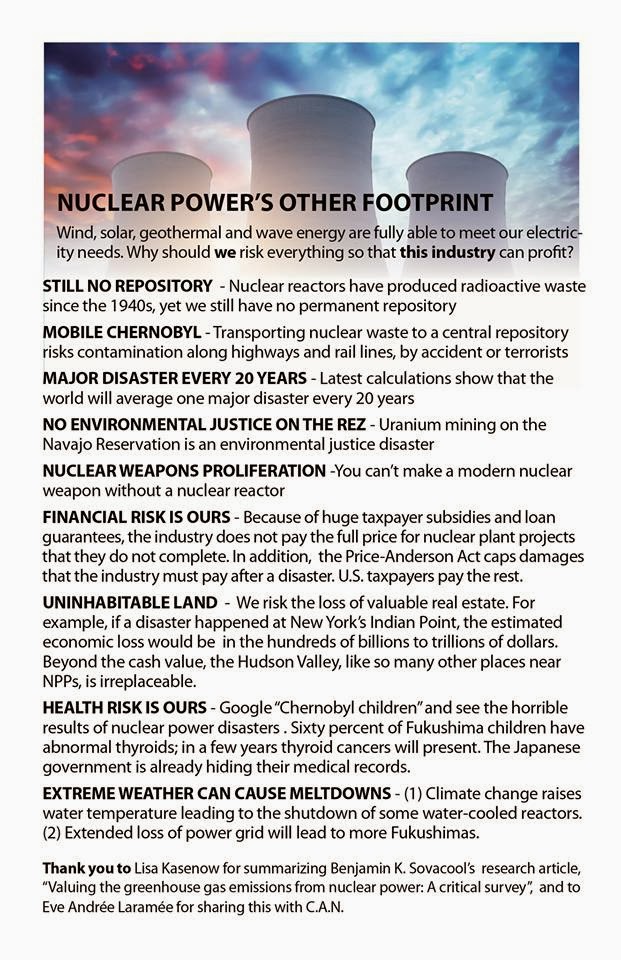
Two great charts about Nuclear ☢ that everyone should share!
Two great charts about Nuclear ☢ that everyone should study!
http://4.bp.blogspot.com/-DoEMx-2GXzc/UoF2CfVXqfI/AAAAAAAAHeo/y71numWymTo/s1600/nuclear+power’s+carbon+footprint.jpg …
and
http://4.bp.blogspot.com/-JqrhjgHn48A/UoF2HYSntRI/AAAAAAAAHew/7yjr7E4F-Ic/s1600/nuclear+power’s+other+footprint.jpg …
Taxpayer will be left with costs of nuclear decommissioning and wastes
 The taxpayer will be left to pick up the bills. The very nature of private companies is that they make a profit when they can … but when they can’t they can be wound up, leaving others to pick up the pieces….
Nuclear fall out, Syniadau , 17 April 2010, “……The major issue is not the cost of building the stations (although that is of course an issue, although it would be one for the companies concerned) but the cost of cleaning up the waste they produce and of decommissioning the site when it has come to the end of its productive life. These costs are much, much greater than the cost of construction.
In principle, the government’s idea is that the power companies would set aside money each year so as to pay the costs of decommissioning and clean up. The fundamental flaw in that approach is that a private company can either go bust or refuse to honour its contract commitments at any time, in much the same way as happened when National Express walked away from the East Coast rail franchise last year. The taxpayer will be left to pick up the bills. The very nature of private companies is that they make a profit when they can … but when they can’t they can be wound up, leaving others to pick up the pieces….
Syniadau :: The Blog: Nuclear fall out
1 This Month

of the week – Shut Down Drone Warfare!


Tell the Ukrainian Government to Drop Prosecution of Peace Activist Yurii Sheliazhenko

Petition to revoke the licensing of the Near Surface Nuclear Disposal Facility (NSDF) at Chalk River. https://www.ourcommons.ca/petitions/en/Petition/Details?Petition=e-7247
To see nuclear-related stories in greater depth and intensity – go to https://nuclearinformation.wordpress.com
-
Archives
- April 2026 (7)
- March 2026 (251)
- February 2026 (268)
- January 2026 (308)
- December 2025 (358)
- November 2025 (359)
- October 2025 (376)
- September 2025 (257)
- August 2025 (319)
- July 2025 (230)
- June 2025 (348)
- May 2025 (261)
-
Categories
- 1
- 1 NUCLEAR ISSUES
- business and costs
- climate change
- culture and arts
- ENERGY
- environment
- health
- history
- indigenous issues
- Legal
- marketing of nuclear
- media
- opposition to nuclear
- PERSONAL STORIES
- politics
- politics international
- Religion and ethics
- safety
- secrets,lies and civil liberties
- spinbuster
- technology
- Uranium
- wastes
- weapons and war
- Women
- 2 WORLD
- ACTION
- AFRICA
- Atrocities
- AUSTRALIA
- Christina's notes
- Christina's themes
- culture and arts
- Events
- Fuk 2022
- Fuk 2023
- Fukushima 2017
- Fukushima 2018
- fukushima 2019
- Fukushima 2020
- Fukushima 2021
- general
- global warming
- Humour (God we need it)
- Nuclear
- RARE EARTHS
- Reference
- resources – print
- Resources -audiovicual
- Weekly Newsletter
- World
- World Nuclear
- YouTube
-
RSS
Entries RSS
Comments RSS
 nuclear-news