Fukushima Myth: Pacific Genocide
The latest video from Goddard
I have always been opposed to the minimalist lies of the pro-nuke spinners aiming to trivialize the Fukushima ongoing catastrophe but I have always been opposed also to the exaggerated claims of the sensationalists feeding their fear hungry gullible fans with much nonsense.
Like the sharp edge of a razor is that path, so the wise say—hard to tread and difficult to cross.
I always also said that the sensationalists with their exaggerated claims provide the fodder to be later used against us anti-nukers to suppress our rightful concerns in the eyes of the general public.
I have always been opposed to the sensationalization of Fukushima, the “Pacific is dying from Fukushima”, high-pitched drama on internet played by some websites, bloggers, Youtubers, the same ones that Goddard is now quoting in this video: Enenews, Natural News, Info Wars, Kevin Blanch and others.
There are many things causing the North American Pacific coastline ecocide at the same time, it is a convergence of many factors. These pre-date Fukushima.
That said I do believe that there should be wide scale fish testing, not just due to Fukushima but to the long term radioactive contamination of the Pacific. But having that happen, having it done properly and without it being hijacked by vested interests is extremely difficult. Why there should be wide scale fish testing is to determine the range of contamination among fish and where the high readings pop up to try to better understand where and what species are showing up with high readings and also what are the real averages being seen. Again, a big undertaking that can easily be hijacked making it meaningless.
The main danger is for the people living in eastern Japan, which has been contaminated at various degrees depending on the locations. The contaminated food, which when constantly consumed, even at a low level of contamination, will certainly have mid-term and long-term harmful consequences on the health of the people.
Another danger is the danger of radiation contaminated food products exported from Japan oversea to other countries with more lax radiation control and regulations, where people will buy them and consume them unknowingly of their contamination. As an example, in 2013 some tuna fish imported from the Philippines which was radiation contaminated was found sold in a supermarket in Switzerland. Of course that Philippines tuna had been contaminated by radioactive nanoparticles coming from Fukushima Daiichi in nearby Japan, and not from Diablo Canyon in far-away California.
To expose the false exaggerated claims, the sensationalism and the sensationalists, still does not change nor remove the fact that Fukushima contamination is spreading slowly but surely into our environment, and therefore there should be more measures and controls made to protect the people from possibly present radioactive contamination. As our governments are more busy protecting the financial interests than the people health, concerned citizens should organize themselves in local radwatch groups, to learn and to practice radiation measuring, in their surrounding environment and in their food, so as to protect themselves.
To resume: the Pacific ocean is not dying from Fukushima, but Fukushima radioactive contamination is slowly but surely, continously spreading into our environment, to slowly bioaccumulate and to affect the food chain.
That said, the biggest risks are still for the Fukushima people who are being left on location to live everyday with omnipresent radiation and contamination.
A Massive Campaign of Disinformation to Trivialize Fukushima Health Risks

I am being nice, I did not add a 4th monkey to this picture, to represent the selling-out “scientists”….
5 years have past, we are now submerged by a massive campaign of lies, spinned propaganda, that everything is now fine about Fukushima. Some articles spreading plain nonsense, lies without any fear to be accused to be lying. Some our friends even sharing those B.S. articles on their FB pages or FB group without even having the intelligence to write an introduction to those articles, exposing the lies of those articles.
As an example, this article “Scientists Find New Kind Of Fukushima Fallout” where they say: ““He cautions that any internal radiation from particles containing cesium-137 would be much less than the doses people got from external radiation, which would come from cesium-137 and other radioactive elements in the soil or the environment around them.”
http://www.forbes.com/sites/samlemonick/2016/06/30/scientists-find-new-kind-of-fukushima-fallout/#636c0d6a4126
Which is absolute bullshit, nonsense, a lie, It completely ignores what science and multiple studies have already well established, that internal radiation is 100 times more harmful than external radiation.
Also the recently released report from the conclusions of a major 5 year review, with multi-international authors who are all working together as part of a Scientific Committee on Oceanic Research (SCOR) Working Group. The report is being presented at the Goldschmidt geochemistry conference in Japan.
http://phys.org/news/2016-06-fukushima-oceans-years.html#jCp
Which says: ” Uptake by marine life. In 2011, around half the fish samples in coastal waters off Fukushima had radiocesium levels above the Japanese 100Bq/kg limit, but by 2015 this had dropped to less than 1% above the limit. High levels are still found in fish around the FDNPP port. High levels of 131I were measured in fish in April 2011, but as this has a short radioactive half-life, it is now below detection levels. Generally, with the exception of species close to the FDNPP, there seem to be little long-term measurable effects on marine life.”
It takes 12 years for the TRITIUM to lose half of its radioactivity and 120 years for it to lose it all, And 30 years and 300 years for CESIUM, and tens of thousands of years to the PLUTONIUM etc But according to their report the Pacific is now clean just after 5 years.
That report also says: “Risk to Humans. The radiation risk to human life is comparatively modest in comparison to the 15,000 lives were lost as a result to the Tohoku earthquake and tsunami. So far, there have been no direct radiation deaths. The most exposed FDNPP evacuees received a total dose of 70 mSv, which (if they are representative of the general population) would increase their lifetime fatal cancer risk from 24% to 24.4%. However, there are still over 100,000 evacuees from the Fukushima area, and many industries such as fishing and tourism have been badly hit.”
Thus that report is completely ignoring the well proven harmful effects of a constant low dose radiation on human life, and of course completely omitting to talk about the dangers of internal exposure by contaminated food and liquid for the Fukushima population.
When I shared this report on my blog, I wrote an introduction saying: “This report raises certainly a lot of questions about today’s scientific community unbiasedness and independance from governmental and corporated powers.”
A marine biologist came to argue with me on Twitter, reproaching me to not accept science. I answered to him that I do respect science but I won’t stand for bias, for that “science” which is being influenced, bought, twisted or silenced by financial and political interests.
Fukushima and the oceans: What do we know, five years on?
This report raises certainly a lot of questions about today’s scientific community unbiasedness and independance from governmental and corporated powers.
A major international review of the state of the oceans 5 years after the Fukushima disaster shows that radiation levels are decreasing rapidly except in the harbour area close to the nuclear plant itself where ongoing releases remain a concern. At the same time, the review’s lead author expresses concern at the lack of ongoing support to continue the radiation assessment, which he says is vital to understand how the risks are changing.
- The accident. The Tohoku earthquake and tsunami on March 11, 2011 led to the loss of power and overheating at the Fukushima Daiichi Nuclear Power Plants (FDNPP), causing extensive releases of radioactive gases, volatiles and liquids, in particularly to the coastal ocean. The radioactive fall-out on land is well-documented, but the distribution of radioactivity in the seas and onto the wider oceans is much more difficult to quantify, due to variability in the ocean currents and greater difficulty in sampling.
- Initial release of radioactive material. Although the FDNPP accident was one of the largest nuclear accidents and unprecedented for the ocean, the amount of 137Cs released was around 1/50th of that released by the fall out of nuclear weapons and 1/5th that released at Chernobyl. It is similar in magnitude to the intentional discharges of 137Cs from the nuclear fuel reprocessing plant Sellafield.
- Initial fallout. The main release of radioactive material was the initial venting to the atmosphere. Models suggest that around 80% of the fallout fell on the ocean, the majority close to the FDNPP. There was some runoff from the land, peaking around 6 April 2011. There is a range of estimates of the total amount of 137Cs release into the ocean, with estimates clustering around 15-25 PBq (PetaBecquerel, which is 1015 Becquerel. One Becquerel is one nuclear decay per second). Other radioisotopes were also released, but the focus has been on radioactive forms of Cs given their longer half-lives for radioactive decay (134Cs = 2 yrs; 137Cs = 30 yrs) and high abundance in the FDNPP source.
- Distribution in water. Cs is very soluble, so it was rapidly dispersed in the ocean. Prevailing sea currents meant that some areas received more fall-out than others due to ocean mixing processes. At its peak in 2011, the 137Cs signal right at the FDNPP was tens of millions of times higher than prior to the accident. Over time, and with distance from Japan, levels decrease significantly. By 2014 the 137Cs signal 2000km North of Hawaii was equivalent to around six times that remaining from fallout from atmospheric nuclear tests from the 1960’s, and about 2-3 times higher than prior fallout levels along the west coast of N. America. Most of the fallout is concentrated in the top few hundred metres of the sea. It is likely that maximum radiation levels will be attained off the North American coast in the 2015-16 period, before declining to 1-2 Bq per cubic metre (around the level associated with background nuclear weapon testing) by 2020. Sea-floor sediments contain less than 1% of the 137Cs released by the FDNPP, although the sea-floor contamination is still high close to the FDNPP. The redistribution of sediments by bottom-feeding organisms (more common near the coast) and storms is complex.
- Uptake by marine life. In 2011, around half the fish samples in coastal waters off Fukushima had radiocesium levels above the Japanese 100Bq/kg limit, but by 2015 this had dropped to less than 1% above the limit. High levels are still found in fish around the FDNPP port. High levels of 131I were measured in fish in April 2011, but as this has a short radioactive half-life, it is now below detection levels. Generally, with the exception of species close to the FDNPP, there seem to be little long-term measurable effects on marine life.
- Risk to Humans. The radiation risk to human life is comparatively modest in comparison to the 15,000 lives were lost as a result to the Tohoku earthquake and tsunami. So far, there have been no direct radiation deaths. The most exposed FDNPP evacuees received a total dose of 70 mSv, which (if they are representative of the general population) would increase their lifetime fatal cancer risk from 24% to 24.4%. However, there are still over 100,000 evacuees from the Fukushima area, and many industries such as fishing and tourism have been badly hit.
http://phys.org/news/2016-06-fukushima-oceans-years.html#jCp
Scientists Find New Kind Of Fukushima Fallout
THIS IS ABSOLUTE B.S. , THIS IS DISINFORMATION, SPREADING NONSENSE!
It completely ignores what science and multiple studies have already well established, that internal radiation is 100 times more harmful than external radiation: “He cautions that any internal radiation from particles containing cesium-137 would be much less than the doses people got from external radiation, which would come from cesium-137 and other radioactive elements in the soil or the environment around them.”

A Tokyo Electric Power Co. (TEPCO) employee, wearing a protective suit and a mask, walks in front of the No. 1 reactor building at TEPCO’s Fukushima Daiichi nuclear power plant.
Some of the radioactive material that escaped the Fukushima Daiichi nuclear reactor in 2011 took a form no one was looking for, scientists have discovered. Now they have to figure out what it means for Japan and for future disasters.
Radioactive cesium—specifically, cesium-137—is one of the waste products of nuclear power. It’s also one of the most dangerous substances in a nuclear disaster like Chernobyl or Fukushima.
One reason why is that the type of radiation it emits is particularly damaging to our bodies. Another is that cesium-137 dissolves in water. That means it can spread quickly through the environment and get into the plants, animal and water we consume.
Until now, scientists and disaster experts thought cesium-137 fallout from the Fukushima reactor meltdown was in this soluble form. That guided their cleanup efforts, like removing and washing topsoil, and helped them map where radiation might spread.
It turns out that wasn’t entirely true. Satoshi Utsunomiya, a geochemist at Kyushu University in Japan, announced over the weekend that he had found cesium-137 in a new form: trapped inside tiny glass particles that spewed from the damaged reactors. These particles are not water soluble, meaning we know very little about how they behave in the environment—or in our bodies. He found the particles in air filters placed around Tokyo at the time of the disaster.
According to Utsunomiya, high temperatures inside the malfunctioning reactors at the Fukushima plant melted and broke down the concrete and metal in the buildings. Silica, zinc, iron, oxygen and cesium-137 fused into millimeter-wide glass microparticles, each about the size of a pin’s head. Lifted into the atmosphere by the fires raging at the plant, they then blew about 240 kilometers southeast to Tokyo.
“As much as 89% of all of the cesium [in Tokyo] was in fact in these particles. It’s profound,” says Daniel Kaplan, a geochemist at Savannah River National Laboratory in South Carolina. He attended Utsunomiya’s lecture describing the findings at the ongoing Goldschmidt Conference in Yokohama, Japan.
Kaplan says similar particles were observed near the Chernobyl reactors after the explosion there in 1986. But they were only seen within about 30 kilometers; beyond that, cesium-137 was only observed in rain.
The discovery could change how we model fallout from nuclear disasters. Kaplan explains that it might add a new variable to the models we use to predict where radioactive particles will go and how long they’ll stay there. It might also change how we treat cesium-137 during cleanup and monitoring.
It is probably still too early to say what this means for people living in Tokyo or elsewhere in Japan. Kaplan thinks the amount of radiation they received probably hasn’t changed. Whether they got it from water-soluble cesium-137 or from these particles, the radiation dose was the same—and for Tokyo residents, that number was within the margin of safe exposure.
The bad thing about water-soluble cesium-137 is that it can easily get into our bodies from soil by way of plants and animals. This new discovery alleviates that concern. But it opens up a new possibility we know little about.
“If the particles are in the air—because that’s how they get to Tokyo—then when you are aspirating this air you should find them in some ways on your lungs,” says Bernd Grambow, who studies nuclear waste chemistry as head of the SUBATECH laboratory in France.
Water-soluble cesium-137 that makes it into our lungs passes into the bloodstream and is peed out within a few weeks. But Grambow says we really don’t know what happens to insoluble cesium-137-containing particles if they get in our lungs. Some of them are likely coughed out or removed by our lungs’ other normal processes. As for the rest, Grambow says we don’t know how long they might remain.
He cautions that any internal radiation from particles containing cesium-137 would be much less than the doses people got from external radiation, which would come from cesium-137 and other radioactive elements in the soil or the environment around them. “We don’t know very much, and my point is only that they should be studied,” Grambow says.
Utsunomiya’s next step is finding out how much of the cesium-137 that ended up in soils in Tokyo and elsewhere was in these glass particles. That way, researchers will be able to better understand how cesium made its way out of the reactor and into the environment.
Radioactive cesium fallout on Tokyo from Fukushima concentrated in glass microparticles
Public Release: 26-Jun-2016 Goldschmidt Conference
New research shows that most of the radioactive fallout which landed on downtown Tokyo a few days after the Fukushima accident was concentrated and deposited in non-soluble glass microparticles, as a type of ‘glassy soot’. This meant that most of the radioactive material was not dissolved in rain and running water, and probably stayed in the environment until removed by direct washing or physical removal. The particles also concentrated the radioactive caesium (Cs), meaning that in some cases dose effects of the fallout are still unclear. These results are announced at the Goldschmidt geochemistry conference in Yokohama, Japan.
The flooding of the Fukushima Daiichi Nuclear Power Plant (FDNPP) after the disastrous earthquake on March 11 2011 caused the release of significant amounts of radioactive material, including caesium (Cs) isotopes 134Cs (half-life, 2 years) and 137Cs (half-life, 30 years).
Japanese geochemists, headed by Dr Satoshi Utsunomiya (Kyushu University, Japan), analysed samples collected from within an area up to 230 km from the FDNPP. As caesium is water-soluble, it had been anticipated that most of the radioactive fallout would have been flushed from the environment by rainwater. However, analysis with state-of-the-art electron microscopy in conjunction with autoradiography techniques showed that most of the radioactive caesium in fact fell to the ground enclosed in glassy microparticles, formed at the time of the reactor meltdown.
The analysis shows that these particles mainly consist of Fe-Zn-oxides nanoparticles, which, along with the caesium were embedded in Si oxide glass that formed during the molten core-concrete interaction inside the primary containment vessel in the Fukushima reactor units 1 and/or 3. Because of the high Cs content in the microparticles, the radioactivity per unit mass was as high as ~4.4×10¹¹ Bq/g, which is between 107 and 108 times higher than the background Cs radioactivity per unit mass of the typical soils in Fukushima.
Closer microparticle structural and geochemical analysis also revealed what happened during the accident at FDNPP. Radioactive Cs was released and formed airborne Cs nanoparticles. Nuclear fuel, at temperatures of above 2200 K (about as hot as a blowtorch), melted the reactor pressure vessel resulting in failure of the vessel. The airborne Cs nanoparticles were condensed along with the Fe-Zn nanoparticles and the gas from the molten concrete, to form the SiO2 glass nanoparticles, which were then dispersed.
Analysis from several air filters collected in Tokyo on 15 March 2011 showed that 89% of the total radioactivity was present as a result of these caesium-rich microparticles, rather than the soluble Cs, as had originally been supposed.
According to Dr Satoshi Utsunomiya;
“This work changes some of our assumptions about the Fukushima fallout. It looks like the clean-up procedure, which consisted of washing and removal of top soils, was the correct thing to do. However, the concentration of radioactive caesium in microparticles means that, at an extremely localised and focused level, the radioactive fallout may have been more (or less) concentrated than anticipated. This may mean that our ideas of the health implications should be modified”.
Commenting, Prof. Bernd Grambow, Director of SUBATECH laboratory, Nantes, France and leader of the research group on interfacial reaction field chemistry of the ASRC/JAEA, Tokai, Japan, said:
“The leading edge observations by nano-science facilities presented here are extremely important. They may change our understanding of the mechanism of long range atmospheric mass transfer of radioactive caesium from the reactor accident at Fukushima to Tokyo, but they may also change the way we assess inhalation doses from the caesium microparticles inhaled by humans. Indeed, biological half- lives of insoluble caesium particles might be much larger than that of soluble caesium”.
http://www.eurekalert.org/pub_releases/2016-06/gc-rcf062316.php
Radioactive “Glassy Soot” Fell Over Tokyo After the Fukushima Meltdown
It’s science no one wishes was necessary.
Most of the radioactive material that rained down on Tokyo following the meltdown at the Fukushima Daiichi Nuclear Power Plant was encapsulated in glassy microparticles, researchers have found.
The findings, which will be presented on Monday at the Goldschmidt conference in Japan, show that the radioactive fallout from the 2011 earthquake and subsequent nuclear disaster has been poorly understood. Previously, it was assumed that most of the radiation that fell dissolved in rain. This would mean that it would wash out of the soil and through the environment with the hydrologic cycle.
However, what actually happened is that, in the midst of the meltdown, molecules of radioactive caesium and nanoparticles of iron-zinc oxides became embedded in silicon oxide glass. This occurred because of the interaction between the molten core and the concrete containment units.
These tiny glass particles entered the air and fell as soot on the surrounding region. Because the radioactive molecules are contained in an insoluble medium, they will not wash out of the soil with rainwater to the same extent.
“It looks like the clean-up procedure, which consisted of washing and removal of top soils, was the correct thing to do,” says Dr. Satoshi Utsunomiya, who will present the findings on Monday. “However, the concentration of radioactive caesium in microparticles means that, at an extremely localised and focused level, the radioactive fallout may have been more (or less) concentrated than anticipated.”
Beyond the consequences for the environment, there are significant consequences for human health. Breathing caesium encased in glass particles may have a very different impact from exposure to it as radioactive rain, and it may be dangerous at a much higher or lower concentration. The half-life of the material may also depend heavily on the medium.
This information will be valuable in assessing the ongoing impacts the Fukushima disaster. Hopefully, no nuclear meltdown on that scale occurs again, but if one does, this new science will help governments better respond to the crisis.
To carry better the Fukushima radioactive water into the ocean

New Drainage Channels Start Operations at Fukushima Daiichi Nuclear Power Station
More Drainage “Improvements” at Fukushima Daiichi: In advance of typhoon season, rainwater drainage has been further improved by the construction of a new drainage channel. The channel runs between Units 5-6 and the cluster of Units 1-4. It carries water into two drainages, both of which empty into the protected port area and not the open ocean. The new channel helps manage the increased runoff that results from extensive hard-surfacing that has been done to reduce radiation, prevent rainwater from seeping into the ground, and in turn “improve the environment”.
http://www.tepco.co.jp/en/news/library/archive-e.html?video_uuid=tq4l2aqa&catid=69631
Living with radiation in Fukushima
In Iwaki city, Fukushima, the Tarachine “screening center” is a fully independent citizen laboratory, well equipped and employing qualified technicians to help the Fukushima population with anything involving radiation measuring or contamination testing.

For a minor fee people can come to the Tarachine screening clinic to have their foods tested, but also their house lot soil tested, or even the vacuumed dust of their house tested.
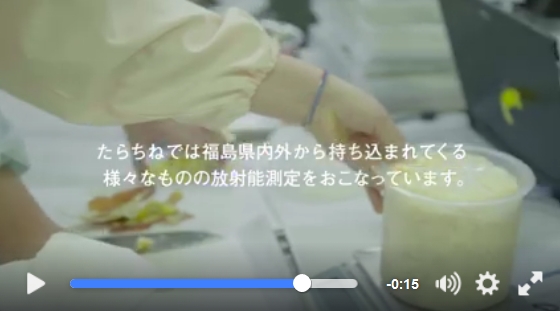
The Tarachine screening center fulfill a very important role for the Fukushima families, as families do not have the means to acquire all the necessary expensive equipment nor the technical qualifications.

As the Japanese government does not provide such vital service nor could be trusted with radiation measure numbers, some citizens organized themselves to set up such laboratories. There are at present about 100 such laboratories which have spread up, but Tarachine is certainly the most efficient and fully equipped for various types of radiation measures.
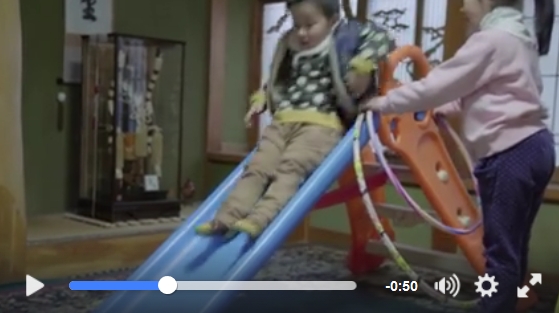
For example, since in a lot of places very young children cannot anymore play outside safely, but are kept to play indoors, it is therefore vital for the mothers to constantly control the level of contamination inside their house, thus they bring to the Tarachine center their vacuumed dust to be measured.
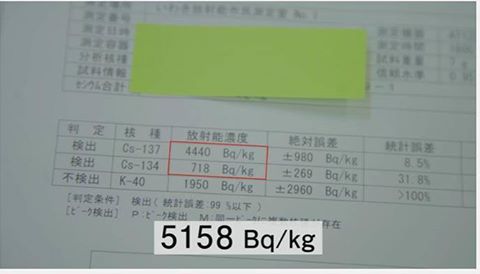
As an example this mother having brought her house vacuumed dust to be analyzed learned that it is contaminated by 4400 Bq/kg of Cesium 137, 718 Bq/kg of Cesium 134 and 1950 Bq/kg of Potassium 40, thus a total contamination of 5158 Bq/kg. The levels of Cesium 137 and Cesium 134 have too high, 4 times higher than the advised contaminated threshold and could therefore be harmful to the persons living in that house, especially for children.
As a comparison, you may see vaccumed dust from 3 different locations, one in Iwaki, Fukushima, one in Chiba, nearby Tokyo, and one in Vancouver, British Columbia,Canada:
Vacuum House Dust in Fukushima (Iwaki)
Cs 137 4440 Bq/kg
Cs 134 718 Bq/kg
Vacuum House dust in Chiba (Makuhari)
Cs 137 137Bq/kg(± 2%)
Cs 134 27Bq/kg(± 5%)
Vacuum House dust in Vancouver, BC
Cs 137 <1.08Bq/kg
Cs 134 <0.86bq/kg
The Japanese government during the past 5 years has constantly lied to the Fukushima population about the harmful radiation risks, condemning the people to stay and live with radiation. Consequently citizens have learned to rely only on their own for radiation measuring and protection.
https://www.actbeyondtrust.org/campaign/pledge/tarachine/jp/
Contact adress: Tarachine Screening center
Onahama hanabatake-cho 11-3, Iwaki city, Fukushima Prefecture, Japan
Tel: 0246‐92‐2526
Fukushima rice set to make first EU foray with debut in Britain
Not only it is criminal to allow Fukushima products, potentially contaminated, to be sold in London, Europe at a Japanese Government sponsored event, and their ignorant buyers to be possibly internally contaminated, knowing that internal radiation exposure is 100 times more harmful than external radiation exposure; such event is then used by the Japanese government in the local Fukushima newspaper (Fukushima Minpo) and in the national newspapers (Japan Times) as propaganda to convince the Fukushima people and the Japanese people that it is quite safe, not harmful to eat the Fukushima products, the proof: Europeans are buying it and eating it!
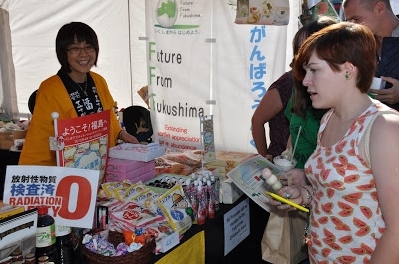
Fukushima nativees sell products made in Fukushima Prefecture at the Japan Matsuri festival in London last Spetember (Fukushima Minpo)
Fukushima-harvested rice will hit the stores in Britain in July, which might make it the first member of the EU to import the grain, following a sustained effort by a group of Fukushima natives in London fighting rumors about the safety of the crop.
It is also the third nation, after Singapore and Malaysia, to import Fukushima rice since the March 2011 earthquake and tsunami caused three reactor meltdowns at the Fukushima No. 1 nuclear plant. Starting next month, 1.9 tons of Fukushima rice called Ten no Tsubu will be sold in London. A Fukushima branch of National Federation of Agricultural Cooperative Associations, a Japanese farmers group better known as Zen-Noh, will export the rice via a British trading company.
“With the U.K. as a foothold, we hope to expand the sale of prefecture-produced rice to other EU member countries,” said Nobuo Ohashi, who heads the Fukushima branch of Zen-Noh.
According to Japan’s Agriculture, Forestry and Fisheries Ministry, the EU has been phasing out its ban on Fukushima food products since the nuclear disaster started. But for Fukushima rice, the EU still obliges importers to submit a radiation test certified by the Japanese government or sample tests by the member nation importing it.
“It’s bright news for Fukushima, which has been struggling with the import restrictions,” said an official at the prefectural office in charge of promoting its products. “We will make further efforts so the restrictions will be lifted entirely.”
There were many hurdles to overcome.
Amid fears that Fukushima products were tainted with radioactive fallout, Yoshiro Mitsuyama, who heads the Fukushima group in London, consulted an official at Zen-Noh’s branch in Germany on how to sell Fukushima products a few years ago.
With the help of Zen-Noh, Mitsuyama’s group started selling Fukushima-made rice, peach and apple juice at the annual Japan Matsuri held at London’s Trafalgar Square three years ago.
The products were popular with London residents. When Visit Japan Ambassador Martin Barrow came to Fukushima last April, he bought some local produce.
“I want to help sell Fukushima fruits like cherries, apples and pears in London as well, not just rice,” said Mitsuyama.
This section, appearing every third Monday, features topics and issues covered by the Fukushima Minpo, the largest newspaper in Fukushima Prefecture. The original article was published on May 25.
Radioactive Dust Vacuumed in Iwaki House
Cs 137 4440 Bq/kg
Cs 134 718 Bq/kg
40,26 km from Fukushima Daiichi to Iwaki city

Fairewinds in the News: Gendai Business Online Feature Article
Gendai Business Online’s top ranked article is an exclusive interview with Fairewinds Chief Engineer Arnie Gundersen titled, American nuclear expert warns: “There is a possibility that now in Fukushima recontamination is occurring.” With more than 10,000 likes on Facebook, this Japanese article delves into the truth about nuclear contamination from Fukushima Daiichi as uncovered by Arnie Gundersen during his most recent trip to Japan. Fairewinds, with the help of Japanese translators, provides you with an English translation:
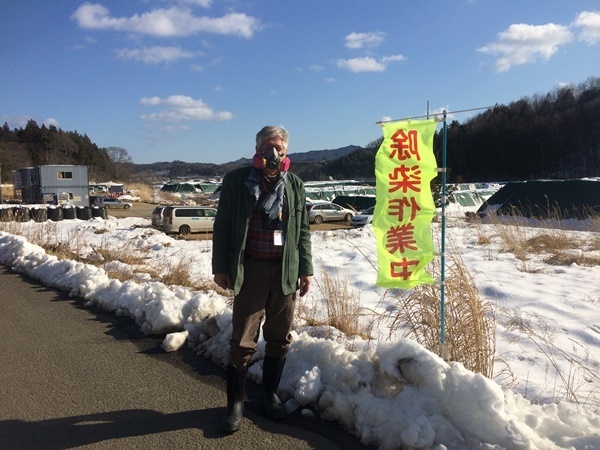
On a mid-February morning, just before the 5th anniversary of the triple meltdown at Fukushima Daiichi, a group of young girls in the city of Minami-Soma rode their bikes to school past a shocked and saddened pedestrian. That upset observer was Arnie Gundersen, nuclear reactor expert and Chief Engineer with Fairewinds Associates. Mr. Gundersen has 45 years of experience as a design, operations, and decommissioning nuclear engineer. He has engaged in research of the effects of the meltdown at Three Mile Island (TMI) and conducts independent research of the triple meltdown at Fukushima Daiichi. Mr. Gundersen is in ongoing conversations with both the US and Japanese media concerning the dangers of nuclear reactors and nuclear power operation. Invited by “Peace News Japan” and several other civil groups, Mr. Gundersen visited the Fukushima prefecture five years after the catastrophe at Fukushima Daiichi.
“What surprised me at this visit to Japan [his third since the meltdowns] is that the decontaminated area is contaminated again,” Mr. Gundersen said while explaining why it was such as sad shock to witness the girls on their bicycles. “This was not what I had expected. I had thought that we would not find such high doses of radiation in the decontaminated area. But, sadly, our results prove otherwise.”
During his Japan visit, Mr. Gundersen collected samples of dust from the rooftop of Minami-Soma city town hall, the floor mat of a 7-Eleven convenience store, and the roadsides of Minami-Soma city. Although the official data cannot be released before the publication of formal scientific papers, it is evident that high doses of radiation, usually found in nuclear waste, was detected from these samples.
“This means that highly radioactive dust is flying around the city. In other words, the decontaminated land is contaminated again. Little girls are affected by the radiation 20 times as much as adult men. The Japanese government’s standard of 20 mSv is based on exposure assessments for adult men. The girls on their bicycles are actually being affected by a radiation dose equivalent to as much as 400 mSv.”
Mr. Gundersen also pointed out that human lungs are heavily affected by internal exposures to radiation.
“At this visit, I wore a radiation proof mask that can filter out 99.98% of radiation for six hours. I sent my filter to the lab, and they found a high dose of Cesium. But, unfortunately, the Japanese government only cares about the number on a Geiger counter and does not consider the internal exposure. This has resulted in a hazardous downplay of this kind of data and human lungs are affected by the serious internal exposure.”
Why is the recontamination happening? One of the reasons is that the government did not decontaminate thoroughly. Mr. Gundersen witnessed first-hand the poor decontamination of the prefecture.
“In the house I visited, only half of the garden area was decontaminated because only that half fell into the category of a contaminated area. It should not be like that. The other half would be contaminated too. Furthermore, one person discovered highly radioactive dust in their driveway where decontamination had occurred. So, of course, this person notified the related offices but the related offices told them that it was not necessary to decontaminate the driveway again because it had already been done once. It’s unbelievable. This person’s house is located near a ravine and the opposite side of the ravine is designated a non-habitable zone.”
Another reason for recontamination is that the radiation from the mountains are coming back to the city by way of wind and rain. Mr. Gundersen noted the extreme radioactive contamination of the mountains.
“We tracked wild monkeys in the mountains and found a high dose of radiation in their feces. I received the meat of a wild pig as a gift and since I could not bring it back to the US [it is illegal to bring meat back to the United States from Japan], tested the meat on a Geiger counter. The meat showed 120 counts/min. I think that the Japanese government should spend more money to decontaminate the mountains but they don’t appear to have that kind of political will. I also worry that contamination in the rivers is not monitored as rain from the mountains flow down into the rivers.”
Due to the heavy radiation contamination of the mountains, vegetables grown in that area exceed the government’s standard by 1500 Bq. These vegetables were sold at the MichinoEki in Tochigi prefecture, and the bamboo shoot grown in this contaminated region was used for elementary school lunches in Utsunomiya. These school lunches contained more than twice as much radiation as the government’s standard.
Recontamination is happening due to poor decontamination and residents of Kawauchi village in Fukushima prefecture claim that the decontamination in the forests is not enough. However, the government continues to push for the end of people’s relocation and force the return to recontaminated areas.
“If I had a little child, I would never let them live there,” Mr. Gundersen pointedly states.
Mr. Gundersen also found that Tokyo remains contaminated. He measured dust collected from the sidewalk in front of MITI (Ministry of International Trade and Industry) and found a high dose of radiation. That dust is in the air that will be inhaled by the visitors and athletes of the 2020 Olympic Games. Needless to say, the current residents are inhaling it every day. “Mr. Abe should not take the advice from IAEA, MITI and TEPCO seriously,” Mr. Gundersen insists. “Instead, he should have an independent organization conduct research and listen to the advice from them.”
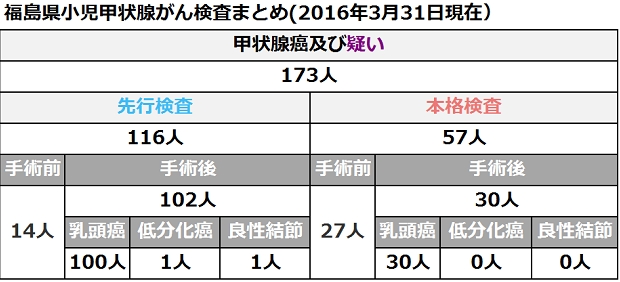
173 Children Thyroid Cancers in Fukushima Prefecture
As a reminder, elsewhere, children thyroid cancer occurs in only about one or two of every million children per year by some estimates. This shows an incidence of thyroid cancer multiplied by more than a hundred.
According to the latest Fukushima prefectural survey report, published on June 6, 2016, the number of childhood thyroid cancers increased from 163 three months and a half ago to 169 now, as 6 persons more were found affected with thyroid cancer.
Then the Fukushima Medical University professor Akira Ozuru verbally reported 3 additional cases, making now the number of thyroid cancers 172.
Therefore in the last 3 months and half, 9 additional cases have been further detected, which brings now the total number of children affected with thyroid cancer up to 172.
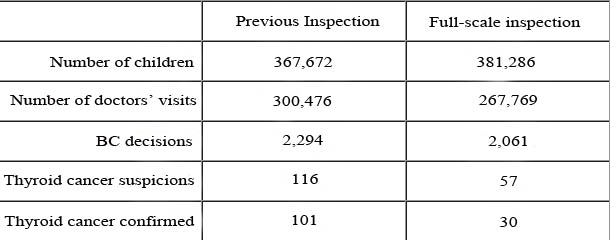
Here below in this first picture you may see the evolution of the number of children thyroid cancers and its evolving ratio to the Fukushima population from December 31, 2013 to March 31, 2016.

We can see that they are become higher at every announcement.
This time March 31, 2016 it became one in 1746 children.
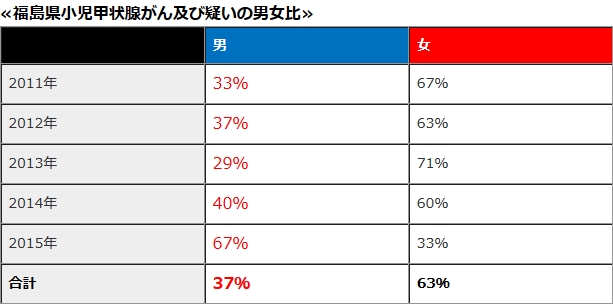
In the next picture we see the male-to-female ratio of Fukushima Prefecture childhood thyroid cancer and suspicion of thyroid cancer. The stats proving that girls (women) are indeed getting more affected than the boys (men) by radiation, as well expected.
As you may see in the next picture the thyroid cancer ratio to population differs depending on each municipality.
Red color – 1 in 999
Orange color – 1 in 1000 to 1999
Yellow color – 1 in 2000 to 2999
Green color – 1 in 3000 to 3999
Blue color – 1 in 4000 to 6999

Source: http://www.sting-wl.com/fukushima-children9.html
Translated by D’un Renard
Japan Fish Fukushima Contaminated
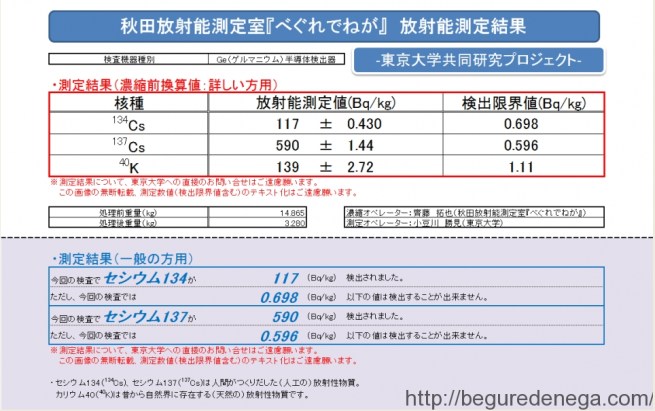
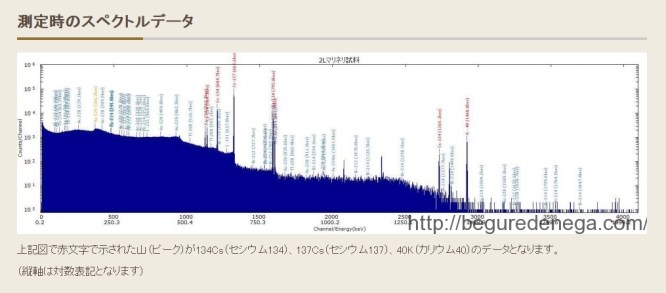
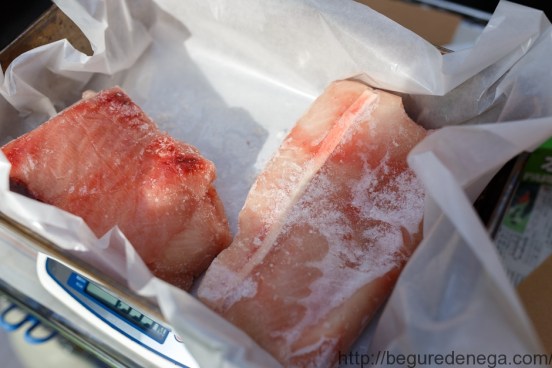
Shortfin mako shark steaks, commonly consumed in Japan, caught off Shizuoka prefecture, more than 500 kms south of Fukushima : 707 becquerels / kg of Cesium 134 + 137
Cesium 134Cs: 117 Bq / kg
Cesium 137Cs: 590 Bq / kg
Thank you Tepco!
The release of radioactive water from the Fukushima Daiichi nuclear plant into the sea continues (300 Tons per day), and its bioaccumulation in living organisms continues as well, especially at the top of the food chain…
Bon appetit!
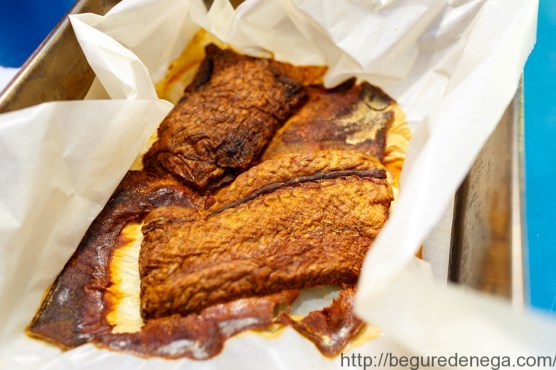
Source http://beguredenega.com/archives/9498
In the meantime Japanese Ministry of Environment decides to lift shipment restrictions on Fukushima flounder and conger and other types of fish, 18 species:
Shipment Restrictions on Fukushima Flounder, Conger Lifted
Tokyo, June 9 (Jiji Press)–The Japanese government lifted shipment restrictions on Thursday on flounder and whitespotted conger caught off the nuclear disaster-hit northeastern Japan prefecture of Fukushima.
The lifting came after the government confirmed that the samples stably contain less than the government-set standard of 100 becquerels of radioactive substances per kilogram.
The government introduced the shipment restrictions following the March 2011 meltdowns at Tokyo Electric Power Company Holdings Inc.’s Fukushima No. 1 nuclear power plant.
Including flounder and whitespotted conger, 18 species have seen a shipment ban lifted, while shipments of 26 others, including Japanese black porgy and masu salmon, have yet to be approved.
In 2010, flounder and whitespotted conger ranked third and ninth, respectively, in terms of the value of landings off Fukushima.
http://jen.jiji.com/jc/i?g=eco&k=2016060900848
China Issues Travel Warnings to Japan over Fukushima Nuke Leak
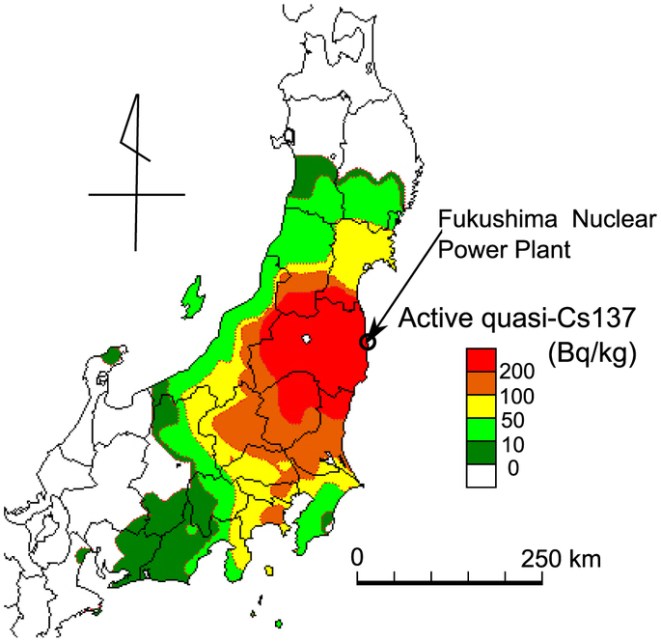
China’s Ministry of Foreign Affairs has issued notice to its citizens warning of safety problems regarding the Fukushima nuclear leak, said the ministry’s spokesperson.
Hong Lei also urged Japan to explain to the world with a responsible attitude on the impact of the leak.
Hong said: “Japan should explain clearly to the world with a responsible attitude. The Ministry of Foreign Affairs has issued notice reminding people of the related safety problem and I believe Chinese citizens will make proper arrangements for their tours and well protect their own safety.”
He noted that the number of visas issued to Chinese nationals in 2015 was 3.78 million, accounting for around 80 percent of the total number of visas issued and exceeded the total number of visas issued to all nationals in 2014 (approximately 2.87 million).
The plant’s operator, Tokyo Electric Power Co., on June 1 admitted, for the first time ever, that its insistence on simply calling the tragedy “nuclear reactor damage” in the past five years had “hidden the truth.”
According to Ken Buesseler, marine radio chemist with the U.S. Woods Hole Oceanographic Institution, the consequences of the Fukushima nuclear incident were “unprecedented,” since over 80 percent of the leaked radioactive substances have flown into the sea.
Woman breaks silence among Fukushima thyroid cancer patients
“I want everyone, all the children, to go to the hospital and get screened. They think it’s too much trouble, and there are no risks, and they don’t go,” the woman said in a recent interview in Fukushima. “My cancer was detected early, and I learned that was important.”
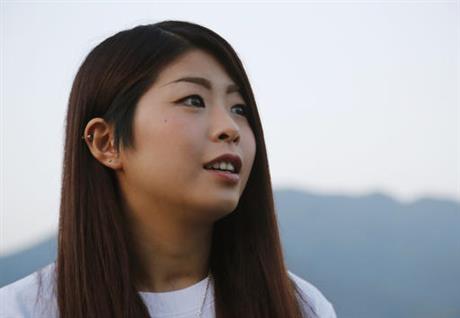
In this Saturday, May 28, 2016 photo, a young woman, who requested anonymity because of fears about harassment, speaks to The Associated Press in a town in Fukushima prefecture, northeast of Tokyo. She is among 173 people diagnosed with thyroid cancer in Japan’s Fukushima, but she’s the first to speak to media more than five years after the nuclear disaster there. That near-silence highlights the fear Fukushima thyroid-cancer patients have about being the “nail that sticks out,” and thus gets hammered.
KORIYAMA, Japan (AP) — She’s 21, has thyroid cancer, and wants people in her prefecture in northeastern Japan to get screened for it. That statement might not seem provocative, but her prefecture is Fukushima, and of the 173 young people with confirmed or suspected cases since the 2011 nuclear meltdowns there, she is the first to speak out.
That near-silence highlights the fear Fukushima thyroid-cancer patients have about being the “nail that sticks out,” and thus gets hammered.
The thyroid-cancer rate in the northern Japanese prefecture is many times higher than what is generally found, particularly among children, but the Japanese government says more cases are popping up because of rigorous screening, not the radiation that spewed from Fukushima Dai-ichi power plant.
To be seen as challenging that view carries consequences in this rigidly harmony-oriented society. Even just having cancer that might be related to radiation carries a stigma in the only country to be hit with atomic bombs.
“There aren’t many people like me who will openly speak out,” said the young woman, who requested anonymity because of fears about harassment. “That’s why I’m speaking out so others can feel the same. I can speak out because I’m the kind of person who believes things will be OK.”
She has a quick disarming smile and silky black hair. She wears flip-flops. She speaks passionately about her new job as a nursery school teacher. But she also has deep fears: Will she be able to get married? Will her children be healthy?
She suffers from the only disease that the medical community, including the United Nations Scientific Committee on the Effects of Atomic Radiation, has acknowledged is clearly related to the radioactive iodine that spewed into the surrounding areas after the only nuclear disaster worse than Fukushima’s, the 1986 explosion and fire at Chernobyl, Ukraine.
Though international reviews of Fukushima have predicted that cancer rates will not rise as a result of the meltdowns there, some researchers believe the prefecture’s high thyroid-cancer rate is related to the accident.
The government has ordered medical testing of the 380,000 people who were 18 years or under and in Fukushima prefecture at the time of the March 2011 tsunami and quake that sank three reactors into meltdowns. About 38 percent have yet to be screened, and the number is a whopping 75 percent for those who are now between the ages of 18 and 21.
The young woman said she came forward because she wants to help other patients, especially children, who may be afraid and confused. She doesn’t know whether her sickness was caused by the nuclear accident, but plans to get checked for other possible sicknesses, such as uterine cancer, just to be safe.
“I want everyone, all the children, to go to the hospital and get screened. They think it’s too much trouble, and there are no risks, and they don’t go,” the woman said in a recent interview in Fukushima. “My cancer was detected early, and I learned that was important.”
Thyroid cancer is among the most curable cancers, though some patients need medication for the rest of their lives, and all need regular checkups.
The young woman had one cancerous thyroid removed, and does not need medication except for painkillers. But she has become prone to hormonal imbalance and gets tired more easily. She used to be a star athlete, and snowboarding remains a hobby.
A barely discernible tiny scar is on her neck, like a pale kiss mark or scratch. She was hospitalized for nearly two weeks, but she was itching to get out. It really hurt then, but there is no pain now, she said with a smile.
“My ability to bounce right back is my trademark,” she said. “I’m always able to keep going.”
She was mainly worried about her parents, especially her mother, who cried when she found out her daughter had cancer. Her two older siblings also were screened but were fine.
Many Japanese have deep fears about genetic abnormalities caused by radiation. Many, especially older people, assume all cancers are fatal, and even the young woman did herself until her doctors explained her sickness to her.
The young woman said her former boyfriend’s family had expressed reservations about their relationship because of her sickness. She has a new boyfriend now, a member of Japan’s military, and he understands about her sickness, she said happily.
A support group for thyroid cancer patients was set up earlier this year. The group, which includes lawyers and medical doctors, has refused all media requests for interviews with the handful of families that have joined, saying that kind of attention may be dangerous.
When the group held a news conference in Tokyo in March, it connected by live video feed with two fathers with children with thyroid cancer, but their faces were not shown, to disguise their identities. They criticized the treatment their children received and said they’re not certain the government is right in saying the cancer and the nuclear meltdowns are unrelated.
Hiroyuki Kawai, a lawyer who also advises the group, believes patients should file Japan’s equivalent of a class-action lawsuit, demanding compensation, but he acknowledged more time will be needed for any legal action.
“The patients are divided. They need to unite, and they need to talk with each other,” he told AP in a recent interview.
The committee of doctors and other experts carrying out the screening of youngsters in Fukushima for thyroid cancer periodically update the numbers of cases found, and they have been steadily climbing.
In a news conference this week, they stuck to the view the cases weren’t related to radiation. Most disturbing was a cancer found in a child who was just 5 years old in 2011, the youngest case found so far. But the experts brushed it off, saying one wasn’t a significant number.
“It is hard to think there is any relationship,” with radiation, said Hokuto Hoshi, a medical doctor who heads the committee.
Shinsyuu Hida, a photographer from Fukushima and an adviser to the patients’ group, said fears are great not only about speaking out but also about cancer and radiation.
He said that when a little girl who lives in Fukushima once asked him if she would ever be able to get married, because of the stigma attached to radiation, he was lost for an answer and wept afterward.
“They feel alone. They can’t even tell their relatives,” Hida said of the patients. “They feel they can’t tell anyone. They felt they were not allowed to ask questions.”
The woman who spoke to AP also expressed her views on video for a film in the works by independent American filmmaker Ian Thomas Ash.
She counts herself lucky. About 18,000 people were killed in the tsunami, and many more lost their homes to the natural disaster and the subsequent nuclear accident, but her family’s home was unscathed.
When asked how she feels about nuclear power, she replied quietly that Japan doesn’t need nuclear plants. Without them, she added, maybe she would not have gotten sick.
___
Ash’s video interview:
https://www.youtube.com/playlist?list=PLpmdZYCRIZfvTtTE1sbY3ynaGsfDYmNWn
Source: http://bigstory.ap.org/2311e999708d48c491efde5154514ef9
1 This Month

of the week – Shut Down Drone Warfare!


Tell the Ukrainian Government to Drop Prosecution of Peace Activist Yurii Sheliazhenko

Petition to revoke the licensing of the Near Surface Nuclear Disposal Facility (NSDF) at Chalk River. https://www.ourcommons.ca/petitions/en/Petition/Details?Petition=e-7247
To see nuclear-related stories in greater depth and intensity – go to https://nuclearinformation.wordpress.com
-
Archives
- April 2026 (44)
- March 2026 (251)
- February 2026 (268)
- January 2026 (308)
- December 2025 (358)
- November 2025 (359)
- October 2025 (376)
- September 2025 (257)
- August 2025 (319)
- July 2025 (230)
- June 2025 (348)
- May 2025 (261)
-
Categories
- 1
- 1 NUCLEAR ISSUES
- business and costs
- climate change
- culture and arts
- ENERGY
- environment
- health
- history
- indigenous issues
- Legal
- marketing of nuclear
- media
- opposition to nuclear
- PERSONAL STORIES
- politics
- politics international
- Religion and ethics
- safety
- secrets,lies and civil liberties
- spinbuster
- technology
- Uranium
- wastes
- weapons and war
- Women
- 2 WORLD
- ACTION
- AFRICA
- Atrocities
- AUSTRALIA
- Christina's notes
- Christina's themes
- culture and arts
- Events
- Fuk 2022
- Fuk 2023
- Fukushima 2017
- Fukushima 2018
- fukushima 2019
- Fukushima 2020
- Fukushima 2021
- general
- global warming
- Humour (God we need it)
- Nuclear
- RARE EARTHS
- Reference
- resources – print
- Resources -audiovicual
- Weekly Newsletter
- World
- World Nuclear
- YouTube
-
RSS
Entries RSS
Comments RSS
 nuclear-news