Wind and cars disperse radioactive material
By Kurumi Sugita
A remarkable documentary of the RTBF about contaminated areas, including Minami Soma in Fukushima prefecture. These areas are heavily contaminated. Nevertheless, the Japanese government makes the people return by lifting the evacuation order and stopping aid.
The Nos Voisins Lointains 3.11 association, exchanged messages with Mr. Ozawa, the engineer interviewed in the documentary. According to him, the most worrisome problem is the fact that black substances in the mall parking area get attached to car tires and are transported everywhere, as we can see in the documentary. The risk of radiation is thus dispersed.

On the other side of the parking area, we see collective dwellings from where children play outside, according to Mr. Owaza.
See also the video sent by Mr. Ozawa showing the wind lifting and dispersing the contaminated dust from fields now uncultivated.
Linens that are drying on the balcony outside are exposed to radioactive material transported by these dusty winds. Just watch at which height the dust is lifted compared to the passing car towards the end of the video. Farmers working the land inhale this dust.
With the forced return of the population this will become their daily reality.
American nuclear expert Arnie Gundersen warns: “There is a possibility that now in Fukushima recontamination is occurring.”
CCTV (Channel 17 in Burlington, Vermont), published Jun 20, 2016
Maggie Gundersen, Chiho Kaneko and Caroline Phillips of Fairewinds Energy Education discuss the nuclear risk concerns for children not only near the nuclear disaster sites of Fukushima-Dai-ichiin Japan and Chernobyl in Ukraine, formerly the Soviet Union, but globally where areas near all nuclear power plants are contaminated with radiation. Since mothers in Japan especially bear the responsibility to protect children, they experience greater hardships in an environment where just expressing one’s concern about radiation is seen as a treasonous act. Even 30 years later, the Belarus government recognizes the merits of relocating children away from radiation contaminated areas but the children of Japan are socially forced to stay put in highly contaminated areas.
Margaret Harrington, host: I know you mentioned Arnie Gundersen, the chief engineer at Fairewinds, and he said that he measured the radiation there, too. Could you talk about that a little bit?
Maggie Gundersen, Fairewinds Energy Education founder and CEO: He’s working with some other scientists who are studying — both Japanese scientists, the samples that they took, and the US scientists who are evaluating the samples — and they’re finding astronomical amounts of radiation, even in downtown Tokyo outside of METI’s door. METI is the regulatory agency over nuclear power… When he and others were downtown in Tokyo, they took samples right there in a garden right outside the door and on the front doormat, and these are really, really high samples. Frightening, because people walking in Tokyo will then be inhaling that dust. What was the film we saw from Japan that had the mothers who were in an area where kids play and run from middle school?
Caroline Phillips, Fairewinds Energy Education: It’s a fantastic video… it’s a mothers organization, they live in the Fukushima Prefecture and they’re actually using Geiger counters that have been issued by the government. They’re walking along the river [in Fukushima City.]
Maggie Gundersen: What’s so tragic about it – kids are running along dirt paths doing gym class and track and things like that and the mothers are right down in areas that are not posted and the kids can go after school and play, and people do nature hikes and stuff. And the radiation readings are horrific.

Gendai Business Online’s top ranked article is an exclusive interview with Fairewinds Chief Engineer Arnie Gundersen titled, American nuclear expert warns: “There is a possibility that now in Fukushima recontamination is occurring.” With more than 10,000 likes on Facebook, this Japanese article delves into the truth about nuclear contamination from Fukushima Daiichi as uncovered by Arnie Gundersen during his most recent trip to Japan. Fairewinds, with the help of Japanese translators, provides you with an English translation:
On a mid-February morning, just before the 5th anniversary of the triple meltdown at Fukushima Daiichi, a group of young girls in the city of Minami-Soma rode their bikes to school past a shocked and saddened pedestrian. That upset observer was Arnie Gundersen, nuclear reactor expert and Chief Engineer with Fairewinds Associates. Mr. Gundersen has 45 years of experience as a design, operations, and decommissioning nuclear engineer. He has engaged in research of the effects of the meltdown at Three Mile Island (TMI) and conducts independent research of the triple meltdown at Fukushima Daiichi. Mr. Gundersen is in ongoing conversations with both the US and Japanese media concerning the dangers of nuclear reactors and nuclear power operation. Invited by “Peace News Japan” and several other civil groups, Mr. Gundersen visited the Fukushima prefecture five years after the catastrophe at Fukushima Daiichi.
“What surprised me at this visit to Japan [his third since the meltdowns] is that the decontaminated area is contaminated again,” Mr. Gundersen said while explaining why it was such as sad shock to witness the girls on their bicycles. “This was not what I had expected. I had thought that we would not find such high doses of radiation in the decontaminated area. But, sadly, our results prove otherwise.”
During his Japan visit, Mr. Gundersen collected samples of dust from the rooftop of Minami-Soma city town hall, the floor mat of a 7-Eleven convenience store, and the roadsides of Minami-Soma city. Although the official data cannot be released before the publication of formal scientific papers, it is evident that high doses of radiation, usually found in nuclear waste, was detected from these samples.
“This means that highly radioactive dust is flying around the city. In other words, the decontaminated land is contaminated again. Little girls are affected by the radiation 20 times as much as adult men. The Japanese government’s standard of 20 mSv is based on exposure assessments for adult men. The girls on their bicycles are actually being affected by a radiation dose equivalent to as much as 400 mSv.”
Mr. Gundersen also pointed out that human lungs are heavily affected by internal exposures to radiation.
“At this visit, I wore a radiation proof mask that can filter out 99.98% of radiation for six hours. I sent my filter to the lab, and they found a high dose of Cesium. But, unfortunately, the Japanese government only cares about the number on a Geiger counter and does not consider the internal exposure. This has resulted in a hazardous downplay of this kind of data and human lungs are affected by the serious internal exposure.”
Why is the recontamination happening? One of the reasons is that the government did not decontaminate thoroughly. Mr. Gundersen witnessed first-hand the poor decontamination of the prefecture.
“In the house I visited, only half of the garden area was decontaminated because only that half fell into the category of a contaminated area. It should not be like that. The other half would be contaminated too. Furthermore, one person discovered highly radioactive dust in their driveway where decontamination had occurred. So, of course, this person notified the related offices but the related offices told them that it was not necessary to decontaminate the driveway again because it had already been done once. It’s unbelievable. This person’s house is located near a ravine and the opposite side of the ravine is designated a non-habitable zone.”
Another reason for recontamination is that the radiation from the mountains are coming back to the city by way of wind and rain. Mr. Gundersen noted the extreme radioactive contamination of the mountains.
“We tracked wild monkeys in the mountains and found a high dose of radiation in their feces. I received the meat of a wild pig as a gift and since I could not bring it back to the US [it is illegal to bring meat back to the United States from Japan], tested the meat on a Geiger counter. The meat showed 120 counts/min. I think that the Japanese government should spend more money to decontaminate the mountains but they don’t appear to have that kind of political will. I also worry that contamination in the rivers is not monitored as rain from the mountains flow down into the rivers.”
Due to the heavy radiation contamination of the mountains, vegetables grown in that area exceed the government’s standard by 1500 Bq. These vegetables were sold at the MichinoEki in Tochigi prefecture, and the bamboo shoot grown in this contaminated region was used for elementary school lunches in Utsunomiya. These school lunches contained more than twice as much radiation as the government’s standard.
Recontamination is happening due to poor decontamination and residents of Kawauchi village in Fukushima prefecture claim that the decontamination in the forests is not enough. However, the government continues to push for the end of people’s relocation and force the return to recontaminated areas.
“If I had a little child, I would never let them live there,” Mr. Gundersen pointedly states.
Mr. Gundersen also found that Tokyo remains contaminated. He measured dust collected from the sidewalk in front of MITI (Ministry of International Trade and Industry) and found a high dose of radiation. That dust is in the air that will be inhaled by the visitors and athletes of the 2020 Olympic Games. Needless to say, the current residents are inhaling it every day. “Mr. Abe should not take the advice from IAEA, MITI and TEPCO seriously,” Mr. Gundersen insists. “Instead, he should have an independent organization conduct research and listen to the advice from them.”
Fukushima Disaster’s Victims
I decided to translate this particular article because this article for a change talks about the Fukushima disaster victims and in details how their everyday lives have been affected.
In most of the Fukushima related articles from websites and mainstream media, the writers usually focus on the Fukushima Daiichi nuclear power plant and its technical failures, about its continuous leaking into the Pacific ocean etc. but somehow they almost always forget to talk about the plight of the victims, the victims who are at the forefront of this tragedy.
August 12, 2016
Article written by Evelyne Genoulaz, from a lecture given by Kurumi Sugita,
translated by Dun Renard.
Source : Fukushima Blog de Pierre Fetet http://www.fukushima-blog.com/2016/08/fukushima-les-vies-sinistrees.html
March 11, 2016, Kurumi Sugita, social anthropologist researcher and founding president of the association “Our Far Neighbors 3.11”, gave a lecture entitled “Fukushima disaster’s lives” in the Nature and Environment House (MNEI) in Grenoble, Isere, an inaugural lecture for the commemoration of the “Chernobyl, Fukushima disasters”.
The speaker outlined the concrete and current situation of the victims of the Fukushima disaster, particularly on health issues. Attached to Japan, committed, Kurumi monitored the situation of 60 affected people, for several years, visiting each once a year to collect field data for her associative actions. It is the project “DILEM”, “Displaced and Undecided Left to Themselves”, from the nuclear accident in Japan – the life course and geographical trajectory of the victims outside of the official evacuation zone.
I offer a written return of this conference, courtesy of Kurumi who also was kind enough to add data to date on her return from Japan in June 2016.
Evelyne Genoulaz
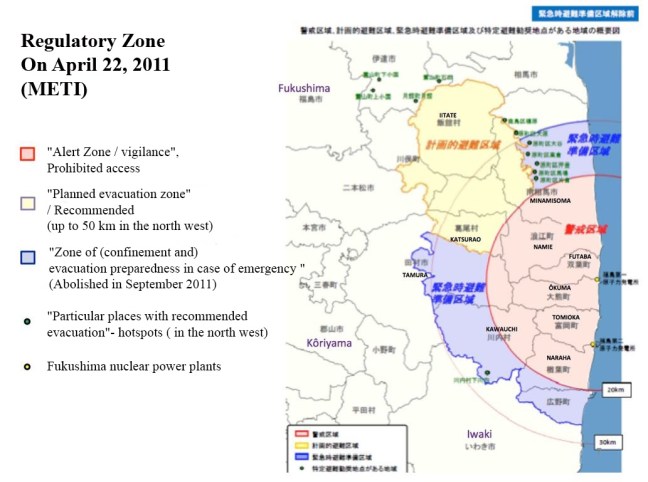
I. The contaminated territories
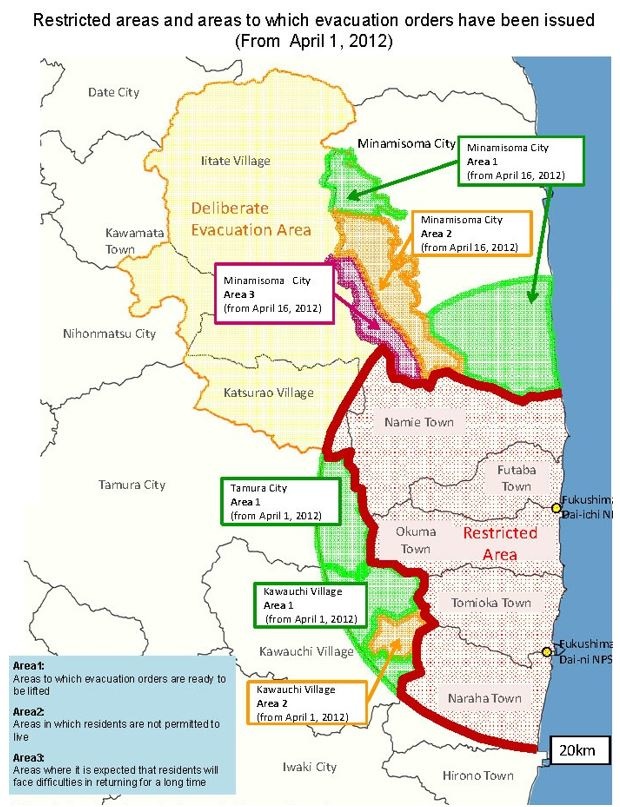
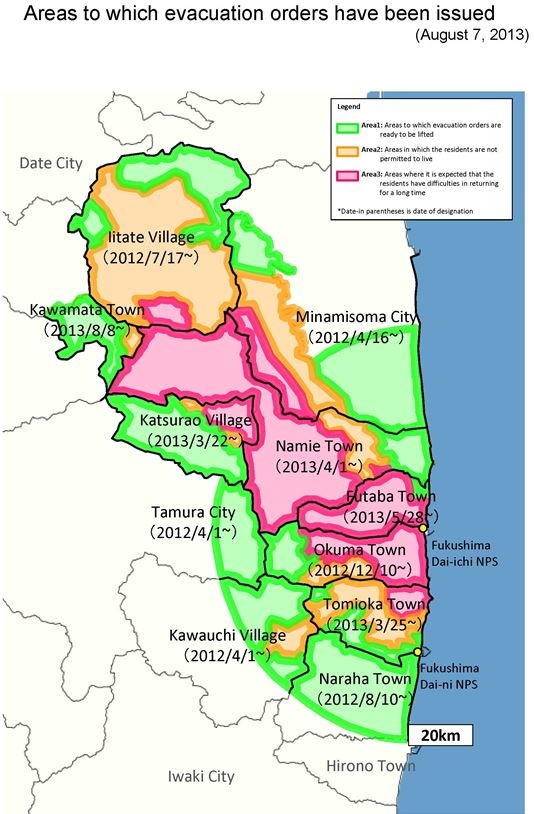
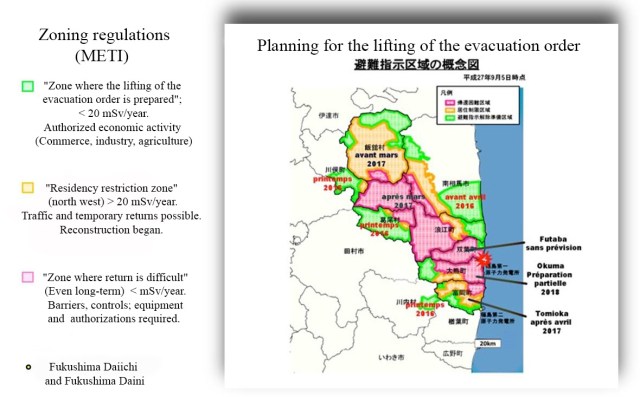
After the disaster the authorities declared a state of emergency and to this day Japan is still “under that declaration of a nuclear emergency state (genshiryoku kinkyu Jitai sengen).” But over time, the zoning of the contaminated territories has been increasingly reduced by the authorities, as shows the chronological overview on these maps (METI).
II. The return policy
Starting this month of March 2016, in fact, many areas were “open”. The return to TOMIOKA is programmed by authorities after April 2017; OKUMA partially in 2018. Only FUTABA is labeled “no projection”. Do note that zoning maps were delineated at the beginning of the disaster zoning by concentric circles, while the radioactivity is deposited in “leopard spots” and today, programmed to be returned to areas are gradually getting geographically closer to the Fukushima Daiichi nuclear plant even though these areas are dangerous!
The government is preparing to lift the evacuation order at 20 mSv / year, and areas from 20 to 50 mSv / year will enter the opening schedule after spring 2017 establishing strategic points for reconstruction ( fukkô Kyoten).
To speak only of Iitate, which was the most beautiful village in Japan, its mayor is in favor of return, but today the situation there is poignant: it was decontaminated up to 20 meters of the houses, but as it is surrounded by mountains and forests, the radioactivity will remain dangerous …
Measures delegated to individuals
The control measurement of environmental radioactivity will now be based on the individual rather than on space. Thus, everyone is invited to measure himself or herself, to measure what is consumed, so that if the individual is contaminated it will only be blamed upon his or her own negligence!
The absurd and arbitrary at work in the calculation of dose rates
Official figures on the geographical contamination, dose rates displayed, are using a biased calculation.
Usually to measure in the field a dose rate, we get a figure in mSv / h then multiply it by 24 (hours) x 365 (days) to obtain the annual rate. But this is not the calculation undertaken by the authorities.
The authorities makes first a difference between the level of contamination on one hand inside the housing, and on the other hand on the outside. They decided to consider that an individual spends only 8 hours outside. It is also estimated (official rules) that “the radiation inside a building is reduced to 40% of the radiation reading outside.”
Yet, in Minamisoma for example, studies have shown that the contamination inside was at best 10% lower than the outside, sometimes even worse inside!
That is to say that the authorities uses a biased calculation that ultimately determines if we take an example, a dose rate of 20 mSv / year whereas the actually measured dose rate is 33 mSv / year!
Residents who did not evacuate are distressed because they now know fear, for example those of Naraha who no longer recognize their city because it has changed since the disaster: vandalism, insecurity soon as night falls, since it is now black in the streets, some girls were abused …
Furthermore, Naraha is a coastal town with a seaside road and all night – especially at night – they hear the noise of the incessant and disturbing road traffic of the trucks loaded with radioactive waste, without knowing precisely what is carried …
What motivates the return policy? According to Kurumi Sugita, in view of the Olympic Games coming to Japan in 2020, the government pursues a staistics dependent objective: it comes to lowering the numbers! If the evacuees or the self-evacuees leave the “assisted housing”, they are no longer counted as “evacuees”….
III. Works and Waste
The whole territory of Fukushima Prefecture today is littered with waste bags. Everywhere, at the turn of any road you’ll encounters mountains of waste bags, sometimes piled up so high! It is a sorry sight for the residents. And space lacks where to store them, so much that the authorities have even created dumps that they call “temporary intermediary storage areas! “
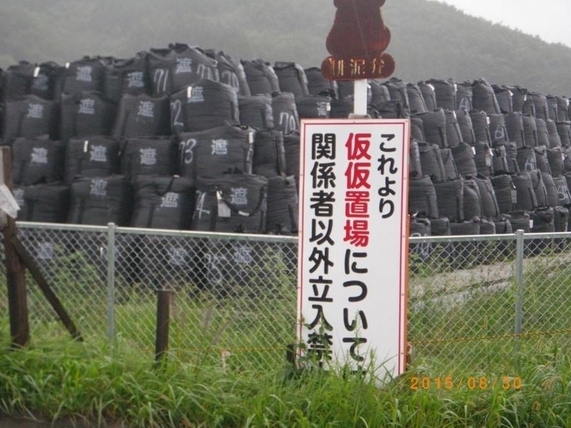
A “temporary intermediary storage area” in Iitate
A row of uncontaminated sandbags is added around the perimeter of the “square” of the most contaminated bags, so as to reduce the number of the dose rate!
As of March 2016, there were no less than 10 million bags and 128,000 temporary dumpsites in Fukushima Prefecture. Waste bags are omnipresent, despite the residents’ distress; near schools, and even in people’s gardens.
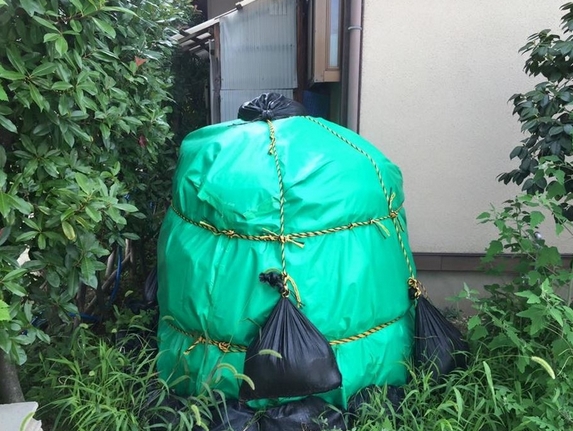
Contaminated waste bags at someone’s house
Short of sufficient storage space, the authorities are forcing residents to an intolerable alternative: if the resident does not want to store the waste on his property, it is his right. But in this case it will not be decontaminated! The resident requesting “decontamination intervention” must keep the waste on his property! This is why we see here and there, everywhere in fact, bags near buildings or in private homes.
According to the “Nuclear Reactor Regulation Law” (Genshiro tô kiseihô), the recycling threshold of “nuclear waste” is 100 Bq / kg. However, on June 30, 2016, the Ministry of Environment has officially decided to “reuse” waste below 8000 Bq / kg (1).
In practical terms, this waste will be used in public works, covered by cement and land in order to lower the ambient radioactivity.
In order to “reduce the volume” of waste, “temporary incinerators” were built to incinerate nuclear waste and to “vaporize” cesium.
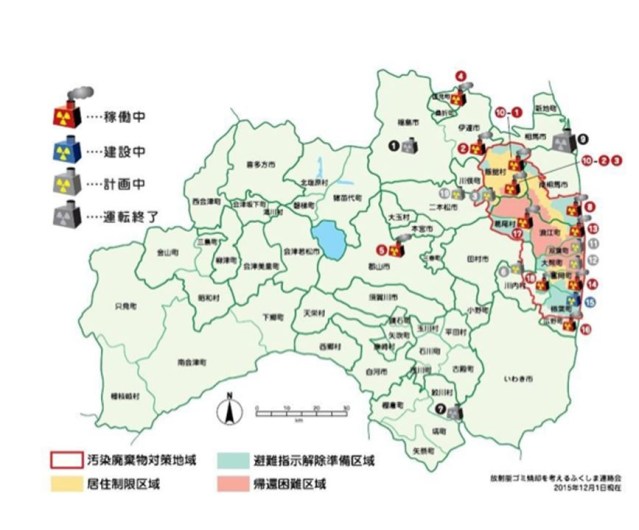
Map of Fukushima prefecture showing the nuclear waste processing establishments locations (shizai-ka center) – Legend: the icons differentiate the various incinerators; red = in operation – blue = under construction – gray / yellow = planned – gray = operation completed
Everywhere on village outskirts there are incinerators of which people know nothing! They often operate at night for two to three months and then everything stops. People wonder what is being burned… Not to mention a rumor about a secret experimentation center where much more contaminated waste would be burned…
Even more frightening, waste processing plants …
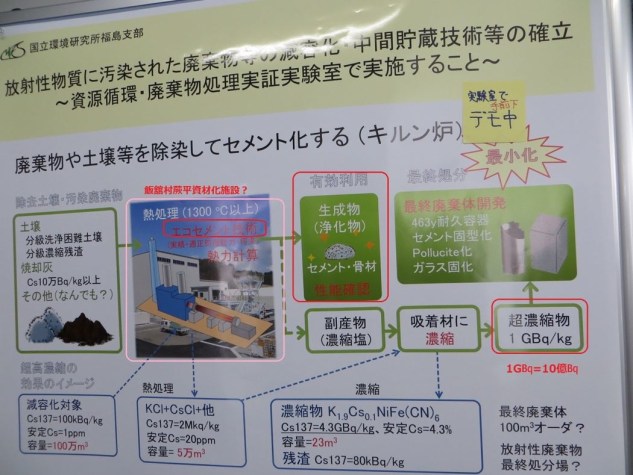
At the “Environmental Design Centre”, a poster about the revolving furnace” which decontaminates waste, debris, soil, etc, transforming them into cement”.
For example, the Warabidaira waste processing plant located in the village of Iitate or the Environment Creation Center (Kankyô Sôzô Center) opened in July 2016 in the town of Miharu, treat contaminated waste (ashes above 100 000 Bq/kg) and contaminated soil coming from land decontamination work.
Now these last two categories are not covered by the Waste Management Law (1) so they have no constraints associated with their treatment… To reduce their volume and to make them … “recyclable”!
In addition, these establishments are registered as “research institutes” and, as such, they are exempt from the building permit application commonly mandated in the framework of the waste management law!
We see inconsistencies and even contradictions between laws. We have already seen the contradiction between the limit of 100 Bq / kg set by the Nuclear Reactor Regulation Law and the 8000 Bq / kg recently adopted by the Ministry of Environment.
IV. Residents, displaced and returned
Citizen radiation measuring. Mothers, and also dads, explore the everyday environment to identify hot spots so as to modify if necessary the route recommended for children, for example “the way to school” (as in Japan all children walk single file).
For that purpose associations use “hot spot finders”. Well aware of the health risk to which children are exposed, they attach sensors connected to GPS on their strollers to walk routes and the way to school or to explore parks.
That system is well thought out: it is a vertical rod 1 meter long that leaves the ground and consists of a measuring device at 10 cm from the ground, another one at 50 cm, and a third at 1 meter to take into account the different sizes of children. If a hot spot is located, others are warned of its location and the children are required to change their route, and authorities are asked to decontaminate. For parents, this work is endless …
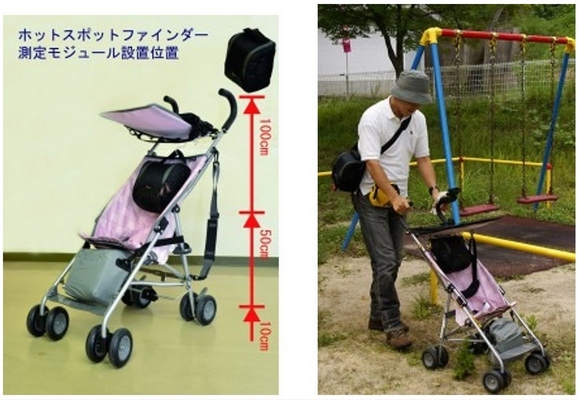
Hot spot finders
People organize citizen actions thru Internet. These independent citizen online databases are many,
and one of them is even translated into English since November 2014. It is the “Minna no Data”: ambient radioactivity measures, soil measurements, food analyzes (2).
Some associations’ logos:
V. Protest actions
The trial against the three former TEPCO executives which began in spring 2016 is the first criminal trial to take place; it could last ten years …
However, in Fukushima Prefecture, there are many other trials at different levels also taking place. For example, in March 2016, a lawsuit was initiated by 200 parents brought against the Fukushima Prefecture, to “get children out of contaminated areas.” People protest to have the “thresholds” lowered. In their opinion the issue of “thresholds” go beyond the strict framework of Japan. They fear that the thresholds of Japan will end up being generalized overseas, which is highlighted in some of the maps captions eg “against the generalization and the externalization of the 20 mSv / year threshold”. Some victims require, as after Hiroshima, “an irradiation book” (personal records) to be used for their access to treatment.
Radiation free health holiday
To send children on a health holiday is now more and more difficult, because people tend to believe that the disaster is already over therefore requests for help have become complicated.
In the city of Fukushima, for example, referring to the nuclear disaster is now taboo …
VI. Social and family catastrophe
It causes “conflicts” among neighbors (one example, one person’s place is decontaminated while its adjoining neighbor’s place is not), between beneficiaries and others, between the displaced and the residents of the hosting location (there are misunderstandings on the issue of compensations; the self-evacuated are not receiving any compensation, but the hosting city locals think they are).
So today many prefer to return their evacuated Fukushima resident card and acquire the resident card of their hosting town (in Japon you are résident of the village from which you keep the residence card) so as to “turn the page” because they can no longer bear to be called “evacuees”. They want to integrate into the community where they moved. Only older people remain unswervingly committed to their original residence; it is mostly the elderly who intend to return.
In many families of the Fukushima Prefecture men stayed by necessity to keep their jobs to provide for their families, while mothers with children evacuated to put them out of danger; but as time has passed, more than five years already, many families have disintegrated… The father visiting the family rarely, often for lack of resources, the marriage falling apart, resulting in many divorces and suicides.
Women are showing remarkable energy, they are on all fronts, openly, and even heavily involved in actions and trials, so that even the articles of the so-called “feminine” press today are often dealing with topics related to the nuclear disaster. Young women in particular are very active in the protests and rallies. This is a significant change in Japanese society.
(1) Waste Management and Public Cleansing Law, Haikibutsu no shori oyobi seisô ni kansuru hôritsu, law N°137 from 1970, last amendment in 2001 https://www.env.go.jp/en/laws/recycle/01.pdf
Nuclear Reactor Regulation Law (Genshiro tô kiseihô).
“Act on the Regulation of Nuclear Source Material, Nuclear Fuel Material and Reactors” (kakugenryô busshitsu,kakunenryô busshitsu oyobi genshiro no kisei ni kansuru hôritsu)
law N°166 from 1957(2) –
English translation of Nuclear Reactor Regulation Law.
http://www.japaneselawtranslation.go.jp/law/detail/?id=1941&vm=03&re=01
(2) – Minna no Data Site (MDS) : http://en.minnanods.net/
_____________________
After his lecture, I asked a simple question to Kurumi Sugita:
Why has she founded the association « Nos Voisins Lointains 3.11 » (“Our Distant Neighbors 3.11”)? …
In France, where lives Kurumi, several Japanese associations exchange about the disaster.
But Kurumi Sugita founded on January 8, 2013 in Lyon, the association « Nos voisins lointains 3-11 » also to inform the French and francophones who do not read Japanese.
The website of the association publishes valuable and moving testimonies, translated into French.
Thanks to donations, the association helps concretely, as much as possible, some affected families in Japan.
To know more
The website of Kurumi Sugita’s association:
http://nosvoisins311.wix.com/voisins311-france
You may find the victims testimonies on her Facebook page:
And general informations on the Fukushima nuclear disaster:
https://www.facebook.com/Nos-Voisins-Lointains-311-555557711144167/
Space dose 1.55 micro Sv/h, Koriyama city, park waterside hotspot
Published on Jul 20, 2016 by Birdhairjp
July 16, 2016 (five years & four months from the nuclear disaster)
I monitored radiation around Gohyakubuchi-park of Koriyama city, Fukushima Prefecture, Japan.
Space dose of the height of the chest of the promenade circling the pond, was approximately 0.27 to 0.30 micro sievert per hour.
At the entrance of the park, a sighnboad shows the decontamination result by the city.
Before the decontamination: 2.33 micro Sv/h as of Sep of 2011
After the decontamination: 0.21 micro Sv/h as of Jun of 2016
(Air dose rate 50cm high from the ground level)
My monitor shows space dose 0.47 on the pond-side promenade near a floodgate to the waterway into the woods.
Space dose on the promenade in the park forest is at the height of the breast, was 0.3 to 0.45 micro Sv/h
To the waterside in the forest, there is a hot spot that radioactive material is collected.
Approaching to the place, the value of the dosimeter is jumped.
Space dose of the height of the breast in the hot spots were recorded 1.5-1.9 micro Sv/h.
Measuring instrument that was used during the video shoot, Ukraine made, ECOTEST’s MKS-05.
Koriyama city : population, about 330,000 people.
Contaminated Bamboo, Iitate, Fukushima
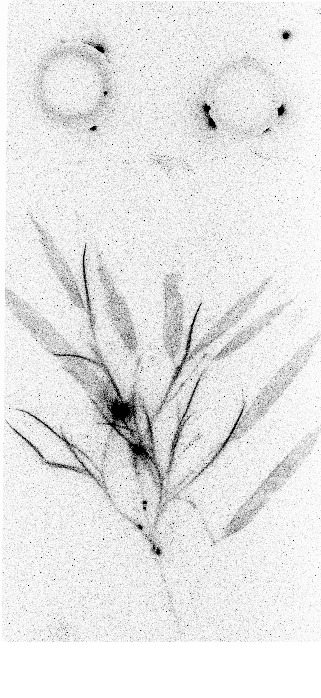
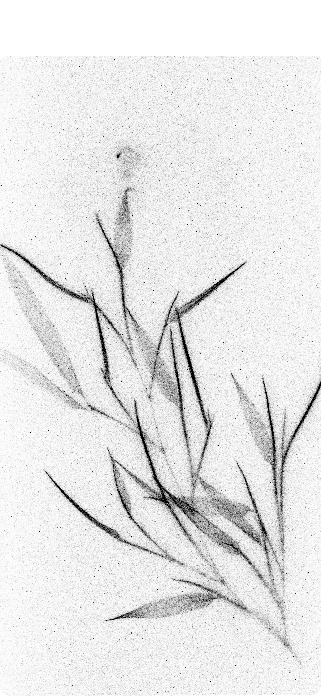
Bamboo was found to be contaminated by radioactive Cesium in the Komiya marsh of the Iitate village, Fukushima Prefecture.
About 500 ㏃ / kg of cesium but the Cesium concentrating more in the new leaves.
Incidentally, the soil has 43,000 ~ 77,000 ㏃ / kg of Cesium
https://www.facebook.com/nobuyoshi.itou/posts/1015326065230713
960 Bq/kg of Cs-134/137 detected from wild boar in Fukushima
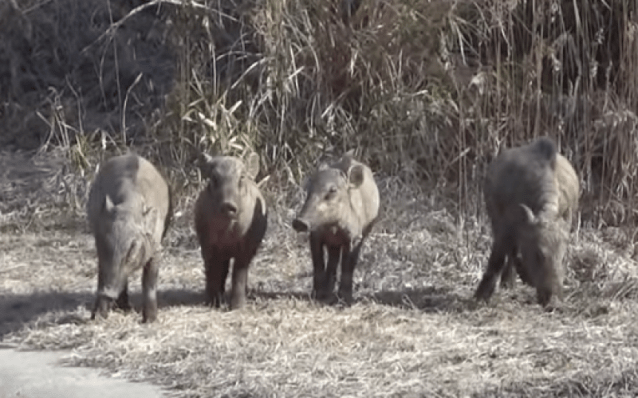
According to MHLW (Ministry of Health, Labour and Welfare), 960 Bq/Kg of Cesium-134/137 was measured from the meat of wild boar in Fukushima.
The sampling date was 6/11/2016. This reading is over 9 times much as food safety limit.
Cs-134 density was 154 Bq/Kg to prove it is contaminated from Fukushima accident.
From this report MHLW released on 7/19/2016, significant density of Cs-134/137 was detected from all of 33 wild boar samples and it exceeded the food safety limit (100 Bq/Kg) in 2/3 samples.
MHLW reports none of these wild boar meat was distributed for sale.
http://www.mhlw.go.jp/file/04-Houdouhappyou-11135000-Shokuhinanzenbu-Kanshianzenka/0000123667_18.pdf
http://fukushima-diary.com/2016/07/960-bqkg-of-cs-134137-detected-from-wild-boar-in-fukushima/
Surf Contest in Minamisoma, Fukushima

On July 17, 2012, they had a national surf contest in Minami Soma city, Fukushima..
In Fukushima, Minami Soma City, after the nuclear accident, for the first time a surfing tournament took place.
Competition in Minami Soma after the nuclear accident had been canceled. It was held for the first time in six years.
Before March 2011, Minami Soma was known as one of Japan’s leading surfing spots.
The evacuation order having been lifted in most of Minami Soma city, Minami Soma city aimed to boost its reconstruction by reviving its surf contest on its Kitaizumi coast.
200 participants from all over Japan came to engage in that surf contest.
Radiation along Fukushima rivers up to 200 times higher than Pacific Ocean seabed – Greenpeace
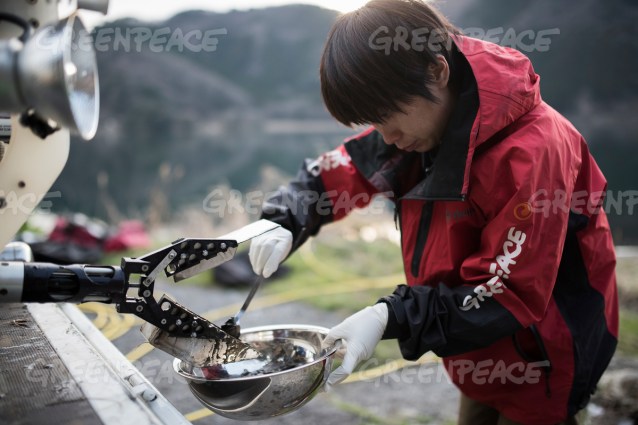
Sediment Sampling at Lake Biwa in Japan: Mai Suzuki from Greenpeace Japan, removes sediment samples from the ROV grabber (Remote Operated Vehicle), at Lake Biwa. Greenpeace has been surveying lake Biwa to conduct baseline sampling. The lake is located as close as 30 km from the Takahama nuclear plant owned by Kansai Electric. In the event of a severe accident Lake Biwa would be at risk of major radioactive contamination. The lake provides the drinking water for 14,5 million people in Shiga Prefecture, the city of Kyoto and the wider Kansai region. The citizens of Shiga recently won a historic legal action that forced the immediate shutdown of Takahama reactor #3, Kansai electric is determined to overturn the legal action on appeal and restart both Takahama 3 and 4 reactor.
Tokyo, 21 July 2016 – Radioactive contamination in the seabed off the Fukushima coast is hundreds of times above pre-2011 levels, while contamination in local rivers is up to 200 times higher than ocean sediment, according to results from Greenpeace Japan survey work released today.
“The extremely high levels of radioactivity we found along the river systems highlights the enormity and longevity of both the environmental contamination and the public health risks resulting from the Fukushima disaster,” said Ai Kashiwagi, Energy Campaigner at Greenpeace Japan.
“These river samples were taken in areas where the Abe government is stating it is safe for people to live. But the results show there is no return to normal after this nuclear catastrophe,” said Kashiwagi.
Riverbank sediment samples taken along the Niida River in Minami Soma, measured as high as 29,800 Bq/kg for radiocaesium (Cs-134 and 137). The Niida samples were taken where there are no restrictions on people living, as were other river samples. At the estuary of the Abukuma River in Miyagi prefecture, which lies more than 90km north of the Fukushima Daiichi plant, levels measured in sediment samples were as high as 6,500 Bq/kg.
The lifting of evacuation orders in March 2017 for areas that remain highly contaminated is a looming human rights crisis and cannot be permitted to stand. The vast expanses of contaminated forests and freshwater systems will remain a perennial source of radioactivity for the foreseeable future, as these ecosystems cannot simply be decontaminated.
Caesium-137 has a half life of 30 years, and will continue to pose a risks to the the environment and human health for hundreds of years. Cs-137 contamination in seabed samples near the Fukushima plant was measured at up to 120 Bq/kg – compared to levels pre-2011 of 0.26 Bq/kg. Further, the levels of contamination found 60km south of the Fukushima Daiichi nuclear plant were comparable with those found within 4km of the plant. Numerous marine science investigations, have concluded that these higher levels are one explanation for some marine species still showing higher cesium levels than the background levels in seawater.
“The radiation levels in the sediment off the coast of Fukushima are low compared to land contamination, which is what we expected and consistent with other research,” said Kendra Ulrich, Senior Global Energy Campaigner at Greenpeace Japan. “The sheer size of the Pacific Ocean combined with powerful complex currents means the largest single release of radioactivity into the marine environment has led to the widespread dispersal of contamination.”
Most of the radioactivity in Fukushima Daiichi reactor units 1-3 core fuel in March 2011 remains at the site.
“The scientific community must receive all necessary support to continue their research into the impacts of this disaster,” said Ulrich.
“In addition to the ongoing contamination from forests and rivers, the vast amount of radioactivity onsite at the destroyed nuclear plant remains one of the greatest nuclear threats to Fukushima coastal communities and the Pacific Ocean. The hundreds of thousands of tonnes of highly contaminated water, the apparent failure of the ice wall to reduce groundwater contamination, and the unprecedented challenge of three molten reactor cores all add up to a nuclear crisis that is far from over,” said Ulrich.
A radiation survey team onboard the research vessel Asakaze, supported by the Greenpeace flagship Rainbow Warrior, conducted underwater survey work along the Fukushima coastline from 21 February to 11 March this year, as well collecting samples in river systems. The samples were measured at an independent laboratory in Tokyo.
Link to the report, Atomic Depths, can be found here http://www.greenpeace.org/japan/Global/japan/pdf/20160721_AtomicDepths_ENG.pdf
http://www.greenpeace.org/japan/ja/news/press/2016/pr201607211/
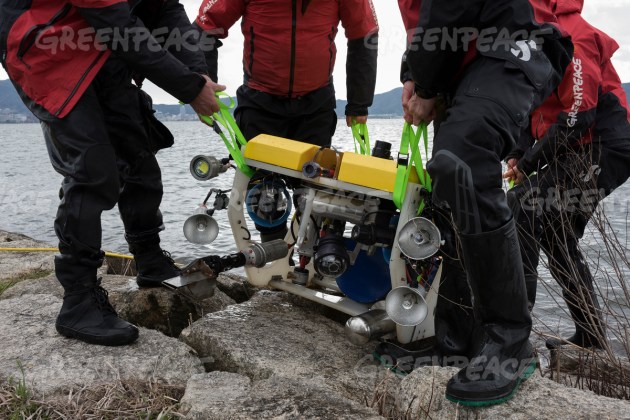
Greenpeace Japan members carry out ROV (Remote Operated Vehicle) operations at Lake Biwa, Shiga Prefecture in Japan. Greenpeace has been surveying lake Biwa to conduct baseline sampling.
Greenpeace reports jump in radioactive contamination in Fukushima waterways
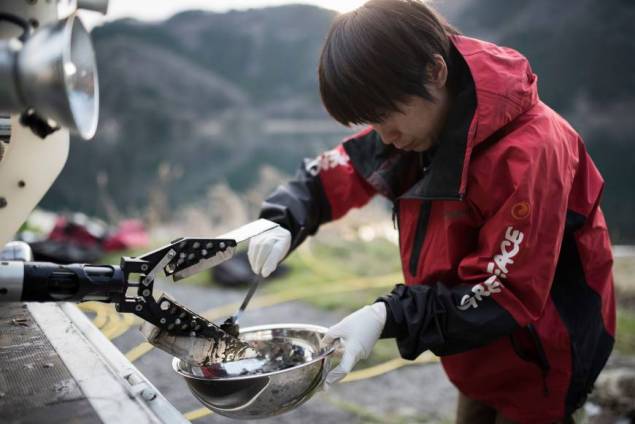
Greenpeace Japan member Mai Suzuki removes sediment samples from a remotely operated grabber at Lake Biwa in Shiga Prefecture on March 22.
OSAKA – Greenpeace Japan on Thursday said it has discovered radioactive contamination in Fukushima’s riverbanks, estuaries and coastal waters at a scale hundreds of times higher than pre-2011 levels.
One sample of sediment taken along the Niida River, less than 30 km northwest of the crippled Fukushima No. 1 power plant, revealed the presence of cesium-134 and cesium-137 at levels of 29,800 becquerels per kilogram.
That was just one of 19 samples of dried sediment and soil the environmental activist group took and analyzed from the banks of the Abukuma, Niida, and Ota rivers. The samples were collected by Greenpeace in February and March.
All of the samples but one exhibited more than 1,000 Bq/kg of radioactive material. The lowest level, 309 Bq/kg, was logged at a spot along the Abukuma River.
Cesium-134 has a half-life of about two years, but cesium-137 has a half-life of 30 years and is considered particularly hazardous. The standard limits set for radioactive cesium in Japan are 100 Bq/kg for general foods and 10 Bq/kg for drinking water.
“The radiological impacts of the Fukushima nuclear disaster on the marine environment, with consequences for both human and nonhuman health, are not only the first years. They are both ongoing and future threats, principally the continued releases from the Fukushima No. 1 plant itself and translocation of land-based contamination throughout Fukushima Prefecture, including upland forests, rivers, lakes and coastal estuaries,” the report said.
Greenpeace Japan also published the results of tests on dried marine sediment samples collected at 25 points off the Fukushima coastal area, including three river estuaries, during this same period, at depths of between 7.4 and 30.6 meters. The results showed that the highest level of cesium was 144 Bq/kg taken from a sample collected off the coast from the Fukushima power plant, while the lowest total cesium figure was 6.5 Bq/kg off Nakanosaku, well to the south of the plant.
In addition to Fukushima, Greenpeace Japan took dried sediment samples from Lake Biwa at three locations near the shore. The results showed cesium levels to be between 7.1 Bq/kg and 13 Bq/kg at two locations, and negligible at the other two.
The safety of Lake Biwa, which provides drinking water for about 14 million people in the Kansai region, has become a major bone of contention between Kansai Electric Power Co., which wants to restart reactors in neighboring Fukui Prefecture, and residents in and around Lake Biwa who are fighting to keep them shut down.
Fukushima Radioactive Feces of Mouse

Feces of the mouse: Tomioka city, near crippled Fukushima Nuclear power station.
Cs-134:11917 Bq/kg
Cs-137:63557 Bq/kg
Total:75474 Bq/kg
Data reveals leading edge of Fukushima plume is in BC’s coastal waters
Current status:
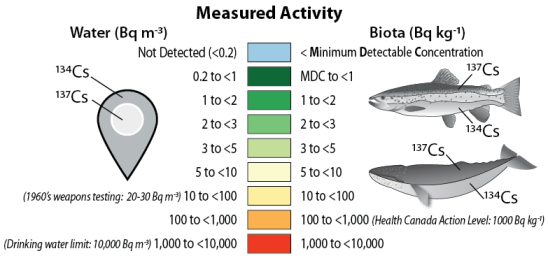
Coastal monitoring: Seventeen more samples are in the books. Mostly from March and a few from April; no coastal samples contained any of the Fukushima fingerprint isotope, 134Cs (2 year half-life). Low levels of 137Cs (~30 year half-life) were present in all of the samples. These new data continue to lie along the increasing trend which indicates that the leading edge of the Fukushima plume is in BC’s coastal waters.

Monthly averaged 137Cs data from the BC coast collected by the InFORM citizen science network between October 2014 and March 2016. The dashed linear trendline shows that levels of 137Cs have been increasing over this period. Error bars indicate one standard deviation. Large error bars in Februray and May 2015 were months when Ucluelet samples tested positive for 134Cs. Colors are the same as used in the spatial map of the data.
The above trend is clear and shows a steady rise that would predict that the average sample will have double the initial background concentrations of 137Cs sometime this summer. While still far below the 10,000 Bq m-3 level of concern for cesium radionuclides in drinking water, these more contaminated samples should also more regularly contain the Fukushima fingerprint isotope, 134Cs.
While the increasing 137Cs trend is clear for the whole coast, it is also evident that each region is telling the story of how ocean waters circulate in coastal British Columbia.

Analysis as above, but with data grouped into regions as follows: Haida Gwaii / North Coast: Lax Kw’alaams, Prince Rupert, Masset, Hartley Bay, Sandspit, North Van Is / Central Coast: Bella Bella, Port Hardy, Winter Harbour, West Coast Van Is: Tofino, Ucluelet, Bamfield, Strait of Georgia: Powell River, Vancouver, Salt Spring Island, South Van Is: Port Renfrew, Victoria.
Looking at this regional graph and focusing on the period from August 2015 – March 2016, we see the highest concentrations of 137Cs shift from appearing on the west coast of Vancouver Island northward to Haida Gwaii. As explored last month, this could indicate a northward shift of the North Pacific Current bifurcation.
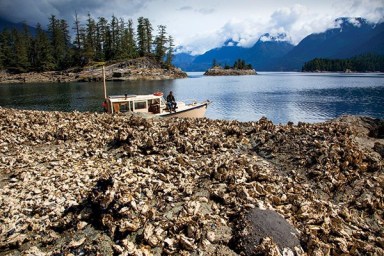
Biotic Monitoring:
Summer sampling season is back! We’re coordinating with many of the same First Nations as in 2015 for repeat sampling of the same salmon populations. In addition to salmon, this year we are joined by Dr. Helen Gurney-Smith from Vancouver Island University who specializes in marine invertebrates. She is coordinating the collection of mussels, clams, oysters, and scallops from all of the major shellfish beds in BC waters including Baynes Sound, Quadra Island, and Haida Gwaii. These samples will be new species in our sampling repertoire and will help us see how sessile organisms take up Fukushima radionuclides along the coast. The resulting data will be valuable to invertebrate scientists like Dr. Gurney-Smith and reassure consumers of the the $33 million BC shellfish industry.
Oceanic Monitoring:
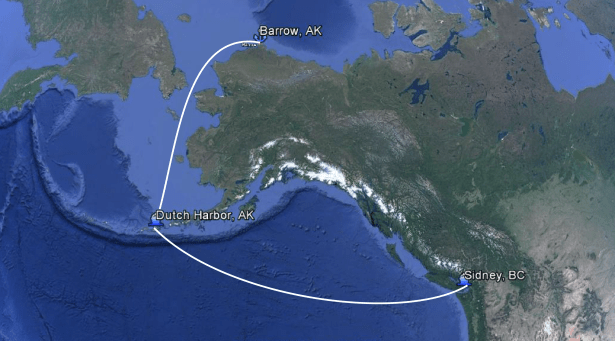
Three research cruises will collect InFORM samples this summer. Two out to Ocean Station Papa in the central NE Pacific, and currently, undergrad Saskia Kowallik is aboard the CCGS Sir Wilfred Laurier enroute from Sidney, BC to Dutch Harbor, then onto Barrow, AK. She will be reporting in a few times while away and you can read her first dispatch here.
Additionally, Dr. John Smith says that initial results from the February 2016 Line P cruise indicate that the concentrations of 134-Cs may have plateaued at Ocean Station Papa and possibly slightly decreasing. This isn’t so much a true decline as it is a smearing of the signal as the radionuclides are dispersing throughout the rest of the NE Pacific. In other interesting news, Dr. Smith just returned from a meeting in China where a colleague used a highly specialized gamma spectrometer and a very large volume of water sampled in the Chuckchi Sea to detect the trace level of 134-Cs that is ~5 times lower than the detection threshold (0.2 – 0.4 Bq m-3) for the instrumentation used at the University of Ottawa where the coastal samples are processed. This means that minute amounts of Fukushima contamination are entering the Arctic Ocean and that that it only takes ~5 years for waters to transit from coastal Japan to the Arctic. With the ability to detect such low levels of contamination, it will be interesting to see what else we can learn about oceanic transport times as monitoring continues into the future.
*Note: Results are preliminary and may be slightly adjusted pending results from further chemical analysis.
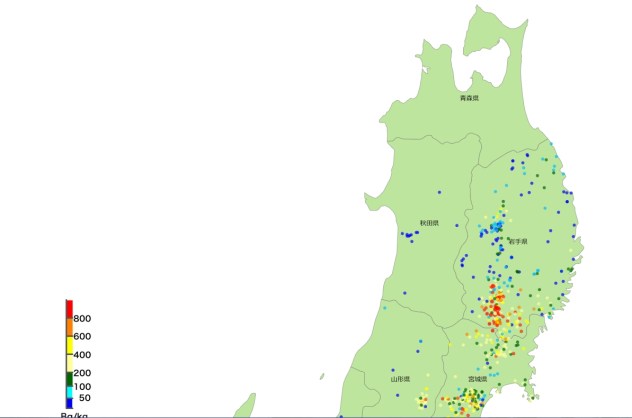
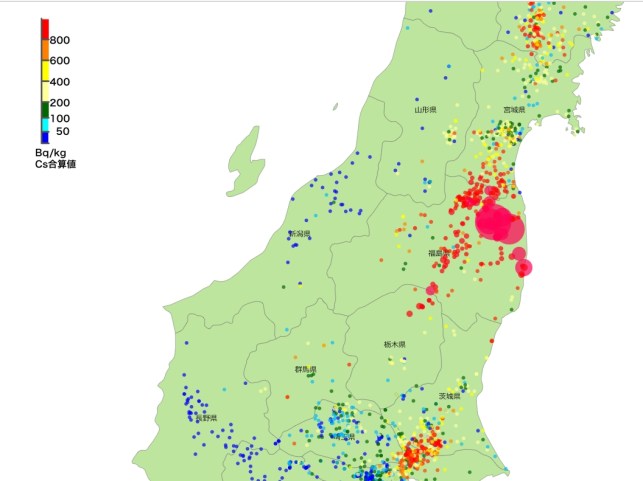
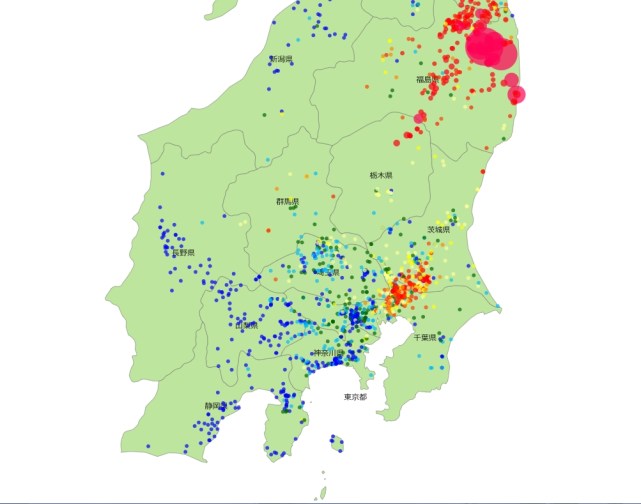
Interactive Map of Cesium in Japan by citizen’s monitoring project.
As you may see the contamination is well spread all along the eastern coast of Japan, the highest contamination found of course in the Fukushima prefecture.
But also numerous hot spots are found in the two prefectures above Fukushima prefecture, the Iwate and Miyagi prefectures, and also near Tokyo in the Ibaraki, Saitama, Kanagawa and Chiba prefectures.
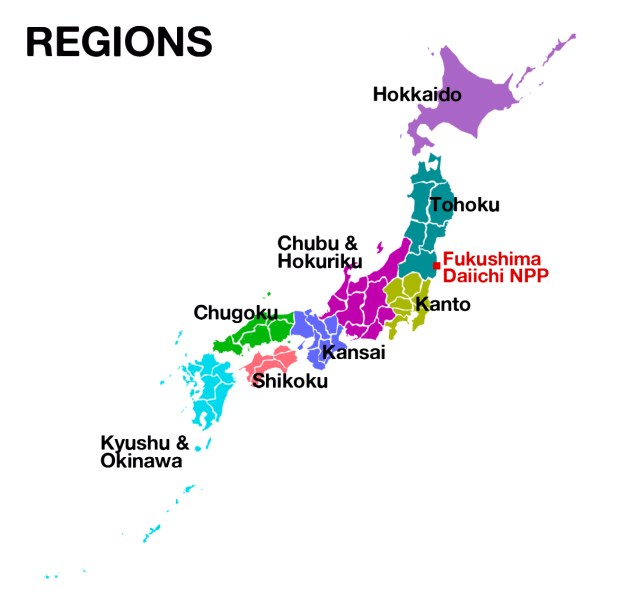
The contamination is concentrated in the two eastern regions of Japan: the Tohoku region in the north-east, and the Kanto region in the east. It is less pronounced once you leave the eastern part of Japan going towards the central regions of nearby Chubu and distant Kansai.
Some restricted zones to be lifted near Fukushima nuclear plant
Soft propaganda from the Asahi Shimbun, supporting the Government lifting of the evacuation order in some of the restricted zones, encouraging people to return into the evacuated zones.
Saying “In some of the areas, however, radioactive contaminants have been washed away by rain or blown away by wind. Radiation from those substances has also dissipated naturally.”
Conveniently omitting to mention, that in many decontaminated places, radiation soon returns to pre-decontamination level, thanks to the accumulated radionuclides of the mountain forests (80% of Fukushima prefecture) always ruisseling down with the rain or carried everywhere by the wind, not mentioning also that something in Fukushima Daiichi still fissioning, releasing radionuclides loaded gassings into the environment.
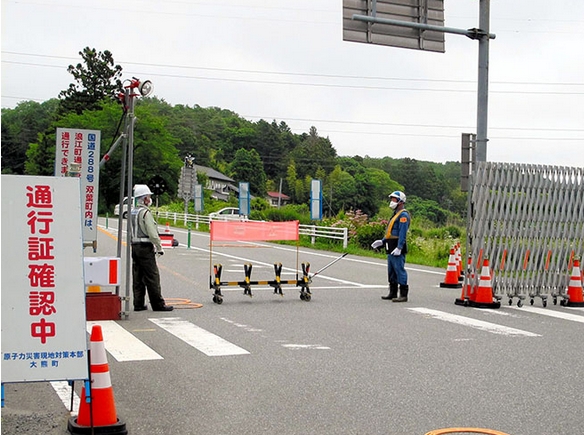
A gate is set up on a national road in Okuma, Fukushima Prefecture, restricting entrance to “difficult-to-return zones.” Permits from the central government are required to enter the areas.
For the first time since the 2011 nuclear disaster in Fukushima Prefecture, the government will lift the designation of some “difficult-to-return zones” around the crippled nuclear plant.
The rescinding is expected to be done gradually from around 2021. By that time, the government plans to undertake intensive decontamination work in central districts of municipalities, where residents will likely return, and districts along main roads.
The “difficult-to-return zones,” which cover a total of 337 square kilometers, are areas where the radiation level exceeded 50 millisieverts per year after the accident at the Fukushima No. 1 nuclear plant. Those areas are off-limits, in principle.
In some of the areas, however, radioactive contaminants have been washed away by rain or blown away by wind. Radiation from those substances has also dissipated naturally.
In front of the Environmental Radioactivity Monitoring Center of Fukushima in the central district of Okuma town, the radiation level is now about 9 millisieverts per year, about one-fifth the level of five years ago.
According to the policies of the government and the ruling parties, if radiation levels are reduced to 20 millisieverts or lower in some areas due to decontamination work, people are allowed to live there.
Of the areas, those where residents or workers for decommissioning of crippled nuclear reactors are expected to live will be subject to intensive decontamination work along with areas on both sides of main roads.
The government and the ruling parties will discuss the lifting of “difficult-to-return zones” with seven municipalities, including Okuma, and will make the official decision in August.
However, even if the designation is lifted, it is uncertain if residents will return to their homes.
According to the annual survey conducted by the Reconstruction Agency on evacuees, only about 10 percent of households evacuating from four municipalities around the nuclear plant are hoping to return home.
Before the nuclear crisis occurred, about 24,000 people of 9,000 households were living in areas that are currently designated as “difficult-to-return zones.”
Radioactive Forest
July 9, 2016
The Fukushima nuclear accident in 2011 turned the surrounding towns into a desolate land, making the area into a “radioactive forest”. Without human presence, the land is roamed by wildlife like civets, macaques and wild boars. A project is underway to study the deserted areas by attaching a camera to wild boars to record the conditions of the former farmlands. 5 years after the disaster, we take a close look at how radiation has affected the wildlife, and what it entails for us humans.
Deposition of radiocesium on the river flood plains around Fukushima

The environment in the area around Fukushima Daiichi Nuclear Power Plant has been contaminated by widely deposited significant amount of radioactive materials, which were released to the atmosphere caused by the Fukushima Daiichi Nuclear Power Plant accident due to the Great East Japan Earthquake, which occurred on March 11, 2011. The radiocesium released in the accident mainly affects radiation dose in the environment. Decontamination work in the contaminated area except a mountain forests has been conducted to decrease the radiation dose. However, there are concerns that the redistribution of this radiation due to water discharge will occur due to the resulting transport of radiocesium. In particular, the deposition of soil particles containing radiocesium on the flood plains in the downstream areas of Fukushima’s rivers can potentially increase the local radiation dose. Therefore, it is important to understand the influence of the deposition behavior of radiocesium on the radiation dose.
Investigations of rivers have been performed to enhance the understanding of the mechanisms by which radiocesium is deposited on these flood plains. It was found that the spatial distribution of the radiocesium concentration on the flood plain along the river is heterogeneous with a dependence on the depositional condition and that the number of points with high air dose rates is limited. In detail, the radiocesium concentration and air dose rates in flood channels are higher than those at the edges of the river channels. Based on these heterogeneity and hydrological events, the deposition and transport mechanisms of the radiocesium due to water discharge at rivers were also interpreted, and a conceptual model was constructed.
http://www.sciencedirect.com/science/article/pii/S0265931X16301187

1 This Month

of the week – Shut Down Drone Warfare!


Tell the Ukrainian Government to Drop Prosecution of Peace Activist Yurii Sheliazhenko

Petition to revoke the licensing of the Near Surface Nuclear Disposal Facility (NSDF) at Chalk River. https://www.ourcommons.ca/petitions/en/Petition/Details?Petition=e-7247
To see nuclear-related stories in greater depth and intensity – go to https://nuclearinformation.wordpress.com
-
Archives
- March 2026 (244)
- February 2026 (268)
- January 2026 (308)
- December 2025 (358)
- November 2025 (359)
- October 2025 (376)
- September 2025 (257)
- August 2025 (319)
- July 2025 (230)
- June 2025 (348)
- May 2025 (261)
- April 2025 (305)
-
Categories
- 1
- 1 NUCLEAR ISSUES
- business and costs
- climate change
- culture and arts
- ENERGY
- environment
- health
- history
- indigenous issues
- Legal
- marketing of nuclear
- media
- opposition to nuclear
- PERSONAL STORIES
- politics
- politics international
- Religion and ethics
- safety
- secrets,lies and civil liberties
- spinbuster
- technology
- Uranium
- wastes
- weapons and war
- Women
- 2 WORLD
- ACTION
- AFRICA
- Atrocities
- AUSTRALIA
- Christina's notes
- Christina's themes
- culture and arts
- Events
- Fuk 2022
- Fuk 2023
- Fukushima 2017
- Fukushima 2018
- fukushima 2019
- Fukushima 2020
- Fukushima 2021
- general
- global warming
- Humour (God we need it)
- Nuclear
- RARE EARTHS
- Reference
- resources – print
- Resources -audiovicual
- Weekly Newsletter
- World
- World Nuclear
- YouTube
-
RSS
Entries RSS
Comments RSS
 nuclear-news