For some Fukushima mothers, protecting children from radiation comes at heavy price

Residents who were evacuated from Okuma and three other towns in Fukushima Prefecture attend an event at a public housing facility in Iwaki to help them assimilate into the community on Feb. 19.
Three-and-a-half years after fleeing to central Japan, a mother received a package from her husband who had opted to remain at their home in Fukushima Prefecture despite the nuclear disaster.
From Tamura, about 35 kilometers west of the stricken Fukushima No. 1 nuclear plant, the father sent snacks for the couple’s two children. The cardboard box also contained divorce papers.
“I cannot send money to my family whom I cannot see,” the husband told his wife.
She still refused to return home.
Thanks to decontamination work, radiation levels have fallen around the nuclear plant since the triple meltdown caused by the Great East Japan Earthquake and tsunami in March 2011. And families are returning to their hometowns, trying to resume normal lives.
But many mothers, distrustful of the government’s safety assurances, still harbor fears that radiation will affect the health of their children. As a result of these concerns, families are being torn apart, friendships have ended, and a social divide remains wide in Fukushima communities.
Around 70,000 people are still not allowed to return to their homes located in evacuation zones designated by the central government. And an estimated 18,000 people from Fukushima Prefecture whose homes were outside those zones remain living in evacuation.
The government is pushing for Fukushima residents to return home and trying to counter false rumors about the nuclear disaster.
More families in Fukushima Prefecture are willing to buy food produced in the prefecture–but not all.
A 40-year-old mother who once lived on the coast of Fukushima Prefecture and moved farther inland to Koriyama said she still fears for the health of her 11-year-old daughter.
Her classmates started serving “kyushoku” school lunches containing Fukushima rice and vegetables that passed the screening for radioactive materials. But the fifth-grader has instead eaten from a bento lunch box prepared by her mother.
The daughter says that eating her own lunch led to teasing from her classmates. She heard one of them say behind her back: “You aren’t eating kyushoku. Are you neurotic?”
She does not talk to that classmate anymore, although they used to be friends.
“I now feel a bit more at ease even when I am different from other students,” the daughter said.
Her mother expressed concerns about her daughter’s social life, but protecting her child’s health takes precedence.
“My daughter may fall ill sometime,” the mother said. “I feel almost overwhelmed by such a fear.”
An official of the Fukushima prefectural board of education said a certain number of students act differently from other students because of health concerns over radiation.
“Although the number is limited, some students bring bento to their schools,” the official said. “Some students wear surgical masks when they participate in footraces during outdoor school athletic meets.
“The feelings toward radiation vary from person to person, so we cannot force them (to behave in the same way as other students).”
Sung Woncheol, a professor of sociology at Chukyo University, and others have conducted surveys on mothers whose children were 1 to 2 years old when the nuclear disaster started. The mothers live in Fukushima city and eight other municipalities in Fukushima Prefecture.
Of the 1,200 mothers who responded to the survey in 2015, 50 percent said they had concerns about child-rearing in Fukushima Prefecture.
Nearly 30 percent said they avoid or try to avoid using food products from Fukushima Prefecture, compared with more than 80 percent six months after the disaster.
But for some mothers, the passage of nearly five years since the disaster unfolded has not erased their fears of radiation.
The 36-year-old mother who received the divorce papers from her husband in autumn 2014 continues to live with her children in the central Japan city to which she had no previous connection.
A month after the nuclear disaster, she fled with her then 1-year-old son and her daughter, 10, from their home, even though it was not located in an evacuation zone.
She said she left Fukushima Prefecture because she “could not trust the data released by the central government.”
The mother still has not told her children that their parents are divorced.
“I believe I could protect the health of my children,” the woman said. “But my family has collapsed.”
http://ajw.asahi.com/article/0311disaster/fukushima/AJ201602230068
Less protective gear at Fukushima Daiichi
The operator of the Fukushima Daiichi nuclear plant plans to make it easier for workers engaged in decommissioning efforts nearly 5 years after the accident. They will gradually be able to work without wearing protective gear or gloves in areas with low radiation.
NHK has learned that Tokyo Electric Power Company is to introduce the new measure early next month for about 90 percent of the facility.
Radiation readings near the ground in these areas were 5 microsieverts per hour or less as of December. The figures went down after the operator removed contaminated soil and paved the surface.
TEPCO will increase in stages the number of workers wearing only regular work clothing.
The utility now requires each worker to wear protective gear and 2 pairs of gloves. This is preventing them from moving around smoothly and from carrying out precision work.
The policy will continue for people working near the reactor buildings and around tanks that contain highly radioactive water.
TEPCO plans to notify workers and tighten controls so that they do not approach these areas without wearing protective gear.
http://www3.nhk.or.jp/nhkworld/en/news/20160225_02/
Fukushima ice wall shown to media
An incinerator in Fukushima Daiichi means more incineration, which add more radioaticle nanoparticles dispersed into the air and into the environment.
The operator of the damaged Fukushima nuclear power plant has shown media outlets the site where work has been completed for an underground ice wall. The wall is designed to stop underground water from flowing into the plant’s reactor buildings.
Tokyo Electric Power Company, or TEPCO, began construction of the wall in 2014. Its work was completed earlier this month.
The wall is designed to freeze the soil around the Number 1 to Number 4 reactor buildings in order to keep groundwater from seeping into the structures.
TEPCO has driven about 1,500 pipes carrying refrigerant liquid into the ground around the buildings. The pipes and cooling devices were shown to the media on Tuesday.
But workers have not yet injected a freezing agent into the pipes. This is due to concerns that a sudden drop in groundwater levels may result in the release of radioactive water. TEPCO officials are examining the situation with the Nuclear Regulation Authority, or NRA.
Masato Kino of the Agency for Natural Resources and Energy is in charge of dealing with the contaminated water. He says now that the ice wall is completed, his agency is consulting with the NRA to reduce the volume of radioactive water at the plant.
TEPCO officials also showed the media an incinerator that will burn contaminated waste such as used protective suits.
Officials plan to start testing the incinerator on Thursday.
They hope it will help reduce about 66,000 cubic meters of waste that has accumulated at the plant.
http://www3.nhk.or.jp/nhkworld/en/news/20160223_32/
Japan Olympic teams to train in nuclear clean-up zone

Piles of used protective clothing worn by workers inside the contaminated ‘exclusion zone’, seen in 2011 at J-Village, a football training complex serving as an operation base for those battling Japan’s nuclear disaster in Fukushima
Tokyo (AFP) – Japan’s Olympic football teams will train for the Tokyo 2020 Games at a complex currently being used as a base for thousands of workers cleaning up the crippled Fukushima nuclear plant.
The Japan Football Association (JFA) said Monday that the Japanese men’s and women’s teams would hold their training camps at J-Village, once the country’s centre of excellence until it was taken over by plant operators following the 2011 nuclear disaster.
“The teams will use the J-Village facility as a training base,” JFA communications chief Takato Maruyama told AFP.
“It is something the JFA had been talking about but a timeline hadn’t been formally approved by the executive board, until now,” Maruyama said.
J-Village is on the fringes of the old 12-mile (20-kilometre) exclusion zone around the stricken plant, which suffered a triple reactor meltdown after a giant tsunami slammed into it in March, 2011, causing massive radiation leaks and forcing the evacuation of more than 150,000 people.
As the nuclear crisis raged, J-Village became the front line in the fight to control the situation, with helipads, medical centre and dormitories hastily erected for workers filing in and out of the plant in their protective suits and masks.

Workers queue for a bowl of soup at J-Village, a football training complex serving as an operation base for those battling Japan’s nuclear disaster in Fukushima prefecture, in 2011
Following the removal of the no-entry zone last September, the sprawling site located in the sleepy town of Naraha will undergo large-scale reconstruction with a view to a partial reopening by July 2018.
“Obviously the complex will need some refurbishment but that is the time frame we have heard from TEPCO (Tokyo Electric Power Company) and J-Village,” said Maruyama.
Japanese officials plan to reopen the facility — originally constructed by TEPCO and donated to the regional government in 1997 — to serve as a symbol of recovery for the Tokyo Olympics.
Venues in the tsunami-ravaged northeastern Tohoku region also hoping to be involved in the Games.
“J-Village has always been an important venue and it has a large role to play in the recovering of Fukushima,” JFA director Eiji Ueda told local media.
Despite the symbolic value of training at the complex, the JFA insisted that safety was of utmost importance.
“We can’t make any specific comment on radiation but clearly you can’t play football in places where it isn’t safe for people to go,” said Maruyama, referring to the proposal to reopen J-Village in 2018.
“Obviously it will be opened on condition that all decontamination work has been completed safely,” he added.
“We can’t say (at this point) if that decontamination will have been fully carried out and whether there will be zero effect from radiation by that time.”
Japan’s nuclear reactor restarts anger Minami Soma mayor

Katsunobu Sakurai: ‘It is necessary for all of Japan to change its way of thinking and its way of life’
TOKYO (TR) – One video made him one of the most well-known faces of the Fukushima nuclear crisis.
In the 11-minute YouTube video uploaded on March 24, 2011, mayor Katsunobu Sakurai begged for help for his city of Minami Soma, located 15 miles away from the crippled Fukushima Daiichi Nuclear Power Plant.
Five years later, Sakurai says his city still hasn’t fully recovered. Making matters worse, he says, is Japan’s reversion to nuclear energy: After a nationwide halt, two power companies restarted reactors in Fukui and Kagoshima prefectures beginning last year and Tokyo Electric Power (TEPCO), which operates Fukushima Daiichi, is scheduled to bring two reactors back online in Niigata Prefecture later this year.
“As a resident of an area affected by the nuclear power plant disaster, I must express great anger at this act,” said Sakurai at a press luncheon at he Foreign Correspondents’ Club of Japan on Thursday. “When we look at how all of the affected areas of Japan, including Minami Soma, can rebuild following the disaster, it is necessary for all of Japan to change its way of thinking and its way of life.”
After the Great East Japan Earthquake on March 11, 2011, the meltdown at the Fukushima Daiichi plant resulted in the halting of all nuclear power plants in Japan. In 2013, stricter safety regulations were implemented by the Nuclear Regulation Authority.
In August and October of last year, the first two reactors under the new regulations were brought back online at Kyushu Electric Power’s Sendai Nuclear Power Plant in Kagoshima. A third reactor was restarted by Kansai Electric Power at the Takahama Nuclear Power Plant in Fukui earlier this month.
This summer, TEPCO is expected to restart two reactors at its Kashiwazaki-Kariwa Nuclear Power Plant in Niigata. When asked to comment on the restart, Yukako Handa, a TEPCO spokesperson, wrote in an email, “For the restart, we will accurately respond to (any requests for) review with safety as a top priority while proceeding by putting our best efforts into sincere explanations about safety concerns (obtained) from local residents.”
Recovery
An evacuation order issued after the earthquake forced many residents in Minami Soma to leave their homes. But the population is recovering, says Sakurai. Having dipped as low as 10,000, the number of residents in Minami Soma is approximately 57,000, about 80 percent of the total before the disaster.
Radiation levels are being continually monitored. According to Sakurai, 70 percent of the children in Minami Soma have returned since the disaster, with 99.86 percent of those tested being radiation-free.
But, according to Sakurai, there remains lingering fears of high radiation levels and that compensation from the government may disappear. This, he says, is having social and economic implications: The city is suffering from a shortage of workers, especially for schools and nursery facilities.
“Our hope is for as many people as possible to be able to return to Minami Soma and also join or become involved in the ongoing recovery process,” said Sakurai. “However, we are also faced with the reality that five years has passed since the disaster. During that time, many of the younger generation have moved away and built new homes and new lives in their places of evacuation or in the places they have moved to.”
How officials and popular academics have responded to disaster victims in the wake up of Tokyo Electric Power Company’s Fukushima nuclear accident
 About the author
I worked as a full-time teacher at a public high school in Fukushima for about twenty-five-and-a-half years, until July 31, 2011. During the first four years of my career, I taught at Futaba High School in Futaba-machi, home to the Fukushima Daiichi Nuclear Power Plant. Naturally, I have heard stories about the harsh working conditions of nuclear workers. For example, in a certain area of the power plant, working for 10 minutes would exceed the legal maximum daily radiation exposure limit. So each shift was officially recorded as 10 minutes even though their actual worked shift was 8 hours. The workers would primarily wipe water leaking from the piping surrounding the nuclear reactor. When workers died of illnesses like cancer, their families received unusually high amounts of cash as lump-sum payments, while actual workmen’s compensation insurance was not provided.
 At the time of the 2011 nuclear accident, I was living in a city 53 kilometers (33 miles) away from the power plant with my wife and two children. I was working at a public school 60 kilometers (37 miles) from the plant.
After the accident, on the evening of March 15, 2011, the maximum airborne radioactive levels of 23 microsievert/hour was detected in Fukushima City, where I worked. Outside the school the following day, however, the annual school acceptance announcements were held as scheduled. Several faculty, including myself, met with the principal to insist that usual outdoor announcement be cancelled as to avoid having young students exposed to radiation–but the announcement event was forced outdoors. The principal cited reasons such as, “the Fukushima Prefecture office strongly supports the outdoor plan” and he “had no choice as the school principal.”
From April 2011 on, aside from the prohibition of outdoor gym classes, neither my school nor the Fukushima Board of Education took any measures to prevent further radiation exposure for students. The school had students practice club activities outdoors as usual. Indoor club athletes were made to run outdoors as well, without any protective measure against radiation exposure. Despite the standard practice, measures such as gargling, washing hands, changing clothes, and showering weren’t deemed necessary for students when returning from outdoor activities. Since I had some knowledge about radiation exposure, I advised the students to take caution to remove potential contamination whenever possible. However, in response to my giving the students advice to prevent radioactive materials from entering the building, I had been cautioned by the Fukushima Prefectural Board of Education, in the form of official “guidance” which forbids me to even talk about radiation and nuclear power plants to the students. Given that I was officially barred from protecting students from radiation exposure, I decided to make my move: along with my family, I evacuated my hometown and relocated to Sapporo city in Hokkaido. Once we evacuated, we found out about a financial system by Fukushima Prefecture which supports voluntary evacuees from the areas outside of the officially restricted zone (though it only approved applications from evacuees pre-December 2012; those who evacuated thereafter would not be financially supported).
I have been teaching part-time in Hokkaido. Since finding out that within the public school system the Fukushima Prefecture Board of Education can intervene to oversee public high school relocation anywhere, I have been teaching at private schools only. Aside from my part-time job, I have been involved in a nuclear power plant damages lawsuit as a plaintiff as well as a member of the refugee organization.
 1. Fukushima Prefectural Government and the Tokyo Electric Power Company (TEPCO)’s Fukushima Nuclear Accident
The reactors at the TEPCO Fukushima Daiichi Nuclear Power Plant, especially Unit 1 and Unit 2, were delivered and installed from the US after the US manufacturer finished all of their construction. As for Units 3, 4, 5, and 6 the Japanese manufacturer added their own “improvements” to the original structure.
I will try to avoid a lengthy explanation. TEPCO’s Fukushima Daiichi Nuclear Power Plant frequently had accidents immediately after beginning operation and the nuclear workers’ exposure levels amounted to twice to ten times the average exposure dose at other nuclear plants. Furthermore, TEPCO kept a lot of serious accidents hidden from Fukushima Prefecture and the Japanese government. TEPCO proposed using Unit 3 for so-called pluthermal power generation, utilizing fuel which can contain weapons-grade plutonium in order to reduce the plutonium surplus in Japan. Eisaku Sato, then-governor of Fukushima, strongly objected to the proposal.The Japanese government arrested and convicted Governor Sato on bribery charges with the amount of the bribe recognized as “zero yen.” They drove him to resign, then elected Yuhei Sato as the new governor. As described above, neither the Fukushima governor nor the organization called the Fukushima Prefectural Government had power over TEPCO.
 2. Nuclear accident and the Fukushima Prefectural Government
March 11, 2011, when a massive earthquake hit a wide area including Fukushima Prefecture, the building of the Fukushima prefectural office (which had been planned to function as a Disaster Response Headquarters) was damaged in the earthquake. The headquarters were set up in a small building next to the main office building to serve temporary functions. The prefectural government has never publicized records of proceedings and documents from over 20 meetings in the beginning. From the 25th meeting, they finally began keeping records of proceedings.
At the time, the temporary disaster response headquarters was believed to have had little to no communication lines, and had reportedly only two satellite mobile phones. Although the communication infrastructure began to be rebuilt gradually, what was happening then still remains largely unknown. There has been no official investigation into the correspondence between the local governments, the central government and TEPCO, and no evacuation orders to the local communities.
As far as public record goes, the only time Fukushima Governor issued an announcement in the first week was on the evening of March 14th. “Follow the instructions and do not panic,”“High school entrance announcements will be held as planned on March 16th,”— these two lines were broadcast repeatedly throughout local media.
From another angle, the recordings of the TEPCO video conference shows that Fukushima Prefecture requested TEPCO make a public announcement saying “the explosion in the Unit 3 at Fukushima Daiichi will not cause health damage.” Appalled by the request, thinking they “couldn’t say such an irresponsible thing,” TEPCO decided to “ask the central government to suppress Fukushima Prefecture,”—as evidently recorded during the video conference.
However Fukushima Prefecture repeatedly expressed that in the “Nakadōri” region—which includes the prefectural capitol, Fukushima City, and the commercially and industrially flourishing Koriyama City—there would be zero risk of health damage from radiation.
There has been a use of protective measures like wearing long-sleeves and masks for school children, which may have been a globally familiar sight through media reports. However this was not a recommendation or an order issued by Fukushima Prefecture, but rather a result of demands from local PTAs to boards of education in individual school districts.
 Towards the end of March 2011, right before the school year resumed, the Fukushima governor was seen out in local grocery stores saying “Fukushima today is business as usual,” in which he began a campaign to “dispel harmful rumors” about local agricultural produce being contaminated by radiation. The governor also opposed widening the evacuation zone beyond the 20km radius of the nuclear power plant, and has repeatedly made remarks to avoid increasing the number of evacuees from outside the official evacuation zone.
As a result, aside from two local Fukushima newspapers, NHK, and four private television networks in addition to NHK Radio and Radio Fukushima, there was little to no mention of messages from outside Fukushima offering free housings and support networks for voluntary evacuees. Fukushima Prefecture also prohibited the use of not only public conference centers, but private facilities for hosting “counseling room” for evacuation as well. People around me practically had no knowledge of local autonomous support groups offering evacuation support. I have heard numerous times that “there is no evacuation order from outside the prefecture, meaning we have been abandoned.” In fact, it was Fukushima Prefecture who had been interfering with such efforts to reach our community.
 3. Hiroshi Kainuma, “the Sociologist”
In 2011, an author from Fukushima became renowned after publishing the book “Fukushima’ theory–the birth of a nuclear village,” based on a thesis he wrote as a sociology student at the University of Tokyo Graduate School of Interdisciplinary Information Sciences. His name is Hiroshi Kaiuma, born in Iwaki City, Fukushima, and graduated from the University of Tokyo Literature department at the age of 25 and advanced to the graduate program. I must note that this is difficult to grasp if you are not well-connected within Fukushima. But in short, Iwaki City, where Mr. Kainuma was born and raised, has very little connection to the Futaba district which hosts TEPCO’s power plant. In terms of large-scale trading areas, while the Futaba district is part of the Sendai, Miyagi Prefecture trade area, Iwaki City would be part of Mito City in Ibaraki Prefecture. In any case, Mr. Kainuma did not have strong connections to the Fukushima Prefectural government prior to March 11th, 2011.
Since the meltdown, however, he has somehow become “the Fukushima spokesperson who speaks about Fukushima on TV and radio.”
Additionally, I have written several critiques of his writings, one of which can be found on the following link (in Japanese): “Personal note on “‘Fukushima’ theory–the birth of a nuclear village”
4. Hiroshi Kainuma and the Fukushima Prefectural Government
After 3.11, his master’s thesis was published in books and he began to be featured in various media, including an appearance as a commentator on the popular evening program “Hodo Station (News Station).” We must note that the content of his remarks have been consistent—such as, “The acceptance of nuclear power plant by local communities was necessary for the regions’ survival”; “Those outside of Fukushima protesting against nuclear energy do not understand the reality of nuclear-hosting communities.” His views and comments on the anti-nuclear movement have been antagonistic from the beginning, for example, “People who oppose nuclear energy are rubbing local communities the wrong way.”
Mr. Kainuma currently holds the title of Junior Researcher of the Fukushima Future Center for Regional Revitalization, but at the same time he is a PhD student at the University of Tokyo. While it would be appropriate to call him a sociology researcher, I feel it’s an overestimation to refer to him as a sociologist.
Currently the gist of Mr. Kainuma’s speech is towards the “recovery of Fukushima in visible forms” and its target audience is outside Fukushima Prefecture. While many others have in fact been referring to “bags” jammed with contaminated waste—seen everywhere and impossible to be ignored upon entering Fukushima—Mr. Kainuma continues to emphasize the “ordinary Fukushima” without mentioning the bags.
I see the previous governor of Fukushima, Yuhei Sato, in Mr. Kainuma in many ways, like in his seeming lack of experience interacting with people in temporary housings immediately following the meltdowns, or with shelter residents still living with much confusion and inconveniences as a result of the disaster.
Even the current Fukushima governor does not seem to have made too many visits to temporary shelters during or after elections.
To those who evacuated Fukushima to outer prefectures like myself, the Prefecture kept even more distance. By principle, they never made any official inspection visits to meet the evacuees. There is a notable lack of inspection visits not only in remote areas such as Hokkaido, but also in places like Yamagata and Niigata which are adjacent to Fukushima Prefecture.
In the wake of the disaster, though there was housing support for those who evacuated the areas outside of Fukushima as well, such efforts have gradually died down—as of March 2016, state subsidies for housing would be available only for evacuees who are from Fukushima. In addition, the housing subsidy program for those who evacuated the non-restricted zone will end in March 2017. However, there is no housing program for returning residents to Fukushima even if they decide to move back there.
Starting March 2017, voluntary evacuees still living in outer prefectures need to choose one of the three following choices:
1) Return home to Fukushima while paying out-of-pocket for most of the expenses associated with the move and your life thereafter. 2) Continue living outside Fukushima while relinquishing your rights to access resources as a disaster victim 3) Upon proving your need for financial assistance, receive housing subsidies for up to 2 years to live in privately-owned housing.
The reason for this policy change was credited to correspondence between the Minister of Environment and the Nuclear Regulatory Authority, a non-governmental agency to provide scientific grounds for nuclear policy. The Minister of Envirnoment asked the NRA if “it is considered desirable to evacuate the areas that don’t have restrictions” to which the NRA answered, ”these areas are no longer fit to be evacuated.” It should be noted that there was no legal ground for this correspondence to be treated as official; how this exchange was reviewed and by whom is unknown.
Based on this document issued by the NRA, the Japanese government made a Cabinet decision to largely reduce support for evacuees through the Nuclear Accident Child Victim’s Support Law.
Following this decision, Fukushima Prefecture also determined its policy would end support for the voluntary evacuees from non-restricted areas.
Hiroshi Kainuma is working from an assumed role to justify such policy of Fukushima Prefecture, utilizing his position as a so-called sociologist. Even if he has ideas and views that differ from Fukushima Prefecture’s policy, he does not speak about them on media or at talk events.
For instance, when Mr. Kainuma was relatively unknown before 3.11, he had reportedly interviewed local anti-nuclear activists. Another instance tells us that although he had met and interviewed several people who have moved voluntarily out of the non-restricted areas, he proceeds to ignore the voices and opinions of them as though they had never existed.
Last year, nuclear reactors in Japan started resuming operation. Mr. Kainuma has not been seen or heard expressing opposition to it. Neither Fukushima Prefecture nor the Prefectural Assembly expresses any intentions to oppose nuclear restorations.
5. The current presence of “Hiroshi Kainuma”
Through the circumstances described above, Hiroshi Kainuma is working so as to be portrayed by the media as a Fukushima Prefecture spokesperson, intent on selling “business-as-usual” appeal and depicting a Fukushima that “overcame a nuclear disaster.”
Meanwhile, and quite unfortunately, many Fukushima residents agree with his words and actions. Just as there are many people hoping to forget the scars from the 1995 Great Hanshin Earthquake, there are many who explicitly “do not evacuate,” comprising an overwhelming majority of the Fukushima population and wishing to forget and move past the disaster and nuclear crisis.
Here we have an academic scholar who speaks for us and to those who are outside Fukushima as well, saying to leave the nuclear disaster in the past.
Thus, this concludes the significance of Hiroshi Kainuma’s existence today.
http://mp-nuclear-free.com/

No Legitimacy, No Principle in Japan’s Nuclear Victim Support Policy

Fukushima, Voices of Evacuees
By Toshinori Shishido
原発事故被害者支援策の、論理的根拠と正当性の欠如(日本語)
In July 2015, the Fukushima prefectural government announced its plan to terminate housing assistance for nuclear evacuees who fled areas outside of the restricted zone at the end of March 2017. It has absolutely no intention to change this policy as of this moment in February 2016.
In addition, by March 2017, the Fukushima Prefectural Office will lift evacuation orders for the entire prefecture, except for the immediate vicinity of the power plant designated the “difficult-to-return zone,” that has “equal to or greater than the external exposure dose of 50mSv/year.” (Insert: “translator’s note: the internationally recognized standard dose limit per year is 1mSv/year.) For residents who may eventually move back to these areas, the Prefectural Office has determined that it will only pay one year’s worth of compensation (1.2 million yen or US$ 10,500) per person and will terminate other special protective measures and financial incentives.
For residents of regions that have been designated as “difficult-to-return areas”, the Office has reportedly finished the payments of reparations in bulk, and is not going to make additional payments.
And for residents outside of Fukushima Prefecture, there has been almost no official support for damages from the nuclear power plant accident in the first place.
While the government has provided extremely limited housing support for very few residents from prefectures adjacent to Fukushima and for evacuees from these prefectures, it has gradually decreased the target population over time and plans to end all financial assistance for them by March 2018.
Although there is room to compensate local industries for damages, even in cases where the “Nuclear Damages Dispute Resolution Center” (or Alternative Dispute Resolution Center, ADR for short), established to bring speedy resolutions, has sought payment from Tokyo Electric Power Company, there are an increasing number of cases in which TEPCO has refused to pay. In addition, even though the ADR Center has repeatedly demanded that the Japanese government instruct TEPCO to comply with the settlements and make payments quickly, the Japanese government has not directed TEPCO to do so.
For sources related to above, please refer to:
Website of Education, Culture, Sports, Science and Technology “About compensation for nuclear damage caused by the Tokyo Electric Power Company Fukushima nuclear power plant accident” (in Japanese)
“About the guidance on the determination regarding damages caused by Tokyo Electric Power Company’s Fukushima Daiichi and Daini nuclear accident (PDF: 169KB, in Japanese)”
Website of Ministry of Education, Culture, Sports, Science and Technology, Nuclear Damages Dispute Resolution Center (in Japanese)
It is clear to us that Japanese officials have neglected to work on compensation, reparation, fact-finding, clarification of causes, and information disclosure from the nuclear accident until now. Not only that, but Japanese government agencies have destroyed some official documents from immediately after the nuclear accident without even notifying the public, on the grounds that there is a “legal obligation to preserve these documents for three years”.
Thanks to the destruction of documents from early stages, it has become extremely difficult to obtain proof that there have been measures that should have been implemented immediately after the nuclear accident, and it has become difficult to investigate and prove government blunders.
On matters besides those related to the nuclear accident, both the Japanese government and the Fukushima prefectural government are promoting and activating economic activities, including capital improvement projects fueled with tax money.
As for the motorways, all of Route 6, the main national highway, has been re-opened, and all of the Joban Expressway opened in 2015, ahead of the original construction schedule, which had been planned prior to the nuclear accident.
As for the railway, Japan Railway East Japan is aiming to reopen its entire Joban Line in the summer of 2020, prior to the Tokyo Olympics.

“Recovery” can be realized on roads and railroads through ample budgeting, gathering materials, and investing labor. The same is also true for most infrastructure, such as local government offices and electricity. The exception, however, is the water supply – there is no guarantee that radioactive isotopes that have accumulated at the bottom of the lake upstream of the intake will not be mixed into the water supply.
Including the issue of water supply, the fundamental causes of the troubles related to the current “revitalization” programs come from the government and Prefecture’s attitude that ignores the wishes of the residents who are victims. If I may borrow the phrase that has been used over time, there has been no “revitalization of humans.”
In other words, why doesn’t the “revitalization” from the nuclear accident that is promoted by the Japanese national government and the Fukushima prefectural government become the “revitalization” of people? Let us return to the starting point to consider this.
The reasons I propose are two-fold.
First, both the Japanese government and the Fukushima prefectural government continue to avert their eyes from the fact that this is a nuclear disaster. They never told residents about the extremely long timeline and difficulty of managing the aftermath of a nuclear disaster. Most of the media are constantly releasing words straight from the government and Fukushima prefecture without even investigating the contents. Hence, the majority of victims have been unable to face the complexity of the issues.
While it will soon be five years since March 11, 2011, it is hard to say that authorities have correctly communicated to the public how dangerous the situation had become, not only at the Fukushima Daiichi and Daini power plants under declaration of a Nuclear Emergency Situation, but also at the nearby Tokai 2 and Onagawa power plants.
Even Diet members and nuclear “scientists” have spoken unabashedly in the Diet and on television that “no problems occurred at [these] state-of-the-art nuclear power plants”, without being prompted to correct themselves. To say nothing of what happened to the ten reactors in Fukushima Prefecture and what is happening to them today, which is not even known.
On December 16, 2012, then-Prime Minister Noda used what had until then been only a scientific term, “cold shutdown,” to declare a “state of cold shutdown” in circumstances where this could not be [scientifically] declared. In other words, it was so necessary for the Japanese government to domestically fabricate the impression that “the nuclear crisis is over” that it used the term in a way not internationally recognized as a scientific concept.
And in regard to Reactors 1 to 4 at Daiichi, the government didn’t even bother making potentially realizable countermeasures an object of debate. They called issues inside the power plant “on-site” issues, implying there was little room for off-site intervention, and no projects after the “cold shutdown” declaration were deemed urgent. Naturally, we are left with no option to even ask beyond what options are available; how long these options will take to be effective or how long they will last.
Assuming this unstable situation at the power plant, it is impossible to discuss how
people’s daily existence around the accident plant [Daiichi] is possible to what distance, in what way.
The problem is not limited to within the facility. As long as we are unable to see distinctly what types of radioactive isotopes and how much they are present, at least within the vicinity of several miles off the plant, the “revitalization” planning would draw direct link from the clean up of the plant.
However, even in the areas within 10km (6.2 miles) radius of the plant where the airborne radioactive levels are relatively lower than its surroundings, the government has already decided to lift evacuation order by March of 2017.
Therefore, to those who will be living in the close proximity to the plant, the fate of the nuclear crisis is a matter of life and death. The government however insist that on-site (within plant facility) and off-site issues are two separate issues, refusing to incorporate clean-up plans into the “revitalization” roadmap.
Even if I give it extra compromise as to say the situation inside fences of the power plant is not related to “revitalization” activities, I must stress that both the government and Fukushima prefecture continue to defend an absurd stance on any potential radiological effects in the future, stating “any potential impact would be would be small enough to be unrecognizable.”
The state-led plans to proceed with human recovery as if the “disaster wasn’t a nuclear disaster” is extremely reckless, considering cases of Chernobyl nuclear accident and nuclear testings at Marshall Islands.However, the Japanese government and the Fukushima prefectural government continue to be reckless, ignoring “the people.”
My second point is that the Japanese government, the Fukushima prefecture as well as many local municipal offices have been deceiving us without a directly facing the human beings as victims and by neglecting the whereabouts of them.Essentially, when disasters and accidents bring damage, state bodies would have to desperately gather information from the first day in order to clarify the extent of the damage.
On the flip side, in regards to the victims and damages caused by the earthquake and tsunami that occurred on March 11, there have been evidences across the country that municipalities and governments put extensive efforts to grasp and understand the extent of damages as much as possible.even in municipalities where almost all of residences and even offices were damaged by the tsunami, there were attempts to understand the scale and circumstances of the damage.In places where the damages was too great for local municipalities to maintain their functions, prefectural governments cooperated trying to figure out actual damage.
However, with respect to the current nuclear accident, the government did not try to figure out scale of the damage or the actual situations of the victims.There is no way to find out the reason why they chose not to, unless you have access to confidential information by the government.
I suppose that the Japanese government and prefectural offices would have been liable for investigating the nuclear accident and not the local municipalities which didn’t have necessary human, organizational and technical resources. Yet there is no evidence of the government or prefectural offices having actively looked into the actual damages and status of evacuations caused by the nuclear contamination.
Rather, even when evacuees themselves demanded for official investigation, the authorities refused to act on their behalf and at times delayed publications of data they obtained.
I am yet to see a single governmental document on how nuclear evacuations took place. Perhaps such documents never even existed.
To my knowledge, in Japan, there has not been any official agencies or staff positions for creating and maintaining historical records of national events. Due to this, there is a serious lack of documentation that could be used as future reference. Nor the involvement of the responsible parties is ever questioned.
In fact, after writing the above paragraph I attempted to summarize evacuation processes as much as I could within my knowledge, only to find such efforts would require vast amount of writings and I would not know when I could finish such a project. Thus for the time being I would like to conclude my thesis here.
In conclusion, I will verify my points in summary.
The so-called “nuclear disaster victim assistance program” orchestrated by the Japanese government and Fukushima prefecture has been fraudulent since its inception. For the goal of their program has never been to protect the livelihood and safety of the victims and it lacked logical foundation.
By ending the inherently fraudulent assistance program, the government and Fukushima prefecture are crying out loud to the world that Fukushima has been recovered. The Fukushima prefectural government continues to actively send delegations overseas solely for the publicity purpose.
I repeat.
Fukushima Prefecture sends the delegations in order to round down the nuclear disaster victims and to disguise to the world the fact that the “reconstruction” they are proposing is ignoring the voices of victims.
No Legitimacy, No Principle in Japan’s Nuclear Victim Support Policy
Radioactive Cs in the estuary sediments near Fukushima Daiichi Nuclear Power Plant
Cs-137 of estuary sediment impacted by the FDNPP was measured.
Physical and chemical properties were measured also.
Increasing radioactivity was observed from surface to bottom.
90% of the Cs-137 was strongly bound to clay minerals in the estuary sediments.
Cesium-137 is being transported from contaminated paddy fields to the estuary.
The migration and dispersion of radioactive Cs (mainly 134Cs and 137Cs) are of critical concern in the area surrounding the Fukushima Daiichi Nuclear Power Plant (FDNPP). Considerable uncertainty remains in understanding the properties and dynamics of radioactive Cs transport by surface water, particularly during rainfall-induced flood events to the ocean. Physical and chemical properties of unique estuary sediments, collected from the Kuma River, 4.0 km south of the FDNPP, were quantified in this study. These were deposited after storm events and now occur as dried platy sediments on beach sand. The platy sediments exhibit median particle sizes ranging from 28 to 32 μm. There is increasing radioactivity towards the bottom of the layers deposited; approximately 28 and 38 Bq g− 1 in the upper and lower layers, respectively. The difference in the radioactivity is attributed to a larger number of particles associated with radioactive Cs in the lower part of the section, suggesting that radioactive Cs in the suspended soils transported by surface water has decreased over time.
Sequential chemical extractions showed that ~ 90% of 137Cs was strongly bound to the residual fraction in the estuary samples, whereas 60 ~ 80% of 137Cs was bound to clays in the six paddy soils. This high concentration in the residual fraction facilitates ease of transport of clay and silt size particles through the river system. Estuary sediments consist of particles < 100 μm. Radioactive Cs desorption experiments using the estuary samples in artificial seawater revealed that 3.4 ± 0.6% of 137Cs was desorbed within 8 h. More than 96% of 137Cs remained strongly bound to clays. Hence, particle size is a key factor that determines the travel time and distance during the dispersion of 137Cs in the ocean.
http://www.sciencedirect.com/science/article/pii/S0048969716301541
Over 0.5 μSv/h detected from mud in Shibuya ward Tokyo

On 2/4/2016, a Japanese citizen posted on Twitter that 0.51 μSv/h was detected on accumulated mud in Shibuya ward of Tokyo.
The location is 2-17-5 Jingu-mae, Shibuya ward. The area is used as a coin-parking lot. The area is not blockaded.
Source : http://fukushima-diary.com/2016/02/photo-over-0-5-%CE%BCsvh-detected-from-mud-in-shibuya-ward-tokyo/
NRA’s data shows contamination level in Tokyo tap water higher than Fukushima by 24 percent

According to NRA (Nuclear Regulation Authority), Cs-134/137 density in Tokyo tap water is 24% higher than Fukushima.
The report was released on 10/30/2015, titled as “Readings of radioactivity level in drinking water by prefecture” to cover from July to September in 2015.
From this report, only 0.0015 Bq/Kg of Cs-137 was detected in Fukushima drinking water. Cs-134 was not supposed to be detected. On the other hand, 0.00036 Bq/Kg of Cs-134 and 0.0015 of Bq/Kg were detected from Tokyo drinking water.
The measurement of Cs-134 is due to Fukushima accident.
NRA comments each data is based on the reports from prefectures.
It is not mentioned by Fukushima prefectural government why Cs-134 was not detected in their drinking water.
Click to access 194_20151030.pdf
NRA’s data shows contamination level in Tokyo tap water higher than Fukushima by 24 percent
Decontamination of minds
A Japanese organization called “declaration of safety in Fukushima” (福島 安全 宣言) or something like that launched a campaign for the “decontamination of minds” (心 の 除 染) to convince that radioactivity is safe.
In a video taken in the twenty kilometers zone, sill evacuated, a person takes radiation readings and states that it is safe as it is well below 100 mSv. But the video avoids the most contaminated areas and confuses microsieverts and microsieverts / hour. When the Japanese authorities say there is no risk below 100 mSv, it is on the whole life span. To compare that value to microsieverts per hour or millisieverts per year is meaningless.
There are also videos of pseudo-scientific conferences to affirm that radiation in Fukushima is safe. The audience seems very small.
The group calls for the lifting of the evacuation orders and the return of inhabitants, and also for the restart of the declared safe nuclear reactors.
Another similar initiative, already presented by the Blog of Fukushima, has been to make children to pick up garbage along the highway 6 that passes thru the forbidden zone. This time, it was an organization called “Happy Road Net” which was the organizer. http://happyroad.net/wordpress/wp-content/uploads/2015/09/Image150915145225.pdf
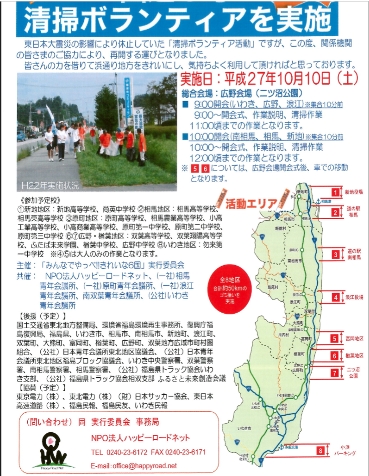
Let us remember that it is internationally recognized that there is no safe limit for radiation and that each radiation dose has an impact that is proportional to it. In such a context, it is recommended that the radiation exposure should be justified by a benefit. What was the benefit for these children?
It’s a safe bet to say that the decontamination of minds will be no more effective than the decontamination of the contaminated territories was …
Source: http://fukushima.eu.org/la-decontamination-de-lesprit/
Radioactive Wild Monkey Poops from Namie-city, Fukushima
January 23, 2016
An example of bio-accumulation of radioactive material in Fukushima:
According to the following post, wild monkey poops from Namie-city, Fukushima had more than 150,000Bq/kg in terms of radioactive Cs137 & Cs134.
Cs137: 133987 Bq/kg
Cs134: 25186 Bq/kg
K40: 225 Bq/kg
The surrounding ground surface was about 500~600cpm.
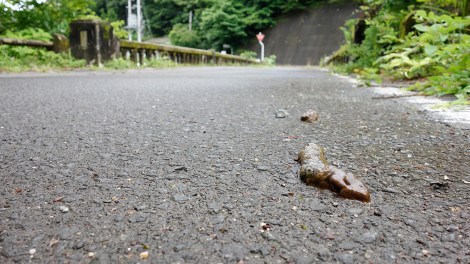
More details at the Japanese blog :
http://www.autoradiograph.org/info/%E6%96%B0%E4%BD%9C35%EF%BC%9A%E3%82%B5%E3%83%AB%E3%81%AE%E7%B3%9E2/
Nothing Resolved at Fukushima, Japan Must Not Sponsor the Olympic Games

I strongly support “an honorable retreat from the 2020 Olympic Games” which is called for by former PM Hatoyama and a former Japanese Ambassador to Switzerland Mitsuhei Murata.
Hatoyama says, in an interview with the Japan Times, “In a situation in which nothing has been resolved at #Fukushima, Japan must not sponsor something like the Olympic Games.”
Hatoyama also said “There are still many inhabitants of the Tohoku region living in temporary housing. Moreover, the government has yet to admit the truth about the accident despite its having been more severe than Chernobyl. It is regrettable that the government has failed in its duty to inform both the people of Japan and the world about the true situation. The government even goes so far as to deny the increased incidents of thyroid cancer in the Fukushima region are connected to radiation releases from the multiple meltdowns.”
Hatoyama believes the government claimed the situation at nuclear plant was “under control” in order to lure the 2020 Olympic Games to Tokyo. “The government was successful in this ploy,” he says, “but this was a complete lie. Far from having been under control then, it is still not under control even now. This is a grave situation.”
He also shared interesting comments about Okinawa and the US base issues in the following exclusive interview with the Japan Times.
Hatoyama dreams of a Japan anchored within a united Asia
“I wish to apologize to the Japanese people for having betrayed their expectations,” says Yukio Hatoyama halfway through our interview, lowering his head and bowing deeply.
Hatoyama, prime minister for nine months of the Democratic Party of Japan’s three years in power between 2009 and 2012, is discussing the reasons behind his resignation in June 2010 — specifically, his failure to live up to his party’s promise to block the contentious U.S. Marine Corps base construction now underway at Henoko in Okinawa.
Recently, the former DPJ leader has been in the news for other mea culpas in Nanjing and Seoul — apologies made, he says, on behalf of Japanese for colonial-era crimes in Asia. These unsanctioned trips have incensed the ruling Liberal Democratic Party, which has painted Hatoyama as a charlatan and even a traitor for his foreign escapades.
For those having trouble placing Hatoyama among the three DPJ figures who served as prime minister in that brief, heady period when power in postwar Japan changed hands, he is the one who led the DPJ to that historic victory. You know — the “alien.”
Hatoyama, now 68 and retired from politics, has never been able to shake that nickname. Coined by the domestic media in 2001 during his first stint as DPJ leader, the foreign press had a field day with Hatoyama’s extraterrestrial appellation, rejoicing in the fact that they finally had a Japanese leader who stood out from the crowd.
But what was it that made Hatoyama appear so otherworldly? True, his saucer-like eyes did give him a vague resemblance to E.T., but his nickname was not just the product of his looks and his manner; it also owed much to his proposals — proposals that were and remain anathema to Japan’s conservative establishment.
But how did Hatoyama, who came from a well-known, politically conservative family, become a maverick? In an exclusive interview with The Japan Times, Hatoyama discussed a range of issues, including Okinawa, the relationship between the Fukushima No. 1 disaster and the 2020 Tokyo Olympic Games, and his proposal for the creation of an “East Asian EU.” He began by explaining the circumstances that led him to resign the prime minister’s post in 2010 after only nine months in office.
“The DPJ, of which I was leader, proposed a revision of the Japan-U.S. Status of Forces Agreement in our manifesto for the 2009 House of Representatives election. We also proposed the realignment of the U.S. military in Japan, including a review of the state of U.S. bases,” he explains. “As for the relocation of the U.S. Marine base to Henoko, I personally said that at the very least, it should be moved outside (Okinawa) Prefecture. However, as soon as the DPJ took power, bureaucrats close to the U.S. in the Foreign Ministry and Defense Ministry moved to crush my proposal.”
In the end, Hatoyama’s idea went nowhere, and Henoko was confirmed as the proposed site for the new base. Many Okinawans — and DPJ voters — felt betrayed, and the party began to fear defeat in the Upper House elections of July 2010. “So I decided to resign,” Hatoyama confesses. “There was no excuse.”
During his time in office, Hatoyama also emphasized the need for a less lopsided Japan-U.S. relationship.
“I thought that as prime minister, it was only natural for me to seek an equal relationship with the United States. However, there are many (Japanese) politicians and bureaucrats who believe that because Japan is dependent on the U.S. in so many ways, it isn’t appropriate to seek an equal relationship. Once again, my proposal ended in failure.”
This was the first time in the postwar period that a Japanese prime minister had made such a demand. Hatoyama even dared suggest that Japan’s security could be achieved without a permanent U.S. troop presence. None of this was welcomed by those, on both sides of the Pacific, long accustomed to Japan’s subservience to U.S. interests.
Hatoyama was born in 1947 and graduated from the University of Tokyo before going to earn a Ph.D. in industrial engineering at Stanford. Upon graduation, he initially pursued an academic career, but later decided to run for the House of Representatives in 1986.
His lofty aim was to “restore sovereign power to the people, breaking from a system dependent on the bureaucracy,” he says, and to “transform Japan from a centralized state to one of regional and local sovereignty, and from an insular island to an open maritime state.”
During his campaign, Hatoyama took advantage of his experience as a researcher and garnered public attention with his unique appeal for “a scientific approach to politics.” Following his election, he quickly became a controversial figure for, among other things, revealing the huge scale of political campaign funding the LDP was receiving from business interests — even though he was a member of the party at the time.
“I eventually left the Liberal Democratic Party because of repeated incidents involving money and politics, such as the Recruit insider-trading and corruption scandal of 1988 and Shin Kanemaru’s huge tax evasion affair of 1992,” Hatoyama says. “Political reform was urgently called for, but the LDP was unwilling to act.”
A messy political realignment soon followed, eventually leading to the creation of the current iteration of the Democratic Party of Japan in 1998. Hatoyama went on to lead the party between 1999 and 2002, and again from May 2009. The DPJ grew steadily until finally, in September 2009, it succeeded in ousting the scandal-tainted LDP.
Hatoyama became Japan’s 93rd prime minister, though he would not remain so for long. Government bureaucrats, long accustomed to running the country behind the scenes, acted quickly to undermine his administration and hasten its demise.
Hatoyama says that Defense Ministry officials attempted to scuttle his plan to relocate the U.S. Marine Corps’ Futenma air base outside of Okinawa by claiming that any replacement facility must be located within 65 miles (105 km) of the marines’ Northern Okinawa Training Area. “The bureaucrats and ministers who should have been doing their best to support me were in fact attempting to resolve the matter by supporting the U.S.,” Hatoyama says.
The 65-mile requirement effectively precluded moving the base off the main island of Okinawa, which is a convenient 70 miles long. Yet the source of this apparent requirement remains elusive. Hatoyama says the Defense Ministry simply claimed that this figure was included in a U.S. military document. “Whether or not this requirement was expressly stated in the document remains unclear even now,” he notes.
But what about the U.S.? Were American officials also involved in the attempt to derail Hatoyama’s base relocation plans? Apparently not, Hatoyama says.
“No documents on the U.S. side support the claim of Defense Ministry officials. Thus, it can be said their claim was groundless,” he explains. “It’s possible it was just their way of forcing me to abandon my proposal. However, when we consider the feelings of the Okinawan people, there’s no way they would grant permission for the base to be relocated within Okinawa.”
At this point in the interview, Hatoyama bowed and offered his apology.
Another blow to the fledgling DPJ administration came in December 2009, when it was revealed that Hatoyama had received some ¥1.2 billion in political donations that had been improperly reported. Most of the money came from his mother, the wealthy heiress to the Bridgestone empire, though ¥400 million of this was listed as coming from fictitious donors — including some who were deceased.
While Hatoyama denied personal knowledge of the donations, he later apologized to the nation for the scandal and promised to pay more than ¥600 million in gift taxes on donations made to him by his mother that were first deemed as “loans.” Hatoyama recognizes the major impact this issue had on his tenure as prime minister, admitting, “The political donations I received from my mother were the second major reason I had to resign.”
Prosecutors declined to bring charges against Hatoyama, citing insufficient evidence of criminal activity. They did, however, indict two of his former secretaries, resulting in a ¥300,000 fine for one and a suspended sentence for the other. While no question of corporate bribery or political favors was involved, the incident nevertheless served to raise questions in the public’s mind about just how different the DPJ was from the money-tainted politics of the long-ruling LDP.
The media was unforgiving. After all, Hatoyama had already managed to upset both the establishment media and their new-media competitors. The former fought against his proposal to open up the prime minister’s news conferences to journalists from outside the cozy “press club,” and the latter were angry after he failed to follow through on that pledge.
“When I became prime minister, I tried to abolish the press-club system, which had become a vested interest for its members,” Hatoyama explains. “However, I was subject to a fierce counterattack.”
One club-affiliated reporter told Hatoyama that the prime minister’s press conferences were not something he was in charge of but, rather, something the press club sponsored.
Although by March 11, 2011, Naoto Kan was prime minister, Hatoyama was still a member of the House of Representatives, and the multiple disasters — especially the nuclear meltdowns at Fukushima No. 1 plant — affected him deeply. In the December 2011 issue of the magazine Nature, Hatoyama co-authored an article expressing his concerns about both the radioactive and political fallout from the accident.
Titled “Nationalize the Fukushima Daiichi atomic plant,” Hatoyama first pointed out the need “to know precisely what happened (on March 11, 2011) and what is continuing to happen now.” He further argued that only when all the evidence relating to the accident had been gathered and made public “will the world be able to have faith in the containment plan developed by Tepco or be able to judge how it should be modified.”
Hatoyama and two fellow Diet members formed a committee to conduct an independent investigation of the accident. The group reached two major conclusions, outlined in the Nature article. First: “The Fukushima Daiichi nuclear power plant must be nationalized so that information can be gathered openly. Even the most troubling facts should be released to the public.” Second: “A special science council should be created to help scientists from various disciplines work together on the analyses. That should help to overcome the dangerous optimism of some of the engineers who work within the nuclear industry.”
Although Hatoyama is no longer a Diet member, he has not lost interest in this issue. Recently, he joined former Japanese Ambassador to Switzerland Mitsuhei Murata in calling for “an honorable retreat from the 2020 Olympic Games.” Echoing Murata, who was also present at the interview, Hatoyama says, “In a situation in which nothing has been resolved at Fukushima, Japan must not sponsor something like the Olympic Games.”
Hatoyama elaborates: “There are still many inhabitants of the Tohoku region living in temporary housing. Moreover, the government has yet to admit the truth about the accident despite its having been more severe than Chernobyl. It is regrettable that the government has failed in its duty to inform both the people of Japan and the world about the true situation. The government even goes so far as to deny the increased incidents of thyroid cancer in the Fukushima region are connected to radiation releases from the multiple meltdowns.”
Hatoyama believes the government claimed the situation at nuclear plant was “under control” in order to lure the 2020 Olympic Games to Tokyo. “The government was successful in this ploy,” he says, “but this was a complete lie. Far from having been under control then, it is still not under control even now. This is a grave situation.”
Hatoyama’s change of mind is significant because as prime minister in October 2009 he had given a speech in Copenhagen in support of Tokyo’s failed bid for the 2016 Games. At the time, he sought to promote a new image of the Olympics centered on environmental protection, held in harmony with nature and celebrating simplicity.
March 11, 2011, however, changed everything. Again, like Murata, Hatoyama stresses that he is not opposed to the Olympics per se, but asks: Why now, and why Tokyo — especially in the absence of any pressing need to do so? Hatoyama nods in assent when Murata states: “At this point there is no other solution than to stage an honorable retreat from the games. Failure to do so will ultimately lead to a disgraceful retreat, dishonoring our country. The time to act is now!”
Hatoyama’s reservations about Japan’s future are not limited to either Fukushima or the Olympics. Politically and militarily, Hatoyama believes Japan is moving in an ever more dangerous direction.
“Prime Minister (Shinzo) Abe’s recent passage of the collective security bills has made it possible for America to call upon Japan to participate in its wars,” he says. “However, the Constitution states that Japan will never again wage war and, accordingly, rejects the threat or use of force as means of settling international disputes.”
He continues: “Given this, I deeply regret that the road to our participation in war has been opened once again. It may be presumptuous of me to say this now that I am no longer a politician, but in light of the wrong direction our country is currently heading in, I earnestly hope for an end to the Abe regime.”
Just as relations between Tokyo and Beijing were sinking to new lows over historical and territorial issues, Hatoyama infuriated the Abe government with his decision to visit Nanjing in January 2013. At the Nanjing Massacre Memorial Hall, he bowed and offered a silent prayer, later explaining, “As a Japanese, I feel responsible for the tragedy, and I am here expressing my sincere apology.”
While in Nanjing, Hatoyama also urged the Japanese government to acknowledge the dispute between the two countries concerning sovereignty of the islands known the Senkakus in Japanese and Diaoyu in China. “The Japanese government says there are no territorial disputes, but if you look at history, there is a dispute,” he says.
Hatoyama’s comments led Japanese government officials to criticize him for admitting the existence of a territorial dispute with China, something they adamantly deny. The defense minister at the time went so far as to use the word “traitor.”
“If his remarks have been politically used by China, I’m unhappy,” said Itsunori Onodera. “At that moment, the word ‘traitor’ arose in my mind.”
In March 2015, Hatoyama made another controversial trip, this time to Crimea, where he expressed his belief that Japan should “normalize” relations with Russia by lifting sanctions imposed after Moscow’s annexation of the Ukrainian territory. Hatoyama defended the referendum in the region as constitutional, stating, “Crimea wasn’t annexed unilaterally under pressure from Russia. In fact, people reached a conclusion based on their own strong will.”
Once again, Hatoyama’s remarks earned him the condemnation of the Japanese government. “It’s unthinkable that such action and comments came from a person who was once prime minister,” said Chief Cabinet Secretary Yoshihide Suga. Suga also described Hatoyama’s behavior as “extremely imprudent.”
In August 2015, just prior to Prime Minister Abe’s statement commemorating the 70th anniversary of the end of World War II, Hatoyama visited the Seodaemun Prison History Hall in Seoul. He knelt down in front of a memorial stone to apologize to Korean independence activists jailed, tortured and executed during Japan’s colonial control of Korea from 1910 to 1945.
“In the hope that no such mistake is made in the future, I regard, in a spirit of humility, these irrefutable facts of history, and express here once again my feelings of deep remorse and state my heartfelt apology,” he said.
Though Hatoyama’s actions may seem quixotic or even deliberately provocative to some, they are best understood through the prism of his world view, which stands in stark contrast to one of the guiding principles of modern Japan in the years following the Meiji Restoration. Promoted by the famous Meiji educator Yukichi Fukuzawa, this principle is known as Datsu-A Ron or the “Goodbye Asia doctrine.” Fukuzawa maintained, “It is better for us to leave the ranks of Asian nations and cast our lot with the civilized nations of the West.”
While not turning his back on the West, Hatoyama nevertheless seeks to redirect Japan’s focus away from the U.S. and back to its geographical location in Asia. He imagines a Japan at peace with its neighbors — from Russia in the north to China and South Korea — and at ease with its position on the edge of the continent.
With this dream in mind, Hatoyama created the East Asian Community Research Institute in March 2013, with the ultimate goal of creating something resembling an East Asian EU. With membership open to the general public, the institute, through its educational arm, Sekai Yuai Forum, holds lectures and other events to promote Hatoyama’s vision.
All of which brings us back to the issue of the U.S. military presence on Okinawa. Hatoyama continues to be concerned about the struggle of the Okinawan people against the construction of the new U.S. base at Henoko. This led to a series of trips to Okinawa seeking a solution to this intractable problem. As recently as November, Hatoyama visited the island to encourage the anti-base demonstrators at Henoko.
Hatoyama envisions a future for Okinawa not as a “keystone of the Pacific” for the U.S. military but as a “keystone of peace” for the countries of Asia. He has called for the creation of an “East Asian Community” headquartered in Okinawa and composed of the 10 members of the Association of Southeast Asian Nations plus Japan, China and South Korea.
“It is important for the countries of East Asia to become self-reliant, helping one another by developing win-win relationships,” he explains. “Should, however, they engage in a military arms race, it would only lead to a decline in deterrent power.”
“If Europe can do it,” says Hatoyama, pointing to the continent’s postwar integration, “there is no reason East Asia can’t.”
Source : Japan Times
http://www.japantimes.co.jp/community/2016/01/20/our-lives/hatoyama-dreams-japan-anchored-within-united-asia/#.VqFRnFLzN_k
Special credits to Mari Inoue & Libbe Halevy
1 This Month

of the week – Shut Down Drone Warfare!


Tell the Ukrainian Government to Drop Prosecution of Peace Activist Yurii Sheliazhenko

Petition to revoke the licensing of the Near Surface Nuclear Disposal Facility (NSDF) at Chalk River. https://www.ourcommons.ca/petitions/en/Petition/Details?Petition=e-7247
To see nuclear-related stories in greater depth and intensity – go to https://nuclearinformation.wordpress.com
-
Archives
- April 2026 (44)
- March 2026 (251)
- February 2026 (268)
- January 2026 (308)
- December 2025 (358)
- November 2025 (359)
- October 2025 (376)
- September 2025 (257)
- August 2025 (319)
- July 2025 (230)
- June 2025 (348)
- May 2025 (261)
-
Categories
- 1
- 1 NUCLEAR ISSUES
- business and costs
- climate change
- culture and arts
- ENERGY
- environment
- health
- history
- indigenous issues
- Legal
- marketing of nuclear
- media
- opposition to nuclear
- PERSONAL STORIES
- politics
- politics international
- Religion and ethics
- safety
- secrets,lies and civil liberties
- spinbuster
- technology
- Uranium
- wastes
- weapons and war
- Women
- 2 WORLD
- ACTION
- AFRICA
- Atrocities
- AUSTRALIA
- Christina's notes
- Christina's themes
- culture and arts
- Events
- Fuk 2022
- Fuk 2023
- Fukushima 2017
- Fukushima 2018
- fukushima 2019
- Fukushima 2020
- Fukushima 2021
- general
- global warming
- Humour (God we need it)
- Nuclear
- RARE EARTHS
- Reference
- resources – print
- Resources -audiovicual
- Weekly Newsletter
- World
- World Nuclear
- YouTube
-
RSS
Entries RSS
Comments RSS
 nuclear-news