“The Fukushima Nuclear Disaster is a Serious Crime”: Interview with Professor Koide
Introduction
Koide Hiroaki (66) has emerged as an influential voice and a central figure in the anti-nuclear movement since the nuclear meltdown at Fukushima Daiichi of March 11, 2011. He spent his entire career as a nuclear engineer working towards the abolition of nuclear power plants. His powerful critique of the “nuclear village” and active involvement in anti-nuclear movements “earned him an honorable form of purgatory as a permanent assistant professor at Kyoto University.”1 Koide retired from Kyoto University in the spring of 2015, but continues to write and act as an important voice of conscience for many who share his vision of the future free from nuclear energy and weapons. He has authored 20 books on the subject. Professor Kasai Hirotaka and I visited his office at Kyoto University’s Research Reactor Institute in Kumatori, Osaka, on December 26th, 2014 for this interview. We believe that the contents of the interview, which offer new information about the degree of radioactive contamination and invaluable insight into Koide’s ethical and political stance as a scientist, remain crucial for our critical reflection on ecological destruction, the violation of human rights, and individual responsibility. Professor Robert Stolz, the translator of this interview and the author of Bad Water (Duke University Press, 2015), provides a historical perspective on the interview in a separate article. KH

Interview
I The Fukushima Disaster and Government and Corporate Response
Hirano: How does the Fukushima accident compare with the bombing of Hiroshima or Chernobyl in its scale? What are the possible effects of this yet unknown exposure?
Koide: Let’s start with the scale of the accident: It was a core meltdown involving the release of various kinds of radioactive material. Radioactive noble gas isotopes were also released, as were iodine, cesium, strontium, and other radioactive material. The noble gas isotopes have a short half-life and so at this stage they are all gone. Iodine, too, is gone. So now four years since the accident the materials that are still a problem are cesium-137, strontium-90, and tritium; really, it’s these three.2
Now, as for the scale of the accident, I think it would be best to compare these three radionuclides. Today the main contamination of Japanese soil is the radionuclide cesium-137 [Cs-137 or 137Cs]. The ocean is largely contaminated with strontium-90 [Sr-90 or 90Sr] and tritium [T or 3H]. Right now the main culprit adding to the exposure of the people in Japan is Cs-137, so I think it’s best to use Cs-137 as a standard for measuring the scale of the accident.
But we simply don’t know with any precision how much Cs-137 was released. That’s because all the measuring equipment was destroyed at the time of the accident. How much Cs-137 was released into the air? How much was spilled in the sea? We just don’t know.
Still, the Japanese government has reported estimates to the IAEA [International Atomic Energy Agency]. According to those estimated levels, reactors 1, 2, and 3 had been in operation on March 11, 2011, and all three suffered meltdowns. Those three reactors released 1.5×10¹⁶ Becquerels of Cs-137, which would make it a release of 168 times more radioactive material than the Hiroshima bombing. And this is only material released into the atmosphere-at least according to Japanese government estimates.
But I myself think the government’s numbers are an underestimate. Various experts and institutes from around the world have offered several of their own estimates. There are those that are lower than the Japanese government’s numbers and those that are higher, some two or three times higher than the government’s numbers. According to these other estimates I think that the release of Cs-137 into the atmosphere could be around 500 times the Hiroshima bombing.
Now for what has been washed into the sea. That number is likely not much different from the levels released into the atmosphere. Even today we are unable to prevent this release. And so if we combine the amount of Cs-137 released in the air and the ocean together, we get an estimate several hundred times the Hiroshima levels. And some estimates suggest the Fukushima accident could be as much as one-thousand Hiroshimas.
Now to compare this with other accidents: The amount released into the atmosphere from the explosion during the accident at the Chernobyl nuclear plant was 800 to 1000 times the Hiroshima levels. Put simply, these estimates place Fukushima on par with Chernobyl.
Worse than any of these, however, is atmospheric testing. From the 1950s to the 1960s atmospheric testing of nuclear weapons had already released Cs-137 into the air more than sixty times the numbers released even by the Japanese government for Fukushima. Of course Fukushima is an incredible tragedy, but considered from the earth as a whole it is a rather small accident.

Hirano: I want to ask in more detail about the effect of Cs-137 on the human body and the environment.
Koide: Cesium is an alkaline metal. From the human body’s perspective, cesium closely resembles potassium. The body contains enormous amounts of potassium. It is essential for humans. It’s everywhere in our bodies. Especially our flesh and muscles are full of potassium. And because of this, when cesium is released into the environment, the body deals with cesium as it does with the alkaline metal potassium, which is to say that it is taken into the body and accumulates there.
Strontium is an earth metal. The body treats it like calcium. As you know calcium is a human body building block that accumulates in our bones. Strontium, too, is taken into and collects in the bones. Just as cesium is taken in and is transported to the flesh and muscle.
Hirano: Comparing the releases from nuclear tests by the US and the USSR during the Cold War period, you said that the Fukushima accident was small. So in what way should we think about Fukushima: is it best to consider it a Japanese problem, or to consider it from a global perspective?
Koide: The amount of products of nuclear fission released during atmospheric testing was enormous, and these particles continue to expose humans to radiation. I’m a bit older than you and I recall in my childhood being told not to let the rain fall on me at the time of the testing. In this way everyone on earth has been exposed (hibaku/ 被曝). And because of this testing, historically speaking, cancer rates have slowly risen; I believe this increase in cancer is due to the exposure suffered during the atmospheric testing. Now the radioactive material released from Fukushima has been dispersed across the globe and so once again everyone on earth has been exposed to additional radiation. I think we can expect cancer rates to rise once again.
Atmospheric nuclear testing released all of the radioactive material in the explosions, which entered the stratosphere. Between the stratosphere and the troposphere there is the tropopause, and every year come spring all that material dispersed in the stratosphere breaks through the tropopause and falls to earth. So that material, though initially dispersed in the stratosphere, eventually falls to earth evenly, everywhere. Actually, it might not be accurate to say that it falls evenly on the earth. The majority of the testing was done in the temperate regions of the northern hemisphere, such as Nevada and the Semipalatinsk test site [in Kazakhstan], so that the northern hemisphere-as the site of most of the testing-is heavily contaminated, and within that the temperate region is heavily contaminated. Still, I can say the atmospheric testing overall has caused global contamination.
My focus now is to figure out how to deal with the acute and heavy contamination from Fukushima. I know something needs to be done right there in that specific place. That contamination will disperse and be diffused across the globe. Once dispersed, the amount of radioactive material from Fukushima will be small when compared with the atmospheric testing. Which is not to say it is not harmful. An increase in cancer will be the result. I mention that for humanity as a whole; the atmospheric tests were worse.
Now, strontium-90 [Sr-90] has been leaking from Fukushima into the ocean, so it will eventually reach the United States, especially the west coast. This much we are sure of. But to answer your question, the amount of dispersed cesium and strontium released by the atmospheric tests is tens of times greater than the Fukushima levels. Because the west coast of the US is already contaminated from the atmospheric testing, though the dispersed contamination from Fukushima will reach US shores, for people living on the US west coast, the Fukushima accident―and this is perhaps awful to say―contamination from Fukushima is hardly worth considering. Historically a much greater event has already taken place.
Hirano: To put that another way, the current Fukushima accident gives us a chance to reconsider the enormity of the past contamination from US and Soviet atmospheric tests, which has not been openly discussed.
Koide: Yes, that’s exactly right. In fact, it is the masses of people who need to realize the impact of the contamination on them. In the case of the Fukushima disaster, for example, they need to be aware that some radioactive material is reaching the North American coast, and the prevailing westerly winds will carry anything released into the atmosphere to the US. Those earlier numbers from the Japanese government indicate that the levels for Cs-137 in the atmosphere are 168 times those of the Hiroshima bombing. I’ve been told that level is 1.5 x 10¹⁶ Becquerels [Bq]. These exponents can be a pain to process, so if we think of it in peta-units-which is 1015-we get essentially 15 petabecquerels [PBq].
That said, while we are not really sure this is the number, we do know that a portion of this material will ride the prevailing winds across the Pacific Ocean. On the other hand, closer to the ground, the winds will be east, south, and north, and therefore this other portion will fall on Japan―and we can investigate the actual levels here: how much fell on this town, on this prefecture? Adding these up, it seems to be only 2.4 PBq. Which is to say of the total fifteen PBq, 2.4, or roughly only 16%, fell on Japanese soil. If the totals are higher, still a smaller share of the total contamination will have fallen on Japan compared with the Pacific, with the largest portion falling on the west coast of the United States.
So why don’t we hear complaints from the US? Why are there no calls for compensation? Whenever someone asks me this, I simply say that there just aren’t any such complaints. Why is this so? Well the levels released by the US during the atmospheric testing were tens of times greater than Fukushima. They are the criminals, so they cannot ask for compensation from Japan. The U.S. government does not want to have to reflect on its own past, and I think they are eager to completely avoid bringing up anything like that conversation. That is why I believe it is so important that those who have been exposed to radioactive contamination realize what atmospheric testing has done to them.
Kasai: I’d like to get back to the moment of the accident in some detail. On March 11, 2011 we had the East Japan Disaster (meaning the earthquake and tsunami off Tohoku). You’ve already talked about the string of accidents at the nuclear plant. At the moment the accident was taking place, you were following the response by the Japanese government and the Tokyo Electric Power Company (TEPCO) in real time. What did you see in those initial moments?

Koide: It was truly a disastrous response. On the 11th I was in the laboratory in Kyoto as March was my month to work in the radiation-controlled area.3 It was normal workday hours and various tasks kept me busy working within the controlled area. Of course there is no TV or anything like that in the work space. That night there was a meeting so I came out to attend and that’s when I saw the images of the Sendai airport being swept away by the tsunami. The report said that there had been a devastating earthquake and tsunami. Then I wondered about the safety of the nuclear plants.
Right then, there really was no more information. We had scheduled a nuclear safety issues seminar for the 18th. I’ve participated in hundreds of these seminars. Participants from the Ukraine had just arrived on the 11th. We promised to go out drinking after they arrived and so that night I went out. There was no more TV, and while there was a vague unease among us, that’s how we spent the time.
The next day I learned that all power at Fukushima had been lost and I knew things were not going to be simple. Then at noon on the 12th the roof of reactor one was blown off; at that point any expert must have known there had been a reactor meltdown. So I was certain of a core meltdown and because once it has gone this far, there is no going back, it was time to call for anyone who could evacuate to do so. I thought we were at that stage on the 12th.
Yet neither the government nor TEPCO said a single word about a core meltdown; they announced that the incident merited a 3 or 4 on the International Nuclear Event Scale. I remember thinking “You’ve got to be kidding! There’s already been a meltdown. This is at least a level 6 or 7.” But neither the government nor TEPCO gave any indication of this and there was no word of it in the media either.
One by one there were explosions at reactors 3, 4, and 2. As an expert in nuclear power, I understood there was absolutely nothing that could be done. I thought people needed to be evacuating, but still the Japanese government didn’t make the call. Government officials had set up at an off-site center near a power plant in Fukushima―at first they announced evacuation inside two kilometers, then that expanded to three, five, ten, and finally twenty km. After that nothing was done. The offsite center was supposed to coordinate the emergency response in the event of an accident, but it turned out that every one of the officials fled. They left the employees behind and fled. The Japanese government’s response was indescribably cruel.
Kasai: It seems the very words “meltdown” (メルトダウン) and “core meltdown” (roshin yōyū/炉心熔融) were strictly forbidden.
Koide: Exactly.
Kasai: I was in Japan watching on TV. What shocked me was all the nuclear power experts explaining the incident in the studio. I suppose it was a satellite relay, but when reactor number three exploded on our screens they were giving their analyses of the explosion in real time. There were experts on TV saying that the reactor had a blast valve that was used successfully. Even hearing that, an average viewer might think something was amiss. But having physicists, experts on radiation, on TV saying these things, well, even the average viewer wouldn’t buy that explanation. In a broad sense, nuclear experts like yourself played several roles in the media and government.
Koide: Yes, that’s clearly true for pronuclear experts. They all tended to tell a story that underestimated the accident. Immediately after the accident public announcements and information were restricted. As a result individual opinions or statements were strictly forbidden and nearly all experts remained silent, so even basic information was not broadcast. Though I’d made statements from the nuclear lab beginning on the 12th, it is likely there were instructions from the Ministry of Science and Education to silence me. The head of the lab convened several meetings where he told each of us not to make any statement, that the lab would toe the official line when dealing with the mass media. I thought this was wrong and said that anyone who was asked a question by the media should answer it, further saying that if I were asked a question, I had a responsibility to answer. Since then I’ve continued to make statements in the media. Still the large majority of nuclear researchers were not able to do this.
As a result it was the pronuclear researchers who monopolized the interpretations – exactly. So as they went to the TV studios I think each was told: “Today, it’s your turn to go to the studio.” I think that’s how they played their part and handled the media.
Kasai: With respect to controlling information, would you say your experience with the head of the nuclear lab shows how the professional organizations exert pressure on the universities?
Koide: Yes, I would. The head of the lab opened a conference with all the other laboratories―even I went. There he said that any statements to the media should be on message and come only from the information office.
Kasai: So pressure came from academic conferences.
Koide: Yes, there was pressure coming from the academic conference side as well. Take for example something like a conference on nuclear power. From the very start it was never a real discussion; it was a meeting of powerful and vocal spokesmen for the nuclear community or village (genshiryoku kyōdōtai/原子力共同体 or genshiryoku mura/ 原子力村), which is to say the group of pronuclear government officials and private companies mainly centered around the LDP and Toshiba, Hitachi, Mitsubishi, and other pronuclear manufacturers of power plants―and of course their supporters in the media. Thus as an organization the conference was predisposed to underestimate the accident and to then promote that underestimation.
Hirano: Immediately after the accident you testified in the Diet presenting data indicating the seriousness of the disaster and demanding that the government terminate the operation of all the power plants.4
Koide: I did.
Hirano: After that it seems you weren’t again asked to speak publicly, or given the opportunity to offer more detailed thoughts on the situation.
Koide: By “speak publicly” you mean in the Diet or in some other official government setting?
Hirano: Yes, and also in the media.
Koide: With respect to the media, I’ve never really had any confidence in them. Since the accident, I’ve been overwhelmingly busy and haven’t accepted a single invitation from TV stations.
Hirano: I see. So there were invitations.
Koide: There have been many calls saying, “come down to the studio.” But I always tell them that I am too busy for this sort of thing. I’d say, if you come to my office, we could meet. Many did come by, even back then. But as everyone knows, in television you might talk for an hour and none of it makes it on air, or if it does, it’s maybe thirty seconds.
Hirano: Right, and only the convenient parts.
Koide: That’s it and there’s really nothing that can be done about it. There was, however, one outlet for which I was extremely grateful: the daily radio program called Tanemaki Journal (種まきジャーナル).5 There I could go on every day and offer my thoughts live. I wish it could have continued, but it was completely and totally smashed. What a world we live.
Kasai: So, on the subject of standards used for assessing the danger posed by radiation for the human body and the environment: What are your thoughts on how the government deals with this issue?
Koide: They are absolutely not dealing with it at all. I think you already know this but in Japan the average person is not supposed to be exposed to more than one milliSievert per year―that’s set by law. Why is that the level decided on? Because exposure to radiation is dangerous. If exposure weren’t dangerous, if low levels of exposure were safe, there’d be no problem even without that legal limit. But exposure to radiation is dangerous―this is the conclusion of all research. So every nation in the world has set legal limits for exposure.
For people like me who get paid to work with radiation, it’s not really possible to observe the 1mSv/yr limit [1mSv/yr]. We’re told that in exchange for our salaries, we accept exposure to twenty milliSieverts a year. That’s the standard I work under in my job. But the current Japanese government has now stated that if contamination is under 20mSv/yr somewhere, that place is safe to return to―safe to return to even for children. This is way beyond common sense.
Hirano: What is the basis of this claim? Why would the government announce these numbers and forcefully declare these areas safe to return to? What’s the basis for the government’s numbers?
Koide: The basis for those numbers…for example the government says that organizations like the IAEA or the ICRP [International Commission on Radiological Protection] suggest that in emergencies during which the 1mSv/yr standard cannot be maintained standards should be set between twenty and 100mSv/yr. The government seizes on this and declares that since the IAEA and the ICRP have said this, that 20mSv/yr is therefore a safe level-usually adding that membership in both the IAEA and the ICRP is voluntary anyway. But because these organizations have said this is no reason to break Japanese law. If Japan is a nation governed by the rule of law at all, surely this means that the very people who make the laws should also follow them―that should be obvious. But these guys have declared 20mSv/yr safe even for children. There is absolutely no way I can consent to this.
Hirano: So there is no scientific basis for these levels.
Koide: Well… the danger corresponds to the amount of exposure―you probably know this―so for a country that has declared its intention to maintain the 1mSv/yr standard to then turn around and ask people to endure twenty times that level, there is no scientific basis for that declaration. That’s a social decision.
But if you want to inquire as to why, as I’ve mentioned to you, some 2.4 petaBecquerels of radioactive material have fallen on Japan, that material has been dispersed, contaminating Tohoku, Kanto, and western Japan. So in addition to the law setting the legal limit for exposure at 1mSv/yr, there is another law that states that absolutely nothing may be removed from a radioactive management area in which the levels exceed 40,000 Becquerels per square meter.
So the question becomes how many places or how much area has been contaminated beyond 40,000 Bq/m2? And according to the investigations, that answer is 140,000 km2. The entirety of Fukushima prefecture has been contaminated to where all of it must be declared a radioactivity management area. Indeed, while centered on Fukushima, parts of Chiba and Tokyo have also been contaminated. The number of people living in what must be called a radiation-controlled area is in the millions, and could exceed ten million.
For me, if Japan is in fact a nation governed by the rule of law, I believe the government has the responsibility to evacuate these entire communities. Instead of taking a proper action to secure people’s livelihood, the government decided to leave them exposed to the real danger of radiation. In my view, Fukushima should be declared inhabitable and the government and TEPCO should bear a legal responsibility for the people displaced and dispossessed by the nuclear disaster. That’s what I think, but if that were to be done, it would likely bankrupt the country. I think that even though it could bankrupt Japan, the government should have carried out the evacuation to set an example of what the government is supposed to do. But obviously those in and around the LDP certainly didn’t agree. They’ve decided to sacrifice people and get by taking on as little burden as possible. So they’ve made the social decision to force people to endure their exposure. In my view, this is a serious crime committed by Japan’s ruling elite.
I would like people to know just how many thousands of people live in this abnormal situation where even nuclear scientists like me are not allowed to enter, not to mention, drink the water. It is strange that this issue has been left out of all debate over the effects of the radioactive exposure. We must be aware that contemporary Japan continues to operate outside the law in abandoning these people to their fate by saying it’s an extraordinary situation. Under such circumstances, I think, there are a multitude of symptoms of illnesses in contaminated areas. But if we’re talking about any given symptom, it’s hard to say since we just don’t have any good epidemiological studies, or even any good data. But there will surely be symptoms, namely cancer and leukemia.
However little exposure to radiation is, it causes cancer and leukemia―this is the conclusion of all current science. These symptoms are said to become visible 5 years after the initial exposure. But because radiation is not the sole cause of cancer or leukemia establishing a direct causal relationship is extremely difficult. For this very reason we need to continue to investigate the state of exposure by conducting rigorous epidemiological studies. But this government wishes instead to hide the damage so I’m afraid no such study is on the horizon. In addition, I have heard about many cases of nose bleeding, severe headaches, and extreme exhaustion. And I am truly concerned about small children and young people living in Fukushima as they are most vulnerable to exposure.
Hirano: So what is your view of the actual damages of radiation exposure on human health?
Koide: On the evening of the Fukushima dai-ichi reactor accident of March 11, 2011, a Radiation Emergency Declaration was announced. The Declaration suspended existing Japanese law concerning exposure to radiation. Though Japanese law sets the limit for exposure for the general population at one milliSievert a year [1mSv/yr], the new permissible level would be 20 mSv/yr. That Emergency Declaration is still in effect. It is common knowledge that even low levels of exposure are dangerous. Including even infants in this newly imposed 20mSv/yr standard will obviously lead to various diseases. Further, because the monitoring equipment was destroyed at the time of the accident we do not have accurate data on the exposure levels of the residents. Numerous cases of thyroid cancer have been found. The prevalence of thyroid cancer is dozens of times that of normal incidence. Pro-nuclear groups say those numbers are the result of the screening process itself, not the effect of radiation exposure. Which is to say that this was the first major screening of that population and so it was natural that many cases of thyroid cancer would be found. Put differently, what they are saying is that they have never conducted a thorough study of radiation exposure and its impact on human health. Science should acknowledge what it already knows and what it does not. If it is true that there is no established scientific data, a properly scientific approach would be to carry out a through investigation. To deny the damage to health by exposure to radiation without such an investigation is absolutely at odds with the scientific spirit. Prof. Tsuda at Okayama University has already conducted a detailed study on the outbreak of thyroid cancer, showing an epidemiological-like outbreak. Just as happened at Chernobyl, as time passes it is clear there will be more and more instances of all kinds of illnesses.
Hirano: In your books you’ve often stated that there is no uncontaminated food. But for most Japanese, such basic knowledge seems limited to food from Fukushima, and nearby parts of Ibaraki, Gumma, Chiba, Miyagi. For food produced outside these areas, do you think it’s necessary to have strict testing of food that is sold and consumed? What is to be done? Do you think food from outside these areas should also be subject to strict testing before being sent to market and consumed?
Koide: Right, as we discussed earlier, before the Fukushima accident the entire globe was already contaminated with radiation. This means that Tohoku or Kanto or Kansai food, all of it, has been contaminated with radiation―radiation from atmospheric tests. Beyond this, contamination from the 1986 Chernobyl accident reached Japan on the prevailing westerly winds, meaning that all Japanese food was contaminated. And on top of all this, with the Fukushima disaster, as I mentioned, it is not that a thick layer of contamination has dispersed to every corner of the globe from Fukushima, but that this thick layer of contamination is right now centered on Fukushima.
So if we were to carefully measure the levels of food contamination, we’d more or less find moving out from the highest levels in Fukushima to say western Japan or Kyushu, that the numbers would gradually decline to the lower levels received from the atmospheric tests. Right now the people of Fukushima have been abandoned in the areas of the highest levels of radiation. And abandoned people have to find a way to live. Farmers produce agricultural goods, dairy farmers produce dairy products, and ranchers produce meat; these people must do so in order to live. They are not the ones to be blamed at all.
As the Japanese state is absolutely unreliable in this matter, these people have no choice but to go on producing food in that place, all the while suffering further exposure. So I don’t think we can throw out the food they produce there under those conditions. Inevitably someone has to consume that food―I suggest it be fed to the pronuclear lobby (laughs). We should serve all of the most heavily contaminated food at say the employee cafeteria at TEPCO or in the cafeteria for Diet members in the Diet building. But that isn’t nearly enough. We must carefully inspect the food, and once we’ve determined what foods have what levels of contamination, once that is fully measured and delineated, then those who have the corresponding levels of responsibility should eat it, should be given it.
Now of course strict levels of responsibility cannot really be allotted one by one to individuals that way, so when it comes to this food, I would propose devising a “60 and over” system. The most contaminated foods could only be eaten by those 60 years old and older, and from there also have food for “50 and over,” “40 and over,” “30 and over” – giving the best food to children. For example, school lunches would get the most uncontaminated food available―there’d still be contamination from the atmospheric tests―but food with only those levels would be given to children and only adults would receive the contaminated food. That would be my proposal.
My proposal would first be a precise measurement, starting from Fukushima and then of course including western Japan and Kyushu, to sort out the levels and then determine the relative burdens. I am aware that this is a controversial proposal, but each one of us, especially those who built postwar Japan, bears responsibility for allowing our society to heavily dependent on nuclear energy without carefully reflecting on the risks and consequences of it. And more importantly, we have the responsibility for protecting children.
Kasai: Recently, that idea has been suggested in Nishio Masamichi’s Radioactive Archipelago (Hibaku retto/『被爆列島』). You’ve just stressed that though the first step must be a rigorous measurement, right now that is simply impossible.
Koide: Right, completely impossible.
Kasai: So, that’s true of water as well. First I don’t think most people know how to measure the levels in water. You’ve already said how the current minimum standards are worthless, that below a certain threshold it would be displayed as “ND” (Not Detectable). For example, for tap water, up to 20 Becquerels would be posted as “ND,” exactly as if there was no radiation detected at all. Yet even with all these doubts on measurement, we must start with it, though it’s a dizzyingly long road ahead. But what do you think can be done to change this situation for the better?
Koide: Right now Japan has a standard of 100Bq/kg for general foodstuffs. Before the Fukushima disaster, Japanese foodstuffs were contaminated―by the atmospheric tests―at a level of 0.1Bq/kg. Of course there were some foods with less contamination and some with more. Still, roughly speaking it was 0.1Bq/kg. So when you’re talking 100 Bq/kg that’s allowing 1,000 times the [pre-Fukushima] levels.
As I said before, any exposure is absolutely dangerous. And the dangers increase corresponding to an increase in levels of exposure; this is the conclusion of all research. 100 Bq/kg is dangerous, 99 is dangerous, as is 90, and 50, and 10―they are all dangerous. 10 Bq/kg is 100 times the pre-Fukushima levels.
So I think it’s necessary to precisely measure the levels of contamination. As many people are living in a state of anxiety, groups like consumers’ cooperatives and other sorts of organizations are trying to measure the contamination on their own. But the measuring devices that these groups are able to get, such as the ones called NAI, these devices can only measure levels above 20Bq/kg. While this means that they can measure levels as little as one-fifth of the national thresholds, from my perspective even this lower level is far too high.
And the worst thing that could happen is thinking that any contamination below the detectable limits of these machines, meaning below 20Bq/kg, would be misunderstood as being free of contamination, and then having the Fukushima prefectural government actively using this data as good news: “measurements below the detectable limits of the device must be clean; we can even serve this food in school cafeterias,” or PR campaigns announcing “Fukushima produce is safe.” Of course it would be totally outrageous and unthinkable and yes I think every effort should be made to serve the least contaminated food in school cafeterias―but the reality is that any food tested below detectable levels is distributed to schools as safe produce.
I think we need to stop this situation, and technically speaking, I think several germanium semiconductor detectors must be deployed instead. But a germanium detector would cost from $100,000 to $200,000. And in order to use it, the detector needs to be kept at 150 degree below zero Celsius. So these are not devices that the average citizen is going to be able to use.
So no matter how dedicated any individual citizen may be, there are real limitations when it comes to measuring radiation levels. If you ask me what should be done, for example when faced with Cs-137 or Sr-90, what should be done about these contaminants? Well these contaminants were produced in a nuclear reactor at TEPCO’s Fukushima Daiichi plant and it means that they are unmistakably TEPCO’s property. And if their private property is found to have contaminated other areas they have undeniable responsibility for it. So I think this is something that is required of TEPCO. I think it is TEPCO’s responsibility to precisely measure which foods have been contaminated, and to what extent, and then to report the results to the public. I think this is something the public should demand. After TEPCO the government also has responsibility―they gave their seal of approval to TEPCO after all. So the public should also demand that the government precisely measure the levels and publish the results.
Because there are limits to what one can do on one’s own, I think we need a movement that forces the government and TEPCO to take responsibility for the precise measurement of the contamination.
Hirano: Some have raised doubts over precisely this kind of rigorous measurement citing possible damage caused by rumors or misinformation (fūhyōhigai/風評被害), but to me this sort of criticism is tainted with a sort of “national morality” discourse (kokumin dōtokuron/国民道徳論).
Koide: Yes, I think so.
Hirano: There seems to be a very strong sense of dividing people into those who are seen as patriotic and those who are seen as un-Japanese (hikokumin/非国民).
Koide: For me, I’ve been making statements on the Fukushima contamination. These statements have been denounced and even made some angry with me. But the contamination is real. For a long time now I’ve been the kind of person who would rather hear the truth, no matter how awful, than to remain ignorant. I am absolutely not going to hide the truth; no matter how much criticism I have to take I am going to diligently report the truth. Yeah, a lot of people get angry with me. (Laughs).
Kasai: On this point, this year saw the publishing of Kariya Tetsu’s manga series Oi shinbo: Fukushima no shinjitsu (『美味しんぼ – 福島の真実』). 6 It would seem a kind of political campaign was developed to attack it. What is your take on this?
Koide: The editors sent me a copy and I’ve read it. It’s an awesome manga. In this day and age we just don’t have this kind of detailed manga on this problem and I am grateful for it. And more, Oi shinbo talks about the nosebleeds [caused by radiation]. The nosebleeds are real. Lots of Fukushima residents are said to be suffering from nosebleeds. Itokawa, the mayor of Futaba machi, has shown us proof. One of my acquaintances often talks about the nosebleeds.
It was true at Chernobyl, too. But nosebleeds have not been definitively and scientifically linked to exposure to radiation.7 Still there is no denying that it is real and happening. So even if current science is unable to explain it, it’s for science to ask just what is going on? Science has a duty to explain this, to tell the truth without obfuscation. No matter the reasons, we should be allowed to tell the truth. So for me I don’t think there is anything wrong with this part of Oi shinbo.
Kasai: I think Oi shinbo clearly exposed the politically constructed narratives “damage from rumor or misinformation” and “emotional bonds” (kizuna/絆) as fictions, and so for this reason it appears it had to be crushed.
Koide: Exactly. But Kariya, the author of Oi shinbo, is not one of the criminals responsible for the Fukushima disaster. Rather the government officials who caused the Fukushima disaster are the criminals. Yet it is these same government bureaucrats who now come out and complain that this manga is out of order. I say, “No, it’s you who are out of order. We need to send you to prison right now.”
But isn’t it always the case that a criminal who has committed a crime remains unquestioned and so starts bashing those who are telling the truth? When that happens I think the problem is precisely this word you just used “emotional bonds.” Since Fukushima, I have come to hate this word. (Laughs).
Hirano: “Bonds” seems to be the new nationalism, doesn’t it?
Koide: Yes, yes it does.
Hirano: You’ve often said that the Japanese economy and the people’s lifestyle would be fine even without a single nuclear power plant. In fact, since the government shut all the nuclear reactors down, the people have experienced no real trouble at all. In addition, considered in light of world standards we still have material riches and a lifestyle of surplus. Given this, what are your thoughts on the call to restart the reactors? For what purpose, what reason do you think the government has?8
Koide: First of all, the power companies don’t want to go bankrupt. In other words, the heads of the power companies do not want to take personal responsibility. For example, if the reactors are restarted and there’s an accident, are the heads of the power companies going to be punished? We already know that they will not be. Even after the Fukushima disaster neither the chairman, nor the CEO, nor anyone below―not a single person―was punished.9 It certainly looks as if the reactors are restarted and there’s an accident, the heads of the power companies would not be required to take any responsibility. The heads of the power companies, from Kyushu Electric to Kansai Electric, have received this message loud and clear.
What’s more, if the nuclear power plants are idled and not allowed to restart, then all the capital they represent becomes a non-performing asset. And of course this is anathema to anyone in management.
Hirano: If we could return to a technical discussion specifically how to decommission a reactor. As have others in your field you’ve already stated that a full end game cannot be envisioned yet. Still could you talk about what makes this issue so difficult?
Koide: By decommissioning you mean the endpoint of the Fukushima reactors?
Hirano: Yes, what does it mean for Fukushima dai-ichi?
Koide: When we say decommission we basically mean: How do we fully contain the radiation? At least I think that’s the main point. Now this is impossible if we don’t know the status of the melted core. Though it’s been four years since the disaster we simply do not know where the core is or in what state it is.
This is a situation that only happens in nuclear accidents. However large a chemical plant explosion may be there’d probably be an initial fire, but usually after several days, perhaps weeks you’d still be able to go on site and investigate. You’d be able to see just how things broke down. And in some situations might even be able to fix them. But with an accident at a nuclear plant you cannot even go on site four years later―probably not even ten years later.
Hirano: Because the contamination is so severe that no one can come close to it.
Koide: Yes. For humans going there means instant death, so the only way at all is to use robots. But robots are extremely vulnerable to radiation. Consider, robots receive their instructions through series of 1s and 0s, so should the radiation switch a 0 to a 1 you’d end up with completely different instructions. Essentially robots are useless. Even if you are able to send them in they can never return. Because this has been the case up to now, the only way left in the end might be to use robots that try to avoid exposure or that are built as much as possible to withstand exposure, but that is no simple thing.
So it means until we figure out what to do it would still take many years. Once you understand this fact you can start thinking about what can be done. And at the very least the “road map” devised by the government and TEPCO is the most absolutely optimistic road map that there could be. They are convinced that the melted core fell through the bottom of the pressure vessel and now lie at the bottom of the containment vessel―basically piling up like nuggets of the melted core. There’s no way this would be the case. (Laughs).
As the severity of the disaster became clear, water was repeatedly thrown on the reactors. This water would evaporate and dissipate continuously. That was the actual situation. There is no way that the melted core would have stayed as slimy liquid and then piled up like so many little nuggets. It should have been scattered all over the place. This is how the government and TEPCO’s roadmap goes: The buns would stay at the bottom of the containment vessel, above which is the reactor pressure vessel―a steel pressure furnace. With the furnace floor broken open, there is a hollow at the bottom through which the melted core must have leaked.
So at some point both the containment vessel and the pressure vessel would be filled with water and they’ll be able to see the nuggets of melted core by looking from above down into the water. They say the nuggets (the fallen material), yes, that they sit some thirty to forty meters below the water’s surface, that they’ll eventually be able to grab and remove them. This is all it takes, according to the government and TEPCO’s roadmap. Not a chance. This simply cannot be done.
Hirano: Obviously we can’t confirm or really say anything definitive about the situation in the reactors, but what do you think has happened?
Koide: I simply don’t know. But as I have mentioned, this whole “nugget” scenario is just not the case, and so I think the materials are scattered all over the place. Though the containment vessel is made of steel, if the melted core has come in contact with that steel, just as it ate through the floor of the pressure vessel, it could possibly have melted through the containment vessel. Depending on how things developed this, too, is a possibility. Unfortunately, I simply do not know.
Hirano: If that is in fact the situation, what steps are necessary?
Koide: First, as we talked about earlier, radiation must be prevented from being released into the environment. As I consider this task as “decommissioning” or the final containment of the accident, I think in order to prevent the release into the environment you must do whatever you can starting from the worst-case scenario.
There are situations in which the containment vessel can suffer a melt-through. I think this likely has already happened. And if it has happened what should be done? Outside the reactor there flows ground water. If the melted core were to come in contact with the ground water, the whole situation would be unmanageable. While this may have already have happened, in order to get any kind of control over the situation, some sort of barrier must be built to prevent the melted core from reaching the ground water. I’ve been saying this since May 2011―and they have not done a thing.
Kasai: This barrier would be an ice dam, a wall of super-chilled soil.
Koide: That’s the most recent idea. But it simply cannot be done successfully. It would cost billions of dollars. And it would fail. And when it did fail they’d say there’s nothing to be done but build a concrete wall. No matter how foolish an idea may be, they’ll just keep moving from failure to failure.
But really, for the construction companies that’s a good thing. I think Kashima would be the ones to build the super-chilled earth wall, for some billions of dollars. And if it doesn’t work―they wouldn’t have to take responsibility. Next they’d build an impermeable concrete wall. Several huge construction firms (zenekon/ゼネコン) would be contracted and would all make billions.
But considered from the perspective of actually ending the disaster, it would be a series of failures. Personally, I think an underground, impermeable wall needs to be built immediately. They are not going to be able to remove the material. All that can be done is to contain it. Underground the wall needs to be strengthened; above ground the only choice is some sort of sarcophagus like the one they built over Chernobyl. But even this would take dozens of years―I’ll probably be dead by then.
Kasai: There are temporary tanks sitting on land for this water, but they are starting to leak. What should be done about this contaminated water? There’s not enough space for all of it on land; it cannot be controlled; and every year the volume grows larger.
Koide: The radioactive water has penetrated the coastline around the Fukushima Daiichi. Underground water in the large area of Fukushima has been seriously contaminated. And at some point those contaminated water tanks will fail. I thought we must do everything that we possibly could. Already in March of 2011 there was some 100,000 tons of contaminated water. Even then I proposed moving it but didn’t get anywhere with it. Now there’s up-to 400,000 tons. In the near―meaning not too distant―future there will be nothing left but to release it into the sea.10 The water contains plutonium 239 and its release into the Ocean has both local and global impacts. A microgram of plutonium can cause death if inhaled.

Kasai: It appears that they are already moving toward that direction a little at a time aren’t they.
Koide: The Nuclear Regulatory Committee has been hinting at the possibility of releasing it into the ocean.
Kasai: They have been trying to persuade the fishing cooperatives and others to allow the release.
Koide: Yes, they have.
Kasai: Something that has not been much of a topic of discussion today is decontamination. It has become a rather large industry, in other words, “the exposure industry” (hibaku sangyō/被曝産業). Do you think decontamination is really meaningful and effective?
Koide: Yes, I do. And we must do it. But, to say that because we’ve decontaminated some area that the whole issue is resolved, or that people may safely live in a decontaminated place―I think that is a real problem.
First, fundamentally, people must not be forced to live in contaminated areas that must be decontaminated. First must come complete evacuation. The state must take on the responsibility to allow whole communities to evacuate. Of course, they did not do this.
Briefly, I use the word “decontamination” (josen/除染), which is a compound word written with the characters for “remove” and “stain.” But this is something that cannot be completed when it comes to radiation, so the original sense of the word “removal of contaminants” is impossible. But as long as people are abandoned in the contaminated areas, I believe all possible actions should be taken to lessen their exposure. It is essential that the contamination be removed as far away as possible, to be transported far from where people live. For this reason I prefer to call it “[toxic] relocation” (isen/移染).
But even if this is done, that does not mean that the radiation has been erased. This stuff contaminates everything from mountains to what have you, it gets into the space of people’s lives. When that happens it must be removed. But removal merely means moving it around―it does not mean eliminating it. It means another job is waiting to handle the contaminated materials that get moved around.
Right now the authorities say they want various prefectures and other local governments to build a temporary storage and bury the accumulated contamination there.
We talked about this before, but the contaminants themselves were clearly formerly in the reactor at TEPCO’s Fukshima Daiichi plant and are therefore also clearly TEPCO’s property. So while it is residents who are doing the hard work of collecting all these contaminants, I think it would be right and just for these contaminants to be returned to TEPCO. Earlier prof. Kasai told us the contaminants were being called “no-one’s property” (mushubutsu/無主物), but I say in all seriousness, the conclusion of my logic here is to say to TEPCO: “Hey, this is your crap” and return it to them. That way the residents are not forced to accept the stuff, TEPCO is. The best solution is to return all of the material back to the Fukushima Daiichi plant, but that is not possible. Right now that place is a battlefield between poorly paid workers and the radiation, so I don’t see this as a possibility.

What I would most like to do is have TEPCO’s headquarters buried under all the radiation, but whenever I say this people just laugh. (laughs)
I do have a second proposal. Fifteen kilometers south of Fukushima Daiichi [Fukushima 1] is the Fukushima dai-ni [Fukushima 2] nuclear plant. There is a lot of wide open space there. So first off we would return the Fukushima 1 contamination to TEPCO there. I think there would be enough space, but if there were not, the rest could be taken to TEPCO’s Kashiwazaki Kariya nuclear plant. It’s the world’s largest nuclear plant and so there is a lot of space. I think turning that place into a nuclear waste site is a good idea.
Lately I’ve been invited to Kashiwazaki11 and talked about it. I think I’ve become a hated man there. (Laughs). But I think taking full responsibility for various actions is the most important thing. And when it comes to this particular disaster no one has greater responsibility than TEPCO. As I think it important for one to take full responsibility, if Fukushima 2 doesn’t work out, then Kashiwazaki Kariya is the only other option.
Hirano: State expenditures for decontamination have supposedly reached one trillion yen.
Koide: It’s more than that.
Hirano: This summer I spent some time in Iitate village. Of course at the time the place was crawling with decontamination workers. It was a truly bizarre scene. I had the feeling of running around on a moonscape. Of course there were no residents there-just decontamination workers in strange gear, trucks running all over the place. Looking at that scene, being shown the actual work of decontamination, it seemed to be an excruciatingly slow―even endless―endeavor. I mean they were scrubbing everything with small brushes. I was able to ask the workers a few questions―off the record. Many were people from Hokkaido, Okinawa, and Fukushima who had lost their homes. It was a collection of modern day migrant workers and victims of disaster. They said that they work for just 15,000 yen a day.
I asked them if they thought their work was doing any good. They said they needed the money and honestly had no way of knowing if this sort of minute and delicate work would remove the contamination.
Was this a mistake? Is scrubbing everything by hand and then dumping it all in the ground really the only way to decontaminate an area?
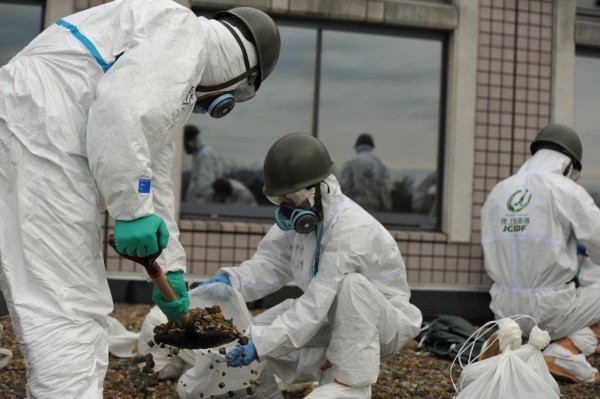
Koide: Well I think both that it is and it isn’t effective. For example, when they first started the decontamination work, what they did was blasting everything with high-pressure water hoses. That’s bad. All that does is get all the contamination moving around. It’s really just dispersing it.
Some of my colleagues have said that is a bad method. Be it a roof or a wall, you shouldn’t just douse it with water. To really remove the contamination, you would first cover it with something that could prevent the escape of radioactivity then knock down the radiated structure, tear it all off, and then fold it up and collect it all. I think that’s probably true. But it takes a long time.
I think there are effective ways of doing it and I think there are ineffective ways. Still it is fundamentally impossible to erase the contamination and so it must be moved. The only thing we should be doing is thinking about the easiest way to relocate it all.
Hirano: That’s the meaning of “effective” in this situation isn’t it.
Koide: Right. So the current method may be rather small in scale. But for me even small-scale methods are necessary. As long as people are living there everything is necessary.
Of course, there’s legitimate criticism over the fact that this is a decontamination business and that the large construction companies are getting rich, but again, for me, as long as there are abandoned people still living there it all must be done.
Hirano: It was really a shock going there and seeing it. To see those workers and, honestly, their lack of conviction for the work. It was a really weird scene. No real enthusiasm, but rather one day after the other, contingent labor. The media has reported that the workers come from a few particular prefectures, but actually being there and talking to them, I could really get a true sense of the structure of economic inequality in Japan, that this sort of work found this kind of person, a person coming from economically precarious and socially marginalized backgrounds. In fact, you come to understand that decontamination work depends on these people.
For example, decontamination, or your preferred “relocation,” couldn’t those jobs be made more equitable―say by requiring TEPCO office workers, especially executives, to do it?
Koide: I’ve said that.
Hirano: You have? (Laughs).
Kasai: So…about the airborne radiation dosage and the soil contamination, there is a public entity that measures and publishes the airborne levels. But the soil contamination is not measured. I remember reading about Chernobyl that the soil contamination levels are the standard by which one gets the right to evacuation and refuge. But Japan only measures the air. And there are those who doubt the accuracy of the levels recorded. I thought the soil contamination had not been measured yet, but from what you mentioned earlier, we do know the extent of the contamination, don’t we?

Koide: Yes, we do.
Kasai: The actual levels?
Koide: With respect to soil contamination we more or less know the extent of it. We largely know which prefectures, which towns, and which villages―as well as how badly―have been contaminated. Four years after the disaster it has moved around. Radiation moves through the environment; it has a material existence and also does die out. I’m sure much has changed since immediately following the accident.
We have the data necessary to draw a map of the situation immediately following the accident, but we don’t have the data necessary to draw a map of the contamination today. That said, we basically know the extent of the soil contamination.
Kasai: Who is it that is making these measurements?
Koide: It is basically the Ministry of Education, Culture, Sports, Science and Technology. Some local governments took part as well. Some independent groups, as well as some local governments, took part in taking measurements back then. But for us the number one data source is the US military.
Hirano: I see; how is that?
Koide: They worked at truly amazing speed-and accuracy.
Hirano: Sorry if this next thought seems a bit of a tangent, but right after the accident both the US and Japan were looking at the same data. But their interpretations of it were extremely far apart. The US ordered all of its personnel to evacuate an area 80 km from Fukushima. While Japan’s largest evacuation zone was 20 km. Where does this disparity in evacuation zones come from? They are both looking at the same data. How do they arrive at such definitive and divergent judgments?
Koide: Well…and this was true for me, too, any nuclear specialist would have known on March 11th-March 12th at the latest-that there had been a meltdown. And this means, quite simply, that control had been lost. And once control is lost you simply don’t know what is going to happen next-or that’s what you must think at the time. Disaster preparedness must always imagine the worst-case scenario. If you don’t plan for the worst-case scenario it will be too late. What the US did was believe there had been a worst-case scenario-a meltdown-and so moved to take care of its people. That’s why they ordered an 80 km evacuation. I think this was the correct strategy. Japan didn’t do this. Japan was always thinking of the ideal, the best case scenario. They had to be thinking they could still get control and based their policy on that optimistic assumption. So they only declared a 20 km evacuation zone. I would say that from this conclusion two things may unfold: one is their desire to see this as a best-case scenario and the other is their inability to deal with it.
Hirano: What do you mean by their inability?

Koide: In a word, the Japanese state is incapable of functioning adequately when dealing with a disaster. That’s why they evacuated those within 20 km by bus but when it came to the 30 km zone they told those who could easily evacuate to do so and for all others to merely close their doors and windows.
Hirano: So there was no emergency management.
Koide: None. There simply is not a single person in the Japanese government who had thought an accident like this was possible. They all immediately fled the off-site center and so there was absolutely no emergency management―there couldn’t be. And because management was now impossible, there were no announcements. Even if they had declared an 80 km evacuation zone there were no emergency shelters. They had made no preparations, so there was nothing to be done.
Hirano: Last summer I interviewed Murakami Tetsuya 12 Just as the accident was happening he reached out to the government. But he got no response. He went to the prefecture. No response from them either. In the end he just used his own judgment. So really there was essentially zero emergency management in place. His thoughts at the time were to get the whole village to emigrate; that really there was nothing to do but to buy land and move to Hokkaido. He said these were his actual plans at the time. In fact, it would seem that the myth of safety has so totally permeated the bureaucracy that there really is no one who thinks about these things―wouldn’t you say?
Koide: That’s right. Not a single nuclear expert or policy maker ever seriously considered the possibility of an accident like this. I knew accidents were possible, and that when they happened the damage would be enormous; I had been commenting on the possibility, referring to some results of simulations. But still I would have thought the kind of disaster that happened at Fukushima was some kind of impossible nightmare―yet it actually happened. It was like the worse nightmare becoming a reality. And if even I thought this then all those pronuclear people surely never gave it a moment’s thought. And so when it actually happened, no one had thought about, let alone built a system to deal with it.
II The Responsibility of the Scientist and the Citizen
Kasai: In your books and lectures you often express strong respect for Tanaka Shōzō.13 Can you connect what you’ve just said to this as well?
Koide: Sure. I first became aware of Shōzō when I was in the student movement during the 1970s This was a time when there was close attention paid to Japan’s many pollution incidents, such as at Minamata. Personally I was working on nuclear power, but it was a time when, like it or not, we learned of all the harm that came along with building Japan into a modern nation. What I got from Shōzō was this epiphany that just like the Minamata disease right there before our eyes these sorts of pollution incidents went way back in Japanese history. With Japan’s decision to cast off Asia and follow the West after the Meiji Ishin of 1868 came these sorts of incidents, and the question within that was just how should one live? I learned the way Shōzō lived his life. I thought: Wow, it is possible to live that way; I must do it. Unfortunately I am completely unable to do so, but I never stop thinking that Shōzō’s was a wonderful way to live a life.
Hirano: Going back to an earlier discussion. You’ve repeatedly talked about the government’s responsibility, scientists’ responsibility, and individual responsibility. It would seem that this word “responsibility” is an extremely important keyword for you. You often emphasize it in your writing, too. What I want to ask concerns the issue of scientists’ special responsibility, a particular social responsibility. Scientists are often thought of as technicians, but this is not really the case. As a result, I feel you’ve pursued an intense interrogation of yourself as a scientist. As you’ve said you are not going to enter politics, could you connect this discussion of scientific responsibility to your earlier discussion of doing all that has fallen to you personally to do? How should we think about these two things?
Koide: I am in science and as such I have to take on the responsibility of a scientist-Just as a politician must take political responsibility. I think I mentioned this to you the last time, but I am an absolute individualist (tetteiteki na kojinshugisha/徹底的な個人主義 者). I don’t want to be constrained by anyone. I want to be able to decide my own life for myself. But because I’ve made this choice by myself I must also take full responsibility for that choice.
It’s two sides of the same coin. I don’t take orders from anyone. And this means that I alone bear the responsibility. It’s really as simple as saying: I’m a scientist and so I have the responsibility of a scientist.
Hirano: On this way of thinking about responsibility: “Who is the subject responsible?”―this way of thinking about it seems to be quite absent in contemporary Japan.
Koide: Right. People living in Japan today have not made decisions as individuals. They just “go with the flow;” as long as they follow the “authorities” whom they believe will guarantee the happiness of their individual selves. This seems true of education, too. Go to a slightly better school; get into a slightly better company; grow a bit more rich, a bit more grand. I think everyone is swept up in this current, and it’s really senseless.
I think it is extremely important that each and every individual live out their individuality. The absolute worst thing is for everyone to become blindly obedient to the “authorities,” yet this is the Japan we find ourselves in today. And so no one takes any responsibility. Living in such a society it is too easy to say, “It can’t be helped.” Everyone is thus able to blame the society as a whole; “It can’t be helped.” And so no one takes any individual responsibility.
The most extreme and obvious example was the war. Everyone would say: “It’s not my fault; I was deceived. The military were the culprits.” Saying this allows people to remain at a distance, indifferent. It is bad news for a nation when its citizens have only this view of responsibility.
Hirano: You’ve declared, “I am an absolute individualist.” Personally I am very interested in that statement. So could you speak a bit more concretely about the meaning of your individualism for how one lives a life? In other words, could you explain just what you mean by this “individualism?”
That is, in Japan being individualistic is more often a way to say egotistical; a sort of disregard of others. One should pursue one’s own interests―in English the word is “selfish” ― egocentric ― pursue your own egotistic advantage. Now this seems completely different from the way you use the term. Could you speak directly to this difference?
Koide: I think you’ve just done so.
Hirano: Did I? (Laughs). So that’s it then, just as I said? Still it’s clearly not selfishness.
Koide: No, I don’t think it’s about interests.
Hirano: It’s about values isn’t it?
Koide: Yes, it’s about personal values. You and I are different people. I am different again from Mr. Kasai. Why? Well our genetic information is different. I received a bundle of information from my parents. You and Mr. Kasai, too, are influenced by your genetic information. Every one of the over one hundred million Japanese is a unique human being; and every one of the over 7.3 billion people on earth are unique individuals.
History may keep moving on, and there is a big, wide world here on this planet earth. That said, right now, at this moment, and right now, in this place, I exist as an irreplaceable being. It is nothing but an absolute truth. You normally live in Los Angeles, but right now at this moment you are a person who is here. Mr. Kasai has come down from Tokyo. While acknowledging all the implications of being within the flow of history, we are all right here, right now.
In other words, every single individual human being has a different way of living a life; they are each unique. They have each lived a life that absolutely no one else could have lived. It is a real loss if they don’t live up to their full potential. Those are my thoughts.
So for my own unique self, and so for your own unique self, and Mr. Kasai’s own unique self, none of us should be compelled by someone else to do something (meirei o sarete/命令されて). If we don’t live our lives according to the will coming from deep within ourselves, that’s a real loss; we must all live with our values coming from within ourselves.
I am going to retire next March, but though I am the lowest ranked employee here― above me are assistant professors and professors ― because of the peculiar arrangements of working where I do, I am not compelled to take orders from anyone. I am the lowest ranked so of course there is also no one below me to order around. So I am in a position where I never take nor give orders. For me this is the ideal position to be in.
And so I can live out my own life according to my own values; I’m allowed to live a life that suits me. Now I found myself in this position largely by accident, and then chose to continue to live my life this way. Related to this, I am a human being and so will make mistakes, but these mistakes will be things that I have chosen, things that I have personally done so there is nothing to do but to take responsibility for them. This is what I mean when I say that responsibility is an extremely important word.
Hirano: Well, you’ve exhaustively criticized this competitive society. You’ve said that this competitive society has ruined Japan and destroyed life based on what you call responsibility.
Koide: Yes. Everyone is running towards the exact same goal. It’s ludicrous. You want to go that way; I want to go this way. I think this would be the ideal society. Full mutual recognition is a good thing.
Hirano: Does your view come from your personal experience? In your books you state that you were a really conscientious student when you were younger (laughs).
Koide: (laughs) Well, yes.
Hirano: You studied extremely hard. Did everything extremely hard. You continued this in your nuclear research in college believing that a new energy source was cheap and good for everyone. You must have thought this was a great thing.
Koide: That’s right.
Hirano: But you eventually noticed that it was all wrong. So on this, from deep in your own experience, it’s an individual history, an individual experience, in one sense it’s connected to your current individualism, to how you live your life focused on the important things to you.
Koide: I think that’s right. So, well, when I was young, in my late teens, I was consumed by the dream of nuclear power. I devoted my life to it. That was all a mistake―it did not take me too long to realize that.
Hirano: When did it happen? In graduate school?
Koide: My third year in university.
Hirano: Third year―so as an undergraduate.
Koide: Yes, I came to this realization in the latter half of my undergraduate studies. It was foolish and I curse myself for it, but I didn’t quit. To this day I’ve lived my life as someone who made that wrong choice, and there is nothing to do but make amends for that choice.
At a minimum I wanted to get rid of nuclear power before there was a bad accident. I guess I’ve lived with this wish for over forty years―but that wish stayed out of reach. And here we have had the accident so my life has been for nothing. You could say that thing I wanted most to do has been denied. Really, what have I lived for? I think about that from time to time.
As this was my choice I have to accept it. So while the meaning of my life may have been lost, still I was able to live my own life as I pleased, without submitting to the orders of others and without ordering others around―for this I am grateful. My hopes were never realized. History is full of that kind of thing. Likely very few people see their hopes fulfilled. And while in my case they were rejected, I was able to live the life I wanted and that is a life to be grateful for.
Hirano: In a way, it’s just how Tanaka Shōzō lived his life isn’t it?
Koide: Yes it is. That is what I like about Shōzō.
Hirano: On that point. His life, too, was a defeat.
Koide: Complete and total defeat.
Hirano: Still, he used all sorts of means, and followed all the way through on his beliefs.
Hirano: So getting back to Fukushima, it seems when it comes to the life choices of the so-called Japanese elites, they seem caught in a system in which they will succeed and become famous by crushing their individuality and subsuming it under some organization in order to get ahead in a society and achieve fame and status. And the education system seems to be promoting this lifestyle where these sorts of people are created through intense competition. I think the very end result of this social and educational system was revealed, and it exploded in an explicit and ugly manner through various problems the Fukushima disaster has posed.
Koide: Yes, I think so. You said it.
Hirano: I see. In one sense it would have been possible even for these Japanese elites to make their personal responsibility clear and take appropriate actions only if they had lived a life based on individualism as you suggested.
Koide: Yes I think such a possibility exists, but unfortunately in Japan today that possibility has been completely crushed. It was abundantly clear from the Fukushima disaster that no one in this country is going to take responsibility.
Hirano: You’ve already talked about how TEPCO and the government made huge mistakes in dealing with the problem immediately after the accident. What do you see as the definitive mistake that led to this disaster?
Koide: There’s a ton of them. Any specialist would have known right away there had been a meltdown, and that everyone needed to be evacuated immediately. And evacuating to 20 km away is totally inadequate. Iitate village some 40-50 km away received an enormous amount of contamination and was neglected for over a month.
Soma residents evacuated to Iitate, this kind of stupidity cannot stand, the government’s criminal mistakes.
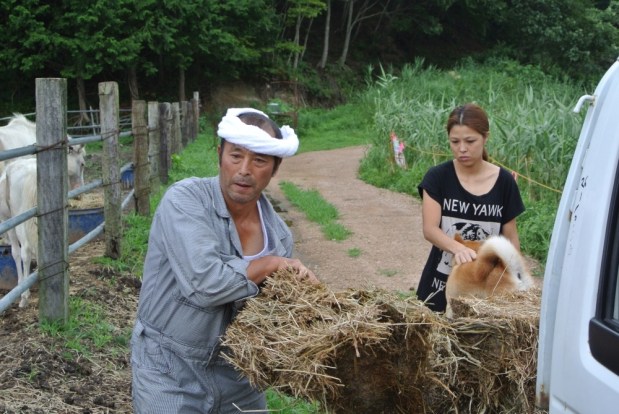
Kasai: I’m deeply taken by your previous discussion on responsibility. It’s really a story of something with no owner. A golf course that has had to close because it is considered contaminated with radiation from TEPCO’s plant has recently sued. TEPCO’s top attorneys argued in defense that the radiation is not their property, which would make it no one’s property and therefore TEPCO is not responsible. It seems the opposite of what you’ve just said about responsibility, to be sure, yet this declaration of complete lack of responsibility, once passed through the logic and system of the courts, these lawyers have arrived at precisely this conclusion. It is not a question of individual responsibility; it is a problem of the social system. Lack of any responsibility is the basis of the entire social system. What are your thoughts on this?
Koide: It’s exactly as you say. This is what it has come to. I couldn’t care less about a country like that. But in order to overcome this situation, it’s something I mentioned earlier, but there is no way but for rather foolish citizens to get smarter. Only each individual standing up for his or her own way is going to do it.
Hirano: You’ve also talked about “responsibility for being fooled.” You’ve said that even the deceived are guilty and stressed that they too must take responsibility. How do you think about this at the individual level? For example, you’ve often stated that there should be a new food labeling system put in place by which especially the generation that agreed to build the reactors would be obliged to eat the contaminated food―would this be an example of taking individual responsibility for you?
Koide: Yes, that’s exactly what I mean. So, because I think that every Japanese adult has responsibility for both allowing the rampant development of nuclear power and the Fukushima disaster, I said that they should be the ones to eat the contaminated food. And so that this disaster may never happen again, nuclear power must be eliminated―of course there should be no question of restarting the reactors. Yet, what I’ve just said is not really a widespread idea. Slowly all the reactors are being restarted.
Hirano: So in that sense Japanese citizens’ responsibility is increasing in that they are allowing the restart of the reactors.
Koide: I think the nuclear power issue is precisely analogous to the war.
Hirano: Indeed, as with the damage of misinformation and national morality discourse we talked about and the pressure that comes from those hints of someone being somehow “un-Japanese,” it seems to really resemble the war.
Koide: I think so, yes.
Hirano: I’d like to ask more about the responsibility for being misled. Up to now the reason most would say that nuclear power has been allowed is the myth of safety―a myth invented by the coordination of the government, TEPCO, and the media. So Japanese citizens have been robbed of being told the truth, of having the chance to know the truth.
Koide: That’s true.
Hirano: So the likely response to your position would be that it’s unjust to blame those who were robbed of the chance to know the truth. How would you answer this challenge?
Koide: I also said that the current situation is just like during the war. Then, too, the media only reported the information coming from imperial headquarters: The Japanese military enjoyed nothing but a string of victories. We were all told that because of the emperor Japan was a divine country and therefore could not lose. You would go to school and there would be the emperor’s portrait hanging on the wall. There was a place where the emperor was enshrined right there on school grounds. Every child was taught that the emperor was present there.
In such a country it wasn’t strange to think that Japan would win the war. But those who knew more about the world, including of course those in the military, knew that Japan could not win. Still they said nothing. And so everyone was swept along with the current.
But history is harsh, and in the end Japan was battered. And people at that time said, “Ah, we’ve been misled. The military are the culprits.” But even within all of this there were those who resisted the war. The number of people tortured and killed by the Special Higher Police was huge. And those people, too, were labeled as “un-Japanese” and ostracized from society by the majority of the population. Whole families, whole groups of people were obliterated.
So those who lived then were duped, they were given false information. But should they say that’s where their responsibility ends? I would respond that even if they were duped, the duped still bear the responsibility of the duped. How did each and every one of them live their lives during the war? How did they deal with the information they were being given? I think we need to include these kinds of questions when we interrogate ourselves over taking responsibility. Now if you say this people get angry but I think without question the emperor has absolute responsibility for the war. We ended up moving on without trying to pursue the emperor’s war responsibility.
Even today you’ll see people happily shouting “Tennō heika banzai,” Long Live the Emperor. At midnight NHK will broadcast the Japanese flag flapping in the wind. I can’t stand that and so don’t watch TV. Most Japanese get happy when they hear ‘honorable’ addresses by His Majesty the Emperor or news about the imperial family. From the bottom of my heart I think we should have pursued his war crimes and punished him with whatever it takes, including execution. I have been saying this and people get very angry.
I am told not to criticize the emperor. They say if I do I’ll harm the anti-nuclear movement.
Hirano: Even people in the anti-nuclear movement warn you about things like that? A critical reference to the emperor’s wartime responsibility could be fatally divisive for the movement?
Koide: Those roots are that strong when you talk about war responsibility. But as I have mentioned to you, I feel at the bottom of my heart that each and every individual must take personal responsibility for how he or she lived his or her life. That’s the reason why I wanted the emperor to take his responsibility as a person.
We must build such a country. Even the duped and the lied to have responsibility as individual human beings. It’s true for those who lived through the war, and it’s true for those who promote nuclear power in Japan today―indeed it’s true for everyone on earth. Each one, should they be deceived, is responsible for being deceived.
Hirano/Kasai: Well we’ve gone on long today and heard some really important things. Thank you very much.
Katsuya Hirano is Associate Professor of History at UCLA. He is the author of The Politics of Dialogic Imagination: Power and Popular Culture in Early Modern Japan (Chicago). This interview is the second installment of his oral history project on Fukushima in The Asia-Pacific Journal: Japan Focus. The first interview was with Murakami Tatsuya: “Fukushima and the Crisis of Democracy: Interview with Murakami Tatsuya”, The Asia-Pacific Journal, Vol. 13, Issue 20, No. 1, May 25, 2015.
Hirotaka Kasai is Professor of Political Thought at Tsuda College in Tokyo, Japan. He has published articles and book chapters on Maruyama Masao and radical democracy in Gendai Shiso and others.
Robert Stolz is Associate Professor of History at University of Virginia. He is the author of Bad Water: Nature, Pollution, and Politics in Japan, 1870-1950 (Duke). He has published an article on Tanaka Shozo in The Asia-Pacific Journal: “Remake Politics, Not Nature: Tanaka Shozo’s Philosophies of ‘Poison’ and ‘Flow’ and Japan’s Environment”, Vol. 5, Issue 1, January 2, 2007.
Akiko Anson is a freelance translator who lives in Iowa City, Iowa. Anson obtained a BA degree in English Literature from Gakushūin University in Tokyo, Japan and an MA degree in Asian Studies from the University of Iowa.
Recommended citation: Katsuya Hirano and Hirotaka Kasai interview Koide Hiroaki, “The Fukushima Nuclear Disaster is a Serious Crime”, The Asia-Pacific Journal, Vol. 14, Issue 6, No. 1, March 15, 2016.
Notes
INTERVIEW/ Kazuya Tarukawa: Reality of Fukushima is unrecoverable, uncompensable
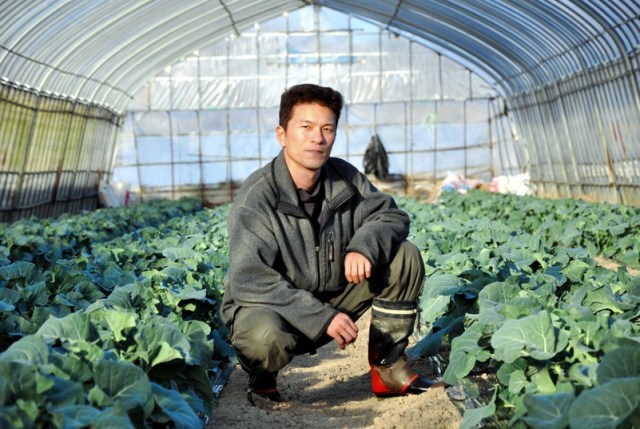
Farmer Kazuya Tarukawa at his greenhouse in Sukagawa, Fukushima Prefecture
Kazuya Tarukawa, a farmer in Sukagawa, Fukushima Prefecture, found himself in the media spotlight after his father committed suicide in the early stages of the disaster at the Fukushima No. 1 nuclear power plant.
In a recent interview with The Asahi Shimbun, Tarukawa recounted how his gratifying life as a farmer drastically changed on March 11, 2011.
He also shared his thoughts on the compensation system, rumors about Fukushima products, and how Tokyo Electric Power Co. sent him a fax instead of a direct apology for his father’s death.
Excerpts of the interview follow:
* * *
Question: What are things like five years after the disaster started?
Tarukawa: Radioactive materials fell on this central strip of Fukushima Prefecture, too. Rice paddies, farm fields and plastic greenhouses were all ruined, so our “workplaces” were contaminated. But Tokyo Electric Power Co., operator of the crippled nuclear plant, has not compensated us for lost assets or removed the radioactive substances.
Five years have passed, and that’s it. We have only sustained damage and suffering. I keep asking myself, “Why do we have to go through all this?”
We did receive 80,000 yen ($706) in the first year of the disaster and 40,000 yen in the second year for psychological suffering, but that was all. The thinking behind the payments was probably like, “Here’s 120,000 yen, so keep your mouth shut and wait for the radiation levels to go down on their own.”
How can that make up for the damage we sustained?
Q: I have been told that your father was dedicated to organic farming of vegetables. Could you elaborate?
A: He cared a lot about the environment. He began growing winter cabbage because you never get worms, even without a single disinfection, in winter. The cabbage grows under the snow and develops quite a sweet taste. All local schools were using our cabbage in their school lunches.
He was so happy to be feeding children with something really safe and tasty. He was once invited by school officials to give a talk about food education. He was proud of things like that.
He hanged himself on the morning the day after the central government told him to stop shipping his vegetables. Around 7,500 pre-harvest cabbages were ruined. His farmland was contaminated. His heart was probably heavy while he was wondering how he would get on with his life.
Q: You reached a settlement in the case through the intermediary of the Nuclear Damage Compensation Dispute Resolution Center, whereby TEPCO acknowledged a causal relation with the disaster. Could you elaborate on that?
A: I took the case to the center because I wanted to avenge my father so he would not die in vain. I finally won the settlement and received damages. I thought that TEPCO people would finally come to my place to offer incense and apologize. But that never happened. I got a fax instead.
Q: How is the cleanup work going?
A: Our rice paddies were cleaned up. The ground was plowed to about 40 centimeters using a big tractor, sprinkled with zeolite and then plowed again. We were told that the zeolite will absorb radioactive substances in the soil, and that’s the cleanup thing.
But it doesn’t make sense. Rice may stop pulling up radioactive materials, but the absolute amount in the soil remains the same.
We are toiling every day from morning until evening on contaminated soil. We are filled with anxiety about what will become of us in the future, and whether we might suffer the impact someday.
When we were negotiating with the central government, I repeatedly asked farm ministry officials on the podium: “Do you know the first kanji in the Japanese word for ‘cleanup?’ (The kanji means “remove.”) You are just stirring things up. How can that amount to a ‘cleanup?’”
Everyone then cast their eyes low at their documents. They must have thought I was right.
Q: Isn’t there a way to strip away the contaminated surface soil?
A: We would be luckier if only there was a way to strip it off in thin slices. But in the month after the disaster started, the prefectural government gave us directions, saying it was OK to plow the ground. I didn’t quite believe in that stuff, but everybody did plow the ground.
We shouldn’t have done the plowing thing back then. They could have told us to stop growing crops for a year, and you will be compensated for that. That was a big moment when the sides parted.
It’s easy to strip off soil with a machine. But if you remove 40 cm of soil, you wouldn’t get decent crops. It takes tens of years to make just 1 cm of fine, fluffy soil.
I stick to what I am doing because I don’t want to let my rice paddies go to ruin during my time, the time of the eighth generation.
The paddies would quickly go to ruin if you didn’t do anything about them and just let them lie around. That would also cause trouble with your neighbors. Come to think of it, if you didn’t grow anything, you also wouldn’t be getting compensation money, and you would be left without income. You couldn’t maintain your living.
Q: What compensation are you getting for the farm products you grow?
A: We are only being compensated for crops with records of sale and proof that we suffered damage. For example, if you sold something at 2,000 yen before the disaster but now are making only 1,500 yen from it, TEPCO will compensate you for the difference.
But we have not been compensated for cucumbers for the past two years because their prices soared due to the unseasonable weather. People are saying stuff like, “We are not paying you because you are selling them at higher prices than you did before the disaster.”
It’s funny, huh? We would be making more money if it were not for the disaster. We are getting less than in other prefectures. You know, TEPCO is loath to shell out money.
And there are so many things that we have no way to seek damages for. Things that will never be with us again. We used to grow shiitake mushrooms at our homestead every year for consumption. Butterbur sprouts and Japanese angelica tree shoots from the mountains–they have all been spoiled. But we are getting nothing for that.
Q: What about the impact of negative publicity?
A: The 2011 harvest of rice from our paddies measured up to 30 becquerels or so in radioactive content. That was a safe enough level because the regulation standard was 500 becquerels (per kilogram; 100 becquerels from fiscal 2012) or less. But it’s something that you are putting in your mouth, after all.
Frankly, I didn’t want to eat it myself. Well, I did eat it because I couldn’t have gone shopping elsewhere.
But I do have a sense of guilt about making shipments. So I know very well why Tokyoites don’t feel like eating things from Fukushima. Who would want to buy stuff to eat from a place with such a stupid old nuclear plant?
It’s not about “negative publicity.” You suffer from “negative publicity” when your sales have dropped because groundless rumors have spread. But our case is not like that. Everything is well-grounded. The radioactive materials actually fell.
Q: Do they still continue to be detected?
A: No radioactive materials were detected in rice last year and the year before last. In fact, we have done everything we can. We are spraying potassium chloride, which suppresses the absorption of radioactive substances, every year.
All bags of rice are being screened, and when you get measurement figures, you are not allowed to ship them. I believe that rice from Fukushima is now much safer than rice from other prefectures.
And our rice is selling well, in fact, in the restaurant industry and in hospitals because you may never know that the product is from Fukushima Prefecture. You may not see a lot on the surface, but vast quantities are on the move. Because Fukushima rice tastes good. It’s sticky and sweet. So restaurant industry people seem to be happy because they can buy tasty rice at cheap prices.
Q: What about vegetables?
A: Greenhouses were under plastic covers at the time of the disaster, so the soil in there was never contaminated. I decided to grow everything in greenhouses, so I have almost stopped growing things outdoors, including cabbage, because I don’t want to see measurement figures in my crops again.
I am now growing broccoli, but the prices are so cheap, beaten down. Urbanites don’t bother to differentiate between broccoli grown in greenhouses and those grown in open fields as long as they are from Fukushima Prefecture.
Q: Nuclear reactors are being brought back online these days. Your thoughts?
A: Japan remained free of nuclear power for some time. But look, was there any part of Japan where everything was pitch-dark at night during that time? We certainly had enough electricity.
We may have paid more for crude oil, and nuclear power may be cheaper in fuel costs. But think about it: How much do you have to pay to clean up after a disaster when one happens? It’s really a burden. What would become of this country if another nuclear plant were to fail somewhere? You could raise taxes, but would that be the end of it?
Q: With whom do you want to share your feelings now?
A: I could be better off if I didn’t raise my voice and kept silent. But I am somebody in the media spotlight because of my father. There are hosts of other farmers who feel like I do, that something is wrong. It’s not in my power, after all, to hold my voice about such feelings. Doing that is dishonest.
That’s why I decided to appear in the movie (“Daichi wo Uketsugu” (Taking over Mother Earth), a 2015 documentary directed by Junichi Inoue). I particularly want farmers in areas hosting nuclear plants to watch this film. I want them to know what will happen when there is a disaster.
My father used to say: “Human-made things will certainly fail someday. Nothing can stand the forces of nature.” And things have turned out exactly like that. And after five years, nobody has taken responsibility.
* * *
Born in 1975, Kazuya Tarukawa worked for a company in Iwaki, Fukushima Prefecture, after graduating from a university. He returned to his family home in Sukagawa, 65 kilometers from the Fukushima No. 1 nuclear power plant, 10 years ago to engage in farming.
Fukushima Report: 10,000 Excess Cancers Expected in Japan as a Result of 2011 Reactor Meltdowns, Ongoing Radiation Exposure
Report Gauges Cancer Prospects for Children, Rescue/Recovery Worker, and General Population; Japanese Government Criticized for “Disturbing” Failure to Examine Wider Radiation-Related Diseases
WASHINGTON, D.C. & BERLIN – March 9, 2016 – Residents of the Fukushima area and the rest of Japan will experience more than 10,000 excess cancers as a result of radiation exposure from the triple-reactor meltdown that took place on March 11, 2011, according to a new report from Physicians for Social Responsibility (PSR) and International Physicians for the Prevention of Nuclear War (IPPNW).
Titled “5 Years Living With Fukushima” and available online at www.psr.org/FukushimaReport2016, the PSR/IPPNW report laments that the full impact of Fukushima may never be known, due to Japan’s failure to immediately and fully track radiation exposures, as well as a “disturbing” lack of testing of the general population for radiation-related diseases and other impacts (miscarriages, fetal malformations, leukemia, lymphomas, solid tumors or non-cancerous diseases). The massive initial radioactive emissions were not recorded at the time of the triple-reactor meltdown and some radioactive isotopes (including strontium-90) have not been measured at all.
The PSR/IPPNW report uses the best available science and data to gauge the excess cancer rates among children, rescue and clean-up workers, and the general population of Japan. In addition to the 200,000 Fukushima residents relocated nearby into makeshift camps, the exposed include millions of others in Japan as a result of fallout-contaminated food, soil and water. Fukushima is often incorrectly seen as a “past” event; the reality is that radioactive emissions from the wrecked reactors continue to this day both into the atmosphere and in the form of 300 tons of leakage each day into the Pacific Ocean.
Key findings of the PSR/IPPNW report include the following:
- Children. “116 children in Fukushima Prefecture have already been diagnosed with aggressive and fast-growing, or already metastasizing, thyroid cancer – in a population this size about one to five case per year would normally be expected. For 16 of these children a screening effect can be excluded as their cancers developed within the last two years.”
- Workers. “More than 25,000 cleanup and rescue workers received the highest radiation dose and risked their health, while preventing a deterioration of the situation at the power plant site. If data supplied by the operator TEPCO is to be believed, around 100 workers are expected to contract cancer due to excess radiation, and 50 percent of these will be fatal. The real dose levels, however, are most likely several times higher, as the operator has had no qualms in manipulating the data to avoid claims for damages – from hiring unregistered temporary employees to tampering with radiation dosimeters and even crude forgery.”
- The rest of Japan. “The population in the rest of Japan is exposed to increased radiation doses from minor amounts of radioactive fallout, as well as contaminated food and water. Calculations of increased cancer cases overall in Japan range from 9,600 to 66,000 depending on the dose estimates.”
Catherine Thomasson, MD, report co-editor, and executive director, Physicians for Social Responsibility, said: “The health legacy of Fukushima will haunt Japan for years to come and it cannot be wished out of existence by cheerleaders for nuclear power. Unfortunately, the pro-nuclear Japanese government and the country’s influential nuclear lobby are doing everything in their power to play down and conceal the effects of the disaster. The high numbers of thyroid cancers already verified with 50 additional waiting for surgery in the children of Fukushima prefecture is astounding. The aim seems to be to ensure the Fukushima file is closed as soon as possible and the Japanese public returns to a positive view of nuclear power. This rush to re-embrace nuclear power is dangerous to the extent that it sweeps major and very real medical concerns under the rug.”
Dr. Alex Rosen, pediatrician and vice-chair, International Physicians for Prevention of Nuclear War, said: “One is of course reminded of the tobacco lobby disputing the notion that the horrific effects of its products have no adverse health impacts. This self-serving falsehood echoed for decades was made possible simply because the long-term health effects of smoking were not immediately observable. The 10,000 to 66,000 people who will develop cancer solely as a result of the “manmade disaster” are neither ‘negligible’ nor ‘insufficient,’ as Japanese authorities, the nation’s nuclear lobby, and various industry-dominated international bodies, would have you believe.”
Tim Mousseau, PhD, professor of Biological Sciences, University of South Carolina, said: “It is unfortunate that, in some regards, we have better and more complete data about the impacts of Fukushima radiation on trees, plants and animals than we do on humans. We are seeing higher mortality rates, reduction in successful reproduction and significant deformities. A great deal of this research has been done to date and it has troubling implications. The research findings should be heeded to direct human studies, particularly regarding the question of genetic and transgenerational effects of radiation.”
Robert Alvarez, senior scholar specializing in nuclear disarmament, environmental, and energy policies, Institute for Public Studies, and former senior policy advisor, US Department of Energy, said: “Radioactive fallout from the reactors has created de faco ‘sacrifice zones’ where human habitation will no longer be possible well into the future. In November 2011, the Japanese Science Ministry reported that long-lived radioactive cesium had contaminated 11,580 square miles (30,000 sq km) of the land surface of Japan. Some 4,500 square miles – an area almost the size of Connecticut – was found to have radiation levels that exceeded Japan’s allowable exposure rate of 1 mSV(millisievert) per year. Fourteen of the nation’s 54 reactors are permanently shut down as they are on fault lines and only four have been restarted.”
The PSR/IPPNW report also cautions that Fukushima was far from a one-time radiation incident: “The wrecked reactors have been leaking radioactive discharge since March 2011, despite assurances by the nuclear industry and institutions of the nuclear lobby such as the International Atomic Energy Organization that a singular incident occurred in spring 2011, which is now under control. This statement ignores the continuous emission of long-lived radionuclides such as cesium-137 or strontium-90 into the atmosphere, the groundwater and the ocean. It also ignores frequent recontamination of affected areas due to storms, flooding, forest fires, pollination, precipitation and even clean-up operations, which cause radioactive isotopes to be whirled into the air and spread by the wind. Thus, several incidents of new contamination with cesium-137 and strontium-90 have been discovered during the past years, even at considerable distance beyond the evacuation zone.”
The report also notes: “Finally, there are frequent leaks at the power plant itself – particularly from the cracked underground vaults of the reactor buildings and from containers holding radioactive contaminated water, which were hastily welded together and already exhibit numerous defects. According to TEPCO, 300 tons of radioactive wastewater still flow unchecked into the ocean every day – more than 500,000 tons since the beginning of the nuclear disaster. The amount and composition of radioactive isotopes fluctuate widely so that it is not possible to ascertain the actual effect this radioactive discharge will have on marine life. What is clear, however, is that increasing amounts of strontium-90 are being flushed into the sea. Strontium-90 is a radioactive isotope that is incorporated into living organisms in a similar way to calcium – in bones and teeth. As it travels up the marine food chain, it undergoes significant bioaccumulation and, because of its long biological and physical half-lives, will continue to contaminate the environment for the next hundreds of years.”
ABOUT THE GROUPS
Physicians for Social Responsibility has been working for more than 50 years to create a healthy, just and peaceful world for both the present and future generations. PSR advocates on key issues of concern by addressing the dangers that threaten communities. www.psr.org.
International Physicians for the Prevention of Nuclear War is a non-partisan federation of national medical groups in 64 countries, representing tens of thousands of doctors, medical students, other health workers, and concerned citizens who share the common goal of creating a more peaceful and secure world freed from the threat of nuclear annihilation. www.ippnw.org
http://www.psr.org/news-events/press-releases/fukushima-report-10000-excess-cancers-japan.html
Radiation fears keep Japan’s nuclear refugees from returning
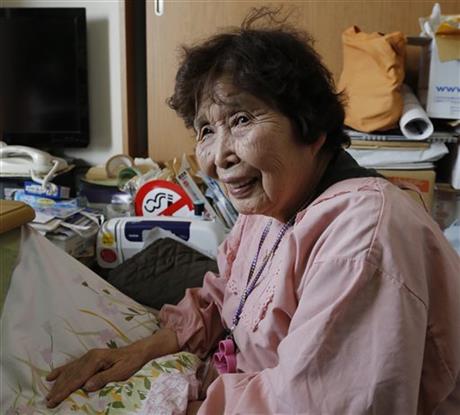
TOKYO (AP) — They feel like refugees, although they live in one of the world’s richest and most peaceful nations.
Five years ago, these people fled their homes, grabbing what they could, as a nearby nuclear plant melted down after being hit by a tsunami, spewing radiation. All told, the disaster in Fukushima displaced 150,000 by the government’s count.
About 100,000 are still scattered around the nation, some in barrack-like temporary housing units and others in government-allocated apartment buildings hundreds of kilometers (miles) away.
Although authorities have started to open up areas near the damaged reactors that were previously off limits, only a fraction of residents have returned. For example, in the town of Naraha, where evacuation orders were lifted in September, 459 people, or 6 percent of the pre-disaster population, have gone back.
Most say they don’t want to return for fear of lingering radiation. Some don’t want the upheaval of moving again after trying to start their lives over elsewhere.
With government housing aid set to end next year, many feel pressured to move back.
___
Tokiko Onoda, 80, lives with her husband in a cramped, cluttered apartment on the 21st floor of a high-rise in the edge of Tokyo where about 1,000 people displaced by the disaster live in rent-free housing.
Several Fukushima towns that were deserted now are urging residents to return, saying it is safe to live in certain areas. An ambitious effort to decontaminate vast swaths of land by removing topsoil and razing shrubbery has turned farmland and coastlines into stretches of dirt with rows upon rows of black garbage bags filled with grass, soil and debris.
When housing aid ends in April 2017, people in apartments under the government program will have to start paying rent or move out. Those whose homes in Fukushima that are in areas still off-limits for living will continue to receive the aid.
Onoda fears hers will be cut off because her home is in Namie, where evacuation orders are gradually being lifted in parts of the town.
She doesn’t believe it’s safe to go back. She feels duped because she had believed that nuclear power was safe.
Onoda angrily talks about how authorities are treating people like her. Why didn’t the government give her land elsewhere to build a new home?
When she lived in Fukushima, she had a big house with a garden where she grew vegetables and peonies. She picked mushrooms and ferns in the hills.
“We worked so hard to build that house,” she said, often stopping to wipe away tears. “We had no worries in the world except to plan vacation trips to the hot springs.”
That home is now in shambles. Although it survived the 9.0 magnitude quake on March 11, 2011, burglars have ransacked it and rats have chewed the walls. The last time she visited, the dosimeter ticked at 4 microsieverts an hour, more than 100 times the average monitored in-air radiation in Tokyo. That’s not immediately life-threatening but it makes Onoda feel uncomfortable because of worries that cancer or other sicknesses may surface years later.
Before the disaster, the government had set the safe annual radiation dosage level at 1 millisievert. Afterward, it has adopted the 20 millisievert recommendation of the International Commission on Radiation Protection set for emergencies, and 1 millisievert became a long-term goal.
Onoda says she has done her best to cope. She has made friends. She keeps busy with tea parties, art classes and a sewing circle.
And now they want her to go back, after all she has gone through?
“Only someone who has gone through this evacuation can understand,” she said.
___
Ryuichi Kino, a journalist who wrote, edited and compiled the 2015 book, “The White Paper on Nuclear Evacuees,” believes people like Onoda have been treated like “kimin,” which means “people who have been discarded” because they have been forgotten or abandoned by society.
“We don’t even know their real numbers,” he said, noting the government lacks a clear definition for “evacuees,” and bases its figures on tallies of those receiving aid. A recent count in Fukushima and a neighboring prefecture found the total number may be as high as 200,000, Kino said.
“Evacuation is a term that assumes the situation is temporary, and there is a place to go back,” said Kino.
The government is spending about 40 billion yen ($400 million) a year on housing aid for those displaced by the disaster. It’s also financially backing Tokyo Electric Power Co., operator of the damaged Fukushima Dai-ichi nuclear plant, to make monthly compensation payments, now at a cumulative 5.9 trillion yen ($59 billion) and rising.
Tests with volunteers who wore dosimeters for two weeks in the town of Naraha found average radiation exposure to be at a rate of 1.12 millsieverts a year.
Government official Yuji Ishizaki, who is overseeing the lifting of evacuation orders, says he is merely following policy.
“There is no clear boundary for what is safe or not safe for radiation,” he said. “Even 1 millisievert might not be absolutely safe.”
Fukushima Medical University, the main academic body studying the health effects of the nuclear disaster, says no sickness linked to radiation has been detected so far, although sickness from lack of exercise, poor diet and mental stress has been observed.
The more than 100 cases of thyroid cancer found among the 370,000 people 18 years old and younger at the time of the disaster the university calls “a screening effect,” or a result of more rigorous testing.
Some scientists say that is unusually high, given that thyroid cancer among children is rare at two or three in a million. Thyroid cancers among the young surged in the Ukraine and Belarus after the 1986 Chernobyl catastrophe.
___
Seiichi Nakate is relatively content in his new life with his wife and two children, 13 and 11, in the northern city of Sapporo, 600 kilometers (370 miles) from Fukushima. There, some 1,500 people from Fukushima have formed a support network, often getting together for drinks and helping each other find jobs.
Nakate recently bought a house and started a company that refers professional helpers to disabled people, and has hired former Fukushima residents. He vows to never return to Fukushima because of the radiation danger.
He believes that from the beginning, authorities underplayed those risks. He doesn’t trust them.
After the disaster, he immediately sent his wife and children to a relatives’ home in southern Japan. The family started living together in Sapporo a year later.
The end of government housing support makes people feel pressure to return, he says.
“The government abandoned the people of Fukushima, even the children. Now the policy is to push us to go back,” he said. “It’s a policy that forces radiation upon people.”
Megumi Okada, a mother of four, is fighting hard to keep her housing aid in Tokyo, getting people to sign petitions and meeting with government officials.
She scoffs at how officials keep saying that people are living “as normal” in much of Fukushima. She doesn’t want her children eating the food or breathing the air. They get periodic blood tests to make sure they are healthy.
Her husband has found a job as a construction worker in Tokyo. Their apartment is just two rooms and a kitchen, but the rent is covered. Okada wants to work, but publicly funded child-care is scarce in Japan, and private ones are costly.
“Nothing has progressed in five years,” she said. “We have the right to stay evacuated.”
Okada says she wants to apply for U.N. refugee status and move to Europe with her family, if she could.
“I know Japanese can’t become refugees now. But I wish we could,” she said. “It is about our staying alive.”
___
Government evacuation map for Fukushima September 2011: http://www.meti.go.jp/english/earthquake/nuclear/roadmap/pdf/evacuation_map_111125.pdf
Government evacuation map for Fukushima September 2015:
http://www.meti.go.jp/english/earthquake/nuclear/roadmap/pdf/150905MapOfAreas.pdf
The Broken Maps of Fukushima
by Robert Jacobs, March 9, 2016
When we look at maps of Fukushima what we see is disinformation. The maps of the radioactive contamination of Fukushima contain contradictions that embody our inability to understand the true nature of the dangers to people living there. This is rooted in the difficulty in understanding radiation. If we can separate the maps, we may be able to grasp the dangers more readily, and thus understand the situation in a more functional way.
Similarly, one can hold a Geiger counter up in the air in a village in Fukushima prefecture and declare that there is no radiation present. The assumption, therefore, is that there is no danger. The ways in which this can be both true, but only partial truth, are part of what we need to fully grasp to understand the situation in Fukushima.
I will begin with the Geiger counter.
Radiation is a very difficult thing to understand. For starters, we tend to assume that radiation is a “thing.” Something is radioactive or it is not. We are affected by the radiation or we are not. This is not quite accurate. Radiation is a quality: it is a process—something radiates. How it radiates can differ, and it is in this difference that half-truths can be told as whole truths. While there are many aspects to this, for the present article I will concentrate on the differences between gamma, beta and alpha radiation. Most of the discourse that you hear about radiation related to Fukushima is describing gamma radiation. The danger to most of the people continuing to live in contaminated areas is in the form of alpha or beta radiation, so when we hear people talk about radiation in Fukushima, most of the time they are not talking about what is of most concern and danger.
Here is a quick primer. Gamma radiation comes off of radioactive materials in waves. These waves can penetrate anything, and they are partially filtered by heavy materials, such as lead. You can think of gamma radiation as similar to x-rays. This is why you have a lead apron placed on you when you have dental x-rays, and why the technician goes behind a lead-lined wall. When gamma radiation passes through your body it does not stay in your body. Like x-rays, when the source is turned off, they stop and there is no more danger. To limit the damage to the body from gamma radiation we limit the total cumulative dose received, hence the person working with it protects themselves behind the lead wall; the patient receives a small dose, but if the technicians received that same small dose repeatedly every day, they would be at much higher risk.
Alpha and beta radiation comes from specific irradiated particles, such as individual atoms of plutonium, or cesium-137. These particles cannot penetrate through materials: they cannot penetrate through skin, or even paper. They are primarily dangerous when we internalize them inside of our bodies and they permanently lodge there. They generally give off a small amount of radiation because they are single atoms. If there are a lot of them present, they give off more radiation. If one is internalized into the body, it will give this small amount of radiation to the same surrounding cells for 24 hours a day. While the amount is small, 24/7 exposure to this radiation may cause mutations to these cells, and then cancer.
Gamma radiation fills an area equally, lessening quickly as you get further from the source. This is what most Geiger counters are set to measure—the levels of gamma radiation present. When you have alpha and beta-emitting particles scattered in an area, the amount of detectable radiation will likely vary. In Fukushima City last year (about 50 miles away from the nuclear plants), I held a Geiger counter at chest level on a street and found a low level of radiation. However, moments later when I placed that same Geiger counter on the ground, I found much higher levels of radiation. That is because particles fall and collect on the ground. When I then moved my Geiger counter to the gutter at the side of the street, I found dramatically more radiation. This is because rain washes the particles to the gutter. So the distribution of the particles is irregular, depending on how long ago they fell-out of the sky (fallout) and how much wind and rain there has been.
This is how you can hold a Geiger counter in the air (or place a public Geiger counter five or twenty feet in the air) and show very low levels of radiation, and yet there can still be significant dangers present. If the danger is from alpha and beta-emitting particles, the readings taken in mid-air can be low. The way that such particles are dangerous to us is if we internalize them into our bodies, typically by inhaling them, swallowing them, of having them enter through cuts in our skin. Once inside the body, they may pass through, but they may also permanently lodge there. The body is tricked into thinking that these particles are useful chemicals. Strontium-90 “mimics” calcium, and the body can put it into the bones. Since the body puts iodine into the thyroid gland, if someone has internalized iodine-131 (a radioactive form of iodine) the body may put that in the thyroid gland. Thyroid cancer is one of the first cancers to develop from internalized particles, and that is why our conversation about the health impacts in Fukushima are currently focused on thyroid cancer. Other cancers will follow as we move through their latency periods.
______________
Table 1
Some isotopes of concern after a nuclear accident:
Plutonium 239, half-life: 24,000 years, decay mode: alpha, decay energy: 5.24 MeV
Strontium 90, half-life: 29 years, decay mode: beta, decay energy: 0.546 MeV
Cesium 134, half-life: 2 years, decay mode: beta, gamma, decay energy: 0.698 MeV
Cesium 137, half-life: 34 years, decay mode: beta, gamma, decay energy: 1.76 MeV
Iodine 131, half-life: 8 days, decay mode: beta, gamma, decay energy: 971 keV
Tritium, half-life: 12 years, decay mode: beta, decay energy: 18.6 keV
Decay energy is measured in electron volts (eV), a measure of the particle’s momentum. 1 MeV is 1,000,000 eV, and 1 keV is 1,000 eV. According to the table, Plutonium 239 is the most dangerous internal emitter, but the hazards to public health depend on the relative quantities released and the relative quantities that people actually absorb. Some segments of the population are more vulnerable than others. Is it a matter of a single exposure or a continual exposure and accumulation? What parts of the body do different particles tend to go to, and how long on average do they tend to stay in the body (the biological half-life)? None of this complexity can be conveyed with a map and a simple declaration of a “safe” limit of external gamma radiation exposure. (Table added by Dianuke editor)
______________
These alpha and beta-emitters are particularly dangerous for children. Children are lower to the ground to start with, tend to put things into their mouths, and tend to play outdoors and suffer cuts and bruises, and since their bodies are growing rapidly, damage to cells can replicate faster. This is why parents agonize over whether to stay or evacuate an area that has had radiological fallout.
This is also why it is hard to be certain about the contamination to the food supply. It is virtually impossible to test all food, and so samples are tested: samples of rice from rice fields, samples of fish from catches, samples of fruit from orchards. Because the danger to these crops is not from gamma radiation, which would be equally distributed, but from their internalizing alpha and beta-emitting particles, portions of a crop, or haul of fish, can test negative while other portions contain significant amounts of radiation deposited on them or taken up through soil and water into the plant or fish itself.

Our ability to technologically determine the distribution of alpha and beta-emitting particles is limited because of the irregular deposit of the material from fallout clouds, and the subsequent scattering of the particles from wind and water. This is also why it is possible to “decontaminate” an area only to have it re-contaminated as the wind and rain redistribute the particles that fell on nearby forests. Technically it is not possible to “decontaminate” a natural area. The radioactive particles will remain dangerous for their natural life. For plutonium that is over 100,000 years. During that time, it cannot be decontaminated, it can only be moved. We can attempt to contain these particles, however most of them will long outlive the plastic bags into which we placed them, at which time they will re-enter the soil and the ecosystem and begin to cycle through it again.
Understanding the difference between the dangers from gamma, beta and alpha radiation is the key to understanding how the maps of Fukushima are broken. Below is a typical map that we see of Fukushima, produced by the Japanese government:

Map of Fukushima produced by MEXT of the Government of Japan and reproduced on the website of the IAEA.
There are two things that I want to point out. First, the concentric circles. These have the Fukushima Daiichi nuclear plant at their center. The second thing is the color coded splotches and streak. These show where the plumes of the three nuclear plant explosions deposited their fallout, in this case specifically measurements of cesium-134 and cesium-137. Notice how the representation of the areas of fallout are constrained by the outermost concentric circle.
These two things should be read separately.
Concentric circles describe relative distances from a point. In this case, distances from the nuclear plant. People were evacuated based on their distance from the plant. The mandatory evacuation zone was at 20 km and the suggested, or prepared evacuation zone was from 20-30 km (the key difference between “mandatory” and “suggested” evacuation is liability). The reason that people had to evacuate from these areas was because of the high levels of gamma radiation coming from the melted cores of the nuclear plants, and the high levels of gamma radiation where the plumes deposited the largest amounts of fallout close-by. The levels of gamma radiation near the reactors is lethally high. At this point, no human being can enter into the buildings where the nuclear cores melted. The gamma radiation levels are so high that they would be killed in minutes. We have yet to build robots capable of operating in these highly radioactive locations for longer than an hour or so. Moving away from the point at the center of these circles will decrease one’s exposure to radiation. The amount of gamma radiation coming from the plant is measurable and relatively constant across the areas at similar distances. Hence the use of circles, concentric circles marking decreasing levels of gamma radiation.
Here is a map of the evacuations:
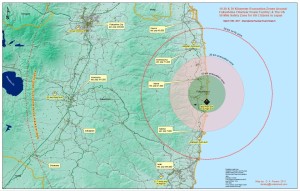
Concentric Circles Showing Areas of Evacuation, No-Fly Zone, and U.S. Safety Zone Around the Fukushima Daiichi Nuclear Plants, and the Populations of Nearby Towns.
When we look, instead, at a map of the radiological contamination of the downwind area, we are reading entirely different information. The splotches of color marking the levels of radiation from the plumes is irregular, unlike the neat and cleanly measured concentric circles. The colors mark the different grades of radiation from the fallout. They are created based on the gamma radiation from the fallout, however, the primary danger to people living in these areas is not based on the levels of the gamma radiation, but from internalizing individual alpha and beta-emitting particles. Since there is no single source, like the melted cores, but rather billions of individual particles, once the plume has fallen out and the particles have reached the ground, they begin to move through the ecosystem via the dynamic motion of wind and water, and then they are internalized in the bodies of animals. Rain will collect them along gutters and gullies and transport them. Wind will blow them along hillsides and valleys. Once these particles begin to move through the ecosystem, there is no center, no specific source that people must move away from. The dangers are unevenly distributed, and they are constantly changing. Once you are over 30 km away from the nuclear plants, surrounded by their concentric circles, moving further away from the direction of the plants may or may not provide more safety. The contamination that comes from alpha and beta-emitting particles is unpredictable, irregular, and changes over time. Each specific particle has a specific period of radioactivity and during that period, it will move through the ecosystem, being taken up by plants, moved by wind, entering soil, eaten by animals and returning to the soil when the animals die. They may move in the same direction that you are moving to get away from the center of the concentric circles, if the wind is blowing that way.
Here is a map showing the radiological contamination of the region, which differs from the specific places where the plumes first deposited:
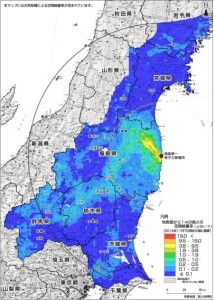
Map of Radiation Levels Downwind from the Fukushima Daiichi Nuclear Plants in 2014, Produced by the Nuclear Regulation Authority of the Government of Japan.
The maps of Fukushima are broken. These broken maps are reflections of the broken chain of information that has been provided to those living there and grappling with the dangers on a daily basis. Because these maps, and this information, are broken, disinformation can thrive and blossom. A March 7th editorial in the Yomiuri Shimbun in Japan makes use of these broken maps and the data that they convey to misinform people in Japan about the safety of former residents moving back into contaminated areas. With no sense of irony, it’s headline proclaims, “Correct Understanding of Radiation Needed to Speed Reconstruction.” Explaining that exposure to radiation is natural, the editorial claims that, “The government needs to continue carefully explaining to residents that there will be no health problems as long as the radiation exposure is at 20 millisieverts or lower.” For this reason, people need “correct understanding” to cooperate and return to areas that can only be decontaminated to 20 millisieverts. While there is significant debate about what level of gamma radiation is safe, and increasingly convincing data that no level is safe (see here), this argument ignores the fact that much of that 20 millisievert exposure is coming from alpha and beta-emitting particles, which pose an additional danger from that of the external exposure. For the people being advised to return, the areas they would return to are plagued by the more urgent risk of internalizing these particles, a danger that increases dramatically in areas where the external exposure is still measurably high. Their lives would be filled with the presence of large amounts of invisible atoms that will very likely cause cancers if inhaled or swallowed. These dangers are not factored into the 20 millisieverts the editorial writers so casually dismiss.
These broken maps, co-mingling the dangers of external and internal radiation in one graphic, present the idea that the dangers from radiation near Fukushima are fixed and knowable. This is not true. Massive amounts of radionuclides have deposited along large areas of Fukushima, and they will now pulse and fluctuate within the dynamics of that ecosystem for as long as each particle remains radioactive. Most of them will be hard to trace and difficult to control. People can be moved away from the plants, where the danger is in a fixed location and is measurable. Where the plumes deposited the particles the opposite is true. The dangers are unknowable and can move around, just like the people. This puts the health of those living there in a very different relationship to the risks.
To fix the maps, we need to fix the knowledge chain. Radiation is difficult to understand, and that difficulty allows disinformation to take root–disinformation like that contained in the editorial of the Yomiuri cited above, and in so many pronouncements from experts who omit information about alpha and beta-emitting particles and the dangers of internalized radiation when they speak down to people who must live with these dangers. For most people having to live with the radiation scattered by TEPCO’s meltdowns, clear information about internalized radiation and how these dangers persist in their communities is essential for them to map their own paths to a future of their choosing. No one should insist that they live with higher levels of radiation by changing their understanding to the “correct understanding.”
_____
Robert Jacobs is a historian of nuclear technologies and radiation technopolitics at the Hiroshima Peace Institute of Hiroshima City University.
Dentist urges people to keep kids’ baby teeth to study Fukushima radiation exposure
A movement calling on people to retain their children’s baby teeth to help study radiation exposure in the wake of the Fukushima nuclear disaster is gaining momentum in Japan.
The radioactive material strontium-90 is easily absorbed into baby teeth, and last year a group of experts formed the “Preserving Deciduous Teeth Network (PDTN),” urging people to keep their children’s baby teeth.
“Baby teeth are evidence of exposure to radiation. We urge people to keep them for the future,” says Takemasa Fujino, 67, a joint head of the network.
Fujino is president of a medical institution that operates three dental clinics in the Tokyo metropolitan region. One clinic is in Matsudo, Chiba Prefecture, which was regarded as a “hot spot” with relatively high levels of radiation following the March 2011 outbreak of the Fukushima No. 1 Nuclear Power Plant disaster.
With residents feeling uneasy, in 2011 Fujino began calling for people to preserve their children’s baby teeth, wanting to do something as a dentist to protect children’s lives and health.
So far, Fujino has had about 500 baby teeth donated, and has commissioned a Swiss testing facility to analyze some of them. Next year the network plans to establish its own testing facility in central Japan.
Baby teeth are formed from when the child is in the womb. “The teeth of children that were fetuses five years ago at the time of the accident will be coming at about this point exactly, and the movement to preserve them will become even more important,” Fujino says.
http://mainichi.jp/english/articles/20160307/p2a/00m/0na/015000c
32,000 workers at Fukushima No. 1 got high radiation dose, Tepco data show
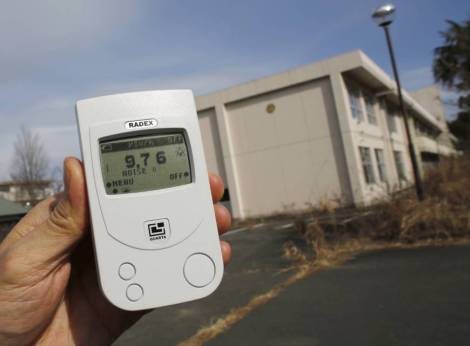
A Reuters reporter measures a radiation level of 9.76 microsieverts per hour in front of Kumamachi Elementary School inside the exclusion zone in Okuma, near Tokyo Electric Power Co’s tsunami-crippled Fukushima No. 1 nuclear power planton Feb. 13
A total of 32,760 workers at the Fukushima No. 1 nuclear plant had an annual radiation dose exceeding 5 millisieverts as of the end of January, according to an analysis of Tokyo Electric Power Co. data.
A reading of 5 millisieverts is one of the thresholds of whether nuclear plant workers suffering from leukemia can be eligible for compensation benefits for work-related injuries and illnesses.
Of those workers, 174 had a cumulative radiation dose of more than 100 millisieverts, a level considered to raise the risk of dying after developing cancer by 0.5 percent. Most of the exposure appears to have stemmed from work just after the start of the crisis on March 11, 2011.
The highest reading was 678.8 millisieverts.
Overall, a total of 46,490 workers were exposed to radiation, with the average at 12.7 millisieverts.
The number of workers with an annual dose of over 5 millisieverts increased 34 percent from fiscal 2013 to 6,600 in fiscal 2014, when workloads grew to address the increase in radiation-tainted water at the plant. The number was at 4,223 in the first 10 months of fiscal 2015, which ends this month, on track to mark an annual decline.
A labor standards supervision office in Fukushima Prefecture last October accepted a claim for workers compensation by a man who developed leukemia after working at the plant, the first recognition of cancer linked to work after the meltdowns as a work-related illness. Similar compensation claims have been rejected in three cases so far, according to the labor ministry.
The average radiation dose was higher among Tepco workers at the plant than among workers from subcontractors in fiscal 2010 and 2011. Starting in fiscal 2012, the reading was higher among subcontractor workers than among Tepco workers.
The average dose for subcontractor workers was 1.7 times the level of Tepco workers in fiscal 2013, 2.3 times in fiscal 2014 and 2.5 times in fiscal 2015 as of the end of January.
A separate analysis of data from the Nuclear Regulation Authority showed that the average radiation dose of workers at 15 nuclear power plants across the country, excluding the Fukushima No. 1 and No. 2 plants, fell to 0.22 millisievert in fiscal 2014, when none of the plants was in operation, down 78 percent from 0.99 millisievert in fiscal 2010
http://www.japantimes.co.jp/news/2016/03/07/national/science-health/32000-fukushima-no-1-workers-got-high-radiation-dose-tepco-data-show/#.Vt2gKfl95D8
FIVE YEARS AFTER: Fukushima fishermen still struggle to prove catches are safe
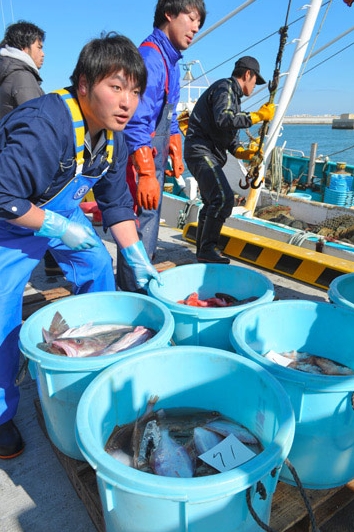
Fishermen unload their catch in experimental operations from a boat anchored at the Matsukawaura fishing port in Soma, Fukushima Prefecture.
Fukushima fishermen have been stuck in a vicious circle over the past five years. Whenever a glimmer of hope arises that they can resume normal operations, something happens at the Fukushima No. 1 nuclear plant that quashes the optimism.
“Just when we thought the fishing environment had progressed one step forward, it would take a step back,” said Yukio Sato, a 56-year-old fisherman. “The past five years have been such a forward and back zigzag.”
Although radioactivity levels in their catches have fallen considerably, the fishermen are still struggling to convince consumers that the fish are safe to eat.
Any leak of radioactive water from the Fukushima No. 1 plant–and there have been many–into the Pacific Ocean reinforces the negative image of Fukushima fish.
The catches have dropped in size, prices have plummeted and some fishermen are now giving up hopes of making a living from the fishing grounds.
Sato used to take his fishing trawler out five days a week.
But fishermen in the prefecture were forced to suspend operations immediately after the Great East Japan Earthquake and tsunami triggered the crisis at the Fukushima No. 1 nuclear plant. Radiation levels exceeding national standards were detected in the fish they caught.
“We could not catch the fish that we knew were swimming in those waters,” Sato said. “It was just so frustrating.”
Sato now takes his fishing trawler out twice a week.
The waters off Fukushima Prefecture are bountiful because two currents collide there. Close to 200 different types of fish can be caught in those waters.
In early February, Sato’s boat and other trawlers returned to the Matsukawaura fishing port in Soma, Fukushima Prefecture, carrying Pacific cod, monkfish, snow crab and other fish.
Sato’s catch totaled about 500 kilograms, and the fish were sent to local shops as well as the Tsukiji fish market in Tokyo.
“It would be great if we could return to the fishing of the past while I am still alive,” Sato said.
The catch from the coastal waters is still only about 6 percent of the levels before the nuclear accident.
In June 2012, more than year after the triple meltdown at the nuclear plant, experimental operations started to determine the market reaction to fish considered safe in terms of radioactivity levels.
Despite that effort, problems with radiation-contaminated water flowing into the Pacific continued.
Tokyo Electric Power Co., the operator of the Fukushima No. 1 nuclear plant, is still facing difficulties bringing the water problem under control. Every day, tons of groundwater flow under the Fukushima plant and become contaminated with radiation.
At one time, TEPCO came up with a plan to pump up the groundwater and dump it into the ocean before it could reach the plant.
Local fishermen opposed the plan because even dumping safe water into the Pacific would hurt the image of the fish caught in coastal waters.
But if such measures were not taken, the volume of contaminated water could increase to levels that would make it impossible to process.
In March 2014, the fishermen reluctantly agreed to the water bypass plan.
However, a year later, contaminated rainwater spilled outside the port waters. TEPCO’s failure to immediately disclose that problem refueled general concerns about contaminated water.
Other measures have since been taken to deal with the contaminated water, but according to one individual in the fishing industry, “No matter what is done, only the negative image that arises from that time is highlighted.”
Fishermen now depend on compensation from TEPCO for their daily livelihoods. Even those who are not engaged in experimental operations receive compensation equivalent to about 80 percent of their actual catch before the nuclear accident.
With no prospects for a resumption of full-scale operations, some fishermen are not bothering to take part in the experimental operations.
The radioactivity levels in the water and fish have steadily declined.
Three months after the nuclear accident started, half of the fish sampled had radioactivity levels exceeding the national standard of 100 becquerels per kg.
In 2015, 8,500 samples were tested; only four exceeded the national standard.
The decline in radioactivity levels has led to an expansion in the types of fish that can be caught through experimental operations, from three to 72.
While a simple comparison is not possible because the catch level in Fukushima is so low, fish caught through experimental operations fetch between 80 and 90 percent of the prices paid for the same fish types caught in other prefectures.
“With the brand image having fallen so low, it would not be profitable even if operations were allowed to expand,” said Takashi Niitsuma, 56, an official with the Iwaki city fisheries cooperative.
Fish caught further out to sea are also affected. Regardless of where the fish are caught, if they are brought to Fukushima ports, they are classified as being from Fukushima. That has led fishermen to avoid anchoring at Fukushima ports.
According to Fukushima prefectural government officials dealing with the fishing industry, about 5,600 tons of fish, excluding those caught in coastal waters, were brought into Fukushima ports in 2014. The figure is only 40 percent of the pre-nuclear accident level.
The Aquamarine Fukushima aquarium in Iwaki holds monthly events to show that fish caught off Fukushima are safe. At one recent event, a fat greenling was placed in a device to measure radiation levels while visitors looked on. A message flashed on a screen: “None detected.”
“Fish born after the nuclear accident will never exceed the central government’s standard,” said Seiichi Tomihara, 43, a veterinarian at the aquarium.
Local residents are involved in the project to dispel doubts about the trustworthiness of information provided by TEPCO and the central government.
“I first of all want people to understand the fact that the waters off Fukushima are steadily recovering,” Tomihara said.
http://ajw.asahi.com/article/0311disaster/recovery/AJ201603070041
Mutations, DNA damage seen in Fukushima forests, says Greenpeace
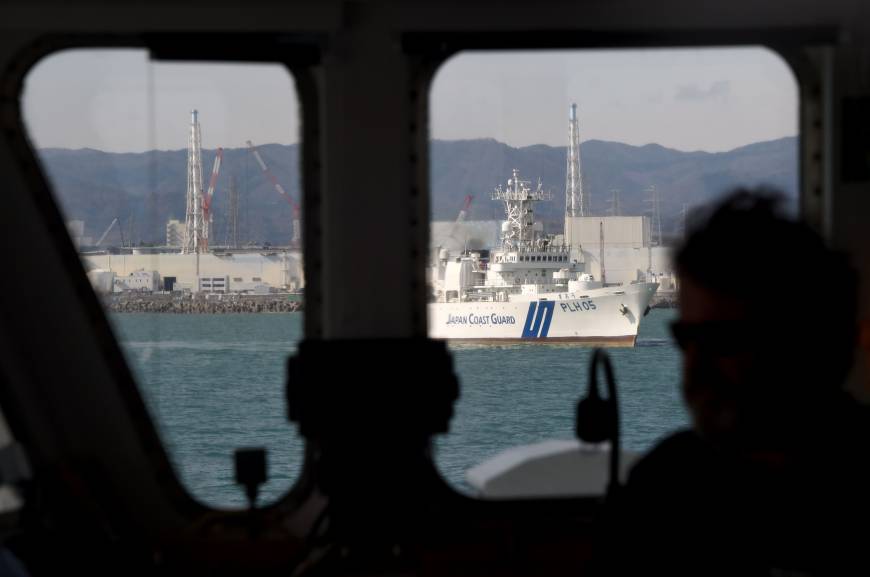
Conservation group Greenpeace warned on Friday that the environmental impact of the Fukushima nuclear crisis five years ago on nearby forests is just beginning to be seen and will remain a source of contamination for years to come.
The March 11, 2011 magnitude-9.0 undersea earthquake off the nation’s northeastern coast sparked a massive tsunami that swamped cooling systems and triggered reactor meltdowns at the Fukushima No. 1 nuclear plant.
Radiation spread over a wide area and forced tens of thousands of people from their homes — many of whom will likely never return — in the worst nuclear accident since Chernobyl in 1986.
As the fifth anniversary of the disaster approaches, Greenpeace said signs of mutations in trees and DNA-damaged worms were beginning to appear, while “vast stocks of radiation” mean that forests cannot be decontaminated.
In a report, Greenpeace cited “apparent increases in growth mutations of fir trees, … heritable mutations in pale blue grass butterfly populations” as well as “DNA-damaged worms in highly contaminated areas.”
The report came as the government intends to lift many evacuation orders in villages around the Fukushima plant by March 2017, if its massive decontamination effort progresses as it hopes.
For now, only residential areas are being cleaned in the short-term, and the worst-hit parts of the countryside are being omitted, a recommendation made by the International Atomic Energy Agency.
But such selective efforts will confine returnees to a relatively small area of their old hometowns, while the strategy could lead to re-contamination as woodlands will act as a radiation reservoir, with pollutants washed out by rains, Greenpeace warned.
The conservation group said its report relies largely on research published in peer-reviewed international journals.
But “most of the findings in it have never been covered outside of the close circles of academia”, report author Kendra Ulrich said.
The government’s push to resettle contaminated areas and also restart nuclear reactors elsewhere around the country that were shut down in the aftermath of the crisis are a cause for concern, Ulrich said, stressing it and the IAEA are using the opportunity of the anniversary to play down the impact of the radiation.
“In the interest of human rights — especially for victims of the disaster — it is ever more urgent to ensure accurate and complete information is publicly available and the misleading rhetoric of these entities challenged,” she said.
Scientists, including a researcher who found mutations of Fukushima butterflies, have warned, however, that more data are needed to determine the ultimate impact of the Fukushima accident on animals in general.
Researchers and medical doctors have so far denied that the accident at Fukushima would cause an elevated incidence of cancer or leukemia, diseases that are often associated with radiation exposure.
But they also noted that long-term medical examination is needed, especially due to concerns over thyroid cancer among young people — a particular problem for people following the Chernobyl catastrophe.
http://www.japantimes.co.jp/news/2016/03/04/national/science-health/mutations-dna-damage-seen-fukushima-forests-greenpeace/#.VtmtlObzN_m
Living in Limbo
Five years after the meltdown in Fukushima, the Japanese government’s effort to reboot its nuclear energy program is still being met with resistance.

The atmosphere in the packed meeting room is tense. It is a Wednesday night in November, and perhaps a hundred people have gathered at a community center in the city of Minamisoma, which begins about six miles north of the decimated Fukushima Daiichi nuclear power plant. At the front of the room sits a phalanx of government officials in dark suits. Facing them are men and women who were forced from their homes in Minamisoma’s Odaka district by nuclear fallout, and who are now being told they might be allowed back by spring. The question on the table is whether that move is premature. Twenty minutes into the discussion, the deep divide between the officials and the residents is clear.
An older man raises his hand. “There’s a tombstone behind my house where the radiation measures 10.5 microsieverts per hour. 10.5!” he says.
Multiplied over a year, the figure is 4.6 times the standard Japan’s government has set for mandatory evacuation, and 92 times the limit the International Commission on Radiological Protection recommends for the general population under normal circumstances. It is also far higher than most measurements taken recently in Odaka, where a massive government-sponsored cleanup – together with natural decay – is steadily lowering radiation levels.
“It’s probably a hotspot,” an environment ministry official says. “We can take care of it for you.”
“I asked the government for data about that spot in August, but I haven’t gotten anything. Why not?” the resident demands.
A woman in the audience shouts out: “Because they’re liars!”
“We think you’re afraid to give us the real data,” the man says.
Another resident speaks up: “The forest surrounding my house has not been decontaminated. Would you live in a place like that? I beg of you, please delay the resettlement!” Applause breaks out in the audience.
I kneel at the back of the crowd, surprised by the depth of the anger and skepticism coursing through the room. The normal tone of public space in Japan is deferential courtesy. That ordinary residents of a provincial town are willing to challenge officials so openly reflects a profound shift brought about by the nuclear disaster.
Simply put, far fewer people trust the government today than they did five years ago. The immediate cause of the disaster was an earthquake and tsunami on March 11, 2011 that deprived the coastal Fukushima plant of its power supply, and hence of its ability to keep reactors and spent fuel cool. A series of explosions and meltdowns followed, which led to the eventual evacuation of 164,000 people. Subsequent investigations soon revealed, however, that poor oversight and cozy ties between government, industry, and academia (the so-called “nuclear village”) laid the groundwork for the disaster. The public also learned that the government bungled the evacuation, causing thousands of people to suffer more radiation exposure than they otherwise would have.
Since then, resistance has extended deep roots. The clearest evidence of that is here in Fukushima, where residents like the ones in this room are fighting to make sure their rights are respected. But far beyond these borders as well, communities are embracing renewable energy and citizens are protesting government abuses of power more loudly than they have in decades. The question that remains after I slip out into the cool night air is how much that resistance is changing policy and politics in Japan.
At times, the answer seems to be: very little. The same political party that enabled the Fukushima disaster through half a century of pro-nuclear policy is back in power, three nuclear reactors are running again despite safety concerns, one more is about to restart, and 20 more are awaiting approval. Meanwhile, Japan played only a minor role at the Paris climate talks in November, and is pouring money into coal plants to compensate for its idled nuclear fleet. In Fukushima, the government remains intent on repopulating the 310-square-mile exclusion zone as quickly as possible.
I have come to Japan on the eve of the disaster’s fifth anniversary to try to make sense of these changes – to weigh hope against cynicism, transformation against retrenchment. What happens here matters globally. Japan is the world’s fifth largest carbon dioxide emitter, is the number-one importer of liquefied natural gas and number-two importer of coal, and a leading exporter of nuclear and “clean coal” technologies. Its domestic energy choices clearly affect the world’s efforts to tackle climate change. But my motivation is also personal. I was living in Japan when the disaster occurred. I witnessed firsthand both its devastating aftermath and the sense of hope for a more sustainable and democratic future that sprang up in its wake. I want to know the fate of that hope.
My host in Minamisoma is a retired postman and lifelong activist from Odaka named Tomio Kokubun. He began protesting nuclear power when he was 20 years old and a new plant – Fukushima Daiichi – was proposed south of his home. Back then, his anti-nuclear activism placed him on the fringe of a community eager to benefit from the jobs the plant brought to the region. Today, he tells me with just a hint of vindication, his neighbors concede he was right to worry.

Long-time anti-nuclear activist and Fukushima native Tomio Kokubun stands next to a sign he wrote and posted near his abandoned house. It reads: “Abe administration, don’t ignore the voice of the people and restart the nuclear reactors.”
I first met Kokubun in 2013 in the snowy mountains west of Fukushima City, where he and his family had been living since they fled the coast after the first explosion at the plant. It was clear that two years of displacement had taken their toll. Kokubun’s ailing mother-in-law and sister-in-law died after a series of evacuation-related moves, and his wife Mieko told me she felt isolated and unhappy in her new surroundings. His grown son, too, talked about how much he wanted his old life back.
Kokubun alone seemed galvanized by the chain of events. He had founded a sprawling association of evacuees and supporters, and was traveling regularly to speak against nuclear power. He was also deeply involved in a class-action lawsuit to gain more compensation from Tepco, the plant operator, for damages caused by the accident. (By 2015, over 10,000 evacuees and nearby residents had filed similar claims.) The stricter safety rules for nuclear plants that the government implemented later that year – including more rigorous backup power requirements – did not placate him. To the contrary, the disaster and its aftermath proved what he had always suspected – that any man-made system contains the potential for failure, and in the case of nuclear power, failure is catastrophic.
Now, two years later, Kokubun was back in Minamisoma, and I had arranged to meet him there the morning of the community meeting. As I looked around the clean, quiet bus stop, I caught sight of him grinning and waving at me from across the street. He was dressed in jeans and a plaid shirt, his snow-white hair poking out from under a tweed hat.
“We’re doing well,” he told me as I climbed into his car. He and Mieko had finally pulled together enough money to start building a new house farther north. In the meantime, they are living in a house in a part of their hometown that was only briefly evacuated. One reason for this move was Mieko’s worsening depression, which Kokubun told me had eased now that she was on familiar ground. The other reason was political.
“I felt strongly that I needed to expand my activism, and I thought if I came back here more people would sympathize with my message,” he said. In July of last year he launched a local organization focused on radiation safety, which so far has attracted around 100 members.
We headed into Odaka where Kokubun’s abandoned house is located. The cleanup was in full swing. Industrious men in masks power-washed sidewalks, dump trucks crowded the streets, and orange placards marked houses for demolition. Everywhere we went we saw squat black bags stuffed with tainted dirt and debris. (Almost 10 million of these bags litter Fukushima, awaiting transportation to a mid-term storage site near Fukushima Daiichi.)
At the community meeting later that night, the mayor of Odaka insisted that all this work was meant only to ensure displaced residents could return if they wanted to – not to force them back.
The dilemma, of course, is that contamination cannot be completely removed from the environment. It will linger in forests and ponds and backyard corners for decades to come, exposing anyone who returns to low but persistent levels of radiation. Science provides no clear answers regarding the potential health risks of that exposure. Above 100 millisieverts (mSv) cancer rates clearly rise; below that level, they may also rise slightly, but the increase is extremely hard to detect in population-level studies.
Following the Fukushima disaster, Japan’s government used the lack of scientific consensus on low-level radiation impacts to justify raising the acceptable level of exposure for the general population from 1 mSv to 20 mSv per year above background levels. (The International Commission on Radiological Protection’s recommended maximum exposure for the general population is 1 mSv under normal circumstances and between 1 mSv and 20 mSv after a nuclear accident.) The decision was, in effect, a pragmatic one. If the government had stuck with the 1 mSv limit, it would have had to evacuate far more people and establish a large, long-term exclusion zone similar to the one around Chernobyl. With the higher limit, bringing nuclear refugees back home became a possibility.
But why the fixation on return? Is it merely that Japan is small, land is precious, and people’s attachment to place fierce? As we drove through the strange landscape of black bags and masked men, Kokubun told me he believes otherwise. “The government is doing this to regain support for nuclear power,” he said. The logic is that if even Fukushima can be “fixed,” people will stop fearing the reopening and operation of other plants.
Kokubun’s response has been to do whatever he can to prevent the illusion of normalcy from seeping in – from dragging Tepco through court to lecturing nationwide about the situation on the ground to hosting visitors who want to see the exclusion zone for themselves. That he is 70 and has been fighting the same fight for 50 years appears not to bother him.
“Right now, the old have to protect the young,” he told me. “We’re the ones who accepted the nuclear plants, who allowed them to be built. The real responsibility lies with us.”
“Do you ever feel like giving up?” I asked.
“I will never give up,” he replied, almost cheerfully. “I will never accept nuclear power.”
A majority of Japanese now share Kokubun’s opinion. Over 70 percent of respondents in recent polls say they want to phase out nuclear power, and 8.5 million have signed a petition calling for renewable energy to replace reactors. Anti-nuclear protests in Tokyo drew hundreds of thousands of ordinary citizens at their peak in 2012. When the Democratic Party of Japan (DPJ) – which briefly held power before and after the disaster – asked for public input on its energy and environment policy in 2012, a record-breaking 89,000 people sent in comments, close to 90 percent of them opposing nuclear power.
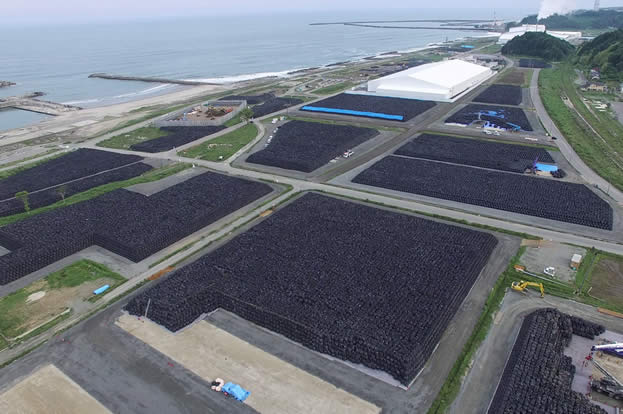
Bags stuffed with tainted dirt and debris stored near the sea. About 10 million of these bags litter Fukushima, awaiting transportation to a mid-term storage site.
The relationship between this surge in anti-nuclear sentiment and Japan’s broader energy policy is complex. The Fukushima disaster occurred just as global concern over climate change was accelerating. In 2009, then-Prime Minister Yukio Hatoyama had committed Japan to lowering carbon emissions a quarter below 1990 levels by 2020 – largely through a plan to increase nuclear power to half of the country’s electricity mix. The meltdowns changed everything.
“With the 3-11 disaster, everyone’s attention turned toward nuclear power. Since then, climate change has fallen more and more off the public’s radar as an important issue,” Takako Momoi told me when I stopped by the Tokyo office of Kiko Network, Japan’s biggest homegrown climate-change NGO, where she works as a manager. A minority of activists even began to spread the message that climate change was a ruse to gain support for nuclear power. In 2013, when the new government traded Hatoyama’s ambitious emissions goal for a 3 percent increase over 1990 levels by 2020, few people protested.
Coal has already seen a major resurgence. Construction of coal-fired power plants had stalled around 2009 due to climate change concerns, but now 48 new plants are planned or under construction, says Momoi. Even with much-touted new “clean coal” technology, she adds, these plants will emit as much carbon dioxide as those that burn oil.
Then there is the fact that even if the public prefers renewables to coal or nuclear, most people still prioritize the economy over the environment in elections. In 2012, voters ousted the DPJ in favor of the pro-nuclear Liberal Democratic Party (LDP), which has monopolized power for most of Japan’s post-war period. The LDP quickly set about formulating its own energy vision. It tossed out the public comments the DPJ had collected, kicked anti-nuclear advisors like those from Momoi’s organization off policy committees, and last summer finalized a long-term energy vision that calls for electricity to come from roughly equal parts nuclear, liquid natural gas, coal, and renewable sources by 2030.
At the local level, however, a more ambitious vision has started to emerge. Many communities are formulating their own renewable energy plans – Minamisoma among them. This March, the city of 63,000 released a “Non-Nuclear Power Declaration” reaffirming an earlier pledge to generate 65 percent of its electricity from renewable sources by 2020, and 100 percent by 2030 (compared to around 10 percent today). Construction is slated to begin this year on a solar farm large enough to power almost all of the city’s households, and four windmills are planned as well. A generous national feed-in tariff program introduced in 2012, which guarantees high prices to individuals and companies selling renewable energy to the grid, has lured corporate investors to these projects.

Cleanup workers power-wash a parking lot in the Odaka district of Minamisoma.
That, together with some smaller subsidy programs, should get the city to its 2020 goal, says Shunichi Shiga, who heads Minamisoma’s newly-established renewable energy division. Reaching 100 percent could be tougher. Power distributors say they’ve already reached the limit of how much renewable energy they can incorporate without major improvements to the grid, and now that the feed-in-tariffs are being ratcheted down, investing in renewable energy is looking riskier. Overcoming these obstacles, Shiga says, will require action at the national level. Momoi concurs. “The [local] movement to increase renewable energy is great, but within the current policy context, it will hit a ceiling,” she says. “There’s a need to think more about the big picture.”
Many people are, in fact, starting to think about what it will take to achieve true change at the national level. One of the most interesting developments set off by the disaster has been the emergence of a strong student movement protesting the government’s disregard for democratic processes. Although its focus is on military policy rather than energy issues, the underlying concern is the same.
Called Students Emergency Action for Liberal Democracy, or SEALDs, this small but vocal group of high school and university students coalesced in mid-2015 against a set of security bills that the LDP ultimately pushed through the Diet (Japanese parliament) in September. Using social media and protests outside the Diet building featuring fierce, smart speeches, the students quickly engaged a broader slice of society than old-school protesters had been able to. It was the most significant student movement since the 1960s.
Koichi Nakano, a political science professor at Tokyo’s Sophia University says SEALDs is a “direct descendant” of the civil-society awakening that followed the nuclear disaster. “They were high school students at the time [of the meltdowns], and for many of them the first experience of protest was those anti-nuclear rallies,” he tells me. “The disaster exposed the myth that was more credible in earlier times about the trustworthiness of ruling elites in Japan.”
Nakano is himself active in an organization opposing the security bills, and has collaborated closely with SEALDs over the past year. He too sees the roots of the nuclear and military issues as intimately linked. “There’s a sense that the 1 percent increasingly control our fate and the 99 percent of us are left out in the dark, uninformed and practically disenfranchised,” he says. “In the case of the security bills, it’s about the ruling elites of Japan in collusion with the American elites changing the interpretation of the constitution to allow Japan to take part in America’s wars even without Japan being attacked. The nuclear power issue is very similar because nuclear power is something that those big powers need to continue on for lucrative reasons. They wouldn’t want to see Japan dropping out from the nuclear power club.”
In spite of this, Nakano believes citizen activists have changed the government’s course, at least on energy. “There was a long period in which even [Prime Minister] Abe couldn’t restart the nuclear reactors. That has only to do with the strength of the opposition,” he tells me. “We are talking about ordinary citizens, without resources, stopping the reactors for many, many months.”
As important as these popular movements may be, the people who will determine Japan’s longer-term energy path are not in the crowds outside the Diet, or even inside its halls. They are in elementary and middle school classrooms across the country. Japan’s education system played a key role in creating the so-called “myth of nuclear safety” – the widespread belief that Japan’s reactors were indestructible – that led towards poor oversight and, ultimately, disaster. Likewise, the lessons children learn now about the Fukushima disaster will shape their views on energy and the environment throughout their lives. So, on my last day in Japan, I take the train back to Fukushima to talk with a professor who has spent the past five years trying to improve radiation education.

The contamination will linger in forests and ponds and backyard corners
for decades to come.
Shinobu Goto is a tall, serious man in his forties who teaches environmental education at Fukushima University. We meet on a Saturday evening in a cluttered university office, where we are joined by two members of the Fukushima teachers’ union, Toshiki Kokubun (no relation to Tomio) and Hiroshi Sato, whose name has been changed to protect his identity. All three were deeply impacted by the disaster.
Goto in particular says the unexpected catastrophe thrust him into a period of intense reflection and regret. He had not previously focused on nuclear education, but now he began to scour official teaching materials on the topic for evidence of bias. He found plenty: elementary-level readers titled Exciting Nuclear Power Land, illustrations of frowning coal plants juxtaposed with friendly nuclear reactors, claims that Japan’s reactors could withstand large earthquakes and tsunamis. Goto was not alone in his critique. The minister of education himself admitted that the pre-disaster texts contained information “contrary to reality,” and soon had them replaced.
Yet the new radiation readers that the ministry published in late 2011 were hardly an improvement. They included just 8 lines about the Fukushima disaster, and instead emphasized how useful and ubiquitous radiation is in daily life. In this, Goto saw the makings of a new myth – not that reactors are infallible, but that the radiation they emit when they do fail is nothing to worry about.
“The concept that the level of radiation we have in Fukushima is safe is being steadily created through education and PR,” he tells me as we sip tea in the quiet research building. He was particularly worried that kids weren’t getting the information they needed to protect their own rights to physical, mental, and social wellbeing. “If you don’t know the exposure limit is 1 or 5 mSv per year in other places, you don’t realize the situation in Fukushima is abnormal,” he says. “Education is empowerment in the sense that it allows you to make those critiques.”
Teachers needed a better option, so in early 2012 he assembled a group of 16 Fukushima University professors, and together they wrote an alternative reader from a human-rights perspective. He also began holding workshops to teach critical thinking skills to public school students, so they could assess government and media claims on their own. At this point, top-level administrators began pressuring him to tone down his activism. The school is the only national university in the prefecture; from the start, its administrators had echoed the government’s emphasis on recovery over risk.

A sign in Fatuba, directly north of the Fukushima Daiichi power plant, reading “Nuclear power, energy for a bright future.” The town is closed off now.
“They told me I had to put a sticker on the reader saying it wasn’t an official publication of the university. I said that’s discriminatory; you don’t do that for other publications,” Goto says. (University representatives tell me they are unable to confirm or deny Goto’s claims, citing personnel changes and a lack of relevant meeting minutes.)
He refused to back down. Ultimately, the reader was published without the sticker, helping to turn national attention on the official curriculum. That attention reverberated to the ministry of education; when the official readers were revised again in 2014, they included more information on the Fukushima disaster, and an acknowledgement that scientists hold “various views” on the impacts of low-level radiation. Still, a startling array of terms were missing: “meltdown,” “Nuclear Accident Child Victim’s Law,” “hotspot,” “thyroid cancer,” and “radioactive waste” among them.
Kokubun and Sato say most teachers in Fukushima don’t venture beyond the official curriculum, which allots just two hours a year for radiation education, partly because they are too busy, and partly because they’re pressured not to.
Sato, an elementary school teacher in Fukushima City, has experienced this pressure directly. “Some high-level board-of-education staff observed one of my classes [on radiation in 2013], and afterwards they said to me, Don’t you think today’s class might worry the children?” The content was purely science based: Sato had shown the kids a graph of the relationship between radiation and cancer, and pointed out that high levels of exposure can be deadly. (In lessons, he also explains that the current degree of contamination in Fukushima City carries a relatively low risk of cancer.)
Fukushima’s Board of Education tells me later that teachers are permitted to share science-based radiation material as long as it is widely accepted. “Our goal,” a staff member writes in an email, “is to teach children to make appropriate decisions based on correct knowledge and understanding of radiation.” However, Sato says he’s been told to avoid the topic by his principal, vice-principal, and other teachers.
Like Goto, he has not bowed to this pressure. Yet both he and Kokubun seem worn down by their lonely struggle. The government defends its interests tenaciously, and the public – with the exception of a determined minority – is all too eager to assist by turning away from the painful past. “People need to be angrier,” Kokubun says. “I’m sad that more people haven’t spoken out with us.”
Outside Goto’s office, the sky is growing dark. Kokubun and Sato need to head home. After they leave, I ask Goto how much hope he has that things will change. He says he feels like he is gasping for breath. The pace of progress is slow, and public interest in the disaster’s ongoing impact is dwindling. Still, he says, he is determined to continue his work.
Later, after he drops me off at the train station, I leaf through some papers he has given me, among them an essay he wrote for his hometown newspaper concluding with the following lines: “They say that history is written by the victors. I will be watching and acting to make sure the lessons of the Fukushima nuclear accident are not written to suit the interests of the perpetrators of this unprecedented man-made disaster.”
In that, and in the commitment of many others to do the same, there lies a glimmer of hope.
http://www.earthisland.org/journal/index.php/eij/article/living_in_limbo/
Radiation research in children teeth in Japan
Prof. Chihiro Ichihara from Aichi Medical University, is an independent man.
He informed the audience about the children teeth project for measuring Strontium 90, with no government support, looking for funding.
Prof. Chihiro Ichihara collects children teeth and lets them measure for Strontium 90. He plans to build an own independent lab for parents.
Similar project was done until the1980s in the U.S. after the bomb tests. It was then supervised by Jay Gould. (STRONTIUM-90 IN BABY TEETH AS A FACTOR IN EARLY CHILDHOOD CANCER http://www.radiation.org/reading/ijhs/ijhs_9_2000.html)
To measure Sr90 is very difficult, because it emits only beta radiation. It causes bone marrow depression, destroys the stem cells and immune system, casuses bone cancer / sarcoma.
His project deserves more attention, because it is VITAL.
STRONTIUM-90 IN BABY TEETH AS A FACTOR IN EARLY CHILDHOOD CANCER
Jay M. Gould, Ernest J. Sternglass, Janette D. Sherman,
Jerry Brown, William McDonnell, Joseph J. Mangano
International Journal of Health Services
Volume 30, Number 3, Pages 515-539, 2000
Copyright Baywood Publishing Co., Inc
http://www.radiation.org/reading/ijhs/ijhs_9_2000.html
Kudos to Prof. Ichihara, wo worked at the research reactor in Kyoto: “He is a physicist specialising in Neutron transport experiments and their calculation as well as in gamma-ray spectrum measurement.
Currently, he teaches as a Visiting Professor at Aichi Medical University. He is a member of the Steering Committee of PDTN. Previously, Prof. Chihiro Ichihara was an Associate Professor at the Research Reactor Institute of Kyoto University.”
Special credits to Jan Hemmer for the pictures and the informations


Hot Spots in the 5th Year Over 20μSv h in Fukushima city Feb. 23, 2016
Here is the video made by Masa in Fukushima and his group. The video is available in English. This is the reality of 5 years after the nuclear accident. The area in the video is going to be “de-contaminated” in this coming spring, 2016.
Despite that there are numerous hot spots in school routes and parks, Masa says that in Fukushima, nobody talks about radiation anymore.
In the 5th year since the Fukushima nuclear accident, we found hotspots on the riverbed in Fukushima city. They exceeded 20μSv/h. We examine the present FUKUSHIMA which is facing the micro-hot-spots phenomena.
Five years on, Fukushima still faces contamination crisis: environmentalists

Crippled Fukushima Daiichi nuclear power plant in northeastern Japan.
Fish market vendor Satoshi Nakano knows which fish caught in the radiation tainted sea off the Fukushima coast should be kept away from dinner tables.
Yet five years after the worst nuclear accident since Chernobyl there is still no consensus on the true extent of the damage – exacerbating consumer fears about what is safe to eat.
Environmentalists are at odds with authorities, warning the huge amounts of radiation that seeped into coastal waters after a powerful tsunami caused a meltdown at the Fukushima Daiichi nuclear power plant on March 11, 2011, could cause problems for decades.
The Japanese government is confident it has stemmed the flow of radioactive water into the ocean, but campaigners insist contaminated ground water has continued to seep into the Pacific Ocean, and the situation needs further investigation.
“It was the single largest release of radioactivity to the marine environment in history,” Greenpeace nuclear expert Shaun Burnie said on the deck of the campaign group’s flagship Rainbow Warrior, which has sailed in to support a three-week marine survey of the area the environmental watchdog is conducting.
Fukushima is facing an “enormous nuclear water crisis,” Burnie warned.
He added: “The whole idea that this accident happened five years ago and that Fukushima and Japan have moved on is completely wrong.”
Existing contamination means fishermen are banned from operating within a 20-km radius from the plant.
Although there are no figures for attitudes on seafood alone, the latest official survey by the government’s Consumer Affairs Agency showed in September that more than 17 per cent of Japanese are reluctant to eat food from Fukushima.
Nakano knows it’s best for business to carefully consider the type of seafood he sells, in the hope it will quell consumer fears.
“High levels of radioactivity are usually detected in fish that move little and stick to the seabed. I am not an expert, but I think those kinds of fish suck up the dirt of the ocean floor,” he said from his hometown of Onahama by the sea.
Greenpeace is surveying waters near the Fukushima plant, dredging up sediment from the ocean floor to check both for radiation “hotspots” as well as places that are not contaminated.
On Monday, the Rainbow Warrior sailed within a 1.6km of the Fukushima coast as part of the project – the third such test it’s conducted but the closest to the plant since the nuclear accident.
Researchers on Tuesday sent down a remote-controlled vehicle attached with a camera and scoop, in order to take samples from the seabed, which will then be analysed in independent laboratories in Japan and France.
“It’s very important [to see] where is more contaminated and where is less or even almost not contaminated,” Greenpeace’s Jan Vande Putte said, stressing the importance of such findings for the fishing industry.
Local fishermen have put coastal catches on the market after thorough testing, which includes placing certain specimens seen as high risk through radiation screening – a programme Greenpeace lauds as one of the most advanced in the world.
The tests make sure no fish containing more than half of the government safety standard for radiation goes onto the market.
The 2011 disaster was caused by a magnitude 9.0 undersea earthquake off Japan’s northeastern coast which then sparked a massive tsunami that swamped cooling systems and triggered reactor meltdowns at the Fukushima Daiichi plant, run by operator Tokyo Electric Power (TEPCO).
Today, about 1,000 huge tanks for storing contaminated water occupy large parts of the site, but as 400 tonnes of groundwater a day flows into the damaged reactor buildings, many more will be needed.
TEPCO have said they are taking measures to stop water flowing into the site, including building an underground wall, freezing the land itself and siphoning underground water.
The government too insist the situation is under control.
“The impact of the contaminated water is completely contained inside the port of the Fukushima plant,” Tsuyoshi Takagi, the Cabinet minister in charge of disaster reconstruction, told reporters on Tuesday.
But Greenpeace’s Burnie says stopping the groundwater flow is crucial to protecting the region.
“What impact is this having on the local ecology and the marine life, which is going on over years, decades?”, Burnie asked.
He added: “We can come back in 50 years and still be talking about radiological problems” at the nuclear plant as well as along the coast, he said.

Storage site of contaminated soil generated by decontamination work in Fukushima Prefecture, home of the crippled Fukushima Daiichi complex
Fukushima plant begins testing waste incinerators
”The operator says it expects to burn up to 14 tons of waste per day. But the resulting ash will have a higher concentration of radioactive materials than the waste has before it is burned.”
Fukushima plant begins testing waste incinerators
The operator of Fukushima Daiichi has begun testing an incinerator facility at the damaged nuclear power plant. The facility will be used for burning used protective gear and other waste produced during the decommissioning of the plant’s reactors.
Tokyo Electric Power Company initially planned to start testing the two incinerators at the facility on February 10th. But a water leak forced a delay.
Workers on Thursday began testing one of the incinerators, which had been repaired.
At the end of last year, there were about 66,000 cubic meters of waste being stored at the plant after nearly five years of decommissioning work following the March 2011 accident. That is enough to fill more than 100 swimming pools 25 meters in length.
The incinerators are expected to reduce the volume of waste by about 90 percent. The waste includes used disposable protective gear, clothing, sheets, cardboard and timber.
The operator says it expects to burn up to 14 tons of waste per day. But the resulting ash will have a higher concentration of radioactive materials than the waste has before it is burned.
TEPCO says filters installed in the smokestack will prevent the release of radioactive substances. The ash will be stored in drums inside a secure building.
Tokyo Electric Power said it will dispose of some four tons of waste in Thursday’s test. It said it will start testing the other incinerator on Sunday.
http://www3.nhk.or.jp/nhkworld/en/news/20160225_25/
TEPCO begins burning radiation-tainted work clothes at Fukushima plant
OKUMA, Fukushima Prefecture–Tokyo Electric Power Co. has started to incinerate the thousands of boxes of lightly contaminated waste, including clothing used by workers, at the Fukushima No. 1 nuclear power plant to reduce the amount of tainted waste on the site.
TEPCO, the plant operator, fired up a special on-site incinerator on Feb. 25 to burn protective suits, gloves, socks and other work clothes worn by plant workers that became contaminated with low-level radiation.
The operation will reduce the amount of tainted work clothing accumulating at the plant during decommissioning operations since the nuclear disaster unfurled in March 2011. The garments cannot be processed outside the plant due to the radiation.
The clothing being incinerated are items with the lowest levels of contamination that have been stored in tens of thousands of 1 cubic-meter special boxes. The number of containers reached 66,000 at the end of last year.
The incinerator is equipped with two types of filters that can reduce the radioactive levels of the exhaust air to less than one-millionth, while reducing the capacity of the waste to about 2 percent.
The incinerator can burn a maximum of 14 tons of items per day when it is operated to capacity for 24 hours. The ash residue will be stored in metallic barrels on the plant compound.
The incineration project was authorized by the Nuclear Regulation Authority in July 2014. TEPCO began operational tests of the incinerator using untainted waste last fall.
http://ajw.asahi.com/article/0311disaster/fukushima/AJ201602260071
Upcoming Tokyo photo exhibition to convey scars of 2011 quake disaster

This 2013 photo shows radioactive materials on a slipper from the Fukushima Prefecture town of Namie, which was evacuated after the Fukushima No. 1 Nuclear Power Plant disaster. The white spots in the photo indicate the presence of radioactive cesium and other materials, visualized on large-format film after the slipper was exposed to it for two months. (Photo by Takashi Morizumi)
A photo exhibition on the theme of the 2011 Great East Japan Earthquake will be held in Tokyo beginning on March 1, and will aim to convey the scars left by the disaster ahead of its fifth anniversary on March 11.
About 100 photos taken by 39 photographers will be on display during the exhibit, which will be held at the Bengoshi Kaikan building in Chiyoda Ward.
Specifically, photos featuring Fukushima Prefecture will provide visitors with opportunities to think about the matter of how to recover from the Fukushima No. 1 Nuclear Power Plant disaster.
The exhibition, which is being put together by organizations including the Tokyo Bar Association, will run through March 10, except for March 6, when it will be closed. Admission is free.
A gathering for disaster evacuees will be held at the same building on March 5. For more information, call the Tokyo Bar Association at 03-3581-2251.
http://mainichi.jp/english/articles/20160225/p2a/00m/0na/021000c
1 This Month

of the week – Shut Down Drone Warfare!


Tell the Ukrainian Government to Drop Prosecution of Peace Activist Yurii Sheliazhenko

Petition to revoke the licensing of the Near Surface Nuclear Disposal Facility (NSDF) at Chalk River. https://www.ourcommons.ca/petitions/en/Petition/Details?Petition=e-7247
To see nuclear-related stories in greater depth and intensity – go to https://nuclearinformation.wordpress.com
-
Archives
- April 2026 (44)
- March 2026 (251)
- February 2026 (268)
- January 2026 (308)
- December 2025 (358)
- November 2025 (359)
- October 2025 (376)
- September 2025 (257)
- August 2025 (319)
- July 2025 (230)
- June 2025 (348)
- May 2025 (261)
-
Categories
- 1
- 1 NUCLEAR ISSUES
- business and costs
- climate change
- culture and arts
- ENERGY
- environment
- health
- history
- indigenous issues
- Legal
- marketing of nuclear
- media
- opposition to nuclear
- PERSONAL STORIES
- politics
- politics international
- Religion and ethics
- safety
- secrets,lies and civil liberties
- spinbuster
- technology
- Uranium
- wastes
- weapons and war
- Women
- 2 WORLD
- ACTION
- AFRICA
- Atrocities
- AUSTRALIA
- Christina's notes
- Christina's themes
- culture and arts
- Events
- Fuk 2022
- Fuk 2023
- Fukushima 2017
- Fukushima 2018
- fukushima 2019
- Fukushima 2020
- Fukushima 2021
- general
- global warming
- Humour (God we need it)
- Nuclear
- RARE EARTHS
- Reference
- resources – print
- Resources -audiovicual
- Weekly Newsletter
- World
- World Nuclear
- YouTube
-
RSS
Entries RSS
Comments RSS
 nuclear-news