China opens the door a crack wider to Japanese rice imports


WTO rules in favor of Japan on South Korea’s post-Fukushima seafood ban

Intensive campaign from Japanese diplomats to push other countries to lift their ban on Japanese contaminated produce

Fukushima Flounder Promotion Event Cancelled in Thailand Due to Consumers Concerns

Support Most Common Reason for Buying ‘Fukushima Food’

March 8, 2018
Japan Ships First Seaweed, Farmed 6 Miles from Fukushima Meltdowns, for Human Consumption


Safety of Fukushima food known less overseas


Delicacies from disaster-hit areas on the menu for Tokyo IOC banquet

Delicious Fukushima Peaches at the “konbeni” Checkout


Fukushima Food Presents “No Immediate Problem”: UN Food and Agricultural Organization Director General

The other day I read a headline at The Asahi Shimbun that made me pause and read the entire article carefully.
Please note that the headline states that the Director General of the UN FAO is “convinced” that Fukushima food is safe to eat.
However, if you read his actual words, as quoted in the article, you will see that he is not in fact arguing that Fukushima food is safe to eat.
Rather, what he is saying is at this “moment” the agency sees “no immediate problem”:
Yukie Yamao. (2017). U.N. food agency ‘convinced’ that Fukushima food is safe to eat. The Asahi Shimbun http://www.asahi.com/ajw/articles/AJ201705080043.html
ROME–Food produced in Fukushima Prefecture is safe, but continued monitoring will be needed to ensure that remains the case, according to the U.N. Food and Agricultural Organization’s top official.“We’ve been following this issue very closely,” said FAO Director-General Jose Graziano da Silva in a recent interview with The Asahi Shimbun, referring to the safety of agricultural products and other food items grown and manufactured in the prefecture.
“We are also periodically testing samples to certify that the food presents no danger to human beings. For the moment we are convinced that there is no immediate problem with the food coming from that area.”
He added that maintaining control over the situation is crucial.
Whenever I read “no immediate” risk, I know that there are very likely to be long-term risks.
Long-term risks derive from chronic exposure to elevated gamma, beta and alpha radiation from sources internal and external to human bodies.
Concentration of radioactive isotopes – such as cesium-137, iodine-131, and strontium-90 – in food is a well-established problem and poses risk for internal contamination and bio-accumulation in biological bodies.
Japan has historically had strict standards for radionuclides in food compared to the US, but even low-levels of isotopes in food can create problems over time. For example, strontium-90 ends up in bone and teeth. Most isotopes are chemically toxic in addition to being radioactive.
Monkeys living in Fukushima have been found to have bio-accumulated radio-cesium:
Bahar Gholipour Fukushima monkeys show signs of radiation exposure Livescience.com July 24, 2014, http://www.cbsnews.com/news/fukushima-monkeys-blood-shows-signs-of-radiation-exposure/
The results showed Fukushima monkeys had lower counts of red and white blood cells, and other blood parts compared with 31 monkeys from Shimokita Penisula in northern Japan. The researchers also found radioactive cesium in the muscles of Fukushima monkeys, ranging from 78 to 1778 becquerels (units of radioactivity representing decay per second) per kilogram, but they didn’t find any in Shimokita monkeys. [7 Craziest Ways Japan’s Earthquake Affected Earth] Exposure to radioactive materials may have contributed to the blood changes seen in Fukushima monkeys, study researchers Shin-ichi Hayama and colleagues wrote in their study, published today in the journal Scientific Reports. Low blood cell counts could be a sign of a compromised immune system and could potentially make the monkeys vulnerable to infectious diseases, the researchers said.
Here is the relevant academic publication and an excerpt from the abstract, that describes cesium concentrations:
Kazuhiko Ochiai , Shin-ichi Hayama , Sachie Nakiri et al “Low blood cell counts in wild Japanese monkeys after the Fukushima Daiichi nuclear disaster,”Scientific Reports 4, Article number: 5793 (2014) doi:10.1038/srep05793, http://www.nature.com/articles/srep05793
[excerpted] Total muscle cesium concentration in Fukushima monkeys was in the range of 78–1778 Bq/kg, whereas the level of cesium was below the detection limit in all Shimokita monkeys. Compared with Shimokita monkeys, Fukushima monkeys had significantly low white and red blood cell counts, hemoglobin, and hematocrit, and the white blood cell count in immature monkeys showed a significant negative correlation with muscle cesium concentration. These results suggest that the exposure to some form of radioactive material contributed to hematological changes in Fukushima monkeys.
The study in Scientific Reports detected cesium levels ranging from 78-1778 Bq/kg in monkey muscle. What are the implications for monkeys bio-accumulating cesium in their muscles? My guess is that what happens to monkeys is likely to follow what happens to people.
In a 2003 video titled Nuclear Controversies by Vladimir Tchertkoff,Professor Yury Bandazhevsky (former director of the Medical Institute in Gomel), states that based on his research on children exposed to radiocesium from Chernobyl, ‘Over 50 Bq/kg of body weight lead to irreversible lesions in vital organs.’
In a short summary of his work published in 2003, Bandazhevsky described high levels of Cesium-137 bioaccumulation in Chernobyl children’s heart and endocrine glands, particularly the thyroid gland, the adrenals, and the pancreas. He also found high levels in the thymus and the spleen. He found higher levels of bio-accumulation in children than adults. This research demonstrates how radiocesium bioacccumulates within organs and establishes the vulnerability of young people to that process.
Is Fukushima food safe? Based on the monkey research and comments made by the head of the FAO, my conclusion is that Fukushima momentarily poses no immediate risks but long-term consumption could lead to bioaccumulation of radionuclildes, a situation which probably is not, at all, limited to Japan, and poses excess risks for disease and disability.
http://majiasblog.blogspot.fr/2017/06/fukushima-food-presents-no-immediate.html
Singapore keeping in place Fukushima food import curbs, six years after disaster

Signs at Cold Storage supermarket in 2011 clarifying that food imports are from safe regions in Japan, and are tested by the Agri-Food and Veterinary Authority of Singapore.
TOKYO – Singapore is keeping in place curbs on food imports from Fukushima, which six years ago on Saturday (March 11) was hit by an earthquake, tsunami and nuclear disaster, the Agri-Food and Veterinary Authority of Singapore (AVA) has told The Straits Times.
This is despite the authority having announced a review on easing curbs in January last year, and Japan’s repeated insistence that its strict food safety standards already exceed international requirements.
Japan’s reconstruction minister Masahiro Imamura had said last month that it was “irrational” to restrict the import of Japanese food products that are sold on the market, lobbying countries and regions to lift their food bans on imports from the disaster-hit regions.
On March 11, 2011, a 9.0-magnitude earthquake struck under the Pacific Ocean at 2.46pm local time (1.46pm in Singapore), triggering a 10m wall of water that ravaged the north-east Japanese coast. It crippled the Fukushima No. 1 power station, causing meltdowns in three of its reactors.
The AVA did not explicitly address the reasons it has opted to retain the curbs, but a spokesman told The Straits Times on Saturday that the authority “periodically reviews food import conditions to ensure food safety for our consumers, without unnecessarily impeding trade”.
Last year’s review came as Agriculture Minister Hiroshi Moriyama requested Singapore ease its restrictions during a meeting with National Development Minister Lawrence Wong. During their talks, Mr Moriyama noted that the European Union had begun to relax its regulations on Japanese food imports.
The AVA banned the import of some food products from 11 prefectures after the incident, but some of these restrictions were lifted in 2014, after “an inspection and comprehensive risk assessment of food from Japan”.
However, curbs on seafood and other produce from several areas remain in place.
Singapore does not allow the import of seafood, agricultural produce and forest products – including wild berries, wild mushrooms and wild boar meat – from areas in Fukushima prefecture where agriculture remains banned, or within a 20km radius of the Fukushima Daiichi nuclear power plant.
Meanwhile, seafood and forest-gathered or harvested products from prefectures neighbouring Fukushima – namely Ibaraki, Tochigi and Gunma – still require pre-export tests, the AVA added.
“All food products from Japan still require a certificate of origin to identify the prefecture of origin of the food product,” the AVA spokesman said on Saturday, adding that it will continue to closely monitor food imports from Japan to ensure that they comply with Singapore’s food safety requirements.
She added that current imports from Fukushima prefecture are “insignificant” and accounted for less than 0.1 per cent of total food imports worldwide last year.
Mr Imamura had said last month that 21 countries have lifted the bans while many countries and regions have “significantly relaxed” the restrictions.
He told a news conference: “Japan carries out an inspection of radioactive substances according to the world’s strictest level of standard limits based on scientific evidence. Only foods that have passed the inspection are circulated on the market. Of course, exported foods are subject to the same strict inspection process.”
But the easing of food import curbs from Fukushima remains a deeply political issue in several territories. In Taiwan, a public hearing over whether the territory should ease its ban last December was scuppered by rioting.
Mr Imamura stressed that Japanese standards, which specify general foods containing radioactive substances of 100 becquerel (Bq) or higher per 1 kg should not be sold, “are extremely strict compared to those in the European Union or the United States, or the international Codex standard”.
He said: “Last year, no rice, vegetables and fruits, livestock products, cultivated mushrooms, or seafood products grown in Fukushima prefecture were detected to have exceeded standard limits.”
He added that inspections on rice grown in Fukushima prefecture are done for “all bags of rice, not only samples”, and that in 2015 and 2016, no bags of rice exceeded the standard limit.
As for seafood, no items have exceeded the standard limits since April 2015, he said.
“It is irrational to restrict the import of Japanese food products that are sold on the market, which have passed very strict inspection,” he said. “We would like the authorities in each country and region to see these scientific and objective facts.”
Fukushima fishermen expand fishing zone to within 10 km of crippled nuclear plant

Restricted fishing zone around Fukushima Daiichi nuclear plant to be reduced to 10km. Tests not looking for Sr-90. In my humble opinion a 7 mile radius is not nearly enough given the unfathomable quantities of radiation that have escaped, or been willingly released into the Pacific ocean. It has reached the west coast of North America via the North Pacific Gyre and the abundance of aquatic life it carries with it.
“We keep saying sea products from Fukushima are safe, based on the results of radioactive tests,” Tetsu Nozaki, chairman of the federation, told reporters after it held a meeting in the city of Iwaki on Tuesday.
yes, you keep saying it…
FUKUSHIMA – Fishermen in Fukushima Prefecture have decided to expand the fishing zone off the northeastern prefecture nearly six years after a nuclear crisis caused havoc in the region.
The Fukushima Prefectural Federation of Fisheries Co-operative Associations will next month narrow down the restricted zone to within a 10-km radius of the crippled Fukushima No. 1 nuclear plant from the current 20 km.
In January last year the federation proposed expanding the fishing area, citing a declining density of radioactive material in the sea following the completion in October 2015 of seawalls to prevent contaminated underground water entering the ocean from the plant.
But the plan was postponed amid concerns over contaminated debris, which has since been removed.
“We keep saying sea products from Fukushima are safe, based on the results of radioactive tests,” Tetsu Nozaki, chairman of the federation, told reporters after it held a meeting in the city of Iwaki on Tuesday.
Farm in ex-evacuation area near Fukushima nuke plant ships milk again

FUKUSHIMA, Japan (Kyodo) — A dairy farm near the disaster-struck Fukushima Daiichi nuclear power plant in northeastern Japan began shipping raw milk again on Tuesday.
It was the first milk shipped for processing and public sale from an area previously designated for evacuation following the March 2011 nuclear disaster at the seaside plant in Fukushima Prefecture, according to the prefectural government.
Milk produced at the farm in the Naraha district had been checked for radioactive cesium every week from last May to December, with no reading ever surpassing the government-set limit of 50 becquerels per kilogram. In fact, the readings were below the testing equipment detection limit.
Around 400 kg of raw milk from 18 cows was shipped Tuesday.

“We were able to start operating this farm again with the support of so many people,” said farm head Hiroaki Hiruta, 48. “I want to pay a debt of gratitude by making good milk.”
Following the disaster, in which a massive amount of radioactive material was spewed into the air and sea, the central government banned milk shipments from the area in March 2011. Restrictions were lifted last December for the area where Hiruta’s farm is located.
Similar restrictions are still in place for eight other districts, including the towns of Okuma and Futaba where the nuclear power station is located.
http://mainichi.jp/english/articles/20170124/p2g/00m/0dm/080000c
8 Taiwanese firms to be fined for importing food from radiation-affected areas
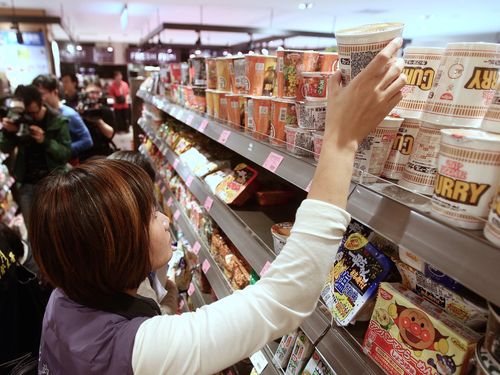
Taipei, Dec. 18 (CNA) Fines will be imposed on eight companies which have been found to have imported foods from Japan’s radiation-affected areas, Taiwan’s Food and Drug Administration (FDA) said Sunday.
As of Sunday, a total of 39 Japanese food products and nearly 60,000 items have been pulled from store shelves in Taiwan, with many of them being soy sauce and wasabi packets that go with Japanese natto, or fermented soybeans.
FDA Northern Center Senior Executive Officer Wei Jen-ting (魏任廷) said 103 importers and 849 distributors island-wide have been questioned since Monday, urging vendors to check the food items they are selling, and notify health authorities if their products came from Fukushima, Ibaraki, Tochigi, Gunma and Chiba prefectures.
Of the 39 products, 26 have tested negative for radiation contamination, while 13 are still being screened, Wei said.
Among the eight importers of these problematic products, Tai Crown Co. (太冠公司) is subjected to a fine of NT$1 million, he said.
The FDA said it will step up inspection of food imported from Japan and will ask importers and distributors to list the places of origin, including the prefecture, on the product labels in Chinese.
Failure to provide Chinese labeling could also result in a fine of between NT$30,000 (US$937) and NT$3 million, it said.
The affected companies have one month to explain themselves, or else the fines will be issued in accordance with the law.
Fukushima Apples Are Very Hot In Cocktails
Here is another propaganda article on Forbes from James Conca, the highest paid pro-nuke shill, wanting us to believe that Fukushima Apples are dynamite in cocktails.
They are certainly not dynamite, but surely hot!

Fukushima Apples Are Dynamite In Cocktails
The 42nd World Cocktail Championships, which kicked off in Tokyo this week, is an unusual event to discuss a nuclear disaster. But that is exactly what Yoshikazu Suda, a bartender in Tokyo’s Ginza district who hails from Fukushima, is doing.
And his demonstration of solidarity with farmers and the people of Fukushima is in the form of some very cool drinks.
Bartenders and mixologists from over from 53 countries will gather in Tokyo to take part in the drink-creating championships. But the International Bartenders Association is no ordinary group. Founded in 1951, the IBA represents the National Bartender Guilds in 64 countries around the world. Over 500 bartenders and mixologists will gather at the event, which is being held in Japan for the first time in 20 years.
The International Bartenders Association is committed to responsible drinking and dispelling myths about alcohol. But this World Cocktail Championship will dispel a completely different type of myth – that Fukushima food is contaminated by radiation. It certainly is not.
During the contest at Tokyo’s Imperial Hotel, several varieties of fruit will be used, but only Fukushima-grown apples will be used in the fruit-cutting event, specifically apples grown by Fukushima farmer Chusaku Anzai.
Five years ago, a magnitude 9 earthquake on the Tohoku Fault off the east coast of Japan sent a 50-foot tsunami crashing into the coast with almost no warning, flooding over 500 square miles of land, killing almost 20,000 people and destroying a million homes and businesses.
1 This Month

of the week – Shut Down Drone Warfare!


Tell the Ukrainian Government to Drop Prosecution of Peace Activist Yurii Sheliazhenko

Petition to revoke the licensing of the Near Surface Nuclear Disposal Facility (NSDF) at Chalk River. https://www.ourcommons.ca/petitions/en/Petition/Details?Petition=e-7247
To see nuclear-related stories in greater depth and intensity – go to https://nuclearinformation.wordpress.com
-
Archives
- March 2026 (251)
- February 2026 (268)
- January 2026 (308)
- December 2025 (358)
- November 2025 (359)
- October 2025 (376)
- September 2025 (257)
- August 2025 (319)
- July 2025 (230)
- June 2025 (348)
- May 2025 (261)
- April 2025 (305)
-
Categories
- 1
- 1 NUCLEAR ISSUES
- business and costs
- climate change
- culture and arts
- ENERGY
- environment
- health
- history
- indigenous issues
- Legal
- marketing of nuclear
- media
- opposition to nuclear
- PERSONAL STORIES
- politics
- politics international
- Religion and ethics
- safety
- secrets,lies and civil liberties
- spinbuster
- technology
- Uranium
- wastes
- weapons and war
- Women
- 2 WORLD
- ACTION
- AFRICA
- Atrocities
- AUSTRALIA
- Christina's notes
- Christina's themes
- culture and arts
- Events
- Fuk 2022
- Fuk 2023
- Fukushima 2017
- Fukushima 2018
- fukushima 2019
- Fukushima 2020
- Fukushima 2021
- general
- global warming
- Humour (God we need it)
- Nuclear
- RARE EARTHS
- Reference
- resources – print
- Resources -audiovicual
- Weekly Newsletter
- World
- World Nuclear
- YouTube
-
RSS
Entries RSS
Comments RSS
 nuclear-news