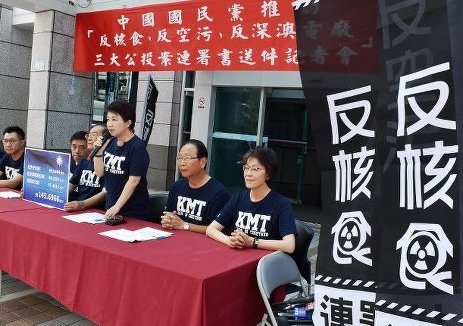
 In this file photo dated Aug. 27, 2018, senior officials of the Kuomintang, Taiwan’s major political party, hold a press conference in Taipei to state their opposition to lifting a ban on food imports from Fukushima and four other Japanese prefectures. The banners read “oppose nuclear food.” (Mainichi/Shizuya Fukuoka)
TAIPEI (Kyodo) — A referendum on maintaining a ban on food products from five Japanese prefectures, imposed after the 2011 Fukushima nuclear disaster, saw the restrictions kept in place on Saturday, dealing a major blow to the government of President Tsai Ing-wen and the island’s relations with Japan.
For a referendum to deliver a decisive result in Taiwan, the “yes” vote must account for more than 25 percent of the electorate, or about 4.95 million voters.
The Central Election Commission website showed that more than 15 million of the 19.76 million eligible voters cast their ballots. More than 6 million voters approved the initiative, well over the 25 percent required.
The referendum is legally binding and government agencies must take necessary action.
The result dealt a significant blow to the Democratic Progressive Party government which proposed easing the ban after coming to power in May 2016, but backed away when the main opposition Nationalist Party (KMT) questioned the new government’s ability to ensure the safety of the imported products.
Government officials responsible for the policy declined to comment on Sunday, only saying it is a matter for President Tsai to decide.
Tsai announced her resignation as DPP leader on Saturday following her party’s disastrous defeat in key mayoral elections that day, races viewed as indicators of voter sentiment ahead of the next presidential and island-wide legislative elections in 2020.
Some worry that the result of the referendum on Japanese food imports will have a negative impact on the island’s relations with Japan. Taiwan’s representative to Japan, Frank Hsieh, said the initiative was a KMT scheme aimed at undermining bilateral relations between Taiwan and Japan at a time when the two are seeking closer ties as a way of protecting themselves from an increasingly belligerent China.
He also warned that if the referendum is successful, Taiwan would pay “a grave price” that will affect all its people.
China is the only other country still restricting comprehensive imports from Fukushima Prefecture and nearby Ibaraki, Gunma, Tochigi, and Chiba prefectures.
The referendum, initiated by the KMT, was one of 10 initiatives put to a vote in conjunction with Saturday’s island-wide local elections.
Voters approved two other referendums initiated by the KMT. One sought to stop the construction of new coal-fired power plants or the expansion of existing ones, and the other asked voters if they wanted to phase out thermal power plants.
Beijing will be happy about the result of a referendum on the name the island uses when competing at international sports events. It had sought to change the name used to participate in future international events, including the 2020 Tokyo Olympics, from “Chinese Taipei” to “Taiwan.”
The CEC website showed that more than 8.9 million cast their ballots. About 3 million of the eligible voters approved the initiative, less the 25 percent needed for the referendum to count.
The referendum was highly unpopular among athletes, who were worried that a successful outcome would hamper their right to compete, as the International Olympic Committee resolved in May that it would stand by a 1981 agreement that Taiwanese athletes must compete as “Chinese Taipei.”
The IOC had also warned that Taiwan would risk having its recognition suspended or cancelled if the referendum was successful.
China was annoyed by the proposal and pressured the East Asian Olympic Committee to revoke Taichung’s plan to host the 2019 East Asian Youth Games.
Beijing said that if the referendum was successful, it would not sit idly by and would “definitely respond,” without elaborating.
There were also five referendums relating to same-sex marriage — three initiated by opponents of same-sex marriage and two by supporters.
The CEC website showed that all three of the anti-same sex marriage initiatives passed, while both the pro-same sex marriage referenda failed.
The result also puts the Tsai government in an awkward position as Taiwan’s highest court, the Council of Grand Justices, ruled 18 months ago that the government must, within two years, amend the Civil Code or enact a special law legalizing gay marriage.
https://mainichi.jp/english/articles/20181125/p2g/00m/0in/010000c?fbclid=IwAR0ZlvV-JO_PHes83Gn8mutF6jKkFBzyx6iAYPJPw_2FA-tSqx3W71k9y2c
November 25, 2018
Posted by dunrenard |
Taiwan | Contaminated Food, Fukushima Food Ban, Fukushima Radiation |
Leave a comment
What is wrong with those people? Are they just uninformed? Ignorant? Don’t they know, understand that this sake is made with Fukushima rice, a radiation contaminated rice…. To drink alcohol is one thing, but to drink radiation contaminated alcohol is like having a death wish….
 The United States imported 118,000 liters — 77,000 liters of sake and 41,000 liters of other alcohol, accounting for 40 percent of the prefecture’s alcohol export.
November 18, 2018
Exports of sake, liquor and other alcoholic beverages produced in Fukushima Prefecture reached a record high of about 296,000 liters in fiscal 2017, or 3.2 times that of fiscal 2012, when the Fukushima Trade Promotion Council, in charge of supporting business activities among local companies and municipalities, began monitoring the figures.
The total value of alcohol exports was ¥363.37 million, up 16 percent from the year before.
The Fukushima Prefectural Government plans to further promote the safety and attraction of local alcohol, aiming to rebuild its reputation after the nuclear meltdowns at the Fukushima No. 1 nuclear power plant in March 2011.
In fiscal 2017, the amount of sake exported rose 11.9 percent from a year earlier to 179,000 liters, worth ¥204.69 million. Other alcohol, including whiskey, plum wine, and shōchū(spirits) jumped 23 percent to 117,000 liters, worth ¥158.68 million.
The United States imported 118,000 liters — 77,000 liters of sake and 41,000 liters of other alcohol, accounting for 40 percent of the prefecture’s alcohol export. France imported 53,000 liters — 2,000 liters of sake and 51,000 liters of other alcohol — accounting for 18.1 percent. South Korea imported 39,000 liters of sake, accounting for 13.2 percent.
Out of all the sake produced in Fukushima, 43.1 percent was exported to the U.S. To take advantage of the trend and the popularity of Japanese cuisine in America, the prefecture will launch an antenna shop in New York to sell Fukushima-brand sake by the end of March.
The prefecture will also release about three PR videos with English subtitles on YouTube to promote local sake to English-speaking consumers.
Fukushima aims to increase its alcohol exports to 500,000 liters, worth ¥700 million, by the end of fiscal 2020. It also plans to reinforce sales by focusing on five countries and regions including the U.S., France, where sake is becoming increasingly popular, and Hong Kong, where there are a number of Japanese restaurants.
However, out of the 58 breweries in the Fukushima Prefecture Sake Brewers Cooperative, only 24 had exported their sake abroad. To achieve the prefecture’s goal, the next thing they will need to do is to increase the number of sake exporters.
“It was the result of each maker’s efforts to improve the taste,” Yoshihiro Ariga, chairman of the cooperative, said in referring to the record exports in fiscal 2017.
But he also said further support will be needed.
“It costs a huge amount of money and effort to export sake,” Ariga said, urging municipalities to provide further assistance to small breweries.
According to the Finance Ministry, 23,482,000 liters of sake were exported in 2017, breaking the record for an eighth consecutive year.
https://www.japantimes.co.jp/news/2018/11/18/national/exports-fukushima-brand-alcohol-hit-record-fiscal-2017/#.W_gTe_ZFzIU

November 25, 2018
Posted by dunrenard |
Fukushima 2018 | Contaminated Food, Fukushima Radiation, Fukushima Sake, Japan Exports |
Leave a comment

November 10, 2018
TAIPEI – The Japanese business community in Taipei on Friday lamented over Taiwan’s continued ban on food imports from five Japanese prefectures imposed in the wake of the 2011 Fukushima nuclear disaster.
In its annual white paper, the Taipei branch of the Japanese Chamber of Commerce and Industry said the Japanese business community in Taipei is disappointed that the issue has been manipulated into a “political problem.”
“We are deeply disappointed and think it’s extremely dangerous that the (Taiwan) government continues the ban without any support of scientific evidence,” it said.
The local Japanese chamber, with 471 member companies, urged the administration of President Tsai Ing-wen to make a “cool-headed judgment based on conscience to avoid undermining sound Japan-Taiwan relations.”
It also called on the Taiwan government to re-examine the ban based on scientific evidence. As of August, the Taiwan government had conducted inspections on more than 125,000 units of food products imported from Japan since March 15, 2011, with none exceeding the legal limits for radiation, it pointed out.
Other countries and regions such as the United States, Hong Kong and Singapore have relaxed restrictions on food imports from Fukushima Prefecture and other affected areas, it added.
The World Trade Organization has ruled that Taiwan’s continued import ban on seafood from Fukushima and other parts of Japan as “arbitrarily and unjustifiably” discriminatory measures. China and Japan are also in talks about easing the ban, it said.
The Tsai government proposed easing the ban after coming to power in May 2016, only to back away when the main opposition Kuomintang questioned the new government’s ability to ensure the safety of the imported products.
Kuomintang has initiated a referendum seeking to maintain the ban. The initiative, along with nine others on other issues, will be put to a vote in conjunction with the nationwide local elections on Nov. 24.
National Development Council Minister Chen Mei-ling, who accepted the chamber’s policy proposal Friday, said the Taiwan government must complete all necessary safety assessments and communications with the public before it considers adjusting the policy.
“Then it’ll be just waiting for the right time to lift the ban,” she said.
Despite the absence of diplomatic ties, which were severed in 1972, the unofficial relationship between Taiwan and Japan has remained robust.
Japan is Taiwan’s third-largest trading partner after China, including Hong Kong, while Taiwan is Japan’s fourth-largest trading partner.
Bilateral trade totaled $62.7 billion last year, up about 4 percent from the previous year. Japanese investment in Taiwan last year also increased more than 84 percent from the previous year to $649 million.
https://www.japantimes.co.jp/news/2018/11/10/national/japanese-business-group-decries-taiwans-continued-ban-japanese-food-imports-wake-3-11/#.W-b_kfZFzIU
November 17, 2018
Posted by dunrenard |
Fukushima 2018 | Contaminated Food, Fukushima Food Ban, Japan Food Exports, Taiwan |
Leave a comment
It is odd that only mainland China, Taiwan and South Korea are maintaining the Japanese food ban to protect their population from radiation contaminated food, while ours pass deals with the Japanese gouvernment and even letting them to promote it in special trade shows sponsored by the japanese embassies….
Taipei, Nov. 3 (CNA) A Council of Agriculture (COA) official and a former Taipei mayor argued the merits Saturday of lifting a ban on imports of food from parts of Japan affected by a nuclear plant disaster in March 2011 ahead of a referendum on the issue later this month.
The two separately argued their positions on the issue in prepared presentations, with COA deputy chief Chen Chi-chung (陳吉仲) saying Taiwan’s inspection rules for food imports would keep the public safe if the ban were lifted.
But former Taipei mayor and opposition Kuomintang (KMT) Vice Chairman Hau Lung-bin (郝龍斌), who proposed the referendum, said the radioactive substances that still exist in the affected areas in Japan pose a potential threat to consumers and Taiwan’s food safety.
The referendum question, one of 10 up for a vote on Nov. 24, will ask voters: “Do you agree the government should maintain the ban on imports of agricultural products and food from areas in Japan affected by the Fukushima Daiichi nuclear plant disaster on March 11, 2011, including Fukushima, Ibaraki, Gunma, Tochigi and Chiba prefectures?”
In arguing the government’s position that the ban should be lifted, Chen said Taiwan has embraced stricter standards than other countries for inspecting food items that could be contaminated by radioactive substances.
The inspection process in Taiwan is transparent, meaning that the government can assure the public that Japanese food allowed to be put on store shelves is 100 percent safe, he said.
Hau argued that the radiation leaks from the Fukushima power plant has damaged the soil, water and the general environment in the area, and if radionuclides such as cesium and strontium affect fish or other agricultural items in Japan, the impact will be felt for a long time.
Once people in Taiwan consume these tainted food items, Hau said, it will be like ingesting poison, in effect posing a risk to food safety in Taiwan.
In particular, Hau said, Taiwan is geographically close to Japan and Taiwanese like to eat Japanese food, meaning the government should have a zero tolerance policy for food safety and continue to ban food and agricultural product imports from the radiation-affected areas.
Taiwan imposed the ban on food imports from Fukushima, Ibaraki, Gunma, Tochigi and Chiba prefectures on March 25, 2011, two weeks after the Fukushima nuclear power plant was battered by a major earthquake and tsunami.
It soon suffered a nuclear meltdown that led to large amounts of radioactive substances being spewed into the environment.
Hau said the public has the right to be free of potential scares from eating contaminated Japanese food resulting from the nuclear disaster.
Chen argued, however, that many countries such as the United States, Singapore and South Korea and countries in Europe have opted to closely monitor high contamination risks related to food imports from Japan rather than continuing to impose a complete ban.
In other words, those countries allow the sale of foods from the radiation-affected areas in Japan if they are determined to be safe through inspections, the official said.
According to Chen, Taiwan and China are the only countries in the world to maintain a complete ban on foods from these parts of Japan, and he said Taiwan should adopt pragmatic measures on the issue.
The Democratic Progressive Party government, which has traditionally had close ties with Japan, has tried to lift the ban since taking power in May 2016 but has yet to succeed because of popular resistance.
November 3, 2018
Posted by dunrenard |
Fukushima 2018 | Contaminated Food, Japanese Food Ban, Taiwan |
Leave a comment
Hong Kong Chief Executive Carrie Lam
HONG KONG – More time is needed for Hong Kong to lift its ban on food imports from Japan’s Fukushima Prefecture imposed in the wake of the 2011 nuclear disaster there as public confidence remains low, Hong Kong leader Carrie Lam said.
In an interview with Japanese media ahead of her first official working trip to Tokyo since taking office as chief executive in 2017, Lam said that while food safety remains a priority, consumer sentiment is another deciding factor for when the ban should be lifted.
“We will have to continue to monitor the situation and to see when is the right time, especially (for) public acceptance,” Lam said.
She said there’s no point in the government relaxing the ban if the public end up not supporting the move. “They will still not buy the food, so we have to find the right situation with the needed assurance before we change the import restrictions,” she added.
Hong Kong in July lifted the ban on imports of foods including vegetables, fruits, milk, milk beverages and milk formula from the prefectures of Ibaraki, Tochigi, Chiba and Gunma nearby Fukushima.
But the ban on food imports from Fukushima, which hosts the damaged Fukushima Daiichi nuclear power plant, remains in place.
Lam said that since the lifting of the food ban from the four prefectures, individual cases of food imports lacking needed certificates have led to law enforcement activities, which in turn impacted public confidence.
China, which restricted the import of foods and feedstuff produced in 10 of Japan’s 47 prefectures over radiation worries, has informed Japan of its intention to relax the ban through diplomatic channels, it was reported, according to the sources.
Japanese Prime Minister Shinzo Abe is expected to reach a deal when he meets with Chinese Premier Li Keqiang in Beijing on Oct 26.
Defending Hong Kong’s recent moves to outlaw an independence-seeking political party and expel a foreign journalist who hosted a talk by the party’s leader, Lam insisted that the people’s rights and freedoms remain intact.
“I am not suggesting that I should, or the government should put a limit on freedom of speech or freedom of reporting in Hong Kong. I am saying, internationally, there is no absolute freedom per se. If anybody is aggrieved by the executive…they can take us to court,” she said.
Lam said judges from foreign common law jurisdictions, including Britain, Australia and Canada, sitting on the territory’s top court to adjudicate cases is proof that Hong Kong courts are not interfered with or influenced by the Chinese government.
The chief executive will embark on the five-day visit to Japan from Oct 29, a first for a Hong Kong leader since 2010. She is slated to meet with Japanese officials over issues covering government business, trade and investment, education, technology science, tourism and women’s affairs.
October 27, 2018
Posted by dunrenard |
Fukushima 2018 | Contaminated Food, Food Import Ban, Fukushima Radiation, Hong-Kong |
Leave a comment
Prime Minister Shinzo Abe is due to visit Beijing this week, with China’s food import ban on Japan likely to be discussed
China’s import ban on Japanese food introduced following the March 2011 nuclear disaster is likely to be discussed between Japanese and Chinese leaders in upcoming summit talks in Beijing this week, though whether any progress can be made on the discussion is uncertain.
China has taken a cautious approach to relaxing the import regulations due to safety concerns among the public.
China has a ban in place on food imports from 10 prefectures: Fukushima, Miyagi, Ibaraki, Tochigi, Gunma, Saitama, Chiba, Tokyo, Niigata and Nagano. Food products made in other prefectures need to have certificates that confirm they have passed radioactive checks.
China introduced the ban because of concerns over radioactive contamination due to the meltdown at Tokyo Electric Power Company Holdings Inc.’s Fukushima No. 1 power plant.
Japan has been asking Beijing to lift the ban at an early date.
In an effort to make this happen, Tokyo has explained the examination process for food and provided data related to their safety.
But China has stood pat over concerns that lifting the ban could create public backlash. Also behind the inaction were tensions over the Japanese-administered Senkaku Islands in the East China Sea that are claimed by Beijing, informed sources said.
Amid warming bilateral ties and an improvement in the public’s perception of Japanese food, Abe and Chinese Premier Li Keqiang agreed in May this year to start working-level talks for a possible easing of the import regulations.
The focus now is on how much progress can be made at the working level before Abe’s three-day visit to China from Thursday, which comes as the two countries mark the 40th anniversary of the entry into force of their peace and friendship treaty, the sources said.
If the ban is relaxed, Japan is expected to make progress toward its goal of attaining ¥1 trillion in annual exports in the agricultural, forestry and fishery sectors, the sources said.
The nuclear disaster led a total 54 economies to introduce import restrictions or strengthen radioactive checks on Japanese food products.
Of them, 29 had scrapped their restrictions as of August this year and 17 others conditionally resumed imports. China is among the eight that maintain import bans on food made in some prefectures.
October 27, 2018
Posted by dunrenard |
Fukushima 2018 | China, Contaminated Food, Food Import Ban, Fukushima Radiation |
Leave a comment
A Honnoriya staff member displays rice balls at the company’s Tokyo Station outlet. Honnoriya offers rice balls made with the Aizu Koshihikari brand from Fukushima Prefecture.
After 16 years, Fukushima’s Aizu Koshihikari still the brand of choice for popular Tokyo rice ball shop
A popular rice ball shop stands near Tokyo Station’s Yaesu Central Gate, drawing long lines of customers waiting to buy products made with rice from Aizu, Fukushima Prefecture, known for remaining soft with a touch of sweetness even when it gets cold.
As it takes less than a minute to make the rice balls, customers don’t have to wait long at Honnoriya, a rice ball chain operated by JR East Food Business Co.
From actors, athletes and comedians to politicians and culinary maestros, many say they are fans of the rice balls. After it was featured on the popular TBS television show “Matsuko no Shiranai Sekai” (“The World Unknown to Matsuko”), a rush of traffic swarmed Honnoriya’s website, temporarily shutting it down.
Sadafumi Yamagiwa, president of JR East Food, said the secret of the chain’s popularity is the quality of the rice — Koshihikari rice produced in Fukushima’s Aizu region.
“It’s because the rice tastes good. The Aizu Koshihikari rice is chewy, making it different from other rice,” Yamagiwa said.
The firm uses Aizu Koshihikari in all of its 13 outlets located in Tokyo, Kanagawa, Saitama and Chiba. At the main shop in Tokyo, around 7,000 rice balls are sold on busy days. In fiscal 2017, a total of 252 tons of rice were consumed at its 13 stores.
Since Honnoriya opened its first outlet at Tokyo Station in March 2002, it has continued to use Koshihikari brand. Despite having been awarded the top “special A” ranking by the Japan Grain Inspection Association, Aizu Koshihikari is cheap compared with other varieties produced in different regions, Yamagiwa said.
Following the 2011 Great East Japan Earthquake and the ensuing nuclear meltdowns at the Fukushima No. 1 nuclear power plant, many consumers avoided produce from the prefecture. The company also received many inquiries about the safety of the rice, and employee opinions differed over which brand should be used.
But as blanket radiation checks conducted on Fukushima-grown rice found no radioactive material, such concern gradually eased, Yamagiwa said.
He stressed that the company has been using Aizu Koshihikari solely for the reason that it tastes good. “It’s not like we’ve been using the rice to support the disaster-hit regions,” he said.
Each year, the company chooses a rice brand after comparing the tastes of different varieties produced in different parts of the country.
For the past 16 years, there has been no rice that surpassed Koshihikari produced in Aizu, Yamagiwa said, meaning that Aizu Koshihikari has consistently won the internal competition every single year.
This section features topics and issues from Fukushima covered by the Fukushima Minpo, the largest newspaper in Fukushima Prefecture. The original article was published on Sept. 30.
October 17, 2018
Posted by dunrenard |
Fukushima 2018 | Contaminated Food, Fukushima Radiation, Fukushima Rice, Propaganda |
Leave a comment
Japanese regions struggle to export farm produce to Taiwan as radiation fears politicized

Information boards explain stringent safety measures taken in Chiba Prefecture east of Tokyo during an agricultural expo held in the northwestern Taiwanese city of Taoyuan in May 2018.
TAIPEI, TAOYUAN, Taiwan/BEIJING — Some local governments in Japan are struggling to export their agricultural products to Taiwan as Taipei is expected to conduct a referendum on whether or not to lift a ban on imports from five Japanese prefectures following the 2011 disaster at the Tokyo Electric Power Co.’s Fukushima No. 1 Nuclear Power Plant.
During a recent agricultural exhibition held in the city of Taouyan in northwestern Taiwan, few participants dropped by a booth run by the government of Chiba Prefecture in eastern Japan, which is one of five prefectures hit by the ban. The remaining four prefectures are Fukushima, Ibaraki, Tochigi and Gunma, all north of Tokyo. In contrast, the stall of Miyazaki was inundated by visitors trying to test the juicy beef the southern Japan prefecture is famous for.
Chiba Gov. Kensaku Morita visited Taiwan in November last year and met with Taoyuan Mayor Cheng Wen-tsan. They agreed that local sweets made from peanuts harvested in Chiba should be made available in Taiwan, too. As Chen is said to be close to Taiwan President Tsai Ing-wen, an individual who accompanied the governor told the Mainichi Shimbun that the two leaders had “a fairly in-depth discussion” toward lifting the ban.
However, at the agricultural festival earlier this year in Taoyuan, the Chiba government was not allowed to bring in food samples because of the import ban. Officials only had a video and panels explaining the safety of agricultural products in Chiba. “We want the ban to be lifted as soon as possible,” emphasized an official during the event.
Fukushima also wants to resume exports of peaches to Taiwan, which was the biggest overseas market for the fruit before the nuclear accident. The radioactive fallout from the TEPCO power plant contaminated a large swath of land near the facility. The Ibaraki Prefectural Government also sees Taiwan as a promising market for its agricultural items.
Taiwan ranked fourth among overseas markets for Japanese farm and food products last year, importing 83.8 billion yen out of the 807.1 billion yen total value. Hong Kong is the No. 1 importer, followed by the United States and China.
The Tsai administration is positive about lifting the ban, as most Japanese farm products do not contain detectable levels of radioactive materials under a strict screening system. Administration officials say if Taiwan came after China in resuming the import of Japanese farm products, it would be a blow to its relationship with Japan, which is vital for Taipei, along with its ties with the U.S., to counter Beijing. China regards Taiwan as a renegade province and is trying to bring the island back into its fold eventually.
But people close to the ruling Democratic Progressive Party say Taiwan’s largest opposition party Kuomintang is using the issue to wage a political attack on the ruling party, fanning up public fear toward farm products from the five Japanese prefectures as “nuclear food.” The November referendum is expected to be called after the opposition collected some 470,000 signatures, more than the legally required number, to conduct the vote.
Taiwan is not alone in blocking Japanese agricultural products from entering the domestic market. It wasn’t until July this year that Hong Kong lifted its ban on agricultural items from four Japanese prefectures, but it still keeps its door closed to Fukushima produce.
China also continues to deny the import of agricultural and food items from 10 prefectures in the Tohoku and Kanto regions in the northern and eastern parts of the country, respectively, including Tokyo. The country accepts produce from other Japanese regions only if the goods come with certificates saying they are radiation free.
The Japanese government and business community have repeatedly demanded that Beijing relax the regulations, and Prime Minister Shinzo Abe and Chinese President Xi Jinping agreed in May to set up a joint panel of experts to discuss the removal of the restriction.
The reason behind the intransigence indicated by some Asian countries and regions in denying Japanese farm produce is public concern. A survey of consumers in 10 countries and regions in the United States, Europe and Asia in February last year found that 81 percent of respondents in Taiwan said they were “worried about Fukushima produce.” The ratio stood at 69.3 percent in South Korea, followed by China with 66.3 percent. But a domestic poll in Japan by the Consumer Affairs Agency in February 2018 found that people hesitating to buy products from Fukushima was just 12.7 percent.
According to associate professor Naoya Sekiya of the University of Tokyo, a specialist in disaster information studies who conducted the 10-country/region survey last year, “the negative image caused by the 2011 nuclear accident just stuck, and people are not aware of food safety checks.” Only 10 percent-plus of people in South Korea responded that they knew about the complete radiation checks on all Fukushima rice carried out by the prefectural government. The ratio was just more than 20 percent for Taiwan, while 40 percent of Japanese respondents said yes.
Farmers in areas affected by the nuclear disaster have made efforts to reduce radiation, including the use of potassium to prevent the absorption of radioactive cesium from the fallout. Seventeen prefectures as well as agricultural cooperatives and shipment companies are testing their farm products. During the past three years, more than 99 percent of tested items did not contain detectable levels of radiation. In Fukushima, too, no rice was found to contain radiation above acceptable levels.
“Just telling people how tasty the food items are is not enough,” said Sekiya. “You also have to convey that airborne radiation levels are completely different from those right after the accident, no radioactive materials have been detected in food items, and the checking system functions with no problems.”
October 3, 2018
Posted by dunrenard |
Fukushima 2018 | Contaminated Food, Fukushima Radiation, Japan Food Exports, Taiwan |
Leave a comment
Tetsuji Sakuma, right, unloads a cow from a truck in the Fukushima Prefecture village of Katsurao on Sept. 13, 2018, as he resumes operations at his dairy farm for the first time since the Fukushima No. 1 Nuclear Power Plant disaster.
KATSURAO, Fukushima — A 42-year-old man resumed operations at his dairy farm on Sept. 13 with the arrival of eight cows at his barn, after an evacuation order for the 2011 nuclear crisis was lifted in most parts of the village here.
Tetsuji Sakuma, who is aiming to ship milk for public sale from the beginning of next year, restarted his business for the first time in 7 1/2 years after the Fukushima No. 1 Nuclear Power Plant disaster. He did not give up hope of resuming his work even after being forced to evacuate and losing all his cattle as a result. “I hope to restore my finances and to lead this area (to recovery),” said the farmer, taking one step toward the reconstruction of his hometown.
Sakuma unloaded the cows from a truck into his barn with the help of his 68-year-old father Shinji. Sakuma laughed bitterly as he suddenly felt old, realizing he had “lost strength after not doing such work for 7 1/2 years,” but flashed a smile as he watched the cattle graze.
Sakuma took over running the ranch when he was just 20 years old. He successfully increased the number of cows and barns, and was raising a total of 129 dairy cattle before the nuclear crisis struck. He grew corn and grass to feed the cows, which he raised from when they were calves, and brought them up in a stress-less environment to produce large quantities of high quality milk. The cows were like members of the family and he used to ship the largest amount of raw milk among farmers in Fukushima Prefecture.
After the deadly quake struck on March 11, 2011, a tanker did not come to collect his milk the next day, forcing him to discard it. Dairy cattle can die if they are not milked and Sakuma thought that “cows sacrifice themselves to produce milk, and throwing it away is like wasting their lives.”
Everyone in the village was advised to evacuate on the night of March 14, 2011. Sakuma let his wife and child evacuate to Gunma Prefecture while he took shelter in the city of Fukushima with his parents. Ten of his cows were found dead when he returned on May 18.
Some 25 of his young cows were sent to a ranch in Hokkaido in June that year and the rest were shipped off to be culled for their meat following inspections. “People can evacuate, but cows have nowhere to escape,” the distressed farmer thought as he apologized to the cows.
Sakuma moved into a temporary housing complex in the town of Miharu in Fukushima Prefecture with his wife and child. He helped his friend’s civil engineering work while serving as a village assembly member, and waited for a chance to start farming again. Restrictions on shipments of milk were lifted in December 2016, half a year after the easing of the nuclear evacuation order. Sakuma rushed to prepare for the reopening of his dairy farm, such as repairing milking machines.
The excited farmer bought eight dairy cattle at an auction in Hokkaido on Sept. 11, exactly 7 1/2 years after the Fukushima disaster. Sakuma will check the level of radiation in the cows’ milk once a week, to accomplish his goal to ship milk for public sale from the beginning of next year. His future dream is to have 300 cows graze on his farm.
His wife gave birth to three more children while they lived as evacuees and this spring, the family moved into a new home he built in the place where their old home used to stand in the town of Katsurao. The father of four feels proud every time his eldest son Ryoji, 13, says he wants to “become a dairy farmer.”
Sakuma never once thought of shutting down his dairy farm. “I don’t want to be perceived as someone who quit in exchange for compensation. If I stop farming, I would feel like I have lost to these circumstances,” he stated. Sakuma has to repay a 100 million yen loan he took out to resume operations at his dairy farm and to work to eliminate damage caused by harmful rumors, as well as face many other challenges. “This is the point of no return,” said Sakuma, as he rolled up his sleeves to start his difficult journey.
(Japanese original by Rikka Teramachi, Fukushima Bureau)
September 24, 2018
Posted by dunrenard |
Fukushima 2018 | Contaminated Food, Dairy, Fukushima Radiation |
Leave a comment

‘Don’t politicize Japanese food import issue’: official
Taipei, July 31 (CNA) A Taiwan official on Tuesday urged all sides not to politicize food safety after Japan’s top envoy to Taiwan last week raised concerns over an opposition party-initiated referendum to prevent the government lifting an import ban on food from radiation-affected areas of Japan.
The opposition Kuomintang (KMT) held an event on July 24 to promote a referendum bid it initiated to prevent the government lifting a ban on the import of food products from five radiation-affected prefectures in Japan — Gunma, Fukushima, Ibaraki, Tochigi and Chiba — following the Fukushima Daiichi nuclear plant disaster in 2011.
Following the KMT event, Japan’s top envoy to Taiwan Mikio Numata (沼田幹夫) issued an open letter to the public, calling the KMT’s move “deeply disappointing,” while urging Taiwan to lift the ban that he said was imposed “without any scientific basis.” Failure to do so could harm the friendly relationship between Japan and Taiwan, he added.
Asked to comment, Taiwan-Japan Relations Association (TJRA) Secretary-General Chang Shu-ling (張淑玲), said as a democratic country governed by the rule of law, the government has no right to stop people exercising their civil right to initiate a referendum.
She reiterated that the government will do everything possible to safeguard public health, adding that the Ministry of Health and Welfare, which is in charge of food safety, will make the final decision on whether to lift the ban.
Chang called on all sides to remain clam and rational as food safety is a highly specialized issue and should not be politicized in ways that adversely impact Taiwan’s trade and economic relations with other countries.
The foreign ministry-funded TJRA handles Taiwan-Japan relations in the absence of official diplomatic ties.
Since returning to power in May 2016, the Democratic Progressive Party (DPP) administration has said it is considering lifting the ban but has run into heavy opposition. No progress has been made on the issue since then.
Food safety issue should not be politicized: official
Food safety should not be politicized, a top diplomat said yesterday, after Japan’s representative to Taiwan last week raised concerns over a proposed referendum to prevent the government from lifting an import ban on food from Japanese prefectures linked to a 2011 nuclear power plant disaster.
The Chinese Nationalist Party (KMT) on Tuesday last week held an event to promote the referendum bid it initiated to prevent the government from lifting a ban on the import of food products from Japan’s Fukushima, Gunma, Ibaraki, Tochigi and Chiba prefectures that was imposed following the Fukushima Dai-ichi nuclear power plant disaster in March 2011.
Japanese Representative to Taiwan Mikio Numata later issued an open letter calling the KMT’s move “deeply disappointing” and urging Taiwan to lift the ban, which he said was imposed “without any scientific basis.”
Failure to do so could harm the friendly relationship between Japan and Taiwan, he added.
Asked to comment on Numata’s remarks, Taiwan-Japan Relations Association Secretary-General Chang Shu-ling (張淑玲) said that as Taiwan is a democratic nation governed by the rule of law, the government has no right to stop people from exercising their civil right to initiate a referendum.
However, the government would do everything possible to safeguard public health, she said, adding that the Ministry of Health and Welfare, which is in charge of food safety, would make a final decision on whether to lift the ban.
Chang called on all sides to remain calm and rational, as food safety is a highly specialized issue and should not be politicized in ways that adversely affect Taiwan’s trade and economic relations with other nations.
The association, which is funded by the Ministry of Foreign Affairs, handles Taiwan-Japan relations in the absence of official diplomatic ties.
Since returning to power in May 2016, the Democratic Progressive Party administration has said it is considering lifting the ban, but the effort has been met with heavy opposition.
August 6, 2018
Posted by dunrenard |
Fukushima 2018 | Contaminated Food, Japan Food Exports, Taiwan |
Leave a comment
The Japanese government is asking the Philippines to lift the restrictions it imposed on the importation of agricultural and other food products coming from areas affected by the March 2011 Fukushima nuclear meltdown.
Mitsuhiro Miyakoshi, Special Advisor to Prime Minister Shinzo Abe and in charge of promoting the export of Japanese agricultural products, relayed this message to the Philippine government during a three-day official visit in Manila last week.
In his meeting with Agriculture Secretary Emmanuel Pinol, Miyakoshi noted that the European Union has already lifted some regulations on certain products that include agricultural and fisheries, “based on comprehensive scientific data and analyses.”
Citing the increasing demand for consumption of Japanese products in the country, the government of Japan is eyeing a total of JY1 trillion (PhP47 billion) annual exports to the Philippines until the end of 2019.
In a statement, the Japanese Embassy in Manila said both the Ministry of Agriculture, Forestry and Fisheries (MAFF) and the Japan External Trade Organization (JETRO) are working on several policies related to export promotion in order to facilitate the freer flow of Japanese products to the Philippines.
At the sidelines of the Association of Southeast Asian Nations (ASEAN) summit in Manila last November, Prime Minister Abe also asked the countries in the region to consider accepting imports of food from the affected areas, noting that sufficient time had passed since the earthquake and the food are widely considered safe.
In the aftermath of the 2011 nuclear incident triggered by the earthquake-borne tsunami in the eastern coast of Japan, many countries, including the Philippines, introduced restrictions on agricultural and other food products from areas near the Fukushima power plant.
Some countries and regions have since then eased the restrictions following widespread clean-up and decontamination conducted by Japan.
Alongside with the discussion on the lifting of restrictions of products from Fukushima and nearby prefectures, Miyakoshi also discussed with Pinol the updates on rice production and harvest in the Philippines and Japan, as well as the possible infusion of Japanese development assistance in these areas.
Miyakoshi, together with Ambassador Koji Haneda, also held a meeting with representatives of Japanese companies doing business in the Philippines to discuss ways to further promote exports of Japanese agricultural products.
“Miyakoshi underscored the importance of this matter to Japan, and that the Japanese Government is now exerting its best efforts to increase export in the nearest future,” the Embassy said in the statement.
June 7, 2018
Posted by dunrenard |
Fukushima 2018 | Contaminated Food, Japan Food Exports, Philippines |
Leave a comment
Centre for Food Safety plans to resume imports of fruit, vegetables, milk and dairy from four prefectures neighbouring stricken area, as long as they pass radiation tests
Hong Kong should relax a ban on food imported from Japan which has been in place since the Fukushima nuclear disaster, the government proposed on Tuesday, saying it considered the health risk low.
The suggestion of relaxing the seven-year-old ban was based on a scientific assessment of food safety, said a government source, who said trade was not the main concern.
In the wake of the 2011 earthquake and nuclear meltdown in Fukushima, Hong Kong banned the import of fresh produce and milk from the prefecture and four nearby prefectures – Chiba, Ibaraki, Tochigi, and Gunma – while also testing fresh produce from the rest of the country for radiation. Hong Kong has been the top market for Japanese food for more than a decade, taking 26 per cent of the country’s food exports in 2016, according to Japan’s agriculture ministry.
But the government plans to resume imports of fruit, vegetables, milk and dairy from the four neighbouring prefectures, as long as they pass radiation tests. The ban on produce from Fukushima should stay in place “with a view to addressing the concerns of the public”, said the proposal submitted to the Legislative Council on Tuesday by the Centre for Food Safety, under the Food and Health Bureau.
“The proposed amendment is made based on the scientific data on food safety,” a government source said. “Trade consideration with Japan is not a concern that should came before food safety.”
But he added that Hong Kong should also consider measures taken elsewhere when issuing an import ban, as the city is a member of the World Trade Organisation. Many countries which had similar bans – including Canada, Australia, the United States and Singapore – had lifted them totally or partially in recent years, the report said.
The proposal will be discussed by a Legco panel on June 12, and can be gazetted and implement once it gets lawmakers’ approval.
But legislator Helena Wong Pik-wan disagreed that the ban should be relaxed at all.
“There is no food shortage in Hong Kong and there is no urgency to relax the ban,” she said. “The government should have public health as the foremost consideration, instead of putting it at unnecessary risk.”
She expressed worries that contamination in Japan is not over, as it can take up to 30 years for radiation to wear off. She pointed out that mainland China, Taiwan and South Korea had maintained their bans.
Since the ban came in, the centre has tested 490,000 food samples from Japan and found low radiation levels in 46. The most recent tainted sample was found in September 2016.
Japanese health officials said more than 2 million food samples had been collected in the country for radiation testing by early March, and most of the 1,200 found with unacceptable radiation levels were taken before March 2013, nearly 60 per cent of them from Fukushima.
Secretary for Food and Health Professor Sophia Chan Siu-chee said on Tuesday that local authorities would implement two levels of gatekeeping to ensure the safety of food from the radiation-affected prefectures once imports resume.
Food products from the four prefectures would have to meet Japanese requirements to get export certificates, which Hong Kong officials would check. The centre would then scan all Japanese food products, not just those from the affected prefectures, for radiation.
In March, Chief Executive Carrie Lam Cheng Yuet-ngor met Japanese foreign minister Taro Kono to discuss the removal of restrictions, which Lam rejected, citing safety concerns. But last month Japanese news agency Kyodo reported that Lam had promised she was exploring measures to scrap the restrictions.
June 7, 2018
Posted by dunrenard |
Fukushima 2018 | Contaminated Food, Hong-Kong, Japan Food Exports |
Leave a comment
Japanese “sake” from Fukushima, anyone?
The governor of Fukushima was in NYC promoting their food products.
Promoting Fukushima foods is national policy of Japan. No other prefecture in Japan gets this kind of support. Here is a page from the official government’s site:
Fukushima Foods: Safe and Delicious: Six years have passed since the 2011 Great East Japan Earthquake, and the prefecture of Fukushima is making steady progress in its reconstruction and revitalization. Fukushima has long been famous for its agriculture, known since old times as one of Japan’s premier rice-growing regions, and also earning the nickname “The Fruit Kingdom.” Fukushima’s agriculture suffered drastically after the earthquake and the nuclear power accident that followed, but as a result of thorough safety measures implemented through national efforts, foods produced in Fukushima have been recognized as safe by the FAO (Food and Agriculture Organization of the United Nations), as well as by many individual countries, and the prefecture’s exports are increasing. Japan hopes that more and more people will enjoy the safe and delicious foods from Fukushima in the years to come.
Fukushima Gov. Masao Uchibori speaks about the current conditions of Fukushima Prefecture on Wednesday at One World Trade Center in New York.
NEW YORK – Fukushima Gov. Masao Uchibori on Wednesday told the international community that the nuclear-crisis-hit prefecture is mostly decontaminated and that its food exports are picking up.
“Our consistent efforts over the seven years have borne fruit and recovery is underway,” Uchibori said at a news conference at One World Trade Center in New York, a site symbolizing the U.S. recovery from the Sept. 11, 2001, terror attacks.
He said the prefecture has completed decontamination work for 97 percent of its land after a magnitude-9.0 earthquake and tsunami on March 11, 2011, triggered reactor meltdowns at the Fukushima No. 1 nuclear power plant. The governor also said the size of evacuation zones has dropped to 3 percent of prefectural land from the peak of 12 percent.
“The radiation levels of the cities within the prefecture are now the same as any other major city in the world,” he said.
Although a stigma is still attached to Fukushima food products, exports in the year through this March stood at about 210 tons, eclipsing the pre-crisis level of roughly 150 tons in fiscal 2010, according to Uchibori.
Rice and peaches are being exported to countries including Malaysia and Vietnam and a store dealing in its local sake is opening in New York.
As of May 17, about 12,000 Fukushima residents were still under evacuation, according to the Reconstruction Agency. The decommissioning of the crippled nuclear power plant of Tokyo Electric Power Company Holdings Inc. is expected to take 30 to 40 years.
June 5, 2018
Posted by dunrenard |
Fukushima 2018 | Contaminated Food, Denial, Japan Food Exports, Propaganda, radiation |
Leave a comment
Soon to reach our tables deliciously hot!!!
Farmer Takeshi Yamada lets his beef cattle graze in the village of Iitate on May 23, 2018, for the first time since the Fukushima nuclear disaster.
IITATE, Fukushima — Farmers began tests on having their cattle graze here on May 23 for the first time since the March 2011 triple meltdown at the Fukushima No. 1 nuclear plant.
The national government lifted the nuclear evacuation order in most parts of the village at the end of March 2017.
While about 220 farmers bred beef cattle before the nuclear disaster, just five farmers restarted their breeding after the ban was lifted. The test will last over three months, and the farmers will check the level of radiation in the cattle’s blood and conduct other checks with the aim to return to regular grazing in 2019 or later.
Farmer Takeshi Yamada, 69, who had six of his beef cows graze on the green grass, commented, “Grazing is less stressful than breeding in barns. It makes it possible to produce fresh beef.” Yamada will strive to revive the local “Iitate Beef Cattle” brand.
May 27, 2018
Posted by dunrenard |
Fukushima 2018 | Contaminated Food, Fukushima |
Leave a comment
News comes after city’s leader in March declined request to remove restrictions, citing public safety
Hong Kong is considering lifting a ban on Japanese food imports after the Fukushima nuclear disaster, with a decision to be reached by November when the city’s top official visits the country, the Post has learned.
In March, Japanese foreign minister Taro Kono met Chief Executive Carrie Lam Cheng Yuet-ngor in Hong Kong to request the removal of restrictions on food imports imposed after the 2011 accident. But Lam expressed reservations at the time, citing public safety.
The ban covers fresh produce and milk from Fukushima and four neighbouring prefectures, while fresh produce from the rest of the country is subjected to radiation tests by Hong Kong authorities.
An earthquake seven years ago led to a tsunami damaging nuclear reactors at a plant in Fukushima, sparking fears of radiation leaks.
On Saturday, Japanese news agency Kyodo reported that Lam told visiting members of the Japan-Hong Kong Parliamentarian League earlier this month she was exploring measures to scrap food import restrictions.
It also stated that Lam hoped to make the decision by November 1, when she is expected to head to Tokyo for a Hong Kong-related forum and meet Japanese Prime Minister Shinzo Abe.
A local government source confirmed to the Post that it was looking into the possibilities of lifting the ban, but he added these might not cover Fukushima imports.
He also said Lam’s meeting with Abe was not finalised.
The Kyodo report said Lam had explained to visiting league members the difficulties in lifting the ban on Fukushima’s food products, saying the public might not understand the decision because the prefecture was “too well known”.
The report also quoted a Japanese government source as saying: “We are negotiating with Hong Kong and trying our best to get the ban lifted.”
A spokesman for the Hong Kong Food and Health Bureau said on Saturday the authority had tested more than 490,000 samples of food imported from Japan since the restrictions were in place and none of the samples had radiation levels exceeding recommended limits.
He said the government had been maintaining communication with Japanese authorities and reviewing control measures on food imported from the country in light of current conditions.
May 21, 2018
Posted by dunrenard |
Fukushima 2018 | Contaminated Food, Fukushima, Hong-Kong, Japan Food Exports |
Leave a comment






 nuclear-news