Stark health findings for Fukushima monkeys


Biological Effects of Ionizing Radiation on Fukushima Wildlife

Relatively little research has been conducted on animal life in Japan and its coastal waters after the Fukushima Daiichi disaster but anomalies have already been identified.
One study found a marked decline in bird abundance in Fukushima.[i]
Spiders, grasshoppers, dragonflies, butterflies, bumblebees and cicadas also suffered population declines since the accident.[ii]
Another study found cesium contamination in Japanese macaques, ranging across time from a high of 25,000 Becquerels per kilogram in 2011 to 2,000 in 2012.[iii]
Yet another study published in 2015 found chromosomal malformations in wild mice caught in Fukushima Prefecture, with young mice more adversely impacted than older mice.[iv]
Research conducted by Japan’s National Institute of Radiological Sciences on fir trees near the Fukushima Daiichi plant found significant increases in morphological defects corresponding to radiation exposure doses.[v]
Taken together, these studies point to increased biological risks for flora and fauna living in radiation contaminated zones.
REFERENCES
[i] A. Moller, A. Hagiwara, S. Matsui, S. Kasahara, K. Kawatsu, I. Nishiumi, H. Suzuki, K. Ueda, T. and A. Mousseau (2012) ‘Abundance of Birds in Fukushima as Judged from Chernobyl’, Environmental Pollution, 164, 36–39.
[ii] A. Moller, I. Nishiumi, H. Suzuki, K. Ueda, T. A. Mousseau (2013) ‘Differences in Effects of Radiation of Animals in Fukushima and Chernobyl’, Ecological Indicators, 24, 75–81.
[iii] S. Kimura and A. Hatano (4 October 2012) ‘Scientists in Groundbreaking Study on Effects of Radiation in Fukushima’, The Asahi Shimbun, http://ajw.asahi.com/article/0311disaster/fukushima/AJ201210040003, date accessed 6 October 2012.
[iv] Yoshihisa Kubota, Hideo Tsuji, Taiki Kawagoshi, Naoko Shiomi, Hiroyuki Takahashi, Yoshito Watanabe, Shoichi Fuma, Kazutaka Doi, Isao Kawaguchi, Masanari Aoki, Masahide Kubota, Yoshiaki Furuhata, Yusaku Shigemura, Masahiko Mizoguchi, Fumio Yamada, Morihiko Tomozawa, Shinsuke H. Sakamoto, and Satoshi Yoshida Chromosomal Aberrations in Wild Mice Captured in Areas Differentially Contaminated by the Fukushima Dai-ichi Nuclear Power Plant Accident. Environ. Sci. Technol., 2015, 49 (16), pp 10074–10083. DOI: 10.1021/acs.est.5b01554.
[v] Watanabe, Yoshito, San’ei Ichikawa, Masahide Kubota, Junko Hoshino, Yoshihisa Kubota, Kouichi Maruyama, Shoichi Fuma, Isao Kawaguchi, Vasyl Yoschenko, Satoshi Yoshida, “Morphological defects in native Japanese fir trees around the Fukushima Daiichi Nuclear Power Plant,” Scientific Reports 5.13232 (2015): doi:10.1038/srep13232.
http://majiasblog.blogspot.fr/2017/01/biological-effects-of-ionizing.html
Fukushima Consequences of Radiation on Wildlife
By Pierre Fetet (translation by Hervé Courtois)
Source : http://www.fukushima-blog.com/2016/09/fukushima-consequences-de-la-radioactivite-sur-la-faune.html
Scientific studies conducted following the Fukushima disaster revealed little by little the consequences of radioactivity on the living and particularly on wildlife. Although published, they are nevertheless rarely circulated. This is why I would like to put a spotlight on some of them and publicize various observations which we do not hear much about, to counter the silly optimism to always relativize the consequences of low doses on life. Any dose of radiation, however small it be, has effects on the living: the ionizing radiation breaks the DNA molecules.
The birds
The feathers of birds take radioactive dust released into the atmosphere continuously by the wind. They therefore suffer permanent external irradiation.
We can see this dust by placing a contaminated bird on a radio-sensitive paper for a month. Here is an example with a bird picked in Iitate in December 2011.
Autoradiography also allows to highlight that the birds also undergo internal contamination.

Autoradiography of a bird revealing radioactive contamination in the plumage and stomach (Source Morizumi)
Yasuo HORI has also reported that some swallows Fukushima undergo depigmentation, as had already been found in Chernobyl. The Wild Bird Society of Japan also noted that the tail feathers of some Japanese swallows were not uniform.
It must be said that nests of swallows up to 1.4 million becquerels of radioactive cesium per kilogram (Bq / kg) have been found in the towns of Okuma and Namie. The nests of chickadees, were not better: 1.3 million Bq / kg.

Left: Swallow from Minamisoma (Fukushima Prefecture) – Right: deformed tail of a swallow from Kakuda (Miyagi Prefecture)
According to studies conducted by Tim Mousseau (University of South Carolina), the population of fifteen bird species living in contaminated areas of Fukushima prefecture decreases with time, with a 30% survival rate.
Another research focused on a falcon species returning in the same nest every year was also conducted by a team of scientists led by Naoki Murase (Nagoya University) at a distance of 100 to 120 km from the Fukushima Daiichi nuclear plant. The interest of this study is that raptors are at the top of a food chain and concentrate radionuclides accumulated by their prey. The authors have shown that the reproductive capacity of the bird was related to radiation measured directly under the nest : radioactivity affects the germline of the bird. The ability of birds to leave the nest fell from 79 to 55% in 2012 and 50% in 2013.
Another study finally published in 2015 by ASN and the Anders Møller laboratory (CNRS), focused on the total dose – internal and external – of birds.
It showed that 90% of the 57 species studied had been chronically exposed to radioactivity dose rate possibly affecting their reproduction.

Simplified representation of the level change of maximum exposure of adult birds (in dose rate) for 57 species of the bird community observed on 300 sites and four years of study. Compared to the range of variation (in blue) ambient dose rate measured on the sites and ranges (red) corresponding to various effects in birds published by the ICRP (2008) (Source IRSN)
So there are three factors that affect living organisms in contaminated areas: the ambient radiation (the dose that is received by being next to a radioactive object), the external contamination (radioactive dust that sticks to the skin, hair, feathers), and internal contamination (radionuclides ingested or trapped in organs).
The butterflies
The first scientific evidence of damage to a living organism by radioactive contamination due to the disaster of Fukushima Daiichi was delivered by the team of researcher Chiyo Nohara (University of Okinawa).
The study highlighted the physiological and genetic damage of a common butterfly of Japan, the maha zizeeria. In May 2011, some show relatively slight abnormalities. But the first female offspring of the first generation showed more serious defects, inherited by the second generation. Adult butterflies collected in September 2011, then showed more severe abnormalities than those collected in May: abortive hatching, infertility, size reduction, slow growth, high mortality and morphological abnormalities (Atrophied wings, curved or in excess number, malformed antennae, bumpy eyes, discolored).
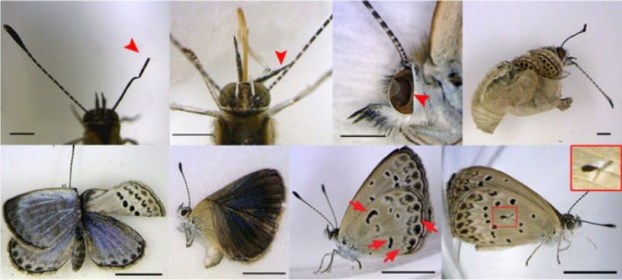
Representative anomalies of butterflies fed contaminated leaves. (Source: Hiyama et al)
Aphids
In 2014, Shin-ichi Akimoto (Hokkaido University) found that about 10% of certain insects, such as aphids, have malformations in Fukushima. But their survival and their reproduction remain possible.
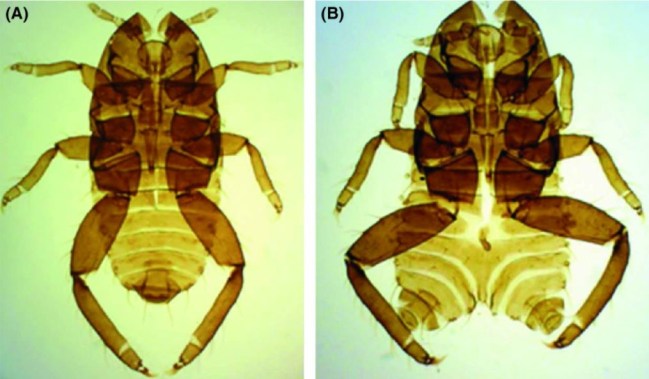
Sorini aphid T. From Fukushima. (A) normal morphology, (B) Level 3 malformation of the abdomen (Source: S. Akimoto)
The cows
The phenomenon of white patches (depigmentation) on the observed swallows in Fukushima and Chernobyl is also found on the cows of Masami Yoshizawa, at the Farm of Hope in Namie, a town located 14 km from the destroyed plant .

A cow of Masami Yoshizawa was brought to Tokyo in 2014 to the government for diagnosis (AFP Photo)
Horses
The biologist Hayato Minamoto reported the carnage suffered by Tokuei Hosokawa, an Iitate farmer who lost a hundred horses in two years. Iitate had suffered the brunt of the radioactive cloud from the Fukushima Daiichi plant in March-April 2011.
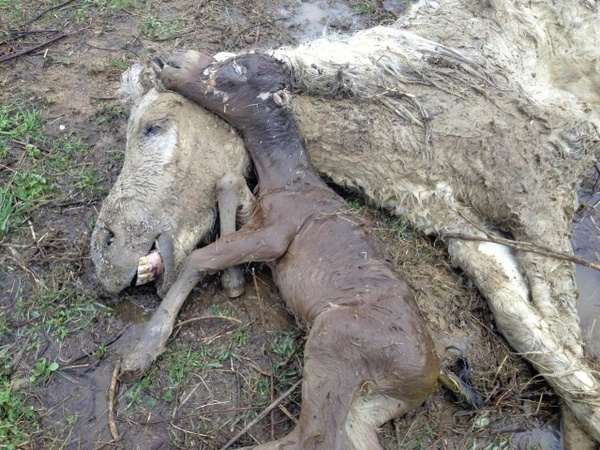
Iitate horses
Monkeys
Between April 2012 and March 2013, researchers led by Shin-ichi Hayama (Japan University of Life Sciences and Veterinary Sciences) analyzed the blood of 61 Japanese monkeys living in a forest 70 km from the Fukushima Daiichi nuclear power plant. The total concentration of cesium in monkeys muscles was between 78 and 1778 Bq / kg. Blood tests in these animals revealed a small quantity of white blood cells and red blood cells, which could make them more vulnerable. The decrease of blood cells was directly proportional to the concentration of cesium in the muscles, which suggests a dose-response correlation. Researchers estimate that exposure to radioactive materials contributed to hematological changes in Fukushima monkeys.

Drawing by Julien Loïs
Provisional Conclusion
The consequences of radioactivity on animals are visible to anyone who will bother to observe what happens. In this article, I focused on some animals only (there would be other cases to develop: the population decline of the cicadas, the increased cataract of rodents, etc.). Scientists could conduct similar studies on this strange animal that is man, but it would not be politically correct.
Yet this has already been done, in Hiroshima and Nagasaki, Chernobyl. For example, studies conducted between 1993 and 1998 on Ukrainian children permitted to observe a drop of blood cells, which was related to the exposure of each child to cesium depending on the place of residence. And yet, in Tokyo, from 2011 to 2014, Dr. Mita observed that white blood cells, especially neutrophils, decreased in children under 10 years old. (Which prompted him to move and to ask his patients to leave Tokyo). But no, do not say anything, and do not look into such matter.
In Japan, the denial of the danger is a must. The only mention of a nosebleed in a manga can cause a national affair and censorship … To speak of the negative consequences of the nuclear disaster at Fukushima Daiichi is not accepted.
You must rebuild, you must forget, you must think about the future. Institutionally, only one study is accepted, the monitoring of thyroids of children in Fukushima. That study is the screen that hides the forest of lies.
And yet, despite 131 thyroid cancers confirmed in June 2016, the official Japanese scientists refuse to see them as caused by radioactivity.
Pierre Fetet
To read more:
1) Scientific studies cited in this article
The biological impacts of the Fukushima nuclear accident on the pale grass blue butterfly, A. Hiyama, C. Nohara, S. Kinjo, W. Taira, S. Gima, A. Tanahara, J.-M. Otaki, 2012
Low blood cell counts in wild Japanese monkeys after the Fukushima Daiichi nuclear disaster, K. Ochiai, S. Hayama, S. Nakiri, S. Nakanishi, N. Ishii, T. Uno, T. Kato, F. Konno, Y. Kawamoto, S. Tsuchida, T. Omi, 2014
Morphological abnormalities in gall-forming aphids in a radiation-contaminated area near Fukushima Daiichi: selective impact of fallout?, S. Akimoto, 2014
Effects of the Fukushima Daiichi nuclear accident on goshawk reproduction, K. Murase, J. Murase, R. Horie, K. End, 2015
Radiological dose reconstruction for birds reconciles outcomes of Fukushima with knowledge of dose-effect relationships, J. Garnier-Laplace, K. Beaugelin-Seiller, C. Della-Vedova, J.-M. Métivier, C. Ritz, T. A. Mousseau, A. P. Møller, 2015
Cumulative effects of radioactivity from Fukushima on the abundance and biodiversity of birds, A. P. Møller, I. Nishiumi & T. A. Mousseau, 2015
2) Articles and file
Tchernobyl, une histoire pas si naturelle que ça (Pierre Fetet)
Non, Tchernobyl n’est pas devenu une réserve naturelle (Timothy Mousseau)
A Fukushima, les souris sont aveugles et les oiseaux ne chantent plus (Anne-Laure Barral)
Biological effects of Fukushima radiation on plants, insects, and animals

This is a pale grass blue butterfly, one of the most common species of butterfly in Japan. Recent research has revealed major impacts on this species from the radiation leaks at the Fukushima nuclear power plant. Credit: Joji Otaki, University of the Ryukyus, Okinawa, Japan
Following the 1986 Chernobyl nuclear power plant meltdown, biological samples were obtained only after extensive delays, limiting the information that could be gained about the impacts of that historic disaster. Determined not to repeat the shortcomings of the Chernobyl studies, scientists began gathering biological information only a few months after the disastrous meltdown of the Fukushima Daiichi power plant in Japan in 2011. Results of these studies are now beginning to reveal serious biological effects of the Fukushima radiation on non-human organisms ranging from plants to butterflies to birds.
A series of articles summarizing these studies has now been published in the Journal of Heredity. These describe widespread impacts, ranging from population declines to genetic damage to responses by the repair mechanisms that help organisms cope with radiation exposure.
“A growing body of empirical results from studies of birds, monkeys, butterflies, and other insects suggests that some species have been significantly impacted by the radioactive releases related to the Fukushima disaster,” stated Dr. Timothy Mousseau of the University of South Carolina, lead author of one of the studies.
Most importantly, these studies supply a baseline for future research on the effects of ionizing radiation exposure to the environment.
Common to all of the published studies is the hypothesis that chronic (low-dose) exposure to ionizing radiation results in genetic damage and increased mutation rates in reproductive and non-reproductive cells.
One of the studies (Hayashi et al. 2014) documented the effects of radiation on rice by exposing healthy seedlings to low-level gamma radiation at a contaminated site in Fukushima Prefecture. After three days, a number of effects were observed, including activation of genes involved in self-defense, ranging from DNA replication and repair to stress responses to cell death.
“The experimental design employed in this work will provide a new way to test how the entire rice plant genome responds to ionizing radiation under field conditions,” explained Dr. Randeep Rakwal of the University of Tsukuba in Japan, one of the authors of the study.
Another team of researchers (Taira et al. 2014) examined the response of the pale grass blue butterfly, one of the most common butterfly species in Japan, to radiation exposure at the Fukushima site. They found size reduction, slowed growth, high mortality and morphological abnormality both at the Fukushima site and among laboratory-bred butterflies with parents collected from the contaminated site.
Multiple sources of exposure were included in the butterfly study. “Non-contaminated larvae fed leaves from contaminated host plants collected near the reactor showed high rates of abnormality and mortality,” explained Dr. Joji Otaki of the University of the Ryukyus in Okinawa, Japan. Some of their results suggested the possible evolution of radiation resistance in Fukushima butterflies as well.
A review of genetic and ecological studies for a range of other species at both Chernobyl and Fukushima (Mousseau 2014) revealed significant consequences of radiation. Population censuses of birds, butterflies, and cicadas at Fukushima showed major declines attributable to radiation exposure. Morphological effects, such as aberrant feathers on barn swallows, were also observed. The authors suggest that long-term studies at Chernobyl could predict likely effects in the future at the Fukushima site.
All of these studies highlight the need for early and ongoing monitoring at sites of accidental radiation release. “Detailed analyses of genetic impacts to natural populations could provide the information needed to predict recovery times for wild communities at Fukushima as well as any sites of future nuclear accidents,” Mousseau said. “There is an urgent need for greater investment in basic scientific research of the wild animals and plants of Fukushima.”
Provided by: American Genetic Association
http://m.phys.org/news/2014-08-biological-effects-fukushima-insects-animals.html
1 This Month

of the week – Shut Down Drone Warfare!


Tell the Ukrainian Government to Drop Prosecution of Peace Activist Yurii Sheliazhenko

Petition to revoke the licensing of the Near Surface Nuclear Disposal Facility (NSDF) at Chalk River. https://www.ourcommons.ca/petitions/en/Petition/Details?Petition=e-7247
To see nuclear-related stories in greater depth and intensity – go to https://nuclearinformation.wordpress.com
-
Archives
- April 2026 (79)
- March 2026 (251)
- February 2026 (268)
- January 2026 (308)
- December 2025 (358)
- November 2025 (359)
- October 2025 (376)
- September 2025 (257)
- August 2025 (319)
- July 2025 (230)
- June 2025 (348)
- May 2025 (261)
-
Categories
- 1
- 1 NUCLEAR ISSUES
- business and costs
- climate change
- culture and arts
- ENERGY
- environment
- health
- history
- indigenous issues
- Legal
- marketing of nuclear
- media
- opposition to nuclear
- PERSONAL STORIES
- politics
- politics international
- Religion and ethics
- safety
- secrets,lies and civil liberties
- spinbuster
- technology
- Uranium
- wastes
- weapons and war
- Women
- 2 WORLD
- ACTION
- AFRICA
- Atrocities
- AUSTRALIA
- Christina's notes
- Christina's themes
- culture and arts
- Events
- Fuk 2022
- Fuk 2023
- Fukushima 2017
- Fukushima 2018
- fukushima 2019
- Fukushima 2020
- Fukushima 2021
- general
- global warming
- Humour (God we need it)
- Nuclear
- RARE EARTHS
- Reference
- resources – print
- Resources -audiovicual
- Weekly Newsletter
- World
- World Nuclear
- YouTube
-
RSS
Entries RSS
Comments RSS
 nuclear-news