We’re not going to get de-escalation, diplomacy and detente unless the people use the power of their numbers to demand those things, and the people are not going to use the power of their numbers to demand those things as long as they are successfully propagandized not to. This means propaganda is the ultimate problem that needs to be addressed.
In a new article titled “European antiwar protests gain strength as NATO’s Ukraine proxy war escalates,” The Grayzone’s Stavroula Pabst and Max Blumenthal document the many large demonstrations that have been occurring in France, the UK, Germany, Greece, Spain, the Czech Republic, Austria, Belgium and elsewhere opposing the western empire’s brinkmanship with Russia and proxy warfare in Ukraine.
Pabst and Blumenthal conclude their report with a denouncement of the way the western media have either been ignoring or sneering at these protests while actively cheerleading smaller demonstrations in support of arming Ukraine.
“When Western media has not ignored Europe’s antiwar protest wave altogether, its coverage has alternated between dismissive and contemptuous,” they write. “German state broadcaster Deutsche Welle sneeringly characterized the February 25 demonstration in Berlin as ‘naive’ while providing glowing coverage to smaller shows of support for the war by the Ukrainian diaspora. The New York Times, for its part, mentioned the European protests in just a single generic line buried in an article on minuscule anti-Putin protests held by Russian emigres.”
This bias is of course blatantly propagandistic, which won’t surprise anyone who understands that the mainstream western media exist first and foremost to administer propaganda on behalf of the US-centralized empire. And chief among their propaganda duties is to suppress the emergence of a genuine peace movement.
As we’ve discussed previously, it has never in human history been more urgent to have a massive, forceful protest movement in opposition to the empire’s rapidly accelerating trajectory toward a global conflict against Russia and China. Other peace movements have arisen in the past in response to horrific wars which would go on to claim millions of lives, but a world war in the Atomic Age could easily wind up killing billions, and must never be allowed to happen.
And yet the public is not treating this unparalleled threat with the urgency it deserves. A few protests here and there is great, but it’s not nearly enough. And the reason the people have not answered the call is because the mass media have been successfully propagandizing them into accepting the continuous escalations toward world war that we’ve been seeing.
People aren’t going to protest what their government is doing if they believe that what their government is doing is appropriate, and the only reason so many people believe what their government is doing with regard to Russia and China is appropriate is because they have been propagandized into thinking so.
The mass media are not telling the public about the many well-documented western provocations which led to the war in Ukraine and sabotaged peace at every turn; they’re just telling everyone that Putin invaded because he’s an evil Hitler sequel who loves killing and hates freedom. The mass media are not telling the public about the way the US empire has been encircling China with war machinery in ways it would never permit itself to be encircled while deliberately staging incendiary provocations in Taiwan; they’re just telling everyone that China is run by evil warmongering tyrants. The mass media are not reminding the public that after the fall of the Soviet Union the US empire espoused a doctrine asserting that the rise of any foreign superpower must be prevented at all cost; they’re letting that agenda fade into the memory hole.
Because people believe Russia and China are the sole aggressors and the US and its allies are only responding defensively to those unprovoked aggressions, they don’t see the need for a mass protest movement against their own governments. If you tell the average coastal American liberal that you’re holding a protest about the war in Ukraine, they’re going to assume you mean you’re protesting against Putin, and they’ll look at you strangely if you tell them you’re actually protesting your own government’s aggressions.
The narrative that Russia and China are acting with unprovoked aggression actually prevents peace, because if your government isn’t doing anything to make things worse, then there’s nothing it can change about its own behavior to make things better. But of course there is a massive, massive amount that the western power alliance can change about its own behavior with regard to Russia and China that would greatly improve matters. Instead of working to subordinate the entire planet to the will of Washington and its drivers, they can work toward de-escalation, diplomacy and detente.
We’re not going to get de-escalation, diplomacy and detente unless the people use the power of their numbers to demand those things, and the people are not going to use the power of their numbers to demand those things as long as they are successfully propagandized not to. This means propaganda is the ultimate problem that needs to be addressed. Ordinary people can only address it by waking the public up to the fact that the political/media class are lying to them about what’s happening with Russia and China, using whatever means we have access to.
Our rulers are always babbling about how they’re fighting an “information war” against enemy nations, but in reality they’re fighting an information war against normal westerners like us. So we must fight back. We need to cripple public trust in the propaganda machine and begin awakening one another from our propaganda-induced sleep, so that we can begin organizing against the horrific end they are driving us toward.
The Biden administration has a name for this network – the rules-based international order. And sustaining the grip this order has on the world represents an existential challenge for the US.
one is struck by the exclusively militaristic nature of their mission—the North Atlantic Treaty Organization (NATO), the Australia-UK-US (AUKUS) security partnership, and a “revitalized Quad” ……. all, at their core, military alliances.
When one reads the 2022 National Security Strategy of the US, it becomes crystal clear that, at least according to the world view as promulgated by the administration of President Joe Biden, the US and China are on trajectory that can only lead to one thing – military confrontation.
At the core of this assessment is the enduring belief on the part of the Biden administration that the key to America’s continued role as a world leader is the reinvigoration of “America’s unmatched network of alliances and partnerships to uphold and strengthen the principles and institutions that have enabled so much stability, prosperity, and growth for the last 75 years.”
The Biden administration has a name for this network – the rules-based international order. And sustaining the grip this order has on the world represents an existential challenge for the US.
According to the Biden administration, “The [People’s Republic of China] is the only competitor with both the intent to reshape the international order and, increasingly, the economic, diplomatic, military, and technological power to advance that objective.”
According to the Biden administration, “The [People’s Republic of China] is the only competitor with both the intent to reshape the international order and, increasingly, the economic, diplomatic, military, and technological power to advance that objective.”
China, the Biden administration believes, is the greatest threat to the US, something the Biden administration makes abundantly clear. “The People’s Republic of China harbors the intention and, increasingly, the capacity to reshape the international order in favor of one that tilts the global playing field to its benefit, even as the US remains committed to managing the competition between our countries responsibly.”
The “responsible management” the Biden administration speaks of draws upon an “unrivaled network of allies and partners” which “protects and advances our interests around the world.” The Biden administration’s strategy for “competing” with China requires the US to “assemble the strongest possible coalitions.”
But when one looks at the coalitions highlighted by the Biden administration as being central to this effort, one is struck by the exclusively militaristic nature of their mission—the North Atlantic Treaty Organization (NATO), the Australia-UK-US (AUKUS) security partnership, and a “revitalized Quad”, which brings together the US with Japan, India, and Australia in a security arrangement designed to contain Chinese influence in the Indo-Pacific region—are all, at their core, military alliances.
“Competition”, when it comes to the US approach toward China, is better defined as “deterrence”, and “deterrence” is a military mission, one which the Biden administration has pledged to “act urgently to sustain and strengthen”, noting that China is the “pacing challenge.”
The result of the Biden administration’s approach toward China is the militarization of what should be a classic problem of diplomacy, where the traditional tools of negotiation are increasingly replaced by confrontation.
The most recent example of this militarized approach is the so-called “Chinese Spy Balloon” crisis, where the Biden administration used the incursion by what clearly was a wayward high-altitude balloon equipped with sensors designed to collect atmospheric information used to investigate climate change to generate hysteria about a non-existent Chinese threat. This hysteria culminated in the US employing Air Force fighter aircraft to shoot down the balloon, destroying both it and its scientific payload.
The extent to which the Biden administration has supplanted diplomacy with “militarized” competition is underscored by the fact that, because of this self-generated Sinophobia, Secretary of State Antony Blinken cancelled plans to travel to China for high-level talks. At a time when the US and China should be exhausting every opportunity to engage in the kind of constructive dialogue the Biden administration claims as its principal tool for managing its relationship with China, the US has instead embarked on a phrenetic “balloon chase”, where US fighter aircraft scour the American skies for even more “made in China” balloons to shoot down.
The militarization of US-Chinese relations reached its apex recently when US Air Force General Mike Minihan, the head of the US Air Mobility Command (AMC), issued a memorandum declaring that his “gut” told him that the US and China would be at war by 2025, and instructing the men and women under his command practice pistol marksmanship by firing a full “clip” of ammunition into a 7-meter target, aiming for the head.
While General Minihan’s superiors have distanced themselves from the memorandum, the fact is his undiplomatic language is reflective of a core assessment dating back to 2021 known as “the Davidson Window”, named after the former commander of the US Indo-Pacific Command, Philip Davidson, who postulated at that time that China would invade Taiwan within six years. The “Davidson Window” guides the posture of a US military which, by the Biden administration’s own admission, uses China as its “pacing challenge.”
The Biden administration would be well-advised to become grounded in old-school diplomacy rather than chasing balloons in the sky because, left unchecked, the ongoing militarization of the US-Chinese relationship can only lead to disaster.
The 1967 U.N. Outer Space Treaty prohibits ‘weapons of mass destruction’ in space or on ‘celestial bodies’ like the moon. But currently ‘weapons of selective destruction’ fall outside of the OST. Thus a new treaty is urgently needed.
Space orbital parking lots are getting dangerously crowded risking cascading collisions ( Kessler Syndrome) which could become so severe that space flight would be impossible due to the orbiting field of debris. If this was to occur much of life on planet Earth would go dark as our daily activities are enabled by space satellites (GPS, Internet banking, weather prediction, cell phones, air traffic control, etc).
In addition, because of the massive escalation of satellite launches, astronomers are complaining that we are losing the night sky.
Elon Musk’s SpaceX makes rockets and satellites to build Starlink, a broadband Internet system that once completed will cover the entire world. SpaceX has so far put 2,500 satellites into orbit and plans for 42,000 satellites in low-Earth orbit (LEO) occupying 80% of this space.
The Pentagon funds and tests Starlink to use its military capabilities. Starlink satellites are being utilized by the Ukrainian military to guide drones, artillery shells, and missiles into Russian positions and at civilian targets.
Very recently Musk has begun to slightly restrict the use of Starlink by the Ukrainian military as he feared that Russia might take action against the constellation.
Anti-satellite weapons (ASAT) have been tested by India, US, Russia and China. ASAT’s need no explosives, at orbital speeds kinetic energy (one thing smashing into the other) does the job.
Virtually all warfare on the planet is now enabled by space technology. Thus filling up the increasingly limited parking spaces in various orbital regions will determine which nation has an advantage.
NATO in 2019 announced a new doctrine calling space a ‘fifth operational domain’. NATO maintains that the US-led bloc will use commercial satellites as a military booster.
The 1967 U.N. Outer Space Treaty prohibits ‘weapons of mass destruction’ in space or on ‘celestial bodies’ like the moon. But currently ‘weapons of selective destruction’ fall outside of the OST. Thus a new treaty is urgently needed.
Russia and China have been leading the effort at the UN to create a new treaty to ban all weapons in space for many years. But the US and Israel have been blocking such a step for peace in space. The official US line through Republican and Democratic administrations is ‘there is no problem in space, and no new treaty is needed’.
During recent years the numbers of satellites orbiting the Earth has grown dramatically. Thousands more satellite launches have been approved by the Federal Communications Commission despite legal action by a coalition of groups (including the Global Network Against Weapons & Nuclear Power in Space).
Each launch releases toxic agents which are destroying the Earth’s ozone layer. In addition, when satellites fall from lower earth orbit and burn-up on reentry they release a deadly stew of electronic particles into our atmosphere.
Russia has issued a warning to the US-NATO that they are ‘exposing civilian space assets to potential attack by utilizing them for military purposes’.
In early February Ukrainian troops fired rockets from a US-made HIMARS system which hit a hospital in Novoaydar, killing 14 Russian-ethnics and injuring 24. Russia claimed that Kiev used western satellites operated by NATO personnel to target the hospital.
In late February China announced that it was preparing to launch close to 13,000 satellites into LEO in a move to counter Musk’s SpaceX network. China stated that they intended to ‘ensure that our country has a place in low orbit and prevent the Starlink constellation from excessively preempting low-orbit resources.
The EU countries are at odds over the future role of nuclear energy. At a meeting, eleven countries, including France, agreed to expand nuclear power cooperation. Germany strictly rejects this.
Eleven member states of the European Union have agreed on “enhanced cooperation” in the field of nuclear energy. These include France, the Netherlands, Poland, Finland, Bulgaria, Croatia, the Czech Republic, Hungary, Romania, Slovenia and Slovakia. At the meeting of EU energy ministers in Stockholm, they specifically decided to promote “new joint projects” alongside existing nuclear power plants. They also decided to work closely together in the areas of research and security.
On the one hand, countries like Germany, Luxembourg, Austria and Spain are strictly against the expansion of nuclear power in Europe to achieve climate goals. On the other hand, the “nuclear alliance” led by long-standing nuclear power France wants to further expand nuclear power. According to a joint statement by the eleven EU countries, nuclear energy is one of many tools to achieve climate goals. With nuclear energy, electricity should be produced for the needs of consumers in order to guarantee “security of supply” in the future. France is committed to allowing its nuclear power to count toward renewable energy and “green” hydrogen targets.
A drone crashed just 68 miles from the Kremlin today in a suspected ‘failed attack’ by Ukraine.
Russian president Vladimir Putin has ordered officials to tighten control of the border with Ukraine after a spate of drone attacks delivered a new challenge to Moscow more than a year after the invasion of its neighbour.
While Putin did not refer to any specific attacks in a speech in Moscow, his comments came hours after drones targeted several areas in southern and western Russia and authorities closed the airspace over St Petersburg in response to what some reports said was a drone.
Images shared online appear to depict a Ukrainian UJ-31 ‘loitering munitions’ kamikaze flying bomb after it crashed down near a gas plant more than 300 miles from the border.
It came down near the village of Kolomna hours after Russia’s Defence Ministry accused Ukraine of two attempted drone strikes in the south overnight.
Ukraine does not publicly claim responsibility for attacks inside Russia.
If it was behind the Kolomna drone, it would be its closest attempted strike to Moscow since the start of the invasion of Ukraine.
It is also the deepest inside Russian territory any suspected Ukrainian drone has been spotted.
Postings on Russian social media showed the broken grey metal drone in a snowdrift in a woodland area.
Regional governor Andrei Vorobyov said the drone appeared to have been intended to hit a ‘civil infrastructure facility’ but noted that there was no damage.
He said the FSB security agency was handling the situation and there was no threat to residents.
There is a gas compressor plant close to the crash site.
Reports claimed the low-flying drone may have clipped trees.
Earlier, the Russian Defence Ministry accused Ukraine of sending attack drones towards civil infrastructure targets in the southern regions of Adygea and Krasnodar.
It said its electronic anti-drone jamming systems had caused them to miss their targets.
The ministry said: ‘Both drones lost control and deviated from their flight paths.
‘One fell into a field, the other, deviating from its trajectory, did not harm the intended target.’
……………………………………………… While Ukrainian drone strikes on the Russian border regions of Bryansk and Belgorod that lie north of Ukraine’s Sumy region are not unusual, the hits on the Krasnodar and Adygea regions further south are noteworthy.
…………… Ukrainian authorities offered no immediate acknowledgement or comment on the reported strikes.
Last year, Russian authorities repeatedly reported shooting down Ukrainian drones over annexed Crimea. In December, the Russian military said Ukraine used drones to hit two bases for long-range bombers deep inside Russian territory.
Separately, the local government of St Petersburg – Russia’s second-largest city 800 miles north of the border with Ukraine – said early on Tuesday that it was temporarily halting all flight departures and arrivals at the city’s main airport, Pulkovo. It did not give a reason for the move.
WASHINGTON – With more than $100 billion in U.S. weaponry and financial aid flowing to Ukraine in less than a year – and more on the way to counter Russia’s invasion – concerns about arms falling into terrorists’ hands and dollars into corrupt officials’ pockets are mounting.
The special inspector general who has overseen aid to Afghanistan since 2012, and some House Republicans, warn of the need for closer oversight of the military and humanitarian aid to Ukraine. The scale of the effort is massive. The $113 billion appropriated by Congress in 2022 approaches the $146 billion spent in 20 years for military and humanitarian assistance to Afghanistan, though the cost of sending U.S. troops there was far higher.
“When you spend so much money so quickly, with so little oversight, you’re going to have fraud, waste and abuse,” John Sopko, the special inspector general for Afghanistan reconstruction, said in an interview. “Massive amounts.”
Among the American public and on Capitol Hill, support for Ukraine’s resistance to Russia’s invasion remains strong. But it is softening. An Associated Press poll in late January showed that 48% of U.S. adults say they favor the U.S. providing weapons to Ukraine, with 29% opposed and 22% saying they’re neither in favor nor opposed. That’s a drop from May 2022, when 60% of U.S. adults said they were in favor of sending Ukraine weapons.
Support could erode further among Americans and Ukrainians, according to members of Congress and Sopko, without greater transparency and accountability for the tens of billions spent. The costs to American taxpayers can be expected to increase as the Biden administration sends increasingly sophisticated and expensive arms to Ukraine, including Abrams battle tanks.
Assuring that the aid ends up in the right hands, they say, demands greater oversight.
U.S. struggles to account for billions sent to Ukraine
The Pentagon spent $62.3 billion in 2022 on Ukraine for weapons, ammunition, training, logistics, supplies, salaries and stipends, according to the Joint Strategic Oversight Plan for Ukraine Response report. Inspectors general for several agencies released the report in January.
The State Department and U.S. Agency for International Development spent $46 billion for activities ranging from border security to basic government services such as utilities, hospitals, schools and firefighting. Other government agencies, including the Department of Agriculture, spent another $5 billion.
The report noted the difficulty U.S. agencies had accounting for the billions spent.
The Pentagon, for example, was “unable to provide end-use monitoring in accordance with DoD policy” in Ukraine, according to a report by the Pentagon’s inspector general. “End-use monitoring” includes tracking serial numbers of weapons and ammunition to ensure they’re used as intended.
……………………. With few U.S. troops or State Department personnel in Ukraine, keeping inventories is difficult, the report said. Moreover, the vast amount of money complicates the effort. The report notes the danger of corrupt officials siphoning it off.
“State is overseeing unprecedented levels of security assistance in Ukraine, presenting significant risk of misuse and diversion given the volume and speed of assistance and the wartime operating environment,” according to the report…………………….
Lack of Ukraine oversight draws parallels to Afghanistan corruption
Ukraine has a history of corruption, and President Volodymyr Zelenskyy has made stamping it out a priority.
Ukraine ranks 116th out of 180 nations on Transparency International’s Corruption Perceptions Index. On Feb. 14, the defense minister named new deputies after news reports showed officials in the defense ministry had bought food for troops at inflated prices.
Corruption corrodes the public’s faith in government, said Sopko, the special inspector general for Afghanistan. Elites in Afghanistan skimmed U.S. aid money, and the obvious corruption alienated Afghans…………………….
‘Need truth tellers’: Republicans demand more oversight
Yes, France is the soul of egalite, fraternite and all that (and Yes I dunno how to do the accents on this).
So it’s understandable that French energy minister Agnès Pannier-Runacher should be most upset when other countries belittle mighty France, and its holy nuclear industry.
Trouble is – I think that poor Agnes has got it a bit wrong.
We’re all in awe of France – its cheeses, its wine, culture – natural beauty- wow! it’s superior. But when it comes to France’s much touted nuclear superiority – it is not discriminatory against France, nor its industry – to mention the facts.
Agnes – you and France are going to have to face the facts:
Global heating is happening too fast – the wonderful new fleet of reactors would be too late anyway.
Climate change, heat, water shortage, are badly affecting France’s nuclear reactors.
France’s reactors have corrosion problems.
Nuclear power is just not “renewable”- depends on a carbon-emitting fuel chain starting with uranium mining.
it’s just not “clean and green ” – emits radioactive particles, produces long-lasting toxic wastes.
it’s not affordable.
EDF’s nearly bankrupt – time to stop the pretence
in a tense conflict-prone world, nuclear facilities are a dangerous target for terrorism
nuclear’s really only useful for supporting the nuclear weapons industry.
it’s popular with the military, the weapons corporations, the bought politicians, but increasingly less so with the general public – who see the preferable alternatives – energy conservation, and wind, solar and other renewable sources.
French President Emmanuel Macron’s government sees “no problem” funding the six new nuclear reactors he has proposed building, a project that by one estimate could cost at least €51 billion ($54 billion).
We trust the nuclear industry, there’s no difficulty ahead to fund nuclear reactors announced by the president,” government spokesman Olivier Veran said after a cabinet meeting on Wednesday. “The funding framework will be introduced, believe me, there’s no problem.”
Macron last year made a U-turn on a previous pledge to cut back France’s reliance on nuclear energy by promising to build at least six new nuclear reactors slated to enter into service from 2035, and up to 14 reactors in total. France gets about 70% of its electricity from nuclear power.
Luc Remont, the chief executive of electricity utility Electricite de France SA, which operates the country’s nuclear reactors, told lawmakers during a hearing on Tuesday that the construction of the six reactors would cost at least €51 billion, cautioning that that was just a “rough estimate.”
EDF is being nationalized by the government, and Remont said the company can’t bear the cost of the new reactors by itself, suggesting the state would have to step in.
Earlier this week, Macron called for the European Investment Bank to invest in low-carbon energy, including nuclear power. On Wednesday, his minister for energy transition, Agnes Pannier-Runacher, who is trying to build an alliance of pro-nuclear countries to weigh in on European Union negotiations, said the funding of future nuclear reactors would be presented by the end of the year. She ruled out higher taxes.
France is making an aggressive push to promote nuclear power in the EU, seeking to rally allies for battles to come in a stand-off with Germany over the bloc’s energy policy. Paris on Tuesday persuaded 10 countries, including Hungary and Bulgaria, to join a “nuclear alliance” calling on Brussels to do more to back atomic energy, a move they argued would help meet climate goals while protecting the EU’s energy independence.
The establishment of the pro-nuclear group at a meeting in Stockholm, comes as France lobbies for concessions from the EU’s ambitious renewable power goals to obtain what would effectively be carve-outs for its nuclear industry, the mainstay of its electricity production. That has opened a rift with Germany and left other member states wondering if they will be forced to pick sides.
The disagreements are bleeding into a host of EU energy reforms, from a planned overhaul of electricity markets to how to promote hydrogen energy and renewables. It also reflects how Germany and France have had trouble forging consensus on a range of issues since Russia’s invasion of Ukraine rattled the EU’s economic and political order.
French energy minister Agnès Pannier-Runacher said she had a “productive discussion” with her German counterpart at the meeting of EU energy ministers in Stockholm on Tuesday, but the pair did not resolve their differences. “We do not want nuclear to be discriminated against,” she said.
Some EU countries are questioning why French president Emmanuel Macron’s government is pushing its agenda so hard given it risks reopening legislative battles on energy issues that had already been resolved. “
It is total war from everywhere [on the nuclear issue],” said one senior EU diplomat outside of the Franco-German nucleus, as several described French efforts to get “low carbon” — a byword for atomic power — into a number of draft regulations in recent months.
Another said the issue had “become a spoiler in every discussion”, when France had agreed last year to a broad outline of a renewable energy agenda without insisting on nuclear carve-outs.
The meeting hastily arranged by Paris was met with a degree of bewilderment by other EU states. Belgium, which recently extended the life of two reactors, was not invited, while Sweden, which has a modest atomic energy sector, declined to join. The Netherlands only signed up on condition that a paragraph in the joint statement linking nuclear power to renewables targets was deleted, people close to the talks said.
With China now identified by the U.S. Department of Defense as the most dangerous, or “pacing” threat to U.S. national security, all of the military services have been instructed to prepare for a U.S.-China conflict. Accordingly, both the U.S. Army and the Marine Corps are restructuring their Asia-oriented forces — those committed to the Pentagon’s Indo-Pacific Command (INDOPACOM) — to be capable of conducting multiple offensive and defensive operations throughout the Western Pacific. This has generally entailed lightening their arms and equipment to allow for easy deployment and acquiring more forward operating bases in the region. Both also seek new mobile missile systems (often called “precision fires”) for attacks on enemy ships and land installations.
The U.S. has been securing new basing facilities and conducting large-scale combat exercises in the Western Pacific.By Michael T. Klare , TRUTHOUT, February 28, 2023
“………………………………………………… the notion of another major amphibious campaign in the Pacific has largely evaporated. Recently, however, the U.S. Army and Marine Corps have begun preparing for precisely such a contest as China has emerged as the principal adversary to U.S. hegemony and neighboring Pacific islands have acquired fresh strategic significance.
Any major U.S. conflict with China, it is widely believed, will largely entail air and naval operations in China’s maritime areas, notably the East and South China Seas and the waters surrounding Taiwan. Such a clash, strategists assume, will involve intense air and sea battles for control of these areas. But, as in World War II, the fighting will also envelop any islands housing the air and naval bases of either side, such as China’s installations on islands in the South China Sea and U.S. bases in Japan, Okinawa and the Philippines. Aside from air and missile attacks on these island facilities, either or both sides may seek to occupy them through amphibious assault, resulting in the sort of brutal combat seen in those same areas during World War II.
These islands are all part of (or enclosed within) what Chinese strategists call the “the first island chain” — the long string of archipelagos stretching from Japan in the north to the Ryukyus and Taiwan in the middle and the Philippines and Borneo in the south, together acting as a sort of barrier to Chinese naval projection into the greater Pacific. (Strategists also speak of a second, outer island chain, consisting of the Mariana Islands and the western Caroline Islands.)
The United States has long maintained a major military presence on islands up and down the first chain, both to project U.S. power into the region and to sustain U.S. combat operations in the event of a war. These include the major concentration of Air Force and Navy forces in Japan, the large Marine Corps contingent on Okinawa and bare-bones facilities in the Philippines. Along with any U.S. ships in the area, these bases would be among the primary targets for Chinese air and missile attacks at the onset of a U.S.-China conflict, followed, conceivably, by amphibious assaults aimed at occupying or demolishing them — which would no doubt provoke an aggressive U.S. response.
Located between the Chinese coastline and the first island chain are several contested island groups — the Spratly Islands in the South China Sea and the Senkaku Islands in the East China Sea — that could also become sites of U.S.-Chinese fighting in the event of a future conflict. The Spratlys are claimed in their entirety by China and in part by Brunei, Malaysia, the Philippines and Vietnam; the Senkakus (called the Diaoyu by the Chinese) are claimed by both China and Japan.
Both island groups have witnessed clashes between Chinese vessels and those of the other claimants in recent years, and the U.S. has vowed to assist its allies in defending their territorial claims against future Chinese harassment. Should China attempt to test this pledge in some significant fashion — say, by seizing islands now occupied by Filipino personnel — U.S. forces might engage in an amphibious operation to repel such an attack. A Chinese attempt to occupy the Senkakus — now administered by Japan — could produce a similar result, especially given President Biden’s recent assertion that the U.S. mutual defense treaty with Japan extends to the Senkakus.
To further complicate the picture, China has established military installations on some of the islands and atolls it claims in the South China Sea, in some cases using sand dredged from the seafloor to expand their size to allow the construction of airstrips. These installations, outfitted with an array of anti-air and anti-ship missiles, pose a potential threat to U.S. and allied warships operating in the area and so would constitute a prime target for amphibious assault in the event of a major U.S.-China conflict.
Restructuring the Force
With China now identified by the U.S. Department of Defense as the most dangerous, or “pacing” threat to U.S. national security, all of the military services have been instructed to prepare for a U.S.-China conflict. Accordingly, both the U.S. Army and the Marine Corps are restructuring their Asia-oriented forces — those committed to the Pentagon’s Indo-Pacific Command (INDOPACOM) — to be capable of conducting multiple offensive and defensive operations throughout the Western Pacific. This has generally entailed lightening their arms and equipment to allow for easy deployment and acquiring more forward operating bases in the region. Both also seek new mobile missile systems (often called “precision fires”) for attacks on enemy ships and land installations…………………………………………………………………………………………………………………………………………………………
Training for Pacific Island Wars
To put all these plans into practice, both military branches have been conducting large-scale combat exercises in the Western Pacific and securing new basing facilities there.
Especially indicative of the Marines’ new thinking is a series of exercises called “Resolute Dragon,” held in conjunction with the Japan Self-Defense Forces (JSDF) over the past two years. Although ostensibly focused on defending Japan’s main islands, the exercises appear to embody a larger strategic sweep, involving joint amphibious operations throughout the region.
During Resolute Dragon 2021, held December 4-17 of that year, some 2,650 Marines and 1,400 soldiers from the JSDF engaged in simulated maritime assault operations. …………………………………
Resolute Dragon 2022, held last October, retained many features of the 2021 version but included an additional twist: while 1,600 U.S. Marines were training alongside JSDF soldiers in Japan, another 1,900 were partnered with Philippines Marine Corps personnel in a parallel exercise,…………….. also involved participation by the JSDF Amphibious Rapid Deployment Brigade and Republic of Korea Marines, suggesting the multinational and region-spanning nature of U.S. planning for future amphibious operations.
………………………………………………. Guam was again the site of a simulated airborne assault one year later,
…………………………………. Acquiring Forward Operating Bases
In addition to these training and restructuring efforts, the Army and Marine Corps are preparing for possible island battles in the Western Pacific by acquiring additional bases in the area.
The first such installation to be established is the Marine Rotational Force (MRF) in Darwin, Australia. Located by the Timor Sea in Australia’s Northern Territory, the MRF facility is closer to the southern Philippines and the South China Sea than to, say, Sydney or Melbourne. As a result of an agreement signed by President Obama during a visit to Australia in 2011, the U.S. presence has grown from just 200 Marines in the first rotation to approximately 2,500 today. While in Australia, these troops engage in a six-month stint of training and exercises, usually in conjunction with Australian military personnel. In the event of a war with China, the Darwin facility could also be used to support combat operations throughout the South China Sea area.
Just recently, on February 2, Secretary of Defense Lloyd Austin signed an agreement with Philippine President Ferdinand Marcos Jr. affording the U.S. military access to four more bases in his country, in addition to four other facilities the Pentagon has been allowed to use under a previous accord.
The acquisition of these bases, along with all the other developments described above, demonstrate just how far the Army and Marine Corps have proceeded in their efforts to prepare for major combat operations in the Western Pacific. Clearly, senior Pentagon officials believe that a war with China is becoming increasingly likely, and that, when and if such a conflagration erupts, it will entail heavy fighting over key islands in that region.
Probably the biggest challenge facing the U.S. in any future arms control agreement is winning back the trust necessary for such agreements to have any true meaning
Having used arms control to gain unilateral advantage over Russia, the cost to the U.S. and NATO in getting Moscow back to the negotiating table will be high.
U.S.-Russian arms control is in a state of extreme distress.
The U.S. withdrawal from the foundational Anti-Ballistic Missile (ABM) treaty in 2002 undid the functional and theoretical premise of mutually assured destruction (MAD) that provided logical equilibrium to the fundamentals of nuclear deterrence theory.
Similarly, the Trump administration’s precipitous termination of the Intermediate Nuclear Forces (INF) treaty in 2019 attacked both elements of the “trust but verify” maxim that governed issues of compliance verification that made arms control viable in the first place.
The last remaining arms control agreement that places limits on the strategic nuclear arsenals of both the U.S. and Russia is the New Strategic Arms Reduction Treaty (START).
Signed in 2010, and extended for five years in 2021, the treaty will expire in 2026. It places restrictions on the number of deployed nuclear warheads each side is permitted to have (1,550), as well as vehicles (missiles, bombers, submarines) to deliver these warheads (700).
Equally important to the numerical caps is the compliance verification regime mandated by the treaty, which includes the right of each side to conduct up to 18 on-site inspections per year. Up to 10 of these inspections can be done at operational bases where nuclear delivery systems are based. Inspectors there can visually confirm the presence of nuclear warheads by randomly selecting missiles for inspection.
The compliance verification aspects of New START have been on pause since early 2020, when public health concerns generated by the Covid-19 pandemic compelled both countries to cease inspections and the bi-annual convening of the Bilateral Consultative Committee (BCC) which oversaw the handling of any treaty discrepancies identified by either party.
When the pandemic began to wane in early 2022, efforts to restart treaty compliance verification and consultations were stymied by the political fallout from the Russian invasion of Ukraine. European Union sanctions banning overflights of Russian aircraft prevented Russia from carrying out on-site inspections of U.S. strategic nuclear facilities.
Issues of reciprocity drove Russia to deny U.S. inspectors access to Russian strategic facilities. And the BCC process was put on hold due to Russia’s concerns over the publicly-stated U.S. policy objective of achieving Russia’s “strategic defeat” in Ukraine.
The Russian posture became official policy when, at the end of his Feb. 21 address to the Russian Federal Assembly, Russian President Vladimir Putin announced that: “Russia is halting, putting a stop on its participation in the strategic weapons control agreement. I would like to reiterate, we are not exiting the agreement. We are putting a hold on it.”…………………………..
The Future of Arms Control
Where does this leave U.S.-Russian arms control? Dormant, but not yet dead. Resuscitating it, however, will require effort on the part of the U.S. and its NATO allies. Having made the choice to use arms control as a vehicle for gaining unilateral advantage over Russia, the cost for getting Russia back to the negotiating table will be high.
There are four primary issues that any future arms control agreement must, from the Russian perspective, address: missile defense; inclusion of U.K. and French nuclear forces; resurrection of the INF treaty and additional verification measures designed to signify good faith on the part of U.S. negotiators.
Missile defense was supposed to be part and parcel of the 2010 New START negotiations. The Obama administration convinced then-Russian President Dmitry Medvedev that strategic nuclear forces and missile defense must be treated as separate issues, and that the U.S. would in good faith seek to address Russian concerns once New START was ratified.
The U.S. lied by installing defensive missiles, with offensive capabilities, in Romania and Poland. The end result is that Russia has become locked into a treaty arrangement that sought to limit its nuclear deterrence forces at the same time as the U.S. was installing missile-killing technology on Russia’s borders.
Any future arms control agreement must address Russian concerns regarding missile defense if it is to have any hope of seeing the light of day.
In his address, Putin declared that, “Before we come back to the discussion of this [New START], we need to understand what France and the U.K. are trying to do and how we are going to take into account their strategic arsenals.”
From the very inception of negotiations on the reduction of U.S. and Soviet (and later, Russian) stockpiles, Russia has tried to include the British and French nuclear arsenals into the mix. The U.S. has steadfastly refused. Linking U.S. and NATO objectives to Russia’s “strategic defeat” has made it impossible for Russia to consider any future arms control discussion that does not include the nuclear weapons of these two NATO stalwarts in the overall equation.
Regaining Trust – A Tall Order
Moscow continues to view the U.S. withdrawal from the INF treaty as one of the greatest threats to its national security, second only to the previous U.S. withdrawal from the ABM treaty.
The potential deployment of U.S. ballistic missiles onto European soil that could strike Moscow in five minutes after launch is deemed, correctly, to be an inherent risk to Russia’s survival and which exponentially increases the likelihood of inadvertent nuclear conflict. Thus INF systems are part and parcel of any arms control agreement about strategic nuclear forces.
Probably the biggest challenge facing the U.S. in any future arms control agreement is winning back the trust necessary for such agreements to have any true meaning………………………………….
Any future arms control agreement must return to the basic fundamental precept that it be mutually beneficial, meaning that Russian needs receive as much attention as those of the U.S.
The day of a weak Russia acceding to the demands of a dominant U.S. side is long gone. For Russia to return to any future arms control negotiating table, it must be as a full and equal partner. Otherwise, as Putin has made clear, there is no purpose to it.
Scott Ritter is a former U.S. Marine Corps intelligence officer who served in the former Soviet Union implementing arms control treaties, in the Persian Gulf during Operation Desert Storm and in Iraq overseeing the disarmament of WMD. His most recent book is Disarmament in the Time of Perestroika, published by Clarity Press. https://consortiumnews.com/2023/02/28/scott-ritter-reimagining-arms-control-after-ukraine/
EDF’s reactor for its first nuclear plant in the UK for 30 years arrives by ship. While the arrival of the reactor could be a positive signal that progress is being made on the nuclear rollout, some critics say that new nuclear power will not come online soon enough to ease the current energy bill crisis.
Hinkley Point C, for instance, is not expected to finish construction until 2026 at the earliest. Meanwhile, energy bills are at record highs and the Government has been urged to find a way to quickly ease the burden of high energy costs.
Hinkley Point C’s repeated delays have raised concerns as the Government has appeared to hedge its bets on nuclear. The Somerset project was initially meant supposed to start producing electricity by 2017 at a cost of £18billion. Now expected to cost £32billion, the delays have thrown into question whether building more nuclear plants is an appropriate response to the energy crisis.
Previously speaking to Express.co.uk, Dr Paul Dorfman, Associate Fellow SPRU University of Sussex, explained: “The fact is, EDF EPR reactor design costs have ramped everywhere it’s built with massive delays.”
The UK/Ireland Nuclear Free Local Authorities have joined forces with local campaigners in protesting against the destruction of the local environment around the Sizewell C site now being carried out by developer, EDF.
The Chair of the NFLA Steering Committee, Councillor Lawrence O’Neill has written to the Secretary of State for the Environment, Dr Therese Coffey, asking her to intercede to stop the destruction.
The Sizewell C project has yet to receive site approvals from the Office of Nuclear Regulation and the Environment Agency or achieve financial close (the so-called Financial Investment Decision) and the decision by government ministers to give the go-ahead last year is being challenged in the High Court by Together Against Sizewell C in late March.
Despite this, developer EDF has been busy felling ancient trees and destroying wet woodland, in a Protected site of Special Scientific Interest, despite previously promising to only carry out preparatory works that were ‘reversible’ at this time. Councillor O’Neill said: “It appears that EDF are playing fast and loose with the word ‘reversible’. It is way too early to be carrying out such drastic acts of destruction against the natural environment, such as uprooting irreplaceable ancient trees, when there are still many uncertainties about whether Sizewell C will go ahead and when the plans are still subject to a major legal challenge.
Conservative former Prime Minister Boris Johnson faced claims of wanting his “old job back” as he accused Labour of being anti nuclear. Mr Johnson urged the Energy Secretary, Grant Shapps, to “accelerate the tech selection process” as he backed the rollout of British nuclear power. His comments prompted Labour former Opposition leader, and shadow climate change secretary, Ed Miliband, to joke: “It’s important to welcome ex-party leaders to their place, but my only piece of advice is it’s important to not want your old job back.” Mr Johnson said: “I congratulate (Grant Shapps) on his continuing commitment to Great British Nuclear, but is it not vital that we reaffirm the target of 24 gigawatts by 2050 and that we also accelerate the tech selection process, so that small modular reactors whether made by Rolls Royce or anybody else (can commence operating). “I think it would be wonderful if they came from this country, are on contract with Great British Nuclear by the end of the year, so that we can get back to the nuclear tradition that this country once had and undo the baleful, luddite, Atomkraft Nein Danke legacy of the party opposite.” Commons Speaker Sir Lindsay Hoyle intervened during Mr Johnson’s comments, saying: “I want to get everybody else in as well.” Mr Shapps replied: “(Mr Johnson) is of course absolutely right about this. He will know as the whole House will know that every single nuclear reactor currently operational in the UK was given permission under the Conservative Party and he is right to champion Great British nuclear and we will get the nuclear industry going again. “Indeed, I was the first energy secretary to put money, £700 million, into nuclear power since 1986.”
It’s not just Zaporizhzhia we have to worry about: There are 14 other nuclear power plants in the war zone. By Joshua Frank , TOMDISPATCH, February 28, 2023
In 1946, Albert Einstein shot off a telegram to several hundred American leaders and politicians warning that the “unleashed power of the atom has changed everything save our modes of thinking and we thus drift toward unparalleled catastrophe.” Einstein’s forecast remains prescient. Nuclear calamity still knoc
“………………………………………………………………………………………………………………………. here’s the true horror story lurking behind the war in Ukraine. While a nuclear tit-for-tat between Russia and NATO — an exchange that could easily destroy much of Eastern Europe in no time at all — is a genuine, if frightening, prospect, it isn’t the most imminent radioactive peril facing the region.
Averting a Meltdown
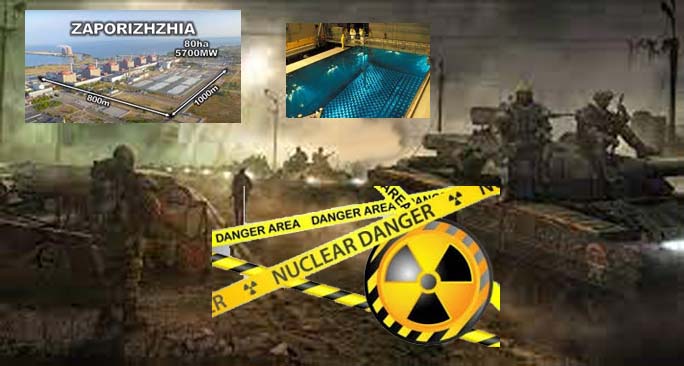
By now, we all ought to be familiar with the worrisome Zaporizhzhia nuclear complex (ZNPP), which sits right in the middle of the Russian incursion into Ukraine. Assembled between 1980 and 1986, Zaporizhzhia is Europe’s largest nuclear-power complex, with six 950-megawatt reactors.
……………………. In September 2022, due to ongoing shelling in the area, Zaporizhzhia was taken offline and, after losing external power on several occasions, has since been sporadically relying on old diesel backup generators. (Once disconnected from the electrical grid, backup power is crucial to ensure the plant’s reactors don’t overheat, which could lead to a full-blown radioactive meltdown.)
However, relying on risk-prone backup power is a fool’s game, according to electrical engineer Josh Karpoff. A member of Science for the People who previously worked for the New York State Office of General Services where he designed electrical systems for buildings, including large standby generators, Karpoff knows how these things work in a real-world setting. He assures me that, although Zaporizhzhia is no longer getting much attention in the general rush of Ukraine news, the possibility of a major disaster there is ever more real. A backup generator, he explains, is about as reliable as a ’75 Winnebago.
“It’s really not that hard to knock out these kinds of diesel generators,” Karpoff adds. “If your standby generator starts up but says there’s a leak in a high-pressure oil line fitting, it sprays heated, aerosolized oil all over the hot motor, starting a fire. This happens to diesel motors all the time. A similar diesel engine fire in a locomotive was partly responsible for causing the Lac Megantic Rail Disaster in Quebec back in 2013.”
Sadly enough, Karpoff is on target. Just remember how the backup generators failed at the three nuclear reactors in Fukushima, Japan, in 2011. Many people believe that the 9.0 magnitude underwater earthquake caused them to melt down, but that’s not exactly the case.
It was, in fact, a horrific chain of worsening events. While the earthquake itself didn’t damage Fukushima’s reactors, it cut the facility off from the power grid, automatically switching the plant to backup generators. So even though the fission reaction had stopped, heat was still being produced by the radioactive material inside the reactor cores. A continual water supply, relying on backup power, was needed to keep those cores from melting down. Then, 30 minutes after that huge quake, a tsunami struck, knocking out the plant’s seawater pumps, which subsequently caused the generators to go down.
“The myth of the tsunami is that the tsunami destroyed the [generators] and had that not happened, everything would have been fine,” former nuclear engineer Arnie Gunderson told Amy Goodman on Democracy Now! “What really happened is that the tsunami destroyed the [sea] pumps right along the ocean… Without that water, the [diesel generators] will overheat, and without that water, it’s impossible to cool a nuclear core.”
With the sea pumps out of commission, 12 of the plant’s 13 generators ended up failing. Unable to cool, the reactors began to melt, leading to three hydrogen explosions that released radioactive material, carried disastrously across the region and out to sea by prevailing winds, where much of it will continue to float around and accumulate for decades.
At Zaporizhzhia, there are several scenarios that could lead to a similar failure of the standby generators. They could be directly shelled and catch fire or clog up or just run out of fuel. It’s a dicey situation, as the ongoing war edges Ukraine and the surrounding countries toward the brink of a catastrophic nuclear crisis.
“I don’t know for how long we are going to be lucky in avoiding a nuclear accident,” said Rafael Grossi, director general of the IAEA in late January, calling it a “bizarre situation: a Ukrainian facility in Russian-controlled territory, managed by Russians, but operated by Ukrainians.”
Bad Things Will Follow
Unfortunately, it’s not just Zaporizhzhia we have to worry about. Though not much attention has been given to them, there are, in fact,14 other nuclear power plants in the war zone and Russia has also seized the ruined Chernobyl plant, where there is still significant hot radioactive waste that must be kept cool.
Kate Brown, author of Plutopia, told Science for the People last April:
“Russians are apparently using these two captured nuclear installations like kings on a chessboard. They hold Chernobyl and the Zaporizhzhia nuclear power reactor plants, and they are stockpiling weapons and soldiers there as safe havens. This is a new military tactic we haven’t seen before, where you use the vulnerability of these installations, as a defensive tactic. The Russians apparently figured that the Ukrainians wouldn’t shoot. The Russians noticed that when they came to the Chernobyl zone, the Ukrainian guard of the Chernobyl plant stood down because they didn’t want missiles fired at these vulnerable installations. There are twenty thousand spent nuclear fuel rods, more than half of them in basins at that plant. It’s a precarious situation. This is a new scenario for us.”
Of course, the hazards facing Zaporizhzhia and Chernobyl would be mitigated if Putin removed his forces tomorrow, but there’s little possibility of that happening. It’s worth noting as well that Ukraine is not the only place where, in the future, such a scenario could play out. Taiwan, at the center of a potential military conflict between the U.S. and China, has several nuclear power plants. Iran operates a nuclear facility. Pakistan has six reactors at two different sites. Saudi Arabia is building a new facility. The list only goes on and on.
Even more regrettably, Russia has raised the nuclear stakes in a new way, setting a distressing precedent with its illegal occupation of Zaporizhzhia and Chernobyl, turning them into tools of war. No other power-generating source operating in a war zone, even the worst of the fossil-fuel users, poses such a potentially serious and immediate threat to life as we know it on this planet.
And while hitting those Ukrainian reactors themselves is one recipe for utter disaster, there are other potentially horrific “peaceful” nuclear possibilities as well. What about a deliberate attack on nuclear-waste facilities or those unstable backup generators? You wouldn’t even have to strike the reactors directly to cause a disaster. Simply take out the power-grid supply lines, hit the generators, and terrible things will follow. With nuclear power, even the purportedly “peaceful” type, the potential for catastrophe is obvious.
The Greatest of Evils
In my new book Atomic Days: The Untold Story of the Most Toxic Place in America, I probe the horrors of the Hanford site in Washington state, one of the locations chosen to develop the first nuclear weapons for the covert Manhattan Project during World War II. For more than 40 years, that facility churned out most of the plutonium used in the vast American arsenal of atomic weapons.
Now, however, Hanford is a radioactive wasteland, as well as the largest and most expensive environmental clean-up project in history. To say that it’s a boondoggle would be an understatement. Hanford has 177 underground tanks loaded with 56 million gallons of steaming radioactive gunk. Two of those tanks are currently leaking, their waste making its way toward groundwater supplies that could eventually reach the Columbia River. High-level whistleblowers I interviewed who worked at Hanford told me they feared that a hydrogen build-up in one of those tanks, if ignited, could lead to a Chernobyl-like event here in the United States, resulting in a tragedy unlike anything this country has ever experienced.
All of this makes me fear that those old Hanford tanks could someday be possible targets for an attack. Sabotage or a missile strike on them could cause a major release of radioactive material from coast to coast. The economy would crash. Major cities would become unlivable. And there’s precedent for this: in 1957, a massive explosion occurred at Mayak, Hanford’s Cold War sister facility in the then-Soviet Union that manufactured plutonium for nukes. Largely unknown, it was the second biggest peacetime radioactive disaster ever, only “bested” by the Chernobyl accident. In Mayak’s case, a faulty cooling system gave out and the waste in one of the facility’s tanks overheated, causing a radioactive blast equivalent to the force of 70 tons of TNT, contaminating 20,000 square miles. Countless people died and whole villages were forever vacated.
All of this is to say that nuclear waste, whether on a battlefield or not, is an inherently nasty business. Nuclear facilities around the world, containing less waste than the underground silos at Hanford, have already shown us their vulnerabilities. Last August, in fact, the Russians reported that containers housing spent fuel waste at Zaporizhzhia were shelled by Ukrainian forces. “One of the guided shells hit the ground ten meters from them (containers with nuclear waste…). Others fell down slightly further — 50 and 200 meters,” alleged Vladimir Rogov, a Russian-appointed official there. “As the storage area is open, a shell or a rocket may unseal containers and kilograms, or even hundreds of kilograms of nuclear waste will be emitted into the environment and contaminate it. To put it simply, it will be a ‘dirty bomb.’”
Ukraine, in turn, blamed Russia for the strike, but regardless of which side was at fault, after Chernobyl (which some researchers believe affected upwards of 1.8 million people) both the Ukrainians and the Russians understand the grave risks of atomically-charged explosions. This is undoubtedly why the Russians are apparently constructing protective coverings over Zaporizhzhia’s waste storage tanks. An incident at the plant releasing radioactive particles would damage not just Ukraine but Russia, too.
Read the Public Inquiry Report, the Commissioners’ report, Surrendering Australia: The AUKUS Deception is available to download for free at aukuspublicinquiry.com. Or just watch the replay of the National Press Club Luncheon.
19 November – Webinar – The Reality of Reprocessing
Time: 11:00 AM Pacific Time (US & Canada) / 2:00 PM Eastern / 7:00 PM UK / 8:00 PM CET