A coming wider war with Crimea in US sights

How is it that this evil woman, Nuland, is allowed to drive the US towards nuclear war with Russia?
There are two key signals of a possible US-NATO change in strategy that are perceptible if we understand that NATO, at least so far, does what the US says it needs to do.
New deliveries of special types of long-range ammunition to Kiev are the first signal. The second is the publicized switch by
Under Secretary of State for Political Affairs Victoria Nuland to favoring a refocus on retaking Crimea in a new Ukrainian offensive.
US-NATO response to fall of Bakhmut is likely an assault on Crimea, which in turn will spark Russian attacks on Eastern Europe
by Stephen Bryen March 4, 2023 https://asiatimes.com/2023/03/a-coming-wider-war-with-crimea-in-us-sights/
Ukrainian forces are pulling out of Bakhmut and the battle for the small Donetsk city is nearly finished. So what happens next?
There appear to be two stages to the Bakhmut pullout. The first started perhaps a month ago, though that isn’t certain. The troops pulled out comprised foreign fighters and Yellow Armband troops.
The Russians say they have not seen any foreign fighters for about a month. Most of these were said to be from Georgia and Abkhazia. (Abkhazia is the area in Georgia carved out by the Russians and declared an independent entity.)
The Yellow Armband troops are professional and well-trained Ukrainian “heavy” military units. They have mostly been used on the flanks protecting the city of Bakhmut, trying to stop the Russian encirclement.
Within the city are so-called Green Armband troops. They are not well trained and are mostly recent conscripts. Mainly they carry small arms, which they fire from buildings and other covered positions. Many of them are underage or, alternatively, overage.
According to Yevgeny Prighozin, head of the Wagner Group paramilitary organization, the Green Armbands are starting to leave the city, having already pulled out from most of the eastern parts. Reports say they are either using a country road or walking across farm fields.
As it now stands, the end of the battle is at most a few days away, although the Ukrainians have launched a counteroffensive to the west and south of a town called Ivanivske. The operation may be meant to hold off a wider encirclement of Ukrainian forces that the Russians appear to have launched.
The Yellow Armband Ukrainian forces trying to relieve Ivanivske are deploying a number of infantry fighting vehicles, but so far few if any tanks. Whether Ukraine’s army can actually hold off a wider Russian operation remains to be seen.
But the Ukrainians are low on soldiers and ammunition, so it isn’t clear they can sustain a hard hit if that’s what the Russians intend to launch.
Up next: Crimea
The US and NATO likely see the handwriting on the wall if the Ukrainians continue to try and hold territory in the Donbas region.
While the US thinks that Russia failed to succeed in its original objectives in the Donbas and in forcing a governmental change in Kiev, the long-term picture looks troublesome as the Russians have not only improved their tactics but also appear willing to pay the price and grind down Ukraine’s army.
Likewise, it is by now clear that it will take more than a few years in the US and Europe to rebuild ammunition and equipment stocks, while the Russians seem to have put their defense manufacturing on a full-time, day-and-night basis to bring supplies to the front.
There are two key signals of a possible US-NATO change in strategy that are perceptible if we understand that NATO, at least so far, does what the US says it needs to do.
New deliveries of special types of long-range ammunition to Kiev are the first signal. The second is the publicized switch by Under Secretary of State for Political Affairs Victoria Nuland to favoring a refocus on retaking Crimea in a new Ukrainian offensive.
“[W]e will support Ukraine for as long as it takes. Ukraine is fighting for the return of all of its land within its international borders. We are supporting them, including in preparing a next hard push to regain their territory…Crimea must be—at a minimum, at a minimum—demilitarized.”US Under Secretary of State for Political Affairs Victoria Nuland
Nuland’s view is not supported fully by the State Department or the Pentagon, largely because of concern Russia may choose to attack Western supply lines in retaliation, leading to a broader war in Eastern Europe, starting with Poland and Romania.
Both Poland and Romania, one should recall, are historical Russian stomping grounds. Joseph Stalin decided to support the Ribbentrop-Molotov pact in August 1939 because the Soviet leader saw it as giving him part of Poland and Romania’s oil fields.
There is a famous story that circulated during the Cold War about a Polish soldier facing an invasion by Russian tanks on one axis and German tanks on the other. Standing there with one antitank weapon, what should he choose? Deciding to fire on the Russian tanks, the Polish soldier supposedly says, “Business before pleasure.”
Fast forward to the present, US Secretary of State Antony Blinken is known to worry about a wider conflict but may well have lost out to Nuland, a major proponent of the Ukraine war who wants at a minimum regime change in Moscow.
The evidence that Nuland has won the argument starts with the fact Biden has announced a new long-range weapons program for Ukraine and is also sending mobile bridging equipment that could help the Ukrainian army attack Russian forces in a Crimea offensive.
Such an operation itself would start with long-range glide bombs – joint direct attack munitions (JADAM), HIMARS with long-range, ground-launched, small-diameter bombs (GLDSB) and artillery strikes. It would then develop into a land offensive against Crimea.
The operational problem is that this scenario would require fighter planes that can fly to high altitudes of around 30,000 feet before launching JDAMS, kits that fit on “iron” bombs to give them GPS guidance. But a bomb glides to its target, so to achieve standoff range high-flying aircraft are required.
This would require Ukraine to use its MIG-29s, but it has few of the fighters left. Thus the latest arms deliveries may include, in some form or another, Western aircraft probably flown by NATO pilots.
This would amount to a direct declaration of war, as both Blinken (who is against it) and Nuland (who is for it) understand. To launch such an offensive, for example as soon as this May, there’s no alternative to using Western aircraft.
There is bipartisan Congressional support for F-16s for Ukraine, although that support is for Ukrainians to fly them, which is unlikely in the next three months.
The Nuland threat to Crimea appears more and more to be a foregone conclusion: a US policy with existential implications for Europe and perhaps also for America.
The issue was decided by the new arms shipments (two separate announcements as late as March 3 US time). While no published decision has been made and Biden has been silent, the equipment being sent could only be intended for Nuland’s offensive on Crimea.
If there were a public announcement of a decision supporting Nuland, Blinken would likely have a heart attack – but the US is sending long-range bombs and artillery as well as bridging equipment essential to attack Crimea. If such an attack is not envisioned, the Ukrainians don’t need this kit.
Meanwhile, there seems to be very little coherent US opposition to the unfolding scenario of what could quickly become a general war in Europe.
Stephen Bryen is a senior fellow at the Center for Security Policy and the Yorktown Institute. Follow him on Twitter at @stevebryen
Is nuclear power in a global death spiral?

Jim Green 3 March 2023 https://reneweconomy.com.au/is-nuclear-power-in-a-global-death-spiral/?fbclid=IwAR0wIw8QIyQA0qxkgFa0Sa_WVmAYGlnKG3_4zdJOqoj4UvbmM
Last year was the same for nuclear power as almost every other for the past 30 years: a small number of reactor start-ups and a small number of closures. There were seven reactor start-ups worldwide in 2022 and five permanent reactor closures, a net gain of 4.2 gigawatts (GW) of electricity generating capacity.
The fleet of mostly young reactors 30 years ago is now a fleet of mostly ageing reactors. Due to the ageing of the reactor fleet, the International Atomic Energy Agency (IAEA) anticipates the closure of 10 reactors (10 GW) per year from 2018 to 2050.
Over the past decade (2013-22), there were on average 6.5 reactor construction starts annually — that’s a recipe for slow decline.
That said, there were 20 construction starts over the past two years, suggesting the possibility of a further period of stagnation.
Slight growth is also a possibility, if and only if China’s nuclear program accelerates. The 2022 World Nuclear Industry Status Report notes that from 2002-2021, there were 50 reactor start-ups in China and no closures while in the rest of the world there was a net loss of 57 reactors.
China’s nuclear program is modest — an average of 2.5 reactor start-ups per year from 2002-2021. But the pace has picked up with 11 construction starts over the past two years. China’s nuclear program has picked up pace and then lost steam twice over the past 15 years, so only time will tell if the latest acceleration persists.
In addition to sparing the nuclear industry from a global death spiral, China has shown the world how to grow the nuclear industry: with inadequate nuclear safety and security standards, inadequate regulation, media repression, whistleblower repression, the worst insurance and liability arrangements in the world, and rampant corruption.
Even in the most optimistic scenario for the nuclear industry, its share of global electricity generation will continue to fall. Nuclear power’s contribution to global electricity generation has fallen 46 percent from a peak of 17.5 percent in 1996 to 9.4 percent now.
The Golden Rule of nuclear economics
The growth of nuclear power in China contrasts with the stunning failure of reactor construction projects in the US, the UK and France.
In the US, the only reactor construction project is the Vogtle project in Georgia (two AP1000 reactors). The latest cost estimate of US$34 billion (A$50.6 billion) is more than double the estimate when construction began (US$14-15.5 billion). Costs continue to increase and the project only survives because of multi-billion-dollar taxpayer bailouts.
The V.C. Summer project in South Carolina (two AP1000 reactors) was abandoned in 2017 after the expenditure of around US$9 billion (A$13.4 billion).
In 2006, Westinghouse said it could build an AP1000 reactor for as little as US$1.4 billion (A$2.0 billion) — 12 times lower than the current estimate for Vogtle.
In the late 2000s, the estimated construction cost for one EPR reactor in the UK was £2 billion (A$3.6 billion). The current cost estimate for two EPR reactors under construction at Hinkley Point — the only reactor construction project in the UK — is £32.7 billion (A$58.6 billion). Thus the current cost estimate is over eight times greater than the initial estimate of £2 billion per reactor.
The only current reactor construction project in France is one EPR reactor under construction at Flamanville. The current cost estimate of €19.1 billion (A$30.1 billion) is nearly six times greater than the original estimate of €3.3 billion (A$5.2 billion). (Lower figures cited by EDF and others typically exclude finance costs.)
So the cost of reactors in the US, the UK and France stands at A$25 billion, A$29 billion and A$30 billion per reactor, respectively.
The ballooning cost estimates have increased 12-fold, 8-fold and 6-fold. Thus we can posit the Golden Rule of Nuclear Economics: add a zero to industry estimates and your estimate will be far closer to the mark than theirs.
‘Turbocharged’ renewables growth
Nuclear power’s stagnation contrasts sharply with the growth of renewables. Renewable expansion of about 320 GW last year was 76 times greater than nuclear growth of 4.2 GW. The same pattern was evident in 2021: nuclear capacity fell by 0.4 GW while renewable capacity growth amounted to 314 GW including 257 GW of non-hydro renewables.
Renewables (including hydro) accounted for 29.1 percent of worldwide electricity generation in 2022 according to the Electricity Market Report 2023 report by the International Energy Agency (IEA — not to be confused with the IAEA), more than three times nuclear’s share of 9.4 percent.
Nuclear has been overtaken by non-hydro renewables and has fallen below 10 percent for the first time in decades.
The growth of renewables is being turbocharged as countries seek to strengthen energy security, the IEA said in December when releasing its Renewables 2022 report.
The IEA projects that in 2025, renewable electricity generation will account for 34.6 percent of total global generation and renewables will have overtaken coal and gas.
The IEA projects that in 2027, renewable electricity generation will have grown to 38 percent of total global generation with declining shares from 2022-27 for all other sources: coal, gas, nuclear and oil. Wind and solar PV are projected to more than double to account for almost 20 percent of global power generation in 2027.
The IEA projects that China will install almost half of new global renewable power capacity from 2022–2027, with growth accelerating despite the phaseout of wind and solar PV subsidies. In China in 2021, wind (656 terrawatt-hours — TWh), solar (327 TWh) and hydro (1300 TWh) combined generated six times more electricity than nuclear (383 TWh).
The IEA projects that China, the US and India will all double their renewable generating capacity from 2022-27, accounting for two-thirds of global growth. Renewable generating capacity in Australia is expected increase by 85 percent.
IEA Executive Director Fatih Birol said in December 2022 that renewables were already expanding quickly, but the global energy crisis has kicked them into “an extraordinary new phase of even faster growth as countries seek to capitalise on their energy security benefits.
“The world is set to add as much renewable power in the next 5 years as it did in the previous 20 years,” Birol said.
“This is a clear example of how the current energy crisis can be a historic turning point towards a cleaner and more secure energy system. Renewables’ continued acceleration is critical to help keep the door open to limiting global warming to 1.5 °C.”
Nuclear risks in Ukraine
Meanwhile, there is an ongoing risk of a nuclear catastrophe in Ukraine. The IAEA (not to be confused with the IEA) has released a report noting that several of Ukraine’s five nuclear power plants and other facilities have come under direct shelling over the past year.
The IAEA report states:
“Every single one of the IAEA’s crucial seven indispensable pillars for ensuring nuclear safety and security in an armed conflict has been compromised, including the physical integrity of nuclear facilities; the operation of safety and security systems; the working conditions of staff; supply chains, communication channels, radiation monitoring and emergency arrangements; and the crucial off-site power supply.”
Loss of off-site power, and thus reliance on diesel generators to power reactor cooling, dramatically increases the risk of nuclear fuel meltdown and significantly increases the risk of a nuclear disaster.
The IAEA report further states:
“Shelling, air attacks, reduced staffing levels, difficult working conditions, frequent losses of off-site power, disruption to the supply chain and the unavailability of spare parts, as well as deviations from planned activities and normal operations, have impacted each nuclear facility and many activities involving radioactive sources in Ukraine.
“The reliability of the national power infrastructure necessary for the safe and secure operation of the nuclear facilities has also been affected and, for the first time since the start of the armed conflict, all [nuclear power plant] sites, including the [Chernobyl] site, simultaneously suffered a loss of off-site power on 23 November 2022.”
In addition to the horrors that a nuclear catastrophe would inflict on Ukrainians, it would surely result in a global death spiral for nuclear power
Dr Jim Green is the national nuclear campaigner with Friends of the Earth Australia and lead author of a detailed submission to a current Senate inquiry into nuclear power.
Rolls-Royce Small Modular Reactor project running out of cash

3 March 2023 https://www.neimagazine.com/news/newsrolls-royce-smr-faces-financial-problems-10648145
UK-based Rolls-Royce SMR says its £500m ($600m) small modular reactor (SMR) programme will run out of cash by the end of 2024, Reuters has reported. Alastair Evans, Government & Corporate Affairs Director at Rolls-Royce SMR noted: “We aren’t asking the government to make an order (for the nuclear units) today but we need to start negotiations on a deployment plan by the middle of this year. We are facing a cliff edge, by December 2024 the money will have run out.” This would put at risk UK government plans to use SMRs to boost energy security and achieve climate targets.
The 470 MWe Rolls-Royce SMR design is based on a small pressurised water reactor. The design was accepted for Generic Design Assessment review in March 2022 and Rolls-Royce SMR expects to receive UK regulatory approval by mid-2024. A Rolls-Royce-led UK SMR consortium aims to build 16 SMRs. The consortium – which includes Assystem, Atkins, BAM Nuttall, Jacobs, Laing O’Rourke, National Nuclear Laboratory, the Nuclear Advanced Manufacturing Research Centre and TWI – expects to complete its first unit in the early 2030s and build up to 10 by 2035.
Rolls-Royce’s SMR development business received a commitment of £210m from the UK government in 2021 but talks on how the projects would be funded are yet to start. Rolls-Royce’s new CEO Tufan Erginbilgic said recently that there was a sense of urgency in its engagement with government. “We built a capable team (and) without any project, sustaining that team will be a big challenge,” he told reporters after the group published full-year results. He noted that it was vital to move quickly, given that rival companies were developing similar technology.
“It is important that we engage therefore with the UK government urgently, and for a project that we can deploy as soon as possible,” he said. Rolls Royce and shareholders in the SMR business – advisory firm BNF Resources Ltd, US Energy company Constellation and Qatar Investment Authority have invested a total of around £280m.
This and the government money have been used to build the business, which employs some 600 staff across Derby, Warrington and Manchester. The funds have enabled it to start the regulatory process to approve the reactor design and identify sites for plants and factories. In November 2022, Rolls-Royce identified four sites with the potential to deploy multiple SMR units: Trawsfynydd (requiring agreement with Nuclear Decommissioning Authority (NDA) – and the Welsh Government); Sellafield (NDA land availability to be confirmed); Wylfa-South (requiring agreement with Horizon Nuclear Power); and Oldbury-North (also requiring agreement with Horizon Nuclear Power).
Rolls-Royce hopes to build the reactors in UK factories. In July 2022, the company announced six potential locations for the factory, shortlisted from more than 100 submissions from local enterprise partnerships and development agencies. They were: Sunderland in Tyne and Wear, Richmond in North Yorkshire, Deeside in Wales, Ferrybridge in Yorkshire, Stallingborough in Lincolnshire and Carlisle in Cumbria. David White, newly appointed Chief Operating Officer of Rolls-Royce SMR, said another two locations – Shotton in Deeside (Wales) and Teesworks in Redcar (North East) – had been added to the list.
Little progress seen in removing fuel debris at Fukushima plant
By RYO SASAKI/ Staff Writer, https://www.asahi.com/ajw/articles/14854929, March 6, 2023
Tokyo Electric Power Co. has little to show in removing fuel debris at its Fukushima No. 1 nuclear power plant in the 12 years since the nuclear disaster started.
The company, in fact, has postponed the work.
An estimated 880 tons of fuel debris remain in the No. 1, 2 and 3 nuclear reactors at the plant.
Remote-control operations must be used to remove the fuel debris because radiation levels in the reactor buildings could kill a person within one hour.
TEPCO had initially planned to start removing fuel debris at the No. 2 reactor, where the level of radiation is comparatively low, by the end of 2022.
However, the company announced in August 2022 that it had abandoned this target, citing delays in developing a robotic arm that could be used to remove the debris.
The company set a new target to start the removal work in the second half of fiscal 2023.
The government and TEPCO aim to complete the decommissioning of the stricken plant between 2041 and 2051.
However, the company’s first goal is to test the retrieval of only several grams of fuel debris. It still hasn’t decided how it will conduct larger-scale removal.
TEPCO has also not explained when it will start removing fuel debris at the No. 1 and No. 3 reactors.
A “submergence method” is under consideration to remove fuel debris from the No. 3 nuclear reactor, but it’s still unclear whether it will be implemented.
With the submergence method, workers would cover the building that houses the No. 3 reactor with a metal structure, fill the inside of the structure with water to submerge the reactor, and then remove fuel debris from the upper part of the building.
Another worrying factor about the Fukushima nuclear power plant is that the foundation, or “pedestal,” supporting the No. 1 reactor’s pressure vessel has deteriorated so much that the reinforcing bars are now exposed.
Concerns have been expressed about the earthquake resistance of the pedestal.
Evacuation plans still missing around 6 nuclear power plants

THE ASAHI SHIMBUN, March 6, 2023 https://www.asahi.com/ajw/articles/14854836
Six of 15 locations with nuclear power plants, excluding those in Fukushima Prefecture, have not compiled sufficient emergency plans, including wide-area evacuations, in the event of a serious accident.
Prime Minister Fumio Kishida has pushed a policy to “return to nuclear power,” but disaster prevention challenges remained unresolved, and local people have expressed concerns.
The emergency plans were deemed necessary after the March 2011 nuclear disaster at Tokyo Electric Power Co.’s Fukushima No.1 nuclear power plant.
Niigata Prefecture hosts TEPCO’s Kashiwazaki-Kariwa nuclear plant, one of the largest in the world.
On Feb. 7, disaster prevention officials of municipal governments in the prefecture held an annual meeting online in Niigata with staff of TEPCO and members of the Cabinet Office in charge of nuclear emergency preparations.
One theme at the meeting was whether people could safely flee if a severe accident were to occur at the plant on a day with heavy snow.
“For our residents, heavy snow is a threat much closer than terrorism, and it could cause tremendous anxiety and risk,” said a Nagaoka city government official, urging the prefectural government to examine evacuation plans in heavy snow.
Municipal governments within a radius of 30 kilometers of a nuclear power plant are required to draw up evacuation plans for severe nuclear accidents and discuss emergency procedures with the central government.
These plans are then supposed to receive approval at a nuclear emergency preparedness meeting chaired by the prime minister.
But there are no such plans in place in the Kashiwazaki-Kariwa area, where 437,000 people live.
Local officials said they are stumped over how to plan an evacuation in heavy snow.
On Dec. 18, snow started falling in the city of Kashiwazaki, where the nuclear power plant is located.
The Hokuriku Expressway that runs through the city was closed for up to 52 hours. National road No. 8, which runs parallel to the expressway, was shut down for 38 hours, and stranded vehicles formed a 22-km line in the snow.
The Kashiwazaki city government estimates that about 60,000 of the 79,000 or so residents would evacuate westward in the event of a nuclear power plant accident.
Any evacuation plan in the city would be severely hampered if the Hokuriku Expressway and national road No. 8 were unusable.
On Feb. 10, the Cabinet approved Kishida’s green transformation policy, marking a dramatic shift in the government’s post-3/11 stance on nuclear power.
The new policy allows the construction of new nuclear reactors and extending the maximum life of existing units beyond 60 years.
Operations of 10 reactors have already resumed.
Seven other reactors, including the No. 6 and No. 7 reactors at the Kashiwazaki-Kariwa plant, are scheduled to restart in or after this summer.
Kishida said the central government “will be out in front and take any and every step” to push the policy, an unprecedented remark for a prime minister concerning nuclear energy.
TEPCO is seeking to resume operations of the No. 7 reactor at Kashiwazaki-Kariwa plant in October.
The Nuclear Regulation Authority has issued a de facto ban on operations of the No. 7 reactor because of the utility’s blunders related to anti-terrorism measures, but the ban may be lifted in spring.
Once the ban is lifted, the remaining conditions for the reactor restart will be obtaining consent from local people and setting up a wide-area evacuation plan.
As of Feb. 11, TEPCO had held explanatory meetings on its reactor resumption plans to local residents at five locations in the prefecture.
A total of 71 people asked questions during the process.
A woman who made the last comment to TEPCO at the meetings said, “If you can’t protect people who can’t evacuate because of heavy snow, I don’t want you to resume the operation.”
Masaya Kitta, who heads TEPCO’s Niigata headquarters, replied: “An evacuation plan is not something we make. It may appear that we are leaving it to someone else, but we, as a plant operator, are doing our best to increase the evacuation plan’s effectiveness as much as possible.”
Of the seven reactors that the Kishida administration plans to restart in or after this summer, two are located in plants lacking local government evacuation plans: the Kashiwazaki-Kariwa plant and Japan Atomic Power Co.’s Tokai No. 2 nuclear power plant in Tokai, Ibaraki Prefecture.
In August 2022, Ibaraki Governor Kazuhiko Oigawa said the Tokai No. 2 plant “is located in an extremely densely populated area,” and the prefectural government “has been in an extremely difficult situation and faced enormous problems in making an effective and sensible evacuation plan.”
Around 940,000 residents live within 30 km of the Tokai No. 2 plant and would be subject to an evacuation in a nuclear disaster. That is the largest such figure in Japan.
Disaster prevention officials have had difficulties securing routes and transportation means for many people to evacuate all at once.
In a wide-area evacuation plan designed by the Ibaraki prefectural government, residents are supposed to leave in their own cars.
The prefecture will ask bus companies for cooperation to evacuate senior residents and disabled people.
The prefectural government estimates that more than 400 buses will be needed for the task, and it does not know how it can secure that many buses.
One guiding principle of the nuclear emergency preparedness was created in response to the 2011 Fukushima disaster.
Until then, the areas required to have an evacuation plan in place were located within 8 to 10 km of nuclear plants.
But the Fukushima accident showed how radioactive materials could spread to wider areas.
The central government expanded the radius to 30 km and required municipal governments within the areas to compile evacuation plans.
The central government also set up a group to discuss nuclear-related disaster-prevention measures in normal times.
But more than 10 years have passed since then. And many of the populated areas still do not have evacuation plans.
(This article was written by Yasuo Tomatsu and Shiki Iwasawa.)
‘David and Goliath’ – legal case, as indigenous group fights the Australian government to stop a nuclear waste dump on their traditional land

Stephanie Richards, 6 March 23, https://indaily.com.au/news/2023/03/06/david-and-goliath-kimba-nuke-waste-fight-heads-to-federal-court/?utm_medium=email&utm_campaign=InDaily%20Lunchtime%20%206%20March%202023&utm_content=InDaily%20Lunchtime%20%206%20March%202023+CID_654499187b614fa7e1f09bd8ceb7100e&utm_source=EDM&utm_term=READ%20MORE
Barngarla Traditional Owners’ fight to stop a nuclear waste facility being built near Kimba on South Australia’s Eyre Peninsula has reached the Federal Court, with the first substantive case hearing in Adelaide today.
They were supporting the Barngarla Determination Aboriginal Corporation, which has applied for judicial review in an attempt to thwart construction of the federal government’s planned radioactive waste storage facility at Napandee near Kimba.
“We’re fighting against injustices that have been happening to the Barngarla people regarding this waste dump in Kimba,” Barngarla Traditional Owner Harry Dare told InDaily outside court.
“We’re actually fighting for a seven sisters and women’s dreaming site and we’re fighting for a vote in our local governance.
“The Australian Government has given back our Native Title, but they haven’t given us a voice in those Native Title areas, so we’re fighting for equality and for all of Australia to be nuclear free.”
The Napandee site was selected by the former Morrison Government, with then Resources Minister Keith Pitt saying the government had secured “majority support” from the local community after more than “six years of consultation”.
But Barngarla Traditional Owners opposed the project and argued they were not included in the consultation.
During today’s hearing, the Federal Court was told of how the decision to locate the dump at Napandee, near Kimba, played out.
After beginning the process to select the site through its administrative powers, the then Coalition Government changed tack and decided to legislate, partly to avoid delays through legal challenges.
However, when the legislation failed in the Senate, the government restarted the administrative process.
Counsel for the Barngarla told Justice Natalie Charlesworth that raised questions over whether Pitt, who ultimately named the Napandee location and who strongly supported the legislative approach, could properly carry out his administrative role.
“That, of itself, would excite a reasonable apprehension that the minister might be unable or unwilling to approach the matter with an open mind,” he said.
“Because, effectively, the decision had already been made.”
The court was also told that the Barngarla disagreed with the former government’s view that the dump had wide community support in Kimba and would also argue the decision on the dump was unreasonable given the lack of proper consultation with the Indigenous owners.
Given Pitt’s correspondence with the Barngarla people and his other statements, the impression that might arise was that consultation would largely amount to “matters around the edges”.
“In terms of identifying culture and the like in the implementation of the site, which had already been selected and to which the minister was committed,” counsel said.
With the case listed for several days, the federal government is expected to argue that much of the material to be relied on by the applicants is subject to parliamentary privilege.
The Barngarla launched their action in 2021 after being denied the right to participate in a community ballot to gauge local support for the Napandee site because many did not live in the Kimba council area.
The community ballot returned about 61 per cent in favour of the dump.
But when the Barngala conducted their own ballot among their community members, 83 voted no and none voted yes.
They argue they were denied the right to participate in a community ballot to gauge local support for the site, because many did not live in the Kimber council area.
Traditional Owner Linda Dare told protestors ahead of this morning’s hearing that the proposed location for the nuclear waste facility was near an important women’s site for the Barngarla people.
“It just seems to be that every time the government wants to put something it’s always around a women’s site,” she said.
“We need to fight as women around Australia to protect our sites.
“We need to say ‘no’ because it’s going to affect the waterways, not just in South Australia but everywhere.”
InDaily reported in September that the federal government was spending three times more than Barngarla Traditional Owners fighting the project in the Federal Court.
Information released to SA Greens Senator Barbara Pocock showed that between December and July, the government had spent $343,457.44 on legal fees.
That compares to the approximate $124,000 spent by the Barngarla Determination Aboriginal Corporation over the same period.
The Native Title group estimates that the total cost incurred by the federal government would run into the millions.
Barngarla Determination Aboriginal Corporation chairperson Jason Bilney told InDaily the judicial review was a “David and Goliath battle”.
“But, we’re dedicated. It took us 21 years to win our Native Title, come out of Native Title six months later and we’re fighting a nuclear waste dump on our country,” he said.
“What does that tell you about truth telling, the Statement From The Heart or the Voice?
“Our Voice isn’t being heard, truth telling isn’t being told and they’re going to break the First Nations’ heart – Barngarla – and put it (the nuclear waste dump) on our country.”
Bilney said Traditional Owners expected the Federal Court would take months to reach a decision, with hearings scheduled each day this week.
“It could take a year, but we would like it to have it sooner than later,” he said.
It comes after the Barngarla Native Title group last month won a separate Supreme Court bid to overturn former Premier Steven Marshall’s decision to allow a mineral exploration company to drill at Lake Torrens in the state’s outback.
At the time, Bilney said the group was buoyed by the win as they continued their legal fight to stop the Napandee nuclear waste facility from going ahead.
South Australian Labor has long called for Barngarla people to have the right to veto the project, with Premier Peter Malinauskas previously saying that the state government had expressed its views to the federal government.
UN nuclear chief says Iran pledges more access for inspectors
Iran makes sweeping pledges of cooperation after the head of the UN atomic agency meets top Iranian officials in Tehran.
Iran has agreed to reconnect cameras and other monitoring equipment at its nuclear sites and increase the pace of inspections, according to the head of the United Nations atomic agency.
Rafael Grossi made the announcement on Saturday after meeting Iranian President Ebrahim Raisi and other top officials in Tehran
His visit followed the discovery of uranium particles enriched to near weapons-grade level at an underground Iranian facility and came just two days before a quarterly meeting of the International Atomic Energy Agency’s (IAEA) 35-nation board of governors.
“Over the past few months, there was a reduction in some of the monitoring activities” related to cameras and other equipment “which were not operating,” Grossi told reporters upon his return to Vienna, Austria, where the agency has its headquarters.
“We have agreed that those will be operating again.”………………………………..
The statement gave little additional detail, but the possibility of a marked improvement in relations between the two is likely to stave off a Western push for another resolution ordering Iran to cooperate, the Reuters news agency cited diplomats as saying.
A confidential IAEA report to member states seen by Reuters said Grossi “looks forward to … prompt and full implementation of the Joint Statement”. https://www.aljazeera.com/news/2023/3/4/iran-makes-sweeping-pledge-of-cooperation-to-iaea
—
G7 should declare ‘no first use’ of nuclear weapons: ex-Hiroshima mayor
Mar. 5 Japan Today, LONDON
The Group of Seven industrialized nations should declare a nuclear weapon “no first use” policy during a summit in May in Hiroshima, the former mayor of the atomic-bombed Japanese city said in a speech on Saturday in London.
Japan, as host of the summit, can lead efforts to pressure Russian President Vladimir Putin to not use nuclear weapons in his war on Ukraine, but G7 members should “aim higher,” said Tadatoshi Akiba during a ceremony where he received a peace award from a British Islamic group.
“The G7 Hiroshima declaration should be the starting point for the universal ‘no first use’ of nuclear weapons,” the 80-year-old added.
Japanese Prime Minister Fumio Kishida, a lawmaker representing a constituency in Hiroshima, has vowed to pitch his vision of a world without nuclear weapons at the summit, which will be joined by leaders from other G7 members — Britain, Canada, France, Germany, Italy and the United States, plus the European Union.
However, Japan remains in a policy dilemma when it calls for the abolition of nuclear weapons while at the same time relying on U.S. weapons for protection.
Akiba, who served as Hiroshima mayor for 12 years through 2011, slammed as “a fantasy” the belief that “the possession of and threat of use of nuclear weapons guarantee that no nuclear powers will use such weapons.”
Holding up a graphic photo of a young victim in Nagasaki, the second Japanese city to suffer a U.S. atomic bombing in 1945, Akiba said the boy was “thrown into a living hell.”……………………………………. more https://japantoday.com/category/politics/g-7-should-vow-no-first-use-of-nukes-at-hiroshima-summit-ex-mayor
Scholz vows to ‘permanently’ increase Germany’s military output: CNN
By Al Mayadeen English , Source: CNN, 5 Mar 23
This comes a day after the Chancellor met with US President Joe Biden and discussed Germany’s contribution to aiding Ukraine and how to respond to its current military needs.
Despite talks of de-industrialization in Germany’s economy and the excruciating energy crisis which has swept Europe, German Chancellor Olaf Scholz told CNN on Sunday that Germany plans to boost its military build-up ‘permanently’ to meet Ukraine’s demands, including the production of tanks and air defense systems.
“The build-up of defense production in Germany will be permanent,” he told CNN host Fareed Zakaria, noting that Berlin requires an uninterrupted supply of basic hardware that is in service with the German armed forces, as well as maintenance capabilities and ammunition supply.
This comes a day after the Chancellor met with US President Joe Biden and discussed Germany’s contribution to aiding Ukraine and how to respond to its current military needs.
There were no talks of the possible US’ role in sabotaging the Nord Stream II pipeline during their meeting. …………. https://english.almayadeen.net/news/politics/scholz-vows-to-permanently-increase-germanys-military-output
Belgian nuclear regulator tells govt not to extend oldest reactors
By America Hernandez and Charlotte Campenhout, BRUSSELS, March 6 (Reuters) – Belgium’s nuclear regulator has advised the government against a life extension of the country’s three oldest reactors, despite the risk of a gap in electricity supply over the next two winters.
Instead, it proposed adjusting the life extension plans of two newer reactors so that safety upgrades are staggered, keeping the power on during the coming crunch period.
The proposal was in a written opinion submitted to the government by the regulator and seen by Reuters on Monday. The document has not been made public yet but the regulator, FANC, confirmed its authenticity to Reuters………………………………. https://www.reuters.com/business/energy/belgian-nuclear-regulator-tells-govt-not-extend-oldest-reactors-2023-03-06/—
EU rewrites climate diplomacy deal to resolve nuclear sticking point

By Kate Abnett, BRUSSELS, March 6 (Reuters) – European Union countries intend to push for a global phasing out of fossil fuels among their climate diplomacy priorities this year, which the bloc hopes to approve this week after rewriting a contentious section on nuclear energy………………………………………………………………
Diplomats from EU countries will attempt to finalise the text on Wednesday, which ministers must then approve formally.
DELAYS
The approval has been delayed, however, by disputes over the role of nuclear energy in the green transition.
Specifically, countries could not agree on whether EU diplomacy should promote low-carbon hydrogen – meaning hydrogen produced from nuclear electricity – or focus on hydrogen produced from renewable energy.
The issue has split EU member nations. France and other countries want more EU policies to promote the low-carbon energy source while Germany and Spain warn that this could hamper efforts to drive massive expansion in renewable energy.
The latest draft did not specify which type of hydrogen the EU would promote……………
The nuclear issues have already disrupted negotiations on EU renewable energy targets and some diplomats fear it could delay other laws needed to meet climate goals. https://www.reuters.com/business/environment/eu-rewrites-climate-diplomacy-deal-resolve-nuclear-sticking-point-2023-03-06/
Fukushima Anniversary Vigil Outside UK’s Nuclear Fuel Manufacturing Plant Near Preston — RADIATION FREE LAKELAND

Image: Surround Springfields 2019 Fukushima Anniversary Vigil Outside UK’s Nuclear Fuel Manufacturing Plant Near Preston 12th Anniversary Campaigners plan to mark the 12th anniversary of the Fukushima disaster outside the Springfields Nuclear Fuel Manufacturing Plant, Station Road, Lea Town, Preston, PR4 0XJ, starting at 1pm on Saturday 11th March 2023. Vigil Japanese Against Nuclear UK […]
Fukushima Anniversary Vigil Outside UK’s Nuclear Fuel Manufacturing Plant Near Preston — RADIATION FREE LAKELAND
Preparing for war with Russia: Texas air base has trained over 8,000 NATO pilots — Anti-bellum
Defense NewsMarch 6, 2023 Preparing for Russia: Inside NATO fighter pilot training in Texas SHEPPARD AIR FORCE BASE, Texas – More than 5,000 miles from NATO’s eastern flank, a new generation of allied fighter pilots is coming of age in North Texas. After decades of peace at home, American and European airmen here face a […]
Preparing for war with Russia: Texas air base has trained over 8,000 NATO pilots — Anti-bellum
Traditional owners fight to stop South Australian nuclear waste dump
Peth Now, Tim Dornin, AAP, March 6, 2023
Issues with the decision-making process and questions over consultation have been raised by traditional owners in their court bid to block the federal government’s plans for a nuclear waste dump on South Australia’s Eyre Peninsula.
The case for a judicial review brought by the Barngarla people opened on Monday, with the Federal Court in Adelaide told of how the decision to locate the dump at Napandee, near Kimba, played out.
After beginning the process to select the site through its administrative powers, the then coalition government changed tack and decided to legislate, partly to avoid delays through legal challenges.
However, when the legislation failed in the Senate, the government restarted the administrative process.
Counsel for the Barngarla told Justice Natalie Charlesworth that raised questions over whether former resources minister Keith Pitt, who ultimately named the Napandee location and who strongly supported the legislative approach, could properly carry out his administrative role.
“That, of itself, would excite a reasonable apprehension that the minister might be unable or unwilling to approach the matter with an open mind,” he said.
“Because, effectively, the decision had already been made.”
The court was also told that the Barngarla disagreed with the former government’s view that the dump had wide community support in Kimba and would also argue the decision on the dump was unreasonable given the lack of proper consultation with the Indigenous owners.
Given minister Pitt’s correspondence with the Barngarla people and his other statements, the impression that might arise was that consultation would largely amount to “matters around the edges”.
“In terms of identifying culture and the like in the implementation of the site, which had already been selected and to which the minister was committed,” counsel said.
With the case listed for several days, the federal government is expected to argue that much of the material to be relied on by the applicants is subject to parliamentary privilege.
Before Monday’s hearing began, members of the Barngarla community and their supporters gathered outside the court, vowing to continue the fight no matter the result of the court proceedings.
“If it goes against the government, they are going to appeal it. If it goes against us, we are going to appeal it,” Elder Harold Dare said.
“We are going to appeal it as long and as hard as we can.
“It’s not just about the Barngarla, it’s about all of Australia and ultimately the world.
“We’re fighting for the protection of a sacred Aboriginal women’s site. It’s about the respect we are showing to our women’s sites.”
“We’re fighting for the protection of a sacred Aboriginal women’s site. It’s about the respect we are showing to our women’s sites.”
The Barngarla launched their action in 2021 after being denied the right to participate in a community ballot to gauge local support for the Napandee site because many did not live in the Kimba council area.
The community ballot returned about 61 per cent in favour of the dump.
But when the Barngala conducted their own ballot among their community members, 83 voted no and none voted yes……. more https://www.perthnow.com.au/news/crime/traditional-owners-fight-to-stop-sa-nuclear-waste-dump-c-9947910
Many Fukushima mayors reluctant to take stand on nuke energy shift
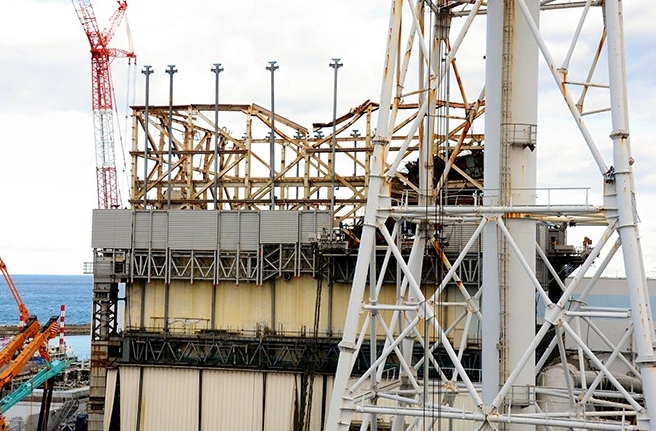
The crippled No. 1 reactor at the Fukushima No. 1 nuclear power plant
March 4, 2023
Several mayors of the three prefectures hardest hit by the 2011 Great East Japan Earthquake and tsunami showed a reluctance to voice an opinion about the government’s return to a reliance on nuclear power.
The recent Asahi Shimbun poll showed the sensitivity of the issue particularly in areas that still have not completely recovered from the twin disasters.
In December, the government made a dramatic shift in nuclear energy policy that would allow for construction of new reactors and the extension of the operating life of those already built.
The Asahi Shimbun polled mayors of 37 municipalities along the Pacific coast in Iwate, Miyagi and Fukushima prefectures along with five others in Fukushima where evacuation orders were issued following the triple meltdown at the Fukushima No. 1 nuclear power plant.
In addition, mayors of three municipalities lying within a 30-kilometer radius of the Onagawa plant in Miyagi Prefecture were also asked their views.
Of the 45 mayors, 19 were somewhat or totally opposed to a reversion to nuclear energy, while 14 were somewhat or totally in favor.
But the mayors of six municipalities that either host the Fukushima No. 1 plant or are in close proximity to the plant did not take a clear stand on any of the questions in the survey.
When the mayors were contacted individually, many said with so many residents still living as evacuees away from their municipalities, expressing a clear opinion on nuclear energy would only further divide those with differing views.
One mayor had in the past voiced clear stands on the central government’s reconstruction policy, but that led to letters sent to the municipal government criticizing those comments.
“I always feel internal turmoil about whether criticism directed at me and the municipal government will also not be turned on the evacuees” who live in various parts of Japan, the mayor said.
Another mayor said, “I do not want residents to feel troubled by my comments about the central government’s nuclear energy policy.”
With part of the municipality still designated a “difficult-to-return zone” and the population and infrastructure nowhere close to the levels before the disasters, the mayor said, “Now is the time to put every effort into reconstruction.”
The mayor said taking a clear stand on nuclear energy issues might create division among local residents.
Toshiyuki Kanai, a professor of local public administration at the University of Tokyo, said it was understandable why the mayors were reluctant to take a clear stand because municipalities had to seek the cooperation of the central government for their reconstruction efforts.
“It is important that effects on local governments in such policy areas as reconstruction do not arise because of their opposition to nuclear energy policy,” Kanai said.
Eight Fukushima mayors did say they were either somewhat or totally opposed to returning to a reliance on nuclear energy.
The only Fukushima mayor who was somewhat in favor of nuclear energy was Ikuo Yamamoto of Tomioka.
But in response to questions from The Asahi Shimbun, Yamamoto recalled the difficulties he faced with discussions about a final storage site for low-level radioactive waste from the Fukushima nuclear accident.
“In my heart, I am opposed,” he said.
But Yamamoto added that in general terms he understood that nuclear energy was effective in preventing global warming and was also instrumental at a time when fuel prices for thermal power generation were surging.
The mayors were also asked if they thought the Kishida administration had done an adequate job of explaining to the public why a move back toward nuclear energy was needed.
Thirty-one mayors said they felt either somewhat or totally negative about the government’s efforts. Even nine mayors who favored reverting back to nuclear energy felt the Kishida administration had done a poor job of explaining the reason for doing so.
(This article was written by Wataru Netsu, Shoko Rikimaru, Keitaro Fukuchi and Takemichi Nishibori.)
1 This Month

Read the Public Inquiry Report, the Commissioners’ report, Surrendering Australia: The AUKUS Deception is available to download for free at aukuspublicinquiry.com. Or just watch the replay of the National Press Club Luncheon.



19 November – Webinar – The Reality of Reprocessing
Time: 11:00 AM Pacific Time (US & Canada) / 2:00 PM Eastern / 7:00 PM UK / 8:00 PM CET
Register for the Zoom Event Here



Shut down the radiation-damaged Heysham nuclear reactors now
To see nuclear-related stories in greater depth and intensity – go to https://nuclearinformation.wordpress.com

Say No to NASA’s Reckless Nuclear Reactor on the Moon
Say No to NASA’s Reckless Nuclear Reactor on the Moon
-
Archives
- November 2026 (109)
- October 2026 (302)
- September 2026 (339)
- August 2026 (330)
- July 2026 (355)
- June 2026 (287)
- May 2026 (306)
- April 2026 (356)
- March 2026 (251)
- February 2026 (267)
- January 2026 (308)
- December 2025 (358)
-
Categories
- 1
- 1 NUCLEAR ISSUES
- business and costs
- climate change
- culture and arts
- ENERGY
- environment
- health
- history
- indigenous issues
- Legal
- marketing of nuclear
- media
- opposition to nuclear
- PERSONAL STORIES
- politics
- politics international
- Religion and ethics
- safety
- secrets,lies and civil liberties
- spinbuster
- technology
- Uranium
- wastes
- weapons and war
- Women
- 2 WORLD
- ACTION
- AFRICA
- Atrocities
- AUSTRALIA
- Christina's notes
- Christina's themes
- culture and arts
- Events
- Fuk 2022
- Fuk 2023
- Fukushima 2017
- Fukushima 2018
- fukushima 2019
- Fukushima 2020
- Fukushima 2021
- general
- global warming
- Humour (God we need it)
- Nuclear
- RARE EARTHS
- Reference
- resources – print
- Resources -audiovicual
- Weekly Newsletter
- World
- World Nuclear
- YouTube
-
RSS
Entries RSS
Comments RSS

