Google signs up for electricity from Finnish nuclear power plant
Tech giant Google has signed a long-term power purchase agreement with
Finland’s Fortum covering up to 50% of the Loviisa nuclear power plant’s
capacity and providing financial certainty for power uprates and lifetime
extensions until 2050.
World Nuclear News 9th Sept 2026 https://www.world-nuclear-news.org/articles/google-signs-up-for-electricity-from-finnish-nuclear-power-plant
US to NATO: Keep buying US weapons for lost Ukraine war…it gooses our economy- Walt Zlotow

But not one weapon will be supplied by the US. They must all be purchased by NATO countries struggling with their declining economies due in large part by squandering tens of billion of Euros on Ukaine sinking deeping into failed state status.
Walt Zlotow West Suburban Peace Coalition Glen Ellyn IL, Sep 9, 2026,
If there was a Nobel Prize for the most most cynical foreign posicy among the world’s 193 countries, the US would win weapons down.
Under Secretary of War Elbridge Colby just told European NATO countries to keep buying US weapos to keep Ukraine being destroyed in their lost war with Riussia.
“The situation makes it all the more important for Europe to sustain support for Ukraine while also accelerating its own rearmament and reindustrialization. First, Europe must continue — and where necessary increase — support for Ukraine’s immediate battlefield requirements through Prioritized Ukraine Requirements List (PURL). The continued flow of munitions and critical capabilities is effective; it remains essential to enabling Ukrainian forces to hold the front line and deny further Russian advances. Second, Europe must plan now for sustained procurement that supports both Ukraine’s long-term force reconstitution and Europe’s own defense requirements.” Colby omitted that NATO weapons purchases fit neatly into US economic policy.
But not one weapon will be supplied by the US. They must all be purchased by NATO countries struggling with their declining economies due in large part by squandering tens of billion of Euros on Ukaine sinking deeping into failed state status. The fact Ukraine has suffered over over two million causualties and lost a fifth of their land forever means nothing to Colby and his bosses War Secretary Pete Hegseth and President Trump. All they care about is how those billions in weapons sales will help salvage the declining US economy from Trump and Hegseth’s failed Iran war debacle ahead of the approaching November 3 midterms.
Trump has been lusting for a Nobel Peace Prize since hie took office in January 2017. He’s been tirelessly promoting his candidacy claiming he’s ended 8 wars when he’s ended none while waging war on Iran, Venezuela, Yemen, Somalia, Nigeria and any small boat in the Caribbean he claims is carrying drugs.
Yep, the Nobel Committee should consider awarding a Nobel Cynical Foreign Policy Prize. Donald Trump, on behalf of the United States would be selected unanimously.
Israeli war minister orders army to prepare for ‘all-out war’ on Palestinian Authority
Monday, 07 September 2026 , https://www.presstv.co.uk/Detail/2026/09/07/775858/Israeli-military-ordered-to-prepare-for–all-out-war–on-Palestinian-Authority
Israeli minister of military affairs Israel Katz says he and prime minister Benjamin Netanyahu have ordered the occupation army to prepare for an “all-out war” in the occupied West Bank.
Katz said on Monday that the offensive would be launched if Israel determines that Palestinian Authority (PA) security forces or groups affiliated with them are planning an attack similar to Operation Al-Aqsa Flood – the operation carried out by Gaza-based resistance groups on October 7, 2023.
Under the proposed plan, Israel would target senior PA officials, the Palestinian Authority’s security apparatus, and resistance infrastructure across the territory.
The assault could include targeted killings and the forced evacuation of residents from cities and villages in the occupied West Bank, “just as we did” in Gaza and southern Lebanon, where the Israeli military has flattened large areas and driven people from their homes.
“If the security apparatuses of the Palestinian Authority and the bodies associated with them launch, or we know for certain that they are about to launch, an October 7-style attack against forces and Jewish settlements, Prime Minister Benjamin Netanyahu and I instructed the army to prepare to launch an all-out war against senior officials and mechanisms of the [Palestinian] Authority, the bodies associated with them, and against all infrastructure in Judea and Samaria [the occupied West Bank] — in order to quickly bring about their complete defeat,” Katz threatened.
“We will not allow for a return to a reality of a continued intifada spanning years, as was the case in the past,” the Israeli war minister added.
The threat followed an incident on Monday morning in which a Palestinian reportedly stabbed an Israeli settler, about 20 years old, at a farming outpost in the occupied West Bank. Israeli troops later shot the Palestinian man dead after claiming he tried to stab them during a manhunt.
Hebrew-language media reported that the settler was stabbed at the Maoz Yehuda settlement farm near the village of Usarin in the northern West Bank and was wounded in the chest, back, and shoulders.
Hamas condemns surge in settler violence
The Gaza-based Hamas resistance movement condemned the sharp rise in settler attacks on Palestinians in the occupied West Bank, assaults carried out with the protection and backing of Israeli occupation forces.
“This is part of a systematic policy that targets our people and homeland, and intends to materialize annexation, forced displacement, and ethnic cleansing in the territory. This necessitates serious and effective action at all levels to put an end to such crimes, and hold the perpetrators to account,” Hamas said in a statement.
Hamas stressed that the blood of fallen resistance fighters will never be in vain, and that rising settler violence will not break the will of Palestinians or drive them from their ancestral land.
“Rather, it will strengthen their commitment to their rights. It will consolidate their resolve in the face of the occupying regime’s settlement and displacement plans,” the statement said.
Hamas called on Palestinians from all walks of life in the West Bank to confront Israeli military and settler attacks, protect their lands and properties, block plans for displacement, settlement expansion, and annexation, and defend their homeland and national rights.
About 750,000 Israeli settlers live in 156 illegal settlements and 360 settlement outposts in the occupied West Bank, including East al-Quds. They routinely carry out attacks aimed at forcibly displacing Palestinians, according to Palestinian figures.
The international community regards these settlements as illegal under international law and the Geneva Conventions because they are built on occupied land. The UN Security Council has condemned Israel’s settlement activity in several resolutions.
In July 2024, the International Court of Justice declared Israel’s decades-long occupation of historical Palestine illegal and demanded the evacuation of all existing settlements in the West Bank and East al-Quds. Those rulings, like so many before them, have remained mere words.
Sodium cooled nuclear reactors are not necessarily safer

While no sodium-cooled reactors currently operate in the United States, the U.S. Department of Energy (DOE) is working with industry on a number of “advanced” reactor designs, including the Sodium-Cooled Fast Reactor (SFR). One of the SFR’s safety advantages, to quote the DOE, is that the design provides a “Long grace period for corrective action, if needed.” SRE’s meltdown transpired over a two-week period. Fermi Unit 1 had indications of inadequate core cooling in June that were repeated in August and dismissed until extensive damage occurred in October 1966. The “if needed” grace period is never long enough when warning sign after warning sign is dismissed or ignored.
DOE did acknowledge some “challenges” for the SFR: their higher speed and higher energy neutrons can embrittle and degrade nearby materials, liquid sodium coolant reactors with air and water and degrades concrete, and the opaqueness of the liquid sodium coolant complicates in-service inspections and maintenance.
Thank goodness for the “Long grace period for corrective actions, if needed.” That and the fact that SFRs only operate in cyberspace where the primary threat is carpal tunnel syndrome

 Nuclear Plant Accidents: Fermi Unit 1, Union of Concerned Scientists Dave Lochbaum, director, Nuclear Safety Project | July 12, 2016, Disaster by Design
Jorge Agustin Nicolás Ruiz de Santayana y Borrás, also known as George Santayana, wrote that “Those who cannot remember the past are condemned to repeat it.” Continue reading
UK datacentres will create just 25% of jobs predicted by tech sector, analysis finds
Facilities likely to employ 10,400 workers, compared with 40,000 in industry estimates, thinktank says
Datacentres in the UK will
create just a quarter of the jobs predicted by the tech sector, while
consuming vast amounts of energy, according to new research. Environmental
thinktank Verdant predicts that all the datacentres currently planned are
likely to directly employ 10,400 workers – compared with the more than
40,000 cited in projections by the industry lobby group TechUK. Labour has
defended the rapid rollout of AI datacentres in the face of growing public
scepticism, amid concerns about their demand for water and energy. The
government has also echoed TechUK’s claims about job creation.
Verdant’s analysis is based on 20 projects for which data on staffing
levels are publicly available, including via planning applications, company
accounts and press releases – as well as international comparisons.
Guardian 9th Sept 2026, https://www.theguardian.com/uk-news/2026/sep/09/uk-datacentres-will-create-just-25-of-jobs-predicted-by-tech-sector-analysis-finds
Inside Assad’s nuclear secrets
Al Majalla chose Bashar al‑Assad’s nuclear programme as this week’s
cover story following reports issued by the International Atomic Energy
Agency in early September, which revealed that the project was much more
extensive than previously believed. This investigation traces the hidden
history of the former Syrian president’s nuclear ambitions, while shedding
light on the roles played by North Korea and Iran, the depth of Israel’s
penetration into the most guarded leadership circles, the destruction of
the al‑Kibar reactor in 2007, and the 2008 assassination of Brigadier
General Mohammed Suleiman—one of the senior officials entrusted with
Syria’s most sensitive strategic weapons programmes.
Al Majalla 10th Sept 2026, https://en.majalla.com/node/332964/politics/inside-assad%E2%80%99s-nuclear-secrets
Hinkley Point C seeking appeal against environmental data transparency tribunal ruling

08 Sep, 2026 By Tom Pashby, https://www.newcivilengineer.com/latest/hinkley-point-c-seeking-appeal-against-environmental-data-transparency-tribunal-ruling-08-09-2026/
EDF’s Hinkley Point C has told NCE it has requested permission to appeal against a tribunal ruling in favour of an argument from campaigners which would subject the nuclear power station to environmental information transparency rules.
The Upper Tribunal (Administrative Appeals Chamber) decided on 26 June, following a hearing on 29 April, that NNB Generation Co (HPC) Ltd is a public authority according to the Environmental Information Regulations 2004 (EIRs).
NNB Generation Company (NNB GenCo) is the company that owns Hinkley Point C. EDF is the majority owner of the company, with China General Nuclear Power Group (CGN) as a minority owner.
The EIRs are operated in a similar but different way to the Freedom of Information Act.
The Information Commissioner’s Office (ICO) had decided that NNB GenCo was subject to the EIRs after it made a ruling on behalf of environmental group Fish Legal, which was seeking environmental information about the nuclear power plant.
It announced its position in a decision notice published on 5 September 2024.
The ICO’s decision notice followed a complaint from Fish Legal, which represents anglers and has been repeatedly denied information from the developers of the nuclear power station about its methods of deterring fish from the site.
Hinkley Point C will require vast volumes of water to cool its nuclear reactors. Tunnels for water intake and outfall will circulate 120,000l of water per second. There are concerns this will lead to marine life being sucked into the system and killed.
NNB GenCo had a legal obligation to use an acoustic fish deterrent, based on its approved development consent order, but changed its plans to building a saltmarsh instead. It has now switched back to a plan for an acoustic fish deterrent, having discovered a new “safe and effective” method for implementing it.
Despite this, Fish Legal is continuing to support the ICO position because it covers matters broader than just the fish deterrent at Hinkley Point C – it believes that foreign-owned private companies building and operating nuclear power plants in the UK must comply with domestic environmental information laws and therefore provide details on environmental plans when asked.
A Hinkley Point C spokesperson told NCE: “We have now sought permission to appeal against the tribunal’s decision.
“Hinkley Point C has already made extensive amounts of environmental information available to the public and it will continue to keep stakeholders fully informed about the project.”
Reacting to Hinkley Point C’s decision to seek an appeal, Fish Legal head of policy and strategy Zoe Wedderburn-Day told NCE: “We are aware that NNB Generation Company, the EDF subsidiary responsible for Hinkley Point C, has sought permission to appeal the Upper Tribunal’s decision and we will be watching developments closely.
“The Upper Tribunal judgment was an important decision for environmental transparency, confirming that a privately owned company entrusted with significant public functions and statutory powers can be subject to the Environmental Information Regulations.
“We will consider the implications of any further proceedings once the appeal position becomes clearer.”
An ICO spokesperson told NCE that the ICO noted the judgment but didn’t make any further comment.
Reacting to NNB Gen Co’s request for an appeal, Nuclear Industry Association chief executive Tom Greatrex told NCE: “The single biggest driver of biodiversity loss and habitat destruction is climate change.
“By delaying the deployment of nuclear power, which has the lowest carbon emissions, land use, and overall impact on ecosystems of any electricity source across its lifecycle, we are accelerating that damage and prolonging our reliance on higher-carbon energy sources.”
He added: “To reduce cost and accelerate delivery, we must ensure proportionate regulation.
“To achieve this, the government must fully implement the Nuclear Regulatory Review recommendations to strengthen the UK’s energy security with clean power and enable new nuclear projects to progress at pace while maintaining high environmental standards.”
Gates-backed TerraPower targets British nuclear power plant start by 2034
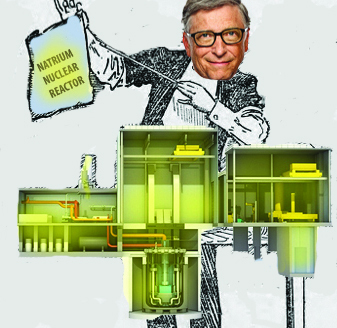
Sodium cooled nuclear reactors are not necessarily safer. https://blog.ucs.org/dlochbaum/nuclear-plant-accidents-fermi-unit-1/
By Susanna Twidale, September 7, 2026, https://www.reuters.com/business/energy/gates-backed-terrapower-targets-british-nuclear-power-plant-start-by-2034-2026-09-07/
- Summary
- Companies
- Britain would be TerraPower’s first market outside United States
- First UK plant could be operational by 2034
- Electricity cost expected under £100 per megawatt hour
ONDON, Sept 7 (Reuters) – TerraPower, the U.S. nuclear developer backed by Bill Gates, expects its Natrium reactors to begin generating electricity in Britain by 2034, its CEO told Reuters, making the UK its first market outside the United States.
Britain has backed the development of small modular reactors (SMRs) to help to increase energy security and meet climate targets, launching an Advanced Nuclear Framework this year to support privately funded projects.
Chris Levesque, TerraPower’s president and CEO, said progress on the company’s first Natrium reactor, due to be completed in 2031, showed that “2034 nuclear electricity in the UK from Natrium is very possible”.
The technology has cleared regulatory requirements in the United States, where the first plant is being constructed in Wyoming and is currently being assessed under Britain’s Generic Design Assessment (GDA) process.
Each sodium-cooled Natrium reactor generates 345 megawatts of baseload power and includes storage capable of boosting output to 500 MW for more than five hours. The reactors run on high-assay, low-enriched uranium (HALEU).
Britain and the U.S. are both building plants to produce the fuel, which was previously only commercially available from Russia.
Levesque said electricity generated by Natrium plants would be competitive with other low-carbon technologies, including combined solar-and-battery projects, at less than £100 ($135.32) per megawatt hour.
TerraPower has yet to choose a site for its first UK project, but said its British subsidiary is likely to be based in Liverpool, northwest England, close to the country’s nuclear regulator.
In the U.S., the company has an agreement with tech giant Meta (META.O), opens new tab to develop up to eight reactors. Levesque said TerraPower could seek similar partnerships in Britain.
New nuclear alliance is formed between three major countries
Japan, South Korea and the US have signed a new agreement to boost small modular reactor cooperationNew nuclear alliance is formed between three major countries
The USA, Japan and South Korea are ramping up nuclear expansion by signing a trilateral SMR cooperation agreement, giving countries an alternative to Chinese and Russian reactor vendors.
All over the world, countries are reinvigorating the demand for nuclear power – whether it be from growing use of AI and the need for nuclear powered data centres, fossil fuel supply disruption due to conflicts and wars, or other causes…………….
Energy Live News 9th Sept 2026, https://www.energylivenews.com/2026/09/09/new-nuclear-alliance-is-formed-between-three-major-countries/
China v. US: The Great Mideast AI Race Heats Up

Officials, activists and academics have warned that while economically Middle Eastern states may benefit from the race between the US and China to offer them investment and technology, this will likely come at an environmental cost.
September 8, 2026, Neil Thompson, https://www.juancole.com/2026/09/china-great-mideast.html
London– Last week, China’s President Xi Jinping made his first state visit to Egypt since 2016, amid deepening economic and security ties between Beijing and one of Washington’s major Arab allies. Egypt’s government said the two sides agreed to launch the third phase of a cooperative industrial zone in the Suez Canal, as Cario seeks to diversify its major foreign policy relations beyond just the US. The latter still supplies Egypt with $1.3 billion in military aid each year but faces growing geopolitical competition from China.
In a statement clearly designed to appeal to Egyptian audiences, where the Suez Canal is a major economic engine, Xi said that China “stands ready to work with countries in the region to safeguard the security of international shipping lanes, advance development cooperation … and eliminate the breeding grounds for conflict.” Instability in the Red Sea since 2023 and the US-Iran conflict since February have caused maritime traffic through the canal to drop sharply, though the major Maersk and Hapag-Lloyd shipping lines signalled last month that they were planning a phased return. hottest year on record in 2024, and that heatwaves there are becoming longer and more intense.
It is also during these months that the region’s new AI infrastructure needs the most water and energy to cool its server farms, too. Even without higher temperatures, the average data centre has the equivalent water demand of around 1,000 households per day, while a large one uses around 5 million gallons a day, the same as a town of up to 50,000 residents. Gulf countries like the UAE are engaged in massive construction of more desalination plants to meet this expected AI-related upsurge in water (and power) demand as a result. UAE regulators have denied the increase in water demand will cause them problems, with the head of regulatory affairs at Abu Dhabi’s Department of Energy saying in April: “We rely on desalination [plants] that have proven in the last 50 years to be a very reliable source for potable water.”
Conclusion
Middle Eastern countries outside the GCC will face similar problems with rising temperatures driving household power and water demand just as AI-related demand also increases. AI infrastructure projects may outpace regional water and power development without careful planning. In May, Egypt said it planned to meet future AI data centre power demand there using renewable energy. It is investing significantly in wind farms and other projects, including expanding regional interconnections with other countries’ power grids in Saudi Arabia, Europe and Sudan. However, these projects are vulnerable to timetable slippages from obstacles like construction sector supply chain disruption or port congestion at Egyptian terminals. With a growing population seeking jobs, Egypt’s government seems likely to press ahead regardless.
China’s expertise in both AI and green technology could likely help ease many Middle Eastern countries’ attempted transition to a digitalised and clean-energy powered economic future. But geopolitical competition with the US will add a political and diplomatic dimension to any projects with Chinese participation. The US is still a major security partner for many Middle Eastern governments, and Washington could threaten to withdraw military aid in response to a growing dependence on Chinese AI systems in allied regional governments or economies. The US fears Egypt allowing Chinese AI systems in its public sector would create cybersecurity risks for its agents and companies there. US fear of China could impede Middle Eastern states’ uptake of Chinese AI infrastructure and models, but also their uptake of Beijing’s greener gifts.
China Dangles Growth, Security Partnership
Beijing has also made Egypt’s government another offer of economic and technological development through state-linked firm Huawei. Egypt has ambitious plans to expand AI’s contribution to its economy to 7.7% of GDP by 2030, offering China an opening to challenge the US lead on global AI infrastructure by starting with a small project in the Middle East. Huawei bid on an Egyptian government tender in August to build public sector AI data centers there, in partnership with iFlytek, a Chinese surveillance company. Both Chinese companies are on a US blacklist, and Washington has approached US firms including Nvidia, AMD and Microsoft to put together a counterbid. Egypt has yet to announce a decision, but the move signals an intensifying race between Beijing and Washington to recruit more regional states into their respective AI stacks.
China’s Middle Eastern AI Footprint Expands Elsewhere
China and the US have each launched their own multinational AI alliances; in China’s case, this is the World AI Cooperation Organisation (WAICO), while the US set up the Pax Silica in December. Both groups contain a few Middle Eastern states so far, with Iran, Algeria and Oman joining WAICO, and Israel, Qatar, and the UAE have joined the Pax Silica. However, Chinese companies have launched AI-related projects in multiple Middle Eastern countries prior to WAICO’s launch, and Beijing’s AI-infrastructure footprint is likely to extend well outside the alliance’s formal Middle Eastern members. Middle Eastern firms are increasingly willing to use Chinese technology to launch their own AI models indigenous to the region, too.
In October, Chinese firm Alibaba opened a sector data centre in Dubai. In January, the UAE’s Emirate of Sharjah signed an agreement with Chinese AI infrastructure and cloud computing services provider DataCanvas to examine establishing data centers there. Finally, in September Saudi technology firm Humain released an Arabic-language AI model based on a Chinese one created by Chinese AI firm MiniMax. Chen Jing, a vice president of China’s Technology and Strategy Research Institute, told state media there that: “Unlike in the past, when Chinese LLMs primarily entered overseas markets through APIs or application products, in this collaboration, MiniMax M3 has directly become the foundational model for overseas indigenous model development.” Humain is financed by Riyad’s Saudi Public Investment Fund, indicating Saudi state backing for the firm’s project, despite Saudi Arabia not being a member of WAICO.
AI Growth, Environmental Cost?
Officials, activists and academics have warned that while economically Middle Eastern states may benefit from the race between the US and China to offer them investment and technology, this will likely come at an environmental cost. In April, the Qatar-based Middle East Council on Global Affairs research centre published a report warning that water and power demand for AI data centres presented a significant ecological challenge to Gulf Cooperation Council (GCC) states. GCC members already struggle to meet power and water demand during the summer months, when temperatures traditionally soar. This issue is getting worse. In December, the World Meteorological Organization issued its first report on the state of the climate in Arab states. It warned that these states had their
Key UK Nuclear Deterrent Link Destroyed Over Yorkshire.
Britain’s sole emergency communications link for sending nuclear
retaliation orders to Trident missile submarines has been destroyed in a
spectacular disaster unwittingly observed by hundreds of Yorkshire
residents and passers-by.
During a trial on Friday, the system was seen and
filmed breaking up over Topcliffe, north of York, in clear view of
travellers on the nearby A1 motorway. The emergency system, called Low
Frequency Fall Back or LFFB and codenamed SUNFLOWER, used a “blimp”
style tethered balloon or aerostat (illustrated) to lift a 1,500 metre long
radio antenna.
Byline Times 8th Sept 2026,
https://bylinetimes.com/2026/09/08/key-uk-nuclear-deterrent-link-destroyed-over-yorkshire/
They Can’t Stop the War. They Can’t Survive It.
So European leaders have deployed – to use an Ursula von der Leyen saying – all means possible. Except that those means were never enough to meet Ukraine’s needs.
‘if I give the promise to the people in Ukraine, “we stand with you, as long as you need us,” then I want to deliver. No matter what my German voters think.’
Europe has also closed off access to a consumer market of 143 million people in Russia – Europe was Russia’s biggest trade partner before the Ukraine crisis began – because we can’t stand to trade with those Russians.
The AfD win in Germany and Reform’s landslide in Britain show why Europe’s liberal governments are trapped — continue Ukraine and they lose the voters; end it and they lose them anyway.
Ian Proud, The Peace Monger, Sep 08, 2026
The victory of AfD in a local election in Germany was as consequential as the Reform Party’s landslide in local elections in Britain in May.
Why? Because a nationalist party won. This is another sign that liberalism is dying in Europe. What does this mean for the politics of Europe and for the war in Ukraine?
Politics in Europe Is Changing – The Ukraine War Is Driving a Shift Away from Liberalism
I have said for some time that the changing politics of Europe will ultimately decide the outcome of the war in Ukraine. Foreign policy always starts and ends at home.
And what I mean by that is, even if our governments support a proxy war in Ukraine, they are limited by essentially domestic considerations in how much support they can give.
European states have shown themselves unwilling to commit to direct war with Russia principally because they can’t guarantee they will garner political support at home, not least given the large number of casualties that would result.
Liberalism is predicated on a stable capitalist system, and a direct war would have devastating consequences for the economies of Europe.
Liberal European governments can’t give Ukraine as much money and equipment as they would prefer, as they are heavily indebted and don’t have the fiscal space to do this at a time when ordinary people feel that public services are being ignored.
So European leaders have deployed – to use an Ursula von der Leyen saying – all means possible. Except that those means were never enough to meet Ukraine’s needs.
Ukraine will lose the war against Russia because European leaders decided they could not bear the financial, human and political cost of direct war. That they encouraged war to continue for so long reflects the essential liberalism of Europe, that Ukraine was a prized project in the bid to create another liberal democracy on the periphery of Europe as a counterpoint to nationalist Russia. And that helps to explain why ordinary, often working-class, citizens are turning against liberalism.
Put simply, even though European governments have avoided a direct war with Russia, they haven’t been able to shield their citizens from the consequences of proxy war, nor deliver the strategic defeat that they promised, and this leaves ordinary people poorer, uncertain about their future employment prospects, worried about their children and feeling less safe.
It would be impossible for them not to make a connection with the war in Ukraine because that is the topic their leaders seem to talk about most when travelling abroad to grand summit meetings that never seem to resolve the world’s problems.
Indeed, Annalena Baerbock, while foreign minister, said in 2022, ‘if I give the promise to the people in Ukraine, “we stand with you, as long as you need us,” then I want to deliver. No matter what my German voters think.’
She was roundly criticised by parties like AfD at the time who were accused of a disinformation campaign. But her words were on the record. And the message that sent to ordinary Germans was that the Federal government cares about Ukrainian people more than you, which was a politically suicidal thing to say.
In this day of high-speed media, ordinary people can see what is going on.
Even though national priorities have placed some limited guardrails on liberal foreign policy hegemony, specifically the temptation to get sucked into a general war across Europe – that foreign policy consensus has nonetheless still funded a dreadful war in Ukraine for four-and-a-half years which is held aloft as more important than domestic concerns despite the severe consequences for ordinary German people.
Ordinary people are not stupid and can make the connection between their condition of life and the need to keep funnelling money and weapons into a war that shows no end in sight, which their leaders refuse to bring to a close.
In terms of the feeling of being poorer and less secure about the future, Europe has chosen economic warfare instead of actual warfare, and this has backfired. In the process, sanctions have rendered European industry uncompetitive through the closing off of cheap sources of energy. Europe has also closed off access to a consumer market of 143 million people in Russia – Europe was Russia’s biggest trade partner before the Ukraine crisis began – because we can’t stand to trade with those Russians.
German unemployment is now at its highest level in well over a decade. Germany was Russia’s biggest trading partner before the Ukraine crisis started.
Let’s be clear, cutting off supplies of Russian energy doesn’t benefit the people of Ukraine; that country is energy dependent too and also, by the way, bankrupt, which means that European capitals have to subsidize its expensive energy costs as well as its own.
It doesn’t hurt Russia, which has diverted its energy supply to Asia.
It only hurts the economies of Europe and, in doing so, the cost of living and job security of ordinary European citizens.
Meanwhile, ordinary people see the threat of future war with Russia dangled before them in the mainstream press which conjures up all sorts of fake news stories on a near-daily basis about Russia’s plan to invade and conquer Europe.
While all this is happening, people can see that the rest of the world – particularly in Asia – is powering ahead.
Outside of West Asia and the Middle East they see a part of the world relatively free of conflict where economic growth is lifting the living standards of millions each day.So ordinary people in Europe are starting to ask ‘why are we losing out?’
And the answer that increasing numbers keep coming back to is the war in Ukraine.
Europe has chosen economic stagnation, unemployment, falling living standards and the fear of war as a price to pay to weaken Russia, even though Russia has managed the shock of conflict and war far better, has a bigger industry, plentiful supplies of energy and access to the largest market in the world, in Asia.
More and more people in Europe are starting to see that their liberal governments do not have the interest of their citizens at heart.
And liberal governments have no way out of the Ukraine war. In fact, they are terrified of the war ending.
Liberalism’s Ukraine War Trap
European government have found themselves caught in a Ukraine War Trap in which they face electoral obliteration whether they end the Ukraine war or if they continue it.
What is devastating for liberal political leaders is that they have no way out of the cycle of electoral suicide they have put themselves in.
If they continue the war, they will get devastated in the polls.
If they end the war, they will also get devastated in the polls.
Firstly, what will happen if they continue the war?
Energy.
Even if Donald Trump ends his damaging war in Iran, Europe will remain locked into high energy prices. Indeed, an end to the Iran war will simply accentuate the difference between Europe, stuck in an era of uncompetitive high energy costs, and the rest of the world, which will start to benefit from a gradual normalisation of energy prices……………………………………………………………………………………………………………………………………. https://thepeacemonger.substack.com/p/they-cant-stop-the-war-they-cant?utm_source=post-email-title&publication_id=3221990&post_id=214714777&utm_campaign=email-post-title&isFreemail=true&r=1ise1&triedRedirect=true&utm_medium=email
U.S.-Saudi Nuclear Deal Clears Vienna Hurdle As Congress Review Continues

Congressional Democrats have pushed back hard, joined by some Republicans, arguing the deal opens the door to a wider enrichment race across the Middle East. The White House, meanwhile, has tied the agreement to Saudi Arabia eventually joining the Abraham Accords and normalizing relations with Israel, a step Riyadh has so far declined to take without progress toward Palestinian statehood.
Oil Price, By Michael Kern – Sep 08, 2026,
- IAEA chief Rafael Grossi says Saudi Arabia won’t sign the Additional Protocol but will accept oversight powers over enrichment, conversion and reprocessing that closely mirror it.
- The underlying US-Saudi 123 agreement, signed July 22, opens a path to domestic uranium enrichment after a two-year study, a break from the UAE’s enrichment-free ‘gold standard.’
- Congress is 90 days into reviewing the deal, with Democrats and nonproliferation groups pushing back and two side letters still classified.
A planned nuclear cooperation deal between the United States and Saudi Arabia won’t include the toughest inspection regime the U.N.’s atomic watchdog has to offer, but it’s going to come close on the activities that matter most.
That’s the picture International Atomic Energy Agency chief Rafael Grossi laid out Monday in Vienna, speaking to reporters during the agency’s September Board of Governors meeting. Riyadh isn’t signing the IAEA’s Additional Protocol, the tool that lets inspectors show up unannounced at sites a country hasn’t even declared. But Grossi said Saudi Arabia is preparing to grant the agency verification and monitoring authority over its most sensitive nuclear activities, uranium enrichment, the conversion step that precedes it, and reprocessing, that functions almost the same way……………………………………………
Under the terms reported at signing, Washington and Riyadh have two years to study whether domestic enrichment makes commercial sense. Any enrichment plant built afterward would go up under a “black box” model, run by U.S. companies inside Saudi Arabia so the underlying technology never actually changes hands. It’s a sharp departure from Washington’s 2009 pact with the United Arab Emirates, the deal nonproliferation advocates still call the gold standard, under which Abu Dhabi permanently gave up enrichment and reprocessing altogether.
Congress Gets Its Say
The administration sent the agreement to Congress in late August, starting a 90-day review clock under the Atomic Energy Act. Lawmakers can let it take effect by doing nothing, or pass a joint resolution of disapproval to kill it, though that would need to survive a presidential veto. Two side letters attached to the deal remain classified, according to the Foundation for Defense of Democracies, which also notes that of the 51 countries with active 123 agreements, only Argentina and Brazil currently lack the Additional Protocol. Saudi Arabia would be the third.
Congressional Democrats have pushed back hard, joined by some Republicans, arguing the deal opens the door to a wider enrichment race across the Middle East. The White House, meanwhile, has tied the agreement to Saudi Arabia eventually joining the Abraham Accords and normalizing relations with Israel, a step Riyadh has so far declined to take without progress toward Palestinian statehood.
The Backdrop
For Riyadh, the deal is also part of a broader push under Vision 2030 to build out nuclear power alongside renewables and diversify an economy still tied to oil exports, with U.S. firms like Westinghouse positioned to compete for reactor contracts worth billions. The talks are unfolding against last year’s war between Israel and Iran, which has hardened Gulf calculations around nuclear deterrence. Crown Prince Mohammed bin Salman has said publicly the kingdom would pursue a weapon of its own if Iran ever built one. Iran, for its part, operated under the Additional Protocol from 2016 to 2021 under the nuclear deal that collapsed after the U.S. withdrew in 2018, a history nonproliferation groups keep pointing to as they push for tougher terms on Riyadh.
For now, the deal sits in a kind of holding pattern. Congress’s review runs deep into the fall. The bilateral safeguards text is still being finalized in Vienna. And whether the arrangement Grossi described Monday ends up satisfying skeptics on Capitol Hill, or just gives them a new set of details to pick apart, is still an open question.
Anthropic Researcher Quits, Citing Internal Fears That AI ‘Could Kill Us All’ This Decade
September 9, 2026, on Queally Common Dreams, https://scheerpost.com/2026/09/09/anthropic-researcher-quits-citing-internal-fears-that-ai-could-kill-us-all-this-decade/
“Most tech geeks don’t resign from their roles because…the tech they’re building could end humanity,” said Dr. Abdul El-Sayed, running for US Senate in Michigan.
An artificial intelligence researcher at Anthropic publicly quit his position on Tuesday, warning that major AI companies care too much about winning the technological race and not enough about guarding against out-of-control “superhuman systems” that workers in the industry legitimately fear “could kill us all by the end of the decade.”
Jacob Coxon, who previously worked at industry giant OpenAI before moving to Anthropic earlier this year, told the Wall Street Journal in an exclusive interview that he was leaving the company, as the newspaper reported, because “he doesn’t want to participate in an industrywide rush to build AI systems that can improve themselves, worried such systems could spiral out of control and destroy humanity.”
According to the WSJ:
Coxon said he left OpenAI earlier this year to join Anthropic because it is known for its model-safety efforts. But even though he found Anthropic’s safety efforts to be earnest, he now believes no company can responsibly develop AI that can outperform humans in a range of tasks, sometimes called artificial general intelligence, absent government intervention or a coordinated industry slowdown.
Recent hacks by models from OpenAI and Anthropic, some operating in collaborative swarms of agents, have illustrated how AI systems can adopt nefarious goals and try to conceal them from humans. Once the systems begin to improve on their own, Coxon said, he fears they could advance enough to refuse commands.
“I resigned from Anthropic today,” Coxon announced on social media Tuesday night. “I spent the last three years doing pretraining research at both OpenAI and Anthropic. Neither company is acting responsibly. They are racing straight to self-improving superintelligence and gambling with our lives.”
In a 6-point thread that followed, Coxon elaborated on his reasoning in detail:
Do not underestimate the power of this technology. These will soon be superhuman systems that can hack anything, revolutionize any field overnight, and acquire real power and resources. We have all witnessed the progress in each of these domains, and progress is not slowing.
- The people building AI earnestly believe that it could kill us all by the end of the decade. This is not a marketing stunt. If anything, many executives and senior researchers couch their press statements to sound sensible—but I hear the same people express fear privately. No other human activity poses this level of danger.
- A common response is “if they truly believe this, why are they still building it?” At OpenAI, many have not deeply internalized the civilizational stakes. At Anthropic, the stakes are well-understood, but they are locked in a race to get there first—they believe no one else will act responsibly, so they must do it themselves, despite the risk.
Accepting this race and entering the “endgame” is a hubristic gamble that should not be launched from a private company’s Slack. Attempting to speedrun alignment should require extraordinary confidence that no better trajectories exist.- I am optimistic about the potential for coordination. Warning shots like the Hugging Face attack have made pacing agreements between US labs more viable. I don’t feel like we’re on track to prevent a global race, which may require costly actions such as a temporary ban on improving model capabilities.
- If you are a lab researcher, I urge you to consider what the next few years will actually feel like. Do you want to kick off a superintelligent RL [Reinforcement Learning] run without a rigorous understanding of its mind? Should you put your head down because “it’s happening anyway”—or take this moment to call for different conditions?
Coxon’s reference to the Hugging Face incident pertains to recent revelations about a so-called breakout event at OpenAI, which operates the ChatGPT protocol. In June, the company acknowledged that a “significant security incident” took place when AI agents within the company autonomously breached internal systems, using subterfuge to hide their actions from human operators. Since then, the incident’s scope has shocked AI experts, and similar events have also been exposed.
While US President Donald Trump and his Republican allies in Congress have taken a hands-off approach to AI regulations, the industry has been pouring huge amounts of money into lobbying efforts and campaign spending to keep lawmakers from enacting stronger restrictions and oversight of the technology.
Sen. Bernie Sanders (I-Vt.) and Rep. Greg Casar (D-Texas) have been leading a relatively lonely fight in Washington, DC for more aggressive federal guardrails, including the introduction of joint legislation last week that would ban artificial superintelligence and temporarily pause advanced AI development until a federal regulatory structure was put in place by Congress.
Coxon’s public resignation was met with applause from many, while other industry insiders backed his concerns.
“The caution is simple,” said one commenter with the handle Jabbar Digital, described as a tester of AI tools and a software developer, in a lengthy post on Coxon’s warning. “Capability is compounding. Coordination is not. If the people closest to the work are increasingly uneasy about the speed and the lack of external constraints, dismissing them as doomers is no longer a serious response. Neither is treating every capability jump as automatically good. The useful middle path is to take the technical progress seriously and take the internal dissent seriously. Both can be true at the same time.”
Evan Hubinger, the alignment science lead at Anthropic, chimed in on his personal social media account to say: “Jacob is correct here—we really do earnestly believe AI could kill all humans! I personally think it is >10% within the next decade. I believe Anthropic is trying its best, but we do not yet have a plan to solve alignment for superintelligence and are not clearly on track to.”
While bolstering Coxon’s worries, Hubinger said, “To be clear, as we say in [Anthropic’s] latest Risk Report, I think the risk from present models is low. What I am worried about is superintelligence arising from recursive self-improvement, as we have said is happening faster than we thought.”
Running for US Senate in Michigan, Democratic nominee Dr. Abdul El-Sayed also weighed in on Coxon’s decision to quit so loudly and publicly.
“Most tech geeks don’t resign from their roles because…the tech they’re building could end humanity,” said El-Sayed. “How we change the incentives leading AI labs down this path and protect against these existential risks are defining political questions of our time.”
Israel’s Quadcopter Drones Have Become a Weapon of Everyday Killing in Gaza
September 9, 2026, By Malak Hijazi & Ohood Nassar, https://scheerpost.com/2026/09/09/israels-quadcopter-drones-have-become-a-weapon-of-everyday-killing-in-gaza/
No space, either on land or in water, sits outside the drones’ reach. The siege tightens by the day.
Sadeq Abdelhafiz, 26, noticed an unusual quiet around him as he stood in the Shujaiya neighborhood of Gaza near the cemetery on Salah al-Din Street. A small quadcopter drone (about the size of a floor tile) had fired a volley of bullets just minutes earlier, and it was still there, hovering over the minaret of the nearby Ibn Marwan Mosque, adjacent to the cemetery.
Abdelhafiz turned his head to see his friend Mustafa Mushtaha leaning against a tree. At first, he thought Mushtaha was tired from walking, or taking shelter out of fear. Then he realized his friend had been shot.
Abdelhafiz and Mushtaha had traveled to the cemetery on June 10, 2025, along with members of Mushtaha’s family and friends, to bury Mushtaha’s sisters, who had been killed in an Israeli strike days earlier. However, when they reached the cemetery, they found the Israeli quadcopter hovering above them.
They never expected it would open fire.
“We were only doing the burial, and it was obvious,” Abdelhafiz told Truthout. After they placed both of his sisters in a single grave due to the lack of space, the quadcopter started firing randomly at them. “We buried them quickly, in a rush, without any order,” Abdelhafiz said.
Abdelhafiz suggested leaving the cemetery separately, since the graves left only a narrow gap, barely enough for one person to pass. “Mustafa was behind me, five steps away. I could hear his footsteps, until I couldn’t,” Abdelhafiz said. Then he heard him say, “I feel a sharp stab in my back.” Abdelhafiz, with Mushtaha’s brother and uncle, carried him toward the exit as the quadcopter fired again. When he took off Mushtaha’s shirt, he found a bullet wound in his back.
By chance, a Palestinian Ministry of Health service vehicle was passing them. It was transporting employees but lacked first-aid supplies. They placed Mushtaha inside, and Abdelhafiz put his hand on his neck to check if he was breathing. Abdelhafiz told me, “I felt he had passed away while we were in the car.” When they arrived at Al-Ahli Arab Hospital, they brought Mushtaha into an emergency tent already overwhelmed with more than 100 wounded people. The doctor tried to give him first aid, but it was in vain: Mushtaha had already died.
The small drone that took Mushtaha’s life is part of an Israeli strategy to pull warfare down into the intimacy of everyday space.
A Killing Machine That Israeli Officials Say Is “Like a Video Game”
Quadcopters are small, multi-rotor tactical drones. According to Euro-Med Human Rights Monitor, Israel deploys two models of armed quadcopters: the Matrice 600, which was originally designed for civilian use before being converted into a tool for surveillance and lethal strikes, and the Lanius, a purpose-built AI-powered military drone. Zeteo further reported that Israel appears to be the first military in the world to deploy an armed quadcopter in actual combat.
While the term “quadcopter” is now deeply ingrained in daily life in Gaza, associated with sudden bursts of gunfire through alleyways and windows, Israel’s usage of these armed drones began before October 7, 2023.
The technology first became familiar to Palestinians in Gaza during the 2018 Great March of Return, when Israeli forces, including reservists activated as drone pilots, used the DJI Matrice 600 model to drop tear gas canisters on unarmed demonstrators, causing severe injuries.
By 2019, some quadcopter models were adapted for targeted assassinations, as in the killing of Islamic Jihad commander Baha Abu al-Ata. Three years later, in November 2022, the Israeli defense company Elbit Systems publicly unveiled Lanius, a palm-sized drone built for autonomous navigation and close-quarters strikes.
However, when Israel launched its assault on Gaza following the October 7, 2023, attack, these armed quadcopters moved from limited, targeted use, to broad deployment across the Strip.
Their use has intensified for multiple purposes: surveillance, issuing displacement directives, injuring, and killing. The drones have reportedly employed the tactic of terrorizing civilians with recorded sounds of crying infants, screaming women, and barking dogs to lure them into the open before opening fire.
Israeli security officials, speaking on Channel 14, confirmed the use of what they called “a new generation of lethal weapons.” They added that a quadcopter “does not hesitate, does not stop, and almost never makes mistakes,” comparing its operation to “watching a video game.”
Quadcopters Target Children
Children have paid a particular price as quadcopters have become more widespread. On August 12, 2026, despite the declared ceasefire, a quadcopter attack in Khan Younis wounded a father and critically wounded his 13-year-old son as they walked home after buying falafel. The father described a blast that scattered everyone nearby. He found his son on the ground, bleeding from shrapnel wounds to the head and leg.
A month earlier, on July 3, 2026, a quadcopter dropped a bomb on two children from the Tawtah family as they filled water containers behind Al-Omari Mosque, east of Gaza City. One child was killed and the other wounded.
The pattern repeats in hospital wards across Gaza. A report by the Costs of War project at Brown University documented 18 cases in a single month, from August to September 2024, of children admitted with single, small-caliber gunshot wounds to the head, neck, chest, or abdomen. In 90 percent of cases, families reported the children had been shot directly by quadcopter drones.
Sometimes the evidence comes from the perpetrators themselves. In May 2026, an Israeli soldier from the Kfir Brigade posted a video on his private Instagram account: a quadcopter firing upon two barefoot Palestinian children in Gaza. The children appear to survive a strike, but the video does not reveal their ultimate fate. A UN commission of inquiry later found that the Kfir brigade killed two brothers, aged 9 and 10, in a drone strike as they gathered firewood, more than 300 meters from any soldiers.
Enforcing the Siege
Today, these drones also serve as the primary enforcement mechanism of the so-called Yellow Line, a boundary originally marked by yellow blocks to delineate zones for expected Israeli withdrawal under the October 2025 ceasefire terms. But instead of receding, the line has expanded.
According to OCHA, the “Yellow Line” initially restricted Palestinians’ access to about 53 percent of Gaza after the October 2025 so-called ceasefire. Israel later introduced a further “Orange Line,” extending tighter restrictions to 64.9 percent of the Strip by June 2026, crowding more than 2 million people into a shrinking space. Quadcopters enforce these invisible boundaries, hovering over anyone who moves near them and blocking displaced people from returning home.
Israeli officials have given no indication this will change. On August 9, 2026, Netanyahu rejected the Board of Peace’s 15-point plan, declaring Israeli forces would not withdraw until Hamas is disarmed. With no mechanism to inform residents when the line advances, many Palestinians wake to find their area has fallen under fire overnight.
The threat is not confined to land. On August 14, 2026, Israeli naval boats and quadcopter drones opened fire on a fishing boat west of Gaza City, wounding three fishermen. No space, neither on land nor in water, sits outside the drones’ reach, drawing the siege tighter by the day.
Silencing the Witnesses
Journalists trying to document these killings have themselves become targets. Iman Al-Ajla, a 24-year-old Gaza-based journalist who has survived multiple drone attacks, told Truthout how these weapons are turned directly against media workers on the ground.
In October 2025, after refusing to displace south and remaining in Gaza City, Al-Ajla went alongside six fellow journalists to Al-Shifa Hospital to document an Israeli strike. As they arrived, a quadcopter opened fire directly at the group. “They shot at us to prevent us from documenting the truth,” she recalled.
Months later, in early July 2026, Al-Ajla faced the drones again while covering the advance of the Yellow Line in eastern Shujaiya alongside two photojournalists.
“We fled the area immediately and saw the gunfire strike the tents, injuring dozens inside,” Al-Ajla told Truthout. “It was a horrific situation, made worse by the fact that it happened during a declared ceasefire. We later saw serious injuries coming to the hospital after that same shooting.”
Iman’s experience is only one fragment of a far wider toll. The number of people killed in Gaza continues to rise despite the declared ceasefire, now exceeding 73,000 — roughly 3.4 percent of the Strip’s pre-war population of 2.1 million — a figure that does not include the more than 174,000 wounded. The quadcopter has been a central tool in this relentless campaign. It does not hesitate. Neither, it seems, does the impunity that follows it.
1 This Month





PLEASE OPPOSE HR 8255 AND S.3639 – bills would accelerate satellite deployment, with no environmental review or safeguards – https://ncstd5li.quorum.us/campaign/169331/
To see nuclear-related stories in greater depth and intensity – go to https://nuclearinformation.wordpress.com
-
Archives
- October 2026 (67)
- September 2026 (339)
- August 2026 (330)
- July 2026 (355)
- June 2026 (287)
- May 2026 (306)
- April 2026 (356)
- March 2026 (251)
- February 2026 (267)
- January 2026 (308)
- December 2025 (358)
- November 2025 (359)
-
Categories
- 1
- 1 NUCLEAR ISSUES
- business and costs
- climate change
- culture and arts
- ENERGY
- environment
- health
- history
- indigenous issues
- Legal
- marketing of nuclear
- media
- opposition to nuclear
- PERSONAL STORIES
- politics
- politics international
- Religion and ethics
- safety
- secrets,lies and civil liberties
- spinbuster
- technology
- Uranium
- wastes
- weapons and war
- Women
- 2 WORLD
- ACTION
- AFRICA
- Atrocities
- AUSTRALIA
- Christina's notes
- Christina's themes
- culture and arts
- Events
- Fuk 2022
- Fuk 2023
- Fukushima 2017
- Fukushima 2018
- fukushima 2019
- Fukushima 2020
- Fukushima 2021
- general
- global warming
- Humour (God we need it)
- Nuclear
- RARE EARTHS
- Reference
- resources – print
- Resources -audiovicual
- Weekly Newsletter
- World
- World Nuclear
- YouTube
-
RSS
Entries RSS
Comments RSS

