European leaders are slashing social spending to keep the US happy
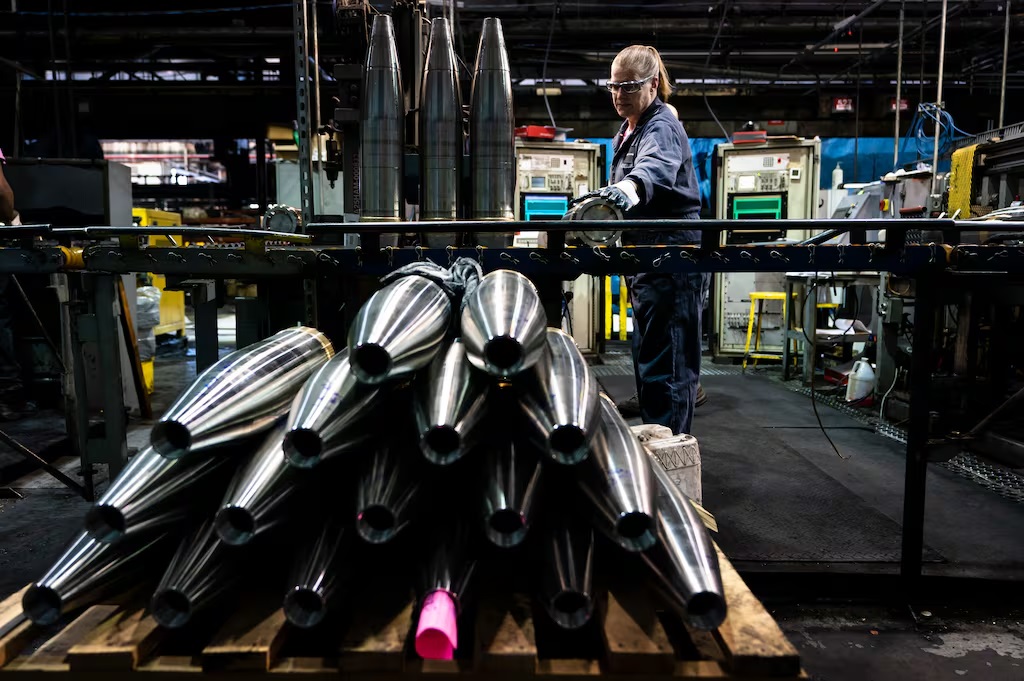
Military budgets paint a target on social spending
Kevin Cashman, 30 September 2026, https://newint.org/military/2026/military-budgets-paint-target-social-spending?utm_source=ni-email-whatcounts%20&utm_medium=email&utm_campaign=YYYY-MM-DD%20enews%20-%20Enews%202%20October%202026&utm_content=1%20NI%20Main%20List1%20-%20enews%20-%20International%20AND%20North%20America
The US is pushing Europe to choose warfare over welfare. Now is the time to reassess NATO membership, argues Kevin Cashman.
Wildfires are raging across Europe. Heatwaves are killing tens of thousands. The US, supported by many European governments, manages the Palestinian genocide with Israel as it wages an unjustifiable war on Iran and tightens its stranglehold on Cuba. Energy and food prices surge around the world, while US officials openly talk about war crimes and fantasize about dismantling the International Criminal Court.
European leaders are not strategizing on how to insulate their constituents from reckless US behaviour. Instead, they are in the grip of a new wave of militarism, plotting to slash social spending to make the US happy. NATO’s spending target is being used to reorder Europe’s public finances: military spending is exempted from fiscal constraints while social investment and climate programmes are on the chopping block. Britain is leading the charge.
Former prime minister Keir Starmer’s last weeks in office were dominated by his attempt to sell the Defence Investment Plan (DIP) to his ministers and NATO allies. It adds nearly $84 billion (£63 billion) to the Ministry of Defence’s budget over the next four years, including an extra top-up of $20 billion (£15 billion) agreed this summer – in response to a surprise request from the ministry for $37 billion more shortly after the last spending review.
The plan is not an anomaly. It is one national installment of a NATO-wide reallocation of public resources to militarism to meet an arbitrary spending target – driven from Washington.
Starmer said the plan would create a ‘defence dividend’ for ‘every region and community’ in Britain, implying that defence will drive growth and create jobs. These claims do not stand basic scrutiny. For one, military spending generally creates fewer jobs and drives less growth than equivalent investment in rail, health, libraries and museums, education, or care – in part because more money leaves the country directly and further down the supply chain. As such, even though the military budget is larger than it was in 1980 in real terms, it supports far fewer jobs.
It gets worse. The recent top-up negotiated with the Ministry of Defence (MoD) and its lobbyists was unfunded. Just before he handed over the government to Andy Burnham, Starmer chose to cut investment across the government by $9 billion, concentrated in the energy and transport departments. This left a further $10.9 billion that may yet be funded through more cuts.
Our analysis at Transition Security Project estimated that the expanded DIP would lead to a net loss of thousands of jobs. Andrea Egan, general secretary of Unison, the country’s largest union, described the plan’s priorities as ‘extra cash for war and overseas interventions but less for schools and hospitals’.
These cuts have received less attention than the military establishment’s displeasure at ‘only’ receiving $20 billion more – rather than every last billion extra that they had demanded. George Robertson, who led the defence review process that was fully funded just one year ago, said the extra funding was insufficient and the ‘challenge is now bigger, more serious, and earlier than we had anticipated’.
John Healey, now British Chancellor, quit his role as defence secretary when it became clear that Starmer was not going to provide the full $37 billion. This is an inversion of every other area of public life, where the demand is to do more with less – a far cry from Starmer’s demand of ‘no more money without reform’ for the National Health Service. The Labour Party’s climate plan, which had an identical price tag to the MoD’s latest request, was promised to bring jobs, energy security and energy bill reductions before being abruptly dropped.
The US’s comically bloated military budget undergirds an ecosystem of military contractors who then lobby for more increases
A coercive strategy
This dynamic is not confined to British politics. The US government is demanding more and providing less to NATO members, even though the Cold-War era alliance has always been about US interests and, as NATO secretary general Mark Rutte put it, serves as a ‘power projection platform for the United States’. With this new orientation, the US has set a target to increase military and security spending to 5 per cent of GDP by 2035.
Across NATO, which currently averages 2.2 per cent spending, it is estimated that this will result in about $8 trillion more spent on militaries by 2035 with annual spending reaching $4.2 trillion. This is not just an arbitrary target, but part of a larger coercive strategy to further subordinate Europe to US political and economic demands by sapping public resources and undercutting states’ ability to address pressing problems that matter to the public. This strategy furthers dependence on the US, while creating a cycle where public disillusionment feeds into rightwing movements, propped up by elites and the US, which then further hollow out productive capacity and social spending.
This approach is working. At July’s NATO summit in Ankara, Starmer received little praise for bowing to military lobbyists while slashing public investment and international aid. Instead, Britain was castigated by the US and the press for not doing enough. It is a similar story in other NATO countries.
To meet targets, the Netherlands is planning cuts to aid and social spending, including limiting unemployment benefit to a year and raising the state pension age beyond the current 67. In Germany, chancellor Merz says that the social welfare system is no longer viable and is cutting housing and parental benegits, while raising military spending dramatically by exempting it from borrowing rules to make space to meet future targets. In addition to other cuts, Britain’s international aid was cut to its the lowest level since 2008 to accommodate military spending, a move that aid network Bond called ‘apalling’ and ‘reckless’.
The effects of these cuts across Europe mean devastating consequences around the world, as programmes supported by aid are ended, and a further deterioration of human security is witnessed in Europe. No matter that both of these effects makes national security more challenging in various respects; the press has been largely supportive of this military largesse. An editorial in Le Monde characterized military spending as everyone’s burden in the face of a grim reality.
The debate in NATO capitals on military spending targets has tried to avoid a public conversation on militarism. One aspect of that conversation should be whether military spending is genuinely defensive. The Defence Investment Plan, for instance, says that Britain should have a persistent presence in the Middle East, Indo-Pacific, Latin America and the Caribbean, and military engagement with states around the world. This is not spending on territorial defence or deterring attack ; it is projecting power and showing allegiance to Washington.
Wasteful aggression
To justify this abuse of public resources and the harsh tradeoffs governments know are unpopular, spending must be sold inaccurately as supporting defensive measures to counteract inflated threats or as a driver of the economy.
Even when spending is focused on defence, it often doesn’t meet basic requirements about accountability. Military spending is rife with fraud and waste. This is easy to see in British military procurement: the Ajax vehicle programme is nearly a decade delayed and a billion pounds over budget, and continues to injure soldiers testing it. A conservative estimate for the scale of fraud and waste in the country’s military spending puts it at billions per year.
Since it is undeniable that human security is fundamental to national security, spending on green industrialization, firefighting, hospitals and care facilities, and public infrastructure, should count towards defence targets
Another problem for NATO members is that much of military spending flows out of their countries, as acknowledged by the Dutch economic affairs ministry. Most European military spending goes to the US: 86 per cent of Britain’s arms imports come from the US and the US share of European NATO imports is 64 per cent and rising. Rutte put the political economy of the European arms trade in surprisingly clear terms recently, saying European military spending sustains nearly 200,000 jobs in the US. This might be seen as a protection racket, but since the US appears to create more problems than it solves, it could be better described as transatlantic tribute between elites. As the public in Europe pays for US decline, elites still capture a share of the extraction the US undergirds.
These problems have become acute for Europe for two structural reasons. The first is the self-imposed fiscal framework adopted by many European governments. By restricting borrowing and other ways of mobilizing public financing, this framework leaves governments with only two ways to finance higher spending: raising taxes or cutting other programmes. These constraints weaken growth and employment and risk locking countries into repeated cycles of austerity. Fiscal rules should be relaxed or removed for productive public investment, but instead governments have largely chosen to suspend or circumvent them to meet NATO spending targets.
The structure of the global economic system is the other reason. Because of the outsized role of the dollar, the US uniquely accrues huge economic and non-economic benefits. It can receive goods and services from abroad for very low cost, allowing it to mobilize resources on a massive scale. But rather than focus on productive investment like solving global problems, US governments largely squander this ‘exorbitant privilege’ by funnelling money to the wealthy.
A good example of this is the US’s comically bloated military budget, which is by far the largest in the world and has few guardrails. This massive spending undergirds an ecosystem based around military contractors that lobbies for more increases, inflates threats and agitates for war, and presses for the same in US client states. But even US military officials were bewildered by the proposal for a $500 billion increase in the latest budget – one that does not need to be offset by cuts.
European militarism at Trump’s behest looks less like a defence dividend and more like a drain: where Europe’s public resources are siphoned off to meet arbitrary targets by a complicit elite and sent in large part to the US. From the US perspective, maintaining and expanding this extraction is the point. It wants a weaker Europe that is dependent on US military exports and technology, and which also dutifully collaborates to reach US economic and foreign policy objectives.
US foreign policy has cost Europe dearly. The sanctions-first Western response led by Washington, and rejection of diplomacy early in the Ukraine war, led to Europe paying well over $1 trillion in higher energy bills as it switched its dependence from Russian natural gas to more costly US liquified natural gas. The US-Israeli war on Iran continues in the same vein. Higher energy prices are again costing Europe billions and leading to record profits for energy companies, which flow disproportionately to the US and the wealthy. At the same time the US stifles European industry.
NATO members meeting their spending targets on time is not likely to placate Washington. In Britain, prime minister Burnham has a chance to change course but his government has so far signalled that military spending will be a priority over any other spending, and that it will seek new financing opportunities not for climate action or green industry, but for war. Will his government keep arguing that defence will drive growth and innovation, even though other public spending does both and is a productive use of resources? And as the US war on Iran threatens to derail the British economy, will Burnham prioritise the British public and their priorities, and abandon the unworkable path to 5 per cent military spending?
Short of leaving NATO, Burnham has options. One is broadly classifying public spending as military-related, as Slovakia has done with hospitals. This is permitted for up to 1.5 percentage points of the target, but since it is undeniable that human security is fundamental to national security, spending on green industrialization, firefighting, hospitals and care facilities, and public infrastructure, for example, should count toward the overall target.
Another approach would be strengthening security at dramatically less cost by focusing on territorial defence and collective deterrence, and eliminating unnecessary programmes focused on power projection abroad. Part of this would be breaking with US foreign policy where necessary, for example by not permitting the US to use bases in its war on Iran.
As military spending drives a wave of self-defeating cuts, and a new militarism even more dependent on the US threatens to become a permanent fixture of the economy, now is the time to rethink NATO membership. Europe needs a new approach: one that is independent and grounded in broad, genuine human security above all. Public wellbeing depends on the ability to act on global problems like climate change and invest in social priorities. These are on the chopping block today.
No comments yet.
-
Archives
- October 2026 (120)
- September 2026 (339)
- August 2026 (330)
- July 2026 (355)
- June 2026 (287)
- May 2026 (306)
- April 2026 (356)
- March 2026 (251)
- February 2026 (267)
- January 2026 (308)
- December 2025 (358)
- November 2025 (359)
-
Categories
- 1
- 1 NUCLEAR ISSUES
- business and costs
- climate change
- culture and arts
- ENERGY
- environment
- health
- history
- indigenous issues
- Legal
- marketing of nuclear
- media
- opposition to nuclear
- PERSONAL STORIES
- politics
- politics international
- Religion and ethics
- safety
- secrets,lies and civil liberties
- spinbuster
- technology
- Uranium
- wastes
- weapons and war
- Women
- 2 WORLD
- ACTION
- AFRICA
- Atrocities
- AUSTRALIA
- Christina's notes
- Christina's themes
- culture and arts
- Events
- Fuk 2022
- Fuk 2023
- Fukushima 2017
- Fukushima 2018
- fukushima 2019
- Fukushima 2020
- Fukushima 2021
- general
- global warming
- Humour (God we need it)
- Nuclear
- RARE EARTHS
- Reference
- resources – print
- Resources -audiovicual
- Weekly Newsletter
- World
- World Nuclear
- YouTube
-
RSS
Entries RSS
Comments RSS


Leave a Reply