Can the Imperial Core Be Reformed? Chris Hedges and Aaron Maté on the Collapse of the Global Order
May 29, 2026 , Joshua Scheer, https://scheerpost.com/2026/05/29/can-the-imperial-core-be-reformed-chris-hedges-and-aaron-mate-on-the-collapse-of-the-global-order/
At the Vancouver Web Summit, Chris Hedges and Aaron Maté examine Gaza, the erosion of international law, AI-powered warfare, media censorship, and whether meaningful reform is still possible inside a system they argue is designed to preserve empire.
For decades, Western leaders have championed a so-called “rules-based international order,” presenting international law, human rights, and democratic institutions as the foundation of global stability. But what happens when the very powers that claim to defend those principles openly violate them?
In a wide-ranging conversation at the Vancouver Web Summit, journalist Chris Hedges and investigative reporter Aaron Maté argue that the war in Gaza has exposed a crisis far deeper than a single conflict. From the collapse of international legal norms and the weaponization of global institutions to the rise of AI-driven warfare and expanding censorship across the West, both contend that the legitimacy of the post-World War II order is rapidly unraveling.
The discussion moves beyond foreign policy to examine the consequences at home: shrinking democratic space, growing surveillance, media consolidation, and the increasing influence of tech billionaires over public life. While Maté points to remaining pockets of institutional accountability, Hedges argues that meaningful change will not come from political elites or established parties, but from organized popular movements capable of challenging concentrated power.
At its core, the conversation asks a question that increasingly defines our political moment: Can the imperial center be reformed, or has the system become so corrupted that only mass resistance can alter its course?
The Empire Has No Clothes: Chris Hedges and Aaron Maté on the Collapse of the Rules-Based Order
For decades, Western leaders sold the world a comforting fiction.
International law mattered. Human rights mattered. Democracy mattered. The United States and its allies, whatever their flaws, were supposedly the guardians of a rules-based international order.
According to Chris Hedges and Aaron Maté, that illusion is now impossible to maintain.
Speaking at the Vancouver Web Summit, the two journalists argued that the war in Gaza has done more than devastate a population. It has exposed the moral and institutional bankruptcy of the very system that claims to govern the world.
“The genocide in Gaza has obliterated any pretense of international law,” Hedges said.
The significance of Gaza, they argued, extends far beyond Palestine. What the world is witnessing is the public collapse of institutions that once claimed to provide accountability, restraint and justice. The crime itself is horrific enough. But equally revealing is the response: governments supplying weapons, blocking censure, shielding allies from consequences and demanding that the public look away.
For much of the Global South, this reality is hardly new. What is different, Hedges argued, is that the mask has finally slipped for audiences in the West.
The Death of the Rules-Based Order
Throughout the discussion, both journalists returned to a central theme: institutions are only as strong as the political will behind them.
The United Nations, international courts, humanitarian law and global watchdog organizations were all designed to constrain power. Yet again and again, powerful states have demonstrated that those constraints apply only to weaker nations.
Maté pointed to what he described as the growing willingness of international institutions themselves to accommodate power rather than challenge it. Long-standing principles and resolutions can be discarded overnight when geopolitical interests demand it.
What emerges is not a world governed by law but by hierarchy.
The powerful write the rules.
The rest are expected to obey them.
AI and the Machinery of Modern Empire
One of the most chilling moments of the conversation focused on artificial intelligence.
While Silicon Valley markets AI as a tool of progress, Hedges and Maté warned that it is increasingly becoming a tool of surveillance, censorship and warfare.
Hedges described a future in which technology giants function as partners in a rapidly expanding surveillance state. He argued that algorithms are already helping select military targets and enabling forms of social control that previous authoritarian systems could only dream about.
Maté raised the disturbing possibility that automated systems are already playing direct roles in lethal decision-making, with devastating consequences when flawed intelligence becomes automated violence.
The issue, they argued, is not the technology itself.
The issue is who owns it.
Who controls it.
And whose interests it serves.
As wealth and technological power become concentrated in fewer hands, democratic oversight becomes increasingly irrelevant.
The people building the future are not elected.
Yet they wield powers once reserved for governments.
Manufacturing Ignorance
If the empire’s first weapon is force, its second is amnesia.
Both journalists argued that one reason the public remains disconnected from the consequences of Western power is because information itself is increasingly controlled.
The conversation touched on censorship, algorithmic suppression and the shrinking space for dissenting voices. Images that challenge official narratives are hidden, marginalized or removed. Journalists who challenge prevailing orthodoxies often find themselves isolated or punished.
What is striking, they argued, is how openly this process now occurs.
No elaborate conspiracy is required.
The institutions often announce exactly what they are doing.
The public is simply expected to accept it.
The result is a society where citizens are encouraged to consume endless information while remaining disconnected from the realities that information might reveal.
Why Independent Journalism Matters
Both men argued that this crisis has created an opening for independent media.
As trust in corporate outlets declines, audiences increasingly turn toward journalists willing to challenge official narratives and ask uncomfortable questions.
Yet they also acknowledged the dangers.
Independent media is not immune to the pressures of capitalism. Clickbait, outrage farming and audience capture can corrupt alternative media just as thoroughly as corporate ownership corrupts mainstream outlets.
The challenge, Hedges argued, is maintaining integrity in a media environment increasingly driven by algorithms and attention metrics.
Journalism is supposed to tell the truth.
Not maximize engagement.
Not serve power.
Not protect careers.
Tell the truth.
That simple principle has become radical.
Can the System Be Reformed?
The sharpest disagreement—or perhaps difference in emphasis—came when the discussion turned toward solutions.
Maté expressed hope that some institutions remain worth saving. He pointed to international legal actions and pockets of accountability as evidence that reform remains possible.
Hedges was far less optimistic.
“The system’s not reformable,” he said.
His argument was blunt. Democratic institutions have been hollowed out. Political parties no longer function as genuine vehicles of popular power. Economic elites dominate both politics and media. Elections alone cannot reverse the trajectory.
If change is to come, he argued, it will come from organized mass movements capable of disrupting the normal functioning of power.
History, he noted, offers the same lesson repeatedly.
Workers won rights because they organized.
Civil rights were won because people mobilized.
Democracy expanded because ordinary people forced it to expand.
Nothing was given voluntarily.institutions remain worth saving. He pointed to international legal actions and pockets of accountability as evidence that reform remains possible.
Hedges was far less optimistic.
“The system’s not reformable,” he said.
His argument was blunt. Democratic institutions have been hollowed out. Political parties no longer function as genuine vehicles of popular power. Economic elites dominate both politics and media. Elections alone cannot reverse the trajectory.
If change is to come, he argued, it will come from organized mass movements capable of disrupting the normal functioning of power.
History, he noted, offers the same lesson repeatedly.
Workers won rights because they organized.
Civil rights were won because people mobilized.
Democracy expanded because ordinary people forced it to expand.
Nothing was given voluntarily.
The Empire Has Been Revealed
The conversation ultimately returned to a simple but devastating observation.
What many people once dismissed as isolated failures increasingly appears systemic.
Wars without accountability.
Technology without oversight.
Media without independence.
Democracy without meaningful participation.
Whether one agrees with every argument presented by Hedges and Maté, the question they raise is impossible to ignore.
If the institutions designed to restrain power consistently serve power instead, what exactly are they preserving?
The answer may explain why so many people around the world no longer see a rules-based order.
They see an empire.
And empires, history suggests, rarely reform themselves.
Federal appeal court upholds First Nations victory to protect wildlife at planned nuclear waste site

The Globe and Mail, May 29, 2026, Marie Woolf, Ottawa, https://www.theglobeandmail.com/politics/article-federal-appeal-court-upholds-first-nations-protect-wildlife/
A small Quebec First Nation has won a landmark case in the Federal Court of Appeal over a failure to reduce risks to wildlife – including two types of bat and a yellow throated turtle – in planning the location of a nuclear waste storage site near the Ottawa River.
The Federal Court of Appeal on Thursday upheld a decision last year by the Federal Court that ruled in favour of Kebaowek First Nation and local environment advocates.
The ruling may stall plans to build a storage mound at the Chalk River Laboratories site northwest of Ottawa, designed to hold up to one million cubic metres of radioactive low-level nuclear waste. It could also have implications for future legal challenges to building projects, which could threaten local wildlife.
Kebaowek First Nation and local environmentalists in March last year successfully challenged a 2024 decision by then-environment-minister Steven Guilbeault to issue a permit allowing a nuclear waste mound near the Ottawa river to be built, even though it could impact species at risk
The former environment minister issued the species-at-risk permit, allowing Canadian Nuclear Laboratories to press ahead with its plans for the waste site, in spite of potential harm to two types of bats and a turtle with a bright yellow throat.
The permit authorized incidental harm, harassment or killing of the threatened Blanding’s turtle, the endangered little brown bat and endangered Northern long-eared bat.
The Blanding’s turtle, which can live for 80 years in the wild, is known as the turtle “with a sun under its chin” in some Indigenous legends. Its population has been hit by habitat loss, invasive species and development.
The construction of the nuclear waste mound at Chalk River could lead to such turtles being killed on roads, while the habitat where the bats roost and raise their young could also be threatened, Kebaowek First Nation has warned. It fears the development would also harm black bears with dens there, and other wildlife including rare Eastern wolves.
Ole Hendrickson, conservation committee chair with the non-profit Sierra Club Canada Foundation, an environmental group that mounted the challenge alongside the First Nation, said the ruling “will have implications right across Canada, for other threatened habitat.”
“This should send a strong message to the federal government that placing environmental protection in last place after economic interest is not only unacceptable to Canadians, it will cause them trouble in the courts,” he said in a statement.
The Federal Court of Appeal decision comes amid tension over environmental protection, Indigenous rights and major federally backed projects.
On Wednesday, Mr. Guilbeault, a committed environmentalist, announced his resignation from federal politics. Mr. Guilbeault played a key role in many of the previous Liberal government’s climate initiatives which have been diluted, stalled or reversed by the current government. He plans to resign his seat later this summer.
In the judgment issued on Thursday the Federal Court of Appeal questioned Mr. Guilbeault’s decision that Chalk River was the “best solution” for the storage site. To issue a species of risk permit, the minister needed to be of the view that “all reasonable alternatives” had been considered as locations.
Three judges at the Federal Court of Appeal ruled on Thursday that Mr. Guilbeault’s decision to issue a permit was “unreasonable” and in dismissing the appeal by Canadian Nuclear Laboratories said the issue should go back to the current minister for redetermination.
Minister of Environment and Climate Change Julie Dabrusin will now have to reconsider the issuing of a species-at-risk permit, and whether there could be other viable locations for the site with fewer impacts on wildlife. CNL, which plans to build and operate the proposed waste dump, had looked at other locations owned by the Crown corporation Atomic Energy of Canada, but chose Chalk River.
Chief Lance Haymond of Kebaowek First Nation said “the Federal Court of Appeal has confirmed that Environment Canada must go back and do its job properly.”
Nicholas Pope, the Ottawa lawyer who represented Kebaowek First Nation, said there are alternative sites that could have been considered, including federal land near Chalk River that would have not posed as great a threat to species at risk.
He hoped Ms. Dabrusin in looking again at species at risk would also consider the potential impact on endangered monarch butterflies, and Eastern wolves that roam at the Chalk River site.
In 2024, the federal environment department upgraded the Eastern wolf, found only in Ontario and Quebec, to threatened species status, saying there may be as few as 236 adults in Canada.
Cecelia Parsons, spokesperson for Environment and Climate Change Canada, said it is reviewing the court of appeal decision “and its implications carefully and will determine next steps as appropriate.”
CNL said it had sought “to obtain clarity in a complex regulatory environment” in going to the Federal Court of Appeal.
“CNL respects the decision of the court and is now taking time to evaluate today’s decision and determine next steps,” it said in a statement. “CNL remains committed to protecting the environment and species at-risk – restoration and protection of the environment is at the core of our work.”
Last year, the federal court partly granted Kebaowek’s application for judicial review of the decision to build the Chalk River waste dump on the grounds that it was not properly consulted. This decision is now before the Federal Court of Appeal.
Inside the broligarchy: Is big tech running US politics? Carole Cadwalladr talks to DW News.
From Donald Trump’s alliances with tech billionaires to the collapse of US media outlets, investigative journalist Carole Cadwalladr says we are accelerating towards a “techno‑fascist future.” Chapters 00:00 Where does government end and Big Tech begin? 00:26 DW speaks with Carole Cadwalladr, Investigative Journalist 02:40 What is the broligarchy? 06:45 Missing accountability for big tech 08:00 Tech entrepreneurs are taking over legacy media companies 10:30 A techno-Fascist future? 12:30 What can People do? 14:00 How Aware is the public about data collection risks? 15:20 AI and intellectual property 18:00 A positive way forward?
Warmongers Keep Generating AI Atrocity Propaganda About Iran
Caitlin Johnstone, May 29, 2026, https://www.caitlinjohnst.one/p/warmongers-keep-generating-ai-atrocity?utm_source=post-email-title&publication_id=82124&post_id=199683036&utm_campaign=email-post-title&isFreemail=true&r=1ise1&triedRedirect=true&utm_medium=email
Another AI atrocity propaganda project about Iran has been unleashed, this time in the form of a movie titled “Dreams of Violets” at the Tribeca film festival.
Variety calls the flick “the first full-length, live-action film generated by AI to be accepted by a major film festival,” describing the plot as follows:
“The film, which will premiere June 10 during the festival’s 25th anniversary, is a 75-minute docudrama inspired by the protests that swept Tehran in January, highlighting five Iranians who meet in a Tehran alley before they’re executed, all witnessed from a window by Amir, a 10-year-old boy with cerebral palsy. The clashes reflect the real-world protests between Iranian authorities and civilians, which left at least 7,000 people dead and more than 50,000 people arrested, according to the Human Rights Activists News Agency.”
The film’s trailer depicts sympathetic protagonists being brutally victimized by Iranian authorities, and concludes with the image of fighter jets soaring overhead while an English-captioned Persian voiceover says “If Iran gets liberated, celebrate for me. Enjoy it for us!”
Tribeca Festival co-founder Jane Rosenthal gushed enthusiastically about the so-called “docudrama” and its implications, telling The Hollywood Reporter that “At this time in history when both artificial intelligence and Iran are central to global conversation, this film offers audiences a rare and intimate perspective into a conflict many have not been able to fully see or understand.”
Well hey, now they can see and understand the conflict! They can see and understand it with the help of completely fake AI video footage! Golly gosh, isn’t that deliciously convenient?
This follows our discussion last month about another project using AI-generated atrocity propaganda to manufacture consent for war with Iran called Generative AI for Good, which creates deepfakes of supposedly real women who say they were sexually assaulted by Iranian government forces.
The Canary reports:
“An Israel-based AI firm, Generative AI for Good, claims to be using deepfake technologies for positive ends. ‘Positive’ appears to mean creating deepfake videos to help the illegal US-Israel war on Iran.
“Generative AI for Good claims that it uses AI to ‘help survivors testify safely — in their real voice, without revealing their identity’. But Israel and its mouthpieces have been shown to have used false allegations of rapes and other atrocities on 7 October 2023 to justify its genocide in Gaza.”
The Canary notes that Generative AI for Good is staffed with Israelis who have very conspicuous agendas, including a creative director who pushes the discredited narrative about mass rapes on October 7, a marketing manager who served in the IDF’s “Psychotechnical Headquarter”, and a founder who said in early 2024 that “Artificial intelligence is a secret weapon of ours” in using the revolutionary technology to bolster the military’s efforts both online and on the ground in the information war being waged alongside the military battlefields in Gaza.
It is unsurprising that generative AI is being used to churn out atrocity propaganda to manufacture consent for imperial war projects, because these new technologies lend themselves perfectly to the task of creating realistic-looking video footage of events which never transpired. If you want to tug at people’s heart strings and push them toward anger at an empire-targeted government, generative AI is a cheap and easy tool for doing so.
We are only just beginning to catch the first glimpses of the ways in which AI-generated videos will be used to manipulate the minds of the public to advance imperial agendas. The projects we are seeing today are just the first droplets of ocean mist from a tsunami that is roaring to shore.
Global temperatures to reach near-record highs in next five years, report finds

By Olivia Le Poidevin and Cecile Mantovani,May 28, 2026
Average global temperatures are forecast to reach near-record levels in
the next five years, with Arctic temperatures expected to warm faster
than other regions, a report by the U.N. weather agency and the UK’s Met
Office said on Thursday. The annual report, opens new tab which gives
regional predictions for temperatures and rain predicts that annual global
mean near-surface temperatures will range between 1.3°C and 1.9°C above
the 1850-1900 pre-industrial period.
Reuters 28th May 2026, https://www.reuters.com/sustainability/cop/global-temperatures-reach-near-record-highs-next-five-years-report-finds-2026-05-28/
Legal Victory for Kebaowek First Nation and Allies vs. Proposed Radioactive Megadump
Federal Court of Appeal Upholds Victory for Kebaowek First Nation and Allies in ”Species at Risk” Case Against Chalk River Nuclear Waste Project
Kebaowek, May 29, 2026 – Kebaowek First Nation, Concerned Citizens of Renfrew County and Area, theCanadian Coalition for Nuclear Responsibility, and Sierra Club Canada Foundation welcome a significantvictory following the decision of the Federal Court of Appeal to dismiss Canadian Nuclear Laboratories’(CNL) appeal regarding the Species at Risk Act permit issued for the proposed Near Surface DisposalFacility (NSDF) at Chalk River. The Court upheld the Federal Court’s earlier ruling and ordered Environmentand Climate Change Canada (ECCC) to reconsider its decision to grant the permit.
The permit would have authorized CNL to destroy endangered species and their habitats in order to construct a massive radioactive waste disposal facility less than 1.1 kilometres from the Ottawa River (Kichi Sibi), a watershed that provides drinking water to millions of Canadians.
In its decision, the Federal Court of Appeal concluded that ECCC failed to adequately explain how it determined that all reasonable alternatives had been considered and that the best solution had been selected, as required under the Species at Risk Act. The Court emphasized that the Minister’s reasons lacked sufficient transparency, intelligibility, and justification, and directed ECCC to conduct a new determination. The Court also confirmed that the Federal Court’s interpretation of section 73 of the Species at Risk Act is not binding on ECCC and that the Minister must independently provide a clear and reasonable analysis when reconsidering the permit application.
Furthermore, the Court found that the public notice issued by ECCC failed to provide a meaningful explanation to Canadians about why endangered species would be unharmed in support of the project.
Trump plan to give start-ups plutonium harvested from Cold War–era nuclear weapons is risky, experts say

Weapons-grade plutonium can fuel nuclear reactors known as mixed oxide reactors, but none of these exist in the U.S.
By Adam Kovac edited by Claire Cameron, May 28, 2026 https://www.scientificamerican.com/article/experts-warn-against-trump-plan-to-give-cold-war-plutonium-to-nuclear-power-companies/
The Trump administration’s plan to offer plutonium from dismantled Cold War–era nuclear weapons to private energy companies is drawing criticism from experts who say it makes little economic sense and presents a national security threat.
There are currently no operational nuclear reactors in the country that are built to use plutonium-derived fuel. Instead nuclear power plants in the U.S. are powered by a mixture of two uranium isotopes. A small portion, usually around 5 percent, of that fuel is uranium 235, which can also be used to make nuclear weapons. The majority is uranium 238, which cannot sustain a nuclear fission reaction on its own. Because of that balance, if some of this fuel were to fall into the wrong hands, it would be enormously difficult to weaponize, says Scott Roecker, vice president of nuclear materials security at the Nuclear Threat Initiative, a nonprofit dedicated to preventing nuclear catastrophe.
“The most difficult step in getting a nuclear weapon is having enough of that material,” he explains. “The U.S. government has spent probably billions of dollars over the last several decades to remove highly-enriched uranium and separated plutonium from countries that don’t need it.”
Plutonium, meanwhile, is considered a human-made element and is a by-product of the reactions that take place inside nuclear reactors. As uranium 238 is bombarded with neutrons inside the reactor, the molecules absorb some of these particles and become the heavier uranium 239, which rapidly decays and eventually becomes extremely radioactive plutonium.
That plutonium can be mixed back with uranium to be used as fuel in specific nuclear reactors called mixed oxide reactors. The U.S. abandoned mixed oxide reactors in the 1970s because they were both difficult and expensive to run. These kinds of reactors do exist elsewhere, though—in Japan, Russia and France—but those countries have encountered their own problems with the reactors, Roecker says.
“In France, the government’s subsidizing that process,” he says. “Only I think 1 percent of the uranium that’s actually reprocessed is being reused. And in Japan, it’s cost the country billions of dollars and has still not started operation, and who knows if it actually ever will.”
The U.S. Department of Energy has defended the plan, saying the private sector could play a vital role in advancing U.S. nuclear power infrastructure. Ted Garrish, assistant secretary for the Office of Nuclear Energy, said in April that decommissioned nuclear fuel “represents an immense, untapped energy resource for the United States.”
“The Surplus Plutonium Utilization Program is anticipated to help companies unlock the next level of private funding to broaden domestic nuclear fuel supplies, spur innovation on American recycling technologies, and unlock private sector funding to fuel the nation’s nuclear renaissance,” said a DOE spokesperson in a statement, adding that five companies have been selected to take part in the program.
Aside from the concern over cost and feasibility, other experts point out that keeping plutonium secure is much more difficult than doing so with typical uranium-based nuclear fuel. Daniel Speyer, a professor of nuclear power plant systems at New York University, says he isn’t convinced that energy start-ups could properly store plutonium. Even if the material is mixed back with uranium, separating the two to isolate the highly fissile material isn’t so difficult as to be impossible—which introduces a clear security threat, he says.
“It’s not something that a small organization really probably could do, but if you give them plutonium in purer form, I think it’s almost a trivial act to make a bomb,” he says. “A simple atomic bomb is not difficult to make.”
The DOE says that any company selected to receive the Cold War–era plutonium will have to show a deep understanding of the technology involved, as well as robust security plans and regulatory compliance. The plan has also met some pushback on Capitol Hill, however. Last September Democratic senator Edward Markey of Massachusetts and two Democratic congressional representatives sent a letter to President Donald Trump raising concerns over the risk to national security.
“The transfer of weapons-usable plutonium to private industry would increase the risk of nuclear weapons proliferation, including to rogue states or terrorists,” they wrote.
Getting Iran’s Right to Enrich Wrong (RealClearDefense)
May 28, 2026, https://npolicy.org/getting-irans-right-to-enrich-wrong-realcleardefense/
It’s unclear if the United States and Iran will be able to reach an agreement on Iran’s suspect nuclear weapons-related activities and stockpiles. What should be obvious, however, is that whatever Washington proposes will be seen by Iran’s neighbors and other would-be bombmakers as a standard that might be applied to them next.
As I explain in the attached RealClearDefense piece, “Getting Iran’s Right to Enrich Wrong,” whatever the United States calls upon Iran to do will be seen by Saudi Arabia, the United Arab Emirates (UAE), Turkey, and Egypt as a nuclear standard for their own nuclear behavior. If President Trump says Iran has a conditional right to make nuclear fuel after a moratorium, it will be easier for the United States to strike a cooperative civilian nuclear agreement with Saudi Arabia that would help Riyadh enrich uranium as well.
This, in turn, is almost certain to prompt the UAE to demand equal treatment under its own nuclear deal with the United States. Finally, Turkey and Egypt, which have large civilian reactor construction projects underway and have previously rejected U.S. pleas to foreswear enriching uranium or reprocessing plutonium, would be even more inclined to do so.
How a Middle East loaded up with nuclear fuel-making nations, only months away from being able to make bombs, will be able to remain peaceful is anybody’s guess. As I argue, this is a path best not taken. The alternative is to hang tough, not only against nuclear fuel-making in Iran, but in Saudi Arabia as well.
The False Promise of Nuclear Power: Why Scotland Doesn’t Need New Nuclear.
Just before the 40th anniversary of the Chornobyl nuclear disaster,
Scottish CND host 3 excellent guests to discuss the risks, false promises
and opportunity costs of nuclear power.
Linda Pentz-Gunter is an
environmental campaigner who founded the advocacy organisation “Beyond
Nuclear” in 2007. In her advocacy, she is primarily concerned with the
environmental costs of nuclear power and its false promise as a climate
change solution. She also campaigns for nuclear weapons abolition. As the
international specialist at Beyond Nuclear, she edits and curates the
Beyond Nuclear International website, an essential resource for information
and updates on world nuclear news.
Pete Roche is also an environmental
campaigner who has recently revived the civic campaign SCRAM (Scottish
Campaign to Resist the Atomic Menace), which organised extensive
demonstrations against the construction of Torness nuclear plant in the
1980s. Pete is also a professional energy consultant and proprietor of the
website No2NuclearPower, another key resource for information and updates
on nuclear power in the UK.
Dylan Morgan is spokesperson for the People
Against Wylfa B campaign, and is strongly involved in the
recently-relaunched Welsh Anti-Nuclear Alliance, also originally launched
in the 1980s and is composed of several important civic organisations in
Wales including CND Cymru.
Scottish CND 28th May 2026 –
https://www.youtube.com/watch?v=lfLQs9LRo50
Huge injection of public money to build nuclear submarines at Barrow-in-Furness
“In 2014, Barrow-in-Furness was named the unhappiest place in the UK.
“Since then, the much-maligned former industrial powerhouse has received a
potentially transformative boost in the form of a huge injection of public
money to build nuclear subs there. “
To discuss the prospects of this
crucial part of Britain’s defence and industrial capability, and the 56,000
people who call it home, Lord Simon Case, the former cabinet secretary
deputed by Sir Keir Starmer to lead the town’s revival, heads a panel
moderated by Christopher de Bellaigue.”
The talk will also include Sam
Plum, the former Chief Executive of Westmorland and Furness Council. They
will be joined by Jean McSorley, a policy analyst for the government on
public health and nuclear safety and a key figure for Greenpeace.
NW Evening Mail 27th May 2026, https://www.nwemail.co.uk/news/26139450.barrow-revival-heart-upcoming-lake-district-festival/
Barbarism With Better Software: Pope Leo Warns of the AI Future

Joshua Scheer, May 26, 2026 , https://scheerpost.com/2026/05/26/barbarism-with-better-software-pope-leo-warns-of-the-ai-future/
Pope Leo XIV is warning that artificial intelligence, if left in the hands of profit-hungry corporations and unaccountable tech oligarchs, could unleash a “social calamity” by replacing human work. And now even the markets are beginning to price in the fear. Prediction traders on Kalshi see a 60% chance that U.S. unemployment crosses 8% before 2030, while also betting that AI may already be the leading cause of job cuts this month.
With the Pope writing “Work remains a fundamental dimension of the human experience, for not only is it a means of sustenance, but it is also a context for expression, relationships and contributing to the community,” … A society that guarantees employment to only a small fraction of the population, despite having a high level of technical development, risks exposing many to forced inactivity, a lack of responsibility and the absence of daily tasks and stimuli, resulting in human and cultural impoverishment.”
Tolkien, Gandalf and the Fight Over Humanity in the Age of AI
In one of the encyclical’s most striking moments, Pope Leo invokes the spirit of J.R.R. Tolkien while calling for humanity to “disarm” artificial intelligence and resist technological domination. Without directly naming Gandalf, Leo references a passage from one of Tolkien’s novels that reflects a central moral theme running through The Lord of the Rings: ordinary people confronting immense forces of power and corruption not by controlling the world, but by defending what is human within it.The passage speaks to the responsibility of people to care for “the fields that we know,” preserving a livable future for those who come after us rather than seeking mastery over all things.
The reference is notable not only because it is believed to be the first major incorporation of Tolkien into a high-level Vatican doctrinal document, but because it reveals the philosophical core of Leo’s warning about AI. Like Tolkien, the Pope appears deeply concerned with the dehumanizing effects of technological power when detached from morality, community and human dignity.
Rather than treating technology as destiny, Leo frames the struggle over AI as a profoundly human and ethical question: whether society will allow machines, corporations and systems of profit to dominate human life — or whether people can still reclaim technology for the common good.
What is striking is not that the Vatican is sounding the alarm. It is that Wall Street, usually eager to celebrate every job-killing “innovation” as efficiency, appears to share the anxiety. The same financial class that cheers automation when it boosts margins is now wagering on the social wreckage it may leave behind.
Pope Leo XIV vs. the AI Oligarchy
Leo’s warning cuts directly through Silicon Valley’s favorite lie: that technology is automatically progress. Work, he argues, is not merely a paycheck. It is dignity, community, purpose and participation in society. A world where machines enrich the few while millions are pushed into “forced inactivity” is not advanced. It is barbarism with better software.
The AI revolution is being sold as liberation. But without democratic control, labor protections and a moral economy, it risks becoming the most sophisticated union-busting machine ever built — a system that turns human beings into obsolete costs while calling the wreckage innovation.
The high priests of the digital economy are beginning to admit what workers have feared for years: artificial intelligence is not simply another technological innovation. It is a mechanism for social restructuring on a scale capable of hollowing out entire societies while concentrating unprecedented power into the hands of a tiny technological elite.
Now, in an extraordinary moment that reveals just how deep the anxiety has become, Pope Leo XIV has entered the fight.
In his first encyclical, Magnifica Humanitas, Leo issued a direct moral indictment of the AI economy now being constructed by Silicon Valley and Wall Street. He warned that mass unemployment caused by automation could produce “social calamity,” condemning an economic order that treats human beings as disposable inputs in the pursuit of profit.
“The pursuit of greater profits cannot justify choices that systematically sacrifice jobs,” Leo wrote, arguing that the human person “is an end, not a means.”
The remarkable thing is not simply that the Pope is saying this. It is that the financial markets appear to agree.
On prediction platform Kalshi, traders now place a 60% chance that U.S. unemployment rises above 8% before 2030, with nearly even odds it surpasses 9%. Those are recession-level numbers — the kind associated historically with economic collapse, mass foreclosures and social instability. Yet this time the fear is not merely financial panic. It is technological displacement.
The same corporate class that spent the last decade promising AI would “augment” workers is now openly discussing which sectors can be eliminated first.
Customer service. Journalism. Translation. Design. Coding. Accounting. Legal research. Teaching assistance. Medical diagnostics. Administrative work. Truck driving. Retail logistics. The language has become chillingly clinical: “labor optimization,” “efficiency gains,” “redundancy reduction.” Human lives reduced to balance-sheet obstacles.
Silicon Valley presents this process as inevitable — a law of nature rather than a political choice. But Leo’s encyclical rejects that mythology outright. Technology, he argues, is not neutral when it is controlled by systems organized around extraction and domination.
The Pope’s critique goes far beyond unemployment statistics. He warns that AI is creating a new form of digital colonialism in which data itself becomes the raw material of empire. Entire populations, he writes, are being transformed into “rare earths of power” — mined not for minerals but for behavioral information, biometric profiles, consumption patterns and predictive intelligence.
A handful of corporations now possess more behavioral information about humanity than any government in history. They monitor speech, movement, emotion, consumption and political behavior at planetary scale. AI supercharges that power by transforming raw data into predictive control systems — systems capable not merely of understanding populations, but manipulating them.
And as wealth concentrates upward, the social contract below begins to collapse.
Leo warns that a society where only a small fraction of people maintain meaningful employment — despite immense technological abundance — risks “human and cultural impoverishment.” Work, he insists, is not simply economic survival. It is participation in human life itself: purpose, responsibility, relationships and community.
This is precisely what Silicon Valley’s utopian rhetoric ignores.
For decades, tech billionaires promised automation would liberate humanity from drudgery. Instead, millions find themselves trapped in algorithmic management systems, precarious gig work, surveillance workplaces and endless digital dependency. Productivity exploded while wages stagnated. Corporate profits soared while social bonds disintegrated.
AI threatens to accelerate this process to catastrophic speed.
Even some within the industry appear unnerved by what they are building. Anthropic co-founder Chris Olah, appearing beside Pope Leo at the Vatican, admitted there is “a real possibility that AI will displace human labor at very large scale.” He acknowledged that no mechanism currently exists to distribute the gains globally or prevent mass social devastation.
That admission alone should shatter the fantasy that the architects of AI possess a coherent plan for humanity’s future.
Because the truth is increasingly obvious: the market has no moral framework for handling technological power of this magnitude.
Capital rewards efficiency, not justice.
Profit, not dignity.
Extraction, not community.
If replacing millions of workers with algorithms increases shareholder returns, the system treats that outcome as success — regardless of the social consequences. Entire regions can collapse into unemployment while stock valuations soar.
This is why Leo’s intervention matters.
He is not merely criticizing technology. He is challenging the economic religion surrounding it.
The modern AI boom rests on an almost theological belief that technological progress is inherently good, that innovation justifies itself, and that those who question the social costs are irrational enemies of the future. Silicon Valley speaks of AI in messianic terms: salvation through computation, transcendence through automation, immortality through machines.
But Leo offers a radically different vision. Human beings are not inefficient machines to be optimized away. Society cannot survive if millions are stripped not only of income, but of meaning and social participation itself.
The danger is not simply that AI becomes powerful.
The danger is that it becomes powerful inside an economic system already defined by staggering inequality, democratic decay and corporate domination.
Under those conditions, automation does not liberate workers.
It liberates corporations from workers.
And unless democratic control over technology emerges soon, the future now being constructed may look less like liberation than a technologically sophisticated form of mass abandonment — a world where unprecedented wealth and productivity coexist beside social despair, permanent unemployment and the slow erosion of human dignity itself.
You can read Leo’s words here:
Arming for extinction: The climate cost of militarism

COMMENT. The above video does tackle the problem, but eventually in a rather limited way, even putting in an advertisement for nuclear power as a way to combat climate change!
The military-industrial complex is not merely burning the planet. It is funding the political opposition to anyone attempting to put out the fire.
Every modern war is also a chemical event, a water event, an atmospheric event — consequences that accumulate in soil and groundwater long after the last ceasefire is signed and the reconstruction contracts are issued to the same companies that manufactured the weapons.
By Wayne Hawkins | 27 May 2026, https://independentaustralia.net/environment/environment-display/arming-for-extinction-the-climate-cost-of-militarism,21093
As global military spending surges to record levels, the climate cost of war and rearmament remains largely uncounted, unreported and exempt from scrutiny, writes Wayne Hawkins.
HUMANITY HAS A PROBLEM. Actually, humanity has several, but let us focus on the one where we are simultaneously spending nearly $3 trillion a year preparing to destroy civilisation while solemnly promising to save it.
Welcome to the military-industrial complex’s quiet war on the atmosphere. Fought without declaration. Exempt from accounting. Winning convincingly.
The number nobody counts
Here is a figure worth sitting with. Scientists for Global Responsibility estimate that the global military sector produces around 2.75 billion tonnes of CO₂ every year. That is not from active wars. That is peacetime — bases humming, jets training, supply chains churning.
If the world’s militaries were a country, they would be the fourth-largest emitter on Earth, behind only the United States, China and India. They would also be the only “country” explicitly exempt from international climate reporting requirements. Convenient.
The year 2025 was a banner year for the defence industry. Global military spending hit a record $2.887 trillion — the 11th consecutive year of growth. Europe increased defence budgets by 14%. NATO, not to be outdone, set a new target of 5% of GDP by 2035. The United States, briefly the exception, has already approved over $1 trillion for 2026, with $1.5 trillion potentially on the way.
Meanwhile, at COP30 in Belém in November, delegates scrutinised aviation, agriculture, steel and cement for their climate contributions. War did not make the agenda. Presumably, the irony was noted and filed.
When the shooting starts, so does the scoreboard
The moment active conflict begins, the numbers stop being merely alarming and start becoming geological. Russia’s invasion of Ukraine has generated an estimated 311million tonnes of CO₂ equivalent — comparable to the combined annual emissions of Belgium, New Zealand, Austria and Portugal. Not accumulated over decades — since February 2022.
The first 15 months of the war in Gaza produced more than 33 million tonnes. And these calculations do not fully capture the elegant brutality of modern warfare’s climate toolkit.
Russia’s strikes on Ukrainian electrical infrastructure have released sulfur hexafluoride – a greenhouse gas 24,000 times more potent than CO₂ – from high-voltage switching equipment. Civilian aircraft rerouting around the conflict zone has added an estimated 20 million extra tonnes of CO₂ equivalent. The planet did not get a vote on any of these design choices.
A 2025 Nature Communications study made the structural logic plain: rising global military spending is directly incompatible with limiting warming to 1.5–2°C. Military industries emit nearly twice the CO₂ per unit of economic output as civilian sectors. Every percentage-point increase in the share of military spending pushes emissions meaningfully upward — and expands fossil fuel-dependent industries that then lobby against the green transition.
The military-industrial complex is not merely burning the planet. It is funding the political opposition to anyone attempting to put out the fire.
The slow damage that outlasts the war
Then there is the legacy: the slow, generation-spanning damage that persists long after the press conferences and the peace agreements. In Gaza, the UN Environment Programme (UNEP) has documented the loss of 97% of tree crops, 95% of shrubland and 82% of annual crops since 2023. Food production at scale is not possible. The aquifer supplying most of Gaza’s water is likely contaminated by collapsed sewage infrastructure.
Cases of acute watery diarrhoea have increased 36-fold. Acute jaundice syndrome has increased 384-fold. Sixty-one million tonnes of debris laced with unexploded ordnance, asbestos and chemical munition residue now blanket the territory.
In Ukraine, environmental damage from soil contamination, heavy metal ordnance residue, landmines and destroyed ecosystems is estimated at over $50 billion. Scientists describe it plainly as a toxic legacy for generations.
Every modern war is also a chemical event, a water event, an atmospheric event — consequences that accumulate in soil and groundwater long after the last ceasefire is signed and the reconstruction contracts are issued to the same companies that manufactured the weapons.
The accountability black hole
Here is the part that should end careers, but does not. A 2025 analysis by the Conflict and Environment Observatory found that military emissions reporting is not merely inadequate; it is actively getting worse.
The top three military spenders, the United States, China and Russia, are either failing to submit data to international bodies or providing figures so incomplete as to be decorative. The solution, apparently, to the largest measurement gap in climate policy is to measure less.
Military emissions were explicitly exempted from international climate accounting frameworks at Kyoto. Countries lobbied for that exemption. It has never been corrected. When the world’s most destructive industry gets to operate outside the ledger, the ledger is not an accounting document. It is a performance.
So here we are. Spending nearly $3 trillion a year on systems that are structurally incompatible with our own survival. Exempting those systems from the accountability frameworks we built specifically to address our survival. Doing so at the fastest rate of increase since the Cold War.
The defence industry calls this deterrence. Climate scientists call it a fuse.
Notably, the planet has not exempted us from the consequences.
Time for US to deescalate confrontation with China over Taiwan.
On October 25, 1971, the UN ended the 2 China policy, voting to expel Taiwan, claiming to be the Republic of China, and replacing it with the mainland Peoples Republic of China. Just a year later Nixon’s thaw with mainland China cemented US recognition of the mainland One China policy and de-emphasized supporting the Chiang government on Taiwan.
China’s relationship with Taiwan is essentially none of our business. Yet we continue to risk war 8,000 miles from the Homeland on China’s doorstep by provoking confrontation with China with massive arming of Taiwan’s military.
Current US government and media narrative erases the last 6,000 years of China, Taiwan history to create a new cause célèbre for US military adventurism, America’s No 1 business industry. Without historical context, the US electorate remains clueless of reckless US policy deemed necessary to US national security interests: defending freedom over authoritarianism on the other side of the world.
A review of the long, tortured China, Taiwan history refutes that narrative. Chinese from Southwest China settled Taiwan over 6000 years ago. Beginning in 1624, the Dutch and Spanish moved in to exploit Taiwan’s resources, as Europeans were want to do worldwide. But the Chinese kicked them out by 1683, ruling Taiwan for 212 years till Japan gobbled up Taiwan after in the Sino-Japanese War in 1895.
For the next 50 years Japan used Taiwan (Formosa at the time) as a land based aircraft carrier for their pan Asian adventurism. But at the Cairo Conference in 1943, the Allies declared a major war aim was full return of Formosa to China. This occurred by a UN mandate upon Japan’s surrender in 1945.
With Japan defeated in China, Mao’s communists resumed their civil war to overturn the corrupt, unpopular nationalist government of Chiang Kai-shek. In 1949, Mao prevailed. Chiang fled with about 2 million of his die hard supporters to Formosa, setting up their own version of the Republic of China renamed Taiwan.
The US looked at the 538 million Chinese living under communism on the mainland, the 2 million on Taiwan living under Chiang’s authoritarianism, and said ‘Nope, we’ll recognize Chiang on tiny Taiwan as the legitimate Chinese government till he can kick out the dreaded commies.’ They even gave Chiang the military assistance to prevent any unification with China which was inevitable without that support. Is it any wonder the people and government of China would embark on eventual reunification, whether taking years, decades, even a century?
On October 25, 1971, the UN ended the 2 China policy, voting to expel Taiwan, claiming to be the Republic of China, and replacing it with the mainland Peoples Republic of China. Just a year later Nixon’s thaw with mainland China cemented US recognition of the mainland One China policy and de-emphasized supporting the Chiang government on Taiwan.
Without abandoning Taiwan completely, the US embarked on 5 decades of ‘strategic ambiguity’ which kept tensions with China over Taiwan’s status on the back burner of US China diplomacy. That changed when President Obama’s ‘Pivot to Asia’ in his second term moved pro Taiwan policy to the front burner. His successors Trump, Biden and Trump again have so turned up the heat, that war with China over its long term plan for eventual absorption of Taiwan into Chinese sovereignty, remains a possibility.
From Strategic Ambiguity we’ve degenerated into reckless trips to Taiwan by US officials and congresspersons and proposed legislation giving the President a blank check to intervene militarily with China should they embark on any, albeit unlikely, military move at reunification. The US keeps advancing multibillion dollar weapons tranches that do nothing for Taiwan’s defense; indeed, provoke Chinese military maneuvers near Taiwan, raising the possibility of US China confrontation.
At his recent summit with Chinese President Xi, Trump got schooled by Xi who told Trump that if Trump doesn’t pull back from arming Taiwan it could lead to “clashes and conflicts” between the two superpowers. Trump might be getting the message. He had his Acting Navy Secretary Hung Cao tell Congress that the US was “doing a pause” on a $14 billion Taiwan weapons package to ensure the US has enough weapons to finish off the Iranian regime in so far failed Operation Epic Fury. Facing the biggest military failure in US history, Trump would be wise to put belligerence with China over Taiwan back on the back burner.
Ignoring the 6,000 year long interwoven China, Taiwan history prevents sensible, peace promoting US diplomacy. America made the wrong decision on the Chinese Civil War in 1949 and has chosen to govern in ignorance for the past 77 years. On this issue, ignorance is not bliss. It may mean war.
How do you justify a war?

27 May 2026 , Michael Taylor, AIM Extra, https://theaimn.net/how-do-you-justify-a-war/
There comes a point when the language of war stops matching the reality of it:
- Bombed apartment blocks become “targets”
- Dead children become “collateral damage”
- Starving civilians become “human shields”
And anyone who questions the destruction is accused of supporting terrorism. Or, as in extreme cases, of being antisemitic.
Watching Gaza burn, Lebanon bombed, and Iran drawn deeper into conflict, I find myself asking a simple question: How much is enough?
I understand the fear Israel felt after the October 7 attacks. I understand the anger. I understand the desire for justice.
What I no longer understand is the growing acceptance of endless civilian deaths as though morality itself now depends on which side is doing the killing.
At the time of the first bombings of Iran I wrote thaṯ:
“Every night, the news flickers across my screen, a parade of tragedies reduced to numbers and soundbites. Gaza burns, its streets choked with rubble and grief, thousands dead under Israeli bombs. Iran mourns too, its people buried beneath the chaos of escalating strikes. Yet the world’s voice is strangely muted, a whisper where a scream should be. But when Iran’s missiles streak toward Israel, claiming far fewer lives, the headlines roar with horror, and leaders amplify their outrage. I sit in my quiet room… trying to unravel this knot of hypocrisy. Why do some deaths ripple across the globe while others sink like stones in a silent pond?”
Perhaps the most disturbing part of all this is that the violence no longer appears temporary. What began as retaliation now feels like permanent war.
Gaza destroyed. Lebanon bombed. Iran attacked. Assassinations, airstrikes, threats of escalation; each one defended as necessary, each one promising security, while the region grows more unstable by the day.
At some point the world must ask whether this is still self-defence, or whether the Netanyahu government has become trapped in a cycle where military force is no longer a last resort but the first instinct.
A nation traumatised by terror has every right to defend itself. But defence without restraint can slowly transform into something else entirely.
History is filled with governments that believed overwhelming force would finally bring peace. More often, it deepened hatred, radicalised future generations, and left entire regions scarred for decades.
The tragedy is that every new bomb seems to push peace further away:
Civilians bury their children.
Entire cities learn to live with trauma.
Anger hardens across borders.
And leaders, notably Netanyahu and Trump – especially Trump – continue speaking the language of so-called security while ordinary people inherit the consequences of endless war.
This is disturbing. Not simply the bombs or the missiles, but how quickly human suffering becomes normalised when it is politically convenient.
Somewhere beneath the rubble are children who will never grow old, parents who will never return home, and entire generations learning that the world values some lives more than others.
Perhaps the greatest tragedy is not that this “justified” war brutalises people, but the silence that eventually surrounds it.
History has taught us that.
Israel has a master plan to relocate thousands of Palestinian Bedouins to a giant ghetto
The “Shami neighborhood project” will ethnically cleanse the Bedouin population of Jerusalem’s eastern wilderness as part of Israel’s plan to take total control over the strategic “Greater Jerusalem” corridor, which would split the West Bank in two.
By Shatha Hammad May 21, 2026, https://mondoweiss.net/2026/05/israel-has-a-master-plan-to-relocate-thousands-of-palestinian-bedouins-to-a-giant-prison/
Salem al-Jahalin,73, also known as Abu Nayef, circles his home in the Jabal al-Baba Bedouin community outside the town of al-Aizariya, east of Jerusalem. His eyes scan the surrounding terrain as far as he can see, bracing for any incursion by the Israeli army. This is the fourth time the military has threatened to demolish his home, delivering, once again, a notice informing him that his land had been claimed by one of the largest settlement blocs in the West Bank: “Your home is built on the lands of Ma’ale Adumim.”……………
Salem’s situation is similar to that of every Palestinian Bedouin living in the Jerusalem wilderness — locally known as the badiya of Jerusalem, a vast expanse of semi-arid plains and rolling hills that Bedouin communities have called home for generations. These communities now stand as the last barrier against the E1 settlement project, a long-halted colonization plan that aims to seize a strategic tract of land at the node separating the northern West Bank from the south, and which also encompasses the area Israel calls “Greater Jerusalem.”
Jabal al-Baba is one of 46 Bedouin communities scattered across the badiya, stretching across the steppe to the Dead Sea. Together they form a large Palestinian population bloc east of the city, alongside the four Palestinian towns of Abu Dis, al-Aizariya, Za’im, and al-Sawahra. Although an exact estimate of the total number of people in these 46 communities is unavailable today, in 2017 the UN Office for the Coordination of Humanitarian Affairs (OCHA) put the number at 8,174.
1 This Month

22 June – Virtual Event –Climate Change: New Data, New Debate

Monday, June 22, 2026 2:30 p.m. – 3:15 p.m. CT
YouTube. Register here
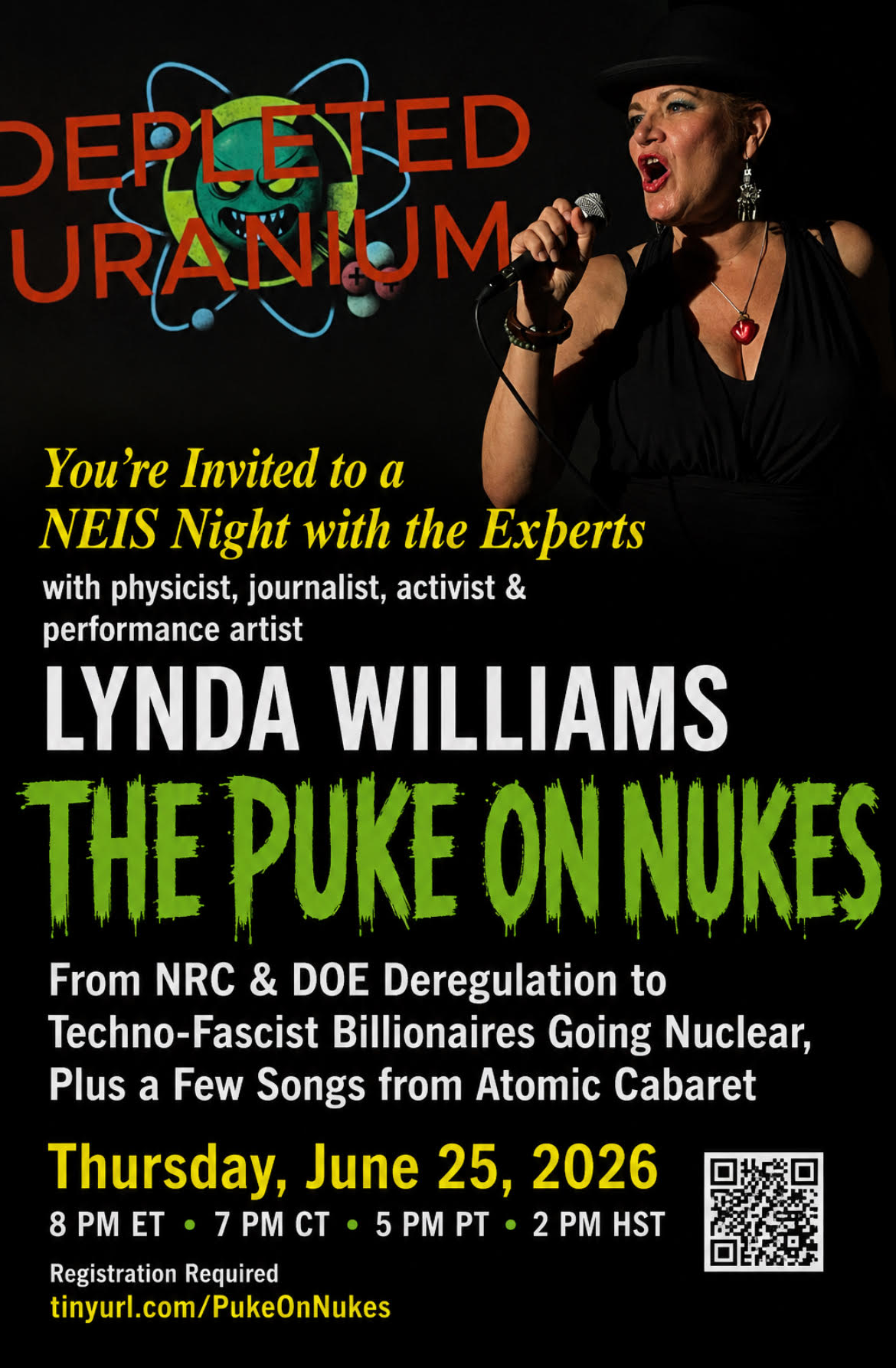
25 June- THE PUKE ON NUKES
Thursday, June 25, 2026
7pm Central Time (8pm ET, 6pm MT, 5pm PT) UTC – 5
From NRC & DOE Deregulation to Techno-Fascist Billionaires Going Nuclear, Plus a Few Songs from Atomic Cabaret REGISTER
26 June – Radiation Trainwreck at the NRC / Join the Protect Better Campaign – https://us02web.zoom.us/meeting/register/4ZlZ5_qLSHGiLSCg8FF6Bg#/registration
1st July – Webinar Waste of Space: The Environmental Harm of Military and Civil Space Activity st July, 7 pm

Report Launch Online: We are seeing an increasing exploitation of space for military and commercial purposes. This must change.

Protect Sazan Island from the Trump family! https://secure.avaaz.org/campaign/en/protect_sazan_island_from_the_trump_family_loc/?bqFCVab&v=174511&cl=22707147157&_checksum=5e9dde668860e8231c33699735e16a1fbf22ab2cb01da50c999fe8732b9775ef&utm_source=email&utm_medium=blast_email&utm_campaign=174511


Cuba Is Not a Failed State – It Is a Besieged State
PETITION: “Global Appeal to Endorse Palestinian Right of Return of Refugees”
To see nuclear-related stories in greater depth and intensity – go to https://nuclearinformation.wordpress.com
-
Archives
- June 2026 (227)
- May 2026 (306)
- April 2026 (356)
- March 2026 (251)
- February 2026 (268)
- January 2026 (308)
- December 2025 (358)
- November 2025 (359)
- October 2025 (376)
- September 2025 (257)
- August 2025 (319)
- July 2025 (230)
-
Categories
- 1
- 1 NUCLEAR ISSUES
- business and costs
- climate change
- culture and arts
- ENERGY
- environment
- health
- history
- indigenous issues
- Legal
- marketing of nuclear
- media
- opposition to nuclear
- PERSONAL STORIES
- politics
- politics international
- Religion and ethics
- safety
- secrets,lies and civil liberties
- spinbuster
- technology
- Uranium
- wastes
- weapons and war
- Women
- 2 WORLD
- ACTION
- AFRICA
- Atrocities
- AUSTRALIA
- Christina's notes
- Christina's themes
- culture and arts
- Events
- Fuk 2022
- Fuk 2023
- Fukushima 2017
- Fukushima 2018
- fukushima 2019
- Fukushima 2020
- Fukushima 2021
- general
- global warming
- Humour (God we need it)
- Nuclear
- RARE EARTHS
- Reference
- resources – print
- Resources -audiovicual
- Weekly Newsletter
- World
- World Nuclear
- YouTube
-
RSS
Entries RSS
Comments RSS
 nuclear-news