The UK would open a “Pandora’s box” if it were to consider using its nuclear arsenal against non-nuclear countries
The UK would open a “Pandora’s box” if it were to consider using its
nuclear arsenal against non-nuclear countries possessing equivalent weapons
of mass destruction, a former defence secretary has warned. Raising his
concerns at Westminster, Labour peer Lord Reid of Cardowan argued against
any shift in the potential deployment of the UK’s submarine-based
deterrent. He made his comments this evening following the Government
publishing details of its major review of foreign and defence policy, known
as the Integrated Review.
City AM 23rd March 2021
UK’s decision to expand nuclear weapons – destabilises the fragile world order say Musicians for Peace and disarmament
| Guardian 23rd March 2021, Letter: Serhii Plokhy’s article (Boris Johnson is playing a dangerous nuclear game, 19 March) explains why this could not be a worse time for the government to raise the cap on nuclear warheads. Musicians for Peace and Disarmament (MPD) has been campaigning for a nuclear-free world since 1983. Although progress towards this end has been painfully slow, little did we expect such a sudden and profound setback as the recent announcement. This reckless decision threatens to destabilise the already fragile world order, and instead of using precious funds for positive purposes, it squanders them on weapons of mass destruction that can never be used, are illegal, and are inherently immoral. Society will need rebuilding after the destructive effects of the pandemic; millions of people around the world are in desperate need of help after years of conflict in their countries, yet foreign aid has been cut; and the climate emergency, now almost at the point of no return, must be made a matter of absolute priority. Along with countless other people who have expressed their dismay, MPD strongly urges the prime minister and his government to show political wisdom and moral leadership by withdrawing this plan. https://www.theguardian.com/politics/2021/mar/23/boris-johnson-should-withdraw-this-reckless-nuclear-weapons-plan |
Covid-19 causes more delays and costs for Hinkley Point C nuclear projects
New Civil Engineer 23rd March 2021, The cost of Hinkley Point C nuclear power station has risen by around £500M and its start date pushed back to June 2026 due to delays arising from the Covid-19 pandemic. In January, EDF said it expected the Somerset project to cost up to £23bn compared with a 2019 estimate of a £22.5bn maximum.
The start of electricity generation from Unit One of the power station had been scheduled for the end of 2025, but work postponed last year at the height of the first lockdown has not yet been completed. In a message to employees, Hinkley Point C managing director Stuart Crooks said: “Ten months after it began, we are still facing the full force of the
pandemic. “Even though experience has allowed us to increase numbers on site during the pandemic from below 2,000 to more than 5,000, social distancing requirements still limit the number of people we can safely have
on site at any one time.” Crooks added that “a longer construction period also adds some cost — as does the reduced efficiency of operating a site for a long period under Covid-19 conditions”.
https://www.newcivilengineer.com/latest/hs2-and-hinkley-to-crossrail-and-tideway-tracking-covids-impact-on-uks-biggest-infrastructure-projects-23-03-2021/
France’s nuclear reactors in state of disrepair, reducing electricity output
World Nuclear Industry Status Report 21st March 2021, Will France ever run out of electricity? Hardly believable in the homeland of nuclear power! By the admission of EDF officials, France is no longer immune to power cuts on very cold days. Here’s why. on January 8, RTE , the subsidiary of EDF in charge of balancing electricity supply and demand, invited households to reduce their consumption in order to avoid a bad surprise.
The production capacities, ie 88,200 megawatts, were indeed just sufficient to cover the needs (88,000 megawatts). The day went off without a hitch, but ” the winter of 2020-2021 remains under special vigilance, mainly because of the health crisis,” RTE made a point of clarifying . If the weather conditions turn out to be normal, then no difficulty will be
expected with the electricity supply. On the other hand, in the event of a cold snap, difficulties could arise ”.
An elegant way to ask us to prepare the candles … Name of a pylon, but how did it come to this, in a country supposedly king of nuclear energy ? The first reason is precisely the state of disrepair of our atomic park. In the annual World Nuclear Industry Status Report for 2020, written by a group of internationalbexperts led by Mycle Schneider, the chapter devoted to France is particularly harsh for our national electricity supplier.
It reveals that the number of days of unavailability of its 58 reactors exploded in 2019, reaching 96.2 on average. This represents more than three months of closure each year for each of our plants. ! Suddenly, the load factor of the tricolor nuclear fleet (in other words its real production compared to its capacities) does not exceed 68.1%, an extremely low figure. By way of comparison, other nuclear countries, such as the United States, show
performances close to 90%.
https://www.worldnuclearreport.org/La-France-va-t-elle-manquer-un-jour-d-electricite.html
Ohio Senate votes to remove nuclear power subsidies
Ohio Senate eliminates nuclear subsidies from House Bill 6 Jessie Balmert, https://www.cincinnati.com/story/news/politics/2021/03/24/ohio-senate-vote-axing-nuclear-subsidies-house-bill-6/6971129002/Cincinnati Enquirer COLUMBUS – Lawmakers once touted $1 billion in ratepayer-financed subsidies as essential to saving nuclear plant jobs in northern Ohio. Now, they are ready to repeal those fees.
Ohio Senate unanimously passed House Bill 128, which would eliminate fees for nuclear plants on Ohioans’ electric bills, ax another fee on FirstEnergy customers’ bills and eliminate another benefit for the Akron-based company.
The legislation, which will soon head to Gov. Mike DeWine, comes two years after Ohio lawmakers passed House Bill 6, saying it was needed to save jobs at the Davis-Besse and Perry nuclear plants in northern Ohio.
Nuclear fees in House Bill 6 made headlines last July when former Ohio House Speaker Larry Householder and four others were arrested in connection to a nearly $61 million bribery scheme to pass the law and defend the legislation against a ballot effort to block it.
The scandal is one reason why lawmakers wanted to start over on portions of House Bill 6.
“When the story broke about the scandal and what was happening behind the scenes, I along with every member of this General Assembly was angry, disgusted and disappointed in what we were hearing,” said Rep. Jim Hoops, R-Napoleon. “We did not vote for what was happening behind the scenes and in a room somewhere outside the Statehouse.”
But the scandal was not the only reason. The energy landscape has changed since the state’s GOP-controlled Legislature approved $1 billion in fees on Ohioans’ electric bills for nuclear plants now owned by Energy Harbor.
A late 2019 change from federal utility regulators effectively penalizes companies that receive state subsidies when they sell their power at regional capacity auctions. That means Energy Harbor sees relinquishing the House Bill 6 subsidies as a competitive advantage.
Those in nuclear power are also banking on Democratic President Joe Biden’s policies hurting their competitors: natural gas. Biden stopped the Keystone XL pipeline and blocked new fracking on federal land.
The Ohio Senate passed similar changes in two separate bills, but House Bill 128 was selected as the piece of legislation to hit DeWine’s desk. The bill also includes a review of whether transmission projects – under-scrutinized fees on ratepayers’ bills – are cost-effective.
House Bill 128 keeps $20 million each year for solar projects. The changes would drop the monthly fee from 85 cents to 10 cents for residential customers and from $2,400 to $242 for industrial customers. Fees already charged on some customers’ bills would be refunded.
The legislation doesn’t change cuts to energy efficiency incentives, fees for two coal plants owned by Piketon-based Ohio Valley Electric Corporation or eliminated mandates to incorporate renewable energy into the mix. Those topics could be addressed later. Sen. Sandra Williams, D-Cleveland, said she would continue to advocate for a full repeal.
The House must approve some technical changes before the bill hits DeWine’s desk.
German government settles disputes with nuclear plant operators
German govt decides amended nuclear law, settles disputes with plant operators, https://www.cleanenergywire.org/news/german-govt-decides-amended-nuclear-law-settles-disputes-plant-operatorsClean Energy Wire 24 Mar 21,
Germany’s government cabinet today approved an amendment to the Nuclear Energy Act which provides for financial compensation to nuclear power plant operators due to the country’s phase-out decision of 2011. Plant operators will be compensated with a total of 2.4 billion euros for the amount of electricity they couldn’t sell and devalued investments, government ministries had announced earlier this month.
An amendment of the existing compensation rules was necessary after Germany’s highest court ruled in November 2020 that the compensation clauses in the nuclear exit law are unconstitutional. While the ruling left the general nuclear phase-out decision and timetable untouched, it forced the government to revisit the law again. Now the government also announced that it had agreed with energy companies EnBW, E.ON/PreussenElektra, RWE and Vattenfall to set the actual amounts of compensation and in return have the companies settle all related legal disputes.
Environment minister Svenja Schulze, whose ministry drafted the amendment said in a press release: “It is good that we are now finally drawing a line under the protracted legal disputes. This is happening at a price that is significantly lower than the energy suppliers’ original demands.”
Germany will pay compensation totalling about 2.428 billion euros. Vattenfall will receive 1.425 billion euros, RWE 880 million euros, EnBW 80 million euros and E.ON/PreussenElektra 42.5 million euros. The compensation is granted primarily for electricity volumes that cannot be used in the group’s own nuclear power plants (RWE and Vattenfall) – a total of about 2.3 billion euros – and for devalued investments in the lifetime extension withdrawn by the German Bundestag (EnBW, E.ON/PreussenElektra and RWE).
Germany’s accelerated nuclear exit was passed by a large majority in parliament in 2011. The last nuclear reactor will go offline at the end of 2022.
Minister Svenja Schulze said that, with the accelerated nuclear phase-out, Germany has created “predictability and reliability on the energy market and cleared the way for electricity from wind and sun”. Johannes Teyssen, CEO of German energy company E.ON, told business daily Handelsblatt that days of nuclear energy are numbered, as no business-oriented company will invest in it. “If nuclear power plants are still being built anywhere, it will be by state-owned companies or with massive state support,” he said, and added it is “too expensive, too risky and too politically explosive”. Teyssen also said he was sceptical of plans for small nuclear power units.NEWS
March to End the Madness of War!

This March Let’s End the Madness of War!
|



 March 2021
 Tuesday, March 30, 2021: 8-9:30 pm EDT; 7-8:30 pm CDT;
View original post 1,971 more words
Environmental Ruin in Modern Iraq – largely due to depleted uranium.


In particular, she points to depleted uranium, or DU, used by the U.S. and U.K. in the manufacture of tank armor, ammunition, and other military purposes during the Gulf War and the 2003 invasion of Iraq.
The United Nations Environment Program estimates that some 2,000 tons of depleted uranium may have been used in Iraq, and much of it has yet to be cleaned up.
‘Everything Living Is Dying’: Environmental Ruin in Modern Iraq, Decades of war, poverty, and fossil fuel extraction have devastated the country’s environment and its people. Undark, BY LYNZY BILLING, 12.22.2021 All photos by LYNZY BILLING for UNDARK ”’,,,,,,,,,,,,,,,,,,,,,,,,,,,,,,,,,,,,,,,,,,, Miscarriages, of course, are common everywhere, and while pollution writ large is known to be deadly in the aggregate, linking specific health outcomes to local ambient pollution is a notoriously difficult task. Even so, few places on earth beg such questions as desperately as modern Iraq, a country devastated from the northern refineries of Kurdistan to the Mesopotamian marshes of the south — and nearly everywhere in between — by decades of war, poverty, and fossil fuel extraction.
As far back as 2005, the United Nations had estimated that Iraq was already littered with several thousand contaminated sites. Five years later, an investigation by The Times, a London-based newspaper, suggested that the U.S. military had generated some 11 million pounds of toxic waste and abandoned it in Iraq. Today, it is easy to find soil and water polluted by depleted uranium, dioxin and other hazardous materials, and extractive industries like the KAR oil refinery often operate with minimal transparency. On top of all of this, Iraq is among the countries most vulnerable to climate change, which has already contributed to grinding water shortages and prolonged drought. In short, Iraq presents a uniquely dystopian tableau — one where human activity contaminates virtually every ecosystem, and where terms like “ecocide” have special currency.
According to Iraqi physicians, the many overlapping environmental insults could account for the country’s high rates of cancer, birth defects, and other diseases. Preliminary research by local scientists supports these claims, but the country lacks the money and technology needed to investigate on its own. To get a better handle on the scale and severity of the contamination, as well as any health impacts, they say, international teams will need to assist in comprehensive investigations. With the recent close of the ISIS caliphate, experts say, a window has opened.
While the Iraqi government has publicly recognized widespread pollution stemming from conflict and other sources, and implemented some remediation programs, few critics believe these measures will be adequate to address a variegated environmental and public health problem that is both geographically expansive and attributable to generations of decision-makers — both foreign and domestic — who have never truly been held to account. The Iraqi Ministry of Health and the Kurdistan Ministry of Health did not respond to repeated requests for comment on these issues……………………….
experts who study Iraq’s complex mosaic of pollution and health challenges say. Despite overwhelming evidence of pollution and contamination from a variety of sources, it remains exceedingly difficult for Iraqi doctors and scientists to pinpoint the precise cause of any given person’s — or even any community’s — illness; depleted uranium, gas flaring, contaminated crops all might play a role in triggering disease……………………………
This is Eman’s sixth year at the hospital, and her 25th as a physician. Over that time span, she says, she has seen an array of congenital anomalies, most commonly cleft palates, but also spinal deformities, hydrocephaly, and tumors. At the same time, miscarriages and premature births have spiked among Iraqi women, she says, particularly in areas where heavy U.S. military operations occurred as part of the 1991 Gulf War and the 2003 to 2011 Iraq War.
Research supports many of these clinical observations. According to a 2010 paper published in the American Journal of Public Health, leukemia cases in children under 15 doubled from 1993 to 1999 at one hospital in southern Iraq, a region of the country that was particularly hard hit by war. According to other research, birth defects also surged there, from 37 in 1990 to 254 in 2001.
But few studies have been conducted lately, and now, more than 20 years on, it’s difficult to know precisely which factors are contributing to Iraq’s ongoing medical problems. Eman says she suspects contaminated water, lack of proper nutrition, and poverty are all factors, but war also has a role. In particular, she points to depleted uranium, or DU, used by the U.S. and U.K. in the manufacture of tank armor, ammunition, and other military purposes during the Gulf War and the 2003 invasion of Iraq.
The United Nations Environment Program estimates that some 2,000 tons of depleted uranium may have been used in Iraq, and much of it has yet to be cleaned up. The remnants of DU ammunition are spread across 1,100 locations — “and that’s just from the 2003 invasion,” says Zwijnenburg, the Dutch war-and-environment analyst. “We are still missing all the information from the 1991 Gulf War that the U.S. said was not recorded and could not be shared.”
Souad Naji Al-Azzawi, an environmental engineer and a retired University of Baghdad professor, knows this problem well. In 1991, she was asked to review plans to reconstruct some of Baghdad’s water treatment plants, which had been destroyed at the start of the Gulf War, she says. A few years later, she led a team to measure the impact of radiation on soldiers and Iraqi civilians in the south of the country.
Around that same time, epidemiological studies found that from 1990 to 1997, cases of childhood leukemia increased 60 percent in the southern Iraqi town of Basra, which had been a focal point of the fighting. Over the same time span, the number of children born with severe birth defects tripled. Al-Azzawi’s work suggests that the illnesses are linked to depleted uranium. Other work supports this finding and suggests that depleted uranium is contributing to elevated rates of cancer and other health problems in adults, too.
Today, remnants of tanks and weapons line the main highway from Baghdad to Basra, where contaminated debris remains a part of residents’ everyday lives. In one family in Basra, Zwijnenburg noted, all members had some form of cancer, from leukemia to bone cancers.
To Al-Azzawi, the reasons for such anomalies seem plain. Much of the land in this area is contaminated with depleted uranium oxides and particles, she said. It is in the water, in the soil, in the vegetation. “The population of west Basra showed between 100 and 200 times the natural background radiation levels,” Al-Azzawi says.
Some remediation efforts have taken place. For example, says Al-Azzawi, two so-called tank graveyards in Basra were partially remediated in 2013 and 2014. But while hundreds of vehicles and pieces of artillery were removed, these graveyards remain a source of contamination. The depleted uranium has leached into the water and surrounding soils. And with each sandstorm — a common event — the radioactive particles are swept into neighborhoods and cities.
Cancers in Iraq catapulted from 40 cases among 100,000 people in 1991 to at least 1,600 by 2005.

In Fallujah, a central Iraqi city that has experienced heavy warfare, doctors have also reported a sharp rise in birth defects among the city’s children. According to a 2012 article in Al Jazeera, Samira Alani, a pediatrician at Fallujah General Hospital, estimated that 14 percent of babies born in the city had birth defects — more than twice the global average.
Alani says that while her research clearly shows a connection between contamination and congenital anomalies, she still faces challenges to painting a full picture of the affected areas, in part because data was lacking from Iraq’s birth registry. It’s a common refrain among doctors and researchers in Iraq, many of whom say they simply don’t have the resources and capacity to properly quantify the compounding impacts of war and unchecked industry on Iraq’s environment and its people. “So far, there are no studies. Not on a national scale,” says Eman, who has also struggled to conduct studies because there is no nationwide record of birth defects or cancers. “There are only personal and individual efforts.”…………………..

After the Gulf War, many veterans suffered from a condition now known as Gulf War syndrome. Though the causes of the illness are to this day still subject to widespread speculation, possible causes include exposure to depleted uranium, chemical weapons, and smoke from burning oil wells. More than 200,000 veterans who served in Iraq, Afghanistan, and elsewhere in the Middle East have reported major health issues to the Department of Veterans Affairs, which they believe are connected to burn pit exposure. Last month, the White House announced new actions to make it easier for such veterans to access care.
Numerous studies have shown that the pollution stemming from these burn pits has caused severe health complications for American veterans. Active duty personnel have reported respiratory difficulties, headaches, and rare cancers allegedly derived from the burn pits in Iraq and locals living nearby also claim similar health ailments, which they believe stem from pollutants emitted by the burn pits.
Keith Baverstock, head of the Radiation Protection Program at the World Health Organization’s Regional Office for Europe from 1991 to 2003, says the health of Iraqi residents is likely also at risk from proximity to the burn pits. “If surplus DU has been burned in open pits, there is a clear health risk” to people living within a couple of miles, he says.
Abdul Wahab Hamed lives near the former U.S. Falcon base in Baghdad. His nephew, he says, was born with severe birth defects. The boy cannot walk or talk, and he is smaller than other children his age. Hamed says his family took the boy to two separate hospitals and after extensive work-ups, both facilities blamed the same culprit: the burn pits. Residents living near Camp Taji, just north of Baghdad also report children born with spinal disfigurements and other congenital anomalies, but they say that their requests for investigation have yielded no results. ……………………………………… https://undark.org/2021/12/22/ecocide-iraq/
A message from Forest Measurement Laboratory in Namegawa
March 6, 2021
A message from a representative of the Forest Measurement Laboratory, a group that measures radioactivity in Saitama Prefecture, just north of Tokyo. It was founded in the fall of 2012 mainly by mothers after the Fukushima nuclear disaster.
They thought that measurements by municipalities were not sufficient to protect their children from radiation exposure, so they started this project by themselves.
Fukushima, a ‘coordinator’ for the nuclear-stricken area, takes a cue from the U.S. to break away from reconstruction dependent on the government
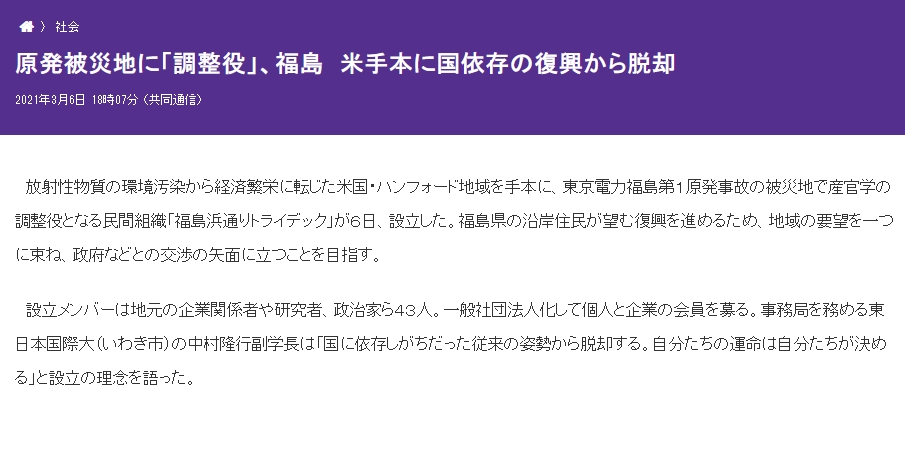
March 6, 2021, 18:07 (Kyodo News)
On March 6, a private organization called Fukushima Hamadori Tridec was established to serve as a coordinator between industry, government and academia in the areas affected by the accident at Tokyo Electric Power Company’s Fukushima No. 1 nuclear power plant. In order to promote the reconstruction that the coastal residents of Fukushima Prefecture desire, the organization aims to unite the demands of the region and take the brunt of negotiations with the government and other parties.
The 43 founding members include local business people, researchers, and politicians. The organization will be incorporated as a general incorporated association and will invite individual and corporate members. Takayuki Nakamura, vice president of East Japan International University (Iwaki City), who will serve as the secretariat, said, “We will break away from our traditional stance of depending on the government. We will decide our own fate,” he said of the founding principles.
https://www.tokyo-np.co.jp/article/89939?fbclid=IwAR0IVgauLUBacHECWFx2axSSV7o5CUqvtvxw6KcLJtZ6A1bqoHtwcQ-cEl8
Fukushima nuclear crisis evacuees face unresolved issues 10 years on
Almost 10 years on from a devastating earthquake and tsunami that hit northeastern Japan and triggered one of the worst nuclear disasters in history, Seiichi Nakate still has not returned home.
He is just one of around 30,000 evacuees from Fukushima Prefecture who remained scattered around the country as of February this year, according to government data.

Photo taken Oct. 22, 2017 shows makeshift housing in Iwaki, Fukushima Prefecture, built for evacuees from Futaba, a town co-hosting the crippled Fukushima Daiichi nuclear complex.
March 5, 2021
And while the numbers — including those who voluntarily fled without an evacuation order — have halved from their peak of 62,831 in March 2012, many of the issues facing evacuees remain unresolved.
Nakate, who was living in the prefectural capital of Fukushima when the earthquake struck on March 11, 2011, said the disaster had “pulled the rug out from under” him and left him feeling like he was “fading away.”
While the city was not designated for forced evacuations after the reactor meltdowns at the Fukushima Daiichi nuclear plant some 60 kilometers away, concerns over radiation led Nakate and his wife to decide two weeks later that she and their two children should move to western Japan while he stayed on in the city.
It was not until around a year and a half later that the family finally started living together again, setting up home in Sapporo, the capital of Japan’s northern main island of Hokkaido, where they still remain.
Nakate, 60, currently co-heads Hinan no Kenri, a Hokkaido-based group fighting for the rights of Fukushima evacuees throughout Japan.
The movement was established in 2015 amid government efforts to promote the return of people to Fukushima — a drive that he says was conducted without consideration to the needs and desires of evacuees.
“It had been more than four years since the accident, and the central and local governments were moving forward with lifting evacuation orders, ending compensation, and promoting the return of evacuees as if ignoring our existence and will,” Nakate said.
His organization has a variety of demands for the central government, the foremost being a survey of the actual situation of evacuees, which he believes it has deliberately avoided doing so far.
Critics say the figures compiled by the central government do not accurately reflect reality as they are based on a system under which evacuees voluntarily register themselves as such with their new municipalities of residence.
In December last year, the Fukushima government, using central government data, reported that there were around 36,000 evacuees across Japan, including those within the prefecture. But the total reported by individual local municipalities in Fukushima added up to more than 67,000.
The picture is complicated by the fact that there is no consistency in how municipalities count their evacuees, with some continuing to list all the people who were registered as residents at the time of the disaster.
Nakate also highlighted that economic disparities among evacuees appear to be widening, in part due to “the narrow scope of compensation and the lack of government support.” For example, evacuees who fled from areas without evacuation orders were not eligible for any compensation in terms of rent.
And while some evacuees have fully settled into their new homes, others have been compelled to resettle in the crisis-hit prefecture due to financial difficulties, often caused by family members living separately, he says.
One of the “most pressing issues” his organization is dealing with is trouble over the termination of a scheme financed by Fukushima Prefecture for evacuees to live in vacant units of housing complexes for government workers in other parts of Japan.
The housing was initially offered for free but this arrangement expired in March 2017 for those who fled without an evacuation order, with the accommodation then offered for a maximum of two more years if normal rent was paid.
But some families, claiming financial difficulties, have decided to stay put. The Fukushima government, which had shouldered the rent, demanded in 2019 twice the normal rent as damages and filed a suit last year against four families still living in a Tokyo condominium for bureaucrats.

Yayoi Haraguchi, a sociology professor at Ibaraki University and head of nonprofit organization Fuainet:
Yayoi Haraguchi, a sociology professor at Ibaraki University, said that while most Fukushima evacuees have settled into a rhythm, issues such as poverty, unemployment, a sense of alienation, and mental distress have continued over the past decade.
“It may look like things are alright, but many unseen issues lie under the surface,” said Haraguchi, 48, who also heads Fuainet, a local nonprofit organization providing support to Fukushima evacuees in Ibaraki, northeast of Tokyo.
Haraguchi said she has encountered evacuees in their 20s to 40s who have fallen into depression or become social recluses after they were unable to find a job. Yet others are struggling financially despite having received government compensation for a period of time.
“A study by Fukushima Medical University Hospital showed that those who evacuated to outside Fukushima Prefecture were more likely to suffer from mental issues than those who had evacuated to somewhere within the prefecture,” she said.
While the initial evacuations were often hurried, many of those remaining outside the prefecture have since moved in search of a better life, she said, often choosing to settle in Ibaraki Prefecture bordering Fukushima to its south.
Part of Ibaraki’s appeal to evacuees, she explained, is its cheaper cost of living compared to Tokyo and relatively mild climate.
Post-disaster evacuations were also not limited to Fukushima, with some residents of Tokyo — located about 200 kilometers away from the crippled nuclear power plant — choosing to leave the capital, and even the country, due to their perceptions of how the radiation contamination could affect their health.

Freelance journalist and translator Mari Takenouchi, now based in Okinawa:
Freelance journalist and translator Mari Takenouchi, who has long held strong antinuclear views, fled from Tokyo to Okinawa with her infant son just days after the disaster. She says she picked the southern island prefecture as it is one of the few places in Japan free of nuclear power plants.
“If (the government) doesn’t shut down its nuclear power plants, it is dangerous to live in mainland Japan,” she said. “Japan is on the border of four (tectonic) plates, and 20 percent of the world’s major earthquakes of magnitude 6 or greater occur here.”
Since moving to Okinawa, the 54-year-old has worked to create greater awareness about the effects of radiation on children and fetuses. “The situation after the Fukushima accident has not become better, but worse. Considering the occasional earthquakes, all of us are still at great risk,” she said.

Kaori Nagatsuka, a former Tokyo resident who moved to Malaysia with her two children after the 2011 Fukushima nuclear crisis:
Kaori Nagatsuka, 52, another former resident of Tokyo, moved to Malaysia with her 9-year-old daughter and 2-year-old son in March 2012, also due to concerns over her children’s health.
Shortly after moving to Penang, Nagatsuka assisted other evacuees who were considering migrating outside of Japan by letting them stay in her home and volunteering to show them around potential schools for their children.
“There were quite a lot of people who wanted to emigrate in consideration of their children’s health but in the end couldn’t for various reasons,” said Nagatsuka, who now works for a local Malaysian company as a travel and education consultant.
Nagatsuka said she chose Malaysia due to its lower cost of living compared to other countries and relative proximity to Japan. But despite her husband remaining in Tokyo due to work, she has not returned home even once since leaving.
The family meets on occasion in either Malaysia or Taiwan, where their daughter, now 19, currently studies. And while her children are free to choose where they want to live in the future, Nagatsuka says she personally has taken a liking to Malaysia and has no plans to return to Japan.
“If I return to Japan, my children will likely come and visit me and that worries me because I think it could damage their health,” she said. “I raised my children with an aim that they could live in any country and I fulfilled my goal, so I’m glad I came here.”
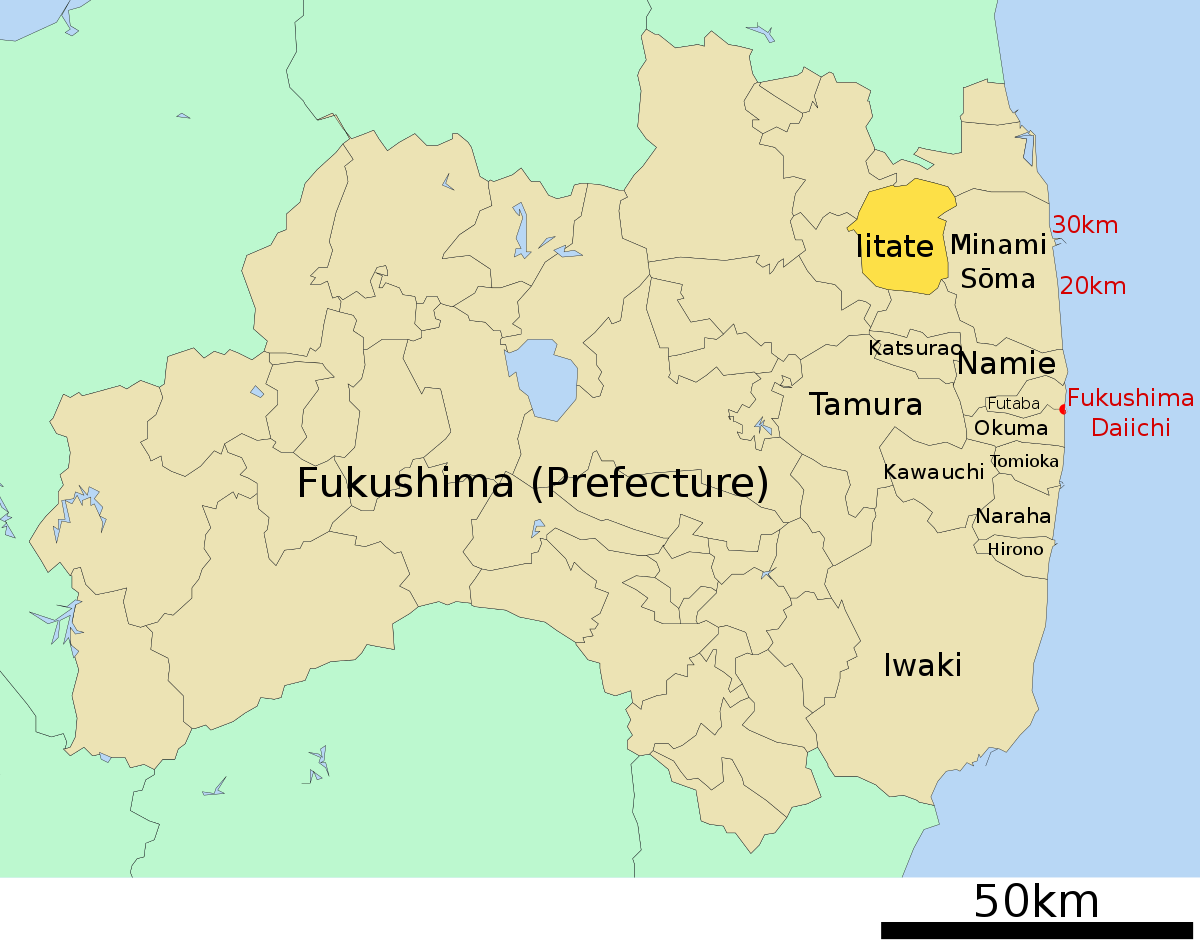
Complaint by residents of Iitaté against TEPCo and the State for exposure to radioactivity
March 5, 2021
The commune of Iitaté, located beyond the 30 km radius, was evacuated late. The order to evacuate was announced on April 11, 2011 and the inhabitants had one month to leave. During this time, those who had not left the area by themselves were exposed to radioactive fallout.
29 residents of Iitaté filed a lawsuit against TEPCo and the State and asked for 200 million yen of damages because the authorities had told them at the beginning of the disaster that it was not necessary to leave. The lack of information about the increase in radiation levels deprived them of their right to evacuate and left them unnecessarily exposed.
They also claim that the subsequent evacuation of the entire village caused them to lose their homes and farms, destroyed their community and deprived them of their hometown.
The leader of the plaintiffs, Kanno Hiroshi, says that he has developed illnesses over the past ten years and that concerns about the effects of radiation will never go away. He holds the government and the plant operator responsible.
This is the first class action suit filed to seek compensation for radiation exposure during the early days of the nuclear accident.
It should be noted that the first independent measurements carried out by ACRO in Japan following the Fukushima nuclear disaster concerned Iitaté. See the results and the press release of the time. These results showed an alarming situation.
ACRO wrote that iodine-131 contamination was preponderant, with levels such that it would be prudent to evacuate the village of Iitate: at the place called Maeda, we had detected 1.9 million becquerels per square meter. Regarding radioactive cesium, almost all the areas monitored by ACRO were above the limits set in Belarus for migration.
Infamous Fukushima town sign praising nuclear energy to become permanent museum display

全町避難が続く福島県双葉町で、原発推進看板の撤去工事を見守る標語考案者の大沼勇治さん=21日
 Infamous Fukushima town sign praising nuclear energy to become permanent museum display https://mainichi.jp/english/articles/20210320/p2a/00m/0na/006000c, March 20, 2021 (Mainichi Japan) FUKUSHIMA — A sign hailing nuclear energy and formerly located on the main street of Fukushima Prefecture town Futaba, which was rendered inaccessible following the nuclear meltdowns triggered by the March 2011 Great East Japan Earthquake, will go on display at the Great East Japan Earthquake and Nuclear Disaster Memorial Museum in the town from March 24. The sign measures 2 meters by 16 meters, and reads “Nuclear Power: Energy for a Bright Future.” After the 2011 nuclear disaster at the Tokyo Electric Power Co. Fukushima Daiichi Nuclear Power Station, the sign became iconic nationally as a symbol of the northeastern Japan town that pushed for nuclear power and still remains entirely subject to evacuation orders. The sign was removed in March 2016 because its deterioration posed dangers, and photos of the sign were displayed at the museum. It is too large to be placed indoors, so authorities delayed its display when opening the museum in September 2020; in the meantime, discussions on how to exhibit it were held with the Fukushima Prefectural Government. Then, on March 19, the prefectural government announced the sign will go on permanent display at the museum’s outdoor terrace from March 24. Yuji Onuma, 45, who came up with the sign’s slogan when he was in elementary school, said, “I believe exhibiting the sign will symbolize a resolve to never have another nuclear accident, and to aim for a bright future this time around. It took a long time after its removal for display plans to be finalized, but I hope coming face to face with the real thing will give visitors a chance to think about the nuclear disaster.” (Japanese original by Ryusuke Takahashi, Fukushima Bureau) |
|
Bill Gates backs costly nuclear reactor design fueled by nuclear-weapon-usable plutonium

Bill Gates’ bad bet on plutonium-fueled reactors https://thebulletin.org/2021/03/bill-gates-bad-bet-on-plutonium-fueled-reactors/?utm_source=Newsletter&utm_medium=Email&utm_campaign=MondayNewsletter03222021&utm_content=NuclearRisk_Gates_03222021 By Frank N. von Hippel | March 22, 2021
One of Bill Gates’ causes is to replace power plants fueled by coal and natural gas with climate-friendly alternatives. That has led the billionaire philanthropist and Microsoft co-founder to embrace nuclear power, and building nuclear power plants to combat climate change is a prospect worth discussing. But Gates has been persuaded to back a costly reactor design fueled by nuclear-weapon-usable plutonium and shown, through decades of experience, to be expensive, quick to break down, and difficult to repair.
In fact, Gates and his company, Terrapower, are promoting a reactor type that the US and most other countries abandoned four decades ago because of concerns about both nuclear weapons proliferation and cost.
The approximately 400 power reactors that provide about 10 percent of the world’s electric power today are almost all water-cooled and fueled by low-enriched uranium, which is not weapon usable. Half a century ago, however, nuclear engineers were convinced—wrongly, it turned out—that the global resource of low-cost uranium would not be sufficient to support such reactors beyond the year 2000.
Work therefore began on liquid-sodium-cooled “breeder” reactors that would be fueled by plutonium, which, when it undergoes a fission chain reaction, produces neutrons that can transmute the abundant but non-chain-reacting isotope of natural uranium, u-238, into more plutonium than the reactor consumes.
But mining companies and governments found a lot more low-cost uranium than originally projected. The Nuclear Energy Agency recently concluded that the world has uranium reserves more than adequate to support water-cooled reactors for another century.
And while technologically elegant, sodium-cooled reactors proved unable to compete economically with water-cooled reactors, on several levels. Admiral Rickover, who developed the US Navy’s water-cooled propulsion reactors from which today’s power reactors descend, tried sodium-cooled reactors in the 1950s. His conclusion was that they are “expensive to build, complex to operate, susceptible to prolonged shutdown as a result of even minor malfunctions, and difficult and time-consuming to repair.” That captures the experience of all efforts to commercialize breeder reactors. The United States, Germany, the United Kingdom, France, and Japan all abandoned their breeder-reactor efforts after spending the equivalent of $10 billion or more each on the effort.
Today, despite about $100 billion spent on efforts to commercialize them, only two sodium-cooled breeder reactor prototypes are operating—both in Russia. India is building one, and China is building two with Russian help. But it is not clear India and China are looking only to generate electricity with their breeders; they may also be motivated in part by the fact that breeder reactors produce copious amounts of the weapon-grade plutonium desired by their militaries to expand their nuclear-weapon stockpiles.
The proliferation risks of breeder-reactor programs were dramatically demonstrated in 1974, when India carried out its first explosive test of a nuclear-weapon design with plutonium that had been produced with US Atoms for Peace Program assistance for India’s ostensibly peaceful breeder reactor program. The United States, thus alerted, was able to stop four more countries, governed at the time by military juntas (Brazil, Pakistan, South Korea, and Taiwan), from going down the same track—although Pakistan found another route to the bomb via uranium enrichment.
It was India’s 1974 nuclear test that got me involved with this issue as an advisor to the Carter administration. I have been involved ever since, contributing to the plutonium policy debates in the United States, Japan, South Korea and other countries.
In 1977, after a policy review, the Carter administration concluded that plutonium breeder reactors would not be economic for the foreseeable future and called for termination of the US development program. After the estimated cost of the Energy Department’s proposed demonstration breeder reactor increased five-fold, Congress finally agreed in 1983
Gates is obviously not in it for the money. But his reputation for seriousness may have helped recruit Democratic Senators Cory Booker, Dick Durbin, and Sheldon Whitehouse to join the two Republican senators from Idaho in a bipartisan coalition to co-sponsor the Nuclear Energy Innovations Capabilities Act of 2017, which called for the VTR.
I wonder if any of those five Senators knows that the VTR is to be fueled annually by enough plutonium for more than 50 Nagasaki bombs. Or that it is a failed technology. Or that the Idaho National Laboratory is collaborating on plutonium separation technology with the Korea Atomic Energy Research Institute at a time when about half of South Korea’s population wants nuclear weapons to deter North Korea.
Fortunately, it is not too late for the Biden administration and Congress to avoid repeating the mistakes of the past and to zero out the Versatile Test Reactor in the Department of Energy’s next budget appropriations cycle. The money could be spent more effectively on upgrading the safety of our existing reactor fleet and on other climate-friendly energy technologies.
Frank N. von Hippel
Frank N. von Hippel is a co-founder of the Program on Science and Global Security at Princeton University’s School of Public and International…
Investment advice? Some big worries against investing in nuclear power
 IW Long Reads: Is Nuclear Energy On The Road To Ruin Or A Sustainability Silver Bullet? How the world can reach net zero target without resorting to nuclear power, Investment Week, Anna Fedorova-22Mar 21, Anyone who has seen the TV series Chernobyl knows that when things go wrong with nuclear power the consequences are dire. And while it may seem that matters have evolved since the days of the Soviet Union, the nuclear disaster in Fukushima that happened just ten years ago suggests otherwise.
For example, even when nuclear reactors are running properly, they use “tremendous amounts of water to cool the reactors”, while mining and refining the Earth’s finite resources of uranium ore also requires a large amount of energy.
And of course, there is the question of waste management over many generations, given that uranium rods remain dangerously radioactive for 10,000 years.
“There are also second order effects to investment in nuclear energy such as the certainty that this research can be used to create nuclear weapons and that plants are a high value targets should a war break out,” Stuart adds.
“Disruption in a nuclear plant invariably won’t remain within country borders so there is also the issue of diplomacy to consider. In short, nuclear is a textbook example of a controversial stock and any investor would be wise to question its place in an ESG portfolio.” ……………….
the balance is expected to shift towards renewables, which is expected to lead to a decentralisation of the power grids, posing further challenges for nuclear.
Jonathan Cohen, partner at Howard Kennedy, says: “Currently, nuclear power projects are being developed at very high costs and it is difficult to finance new projects without large state expenditure.
……………wide scale support from the private sector just is not there, with investors increasingly choosing to stay on the safe side and invest in renewables instead.
Robeco, for example, excludes electricity utilities that generate more than 30% of their power from nuclear sources from all of its sustainable strategies, and does not invest in nuclear power at all in its RobecoSAM Smart Energy Equities strategy.
This decision is driven by a combination of “unique risks”, negative environmental impacts, relatively high costs of nuclear and the “impressive technological and cost developments in both renewables and storage technologies”.
Mark Campanale, founder of the Carbon Tracker Initiative, says: “Our view is that given so many cheaper renewable energy resources available, why would anyone want to go to the expense of what is an uncompetitive technology on price, one which takes hundreds of years to clear up its waste?”
According to Eduardo Monteiro, co-CIO at Victory Hill Capital Advisors, even if nuclear is to play a “robust role” in a country’s energy supply, it has too many shortcomings as a sustainable investment alternative, and should therefore be avoided.
“The waste generated will be a legacy for future generations to deal with and as such investors need to think about the very real negative impact these holdings will have in both the broader sense but also to financial returns,” he says.
“Such managers may naturally prefer to invest in renewables to support their interpretation of ESG investing and the transition to ‘clean’ energy more widely,” he says. https://www.investmentweek.co.uk/analysis/4028635/iw-long-reads-nuclear-energy-road-ruin-sustainability-silver-bullet
1 This Month
Tell Congress: Prevent Nuclear Catastrophe in Iran

Tell Congress: Prevent Nuclear Catastrophe in Iran

Read the Public Inquiry Report, the Commissioners’ report, Surrendering Australia: The AUKUS Deception is available to download for free at aukuspublicinquiry.com. Or just watch the replay of the National Press Club Luncheon.


Shut down the radiation-damaged Heysham nuclear reactors now
To see nuclear-related stories in greater depth and intensity – go to https://nuclearinformation.wordpress.com

Say No to NASA’s Reckless Nuclear Reactor on the Moon
Say No to NASA’s Reckless Nuclear Reactor on the Moon
-
Archives
- November 2026 (255)
- October 2026 (302)
- September 2026 (339)
- August 2026 (330)
- July 2026 (355)
- June 2026 (287)
- May 2026 (306)
- April 2026 (356)
- March 2026 (251)
- February 2026 (267)
- January 2026 (308)
- December 2025 (358)
-
Categories
- 1
- 1 NUCLEAR ISSUES
- business and costs
- climate change
- culture and arts
- ENERGY
- environment
- health
- history
- indigenous issues
- Legal
- marketing of nuclear
- media
- opposition to nuclear
- PERSONAL STORIES
- politics
- politics international
- Religion and ethics
- safety
- secrets,lies and civil liberties
- spinbuster
- technology
- Uranium
- wastes
- weapons and war
- Women
- 2 WORLD
- ACTION
- AFRICA
- Atrocities
- AUSTRALIA
- Christina's notes
- Christina's themes
- culture and arts
- Events
- Fuk 2022
- Fuk 2023
- Fukushima 2017
- Fukushima 2018
- fukushima 2019
- Fukushima 2020
- Fukushima 2021
- general
- global warming
- Humour (God we need it)
- Nuclear
- RARE EARTHS
- Reference
- resources – print
- Resources -audiovicual
- Weekly Newsletter
- World
- World Nuclear
- YouTube
-
RSS
Entries RSS
Comments RSS

