Biden Dangerously Accelerating the New Cold War with China, by Joseph Gerson — Rise Up Times

“While there is much in Joe Biden’s and the Democratic Party’s domestic policy agenda to be admired and supported, rooting it in Trump initiated anti-China hysteria undercuts our national security.”
Biden Dangerously Accelerating the New Cold War with China, by Joseph Gerson — Rise Up Times
The nuclear lobby’s desperate push to be included in COP26. Note the biased agenda of their speakers.

Let’s look at these speakers:
Corporate Astroturf “Nuclear for Climate” is really a lobby group of 140 pro nuclear societies.
Professor Geraldine Thomas and nuclear scientific misconduct.
The Young Generation Network – a part of the Nuclear Institute, which purports to be a charity, but is really a propaganda machine for the industry.
Nuclear societies call for COP26 to support nuclear World Nuclear News, 02 June 2021 …… They are calling on UK Prime Minister Boris Johnson, COP26 President Alok Sharma and United Nations Framework Convention on Climate Change Executive Secretary Patricia Espinosa to acknowledge nuclear’s crucial position alongside renewables in attaining net-zero carbon emissions by 2050.

In February this year, Nuclear for Climate – a grassroots [?] initiative published its COP26 Position Paper, titled Net Zero Needs Nuclear.

“It’s time we used scientific facts rather than urban myths to decide our future energy policy,” said Geraldine Thomas,…..
Fiona Rayment, Chief Science and Technology Officer at the UK’s National Nuclear Laboratory, added: “Nuclear is a clean, reliable and sustainable energy source”

Hannah Paterson, Chair of the Nuclear Institute Young Generation Network. ..
“Fallout: The Hiroshima Cover-up and the Reporter Who Revealed It to the World”

A secondary theme in the book is the role of a free press. Blume observes that “Hersey and his New Yorker editors created `Hiroshima’ in the belief that journalists must hold accountable those in power. They saw a free press as essential to the survival of democracy.” She does, too.
Review: Lesley Blume’s “Fallout: The Hiroshima Cover-up and the Reporter Who Revealed It to the World”, Portside, June 1, 2021 Lawrence Wittner In this crisply written, well-researched book, Lesley Blume, a journalist and biographer, tells the fascinating story of the background to John Hersey’s pathbreaking article “Hiroshima,” and of its extraordinary impact upon the world.
In 1945, although only 30 years of age, Hersey was a very prominent war correspondent for Time magazine—a key part of publisher Henry Luce’s magazine empire………..
Blume reveals that, at the time of the U.S. atomic bombing of Hiroshima, Hersey felt a sense of despair—not for the bombing’s victims, but for the future of the world. He was even more disturbed by the atomic bombing of Nagasaki only three days later, which he considered a “totally criminal” action that led to tens of thousands of unnecessary deaths.
…………. Blume shows very well how this approval of the atomic bombing was enhanced by U.S. government officials and the very compliant mass communications media. Working together, they celebrated the power of the new American weapon that, supposedly, had brought the war to an end, producing articles lauding the bombing mission and pictures of destroyed buildings. What was omitted was the human devastation, the horror of what the atomic bombing had done physically and psychologically to an almost entirely civilian population—the flesh roasted off bodies, the eyeballs melting, the terrible desperation of mothers digging with their hands through the charred rubble for their dying children.
The strange new radiation sickness produced by the bombing was either denied or explained away as of no consequence. “Japanese reports of death from radioactive effects of atomic bombing are pure propaganda,” General Leslie Groves, the head of the Manhattan Project, told the New York Times. Later, when, it was no longer possible to deny the existence of radiation sickness, Groves told a Congressional committee that it was actually “a very pleasant way to die.”
When it came to handling the communications media, U.S. government officials had some powerful tools at their disposal. In Japan, General Douglas MacArthur, the supreme commander of the U.S. occupation regime, saw to it that strict U.S. military censorship was imposed on the Japanese press and other forms of publication, which were banned from discussing the atomic bombing. As for foreign newspaper correspondents (including Americans), they needed permission from the occupation authorities to enter Japan, to travel within Japan, to remain in Japan, and even to obtain food in Japan. American journalists were taken on carefully controlled junkets to Hiroshima, after which they were told to downplay any unpleasant details of what they had seen there.
In September 1945, U.S. newspaper and magazine editors received a letter from the U.S. War Department, on behalf of President Harry Truman, asking them to restrict information in their publications about the atomic bomb. If they planned to do any publishing in this area of concern, they were to submit the articles to the War Department for review…………
Hersey had concluded that the mass media had missed the real story of the Hiroshima bombing. And the result was that the American people were becoming accustomed to the idea of a nuclear future, with the atomic bomb as an acceptable weapon of war. Appalled by what he had seen in the Second World War—from the firebombing of cities to the Nazi concentration camps—Hersey was horrified by what he called “the depravity of man,” which, he felt, rested upon the dehumanization of others. Against this backdrop, Hersey and Shawn concluded that he should try to enter Japan and report on what had really happened there……….
Hersey arrived in Tokyo on May 24, 1946, and two days later, received permission to travel to Hiroshima, with his time in that city limited to 14 days.
Entering Hiroshima, Hersey was stunned by the damage he saw. In Blume’s words, there were “miles of jagged misery and three-dimensional evidence that humans—after centuries of contriving increasingly efficient ways to exterminate masses of other humans—had finally invented the means with which to decimate their entire civilization.” Now there existed what one reporter called “teeming jungles of dwelling places . . . in a welter of ashes and rubble.” As residents attempted to clear the ground to build new homes, they uncovered masses of bodies and severed limbs. A cleanup campaign in one district of the city alone at about that time unearthed a thousand corpses. Meanwhile, the city’s surviving population was starving, with constant new deaths from burns, other dreadful wounds, and radiation poisoning.
Given the time limitations of his permit, Hersey had to work fast. And he did, interviewing dozens of survivors, although he eventually narrowed down his cast of characters to six of them.
……… Ross and Shawn decided to keep the explosive forthcoming issue a top secret from the magazine’s staff.
Given the time limitations of his permit, Hersey had to work fast. And he did, interviewing dozens of survivors, although he eventually narrowed down his cast of characters to six of them.
……… Ross and Shawn decided to keep the explosive forthcoming issue a top secret from the magazine’s staff.
Groves believed that the Japanese deserved what had happened to them, and could not imagine that other Americans might disagree. ………. and he believed that an article that led Americans to fear nuclear attacks by other nations would foster support for a U.S. nuclear buildup.
The gamble paid off. Although Groves did demand changes, these were minor and did not affect the accounts by the survivors…….
On August 29, 1946, copies of the “Hiroshima” edition of the New Yorker arrived on newsstands and in mailboxes across the United States, and it quickly created an enormous sensation, particularly in the mass media. Editors from more than thirty states applied to excerpt portions of the article, and newspapers from across the nation ran front-page banner stories and urgent editorials about its revelations. Correspondence from every region of the United States poured into the New Yorker’s office. A large number of readers expressed pity for the victims of the bombing. But an even greater number expressed deep fear about what the advent of nuclear war meant for the survival of the human race.
Of course, not all readers approved of Hersey’s report on the atomic bombing. Some reacted by canceling their subscriptions to the New Yorker. Others assailed the article as antipatriotic, Communist propaganda, designed to undermine the United States. Still others dismissed it as pro-Japanese propaganda or, as one reader remarked, written “in very bad taste.”
………………………… The conclusion drawn by Blume in this book is much like Hersey’s. As she writes, “Graphically showing what nuclear warfare does to humans, `Hiroshima’ has played a major role in preventing nuclear war since the end of World War II.”
A secondary theme in the book is the role of a free press. Blume observes that “Hersey and his New Yorker editors created `Hiroshima’ in the belief that journalists must hold accountable those in power. They saw a free press as essential to the survival of democracy.” She does, too.
………… Blume has written a very illuminating, interesting, and important work—one that reminds us that daring, committed individuals can help to create a better world.https://portside.org/2021-06-01/review-lesley-blumes-fallout-hiroshima-cover-and-reporter-who-revealed-it-world
President Biden’s budget backs new nuclear weapons, contradicting his policy while campaigning

Biden goes ‘full steam ahead’ on Trump’s nuclear expansion despite campaign rhetoric
The decision to retain a low-yield warhead that was outfitted on submarine-launched ballistic missiles in 2019, and to initiate research into a new sea-launched cruise missile, has sparked an outcry. Politico, By LARA SELIGMAN, BRYAN BENDER and CONNOR O’BRIEN, 06/02/2021
President Joe Biden ran on a platform opposing new nuclear weapons, but his first defense budget backs two controversial new projects put in motion by President Donald Trump and also doubles down on the wholesale upgrade of all three legs of the arsenal.
The decision to retain a low-yield warhead that was outfitted on submarine-launched ballistic missiles in 2019, and to initiate research into a new sea-launched cruise missile, has sparked an outcry from arms control advocates and the progressive wing of the Democratic Party, which is vowing a fight to reverse the momentum.
“The signal this budget is sending is full steam ahead: ‘We like what Trump was doing and we want to do more of it,’’ said Tom Collina, director of policy at the Ploughshares Fund, a leading disarmament group. “It is not the message Biden was sending as a candidate. What we have here is Biden essentially buying into the Trump nuclear plan, in some cases going beyond that.”
Emma Claire Foley, a researcher at Global Zero, a disarmament group, said the latest budget “essentially preserves the priorities of the Trump administration,” despite the new administration’s rhetoric about pursuing a more responsible nuclear posture.
During the 2020 campaign, Biden told the Council for a Livable World, an arms control group, that the current arsenal is “sufficient” and the United States does not need new nuclear weapons. In July 2019, Biden also called Trump’s move to introduce new capabilities a “bad idea.”
The Democratic Party platform in 2020 also bluntly stated that “the Trump Administration’s proposal to build new nuclear weapons is unnecessary, wasteful, and indefensible.”
The Democratic Party platform in 2020 also bluntly stated that “the Trump Administration’s proposal to build new nuclear weapons is unnecessary, wasteful, and indefensible.”
That includes modernizing all three legs of the nuclear triad: the Ground Based Strategic Deterrent, which is the replacement for the fleet of Minuteman III intercontinental ballistic missiles; the Columbia-class ballistic missile submarines; and the new B-21 stealth bomber.
The budget also proposes $609 million for the Long Range Standoff Missile, which is designed to be outfitted on bomber planes. That’s $250 million more than what was projected by the Trump administration for fiscal 2022.
Most controversially, the Pentagon’s request maintains the W76-2 low-yield warhead that is now outfitted on submarines and sets aside $5.2 million for a new sea-launched cruise missile capable of carrying a nuclear warhead. Another $10 million is being requested for the warhead in the budget for the National Nuclear Security Administration, an arm of the Energy Department………….. https://www.politico.com/news/2021/06/02/biden-trump-nuclear-weapons-491631
Australia’s nuclear waste policy shambles

In developing this plan, ANSTO had the option of choosing a different process.
They had the option of disposing of the wastes from O.P.A.L. to the USA, providing a cheaper alternative for ANSTO:
Australia’s nuclear waste policy shambles https://independentaustralia.net/politics/politics-display/australias-nuclear-waste-policy-shambles,15146B 2 June 2021 The Government is scrambling to figure out a solution to Australia’s nuclear waste problem with a new bill before the Senate, writes Noel Wauchope.
TO BE FAIR, Australia is not alone in having a shambolic policy on nuclear wastes. Russia, China, India and even France and the UK are secretive about all aspects of the nuclear fuel chain. But the USA, the first and biggest of the nuclear countries, has openly described its struggles with this problem.
I’ve always thought that America summed up its nuclear waste policy best in its Nuclear Waste Confidence Rule — first promulgated in 1984 and upgraded several times since. This rule, charmingly optimistic, stated that a permanent nuclear waste disposal solution would be found (no details, they didn’t know where, didn’t know when). But therefore, the nuclear industry could confidently continue to make radioactive trash.
It’s no surprise that Australia, too, is struggling with its relatively small amount of nuclear waste.
Indeed, as Griffith University Professor Ian Lowe has pointed out, Australia dodged a bullet in not having nuclear power:
“We were just lucky to avoid having nuclear power stations with mountains of accumulated waste, for which there is no effective permanent solution.”
Still, Australia’s one nuclear reactor, run by the Australian Nuclear Science and Technology Organisation (ANSTO) at Lucas Heights, Sydney, is now mired in problems about what to do with its nuclear waste.
Continue readingGermany’s search for a nuclear waste solution
Aus Politik und Zeitgeschichte 25th May 2021, Search for a repository. In June 2011 the German Bundestag voted with alarge majority in favor of Germany’s complete withdrawal from nuclear energy under the impression of the reactor disaster in Fukushima, Japan. Of the 17 German nuclear power plants at the time, eleven have now been switched off and they will be closed by 2022. last pile from the network.
An end to German nuclear policy, at the latest has been accompanied by polarization and mass protests since the 1970s, That doesn’t mean, however, that the task at hand is to find one for the approximately 27,000 cubic meters of high-level radioactive waste from six decades of nuclear power plant operation To find the safest possible repository location – for a million years. The repository question is not new. While international from the late 1950s Years of disposing of nuclear waste in the world’s oceans, ice sheets or was discussed in space, crystallized early in the Federal
Republic underground storage emerged as the preferred solution.
In 1977 the Salt dome in Gorleben in Lower Saxony named as the location for a “National Waste Disposal Center” – although the weighting is more scientific Findings, political agendas and economic interests. The violent one
Resistance that soon broke out in the region spread throughout the country and became a well-networked movement, made “Gorleben” on the code for anti-nuclear protest in Germany and the pitfalls of Search for a repository.
Launch of bigger Stop Sizewell C campaign in UK
East Anglian Daily Times 31st May 2021, Campaigners are going on the offensive against plans for two new nuclear
reactors on the Suffolk coast – saying “it’s not too late to Stop
Sizewell C”. The new advertising campaign is launched today by Stop
Sizewell C, part of a fight-back to highlight the reasons it claims why the
£20billion power project should be opposed.
The campaign will include a touring digital “Advan” visiting tourism and leisure hotspots on the
Suffolk coast between 10am and 6pm with striking and colourful imagery by
award-winning advertising creative Antony Easton and featuring the voices
of residents and campaigners, including Bill Nighy, Diana Quick, Bill
Turnbull and Charlie Haylock.
https://www.eadt.co.uk/news/stop-sizewell-c-ad-campaign-launch-8015014
Bill Gates’ Terra Power nuclear reactors for Wyoming

This is a long article – reads like a handout from Bill Gates. But at the end, they do tack on a little caveat
Nuclear power experts have warned that advanced reactors could have higher risks than conventional ones. Fuel for many advanced reactors would have to be enriched at a much higher rate than conventional fuel, meaning the fuel supply chain could be an attractive target for militants looking to create a crude nuclear weapon, a recent report said.
Bill Gates’ next generation nuclear reactor to be built in Wyoming, Reuters 3 June 21, Timothy Gardner, Valerie Volcovici Billionaire Bill Gates’ advanced nuclear reactor company TerraPower LLC and PacifiCorp (PPWLO.PK) have selected Wyomingto launch the first Natrium reactor project on the site of a retiring coal plant, the state’s governor said on Wednesday.
TerraPower, founded by Gates about 15 years ago, and power company PacifiCorp, owned by Warren Buffet’s Berkshire Hathaway (BRKa.N), said the exact site of the Natrium reactor demonstration plant is expected to be announced by the end of the year. ……….
China warns of ‘nuclear showdown’ with the United States
China warns of ‘nuclear showdown’ with the United States
China has launched a blistering attack on the West threatening it with a “high intensity showdown” possibly involving nuclear weapons. news.com.au, 2 June 21,
The Chinese government’s mouthpiece newspaper has launched a blistering attack on the United States threatening it with a “high intensity showdown” possibly involving nuclear weapons.
Hu Xijin, the editor of the Chinese state-run newspaper the Global Times, said enhancing China’s nuclear program was now vital to the country’s “strategic deterrence” against the United States.
His comments came shortly after US President Joe Biden called for a further investigation into the origins of the coronavirus pandemic.
…….. “We must be prepared for a high-intensity showdown between the US and China, at which point a large number of DF-41 and JL-2 and JL-3 will be the backbone of our strategic will. “Our nuclear missiles must be so numerous that the US elite will tremble at the thought of military confrontation with China at that time.
“On such a basis, we can calmly and actively manage our differences with the US and avoid all kinds of gunfire. https://www.news.com.au/technology/innovation/military/china-warns-of-nuclear-showdown-with-the-united-states/news-story/19b296a931815cc6e9a7947c95c95116

Biden previously called Submarine-Launched Nuclear Cruise Missile a ”bad idea”, but now it’s in the Budget.

U.S. Navy Funds New Submarine-Launched Nuclear Cruise Missile Biden Called ‘A Bad Idea’ .Forbes, David Hambling, 2 June 21, I’m a South London-based technology journalist, consultant and author Budget documents reveal the U.S. Navy is developing a new nuclear-armed Sea-Launched Cruise Missile, known as SLCM-N. President Biden described the missile as “a bad idea” when campaigning in 2019. Though an
obvious candidate for cancelation, the SLCM-N program is going ahead.
…………………Putting nuclear cruise missile on Virginia-class would be a quick and easy way of ramping up strategic capability. Currently, the only nuclear-armed subs are the fourteen Ohio-class ballistic missile subs, so SLCM-N on Virginia-class would more than double that at a stroke.
But there are downsides.
“Putting nuclear-armed missiles back on the conventional surface or attack submarine fleets of the Navy is a real cause for concern,” says Monica Montgomery, a research analyst at the Center for Arms Control and Non-Proliferation. “Doing so would erode the higher-priority conventional missions of the Navy by reducing the number of conventional missiles each boat could carry and increase the possibility of conflict escalation through miscalculation by blurring the line between conventional and nuclear cruise missiles on these vessels.”
“Putting nuclear-armed missiles back on the conventional surface or attack submarine fleets of the Navy is a real cause for concern,” says Monica Montgomery, a research analyst at the Center for Arms Control and Non-Proliferation. “Doing so would erode the higher-priority conventional missions of the Navy by reducing the number of conventional missiles each boat could carry and increase the possibility of conflict escalation through miscalculation by blurring the line between conventional and nuclear cruise missiles on these vessels.”
“Reversing the Trump administration’s plan to pursue a nuclear SLCM should be an easy choice,” Reif says.
Reif describes the SLCM-N as “a costly hedge on a hedge” – an extra backup for an already extensive and growing nuclear arsenal – making it a pointless extravagance.
Reif also notes that the nuclear capability will come at the expense of urgently needed conventional weapons.
“Arming such vessels with nuclear cruise missiles would also reduce the number of conventional missiles each boat could carry, at a time when Pentagon leaders argue that strengthening conventional deterrence is their top priority in the Asia-Pacific,” says Reif.
Biden himself noted that fielding low-yield weapons as alternatives to more powerful ballistic missiles would make the U.S. “more inclined to use them” and increase the risk of a nuclear war.
The SLCM-N project is starting small, just $15.2 million in this year’s budget compared to the billions for other nuclear programs. But if the analysts are right, the U.S. Navy is buying trouble rather than new capability. https://www.forbes.com/sites/davidhambling/2021/06/02/us-navy-funds-new-submarine-launched-nuclear-cruise-missile-biden-called-a-bad-idea/?sh=405441c022b2
Nuclear News – week to 1st June
Covid 19 coronavirus: Around the world – situation update
Climate change behind global heat deaths
Nuclear. The coronavirus, with its global effects on health, human suffering is also, of course, affecting the economy, and most (though not all) businesses. The ”commercial” nuclear industry is affected, but not the nuclear weapons industry. The nuclear-armed nations are revving up their weapons expenditure. The USA is the shiningly obscene example. Clearly the nuclear weapons industry has captured the American government, it hardly matters whether the administration is in Democratic or Republican hands.
Some bits of good news: Chernobyl Guards Have Befriended Abandoned Dogs, Feeding Them and Bringing Medical Care. World’s Largest Wind Turbine Manufacturer Says All Its Blades Will Soon be Fully Recycled.
A People’s Guide to the War Industry .
The appalling mistreatment of Australian citizen, Julian Assange, – by USA, UK, and Australia. Targeted surveillance threatens human rights defenders.
“Unqualified” —who is allowed to talk about nuclear power ?
Report on the threat of nuclear terrorism.
New technology comes nowhere close to solving the problem of nuclear waste. Despite the Small Nuclear Reactor push from Bill Gates and the rest of the nuclear lobby, we already have the technologies to decarbonise our global economy.
New research highlights need for international standards to safeguard against plutonium ”hot” particles.
Ionising radiation the big danger to astronauts.
The time to divest from Bitcoin is now.
1st U.N. nuclear ban meeting may be postponed until after Non Proliferation Treaty review.
U.S. Energy Information reports uranium at lowest price since 2007.
As electric vehicles take off, we’ll need to recycle their batteries.
USA.
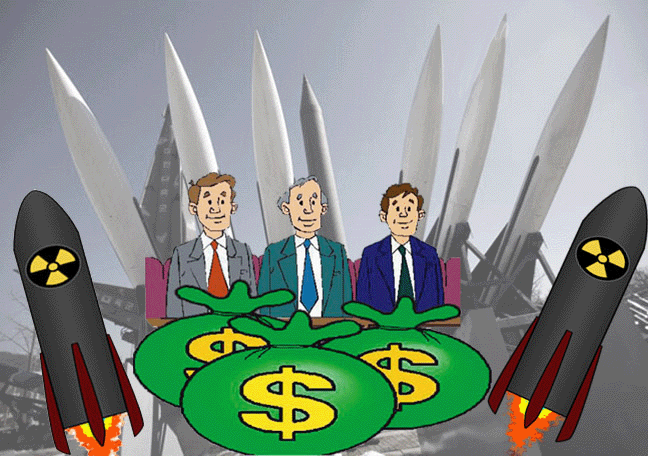
5 Republicans and 1 Democrat – the U.S. Senate nuclear caucus – Intercontinental Ballistic Missile (ICBM) Coalition – bribed by nuclear weapons companies to pour $1.7trillion into new and ‘modernised’ nukes. USA’s $634Billion nuclear weapons budget. For USA, health care is too costly, while weapons makers wildly profitable -as $634 Billion to go to nuclear arms. Ain’t it lovely to see USA Democrats and Republicans in full agreement – on spending $squillions in unnecessary nuclear weapons, of course?. Senator Markey and Rep. Blumenauer introduce Bill to cut $73 billion from USA’s bloated nuclear weapons budget. Costs of upgrading USA’s nuclear arsenal has jumped up by $140 billion in just 2 years
In 1958,U.S military had plans to use nuclear weapons against China, in a crisis over Taiwan.
Biden’s Budget Proposal Funds Most of the World’s Dictators .
Biden’s Budget Proposal Funds Most of the World’s Dictators .
- US military running a massive undercover army and conducting warrantless surveillance of Americans.
- Three U.S. Democrat Senators introduce Bill to prop up nuclear industry.
- Another former Westinghouse executive pleads guilty to lying in South Carolina nuclear power scandal. The sixth high-ranking FirstEnergy executive fired, in Ohio nuclear corruption scandal.
- Nuclear reactors in space, – enthusiasm by corporations and governments ignores the dangers.
- In 1958,U.S military had plans to use nuclear weapons against China, in a crisis over Taiwan.
- Biden’s Budget Proposal Funds Most of the World’s Dictators .
- US military running a massive undercover army and conducting warrantless surveillance of Americans.
- Three U.S. Democrat Senators introduce Bill to prop up nuclear industry.
- Another former Westinghouse executive pleads guilty to lying in South Carolina nuclear power scandal. The sixth high-ranking FirstEnergy executive fired, in Ohio nuclear corruption scandal.
- Nuclear reactors in space, – enthusiasm by corporations and governments ignores the dangers.
CANADA. Canadian government in the grip of the nuclear lobby’s ”NICE” dishonest spin about small nuclear reactors. American experts warn Trudeau that Moltex small nuclear reactors are likely to prove a nightmare for Canada.
EUROPE. NATO’s U.S. nuclear weapons in Europe not safe. U.S. soldiers’ Flashcard Apps reveal secrets.
ASIA. Abdul Khan and the illegal and immoral world of nuclear proliferation.
IRAN. Iran agrees to extend IAEA nuclear monitoring deal for one month. UN nuclear watchdog chides Iran over uranium enrichment .
JAPAN. TEPCO’s history of covering up radioactive water risks. China says Japan ‘repeatedly betrayed public trust‘ in Fukushima response . Radioactive Fukushima soil stored in flood zones.
FRANCE. Corrosion in the fuel cladding at France’s Chooz and Civaux nuclear stations.
UK.
- The USA-UK nuclear cabal . E
- DF’s report on silo collapse at Hinkley Point C nuclear construction raises more questions than answers.
- UK’s Sizewell B nuclear complex continues to be offline for safety reasons. Further outages at UK’s Dungeness nuclear power plant: its future in doubt.
- Activists force shutdown of Israeli weapons factory in UK .
- Secrecy and connivance between UK’s coal and nuclear lobbies in Cumbria.
- Nuclear test veterans: ‘My dad was treated like a guinea pig’.
- How decentralised energy will massively reduce grid costs.
UKRAINE. Fission reactions have been spiking in an inaccessible Chernobyl chamber since 2016 – possibility of a runaway nuclear reaction.
RUSSIA. Russia’s plans for nuclear-powered spacecraft to Jupiter. Russia launches a mission to investigate te Komsomolets, Soviet nuclear submarine sunk 32 years ago .
AUSTRALIA.
Australia, the USA’s only ”best friend” in the Indo Pacific, to deploy more USA military equipment, heightening the threat against China.
“Unqualified” —who is allowed to talk about nuclear power ?

Who is allowed to talk about nuclear power?
“Unqualified” — Beyond Nuclear International Nuclear trolls turn on the aggression as industry collapses around them
By Linda Pentz Gunter, 31 May 21, “My advice is to look out for engineers. They begin with sewing machines and end up with nuclear bombs.” Marcel Pagnol
My normal rule of thumb is to ignore the unrelenting pro-nuclear trolls who pepper our sites with incessant nay-saying and, occasionally ad hominem name-calling. After all, they have only one goal in mind — other than to get up one’s nose — which is to dominate and thereby control the narrative.
But recently, a recurring theme has emerged which needs addressing, because it speaks to who is allowed to talk about nuclear power.

In the view of the trolls, if you have no scientific credentials, you are unqualified to comment on nuclear power. In my case, because I have a degree in English literature, albeit garnered many decades ago, I have, according to the trolls, no authority to expound on the negatives of nuclear anything.
There are some rather obvious flaws in this argument, the first being that it pre-supposes the human brain is incapable of learning anything new after the age of 21.
But it also exemplifies the theme of a recent conference held virtually in Linz by three Austrian anti-nuclear groups which examined the “Atomic Lie.” How has this lie been perpetuated? Answer: by those who promote the nuclear power industry anointing themselves as the only authority deemed knowledgeable enough to either comment about it or make decisions on its use and safety.
What kind of a world we will end up with if, heaven forfend, we allow only engineers to decide what is in our best interest (with all due respect to my friends who are engineers and who, I suspect, would be the first to agree)? Hence the Pagnol quote at the top of this page.
This would mean, for example, that the Western Shoshone should have no say in the fate of the land in Nevada they steward, because nuclear engineers have decided it is perfectly alright to dig a big hole in the volcanic ground and bury nuclear waste there.
It would mean that Marshall Islanders should have nothing whatever to say about the generations of cancers and birth defects they have suffered as the unwilling guinea-pigs of atomic “testing,” because after all it was scientists who decided that it was perfectly alright to detonate 67 atomic bombs there and obliterate islands………..
This intent to dominate the narrative — in our case the nuclear power one — and silence critics, was aptly described by Arnie Gundersen in his presentation during the Linz conference. He talked about the origins of the nuclear cabal — under its alias, Atoms for Peace — in which its originator, President Dwight D. Eisenhower, described the program as solving “‘the fearful atomic dilemma’ by finding some way in which the ‘miraculous inventiveness of man’ ‘would not be dedicated to his death, but consecrated to his life’”.
Gundersen looked up the Oxford Dictionary definition of “consecrate” and found it to mean “to make sacred or declare sacred; dedicate formally to a religious or divine purpose.”

This nuclear priesthood into which believers were ordained did not welcome skeptics gladly, however. Quite the reverse. When Gundersen, a nuclear insider at the time, blew the whistle on a safety issue, he was told to his face that “in this business, you’re either with us or against us, and you just crossed the line.” He was not only fired but persecuted in further attempts to silence him.
Luckily for our movement, the nuclear inquisition was largely unsuccessful in this latter endeavor, but it came at a steep price for Gundersen and his family personally.
As evidenced by Gundersen’s experience, these attacks are by no means restricted to us “lay” advocates, but they have grown observably more vitriolic. This disturbing trend was flagged recently by Andy Stirling of the Science Policy Research Unit at the University of Sussex in the UK, responding to an aggressive critique of an article he co-authored in Nature Energy.
His detractor, Jeremy Gordon, “goes beyond pejorative labelling to actively ridicule any position not in-principle supportive of nuclear power,” Stirling wrote in a letter published in Nuclear Engineering International. “This is exemplified by Gordon’s intemperate ad hominem attack on my fellow author (the globally leading energy scholar Benjamin Sovacool).” Stirling concludes that it is “reasoned policy discourse that forms the lifeblood of democracy itself”.
We are a grand collective of experts. We do have scientists and engineers —Gundersen is one — to whom we can turn in order to unravel the deeper complexities of the workings of nuclear power plants or uranium mines or reprocessing facilities. But it is not the only dimension that matters. So we need Indigenous people, and writers, and lay advocates, and economists, and historians, and artists, and humanitarians to tell this story and set the agenda, too.
Even if it is rocket science, rocket scientists aren’t the only ones who count when decisions are made about whether to put missiles into space or send a nuclear-powered probe to Mars.
As Pagnol implied, when you leave it to the scientists and engineers, you get a Manhattan Project, where consciences pricked far too late. Imagine if humanitarian voices had held sway inside Los Alamos. Would things have turned out differently?
The Japanese mothers, evacuated from Fukushima, who shout on street corners through bullhorns about their experiences, warning Japan never to re-embrace nuclear power, don’t hold engineering degrees. But they know a lot more about the real, lived consequences of using nuclear power than any of the nuclear industry trolls.
Those voices of truth need to be heard, along with those who practice sound science and honest engineering and who are willing to call out the dangers, not control the lies.
It’s one thing to have command of the facts, which of course we must. But it’s another to accompany these with a hefty dose of integrity. And that’s what we are here for, even if we can quote Shakespeare while we are doing it.
Linda Pentz Gunter is the international specialist at Beyond Nuclear and writes for, curates and edits Beyond Nuclear International. https://beyondnuclearinternational.org/2021/05/30/unqualified/
5 Republicans and 1 Democrat – the U.S. Senate nuclear caucus – Intercontinental Ballistic Missile (ICBM) Coalition – bribed by nuclear weapons companies to pour $1.7trillion into new and ‘modernised’ nukes

Meet the Senate nuke caucus, busting the budget and making the world less safe, https://responsiblestatecraft.org/2021/05/26/meet-the-senate-nuke-caucus-busting-the-budget-and-making-the-world-less-safe/ These lawmakers represent states with a direct interest in pouring billions into modernizing and building new weapons. Marcy Winograd and Medea Benjamin, MAY 26, 2021
Democrats might control the legislative and executive branches of the U.S. government right now, but a small Republican-dominated Intercontinental Ballistic Missile (ICBM) Coalition exercises outsized influence in a frightening campaign for nuclear rearmament.
The coalition, comprising six senators from states that house, develop, or test underground land-based nuclear weapons, is pushing a wasteful and dangerous $1.7 trillion, decades-long plan to produce new nuclear weapons, some with warheads 20 times more powerful than the atomic bomb dropped on Hiroshima.
While the 1980s witnessed the nuclear freeze and a mass movement to demand nuclear disarmament between the U.S. and Soviet Union, the 1990s gave birth to the missile caucus, the Congressional engine careening the U.S. into a renewed nuclear arms race.
All but one of the members of this caucus is a Republican from a deep red state — including North Dakota, Montana, Wyoming, Utah and South Dakota — that didn’t vote for Joe Biden. Members of the Senate ICBM Coalition are Co-Chairs John Hoeven (R-N.D.) and Jon Tester (D-Mont.); John Barrasso (R-Wyo.); Steve Daines (R-Mont); Mike Lee (R-Utah); and Mike Rounds (R-S.D.).
The lone Democrat, Tester, a third-generation farmer and former elementary school music teacher, wields a critical gavel as Chair of the Senate Appropriations Subcommittee on Defense, a committee that will write the appropriations bill for military expenditures. Tester told the D.C.-based Advanced Nuclear Weapons Alliance this year that he was committed to keeping new nuclear weapons production “on track.”
If the ICBM Coalition and the weapons lobby have their way, the United States will brandish a new nuclear arsenal in order to, in their view, replace aging and outdated nuclear weapons ill-suited to meet the challenges of a renewed Cold War. Critics charge that the development and production of new nuclear weapons violates the spirit and letter of the Treaty on the Non-Proliferation of Nuclear Weapons (NPT), signed by the United States and Soviet Union in 1968.
In addition to violating a treaty joined by 191 nations, U.S. production of new nuclear weapons is likely to escalate the arms race, sabotage future arms control negotiations with Russia or China and encourage non-nuclear nations to enrich weapons-grade uranium.
Although it was the Trump administration that in 2020 awarded Northrop Grumman a $13.3 billion sole-source contract to build new land-based nuclear missiles called Ground Based Strategic Deterrent (GBSD), it is the Biden administration that is slated to include, as part of its record high $753 billion military budget, $30 billion or more for the GBSD. This would be a down payment on the estimated $264 billion cost to replace all 400 underground Minuteman III missiles in North Dakota, Wyoming, Montana, Nebraska and Colorado, from 2029 through 2075.
The GBSD is part of a euphemistically labeled “nuclear modernization” program proposing, in addition to new ICBMs, new ballistic missile submarines outfitted with low-yield, five-kiloton tactical nuclear weapons, as opposed to larger 100-kiloton “strategic” nuclear weapons meant for a global nuclear showdown.
The Trump administration’s 2018 nuclear posture review reasoned these “more usable” tactical nuclear weapons would keep the Russians and Chinese in check. Critics argue that these smaller, shorter-range tactical nuclear weapons blur the distinction between conventional and nuclear war, making these weapons more likely to be employed under the misguided assumption that a nuclear war can be limited.
The push for rearmament, including a new nuclear cruise missile, a modified gravity bomb with two-stage radiation implosion and long-range strike bomber, comes amid concern the Biden administration’s heated anti-China rhetoric could plunge us into a nuclear war.
Pentagon Papers whistleblower Daniel Ellsberg recently released classified documents that revealed U.S. military leaders penned plans in 1958 to execute a first nuclear strike against China in a dispute over Taiwan’s sovereignty. According to the documents, Pentagon officials were willing to risk a million deaths in the event the Soviet Union fired back with nuclear weapons. In releasing the classified material and purposefully risking prosecution, Ellsberg told the New York Times, “I do not believe the participants were more stupid or thoughtless than those in between or in the current cabinet.”
With Secretary of Defense Lloyd Austin, former Secretary of Defense Ash Carter, Republicans and Tester cheerleading for the GBSD, a missile caucus lobbyist might think the American people would prefer to spend hundreds of billions of dollars on new ICBMs and nearly two-trillion dollars on the entire nuclear escalation package than investing in Medicare for All or clean water in Flint, Michigan. A 2020 University of Maryland poll revealed, however, that 61 percent of Americans–including both Democratic and Republican majorities–support phasing out the United States’s 400 land-based intercontinental ballistic missiles.
Knowing this, why would Biden and Democratic politicians carry out the mission of the small Republican-dominated missile caucus and its chums in the profitable weapons industry? Northrop Grumman, with a net worth of $50 billion, promises nuclear rearmament will create 10,000 jobs, but compare that number to the 3-million employed under FDR’s Civilian Conservation Corps that planted 3-billion trees.
The answer to why the missile caucus is so influential is: money. And lots of it.
ICBM weapons contractors contributed more than $15 million from 2012-2020 to members of the Senate and House Armed Services and Appropriations committees and subcommittees, according to the Arms Control Association. Steven Semler, co-founder of the Security Policy Reform Institute, notes these contractors even buy influence among members of the Congressional Progressive Caucus (CPC), last year donating $376,650 to Democrat Adam Smith (D-Wash.), Chair of the House Armed Services Committee; $148,135 to Donald Norcross (D-N.J.) and $63,086 to Ruben Gallego (D-Ariz.), all of whom belong to the CPC.
While Biden may fear appearing “soft” on defense if he retreats from relaunching our nuclear program, progressives are preparing for a fierce debate. GBSD opponents include an impressive diplomatic team: William Perry, former Secretary of Defense; Daniel Ellsberg, author, The Doomsday Machine: Confessions of a Nuclear War Planner; and William Hartung, director of the Arms and Security Program at the Center for International Policy.
Hartung, author of Prophets of War: Lockheed Martin and the Making of the Military-Industrial Complex,recommends nixing the ICBMs entirely. “Because of their extreme vulnerability to attack, ICBMs are kept on high alert status, leaving the president a matter of minutes to decide whether to launch them on warning of an impending attack,” he says.
There is no law of gravity that compels the current president or Congress to continue funding this drive for nuclear rearmament.
Abdul Khan and the illegal and immoral world of nuclear proliferation

Smiling Buddha and how Khan network’s inside job made Pakistan a nuclear state, Financial Express, May 31, 2021 By Subhash Jangala
By conducting the first confirmed nuclear weapons test by a non-member of the UN Security Council, India caught the entire international intelligence community unawares.
On 26th May 2021, India celebrated Buddha Jayanti, the anniversary of the great soul obtaining enlightenment. Exactly 47 years ago, on the Buddha Jayanti of 1974, Smiling Buddha ushered India into the nuclear age. By conducting the first confirmed nuclear weapons test by a non-member of the UN Security Council, India caught the entire international intelligence community unawares. Thousands of miles away from the test site in Pokhran, Rajasthan was Almelo, a tiny municipality in eastern Netherlands. As the news of the Indian nuclear test trickled in, a silent storm started brewing in a man’s heart. 1974’s Buddha Jayanti not only heralded India’s geopolitical assent, it also flagged off Pakistan’s steep decline in international status and reputation.
Abdul Qadeer Khan, a Pakistani metallurgical engineer employed in a uranium enrichment plant in Almelo, took India’s successful nuclear test to heart. In his work, Khan got several opportunities to work with Highly Enriched Uranium (HEU) in Netherlands. Khan quickly dispatched a letter to Pakistan’s newly powerful Prime Minister, Zulfiqar Ali Bhutto explaining why HEU was the miracle cure for Pakistan’s struggle with making a plutonium bomb. After several attempts, Bhutto did give Khan a hearing and was impressed. Thus began a decades-long saga of illegal and criminal transfer of nuclear materials and technologies from across the world into Pakistan and then via Pakistan to other states like Iran and Libya.
Back in the 1970s and 80s, Anti Money Laundering regulations and investigation into Proliferation Finance weren’t as developed as they are today. This allowed Khan and the Pakistan Government to run a complex international network of benami companies and suppliers that have created and helped sustain a nuclear black economy. A deeper study of the proliferation episode makes for interesting reading……………………..
As years progressed, Khan used his contacts to obtain components from across the world, expanding Pakistan’s chances of testing their first nuclear bomb. At the same time, the West, unmindful of Khan’s dogged belief in his experiment and Pakistan’s tenacious resolve to match India kiloton-for-kiloton, took a laid-back and lackadaisical route to control the black nuclear economy that Pakistan was helping create. Eventually, his endearing nature and Pakistan’s resolute support, Khan managed to assemble all the components required to make his nuclear dream go live.
However, Khan’s dream did not end with making Pakistan a formidable opponent to India in the nuclear battlefield. Khan expanded his activities deeper into the illegal and immoral world of nuclear proliferation. He helped create a market where any budding nuclear adventurist could order from a list of raw materials which could be sourced from any of the reliable suppliers across the world. A “Flipkart for Nuclear dummies” was born. This market place operated from the following places, [shown on map on original]
Khan Research Laboratories in Pakistan and SMB Computers in Dubai (a front company) operated as the hub and the rest were all procurement or delivery centres. An investigation by the Malaysian Police into one such transaction revealed the inner workings of the network. The same is presented below in 8 steps. [diagram on original]
……….. The most important link that connected the entire network was the fact that, apart from the core individuals, no entity had a clue what was being produced and for whom.
The fraud continued for a while. On a fateful day in 2004, the US exposed the outlines of the world;s largest nuclear proliferation ring. In a dramatic television appearance Feb. 4, Abdul Qadeer Khan, the father of the Pakistani bomb, acknowledged that he had secretly provided North Korea, Libya, and Iran with crucial building blocks for making nuclear weapons. Khan, considered a national hero, apologized to the people of Pakistan for what he had done and was pardoned by the then Pakistani President Gen. Pervez Musharraf shortly afterward.
On this Buddha Jayanti, the story of AQ Khan should alert sanctions compliance organisations across the globe to the new challenges like the need to transition to a low carbon energy economy, introduction of advanced materials and growth of underground markets through the dark web. International organisations should re-dedicate themselves to technology, co-operative diplomacy, Exchange of Information and cross-cultural capacity building to ensure rogue proliferators and black markets don’t emerge in newer and more sophisticated areas of crime.
(The author is an officer of the 2011 batch of the Indian Revenue Service. He is presently posted as Joint Director (OSD) in the Directorate General of Administration and Taxpayer Services at New Delhi. Prior to this role, he worked as a Tax Diplomat in the Foreign Tax and Tax Research Division of the Central Board of Direct Taxes. The views expressed are the author’s own, and do not represent the official position or policy of the Government of India or Financial Express Online.) https://www.financialexpress.com/world-news/smiling-buddha-and-how-khan-networks-inside-job-made-pakistan-a-nuclear-state/2262259/
As electric vehicles take off, we’ll need to recycle their batteries

As electric vehicles take off, we’ll need to recycle their batteries Electric car batteries contain critical minerals like cobalt and lithium. We’ll need to recycle them unless we want to keep mining the earth for new ones.As electric vehicles take off, we’ll need to recycle their batteries
Electric car batteries contain critical minerals like cobalt and lithium. We’ll need to recycle them unless we want to keep mining the earth for new ones. BY MADELEINE STONE, 29 May 21 , When Ford unveiled the F-150 Lightning last week — an all-electric version of the best- selling vehicle in the United States—it was a big moment in the short history of electric cars. The 530-horsepower, 6,500-pound truck’s sticker price of just under $40,000 ($32,474 with a federal tax credit) drew comparisons to Ford’s Model T, the vehicle credited with making cars accessible to the middle class. In the first 48 hours after the battery-powered behemoth debuted, Ford received close to 45,000 pre-orders for it, equivalent to nearly 20 percent of all EVs registered in the U.S. last year……… (subscribers only)
1 This Month
Tell Congress: Prevent Nuclear Catastrophe in Iran

Tell Congress: Prevent Nuclear Catastrophe in Iran

Read the Public Inquiry Report, the Commissioners’ report, Surrendering Australia: The AUKUS Deception is available to download for free at aukuspublicinquiry.com. Or just watch the replay of the National Press Club Luncheon.


Shut down the radiation-damaged Heysham nuclear reactors now
To see nuclear-related stories in greater depth and intensity – go to https://nuclearinformation.wordpress.com

Say No to NASA’s Reckless Nuclear Reactor on the Moon
Say No to NASA’s Reckless Nuclear Reactor on the Moon
-
Archives
- November 2026 (246)
- October 2026 (302)
- September 2026 (339)
- August 2026 (330)
- July 2026 (355)
- June 2026 (287)
- May 2026 (306)
- April 2026 (356)
- March 2026 (251)
- February 2026 (267)
- January 2026 (308)
- December 2025 (358)
-
Categories
- 1
- 1 NUCLEAR ISSUES
- business and costs
- climate change
- culture and arts
- ENERGY
- environment
- health
- history
- indigenous issues
- Legal
- marketing of nuclear
- media
- opposition to nuclear
- PERSONAL STORIES
- politics
- politics international
- Religion and ethics
- safety
- secrets,lies and civil liberties
- spinbuster
- technology
- Uranium
- wastes
- weapons and war
- Women
- 2 WORLD
- ACTION
- AFRICA
- Atrocities
- AUSTRALIA
- Christina's notes
- Christina's themes
- culture and arts
- Events
- Fuk 2022
- Fuk 2023
- Fukushima 2017
- Fukushima 2018
- fukushima 2019
- Fukushima 2020
- Fukushima 2021
- general
- global warming
- Humour (God we need it)
- Nuclear
- RARE EARTHS
- Reference
- resources – print
- Resources -audiovicual
- Weekly Newsletter
- World
- World Nuclear
- YouTube
-
RSS
Entries RSS
Comments RSS

