Reaffirm commitment to ban nuclear tests, UN chief says in message for International Day,
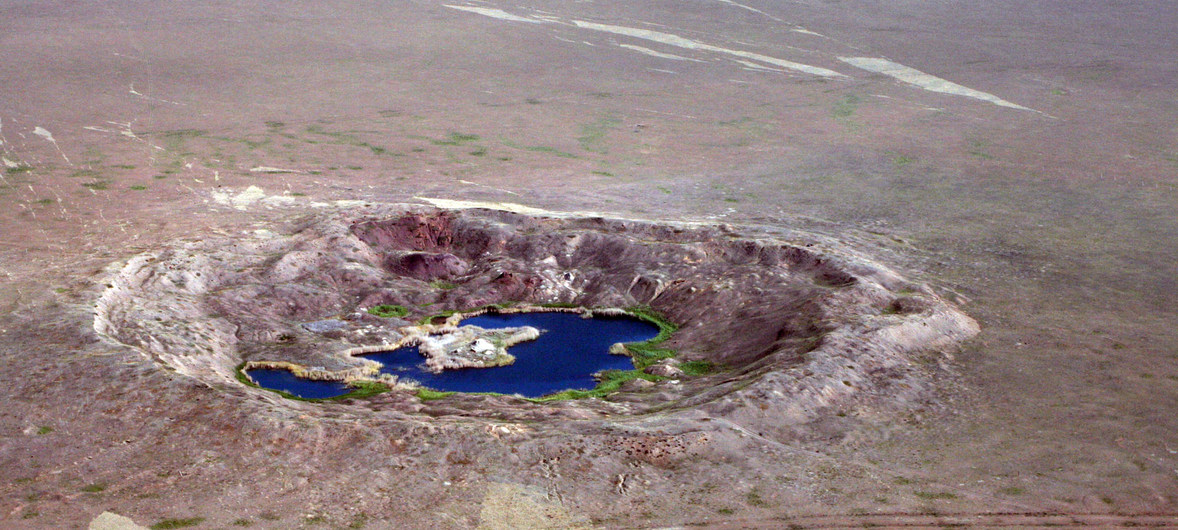
Reaffirm commitment to ban nuclear tests, UN chief says in message for International Day, UN News 29 Aug 21 Countries which have not yet ratified the Comprehensive Nuclear-Test-Ban Treaty (CTBT) are urged by UN Secretary-General António Guterres to do so without delay.
The UN chief made the appeal in his message for the International Day Against Nuclear Tests, observed on Sunday, 29 AugustThe UN chief made the appeal in his message for the International Day Against Nuclear Tests, observed on Sunday, 29 August
The date marks the 30th anniversary of the closure of the Semipalatinsk nuclear test site in Kazakhstan, the largest of its kind in the former Soviet Union, where more than 450 nuclear devices were exploded over four decades.
Terrible consequences
Mr. Guterres said nuclear tests caused enormous human suffering and environmental damage.
They had terrible consequences on the health of people living in affected areas. Many were relocated from their ancestral lands, disrupting their lives and livelihoods. Pristine environments and ecosystems were destroyed, which will take decades, if not centuries, to heal.”
The closure of the Semipalatinsk test site signaled the end of the era of unrestrained nuclear testing, said Mr. Guterres. Soon afterwards, countries began negotiating the CTBT.
The treaty bans all explosive nuclear weapons tests anywhere, by any country, he added, effectively “putting a brake on the nuclear arms race and providing a powerful barrier to the development of new nuclear weapons.”
No excuse
The CTBT was adopted in 1996 and has been signed by 185 countries, and ratified by 170, including three nuclear weapon States. However, it must be signed and ratified by 44 specific nuclear technology holder countries before it can enter into force……………….
Threat still real: Kazakhstan Ambassador
The threat that nuclear weapons pose to the world remains “as realistic as ever”, said Kazakhstan’s Ambassador to the UN, Magzhan Ilyassov, speaking to UN News ahead of the International Day (interview here and at right).
“For us, the 29th of August is not a day in the calendar. It is a reminder about how traumatic nuclear tests can be for humankind because in Kazakhstan alone, 1.5 million people still suffer, and will unfortunately suffer for future generations, from genetic diseases, cancer, leukaemia, which were caused by exposure to nuclear tests.”
Mr. Ilyassov said the total impact of the nuclear explosions carried out at the Semipalatinsk site was “1,200 times more” than the atomic bomb dropped on Hiroshima, Japan, during the Second World War.
“The test site itself is of the size of Israel, so it’s a big chunk of the territory of Kazakhstan and that cannot be used for any other purpose like agriculture for many, many decades now,” he said, adding “so with that, we can also project what was the damage caused by other nuclear test sites around the world which were eventually closed.” https://news.un.org/en/story/2021/08/1098682
Vulnerability of Louisiana’s Waterford 3 nuclear plant to storm surge
Intensifying Hurricane Ida a significant threat to key infrastructure. Ida is forecast to hit the industrial corridor between Baton Rouge and New Orleans, site of three key ports, petrochemical sites, and a nuclear power plant. Yale Climate Connections, by JEFF MASTERS and BOB HENSON, AUGUST 29, 2021
Vulnerability of Waterford 3 nuclear plant to storm surge. Although it lies 65 miles inland from the south coast of Louisiana, the Waterford 3 nuclear generating station, located at an elevation of 10-15 feet on the south shore of the Mississippi River, is vulnerable to storm surge from a major hurricane. Hurricane Betsy, a category 4 storm that hit Louisiana in 1965, brought a storm surge to the edge of the plant’s location (Figure 3 on original).
According to a 2019 analysis by Bloomberg, the Waterford 3 plant is designed to withstand a maximum storm surge of 23.7 feet above sea level, or about 10 feet higher than the plant’s elevation. According to NOAA’s National Storm Surge Hazard database, a worst-case category 3 hurricane could flood the plant to a depth of 3’, while a worst-case category 4 hurricane could flood the plant to a depth of more than 9’ – near its design limit. Fortunately, storm surge modeling by Louisiana State University using the 11 a.m. EDT Saturday NHC forecast showed Ida’s storm surge stopping just short of the plant (Figure 4 on original)
After the 2011 disaster at Japan’s Fukushima nuclear power plant, the Waterford 3 plant moved to store all of its emergency generators, pumps, and other essential safety equipment in a 30-foot flood-proof concrete bunker – a system called Flex, for Flexible Mitigation Capability. The bunker has manually operated and powered sump pumps to remove water in the event of a flood.
After the 2011 disaster at Japan’s Fukushima nuclear power plant, the Waterford 3 plant moved to store all of its emergency generators, pumps, and other essential safety equipment in a 30-foot flood-proof concrete bunker – a system called Flex, for Flexible Mitigation Capability. The bunker has manually operated and powered sump pumps to remove water in the event of a flood…………………….. https://yaleclimateconnections.org/2021/08/intensifying-hurricane-ida-a-significant-threat-to-key-infrastructure/
Hurricane Ida threatens 2 nuclear power stations in Louisiana
Two Nuclear Plants In Ida’s Path As Storm Expected At Cat 4, Simply Info, [excellent pictures and maps]
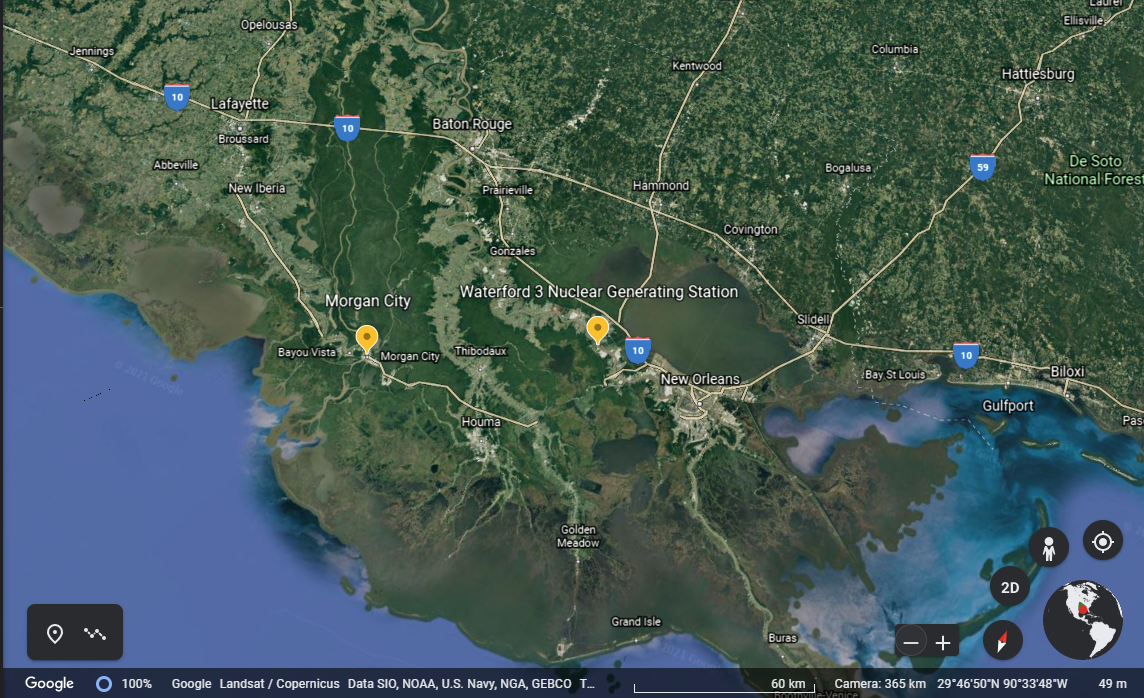
Hurricane Ida is expected to hit the US as a category 4 storm. The Weather Channel projects Sunday night landfall and a direct hit on Louisiana. Storm surges in the area range from the Texas border to Mobile Alabama.
Two nuclear power plants are in the direct storm path. River Bend and Waterford. Waterford sits near the mouth of the Mississippi and in the zone of the highest expected storm surge. Current estimates have a 10-15 foot surge expected for that area. This could be potentially more severe as the storm pushes water up the Mississippi River. Waterford sits about 24 miles from the mouth of the river and is next to Lake Pontchartrain……………..more http://www.simplyinfo.org/?p=19660
Military Contractor CACI Says Afghanistan Withdrawal Is Hurting Its Profits. It’s Funding a Pro-War Think Tank.

But this outcry didn’t materialize out of nowhere. Think tank “experts,” whose organizations are financed by the very companies profiting from the war, play a key part.
They are trotted out in front of cameras and quoted in major media outlets, presented as above-the-fray observers. They are well-financed, polished and groomed precisely for moments like these. And the companies financing them get to launder their own objectives through institutions that are seen as respectable, academic and rigorous. It’s a grotesque system that is functioning as it was designed.
Military Contractor CACI Says Afghanistan Withdrawal Is Hurting Its Profits. It’s Funding a Pro-War Think Tank. https://readersupportednews.org/opinion2/277-75/71175-military-contractor-caci-says-afghanistan-withdrawal-is-hurting-its-profits-its-funding-a-pro-war-think-tank
By Sarah Lazare, In These Times
26 August 21
What CACI reveals about the feedback loop between military contractors and think tanks.
n August 12, the military contractor CACI International Inc. told its investors that the U.S. withdrawal from Afghanistan is hurting its profits. The same contractor is also funding a think tank that is concurrently arguing against the withdrawal. This case is worth examining both because it is routine, and because it highlights the venality of our “expert”-military contractor feedback loop, in which private companies use think tanks to rally support for wars they’ll profit from.
The contractor is notorious to those who have followed the scandal of U.S.-led torture in Iraq. CACI International was sued by three Iraqis formerly detained in Abu Ghraib prison who charge that the company’s employees are responsible for directing their torture, including sexual assault and electric shocks. (The suit was brought in 2008 and the case is still ongoing.)
In 2019, CACI International was awarded a nearly $907 million, five-year contract to provide “intelligence operations and analytic support” for the U.S. Army in Afghanistan.
During an August 12 earnings call, CACI International noted repeatedly that President Biden’s withdrawal from the 20-year Afghanistan War harmed the company’s profits. John Mengucci, president and CEO of CACI International, said, “we have about a 2 percent headwind coming into FY 2022 because of Afghanistan.” A “headwind” refers to negative impacts on profits.
Afghanistan was mentioned 16 times throughout the call — either in reference to the dent in profits, or to assure investors that other areas of growth were offsetting the losses. For example, Mengucci said, “We’re seeing positive growth in technology and expect it to continue to outpace expertise growth, collectively offsetting the impact of the Afghanistan drawdown.”
Similar themes were repeated in an April 22 earnings call, where the company lamented the “headwinds” posed by the Afghanistan withdrawal. (Industry and defense publications have picked up on this them, but framed it in the company’s terms, by emphasizing the offsets to its losses.)
Despite CACI International’s clear economic interest in continuing the war, on the August 12 call, company officials were careful not to editorialize about the Biden administration’s decision. The closest they came was a cautious statement from Mengucci: “At least as of today we’ve watched the administration make the decision to completely exit Afghanistan by 9 – 11 and all I can say is they’re executing on that decision.”
But CACI International does not have to broadcast its positions on the war: Instead, it is funding a think tank that has been actively urging the Biden administration not to leave Afghanistan.
CACI International is listed as a “corporate sponsor” of the Institute for Study of War, which describes itself as a “non-partisan, non-profit, public policy research organization.” Dr. Warren Phillips, lead director of CACI International, is on the board of the think tank. (Other funders include General Dynamics and Microsoft.)
When it comes to the U.S. withdrawal from Afghanistan, however, the think tank is extremely partisan. In an August 20 paper, the think tank argued that “Russia, China, Iran, and Turkey are weighing how to take advantage of the United States’ hurried withdrawal.”
Jack Keane, a retired four star general and board member of the Institute for Study of War, meanwhile, has been on a cable news blitz arguing against the U.S. withdrawal from Afghanistan, as reported by Ryan Grim, Sara Sirota, Lee Fang and Rose Adams for The Intercept.
Kimberly Kagan, founder and president of the Institute for the Study of War, told Fox News on August 17 that the U.S. withdrawal could cause Afghanistan to become the “second school of jihadism.” She warned, “It is not clear that the Taliban, which seeks international recognition and legitimacy, is going to want to tolerate or encourage direct attacks on the U.S. from al Qaeda or other extremist groups based in Afghanistan.”
The think tank’s backing from a military contractor was not discussed in these media appearances.
The case of CACI International is not unique. The Intercept notes, “Among the other talking heads who took to cable news segments or op-ed pages without disclosing their defense industry ties were retired Gen. David Petraeus; Rebecca Grant, a former staffer for the Air Force secretary; Richard Haass, who worked as an adviser to then-Secretary of State Colin Powell; and former Secretary of State Condoleezza Rice.”
This cacophony of voices matters because Biden is facing a media uproar over the withdrawal. Pundits and mainstream press outlets that have been ignoring civilian deaths for years are suddenly expressing moral outrage at their hardships now that the war is ending. While there are legitimate concerns about the fate of Afghans as the Taliban seizes control, the vast majority of the firestorm stems from a reflexively pro-war perspective, in favor of the indefinite extension of an occupation that has proven brutal and lethal for civilians. The overwhelming effect is to send the message to Biden, and any future presidents, that they should think twice before withdrawing from a war, lest they have a media revolt on their hands.
But this outcry didn’t materialize out of nowhere. Think tank “experts,” whose organizations are financed by the very companies profiting from the war, play a key part. They are trotted out in front of cameras and quoted in major media outlets, presented as above-the-fray observers. They are well-financed, polished and groomed precisely for moments like these. And the companies financing them get to launder their own objectives through institutions that are seen as respectable, academic and rigorous. It’s a grotesque system that is functioning as it was designed.
In its August 12 call, CACI International simply acknowledged the company’s economic interests out loud.
International Atomic Energy Agency doubts the ability of Japan to clean up Fukushima nuclear wreck by intended date 2051

UN team: Unclear if Fukushima cleanup can finish by 2051, MARI YAMAGUCHI, THE PRESS DEMOCRAT, ASSOCIATED PRESS, August 27, 2021,
TOKYO — Too little is known about melted fuel inside damaged reactors at the wrecked Fukushima nuclear power plant, even a decade after the disaster, to be able to tell if its decommissioning can be finished by 2051 as planned, a U.N. nuclear agency official said Friday.
“Honestly speaking, I don’t know, and I don’t know if anybody knows,” said Christophe Xerri, head of an International Atomic Energy Agency team reviewing progress in the plant’s cleanup.
“We need to gather more information on the fuel debris and more experience on the retrieval of the fuel debris to know if the plan can be completed as expected in the next 30 years,” he told reporters.
The cleanup plan depends on how the melted fuel needs to be handled for long-term storage and management, he said.
The IAEA team’s review, the fifth since the disaster, was mostly conducted online due to the coronavirus pandemic. Only Xerri and another team member visited the plant this week before compiling and submitting a report to Japan’s government on Friday.
In the report, the team noted progress in a number of areas since its last review in 2018, including the removal of spent fuel from a storage pool at one of the damaged reactors, as well as a decision to start discharging massive amounts of treated but still radioactive water stored at the plant into the ocean in 2023………. https://www.pressdemocrat.com/article/news/un-team-unclear-if-fukushima-cleanup-can-finish-by-2051/?ref=recent
We’re Number One in Weapons Sales, by Polly Mann — Rise Up Times

The main recipient region in 2016–20 was Asia and Oceania (accounting for 42 percent of global arms imports), followed by the Middle East (33 percent), Europe (12 percent), Africa (7.3 percent), and the Americas (5.4 percent).
We’re Number One in Weapons Sales, by Polly Mann — Rise Up Times
DN! Afghanistan: Interviews with Jeremy Corbyn, Sarah Chayes, and Obaidullah Baheer — Rise Up Times

Chayes: ” … the behavior of those Afghan leaders that we, the United States, kind of put forward toward their own citizens, and the role of U.S. officials and U.S. development organizations in reinforcing and protecting and enabling, I mean, just an unbelievably corrupt and abusive governmental system, so that, you know, my Afghan friends, who were not in university — they were ordinary villagers in and around Kandahar — they just didn’t know what to make of it. It was like, ‘Look, the Taliban shake us down at night, but the government shakes us down in the daytime’”
DN! Afghanistan: Interviews with Jeremy Corbyn, Sarah Chayes, and Obaidullah Baheer — Rise Up Times
Experts say that the government’s measures against harmful rumors are “an extension of what we’ve been doing for 10 years.

We have been reporting in this series about the ripple effect of the release of tritiated water into the ocean.
Many people concerned about the release of tritium into the sea are concerned about the reputational damage.
On the 24th, the government presented an interim summary of the immediate measures to deal with the reputational damage.
First of all, as a measure to prevent reputational damage, fish should be raised in treated water and information should be disseminated in an easy-to-understand manner.
The measures include monitoring by international organizations and ensuring transparency.
In the event of reputational damage, a new fund will be set up to temporarily purchase frozen marine products, and sufficient compensation will be provided to match the actual damage.
Looking at it this way, it seems to be a continuation of the previous measures. We examined whether these measures are really effective.
Chief Cabinet Secretary Katsunobu Kato
“We will create an environment in which we can overcome rumors and continue our business with peace of mind, even if rumors should arise.
A meeting of relevant ministers on March 24.
The government has put together a list of immediate measures to deal with the reputational damage caused by the release of treated water.
The government and Tokyo Electric Power Company (TEPCO) plan to release treated water from the Fukushima Daiichi Nuclear Power Plant into the sea by the spring of the following year.
One of the fishermen in the prefecture commented on the measures taken.
“One of the fishermen in the prefecture said, “The decision was made without any discussion or explanation.
“One of the fishermen in the prefecture severely criticized the measures, saying, “We can’t accept it and this way of proceeding is unacceptable.
The prefectural fishermen’s federation also said, “We haven’t received an explanation from the government yet, and we want to wait for that before considering our response.
There is a strong opposition to the release of radioactive materials both inside and outside of the prefecture.
“They have not yet fulfilled their promise not to release the radioactive materials without the understanding of the people concerned.
Professor Ryota Koyama of Fukushima University, who has studied reputational damage in the prefecture and served as a member of the government’s subcommittee, points out that the latest measures to curb reputational damage are “almost the same” as the previous measures.
Professor Ryota Koyama, School of Food and Agricultural Sciences, Fukushima University
“I’m concerned that if this is the case, it’s just an extension of what we’ve been doing for the past 10 years, and if we say we’re going to release the pollutants two years from now under the same conditions, the problem will get bigger.
Another problem is the assumption that reputational rumors will occur, according to Professor Koyama.
Professor Ryota Koyama, School of Food and Agricultural Sciences, Fukushima University
“If we assume that harmful rumors will occur, then we cannot agree to that, and I think the whole premise is that we should not create a situation two years from now where the price of (marine products) falls to the point where we have to buy them, or where trading is suspended.
He also said that we need to analyze the current situation and rethink what we should do to prevent harmful rumors.
Professor Ryota Koyama, School of Food and Agricultural Sciences, Fukushima University
Professor Ryota Koyama of Fukushima University’s Department of Food and Agricultural Sciences said, “Consumers and distributors in Tokyo do not have a good understanding of the situation. I would like to see a process of analyzing this lack of progress and then formulating countermeasures based on the current situation.
Weaponising space -the high road to World War 3, but profitable for weapon and space companies

Insane U.S. Plan to Spend Billions on Weaponizing Space Makes Defense Contractors Jump for Joy—But Rest of World Cowers in Horror at Prospect of New Arms Race Leading to World War IIICovertAction Magazine By Karl Grossman – August 25, 2021 Imagine this scenario from the year 2045: The U.S. and China, after years of belligerence, go to war over control of the Taiwan straits; most of the battles are fought through cyber-attacks and space-based weapons systems that had been perfected over the previous decades.
In a desperate maneuver, the U.S. activates its “rods from God”—a scheme developed in Project Thor involving telephone-pole-sized tungsten rods being dropped from orbit reaching a speed ten times the speed of sound [7,500 miles per hour] hitting with the force of nuclear weapons—and Beijing’s military command centers and other significant targets are destroyed.
The above scenario looks increasingly plausible given a) the growing prospect of war between the U.S. and China; and b) the growing militarization of space by the U.S.—in violation of the landmark Outer Space Treaty of 1967 that sets aside space “for peaceful purposes.”
U.S. Space Force and the Evisceration of the 1967 Outer Space Treaty
Donald Trump declared at a meeting of the National Space Council of the U.S. in 2018 that “it is not enough to merely have an American presence in space, we must have American dominance in space…. I’m hereby directing the Department of Defense and Pentagon to immediately begin the process necessary to establish a Space Force as the sixth branch of the armed forces … It is going to be something.”

Indeed, the U.S. Space Force, established in December 2019, is something—and can, if not will, destroy the visionary Outer Space Treaty of keeping space for peace.
The Outer Space Treaty of 1967 was put together by the U.S., Great Britain and the former Soviet Union and has wide support from nations around the world. 111 countries are parties to the treaty, while another 23 have signed the treaty but have not completed ratification.
As Craig Eisendrath, who as a young U.S. State Department officer was involved in the treaty’s creation, told me—and I quote him in my book Weapons in Space—“we sought to de-weaponize space before it got weaponized … to keep war out of space.”
“This foundational treaty has allowed for half a century of ever expanding peaceful activity in space, free from man-made threats,” writes Paul Meyer, in his chapter “Arms Control in Outer Space: A Diplomatic Alternative to Star Wars” in the book Security in the Global Commons and Beyond.[1]
The Outer Space Treaty bars placement “in orbit around the Earth any objects carrying nuclear weapons or any other kinds of weapons of mass destruction or from installing such weapons on celestial bodies.”
Biden Signs Off on Space Force
Republican Trump’s successor as U.S. president, Democrat Joe Biden, has not pulled back on the U.S. Space Force. As Defense News headlined in 2021: “With Biden’s ‘full support,’ the Space Force is officially here to stay.”
Its article opened: “U.S. President Joe Biden will not seek to eliminate the Space Force and roll military space functions back into the Air Force, the White House confirmed.” It continued: “White House spokeswoman Jen Psaki told reporters during a Feb. 3 briefing that the new service has the ‘full support’ of the Biden administration.” And it went on: “‘We’re not revisiting the decision,’ she said.”
Most Democrats in the U.S. Congress voted for the legislation providing for formation of the U.S. Space Force as pushed by Trump. All Republicans in the U.S. Congress voted for it.
False Pretext
For decades there has been an effort to extend the Outer Space Treaty and enact the Prevention of an Arms Race, the PAROS treaty, which would bar any weapons in space.
China, Russia (and U.S. neighbor Canada) have been leaders in seeking passage of the PAROS treaty. But the U.S.—through administration after administration, Republican and Democrat—has opposed the PAROS treaty and effectively vetoed it at the United Nations.
Although the PAROS treaty has broad backing from nations around the world, it must move through the UN’s Conference on Disarmament which functions on a consensual basis.
A rationale for the U.S. Space Force now being claimed is that it is necessary to counter moves by China and Russia in space, particularly development of anti-satellite weapons.
That is what a CNN report in August 2021, titled “An Exclusive Look into How Space Force Is Defending America,” centrally asserted. There was no mention in the six-minute-plus CNN piece of how China and Russia (and Canada) have led for decades in the push for PAROS, and how China and Russia in recent times have reiterated their calls for space to be weapons-free.
“We are calling on the international community to start negotiations and reach agreement on arms control in order to ensure space safety as soon as possible,” said the Chinese Foreign Ministry spokesperson, Zhao Lijian, in April 2021. “China has always been in favor of preventing an arms race in space; it has been actively promoting negotiations on a legally binding agreement on space arms control jointly with Russia.”
A day earlier, Russian Foreign Minister Sergey Lavrov called for talks to create an “international legally binding instrument” to ban the deployment of “any types of weapons” in space. Lavrov said: “We consistently believe that only a guaranteed prevention of an arms race in space will make it possible to use it for creative purposes, for the benefit of the entire mankind. We call for negotiations on the development of an international legally binding instrument that would prohibit the deployment of any types of weapons there, as well as the use of force or the threat of force.”
Onward and Upward!

Meanwhile, the U.S. Space Force drives ahead.
It has requested a budget of $17.4 billion for 2020 to “grow the service,” reports Air Force Magazine. “Space Force 2022 Budget Adds Satellites, Warfighting Center, More Guardians,” was the headline of its article. And in the first paragraph, it adds “and fund more than $800 million in new classified programs.” (“Guardians” is the name adopted by the U.S. Space Force in 2021 for its members.)
A recruitment drive is under way.
The U.S. Space Force “received its first offensive weapon … satellite jammers,” reported American Military News in 2020. “The weapon does not destroy enemy satellites, but can be used to interrupt enemy satellite communications and hinder enemy early warning systems meant to detect a U.S. attack,” it stated…………
“US Space Command—dominating the space dimension of military operations to protect US interests and investment. Integrating Space Forces into war-fighting capabilities across the full spectrum of conflict,” trumpeted Vision for 2020……….
I displayed the comments of U.S. Space Command Commander-in-Chief Joseph W. Ashy in Aviation Week and Space Technology in 1996: “It’s politically sensitive, but it’s going to happen,” said the general.

Some people don’t want to hear this … but—absolutely—we’re going to fight in space. We’re going to fight from space and we’re going to fight into space…. We will engage terrestrial targets someday—ships, airplanes, land targets—from space.” U.S. Space Command Commander-in-Chief General Joseph W. Ashy……………
Nuclear and Climate Clash – Russia’s nuclear weapons centre threatened by wildfires.

The fires have reached the closed city of Sarov, which has been a center for nuclear research since the Soviet era and was the site of the first Soviet atomic bomb’s development.
Today, the research center makes nuclear warheads and is believed to be developing Russia’s strategic missiles, including its highly touted hypersonic arsenal.
Wildfires Near Russia’s Nuclear Research Center Spark State of Emergency https://www.themoscowtimes.com/2021/08/24/wildfires-near-russias-nuclear-research-center-spark-state-of-emergency-a74878 Aug. 24, 2021 Russian authorities have declared an interregional state of emergency as tough-to-contain forest fires threaten the country’s top-secret nuclear weapons research center, Interfax reported Tuesday, citing the emergencies ministry.
Wildfires have raged in the Nizhny Novgorod region and the neighboring republic of Mordovia, both roughly 500 kilometers east of Moscow, since early August.
The fires have reached the closed city of Sarov, which has been a center for nuclear research since the Soviet era and was the site of the first Soviet atomic bomb’s development.
Today, the research center makes nuclear warheads and is believed to be developing Russia’s strategic missiles, including its highly touted hypersonic arsenal.
Firefighters have struggled to contain the fires due to hard-to-reach terrain, dead wood that remained after the 2010 wildfires and poor weather conditions.
Several aircraft from the Emergency Situations Ministry and Defense Ministry have been deployed to fight the fires.
The emergencies ministry told Interfax that two helicopters and a Be-200ES aircraft will be deployed to the site of the fires on Wednesday.
Russia has been hit hard by an unprecedented wildfire season fueled by historic heatwaves and drought conditions exacerbated by climate change, particularly in Siberia.
Corporate Media Politicize WHO Investigation on Covid Origins to Vilify China
Corporate Media Politicize WHO Investigation on Covid Origins to Vilify China, JOSHUA CHO FAIR (10/6/20, 6/28/21) has previously critiqued Western news media’s credulous coverage of evidence-free “lab leak” speculations. One key factor in spreading suspicion that the coronavirus might have escaped from the Wuhan Institute of Virology (WIV) is media’s early and ongoing politicization of the World Health Organization’s investigation into the pandemic’s origins. Much of this politicization weaponizes Orientalist tropes about China being especially, perhaps genetically, untrustworthy—the sort of people who would unleash Covid-19 on the world.
While no new evidence has emerged suggesting that the virus emerged from the WIV, many more Americans now believe it did. A Politico/Harvard poll in July, following an increase of uncritical Western media coverage on the lab leak theory, found that 52% of US adults now believe Covid-19 leaked from a lab, up from 29% in March 2020. This is contrary to the assessment of most scientists, who believe, based on available evidence, that a natural origin for the virus is more likely………… https://fair.org/home/corporate-media-politicize-who-investigation-on-covid-origins-to-vilify-china/
Star Wars and America’s Nazis

German Major General Walter Dornberger, who had been in charge of the entire Nazi rocket program, and how he “in 1947 as a consultant to the U.S Air Force and adviser to the Department of Defense … wrote a planning paper for his new employers.
He proposed a system of hundreds of nuclear-armed satellites all orbiting at different altitudes and angles, each capable of re-entering the atmosphere on command from Earth to proceed to its target. The Air Force began early work on Dornberger’s idea under the acronym NABS (Nuclear Armed Bombardment Satellites).”
Insane U.S. Plan to Spend Billions on Weaponizing Space Makes Defense Contractors Jump for Joy—But Rest of World Cowers in Horror at Prospect of New Arms Race Leading to World War III CovertAction Magazine By Karl Grossman – August 25, 2021 ” ……………………………………..Star Wars and America’s Nazis
U.S. interest in militarizing and weaponizing space goes back well before the Vision for 2020 and other bellicose U.S. plans for space in the 1990s, or Ronald Reagan’s Strategic Defense Initiative dubbed “Star Wars,” in the 1980s. Its roots are with the former Nazi rocket scientists and engineers brought to the U.S. from Germany after World War II under the U.S.’s Operation Paperclip, where more than 1,600 German scientists, engineers and technicians were taken from former Nazi Germany to the U.S. for government employment after the end of World War II in Europe, between 1945 and 1959.
They ended up at the U.S. Army’s Redstone Arsenal in Huntsville, Alabama—to use “their technological expertise to help create the U.S. space and weapons program,” writes Jack Manno, a State University of New York professor, in his 1984 book Arming the Heavens: The Hidden Military Agenda for Space, 1945-1995 (1984).
“Many of the early space war schemes were dreamt up by scientists working for the German military, scientists who brought their rockets and their ideas to America after the war,” he writes. Many of these scientists and engineers “later rose to positions of power in the U.S. military, NASA, and the aerospace industry.”

Among them were “Wernher von Braun and his V-2 colleagues,” who began “working on rockets for the U.S. Army” and, at the Redstone Arsenal, “were given the task of producing an intermediate range ballistic missile to carry battlefield atomic weapons up to 200 miles. The Germans produced a modified V-2 renamed the Redstone…. Huntsville became a major center of U.S. space military activities.”
Manno tells the story of former German Major General Walter Dornberger, who had been in charge of the entire Nazi rocket program, and how he “in 1947 as a consultant to the U.S Air Force and adviser to the Department of Defense … wrote a planning paper for his new employers.
He proposed a system of hundreds of nuclear-armed satellites all orbiting at different altitudes and angles, each capable of re-entering the atmosphere on command from Earth to proceed to its target. The Air Force began early work on Dornberger’s idea under the acronym NABS (Nuclear Armed Bombardment Satellites).”
In my subsequent Weapons in Space, Manno tells me that “control over the Earth” was what those who have wanted to weaponize space seek. He said the Nazi scientists are an important “historical and technical link, and also an ideological link…. The aim is to … have the capacity to carry out global warfare, including weapons systems that reside in space.”
Dornberger’s nuclear link continues in various forms throughout the U.S. military space program. The Strategic Defense Initiative scheme of Reagan—although this was barely disclosed at the time—was predicated on orbiting battle platforms with on-board hypervelocity guns, particle beams and laser weapons. They were to be energized by on-board nuclear reactors.
As General James Abrahamson, SDI director, said at a Symposium on Space Nuclear Power and Propulsion, “without reactors in orbit [there is] going to be a long, long light [extension] cord that goes down to the surface of the Earth” to bring up power to energize space weaponry………………….[2] https://covertactionmagazine.com/2021/08/25/insane-u-s-plan-to-spend-billions-on-weaponizing-space-makes-defense-contractors-jump-for-joy-but-rest-of-world-cowers-in-horror-at-prospect-of-new-arms-race-leading-to-world-war-iii/
Updates: Afghanistan, Somalia, Syria, Iraq, by Women Against Military Madness — Rise Up Times

“Unless something changes, military skirmishes will continue between Iraq, Iran, Syria, Lebanon, Hamas in Palestine on the one hand, and the U.S. and its allied client-partners on the other, and may develop into a devastating new war in the Middle East.”
Updates: Afghanistan, Somalia, Syria, Iraq, by Women Against Military Madness — Rise Up Times
1 This Month
Tell Congress: Prevent Nuclear Catastrophe in Iran

Tell Congress: Prevent Nuclear Catastrophe in Iran

Read the Public Inquiry Report, the Commissioners’ report, Surrendering Australia: The AUKUS Deception is available to download for free at aukuspublicinquiry.com. Or just watch the replay of the National Press Club Luncheon.


Shut down the radiation-damaged Heysham nuclear reactors now
To see nuclear-related stories in greater depth and intensity – go to https://nuclearinformation.wordpress.com

Say No to NASA’s Reckless Nuclear Reactor on the Moon
Say No to NASA’s Reckless Nuclear Reactor on the Moon
-
Archives
- November 2026 (246)
- October 2026 (302)
- September 2026 (339)
- August 2026 (330)
- July 2026 (355)
- June 2026 (287)
- May 2026 (306)
- April 2026 (356)
- March 2026 (251)
- February 2026 (267)
- January 2026 (308)
- December 2025 (358)
-
Categories
- 1
- 1 NUCLEAR ISSUES
- business and costs
- climate change
- culture and arts
- ENERGY
- environment
- health
- history
- indigenous issues
- Legal
- marketing of nuclear
- media
- opposition to nuclear
- PERSONAL STORIES
- politics
- politics international
- Religion and ethics
- safety
- secrets,lies and civil liberties
- spinbuster
- technology
- Uranium
- wastes
- weapons and war
- Women
- 2 WORLD
- ACTION
- AFRICA
- Atrocities
- AUSTRALIA
- Christina's notes
- Christina's themes
- culture and arts
- Events
- Fuk 2022
- Fuk 2023
- Fukushima 2017
- Fukushima 2018
- fukushima 2019
- Fukushima 2020
- Fukushima 2021
- general
- global warming
- Humour (God we need it)
- Nuclear
- RARE EARTHS
- Reference
- resources – print
- Resources -audiovicual
- Weekly Newsletter
- World
- World Nuclear
- YouTube
-
RSS
Entries RSS
Comments RSS

