Joe Manchin and Big Coal are destroying the planet
Joe Manchin and Big Coal are destroying the planet
Jeff Goodell
The senator from West Virginia is bought and paid for by Big Coal. With his help the dying industry is pulling one final heist — and the entire planet may pay the price
Texas ‘downwinders’ should be eligible for nuclear radiation compensation, advocates say
Texas ‘downwinders’ should be eligible for nuclear radiation compensation, advocates say, TEXAS STANDARD, By Michael Marks. January 12, 2022
Congress is considering a bill to pay more people who were harmed by nuclear development, but the legislation still excludes some Texans who saw fallout firsthand.
A bill to compensate more people who were harmed by U.S. nuclear development is moving through Congress. But advocates say that it still leaves out people who were affected by nuclear radiation.
Under proposed amendments to the Radiation Exposure Compensation Act, eligible people would get $150,000 from the federal government. That includes uranium miners from Texas, but not “downwinders”: people who lived down wind from nuclear test sites.
Istra Fuhrmann is a nuclear policy advocate for the Friends Committee on National Legislation. She spoke to the Texas Standard about the bill and its provisions……………………. https://www.texasstandard.org/stories/texas-downwinders-should-be-eligible-for-nuclear-radiation-compensation-advocates-say/
Biden team weighs killing Trump’s new nuclear weapons
Biden team weighs killing Trump’s new nuclear weapons
Officials are considering canceling weapons that were backed by the last administration. By BRYAN BENDER POLITICO , 01/12/2022
The Biden administration is considering killing off several nuclear weapons programs that were greenlit by the Trump White House as an internal debate over the nation’s atomic arsenal enters its final phase.
According to nine current and former officials with knowledge of the deliberations, the Nuclear Posture Review, which is expected to be completed as early as next month, is not expected to make major changes to nuclear policy. Nor is it likely to recommend deep cuts to multibillion-dollar plans to build new intercontinental ballistic missiles, nuclear-armed submarines and stealth bombers, they said.
But national security officials are debating whether to jettison a new nuclear-armed cruise missile now in the research phase, retire a Cold War-era thermonuclear bomb, and possibly even remove a new “low-yield” warhead that the previous administration deployed on submarines, the current and former officials said. Most spoke on condition they not be identified in order to discuss internal deliberations and private conversations.
Such changes would fall short of the overhaul of nuclear policy and programs that President Joe Biden has long argued would help blunt a nuclear arms race, namely a declaration that the United States would not be the first to strike an adversary using atomic weapons.
Yet halting the Trump-era “add-ons,” as they are called, are considered the most likely cuts if Biden wants to reverse the previous administration’s elevation of nuclear weapons in U.S. strategy, due to resistance from military leaders to big changes as Russia and China build up their arsenals……………………………………………….
Even for the relatively modest changes to the weapons portfolio being considered, there is likely to be strong resistance on the Hill and inside the Pentagon. https://www.politico.com/news/2022/01/12/biden-trump-nuclear-weapons-526976
Claims of strange unidentified craft flying over top secret US Air Force base.
I guarded nuclear weapons and saw yellow orb-like UFOs flying over top-secret US Air Force base The Sun , Henry Holloway, Jan 12 2022 AN EX-NUCLEAR weapons tech has claimed he saw UFOs flying overhead while serving in the military at a top secret US Air Force base.
Adrian Reister, 37, decided to break his silence as the unknown phenomena has become a serious national security concern for US lawmakers and the Pentagon.
But he is speaking out as a variety of former US intelligence officials, nuclear launch officers, and fighter pilots have come forward about their UFO experiences in the last few years.
And it comes as former US Presidents Barack Obama and Bill Clinton even admitted there is something happening in the skies over the US that cannot be explained.
Adrian told The Sun Online he witnessed yellow orb UFOs flying over the base on two occasions while working as a “gun guard”.
Through his duties, he had a clear view and understanding of the bombers, fighter jets and other aircraft which would take off and leave the base.
So he is 100 per cent sure the objects he witnessed were not military or civilian aircraft – and the lights also did not move like any known vehicles……………………………………….
US lawmakers demanded reports of nuclear security as part of the purview of a new UFO office included in a mulit-billona defence bill signed off by Joe Biden.
It came after a number of former US servicemen came forward and revealed their own experiences with UFOs at nuclear weapons facilities.
The veterans even claimed the phenomena had “interfered” with weapons – including taking them offline – as they demanded transparency from the US.
UFOs have stepped from a fringe conspiracy theory to a serious national security debate in the US.
And a historic report by the Pentagon earlier in the year revealed 144 sightings by the military since 2004 remain unexplained.
Biden signed into law at the end of December a new UFO investigation unit that will run on the ground investigations and probe any “threat” posed by the phenomena.
The office will be set up jointly between the Department of Defense and the Office of the Director of National Intelligence (DNI) — a key marriage between the intelligence and military communities.
It will probe whether or not the strange craft that has been reportedly buzzing the US military are unknown technology from Russia and China or potentially something more alien.,,,, https://www.the-sun.com/news/4448824/nuclear-weapons-ufos-top-secret-base-whiteman/
The Treaty on the Prohibition of Nuclear Weapons and the world’s future — IPPNW peace and health blog

Late January of this year will mark the first anniversary of the entry into force of the UN Treaty on the Prohibition of Nuclear Weapons. This momentous international agreement, the result of a lengthy struggle by the International Campaign to Abolish Nuclear Weapons (ICAN) and by many non-nuclear nations, bans developing, testing, producing, acquiring, possessing, stockpiling, and […]
The Treaty on the Prohibition of Nuclear Weapons and the world’s future — IPPNW peace and health blog
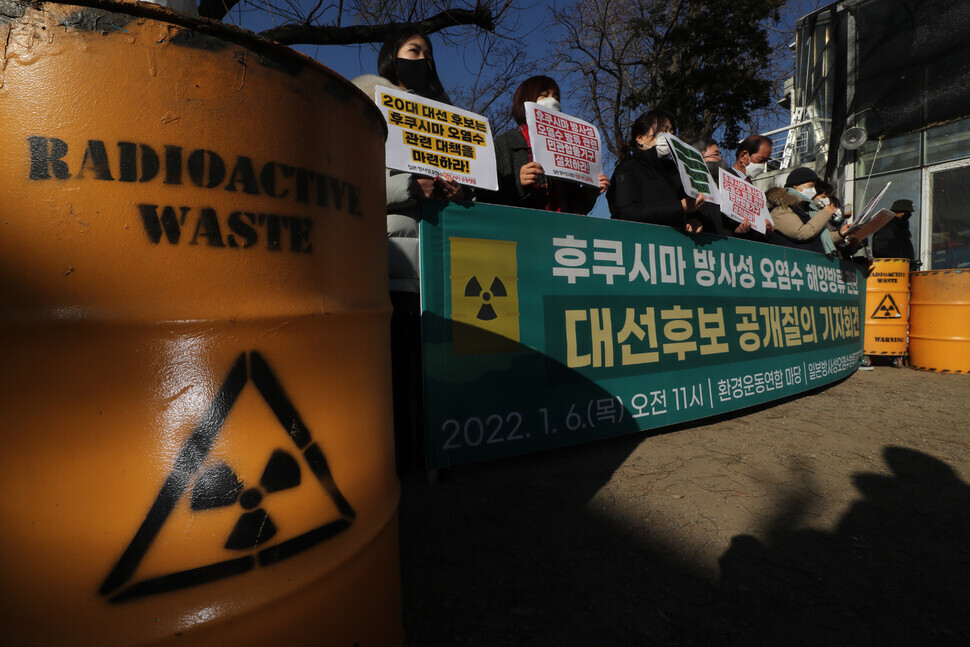
Candidates, tell us your stances on Fukushima water release

Jan.7,2022
Environmental groups in South Korea are calling on presidential candidates to make public their stances on Japan’s plans to dump contaminated water from the Fukushima nuclear site, and to come up with courses of action. Groups including the Korean Federation for Environmental Movement (KFEM), Nuclear Safety and Future, and Korea Radiation Watch convened for a press conference on Thursday morning in front of KFEM’s offices in Jongno District, Seoul. The groups criticized the government’s response thus far as “timid,” saying that since Japan had announced its intentions to release the radioactive water in April of last year, the government had only gone so far as to express protest to the Japanese Embassy and send a letter of protest to Japan. The groups called on presidential candidates to come up with concrete, practical plans for dealing with the issue.


What future for Small Nuclear Reactors (SMRs) ?

Small nuclear reactor? It’s a lemon!
Large taxpayer subsidies might get some projects, such as the NuScale project in the US or the Rolls-Royce mid-sized reactor project in the UK, to the construction stage. Or they may join the growing list of abandoned SMR projects
In 2022, nuclear power’s future looks grimmer than ever, Jim Green, 11 Jan 2022, RenewEconomy
”……………………………………….. Small modular reactors
Small modular reactors (SMRs) are heavily promoted but construction projects are few and far between and have exhibited disastrous cost overruns and multi-year delays.
It should be noted that none of the projects discussed below meet the ‘modular’ definition of serial factory production of reactor components, which could potentially drive down costs. Using that definition, no SMRs have ever been built and no country, company or utility is building the infrastructure for SMR construction.
In 2004, when the CAREM SMR in Argentina was in the planning stage, Argentina’s Bariloche Atomic Center estimated an overnight cost of A$1.4 billion / GW for an integrated 300 megawatt (MW) plant, while acknowledging that to achieve such a cost would be a “very difficult task”. Now, the cost estimate is more than 20 times greater at A$32.6 billion / GW. A little over A$1 billion for a reactor with a capacity of just 32 MW. The project is seven years behind schedule and costs will likely increase further.
Russia’s 70 MW floating nuclear power plant is said to be the only operating SMR anywhere in the world (although it doesn’t fit the ‘modular’ definition of serial factory production). The construction cost increased six-fold from 6 billion rubles to 37 billion rubles (A$688 million), equivalent to A$9.8 billion / GW. The construction project was nine years behind schedule.

According to the OECD’s Nuclear Energy Agency, electricity produced by the Russian floating plant costs an estimated A$279 / MWh, with the high cost due to large staffing requirements, high fuel costs, and resources required to maintain the barge and coastal infrastructure. The cost of electricity produced by the Russian plant exceeds costs from large reactors (A$182-284) even though SMRs are being promoted as the solution to the exorbitant costs of large nuclear plants.
SMRs are being promoted as important potential contributors to climate change abatement but the primary purpose of the Russian plant is to power fossil fuel mining operations in the Arctic.
A 2016 report said that the estimated construction cost of China’s demonstration 210 MW high-temperature gas-cooled reactor (HTGR) is about A$7.0 billion / GW and that cost increases have arisen from higher material and component costs, increases in labour costs, and project delays. The World Nuclear Association states that the cost is A$8.4 billion / GW. Those figures are 2-3 times higher than the A$2.8 billion / GW estimate in a 2009 paper by Tsinghua University researchers.
China’s HTGR was partially grid-connected in late-2021 and full connection will take place in early 2022.
China reportedly plans to upscale the HTGR design to 655 MW (three reactor modules feeding one turbine). China’s Institute of Nuclear and New Energy Technology at Tsinghua University expects the cost of a 655 MW HTGR will be 15-20 percent higher than the cost of a conventional 600 MW pressurised water reactor.
NucNet reported in 2020 that China’s State Nuclear Power Technology Corp dropped plans to manufacture 20 additional HTGR units after levelised cost of electricity estimates rose to levels higher than a conventional pressurised water reactor such as China’s indigenous Hualong One. Likewise, the World Nuclear Association states that plans for 18 additional HTGRs at the same site as the demonstration plant have been “dropped”.

The World Nuclear Association lists just two other SMR construction projects other than those listed above. In July 2021, China National Nuclear Corporation (CNNC) New Energy Corporation began construction of the 125 MW pressurised water reactor ACP100. According to CNNC, construction costs per kilowatt will be twice the cost of large reactors, and the levelised cost of electricity will be 50 percent higher than large reactors.

In June 2021, construction of the 300 MW demonstration lead-cooled BREST fast reactor began in Russia. In 2012, the estimated cost for the reactor and associated facilities was A$780 million, but the cost estimate has more than doubled and now stands at A$1.9 billion.
SMR hype
Much more could be said about the proliferation of SMRs in the ‘planning’ stage, and the accompanying hype. For example a recent review asserts that more than 30 demonstrations of ‘advanced’ reactor designs are in progress across the globe. In fact, few have progressed beyond the planning stage, and few will. Private-sector funding has been scant and taxpayer funding has generally been well short of that required for SMR construction projects to proceed.
Large taxpayer subsidies might get some projects, such as the NuScale project in the US or the Rolls-Royce mid-sized reactor project in the UK, to the construction stage. Or they may join the growing list of abandoned SMR projects.
A failed history of small reactor projects. A handful of recent construction projects, most subject to major cost overruns and multi-year delays. And the possibility of a small number of SMR construction projects over the next decade. Clearly the hype surrounding SMRs lacks justification.
Everything that is promising about SMRs belongs in the never-never; everything in the real-world is expensive and over-budget, slow and behind schedule. Moreover, there are disturbing, multifaceted connections between SMR projects and nuclear weapons proliferation, and between SMRs and fossil fuel mining.
SMRs for Australia
There is ongoing promotion of SMRs in Australia but a study by WSP / Parsons Brinckerhoff, commissioned by the South Australian Nuclear Fuel Cycle Royal Commission, estimated costs of A$225 / MWh for SMRs. The Minerals Council of Australia states that SMRs won’t find a market unless they can produce power at about one-third of that cost.
In its 2021 GenCost report, CSIRO provides these 2030 cost estimates:
* Nuclear (SMR): A$128-322 / MWh
* 90 percent wind and solar PV with integration costs (transmission, storage and synchronous condensers): A$55-80 / MWh
Enthusiasts hope that nuclear power’s cost competitiveness will improve, but in all likelihood it will continue to worsen. Alone among energy sources, nuclear power becomes more expensive over time, or in other words it has a negative learning curve.
Dr Jim Green is the national nuclear campaigner with Friends of the Earth Australia and the author of a recent report on nuclear power’s economic crisis. , https://reneweconomy.com.au/in-2022-nuclear-powers-future-is-grimmer-than-ever/
Downright absurd to classify a technology with the potential danger of nuclear power plants as green and sustainable.
I am very sure that not a single private company will ever build a nuclear power plant on its own account and at its own risk. The taxonomy does not change that. At best, it reduces the enormous government subsidies needed to push this technology into the market
“Nuclear is the opposite of what wind & solar need to partner with” – ex energy state sec Nuclear phase-outEnergiewende Clean Energy Wire, 11 Jan 22 Without the anti-nuclear movement, the energy transition in Germany would likely look different. But despite a strong focus on fighting nuclear power, the civil society movement that marked the rise of the Green Party has always had the climate in mind and wanted to ensure that reactors weren’t substituted with coal plants.

Clean Energy Wire spoke to Rainer Baake, director of the Climate Neutrality Foundation, former energy state secretary, and one of the architects of the original German nuclear phase-out in 2000. He says that with all democratic parties pledged to the exit timetable, it is “absolutely out of the question” that Germany returns to using this high-risk technology. With a decision to include nuclear as a sustainable investment, the EU Commission would discredit the taxonomy, he said. “However, this will not stop the energy transition in Germany.”
……………………………………. The whole energy transition consists of replacing conventional power plants, nuclear as well as fossil power plants with renewables. And that’s what we started with simultaneously. When the nuclear phase-out was decided, the Renewable Energies Act was created. As a consequence of the Kyoto protocol, we decided on an emissions trading system in Europe. Nuclear energy will be history on 31 December 2022 and we will also completely phase out coal in this decade and replace both with renewables. The next step will be to exchange fossil natural gas against hydrogen.
…………………… Can nuclear power, as supplied by today’s nuclear power plants, make a meaningful contribution to an electricity system dominated by renewables? As base load or for other system services?
Is it a problem for the German energy transition if other (European) countries, also with the help of the new European taxonomy, invest in nuclear power instead of renewables?
The opposite is true. A climate-friendly electricity system dominated by weather-dependent production from wind and solar plants requires a great deal of flexibility to balance fluctuating supply with fluctuating demand. Nuclear power plants are technically and operationally designed to produce as consistently as possible. They are the exact opposite of what wind and solar need to partner with.
Is it a problem for the German energy transition if other (European) countries, also with the help of the new European taxonomy, invest in nuclear power instead of renewables?
I find it downright absurd to classify a technology with the potential danger of nuclear power plants as green and sustainable. And even more so because it produces radioactive waste that remains dangerous for the unimaginable period of a million years, and for which we have not yet found a safe solution. With this decision, the EU Commission discredits the taxonomy. However, this will not stop the energy transition in Germany.
I am very sure that not a single private company will ever build a nuclear power plant on its own account and at its own risk. The taxonomy does not change that. At best, it reduces the enormous government subsidies needed to push this technology into the market.
While innovations and learning curves over the past 20 years have ensured that renewable energies have become increasingly cheaper, the costs of nuclear energy have risen more and more. In this respect, it is no wonder that, according to IEA figures, 70 percent of global investment in the power sector now goes to renewable energies.
A recent survey showed that a slight majority of Germans would agree to give nuclear power a role for climate protection reasons. Do you see the possibility that attitudes towards nuclear power could change again in Germany?
What survey? Since Chernobyl, all the polls I know of have shown clear majorities in favour of phasing out nuclear power. Take a look at the last federal election, all democratic parties are sticking to the timetable for the nuclear phase-out and support the expansion of renewable energies. The last three reactors will go offline at the end of this year. This will mark the end of the use of nuclear energy in Germany.
Is there any scenario next year in which Germany will let the existing nuclear power plants run longer after all, as some are calling for?
I consider such a scenario to be absolutely out of the question.
Do you see the new small-scale nuclear reactors as a chance for a renewed use of nuclear power in the fight against the climate crisis?
These reactors, which allegedly are completely safe and produce no nuclear waste, have one major disadvantage: they don’t exist.
The 400 nuclear power plants in existence worldwide today cover only about ten percent of the demand for electricity. If we wanted to replace global fossil power generation with small nuclear reactors, we would need many thousands of these power plants. Precisely because they are so small, they would have to operate with highly enriched uranium. The danger that nuclear fuel would be illegally diverted and used to build bombs is real. No one can want that, and hopefully the free world will not allow it. https://www.cleanenergywire.org/news/nuclear-opposite-what-wind-solar-need-partner-ex-energy-state-sec
In 2022, nuclear power’s future looks grimmer than ever.

As new renewable energy capacity continues to boom, nuclear power generation declined in 2021 and the industry’s future is grimmer than it has ever been. The post In 2022, nuclear power’s future looks grimmer than ever appeared first on RenewEconomy.
In 2022, nuclear power’s future looks grimmer than ever — RenewEconomy Renew Economy, Jim Green 11 Jan 22,
The decline was marginal (<1 per cent): a net loss of two power reactors (six start-ups and eight 8 permanent closures) and a net loss of 2.5 gigawatts (GW) of nuclear capacity.
The marginal decline makes for a striking contrast with renewables. The International Energy Agency calculates that new renewable capacity added in 2021 amounted to nearly 290 GW – that’s more than four times Australia’s total electricity generating capacity.
Nuclear power’s contribution to global electricity supply has fallen from a peak of 17.5 percent in 1996 to 10.1 percent in 2020. Renewables reached an estimated 29 per cent share of global electricity generation in 2020, a record share.
The ageing of the world’s reactor fleet is a huge problem for the nuclear industry, as is the ageing of its workforce — the silver tsunami. The average age of the world’s reactor fleet continues to rise and by mid-2021 reached 30.9 years. The mean age of the 23 reactors shut down between 2016 and 2020 was 42.6 years.
Primarily because of the ageing of the reactor fleet, the International Atomic Energy Agency estimates up to 139 GW of lost nuclear capacity from 2018-2030 due to permanent reactor shutdowns, and a further loss of up to 186 GW from 2030-2050.
So the industry needs about 10 new power reactors (or 10 GW) each year just to maintain its 30-year pattern of stagnation. And there were indeed 10 reactor construction starts in 2021, six of them in China.
But the average annual number of construction starts since 2014 has been just 5.1. Thus, slow decline of nuclear power is the most likely outcome. An extension of the 30-year pattern of stagnation is possible, if and only if China does the heavy lifting. China has averaged just 2.5 reactor construction starts per year since 2011.
Phasing out nuclear power
The number of countries phasing out nuclear power steadily grows and now includes:
Nuclear power generation declined in 2021 and the industry’s future is grimmer than it has ever been.
The decline was marginal (<1 per cent): a net loss of two power reactors (six start-ups and eight 8 permanent closures) and a net loss of 2.5 gigawatts (GW) of nuclear capacity.
The marginal decline makes for a striking contrast with renewables. The International Energy Agency calculates that new renewable capacity added in 2021 amounted to nearly 290 GW – that’s more than four times Australia’s total electricity generating capacity.
Nuclear power’s contribution to global electricity supply has fallen from a peak of 17.5 percent in 1996 to 10.1 percent in 2020. Renewables reached an estimated 29 per cent share of global electricity generation in 2020, a record share.
The ageing of the world’s reactor fleet is a huge problem for the nuclear industry, as is the ageing of its workforce — the silver tsunami. The average age of the world’s reactor fleet continues to rise and by mid-2021 reached 30.9 years. The mean age of the 23 reactors shut down between 2016 and 2020 was 42.6 years.
Primarily because of the ageing of the reactor fleet, the International Atomic Energy Agency estimates up to 139 GW of lost nuclear capacity from 2018-2030 due to permanent reactor shutdowns, and a further loss of up to 186 GW from 2030-2050
So the industry needs about 10 new power reactors (or 10 GW) each year just to maintain its 30-year pattern of stagnation. And there were indeed 10 reactor construction starts in 2021, six of them in China.
But the average annual number of construction starts since 2014 has been just 5.1. Thus, slow decline of nuclear power is the most likely outcome. An extension of the 30-year pattern of stagnation is possible, if and only if China does the heavy lifting. China has averaged just 2.5 reactor construction starts per year since 2011.
Phasing out nuclear power
The number of countries phasing out nuclear power steadily grows and now includes:
Germany: Fourteen reactors have shut down since the 2011 Fukushima disaster and the final three reactors will close this year.
Belgium: The country’s seven ageing reactors will all be closed by the end of 2025.
Taiwan: Final reactor closure scheduled for 2025. Four reactors were shut down from 2018 to 2021 and only two remain operational.
Spain: Nuclear power capacity is expected to decline from 7.1 GW in 2020 to 3 GW in 2030 with the final reactor closure in 2035.
Switzerland: The government accepted the results of a 2017 referendum which supported a ban on new reactors and thus a gradual phase-out is underway. The Mühleberg reactor was shut down in 2019 and most or all of the remaining four ageing reactors are likely to be shut down over the next decade.
South Korea: Long-term (2060) phase-out policy with concrete actions already taken including the shut-down of the Kori-1 and Wolsong-1 reactors in 2017 and 2019 respectively, and suspension or cancellation of plans for six further reactors. The current plan is to reduce the number of reactors from a peak of 26 in 2024 to 17 in 2034.
Too cheap to meter or too expensive to matter?
Despite the abundance of evidence that nuclear power is hopelessly uncompetitive compared to renewables, the nuclear industry and some of its supporters continue to claim otherwise.
Those economic claims are typically based on implausible cost projections for non-existent ‘Generation IV’ reactor concepts. Moreover, the nuclear lobby’s claims about the cost of renewables are just as ridiculous.
Claims about ‘cheap’ nuclear power certainly don’t consider real-world nuclear construction projects. Every power reactor construction project in Western Europe and the US over the past decade has been a disaster.
The V.C. Summer project in South Carolina (two AP1000 reactors) was abandoned after the expenditure of at least A$12.5 billion leading Westinghouse to file for bankruptcy in 2017. Criminal investigations and prosecutions related to the project are ongoing, and bailout programs to prolong operation of ageing reactors are also mired in corruption.
The only remaining reactor construction project in the US is the Vogtle project in Georgia (two AP1000 reactors). The current cost estimate of A$37.6-41.8 billion is twice the estimate when construction began. Costs continue to increase and the project only survives because of multi-billion-dollar taxpayer bailouts. The project is six years behind schedule.
In 2006, Westinghouse said it could build an AP1000 reactor for as little as A$2.0 billion, 10 times lower than the current estimate for Vogtle.
The Watts Bar 2 reactor in Tennessee began operation in 2016, 43 years after construction began. That is the only power reactor start-up in the US over the past quarter-century. The previous start-up was Watts Bar 1, completed in 1996 after a 23-year construction period.
In 2021, TVA abandoned the unfinished Bellefonte nuclear plant in Alabama, 47 years after construction began and following the expenditure of an estimated A$8.1 billion.
There have been no other power reactor construction projects in the US over the past 25 years other than those listed above. Numerous other reactor projects were abandoned before construction began, some following the expenditure of hundreds of millions of dollars.
Western Europe
The only current reactor construction project in France is one EPR reactor under construction at Flamanville. The current cost estimate of A$30.1 billion — yes, over A$30 billion — is 5.8 times greater than the original estimate. The Flamanville reactor is 10 years behind schedule.
The only reactor construction project in the UK comprises two EPR reactors under construction at Hinkley Point. In the late 2000s, the estimated construction cost for one EPR reactor in the UK was A$3.8 billion. The current cost estimate for two EPR reactors at Hinkley Point is A$41.6-43.5 billion, over five times greater than the initial estimate of A$3.8 billion per reactor.
In 2007, EDF boasted that Britons would be using electricity from an EPR reactor at Hinkley Point to cook their Christmas turkeys in 2017, but construction didn’t even begin until 2018.
One EPR reactor (Olkiluoto-3) is under construction in Finland. The current cost estimate of about A$17.4 billion is 3.7 times greater than the original estimate. Olkiluoto-3 is 13 years behind schedule.
Nuclear power is growing in a few countries, but only barely. China is said to be the industry’s shining light but nuclear growth has been modest over the past decade and it is paltry compared to renewables (2 GW of nuclear power capacity added in 2020 compared to 135 GW of renewables).
There were only three power reactor construction starts in Russia in the decade from 2011 to 2020, and only four in India……………………………… https://reneweconomy.com.au/in-2022-nuclear-powers-future-is-grimmer-than-ever/
What motivates Canadian province Premiers to enthuse about costly, probably useless, Small Nuclear Reactors?
So why are Canadian provinces like Alberta so enthusiastic about the idea? Well, it provides a way for governments captured by the fossil fuel industry to show they’re doing something about climate change without actually doing anything about climate change. Of course, just because nuclear power generators might reduce the carbon footprint of oilsands extraction, that doesn’t mean the oil extracted would not be burned elsewhere, contributing to climate change.
Guess Who’s Leading the Charge for Nuclear Power in Canada?
Small reactors make no economic sense, despite the boost by Alberta Premier Jason Kenney and lobbyists. David Climenhaga The Tyee, Today | Alberta Politics 10 Jan 22,
”………………………………… Premier of Albeta Jason Kenney’s most recent tweet — which provides a link to a slick video touting nuclear power produced by the British newsmagazine the Economist, was posted on Jan. 6.
By coincidence, presumably, a communique issued the same day by the former heads of nuclear regulatory committees in the United Kingdom, United States, Germany and France concluded that “nuclear is not a practicable means to combat climate change.”
“The central message, repeated again and again, that a new generation of nuclear will be clean, safe, smart and cheap, is fiction,” the communique states.
Nuclear energy is neither cheap enough nor safe enough to provide an effective strategy against global climate change, the communique authors argued. “To make a relevant contribution to global power generation, up to more than 10,000 new reactors would be required, depending on reactor design.”
Among their key points:
- Nuclear power more expensive than renewable energy on a similar scale
- None of the problems of waste disposal have been solved
- It’s so expensive financial markets won’t invest in it, so it requires massive public subsidies
- No one is prepared to insure against the full potential cost of environmental and human impacts of accidental radiation releases
- Construction timelines are too long for it to make a contribution to stopping global warming.
- So why are Canadian provinces like Alberta so enthusiastic about the idea? Well, it provides a way for governments captured by the fossil fuel industry to show they’re doing something about climate change without actually doing anything about climate change.Of course, just because nuclear power generators might reduce the carbon footprint of oilsands extraction, that doesn’t mean the oil extracted would not be burned elsewhere, contributing to climate change.
- For a government like Kenney’s United Conservative Party, it’s also an opportunity to make positive-sounding announcements about new jobs in a new industry on days when news media would otherwise be concentrating on the latest scandal — nowadays pretty well every day.Moreover, the UCP Government is being actively lobbied by the Canadian Nuclear Association, “the voice of the Canadian nuclear industry since 1960,” which “promotes the industry nationally and internationally.

According to the Alberta Lobbyist Registry, Calgary-based New West Public Affairs, a firm with close ties to the Kenney government headed by former Harper government minister Monte Solberg, has been engaged to “facilitate introductions for the Canadian Nuclear Association and share information on small modular reactors” with various government departments.
New West was hired “specifically, to generate support for the technology and to identify if there is an opportunity in Alberta’s mining and oil and gas sectors for the deployment of new low carbon energy sources, including nuclear,” the registry entry says.
The CNA is also using Ottawa-based Earnscliffe Strategies, one of Canada’s best-known lobby firms, to seek “support for clean electricity — including nuclear electricity — as a foundation for emissions reduction in Canada.” In addition, Earnscliffe is lobbying for “support for the research and development of small modular reactors.” https://thetyee.ca/Analysis/2022/01/10/Nuclear-Power-Canada-Who-Leading-Charge/
The European Union will need to invest 500 billion euros ($568 billion) in new generation nuclear power stations!
France24 9th Jan 2022
The European Union will need to invest 500 billion euros ($568 billion) in new generation nuclear power stations from now until 2050, the bloc’s internal market commissioner said in an interview published at the weekend.
“Existing nuclear plants alone will need 50 billion euros of investment from now until 2030. And new generation ones will need 500 billion!” Thierry Breton told the Journal du Dimanche newspaper. Breton also argued that an EU plan to label energy from nuclear power and natural gas as “green” sources for investment was a vital step towards attracting that capital. The EU is consulting its member states on that proposal, with internal disagreement on whether the power sources truly qualify as sustainable options.
France24 9th Jan 2022
Stoltenberg: NATO ready for war in Europe — Anti-bellum
Jens Stoltenberg: NATO stands ready for conflict in Europe NATO has warned Moscow to abandon its belligerent foreign policy and co-operate with the West or face a military alliance steeled for conflict on the eve of a week of intense diplomacy aimed at averting a Russian assault on Ukraine…. Jens Stoltenberg, NATO’s secretary-general, said the […]
Stoltenberg: NATO ready for war in Europe — Anti-bellum
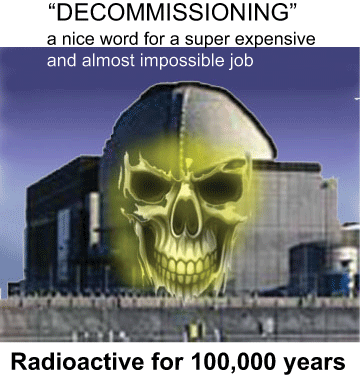
Factoring in the full cost of the radioactive wastes, the price to pay for nuclear power is astronomic.
The price to pay for nuclear power is too high, https://www.scotsman.com/news/opinion/letters/the-price-to-pay-for-nuclear-power-is-too-high-readers-letters-3520498 Tim Flinn, Garvald, East Lothian, 10 Jan 22,
It doesn’t seem 30-odd years since I went with a group of sixth form A Level physics students on a tour of Dunbar’s Torness nuclear power station, now scheduled for decommissioning.
Most of them now have their PhDs and families of their own, but hopefully they all share my view that nuclear electricity remains the most toxic and expensive domestic fuel in regular use – and will remain so unless and until the problems associated with its deadly wastes are finally solved.
As things stand now the next 500 human generations will be stuck with the human and financial costs consequent upon coping with the radioactive detritus of the very first nuclear electricity generated some 80 years ago. Factoring in inflation the final price of just a single nuclear kWh will total more £s than there are particles in the universe. If anyone doubts that, let them do their own sums, or get a copy of mine (I hope they can cope with logarithms and discounting cash flows).
If the investment into nuclear energy (originally so we could keep up with the Jonses and have our own A and H bombs) had instead been ploughed into research and development of clean, safe, renewables we would long ago have had endless energy to spare and green devices to export. But we didn’t and so we haven’t. To replace one nuclear power station with yet another is to refuse to learn. Are we that stupid still?
Small nuclear reactors make no economic sense, despite the boost by Alberta Premier Jason Kenney and lobbyists.
Guess Who’s Leading the Charge for Nuclear Power in Canada?
Small reactors make no economic sense, despite the boost by Alberta Premier Jason Kenney and lobbyists. David Climenhaga The Tyee, Today | Alberta Politics 10 Jan 22,
David J. Climenhaga is an award-winning journalist, author, post-secondary teacher, poet and trade union communicator. He blogs at AlbertaPolitics.ca. Follow him on Twitter at @djclimenhaga.
Small nuclear reactors don’t make any more economic sense now than they did back in the summer of 2020 when Alberta Premier Jason Kenney took to the internet to tout the supposed benefits of the largely undeveloped technology being promoted by Canada’s nuclear industry.
Now that Kenney has taken to Twitter again to claim atomic energy is a “real solution that helps reduce emissions” and that so-called small modular reactors can “strengthen and diversify our energy sector,” it’s worth taking another look at why the economics of small nuclear reactors don’t add up.
As I pointed out in 2020, “as long as natural gas is cheap and plentiful, small nuclear reactors will never make economic sense.”
Natural gas is somewhat more expensive now than it was then, but not enough to make a difference to that calculation when the massive cost of any new nuclear-energy project is considered.
Even “small modular reactors,” so named to reassure a public skittish about the term nuclear and wary of the costs and risks of atomic reactors, are extremely expensive. It would be more accurate to call them “medium-sized nuclear reactors.”
For example, two such reactors built by Russia starting in 2006 were supposed to cost US$140 million. They ended up costing US$740 million by the time the project was completed in 2019.
Getting approvals for smaller reactors is time consuming, too. As environmentalist and author Chris Turner pointed out yesterday, the first small nuclear reactor approved in the United States “submitted its application in 2017, got approval late last year, could begin producing 700MW by 2029 if all goes perfectly. Solar will add double that to Alberta’s grid by 2023.” Indeed, the estimated completion date of the NuScale Power project may be even later.
The small reactors touted by many companies, often entirely speculative ventures, are nothing more than pretty drawings in fancy brochures. According to the International Atomic Energy Agency, there are about 50 concepts, but only a couple in the United States and Russia with massive amounts of government money behind them are anything more than pipedreams or stock touts’ pitches to investors.
And small nuclear reactors are less economical than big reactors, so power companies aren’t interested in building them; all but one proposed design requires enriched uranium, which Canada doesn’t produce, so they won’t do much for uranium mining in Alberta; and all the safety and waste-removal problems of big nukes continue to exist with small ones.
These points are documented in more detail my 2020 post, which also discussed why smaller reactors will never create very many jobs in Alberta, ……………………- https://thetyee.ca/Analysis/2022/01/10/Nuclear-Power-Canada-Who-Leading-Charge/
Nuclear war is a genuine threat, so why have non-proliferation efforts stalled?
Nuclear war is a genuine threat, so why have non-proliferation efforts stalled? Arab News, 10 Jan 22,
- The Treaty on the Non-Proliferation of Nuclear Weapons committed states to reduce their arsenals with the goal of eliminating them
- The P5 group of nations released a joint statement on Jan. 3 affirming “a nuclear war cannot be won and must never be fought”
NEW YORK CITY: Although the world is understandably preoccupied with the coronavirus pandemic, climate change, and regional conflicts, it would be wrong to assume that the threat of nuclear war had vanished. In fact, the probability of nuclear annihilation remains perilously high.
At the beginning of the year, the pandemic claimed yet another casualty — the 10th Review Conference of the parties to the Treaty on the Non-Proliferation of Nuclear Weapons, which had been scheduled to take place on Jan. 4.
The postponement of the meeting until August went largely unreported at the time because, it would appear, the perceived threat posed by nuclear weapons had lost its urgency in recent decades.
However, the development came as tensions escalated between Western countries and Russia over Ukraine as well as between the US and China over Taiwan.
The non-proliferation treaty, or NPT, which forms the foundation of the non-proliferation regime, was signed in 1968 and came into force in 1970. It is the single most important instrument that the 191 states-parties have to prevent further proliferation and lead the world toward total disarmament.
The bargain that underpins the NPT is very simple: The nuclear states under the treaty commit to reduce their nuclear arsenals with the ultimate goal of eliminating them, and the non-nuclear states adhere to their commitments enshrined in the treaty to not acquire nuclear weapons.
Not everyone has adhered to this. India, Pakistan, Israel, and North Korea are not signatories, while Iran, although an NPT signatory, is nevertheless enriching uranium and is locked in a battle with the West over its nuclear program.
It is the second time the 10th RevCon has been rescheduled due to the pandemic. The 2020 conference, which would have coincided with the NPT’s 50th anniversary, was also delayed, scuttling hopes of getting the non-proliferation regime back on track and breathing new life into the arms control and disarmament process.
The three pillars of the NPT — non-proliferation, disarmament, and the peaceful use of nuclear technologies — have seen varying degrees of success.
While the non-nuclear states kept their end of the bargain and adhered to the treaty, bar a couple of exceptions, the nuclear states have been less faithful. They have not fulfilled their obligations, as stipulated by article six of the NPT, to rid the world of nuclear weapons. This has led to tensions and placed a strain on the whole non-proliferation regime.
Looking for an alternative, the non-nuclear states pushed for a process in the UN General Assembly, which culminated in the adoption of a Treaty on the Prohibition of Nuclear Weapons on July 7, 2017, coming into force on Jan. 22, 2021.
However, the conference’s postponement could not have come at a worse time, as anxiety over the fraying of the architecture of arms control is mounting.
Experts believe the risk of nuclear war is greater than ever. The Bulletin of the Atomic Scientists has set its Doomsday Clock at 100 seconds to midnight — the closest the timepiece has been to symbolic doom in its more than 70 years of its existence.
A speech by former US Senator Sam Nunn, an authority on nuclear weapons, on the 50th anniversary of the NPT in 2020 described the danger in stark terms…………….
The Stockholm International Peace Institute has estimated that the world’s nuclear states collectively possessed approximately 13,080 nuclear weapons as of January 2021. That figure represented a small decrease on the 13,400 estimate of 2020.
However, this has been offset by the increase in the number of nuclear weapons deployed with operational forces, from 3,720 in 2020 to 3,825 in 2021. Of these, around 2,000 were “kept in a state of high operational alert,” the institute said in its 2021 report.
All of this has occurred in the absence of a credible arms control process because of growing tensions between the US and Russia over Ukraine, and America and China over Taiwan, Hong Kong, and the Indo-Pacific.
Although they were disappointed by the conference postponement, the non-nuclear states were heartened on Jan. 3 when the US, Russia, China, France, and the UK, a group of powers known as the P5, put out a joint statement claiming they “consider the avoidance of war between nuclear-weapon states and the reduction of strategic risks as our foremost responsibilities.
However, this has been offset by the increase in the number of nuclear weapons deployed with operational forces, from 3,720 in 2020 to 3,825 in 2021. Of these, around 2,000 were “kept in a state of high operational alert,” the institute said in its 2021 report.
All of this has occurred in the absence of a credible arms control process because of growing tensions between the US and Russia over Ukraine, and America and China over Taiwan, Hong Kong, and the Indo-Pacific.
Although they were disappointed by the conference postponement, the non-nuclear states were heartened on Jan. 3 when the US, Russia, China, France, and the UK, a group of powers known as the P5, put out a joint statement claiming they “consider the avoidance of war between nuclear-weapon states and the reduction of strategic risks as our foremost responsibilities……………….
From the standpoint of Arab countries, there was also an important element missing from the joint statement, which failed to mention the 1995 NPT resolution introduced by the US, the UK, and Russia agreeing in support of the principle of a Middle East region free from all weapons of mass destruction.
It had been hoped that the 10th RevCon would provide an opportunity to acknowledge the progress made in this regard. The first Conference on the Establishment of a Middle East Zone Free of Nuclear Weapons and Other Weapons of Mass Destruction took place at the UN headquarters in New York in 2019, chaired by Jordan, and again in 2021, chaired by Kuwait.
Israel, the only state in the Middle East thought to possess nuclear weapons, did not attend any of the sessions, nor did the US, despite being one of the main sponsors of the 1995 resolution.
Supporters of arms control therefore have little choice but to wait until August to see whether the P5 will back up their words with action and deliver a “meaningful outcome” that will preserve the integrity of the NPT. https://www.arabnews.com/node/2001751/world
1 This Month
Tell Congress: Prevent Nuclear Catastrophe in Iran

Tell Congress: Prevent Nuclear Catastrophe in Iran

Read the Public Inquiry Report, the Commissioners’ report, Surrendering Australia: The AUKUS Deception is available to download for free at aukuspublicinquiry.com. Or just watch the replay of the National Press Club Luncheon.


Shut down the radiation-damaged Heysham nuclear reactors now
To see nuclear-related stories in greater depth and intensity – go to https://nuclearinformation.wordpress.com

Say No to NASA’s Reckless Nuclear Reactor on the Moon
Say No to NASA’s Reckless Nuclear Reactor on the Moon
-
Archives
- November 2026 (238)
- October 2026 (302)
- September 2026 (339)
- August 2026 (330)
- July 2026 (355)
- June 2026 (287)
- May 2026 (306)
- April 2026 (356)
- March 2026 (251)
- February 2026 (267)
- January 2026 (308)
- December 2025 (358)
-
Categories
- 1
- 1 NUCLEAR ISSUES
- business and costs
- climate change
- culture and arts
- ENERGY
- environment
- health
- history
- indigenous issues
- Legal
- marketing of nuclear
- media
- opposition to nuclear
- PERSONAL STORIES
- politics
- politics international
- Religion and ethics
- safety
- secrets,lies and civil liberties
- spinbuster
- technology
- Uranium
- wastes
- weapons and war
- Women
- 2 WORLD
- ACTION
- AFRICA
- Atrocities
- AUSTRALIA
- Christina's notes
- Christina's themes
- culture and arts
- Events
- Fuk 2022
- Fuk 2023
- Fukushima 2017
- Fukushima 2018
- fukushima 2019
- Fukushima 2020
- Fukushima 2021
- general
- global warming
- Humour (God we need it)
- Nuclear
- RARE EARTHS
- Reference
- resources – print
- Resources -audiovicual
- Weekly Newsletter
- World
- World Nuclear
- YouTube
-
RSS
Entries RSS
Comments RSS

