Nuclear weapons plutonium pits development planned for Los Alamos National Laboratory, but there’s strong opposition on safety grounds.
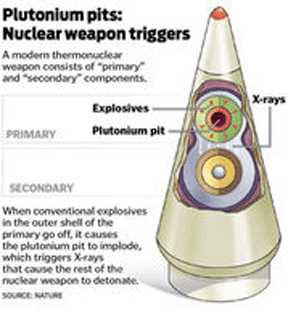
 | |||
Nuclear weapons development coming soon to Los Alamos National Laboratory amid safety concerns https://www.currentargus.com/story/news/local/2022/01/29/los-alamos-national-lab-prepares-nuclear-weapons-development/6562490001/, Adrian Hedden, Carlsbad Current-Argus
A main component of nuclear weapons was poised to be built in New Mexico after federal regulators granted approval for a plan to prepare Los Alamos National Laboratory (LANL) for the work.
The National Nuclear Security Administration (NNSA), an arm of the U.S. Department of Energy, announced earlier this month it approved LANL’s project to prepare areas of the lab to be used in plutonium pit production – a project known as LAP4.
Plutonium pits are hollow spheres of plutonium that when compressed using explosives cause a nuclear detonation, per a DOE report.
The pits were first used in the 1940s during the Manhattan Project, the report read, used to detonate atomic bombs tested at the Trinity Site in south-central New Mexico and then in the bomb dropped on Nagasaki in Japan – largely credited with ending World War II.
Since the war ended, Los Alamos’ pit production was limited to research purposes, and from 2007 to 2011 the lab produced pits to replace those in 31 warheads carried on U.S. military submarines.
Between 1952 and 1989, most of the plutonium pits in the U.S. were generated at the Rocky Flats Plant near Denver amid the Cold War with a peak nuclear stockpile of 31,225 weapons outfitted with the pits reported in 1967, read the report.
Rocky Flats was shut down in 1989, and after concerns that the pits produced since the 1980s or earlier would begin to deteriorate over time, Los Alamos was called to make new ones.
The DOE called on Los Alamos to increase efforts at the lab to produce 30 pits a year by 2026, and the Savannah River Site in South Carolina was tasked with producing 50 pits annually by 2030.
That means that by that year, the U.S. would be producing 80 pits per year.
But to prepare LANL for the work, a project to remove existing equipment and glove boxes was needed to make way for pit manufacturing equipment.
That work was intended to begin this spring via a project known as the Decontamination and Decommissioning Subproject, the first of five operations to get the site ready.
equipment and infrastructure needed to safely manufacture pits for the nuclear stockpile,” said Summer Jones, NNSA assistant deputy administrator for production modernization at LANL.
“LAP4 is a complex, challenging endeavor, and getting the approval to begin the D&D subproject is a big step toward restoring this important capability.”
Opponents call for environmental review of plutonium operations
The effort to resume producing plutonium pits and thus nuclear weapons at the New Mexico lab and in South Carolina as met with controversy from government officials and watchdog groups in both states opposing the projects.
Santa Fe City Councilors passed a resolution last year calling for a “site-wide” environmental impact statement to be conducted and any safety issued be resolved and certified by the federal government before pit production was increased.
“The Governing Body (Santa Fe City Council) requests that the National Nuclear Security Administration suspend any planned expanded plutonium pit production until all nuclear safety issues are resolved, as certified by the independent Defense Nuclear Facilities Safety Board,” read the resolution.
Nuclear Watch New Mexico and Savannah River Site Watch subsequently in June 2021 filed a lawsuit in U.S. District Court for the District of South Carolina’s Aiken Division against the DOE and NNSA, arguing pit production should not be increased until site-wide environmental analysis were conducted at both facilities.
“The drastic expansion of plutonium pit production and the utilization of more than one facility to undertake this production are substantial changes from the Defendants’ long-standing approach of producing a limited number of pits at only one facility,” the suit read.
The suit argued the increased pit production was not only intended for replacing existing warheads but to develop a new warhead known as the W87-1.
This project was developed with proper environmental analysis, the suit read, or proper planning for where associated nuclear waste would be disposed of.
“The drastic expansion of plutonium pit production and the utilization of more than one facility to undertake this production are substantial changes from the Defendants’ long-standing approach of producing a limited number of pits at only one facility,” read the suit.
In southeastern New Mexico is the Waste Isolation Pilot Plant (WIPP), a repository for low-level transuranic (TRU) nuclear waste – clothing materials and equipment irradiated during nuclear activities.
But the litigants argued WIPP was already at limited capacity and its current permit with the New Mexico Environment Department (NMED) specified the repository would have to cease waste disposal by 2024 and begin the decommissioning process.
The DOE last year submitted a permit renewal application to NMED that removed the 2024 closure date, leaving WIPP’s lifetime largely open ended.
Still, the suit alleged the DOE failed to address the need for waste disposal.
“As a National Academy of Sciences has concluded, the WIPP is already oversubscribed for future waste from multiple sites and will overextend its capacity from this increase in TRU production from the pit project and other DOE projects set to generate large amounts of TRU waste,” read the suit.
“The Defendants have failed to meaningfully address this critical waste disposal question.”
The nuclear future and the dread factor
The nuclear future and the dread factor, Cape Cod Times, Brent Harold, Columnist 31 Jan 22, ”………………… The struggle over the nuclear future is still on. The movement to overcome public dread and get nuclear back on track is hot in the U.S, fueled by the idea that only nuclear power will slow climate change and the self-fulfilling prophecy that even a concerted commitment to solar, wind and water will never get the job done.
(The nuclear power optimists who dismiss those they see as irrationally fearful of nuclear technology are themselves irrational pessimists when it comes to the less fear-inspiring technologies of solar, wind, hydro and — often overlooked — conservation.)
Whether nuclear power ends up playing a large role in the energy future depends on how we as a society end up answering the questions: What should be the role, if any, of human feelings about this or any technology? Should we overcome and suppress fear of nukes and let technology decisions be decided by the for-profit industry? Perhaps turn the decision over to AI?
Or, should we, on the contrary, listen to and respect that fear? Should we in fact insist that judgments about this and any technology be based at least in part on the feelings — instinctual, commonsensical — of the vulnerable creatures we are? https://www.capecodtimes.com/story/opinion/2022/01/31/criticism-over-proposal-dump-radioactive-water-into-cape-cod-bay/9240645002/
Iran says nuclear talks have made ‘significant’ headway
Iran says nuclear talks have made ‘significant’ headway, Argus 31 Jan 22, Negotiations in Vienna aimed at restoring the 2015 Iran nuclear deal made “significant progress” over the past three weeks, although differences remain on some key points, Iran’s foreign ministry spokesman Saeed Khatibzadeh said today.
The latest round of discussions resumed in December, with all the original parties to the deal working concurrently on issues relating to sanctions relief, Iran’s nuclear activities, verification and sequencing. The talks broke up late last week to allow delegates to return to their countries for consultations with their respective governments.
“The negotiations over the past three weeks have seen significant progress in four areas: sanctions lifting, nuclear commitments, verification and guarantees,” Khatibzadeh said, echoing some of the more positive assessments that have been made over the past few days.
Russia’s envoy to the talks Mikhail Ulyanov said last week that a deal between Iran and the US could be sealed as early as the end of February. The US has also been more optimistic in its appraisal of the talks, with White House Middle East adviser Brett McGurk saying last week that we are “in the ballpark of a possible deal”……………………. https://www.argusmedia.com/en/news/2297117-iran-says-nuclear-talks-have-made-significant-headway
US DOE announces clean-up progress at Savannah River Site
US DOE announces clean-up progress at Savannah River Site, NEI Magazine, 31 January 2022 The US Department of Energy’s (DOE’s) Office of Environmental Management (EM) and its clean-up contractor at the Savannah River Site (SRS) have reached an important record of decision (ROD) agreement with South Carolina and federal environmental regulators on the final clean-up of a 25-mile-long stream corridor at the site.
The corridor consists of Par Pond, nine miles of canals adjacent to the pond and a stream named Lower Three Runs. The stream begins near the centre of the site, just above Par Pond, and winds its way southward across SRS.
SRS, a 310-square-mile-site in Aiken, South Carolina, focused on the production of plutonium and tritium for use in the manufacture of nuclear weapons from its inception in the early 1950s until the end of the Cold War. In 1992, the focus turned to environmental clean-up, nuclear materials management, and research and development activities……………………
SRNS Engineer and Project Technical Lead Jim Kupar explained that much of the remaining work involves ensuring additional fencing and signage are in place to warn site workers and the public that potential hazards may be present. “Though it is illegal for the public to cross the fencing onto SRS, our first priority is always their safety,” he said.
He added that surveying 25 miles of waterways, especially Lower Three Runs, was often challenging and sometimes potentially hazardous within the forest………………….. https://www.neimagazine.com/news/newsus-doe-announces-clean-up-progress-at-savannah-river-site-9448456
The Nuclear Free Local Authorities (NFLA) of the UK and Ireland call for truly green energy on old nuclear sites
NFLA endorses call for real green energy on former nuclear sites
The Nuclear Free Local Authorities (NFLA) of the UK and Ireland has called for renewable technologies to be used to produce ‘real green energy’ on land formerly occupied by now decommissioned nuclear power plants.
The NFLA was pleased to see the Nuclear Decommissioning Authority (NDA), the agency charged with making safe and clearing closed civil nuclear plants, committing itself in its latest draft Business Plan to being a ‘net (carbon) zero’ business, but disheartened by the lack of detail.
In its response to the consultation on the plan concluded today by the NDA, the NFLA hopes that ‘active consideration can be given to generating onsite power and heat to support decommissioning operations using renewable technologies.
Councillor David Blackburn, Chair of the NFLA Steering Committee, said:
“We are surprised that the NDA has not picked up on the obvious. The land formerly occupied by nuclear power plants, whilst not being so attractive for residential, leisure or office developments, has great potential to be the location for solar farms, wind turbines and ‘green’ hydrogen. Or, where these plants are located by the sea, even to support offshore generation through being a support base for wind farms and tidal schemes. By their nature, nuclear plants are also linked to the electricity grid. Why not use their geographical situation and infrastructure for ‘real green’ energy generation?”
In its draft Business Plan, the NDA has indicated that the following land on each of these redundant power plant sites has now been ‘de-designated’ from nuclear use: Berkeley – 11 hectares; Harwell – 23 hectares; Oldbury – 32 hectares; Winfrith – 10 hectares; and Capenhurst – 17 hectares, but over the next decade all of the UK’s remaining outdated Advanced Gas Cooled reactors will be closed and decommissioning will begin, a process that will take over 100 years.
Councillor Blackburn added: “Clearly NDA operatives will be on-site for a long-time so an investment in micro-generation schemes, such as roof-mounted solar, a solar farm or wind turbines, would pay for itself many fold. Not only would the NDA reap the dividend of generating renewable power to support decommissioning operations, but it would also reduce the agency’s carbon footprint. And as 1,043 hectares is expected to be eventually freed up, there is no reason that the agency could not become a net exporter of renewable energy to the National Grid.”
In its response, the NFLA references a community-owned renewable energy provider which has a 915 KW solar farm on a 1.6 hectare site, and points out that the Oldbury ‘de-designated land’ is 32 hectares, enough to theoretically host twenty such schemes. For more information please contact: Richard Outram, Secretary, NFLA email Richard.outram@manchester.gov.uk / mobile 07583 097793
Let’s not allow the great powers to destroy the world — IPPNW peace and health blog
The vast destruction wrought by the atomic bombing of Japan in August 1945 should have been enough to convince national governments that the game of war was over. Wars have had a long run among rival territories and, later, nations, with fierce conflicts between Athens and Sparta, Rome and Carthage, Spain and Britain, and the combatants of […]
Let’s not allow the great powers to destroy the world — IPPNW peace and health blog
Nuclear news – to wind up January 22
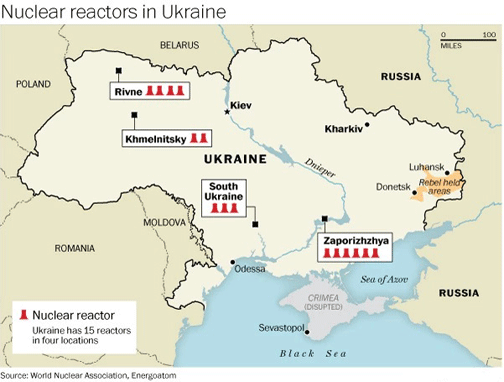
The Ukraine crisis drags on – no American soldiers will be fighting, but American weapons companies making great sales. Here’s hoping that in the event of war, nobody will strike Ukraines’s nuclear reactors – each of them in them in themselves a sitting nuclear bomb.
Some bits of good news : Chinese Method For Growing Veggies Year-Round in Frigid Canada Really Works–And Has No Heating Costs. South Australia Smashes Renewable Record Using 100% Solar And Wind For Full WeekSolar Power Will Account for Nearly Half of New U.S. Electric Generating Capacity in 2022
CoronavirusLPandemic or endemic: Where is COVID heading next?
Climate, Hot Oceans & Escaping Consumerism
The rulers of the great powers are playing with fire. Voices for a World Free of Nuclear Weapons . The threat of nuclear winter hangs over our warming planet.
Swapping one dangerous fossil fuel technology for another dangerous nuclear technology is NOT progress. Former nuclear regulators say that nuclear power is not a feasible option for tackling the climate crisis.
Russia proposes US returns American nuclear weapons from NATO countries close to Russia. U.S. and Russian Threats Over Ukraine—What They’re About .
US and British governments are effectively using “lawfare” to ensure Assange’s continued detention. https://www.youtube.com/watch?v=Q2KuzriLnaU UK High Court gives very little chance for Julian Assange.
Rockets Destroy Ozone and Cause Climate Change – Aerospace Programs’ Deadly Impacts to the Earth.
Scientists say no to Solar Geoengineering .
Nuclear incidents and meltdowns – far more than we realised. ‘We have to stop believing the nuclear hype’ , former chairman of the US Nuclear Regulatory Commission, and other leaders. Busting the nuclear propaganda about Liquid Fluoride Thorium Reactors (LFTR).
UKRAINE. Full scale war in Ukraine? With its 15 nuclear reactors – no more Ukraine, no more Europe. Increased mutations in animals affected by Chernobyl radiation. “Nuclear warfare without bombs”.
JAPAN.Japan needs a realistic debate instead of new push for fast nuclear reactors. Momentum building for nuclear ban treaty, with hopes that Japan will participate.
Fukushima.Leakage of coolant water from ice wall around crippled Fukushima nuclear power station. Can reactor fuel debris be safely removed from Fukushima Daiichi? Fukushima nuclear radiation has had strange effects on plants and trees. The more radiation, the weirder Fukushima’s fir trees became. Father continues to suffer in court over Fukushima nuclear accident: “I exposed my son to radiation.
USA,
- ”All options on the table”to punish Moscow –could bring about a nuclear conflict. Democrats urge Biden to keep pledge to limit nuclear weapons. Anniversary Of The Night Nuclear Bombs Fell Near Goldsboro. Militarized Dolphins Protect Almost a Quarter of the US Nuclear Stockpile.
- Montana communities have better options than nuclear power. Leaders say nuclear will save Kemmerer. Residents aren’t convinced. West Virginia public weighs in on nuclear power plant prohibition repeal .
- Another case of the nuclear industry bribing a university.
- Forensic experts are working to recover texts deleted by ex-FirstEnergy CEO Chuck Jones after he was fired. Lawsuit looks to force nuclear regulator to turn over records from San Onofre ‘near-miss’ incident.
- Nuclear-Testing ‘Downwinders’ Speak about History and Fear.
- Nuclear waste storage in New Mexico would be blocked if Senate, House bill pass Legislature.
- Elon Musk SpaceX rocket on collision course with moon.
CANADA. NB POWER seeks unprecedented 25-year licence for Point Lepreau nuclear power station. Unease in Ontario about planned nuclear waste dump (nobody suggests that they stop making this trash?) Canada’s nuclear waste body ousted liaison officer for being ‘too much on the side of the community,’ lawsuit claims.
Chief Hugh Akagi will present the case against having a CANDU-6 nuclear reactor on Peskotomuhkati land. NB Power and New Brunswick government gamble on untested, non existent ”small” nuclear reactors (SMRs).
Canada’s state broadcaster CBC peddles lies and slanders about jailed journalist Julian Assange.
UK.
- What’s plan B if the government can’t attract investors willing to fund Sizewell C? Sizewell C nuclear project– subsidised construction, subsidised power generation, subsidised waste management, subsidised company. Sizewell C nuclear plant will have catastrophic effects on nature, and the Minsmere nature reserve. UK’s Green Party opposes £100 million government bailout for Sizewell C nuclear project. Nuclear power – a burden that will only slow the energy transition – UK Greens
- Tight timetable for the Rolls Royce-led conglomeration to ever get their small nuclear reactors built. Local MP has vision for a non-nuclear future for Hunterston.
- The escalating costs of decommissioning UK’s nuclear reactors pose a warning about new nuclear reactors. Decommissioning of the AGR nuclear power stations: National Audit Office UK.
- Anti-radiation pills handed out in case of nuclear emergency at BAE Systems
- Map shows the horrible impact a nuclear bomb would have on Coventry.
SWEDEN. Swedish government to decide on construction of nuclear waste dump. Sweden approves plan to bury spent nuclear fuel for 100000 years. The Swedish government allows the nuclear industry to build https://www.mkg.se/en/the-swedish-government-allows-the-nuclear-industry-to-build-an-unsafe-repository-for-spent-nuclear an unsafe repository for spent nuclear fuel.
FRANCE. Marine Le Pen has pro nuclear, anti-renewables policy for the coming election. Striking workers reduced France’s nuclear power generation by 2.2gigawatts (GW). France’s far-rightEUROPE.Debate flares in Amiens over the attempt to include nuclear in the ”green taxonomy”. Europe must get serious about energy conservation.
ITALY. Nuclear not competitive’ and too late for energy transition: Enel Green Power CEO..
IRELAND. “Ireland must take firm stance against greenwashing of EU Taxonomy” – Member of European Parliament.PACIFIC ISLANDS. What’s the situation of Bikini atoll and its people now?
IRAN. Iran ‘will consider’ direct talks with US, says foreign minister. Nuclear deal unlikely unless Iran releases US prisoners: Report. Iran nuclear negotiations reaching final stage. MOST of Iran’s nuclear facilities are vulnerable to devastating drone attacks.
ISRAEL. Shadowy battle – Israel’s attacks on Iran’s facilities and personnel.
GERMANY. Germany’s dramatic departure from the nuclear industry. Other European States follow.
CHINA. China now well and truly the world leader in offshore wind.
RUSSIA. Russia’s nuclear powered container ship is sailing into thick ice. NATO practices nuclear missile sorties near borders of the Russia-Belarus Union.NORTH KOREA. Nuclear-armed North Korea tests long range missile.
AUSTRALIA. Massive flooding in Kimba district, – the Agricultural (no it’s now the Nuclear Waste) Town of the Year. Serious doubts that the Australian government has a plan for nuclear waste dump vulnerable to flooding. Kimba flooding: Australian government must immediately abort nuclear waste dump project.
Caught between nostalgia and science fiction

Swapping one dangerous technology for another isn’t progress
By Linda Pentz Gunter
It’s starting to sound a lot like a Christmas carol as a growing chorus of voices clamors to stop the European Union from including nuclear power in its “green taxonomy.”
Six countries, five former Japanese prime ministers, four former nuclear regulators, a bunch of French hens (at least 20 protesters), and two heads of Italy’s major energy behemoth, have all spoken out in recent weeks against rebranding dangerous, expensive nuclear power as “sustainable” energy or even a bridge to an all renewable future.
The youth climate movement, Fridays for the Future, have also condemned the potential inclusion of nuclear power in the EU Taxonomy as “greenwashing”, with spokesperson Luisa Neubauer telling Euractiv that Germany “can phase out both coal and nuclear power and enter the renewable age.” Why, she asked, would you “swap one high risk technology, coal, for another high risk technology? And maybe those risks aren’t quite the same, but the risks attached to nuclear energy, people have experienced that.” In addition, the costs for nuclear power, she said are “in a different galaxy” compared to renewables.
Francesco Starace, a nuclear engineer by training and the head of Enel, the Italian multinational energy company, said of nuclear power, “we can’t stay halfway between nostalgia for the past and hope in science fiction”. Enel Green Power head, Salvatore Bernabei, said “we don’t intend to invest in nuclear, obviously.”
Said Starace: “We must act now because the red alert for humanity has gone off and the next ten years will be crucial. There is only one road and it is already marked: electrification, renewables and batteries”.
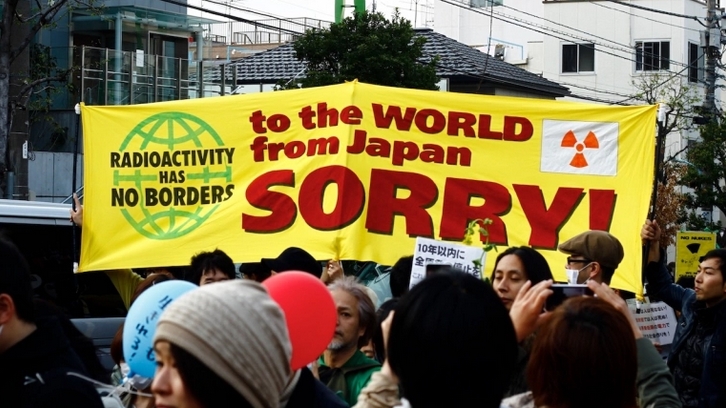
The five former prime ministers of Japan spoke from direct experience, having lived through the devastation caused by the Fukushima Daiichi nuclear disaster, which began on March 11, 2011, but is still damaging human health and the environment today.
“Promoting nuclear power can ruin a country,” wrote Junichiro Koizumi, Morihiro Hosokawa, Naoto Kan, Yukio Hatoyama and Tomiichi Murayama in a statement directed at the EU.
“We have witnessed in Fukushima over the last decade [ ] an indescribable tragedy and contamination on an unprecedented scale,” the prime ministers wrote. “Hundreds of thousands of people have been forced to flee their homes and vast areas of agricultural land have been contaminated. Radioactive water well beyond storage capacity continues to be generated, many children are suffering from thyroid cancer, and massive amounts of the country’s resources and wealth has been lost. We do not wish European countries to make the same mistake.”
The four former nuclear regulators — Dr. Greg Jaczko (US), Prof. Wolfgang Renneberg (Germany), Dr. Bernard Laponche (France) and Dr. Paul Dorfman (UK) — stated categorically that “The central message, repeated again and again, that a new generation of nuclear will be clean, safe, smart and cheap, is fiction.”
Given the urgency of the climate crisis, the four said, using nuclear power to address it was a completely unrealistic proposition. “The reality is nuclear is neither clean, safe or smart; but a very complex technology with the potential to cause significant harm,” they wrote.
They added: “Nuclear isn’t cheap, but extremely costly. Perhaps most importantly nuclear is just not part of any feasible strategy that could counter climate change. To make a relevant contribution to global power generation, up to more than ten thousand new reactors would be required, depending on reactor design.”
Although France is leading the charge — for obviously self-interested reasons — to include nuclear power in the EU Taxonomy, the country is not without its nuclear opponents. The nationwide Réseau sortir du nucléaire and scores of regional groups struggle to get attention, but have staged protests for years. France relies on nuclear power for 70% of its electricity and is also a member of the UN Security Council as a nuclear weapons country, giving it an illusory sense of prestige of which it is reluctant to let go.
Last December, protesters descended on France’s foreign ministry, roundly criticizing French president, Emmanuel Macron’s continued promotion of nuclear power. At the same time, the country was facing electricity shortages due to five French reactor outages.
Even scientists, sometimes the more cautious of species, have spoken out. According to the Financial Times, which viewed the documentation, scientific experts “hired by Brussels to help draw up the sustainable investment rules” have criticized the inclusion of nuclear power, while not going as far as to ask for its removal altogether. However, the experts wrote that “the inclusion of nuclear energy contravenes the principle of ‘do no significant harm’”, the Financial Times said.
Meanwhile, Austria is preparing to take the EU to court if it persists in labeling nuclear power as green. Austria has the support of Spain, Luxembourg and Denmark in calling the consideration of nuclear as a “sustainable” energy source “a step backwards.”
Germany, which is close to phasing out all of its nuclear power plants, has also rejected nuclear as part of the EU Taxonomy while so far failing to oppose the inclusion of gas, again for vested interests.
Linda Pentz Gunter is the international specialist at Beyond Nuclear and writes for and curates Beyond Nuclear International.
“I can’t think about marriage, childbirth or the future”
January 30, 2022
A 26-year-old woman with thyroid cancer and lung metastasis sues TEPCO.
Tokyo Shimbun, January 19, 2022
Six young people who developed thyroid cancer after the accident at the Fukushima Daiichi nuclear power plant are seeking to establish the responsibility of TEPCO (Tokyo Electric Power Company) in court. They have strong doubts that, despite the discovery of thyroid cancer in about 300 people who were children at the time of the accident, no causal link with the accident has been recognized, especially since a reduction in the number of examinations is being considered. “I don’t want this to continue as if nothing happened,” said a 26-year-old woman who lives in the Nakadôri area of central Fukushima Prefecture and is worried about her future after learning that her cancer has spread to her lungs.
17 years old “Why me?”
“The doctor told me there was something suspicious in my neck in addition to the shadow detected on my lungs. I can’t think about marriage, having a child, or anything else in the future,” she says quietly at home that morning of November 11 before heading to her part-time job.
She goes to the hospital once every three months. Her heart sinks when she sees a young child in the waiting room. “The cancer was detected during a test when I was asymptomatic. Reducing the test[1] may not save lives.”
She was diagnosed with thyroid cancer in March 2013, just before she started her third year of high school, at age 17. “I was told that if I didn’t have surgery, I might not live until I was 23. I tried to believe that everything was okay, even though I kept asking myself, Why me?”

is in Fukushima Prefecture.
Two surgeries, a room like a prison cell
Her 57-year-old mother held back tears as she heard the diagnosis along with her daughter. Her daughter entered high school in April 2011, just after the nuclear accident. At first, she wore a mask to protect herself from inhaling radioactive material, but she soon stopped wearing it. She walked 40 minutes each way to school, and participated in outdoor physical education classes. Her mother’s mind was filled with regret: “If only we had evacuated,” she said.
The girl wanted to go to university in Tokyo, but her mother, worried about her health, prevented her from doing so, and she went to university in the nearby prefecture. However, six months later, she began to feel lethargic, tired and had irregular periods. So she was retested.
“There is a recurrence on the remaining lobe of the thyroid gland. There was also a shadow on the lung,” the doctor told her. “I am not cured,” she said, breaking down in tears with her mother. She dropped out of college at age 19 to focus on her treatment.
The two surgeries and tests were difficult trials to endure. During one test, the deeper the needle went into her throat, the more painful it was. She had to undergo three sessions of iratherapy[2]. 2] She was placed in isolation in a cell-like room where she tried to cope by looking out a leaded window.
…but now I want to look forward.
On the day of the coming-of-age ceremony, her playful daughter told her father that she was happy to be able to wear a kimono. Her mother was shocked to learn that their daughter had contemplated death. “I have cancer, I won’t live long,” she repeated to herself, half-joking. This breaks her mother’s heart: “Not a day goes by that I don’t think about her.
Her cancer marker values are higher than before the operation. Because of fears of recurrence and metastasis, she has given up on the idea of a full-time job in her desired profession. But now she wants to look ahead. “If it wasn’t the accident, why are there so many children with thyroid cancer? Maybe there will be more in the future. I feel I have to do what I can now.
EDITOR’S NOTE
[1] Thyroid ultrasound examination of people living in Fukushima Prefecture who were under 18 years old at the time of the Fukushima Daiichi nuclear accident is conducted by Fukushima Prefecture. The decrease in the number of examinations is under discussion; the examination would be a source of concern for the examinees, and these examinations possibly followed by surgery would be a source of overdiagnosis.
[2] Radioactive Iodine Treatment
https://www.tokyo-np.co.jp/article/154986?fbclid=IwAR3kenQXIPf2itXHKTp8qU4t-uWy4o8hdjntp1bTmwIDdzpJuiNPBPLAYS8
“Nuclear warfare without bombs”

the vulnerability of operating reactors in Ukraine is a danger that is not taken nearly seriously enough.….. (A wind farm in a war zone comes with no such hazards.)
Ukraine’s reactors at risk if Russia invades
“Nuclear warfare without bombs” — Beyond Nuclear International Ukraine’s reactors could be in the line of fire
By Linda Pentz Gunter 30 Jan 22, As Craig Hooper so chillingly warned us in his December 28, 2021 article for Forbes, a Russian invasion of Ukraine, “could put nuclear reactors on the front line of military conflict.” The result, he said, depending on the tactics deployed by the Russians, could be equivalent to “nuclear warfare without bombs.”
It’s yet one more reminder of just how much an already perilous situation can become orders of magnitude worse, once you introduce the risk of major radioactive releases into the equation.
There are 15 reactors in Ukraine providing about 50% of the country’s electricity. Hooper’s article speculates not only on what could happen if any one of these nuclear sites — such as the six-reactor VVER-1000 complex at Zaporizhzhia — should find itself in the midst of armed conflict or bombardment. He also postulates intentional sabotage by Russia as a strategic measure — “allowing reactors to deliberately melt down and potentially contaminate wide portions of Europe.”
This may sound far-fetched, or, at least, we hope it does. And the Forbes article roundly condemns Russia without factoring in the bristling U.S.-led buildup of NATO armaments on the border, none of which is easing tensions, and which only worsens the likelihood that Ukraine’s nuclear plants could find themselves literally in the line of fire. (For an interesting assortment of perspectives from all sides, endeavoring to unravel the complexities of this situation, Better World Info provides a useful resource.)

Either way, the vulnerability of operating reactors in Ukraine is a danger that is not taken nearly seriously enough. As far as I can tell, Hooper’s is the only article on the still unfolding tension between Russia and Ukraine that has even mentioned the risks posed by those 15 reactors. (A wind farm in a war zone comes with no such hazards.)
Instead, the implications of a radiological disaster ensuing should Russia indeed invade Ukraine, have been largely ignored in favor of panic over a potential energy crisis in Europe, should Russia cut off gas supplies in an effort to dampen European support for Ukraine in the on-going dispute.
This is in itself is a reminder that Europe could have avoided such dependence on imported fossil fuels — while at the same time contributing to a meaningful reduction in greenhouse gas emissions — by developing home-grown renewable energy decades ago, when climate change was already recognized as a threat.
We have, of course, already seen what can happen when radioactive contamination adds to an existing “natural” disaster. After the major earthquake that hit Japan on March 11, 2011, followed by the devastating tsunami, rescue operations in some hard-hit areas were hampered by high levels of radiation released by the subsequent triple meltdowns at Fukushima Daiichi. How many lives were lost in the earthquake or tsunami that might have been saved had first responders been able to safely enter those disaster zones?
If conflict rages in a region where nuclear power plants are located, the personnel working there cannot simply abandon them. This was the terrible dilemma faced by TEPCO and then Japanese president, Naoto Kan, who insisted that the Fukushima Daiichi workforce stay in place at the risk of their lives.
Abandoning Daiichi to a major runaway meltdown would have forced evacuations further afield, including from the still operating Fukushima Daiini nuclear power plant less than 10 miles down the coast. Abandoning Daiini would have meant more meltdowns. And so on. Such a cascade of nuclear disasters would have necessitated the evacuation of Tokyo, a city of close to 14 million people. That, Kan later said, would have been the end of Japan as a nation.
There is, of course, no need to put anyone into such a “playing God” situation, condemning the few to save the many due to the folly of choosing an energy source that could potentially irradiate an entire country. You simply stop using nuclear power.
But that still leaves the waste. And here we return to the same dilemma. That radioactive waste, some of it lethal for hundreds of thousands of years, cannot be stored anywhere that might become politically volatile.
This was, in part, the driver behind the Australian Pangea project, which viewed that nation as the ideal venue for the world’s underground radioactive waste repository, not only because of the suitable geology, but because it was a country unlikely to be caught up in war.
However, Pangea (full disclosure; this was a project of my eventually estranged and now deceased cousin, David Pentz) thoroughly failed the environmental justice test, an essential criterion for managing the dangerous detritus of the Nuclear Age. Ethically, you cannot demand that nuclear waste be dumped on those who never made it and don’t want it. The massive transport risks were also a deal killer.
As Edgar Hagen’s film — Journey to the Safest Place on Earth — so effectively conveyed, finding a site for high-level radioactive waste that is geologically and ethically sound and politically stable is probably an impossibility. All the more reason not to exacerbate this problem by continuing to make yet more waste.
As Charlie Chaplin already articulated so brilliantly back in 1940 in The Great Dictator, it would be better if the misguided megalomaniacs who run far too many countries in this world, would stop war-mongering and concentrate on a collective effort to save humanity. These days, that means from the looming disaster that is the climate emergency.
But the reality is that we are a warlike species. Nothing in our history suggests we are evolving on this front, even if most of us actually abhor war. We continue to elect leaders who are all too willing to lead us headlong into one.
Therefore, removing everything that could make the consequences of a war even more deadly, is an urgent imperative. That means abolishing nuclear weapons, but it also means closing and dismantling the world’s nuclear power plants. And it most certainly means a halt to any further development and expansion of nuclear power, especially in volatile regions like the Middle East.
We may yet escape the Holocaust of a true nuclear war. But, if we don’t abolish nuclear power, we may still see that “nuclear war without bombs”.
Linda Pentz Gunter is the international specialist at Beyond Nuclear and writes for and curates Beyond Nuclear International. She is based in Takoma Park, Maryland.
Swapping one dangerous fossil fuel technology for another dangerous nuclear technology is NOT progress
‘‘To make a relevant contribution to global power generation, up to more than ten thousand new reactors would be required, depending on reactor design.”
Caught between nostalgia and science fiction https://beyondnuclearinternational.org/2022/01/30/caught-between-nostalgia-and-science-fiction/
Swapping one dangerous technology for another isn’t progress. By Linda Pentz Gunter, 30 Jan 22,
It’s starting to sound a lot like a Christmas carol as a growing chorus of voices clamors to stop the European Union from including nuclear power in its “green taxonomy.”
Six countries, five former Japanese prime ministers, four former nuclear regulators, a bunch of French hens (at least 20 protesters), and two heads of Italy’s major energy behemoth, have all spoken out in recent weeks against rebranding dangerous, expensive nuclear power as “sustainable” energy or even a bridge to an all renewable future.
The youth climate movement, Fridays for the Future, have also condemned the potential inclusion of nuclear power in the EU Taxonomy as “greenwashing”, with spokesperson Luisa Neubauer telling Euractiv that Germany “can phase out both coal and nuclear power and enter the renewable age.” Why, she asked, would you “swap one high risk technology, coal, for another high risk technology? And maybe those risks aren’t quite the same, but the risks attached to nuclear energy, people have experienced that.” In addition, the costs for nuclear power, she said are “in a different galaxy” compared to renewables.
Francesco Starace, a nuclear engineer by training and the head of Enel, the Italian multinational energy company, said of nuclear power, “we can’t stay halfway between nostalgia for the past and hope in science fiction”. Enel Green Power head, Salvatore Bernabei, said “we don’t intend to invest in nuclear, obviously.”
Said Starace: “We must act now because the red alert for humanity has gone off and the next ten years will be crucial. There is only one road and it is already marked: electrification, renewables and batteries”.
The five former prime ministers of Japan spoke from direct experience, having lived through the devastation caused by the Fukushima Daiichi nuclear disaster, which began on March 11, 2011, but is still damaging human health and the environment today.
Promoting nuclear power can ruin a country,” wrote Junichiro Koizumi, Morihiro Hosokawa, Naoto Kan, Yukio Hatoyama and Tomiichi Murayama in a statement directed at the EU.
“We have witnessed in Fukushima over the last decade [ ] an indescribable tragedy and contamination on an unprecedented scale,” the prime ministers wrote. “Hundreds of thousands of people have been forced to flee their homes and vast areas of agricultural land have been contaminated. Radioactive water well beyond storage capacity continues to be generated, many children are suffering from thyroid cancer, and massive amounts of the country’s resources and wealth has been lost. We do not wish European countries to make the same mistake.”
The four former nuclear regulators — Dr. Greg Jaczko (US), Prof. Wolfgang Renneberg (Germany), Dr. Bernard Laponche (France) and Dr. Paul Dorfman (UK) — stated categorically that “The central message, repeated again and again, that a new generation of nuclear will be clean, safe, smart and cheap, is fiction.”
Given the urgency of the climate crisis, the four said, using nuclear power to address it was a completely unrealistic proposition. “The reality is nuclear is neither clean, safe or smart; but a very complex technology with the potential to cause significant harm,” they wrote.
They added: “Nuclear isn’t cheap, but extremely costly. Perhaps most importantly nuclear is just not part of any feasible strategy that could counter climate change. To make a relevant contribution to global power generation, up to more than ten thousand new reactors would be required, depending on reactor design.”
Although France is leading the charge — for obviously self-interested reasons — to include nuclear power in the EU Taxonomy, the country is not without its nuclear opponents. The nationwide Réseau sortir du nucléaire and scores of regional groups struggle to get attention, but have staged protests for years. France relies on nuclear power for 70% of its electricity and is also a member of the UN Security Council as a nuclear weapons country, giving it an illusory sense of prestige of which it is reluctant to let go.
Last December, protesters descended on France’s foreign ministry, roundly criticizing French president, Emmanuel Macron’s continued promotion of nuclear power. At the same time, the country was facing electricity shortages due to five French reactor outages.
Even scientists, sometimes the more cautious of species, have spoken out. According to the Financial Times, which viewed the documentation, scientific experts “hired by Brussels to help draw up the sustainable investment rules” have criticized the inclusion of nuclear power, while not going as far as to ask for its removal altogether. However, the experts wrote that “the inclusion of nuclear energy contravenes the principle of ‘do no significant harm’”, the Financial Times said.
Meanwhile, Austria is preparing to take the EU to court if it persists in labeling nuclear power as green. Austria has the support of Spain, Luxembourg and Denmark in calling the consideration of nuclear as a “sustainable” energy source “a step backwards.”
Germany, which is close to phasing out all of its nuclear power plants, has also rejected nuclear as part of the EU Taxonomy while so far failing to oppose the inclusion of gas, again for vested interests.
Linda Pentz Gunter is the international specialist at Beyond Nuclear and writes for and curates Beyond Nuclear International.
The more radiation, the weirder Fukushima’s fir trees became.
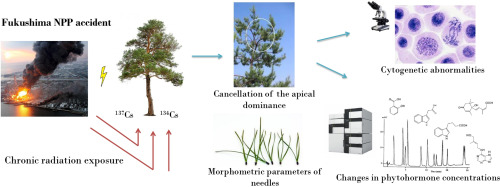
NUCLEAR DISASTER IN JAPAN DID SOMETHING STRANGE TO TREES https://futurism.com/the-byte/nuclear-japan-trees
SOMETHING IS UP WITH THOSE TREES. by ABBY LEE HOOD ( Journalist) They didn’t grow any larger or suddenly become sentient, but the trees outside the Fukushima Daiichi Nuclear Power Plant are definitely acting weird, according to a new study published earlier this month in the journal Plants.
Researchers from multiple universities in Italy and Brazil studied fir trees growing near the plant, which was destroyed in 2011 following a severe earthquake. The scientists studied whorls — nodes where leaves, branches or other plant parts grow from a central point — and found that fir trees around Fukushima exhibited weird growth patterns around them.
“These conifers showed irregular branching at the main axis whorls,” reads the study, spotted by Newsweek. “The frequency of these anomalies corresponded to the environmental radiation dose rate at the observed sites.”
The more radiation, in other words, the weirder the trees got.
Circle of Life
It’s pretty interesting that trees affected by nuclear radiation grow in funky patterns and are still affected by material in the soil near Fukushima. But even more important is the team’s goal of learning how to better take care of people caught up in similar, future disasters, and to create better emergency management plans.
“Ten years have passed since the FNPP accident, and still the large-scale effects are visible,” the researchers concluded. “Learning from past incidents and implementing this knowledge can make a significant difference in terms of lives and costs in healthcare management.”
We may not always be good stewards of the environment around us, but nature seems happy to provide cautionary tales for humanity to learn from all the same.
More on Fukushima weirdness: Scientists Monitoring Radioactive Snakes Near Fukushima Meltdown Site
U.S. and Russian Threats Over Ukraine—What They’re About

“It’s a noble principle, just not one the United States abides by. The United States has exercised a sphere of influence in its own hemisphere for almost 200 years, since President James Monroe declared that the United States ‘should consider any attempt’ by foreign powers ‘to extend their system to any portion of this hemisphere as dangerous to our peace and safety’.”.
Blinken wants a one-way street where spheres of influence are concerned. The U.S., for him, has the right to wield influence everywhere, while others don’t.
STRIPPING AWAY THE BULLS**T: U.S. and Russian Threats Over Ukraine—What They’re About and Who’s the Aggressor, Covert Action Magazine By Dee Knight – January 25, 2022 Threats and counter-threats flying between Washington and Moscow over Ukraine have caused a flurry of fear and confusion that escalates and expands daily. Is the world on the brink of war? What is it about, who is the aggressor and who is to blame?
The dangerous standoff has lasted for most of a year. Each side accuses the other of threatening war—in a way reminiscent of the Cuban missile crisis of 1962.
During a week of intense diplomatic meetings in three European capitals, which appeared to reach a dead end, President Joe Biden seemed to “blink” midweek, on January 19, telling reporters in Washington he had indicated to Russian President Putin that “we can work out something.”
New York Times senior reporter David Sanger jumped on it: “Mr. President, it sounds like you’re offering some way out here, some off-ramp—an informal assurance that NATO is not going to take in Ukraine… and we would never put nuclear weapons there.” Sanger went on to say Russia “wants us to move all of our nuclear weapons out of Europe and not have troops rotating through the old Soviet bloc.” Biden quickly said “No, there’s not space for that.”
Biden’s blink was a break in the warlike atmosphere that has prevailed endlessly. Katrina van den Heuvel wrote the day before in The Washington Post that “Hotheads [were] having a field day. A White House task force that includes the CIA [was] reportedly contemplating U.S. support for a guerrilla war if Russia seizes Ukraine; Russian hawks talk of a military deployment to Cuba and Venezuela.” Biden had “installed a team of national security managers from the ‘Blob,’ marinated in successive debacles in Iraq, Libya, Syria, Yemen and more.”
Guns and sanctions are the U.S. empire’s preferred options, van den Heuvel said: “with about 800 military bases outside the United States,” the U.S. has “more bases than diplomatic missions. (Russia’s only military bases outside the former Soviet Union are in Syria.)” She added that Secretary of State Blinken and the Blob “talk about a rules-based international order but respect it only if we make the rules, often exempting ourselves from their application.”
Spheres of influence?
“When will the U.S. stop lying to itself about global politics?” asked CUNY Professor Peter Beinart, writing in the New York Times on January 13. He took issue with Secretary of State Antony Blinken, who pontificated last month that “One country does not have the right to dictate the policies of another or to tell that country with whom it may associate; one country does not have the right to exert a sphere of influence. That notion should be relegated to the dustbin of history.”
Beinart commented: “It’s a noble principle, just not one the United States abides by. The United States has exercised a sphere of influence in its own hemisphere for almost 200 years, since President James Monroe declared that the United States ‘should consider any attempt’ by foreign powers ‘to extend their system to any portion of this hemisphere as dangerous to our peace and safety’.”………….
Blinken wants a one-way street where spheres of influence are concerned. The U.S., for him, has the right to wield influence everywhere, while others don’t.
The same day Biden blinked, French President Macron weighed in saying war would be the “most tragic thing of all.” Speaking in the European Union’s capital of Strasbourg, as new interim EU chair, Macron said he hoped to revitalize the four-way “Normandy format” talks between Russia, Germany, France and Ukraine to find a solution to the Ukraine crisis. “It is vital that Europe has its own dialogue with Russia,” Macron said. The EU had no part in the talks last week between Russia, the U.S., NATO and the Organization for Security and Cooperation in Europe (OSCD).
The Normandy format has been a vehicle for implementing the 2015 Minsk agreements designed to end the separatist war in Ukraine’s Donbas region. This solution has already been proposed and accepted in principle, according to Anatol Lieven, who wrote in The Nation that the Minsk II agreement was already adopted by France, Germany, Russia and Ukraine in 2015, and endorsed unanimously by the UN Security Council.
Key elements of the Minsk II deal are full autonomy for Ukraine’s eastern regions in the context of decentralization of power in Ukraine, demilitarization, and restoration of Ukrainian sovereignty. Despite agreement by all parties, political analyst Anatol Lieven says “because of the refusal of Ukrainian governments to implement the solution and refusal of the United States to put pressure on them to do so,” the settlement is a kind of “zombie policy.”
The issue of NATO expansion is another “zombie policy” as the U.S. refuses to acknowledge Russia’s legitimate opposition to it.
After the first of three negotiating sessions between the U.S. and Russia during the week of January 10, Russian Deputy Foreign Minister Sergei Ryabkov had declared it “absolutely mandatory” that Ukraine “never, never, ever” become a NATO member. In response, U.S. Deputy Secretary of State Wendy Sherman said: “we will not allow anyone to slam closed NATO’s open-door policy.”……………………..
US Undersecretary of State Victoria Nuland helped orchestrate the 2014 coup in Kyiv, the Ukrainian capital, that toppled a government friendly to Russia. The new far-rightist government ended language rights for Russian speakers who are the majority in the Ukraine’s eastern provinces. Donetsk and Lugansk voted to separate, as did Crimea. Russia then annexed Crimea, to protect Russian speakers there and secure its Black Sea naval base. Russia provided humanitarian aid and trade to Donetsk and Lugansk, and stationed troops on their eastern border for protection.
“Pro-Democracy Protests” or a Fascist Coup?
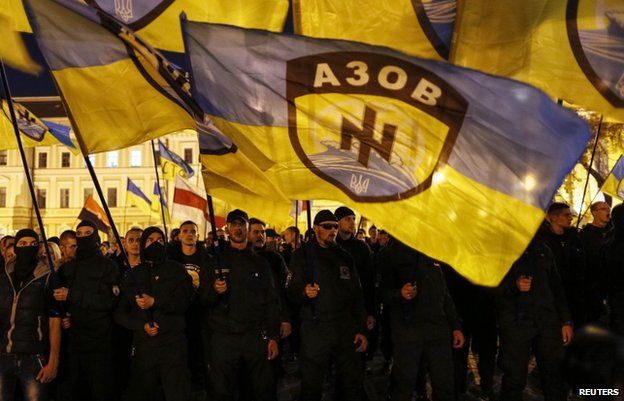
A New York Times report on January 6 said “Russia intervened militarily in Ukraine in 2014 after pro-democracy protests erupted there.” [Emphasis added.] The coup was actually carried out by fascist gangs, according to a May 2, 2018, report in The Nation by Stephen Cohen.
The gangs, including self-declared neo-Nazis, were encouraged by Nuland, Biden and other prominent U.S. politicians. The neo-Nazis were integrated into Ukraine’s official military which, since 2014, has been trained, armed and reorganized by the U.S., Britain, Canada and other NATO countries.
Stephen Cohen wrote that “the pogrom-like burning to death of ethnic Russians and others in Odessa later in 2014 reawakened memories of Nazi extermination squads in Ukraine during World War II.” These horrors have been all but deleted from the American mainstream narrative, despite being well-documented.
Cohen added that “stormtroop-like assaults on gays, Jews, elderly ethnic Russians, and other ‘impure’ citizens are widespread throughout Kyiv-ruled Ukraine, along with torchlight marches reminiscent of those that eventually inflamed Germany in the late 1920s and 1930s… The police and official legal authorities do virtually nothing to prevent these neo-fascist acts or to prosecute them. On the contrary, Kyiv has officially encouraged them by systematically rehabilitating and even memorializing Ukrainian collaborators with Nazi German extermination pogroms and their leaders during World War II, renaming streets in their honor, building monuments to them, rewriting history to glorify them, and more.”
The people of the self-declared people’s republics of Donetsk and Lugansk in eastern Ukraine suffer under a complete economic blockade by Ukraine and its Western allies. Historically known as the Donbass region, eastern Ukraine is a mining and industrial center. Donbass miners played a crucial and heroic role in the defeat of the German invasion of the Soviet Union in World War II. Many Russians revere the Donbass as “the heart of Russia.”
All of Ukraine east of the Dnieper river is predominantly Russian-speaking. U.S. claims of a “Russian invasion” are reminiscent of claims of North Vietnamese invasion of South Vietnam after the artificial separation of Vietnam in 1954. The entire U.S. narrative about Ukraine is a cynical fabrication designed to justify aggression.
Russian Security Proposals
In mid-December Russia took a diplomatic initiative and presented a list of security proposals to the United States. According to the Wall Street Journal, they include ending NATO’s expansion further eastward to include Ukraine, a promise for each side to refrain from hostile activities, and an end to NATO military activities in all of Eastern Europe, Transcaucasia and Central Asia……….
Among the “severe consequences” threatened by the U.S. against Russia, the Financial Times has said sanctioning Russia’s Nord Stream 2 gas pipeline to Germany was “top of the list.” Western Europe is already facing an energy crunch, with skyrocketing prices for natural gas.
Europeans need energy security and are wary of war. They want the Nord Stream 2 pipeline as soon as possible, while the Biden administration calls it a “bad deal” and claims that it makes Europe vulnerable to Russian “treachery.” Texas Senator Ted Cruz has pressed hard against the pipeline, which offsets opportunities for U.S. energy companies to supply gas to the European market. U.S. foreign adventures have often constricted Europe’s energy sources.
A 2021 survey by the European Council on Foreign Affairs found that most Europeans want to remain neutral in any U.S. war against Russia or China. But new NATO member-states align with the U.S. against Russia. They have installed terminals to receive U.S. liquid natural gas deliveries, to reduce dependence on Russian gas.
Despite all the diplomatic efforts, powerful institutional and economic forces in the U.S.—the military industrial complex and big energy companies among others—are eager for a new Cold War with Russia, which would provide them with boundless opportunities for profitable deals. “The U.S. military-industrial complex needs enemies like human lungs need oxygen,” the saying goes. “When there are no enemies, they must be invented.”
The demonization of Vladimir Putin and Russia by the U.S. media is part of this policy of inventing enemies. There is a long list of foreign leaders and nations whose attempts to defy the dictates of Washington and pursue an independent foreign policy have brought down upon them the wrath of the U.S. Capitalist Empire.https://covertactionmagazine.com/2022/01/25/stripping-away-the-bullst-u-s-and-russian-threats-over-ukraine-what-theyre-about-and-whos-the-aggressor/
Forensic experts are working to recover texts deleted by ex-FirstEnergy CEO Chuck Jones after he was fired

Forensic experts are working to recover texts deleted by ex-FirstEnergy CEO Chuck Jones after he was fired Cleveland.com : Jan. 28, 2022, By Jeremy Pelzer,
COLUMBUS, Ohio — Forensic experts have been working to recover text messages deleted by former FirstEnergy Corp. CEO Chuck Jones in October 2020, shortly after the utility fired him for violating company ethics policies amid the House Bill 6 scandal, according to a recent civil lawsuit filing.
The filing was part of a submission made Thursday by attorneys representing FirstEnergy shareholders suing company officials for not stopping a massive bribery scheme to pass HB6. In addition, the filing says the content of the deleted messages remains unknown, and it did not disclose any recipients…………..
A federal complaint against ex-Ohio House Speaker Larry Householder and several allies accuses them of using $60 million in FirstEnergy bribe money to secure the passage of HB6. The complaint says that Jones and Householder emailed and texted each other several times a week about the issues with the legislation, which offered a $1 billion-plus bailout to two Northern Ohio nuclear power plants owned by a then-subsidiary of FirstEnergy………………….
Jones has so far not been accused of any crime, and he denies any wrongdoing. However, a civil lawsuit filed by Attorney General Dave Yost accuses him and two other former FirstEnergy executives of engaging in extortion, money laundering, coercion, intimidation and an attempted coverup.
Cleveland.com has reached out to a spokesman for Jones for comment.
Thursday’s court filing states that plaintiffs in the civil suit have reviewed more than 400,000 pages of documents so far and are preparing to start depositions on Feb. 10. The filing states that plaintiffs will be ready to go to trial by this August.
Read the full filing here: https://www.cleveland.com/news/2022/01/forensic-experts-are-working-to-recover-texts-deleted-by-ex-firstenergy-ceo-chuck-jones-after-he-was-fired.html
Nuclear power – a burden that will only slow the energy transition – UK Greens

‘Nuclear power is a burden’ – Green Party slams Government’s £100 million Sizewell C cash injection. The Green Party’s comments come after the Government pledged £100 million of taxpayer cash towards the Sizewell C project.
The Green Party has slammed the Government’s decision to commit £100 million of public money towards Sizewell C. Ministers hope that the £100 million pledge will attract further private investment in the Sizewell C project. But Adrian Ramsay, the Green party’s co-leader and Suffolk MP candidate, said: “Nuclear power is a burden and a risk, not a solution”.
Mr Ramsay added: “The next decade is crucial for cutting carbon emissions but nuclear will only slow the energy transition, not speed it up. “Even with constant injections of yet more taxpayers’ cash, the
energy from Sizewell C won’t come onstream for years, whereas more cost-effective solar and wind can be deployed right now.
“At a time when people are already struggling with energy prices, it is absurd to throw yet more millions of pounds into a nuclear plant that could just drive energy prices up further when we could be expanding cheaper, cleaner alternatives like solar or wind.”
Suffolk Live 28th Jan 2022
https://www.suffolklive.com/news/nuclear-power-burden-green-party-6565875
1 This Month
Tell Congress: Prevent Nuclear Catastrophe in Iran

Tell Congress: Prevent Nuclear Catastrophe in Iran

Read the Public Inquiry Report, the Commissioners’ report, Surrendering Australia: The AUKUS Deception is available to download for free at aukuspublicinquiry.com. Or just watch the replay of the National Press Club Luncheon.


Shut down the radiation-damaged Heysham nuclear reactors now
To see nuclear-related stories in greater depth and intensity – go to https://nuclearinformation.wordpress.com

Say No to NASA’s Reckless Nuclear Reactor on the Moon
Say No to NASA’s Reckless Nuclear Reactor on the Moon
-
Archives
- November 2026 (238)
- October 2026 (302)
- September 2026 (339)
- August 2026 (330)
- July 2026 (355)
- June 2026 (287)
- May 2026 (306)
- April 2026 (356)
- March 2026 (251)
- February 2026 (267)
- January 2026 (308)
- December 2025 (358)
-
Categories
- 1
- 1 NUCLEAR ISSUES
- business and costs
- climate change
- culture and arts
- ENERGY
- environment
- health
- history
- indigenous issues
- Legal
- marketing of nuclear
- media
- opposition to nuclear
- PERSONAL STORIES
- politics
- politics international
- Religion and ethics
- safety
- secrets,lies and civil liberties
- spinbuster
- technology
- Uranium
- wastes
- weapons and war
- Women
- 2 WORLD
- ACTION
- AFRICA
- Atrocities
- AUSTRALIA
- Christina's notes
- Christina's themes
- culture and arts
- Events
- Fuk 2022
- Fuk 2023
- Fukushima 2017
- Fukushima 2018
- fukushima 2019
- Fukushima 2020
- Fukushima 2021
- general
- global warming
- Humour (God we need it)
- Nuclear
- RARE EARTHS
- Reference
- resources – print
- Resources -audiovicual
- Weekly Newsletter
- World
- World Nuclear
- YouTube
-
RSS
Entries RSS
Comments RSS

