‘Not a dumping ground’: Pacific condemns Fukushima water plan
Northern Mariana Islands says proposal for wastewater from stricken plant to be stored on site must be considered urgently.

By Catherine Wilson – 14 Feb 2022
The Commonwealth of the Northern Mariana Islands says there is a viable alternative to Japan’s plan to dump more than 1 million tonnes of treated water from the crippled Fukushima nuclear power station into the Pacific Ocean, and it requires urgent consideration.
The wastewater is a product of efforts to cool the nuclear reactors at Fukushima that were badly damaged in the March 2011 earthquake and tsunami.
The Northern Mariana Islands, a United States territory with a population of about 51,659 people, is located only 2,500km (1,553 miles) southeast of Japan. The islands’ leaders have declared that Japan’s plan, officially announced last year, is unacceptable.
“The expectation is that the discharge will not happen until 2023. There is time to overturn this decision,” Sheila J Babauta, a member of the Northern Mariana Islands’s House of Representatives, told Al Jazeera in an interview last month. In December, its government adopted a joint resolution opposing any nation’s decision to dispose of nuclear waste in the Pacific Ocean.
“The effort that went into the creation of the joint resolution exposed research and reports from Greenpeace East Asia highlighting alternatives for the storage of Japan’s nuclear waste, including the only acceptable option, long-term storage and processing using the best technology available,” Babauta said.
Currently, Japan intends to dispose of all the wastewater, which will be treated, over a period of about 30 years.
Anxiety is high among local Japanese fishers and coastal communities. And its plan has met with vocal opposition from neighbouring countries, including China, South Korea and Taiwan, as well as Pacific Island countries and the Pacific Islands Forum, the intergovernmental organisation for the region.
“This water adds to the already nuclear polluted ocean. This threatens the lives and livelihoods of islanders heavily reliant on marine resources. These include inshore fisheries as well as pelagic fishes such as tuna. The former provides daily sustenance and food security, and the latter much needed foreign exchange via fishing licences for distant water fishing nation fleets,” Vijay Naidu, adjunct professor at the School of Law and Social Sciences at the University of the South Pacific in Fiji, told Al Jazeera.
It was the use of the Pacific Islands for nuclear weapons testing by the US, the United Kingdom and France from the 1940s to late last century which has driven heated opposition among islanders to any nuclear-related activities in the region.
Radioactive contamination from more than 300 atmospheric and underwater nuclear tests rendered many locations, especially in the Republic of the Marshall Islands and French Polynesia, uninhabitable and led to irreversible long-term health disorders in affected communities.
Satyendra Prasad, the Chair of Pacific Islands Forum Ambassadors at the United Nations, reminded the world in September last year of the Pacific’s “ongoing struggle with the legacy of nuclear testing from the transboundary contamination of homes and habitats to higher numbers of birth defects and cancers”.
In 1985, regional leaders established the South Pacific Nuclear Free Zone Treaty, prohibiting the testing and use of nuclear explosive devices and the dumping of radioactive wastes in the sea by member states, including Australia, New Zealand and Pacific Island nations.
“For us in the Pacific, the Pacific Ocean has become a proving ground, a theatre of war, a highway for nuclear submarines and waste. The Pacific is not a dumping ground for radioactive waste water,” Maureen Penjueli, Co-ordinator of the Pacific Network on Globalisation, added.
Running out of space
When the earthquake and tsunami struck the Fukushima power plant, three nuclear reactors went into meltdown.
The process of decommissioning the disaster-hit site, which could take up to four decades, includes pumping cooling water through the affected infrastructure to prevent overheating. About 170 cubic metres of treated wastewater is accumulating every day and now fills at least 1,000 tanks around the site.
The Japanese government says it needs to release the water because it is running out of space to store it all.
It says it consulted with other countries in the region after announcing its plan in April last year, conducting briefings with Pacific Island Forum countries and the organisation’s secretariat. It adds that it will cooperate with the international community and adhere to relevant international standards.
“In November last year, experts from laboratories of the IAEA [International Atomic Energy Agency], France, Germany, and the Republic of Korea visited Japan to collect samples such as fish. These samples will be divided and sent to these laboratories for analysis,” a spokesperson for Japan’s Ministry of Foreign Affairs told Al Jazeera.
“The sea area monitoring will be strengthened from one year before the discharge, which is expected to start in spring 2022 under the current plan. The concentration measurement of the nuclides regulated by law, including tritium and carbon-14, will be measured prior to the discharge into the sea, and reports of the results will be made public.”
Last year, Rafael Mariano Grossi, the director-general of the IAEA, expressed support for Japan’s decision.
“We will work closely with Japan before, during and after the discharge of the water,” Grossi said. “Our co-operation and our presence will help build confidence, in Japan and beyond, that the water disposal is carried out without an adverse impact on human health and the environment.”
The US has also given its backing to Japan.
Babauta believes storage space is available at the Fukushima Daiichi site and on nearby land in Japan’s Futaba and Okuma districts.
In a report published in 2020, Greenpeace argued that “the only acceptable solution” was for Japan to continue the long term storage and processing of the contaminated water.
“This is logistically possible and it will allow time for more efficient processing technology to be deployed as well as allowing the threat from radioactive tritium to diminish naturally,” the environmental group said. Greenpeace said that while the Japanese government had considered allocating land for storage in Okuma and Futaba, ocean discharge was seen as easier and less time-consuming.
The wastewater storage option is also favoured by the expert civil society organisation, the Citizens Committee on Nuclear Energy (CCNE), which is supported by Tilman Ruff, associate professor at the Institute for Global Health at the University of Melbourne in Australia.
“Their [CCNE’s] recommendation for the management of the water is that, the first thing to do would be to store it in properly built secure long-lived large tanks similar to the ones that Japan uses for its national oil and petroleum reserves … The argument that they make, which, I think, is really very valid, is that, if this water was stored not for an indeterminant period, but even for a period of about 50-60 years, then, by then, the tritium will have decayed to a tiny fraction of what it is today and hardly be an issue,” Ruff told Al Jazeera.
The Japanese government insists the effect of the radiation on human health as a result of the discharge is small, specifying that it will amount to 0.00081 mSv/year (millisievert of radiation per year), a fraction of the natural radiation exposure level, estimated at 2.1 mSv/year. But medical experts have serious concerns about the enormous volume of wastewater and the potential fallout of even minimal amounts of Tritium, a radioactive isotope that will not be removed during treatment.
“Tritium is a normal contaminant from the discharges, the cooling water from normal reactor operations, but this is the equivalent of several centuries worth of normal production of tritium that’s in this water, so it is a very large amount,” Ruff said.
“The government says that it will dilute the water so that it doesn’t exceed the concentration limits that are regulated … It might allow you to tick a regulatory requirement, but it doesn’t actually reduce the amount of radioactivity going into the environment and the amount of radioactivity that is being released here is really critical,” added Ruff, who is a Nobel laureate and co-president of the International Physicians for the Prevention of Nuclear War.
He says that the human and environmental consequences of even very low levels of radiation exposure cannot be discounted.
“Obviously, the higher the level of exposure [to radiation], the greater the risk, but there is no level below which there is no effect,” Ruff said. “That is now really fairly conclusively proven, because in the last decade or so there have been impressive very large studies of large numbers of people exposed to low doses of radiation. At levels even a fraction of those that we receive from normal background [radiation] exposure from the rocks, from cosmic radiation. At even those very low levels, harmful effects have been demonstrated.”
For Babauta and other Pacific Islanders, any effect is untenable.
For now, she says that it is vital that the Northern Mariana Islands have “a seat at the decision-making table. Major decisions such as these impact the core of our lives as Pacific Islanders, thus impacting our children’s future and generations to come.”
https://www.aljazeera.com/news/2022/2/14/not-a-dumping-ground-pacific-condemns-fukushima-water-plan
Standoff ending, Ukraine and Russia both claim victory — Anti-bellum
And for the same thing: Russian troops returning to barracks. To put matters in perspective, NATO troops, arms and equipment continue to flood into what the military alliance claims as its eastern flank, from the Arctic Circle to the Caucasus, notwithstanding Maria Zakharova’s statement below. ==== 112 UkraineFebruary 15, 2022 Ukraine, together with partners, manages […]
Standoff ending, Ukraine and Russia both claim victory — Anti-bellum
Atomic Steppe: How Kazakhstan Gave Up the Bomb
16 February 2022
Carnegie Endowment Kazakhstan remains an important case study of nuclear reversal, yet most accounts of this event merely highlight the return of the nuclear weapons from Kazakh territory to Russia—a the Soviet Union dissolved.
Left out are the human dimensions of the story – the ethnic Kazakhs living around Semipalatinsk and impacted by the Soviet nuclear program; the growing protest movement during the 1980s to halt nuclear testing; and the senior officials navigating complex international politics to garner U.S. security guarantees while agreeing to give up nuclear weapons. Join us for a special event featuring Toghzan Kassenova on her book, Atomic Steppe—a fascinating and compelling new look at Kazakhstan’s nuclear history that artfully weaves together first-hand stories and archival data into a rich accounting of a tumultuous period. She will be joined in conversation by William Courtney, the first U.S. ambassador to Kazakhstan. George Perkovich will moderate.S
Today’s Crisis Over Ukraine ACURA ViewPoint
Today’s Crisis Over Ukraine ACURA ViewPoint Jack F. Matlock, Jr.: American Committee for the Us- Russia Accord
February 14, 2022 Today we face an avoidable crisis that was predictable, actually predicted, willfully precipitated, but easily resolved by the application of common sense.
We are being told each day that war may be imminent in Ukraine………………………….
I cannot dismiss the suspicion that we are witnessing an elaborate charade, grossly magnified by prominent elements of the American media, to serve a domestic political end. ……………………..
Was the crisis avoidable?…………………………………….. In fact, the decision to expand NATO piecemeal was a reversal of American policies that produced the end of the Cold War…………………………
Willfully precipitated? Adding countries in Eastern Europe to NATO continued during the George W. Bush administration (2001-2009) but that was not the only thing that stimulated Russian objection. At the same time, the United States began withdrawing from the arms control treaties that had tempered, for a time, an irrational and dangerous arms race and were the foundation agreements for ending the Cold War.
—Easily resolved by the application of common sense?
The short answer is because it can be. What President Putin is demanding, an end to NATO expansion and creation of a security structure in Europe that insures Russia’s security along with that of others is eminently reasonable. He is not demanding the exit of any NATO member and he is threatening none. By any pragmatic, common sense standard it is in the interest of the United States to promote peace, not conflict. To try to detach Ukraine from Russian influence—the avowed aim of those who agitated for the “color revolutions”—was a fool’s errand, and a dangerous one. Have we so soon forgotten the lesson of the Cuban Missile Crisis?1
Now, to say that approving Putin’s demands is in the objective interest of the United States does not mean that it will be easy to do. The leaders of both the Democratic and Republican parties have developed such a Russophobic stance (a story requiring a separate study) that it will take great political skill to navigate the treacherous political waters and achieve a rational outcome.
President Biden has made it clear that the United States will not intervene with its own troops if Russia invades Ukraine. So why move them into Eastern Europe? Just to show hawks in Congress that he is standing firm? For what? Nobody is threatening Poland or Bulgaria except waves of refugees fleeing Syria, Afghanistan and the desiccated areas of the African savannah. So what is the 82nd Airborne supposed to do?……….
Jack F. Matlock served as US ambassador to the USSR (1987-1991). A member of the board of director of ACURA, he writes from Singer Island, Florida. https://usrussiaaccord.org/acura-viewpoint-jack-f-matlock-jr-todays-crisis-over-ukraine/
Ambassador suggested that Ukraine might drop its bid for NATO membership – but he was quickly corrected.
Ukrainian ambassador forced to walk back claims nation could drop NATO bid, By Vladimir Isachenkov and Stephen Coates, The Age February 14, 2022 Ukraine could drop its bid to join NATO to avoid war with Russia, the BBC quoted the country’s ambassador to Britain as saying, in what would amount to a major concession to Moscow in response to the build-up of Russian troops on its borders.
However, the ambassador walked back his remarks in a later interview as President Volodymyr Zelensky’s spokesman insisted that aspirations to join NATO and the European Union remain the absolute priority to the country.
Ambassador Vadym Prystaiko told the BBC on Monday morning (UK time) that Ukraine was willing to be “flexible” over its goal to join the Atlantic military alliance, a move Russian President Vladimir Putin has said would be a trigger for war.
We might – especially being threatened like that, blackmailed by that, and pushed to it,” Prystaiko, Ukraine’s foreign minister until 2020, was quoted as saying when asked if Kyiv could change its position on NATO membership.
Shortly after his remarks made headlines around the world, Prystaiko returned to the BBC to state that the former Soviet republic would not be reconsidering its attempt to join the military alliance, after a spokesman for the Ukrainian President said the ambassador needed to clarify what he meant…………..
Ukraine is not a NATO member but has a promise dating from 2008 that it will eventually be given the opportunity to join, a step that would bring the US-led alliance to Russia’s border.
Putin has been arguing that Ukraine’s growing ties with the alliance could make it a launch pad for NATO missiles targeted at Russia. He has said Russia needs to lay down “red lines” to prevent that………
Moscow denies it is planning an attack, calling the military manoeuvres exercises, but it has issued written demands that NATO forgo any further expansion eastwards including Ukraine. NATO members have rejected the demand……….https://www.theage.com.au/world/europe/ukraine-could-drop-nato-bid-to-avoid-war-uk-ambassador-20220214-p59we9.html
Nuclear news- week to 15 February

Some bits of good news: The green bucket list When you’re immersed in environmental science and environmental politics, it’s sometimes hard to step back and measure progress. Here are a few gains and victories to charge your batteries .

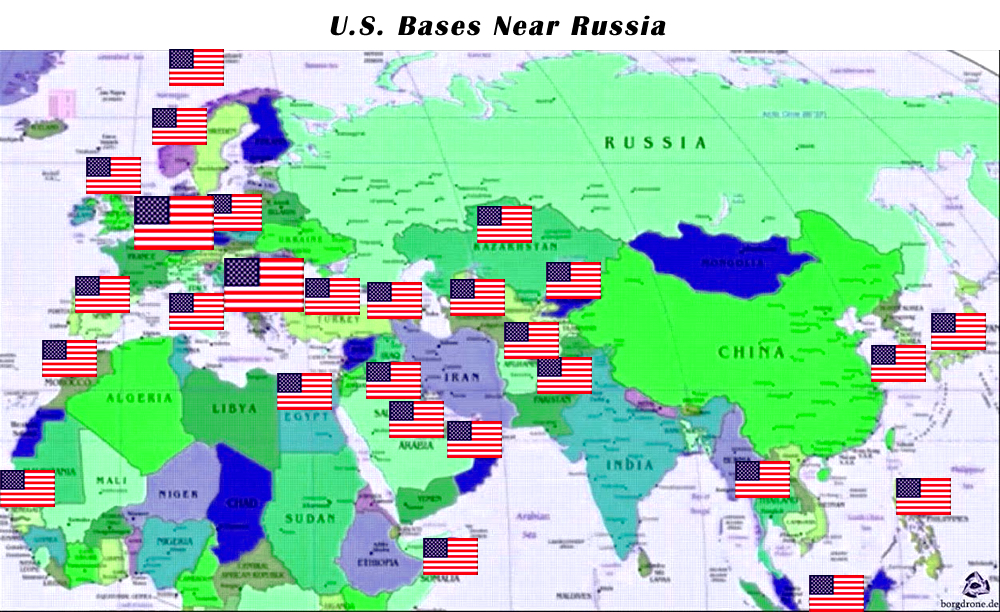
Nuclear. Ukraine dominated the news. The map above might help to explain why Russia really doesn’t need another NATO base on its doorstep.
Coronavirus: COVID-19: What you need to know about the coronavirus pandemic on 14 February
Climate. Adapting to climate change ‘happening worldwide’, essential. Fixing the Climate: Hopes and Hazards.
Ukraine Special – 11 February 22
Conflict resolution – the positive way out of the Ukraine crisis. USA does not have to march into war with Russia over Ukraine. It can choose to keep to the Minsk-Normandy process. Amid Ukraine Tension, US Deploys Nuclear-Ready B-52 Bombers to UK.
Comfortably numb . CounterVortex Episode 110: Nuclear power? No thanks! .
JAPAN. Kenichi Hasegawa, former dairy farmer who continued to tell the truth about the nuclear accident in Fukushima, passes away. PCB waste treatment plan in Fukushima: “Insufficient explanation” and opposition from many people. Robot photos appear to show melted fuel at Fukushima reactor. Zero Contaminated Water” and “Dismantling of Reactor Buildings” Missing from the Plan: The Final Form of Decommissioning the TEPCO’s Fukushima Daiichi Nuclear Power Plant.
RUSSIA. The goal of Russia is to destroy NATO by exposing its impotence. Russian Congress of Intellectuals: An Open Letter to the Russian Leadership.
UKRAINE. In Ukraine, USA to finance American companies to sell nuclear technology there, and to other States. USA’s plan – far right Ukrainian militia to attack Russia-speaking Donbass Region – drawing Russian support – USA then to claim Russia aggression.
CANADA. Canadian First Nations do not want small nuclear reactors on their lands.
INDIA. India’s Nuclear Weapons Could Kill Millions Of People- a matter of pride?
UK
- UK spends over £80m on media in 20 countries around Russia.
- What to do with dead nuclear submarines?
- Hinkley nuclear mud. Judicial review on the dumping of Hinkley Point C radioactive mud.
- Local Councils are signing up to the UN Treaty on the Prohibition of Nuclear Weapons.
- Government approval for Bradwell B project does not really give a green light for nuclear reactors to be built.
- BBC Cons the Public with Reports of “Sadness as Somerset nuclear power station nears closure” Tell us the Truth. The radioactive
- ‘Cumbrian mud patch’ would be shaken up by a coal mine at the Sellafield site.
- Fusion delusion – unsafe, too uncertain, too expensive, and too late – even if it worked.
EUROPE. European dispute over the Taxonomy plan to class nuclear power as ”green”, qualifying it for billions of euros in subsidies. Hugely costly venture – nuclear fusion – now going private – but success is as elusive as ever.
FRANCE. Macron pledged to close down over a dozen nuclear plants, but now he’s done a U-turn . Macron goes for a new nuclear renaissance, despite the industry’s woes in France. President Macron assures France’s EDF of tens of billions of euros in public financing for new nuclear reactors. Macron promises 52 billion euros for 6 new EPR nuclear reactors – but this ”nuclear renaissance” is far from certain. As presidential elections approach in France, only the far right and communists support nuclear power.
French government suppressed, postponed, distributing report that recommended no new EPR nuclear reactors. EDF predicts more cuts in nuclear output, as repairs needed for defects in reactors.
USA.
- The RAND Corporation’s plan for regime change in Moscow.
- Environmental Working Group (EWG) urges Biden to reject ‘outrageous’ call for more nuclear power subsidies in clean energy agenda.
- Ahead of regulatory approval the US Dept of Energy wants Govt to grant $4 billion for Small Nuclear Reactors development.
- Safety concerns as counterfeit parts found in U.S, nuclear reactors.
- Entergy nuclear plant accused of overcharging ratepayers – customers could now get $millions on refunds.
- Temporary spent nuclear fuel storage isn’t temporary. South Carolina Bill to compensate the region for federal govt’s failure to clean up plutonium contamination.
- Space rocket with NASA satellites launched, but now lost in space.
SWEDEN. Reactor at Oskarshamn 3 nuclear power plant in Sweden shut down due to ‘fuel damage. Sweden takes a chance on Forsmark.
SLOVAKIA. Slovak government plans to tax nuclear power plants, owners threaten bankruptcy.
ASIA. EU plan to call nuclear power ”green”, but for Asia, nuclear’s outlook is poor.
CHINA. As China tackles plastic pollution at home, it feeds the scourge globally
PHILIPPINES. The case against coal, other fossil fuels and nuclear power.
AUSTRALIA. Practical considerations may hamper Australia’s path to nuclear submarines.
The goal of Russia is to destroy NATO by exposing its impotence.

By 2008 NATO had become a bloated edifice largely unrecognizable from the organization that had been created at its founding, in 1949. Its appetite for expansion knew no bounds, with membership offers being dangled before two former Soviet Republics, Georgia and Ukraine, and military engagements being initiated in North Africa and the Persian Gulf.
Once NATO began expanding, both in terms of membership composition and scope and scale of its non-European military commitments, it was obvious to any observer exercising a modicum of intellectual curiosity that NATO existed for the sole benefit of the United States.
Exposing NATO
By militarizing the Ukraine crisis, Russia has exposed the absolute military impotence of NATO. First and foremost, after dangling the bait of NATO membership before Ukraine for the past fourteen years, NATO was compelled to confess that it would not be able to come to the defense of Ukraine in case of any Russian military invasion because Article 5 only allowed collective defense to be invoked for NATO members, which Ukraine is not.
Germany, Biden was saying, is little more than a colony of the United States.
The Ultimate End of NATO, Russia’s goal is not to destroy Ukraine—this could be accomplished at any time. Rather, the goal of Russia is to destroy NATO by exposing its impotence, writes Scott Ritter. Consortium News 11 Feb 22,
” …………………………………………. A Messy History.
Students of history might be experiencing what Yogi Berra once famously called “Déjà vu all over again” when examining the frenetic activities undertaken by the North Atlantic Treaty Organization (NATO) today, as it responds to what it alleges is a provocative Russian military buildup along the Russian-Ukrainian border.
The Trans-Atlantic alliance is a strange amalgam of political, economic, and military belief systems cloaking a mass of 30 nations who manage the day-to-day activities of their organization through a consensus-based, collective decision-making process that is as unwieldy as it is inefficient.
Originally formed as a collective of 12 nations united by the desire, as the first secretary-general of NATO, Lord Ismay, once quipped, “to keep the Russians out, the Americans in, and the Germans down”, the Trans-Atlantic alliance was, first and foremost, a club comprised of nations which had two things in common—a shared belief in the primacy of democratic governance, and a desire to be protected under the umbrella of American military power.
Early on the alliance witnessed a period of expansion, as it grew to 16 nations following the admittance of Turkey, Greece, Spain, and Portugal. These 16 nations served as the foundation of NATO throughout the Cold War, united in their determination to stand up to any potential Soviet aggression targeting the territory of western Europe.
NATO was always, from a political standpoint, a mess. Strong pro-communist movements in France and Italy led to the unseemly situation where the intelligence services of an allied nation, the United States, were engaged in manipulating the domestic political affairs of two ostensible allies to keep the communists out of power.
West Germany carried out its own unilateral Ostpolitik, seeking better relations with Soviet-occupied East Germany, much to the consternation of the United States. France, offended by what it (rightly) believed to be the dominance of the United States in the military command structure of the alliance, withdrew its military from NATO command authority. And Turkey and Greece were engaged in their own regional Cold War which, in 1974, went hot over the island of Cyprus.
The glue that held the alliance together was the collective defense provisions of Article 5 of the NATO Charter, which provides that if a NATO Ally is the victim of an armed attack, each and every other member of the Alliance will consider this act of violence as an armed attack against all members and will take the actions it deems necessary to assist the Ally attacked.
For much of the Cold War, the NATO alliance was configured militarily so that there was little doubt as to what actions would be taken, with a standing NATO army deployed in West Germany in constant combat readiness, prepared to repel any attack by the Soviet Army and its Warsaw Pact allies. Likewise, NATO maintained significant air and naval forces deployed in the Mediterranean Sea ready to confront any Soviet aggression there. These forces were anchored by a massive standing U.S. military presence comprising hundreds of thousands of troops, tens of thousands of armored vehicles, thousands of combat aircraft, and hundreds of naval vessels.
This full-time presence of concentrated combat-ready military power, prepared as it was to fight at the drop of a hat, gave the Article 5 obligation far more gravitas than it perhaps deserved. The reality of Article 5 is such that, upon its invocation, Allies can provide any form of assistance they deem necessary to respond to a situation based upon the circumstances.
While this assistance is taken forward in concert with other Allies, it is not necessarily military in nature and depends on the material resources of each country. In short, Article 5 leaves to the judgement of each individual member country to determine how and what it would contribute in the case of its invocation.
With the end of the Cold War in 1990-91 came the dismantlement of this full-time combat-ready military force. The unified nature of the NATO military component that existed in the 1980’s ceased to exist barely ten years later, with each member state carrying out its own demobilization and restructuring based upon domestic political requirements, and not the requirements of the alliance.
NATO Goes on Offense
During this time NATO also watched its long-held mantra of being a purely defensive alliance fall to the side as it engaged in offensive military operations on the soil of the former Republic of Yugoslavia, and non-member, and a offensive bombing campaign against Serbia, despite Serbia not having attacked any NATO member.
This deconstruction of NATO’s military capabilities and status as an exclusively defensive organization took place hand in glove with a decision by NATO to expand its membership to include the former members of the Warsaw Pact, beginning with the accession of Poland, Hungary, and the Czech Republic in 1999. The enlargement of NATO was seen as achieving two objectives—from the NATO perspective, it brought most of Europe together into a single collective of allied parties who, because of their membership, would contribute to the overall stability of Europe.
But there was another perspective at play, that being that of the U.S.. While NATO responded to the U.S. invoking of Article 5 after the 9/11 attacks, providing airborne surveillance aircraft for North American patrols and naval forces in the Mediterranean Sea, several core members, led by Germany and France, balked at becoming involved in the post-9/11 military misadventures of the U.S. in Afghanistan and Iraq.
This prompted then-Secretary of Defense Donald Rumsfeld to make a quip denigrating “Old Europe” at the expense of “New Europe.” The continued expansion of NATO eastwards, absorbing all of the former nations of the Warsaw Pact along with three former Soviet Republics in the Baltics not only pushed NATO’s geopolitical center of gravity further east, but also put NATO on a collision course with Russia, whose opinion most NATO members had conditioned themselves to ignore.
NATO went on to provide military and police training support to Iraq in 2004, following that nation’s defeat at the hands of a military coalition which included the U.S., U.K., and Poland providing combat troops, and Spain, Portugal, and the Netherlands providing political support.
Likewise, NATO contributed significant military forces to reconstruction efforts in Afghanistan. These troops operated under Article 4 authorities after the U.S. brought the Afghan situation post-9/11 to the attention of the general membership, which voted to authorize member states to deploy to Afghanistan in support of U.S. reconstruction and nation-building operations.
In 2011, NATO engaged in offensive military operations in Libya, part of a larger political campaign to remove the Libyan leader, Muammar Qaddafi, from power.
A US Adjunct
By 2008 NATO had become a bloated edifice largely unrecognizable from the organization that had been created at its founding, in 1949. Its appetite for expansion knew no bounds, with membership offers being dangled before two former Soviet Republics, Georgia and Ukraine, and military engagements being initiated in North Africa and the Persian Gulf.
While the bloated organizational structure of NATO looked impressive on paper, there were two realities that no amount of puffing and posturing could obviate. First and foremost was the absolute dearth of real military power on the part of the non-U.S. NATO components.
To support and sustain their respective military commitments to Afghanistan, the major NATO nations involved—Canada, the Netherlands, the United Kingdom, France, and Italy—were forced to cannibalize their overall military capability to surge their respective military components forward. Even then, none of these nations could accomplish their Afghan mission without the logistical support provided by the United States.
This over-reliance upon U.S. military capacity only underscored the inconvenient reality that NATO had become little more than an adjunct of U.S. foreign and national security policy. The U.S. had always played an oversized role in NATO. If this was singularly focused on preserving European security, the non-U.S. members of NATO could deceive themselves into believing that they were co-equal partners in a defensive-oriented Trans-Atlantic arrangement.
Once NATO began expanding, both in terms of membership composition and scope and scale of its non-European military commitments, it was obvious to any observer exercising a modicum of intellectual curiosity that NATO existed for the sole benefit of the United States.
Nothing drove this point home more than the humiliation NATO suffered at the hands of the U.S. when it came to the abandonment of the Afghan reconstruction mission. The decision to withdraw from Afghanistan was made unilaterally by the United States, without consultation. NATO, faced with a fait accompli, had no choice but to do as ordered, and leave Afghanistan with its tail between its legs.
The ultimate humiliation was yet to come. Nothing takes place in a vacuum, and the expansion of NATO, combined with its offensive re-orientation, drew the ire of Russia, which took extreme umbrage over the encroachment of a military alliance no longer bound by the constraints of collective self-defense, but rather imbued with a post-Cold War posture built around the notion of containing and constraining a Russia which was recovering from its post-Soviet collapse malaise and, under the leadership of Vladimir Putin, was actively restoring it position as a regional and global power.
NATO Fissures
Russia had, since 2001, been sounding a claxon call about NATO expansion and the threat it posed to Russian security interests. These calls were ignored by NATO and its U.S. masters, largely because they believed Russia to be too weak both militarily and economically.
While NATO chased post-9/11 ghosts in the Middle East and Afghanistan at the behest of its American overseer, Russia worked to reform its economy and military. In 2008 Russia defeated Georgia in a short but violent war precipitated by a Georgian military assault on the breakaway territory of South Ossetia. In 2014, Russia responded to the U.S.-orchestrated Maidan coup that ousted the democratically-elected president of Ukraine, Victor Yanukovich, by annexing Crimea and throwing its support behind pro-Russian separatists in the Donbass region of Ukraine.
The important thing to note about the current crisis in Ukraine is that while the underlying issues are solely the byproduct of NATO overreach, the timing of the crisis is based upon a Russian timetable defined by purely Russian goals and objectives. The goal of Russia is not to destroy Ukraine—this could be accomplished at any time. Rather, the goal of Russia is to destroy NATO.
This will not be accomplished through the direct use of military force, but rather the indirect threat of military action which forces NATO to react in a way which exposes the impotence of an organization which long ago lost its raison d-etre, collective defense, and instead flounders under the weight of a mission—the containment of Russia—it cannot achieve, and which its membership is not united in pursuing.
Here are a few statements of fact—the Russian military would defeat any force NATO can assemble in a stand-up conventional fight. The entire notion of collective self-defense is predicated on the ability to deter any potential adversary from considering military action against a NATO member because the outcome—the total defeat of the attacking party—was never in dispute.
While a truly defensive alliance would have the moral authority to call out the build-up of Russian military power around Ukraine as un-duly provocative, NATO has long since lost the ability to apply that label to itself with any degree of seriousness. From the standpoint of Russia, when the same “defensive” alliance which bombed its ally Belgrade and worked to overthrow the leader of Libya puts its sights on acquiring Ukraine and Georgia as members, such actions can only be viewed as aggressive, offensively oriented-measures that function as part of a broader anti-Russian campaign.
Exposing NATO
By militarizing the Ukraine crisis, Russia has exposed the absolute military impotence of NATO. First and foremost, after dangling the bait of NATO membership before Ukraine for the past fourteen years, NATO was compelled to confess that it would not be able to come to the defense of Ukraine in case of any Russian military invasion because Article 5 only allowed collective defense to be invoked for NATO members, which Ukraine is not.
Moreover, the “massive” economic sanctions that NATO has promised to unleash in lieu of a military response have turned out to be as impotent as NATO’s military power. Despite what the political leadership of NATO and the United States may say to the contrary, there is no unity of purpose when it comes to imposing sanctions on Russia in the event of a military incursion into Ukraine.
In short, any sanction package that targets Russian energy and/or access to banking institutions will hurt Europe far more than Russia. While the United States continues to push for Europe, and in particular Germany, to wean itself off Russian energy supplies, the fact is there is no viable alternative to Russian energy and, moreover, Europe is increasingly recognizing that the U.S. position has less to do with European security and more to do with a play by the U.S. to grab the European market for itself.
Under normal conditions, the U.S. cannot compete with Russia in terms of price and volume when it comes to natural gas deliveries. If, through sanctions, the U.S. can cut off Europe from Russia, then the U.S. will be able to impose its own energy products on Europe at prices that otherwise would be uncompetitive.
NATO’s Realization
The individual members of NATO are beginning to awaken to the reality that their organization is little more than an impotent tool of American global hegemony. Hungary has cut its own gas deal with Russia, in defiance of U.S. directives to pull back. Croatia and Bulgaria have made it clear that they will not be deploying troops in support of NATO posturing on Ukraine.
Turkey has stated that it views the Ukraine crisis as little more than a thinly disguised effort by NATO and the U.S. to weaken Turkey by forcing it to fight Russia in the Black Sea. But perhaps the most telling moments came when the two European powerhouses of NATO, Germany, and France, were compelled to come face to face with the reality of their subservient role vis-à-vis the U.S..
When French President Emmanual Macron flew to Russia to try and negotiate a settlement to the Ukraine crisis, he was confronted with the reality that Russia won’t negotiate with France without the U.S. first expressing support for the positions being put forward by the French President. The U.S. matters; France does not.
Likewise, the German chancellor was forced to stand mutely during his visit to the White House while U.S. President Joe Biden “promised” that he would unilaterally shut down the NordStream 2 pipeline project, even though the U.S. had no role to play in the construction and administration of the pipeline. Germany, Biden was saying, is little more than a colony of the United States.
The final nail in the NATO coffin came on Feb. 4, when the Russian president met with Chinese President Xi Jinping at the opening of the Winter Olympics in Beijing. The two leaders issued a 5,000-plus word joint statement in which China threw its weight behind Russia’s objection to NATO expansion into Ukraine.
The Sino-Russian joint statement was a de facto declaration that neither Russia nor China would allow the U.S.-led “rules based international order” being promulgated by the Biden administration to go forward unchallenged. Instead, the two nations announced that they will be pursuing a “law based international order” which draws on the United Nations Charter for its authority, in contrast to unilateral rules which only serve the interests of the U.S. and small blocs of allied nations.
A Different World
The world has fundamentally changed. NATO literally has no relevance. Its last gesture of defiance lays in the deployment of forces into eastern Europe to bolster the defensive capabilities of that region in accordance with Article 5. The forces deployed—a few thousand American paratroopers, and a smattering of other contingents from other NATO nations—not only cannot defeat a Russian adversary, but doesn’t even provide a modicum of deterrence value should Russia be inclined to shift its sights away from Ukraine toward Poland and the Baltics.
What NATO doesn’t realize is that Russia has no intention of invading either Ukraine or eastern Europe. All Russia has done is demonstrate the empty shell that NATO has become by underscoring just how empty the Article 5 promise of collective defense truly is.
In this regard, one should view NATO’s current round of muscle flexing as the modern-day equivalent of Picket’s Charge, the high-water mark of the Trans-Atlantic alliance. In the weeks and moths to come, NATO will be faced with the reality that Russia is not invading anyone, and that the muscle flexing it is currently engaged in is not only not needed, but worse, unsustainable.
The fractures exposed in NATO’s membership when it comes to Ukraine will only grow larger over time. It may take years for NATO to go away, but let no one be fooled by what is happening—NATO is finished as an alliance.
Scott Ritter is a former U.S. Marine Corps intelligence officer who served in the former Soviet Union implementing arms control treaties, in the Persian Gulf during Operation Desert Storm, and in Iraq overseeing the disarmament of WMD. https://consortiumnews.com/2022/02/11/the-ultimate-end-of-nato/
Temporary spent nuclear fuel storage isn’t temporary.

It is difficult to believe the nuclear power industry and the federal government are so unethical that they would defer the difficult and dangerous task of spent nuclear fuel disposal to future generations of Americans. The present generation must find a permanent disposal solution.
Temporary spent nuclear fuel storage isn’t temporary https://www.santafenewmexican.com/opinion/my_view/temporary-spent-nuclear-fuel-storage-isnt-temporary/article_068d44e0-854c-11ec-b25d-a70bff5372b1.htmll By Dennis McQuillan, 13 Feb 22, The proposal to “store” spent nuclear fuel in New Mexico is a Trojan horse that will defeat the goal of geologically isolating this highly radioactive and chemically toxic material, and create hazards to future generations of Americans.
At face value, the plan is to consolidate up to 10,000 canisters of spent nuclear fuel from nuclear power plants across the United States, store them in New Mexico for decades or even a century, and transport them to an undetermined permanent disposal facility that the federal government will someday establish.
In reality, after more than six decades of using nuclear power to generate electricity and amassing 90,000 metric tons of spent nuclear fuel, neither the industry nor the federal government has established a permanent repository for the fuel. Moreover, after Nevada stakeholders rejected the Yucca Mountain site, federal funding and efforts to find another potential spent nuclear fuel repository ended in 2010.
The citizens of New Mexico have every reason to doubt that deposits at the interim storage facility would ever be moved. Even if a future repository is established, there is no guarantee the funding and determination to dig up and relocate 10,000 canisters of spent nuclear fuel would exist at that time.
What is certain is this: Spent nuclear fuel will remain dangerous for hundreds of thousands of years, and the interim storage facility will not provide geologic isolation.
As proposed, the fuel would be buried at depths less than 100 feet in young alluvium in a region with shallow groundwater, land subsidence and sinkholes, amid one of the most prolific oil patches in the nation. By contrast, radioactive waste generated by national defense activities is isolated 2,150 feet underground, in 250-million-year-old salt beds, at the Waste Isolation Pilot Plant. The proposed interim storage facility is geologically unsuitable even for a period of decades.
It is difficult to believe the nuclear power industry and the federal government are so unethical that they would defer the difficult and dangerous task of spent nuclear fuel disposal to future generations of Americans. The present generation has benefited from electricity generated by nuclear power, and the present generation must find a permanent disposal solution.
New Mexico executive agencies, Attorney General Hector Balderas, state Sen. Jeff Steinborn, Reps. Matthew McQueen, Tara Lujan and other state legislators, are working to stop this geologically unsound, dangerous, unethical and disingenuous proposal to “store” spent nuclear fuel in New Mexico. But federal action is necessary. Congress urgently needs to give the federal government a statutory directive, and funding, to complete the mission of finding a permanent repository for the geologic isolation of spent nuclear fuel. Dennis McQuillan is the former chief scientist of the New Mexico Environment Department and lives in Santa Fe.
USA’s plan – far right Ukrainian militia to attack Russia-speaking Donbass Region – drawing Russian support – USA then to claim Russia aggression
Al Ronzoni <aronzonijr@msn.com> wrote:
The World Socialist Website also confirms from sources in Donetsk that it actually looks like Ukraine will make the first move v. them and Luhansk. Then, if Russia responds in any way, that will constitute the “invasion,” then Menendez “Mother of All Sanctions” will be imposed and Nord Stream 2 will be cancelled. Hell, even if Russia doesn’t actually do anything, the fact that fighting will be taking place , ‘fog of war” etc. can be used to still claim Russia has invaded. No doubt Biden and US leadership think this can be “managed” with Russia embroiled in a protracted conflict in the Donbass Region that can be capitalized on to marginalize Russia’s economic relations with Europe, in favor of the US and to make further NATO expansion, perhaps now including Sweden and Finland, easier.
Another brilliant essentially neo-con type plan. What could go wrong?
US accelerates troop deployments as Biden threatens “world war” with Russia, WSWS,Alex Lantier, Johannes Stern, 12 February 2022
As Washington and its NATO allies work to militarily surround Russia, US officials yesterday declared that a US-Russia war is imminent.
Yesterday, Washington announced the deployment of 3,000 troops from the 82nd Airborne Division to bases in Poland, which borders Ukraine. Britain and Germany will send hundreds of soldiers to strengthen NATO battlegroups in Estonia and Lithuania. This comes after NATO countries have for weeks delivered Javelin anti-tank missiles, Stinger anti-aircraft missiles and Turkish TB2 Bayraktar drones to the Ukrainian regime in Kiev.
Nearly two decades after Washington invaded Iraq based on lies that it had “weapons of mass destruction,” US imperialism and its NATO allies are concocting a strategy to trigger a war with Russia, a nuclear-armed power, under conditions where they can blame Russia for it. Reports of mounting Ukrainian military activity in the Donbass region suggest that a NATO-backed military provocation can be staged there to trigger the war.
The narrative NATO is peddling—that it is acting to defend Ukraine from Russia—is a pack of lies. Ukrainian President Volodymyr Zelensky has publicly declared that Russia’s military posture is not consistent with plans for an all-out invasion of Ukraine. Moreover, when reporters challenged US claims that Russia is preparing an attack, State Department spokesman Ned Price could do nothing but argue that undisclosed “intelligence information” meant his claims were true.
In 2014 … the NATO powers backed a putsch in Kiev, where far-right militias toppled a pro-Russian Ukrainian president and set up a NATO puppet regime. As these militias backed by NATO mercenaries attacked Russian-speaking areas of Ukraine like Donbass and Crimea, these areas broke off from Ukraine, with Crimea voting to rejoin Russia. Since then, far-right Ukrainian militias have faced off against Russian troops in Crimea and Russian-backed militias in the Donbass.
…………. Russian-speaking areas of Ukraine are reporting highly advanced NATO war preparations. Yesterday, Donetsk People’s Republic (DPR) leader Denis Pushilin cited Biden’s call on US citizens to leave Ukraine, warning that war was imminent. “The US President, probably, given US influence in Ukraine, has information that allows him to make such statements and take such a position. … Ukraine may attack at any moment. Ukraine has everything ready for that: the concentration of forces and means makes it possible to do it at any moment, as soon as a political decision is made.”
On February 9, the DPR Militia’s Deputy Chief Eduard Basurin said Ukrainian tanks are taking positions only 15 kilometers from theirs, near Avdeyevka, Gorlovka and Novgorodskoye. Yesterday, Basurin said Ukrainian forces also deployed an S-300 missile system.
Such deployments violate the 2015 Minsk accords, which temporarily froze the Ukraine conflict and sent the Organization for Security and Cooperation in Europe (OSCE) to monitor the front line. Basurin said, however, that Kiev regime forces are using electronic jamming to prevent OSCE observers from using drones to observe these deployments. “It seems that OSCE observers are quite content with a situation where it is impossible to record violations by Ukraine,” he said.
Significantly, DPR forces last month warned, based on their sources in Kiev, that they expect an attack to come as soon as Ukrainian armored assault brigades are assembled and in position.
On January 28, Basurin said: “According to our intelligence, the Ukrainian General Staff under the guidance of US advisers at the Ukrainian Defense Ministry is putting final touches to a plan for offensive operations in Donbas. The date of aggression against the people’s republics will be set when the attack groups have been created and the operation’s plan approved by Ukraine’s National Security and Defense Council.”
These are conditions in which NATO could goad Russia, a nuclear power, into war. Were such an attack to begin, DPR forces would likely require Russian military assistance to avoid being overrun by far-right Ukrainian militias, which call for killing Russians and have bombed Russian-speaking Ukrainian cities near Russia’s borders. If Moscow intervened against this, however, it would provide grounds for NATO war propaganda, denouncing Russian aid to the DPR as an “invasion” of Ukraine……….. https://www.wsws.org/en/articles/2022/02/12/ukra-f12.html
As presidential elections approach in France, only the far right and communists support nuclear power
Then 24 , 11 Feb 22,
Ecologist Yannick Jadot, who regularly affirms his ambition to develop wind power and other renewable energies in France, castigated the recent commitments made by Emmanuel Macron to develop the country’s nuclear fleet.
Ecologist Yannick Jadot, who regularly affirms his ambition to develop wind power and other renewable energies in France, castigated the recent commitments made by Emmanuel Macron to develop the country’s nuclear fleet.

During his appearance on February 11 on the air of BFMTV, the Greens presidential candidate, Yannick Jadot, stormed against Emmanuel Macron’s recent commitments in the nuclear field, in particular after his announcement of the commissioning, from 2035, six new “EPR 2” type nuclear reactors, to which is added the study for eight more for the end of the 2040s.
President Macron locks the French for a century in nuclear power
“It does nothing for the climate, it does nothing for the French […] for the years to come”, notably protested the environmentalist MEP before adding: “President Macron locks the French for a century in nuclear power.”
Yannick Jadot then praised the virtues of a German energy model (where the share of wind power in electricity production exceeded 20% in 2021), which he describes as particularly prolific in terms of employment to better castigate the decision of the Head of State by invoking “dictators” and “the far right”: “Big companies, like small and large democracies, are investing in renewable energies. Unfortunately, only dictators, and in France the extreme right, still support nuclear power.
After having advocated a reduction in the share of nuclear power in French electricity production from 75% to 50% by 2025 – a reduction in the context of which the closure of the Fessenheim power station (Haut-Rhin) took place –, Emmanuel Macron made a 180 degree turn on the subject in the second part of his mandate, now showing himself in favor of a revival of the national nuclear fleet.
Visiting Belfort on February 10, he thus expressed his desire to “extend” the life of “all the nuclear reactors that can be extended”. “If the first extensions beyond forty years have been successfully carried out since 2017, I ask EDF to study the conditions for extension beyond fifty years”, he said, among other things..
…………… With the approach of the presidential election, the nuclear sector is particularly acclaimed on the right of the French political spectrum. On the left, its future is mainly praised by the communist candidate Fabien Roussel while Jean-Luc Mélenchon undertakes to get the country out of this source of energy as quickly as possible. https://then24.com/2022/02/11/for-jadot-only-dictators-and-in-france-the-far-right-support-nuclear-power/
South Carolina Bill to compensate the region for federal govt’s failure to clean up plutonium contamination
The Senate Finance plan is a big win for our region,” Young said Wednesday. “Since 2015, our county’s legislative delegation has worked to address the federal government’s failure to remove the stored plutonium and the failure to fulfill the” promise of the Mixed Oxide Fuel Fabrication Facility, a never-finished nuclear fuel plant at the Savannah River Site.
Plutonium settlement spending bill heads to S.C. Senate, By Colin Demarest cdemarest@aikenstandard.com, Feb 9, 2022
A bill divvying up money South Carolina secured from the federal government for its failure to remove plutonium from the Savannah River Site is now headed to the Senate, after a finance panel wholeheartedly endorsed the measure Tuesday.
Continue readingMacron promises 52 billion euros for 6 new EPR nuclear reactors – but this ”nuclear renaissance” is far from certain
Building at least 6 new generation EPRs, a challenge for the nuclear industry. It will be a “renaissance of French nuclear power”, promised Emmanuel Macron, but the construction of at least six new EPRs represents a real challenge for a weakened sector, which remains on the bitter failure of Flamanville.
The president announced Thursday in Belfort six new generation EPR2 reactors, with a first commissioning by 2035. To this is added the study for eight more copies. The investment will be “52 billion euros for 6 new EPR reactors, plus studies on eight possible new reactors, plus research on modular reactors”, quantified Friday the Minister of the Economy, Bruno Le Maire.
“It is an intention but there are a certain number of important stages which will take five years”, underlined Valérie Faudon, the general delegate of the French Company of nuclear energy (SFEN). Before even starting work for an EPR, it is indeed necessary to organize a public inquiry on the first site envisaged, that of Penly (Seine-Maritime) and to obtain a certain number of administrative
authorizations. Emmanuel Macron thus envisages a start of construction in 2028. “The deadline of 2028 that he drew is not impossible to meet but is already in itself optimistic vis-à-vis the various stages to be crossed”,judges Yves Marignac , nuclear expert from the NégaWatt association.
Connaissance des energies 11th Feb 2022
The RAND Corporation’s plan for regime change in Moscow.
RAND Corporation study calls for regime change in Moscow, http://space4peace.blogspot.com/2022/02/rand-corporation-study-calls-for-regime.html Bruce Gagnon,13 Feb 22,
Obama’s ambassador to Ukraine made a trip to US-NATO training base in western Ukraine (where the Nazis predominate). US Special Forces are rotated into the base from Ft. Carson, Colorado to train the Kiev regime’s Army. Many of the Nazis have been brought into this ‘new military unit’.
More than 27 million people in the former Soviet Union died during Hitler’s WW II invasion. Imagine how Russians today feel when they see the US arming, training and directing Nazi forces to attack the Russian-ethnic citizens living in the Donbass region of Ukraine, right next to the Russian border.
Imagine how Moscow felt when they first read this RAND Corporation study. When we look at current events can we notice the direct connection to the points from this study listed below? Whether it is US-NATO military expansion right up to Russian borders or efforts by Washington to kill the Nordstream 2 natural gas pipeline from Russia to Germany – it is clear that there is a method behind US-NATO madness. If you were sitting in Russia’s shoes how would you react to these proposals below – many of which have been or are now being implemented?
Despite these vulnerabilities and anxieties, Russia remains a powerful country that still manages to be a U.S. peer competitor in a few key domains. Recognizing that some level of competition with Russia is inevitable, RAND researchers conducted a qualitative assessment of “cost-imposing options” that could unbalance and overextend Russia.
Continue readingFusion delusion – unsafe, too uncertain, too expensive, and too late – even if it worked
Fusion delusion no answer to climate emergency or cost-of-living crisis https://www.nuclearpolicy.info/news/fusion-delusion-no-answer-to-climate-emergency-or-cost-of-living-crisis/ 13 Feb 22,
Fusion is unsafe, too uncertain, too expensive and, if it is even possible, will still come far too late to address either climate change or Britain’s energy needs, says the UK’s Nuclear Free Local Authorities.
Slamming claims of a ‘major break-through’, Councillor David Blackburn, Chair of the NFLA, noted that scientists have made similar claims for decades when it has come to fusion. Commenting he said:
“Fusion has since the Second World War been heralded as the next big evolutionary development in our energy supply, and scientists have made similar claims for decades when it has come to fusion leading to countless billions being invested in this illusionary technology.”
Emeritus Professor of Energy Policy Stephen Thomas of the University of Greenwich suggested a motivation for the latest claims:
“It has always been said that fusion breakthroughs occur when there is a need for more public funding.”
Fusion is a complex technology to master, representing an attempt to reproduce on Earth the nuclear reactions that take place in the sun. As the Earth lacks the immense gravity of the Sun, the interior of the reactor must be superheated to 100 million degrees centrigrade (or six times the temperature of the Sun). Generating fusion reactions to date have used many times more energy than the energy produced, making fusion a technology that remains economically unviable. The reactor also requires intricate cooling and containment systems which ‘gobbles up’ much of the energy it produces; if these failed at any time reactor safety would be compromised.
Fusion is neither green nor safe. Neutrons produced by the reaction would bombard the walls of the reactor and its housing which over time would threaten the integrity of the structure. The radioactive tritium gas that is produced poses a real danger to public health even at very low levels if it enters the air or our water supply. And, like fission power, fusion would result in radioactive waste that will need to be safely stored and managed for countless years.
The UK Government is currently looking at five sites, one of which will soon be chosen to host a new experimental fusion reactor and has pledged £200 million towards its development.
Councillor Blackburn is sceptical there will be any result anytime soon:
“The earliest estimates that any fusion reactor could come on stream is in the late 2040’s, and that even assumes the technology will ever be mastered or economically viable. There is a need for humanity to address climate change and a need for Britons to address the energy crisis now. Fusion will come 30 years too late if at all. All of us are facing huge hikes in our energy bills, and we need power sources that are green, available now and affordable to keep our lights on and heat our homes.
“The UK Government has foolishly continued to pour billions of taxpayer money into the fusion delusion and other grandiose nuclear projects, whilst strangling financial support for renewables that work. We need a complete about-face in energy policy with the government instead investing massively in insulating Britain’s homes to reduce energy demand and energy bills and address fuel poverty, and also to finance the proven renewable technologies that can provide power now at an affordable price to Britain’s citizens, including solar generation, a renewable technology already available to us which harnesses the energy of the Sun.”
The radioactive ‘Cumbrian mud patch’ would be shaken up by a coal mine at theSellafield site

A tsunami of radioactive wastes now largely inert (apart from tidal processes) would be resuspended in the water column – returning to the shores and to the rest of the world. It takes only 4 years for Sellafield’s seaborne waste to reach the Arctic. The coal mine would cause subsidence and resulting resuspension of nuclear wastes.
| *Sellafield** A great article by Paul Brown below – there is however a big elephant in the room regarding this story. The elephant in the room is the Cumbrian Mud Patch – the radioactive silts on the Irish Sea bed resulting from decades of reprocessing. The coal mine due to be decided upon soon by Government (after Planning Inspector Stephen Normington makes his recommendation) would churn up this nuclear crapola on the seabed. A tsunami of radioactive wastes now largely inert (apart from tidal processes) would be resuspended in the water column – returning to the shores and to the rest of the world. It takes only 4 years for Sellafield’s seaborne waste to reach the Arctic. The coal mine would cause subsidence and resulting resuspension of nuclear wastes. The coal mine would cause earthquakes. Both these outcomes are not “likely” they are certain. The coal mine CEO is also employed by government as advisor on the plans for a deep (and not so deep) nuclear dump for heat generating nuclear wastes – you couldn’t make it up. Keep Cumbrian Coal in the Hole 12th Feb 2022https://keepcumbriancoalinthehole.wordpress.com/2022/02/12/decades-of-sellafields-reprocessing-waste-on-irish-sea-bed-could-be-churned-up-by-coal-mine-subsidence/ |
1 This Month
Tell Congress: Prevent Nuclear Catastrophe in Iran

Tell Congress: Prevent Nuclear Catastrophe in Iran

Read the Public Inquiry Report, the Commissioners’ report, Surrendering Australia: The AUKUS Deception is available to download for free at aukuspublicinquiry.com. Or just watch the replay of the National Press Club Luncheon.


Shut down the radiation-damaged Heysham nuclear reactors now
To see nuclear-related stories in greater depth and intensity – go to https://nuclearinformation.wordpress.com

Say No to NASA’s Reckless Nuclear Reactor on the Moon
Say No to NASA’s Reckless Nuclear Reactor on the Moon
-
Archives
- November 2026 (224)
- October 2026 (302)
- September 2026 (339)
- August 2026 (330)
- July 2026 (355)
- June 2026 (287)
- May 2026 (306)
- April 2026 (356)
- March 2026 (251)
- February 2026 (267)
- January 2026 (308)
- December 2025 (358)
-
Categories
- 1
- 1 NUCLEAR ISSUES
- business and costs
- climate change
- culture and arts
- ENERGY
- environment
- health
- history
- indigenous issues
- Legal
- marketing of nuclear
- media
- opposition to nuclear
- PERSONAL STORIES
- politics
- politics international
- Religion and ethics
- safety
- secrets,lies and civil liberties
- spinbuster
- technology
- Uranium
- wastes
- weapons and war
- Women
- 2 WORLD
- ACTION
- AFRICA
- Atrocities
- AUSTRALIA
- Christina's notes
- Christina's themes
- culture and arts
- Events
- Fuk 2022
- Fuk 2023
- Fukushima 2017
- Fukushima 2018
- fukushima 2019
- Fukushima 2020
- Fukushima 2021
- general
- global warming
- Humour (God we need it)
- Nuclear
- RARE EARTHS
- Reference
- resources – print
- Resources -audiovicual
- Weekly Newsletter
- World
- World Nuclear
- YouTube
-
RSS
Entries RSS
Comments RSS

