Thin-walled nuclear waste containers – not really very secure

Greg Phillips, Nuclear Fuel Cycle Watch 4 June The biggest piece of BS that jumped out at me [in this pro nuclear article] is the bolded section:
“…Nuclear waste containers have been tested over the last 40 years by running them into concrete bunkers at 80 mph, being dropped onto huge steel spikes, burned in jet fuel fires at thousands of degrees, and sunk deep in water for weeks. These things are as strong as humans can make them.”
ONLY TRANSPORT CONTAINERS HAVE BEEN SUBJECTED TO THE ABOVE TESTS. THE THIN WELDED CONTAINERS PLACED INTO A PROTECTIVE OUTER SHELL OF CONCRETE. THE PRESSURISED THIN INNER CONTAINERS ARE VENTED TO OPEN AIR TO LET HEAT ESCAPE. ANY LEAK FROM A FAILED WELD WILL ESCAPE TO THE ENVIRONMENT.
Excuse the caps, but too many people have been fooled by such pro-nuclear propaganda. Pictured at top is a thin welded canister – a fully laden canister would not survive a drop of a few metres.
Those nuclear waste containers pictured above are like hermit crabs, a hard exterior shell with vulnerable internals. The thin welded canister is placed into the concrete outer shell, which has vents to keep the canister cool. So any weld failure, crack can lead to radioactive contamination into the atmosphere. If the vents of the outer shell get blocked, the temperature of the fuel will rise to 400C+. If the pressurised Helium leaks out the temperature will rise. https://www.facebook.com/groups/1021186047913052
Spain and Portugal stand out from the European Union, in slashing energy bills because of their high renewable energy use
Spain and Portugal have broken ranks with the EU to allow themselves the
space to slash their energy bills by 40 per cent. The move is being allowed
because both southern European countries have a large amount of renewable
energy and aren’t as reliant on fossil fuels as the rest of the Continent.
MSM 31st May 2022
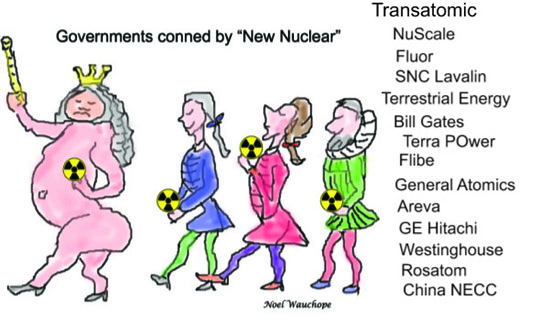
South Korean government to massively fund developing small nuclear reactors, partnering with USA companies NuScam and Terra Power.
Policymakers endorse massive injection of state money for SMR development
Lim Chang-won Reporter(cwlim34@ajunews.com) | Lim Chang-won Reporter, email : cwlim34@ajunews.com© Aju Business Daily & www.ajunews.com
June 2, 2022, SEOUL — With the blessing of President Yoon Suk-yeol, South Korea’s nuclear power industry grabbed a new opportunity to rebound after policymakers endorsed a massive injection of state money for the development of a relatively safe small modular reactor called “i-SMR” that can be operated in an underground water tank and cooled naturally in case of emergency.
Yoon, who took office in early May, dumped his predecessor’s “nuclear-exit” policy of phasing out nuclear power plants and vowed to actively revitalize South Korea’s struggling nuclear power industry and develop next-generation reactors, insisting that nuclear power plants are an essential factor in restoring industrial competitiveness.
Up to Yoon’s expectations, the proposed development of i-SMRs has passed a preliminary feasibility study, according to the Ministry of Science and ICT. Some 399.2 billion won ($319.9 million) will be spent from 2023 to 2028 for the i-SMR project aimed at developing a reactor with a power generation capacity of less than 300 megawatts. ……..
Mainly through partnerships with American companies, South Korean companies have jumped into the SMR market, such as Hyundai E&C and Doosan Enerbility, a key player in South Korea’s nuclear industry that tied up with NuScale Power, an SMR company in the United States.
In May 2022, Samsung C&T strengthened its partnership with NuScale Power to cooperate in SMR projects in Romania and other East European countries. SK Group tied up with TerraPower for cooperation in the development and commercialization of SMR technology.
Separately, the government approved the proposed spending of 348.2 billion won from 2023 to 2030 to develop technologies for the dismantling of defunct reactors………
Hyundai E&C has tied up with its American partner, Holtec International, for the decommissioning of defunct nuclear power plants, starting with the Indian Point Energy Center in Buchanan in Westchester County. https://www.ajudaily.com/view/20220602110820983
Siberia’s tundra could soon disappear, scientists warn
Siberia’s tundra could soon disappear, scientists warn
Across nearly 2,500 miles of unbroken wilderness, the Arctic tundra is a unique and unexpectedly abundant ecosystem. But that could change if human-caused global warming goes unchecked, researchers warn.
There’s a scream building up in young people
The author Elif Shafak has said she thinks “there’s a scream building
up” inside many young people, because they feel their future “is being
shaped by older generations”.
“It’s difficult to be young, in this age in particular,” the Turkish-British novelist told the Hay festival.
“It’s their future that’s been broken by previous generations,” she
said, citing Brexit and the climate emergency.
She also spoke of the
“widening inequalities” that the pandemic has exacerbated and said that
it was women, minorities and young people who suffer the consequences
disproportionately. Because young people are less likely than their older
counterparts to be in stable financial positions there was “a very
existential angst” among them, she said.
The idea that young people
“want to scream at us” is one that Shafak explores in her most recent
novel, The Island of Missing Trees, which was shortlisted for the Women’s
prize. In the book 16-year-old Ada, who lives in London with a father who
rarely shares his wartime memories of his native Cyprus, begins to scream
in the middle of a history lesson. Shafak, 50, said she was interested in
the idea that growing up “in a family of silences” might be carrying
frustration that needs to be let out.
Guardian 4th June 2022
New documentary shows Soviet disinformation over the true horror of the Chernobyl nuclear meltdown
On April 26, 1986, the core of the No. 4 reactor in the Chernobyl Nuclear
Power Plant near Pripyat melted down, causing a nuclear accident that
released airborne radioactive contamination for about nine days in what is
still classified as the worst nuclear disaster in history, both in cost and
casualties.
Stories around the Chernobyl disaster have been told time and
time again, most notably in the critically-acclaimed HBO limited series
“Chernobyl.”
Now, HBO is returning with yet another Chernobyl project, but
this time without the dramatization. As part of HBO Documentary films,
Emmy-winning filmmaker James Jones (“Mosul”) is debuting his film
“Chernobyl: The Lost Tapes.” Thirty-six years after the initial disaster,
“Chernobyl: The Lost Tapes” presents recently uncovered archival footage
and recorded interviews with those who were present during the disaster and
subsequent fall out, as a means to show the reality of just how horrific
the Chernobyl disaster actually was, and the deplorable lengths the Soviet
government went in an attempt to cover up what really happened.
It’s estimated that over 200,000 people died as a result of the Chernobyl
disaster, but the official Soviet count lists it only as 31. The Soviet’s
mishandling of the crisis utilized misinformation and distortion tactics
still used today, led citizens to greatly distrust authorities, and
contributed to the end of the Soviet Union. According to the official press
release, “Chernobyl: The Lost Tapes” is the “full, unvarnished true story
of what happened in one of the least understood tragedies of the twentieth
century.”
Slash Film 3rd June 2022
U.S. Army: Ukraine is laboratory for new warfighting doctrine — Anti-bellum
Breaking DefenseJune 3, 2022 Army delays multi-domain doctrine, sends team to glean info from Ukraine fight The US Army’s forthcoming multi-domain operations doctrine, previously expected to be published in June, will come out later than expected as the Army evaluates it against the unfolding war in Ukraine, according to a top general, including dispatching a […]
U.S. Army: Ukraine is laboratory for new warfighting doctrine — Anti-bellum
NATO, Pentagon chiefs push armaments spending shakedown — Anti-bellum
Stars and StripesJune 3, 2022 Austin and NATO secretary-general agree to push allies to boost military spending ahead of major alliance summit Defense Secretary Lloyd Austin and NATO Secretary-General Jens Stoltenberg agreed Thursday to prod NATO member nations to contribute [a larger] share to the military alliance as it confronts…Russia. Austin and Stoltenberg said the […]
NATO, Pentagon chiefs push armaments spending shakedown — Anti-bellum
Time to Start Reducing Consumption! — harben post — Barbara Crane Navarro

The globe inside a supermarket shopping trolley, computer artwork. For possibly a million or more years humans have used fire from fossil fuels. It was not until the last two hundred years that fossil fuels have becoms a problem. We have to reduce our use. We could go back to the usage prior to the […]
Time to Start Reducing Consumption! — harben post — Barbara Crane Navarro
Turkish drones in Ukraine as model: Japan, U.S. to produce drones for use against China, Russia — Anti-bellum
Nikkei AsiaJune 3, 2022 Japan to develop combat drones to assist jet fightersTokyo eyes deployment of homemade aircraft in 2035 with U.S. help Japan plans to develop unmanned aircraft that will fly in support of fighter aircraft, as the government aims to strengthen the defense of its airspace…Nikkei has learned. The drones will be jointly […]
Turkish drones in Ukraine as model: Japan, U.S. to produce drones for use against China, Russia — Anti-bellum
Erdogan: Turkey will be in the forefront of the space war — Anti-bellum
Trend News Agency/AzernewsJune 3, 2022 Turkey will be the front of the space race: Erdogan Turkey will be in the forefront of the space war thanks to its dedicated youth, President Recep Tayyip Erdogan has said, informing that there is a great interest in the government’s project of sending a Turkish citizen to space in […]
Erdogan: Turkey will be in the forefront of the space war — Anti-bellum
Sapporo District Court orders Hokkaido Electric Power Co. not to operate Tomari Nuclear Power Plant

May 31, 2022
The Sapporo District Court has ruled that Hokkaido Electric Power Company (HEPCO) should not operate the Tomari Nuclear Power Plant in the village of Tomari in the Goshi region of Hokkaido, following a lawsuit by local residents and others claiming that the plant is not safe enough against earthquakes and tsunami.
The court ruled that Hokkaido Electric Power Company’s Tomari Nuclear Power Plant reactors No. 1 through No. 3 should be banned from operation, claiming that they are not safe enough. The court ruled in favor of the plaintiffs, claiming that the plant was “unsafe” and demanded that it be banned and decommissioned.
The plaintiffs argued that “the existence of an active fault that could cause a major earthquake was not taken into account, and that the current tsunami protection system is inadequate to prevent tsunamis. The plaintiffs argued that “there is an active fault that causes major earthquakes, but the shaking was not anticipated, and the current levees cannot prevent tsunamis.
At 3:00 p.m. on March 31, the Sapporo District Court handed down its decision, in which Judge Tetsuya Taniguchi ordered Hokkaido Electric Power Co. to stop operating the Tomari Nuclear Power Plant.
The court did not approve the decommissioning of the plant or the removal of spent nuclear fuel, which the plaintiffs had demanded.
All three units of the Tomari Nuclear Power Plant have been out of operation for 10 years since Unit 3 stopped power generation in 2012 for routine inspections. The plant has been in a state of shutdown for 10 years.
https://www3.nhk.or.jp/sapporo-news/20220531/7000047050.html?fbclid=IwAR2wXLrDKnrR0zQ9KKN3zK2m2t_hYMXgKWht4aF3BFt9dtpZu03kLmUy0vM
Nuke contaminated water from Fukushima may be out of sight, but should never be out of one’s mind

May 30, 2022
In 2011, the “3/11” earthquake in Japan caused the meltdown of the Fukushima Daiichi Nuclear Power Plant reactor core, unleashing enormous amounts of radioactive material. The operator of the plant, Tokyo Electric Power Company (TEPCO), decided to pour in seawater to cool the reactor and contain the leakage. And because the used seawater became highly contaminated with radioactive material, TEPCO had to put it in storage tanks. A decade on, the nuclear contaminated water generated by the Fukushima Daiichi Nuclear Power Plant are about 150 tons per day in 2021, and will reach the upper limit of the storage tank capacity of 1.37 million tons in the spring of 2023.
According to estimates by the Japan Center for Economic Research, it will cost 50-70 trillion yen (about $400-550 billion) to scrap and decontaminate the reactor, the bulk of which goes to the treatment of contaminated water. So in April 2021, the Japanese government announced that the problem of increasing amounts of nuclear contaminated wastewater would be addressed by dumping it into the sea. On May 18, 2022, the Japan Atomic Energy Regulatory Commission granted initial approval for TEPCO’s ocean dumping plan.
After the Fukushima nuclear accident, the Japanese government set up the “Nuclear Damage Compensation and Decommissioning Facilitation Corporation” (NDF), which is an official agency with 50.1 percent of TEPCO’s voting rights, in order to prevent TEPCO from going bankrupt. In other words, TEPCO is now under direct jurisdiction and control of the Japanese government. It is not hard to see that both TEPCO and the Japanese government are the masterminds behind the nuclear contaminated water dumping plan, because for them, this is the most expedient, cost-effective and trouble-saving way. Japan would need to spend only 3.4 billion yen (about $27 million) according to this plan. But the threat to nature, the environment and human life as a result of such reckless actions was probably never on their minds.
Nuclear contaminated water is not nuclear treated water
Monitoring data collected in 2012 showed that the concentration of Cesium in the waters near Fukushima was 100,000 becquerels per cubic meter, which is 100 times higher than what was detected in the Black Sea after the Chernobyl nuclear leak. Ten years later in 2021, 500 becquerels of radioactive elements per kilogram of weight could still be detected in the flat scorpionfish caught by Japanese fishermen off the coast of Fukushima Prefecture, or five times higher than Japan’s own standards. In the 11 years since the nuclear disaster, one or two thyroid cancer cases have been reported for every 60,000 children in Fukushima Prefecture, much higher than the normal rate.
The Japanese government and TEPCO have repeatedly claimed that nuclear contaminated water is “safe” to be dumped into the ocean because it would go through the multi-nuclide removal system (Advanced Liquid Processing System, ALPS). But it is only the radioactive substance called “Tritium” that has reached this standard. And what Japan doesn’t say is that, even after treatment, the water still contains other radioactive substances such as Strontium 90 and Carbon 14 that cause genetic mutation in the ecosystem. Since the release of the ALPS-related report, the Japanese government has not held any briefings or hearings for the public. And in order to justify the dumping plan, the Japanese government contacted citizen and groups to ask them to stop using the words “nuclear contaminated water”, and use “nuclear treated water” instead. Vigorous public relations (PR) efforts have also been carried out to whitewash the plan. In the 2021 budget of the Japanese Reconstruction Agency, PR expenses related to the Fukushima nuclear accident have increased to 2 billion yen (around $16 million), over four times than the previous year figure. The money has been used on professional teams to weaken and remove negative public opinion in Japan and abroad about the nuclear contaminated water through various propaganda programs.
Furthermore, TEPCO’s track records for handling the nuclear accident have been filled with deception and distortion. In 2007, TEPCO admitted that it had tampered with data and concealed potential safety hazards in a total of 199 regular inspections of 13 reactors in its nuclear power plants since 1977, including the cooling system failure in the Fukushima nuclear accident. One week after the 2011 nuclear accident when experts had already made the judgment that the cores of Units 1 to 3 of the Fukushima Daiichi Nuclear Power Plant had melted, the company still refused to announce the truth to the public, and instead chose to use “core damage,” a term that was significantly less alarming. With a past so bad it is hard to make one believe that TEPCO will dump “safe” nuclear contaminated water into the sea.
Waves of opposition at home and abroad
The Japanese government has so far failed to provide sufficient and credible explanations on the legitimacy of the nuclear contaminated water dumping plan, the reliability of nuclear contaminated water data, the effectiveness of the purification devices, and the uncertainty of the environmental impact. To promote the plan under such circumstances has only brought about wide criticism and questions by various communities in Japan and beyond.
Up to 70 percent of the people in Fukushima Prefecture have expressed opposition to the dumping plan. Konno Toshio, former president of Fukushima University, was opposed to advancing the ocean dumping plan without prior understanding at home and abroad, because this plan could affect future generations and must be treated with great caution. The fishery cooperatives and local councils in Miyagi Prefecture, which is adjacent to Fukushima Prefecture, believe that the dumping of nuclear contaminated water into the ocean may affect the safety of local aquatic products and cause significant economic losses to related industries. Already, 180,000 people in Japan have signed the petition to the Japanese government to adopt disposal options other than ocean dumping.
Vladimir Kuznetsov, academician at the Russian Academy of Natural Sciences, said that radioactive substances in the nuclear contaminated water can only be partially filtered, and the treated water still contains extremely dangerous radionuclides, which will pollute marine life and spread to the entire ocean through fish migration. This will gravely harm the global marine environment and cause serious harm to the health of people in the periphery. According to a research model established by GEOMAR Helmholtz Centre for Ocean Research Kiel, half of the Pacific Ocean will be polluted in less than 57 days if nuclear contaminated water is dumped at the speed announced by Japan.
Voices of justice
Japan’s ocean dumping plan of nuclear contaminated water is a serious threat to the marine environment, and it damages marine interests of the neighbors and other littoral countries. It also violates multiple international conventions such as the United Nations Convention on the Law of the Sea, the Convention on Assistance in Nuclear Accidents or Radiation Emergencies, and the Convention on Nuclear Safety as well as principles of the international law. Many countries, including China, have expressed concern over or opposition to it.
The Russian Foreign Ministry issued a statement criticizing the Japanese government for not consulting with or providing any related information to its neighbors when the decision was made, and expressing grave concern over Japan’s dumping of nuclear polluted water into the ocean. The South Korean Foreign Ministry summoned the Japanese ambassador to Seoul to make a serious protest against Japan’s unilateral decision while large crowds gathered in front of the Japanese embassy to protest. The International Atomic Energy Agency (IAEA) has launched an assessment of Japan’s plan.
The spokesperson of the Chinese Ministry of Foreign Affairs has repeatedly pointed out that Japan’s dumping of nuclear contaminated water into the ocean is extremely irresponsible, and demanded that Japan fully consult with neighboring countries, other stakeholders, and relevant international institutions to find a proper way to dispose of the nuclear contaminated water, before which the dumping into the ocean shall not be initiated.
The ocean is a treasure for all mankind and our home for survival. It is essential for sustainable development and our future. To dump nuclear contaminated water from Fukushima into the ocean is a major issue that bears on the environment for human survival and health, it is not just Japan’s internal affairs. Although keenly aware of the grave harm to the global marine environment caused by the dumping of such water into the sea, Japan has attempted to push through the plan without exhausting all other safe methods. Such an opaque and irresponsible approach is unacceptable, let alone trusted by countries in the region and the larger international community.
Fukushima citizens’ group urges TEPCO to “stop construction of facilities to discharge contaminated water into the ocean without understanding and agreement” and to Governor Uchibori, “Do not agree to the prior consent request
May 25, 2022
On May 25th, members of the Fukushima citizens’ group “Don’t Pollute the Sea Anymore! Citizens’ Council” and other members visited the Fukushima branch office of TEPCO’s Fukushima Reconstruction Headquarters and the Fukushima Prefectural Government on the morning of May 25 to submit a written request to TEPCO. They again demanded that TEPCO “stop construction of facilities for discharging contaminated water into the ocean without understanding and agreement” and that Fukushima Prefecture “not agree to the request for prior consent. Although there is still no consent from Fukushima Prefecture and there are voices of opposition, TEPCO is steadily preparing for the oceanic discharge as “construction work that does not require permission. Upon receiving the request, TEPCO asked the interviewer to leave the room to exchange opinions, but no concrete response was given. While the voices of the people are being ignored, the time for Governor Masao Uchibori to make a decision is approaching.

The “clean sea” cannot be promised.
The letter of request to TEPCO asks for five points.
(1) Stop the full-scale construction of facilities for discharging contaminated water into the ocean without understanding and agreement.
(2) Disclosure of all information, including the concentration and total amount of all radioactive nuclides to be discharged.
(3) Establish drastic measures for contaminated water, such as groundwater sealing, as soon as possible.
(4) Hold explanations and public hearings in Fukushima Prefecture and throughout Japan.
(5) Cancellation of the statement made by the director of the Nuclear Energy Center and an apology.
The group also calls on Fukushima Prefecture Governor Masao Uchibori to address the following four points.
(1) Refrain from agreeing to prior consent for oceanic discharge without understanding and agreement.
(2) Make the government and TEPCO disclose all information, including the concentration and total amount of all radionuclides to be released.
(3) Demand that the government and TEPCO establish measures to prevent contaminated water, such as groundwater sealing.
4) Demand that the government and TEPCO hold explanations and public hearings in Fukushima Prefecture and throughout Japan.
At the Fukushima branch office of TEPCO’s Fukushima Reconstruction Headquarters, Mr. Tsuyoshi Shibano of the Fukushima Public Relations Department received the written request. Four representatives from citizens’ groups took part in the exchange of opinions, but TEPCO allowed only a “head shot” to the interviewers. TEPCO asked the reporters to leave the room, saying, “We do not allow interviews in the exchange of opinions,” “We cannot speak frankly when reporters are present,” and “We do so in other situations as well. When reporters asked for interviews, they were told that they would not begin unless they left the room. According to those present, TEPCO did not make any specific comments in response to the request.
The request to TEPCO included “rescinding and apologizing for the statement made by the director of the Nuclear Energy Center,” a protest against the statement he made when he visited the TEPCO headquarters on June 13 to request the cancellation of the June construction start. When a mother who participated in the protest asked TEPCO to “promise to leave a clean sea for our children,” the director of the Nuclear Energy Center replied, “I can’t promise you that. This mother shouted “Don’t make fun of Fukushima” in front of the TEPCO headquarters. In her written request, she demanded a cancellation and an apology in a strong tone, saying, “This shows a corporate culture of ignoring residents without regard for responsibility for the nuclear accident. TEPCO’s response was limited to saying that they had not been able to confirm what she had said.


The “Promise to the Fishermen’s Federation” is heavy.
At the Fukushima Prefectural Government, Shigeru Ito, Director of the Nuclear Safety Division, responded to the four requests as follows.
The Minister of Economy, Trade and Industry also said, “We will keep our promise. The Minister of Economy, Trade and Industry has also said that he will keep his promise, and we will make sure that he keeps his word.
The Minister said, “We have asked TEPCO to reconsider the safety of the water, since there is a possibility that radioactive materials other than the 64 nuclides may be detected in the water. We are asking TEPCO to reconsider the safety of the water, as there is a possibility that radioactive materials other than the 64 nuclides will be detected.
The frozen soil barrier wall has a certain degree of water interception capacity, but it has been in use for some time. We are demanding that the government and TEPCO urgently study ways to reduce the generation of contaminated water itself to near zero.
The prefectural government will also request that the government and TEPCO provide an opportunity to explain the situation to the residents of the prefecture.
The citizens’ group said, “The time to make demands to the government and TEPCO has passed. We will not make it in time unless we have a concrete plan. It is difficult for the prefecture to hold explanatory meetings and public hearings. We will convey our request to the national government and TEPCO.
A woman from Minamisoma City said, “Even with ALPS treatment and dilution, the water is still ‘contaminated water. If a person is instructed by a doctor to cut back on salt, does it mean that he or she has cut back on salt if he or she adds hot water to miso soup and drinks it all? Isn’t it the same thing?
A woman who retired from a prefectural school and is now teaching Japanese in Vietnam said, “This is not just a Fukushima problem, but a global problem. Seawater travels around the world in a few years. It is not just a rumor, but an actual damage to the world. I want everyone’s voices to be properly conveyed to the national government and TEPCO.
A man who had worked at the nuclear power plant for many years said, “It is strange that Governor Uchibori does not oppose the discharge of water into the ocean and is doing the government’s bidding. Fukushima Prefecture is not a subcontractor of the national government. If contaminated water is discharged into the ocean, it will cause real damage. If you have money to dig undersea tunnels, increase the number of tanks.
After the meeting, Mr. Ito, who was interviewed after the meeting, said, “The ‘request for prior consent’ submitted to the prefectural government is not an examination of the pros and cons of the ocean discharge plan, but rather a confirmation of the safety aspects of the facility plan and the radiation effects on the surrounding area, which must be discussed within the framework of the safety assurance agreement. If we can scientifically confirm that there are no safety issues, there will be fewer options for not obtaining prior consent. As for when the Nuclear Regulatory Commission will respond to the “prior consent request,” he said, “We would like to make a decision after the Nuclear Regulatory Commission approves the plan and we see what the public has to say about the plan.


The people of the prefecture have not forgiven you.
Don’t pollute the sea any more! Chiyo Oda, co-chair of the Citizens’ Council, appealed to reporters at a press conference held at the Fukushima Prefectural Government Press Club.
The other day at a protest in Tokyo, I was asked, “Do the people of Fukushima allow the discharge of contaminated water into the ocean?” I was asked, ‘Do the people of Fukushima allow the discharge of contaminated water into the ocean? They said, ‘We haven’t heard much opposition from the press either. I would like to ask the Fukushima press. We are really worried. We don’t want contaminated water to be discharged into the sea. Please report our voices in the newspapers and on TV. We are really worried. We want you to stop. I don’t want people to think that the people of Fukushima have forgiven us. Please help us.”
Mr. Oda read out the written request both at TEPCO and at the Fukushima prefectural office, but his voice and hands were shaking. He was nervous, of course, but he was also trembling with anger. No matter how much he voiced his opposition, he was ignored. The construction of facilities for the offshore discharge was steadily underway, claiming that the work did not require prior approval. The local media also did not take up our voices of opposition head-on…. It was only natural that he felt the need to vent his anger at the press club.
When I pointed this out to TEPCO, they said, ‘That’s just a lie. When I pointed this out to TEPCO, they said, ‘That’s like marking the ocean. Do they think that will reassure us? As the company that caused the nuclear accident, I don’t feel that they are taking any responsibility at all.
It’s upsetting to be lumped together as a company that is ‘concerned about rumors. If they are so concerned about reputational rumors, they should just stop discharging their waste into the ocean, which would spread contamination.
Kazuyoshi Sato, a member of the Iwaki City Council, also a co-chairman, said, “The government and TEPCO think that the fishermen will give up. I think that if we add some more to the so-called “reputational measures,” the All Fishermen’s Federation will give in and the Fukushima Prefectural Fishermen’s Federation will give in as well. They are disregarding the meaning of the ocean in the ecosystem, or rather, they lack imagination,” he said. He then emphasized, “The people of the prefecture have no ‘understanding’ of the situation.
The people of Fukushima Prefecture do not ‘understand,’ and they do not want to be told that they were complicit in the discharge of contaminated water into the ocean.
Members of the citizens’ group bowed their heads at TEPCO, in front of prefectural officials, and at the press club. Nevertheless, the plan to discharge contaminated water into the ocean is steadily moving forward under the guise that it will interfere with the decommissioning work (removal of fuel debris). The voices of the people are always ignored. But we will still speak out.
http://taminokoeshimbun.blog.fc2.com/blog-entry-652.html?fbclid=IwAR01KGHyaom1xxsBYyWQex07JY3sAziwRhLberOInkX3aG5twyry8PIAEMg
Cancer patients forced to testify anonymously in Fukushima nuclear disaster case
The plaintiffs are facing a backlash as they argue that the 2011 disaster is the cause of their ill health.

29 May 2022
A court in Japan this week began hearings against the operator of a Fukushima power plant over cases of thyroid cancer in children allegedly linked to the 2011 nuclear disaster.
Six people are seeking Y616 million (£3.8 million) in damages from Tokyo Electric Power Co (TEPCO), claiming they were exposed to radiation after a massive tsunami destroyed the plant’s cooling systems and caused three of the six reactors to suffer meltdowns.
The people – all aged between 6 and 16 at the time – have been living with the effects of that day ever since.
Four had their thyroid removed entirely and will need to take hormone medication for the rest of their lives. The other two had portions of their thyroids removed. One of the plaintiffs said the cancer has spread to their lungs.
“Because of the treatments, I could not attend university, or continue my studies for my future job, or go to a concert. I had to give up everything”, testified one woman who is now in her 20s. “I want to regain my healthy body, but that’s impossible no matter how hard I wish.”
Their stories are compelling, but the four women and two men are having to testify anonymously in the landmark case – in part because many people simply do not believe them.

A culture of discrimination and misunderstanding around cancer in Japan that dates back to the Hiroshima and Nagasaki bombings of 1945 has meant they have become the target of insidious online abuse.
Some have suggested they are exaggerating or making their illnesses up. Others have accused them of damaging the reputation of Fukushima, which has tried hard to rehabilitate its image since the disaster.
One message posted on the site of a local Fukushima website said the plaintiffs’ parents were to blame because they failed to evacuate the children immediately after the disaster.
Another message said the people “appear to be annoyed that they cannot live perfect lives”.
A third person said the case was being encouraged “by an anti-Japanese, leftist group”.
The plaintiffs involved hope that this case will finally put all that to bed.
Their lawyers will argue that screening of 380,000 local children since 2011 has identified around 300 cases of thyroid cancer. That incidence rate of 77 cases per 100,000 people is significantly higher than the typical one or two cases per million and can only be linked to radiation from the accident, they say. A similar pattern was seen among children following the 1986 Chernobyl nuclear disaster in Ukraine.

“The doctor told my father that the cancer was highly malignant and had spread widely. He said it appeared to be less than five years old,” one man told local media before the hearing.
TEPCO has always maintained that there is no link between the leak of radiation from the plant and the spike in cancer cases, adding that tests of 1,080 children from three cities around the plant showed no one received more than 50 millisieverts of radiation, the annual limit for nuclear workers.
Their lawyers are set to argue that the high rate of thyroid cancers in Fukushima is the result of overtesting.
The company’s attempts to discredit them has added fuel to widespread hostility towards the plaintiffs.
“The people of Hiroshima were shunned by the rest of Japan after the atomic bombing of the city in 1945 because they did not understand about radiation and they feared they could catch it as a disease,” Chisato Kitanaka, an associate professor of sociology at Hiroshima University told The Telegraph.
“We cannot say that people do not lack information on the Fukushima case, but these people are still being singled out. They attack because they prefer to believe TEPCO or because they support the government’s plan to restart the nation’s nuclear reactors.”
In a separate case, earlier this year Japan’s Supreme Court upheld an order for TEPCO to pay damages of 1.4 billion yen (£9.5 million) to about 3,700 people whose lives were devastated by the Fukushima nuclear disaster, in the first decision of its kind.
1 This Month
Tell Congress: Prevent Nuclear Catastrophe in Iran

Tell Congress: Prevent Nuclear Catastrophe in Iran

Read the Public Inquiry Report, the Commissioners’ report, Surrendering Australia: The AUKUS Deception is available to download for free at aukuspublicinquiry.com. Or just watch the replay of the National Press Club Luncheon.


Shut down the radiation-damaged Heysham nuclear reactors now
To see nuclear-related stories in greater depth and intensity – go to https://nuclearinformation.wordpress.com

Say No to NASA’s Reckless Nuclear Reactor on the Moon
Say No to NASA’s Reckless Nuclear Reactor on the Moon
-
Archives
- November 2026 (190)
- October 2026 (302)
- September 2026 (339)
- August 2026 (330)
- July 2026 (355)
- June 2026 (287)
- May 2026 (306)
- April 2026 (356)
- March 2026 (251)
- February 2026 (267)
- January 2026 (308)
- December 2025 (358)
-
Categories
- 1
- 1 NUCLEAR ISSUES
- business and costs
- climate change
- culture and arts
- ENERGY
- environment
- health
- history
- indigenous issues
- Legal
- marketing of nuclear
- media
- opposition to nuclear
- PERSONAL STORIES
- politics
- politics international
- Religion and ethics
- safety
- secrets,lies and civil liberties
- spinbuster
- technology
- Uranium
- wastes
- weapons and war
- Women
- 2 WORLD
- ACTION
- AFRICA
- Atrocities
- AUSTRALIA
- Christina's notes
- Christina's themes
- culture and arts
- Events
- Fuk 2022
- Fuk 2023
- Fukushima 2017
- Fukushima 2018
- fukushima 2019
- Fukushima 2020
- Fukushima 2021
- general
- global warming
- Humour (God we need it)
- Nuclear
- RARE EARTHS
- Reference
- resources – print
- Resources -audiovicual
- Weekly Newsletter
- World
- World Nuclear
- YouTube
-
RSS
Entries RSS
Comments RSS

