What Are The Public Health and Environmental Impacts of Radiation Exposure?
 Cancer, Coverups and Contamination: The Real Cost of Nuclear Energy 27th September 2015 Andreas Toupadakis Ph.D Contributing Writer for Wake Up World
“………Another important factor in the equation of the cost of nuclear power is public health. This factor is downplayed if  not completely ignored in most cost analyses so, while the corporations continue to benefit, the risks of nuclear power generation are passed onto the unaware public. However, informed citizens know that cancer is devastating their families and ask why. Let’s look at some facts about breast cancer, among so many other kinds.
Breast cancer kills 46,000 women in the U.S. alone, each year. It is well known that cancer rates depend on the degree of exposure to carcinogens. But what are the carcinogens that cause cancer?
Physician, author and activist Dr. Janette D. Sherman MD is a practicing physician who specializes in internal medicine and toxicology with an emphasis on chemicals and nuclear radiation that cause illnesses, including cancer and birth defects. In her fully-documented book “Life’s Delicate Balance: The Causes and Prevntion of Breast Cancer” (New York and London: Taylor and Francis, 2000), Dr. Sherman explains an established cause of breast and other cancers: ionizing radiation from x-rays and from nuclear power plant emissions and the radioactive fallout from atomic bomb tests. Dr. Sherman also asks a simple question, which medical and nuclear insiders are otherwise unable to answer;
“How [else] can one explain the doubling, since 1940, of a woman’s likelihood of developing breast cancer, and also increasing in tandem with prostate and childhood cancers?”
How is it known that ionizing radiation in our environment – that is, in air, water, soil and food – plays an important role in causing breast cancer? Because when women from their non-industrial homelands move to nuclear and industrial countries, their breast cancer rate inevitably goes up. In 1984, a study of Mormon families in Utah downwind from the nuclear tests in Nevada reported elevated numbers of breast cancers. Girls who survived the bombing of Hiroshima are also now dying in excessive numbers from breast cancer. There are also a number of ecological studies showing that women living near nuclear power plants suffer from elevated rates of breast cancers.
It is not a secret that all nuclear power plants leak radioactivity routinely into local air and water, and that any exposure to ionizing radiation increases a woman’s danger of breast cancer. Clearly there is an epidemic of cancer that is sweeping the western world, and the only way to prevent the nuclear industry from further contributing to this problem is to end nuclear power permanently. This is also the conclusion of the ECRR 2010 recommendations report
“The Committee concludes that the present cancer epidemic is a consequence of exposures to global atmospheric weapons fallout in the period 1959-63 and that more recent releases of radioisotopes to the environment from the operation of the nuclear fuel cycle will result in significant increases in cancer and other types of ill health.”
But is breast cancer from nuclear power plants the only cost of nuclear power to public health? How about dozens of other illnesses? Studies have clearly linked radiation exposure to increased rates of childhood cancers, thyroid damage, skin complaints, endocrine disruption, pregnancy issues (such as miscarriage) and emotional trauma, which itself negatively impacts the body.
“In 2007, the latest of a long series of childhood leukemia studies was published: this one from the German Childhood Cancer Registry, showing a statistically significant effect on child cancer in those living within 5km of nuclear plants (KiKK 2007). The size of this study, and the affiliation of the authors, made it impossible to conclude that this was anything but proof of a causal relationship between childhood cancer and nuclear plant exposures to radioactive releases…
“The Committee has examined the considerable weight of evidence relating to the existence of childhood cancer clusters near nuclear sites, including evidence from aggregations of nuclear sites in the UK and Germany and has concluded that it is exposure to internal radiation from discharges from the sites which is the cause of the illness.”………http://wakeup-world.com/2015/09/27/cancer-coverups-and-contamination-the-real-cost-of-nuclear-energy/
Radium isotopes in coal ash – from its thorium and uranium content
- Avner Vengosh
- Heileen Hsu-Kim
- Nancy Lauer DURHAM, N.C. — A new Duke University-led study has revealed the presence of radioactive contaminants in coal ash from all three major U.S. coal-producing basins.The study found that levels of radioactivity in the ash were up to five times higher than in normal soil, and up to 10 times higher than in the parent coal itself because of the way combustion concentrates radioactivity.
The finding raises concerns about the environmental and human health risks posed by coal ash, which is currently
 unregulated and is stored in coal-fired power plants’ holding ponds and landfills nationwide.
“Until now, metals and contaminants such as selenium and arsenic have been the major known contaminants of concern in coal ash,” said Avner Vengosh, professor of geochemistry and water quality at Duke’s Nicholas School of the Environment. “This study raises the possibility we should also be looking for radioactive elements, such as radium isotopes and lead-210, and including them in our monitoring efforts.”
- Radium isotopes and lead-210 occur naturally in coal as chemical by-products of its uranium and thorium content. Continue reading

Can Nuclear Power Be Used for Peaceful Purposes?
 Cancer, Coverups and Contamination: The Real Cost of Nuclear Energy 27th September 2015Andreas Toupadakis Ph.D Contributing Writer for Wake Up World
“……Recently, the advocates of nuclear energy have been presenting to the people a deceiving choice between nuclear power and global warming. It is basically a form of extortion by the nuclear establishment towards the people and it is in its highest form, especially in the United States today. The alternatives of solar power, wind power, geo-thermal power and conservation are just a few of the safe, non-polluting answers to our energy problem but they are methodologically ignored or undermined. Their development and finally their application will simply not contribute profits to the nuclear empire and those who control it.
Countries like the US and other economically strong countries do not need nuclear energy, like some people advocate. Forward thinking nations such as Denmark are already generating 140% of their electricity needs from wind power alone. So why is the US government still advocating for nuclear energy?
While the nuclear power plant is producing nuclear energy, it is also producing new nuclear waste materials which can be used after some work to manufacture nuclear weapons. In other words, when nuclear reactors produce electricity, they also produce plutonium at the same time, which can be used to make nuclear bombs. That is very important for people to realize. In the United States, the Department of Energy finances and manages the nuclear weapons programs. In reality the Department of Energy is basically the Department of Weapons. The nuclear weapons programs need nuclear materials to make the bombs. Who provides them? The Department of Energy does. The building of nuclear power plants in the U.S. began in 1943 to produce atomic bombs — it was not until 1957 that plants began to produce electricity, providing a continuous supply of plutonium to the nuclear weapons programs.
With the end of the Cold War in the early 1990s, official production of nuclear materials solely for weapons use ceased in the United States, however US government policy and funding decisions since that time have actively encouraged the development of greater nuclear energy capacity which, of course, produces more plutonium waste for nuclear weapons development.
In the U.S. today, 70 years since the US atomic bombing of Japan, nuclear weapons development is still on the rise. Currently President Barack Obama is planning to invest a further trillion dollars of U.S. taxpayers’ money into the military industry to develop and build more nuclear weaponry, despite the fact that the U.S. is already the most heavily armed nuclear nation in the world.
If someone looks honestly at all of the facts, it is obvious that nuclear power fuels the nuclear bomb, which in turn fuels world domination. It is the weapon of the strong to subdue the weak. The citizens of every country need to closely examine the information that the advocates of the nuclear power are providing to them. They only care for material progress, therefore they close their ears and eyes to anything that has to do with public health. They misinform and disinform the people. The examples are numerous……http://wakeup-world.com/2015/09/27/cancer-coverups-and-contamination-the-real-cost-of-nuclear-energy/
Can Nuclear Plants Actually Operate Safely?
Cancer, Coverups and Contamination: The Real Cost of Nuclear Energy 27th September 2015
Andreas Toupadakis Ph.D Contributing Writer for Wake Up World
“…..If we assume that more nuclear power plants are constructed around the world, can anyone guarantee that the nuclear accidents will disappear? No, that is impossible. Not only will the risks not disappear, but logic dictates they will also increase if there are more plants in operation, as will the volume of unmanageable radioactive waste. And let us not forget the unpredictability of earthquakes. Nuclear accidents will always happen just like any other accidents do, which may affect both power plants and waste storage facitilities.
Reliance on nuclear energy not only results in building new nuclear power plants but also relicensing existing ones. The peril of tragic accidents within the industry will inevitably be higher, especially while maintaining plants that are decades old — as we have already witnessed with the ongoing disaster at Fukushima, as well as the overheated reactor at Miami’s Turkey Point facility in 2014. Other nuclear power plant disasters include:
- 1952 Chalk River, near Ottawa, Canada: a partial meltdown of the reactor’s uranium fuel core resulted after the accidental removal of four control rods.
- 1957 Windscale Pile No. 1, north of Liverpool, England: fire in a graphite-cooled reactor spewed radiation over the countryside, contaminating a 200-sq-mile area.
- 1957 South Ural Mountains, Soviet Union: an explosion of radioactive wastes at a Soviet nuclear weapons factory 12 miles from the city of Kyshtym forced the evacuation of over 10,000 people from a contaminated area.
- 1959, Santa Susana, USA: A reactor at the Atomics International field laboratory in the Santa Susana Mountains, California, experienced a power surge and subsequently spewed radioactive gases into the atmosphere. According to a 2009 report from the Los Angeles Times, residents blame the facility for their health issues and say the site remains contaminated.
- 1976, near Greifswald, East Germany: the radioactive core of a reactor in the Lubmin nuclear power plant nearly narrowly avoided meltdown following the failure of safety systems during a fire.
- 1979, Three-Mile Island, near Harrisburg, Pennsylvania: Following a combination of equipment malfunctions, design-related problems and worker error, one of two reactors lost its coolant which caused overheating and partial meltdown of its uranium core, releasing radioactive water and gases.
- 1986, Chernobyl, near Kiev, Ukraine: an explosion and fire in the graphite core of one of four reactors released radioactive material that spread over parts of the Soviet Union, Europe and Scandinavia.
- 1987, Rocky Flats Plant, near Denver, Colorado, USA: Following insider reports of unsafe conditions, investigation found numerous violations of federal anti-pollution laws, including discharging of pollutants, hazardous materials and radioactive matter into nearby creeks and water supplies. A subsequent grand jury report criticized the Department of Energy and Rocky Flats contractors for “engaging in a continuing campaign of distraction, deception and dishonesty”.
- 1999, Tokaimura, Japan: An uncontrolled chain reaction in a uranium-processing nuclear fuel plant spewed high levels of radioactive gas into the air, exposing 69 people, killing one worker, and seriously injuring two others.
- 2011, Fukushima Prefecture, Japan: The troubled Fukishima Daiichi nuclear plant in Japan has experienced a number of ‘incidents’ since its construction in 1971, culminating in total reactor failure when the plant was hit by a tsunami following an earthquake. At the time of the disaster, the plant began releasing substantial amounts of radioactive materials and, more than four years after the incident, the plant is still leaking radioactive water into the Pacific Ocean.
The extent of this recent disaster at Fukushima should not be taken lightly. The water leaking from the ailing plant contains plutonium 239 and its release into the world’s ocean system has global repercussions. Explains chemist John A. Jaksich for DecodedScience.com:
“Certain isotopes of radioactive plutonium are known as some of the deadliest poisons on the face of the Earth. A mere microgram (a speck of darkness on a pinhead) of Plutonium-239, if inhaled, can cause death, and if ingested… can be harmful, causing leukemia and other bone cancers.
“In the days following the 2011 earthquake and nuclear plant explosions, seawater meant to cool the nuclear power plants instead carried radioactive elements back to the Pacific ocean. Radioactive Plutonium was one of the elements streamed back to sea.”
As history has shown us, assurances on safety from nuclear operators and regulators are nothing but preposterous. That is something that the public understands — because it is common sense. No matter how much uncaring, financially invested scientists will try to convince the public of the safety of the nuclear industry, the public does not have a salary from working on nuclear business and so, unlike those working on behalf of the industry, can maintain integrity and common sense……….….http://wakeup-world.com/2015/09/27/cancer-coverups-and-contamination-the-real-cost-of-nuclear-energ
Radiation Impact Studies: Chernobyl and Fukushima
“Chernobyl and Fukushima Studies Show that Radiation Reduces Animal and Plant Numbers, Fertility, Brain Size and Diversity… and Increases Deformities and Abnormalities”
Some nuclear advocates suggest that wildlife thrives in the highly-radioactive Chernobyl Exclusion Zone, animals like it, and not only that, a little radiation for anybody and everybody is harmless and maybe good, not bad. This may seem like a senseless argument to tackle were it not for the persistence of positive-plus commentary by nuke lovers. The public domain deserves better, more studied, more crucial answers.
Fortunately, as well as unfortunately, the world has two major real life archetypes of radiation’s impact on the ecosystem: Chernobyl and Fukushima. Chernobyl is a sealed-off 30klm restricted zone for the past 30 years because of high radiation levels, whereas PM Abe’s government in Japan has already started returning people to formerly restricted zones surrounding the ongoing Fukushima nuclear melt-down.
The short answer to the supposition that a “little dab of radiation is A-Okay” may be suggested in the title of a Washington Blog d/d March 12, 2014 in an interview of Dr. Timothy Mousseau, the world-renowned expert on radiation effects on living organisms. The hard answer is included further on in this article.
Dr. Mousseau is former Program Director at the National Science Foundation in Population Biology, Panelist for the National Academy of Sciences’ Panels on Analysis of Cancer Risks in Populations Near Nuclear Facilities and GAO Panel on Health and Environmental Effects from Tritium Leaks at Nuclear Power Plants, and a biology professor – and former Dean of the Graduate School, and Chair of the Graduate Program in Ecology – at the University of South Carolina.
The title of the Washington Blog interview is:
“Chernobyl and Fukushima Studies Show that Radiation Reduces Animal and Plant Numbers, Fertility, Brain Size and Diversity… and Increases Deformities and Abnormalities”
Dr. Mousseau made many trips to Chernobyl and Fukushima, making 896 inventories at Chernobyl and 1,100 biotic inventories in Fukushima. His mission was to test the effects of radiation on plants and animals. The title of his interview (above) handily serves to answer the question of whether radiation is positive for animals and plants. Without itemizing reams and reams of study data, the short answer is: Absolutely not! It is not positive for animals and plants, period.
Moreover, low doses of radiation, aka “radiation hormesis”, is not good for humans, as advocated by certain energy-related outlets. Data supporting their theory is extremely shaky and more to the point, flaky.
Furthermore, according to the Cambridge Philosophical Society’s journal Biological Reviews, including reported results by wide-ranging analyses of 46 peer-reviewed studies published over 40 years, low-level natural background radiation was found to have small, but highly statistically significant, negative effects on DNA and several measures of good health.
Dr. Mousseau, with co-author Anders Møller of the University of Paris-Sud, examined more that 5,000 papers involving background radiation in order to narrow their findings to 46 peer-reviewed studies. These studies examined plants and animals with a large preponderance of human subjects.
The scientists reported significant negative effects in a range of categories, including immunology, physiology, mutation and disease occurrence. The frequency of negative effects was beyond that of random chance.
There is no threshold below which there are no effects of radiation.
With the levels of contamination that we have seen as a result of nuclear power plants, especially in the past, and even as a result of Chernobyl and Fukushima and related accidents, there’s an attempt in the industry to downplay the doses that the populations are getting, because maybe it’s only one or two times beyond what is thought to be the natural background level…. But they’re assuming the natural background levels are fine. And the truth is, if we see effects at these low levels, then we have to be thinking differently about how we develop regulations for exposures, and especially intentional exposures to populations, like the emissions from nuclear power plants….
Results of Major Landmark Study on Low Dose Radiation (July 2015)
A consortium of researchers coordinated by the International Agency for Research on Cancer (IARC) in Lyon, France, examined causes of death in a study of more than 300,000 nuclear-industry workers in France, the United States and the United Kingdom, all of whom wore dosimeter badges.1
The workers received on average just 1.1 millisieverts (mSv) per year above background radiation, which itself is about 2–3 mSv per year from sources such as cosmic rays and radon. The study confirmed that the risk of leukemia does rise proportionately with higher doses, but also showed that this linear relationship is present at extremely low levels of radiation.
The study effectively “scuppers the popular idea that there might be a threshold dose below which radiation is harmless.”
Even so, the significant issue regarding radiation exposure for humans is that it is a “silent destroyer” that takes years and only manifests once damage has occurred; for example, 200 American sailors of the USS Reagan have filed a lawsuit against TEPCO et al because of radiation-related illnesses, like leukemia, only four years after radiation exposure from Fukushima.
Japan Moving People Back to Fukushima Restricted Zones
Japan’s Abe government has started moving people back into former restricted zones surrounding the Fukushima Daiichi Nuclear Power Station even though it is an on-going major nuclear meltdown that is totally out of control.
Accordingly, Greenpeace Japan conducted a radiation survey and sampling program in Iitate, a village in Fukushima Prefecture. Even after decontamination, radiation dose rates measured ten times (10xs) the maximum allowed to the general public.
According to Greenpeace Japan:
The Japanese government plans to lift restrictions in all of Area 2 [2], including Iitate, where people could receive radiation doses of up to 20mSV each year and in subsequent years. International radiation protection standards recommend public exposure should be 1mSv/year or less in non-post accident situations. The radiation limit that excluded people from living in the 30km zone around the Chernobyl nuclear plant exclusion zone was set at 5mSV/year, five years after the nuclear accident. Over 100,000 people were evacuated from within the zone and will never return.2
- “Researchers Pin Down Risks of Low-Dose Radiation”, Nature, July 8, 2015.
- Greenpeace Press Release, July 21, 2015
Source: The Dissident
Privatisation of USA’s nuclear arsenal – wasteful, inefficient, irresponsible
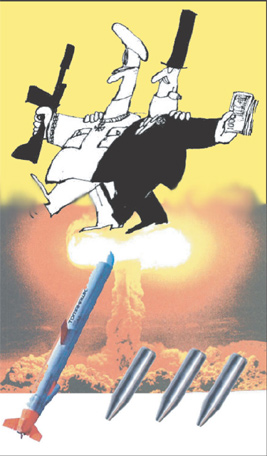 the production, maintenance, and modernization of nuclear weapons are sources of super profits for what is, in essence, a cartel.
Many Americans are unaware that much of the responsibility for nuclear weapons development, production, and maintenance lies not with the Pentagon but the Department of Energy (DOE), which spends more on nuclear weapons than it does on developing sustainable energy sources.
Through contracts with URS, Babcock & Wilcox, the University of California, and Bechtel, the nuclear weapons labs are to a significant extent privatized. The LANL contract alone is on the order of $14 billion. Similarly, the Savannah River Nuclear Facility, in Aiken, South Carolina, where nuclear warheads are manufactured, is jointly run by Flour, Honeywell International, and Huntington Ingalls Industries.
One of the reasons nuclear weapons profitability is extremely high is that the National Nuclear Security Administration (NNSA) of the Department of Energy, responsible for the development and operations of the DOE’s nuclear weapons facilities, does not monitor subcontractors, which makes it difficult to monitor prime contractors as well.
Meet the Private Corporations Building Our Nuclear Arsenal, Privatizing our nuclear arsenal development is not only dangerous, but incredibly inefficient, The Nation By Richard Krushnic andJonathan Alan King, 22 Sept 15
Imagine for a moment a genuine absurdity: Somewhere in the United States, the highly profitable operations of a set of corporations were based on the possibility that sooner or later your neighborhood would be destroyed and you and all your neighbors annihilated. And not just you and your neighbors, but others and their neighbors across the planet. What would we think of such companies, of such a project, of the mega-profits made off it?
In fact, such companies do exist. They service the American nuclear weapons industry and the Pentagon’s vast arsenal of potentially world-destroying weaponry. They make massive profits doing so, live comfortable lives in our neighborhoods, and play an active role in Washington politics. Most Americans know little or nothing about their activities and the media seldom bother to report on them or their profits, even though the work they do is in the service of an apocalyptic future almost beyond imagining.
Radiation risks to interventional cardiologists
 Interventionalists Receive 4.7 Times the Radiation Exposure to Left Side of Head Than Right Side During Invasive Cardiovascular Procedures Published study reveals exposure at 16 times the ambient radiation level WASHINGTON, Sept. 22, 2015 /PRNewswire/ — The results of a research study indicate that interventional cardiologists receive “very high” radiation exposure levels to the left side of the head specifically when performing fluoroscopically guided invasive cardiovascular (CV) procedures. Even with modern imaging equipment and shielding, a significant exposure difference was seen between the two sides of the head. The study was published in JACC: Cardiovascular Interventions, a peer-reviewed journal of the American College of Cardiology. Dr. Ehtisham Mahmud, MD, FACC, FSCAI, chief of Cardiovascular Medicine, director of Sulpizio Cardiovascular Center Medicine and director, Interventional Cardiology at UC San Diego, authored the study.
According to the study, interventionalists received 16 times the ambient radiation level to the left side of the head during an invasive CV procedure. Also, radiation exposure on the left side of the head was 4.7 times higher than exposure on the right side of the head. Interventional cardiologists typically stand anteriorly to the patient, with the left side of their body closest to the patient’s chest and most proximate to the radiation source.
“The implications of this study are significant when considering the subsequent impact ongoing exposure to even low levels of radiation can have on the health of the practitioner over the course of their career,” said Dr. Mahmud………..http://www.prnewswire.com/news-releases/interventionalists-receive-47-times-the-radiation-exposure-to-left-side-of-head-than-right-side-during-invasive-cardiovascular-procedures-300146945.html
The real reason the Nuclear Regulatory Commission cancelled its cancer research
 Nuclear power kills! The real reason the NRC cancelled its nuclear site cancerstudy http://www.theecologist.org/News/news_analysis/2985492/nuclear_power_kills_the_real_reason_the_nrc_cancelled_its_nuclear_site_cancer_study.html Chris Busby 19th September 2015
The US’s Nuclear Regulatory Commission just cancelled its study into cancer near nuclear plants citing the ‘excessive cost’ of $8 million, writes Chris Busby. Of course that’s rubbish – similar studies in the UK have been carried out for as little as £600 per site, and in any case $8 million is small change for the NRC. The real reason is to suppress the unavoidable conclusion: nuclear power kills.
After spending some $1.5 million and more than five years on developing strategies to answer the question of increases of cancer near nuclear facilities, the US Nuclear Regulatory Commission (NRC) last week reported that they would not continue with the process. They would knock it on the head [1].
This poisoned chalice has been passed between the US National Academy of Sciences (NAS) and the NRC since 2009 when public and political pressure was brought to bear on the USNRC to update a 1990 study of the issue, a study which was widely seen by the public to be a whitewash.
Dr Chris Busby at the Royal Society on Scientific Dishonesty
The NCR quickly passed the unwelcome task up to the NAS. It requested that the NAS provide an assessment of cancer risks in populations living ‘near’ the NRC-licenced nuclear facilities that utilize and process Uranium. This included 104 operating nuclear reactors in 31 States and 13 fuel cycle facilities in operation in 10 States.
The NRC request was to be carried out by NAS in two phases. Phase 1 was a scoping study to inform design of the study to be begun in Phase 2 and to recommend the best organisation to carry out the work.
The Phase 1 report was finished in May 2012. The best ‘state of the art’ methods were listed and the job of carrying out the actual study, a pilot study, was sent to: Guess who? The NRC. The poisoned chalice was back home. The NRC was now in a corner: what could they do?
If you don’t like the truth … suppress it Continue reading
Pacific Ocean radioactive isotopes from Atomic Testing compared with from Fukushima nuclear disaster
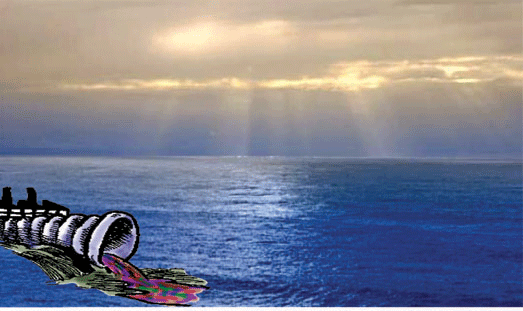 History of Bomb Strontium and Cesium Isotopes in Pacific Compared to Fukushima Sources http://www.dailykos.com/story/2014/01/16/1269942/-History-of-Bomb-Strontium-and-Cesium-Isotopes-in-Pacific-Compared-to-Fukushima-Sources# (EXCELLENT GRAPHS) by MarineChemist
The purpose of this diary is to compare the concentrations of Sr-90 and Cs-137 in the North Pacific Ocean over the last 50 years to the concentrations predicted to arrive on the west coast associated with waters affected by release of radionculides from the Fukushima-Daiichi Nuclear Power Plant. Given present levels that are being measured in the eastern Pacific and barring release rates that significantly exceed past rates in March-April 2011 the impact on marine organisms and the marine environment is going to be very minimal. What follows below the fold is a comparison of the concentrations measured and predicted over much of the Pacific owing to Fukushima to the concentrations that were present in the mid-1960s from the fallout of atmospheric weapons testing that is free from any discussion of safe doses or models of radiation exposure to organisms. Continue reading
Nuclear radiation depletes the ozone layer, will eventually destroy planet’s oxygen
HAZARDS OF LOW LEVEL RADIOACTIVITY, Nuclear Reader, ………OZONE BREAKDOWN The protective layer of ozone around the Earth filters out solar and cosmic rays and prevents them from reaching our planet. Ozone surrounds the Earth in a layer between six and thirty miles above sea level. It is formed when light rays strike molecules of oxygen, which is 02, and causes them to break into two separate oxygen atoms, or an 0 and 0. An atom of oxygen then combines with a molecule of oxygen and forms ozone which is 03. It breaks down again and then recombines again. And so on; unless it is interfered with. Radiation interrupts the process of ozone formation.

1957 – Walter Russell published his book Atomic Suicide, whose principle message was that the development of the nuclear weaponry and nuclear industry, if it continued, would eventually destroy the planet’s oxygen.
“The element of surprise which could delay the discovery of the great danger, and thus allow more plutonium piles to come into existence, is the fact that scientists are looking near the ground for fallout dangers. The greatest radioactive dangers are accumulating from eight to twelve miles up in the stratosphere. The upper atmosphere is already charged with death-dealing radioactivity, for which it has not yet sent us the bill. It is slowly coming and we will have to pay for it in another century, even if atomic energy plants ceased today.”
(Russell, Walter and Lao. Atomic Suicide? University of Science and Philosophy. Virginia 1957 p. 18)
1982 and 1984 – Two German reports conclude that radioactive krypton, which is released in the daily operation of nuclear plants and through the reprocessing of used reactor fuel elements, is affecting the distribution of the electric fields in the atmosphere.
1987 – The ozone hole is twice as large as the U.S. It is discovered that ozone is not only diminishing over the south pole but globally.
1987 – 1988 – Consensus has it that various man-made chemicals are the sole cause of ozone breakdown; especially compounds of chlorine (CFC’s) and bromine (from halon fire extinguishers) and there was an attempt to implicate hair spray and refrigerators. A leading authority on the ozone problem, NASA’s Dr. Robert Watson, admitted many scientists were “baffled” by findings of ozone depletion even in areas where CFC’s action was negligible. He called the extent of the hole’s growth “absolutely unexpected”.
April 6, 1989 – “Scientists reported yesterday that for the first time they have detected an increase in “biologically relevant” levels of ultraviolet radiation reaching the ground as a result of the ozone hole over the Antarctica.” This is the first indication that the depletion of ozone is beginning to cause the potentially harmful effect that has long been predicted.” (The Washington Post 4/6/89)
Late 1990 – University of California researchers publish their findings that phytoplankton are reproducing less profusely than before. Observing the plankton in the Belingshausen Sea (in the Antarctic) they found that increased UV appears to be suppressing the phytoplankton’s productivity by 6 to 12%.
1992 – Both NASA and The World Meteorological Society reported 10 to 25% ozone depletion measured over the northern United States, Canada, Europe and the Antarctic; and the ozone hole is now three times the size of the United States.
1994 – An article in a German journal Strahlentelex (March 3, 1994) argues that the nuclear industry is responsible for the hole in the ozone. The authors, Giebel and Sternglass explain that radioactive gases like krypton-85 from nuclear plants and from the recycling of spent fuel go up to the stratosphere where they create water droplets from the moisture which in turn form ice crystals which enhance the destruction of the ozone by the fluorohydrocarbons.
(Krypton-85 has a half-life of 10.7 years and a whole life of 217 years.)
March 1996 – The World Meteorological Agency reports “the extremely worrying” development of an unprecedented 45 percent ozone thinning over Greenland, Scandinavia and Western Siberia.
Summer 1997 – Research from the Antarctic Marine Living Resources Program find “krill abundance in the Antarctic Peninsula region is down 60 to 90 percent since the early 1980’s”…….http://www.nuclearreader.info/chapter1.html
How Charles Koch operates to sabotage renewable energy development
 How Charles Koch Prevents Clean Energy Businesses From Succeeding TruthOut 02 September 2015 By Matthew Kasper, Republic Report | News Analysis Last week, President Obama correctly singled out the Koch brothers – Charles and David – and the Koch-funded network for standing in the way of America’s clean energy future. Charles Koch responded saying he was “flabbergasted” after hearing Obama’s remark. He continued, “We are not trying to prevent new clean energy businesses from succeeding.” This statement is, at best, highly misleading.
Charles Koch states that he believes government should be smaller and it should not subsidize businesses, including any form of energy business. But while he acknowledges that the fossil fuel businesses he owns benefit tremendously from government subsidies, he doesn’t refuse those benefits or do anything to stop those policy choices. Meanwhile, the Kochs use their political influence and funding for efforts to repeal laws designed to support the deployment of more renewable electricity. Specifically, their political network’s agenda includes weakening renewable energy standards, preventing customers from installing solar panels (by charging fees on people that go solar), and protecting the government monopolized electric utilities.
The facts are indisputable.
Note: For more background, read this full briefing on the Koch’s web of influence across American society.
Here are the facts:
- Arizona Public Service Company (APS), the largest electric utility company in Arizona, admitted that it worked with the 60 Plus Association, a Virginia-based nonprofit seniors advocacy group receiving Koch money, to support the utility company’s proposal to add fees on homeowners with solar panels. Here is anadvertisement paid for by 60 Plus Association attacking solar energy in Arizona.
- 60 Plus Association is now working with the utility companies in Florida to preserve the status quo and the state’s outdated business model, and prevent customers from purchasing electricity from third party solar companies.
- The Koch founded and funded Americans For Prosperity (AFP) worked to prevent Georgia’s Public Service Commission from requiring Southern Company to buy more solar energy. An Associated Press review found AFP used misleading figures to pressure the regulators. The commissioners ignored AFP and as a result, Southern Company has gone on a “solar spree” bolstering its renewables portfolio the past two years.
- Americans For Prosperity has also worked in Kansas and North Carolina to repeal, weaken, or freeze those states renewable energy standards. In 2013, AFP flew Willie Soon to Kansas where he testified in front of state legislators that global warming isn’t a problem as part of AFP’s attempt to completely repeal the renewable energy standard. James Taylor, from the ExxonMobil and Koch-funded Heartland Institute, attended an AFP event the same year to increase support for repealing the state’s standard, and he also testified against the law. Furthermore, Koch Industries’ lobbyist Jonathan Small worked behind the scenes in the repeal efforts. Small held private talks with Representative Dennis Hedke (R-Wichita) about legislation to eliminate the law. In 2015, the standard waschanged to a voluntary one after legislators threatened to impose an excise tax on wind energy. Mike Morgan, a lobbyist for Koch Industries, joined Rep. Hedke and Jeff Glendenning of AFP at the announcement.
- Additionally, Koch-controlled foundations approved grants for Art Hall, director of the University of Kansas’ Center for Applied Economics, to research the state’s renewable energy standard. Lee Fang at The Intercept writes, “The Koch money was part of an ongoing project Hall described as an effort to develop “intellectual products” to be used “as a tool in economic policy debates… Following his grant request, Hall testified before the Kansas legislature in 2014 in favor of repealing the state renewable energy portfolio.”
- In North Carolina, AFP is again working this year to pressure lawmakers to repeal the state’s renewable energy standard. AFP started phone banking and canvassing to encourage voters to call their state officials and urge a vote.
- The American Legislative Exchange Council (ALEC) connects state lawmakers with corporate lobbyists to create model legislation. Koch foundations also fund ALEC. The corporate “bill mill” has approved model legislation to repeal or weaken renewable energy standards, eliminate solar net metering policies, and restrict markets for solar power.
- Koch funding has also flowed to the Beacon Hill Institute and the Utah State University’s Institute of Political Economy/Strata (a private consulting firm run by Randy Simmons, a former “Charles G. Koch Professor of political economy). The two organizations have produced flawed reports (see here and here) in attempts to justify efforts to repeal renewable energy standards. The reports, however, have been thoroughly debunked.
- The Koch funded Institute for Energy Research (IER), founded in 1989 from a predecessor non-profit organization registered by Charles Koch and Robert Bradley, have attacked clean energy laws. In Ohio, for example, IER’s Daniel Simmons testified in favor of repealing the state’s renewable energy standard. The President of IER is Thomas Pyle, who had been a lobbyist for Koch Industriesearlier in his career.
USA’s Nuclear Regulatory Commission might back quack pro nuclear ‘science’ on ionising radiation!
 How might the commissioners of the NRC decide the issue? Like the Atomic Energy Commission which it grew out of, the NRC is an unabashed booster of nuclear technology and long devoted to drastically downplaying the dangers of radioactivity.
A strong public stand – many negative comments – over their deciding that ‘radioactivity is good for you’ could make all the difference.
Petition: ‘Protect children from radiation exposure!‘ (Change.org)
Comment online: The NRC has a set a deadline of 19th November for people to comment on the proposed change. The public can send comments to the US Government’s regulations website.
Is radiation good for you? The US Nuclear Regulatory Commission could decide it is http://extrasensoryprecepts.blogspot.com.au/2015/09/is-radiation-good-for-you-us-nuclear.html,  The Ecologist | Sep 10, 2015 | Karl Grossman
In the wake of the Manhattan Project, the US crash program during World War II to build atomic bombs and the spin-offs of that program – led by nuclear power plants – there was a belief, for a time, that there was a certain ‘threshold’ below which radioactivity wasn’t dangerous.
But as the years went by it became clear there was no threshold – that any amount of radiation could injure and kill, that there was no ‘safe’ dose. Low levels of radioactivity didn’t cause people to immediately sicken or die. But, it was found, after a ‘latency’ or ‘incubation’ period of several years, the exposure could then result in illness and death.
Thus, starting in the 1950s, the ‘Linear No-Threshold’ standard was adopted by the governments of the US and other countries and international agencies.
The LNT standard has presented a major problem for those involved in developing nuclear technology Continue reading
French govt uses amendment to impose nuclear waste dump without parliament vote
The CIGEO project, managed by l’Agence nationale pour la gestion des déchets radioactifs (ANDRA), aims to bury nuclear waste 500 meters under the village of Bure. The wastes consist of 80,000 cubic meters of high-level, long-lived waste produced by French nuclear facilities. The project was estimated to cost 16.5 billion euros in 2005, but an estimate done in 2009 set the figure at 36 billion euros. The final cost is unknowable. For several years, anti-nuclear activists and residents have opposed what they call a “nuclear garbage dump.”
So how did nuclear waste find its way into a bill with 400 articles related to economic growth?

 Executive Privilege Invoked for Approving French Nuclear Waste Site http://nf2045.blogspot.jp/2015/09/executive-privilege-invoked-for.html
For many years, the French nuclear establishment has been struggling to overcome public opposition and legislative obstacles to its plans to bury high-level, long-lived nuclear waste in the rural village of Bure. During the summer of 2015, the socialist government of Francois Hollande took the desperate measure of tacking the issue onto an omnibus bill called the loi Macron, which is supposed to be concerned only with growth, equality and economic opportunity.
Just about anything could be subjectively judged to promote economic growth, so the government took an expansive view and included whatever it wanted under a very flexible definition of matters which favor “growth, equality and economic opportunity.” Once the nuclear waste project was in the Macron Bill, the government then took advantage of an executive privilege called Article 49.3.
About Article 49.3 Continue reading
How ionising radiation gets into water
 by Gordon Edwards, Ph.D.
(1) When nuclear fuel is used in a nuclear reactor or an atomic bomb, the atoms in the fuel are “split” (or “fissioned”) to produce energy. The fission process is triggered by subatomic particles called neutrons. In a nuclear reactor, when the neutrons are stopped, the fission process also stops. This is called “shutting down the reactor.”
(2) But during the nuclear fission process, hundreds of new varieties of radioactive atoms are created that did not exist before. These unwanted radioactive byproducts accumulate in the irradiated nuclear fuel — and they are, collectively, millions of times more radioactive than the original nuclear fuel.
(3) These newly created radioactive materials are classified as fission products, activation products, and transuranic elements. Fission products — like iodine-131, cesium-137 and strontium-90 — are the broken pieces of atoms that have been split. Activation products— like hydrogen-3 (“tritium”), carbon-14 and cobalt-60 — are the result of non-radioactive atoms being transformed into radioactive atoms after absorbing one or more stray neutrons. Transuranic elements — like plutonium, neptunium, curium and americium — are created by transmutation after a massive uranium atom absorbs one or more neutrons to become an even more massive atom (hence “transuranic,” meaning “beyond uranium”).
(4) Because of these intensely radioactive byproducts, irradiated nuclear fuel continues to generate heat for years after the fission process has stopped. This heat (“decay heat”) is caused by the ongoing atomic disintegration of the nuclear waste materials. No one knows how to slow down or shut off the radioactive disintegration of these atoms, so the decay heat is literally unstoppable. But decay heat does gradually diminish over time, becoming much less intense after about 10 years.
(5) However, in the early years following a reactor shutdown, unless decay heat is continually removed as quickly as it is being produced, the temperature of the irradiated fuel can rise to dangerous levels — and radioactive gases, vapors and particles will be given off into the atmosphere at an unacceptable rate.
(6) The most common way to remove decay heat from irradiated fuel is to continually pour water on it. Tepco is doing this at the rate of about 400 tons a day. That water becomes contaminated with fission products, activation products and transuranic elements. Since these waste materials are radiotoxic and harmful to all living things, the water cannot be released to the environment as long as it is contaminated.
(7) Besides the 400 tons of water used daily by Tepco to cool the melted cores of the three crippled reactors, another 400 tons of ground water is pouring into the damaged reactor buildings every day. This water is also becoming radioactively contaminated, so it too must be stored pending decontamination.
(8) Tepco is using an “Advanced Liquid Processing System” (ALPS) that is able to remove 62 different varieties of radioactive materials from the contaminated water — but the process is slow, removal is seldom 100 percent effective, and some varieties of radioactive materials are not removed at all.
(9) Tritium, for example, cannot be removed. Tritium is radioactive hydrogen, and when tritium atoms combine with oxygen atoms we get radioactive water molecules. No filtration system can remove the tritium from the water, because you can’t filter water from water. Released into the environment, tritium enters freely into all living things.
(10) Nuclear power is the ultimate example of the throwaway society. The irradiated fuel has to be sequestered from the environment of living things forever. The high-quality materials used to construct the core area of a nuclear reactor can never be recycled or reused but must be perpetually stored as radioactive waste. Malfunctioning reactors cannot be completely shut off because the decay heat continues long after shutdown. And efforts to cool a badly crippled reactor that has melted down result in enormous volumes of radioactively contaminated water that must be stored or dumped into the environment. No wonder some have called nuclear power “the unforgiving technology.”…….http://akiomatsumura.com/2013/06/experts-explain-effects-of-radioactive-water-at-fukushima.html
Tritium contamination of water: 9 medical implications
by Helen Caldicott, M.D.
(1) There is no way to separate tritium from contaminated water. Tritium, a soft beta emitter, is a potent carcinogen which remains radioactive for over 100 years. It concentrates in aquatic organisms including algae, seaweed, crustaceans and fish. Because it is tasteless, odorless and invisible, it will inevitably be ingested in food, including seafood, over many decades. It combines in the DNA molecule – the gene – where it can induce mutations that later lead to cancer. It causes brain tumors, birth deformities, and cancers of many organs. The situation is dire because there is no way to contain this radioactive water permanently and it will inevitable leak into the Pacific Ocean for over 50 years or longer along with many other very dangerous isotopes including cesium 137 which lasts for 300 years and causes very malignant muscle cancers –rhabdomyosarcomas, strontium 90 which also is radioactive for 300 years and causes bone cancers and leukemia, amongst many other radioactive elements.
(2) All cancers can be induced by radiation, and because much of the land in Fukushima and beyond is contaminated, the food – tea, beef, milk, green vegetables, rice, etc. – will remain radioactive for several hundred years.
(3) “Cleanup” is a misnomer, radioactively contaminated soil, timber, leaves, and water cannot be decontaminated, just possibly moved to another site there to contaminate it.
(4) Incineration of radioactive waste spreads the cancer-inducing agents to other areas including non-contaminated areas of Japan.
(5) Cancers have a long incubation period – 2 to 80 years after people eat or breath radioactively contaminated food or air.
(6) The IAEA says that decommissioning of these reactors will take 50 to 60 years and some people predict that this mess will never be cleaned up and removed.
(7) Where will Japan put this highly radioactive melted fuel, fuel rods and the like? There is absolutely no safe place to store this deadly material (that must be isolated from the exosphere for one million years according to the US EPA) on an island that is riven by earthquakes.
(8) As these radioactive elements continually seep into the water and the ocean and are emitted into the air the incidence of congenital deformities, cancer and genetic defects will inevitably increase over time and into future generations.
(9) Children are 10 to 20 times more sensitive to the carcinogenic effects of radiation than adults (little girls are twice as sensitive as boys) and fetuses are thousands of times more sensitive – one X ray to the pregnant abdomen doubles the incidence of leukemia in the child. http://akiomatsumura.com/2013/06/experts-explain-effects-of-radioactive-water-at-fukushima.html
1 This Month



26 September – International Day for the Total Elimination of Nuclear Weapons


PLEASE OPPOSE HR 8255 AND S.3639 – bills would accelerate satellite deployment, with no environmental review or safeguards – https://ncstd5li.quorum.us/campaign/169331/
To see nuclear-related stories in greater depth and intensity – go to https://nuclearinformation.wordpress.com
-
Archives
- September 2026 (245)
- August 2026 (330)
- July 2026 (355)
- June 2026 (287)
- May 2026 (306)
- April 2026 (356)
- March 2026 (251)
- February 2026 (267)
- January 2026 (308)
- December 2025 (358)
- November 2025 (359)
- October 2025 (375)
-
Categories
- 1
- 1 NUCLEAR ISSUES
- business and costs
- climate change
- culture and arts
- ENERGY
- environment
- health
- history
- indigenous issues
- Legal
- marketing of nuclear
- media
- opposition to nuclear
- PERSONAL STORIES
- politics
- politics international
- Religion and ethics
- safety
- secrets,lies and civil liberties
- spinbuster
- technology
- Uranium
- wastes
- weapons and war
- Women
- 2 WORLD
- ACTION
- AFRICA
- Atrocities
- AUSTRALIA
- Christina's notes
- Christina's themes
- culture and arts
- Events
- Fuk 2022
- Fuk 2023
- Fukushima 2017
- Fukushima 2018
- fukushima 2019
- Fukushima 2020
- Fukushima 2021
- general
- global warming
- Humour (God we need it)
- Nuclear
- RARE EARTHS
- Reference
- resources – print
- Resources -audiovicual
- Weekly Newsletter
- World
- World Nuclear
- YouTube
-
RSS
Entries RSS
Comments RSS
 nuclear-news