Cesium – radioactive contamination in Japan
 I am afraid that there are many Japanese people now living on lands equally
contaminated with radioactive cesium. If Japanese children are allowed to routinely ingest foodstuffs contaminated with Cesium-137, they will likely develop the same health problems that we see now in the children and teenagers of Belarus and Ukraine.
Thus it is very important that we recognize the danger posed to children by the routine ingestion of contaminated food with Cesium-137 where ever they might live. It is also important to prevent further nuclear disasters which release these fiendishly toxic poisons into the global ecosystems. Given the immense amounts of long-lived radionuclides which exist at every nuclear power plant this is an urgent task.
The Implications of The Massive Contamination of Japan With Radioactive Cesium
Steven Starr Senior Scientist, Physicians for Social Responsibility Director, University of Missouri, Clinical Laboratory Science Program Helen Caldicott Foundation Fukushima Symposium New York Academy of Medicine, 11 March 2013 A large number of highly radioactive isotopes released by the destruction of the Fukushima Daiichi nuclear power plant grossly contaminated the Japanese mainland. Most of these radionuclides had short half lives which meant they would essentially disappear in a matter of days or months. For many of those who were exposed to them there will be major health consequences.
However, there were some radioactive elements that will not rapidly disappear. And it is these long-lived radionuclides that will remain to negatively affect the health of all complex life forms that are exposed to them.
 Chief among them is Cesium-137, which has taken on special significance because it is has proven to be the most abundant of the long-lived radionuclides that has remained in the environment following the nuclear disasters at Chernobyl and Fukushima. It has a 30 year radioactive half life which is why it persists in the environment. Scientists now believe that it will be 180 to 320 years before the Cesium-137 around the destroyed Chernobyl reactor actually disappears from the environment. Continue reading
Ken Buesseler, Jay Cullen, lead independent research into radiation in the Pacific Ocean

Christina Macpherson’s websites & blogs
Great article. As an anti nuclear activist myself, I think that it is most important that we keep our concerns in proportion. The nuclear industry has so many bad effects, that we don’t ned to exaggerate ones that are not clear. Thankfully, despite government inertia, Buesseler and co are working to establish the facts on the effect if the Fukuhsima disaster on the ocean.
 Radiation in the Ocean http://www.huffingtonpost.com/peter-neill/radiation-in-the-ocean_b_8072914.html?ir=Australia Peter Neill Director, World Ocean Observatory The West Coast of the United States seems under siege by negative environmental news: earthquake predictions, oil spills, drought, critically diminished water supply, wildfires, and numerous accounts of unusual coastal events: algae blooms, whale strandings, cancer in seals, collapse of fish stocks, and more.
How to explain? Well, much of this can be attributed to climate factors where rising temperatures have resulted in multiple inter-related consequences: limited glacial melt, increased evaporation, no water, dry land, and the inevitable fire darkening that pristine Pacific air with smoke and ash the length of the coast.
The ocean phenomena may be different. The warming of the ocean surely has an impact on changing growth patterns of marine plants and animals, just as the changing pH or acidity of the ocean has been shown to modify habitat and migrations. But what else?
One argument has been the effect of radiation leaking from the three nuclear power plant reactors shut down by the earthquake and resultant tsunami tidal wave that inundated Fukushima, Japan in 2011, and has been thereafter distributed by ocean currents; indeed there is evidence of a plume of increased concentration of Cesium-134, and other radioactive elements that have been observed at unprecedented levels, spreading out some 5,000 miles into the Pacific toward North and South America. In April of this year, there were headlines declaring that “Fukushima radiation has reached the North American Shore” and concerns were raised, spread through the Internet and press, that this was surely the cause of these otherwise inexplicable anomalous natural events.
There is no Federal agency that funds monitoring of radiation in coastal water, and the present effort, conducted since 2004 by Ken Buesseler, a marine chemist at theWoods Hole Oceanographic Institution, has been underwritten by crowd-funding and the efforts of volunteers taking samples to provide data on cesium isotopes along the west coast of Alaska, the U.S. mainland coast, and Hawaii, the information that has been used to model potential distribution and concentration of any contamination. A comparable effort has been launched in Canada, led by Jay Cullen of the University of Victoria in collaboration with government, academic, and NGO partners.
The radioactivity has been decreased by time, the natural half-life of the isotopes, and by dilution in a very large and deep body of water. In their samples, Buesseler and his “citizen scientists” did detect cesium-137 already in the waters as a result of atmospheric nuclear weapons testing in the 1950s and 60s, and cesium-134 which does not otherwise occur naturally in the ocean and can only be attributed to Fukushima, to serve as a first baseline for subsequent collection, analysis, modeling, and conclusion.
Buesseler channels his research through the Center for Marine and Environmental Radioactivity at the Woods Hole Institute, where he offers a preliminary conclusion that “the amount of cesium-134 reported in these new offshore data is less that 2 Becquerels (a radioactive measure) per cubic meter (the number of decay events per second per 260 gallons of water.) This Fukushima-derived cesium is far below where one might expect any measurable risk to human health or marine life, according to international health agencies. And it is more than 1,000 times lower than acceptable limits in drinking water set by the U.S. Environmental Protection Agency.”
Buesseler continues, “We emphasize that cesium-134 has not been detected YET as it has been detected offshore of North America by Canadian oceanographers… The uncertainty in the predictions by these ocean models only emphasizes the importance of collecting samples from along the shores. Remember too that those models predict interacting levels of both cesium isotopes for the next 2 or 3 years, the highest published prediction is for 20 to 30 Becquerels per cubic meter, or well below what is thought to be of human health and fisheries concerns.”
So, yes, and no. No definitive conclusion, no clear argument that radiation is the cause of those coastal events which distress us so. There is no solace in uncertainty, just as there is no certainty without evidence. The question is immensely important and thanks to Ken Buesseler and all those volunteers alongshore and in research vessels who are working to provide the substance for a real answer.
Small Nuclear Power – Not Cheap, Not Beautiful, Not Safe – Not even NEW!
 When it comes to Nuclear Power, Small Isn’t Beautiful, Nor Safe Nor Cheap Nor Even New. USNRC NuScale Comment Deadline Monday Night 31 August, One Minute to
 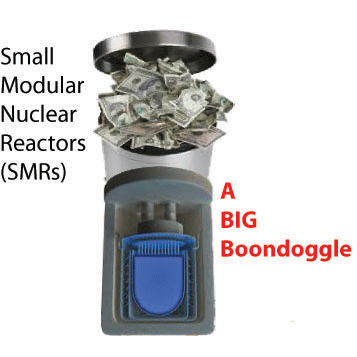 Midnight NY-DC Time 30 SundayAug 2015 by
“NuScale Power, LLC, Design-Specific Review Standard and Safety Review Matrix“Docket Folder Summaryhttp://www.regulations.gov/#!docketDetail;D=NRC-2015-0160 (If you don’t like the questions answer a different question, as per the advice that an MIT Ph.D. gave their grad student, and MIT is big on nuclear, the head of the US DOE, Moniz, teaches there, so it should be ok for this!)
NuScale in 2003 when it belonged to the US Gov and was called “MULTI-APPLICATION, SMALL, LIGHT WATER REACTOR (MASLWR)” INEEL/EXT- 04-01626
Greenpeace’s Justin McKeating made an excellent analysis of NuScale last year (see below our commentary).
However, he overlooked that the US DOE actually invented NuScale under the name of MASLWR. So, this is at least a second round of government funding. The US government dropped MASLWR and former DOE workers picked it up, probably after the patent expired, dubbing it NuScale. And, they are still feeding off the taxpayer pork barrel dole.[1][2] Plus, it’s NuScale Not! The nuclear industry only knows how to recycle the same old stuff.
There doesn’t appear to be much, if anything, new about NuScale. The only known immediate nuclear deaths from a nuclear accident, in the US, were from a mini-SL-1 reactor that made nuclear fallout in rural Idaho. [3] In 1968, in Lucens Switzerland, there was a mini-underground nuclear reactor, which had a major accident. Although smaller than NuScale, 100 Rem (1 Sievert; 1000 mSv) was measured in the reactor cavern, and it is ranked as a major nuclear accident. Radiation was measured in the nearby village; it continues to leak radiation from the cavern. From the beginning the Lucens Reactor was plagued by leaks in the underground cavern and corrosion issues due to its underground location. [4] NuScale too will suffer from additional corrosion and extra problems of hydrogen attack because it is part underground and stuck in water on all sides. Underground nuclear isn’t a magic fix, on the contrary.
NuScale is apparently not really passive either “Conduction through the vessel wall is by itself not a sufficient mechanism for heat removal in the present design. A circulation path is required to effectively remove the core decay heat. The sump makeup system is required.” [5] Furthermore, Italian researchers found that if if “SUMP valves are not operated and the ADS vent valves stuck open“, then there was a six hour “grace” period before CHF [Critical Heat Flux] “conditions are reached at top of the core. The dryout cannot be quenched. Primary system coolant released thorugh the HTC top valve outside the contaiment” [6]. Six hour grace period to meltdown-nuclear accident. So, these are neither passive, nor perfectly safe. And, they are proposing putting them in large groups, which makes one wonder what’s the point. A quick look online shows that NuScale has just submitted a laundry list of patents (July 2015) which, looking at the list alone, sound less original, than trying to patent a chicken sandwich, as someone recently did.
From Greenpeace:
“When it comes to nuclear power, small isn’t beautiful. Or safe or cheap.
Blogpost by Justin McKeating – June 19, 2014 at 11:55
Not beautiful, safe or cheap: a message to the United States, where the Obama administration has pledged to waste money financing the Small Modular Reactor (SMR).
SMRs are supposed to be small and prefab – constructed from parts made in a central location and slapped together onsite like a cheap prefab home. Those parts can then be shipped out and built by staff who don’t necessarily have the skills to build larger, more complex reactors.
The trouble is, this is merely old nuclear technology in new clothes. So why is the US Department of Energy (DoE) is giving $217 million dollars over five years to NuScale, a SMR manufacturer.
Let’s note, with a weary shake of the head, that this is yet another public subsidy for the failing economics of nuclear power, and take a look why this is a bad investment of taxpayer dollars by the Obama administration.
Dr. Mark Cooper, senior fellow for economic analysis at the Institute for Energy and the Environment at Vermont Law School, has published a paper titled, The Economic Failure of Nuclear Power and the Development of a Low-Carbon Electricity Future: Why Small Modular Reactors Are Part of the Problem, Not the Solution.
In his paper, Dr. Cooper finds SMRs won’t be cheaper and, more worryingly, manufacturers and supporters of the technology want to short-circuit safety regulations to get them built.
With the Fukushima disaster in its fourth year and no real solution to the ongoing problems and massive contamination in the foreseeable future, maybe now is not the time to talk about reducing nuclear safety, particularly with experimental, untested technology.
Dr Cooper adds SMRs will be more expensive than traditional nuclear technologies and that up to $90 billion dollars will be needed to make SMRs commercially viable. That’s a huge sum that will drag financing away from renewable power projects that are vital in the fight against climate change.
We’ve been here before: the story of the nuclear industry wasting billions is an old one…….. https://miningawareness.wordpress.com/2015/08/30/when-it-comes-to-nuclear-power-small-isnt-beautiful-nor-safe-nor-cheap-nor-even-new-usnrc-nuscale-comment-deadline-monday-night-31-august-one-minute-to-midnight-ny-dc-time/
USA’s super costly new bomb could ignite anew arms race
 Inside the Most Expensive Nuclear Bomb Ever Made http://www.motherjones.com/politics/2015/07/nuclear-weapon-obama-most-expensive-ever
Could America’s latest atomic weapon ignite a new arms race?
—By Len Ackland and Burt Hubbard
Using “Dial-a-yield” technology, the bomb’s explosive force can be adjusted before launch from a high of 50,000 tons of TNT equivalent to a low of 300 tons—that’s 98 percentsmaller than the bomb dropped on Hiroshima 70 years ago.
Despite these innovations, the government doesn’t consider the B61-12 to be a new weapon but simply an upgrade. In the past, Congress has rejected funding for similar weapons, reasoning that more accurate, less powerful bombs were more likely to be used. In 2010, the Obama administrationannounced that it would not make any nuclear weapons with new capabilities. The White House and Pentagon insist that the B61-12 won’t violate that pledge.
The B61-12 could be deployed by the new generation of F-35 fighter jets, a prospect that worries Hans Kristensen, a nuclear weapons expert at the Federation of American Scientists. “If the Russians put out a guided nuclear bomb on a stealthy fighter that could sneak through air defenses, would that add to the perception here that they were lowering the threshold for the use of nuclear weapons?” he asks. “Absolutely.”
So far, most of the criticism of B61-12 has focused on its price tag. Once full production commences in 2020, the program will cost more than $11 billion for about 400 to 480 bombs—more than double the original estimate, making it the most expensive nuclear bomb ever built.
This story comes from our friends at Reveal. Read more of their coverage of the B61-12 and national security.
Len Ackland is a former newspaper reporter and editor of the Bulletin of the Atomic Scientists magazine. He is the author of Making a Real Killing: Rocky Flats and the Nuclear West.
Burt Hubbard is the editorial director of I-News. His numerous awards include two prestigious Best of the West awards, a National Education Award for investigative reporting, and Reporter of the Year in Colorado.
Radiation standards: comparison of Hormesis theory versus Linear No Threshold theory
US Nuclear Regulatory Commission (NRC): Consultation. US Nuclear Regulatory Commission (NRC): Consultation. Dr Ian Fairlie Consultant on Radioactivity in the Environment LONDON United Kingdom www.ianfairlie.org, 28 Aug 15, Dr Ian Fairlie Consultant on Radioactivity in the Environment LONDON United Kingdom www.ianfairlie.org “………..Comments on Hormesis It is true that some cell and animal experiments indicate that if small amounts of radiation were administered before later larger amounts, the damage done is less than if no previous small amount were given. (The word “tickle” is used in radiobiology lingo to denote such small amounts.)
On the other hand, other cell and animal studies using different doses, durations and endpoints fail to show this effect, and there is no human evidence, ie from epidemiology. But it is true that some evidence from chemistry indicates the same effect, and there is some theoretical support for an adaptive effect in animals and plants.
Hormesis advocates typically argue that although radiation attacks DNA and causes mutations, DNA repair mechanisms quickly correct these. These mechanisms are certainly numerous and busy – it is estimated over 15,000 repairs per hour are carried out in each cell – but from the sheer number of repairs, many misrepairs occur and it is the misrepairs that cause the damage.
 But even if the existence of hormesis were accepted, the question remains – what relevance would it have for radiation protection? The answer- as stated repeatedly in official reports by UNSCEAR and BEIR etc – is zero.
For example, do we give “tickle” doses to people about to undergo radiation therapy, or to nuclear workers? Of course, we don’t. And what about background radiation? All of us receive small “tickle” doses of radiation – about 3 mSv per year of which about 1 mSv is from external gamma radiation.
Do these somehow protect us from subsequent radiation? How would we notice? And if it did, so what? That is, what relevance would it have for radiation protection, eg setting radiation standards? The answer is again ….none.
Indeed, as we show below, increasing evidence exists that even background radiation itself is harmful.
Comments on LNT On the other hand, the scientific evidence for the LNT is plentiful, powerful and persuasive. It comes from epidemiological studies, radiobiological evidence, and official reports. Let’s examine these in turn. Continue reading
Dr Ian Fairlie on US Nuclear Regulatory Commission (NRC): Consultation on radiation standards
US Nuclear Regulatory Commission (NRC): Consultation. Dr Ian Fairlie Consultant on Radioactivity in the Environment LONDON United Kingdom www.ianfairlie.org, 28 Aug 15,

Introduction On June 26 2015, the US Nuclear Regulatory Commission (NRC) stated it was seeking public comments by September 8, on petitions stating that the Linear No Threshold theory of radiation’s effects was not a valid basis for setting radiation standards and that the hormesis model should be used instead.
In more detail, the NRC has received three petitions for rulemaking requesting that the NRC amend its “Standards for Protection Against Radiation” regulations and change the basis of those regulations from the Linear No-Threshold (LNT) model of radiation protection to the hormesis model. (See the Appendix for details of the petitions.) The LNT model assumes that biological damage from radiation is linearly related to exposure and is always harmful, ie without a threshold.
The hormesis model assumes that exposures to low radiation levels is beneficial and protects the human body against deleterious effects of high levels of radiation. The NRC has stated it is examining these petitions to determine whether they should be considered in rulemaking and is requesting public comments.
US environmental groups are concerned that, if the NRC agreed with the petitions, it would introduce rules to weaken radiation protection standards at US nuclear facilities. On the other hand, according to two NRC staffers (Brock and Sherbini, 2012), the NRC apparently pays attention to the evidence on risks of low levels of radiation………
No evidence below 100 mSv? It is necessary at this point to directly address the argument often raised by hormesis advocates – that there is little evidence of effects below 100 mSv.
This is incorrect.Older evidence exists -see http://www.ianfairlie.org/news/a-100-msv-threshold-forradiation-effects/for a list of studies and the newer evidence, as we have just seen, clearly shows this fact as well. B. Radiobiological Evidence Current radiobiological theory is consistent with a linear dose-response relationship down to low doses (ie below ~10 mSv). The radiobiological rationale for linearity comes from the stochastic nature of energy deposition of ionising radiation. It was explained by 15 of the world’s most eminent radiation biologists and epidemiologists in a famous article (Brenner et al, 2003) as follows: “1. Direct epidemiological evidence demonstrates that an organ dose of 10 mGy of diagnostic x-rays is associated with an increase in cancer risk………..
The Importance of LNT in Radiation Protection Regardless of dissenting views on LNT, the reality is that most concepts used in radiation protection today are fundamentally based on the LNT theory. For example, LNT underpins the concepts of absorbed dose, effective dose, committed dose, and the use of dose coefficients (ie Sv per Bq of a radionuclide). It also allows radiation doses (i) to be averaged within an organ or tissue, (ii) to be added from different organs, and (iii) to be added over time.
LNT also permits annual dose limits; optimization -ie comparison of practices; radiation risk assessment at low and very low doses; individual dosimetry with passive detectors; collective dose, and dose registers over long periods of time. 9 In fact, the LNT underpins all legal regulations in radiation protection in the US and in the rest of the world.
Indeed, if the LNT were not used, it’s hard to imagine our current radiation protection systems existing at all. However this statement should not be misconstrued to mean that the LNT is used just because it’s convenient: the LNT is used because the scientific evidence for it is comprehensive, cogent and compelling……..
Conclusions
(i) the debate The validity or otherwise of LNT and hormesis have been the subject of hundreds of scientific articles and debates over several decades. Unfortunately, much of the literature on hormesis or adaptive response is based on faulty science or on misconceptions, or on misinterpretations, or on all three.
This is particularly the case with several US and UK journalists who write with confidence on how radiation risks are exaggerated. Their knowledge and experience of radiogenic risks are limited to say the least, but these journalists, almost on a weekly basis, misinform and mislead the public about radiation risks, so the existence of the US petitions is perhaps unsurprising.
However real scientists are increasingly standing up and opposing the poor science used by hormesis advocates. Very recently, four Swiss scientists from the Institute of Social and Preventive Medicine at the University of Bern; the Swiss Tropical and Public Health Institute, Basel and the University of Basel published a study which revealed that exposure to high rates of background radiation resulted in increased cancer risks to children (Spycher et al, 2015). http://ehp.niehs.nih.gov/1408548/
In other words, the petitions appear to be based on preconceptions, or even ideology, rather than the scientific evidence which points in the opposite direction. The petitions should not be used by the NRC to justify weakening regulatory standards at US nuclear facilities. A question remains whether the NRC should have accepted the petitions for review. Presumably the NRC has discretion not to review or to refer back spurious, mischievous, or ill-founded petitions.
Concerns over reliability, safety, chemistry of planned Advanced Boiling Water Nuclear Reactors (ABWR)
 No2NuclearPower nuClear news No.77, September 2015 ABWRs According to World Nuclear News (WNN) there are four operable Advanced Boiling Water Reactors (ABWR) in Japan while two more are under construction. Another two are being built in Taiwan and two planned for Lithuania, although another two have been shelved in the USA. The design is already licensed in Japan and the USA. WNN points out, disturbingly that ABWRs can run on a full core of mixed oxide (MOX) nuclear fuel, raising the prospect of armed plutonium shipments travelling from Sellafield to Anglesey and Gloucestershire. (6)
No proper assessment of radioactive iodine in Fukushima food and water
 no iodine would be detectable at all, it was announced that a whole body counter study will begin to measure the internal exposure dose of Fukushima residents. Now, however, dose assessment is said to be impossible due to “the lack of direct measurements in residents immediately after the accident.” Government experts should have been well aware of the half-life of iodine 131. Why did they not conduct a thorough survey at the time while iodine 131 was still detectable?
 Oshidori Mako Interviews Experts Regarding Excess Occurrence of Pediatric Thyroid Cancer in Fukushima, Fukushima Voice, English Version 6 Aug 15,”…….Issue to be considered #3:
 Experts now doubt that excess thyroid cancer in Fukushima children is due to “screening effect”
Oshidori Mako Interviews Experts Regarding Excess Occurrence of Pediatric Thyroid Cancer in Fukushima, Fukushima Voice, English Version 6 Aug 15, “………Issue to be considered #2: Disposal of nuclear waste turning out to be half the cost of reprocessing with MOX fuel
 Disposal beats MOX in US comparison http://www.world-nuclear-news.org/WR-Disposal-beats-MOX-in-US-comparison-2108151.html?utm_source=dlvr.it&utm_medium=twitter 21 August 2015
America is reconsidering how it will dispose of 34 tonnes of plutonium as the previous plan involving a MOX plant has been said to be twice as costly as a dilution and disposal option in a leaked Department of Energy (DOE) report.
The plutonium arises from a June 2000 nuclear weapons reduction agreement with Russia under which both countries would put 34 tonnes of plutonium beyond military use. Russia opted to use its plutonium as fuel for fast reactors generating power at Beloyarsk.
The USA, meanwhile, decided to build a mixed-oxide (MOX) nuclear fuel plant at Savannah River, where the plutonium would be mixed with uranium and made into fuel for light-water reactors. The design is similar to Areva’s Melox facility at Marcoule, but modified to handle metal plutonium ‘pits’ from US weapons and their conversion from metal to plutonium oxide. It is this part of the process that has been problematic. Construction started in 2007 with an estimated cost of $4.9 billion but work ran into serious trouble before being ‘zeroed’ in the DOE’s 2014 budget, putting development on ice.
The Union of Concerned Scientists yesterday published what it said was an unreleased DOE report that compared the cost of completing the MOX plant to other options. Use in fast reactors was considered briefly, but with this technology not readily available in the near term, the prime comparison was against a ‘dilution and disposal’ option which would see the plutonium mixed with inert materials and disposed of in the Waste Isolation Pilot Plant, or WIPP, in New Mexico.
Despite being 60% built, the MOX plant still needs some 15 years of construction work, said the leaked report, and then about three years of commissioning. Once in operation the plant would work through the plutonium over about 10 years with this 28-year program to cost $700-800 million per year – a total of $19.6-22.4 billion on top of what has already been spent. Not only is the price tag very high, but the timescale is too long: the report said this would not meet the disposal timeframe agreed with Russia.
The cost of the MOX plant could not be mitigated by income from sales of the MOX fuel because the regulatory process to gain approval to use MOX would be too burdensome for a commercial utility. The report said “it may be unlikely” that even a utility in a regulated market where fuel costs are passed on to consumers would “bear the risk of MOX fuel even if it is free”.
Dilution and disposal would cost $400 million per year, said the report, “over a similar duration” as MOX, working out at close to half the cost. Other advantages for dilution and disposal are that it requires no new facilities to be created or decommissioned after use, although the increase in WIPP disposal means “it may eventually become desirable to explore expansion of WIPP’s capacity” beyond currently legislated limits. This unique geologic disposal facility was said to be of “tremendous value to both DOE and the State of New Mexico”.
International Research Team studies Fukushima contaminants in seafloor sediments
Examining the fate of Fukushima contaminants, Science Daily,
Fraction of buried, ocean sediment uncovered by typhoons, carried offshore by currents August 18, 2015, Woods Hole Oceanographic Institution
- Summary:
- An international research team reports results of a three-year study of sediment samples collected offshore from the Fukushima Daiichi Nuclear Power Plant. The research aids in understanding what happens to Fukushima contaminants after they are buried on the seafloor off coastal Japan. Scientists found that a small fraction of contaminated seafloor sediments off Fukushima are moved offshore by typhoons that resuspend radioactive particles in the water.
- An international research team reports results of a three-year study of sediment samples collected offshore from the Fukushima Daiichi Nuclear Power Plant in a new paper published August 18, 2015, in the American Chemical Society’s journal,Environmental Science and Technology.
The research aids in understanding what happens to Fukushima contaminants after they are buried on the seafloor off coastal Japan.
Led by Ken Buesseler, a senior scientist and marine chemist at the Woods Hole Oceanographic Institution (WHOI), the team found that a small fraction of contaminated seafloor sediments off Fukushima are moved offshore by typhoons that resuspend radioactive particles in the water, which then travel laterally with southeasterly currents into the Pacific Ocean.
“Cesium is one of the dominant radionuclides that was released in unprecedented amounts with contaminated water from Japan’s Fukushima Daiichi nuclear power plant following the March 11, 2011, earthquake and tsunami,” says Buesseler. “A little over 99 percent of it moved with the water offshore, but a very small fraction–less than one percent–ended up on the sea floor as buried sediment.”
“We’ve been looking at the fate of that buried sediment on the continental shelf and tracking how much of that contaminated sediment gets offshore through re-suspension from the ocean bottom,” he adds.
The research team, which included colleagues from the Japan Agency for Marine-Earth Science and Technology and the Japan Atomic Energy Agency, analyzed three years’ worth of data collected from time-series sediment traps……….
-
“The total transport is small, though it is readily detectable. One percent or less of the contaminated sediment that’s moving offshore every year means things aren’t going to change very fast,” Buesseler says. “What’s buried is going to stay buried for decades to come. And that’s what may be contributing to elevated levels of cesium in fish–particularly bottom-dwelling fish off Japan.”
While there were hundreds of different radionuclides released from the Fukushima Daiichi Nuclear Power Plant during the disaster, after the initial decay of contaminants with half lives (the time it takes for one half of a given amount of radionuclide to decay) less than days to weeks, much of the attention has remained focused on cesium-137 and-134– two of the more abundant contaminants. Cesium-134 has a half-life of a little over two years, and so any found in the ocean could come only from the reactors at Fukushima. Cesium-137 has a half-life of roughly 30 years and is also known to have entered the Pacific as a result of aboveground nuclear weapons tests in the 1950s and ’60s, providing a benchmark against which to measure any additional releases from the reactors.
In October, Buesseler and the research team will return to Japan to redeploy more sediment traps. The continued study will help estimate how long it takes to decrease the level of radiocesium in seafloor sediments near the Fukushima Daiichi Nuclear Power Plant.
Story Source:
The above post is reprinted from materials provided by Woods Hole Oceanographic Institution. Note: Materials may be edited for content and length. http://www.sciencedaily.com/releases/2015/08/150818112431.htm
Uranium: a genetic poison that targets DNA
 After Hiroshima and Nagasaki, a Third Nuclear Atrocity: the Corruption of Science, CounterPunch, by CHRIS BUSBY 19 AUG 15 “……… The origin was the “black rain” which contained Uranium-235, Uranium-238 and particularly Uranium-234, which is the missing exposure, and is probably responsible for most of the cancer effects in all the survivors. We know that the Uranium was there because it was measured by Japanese scientists in 1983.
A recently declassified US document tabulates the enormous U-234 content of the enriched Uranium used in the bombs, codename: Oralloy. The Uranium nanoparticles in the Hiroshima (and Nagasaki) black rain were available for inhalation by all the exposure groups in the ruins of Hiroshima for years after the bomb.
All the bombs were made of Uranium, about 1 ton per Megaton yield. For all those tests in Nevada, the Marshall Islands, Kazakhstan, Christmas Island, the results were the same: down came the nanoparticles to be inhaled by anyone nearby and distant.
Why does this matter? New research has been carried out on Uranium. We find that Uranium targets DNA through chemical affinity. This causes terrible and anomalous genetic damage, out or all proportion to its “dose” as calculated by ICRP. Other fallout components also bind chemically to DNA, e.g. Strontium-90, Barium-140.
Those exposed: Uranium miners, Gulf Veterans, Test Veterans, DU civilians, Nuclear Uranium workers, Nuclear Site downwinders, all suffer chromosome damage, cancer, leukemia, heart disease, the works. All this is published, as are the results of laboratory and theoretical studies showing mechanisms. But in the Lancet: nothing.
S L Simon and A Bouville who wrote the article on the health effects of the nuclear testing did not even mention Uranium there, nor in their epic 2010 study of the Marshall Islands exposures. The Nevada site data that they used for their baseline calculations ignored it totally.
In 2012, I made a presentation for the Marshall Islanders at the UN Human Rights Council in Geneva, attacking the Simon et al analysis. In their Lancet nuclear test article, Simon and Bouville major on Iodine effects. So let’s look at those.
Scientific evidence from Fukushima: massive excess of thyroid cancers
In Fukushima Prefecture, surveys have confirmed 103 thyroid cancers in 380,000 18-year olds (25 or so are still being checked out). The Lancet article by Wakeford et al. presents an excess Relative Risk culled from the Hiroshima studies of 0.6 per Sievert (Fig 2 p 473). In the very same issue, the maximum thyroid dose was given as 18mSv with the median dose as 0.67mSv.
So in the two years of screening, if everyone screened got the maximum thyroid dose of 18mSv we should expect an increase of 0.018 x 0.6 = 0.011, a 1.1% increase in the background rate. This background is about 1 per 100,000 per year or 7.6 in two years in 380,000. So the radiation should increase this to 7.7 cases (i.e. one extra case in 10 years).
There are 103, that is 95 more cases than expected, an error in the ICRP model of 95/0.14 = 678-fold. That is, there are 678 times more thyroid cancers than the Hiroshima-based ICRP model predicts.
This calculation is based on what was written in The Lancet – but nobody made the calculation. This on its own should show the authorities (and the public) that the game is up. But instead of doing the simple calculation, another article in The Lancet, written by Geoff Watts, praises the work of those at Fukushima Medical University, who are busy telling everyone that the increases in thyroid cancer cannot be caused by the radiation.
In other words, once again, the predictions from Hiroshima are believed, rather than the evidence in front of their eyes. It’s a kind of mass hypnosis (or maybe not)…….” http://www.counterpunch.org/2015/08/19/after-hiroshima-and-nagasaki-a-third-nuclear-atrocity-the-corruption-of-science/
Science corrupted in the cause of promoting the nuclear industry
 After Hiroshima and Nagasaki, a Third Nuclear Atrocity: the Corruption of Science, CounterPunch, by CHRIS BUSBY 19 AUG 15 On the 70th anniversary of the atomic bombing of Hiroshima and Nagasaki, articles are appearing everywhere discussing the historical, philosophical, scientific, public health and social meaning of this event (I almost wrote ‘war crime’).
The bombings can be extrapolated onward in time through the atmospheric testing fallout and Chernobyl, to the more recent contamination in Japan after Fukushima.
Today, the analysis of the health risks from the Japanese A-Bombs is being cleverly twisted to provide a rationale for the development of nuclear weapons and nuclear energy.
Hiroshima and Nagasaki are not just some historical tableaux that we can weep crocodile tears over, and discuss as socio-historic phenomena.
They are here today, present as ghosts, in all the manipulations and devious calculations made by the international radiation risk agencies and nuclear-industry scientists giving results that continue to permit the release into the environment of the same deadly substances that emerged for the first time in 1945.
Abusing Hiroshima to deny nuclear bomb health damage
I am currently presenting a case for the British Atomic Test veterans in the Royal Courts of Justice in London. The case pivots on the faulty radiation and health risk model that is based on the Lifespan Study of the Japanese A-Bomb survivors. Continue reading
America and Churchill planned huge pre emptive nuclear strike on USSR
 Unthinkable as it may seem, Churchill’s plan literally won the hearts and minds of US policy makers and military officials.
These “first-strike” plans developed by the Pentagon were aimed at destroying the USSR without any damage to the United States.
The 1949 Dropshot plan envisaged that the US would attack Soviet Russia and drop at least 300 nuclear bombs and 20,000 tons of conventional bombs on 200 targets in 100 urban areas, including Moscow and Leningrad (St. Petersburg)
the Kennedy administration introduced significant changes to the plan, insisting that the US military should avoid targeting Soviet cities and had to focus on the rival’s nuclear forces alone.
 Post WW2 World Order: US Planned to Wipe USSR Out by Massive Nuclear Strike, Sputnik News. Ekaterina Blinova. 15 Aug 15, Was the US deterrence military doctrine aimed against the Soviet Union during the Cold War era really “defensive” and who actually started the nuclear arms race paranoia?
Interestingly enough, then British Prime Minister Winston Churchill had ordered the British Armed Forces’ Joint Planning Staff to develop a strategy targeting the USSR months before the end of the Second World War. The first edition of the plan was prepared on May 22, 1945. In accordance with the plan the invasion of Russia-held Europe by the Allied forces was scheduled on July 1, 1945.
Winston Churchill’s Operation Unthinkable The plan, dubbed Operation Unthinkable, stated that its primary goal was “to impose upon Russia the will of the United States and the British Empire. Even though ‘the will’ of these two countries may be defined as no more than a square deal for Poland, that does not necessarily limit the military commitment.” Continue reading
Nuclear nations raise “allowable” limits of ionising radiation – knowing that this is unsafe
 damchodronma, 15 Aug 15, This is why the policy of nuclear nations is to raise ‘allowable’ limits for nuclear workers and the population generally when there are accidents… and since Atomic Age began. Contamination gets worse, it is worse for all life, but nothing about it is really safe or acceptable. It’s propaganda.
“The evidence from the Chernobyl affected territories reveals the real-world consequences of a simple and terrible new discovery: that the effects of low dose internal irradiation cause subtle changes in the genome that result in an increase in the general mutation rate. … first seen in cells in the laboratory. The Chernobyl evidence, shows that this seems to be true for all species, for plants and
animals and humans. It has profound implications that go beyond radiation protection and risk models.
“Krysanov …find that mice living in the high irradiation zone, 22 generations after the initial exposure, are MORE radiosensitive than mice living in lower exposure areas. The same effect is reported for plants by Grodzhinsky who wryly points out that plants cannot exhibit the ‘radiophobia’ that many of the Chernobyl effects have been blamed on. This flies in the face of current ideas about genetic selection.
“The effects of genomic instability are apparent in the evidence of massive harm to the organs and systems of living creatures at low doses of internal exposure, resulting in a kind of radiation ageing associated with random mutations in all cells. At the higher doses in the ‘liquidators’, after some years, their bodies seem to simply fall apart. In an astonishing statement we hear from Yablokov that in Moscow 100% of the liquidators are sick, in Leningrad 85%. These are men that ran like hares into the radiation fields with improvised lead waistcoats cut from roofs and who, by stabilising the situation at the reactor, saved Europe from a nuclear explosion equivalent to 50 Hiroshima Bombs – an outcome that would have made most of it uninhabitable. They are forgotten.
[THEY SIMPLY FALL APART]
“WHOLE BIOLOGICAL SYSTEMS COLLAPSE; at the cell level, at the tissue level and at the population level. Burlakova and Nazarov describe these subtle effects at lower doses of internal irradiation in laboratory cell systems and also people, Grodzhinsky shows the effects in plants, – higher for internal exposures than external, Krysanov shows the effects in wild animals and Yablokov and the Nesterenkos in the children and adults living and continuing to live in the contaminated territories. The effects clearly operate at what are presently thought to be vanishingly low doses.”
“ECRR Chernobyl: 20 Years On” (2006) pg 2
ECRR = European Committee on Radiation Risk
Dr. Chris Busby, Scientific Secretary wrote Introduction.
co-edited with Dr. Alexey Yablokov
http://life-upgrade.com/DATA/chernobylebook.pdf
Spanish http://ciaramc.org/ciar/boletines/cr_bol226.htm
1 This Month



26 September – International Day for the Total Elimination of Nuclear Weapons


PLEASE OPPOSE HR 8255 AND S.3639 – bills would accelerate satellite deployment, with no environmental review or safeguards – https://ncstd5li.quorum.us/campaign/169331/
To see nuclear-related stories in greater depth and intensity – go to https://nuclearinformation.wordpress.com
-
Archives
- September 2026 (245)
- August 2026 (330)
- July 2026 (355)
- June 2026 (287)
- May 2026 (306)
- April 2026 (356)
- March 2026 (251)
- February 2026 (267)
- January 2026 (308)
- December 2025 (358)
- November 2025 (359)
- October 2025 (375)
-
Categories
- 1
- 1 NUCLEAR ISSUES
- business and costs
- climate change
- culture and arts
- ENERGY
- environment
- health
- history
- indigenous issues
- Legal
- marketing of nuclear
- media
- opposition to nuclear
- PERSONAL STORIES
- politics
- politics international
- Religion and ethics
- safety
- secrets,lies and civil liberties
- spinbuster
- technology
- Uranium
- wastes
- weapons and war
- Women
- 2 WORLD
- ACTION
- AFRICA
- Atrocities
- AUSTRALIA
- Christina's notes
- Christina's themes
- culture and arts
- Events
- Fuk 2022
- Fuk 2023
- Fukushima 2017
- Fukushima 2018
- fukushima 2019
- Fukushima 2020
- Fukushima 2021
- general
- global warming
- Humour (God we need it)
- Nuclear
- RARE EARTHS
- Reference
- resources – print
- Resources -audiovicual
- Weekly Newsletter
- World
- World Nuclear
- YouTube
-
RSS
Entries RSS
Comments RSS
 nuclear-news