Looking after Chernobyl’s radioactive puppies
The Puppies of Chernobyl
HUNDREDS OF RADIOACTIVE PUPPIES JUST GOT SPAYED, NEUTERED AT CHERNOBYL DISASTER SITE http://www.newsweek.com/hundreds-puppies-got-spayed-and-neutered-chernobyl-year-669093, BY An American nonprofit organization, Clean Futures Fund, has started a spay and neuter clinic for the four-legged descendants of survivors of one of history’s worst nuclear disasters.
After the Chernobyl nuclear reactor melted down on April 26, 1986, some dogs and cats left behind survived and began to breed. More than 400 animals were spayed and neutered in the first year of the clinic’s operation at the former reactor, which ended earlier this month.
The laws governing the exclusion zone around Chernobyl strongly advise people to avoid feeding or touching the dogs, due to the risk of contamination. Not only is the dogs’ fur potentially loaded with radioactive particles, but their food and water is contaminated. The radioactive molecules they ingest may also linger in their bodies.
“We could find areas in their bones where radioisotopes had accumulated. We could survey the bones and we could see the radioactivity in them,” a Clean Futures Fund co-founder, Lucas Hixson, told Newsweek. The program funds medical treatment for locals in addition to running the spay and neuter program at the power plant and in the neighboring city.
“These dogs run through [contaminated areas] and it gets stuck on their coat and on the end of their noses and their feet.”
There are nearly 1,000 dogs in the area around the power plant. Only a few dozen cats live in the highly contaminated areas that the dogs frequent.
Hixson has been traveling to Chernobyl for about five years, initially as a radiation specialist. “I go over there expecting to do my work, and I step off the train at the power plant and there’s a dog in my face. Honestly, it was one of the last things I expected to see at Chernobyl,” he said.
To keep the veterinary hospital as free from radioactive contamination as possible, dogs that come to the facility are examined and washed down until their levels of radioactivity are deemed safe.
Despite the potential risk, Hixson said he’s continued to interact with the dogs. “There is a fair amount of handling that happens. This is a natural reaction between humans and dogs,” he said. “You can’t help yourself.”
“They’re not hazardous to your immediate health and wellbeing. But anytime you go pet the dogs, go wash your hands afterwards before you eat.”
Clean Futures Fund got approval from the Ukranian government for its operations. Other partners include SPCA International, Dogs Trust and two U.S. universities, including Worchester Polytechnic Institute and the University of South Carolina.
Hixson also noted the local workers have welcomed the team. “I remember there was a lot of skepticism when we showed up,” he said. “But after about two or three days of us catching dogs, processing them, releasing them, the attitude immediately changed,” he said. “I can’t thank them enough for everything they did.”
Even if every dog and cat in Chernobyl is sterilized and vaccinated, the wider stray dog issue in Ukraine means that more dogs could move into the contaminated area and Clean Futures Fund’s efforts could be somewhat for naught. Ultimately, Hixson would like to work with the Ukranian government on a wider rescue program to get the dogs out of the area and into homes.
He will be returning in November to measure the impact of the program, which is expected to run for five years. The next spay and neuter clinic will happen next summer.
New study results in creation of new classification of climate change threats
 New climate risk classification created to account for potential ‘existential’ threats https://www.eurekalert.org/pub_releases/2017-09/uoc–ncr091417.php Researchers identify a one-in-20 chance of temperature increase causing catastrophic damage or worse by 2050
UNIVERSITY OF CALIFORNIA – SAN DIEGO A new study evaluating models of future climate scenarios has led to the creation of the new risk categories “catastrophic” and “unknown” to characterize the range of threats posed by rapid global warming. Researchers propose that unknown risks imply existential threats to the survival of humanity.
These categories describe two low-probability but statistically significant scenarios that could play out by century’s end, in a new study by Veerabhadran Ramanathan, a distinguished professor of climate and atmospheric sciences at Scripps Institution of Oceanography at the University of California San Diego, and his former Scripps graduate student Yangyang Xu, now an assistant professor at Texas A&M University.
The risk assessment stems from the objective stated in the 2015 Paris Agreement regarding climate change that society keep average global temperatures “well below” a 2°C (3.6°F) increase from what they were before the Industrial Revolution.
Even if that objective is met, a global temperature increase of 1.5°C (2.7°F) is still categorized as “dangerous,” meaning it could create substantial damage to human and natural systems. A temperature increase greater than 3°C (5.4°F) could lead to what the researchers term “catastrophic” effects, and an increase greater than 5°C (9°F) could lead to “unknown” consequences which they describe as beyond catastrophic including potentially existential threats. The specter of existential threats is raised to reflect the grave risks to human health and species extinction from warming beyond 5° C, which has not been experienced for at least the past 20 million years.
The scientists term warming probability of five percent or less as a “low-probability high-impact” scenario and assess such scenarios in the analysis “Well Below 2°C: Mitigation strategies for avoiding dangerous to catastrophic climate changes,” which will appear in the journal Proceedings of the National Academy of Sciences on Sept. 14.
Ramanathan and Xu also describe three strategies for preventing the gravest threats from taking place.
“When we say five percent-probability high-impact event, people may dismiss it as small but it is equivalent to a one-in-20 chance the plane you are about to board will crash,” said Ramanathan. “We would never get on that plane with a one-in-20 chance of it coming down but we are willing to send our children and grandchildren on that plane.”
The researchers defined the risk categories based on guidelines established by the Intergovernmental Panel on Climate Change (IPCC) and previous independent studies. “Dangerous” global warming includes consequences such as increased risk of extreme weather and climate events ranging from more intense heat waves, hurricanes, and floods, to prolonged droughts. Planetary warming between 3°C and 5°C could trigger what scientists term “tipping points” such as the collapse of the West Antarctic Ice Sheet and subsequent global sea-level rise, and the dieback of the Amazon rainforest. In human systems, catastrophic climate change is marked by deadly heat waves becoming commonplace, exposing over 7 billion people to heat related mortalities and famine becoming widespread. Furthermore, the changes will be too rapid for most to adapt to, particularly the less affluent, said Ramanathan.
Risk assessments of global temperature rise greater than 5°C have not been undertaken by the IPCC. Ramanathan and Xu named this category “unknown??” with the question marks acknowledging the “subjective nature of our deduction.” The existential threats could include species extinctions and major threats to human water and food supplies in addition to the health risks posed by exposing over 7 billion people worldwide to deadly heat.
With these scenarios in mind, the researchers identified what measures can be taken to slow the rate of global warming to avoid the worst consequences, particularly the low-probability high-impact events. Aggressive measures to curtail the use of fossil fuels and emissions of so-called short-lived climate pollutants such as soot, methane and HFCs would need to be accompanied by active efforts to extract CO2 from the air and sequester it before it can be emitted. It would take all three efforts to meet the Paris Agreement goal to which countries agreed at a landmark United Nations climate conference in Nov 2015.
Xu and Ramanathan point out that the goal is attainable. Global CO2 emissions had grown at a rate of 2.9 percent per year between 2000 and 2011, but had slowed to a near-zero growth rate by 2015. They credited drops in CO2 emissions from the United States and China as the primary drivers of the trend. Increases in production of renewable energy, especially wind and solar power, have also bent the curve of emissions trends downward. Other studies have estimated that there was by 2015 enough renewable energy capacity to meet nearly 24 percent of global electricity demand.
Short-lived climate pollutants are so called because even though they warm the planet more efficiently than carbon dioxide, they only remain in the atmosphere for a period of weeks to roughly a decade whereas carbon dioxide molecules remain in the atmosphere for a century or more. The authors also note that most of the technologies needed to drastically curb emissions of short-lived climate pollutants already exist and are in use in much of the developed world. They range from cleaner diesel engines to methane-capture infrastructure.
“While these are encouraging signs, aggressive policies will still be required to achieve carbon neutrality and climate stability,” the authors wrote.
The release of the study coincides with the start of Climate Week NYC in New York, a summit of business and government leaders to highlight global climate action. Ramanathan and colleagues will deliver a complementary report detailing the “three-lever” mitigation strategy of emissions control and carbon sequestration on Sept. 18 at the United Nations. That report was produced by the Committee to Prevent Extreme Climate Change, chaired by Ramanathan, Nobel Prize winner Mario Molina of UC San Diego, and Durwood Zaelke, who leads an advocacy organization, the Institute for Governance and Sustainable Development, with 30 experts from around the world including China and India.
Abandoned radioactive generators and other nuclear junk sunk in oceans by Russia
Feisty mayor in Russia’s Far East wants his nuclear trash collected http://bellona.org/news/nuclear-issues/2017-09-feisty-mayor-in-russia-far-east-wants-his-nuclear-trash-collected
While lighthouses run on atomic batteries in Russia have become rare, especially along the coasts of the Baltic and Barents Seas, they still have their adherents in the country’s Far East. by Charles Digges charles@bellona.no While lighthouses run on atomic batteries in Russia have become rare, especially along the coasts of the Baltic and Barents Seas, they still have their adherents in the country’s Far East.
A group of radioactivity tracking sleuths on Sakhalin Island in the Pacific say they have hunted down an abandoned generator that ran on strontium-90 sunk off the shores of one of its premier beach resorts.
But that, they say, is just the tip of the iceberg: The discovery lies in the middle of a radioactive graveyard that includes no fewer than 38 sunken vessels containing nuclear waste, and two nuclear warheads that went down when a Soviet bomber crashed near the island’s southern tip in 1976.
Though the Russian Ministry of Defense recently began acknowledging the lost bomber, tracing the origins of the other nuclear cast offs is not so easy.
But at least, says Nikolai Sidirov, mayor of the coastal town of Makarov on Sakhalin’s Bay of Patience, his town knows what this new discovery is – and they want it raised from the depths with the rest of the glowing junk.
Speaking to Novaya Izvestiya, a popular tabloid that morphed out of the official Soviet-era mouthpiece Izvestiya, Sidirov said satellite photos tracking the location of the crashed bomber have turned up something else lurking under the waves: An RTG.
That’s short for Radioisotope Thermoelectric Generator, a small radioactive energy source that for decades powered thousands of Soviet lighthouses and other navigational beacons along Russia’s Baltic, Arctic and Pacific coasts.
After the fall of the Soviet Union and the crash of the Russian economy, officials lost track of many of the RTGs as bureaucracies collapsed and records went missing. Thieves pillaged them for their valuable metal, exposing their strontium innards. Hikers and shepherds, drawn to their atomic heat, would stagger out of the woods sick with radiation poisoning.
Around Murmansk and on the Pacific coast, frightful reports about strontium elements turning up on beaches proliferated in local media. Some newly independent Soviet republics telegraphed anxieties about their inherited RTGs back to Moscow – along with requests to come take them away.
And then there was the biggest fear of all: What if strontium 90 from these virtually unguarded, remotely radiological sources ended up in the hands of terrorists who wanted to make a dirty bomb?
So far, that hasn’t happened – anybody trying to make off with a strontium battery would likely end up very ill or dead. But when three woodsmen in the former Soviet Republic of Georgia turned up in a hospital with radiation burns and caught the attention of the International Atomic Energy Agency, the dangers of orphaned Soviet RTGs were finally on everyone’s mind.
A colossal effort spearheaded by the Norwegian government entirely rid the coasts of the Barents, Kara and White Seas of more than 180 RTGs. By infusing €20 million into the push, Norway helped Russia replace the strontium 90 batteries on these lighthouses and beacons with solar power over a six year period ending in 2015.
In all, Rosatom, Russia’s state nuclear corporation, says it has decommission more than 1000 RTGs throughout the country, adding that it has mostly eliminated the hazard of these stray radioactive sources from its coastlines.
But some areas have not been so lucky, at least according to the mayor of Makarov out on Sakhalin Island, six times zones east of Moscow. Sidirov, a feisty campaigner who had been publicly heckling the capital about the nuclear trash in the seas near his town for years, says divers have located the RTG, and that he now has the coordinates of where it lies. He told Novaya Izvestiya he will pass on the RTGs location to what he calls “competent authorities” lest it end up in scheming hands.
How the RTG, which lies in 14 meters of water, came to be there is still anyone’s guess. The Russian Navy sent a statement to the newspaper insisting that all RTGs under the purview of the Pacific Fleet have been hunted down and destroyed.
But Russia’s environmental oversight agency confirmed that there were numerous radioactive foundlings in the oceans off Sakhalin Island, though they didn’t identify Sidirov’s RTG specifically.
It certainly wouldn’t be the first time someone screwed up with an RTG in the area, however. Twenty years ago, in 1997, a helicopter from Russia’s Emergency Services Ministry accidentally dropped a strontium-powered RTG into Sakhalin’s waters. It was later retrieved by the navy.
So far, Rosatom has remained mum on the veracity of Sidirov’s claim about the RTG. But since the history of the downed bomber and the other hazards in his area has been confirmed, there’s every reason to believe him about the RTG. And he wants it gone.
“The ecological authorities and the military, they’re being very stubborn about coming to collect it,” Sidorov told Novaya Izvestiya. “It’s there job to collect it – if they’re ever interested, I’ll be here to show them exactly where it is.”
The problem of plutonium: justification for its reprocessing is now dead
Forty years later, Japan’s breeder program, the original justification for its reprocessing program, is virtually dead.
Forty years of impasse: The United States, Japan, and the plutonium problem http://www.tandfonline.com/doi/full/10.1080/00963402.2017.1364007 Masafumi Takubo &Frank von Hippel, 23 Aug 2017, Recently, records have been published from the internal discussions in the Carter administration (1977–80) on the feasibility of convincing Japan to halt its plutonium-separation program as the United States was in the process of doing domestically. Japan was deeply committed to its program, however, and President Carter was not willing to escalate to a point where the alliance relationship could be threatened. Forty years later, the economic, environmental, and nonproliferation arguments against Japan’s program have only been strengthened while Japan’s concern about being dependent on imports of uranium appears vastly overblown. Nevertheless, Japan’s example, as the only non-weapon state that still separates plutonium, continues to legitimize the launch of similar programs in other countries, some of which may be interested in obtaining a nuclear weapon option.
Foreign civilian plutonium programs had become a high-level political issue in the United States after India used plutonium, nominally separated to provide startup fuel for a breeder reactor program in its first nuclear weapon test in 1974 (Perkovich 1999). The United States reversed its policy of encouraging the development of plutonium breeder reactors worldwide to avoid an anticipated shortage of uranium. The breeder reactors would convert abundant non-chain-reacting uranium 238 into chain-reacting plutonium and then use the plutonium as fuel, while conventional reactors are fueled primarily by chain-reacting uranium 235, which makes up only 0.7 percent of natural uranium.
The Ford administration (1974–77) blocked France’s plan to sell spent fuel reprocessing plants to South Korea and Pakistan but did not succeed in persuading Japan to abandon its nearly complete Tokai pilot reprocessing plant. Therefore, when the Carter administration took office in January 1977, it inherited the difficult plutonium discussion with Japan.
The earliest document in the newly released trove is a 19-page memo dated 24 January 1977, in which career State Department official Louis Nosenzo briefs the incoming Carter political appointees on the issue.2 His arguments are strikingly similar to those being made some 40 years later by United States and international nongovernmental organizations such as the International Panel on Fissile Materials (IPFM 2015) and by US government officials – most recently, members of the Obama administration.3
These arguments are, in brief, that the separation and use of plutonium as a fuel is not economically competitive with simply storing the spent fuel until its radioactive heat generation has declined and a deep underground repository has been constructed for its final disposal. In this “once-through” fuel cycle, the plutonium remains mixed with the radioactive fission products in the intact spent fuel and therefore is relatively inaccessible for use in weapons.
The earliest document in the newly released trove is a 19-page memo dated 24 January 1977, in which career State Department official Louis Nosenzo briefs the incoming Carter political appointees on the issue.2 His arguments are strikingly similar to those being made some 40 years later by United States and international nongovernmental organizations such as the International Panel on Fissile Materials (IPFM 2015) and by US government officials – most recently, members of the Obama administration.3
These arguments are, in brief, that the separation and use of plutonium as a fuel is not economically competitive with simply storing the spent fuel until its radioactive heat generation has declined and a deep underground repository has been constructed for its final disposal. In this “once-through” fuel cycle, the plutonium remains mixed with the radioactive fission products in the intact spent fuel and therefore is relatively inaccessible for use in weapons.
Presumably with tongue in cheek, he opined that “[s]pace limitations are a real problem only for countries like Luxemburg.” (Luxemburg, about equal in area to St. Louis, Missouri, did not and still does not have a nuclear program.) Subsequently, it was pointed out that the volume of an underground repository for highly radioactive waste is determined not by the volume of the waste but by its heat output; the waste has to be spread out to limit the temperature increase of the surrounding buffer clay and rock (IPFM 2015). Reprocessing waste would contain all the heat-generating fission products in the original spent fuel, and the heat generated by the plutonium in one ton of spent MOX fuel would be about the same as the heat generated by the plutonium in the approximately seven tons of spent low-enriched uranium fuel from which the plutonium used to manufacture the fresh MOX fuel had been recovered.
With regard to the issue of the need for plutonium to provide startup fuel for breeder reactors, Nosenzo noted that “experimental breeders currently utilize uranium [highly enriched in the chain-reacting isotope uranium 235] rather than plutonium for start-up and this will probably also be true of commercial breeder start-up operations.”4
“[T]here is a strong need for a US position paper presenting the above rationale with supporting analysis,” Nosenzo wrote. “This would be of value, for example, with other governments in the nuclear suppliers context and more generally … for use by sympathetic foreign ministries attempting to cope effectively with their ministries of energy, of technology and of economics.”
The last point reflected the reality that the promotion of breeder reactors was central to the plans of powerful trade ministries around the world, including Japan’s Ministry of International Trade and Industry (now the Ministry of Economy, Trade and Industry), and that foreign ministries sometimes use independent analyses to push back against positions of other ministries that seem extreme to them. A few years ago, an official of South Korea’s Foreign Ministry, for example, privately described the Korea Atomic Energy Research Institute, the driving force behind South Korea’s demand for the same “right” to reprocess as Japan, as “our Taliban.”
Japan planned to start operation of its Tokai reprocessing plant later that spring, and it appeared clear to Nosenzo that it would be impossible to prevent the operation of the almost completed plant. Another memo cited Prime Minister Fukuda as publicly calling reprocessing a matter of “life and death” for Japan.5 Japan’s government had committed itself to achieving what Glenn Seaborg, chairman of the US Atomic Energy Commission from 1961–71, had relentlessly promoted as a “plutonium economy,” in which the world would be powered by the element he had codiscovered.
Why would the Fukuda administration have seen the separation and use of plutonium as so critical? We believe that the Prime Minister had been convinced by Japan’s plutonium advocates that the country’s dependence on imported uranium would create an economic vulnerability such as the country had experienced during the 1973 Arab oil embargo, still a recent and painful memory. Indeed, according to a popular view in Japan, further back, in 1941, it was a US embargo on oil exports to Japan that had triggered Japan’s attack on Pearl Harbor. The plutonium advocates argued that breeder reactors would eliminate resource-poor Japan’s vulnerability to a uranium cutoff by turning already imported uranium into a virtually inexhaustible supply of plutonium fuel for its reactors.
During the past 40 years, however, uranium has been abundant, cheap, and available from a variety of countries. Furthermore, as some foreign observers have suggested, if Japan was really concerned about possible disruptions of supply, it could have acquired a 50-year strategic reserve of uranium at a much lower cost than its plutonium program (Leventhal and Dolley 1994). Indeed, because of the low cost of uranium, globally, utilities have accumulated an inventory sufficient for about seven years. Although it took several years for Congress to accept the Carter administration’s proposal to end the US reprocessing and breeder reactor development programs, Congress did support the administration’s effort to discourage plutonium programs abroad. The Nuclear Nonproliferation Act of 1978 required that nuclear cooperation agreements with other countries be renegotiated so that any spent fuel that had either originally been produced in the United States or had been irradiated in a reactor containing components or design information subject to US export controls could not be reprocessed without prior consent from the US government. Internally, however, the administration was divided over whether the United States could force its allies to accept such US control over their nuclear programs.
One of the final memos in the National Security Archives file, written in May 1980, toward the end of the Carter administration by Jerry Oplinger, a staffer on the National Security Council, criticized a proposal by Gerard Smith, President Carter’s ambassador at large for nuclear nonproliferation. Smith proposed that the administration provide blanket advance consent for spent fuel reprocessing in Western Europe and Japan.7 Oplinger characterized Smith’s proposal as “surrender” and argued that, even though the danger of further proliferation in Europe or by Japan was low, their examples could be used by other countries as a justification for launching their own plutonium programs.
The Carter administration did not surrender to the Japanese and the West European reprocessing lobbies but, in 1988, in exchange for added requirements for safeguards and physical protection of plutonium, the Reagan administration signed a renegotiated US–Japan agreement on nuclear cooperation with full, advance, programmatic consent to reprocessing by Japan for 30 years. In the original 1968 agreement, the United States had been given the right to review each Japanese shipment of spent fuel to the British and French reprocessing plants on a case-by-case basis and to make a joint determination on reprocessing in Japan. This right had allowed the United States to question whether Japan needed more separated plutonium. As a result of the 1988 agreement, by the time of the 2011 Fukushima accident, Japan had built up a stock of some 44 tons of separated plutonium, an amount sufficient for more than 5000 Nagasaki-type bombs (Japan Atomic Energy Commission 2012), and the largest amount of MOX fuel it had loaded in a single year (2010) contained about one ton of plutonium (IPFM 2015).
The initial period of the 1988 agreement will expire in 2018, after which either party may terminate it by giving six months written notice. This provides an opportunity for the US government to reraise the issue of reprocessing with Japan.
Unlike the 1968 agreement with Japan, the 1958 US–EURATOM agreement did not have a requirement of prior US consent for reprocessing of European spent fuel in West Europe. The Europeans refused to renegotiate this agreement, and, starting with President Carter, successive US presidents extended the US–EURATOM agreement by executive order year by year (Bulletin of the Atomic Scientists 1994). Finally, in 1995, the Clinton administration negotiated language in a new agreement that the European reprocessors accepted as a commitment to noninterference (Behrens and Donnelly 1996). By that time, the nonnuclear weapon states in Europe – notably Germany and Italy – had lost interest in breeder reactors and the only reprocessing plants listed in the agreement were those of United Kingdom and France. Reprocessing proponents in Japan often say that Japan is the only non-weapon state trusted by the international community to reprocess. In reality, Japan is the only non-weapon state that has not abandoned reprocessing because of its poor economics.
As Oplinger pointed out, Japan played a central role in sustaining large-scale reprocessing in Europe as well as at home. In addition to planning to build their own large reprocessing plant, Japan’s nuclear utilities provided capital, in the form of prepaid reprocessing contracts, for building large new merchant reprocessing plants in France and the United Kingdom. France also played a leading role in promoting reprocessing and in designing Japan’s reprocessing plant.
Oplinger insisted that the planned reprocessing programs in Europe and Japan would produce huge excesses of separated plutonium beyond the requirements of planned breeder programs: “Any one of these three projected plants would more than swamp the projected plutonium needs of all the breeder R&D programs in the world. Three of them would produce a vast surplus … amounting to several hundred tons by the year 2000.”
He attached a graph projecting that by the year 2000, the three plants would produce a surplus of 370 tons of separated plutonium beyond the requirements of breeder research and development. The actual stock of separated civilian plutonium in Europe and Japan in 2000 was huge – using the IAEA’s metric of 8 kilograms per bomb, enough for 20,000 Nagasaki bombs – but about half the amount projected in Oplinger’s memo (IPFM 2015). This was due in part to operating problems with the UK reprocessing plant and delays in the operation of Japan’s large reprocessing plant. On the demand side, breeder use was much less than had been projected, but, in an attempt to deal with the surplus stocks, quite a bit of plutonium was fabricated into MOX and irradiated in Europe’s conventional reactors.
Forty years later, Japan’s breeder program, the original justification for its reprocessing program, is virtually dead. Japan officially abandoned its Monju prototype breeder reactor in 2016 after two decades of failed efforts to restore it to operation after a 1995 leak of its sodium secondary coolant and a resulting fire. Japan’s government now talks of joining France in building a new Advanced Sodium Technological Reactor for Industrial Demonstration (ASTRID) in France, and France’s nuclear establishment has welcomed the idea of Japan sharing the cost.8
The mission for ASTRID-type fast-neutron reactors would be to fission the plutonium and other long-lived transuranic elements in spent low-enriched uranium fuel and MOX fuel, for which Japan will have to build a new reprocessing plant. According to France’s 2006 radioactive waste law, ASTRID was supposed to be commissioned by the end of 2020.9 Its budget has been secured only for the design period extending to 2019, however. In an October 2016 briefing in Tokyo, the manager of the ASTRID program showed the project’s schedule with a “consolidation phase” beginning in 2020 (Devictor 2016). The next day, the official in charge of nuclear issues at France’s embassy in Tokyo stated that ASTRID would not start up before 2033 (Félix 2016). Thus, in 10 years, the schedule had slipped by 13 years. It has been obvious for four decades that breeder reactors and plutonium use as a reactor fuel will be uneconomic. The latest estimate of the total project cost for Japan’s Rokkasho Reprocessing Plant, including construction, operation for 40 years, and decommissioning, is now 13.9 trillion yen ($125 billion), with the construction cost alone reaching 2.95 trillion yen ($27 billion), including 0.75 trillion yen for upgrades due to new safety regulations introduced after the Fukushima accident. The total project cost of the MOX fuel fabrication facility, including some 42 years of operation and decommissioning, is now estimated at 2.3 trillion yen ($21 billion) (Nuclear Reprocessing Organization of Japan 2017
). In the United States, after it became clear in 1977 that reprocessing and breeder reactors made no economic sense and could create a proliferation nightmare, it took only about five years for the government and utilities to agree to abandon both programs, despite the fact that industry had spent about $1.3 billion in 2017 dollars on construction of a reprocessing plant in South Carolina (GAO 1984), and the government had spent $4.2 billion on the Clinch River Demonstration Breeder Reactor project (Peach How could Japan’s government have allowed reprocessing advocates to drive its electric-power utilities to pursue its hugely costly plutonium program over 40 years?
For context, it must be remembered that the United States, a nuclear superpower, has been much more concerned about nuclear proliferation and terrorism than Japan. Tetsuya Endo, a former diplomat involved in the negotiations of the 1988 agreement, depicted the difference in the attitude of the two governments as follows:
Whereas the criterion of the United States, in particular that of the US government … is security (nuclear proliferation is one aspect of it), that of the Japan side is nuclear energy. … [I]t can be summarized as security vs. energy supply and the direction of interests are rather out of alignment. (Endo 2014)As we have seen, in the United States, after India’s 1974 nuclear test, both the Ford and Carter administrations considered the spread of reprocessing a very serious security issue. Indeed, a ship that entered a Japanese port on 16 October 1976 to transport spent fuel to the United Kingdom could not leave for nine days due to the Ford administration’s objections (Ibara 1984
). In Japan, the US concerns about nuclear proliferation and terrorism have been generally considered interference in Japan’s energy policy by a country that possesses one of the worlds’ largest nuclear arsenals. Even the eyes of parliament members opposed to reprocessing, antinuclear weapon activists and the media sometimes got blurred by this nationalistic sentiment.
Nevertheless, reprocessing is enormously costly and the willingness of Japan’s government to force its nuclear utilities to accept the cost requires explanation.
One explanation, offered by the Japan Atomic Energy Commission (JAEC) (Japan Atomic Energy Commission 2005), involves the political challenge of negotiating arrangements for storing spent fuel indefinitely at reactor sites. The government and utilities had promised the host communities and prefectures that spent fuel would be removed from the sites. The reprocessing policy provided destinations – first Europe and the Tokai pilot plant, and then the Rokkasho Reprocessing Plant. The JAEC argued that, since it would take years to negotiate indefinite onsite storage of spent fuel, nuclear power plants with no place to put spent fuel in the meantime would be shut down one after another, which would result in an economic loss even greater than the cost of reprocessing.
Japan’s nuclear utilities have had to increase on-site storage of spent fuel in any case due to delays in the startup of the Rokkasho Reprocessing Plant, which was originally to start commercial operations in 1997. Indeed, the utilities have adopted the dangerous US practice of dense-packing their spent-fuel cooling pools with used fuel assemblies. Storing spent fuel in dry casks, onsite or offsite, cooled by natural convection of air would be much safer (von Hippel and Schoeppner 2016). In the United States, spent fuel is transferred to onsite dry cask storage after the dense-packed pools become completely full. It’s better to make this transfer as soon as the spent fuel gets cool enough. Such a shift to a policy of accelerated dry cask storage would require stronger nuclear safety regulation in both countries (Lyman, Schoeppner, and von Hippel 2017
Second, there is the bureaucratic explanation. The bureaucracy has more power over policy in Japan than in the United States. In Japan, when a new prime minister is elected in the Diet, only the ministers change whereas, in the United States with a two-party system, policy making is shared by Congress and the executive branch to a greater extent, and a new president routinely replaces more than 4000 officials at the top of the bureaucracy.10 (This works both for the better and worse as can be observed in the current US administration.) Also, in Japan, unlike the United States, the bureaucracy is closed. There are virtually no mixed careers, with people working both inside and outside the bureaucracy (Tanaka 2009).
Third, the provision of electric power has been a heavily regulated regional monopoly in Japan. Utilities therefore have been able to pass the extra costs of reprocessing on to consumers without eroding their own profits. This monopoly structure also has given utilities enormous power both locally and nationally, making it possible for them to influence both election results and the policy-making process. Thus, even if the original reprocessing policy was made by bureaucrats, it is now very difficult to change because of this complicated web of influence.
Japan has been gradually shifting toward deregulation, especially since the Fukushima accident, but a law has been passed to protect reprocessing by requiring the utilities to pay in advance, at the time of irradiation, for reprocessing the spent fuel and fabricating the recovered plutonium into MOX fuel (Suzuki and Takubo 2016). The fact that nuclear utilities didn’t fight openly against this law, which will make them pay extra costs in the deregulated market, suggests that they expect the government to come up with a system of spreading the cost to consumers purchasing electricity generated by nonnuclear power producers, for example with a charge for electricity transmission and distribution, which will continue to be regulated.
Plutonium separation programs also persist in France, India, and Russia. China, too, has had a reprocessing policy for decades, although a small industrial reprocessing plant is only at the site-preparation stage and a site has not yet been found for a proposed large reprocessing plant that is to be bought from France. Central bureaucracies have great power in these countries, as they do in Japan. France’s government-owned utility has made clear that, where it has the choice – as it has had in the United Kingdom, whose nuclear power plants it also operates – it will opt out of reprocessing. This is one of the reasons why reprocessing will end in the United Kingdom over the next few years as the preexisting contracts are fulfilled (IPFM 2015
).
A final explanation put forward from time to time for the persistence of reprocessing in Japan is that Japan’s security establishment wants to keep open a nuclear weapon option. There already are about 10 tons of separated plutonium in Japan, however (with an additional 37 tons of Japanese plutonium in France and the United Kingdom), and the design capacity of the Rokkasho Reprocessing Plant to separate eight tons of plutonium, enough to make 1000 nuclear warheads per year, is far greater than Japan could possibly need for a nuclear weapon option. Also, Japan already has a centrifuge enrichment plant much larger than that planned by Iran. Iran’s program precipitated an international crisis because of proliferation concerns. Japan’s plant, like Iran’s, is designed to produce low-enriched uranium for nuclear power plants, but the cascades could be quickly reorganized to produce enough weapon-grade uranium for 10 bombs per year from natural uranium. Japan plans to expand this enrichment capacity more than 10-fold.11 It is therefore hard to imagine that the hugely costly Rokkasho reprocessing project is continuing because security officials are secretly pushing for it.
The idea that Japan is maintaining a nuclear weapon option has negative effects for Japan’s security, however, raising suspicions among its neighbors and legitimizing arguments in South Korea that it should acquire its own nuclear weapon option. It also undermines nuclear disarmament. According to the New York Times, when President Obama considered adopting a no-first-use policy before leaving office, Secretary of State John Kerry “argued that Japan would be unnerved by any diminution of the American nuclear umbrella, and perhaps be tempted to obtain their own weapon” (Sanger and Broad 2016). It’s about time for both the security officials and antinuclear weapon movements to examine this concern more seriously.
Given the terrible economics of reprocessing, its end in Japan and France should only be a matter of time. As the 40-year-long impasse over Japan’s program demonstrates, however, the inevitable can take a very long time, while the costs and dangers continue to accumulate. The world has been fortunate that the stubborn refusals of Japan and France to abandon their failing reprocessing programs have not resulted in a proliferation of plutonium programs, or the theft and use of their plutonium by terrorists. The South Korean election of President Moon Jae-in – who holds antinuclear-power views – may result in a decrease in pressure from Seoul for the “right” to reprocess.
The combined effects of the “invisible hand” of economics and US policy therefore have thus far been remarkably successful in blocking the spread of reprocessing to non-weapon states other than Japan. China’s growing influence in the international nuclear-energy industry and its planned reprocessing program, including the construction of a large French-designed reprocessing plant, could soon, however, pose a new challenge to this nonproliferation success story. Decisions by France and Japan to take their completely failed reprocessing programs off costly government-provided life support might convince China to rethink its policy.
HOW 5 PEOPLE SURVIVED NAGASAKI’S NUCLEAR HELL
 http://www.nationalgeographic.com.au/people/how-5-people-survived-nagasakis-nuclear-hell.aspx Three days after Hiroshima, an American B-29 dropped an atomic bomb on Nagasaki. A new book tells stories of those who lived through horror. on August 9, 1945, an American B-29 dropped an atomic bomb on the Japanese city of Nagasaki, obliterating much of it and killing 74,000 people, mostly civilians. It was only the second time in history an atomic bomb had been used as a weapon. BY SIMON WORRALL 14 SEPTEMBER 2017 In Nagasaki: Life After Nuclear War, Susan Southard follows the lives of five hibakusha (survivors) who escaped the firestorm and through extraordinary courage and resilience went on to live happy, fulfilled lives.
Speaking from her home in Arizona, she talks about the battle for the truth over what happened in Nagasaki; how square dancing helped heal the wounds of war; and why the survivors no longer harbour feelings of animosity towards Americans.
Yours is the first book to tell this story. Why has it taken so long?
One of the reasons is that the bombs were kept top secret. Very few military leaders knew they existed, except for the people who were creating the bombs and those directly overseeing them. After the bombs were dropped, several factors, both in the U.S. and Japan, contributed to people not knowing the effects.
One was direct denial of any radiation effects by key U.S. military leaders like General Leslie Groves, General Thomas Farrell and the U.S. War Department. During the U.S. occupation of Japan, which lasted from 1945 to 1952, General Douglas MacArthur also instituted a strict press code banning “false or destructive criticism” of the Allied powers out of concern that too much anger could put the thousands of U.S. troops in Japan at risk.
General Groves and others promoted the idea that the Japanese were using the effects of the bomb as anti-American propaganda. So, the people of Japan, other than the people in the cities directly affected, didn’t know for years what was happening in their own country. There was medical censorship as well. Physicians working with the survivors weren’t allowed to publish studies or findings of what was happening.
They also didn’t want the decision to use the bombs to be challenged in the U.S., by books like John Hersey’s Hiroshima. So President Truman and the Secretary of War, Henry Stimson, made a concerted effort to publish articles justifying the use of the bombs, excluding any information about what happened to the people beneath the atomic clouds.
The justifications were so airtight that they became the dominant way of perceiving the decision to use the bombs on Japan: that the two bombs ended the war and saved a million American lives.”
What made you want to write this book?
“It has deep roots in my life. In high school, I spent a year as an exchange student in Japan and happened to go on a field trip to the southern island of Kyushu, where I visited the Nagasaki Atomic Bomb Museum. I stood next to my Japanese classmates as the only American and observed the destruction.
But the key event came in 1986, when one of the Nagasaki survivors, Taniguchi Sumiteru, who was 57 years old by then, came to Washington on a speaking tour. I went to hear him speak, then, through a series of unexpected events, his interpreter became unable to complete the last few days of his time in Washington, and I became his interpreter.
In between his presentations we spent hours together. I got to ask him questions and tried to grasp what his experience had been like; it was truly a horrific experience. His entire back had been burned off. From that time on I couldn’t get out of my mind what it would be like to have survived nuclear war.”
Explain the term “hypocenter” and describe the destructive power of the blast in relation to it.
“Contrary to what some of us might imagine, the bomb did not explode on the ground but about one-third of a mile above ground. The purpose was to maximize the blast force and the effect of the heat on the city because the blast and the heat would travel further.
The area directly beneath the blast is called the “hypocenter.” The heat on the ground directly below it was about 5,000 to 7,000 degrees Fahrenheit. For quite a long distance, buildings were pulverized and trees, plants, and animals were blown away or carbonized. It’s an unimaginable level of instantaneous destruction.”
You recount the stories of five survivors. I want to focus on two of them: Do-oh Mineko and Taniguchi. Where were they at the moment of impact and what happened to them?
“Taniguchi was 16 years old at the time. He was delivering mail in the northwestern part of the valley on his bicycle. He was facing away from the blast a little over a mile away. He was thrown off his bicycle and although he didn’t know it at the time, because he was in a daze, his entire back was burned off. He also had severe burns on his arms and legs.
The earth was shaking but he was able to stand up. He gathered the mail he could still see. All the children that had been playing around him were dead. He wandered to a factory and some men carried him to a hillside where they laid him on his stomach. He lay there for two nights, dipping in and out of consciousness, while his grandfather searched for him.
Do-oh was about three-fourths of a mile from the hypocenter, inside a Mitsubishi torpedo factory. The massive steel and concrete Mitsubishi factory collapsed on top of her and thousands of others. Remarkably, she was able to get up. She had a big gash in the back of her neck and was desperate to escape because fires were beginning to flare around her. She had to step over dead bodies to get to an embankment, where her father found her.”
Tanaguchi’s ordeal is of almost biblical proportions. Tell us about his first few years after the bombing.
“There were no hospitals or medical supplies in Nagasaki, so he was taken to a village outside Nagasaki with his grandfather and cared for in a very basic way for three months. He was finally taken to a naval hospital in Omura, 22 miles north of Nagasaki, where he finally began to get proper medical care.
He lay on his stomach in extraordinary agony for three years. As he wasn’t able to lie on his sides or his back, he got incredibly deep bedsores—so deep, that the doctors could see his internal organs, including his heart beating. He was finally released from the hospital on March 20, 1949, when he was 20 years old.”
One of the more bizarre actions taken by the Americans after the bombing was to introduce square dancing. What was that all about?
“It’s so crazy! And quite lovely in the end. It began in Nagasaki. The people assigned to lead the occupation efforts in Nagasaki were very sympathetic toward the suffering of the survivors and tried to find ways to help them. One night, the civilian education officer for the U.S. occupation in Nagasaki, Winfield Niblo, was at a dinner party with Japanese educators.
Afterwards, there was a presentation of Japanese folk dancing. Niblo decided to present some American square dancing to add to the festivities. It caught on nationally to become a post-war American contribution to Japanese life.”
One of the things that shocked me was the extent to which the hibakusha werediscriminated against and mocked by their fellow Japanese. They were even called “tempura face.”
“It was surprising to me as well. The children were made fun of and laughed at. Those who were disfigured, even after the economy recovered a decade later, had trouble getting jobs. Even those who had no physical disfigurement often kept their status as a hibakusha quiet. It made it difficult to get a job and their marriage prospects were almost completely eliminated. Anyone who found out they were hibakusha was afraid of the genetic effects that radiation would have on their children. Many of them married other hibakusha.”
It took many years for the survivors to tell their stories. Why was it so difficult for them to go public and what changed their minds?
“Recovering from nuclear war is a very long process—healthwise, psychologically and economically. Some lost every member of their family and all their friends. The survivors I write about were all in their teen years at the time of the bombing. It was something so extremely painful that they didn’t want to revisit it.
The people who did decide to speak out, including the five survivors I feature in my book, had very personal reasons. One told me that as he held his first granddaughter in his arms, he had a flashback of a baby’s charred body that he had to step over as he was helping in the relief effort. He suddenly realized I have to do something about this, I don’t want my beautiful granddaughter to ever experience what I experienced.
Together, he and other hibakusha are fighting to ensure that Nagasaki will be the last city to be destroyed by an atomic bomb.”
How did the survivors feel towards the United States?
“Each survivor is different. Two I know well had a lot of anger towards the U.S. for dropping the bomb and causing this suffering. Others were so preoccupied with survival and grief and trying to deal with the medical implications that they didn’t think about the Americans too much. They just had to survive. The five I know well no longer feel negatively toward Americans. They accept that it was the governments and militaries of each nation that waged war, not individuals.”
Do-oh’s story has a remarkable happy ending. Tell us about her afterlife in Tokyo.
“Do-oh lost all her hair after the bomb. It didn’t grow back for 10 years, so she remained in her house until she was 25 years old. Her father said she had to learn how to support herself as an adult.
Before the war, she had dreamed of being in fashion so she got a part time job in Nagasaki in a cosmetics shop and was eventually offered a job in Tokyo with that same company. Against her parents’ wishes and cultural norms, she went on her own to Tokyo and began a new life. She worked fiercely and over time rose in the ranks to become a Senior VP of Utena, one of Japan’s leading cosmetics companies. It was unheard of at that time for a woman to have such a high executive position with a corporation.
She then returned to Nagasaki for retirement. She was an artist and poet as well, and she created this beautiful work of art, with green stems and a purple flowering iris. In Japanese writing from the top right, down, she says, “Thank you for a good life.”
How did the time you spent with these survivors change your life, Susan?
“It expanded my appreciation of human courage, resilience and strength. I also learned to appreciate the complexity of political and military actions and decisions, the consequences of those decisions, and how we respond and react to them.
I’ve been changed very profoundly by getting to know these people and being allowed to know the many difficult, intimate moments of their lives, which were split in half by nuclear war.”
Background to the North Korea nuclear crisis – the Cold War that never ended
 The Cold War Never Ended: Historical Roots of the Current North Korea Crisis, Portside, 12 Sept 17 The current conflict is one of the many unintended consequences of the continuing Cold War and the arbitrary division of the Korean peninsula that has lasted to this day. In a military confrontation with the United States, North Korea faces a terrible choice between using its weapons first or losing them in a conventional war against a far superior power.Suzy Kim, American Historical Association
Thompson concluded that the Cold War was an “addiction,” “a habit supported by very powerful material interests in each bloc,” from the military-industrial complex to intelligence and national security agencies, and the politicians they serve. This is no less true here in the United States as it is in North Korea today, where the American threat has been used to justify draconian measures since the Korean War.
North Korea’s threat of turning the United States into a “sea of fire,” while rhetorically inflammatory and unproductive, is based on its historical experience of the Korean War, during which the United States engaged in a literal scorched earth campaign of incendiary bombing that exhausted all targets. Despite American introduction of nuclear weapons into South Korea in 1958 in violation of the 1953 Armistice Agreement, North Korea began developing its own nuclear weapons in earnest only in the 1990s when it could no longer rely on the Soviet nuclear umbrella.
North Korea’s threat of turning the United States into a “sea of fire,” while rhetorically inflammatory and unproductive, is based on its historical experience of the Korean War, during which the United States engaged in a literal scorched earth campaign of incendiary bombing that exhausted all targets. Despite American introduction of nuclear weapons into South Korea in 1958 in violation of the 1953 Armistice Agreement, North Korea began developing its own nuclear weapons in earnest only in the 1990s when it could no longer rely on the Soviet nuclear umbrella…….http://portside.org/2017-09-11/cold-war-never-ended-historical-roots-current-north-korea-crisis
Satellites reveal global fingerprints of sea-level rise
Geological processes send more meltwater from glaciers and ice sheets to Earth’s mid-latitudes. Rachael Lallensack, As an ice sheet melts, it leaves a unique signature behind. Complex geological processes distribute the meltwater in a distinct pattern, or ‘fingerprint’, that causes seas to rise unevenly around the world. Now, for the first time, researchers have observed what these sea-level fingerprints look like on a global scale.
“No one has put it together for a complete global picture like this before,” says James Davis, a geophysicist at Columbia University in Palisades, New York. The work was published in Geophysical Research Letters on 9 September1.
The concept of sea-level fingerprints has been been factored into models used to predict sea-level rise for several years, says lead researcher Isabella Velicogna, a geophysicist at the University of California, Irvine. And researchers have used tide gauges for just as long to observe the fingerprints in coastal regions. But the global view provided by the latest study adds confidence to projections of future sea-level rise.
As an ice sheet melts, it leaves a unique signature behind. Complex geological processes distribute the meltwater in a distinct pattern, or ‘fingerprint’, that causes seas to rise unevenly around the world. Now, for the first time, researchers have observed what these sea-level fingerprints look like on a global scale.
“No one has put it together for a complete global picture like this before,” says James Davis, a geophysicist at Columbia University in Palisades, New York. The work was published in Geophysical Research Letters on 9 September1.
The concept of sea-level fingerprints has been been factored into models used to predict sea-level rise for several years, says lead researcher Isabella Velicogna, a geophysicist at the University of California, Irvine. And researchers have used tide gauges for just as long to observe the fingerprints in coastal regions. But the global view provided by the latest study adds confidence to projections of future sea-level rise.
Velicogna and co-author Chia-Wei Hsu, also at the University of California, Irvine, used gravity data from NASA’s two Gravity Recovery and Climate Experiment (GRACE) satellites, which measure changes in mass on Earth’s surface. The scientists looked at satellite data from April 2002 to October 2014, and matched it with measurements from pressure stations on the ocean floor. These instruments measure the total mass above them.
Velicogna says that the findings should be used to create a roadmap for better placement of ocean-bottom pressure stations, which in turn can be used to improve calculations of sea-level fingerprints in the future.
“We know sea-level change throughout the world won’t be uniform, and it’s useful for people to know how those changes might show up,” says Mark Tamisiea, a geophysicist at the University of Texas at Austin.
Kazakhstan’s international low-enriched uranium bank will NOT make the world a safer place
Banking on Uranium Makes the World Less Safe https://www.counterpunch.org/2017/09/08/banking-on-uranium-makes-the-world-less-safe/ There is a curious fallacy that continues to persist among arms control groups rightly concerned with reducing the threat of the use of nuclear weapons. It is that encouraging the use of nuclear energy will achieve this goal.
This illogical notion is enshrined in Article IV of the nuclear Non-Proliferation Treaty (NPT) which rewards signatories who do not yet have nuclear weapons with the “inalienable right” to “develop research, production and use of nuclear energy for peaceful purposes.”
Now comes the international low-enriched uranium bank, which opened on August 29 in Kazakhstan, to expedite this right. It further reinforces the Article IV doctrine— that the spread of nuclear power will diminish the capability and the desire to manufacture nuclear weapons.
The uranium bank will purchase and store low-enriched uranium, fuel for civilian reactors, ostensibly guaranteeing a ready supply in case of market disruptions. But it is also positioned as a response to the Iran conundrum, a country whose uranium enrichment program cast suspicion over whether its real agenda was to continue enriching its uranium supply to weapons-grade level.
The bank will be run by the International Atomic Energy Agency, whose remit is “to accelerate and enlarge the contribution of atomic energy.” Evidently the IAEA has been quite successful in this promotional endeavor since the agency boasts that “dozens of countries today are interested in pursuing nuclear energy.”
A caveat here, borne out by the evidence of nuclear energy’s declining global share of the electricity market, is that far more countries are “interested” than are actually pursuing nuclear energy. The IAEA numbers are more aspiration than reality.
Superficially at least, the bank idea sounds sensible enough. There will be no need to worry that countries considering a nuclear power program might secretly shift to nuclear weapons production. In addition to a proliferation barrier, the bank will serve as a huge cost savings, sparing countries the expense of investing in their own uranium enrichment facilities.
The problem with this premise is that, rather than make the planet safer, it actually adds to the risks we already face. News reports pointed to the bank’s advantages for developing countries. But developing nations would be much better off implementing cheaper, safer renewable energy, far more suited to countries that lack major infrastructure and widespread electrical grid penetration.
Instead, the IAEA will use its uranium bank to provide a financial incentive to poorer countries in good standing with the agency to choose nuclear energy over renewables. For developing countries already struggling with poverty and the effects of climate change, this creates the added risk of a catastrophic nuclear accident, the financial burden of building nuclear power plants in the first place, and of course an unsolved radioactive waste problem.
No country needs nuclear energy. Renewable energy is soaring worldwide, is far cheaper than nuclear, and obviously a whole lot safer. No country has to worry about another’s potential misuse of the sun or wind as a deadly weapon. There is no solar non-proliferation treaty. We should be talking countries out of developing dangerous and expensive nuclear energy, not paving the way for them.
There is zero logic for a country like Saudi Arabia, also mentioned during the uranium bank’s unveiling, to choose nuclear over solar or wind energy. As Senator Markey (D-MA) once unforgettably pointed out: “Saudi Arabia is the Saudi Arabia of solar.” But the uranium bank could be just the carrot that sunny country needs to abandon renewables in favor of uranium.
This is precisely the problem with the NPT Article IV. Why “reward” non-nuclear weapons countries with dangerous nuclear energy? If they really need electricity, and the UN wants to be helpful, why not support a major investment in renewables? It all goes back to the Bomb, of course, and the Gordian knot of nuclear power and nuclear weapons that the uranium bank just pulled even tighter.
Will the uranium bank be too big to fail? Or will it even be big at all? With nuclear energy in steep decline worldwide, unable to compete with renewables and natural gas; and with major nuclear corporations, including Areva and Westinghouse, going bankrupt, will there even be enough customers?
Clothed in wooly non-proliferation rhetoric, the uranium bank is nothing more than a lupine marketing enterprise to support a struggling nuclear industry desperate to remain relevant as more and more plants close and new construction plans are canceled. The IAEA and its uranium bank just made its prospects a whole lot brighter and a safer future for our planet a whole lot dimmer.
One woman’s story of the horrific Hiroshima nuclear bombing

A Hiroshima survivor’s apocalyptic tale underscores Japanese abhorrence for the Bomb, Straits Times, Ravi Velloor, Associate Editor, 9 Sept 17 “……Mrs Yoshiko Kajimoto, now a sprightly 86, experienced the blast first-hand. She knows something of wars: She had just entered secondary school when the Second Sino-Japanese War broke out and in the sixth grade when the Pacific War, as Japanese call World War II, broke out. And she was in the 9th grade when the bomb arrived.
Middle school kids were mobilised for the war effort. For this reason, she was in a factory making propeller parts, 2.5km from the blast centre when the moment came.
“It was a clear day without the trace of a cloud,” she said, hands and voice steady as she recounted the trauma. “It had been warm since early morning and there were no warnings of an air raid.”
Then, a flash of light.
“The faces of my parents and my grandfather passed before my eyes and I thought I was dead. It was as though Earth had exploded.”
As she had been trained to do, Mrs Kajimoto pressed her fingers to her eyes to prevent them from falling out of their sockets, as the shock wave arrived moments later, meanwhile trying to scramble to safety under the machines.
“My body was lifted up and I passed out of consciousness. When I came to, my friend, stuck under a machine was whimpering: ‘Help me, Mother. Help me, Teacher!’ My shoulders and legs were trapped. I shook my head and the ash fell from my mouth. The flesh had been ripped off my bones. The factory roof had collapsed. I knew I was alive only because of the pain. People had gone insane. In the distance, I heard someone wail: ‘Hiroshima is gone’.”
Mrs Kajimoto tore off her blouse to put a tourniquet on her bleeding friend, and used her school headband to fasten it further. Around her was a scene so ghoulish that it was worse than the worst nightmares.
People had their nails ripped out, faces had puffed up like balloons, lips had turned inside out. A fellow student approached her, one hand holding a nearly torn-off arm. Suddenly, she knelt before her, and slumped to the ground, dead.
Fires raged everywhere. A mother holding a dead baby was spinning around, insanely.
Then, incredibly, the 14-year-old felt fear leave her as she stepped over bodies and on shiny skin as she helped carry friends to nearby Oshiba Park.
Then, the cremations started and a foul smell spread through the city. There were maggots everywhere, including on her own body.
On the third day, she heard her own neighbourhood was safe, and she staggered towards her home, meeting her father along the way. He had gone to the factory and turned over each body as he looked for her. Seeing her, he broke down and extracted a ball of rice he had been carrying in his pocket as a good luck charm.
For the next few weeks, she was bed-ridden, her grandmother removing maggots from her body with chopsticks.
Two months later, a doctor arrived to remove glass shards from her body. A year and a half later, the father died vomiting blood.
“He had probably been affected by the radiation from walking three days in the city,” she said. “Those days there was no concept of radiation, because it is colourless and odourless.”
Mrs Kajimoto herself suffered gastric cancer in later years and had two-thirds of her stomach removed.
Then peace arrived, and so did poverty. She had to provide for three brothers and food was frequently short.
“For the dead it was hell. For the survivors it was hell too.”
Mrs Kajimoto’s husband died 17 years ago, and she has two daughters, eight grandkids and two great grandchildren. Her fortunes have improved but for five decades, she said, she didn’t want to talk about her experience, until a grandson convinced her she must tell her story. That’s how I got to hear of it.
“I do not ask for disarmament, but I demand abolition of nuclear weapons,” she told me. “Nuclear weapons are an absolute evil and cannot exist with human beings. I do not want Hiroshima, or Nagasaki, to be repeated anywhere.”
“Am I concerned over the North Korean situation? Of course, I am. And I believe, that is the sentiment with the young as well. I say that Prime Minister Shinzo Abe should visit North Korea (for talks) even at the risk of his life.”
Is this point of view limited to the few thousands still around who saw the curse of Hiroshima? Not hardly. After a week in Japan, I’d say that there are millions who share the same view.
Japan has all the technology in place to build a nuclear arsenal. From the moment a decision is taken to having ready bombs will probably take a few weeks, no more. But it will be a brave Japanese prime minister who orders those final turns of the screws for Japan’s first atomic bomb. http://www.straitstimes.com/opinion/a-hiroshima-survivors-apocalyptic-tale-underscores-japanese-abhorrence-for-the-bomb
We know that human-induced climate change is real – its role in Irma and Harvey
Irma and Harvey should kill any doubt that climate change is real, We can’t afford to keep pretending. As we begin to clean up from Hurricane Harvey, the wettest hurricane on record, dumping up to 50 inches of rain on Houston in three days, and await landfall of Irma, the most powerful hurricane on record in the open Atlantic Ocean, people are asking: What is the role of human-induced climate change in these events, and how else have our own actions increased our risks?
Fundamental physical principles and observed weather trends mean we already know some of the answers — and we have for a long time.
Hurricanes get their energy from warm ocean waters, and the oceans are warming because of the human-caused buildup of heat-trapping gases in the atmosphere, primarily from the burning of coal, oil and gas. The strongest hurricanes have gotten stronger because of global warming. Over the past two years, we have witnessed the most intense hurricanes on record for the globe, both hemispheres, the Pacific and now, with Irma, the Atlantic.
[I’m a climate scientist. And I’m not letting trickle-down ignorance win.]
We also know that warmer air holds more moisture, and the amount of water vapor in the atmosphere has increased because of human-induced global warming. We’ve measured this increase, and it has been unequivocally attributed to human-caused warming. That extra moisture causes heavier rainfall, which has also been observed and attributed to our influence on climate. We know that rainfall rates in hurricanes are expected to increase in a warmer world, and now we’re living that reality.
And global warming also means higher sea levels, both because ocean water expands as it warms and because ice in the mountains and at the poles melts and makes its way into oceans. Sea level rise is accelerating, and storm surge from hurricanes rides on top of higher seas to infiltrate further into our coastal cities.
Heavier rain and higher sea levels can combine to compound flooding in major hurricanes, as the deluges cause flooding that must drain to the sea but can’t do so as quickly because of storm surges. Sadly, we saw this effect in play in the catastrophic flooding from Harvey.
We don’t have all of the answers yet. There are scientific linkages we’re still trying to work out. Harvey, like Hurricane Irene before it in 2011, resulted in record flooding, because of a combination of factors. Very warm ocean temperatures meant more moisture in the atmosphere to produce heavy rainfall, yes. But both storms were also very slow-moving, nearly stationary at times, which means that rain fell over the same areas for an extended period.
Cutting-edge climate science suggests that such stalled weather patterns could result from a slowed jet stream, itself a consequence — through principles of atmospheric science — of the accelerated warming of the Arctic. This is a reminder of how climate changes in far-off regions such as the North Pole can have very real effects on extreme weather faced here in the Lower 48.
These linkages are preliminary, and scientists are still actively studying them. But they are a reminder that surprises may be in store — and not welcome ones — when it comes to the unfolding effects of climate change.
[Trump will stop paying into the Green Climate Fund. He has no idea what it is.]
Which leads us, inevitably, to a discussion of policy — and, indeed, politics. Previous administrations focused on adapting to climate change, with an eye to what the planet would look like in the future. But events such as Harvey, and probably Irma, show that we have not even adapted to our current climate (which has already changed because of our influence).
The effects of climate change are no longer subtle. We are seeing them play out before us here and now. And they will only worsen if we fail to act.
The Trump administration, however, seems determined to lead us backward. In recent months, we have witnessed a dismantling of the policies put in place by the Obama administration to (a) incentivize the necessary move from climate-change-producing fossil fuels toward clean energy, (b) increase resilience to climate change effects through sensible regulations on coastal development, and (c) continue to fund basic climate research that can inform our assessments of risk and adaptive strategies. Ironically, just 10 days before Harvey struck, President Trump rescinded flood protection standards put in place by the Obama administration that would take sea level rise and other climate change effects into account in coastal development plans.
[We already knew how to reduce damage from floods. We just didn’t do it.]
And as Trump kills policies that would reduce the risks of climate disasters, our nation continues to support policies that actually increase our risks. For example, without the taxpayer-subsidized National Flood Insurance Program, banks would be less likely to provide mortgages for rebuilding houses in locations that have been flooded before, sometimes repeatedly. And the flood insurance program is itself underwater: badly in debt and set to expire at the end of this month unless Congress finds a way to keep it afloat, just as billions of dollars in claims from Harvey come pouring in.
Harvey and Irma are sad reminders that policy matters. At a time when damage from climate change is escalating, we need sensible policy in Washington to protect the citizens of this country, both by reducing future climate change and preparing for its consequences. We should demand better of our leaders.
A picnic in a uranium town that used to be
“Every house. Every tree. Everything was dug up, shredded and buried in a big hole on top of the hill,” Thompson said. Decades and decades of mining left Uravan contaminated with radioactive chemicals and heavy metals. The EPA declared it a superfund site in the 1980s and ordered the mining company, Umetco, to start clearing away the entire town.
You’d never know the empty picnic area was once a community of about 1000 people. Today, you just see the bottom of a crumbling sandstone river valley
she wants to keep having these annual reunion picnics, where the real star of the show is the desert: an actual yellow cake, with yellow frosting and black radioactive signs on top.
Uravan residents may have lost their town, but not their sense of humor.

Uravan: The Uranium Town That Was http://wyomingpublicmedia.org/post/uravan-uranium-town-was, By DAN BOYCE • SEP 8, 2017 Superfund cleanups are a priority for Scott Pruitt, the administrator of the Environmental Protection Agency. He wants to cut through red tape that has left more than a thousand sites still contaminated with everything from radioactive waste to lead.
He also wants to remove sites that have already been cleaned up from the so-called National Priority List, which has more than 1300 sites. One of those sites is the town of Uravan.
After hours in the dark main room of the Rimrocker Historical Society, Jane Thompson showed off what put this part of Western Colorado on the map. She turned on a geiger counter, which began wildly clicking due to the radioactive yellow rock in a nearby antique jar.
Thompson also helps spearhead an annual picnic some 15 minutes up the road, as she did last weekend. She calls it a reunion picnic at the site of her hometown of Uravan.
“The things that happened here were very important,” Thompson said.
A few dozen people gathered under trees and canopies in the otherwise hot empty field on that late August day. Uravan, a tiny mining company town, provided uranium for nuclear weapons developed during the Manhattan Project.
“Even though the town is gone, we feel like that the history of those people need(s) to be kept,” she said.
Uravan — it is gone. Not just the mill where those yellow rocks were processed into so-called yellowcake uranium ore; everything is gone.
“Every house. Every tree. Everything was dug up, shredded and buried in a big hole on top of the hill,” Thompson said. Decades and decades of mining left Uravan contaminated with radioactive chemicals and heavy metals. The EPA declared it a superfund site in the 1980s and ordered the mining company, Umetco, to start clearing away the entire town.
You’d never know the empty picnic area was once a community of about 1000 people. Today, you just see the bottom of a crumbling sandstone river valley. Larry Cooper, 91, sat in a camping chair, wearing suspenders and breathing with the help of an oxygen tank.
“I didn’t know it was dangerous,” he said. “I didn’t know it would hurt ya.”
He worked in the mills and mines around Uravan, starting in the 1950s. His health suffered.
“I got cancer. I lost half of my lung on the right side,” he said.
Registered Nurse Joanna Godwin said it’s very common for former Uravan workers. She attended the picnic with a non-profit called Nuclear Care Partners. They provide free health care through the Department of Labor for medical issues that can be traced back to the mining of radioactive materials.
“We’ve had people with skin cancers. Pulmonary things are very prevalent. It’s a whole array of things,” she said, referring to conditions in former Uravan employees.
After two decades of cleanup, the EPA declared the remediation of Uravan wrapped up in 2008. But, this empty-field-that-used-to-be-a-town was never taken off the list. The agency says it needs further investigation and study before giving it a clean bill of health.
The Colorado Department of Public Health and Environment recently submitted comments to the EPA, saying the agency’s continued work in Uravan is duplicative, costly and causing delay. That seems to be the kind of thing Administrator Pruitt is looking to streamline.
Still, Jane Thompson doesn’t hold out any hope the Uravan site will ever totally be out of the hands of the federal government.
“Well, I think it will remain forever,” she said.
But, she wants to keep having these annual reunion picnics, where the real star of the show is the desert: an actual yellow cake, with yellow frosting and black radioactive signs on top.
Uravan residents may have lost their town, but not their sense of humor.
Plutonium scattered over New Mexico – the shameful history of the July 16, 1945, atomic bomb test
 The God-awful mess made in New Mexico, nm politics, 10 Sept 17, “What the diary does not reveal… is the appalling fact that from late 1945 until 1952 Japanese medical researchers were prohibited by U. S. Occupation Authorities from publishing scientific articles on the effects of the atomic bombs.” – John W. Dower
COMMENTARY: It wasn’t the effects of the atomic bombs on Japan that prohibited Japanese medical researchers from publishing on the effects of the atomic bombs. Rather, it was how that information would be seen in New Mexico, which never suspected a lurking killer.
Three weeks before the atomic bombs were dropped on Japan, a concept test was made at New Mexico’s Trinity Site. This was an atomic device equal to what was used on Japan.
There’s no doubt that in Japan people were sickened by the resultant radiation. But there wasn’t that realization in New Mexico, even to this day. In fact, there’s resistance to that notion.
Robert Oppenheimer was the head of the Los Alamos Laboratory that developed the first nuclear weapons. The “Manhattan Project” initially produced three nuclear devices.
The first, a plutonium implosion device, was detonated July 16, 1945 at New Mexico’s Trinity Site. Oppenheimer remarked the explosion brought to mind the words of the Bhagavad Gita: “Now I am become Death, the destroyer of worlds.” I certainly understand that thought.
That plutonium scattered over New Mexico……..One positive for Japan: The scientists saw how the New Mexico ground blast spread so much contamination, and they exploded the next two nuclear bombs at 2,000 feet to get the blunt force trauma on the site but not contaminate it as had happened in New Mexico.
The military sent lots of scientists to Hiroshima and Nagasaki to monitor the radiation but seem to have not done so in New Mexico. Or, perhaps they did and the government authorities realized what a mess they made in New Mexico. Worse, they didn’t want the role of cleaning up this God-awful mess. Curious, eh?
As the decades have passed and the New Mexicans who were sickened by the plutonium passed, the interest in this story has gone from very little to none at all, except among those people effected.
I don’t believe there’s a risk now, but government is supposed to protect the citizens. Our government hasn’t even said they are sorry for the God-awful mess they made and all of the people they sickened. http://nmpolitics.net/index/2017/09/the-god-awful-mess-made-in-new-mexico/
The well -kept secrets of depleted uranium and the toxic economy of war in Iraq
 Invisibility and the Toxic Economy of War in Iraq, http://www.jadaliyya.com/pages/index/27076/invisibility-and-the-toxic-economy-of-war-in-iraq by Toby C. Jones, In April 2008 a small US engineering firm—Stafford, Texas-based MKM Engineers—brought to a close almost two decades of toxic cleanup work on a former US military facility just west of Kuwait City. Seventeen years earlier, in July 1991, a defective heating unit on a military vehicle loaded with 155mm artillery shells at Camp Doha caught fire and ignited a devastating inferno. The blaze injured several dozen people and damaged scores of other vehicles, including several highly prized M1A1 tanks.[1]
The making and circulation of weapons, typically easily monetized and measured, are only one way to think through the cost of war and the character of its economies. There is a second dimension to the productive power of toxic invisibility for war-makers as well. Because so much around depleted uranium is deliberately mystified and withheld – a pattern that is at odds with how militaries often conspicuously celebrate the power of their weapons systems—military and political authorities have also been able to deny claims about its most pernicious toxic effects. While all war results in long lasting environmental, infrastructural, and embodied suffering, toxic weapons produce consequences that are particularly devastating and long lasting. Given their molecular qualities and the scientific and medical difficulty in linking particular cases of exposure to illness, and especially because they mete out their violence over years and decades—slow violence—the damage they do often persist well after that last bombs were dropped.
In spite of the Pentagon’s efforts to obscure the scale of the use of depleted uranium weapons in Iraq and elsewhere as well as what amounts to obstruction of investigation into DU’s effects, Iraqi scientists and doctors, often assisted by global observers, have documented some of health and environmental damage done. The environmental and health impact has been significant and generational. In the face of extensive epidemiological and other evidence, the US military, alongside its allies that employ it in battle as well, deny the toxic dangers of DU weapons. Whatever the arguments put forward by other observers that DU’s hazardous effects are yet unproven, and there are many, claims of uncertainty are not driven by science, but by politics.[9] The evidence that DU causes health and environmental calamity is overwhelmingly understood to be true except to those who have an interest in believing otherwise.
Beyond the politically driven quest for scientific certainty around depleted uranium’s impact on Iraqi bodies and environments, much is lost. Because the impact of DU is denied by those with the power to potentially neutralize its effects, toxic DU dust is left suspended in Iraqi food systems, coated along infrastructure, lodged in the organs and bones bodies, passed on through childbirth, and left on scraps of metal destroyed in the war that themselves have become commodities exchanged in the country’s postwar economy. Iraqis in particularly affected areas come into constant contact with it. Their exposures are repeated and routine and, yet, remain unmeasured and untreated. And while experts can deny the linkage or withhold certainty about the connections between militarized toxins and affected communities, significant networks of suffering exist.
Indeed, alongside the weapons and the political economic terms of their production, use, and the veils that shroud them, the need for care in war-ravaged communities are the “other side” of these small parts of war economies. The injured and sick, particularly those who face long struggles as a result of toxic exposures, are also central to making sense of the economy of war.[10] Suffering and care, then, must also be accounted for not as the afterlife of war, but as central to our moral and economic calculations of what it involves in the first place. Like depleted uranium weapons themselves, the scale and cost of care and the struggle over health are too easily unseen and uncounted.[11]
[1] Associated Press, “56 Soldiers Hurt in Kuwait Blast,” New York Times, 12 July 1991, http://www.nytimes.com/1991/07/12/world/56-soldiers-hurt-in-kuwait-blast.html.
[3] Thomas D. Williams, “The Depleted Uranium Threat,” Truthout, 13 August 2008, http://truth-out.org/archive/component/k2/item/79582:the-depleted-uranium-threat.
[4] For one early example such a warning, see Wayne C. Hanson, “Ecological Considerations of Depleted Uranium Munitions,” Los Alamos Scientific Laboratory, United States Atomic Energy Commission, June 1974.
[5] Williams, op cit. See also, Snake River Alliance, “Tons of Waste Shipped to Idaho From Kuwait,” http://snakeriveralliance.org/tons-of-waste-shipped-to-idaho-from-kuwait/; Penny Coleman, “How 6,700 Tons of Radioactive Sand from Kuwait Ended up in Idaho,” Alternet, 16 September 2008, https://www.alternet.org/story/98950/how_6%2C700_tons_of_radioactive_sand_from_kuwait_ended_up_in_idaho.
[6] Toby Craig Jones, “America, Oil and War in the Middle East,” Journal of American History 99, no. 1 (June 2012): 208-218, https://academic.oup.com/jah/article-abstract/99/1/208/854761/America-Oil-and-War-in-the-Middle-East?redirectedFrom=fulltext.
[7] Daniel Trotta, “Iraq War Costs more than $2 trillion: Study,” Reuters, 14 March 2013, http://www.reuters.com/article/us-iraq-war-anniversary-idUSBRE92D0PG20130314. On the cost of the Camp Doha fire, see http://www.dtic.mil/ndia/2007/im_em/GeneralSession/Knudson.pdf.
[8] Samuel Oakford, “The United States Used Depleted Uranium in Syria,” Foreign Policy, 14 February 2017, http://foreignpolicy.com/2017/02/14/the-united-states-used-depleted-uranium-in-syria/.
[9] Toby Craig Jones, “Toxic War and the Politics of Uncertainty in Iraq,” International Journal of Middle Eastern Studies 46 no. 4 (October 2014).
[10] See Omar Dewachi, Ungovernable Life: Mandatory Medicine and Statecraft in Iraq (Stanford University Press, 2017).
[11] Omar Dewachi, “The Toxicity of Everyday Survival in Iraq,” Jadaliyya, August 13, 2013. http://www.jadaliyya.com/pages/index/13537/the-toxicity-of-everyday-survival-in-iraq
Humanity’s four most important food crops already affected by climate change
 Climate Change Already Impacting Wheat, Rice, Corn, Soybean Yields Worldwide, https://www.forbes.com/sites/jeffmcmahon/2017/09/01/climate-change-already-impacting-wheat-rice-corn-soybean-yields-worldwide/#6a3501b3777b ,
Increased temperatures from climate change will reduce yields of the four crops humans depend on most—wheat, rice, corn and soybeans—and the losses have already begun, according to a new meta-study by an international team of researchers.
Humans depend for two thirds of their calories on these four staple crops, but yields of wheat are expected to decrease by 6%, rice by 3.2%, maize by 7.4%, and soybean by 3.1%.
“By combining four different methods, our comprehensive assessment of the impacts of increasing temperatures on major global crops shows substantial risks for agricultural production, already stagnating in some parts of the world,” the scientists say in the study, which appears in the latest issue of the Proceedings of the National Academy of Sciences.
“Yield increase has slowed down or even stagnated during the last years in some parts of the world, and further increases in temperature will continue to suppress yields, despite farmers’ adaptation efforts.” The study, led by cites three other studies documenting declines in crop yields in Europe, Africa, India, China, Central and South America and other regions.
The study of studies was conducted by scientists in China, Germany, Belgium, Italy, France, Spain, The Philippines, and the United States, including the University of Florida, Stanford University, the University of Chicago, and Columbia University in New York. They hoped to settle a question that seemed to have produced conflicting results in the many studies they reviewed: what are the effects on crop yields of temperature increases from anthropogenic climate change?
“While elevated atmospheric CO2 concentration can stimulate growth when nutrients are not limited, it will also increase canopy temperature from more closed stomata,” the scientists say. The stomata are the pores plants use to exchange gases and moisture with the atmosphere. When plants close stomata because of higher temperatures they may conserve water but lose the ability to absorb CO2.
Higher temperatures can also increase atmospheric absorption of water in the plants and in the soil, provoke heat waves and stimulate pests and weeds.
The study anticipates that crop yields will improve in some areas because higher temperatures will lengthen the growing season, but it finds net losses worldwide.
The scientists acknowledge uncertainty about the interactions between temperature, rainfall and increased CO2 concentrations in different regions. They note that different crops respond differently in different regions and under different conditions, so they call for increased local analysis and local strategies:
“Differences in temperature responses of crops around the world suggest that some mitigation could be possible to substantially affect the magnitude (or even direction) of climate change impacts on agriculture. These impacts will also vary substantially for crops and regions, and may interact with changes in precipitation and atmospheric CO2, so a reinvigoration of national research and extension programs is urgently needed to offset future impacts of climate change, including temperature increase on agriculture by using crop- and region-specific adaptation strategies.”
By Jeff McMahon, based in Chicago. Follow Jeff McMahon on Facebook, Google Plus, Twitter, or email him here.
Debunking the hype about Generation IV “new nuclear”
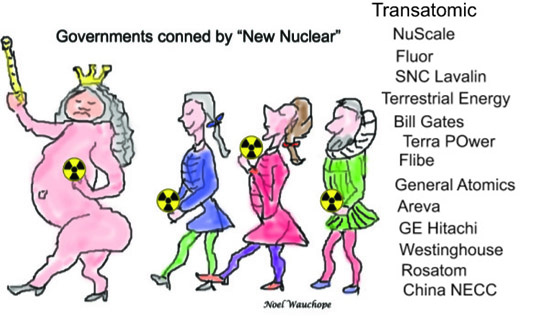 James Hansen’s Generation IV nuclear fallacies and fantasies, REneweconomy, Jim Green, 28 Aug 2017, http://reneweconomy.com.au/james-hansens-generation-iv-nuclear-fallacies-fantasies-70309/
The two young co-founders of nuclear engineering start-up Transatomic Power were embarrassed earlier this year when their claims about their molten salt reactor design were debunked, forcing some major retractions.
The claims of MIT nuclear engineering graduates Leslie Dewan and Mark Massie were trumpeted in MIT’s Technology Review under the headline, ‘What if we could build a nuclear reactor that costs half as much, consumes nuclear waste, and will never melt down?’
MIT physics professor Kord Smith debunked a number of Transatomic’s key claims. Smith says he asked Transatomic to run a test which, he says, confirmed that “their claims were completely untrue.”
Kennedy Maize wrote about Transatomic’s troubles in Power Magazine: “[T]his was another case of technology hubris, an all-to-common malady in energy, where hyperbolic claims are frequent and technology journalists all too credulous.” Pro-nuclear commentator Dan Yurman said that “other start-ups with audacious claims are likely to receive similar levels of scrutiny” and that it “may have the effect of putting other nuclear energy entrepreneurs on notice that they too may get the same enhanced levels of analysis of their claims.”
Well, yes, others making false claims about Generation IV reactor concepts might receive similar levels of scrutiny … or they might not. Arguably the greatest sin of the Transatomic founders was not that they inadvertently made false claims, but that they are young, and in Dewan’s case, female. Ageing men seem to have a free pass to peddle as much misinformation as they like without the public shaming that the Transatomic founders have been subjected to. A case in point is climate scientist James Hansen ‒ you’d struggle to find any critical commentary of his nuclear misinformation outside the environmental and anti-nuclear literature.
Hansen states that 115 new reactor start-ups would be required each year to 2050 to replace fossil fuel electricity generation ‒ a total of about 4,000 reactors. Let’s assume that Generation IV reactors do the heavy lifting, and let’s generously assume that mass production of Generation IV reactors begins in 2030. That would necessitate about 200 reactor start-ups per year from 2030 to 2050 ‒ or four every week. Good luck with that.
Moreover, the assumption that mass production of Generation IV reactors might begin in or around 2030 is unrealistic. A report by a French government authority, the Institute for Radiological Protection and Nuclear Safety, states: “There is still much R&D to be done to develop the Generation IV nuclear reactors, as well as for the fuel cycle and the associated waste management which depends on the system chosen.”
Likewise, a US Government Accountability Office report on the status of small modular reactors (SMRs) and other ‘advanced’ reactor concepts in the US concluded: “Both light water SMRs and advanced reactors face additional challenges related to the time, cost, and uncertainty associated with developing, certifying or licensing, and deploying new reactor technology, with advanced reactor designs generally facing greater challenges than light water SMR designs. It is a multi-decade process …”
An analysis recently published in the peer-reviewed literature found that the US government has wasted billions of dollars on Generation IV R&D with little to show for it. Lead researcher Dr Ahmed Abdulla, from the University of California, said that “despite repeated commitments to non-light water reactors, and substantial investments … (more than $2 billion of public money), no such design is remotely ready for deployment today.”…… http://reneweconomy.com.au/james-hansens-generation-iv-nuclear-fallacies-fantasies-70309/
1 This Month



26 September – International Day for the Total Elimination of Nuclear Weapons


PLEASE OPPOSE HR 8255 AND S.3639 – bills would accelerate satellite deployment, with no environmental review or safeguards – https://ncstd5li.quorum.us/campaign/169331/
To see nuclear-related stories in greater depth and intensity – go to https://nuclearinformation.wordpress.com
-
Archives
- September 2026 (219)
- August 2026 (330)
- July 2026 (355)
- June 2026 (287)
- May 2026 (306)
- April 2026 (356)
- March 2026 (251)
- February 2026 (267)
- January 2026 (308)
- December 2025 (358)
- November 2025 (359)
- October 2025 (375)
-
Categories
- 1
- 1 NUCLEAR ISSUES
- business and costs
- climate change
- culture and arts
- ENERGY
- environment
- health
- history
- indigenous issues
- Legal
- marketing of nuclear
- media
- opposition to nuclear
- PERSONAL STORIES
- politics
- politics international
- Religion and ethics
- safety
- secrets,lies and civil liberties
- spinbuster
- technology
- Uranium
- wastes
- weapons and war
- Women
- 2 WORLD
- ACTION
- AFRICA
- Atrocities
- AUSTRALIA
- Christina's notes
- Christina's themes
- culture and arts
- Events
- Fuk 2022
- Fuk 2023
- Fukushima 2017
- Fukushima 2018
- fukushima 2019
- Fukushima 2020
- Fukushima 2021
- general
- global warming
- Humour (God we need it)
- Nuclear
- RARE EARTHS
- Reference
- resources – print
- Resources -audiovicual
- Weekly Newsletter
- World
- World Nuclear
- YouTube
-
RSS
Entries RSS
Comments RSS
 nuclear-news