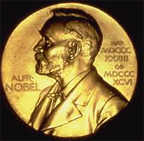
 https://au.news.yahoo.com/a/37375277/text-of-nobel-peace-prize-award-to-anti-nuclear-campaign-ican/ OSLO (Reuters) (Reporting By Alister Doyle), 6 Oct 17 – Following is the text of the Nobel Peace Prize award on Friday to the International Campaign to Abolish Nuclear Weapons:
The Norwegian Nobel Committee has decided to award the Nobel Peace Prize for 2017 to the International Campaign to Abolish Nuclear Weapons (ICAN).
The organization is receiving the award for its work to draw attention to the catastrophic humanitarian consequences of any use of nuclear weapons and for its ground-breaking efforts to achieve a treaty-based prohibition of such weapons.
We live in a world where the risk of nuclear weapons being used is greater than it has been for a long time. Some states are modernizing their nuclear arsenals, and there is a real danger that more countries will try to procure nuclear weapons, as exemplified by North Korea.
Nuclear weapons pose a constant threat to humanity and all life on earth. Through binding international agreements, the international community has previously adopted prohibitions against land mines, cluster munitions and biological and chemical weapons. Nuclear weapons are even more destructive, but have not yet been made the object of a similar international legal prohibition.
Through its work, ICAN has helped to fill this legal gap. An important argument in the rationale for prohibiting nuclear weapons is the unacceptable human suffering that a nuclear war will cause. ICAN is a coalition of non-governmental organizations from around 100 different countries around the globe.
The coalition has been a driving force in prevailing upon the world’s nations to pledge to cooperate with all relevant stakeholders in efforts to stigmatize, prohibit and eliminate nuclear weapons. To date, 108 states have made such a commitment, known as the Humanitarian Pledge.
Furthermore, ICAN has been the leading civil society actor in the endeavor to achieve a prohibition of nuclear weapons under international law. On 7 July 2017, 122 of the UN member states acceded to the Treaty on the Prohibition of Nuclear Weapons.
As soon as the treaty has been ratified by 50 states, the ban on nuclear weapons will enter into force and will be binding under international law for all the countries that are party to the treaty.
The Norwegian Nobel Committee is aware that an international legal prohibition will not in itself eliminate a single nuclear weapon, and that so far neither the states that already have nuclear weapons nor their closest allies support the nuclear weapon ban treaty.
The Committee wishes to emphasize that the next steps towards attaining a world free of nuclear weapons must involve the nuclear-armed states. This year’s Peace Prize is therefore also a call upon these states to initiate serious negotiations with a view to the gradual, balanced and carefully monitored elimination of the almost 15,000 nuclear weapons in the world.
Five of the states that currently have nuclear weapons – the USA, Russia, the United Kingdom, France and China – have already committed to this objective through their accession to the Treaty on the Non-Proliferation of Nuclear Weapons of 1970.
The Non-Proliferation Treaty will remain the primary international legal instrument for promoting nuclear disarmament and preventing the further spread of such weapons.
It is now 71 years since the UN General Assembly, in its very first resolution, advocated the importance of nuclear disarmament and a nuclear weapon-free world. With this year’s award, the Norwegian Nobel Committee wishes to pay tribute to ICAN for giving new momentum to the efforts to achieve this goal.
The decision to award the Nobel Peace Prize for 2017 to the International Campaign to Abolish Nuclear Weapons has a solid grounding in Alfred Nobel’s will.
The will specifies three different criteria for awarding the Peace Prize: the promotion of fraternity between nations, the advancement of disarmament and arms control and the holding and promotion of peace congresses. ICAN works vigorously to achieve nuclear disarmament.
ICAN and a majority of UN member states have contributed to fraternity between nations by supporting the Humanitarian Pledge. And through its inspiring and innovative support for the UN negotiations on a treaty banning nuclear weapons, ICAN has played a major part in bringing about what in our day and age is equivalent to an international peace congress.
It is the firm conviction of the Norwegian Nobel Committee that ICAN, more than anyone else, has in the past year given the efforts to achieve a world without nuclear weapons a new direction and new vigor.
October 7, 2017
Posted by Christina Macpherson |
2 WORLD, Reference, weapons and war |
Leave a comment
 The ITER Power Amplification Myth – By Steven B. Krivit –New Energy Times, 6 Oct 17
Short link: http://tinyurl.com/y9lvf79j
This is the third of three reports about the claims by representatives and proponents of the International Thermonuclear Experimental Reactor (ITER). “The Selling of ITER” published on Jan. 12, 2017. “Former ITER Spokesman Confirms Accuracy of New Energy Times Story” published on Jan. 19, 2017.
Abstract (Abstract is Copyleft, duplication permitted but only with attribution and link to original )
The International Thermonuclear Experimental Reactor (ITER) is the largest and most expensive science experiment on Earth today. Public outreach for the experimental fusion reactor, under the direction of Laban Coblentz, the head of the ITER communications office, has led journalists and the public to believe that, when completed, the reactor will produce 10 times more power than goes into it.
It will do no such thing. The $22 billion reactor is designed to produce only 1.6 times more thermal power than it consumes in electric power. Using a more conservative calculation, the reactor will lose more power than it produces. The planned output power of the reactor has been reported correctly, but the input power for the reactor has been widely reported, incorrectly, as 50 megawatts. The actual input power value, rarely discussed publicly, will be significantly larger.

For decades, some proponents of thermonuclear fusion research have used a double meaning for the phrase “fusion power” yet failed to inform the public, the news media, or legislators about the existence of this dual meaning. This ambiguity has caused non-experts to think that power production rates from large-scale thermonuclear fusion experiments show greater technological progress than has actually occurred. As a result, people who are not fusion experts think that ITER will achieve a power production rate, or power amplification, six times larger than its design specification. ITER will produce power at a rate of only two-thirds of the rate it will consume power, when comparing electric power input to equivalent electric power output.
Some fusion proponents have used the secondary meaning of “fusion power” to convince non-experts that the record-setting 1997 fusion experiment in the Joint European Torus (JET) reactor in the U.K. had produced thermal power at a rate of 65 percent of the electric power consumed by the reactor and, therefore, that the reactor had come close to producing power at a rate equal to the rate of power consumed. In fact, in that experiment, the reactor produced power in heat at a rate of less than 2 percent of the power in electricity it consumed. Coblentz and the ITER communications group have used the same double meaning to promote the publicly funded $22 billion ITER reactor, under construction now in southern France.
Fusion research insiders know that the current primary goal of ITER is not to demonstrate power amplification of the reactor. Instead, they know, the main goal is the power amplification of the fusion plasma, a significantly different measurement. Fusion experts say that non-experts understand the distinction, but nearly all evidence, as shown for example in news coverage by The New York Times, Scientific American, Bloomberg, Forbes and BBC News, is to the contrary. The double meaning of the phrase “fusion power” went unnoticed for years and has misled experienced journalists, scientists, members of the public and elected officials…….http://news.newenergytimes.net/
October 7, 2017
Posted by Christina Macpherson |
EUROPE, Reference, spinbuster, technology |
Leave a comment
In the face of multiple environmental hazards and issues radon often gets overlooked, partially because radon is what one can call a silent killer
Educating the public about radon and their ill effects and ways of preventing it is a must as there is not much awareness about this in the public –despite many northern states in the USA having high concentrations. Part of this education effort involves indoor testing.

Public funding and radon poisoning, what’s the link? https://mahb.stanford.edu/blog/radon-public-funding/ Morgan, Jessica | October 5, 2017 It has only been a short while since the news of drastic budget trimming on various EPA projects by President Donald Trump’s government came out; however, it is already obvious that it will have a long-term effect on the environment.
The proposed 25-30% cut in EPA’s budgets can severely affect several climate programs that were nurtured under President Obama’s rule, and many other initiatives and projects that support clean air and water. These initiatives were introduced for the well-being of the public to a large extent in the future. This move can also shut the doors for the Indoor Air Radon Program and State Indoor Radon Grants.
The main goal of the Indoor Air Radon Program is minimizing and preventing radon-related lung cancer nationally. The EPA provides grant funds to States and tribes. These funds help finance their radon risk reduction programs. The recipients of the funds must provide a minimum of 40% in matching funds. The SIRG or States Indoor Radon Grant funds are however not available to individuals or homeowners.
The SIRG program was started in 1988 and has been consistent in supporting the State efforts to reduce Radon exposure-related health risks. The SIRG program from time to time has been revising the SIRG guidance by removing the obsolete administrative and technical guidance and updating with latest modifications that address a renewed emphasis on program priorities, documenting results, and results reporting.
Those who receive funds from SIRG are expected to follow the agency’s strategic goals and all their projects and activities must be aligned accordingly. The strategic goals include,
- Local government to adopt building codes that require radon-reducing features and initiate those building new homes to add these radon-reducing features where appropriate.
- Have real estate dealers test the property for radon exposure before striking a deal. Also, have homeowners test their homes for radon exposure and have it fixed.
- Have existing school buildings check for radon exposure and get it fixed appropriately. Building new schools with radon-reducing features.
- Conducting projects and activities that bring awareness to the public about the above three strategies which include promoting action by consumers, real estate professionals, state and local building code officials, schools officials, non-profit public health organizations, professional organizations partnerships.
Cutting down the EPA budget can directly affect the SIRG program as it is essential to continue the State radon programs. With the budget cut down, SIRG cannot run an effective program.
In the face of multiple environmental hazards and issues radon often gets overlooked, partially because radon is what one can call a silent killer. It is a gas which is odorless, tasteless, and colorless. When radium or uranium present in the soil, rock, or water breaks down or decays, it releases radon. Radon itself does not cause any harmful effects as it travels to the surface of the ground and dilutes in the air outdoors. The problem is when the gas accumulates indoor in a building it might not have room for an escape of dilution and further decays –radon can enter a house through cracks in foundations, floors, well water, etc. The decayed radon creates radon progeny, which are radioactive particles that attach to dust particles indoors. When a person inhales this radioactive gas, it can damage the cells in the lung tissue and leads to lung cancer.
Usually there will be two copies of DNA repair enzymes in many people that can repair the damage; however, a few less fortunate people may have just one copy of these DNA repair enzymes which might not be sufficient enough to repair the damages and can lead to lung cancer. This is the reason why even though an entire family is living in a radon-exposed environment, only one or two might be affected by it.
Radon is measured in picocuries per liter of air, and the recommended level is 4 pCi/L. In comparison, the outdoor level of radon is just 0.4 pCi/L. If a house or a building has radon above the recommended levels then proper actions need to be taken. Modern technology is able to bring down the radon level indoors to 2 pCi/L or lower.
Educating the public about radon and their ill effects and ways of preventing it is a must as there is not much awareness about this in the public –despite many northern states in the USA having high concentrations. Part of this education effort involves indoor testing. There are short term tests that last for 90 days as well as long-term tests that last for more than 90 days to confirm the levels. There are also test kits available. If it is confirmed that your home is exposed to radon, mitigation steps can be taken by professional contractors who have expertise in this field. The contractor will gauge your house and recommend the exact mitigation system that your house will need. There are different methods like soil suction which involves sub-slab suction, sump holds suction, drain tile suction, and block wall suction. Other methods are heat recovery ventilators, home pressurization, well water aeration, sealing radon entry locations, etc.
Reductions in federal funding for the Indoor Air Radon Program and States Indoor Radon Grant hamstrings many of the radon risk reduction and education programs, raising the likelihood that low-income households will not be able to afford testing and mitigation. Whether your government supports you or not, you can learn more about the harmful risks of radon and the steps you can take to make your house safer for you and your family. To learn more about radon, go through this infographic from PropertEco which explains about radon gas and its ill effects.
The MAHB Blog is a venture of the Millennium Alliance for Humanity and the Biosphere. Questions should be directed to joan@mahbonline.org
MAHB Blog: https://mahb.stanford.edu/blog/radon-public-funding/
October 7, 2017
Posted by Christina Macpherson |
politics, radiation, Reference |
Leave a comment
The ITER Power Amplification Myth Oct. 6, 2017 – By Steven B. Krivit –
Short link: http://tinyurl.com/y9lvf79j
This is the third of three reports about the claims by representatives and proponents of the International Thermonuclear Experimental Reactor (ITER). “The Selling of ITER” published on Jan. 12, 2017. “Former ITER Spokesman Confirms Accuracy of New Energy Times Story” published on Jan. 19, 2017.
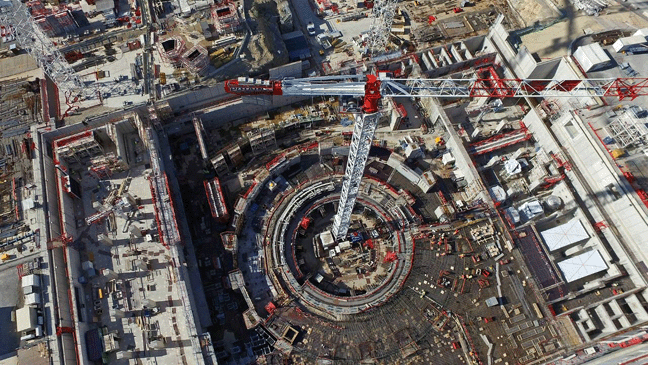
From Fusion Fraud to Physics Fortune
“………..The ITER project, supported by a widespread misunderstanding of its promised results, funded by billions in cash, resources and materials, will not deliver a practical demonstration of fusion power, but merely a scientific demonstration of a sustained fusion reaction. Yet on July 3, 2017, the Chinese Experimental Advanced Superconducting Tokamak reactor already did this, for 101 seconds. When built, ITER will merely do it for four times longer.
Oddly, the quest for practical nuclear fusion on Earth was born out of fraud. The ITER Web site recognizes this, with a page titled “Proyecto Huemul: From Fusion Fraud to Physics Fortune.”
The story began in 1948 in Argentina when Austrian scientist Ronald Richter proposed his idea for a fusion device to President Juan Perón. Perón agreed to fund the concept, and on March 24, 1951, Perón held a press conference at which he announced that his country had achieved practical, controlled nuclear fusion. By 1952, however, after independent investigators reported no evidence to support the claims, the project was shut down. The ITER page calls it “the scientific fraud of the century.”
Yet in 1951, before the Argentinian project was shut down, the project caught the attention of Lyman Spitzer, an astrophysicist at Princeton University. Spitzer, in turn, approached the U.S. Atomic Energy Commission and convinced it to fund his own fusion research concept. Thus, the U.S. controlled nuclear fusion era began at the Princeton Plasma Physics Laboratory, and the worldwide race for fusion energy began.
Since construction on ITER began in 2007, nuclear fusion news stories have been tagged with titillating headlines about unlimited energy. A CNN story headline is typical: “Is Nuclear Fusion About to Change Our World?” Every incremental step forward in temperature, pressure, or plasma confinement time has been a “breakthrough.” Each breakthrough, according to the news stories, has brought the dream of harnessing the power of the sun on Earth one step closer to reality. Rarely have the stories featured any critical assessment or analysis.
One journalist wrote that physicists at the Department of Energy’s Princeton Plasma Physics Laboratory had “demonstrated” how a new fusion reactor design could lead to the first commercially viable nuclear fusion power plant. The demonstration was merely on paper. The article featured a photo of a reactor. But it wasn’t the reactor described in the article. That reactor hadn’t been built yet.
As the comics below show, the very same Princeton Plasma Physics Laboratory — back in 1975 when the DOE was called the Atomic Energy Commission — told journalists it was a big step closer to virtually limitless pollution-free energy thanks to “breakthroughs” in plasma density and temperature.
Then there’s MIT scientist Earl Marmar, who told journalists this year that the technology exists to have fusion energy in 13 years if only it is funded aggressively enough.
Vision and hope are wonderful and necessary components of the human experience. But false hope and worthless promises — laced with misleading claims — do not represent the science accurately. They do not represent the integrity of all scientists involved in the research.
The false idea that the JET reactor produced 65% of the power it consumed has been deeply planted in the minds of the public and journalists. The same goes for the false idea that the ITER reactor will produce 10 times the power it consumes. These two myths serve to misrepresent the status of fusion energy research and, specifically, the ITER project……http://news.newenergytimes.net/2017/10/06/the-iter-power-amplification-myth/#more-44064
October 7, 2017
Posted by Christina Macpherson |
Reference, spinbuster, technology |
Leave a comment
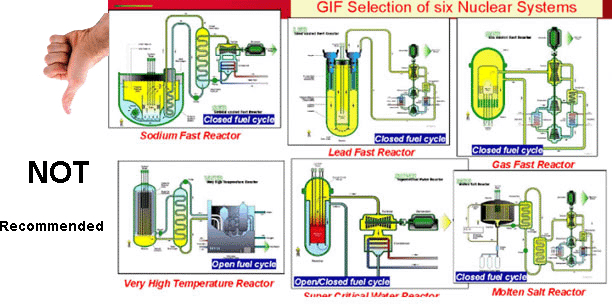
The risks……..in fact, thorium has been used to produce fissile material (uranium-233) for nuclear weapons tests.
Waste…. “Even integral fast reactors (IFRs), which recycle most of their waste, leave behind materials that have been contaminated by transuranic elements and so cannot avoid the need to develop deep geologic disposal.”
Generation IV economics…..The US Government Accountability Office’s 2015 report noted that technical challenges facing SMRs and advanced reactors may result in higher-cost reactors than anticipated, making them less competitive with large light-water reactors or power plants using other fuels.
James Hansen’s Generation IV nuclear advocacy: a deconstruction of nuclear fallacies and fantasies http://www.theecologist.org/News/news_analysis/2989318/james_hansens_generation_iv_nuclear_advocacy_a_deconstruction_of_nuclear_fallacies_and_fantasies.html, Dr Jim Green, 3rd October, 2017
Climate scientist James Hansen’s claims about Generation IV nuclear concepts simply don’t stack up, argues JIM GREEN Dr James Hansen is rightly admired for his scientific and political work drawing attention to climate change. His advocacy of nuclear power ‒ and in particular novel Generation IV nuclear concepts ‒ deserves serious scrutiny.
In a nutshell, Dr Hansen (among others) claims that some Generation IV reactors are a triple threat: they can convert weapons-usable (fissile) material and long-lived nuclear waste into low-carbon electricity. Let’s take the weapons and waste issues in turn. Continue reading →
October 4, 2017
Posted by Christina Macpherson |
2 WORLD, Reference, spinbuster, technology |
Leave a comment
magictr | October 3, 2017
On 29 September 1957 at 16 o’clock on the territory of the chemical plant “Mayak”, which was in the closed city of Chelyabinsk-40 (now Ozersk), was the first in the USSR radiation accident — an explosion of capacity to store radioactive waste. The catastrophe was called the Kyshtym accident — the name closest to Chelyabinsk-40 by city.
The blast occurred in containers, of a capacity of 300 m? because of the failure of the cooling system. In the tank contained a total of about 80 m? highly radioactive nuclear waste. At the time of construction in 1950-ies the strength of the structure is not in doubt. She was in the pit, in a concrete shirt thickness meter.
Cover the container weighed 560 tons, over it was laid a two-meter layer of earth. However, even this failed to contain the explosion.
According to another, unofficial version, the accident occurred due to human error of the plant that in the tank-evaporator with hot plutonium nitrate solution by mistake added a solution of plutonium oxalate. The oxidation of oxalate nitrate allocating a large amount of energy, leading to overheating and explosion of the tank.
During the explosion in the atmosphere were about 20 million curies of radioactive substances, some of which rose to a height of up to two miles, and formed an aerosol cloud.
Over the next 11-12 hours of radioactive fallout on the territory with a length of 300-350 km on northeast from the explosion.
In the area of radioactive contamination got 23 thousand km2 with a population of 270 thousand people in 217 settlements of the Chelyabinsk, Sverdlovsk and Tyumen regions. During the liquidation of consequences of the accident were required to relocate 23 villages with a population of 10-12 thousand a man, all the buildings, property and livestock were destroyed.
Liquidators were hundreds of thousands of soldiers and civilians
Only in the first ten days the number of deaths from radiation have gone on hundreds, during the works in varying degrees, suffered 250 thousand liquidators.
According to the international scale of nuclear testing accident was estimated at six points. For comparison, the seventh level, the maximum was rated accidents at Chernobyl and Fukushima-1.
To avoid scattering of radiation by government decision was established the sanitary-protective zone in which economic activity was banned. In 1968 this territory was formed of the Eastern Ural state reserve.
It is forbidden to visit — the level of radioactivity is still too dangerous for humans.
October 6, 1957 in the newspaper “Chelyabinsk worker” appeared devoted to his note, in which, however, about the accident not a word was said:
On Sunday night… many residents of Chelyabinsk watched the special glow of a starry sky. It’s pretty rare in our latitudes, the glow had all the signs of the Aurora. Intense red, time moves to slightly pink and light blue glow first covered a large part of the South-Western and North-Eastern surface of the firmament. About 11 o’clock it was possible to observe in the North-Western direction… In the sky appeared a relatively large colored area and the quiet lanes that had at the last stage of lights North-South direction. The study of the nature of the Aurora, has begun Lomonosov continues in our days. Modern science has confirmed the basic idea of the University, that the Aurora occurs in the upper layers of the atmosphere by electrical discharges of the Aurora…… can be observed in the future at the latitudes of the southern Urals”.
Kyshtym accident has long been a state secret. For the first time openly about her was said in a shot at the turn of the 1980s and 1990s, the film Director and biologist Elena Sakanyan, dedicated to the fate of Soviet genetics and biologist Nikolai Timofeev-Ressovsky.
The films were shown on television only after Sakanyan directly asked about the show to Boris Yeltsin.
But in the foreign press leaked the information in April 1958. For the first time about the accident said one of the Copenhagen Newspapers. Subsequently, information about the accident appeared in the report of the National laboratory, USA, biologist Zhores Medvedev dedicated incident book entitled “Nuclear disaster in the Urals”, published in the US, an analysis of the causes of the accident and its causes held by a group of American scientists from the atomic center at oak ridge.
“About the explosion at the “Mayak” for long periods of time, the public knew almost nothing. Later, for some reason, the accident was replicated in the media as the “Kyshtym accident”.
In Kyshtym on this occasion, even recently, was the obelisk, although the city to this event is irrelevant.
And the East-Ural radioactive trail, formed after 1957, did not affect Cistema and its residents,” — said in an interview in 2009, one of its liquidators.
Only the “Lighthouse” there were more than 30 incidents of radioactive emissions and human victims.
October 4, 2017
Posted by Christina Macpherson |
history, Reference, Russia |
Leave a comment
 Cold War radiation testing in U.S. widespread, author claims https://www.japantimes.co.jp/news/2017/10/02/world/cold-war-radiation-testing-u-s-widespread-author-claims/#.WdRk7I-CzGgST. LOUIS – Three members of Congress are demanding answers after a St. Louis scholar’s new book revealed details of how the U.S. government sprayed, injected and fed radiation and other dangerous materials to countless people in secret Cold War-era testing.
The health ramifications of the tests are unknown. Lisa Martino-Taylor, an associate professor of sociology at St. Louis Community College who wrote “Behind the Fog: How the U.S. Cold War Radiological Weapons Program Exposed Innocent Americans,” acknowledged that tracing diseases like cancer to specific causes is difficult.
But three congressmen who represent areas where testing occurred — Democrats William Lacy Clay of Missouri, Brad Sherman of California and Jim Cooper of Tennessee — said they were outraged by the revelations.
Martino-Taylor used Freedom of Information Act requests to obtain previously unreleased documents, including army records. She also reviewed already public records and published articles. In an interview, she said she found that a small group of researchers, aided by leading academic institutions, worked to develop radiological weapons and later “combination weapons” using radioactive materials along with chemical or biological weapons.
Her book, published in August, was a follow-up to her 2012 dissertation that found the government conducted secret testing of zinc cadmium sulfide in a poor area of St. Louis in the 1950s and 1960s. The book focuses on the mid-1940s to the mid-1960s.
An army spokeswoman declined comment, but Martino-Taylor’s 2012 report on testing in St. Louis was troubling enough to spur an army investigation. The investigation found no evidence that the St. Louis testing posed a health threat.
Martino-Taylor said the offensive radiological weapons program was a top priority for the government. Unknowing people at places across the U.S. as well as parts of England and Canada were subjected to potentially deadly material through open-air spraying, ingestion and injection, Martino-Taylor said.
“They targeted the most vulnerable in society in most cases,” Martino-Taylor said. “They targeted children. They targeted pregnant women in Nashville. People who were ill in hospitals. They targeted wards of the state. And they targeted minority populations.”
The tests in Nashville in the late 1940s involved giving 820 poor and pregnant white women a mixture during their first pre-natal visit that included radioactive iron, Martino-Taylor said. The women were chosen without their knowledge. Blood tests were performed to determine how much radioactive iron had been absorbed by the mother, and the babies’ blood was tested at birth. Similar tests were performed in Chicago and San Francisco, Martino-Taylor said.
Cooper’s office plans to seek more information from the Army Legislative Liaison, said spokesman Chris Carroll.
“We are asking for details on the Pentagon’s role, along with any cooperation by research institutions and other organizations,” Carroll said. “These revelations are shocking, disturbing and painful.”
In California, investigators created a radiation field inside a building at North Hollywood High School during a weekend in the fall of 1961, Martino-Taylor said. Similar testing was performed at the University of California, Los Angeles and at a Los Angeles Police Department building.
Sherman said he wants a survey of people who graduated from the school around the time of the testing to see if there was a higher incidence of illness, including cancer. He also said he will seek more information from the Department of Energy.
“What an incredibly stupid, reckless thing to do,” said Sherman, whose district includes North Hollywood High School.
Among those who recall the testing is Mary Helen Brindell, 73. She was playing baseball in a St. Louis street in the mid-1950s when a squadron of green planes flew so low overhead that she could see the face of the lead pilot. Suddenly, the children were covered in a fine powdery substance that stuck to skin moistened by summer sweat.
Brindell has suffered from breast, thyroid, skin and uterine cancers. Her sister died of a rare form of esophageal cancer.
“I just want an explanation from the government,” Brindell said. “Why would you do that to people?”
Clay said he was angered that Americans were used as “guinea pigs” for research.
“I join with my colleagues to demand the whole truth about this testing and I will reach out to my Missouri Delegation friends on the House Armed Services Committee for their help as well,” Clay said in a statement.
St. Louis leaders were told at the time that the government was testing a smoke screen that could shield the city from aerial observation in case of Soviet attack. Evidence now shows radioactive material, not just zinc cadmium sulfide, was part of that spraying, Martino-Taylor said.
Doris Spates, 62, was born in 1955 on the 11th floor of the Pruitt-Igoe low-income high-rise where the army sprayed material from the roof. Her father died suddenly three months after her birth. Four of her 11 siblings died from cancer at relatively young ages. She survived cervical cancer and suffers from skin and breathing problems.
“It makes me angry,” Spates said. “It is wrong to do something like that to people who don’t have any knowledge of it.”
According to Martino-Taylor, other testing in Chicago; Berkeley, California; Rochester, New York; and Oak Ridge, Tennessee, involved injecting people with plutonium-239.
She said her book shines a light on the team of mostly young scientists tasked with developing radiological weapons. They worked in a closed world with virtually no input from anyone “who could say, ‘This isn’t right,’ or put some sort of moral compass on it,” she said.
She hopes her book prompts more people to investigate.
“We haven’t gotten any answers so far,” Martino-Taylor said. “I think there’s a lot more to find out.”
October 4, 2017
Posted by Christina Macpherson |
civil liberties, Reference, USA |
1 Comment
Radiation in uranium mines People working in nuclear power plants face considerable health hazards. http://www.millenniumpost.in/opinion/radiation-in-uranium-mines-264457?utm_source=web-social-share&utm_partner=mpost&utm_campaign=share&utm_medium=facebook Arun Mitra | 2 Oct 2017, Nuclear energy is being projected as the panacea for the energy crisis in our country. It is true that we have acute shortage of electricity which is so essential for development. But there has been debate around the globe whether nuclear energy is the answer. There is evidence to prove that It is fraught with dangers right from digging of its ore – the uranium, to its transport to the nuclear power plants, hazards involved in its utilisation in nuclear facilities and lastly its waste management. There have been many accidents worldwide in the nuclear facilities which have been of extremely serious nature. The Three Mile island accident in 1979, the Chernobyl accident in 1986 and the Fukushima nuclear disaster in 2011. In India, too, several low-level accidents have occurred but they have gone unreported because there is no transparency in the nuclear energy industry and it is not covered under the RTI act.
A large number of workers are involved at every step of nuclear energy. Since nuclear energy is directly linked to radiations, it is important to examine if the workers or their families living in and around these facilities have any associated health problems. The Indian Doctors for Peace and Development (IDPD) had conducted a study on the health status of indigenous people around Jadugoda uranium mines situated in Jharkhand. The study was conducted under the leadership of Dr Shakeel Ur Rahman, who at present the General Secretary of IDPD.
All mining operations have related occupational health and safety hazards. Uranium mines present another hazard to workers and to members of the public. That is a radiation hazard. There are three types of exposure paths in the surrounding of uranium mine. Uranium mining and milling operations produce dust and gas (radon) having radioisotopes that are inhaled by miners and deliver internal radiation.
Through the ingestion of uranium series radioisotopes, transported in surface waters discharged from the mine delivering an internal radiation. The gamma-ray exposure by approaching tailing ponds or mine-tailings. The population living around the Jadugoda uranium mines was found to be suffering from following health effects:
Congenital Deformities: The investigation showed that babies from mothers, who lived near the uranium mining operation area, suffered a significant increase in congenital deformities. While 4.49 per cent mothers living in the study villages reported that children with congenital deformities were born to them, only 2.49 per cent mothers in reference villages fell under this category. The study when seen in this background reveals that people with disabilities in the study villages are significantly more than the all India average. Moreover, increased number of children in the study villages are dying due to congenital deformities. Out of mothers who have lost their children after birth, 9.25 per cent in the study villages reported congenital deformities as the cause of death of their children as compared to only 1.70 per cent mothers in the reference villages. The result shows that children born to mothers who lived near uranium mining operational area are more likely to die due to congenital deformities.
Primary Sterility: For the study purpose, the criteria of primary sterility were laid down to be a married couple not having conceived for at least three years after the marriage, and not using any method of contraception. The result shows that while 9.60 per cent of couples in study villages have not conceived even after three years of marriage, only 6.27 per cent of couples from reference villages fell under this category. The finding demonstrates that couples living near uranium mining operational area are approximately 1.58 times more vulnerable to primary sterility.
Cancer: On being asked the cause of last death in the household, 2.87 per cent households in the study villages attributed the cause of death to be cancer, whereas, 1.89 per cent households in reference village fell under this category. The study reveals that cancer as a cause of death among people living near uranium mining operational area is significantly high.
Life Expectancy: The study shows that increased numbers of people living near uranium mining operational area are dying before completing 62 years of age. The average life expectancy in the state of Jharkhand is 62 years. The study shows that 68.33 per cent the of deaths in the study villages were happening before attaining 62 years of age, whereas 53.94 per cent deaths were reported in reference villages under this category. The findings are discerning and the difference is significant. Other variables: The study tried to look at a few other health variables as well, like prevalence of spontaneous abortion among married women, stillbirths, and chronic lung diseases. The prevalence of all these health variables was definitely more in the study villages as compared to reference village, but the results were statistically not significant. (Dr. Arun Mitra is a leading ENT specialist based in Ludhiana. He is the Senior Vice-President of Indian Doctors for Peace and Development (IDPD) and is presently a member of the core committee of Alliance of Doctors for Ethical Health care in India. Views expressed are personal.)
October 4, 2017
Posted by Christina Macpherson |
health, India, Reference, Uranium |
Leave a comment

Trump Threatens Genocide, Crimes Against Humanity in North Korea, http://www.truth-out.org/news/item/42101-trump-threatens-genocide-crimes-against-humanity-in-north-korea, September 29, 2017, By Marjorie Cohn, Truthout | News Analysis Donald Trump threatened to “totally destroy North Korea” in his address to the United Nations General Assembly on September 19. That threat violates the UN Charter, and indicates an intent to commit genocide, crimes against humanity, the war crime of collective punishment and international humanitarian law. Moreover, a first-strike use of nuclear weapons would violate international law.
By threatening to attack North Korea, Trump is endangering the lives of countless people. In the past, he has indicated his willingness to use nuclear weapons and Kim Jong-un has threatened to retaliate. The rapidly escalating rhetoric and provocative maneuvers on both sides has taken us to the brink of war.
Trump’s threat prompted North Korean foreign minister Ri Yong-ho to state, “Given the fact that this [threat] came from someone who holds the seat of the US presidency, this is clearly a declaration of war.”
Ri added, “Since the United States declared war on our country, we will have every right to make counter-measures, including the right to shoot down United States strategic bombers even when they are not inside the airspace border of our country.”
Such a move by North Korea would violate international law. But that does not justify US law-breaking. Two wrongs do not make a right. Moreover, the use of military force by either country would prove disastrous.
The UN Charter Requires Peaceful Dispute Resolution
After two world wars claimed millions of lives, the UN Charter was adopted in 1945 “to save succeeding generations from the scourge of war.”
The Charter mandates the peaceful resolution of international disputes and forbids the use of force except in self-defense or with Security Council authorization.
Article 2 requires that UN members “settle their international disputes by peaceful means in such a manner that international peace and security, and justice, are not endangered.” Peaceful means are spelled out in Article 33: Parties to a dispute likely to endanger international peace and security must “first of all, seek a solution by negotiation, enquiry, mediation, conciliation, arbitration, judicial settlement, resort to regional agencies or arrangements, or other peaceful means of their own choice.”
In 1953, after one-third of North Korea’s population was decimated, the United States and North Korea signed an armistice agreement. But the US never allowed a peace treaty to be adopted. North Korea has repeatedly advocated the signing of a peace treaty to formally end the Korean War. To this day, 30,000 US troops continue to occupy South Korea.
The US has also refused to pursue the “freeze-for-freeze” strategy suggested by China and Russia. Under this plan, North Korea would freeze its nuclear and missile testing, and the US and South Korea would end their annual, provocative joint military exercises. Vassily Nebenzya, Russia’s ambassador to the UN, said this path would offer “a way out” of the current situation.
Instead, the US has engineered punitive sanctions against North Korea, which have only strengthened the latter’s resolve to develop usable nuclear weapons. Since 1953, North Koreans have lived in fear of annihilation by the United States.
In his speech to the General Assembly, on top of his threats toward North Korea, Trump also issued a veiled threat to pull out of the Iran nuclear deal. That sends a dangerous message to North Korea that the US cannot be trusted to abide by its agreements.
The UN Charter Prohibits Threats and Preemptive Use of Force
Article 2 of the Charter states that all members “shall refrain in their international relations from the threat or use of force against the territorial integrity or political independence of any state.” Trump’s threat to totally destroy North Korea violates that mandate. In addition, the preemptive use of force violates the Charter.
The only exceptions to the Charter’s prohibition of the use of force are self-defense or approval by the Security Council.
Self-defense, under Article 51 of the Charter, is a narrow exception to the Charter’s prohibition of the use of force. Countries may engage in individual or collective self-defense only in the face of an armed attack. In order to act in lawful self-defense, there must exist “a necessity of self-defense, instant, overwhelming, leaving no choice of means, and no moment for deliberation,” under the well-established Caroline Case.
North Korea has not attacked the United States or another UN member country, nor is such an attack imminent.
Moreover, the Security Council has not authorized any country to use military force against North Korea The council resolutions that establish sanctions against North Korea end by stating the Council “decides to remain seized of the matter.” That means that the Council, and only the Council, has the authority to approve military action.
Both Trump’s threat to use military force against North Korea and the mounting of a preemptive strike would violate the Charter.
The Crime of Genocide
By stating the intention to totally destroy North Korea, Trump has threatened genocide.
The crime of “genocide,” as defined in the Rome Statute for the International Criminal Court, is committed when, with the intent to destroy, in whole or in part, a national, ethnical, racial or religious group, any of the following acts are committed: killing members of the group, causing serious bodily or mental harm to members of the group, or deliberately inflicting on the group conditions of life calculated to bring about its destruction in whole or in part.
Trump’s threat to totally destroy North Korea, if carried out, would destroy, in whole, the national group of North Koreans. That would amount to genocide.
Crimes Against Humanity
Under the Rome Statute, “crimes against humanity” include: the commission of murder as part of a widespread or systematic attack against any civilian population; or persecution against a group or collectivity based on its political, racial, national, ethnic or religious character, as part of a widespread or systematic attack against any civilian population.
Trump’s threat to totally destroy North Korea, if realized, would constitute a widespread and systematic attack against the civilian population of North Korea, which would amount to a crime against humanity.
The War Crime of Collective Punishment
The crime of “collective punishment” is a grave breach of the Fourth Geneva Convention, which is considered a war crime. Collective punishment means punishing a civilian for an offense he or she has not personally committed.
If Trump were to make good on his threat to totally destroy North Korea, he would be punishing the civilian population for offenses committed by the North Korean government. This would constitute the war crime of collective punishment.
Destroying North Korea Would Violate Distinction and Proportionality
The United States has a legal obligation to comply with the requirements of proportionality and distinction, two bedrock principles of international humanitarian law, as delineated in the First Protocol Additional to the Geneva Conventions.
“Proportionality” means an attack cannot be excessive in relation to the anticipated military advantage sought. “Distinction” requires that the attack be directed only at a legitimate military target.
The total destruction of North Korea would violate the principles of proportionality and distinction.
First-Strike Use of Nuclear Weapons Violates International Law
In its 1996 advisory opinion, “Legality of the Threat or Use of Nuclear Weapons,” the International Court of Justice (ICJ) determined that “the threat or use of nuclear weapons would generally be contrary to the rules of international law applicable in armed conflict, and in particular the principles and rules of humanitarian law.”
The ICJ went on to say, “However … the Court cannot conclude definitively whether the threat or use of nuclear weapons would be lawful or unlawful in an extreme circumstance of self-defence, in which the very survival of a State would be at stake.” That means that while the use of nuclear weapons might be lawful when used in self-defense if the survival of the nation were at stake, a first-strike use would not be.
Donald Trump’s apocalyptic threat against North Korea violates international law. It also imperils the lives of untold numbers of people. We must urge Congress to prevent Trump from launching a catastrophic war.
Copyright, Truthout. May not be reprinted without permission.
September 30, 2017
Posted by Christina Macpherson |
2 WORLD, politics international, Reference, weapons and war |
Leave a comment
 The effects of a single terrorist nuclear bomb, Bulletin of the Atomic Scientists
 Matthew Bunn Nickolas Roth28 SEPTEMBER 2017, The escalating threats between North Korea and the United States make it easy to forget the “nuclear nightmare,” as former
US Secretary of Defense William J. Perry put it, that could result even from the use of just a single terrorist nuclear bomb in the heart of a major city.
At the risk of repeating the vast literature on the tragedies of Hiroshima and Nagasaki—and the substantial literature surrounding nuclear tests and simulations since then—we attempt to spell out here the likely consequences of the explosion of a single terrorist nuclear bomb on a major city, and its subsequent ripple effects on the rest of the planet. Depending on where and when it was detonated, the blast, fire, initial radiation, and long-term radioactive fallout from such a bomb could leave the heart of a major city a smoldering radioactive ruin, killing tens or hundreds of thousands of people and wounding hundreds of thousands more. Vast areas would have to be evacuated and might be uninhabitable for years. Economic, political, and social aftershocks would ripple throughout the world. A single terrorist nuclear bomb would change history. The country attacked—and the world—would never be the same.
The idea of terrorists accomplishing such a thing is, unfortunately, not out of the question; it is far easier to make a crude, unsafe, unreliable nuclear explosive that might fit in the back of a truck than it is to make a safe, reliable weapon of known yield that can be delivered by missile or combat aircraft. Numerous government studies have concluded that it is plausible that a sophisticated terrorist group could make a crude bomb if they got the needed nuclear material. And in the last quarter century, there have been some 20 seizures of stolen, weapons-usable nuclear material, and at least two terrorist groups have made significant efforts to acquire nuclear bombs.
Terrorist use of an actual nuclear bomb is a low-probability event—but the immensity of the consequences means that even a small chance is enough to justify an intensive effort to reduce the risk. Fortunately, since the early 1990s, countries around the world have significantly reduced the danger—but it remains very real, and there is more to do to ensure this nightmare never becomes reality.
Brighter than a thousand suns. Imagine a crude terrorist nuclear bomb—containing a chunk of highly enriched uranium just under the size of a regulation bowling ball, or a much smaller chunk of plutonium—suddenly detonating inside a delivery van parked in the heart of a major city……….
The silent killer. The bomb’s immediate effects would be followed by a slow, lingering killer: radioactive fallout. A bomb detonated at ground level would dig a huge crater, hurling tons of earth and debris thousands of feet into the sky. Sucked into the rising fireball, these particles would mix with the radioactive remainders of the bomb, and over the next few hours or days, the debris would rain down for miles downwind. Depending on weather and wind patterns, the fallout could actually be deadlier and make a far larger area unusable than the blast itself. Acute radiation sickness from the initial radiation pulse and the fallout would likely affect tens of thousands of people. Depending on the dose, they might suffer from vomiting, watery diarrhea, fever, sores, loss of hair, and bone marrow depletion. Some would survive; some would die within days; some would take months to die. Cancer rates among the survivors would rise. Women would be more vulnerable than men—children and infants especially so.
Much of the radiation from a nuclear blast is short-lived; radiation levels even a few days after the blast would be far below those in the first hours. For those not killed or terribly wounded by the initial explosion, the best advice would be to take shelter in a basement for at least several days. But many would be too terrified to stay. Thousands of panic-stricken people might receive deadly doses of radiation as they fled from their homes. Some of the radiation will be longer-lived; areas most severely affected would have to be abandoned for many years after the attack. The combination of radioactive fallout and the devastation of nearly all life-sustaining infrastructure over a vast area would mean that hundreds of thousands of people would have to evacuate.
Ambulances to nowhere. The explosion would also destroy much of the city’s ability to respond. Hospitals would be leveled, doctors and nurses killed and wounded, ambulances destroyed. (In Hiroshima, 42 of 45 hospitals were destroyed or severely damaged, and 270 of 300 doctors were killed.) Resources that survived outside the zone of destruction would be utterly overwhelmed. Hospitals have no ability to cope with tens or hundreds of thousands of terribly burned and injured people all at once; the United States, for example, has 1,760 burn beds in hospitals nationwide, of which a third are available on any given day.
And the problem would not be limited to hospitals; firefighters, for example, would have little ability to cope with thousands of fires raging out of control at once. Fire stations and equipment would be destroyed in the affected area, and firemen killed, along with police and other emergency responders. Some of the first responders may become casualties themselves, from radioactive fallout, fire, and collapsing buildings. Over much of the affected area, communications would be destroyed, by both the physical effects and the electromagnetic pulse from the explosion.
Better preparation for such a disaster could save thousands of lives—but ultimately, there is no way any city can genuinely be prepared for a catastrophe on such a historic scale, occurring in a flash, with zero warning. Rescue and recovery attempts would be impeded by the destruction of most of the needed personnel and equipment, and by fire, debris, radiation, fear, lack of communications, and the immense scale of the disaster. The US military and the national guard could provide critically important capabilities—but federal plans assume that “no significant federal response” would be available for 24-to-72 hours. Many of those burned and injured would wait in vain for help, food, or water, perhaps for days.
The scale of death and suffering. How many would die in such an event, and how many would be terribly wounded, would depend on where and when the bomb was detonated, what the weather conditions were at the time, how successful the response was in helping the wounded survivors, and more. Many estimates of casualties are based on census data, which reflect where people sleep at night; if the attack occurred in the middle of a workday, the numbers of people crowded into the office towers at the heart of many modern cities would be far higher. The daytime population of Manhattan, for example, is roughly twice its nighttime population; in Midtown on a typical workday, there are an estimated 980,000 people per square mile. A 10-kiloton weapon detonated there might well kill half a million people—not counting those who might die of radiation sickness from the fallout. (These effects were analyzed in great detail in the Rand Corporation’s Considering the Effects of a Catastrophic Terrorist Attack and the British Medical Journal’s “Nuclear terrorism.”)………http://thebulletin.org/effects-single-terrorist-nuclear-bomb11150
September 30, 2017
Posted by Christina Macpherson |
2 WORLD, Reference, safety |
Leave a comment
The analysis revealed a spike in strontium-90 levels in children born between 1954 and 1955. This coincided with a period of extensive nuclear testing that started in 1953. Among these children, strontium-90 levels were also found to be higher in those who were bottle-fed compared to those who were breastfed.
This observation further emphasized that the children were absorbing the radioactive element from the environment — picture acres of dairy farms showered with rain that has just passed through kilometers of atmosphere containing radioactive dust.

Experiments explained: Baby Tooth Survey In June 1963, shortly after publishing the first phase of the study, Dr. Eric Reiss, one of the main participating scientists, presented the findings in testimony before the American Senate committee. Two months later, the Partial Test Ban Treaty (PTBT) between the United States, the Soviet Union, and Britain was signed. This agreement prevented countries from performing test detonations of nuclear weapons, except for those conducted underground.
During a second phase of the study, a 50 per cent decline in strontium-90 was seen in children born in 1968, thanks in part to the PTBT that Franklin and her team helped bring about.
Ursula Franklin’s contributions to reforming the regulation of nuclear weapons, Varsity, https://thevarsity.ca/2017/09/25/experiments-explained-baby-tooth-survey/ By Farah Badr,
ZAHRA DANAEI/THE VARSITY, Humanity has been fundamentally transformed by the discovery of nuclear radiation and radioactive chemical elements. Marie and Pierre Curie discovered radium in the late 1890s, following Henri Becquerel’s discovery of radioactivity. Since then, World War I has led to the advent of the first X-ray machine, which treated injured soldiers, and World War II has brought upon the development of weapons of mass destruction.
Not long after, scientists began collecting radioactive baby teeth on American land: the unexpected aftermath of harnessing the unprecedented power of nuclear radiation.
One of those scientists was Ursula Franklin, the first female to receive the University Professor distinction at U of T in 1984. Franklin was an academic, an educator, a prolific writer, a highly vocal and active pacifist and feminist, but also held the lesser known titles of metallurgist, archaeometrist, practicing Quaker, and Holocaust survivor.
It is perhaps the result of her impactful social activism and visionary writings on war, globalism, social justice, and technology that some attention has been drawn away from Franklin’s scientific achievements.
One such accomplishment was a high-profile study that started in 1958. In collaboration with a number of scientists, Franklin investigated the impact of ground nuclear weapon testing, which had begun in the early 1940s in prelude to the attack on Japan at the end of World War II. Radioactive elements, one of which was strontium-90, had been released for the first time into the environment due to this nuclear weapon testing. Strontium-90 chemically resembles the important nutritional element calcium, leading to its incorporation along with calcium into the bones and teeth of developing unborn babies, which continues even after their birth.
Over the course of the 12-year study, the team collected more than 300,000 shed baby teeth, mostly from children in St. Louis, Missouri. The researchers incinerated and pulverized the teeth before extracting and analyzing its composite minerals.
The analysis revealed a spike in strontium-90 levels in children born between 1954 and 1955. This coincided with a period of extensive nuclear testing that started in 1953. Among these children, strontium-90 levels were also found to be higher in those who were bottle-fed compared to those who were breastfed.
This observation further emphasized that the children were absorbing the radioactive element from the environment — picture acres of dairy farms showered with rain that has just passed through kilometers of atmosphere containing radioactive dust.
In June 1963, shortly after publishing the first phase of the study, Dr. Eric Reiss, one of the main participating scientists, presented the findings in testimony before the American Senate committee. Two months later, the Partial Test Ban Treaty (PTBT) between the United States, the Soviet Union, and Britain was signed. This agreement prevented countries from performing test detonations of nuclear weapons, except for those conducted underground.
During a second phase of the study, a 50 per cent decline in strontium-90 was seen in children born in 1968, thanks in part to the PTBT that Franklin and her team helped bring about.
September 30, 2017
Posted by Christina Macpherson |
children, history, radiation, Reference, weapons and war |
Leave a comment
‘It kills slowly, painfully’: Nagasaki atomic explosion survivor has a message for US, North Korea http://www.hindustantimes.com/world-news/it-kills-slowly-painfully-nagasaki-atomic-explosion-survivor-has-a-message-for-us-north-korea/story-BB2nANm1xGmNZ4x73Gx32K.html
Nobu Hanaoka was only 8-months-old when the US dropped Fat Man — a Plutonium bomb — on the Japanese city of Nagasaki on August 9, 1945. Sep 25, 2017 HT Correspondent Hindustan Times, New Delhi
September 30, 2017
Posted by Christina Macpherson |
history, PERSONAL STORIES, Reference |
Leave a comment
Radioactive Iodine Increases Risk of Thyroid Cancer Patient Developing Acute Myeloid Leukemia, Study Reports https://lymphomanewstoday.com/2017/09/25/study-shows-leukemia-risk-rises-when-thyroid-cancer-patients-treated-with-radioactive-iodine/ BY JANET STEWART
Using radioactive iodine as a follow-up treatment to thyroid cancer surgery increases the risk of a patient developing acute myeloid leukemia and having a poorer outcome, a study reports.
Researchers presented the findings at the Congress of the European Society for Medical Oncology in Madrid, Sept. 8-12. The presentation was titled “Risk of developing acute myeloid leukemia (AML) in well-differentiated thyroid cancer (WDTC) patients treated with radioactive iodine (RAI): a population-based study.”
Studies have shown that the risk of a patient with another cancer developing acute myeloid leukemia, or AML, increases after radiation.
Researchers decided to study cases of well-differentiated thyroid cancer, or WDTC, that doctors had treated either with surgery or with surgery followed by radioactive iodine. The team looked at cases in a U.S. cancer database known as Surveillance Epidemiology and End Results, or SEER.
They found 148,215 patients with WDTC diagnosed between 1973 and 2014. Fifty-five percent had had surgery alone and 45 percent surgery plus radioactive iodine, or RAI.
Forty-four patients developed acute myloid leukemia after surgery, compared with 56 who received surgery plus radioactive iodine. After adjusting for age, sex, and year of thyroid cancer diagnosis, researchers discovered that patients who had both surgery and RAI were 5.6 times more likely to develop AML than the general population, where AML occurs at a lower rate. The risk peaked in the first three years after treatment with RAI.
In addition to radioactive iodine treatment, tumor stage and patients’ age were predictors of acute myeloid leukemia.
Another finding was that the prognosis was worse for the thyroid cancer patients who developed AML after radioactive iodine therapy than for those who developed AML spontaneously. Patients treated with RAI survived a median of 1.2 years, compared with 3.5 years for those who developed AML spontaneously.
In addition, thyroid cancer patients who had surgery plus RAI, then developed AML, did not survive nearly as long thyroid cancer patients who were successfully treated and did not develop AML.
“RAI treatment is associated with an increased risk of developing AML in WDTC survivors,” the researchers wrote. “RAI-related AML has a poor survival, similarly to t-AML that arises after radiotherapy or chemotherapy. Considering young patient ages at WDTC diagnosis and high survival rates, the rates of AML in WDTC survivors are likely to continue to rise.”
September 30, 2017
Posted by Christina Macpherson |
2 WORLD, radiation, Reference |
Leave a comment
The military and North Korea: What you hear and what it means http://edition.cnn.com/2017/09/25/politics/korea-military-terms-glossary/index.html, By Brad Lendon, [EXCELLENT PHOTOS] CNN Design by Natalie Leung, CNN September 26, 2017
(CNN)Tensions on the Korean Peninsula have led to a lot of military terms being thrown about by politicians and the media.
To help you cut through the verbiage and hyperbole, here’s a list of common terms and what they really mean.
NUCLEAR POWERED AIRCRAFT CARRIER All active US Navy aircraft carriers are powered by nuclear reactors. They would not, however, typically carry nuclear weapons. US aircraft carriers have a displacement of about 97,000 tons. Japan and the US have smaller ships, with a displacement of 24,000 to 43,000 tons, which look like aircraft carriers but are considered helicopter destroyers and amphibious assault ships, respectively.
NUCLEAR SUBMARINE All active US Navy aircraft carriers are powered by nuclear reactors. They would not, however, typically carry nuclear weapons. US aircraft carriers have a displacement of about 97,000 tons. Japan and the US have smaller ships, with a displacement of 24,000 to 43,000 tons, which look like aircraft carriers but are considered helicopter destroyers and amphibious assault ships, respectively.
FRIGATE Frigates are at the smaller end of what are called major naval surface combatants, displacing around 2,400 to 4,100 tons. The US Navy has no frigates. They have been succeeded by littoral combat ships, lighter-armed more maneuverable next generation vessels. North Korea, South Korea and Japan also operate frigates. Frigates can be armed with a combination of missiles, shells and torpedoes.
DESTROYER The middle range of surface combatants, the destroyer (8,200 to 9,700 tons) is the backbone of the US Navy’s fleet, with more than 60 in service. Destroyers can be armed with a combination of missiles, shell-firing guns and torpedoes. US destroyers carry the Aegis missile defense system, designed to shoot down ballistic missiles. They also carry Tomahawk cruise missiles that can hit targets far inland. Japan and South Korea also operate destroyers.
CRUISER In the US Navy, the Ticonderoga-class cruisers (9,700 tons) are considered the largest of major surface combatants. They are armed with a combination of cruise missiles, standard missiles, shell-firing guns and torpedoes. Some carry the Aegis missile defense system. They are also used to coordinate the air defenses of aircraft carrier task forces. Japan and South Korea also operate cruisers.
STEALTH FIGHTER Stealth fighters are jets designed to be invisible to radar, making it much easier for them to evade enemy air defenses. The US military has two types of stealth fighters, the F-22 and the newer, more versatile F-35. Japan and South Korea are also acquiring F-35s.
STEALTH BOMBER The B-2 is the US bomber with the ability to be invisible to enemy radar. The four-engine jets can be armed with conventional or nuclear weapons. The US has only 20 of the billion-dollar bombers. The US is the only country with stealth bombers.
FIGHTER The US Air Force operates a variety of fighter aircraft, including F-15s and F-16s, as well as F-22s and F-35s. The US Navy and Marines operate F/A-18 aircraft from carriers. Although designated as fighters — an air-to-air combat term — all can attack ground targets with bombs and missiles. Japan and South Korea have versions of the F-15.
BOMBER Besides the B-2, the US operates B-1 and B-52 bombers. B-1s carry only conventional weapons while B-52s can be armed with conventional or nuclear bombs.
ICBM ICBM stands for intercontinental ballistic missile. The US defines missiles this way: intercontinental missiles have a range of more than 5,500 kilometers; intermediate-range missiles have a range of 3,000 to 5,000 kilometers; medium-range missiles have a range of 1,000 to 3,000 kilometers; and short-range missiles have a range of up to 1,000 kilometers. Ballistic missiles are fired on a lofted trajectory, usually going outside the Earth’s atmosphere. The missiles can be tipped with warheads, either nuclear weapons, conventional explosives or chemical agents.
BALLISTIC MISSILE DEFENSE (THAAD AEGIS, PATRIOT) Ballistic missile defense systems are designed to intercept enemy missiles before they reach a target. THAAD — or Terminal High Altitude Area Defense — is a ground-based radar and missile system designed to intercept ballistic missiles on their descent. Aegis, operated from US Navy as well as Japanese warships, is designed to kill enemy missiles mid-flight. Aegis and THAAD use kinetic, non-explosive energy to stop a missile, essentially like a bullet hitting a bullet. Patriot systems are designed to shoot down missiles at closer range than THAAD or Aegis.
LIVE-FIRE DRILL, UNILATERAL OR COMBINED A live-fire drill means the military units involved are using real ammunition during the exercise rather than simulating the combat experience. Unilateral drills are carried out by one country or branch of service. Combined drills are carried out by more than one country or branch of service.
HYDROGEN BOMB VERSUS ATOMIC BOMB Hydrogen bombs, or H-bombs use fusion, the same process that powers the sun. In a hydrogen (thermonuclear) bomb, “heavy” isotopes of hydrogen are forced together to release a much bigger punch — hundreds or even thousands of times more powerful than the only nuclear weapons that have been used in warfare. Atomic bombs use a process called fission. They split plutonium and/or uranium into smaller atoms in a chain reaction that releases massive amounts of energy. The bombs dropped on Hiroshima and Nagasaki, Japan, at the end of World War II were atomic bombs.
September 30, 2017
Posted by Christina Macpherson |
2 WORLD, Reference, weapons and war |
Leave a comment
 Response to ‘Burden of proof: A comprehensive review of the feasibility of 100% renewable-electricity systems’ AUTHORS W. Browna,(a) , T. Bischof-Niemz (b) , K. Blok(c) , C. Breyerc(d) , H. Lund (e) , B.V. Mathiesen (f ) (Their university positions are listed at the end of this post) September 2017
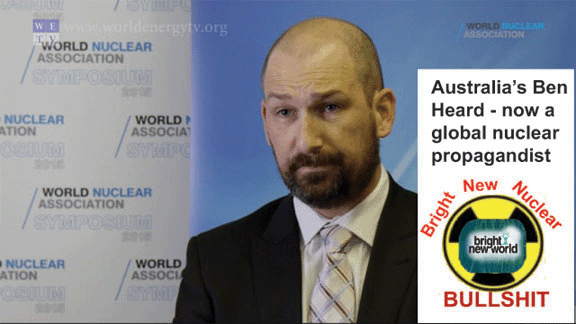
Abstract A recent article ‘Burden of proof: A comprehensive review of the feasibility of 100% renewable-electricity systems’ [by Ben Heard, Barry Brook, Tom Wigley and Corey Bradshaw] claims that many studies of 100% renewable electricity systems do not demonstrate sufficient technical feasibility, according to the authors’ criteria.
Here we analyse the authors’ methodology and find it problematic. The feasibility criteria chosen by the authors are important, but are also easily addressed at low cost, while not affecting the main conclusions of the reviewed studies and certainly not affecting their technical feasibility.
A more thorough review reveals that all of the issues have already been addressed in the engineering and modelling literature. Nuclear power, as advocated by some of the authors, faces other, genuine feasibility problems, such as the finiteness of uranium resources and a reliance on unproven technologies in the medium- to long-term. Energy systems based on renewables, on the other hand, are not only feasible, but already economically viable and getting cheaper every day.
Contents Continue reading →
September 25, 2017
Posted by Christina Macpherson |
AUSTRALIA, Reference, spinbuster |
Leave a comment








 nuclear-news